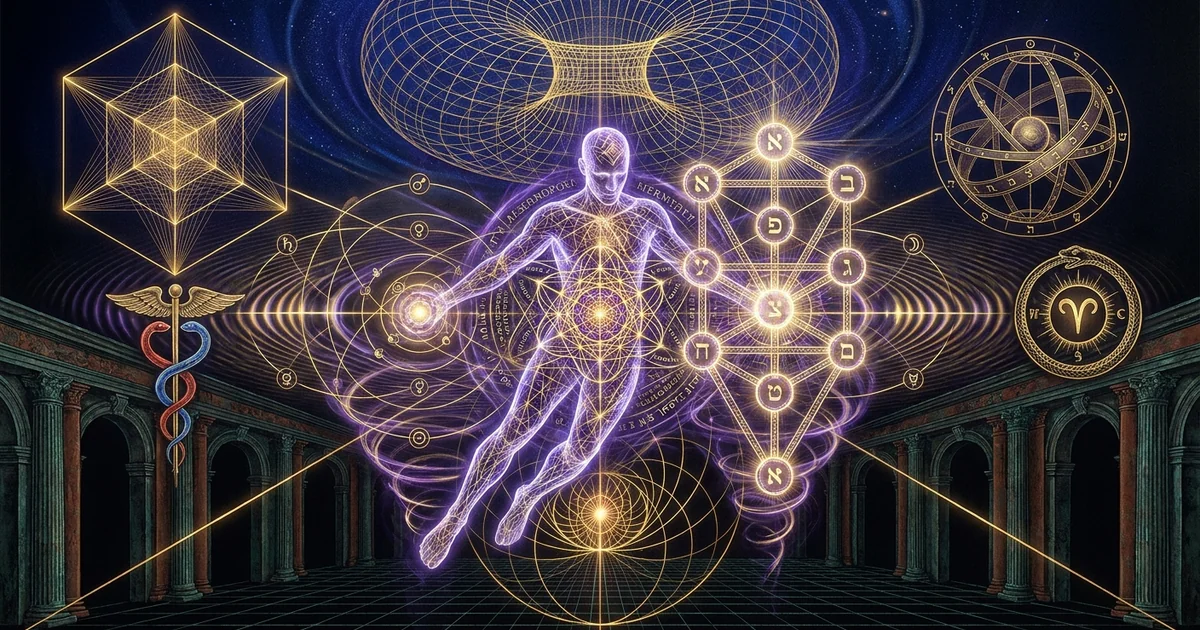
Renaissance Hermeticism: Ficino and Pico della Mirandola
Metaphysical Thesis & Epistemological Opening: The Re-Enchantment of the Quattrocento
The intellectual landscape of fifteenth-century Florence witnessed a structural rupture that permanently altered Western metaphysics. The late medieval consensus, dominated by a calcified scholastic Aristotelianism that bifurcated reality into rigid categories of formal cause and passive matter, collapsed under the weight of recovered antique codices. In its place emerged a revolutionary paradigm: an operational, pan-psychic cosmos wherein the divine, celestial, and terrestrial realms formed an uninterrupted continuum of living signification. At the vanguard of this epistemological inversion were Marsilio Ficino (1433–1499) and his younger, intellectually volatile associate Giovanni Pico della Mirandola (1463–1494). Together, they orchestrated what scholarship characterizes as the apex of the Florentine revival, synthesizing Alexandrian revelatory literature, late antique Neoplatonism, and Hebrew theosophy into a unified, operational cosmology.
THE PLEROMIC METAPHYSICAL CONTINUUM
[ THE ONE / EIN SOF / PRIMAL LOGOS ] <-- Unmanifest Source
|
v
[ NOUS / DIVINE INTELLECT ] <-- Archetypal / Sefirotic Orders
|
v
[ ANIMA MUNDI (WORLD SOUL) ] <-- Cosmic Vivification
|
+----------+----------+
| COPULA MUNDI | <-- Human Consciousness as Pivot
+----------+----------+
|
v
[ SPIRITUS MUNDI (ASTRAL VAPOR) ] <-- Planetary Matrix & Signatures
|
v
[ CORPUS MUNDI (TERRESTRIAL REALM) ] <-- Elemental Matter & Forms</code></pre>
The Crisis of Scholastic Aristotelianism and the Prisca Theologia
The late medieval university apparatus had reduced philosophical inquiry to dialectical exercises detached from existential and metaphysical transformation. Scholasticism had successfully assimilated Aristotle through Thomas Aquinas, yet this synthesis increasingly marginalized the participatory dimension of knowing, portraying nature as an autonomous, mechanically rule-bound creation observed by a detached, rational intellect. Ficino identified this bifurcation as an ontological crisis that threatened to decouple human intellectual activity from divine reality, leaving natural philosophy vulnerable to Averroistic mortalism and secular skepticism.
To counter this descent, Ficino re-introduced the doctrine of the prisca theologia—the ancient, primordial theology. He postulated that God had never abandoned the human intellect to natural reason alone; instead, an uncorrupted stream of divine wisdom was transmitted continuously through a pristine genealogy of gentile sages. This lineage traced backward from Plato through Pythagoras, Aglaophamus, Orpheus, and Hermes Trismegistus, originating ultimately in the primordial revelations granted to Zoroaster and Moses. By asserting the validity of this /ancient-prehistory/prisca-theologia-egyptian-lineage, Ficino did not view pagan antiquity as an adversarial paradigm to Christianity, but rather as an ancient, concordant witness to the eternal Logos. The Hermetic codices, presumed to be contemporaneous with or prior to Moses, supplied the indispensable mythological and philosophical authority necessary to dismantle Aristotelian hegemony and restore an initiatory, illuminative model of epistemology to Western thought.
THE GENEALOGY OF PRISCA THEOLOGIA
[ HERMES TRISMEGISTUS ] & [ ZOROASTER ]   <– Primordial Gnostic Wells
|
v
[ ORPHEUS ]                         <– The Hymnic & Musical Mysteries
|
v
[ AGLAOPHAMUS ]                       <– Initiatic Transmission
|
v
[ PYTHAGORAS ]                       <– Mathematical & Number Mysticism
|
v
[ PLATO ]                         <– Dialectical Philosophy
|
v
[ FLORENTINE ACADEMY ]                 <– Ficino & Pico's Synthesis
The Soul as Copula Mundi: Ontological Mediation Between Intelligible and Material Realms
At the structural center of this recovered cosmos stands Ficino’s radical redefinition of human psychology: the immortal soul as the copula mundi (the bond, knot, and coupler of the universe). In his masterwork Theologia Platonica de immortalitate animorum (1482), Ficino posited a five-tiered ontological hierarchy comprising God (Deus), Angelic Intellect (Angelus), Rational Soul (Anima), Quality (Qualitas), and Body (Corpus). Positioned precisely at the median juncture, the human soul is not merely a resident of the natural order; it is the unique metaphysical hinge through which the entire cosmos achieves reciprocal self-awareness.
The concept of the Anima Mundi (Greek: ψυχὴ τοῦ παντός, psychē tou pantos) derives historically from Plato’s Timaeus (34b–36d), where the Demiurge animates the cosmos by infusing an immaterial, self-moving, rational soul throughout the physical vehicle of the universe. In the context of Renaissance Hermeticism Marsilio Ficino Pico della Mirandola Florence, this doctrine operates as a metaphysical engine: nature is an ensouled biological and spiritual organism, interconnected by sympathetic resonance.
Ficino’s formulation of the human soul as the copula mundi (nodus atque vinculum mundi) establishes that human interiority possesses absolute ontological elasticity. Because the rational soul partakes of both the eternal, indivisible nature of the angelic intelligences and the temporal, divisible nature of corporeal bodies, it can selectively project its center of awareness downward into sheer physical sensation or elevate itself into unmediated communion with the divine archetypes. The Ficinian soul does not passively register phenomena; it harmonizes and sustains the lower orders through its intentional contemplation of the higher.
Because the soul possesses this dynamic mobility, human consciousness functions as an active participant in cosmic maintenance. The /consciousness/anima-mundi-world-soul is not a distant philosophical abstraction, but an immediate ontological reality that the human practitioner can access, influence, and channel. Through the exercise of the purified intellect and the subtle manipulation of cosmic sympathies, the human being transcends the passive limitations of a created subject and assumes the operational mantle of a mediator—a terrestrial god embedded within the mechanics of the cosmos.
Primary Codices & Historical Transmission: Cosimo, Ficino, and the 1471 Hermetic Watershed
The tangible catalyst for this philosophical evolution was not theoretical speculation, but the physical recovery of long-lost Alexandrian manuscripts following the decline and terminal fall of the Byzantine Empire. The dispersion of Greek scholars and scribes into the Italian peninsula catalyzed a frantic institutional effort to recover, translate, and preserve the lost foundational codices of classical antiquity. In the court of the Medici in Florence, this philological quest took on an urgent, almost eschatological significance.
The Arrival of the Macedonian Codex: Cosimo de’ Medici and the Prioritization of Hermes
In 1460, a monk named Leonardo da Pistoia, working under the commission of Cosimo de’ Medici, arrived in Florence carrying a fourteenth-century Greek manuscript acquired in Macedonia (now identified as MS Laurentianus 71.33). This document contained fourteen treatises belonging to the collection known as the Corpus Hermeticum. At the time of its arrival, Ficino was deeply immersed in the monumental task of translating the complete dialogues of Plato into Latin—a project financed and personally commissioned by Cosimo to inaugurate the revival of the Platonic Academy of Careggi.
Upon inspecting the Macedonian codex, Cosimo issued an extraordinary directive: Ficino was ordered to cease work on Plato immediately and divert all his intellectual energies toward translating the Hermetic text into Latin. Approaching the end of his life, Cosimo was convinced that the teachings of Hermes Trismegistus, the supposed contemporary of Moses and fountainhead of the prisca theologia, possessed a more primordial, uncorrupted authority than Plato himself. Ficino obeyed with remarkable speed, completing the Latin translation of the first fourteen treatises, which he titled Pimander (after the opening treatise, the Poimandres), in April 1463. Cosimo read the text shortly before his death in 1464.
TRANSLATION PATHWAY OF THE ALEXANDRIAN HERMETICA
[ 2nd-3rd C. Alexandria ]  –> Greek Hermetic Dialectics
|
v
[ Byzantine Preservation ] –> Macedonian Monastic Scriptorium
|
v
[ 1460: Leonardo da Pistoia ] –> Arrival at the Medici Court (Florence)
|
v
[ Cosimo de' Medici ]      –> Prioritization Directive (Hermes over Plato)
|
v
[ 1463: Marsilio Ficino ]  –> Latin Manuscript Completed
|
v
[ 1471: Editio Princeps ]  –> "Pimander, sive de potestate et sapientia Dei"
Hermetic Philology: Analyzing the Translation of the Pimander and Asclepius
When the translation was formally printed in 1471 under the title Pimander, sive de potestate et sapientia Dei at Treviso, it initiated a watershed moment across European academies. This editio princeps of the translation of Hermetica 1471 made the revelatory texts of Graeco-Egyptian theosophy accessible to the Western reading public for the first time in a complete Latin recension. The Latin West had previously possessed only fragments of this literature: Lactantius’s scattered apologetic citations, Augustine’s hostile critique in De civitate Dei (Book VIII), and the ancient Latin translation of the Asclepius (known historically as the Logos Teleios or Perfect Discourse), which had circulated under the name of Apuleius of Madaura throughout the Middle Ages.
"At the time when Moses was born, flourished the astrologer Atlas, brother of the physicist Prometheus and maternal grandfather of the elder Mercury, whose nephew was this Mercury Trismegistus… They called him Trismegistus, or Thrice-Greatest, because he was the greatest philosopher, the greatest priest, and the greatest king.
He left many books behind that bear witness to his divine knowledge, in which divine mysteries are revealed. He speaks not like a philosopher, but like a prophet filled with the divine spirit; he speaks often of the majesty of God, of the angelic hierarchies, of the generation of the soul, of the contempt of the world, and of the ascent through the celestial spheres… Wherefore, this divine wisdom, which began with Hermes and reached its summit in Plato, contains nothing contrary to the true Christian faith, but rather bears witness to it from antiquity."
Ficino’s philological method was profoundly synthetic. In rendering the dense Greek text of the /spirituality/corpus-hermeticum-gnosis into Renaissance Latin, he negotiated a delicate theological terrain. Alexandrian technical terms such as Nous (Νοῦς), Logos (Λόγος), and Demiurgos (Δημιουργός) were carefully mapped onto Christian Neoplatonic equivalents: Mens Divina, Verbum, and Opifex. Rather than translating the texts as isolated relics of pagan antiquity, Ficino framed them as prophetic texts prefiguring Johannine theology. In the opening chapter of the Pimander, the visionary encounter between Hermes and the divine Nous—wherein light descends to illuminate darkness and produce the orderly cosmos through the Word—was read by Ficino and his contemporaries as an uncorrupted pagan parallel to the prologue of the Gospel of John.
From Alexandria to the Arno: The Survival and Metamorphosis of Gnosis
The survival of these texts was not a simple passive transmission; it represented a profound metamorphosis of Alexandrian gnosis. In the syncretic environment of 2nd-century Roman Egypt, Hermetism had developed as an esoteric response to an empire in spiritual disarray, combining Egyptian temple theology, Greek dialectic, and Jewish apocalypticism into an introspective path of individual regeneration through cosmic contemplation. Transplanted to the banks of the Arno in the late fifteenth century, this gnosis ceased to be the quietist religion of small, persecuted Hellenistic circles.
Instead, under the auspices of Renaissance civic humanism and princely patronage, it was transformed into an intellectual manifesto. The Florentines did not adopt the world-fleeing, pessimistic asceticism present in certain Hermetic tracts; they seized upon its optimistic, world-affirming emanationism. The physical universe, as depicted in the Asclepius and Pimander, was not a demonic prison of matter, but a sacred, living temple constructed by the divine architect. Consequently, operational involvement with nature’s energies was re-evaluated: the manipulation of physical reality through knowledge of its underlying divine sympathies became a holy enterprise, providing direct intellectual and theological legitimacy to natural magic (magia naturalis).
Ontological Architecture & Cosmological Models: The Sefirotic-Hermetic Nexus
While Marsilio Ficino laid the Neoplatonic and Hermetic foundations of the Florentine revival, it was the intellectual prodigy Giovanni Pico della Mirandola who escalated this synthesis into a daring, trans-religious metaphysical architecture. Recognizing that the Alexandrian Hermetica shared conceptual and operational roots with post-biblical Jewish esotericism, Pico fused Christian theology, Hermetic cosmological mechanics, and the Hebrew Kabbalistic system into an integrated metaphysical engine.
Pico’s 900 Theses and the Synthesis of Christian Kabbalah
In December 1486, at the age of twenty-three, Pico published his audacious Conclusiones philosophicae, cabalisticae et theologicae nongentae (the 900 Theses), which he proposed to defend publicly in Rome before an international assembly of theologians and philosophers. The debate never occurred; Pope Innocent VIII condemned thirteen of the theses as heretical or scandalous, leading to the temporary cessation of the project and Pico’s brief flight to France.
PICO'S METAPHYSICAL CONFLUENCE
   [ Alexandrian Hermetism ]       [ Jewish Kabbalah ]
    (Corpus Hermeticum,            (Zoharic Lineage,
      Asclepius, etc.)               Sefirot, Gematria)
                 \                   /
                  \                 /
                   v               v
            [ CHRISTIAN KABBALAH & THEURGY ]
                           |
                           v
           [ TRANS-ASTRAL SOVEREIGNTY ]
      Bypassing Planetary Fate (Fatum) via
         the Divine Names of the Logos</code></pre>
The intellectual engine behind the Conclusiones was Pico’s conviction that all philosophical and revelatory traditions converged upon a single, unitive metaphysical truth. Most radically, Pico was the first non-Jewish thinker to weaponize Hebrew esoteric literature as an apologetic and theological tool, directly inaugurating the /spirituality/christian-kabbalah-origins. Central to his platform was the programmatic declaration found in Thesis Nine of his Kabbalistic Conclusions:
“Nulla est scientia, quae nos magis certificet de divinitate Christi, quam Magia et Cabala.”
(There is no science that assures us more of the divinity of Christ than Magic and Kabbalah.)
To construct this framework, Pico retained Jewish instructors, most notably the convert Flavius Mithridates and Yohanan Alemanno, who translated massive volumes of Kabbalistic texts (including works of the Zoharic stream, Abraham Abulafia, and Menahem Recanati) into Latin for his immediate analysis.
The Cosmological Continuum: Planetary Spheres, Archetypal Sephirot, and Astral Rays
The resulting cosmological model was a multi-dimensional hierarchy wherein the visible cosmos was understood as an energetic crystallization of deeper archetypal dimensions. At the base of the chain sat the sublunary elemental sphere, subjected to decay, generation, and physical dispersion. Surrounding this terrestrial core were the seven planetary spheres (the Ptolemaic-Aristotelian heavens), through which the radii stellarum (astral rays) descended, weaving the invisible fabric of terrestrial fate (fatum).
THE COSMIC CORRESPONDENCE: PLANETARY HEAVENS & THE TEN SEPHIROT

   SEFIRAH (Divine Tree)                   COSMOLOGICAL EMBODIMENT
  -----------------------                 -------------------------
  [ 1. Keter (Crown)      ]  <--------->  Super-celestial Abyss / Primum Mobile
  [ 2. Chokhmah (Wisdom)  ]  <--------->  Sphere of the Fixed Stars (Zodiac)
  [ 3. Binah (Intellect)  ]  <--------->  Saturn (Deep Contemplation)
  [ 4. Chesed (Mercy)     ]  <--------->  Jupiter (Benevolence & Order)
  [ 5. Gevurah (Severity) ]  <--------->  Mars (Dynamic Power / Fire)
  [ 6. Tiferet (Beauty)   ]  <--------->  Sol (Harmonic Center / The Son)
  [ 7. Netzach (Victory)  ]  <--------->  Venus (Attraction & Love)
  [ 8. Hod (Glory)        ]  <--------->  Mercury (Intellectual Transmission)
  [ 9. Yesod (Foundation) ]  <--------->  Luna (Transductive Astral Mirror)
  [ 10. Malkhut (Kingdom) ]  <--------->  Sublunary Elemental Sphere
However, Pico integrated the Kabbalistic doctrine of the ten Sephirot (the dynamic attributes and emanations of the infinite Ein Sof) as an archetypal realm transcendent to the physical stars. In this synthesis, the planetary spheres were not autonomous rulers of destiny; they were physical reflections of the sefirotic potencies. The planetary forces of Saturn, Jupiter, Mars, Sol, Venus, Mercury, and Luna corresponded structurally to the lower seven Sephirot (from Binah down to Malkhut), unified by the central solar principle of Tiferet, which Pico identified explicitly with the Johannine Christ-Logos. Astral rays did not act as mechanistic causes, but as transductive conduits transmitting the metaphysical information of the intelligible heavens down into the elemental matrix.
Comparative Structural Mechanics: Ficinian Spiritus vs. Piconian Trans-Astrological Transcendence
The diverging practical applications of this architecture defined the distinct methodologies of Ficino and Pico. Ficino operated primarily as a physician of the cosmos. His system, systematized in the De vita libri tres (1489), relied upon the mediation of the spiritus mundi—a subtle, vaporous, cosmic quintessence that interfaced between the physical body of the universe (corpus mundi) and its rational soul (anima mundi). Ficinian theurgy aimed at celestial hygiene: through the sympathetic application of stones, plants, aromas, colors, and planetary music, the operator purified his individual spiritus to align harmonically with the benevolent planetary influences (specifically Sol, Jupiter, and Venus) to counteract the saturnine melancholy inherent to the contemplative life. Ficino’s magic was natural, sympathetic, and fundamentally bound within the cosmic web of astrological causation.
Pico, conversely, rejected planetary astrological determinism with fierce polemical energy, as documented in his posthumously published Disputationes adversus astrologiam divinatricem (1496). To Pico, submitting human destiny to the governance of the planetary spheres was an ontological crime that degraded the soul below the level of non-rational celestial bodies. Pico’s Christian Kabbalah provided an operative alternative: vertical, trans-astral transcendence.
Ficinian Natural Astrological Theurgy
- Ontological Plane: Mediated within the natural realm (natura) and the celestial spheres; operates exclusively through the spiritus mundi.
- Primary Vehicles: Material correspondences, talismans, astrological timing (elections), Orphic hymns, dietary and aromatic regimens.
- Agency: Planetary daemons and astral intelligences acting as cosmic intermediaries; tuning the microcosm to the macrocosmic organism.
- Teleological Objective: Harmonization of physical health, preservation of intellectual clarity, counterbalancing of saturnine melancholy, and moral alignment with cosmic order.
- Astrological Stance: Concession to planetary influence (fatum) while attempting to navigate its pressures through natural sympathy.
Piconian Christian Kabbalistic Magic
- Ontological Plane: Operates beyond the celestial spheres (super-coelestia); directly engages the divine emanations (Sephirot) and the Divine Names.
- Primary Vehicles: Linguistic manipulation, permutation of the Hebrew alphabet (Tseruf), theological meditation, invocations of angels and archangels.
- Agency: Divine Word (Christ-Logos), high angelic hierarchies, and the transcendent will of the purified operator.
- Teleological Objective: Absolute trans-astral ascent; decoupling the soul from elemental fate; deification (theosis) and direct mystical communion with the divine source.
- Astrological Stance: Radical anti-fatalism; systematic repudiation of divinatory astrology as a reduction of human spiritual sovereignty.
By invoking the uncorrupted Hebrew divine names—and establishing that the insertion of the Hebrew letter Shin (ש) into the Tetragrammaton (YHVH, יהוה) generated the pentagrammaton Yehoshua (Jesus, יהשוה)—Pico believed the Christian Kabbalist possessed the theurgical authority to bypass the planetary governors (archons) entirely, anchoring human agency directly into the unmanifest source of creation.
Phenomenological Mechanics & Interdimensional Interaction: Theurgy, Astral Magic, and Divine Intellect
The operational dimension of the Florentine revival cannot be understood through modern classifications of science and superstition. In the texts of Ficino and Pico, magical practice was treated as a precise, empirical phenomenology of the subtle planes: a rigorous technology designed to manipulate subtle matter, mediate altered states of consciousness, and establish communication with discarnate intelligences across ontological thresholds.
Ficino’s Astral Technology: Planetary Music, Dietetics, and the Attunement of the Spiritus
In the third book of De vita libri tres, titled De vita coelitus comparanda (“On Obtaining Life from the Heavens”), Ficino articulates a sophisticated cybernetic model of human physiology. Central to this system is the human spiritus (spirit)—an extraordinarily fine, hot, vaporous substance produced by the heart through the combustion of the purest blood, functioning as an energetic bridge between the immaterial soul and the heavy, corporeal body. The health, mental acuity, and visionary capacity of the scholar depended entirely on the purity and clarity of this psycho-spiritual pneumatic vehicle.
FICINO'S CIRCUITRY OF ASTRAL ATTUNEMENT
[ Planetary Ray / Cosmic Archetype (Sol, Jupiter, Venus) ]
|
v
[ Sympathetic Material Receptors ]
(Herbs, Aromas, Pigments, Metrology)
|
v
[ Auditory / Chanted Sonic Signature ]
(Orphic Hymn tuned to Planetary Mode)
|
v
[ Purification of the Human Spiritus ]
(Psycho-physical transformation in the operator)
|
v
[ Influx of Anima Mundi Energies ]
Because the individual spiritus is micro-cosmically identical to the macrocosmic spiritus mundi, it can be deliberately tuned like a musical instrument to resonate with specific planetary frequencies. Ficino provided precise methodologies for this tuning process:
- Auditory Resonance: Chanting the Orphic Hymns in calculated modal scales corresponding to the planetary motions (Dorian for the Sun, Phrygian for Mars), accompanied by the lira da braccio.
- Aromatic Inhalation: Burning specific botanical resins—frankincense and amber for the Sun, storax for Jupiter, musk and rose for Venus—whose subtle vapors directly coat and clarify the cerebral ventricles.
- Dietary Ingestion: Consuming foods and elixirs saturated with solar and jovial qualities (such as saffron, wine, and gold flakes) to clear psychic toxicity.
This astral technology was not designed to alter external physical events, but to recalibrate the operator’s internal informational receiver, transforming the human organism into a resonant vessel capable of receiving celestial influx (influxus) without cognitive distortion.
The Architecture of High Strangeness: Talismanic Animation and Daemonic Ecology
The most philosophically dangerous component of Ficino’s work involved the construction of astrological talismans and the acknowledgment of an invisible, inhabited ecosystem: the daemonic hierarchies. Drawing directly from the controversial Asclepius chapters 23 and 37—which described the ancient Egyptian priests fashioning statues and drawing down the souls of demons or angels into them through the application of herbs, gems, and sonic incantations—Ficino formulated a “naturalized” defense of telestic magic.
Ficino insisted that his talismans—such as an image of the cosmos engraved on brass at an elected astrological moment—did not coerce or invoke malevolent, independent demonic entities (daemones). Instead, they operated via physical and metaphysical sympathy, functioning as archetypal lightning rods. Just as a lute string vibrates when a harmonically matched string on another lute is struck across a room, a material object correctly configured with the proper geometrical proportions, metals, and planetary hours naturally attracts the celestial quality (virtus) of that star.
Yet, Ficino’s cosmology recognized that the cosmos was populated with non-human intelligences. Adapting Proclus and Iamblichus, he situated daemons as essential systemic agents within reality’s informational control matrix. These entities, possessing bodies of pure elemental or ethereal vapor, inhabited the planetary spheres and intermediate atmospheres, acting as the operative executioners of cosmic fate and the transductive conduits through which divine ideas descended into physical forms. Theurgy was the delicate, terrifying art of engaging these intermediary systemic nodes without allowing the lower demonic entities to entrap the soul in terrestrial illusions.
Pico’s Metamorphic Operator: The Oration and Radical Ontological Mutability
Giovanni Pico della Mirandola took these operational mechanics and stripped them of their astrological dependencies, transposing the entire field of action into the interior structure of the human will. In the text prepared as the opening address for the ill-fated Roman debate—posthumously celebrated as the Oratio de hominis dignitate (1486)—Pico presented an astonishing vision of human nature that departed decisively from both classical and medieval theological anthropologies.
In the Oration, God, having completed the architecture of the cosmos, sought an entity capable of appreciating its vast, elegant design. However, all ontological niches within the great chain of being were already fully occupied: the super-celestial realms were filled with pure angelic intelligences, while the terrestrial realms were populated with beasts. God therefore created human beings without a fixed image (indiscretae formae), placing them at the exact center of the world and declaring:
“We have given thee, Adam, neither a fixed seat nor a form that is thine alone, nor any function peculiar to thyself, that according to thy judgment and for thy will thou mayest have and possess what seat, what form, and what functions thou thyself shalt desire. The nature of all other things is limited and constrained within the bounds of laws prescribed by Us. Thou, constrained by no limits, in accordance with thine own free will, in whose hand We have placed thee, shalt ordain for thyself the limits of thy nature… Thou shalt have the power to degenerate into the lower forms of life, which are brutish. Thou shalt have the power, out of thy soul’s judgment, to be reborn into the higher forms, which are divine.”
This statement marks the birth of the Renaissance concept of the metamorphic operator. The human being is an ontological chameleon (chamaeleon), an open system endowed with radical mutability. Humanity does not occupy a static, secure link in the hierarchical chain; rather, human consciousness is a dynamic capacity for self-transmutation. If a person cultivates merely vegetable desires, they become a plant; if they abandon themselves to animal senses, they become a beast; if they embrace pure intellect, they become an angel. And if, withdrawing into the absolute center of their own unity, the operator detaches from all created forms, their soul unites directly with the solitary darkness of the divine Father, achieving total transmutational apotheosis (theosis).
Initiatic Synthesis & Philosophical Implications: Human Sovereignty and the Magus Paradigm
The convergence of Ficinian theurgy and Piconian Kabbalah produced a new human archetype that defined the intellectual horizon of the early modern period: the Renaissance Magus. The Magus was neither a medieval sorcerer making illicit pacts with infernal spirits nor a passive mystic awaiting arbitrary divine grace. The Magus was an operative philosopher, an initiated demiurge, and an intellectual sovereign who, through profound knowledge of nature’s mathematical and sympathetic connections, took control of reality’s hidden mechanics.
THE HISTORIOGRAPHICAL DEBATE
[ MEDIEVAL SCHOLASTICISM ]  –> Mechanical, divided, passive contemplation
|
v
[ THE YATES THESIS ]      –> Hermeticism as the true catalyst of
(Frances A. Yates, 1964)       modern empirical, experimental science
|
v
[ MODERN RE-EVALUATION ]    –> Rejects single linear causality; posits
(Hanegraaff, Copenhaver, etc.)    Hermeticism as an autonomous metaphysical
framework of operational gnosis
The Magus as Operative Demiurge: Ethical Responsibilities and Epistemic Hazards
By claiming that humans possessed the capacity to interact with and calibrate the cosmos, Ficino and Pico inevitably transformed philosophy from a contemplative exercise into an operational discipline. The Magus, by understanding the cosmic architecture, acts as nature’s conscious catalyst. As Pico famously declared, the Magus “weds earth to heaven”—he brings together the hidden powers latent in physical materials with the celestial potencies of the cosmos, accelerating natural processes that would otherwise remain dormant.
Yet this metaphysical agency carried unprecedented spiritual and cognitive risks. The Renaissance Hermetic literature recognized that operational theurgy without absolute moral purification led directly to ontological catastrophe. When an unpurified consciousness attempts to manipulate the hidden forces of the cosmos, the result is not apotheosis, but deep psychological inflation, madness, or demonic deception. The theurgic practitioner was required to undergo rigorous ascetic and intellectual purification: mastering the Trivium and Quadrivium, studying dialectic, and practicing moral philosophy before ever attempting the higher mysteries of talismanic animation or the permutation of divine names.
The recovery of operative theurgy poses a profound psychological and spiritual risk: the transposition of divine mutability into solipsistic megalomania. The foundational texts of both the Corpus Hermeticum and the Kabbalistic lineages explicitly warn that when the human intellect attempts to navigate the subtle planes (mundus imaginalis) while anchored in the delusions of the personal ego, the sympathetic architecture of the universe reverses its function.
Instead of acting as a conduit of divine gnosis, the intermediate astral matrix becomes a hall of mirrors. Unpurified astral desires attract low-tier elemental intelligences that reflect the practitioner’s unconscious projections back to them as divine revelations. This condition—recognized in classical traditions as spiritual delusion (thelematon/plani) and in modern depth psychology as psychic inflation—leads inevitably to the destabilization of the rational soul and the severe dissolution of ontological grounding. The theurgical tradition insists that sovereign operational agency can only be safely exercised when the practitioner’s lower will has been completely immolated in the transcending light of the unmanifest source.
The Dissolution of Pre-Modern Determinism: The Genesis of Modern Consciousness
The long-term philosophical consequence of the Ficinian and Piconian synthesis was the progressive dismantling of pre-modern cosmological determinism. In the classical and high medieval worldview, human beings were enclosed within an immutable order: the fixed social hierarchy of the feudal state was directly mirrored by the fixed celestial hierarchy of the Ptolemaic spheres. Human salvation or damnation occurred within an absolute, unbending architecture of reality.
By advancing the concepts of the copula mundi and human ontological mutability, Ficino and Pico fractured this static cosmic container. If human consciousness is capable of shifting its position within the great chain of being—if humanity has no assigned place, but can choose to descend to the beasts or ascend above the stars—then human destiny is radically open. This philosophical insight laid the essential groundwork for early modern humanism, existential agency, and the conceptualization of the human subject as a co-creator of history and nature. Modern consciousness did not emerge from a sudden, spontaneous rejection of the spiritual; it was born when late-medieval thinkers applied the initiatory, sovereign imperatives of ancient Hermetism and Kabbalah to the human mind itself.
Critical Historiography: Yates Thesis Reevaluated via Contemporary Esotericism Studies
The historical relationship between Renaissance Hermeticism and the rise of modern scientific inquiry remains one of the most vigorously debated problems in intellectual history. In her seminal work, Giordano Bruno and the Hermetic Tradition (1964), Dame Frances A. Yates formulated the famous “Yates Thesis,” asserting that the Renaissance revival of Hermetic magic was the primary intellectual engine driving the Scientific Revolution:
THE GENEALOGY OF OPERATIONAL METHODOLOGY
[ Medieval Scholasticism ]   –> Passive Observation & Dialectical Logic
|
v
[ Renaissance Hermeticism ]  –> Operational Manipulation of Natural Forces
(Ficino & Pico della Mirandola)   (Human as Operative Magus/Demiurge)
|
v
[ Scientific Revolution ]    –> The Empirical-Experimental Method
(Bacon, Newton, Kepler)           (Interrogating and Dominating Nature)
Yates argued that modern science did not arise from scholastic Aristotelian logic, which was purely analytical and descriptive, but from the Hermetic-cabalistic Magus, whose desire to operate on nature—to manipulate its secret forces through physical experiments, mathematical operations, and the manufacture of operational devices—created the psychological and behavioral precondition for empirical science. Men like Francis Bacon, Johannes Kepler, and Isaac Newton were, in Yates’s view, heirs to the operational paradigm established by Ficino and Pico.
Over the past four decades, contemporary scholars of Western esotericism, led by figures such as Wouter J. Hanegraaff, Brian Copenhaver, and Antoine Faivre, have refined and nuanced the Yates Thesis. Hanegraaff, in his landmark study Esotericism and the Academy (2012), demonstrated that Yates tended to romanticize Hermeticism as an isolated, singular force and occasionally obscured the rigorous philological and theological commitments of the thinkers she studied. Contemporary historiography no longer views Hermeticism simply as an early, primitive phase of modern science that was destined to be discarded once the scientific method matured.
Instead, current scholarship recognizes Renaissance Hermeticism as a coherent, autonomous metaphysical system with its own epistemological validity. It combined rigorous philological methods, deep cosmological speculation, and empirical observation. Rather than anticipating the mechanistic, disenchanted materialism that ultimately came to dominate the Enlightenment, the Hermeticism of Marsilio Ficino and Pico della Mirandola stood for an alternative path to modernity: one where human beings gained transformative operational knowledge of the physical universe without severing their sacred, participatory relationship with the living cosmos.
Frequently Asked Questions
How did Ficino harmonize pagan Alexandrian Hermetism with orthodox Catholic theology?
Ficino harmonized Alexandrian Hermetic texts with Catholic orthodoxy by deploying the strategic doctrine of the prisca theologia (ancient theology). He maintained that divine revelation was not restricted to the biblical lineage of the Old Testament, but that God, through the universal operation of the divine Logos, had provided an unbroken lineage of illuminated pagan wisdom that prophesied the Christian revelation. Ficino structured this lineage through figures such as Zoroaster, Hermes Trismegistus, Orpheus, and Pythagoras, culminating in Plato.
Relying upon early Church Fathers such as Clement of Alexandria, Justin Martyr, and especially Lactantius—who spoke favorably of Hermes Trismegistus as an antique witness to the coming of Christ—Ficino argued that the Corpus Hermeticum was fully compatible with Christian scripture. He demonstrated that the opening chapters of the Pimander described creation in terms that mirrored the book of Genesis and the opening of the Gospel of John, viewing the Hermetic Nous as the pre-incarnate Word. Consequently, Ficino viewed his translational and philosophical work not as a pagan deviation, but as a providential reconciliation of ancient philosophy and Christian revelation designed to defend the faith against contemporary materialist and Averroist skepticism.
What distinguishes Pico della Mirandola’s use of Kabbalah from traditional Jewish Kabbalah?
Pico della Mirandola’s engagement with Hebrew Kabbalah was fundamentally characterized by an apologetic, Christological, and syncretic agenda that diverged sharply from traditional rabbinic and Jewish mystical paradigms. While traditional Jewish Kabbalah was inextricably bound to the observance of the Mosaic Law (Halakhah), the study of the Torah, and the specific historical destiny of the Jewish people, Pico extracted Kabbalistic interpretive methodologies—such as gematria (numerical equivalences), notarikon (acrostic extraction), and temurah (letter substitution)—and applied them as universal tools of speculative metaphysics.
Pico utilized these techniques to prove orthodox Christian dogmas from within the Hebrew esoteric corpus itself. Most centrally, he argued that the ten Sephirot of the Kabbalistic tree structurally reflected the Christian Trinity and the angelic hierarchies, and he claimed that the true esoteric meaning of the Hebrew scriptures pointed directly to Jesus of Nazareth as the Messiah. By inserting the Hebrew letter Shin (ש), symbolizing the holy spirit and fire, into the Tetragrammaton (Y-H-V-H, יהוה), Pico formed the Pentagrammaton Y-H-Sh-V-H (Yehoshua / Jesus, יהשוה), arguing that the hidden name of the Father was openly realized in the Son. In doing so, Pico divorced Kabbalistic practice from its traditional halakhic context, creating an autonomous, syncretic “Christian Kabbalah” that served as a speculative foundation for the Renaissance Magus.
Why was Isaac Casaubon’s 1614 redating of the Hermetica fatal to Renaissance Hermeticism?
Isaac Casaubon’s linguistic and philological critique in 1614 delivered a catastrophic blow to the philosophical foundations of Renaissance Hermeticism by systematically dismantling the historical premise of the prisca theologia. Marsilio Ficino, Pico della Mirandola, and their contemporaries had based the sovereign authority of Hermes Trismegistus on the conviction that he was a historical figure living in deep Egyptian antiquity, either contemporary with or prior to Moses, whose texts represented an uncorrupted source of primordial divine revelation.
"Casaubon’s dating of the Corpus Hermeticum was one of the major turning-points in the history of the Western mind… In his De rebus sacris et ecclesiasticis exercitationes XVI (1614), Casaubon applied the new methods of textual and linguistic criticism to the Hermetica, demonstrating that they were not written by a very ancient Egyptian priest at the dawn of time, but were composed in early Christian times by unknown Greek authors. They showed debts to Plato and the Old Testament which had seemed to Ficino and his followers to be prophetic anticipations; Casaubon proved that these were simply the natural reflections of an eclectic Hellenistic environment combining Platonic, Stoic, and Jewish ideas.
With this critical stroke, the entire vast apparatus of the prisca theologia, which had sustained the Renaissance Hermetic movement from Ficino to Giordano Bruno, suffered an irreparable scholarly collapse. The foundation on which the Renaissance Magus had built his operational bridge between pagan philosophy and Christian theology vanished almost overnight from serious intellectual discourse."
By proving that the texts of the Corpus Hermeticum were not ancient Egyptian prophecies of Christianity, but rather derivative Hellenistic compositions composed in the 2nd and 3rd centuries AD, Casaubon destroyed the foundational claim of priority that had justified their philosophical and religious use. Consequently, European thinkers could no longer present Hermes as an ancient pagan prophet who independently verified Christian dogma, leading to the rapid intellectual decline and marginalization of the Hermetic tradition during the seventeenth century.
What is the operational function of the ‘spiritus’ in Ficino’s psychological theory?
In Marsilio Ficino’s psychological and physiological theory, primarily articulated in De vita libri tres, the spiritus (spirit) operates as an indispensable transductive interface between the completely immaterial rational soul and the dense, corporeal, physical body. Drawing upon the medical theories of Galen, the pneumatic doctrines of the Stoics, and the psychology of late Neoplatonists such as Synesius and Plotinus, Ficino posited that the soul and body are ontologically incompatible: an immaterial, indivisible spiritual essence cannot act directly upon gross, divisible matter without a middle term.
The spiritus performs this mediating role. It is an extremely subtle, airy, and warm vapor generated by the heart from the finest constituents of the blood, which circulates through the arteries and the cerebral ventricles. It is simultaneously quasi-corporeal and quasi-spiritual. In Ficino’s operational framework:
- It translates physical sensory impressions gathered by the sensory organs into subtle perceptual forms that the rational soul can apprehend.
- It translates the intellectual volitions, commands, and ideational contents of the soul downward into physiological motor functions.
- It serves as the specific receiver for the influences (influxus) of the Anima Mundi (World Soul) and the planetary rays, which enter the human organism through the macrocosmic spiritus mundi.
Because intellectual labor, particularly the intense philosophical speculation characteristic of the Saturnine scholar, burns away and depletes this delicate vapor—causing mental exhaustion, bodily illness, and the psychological torment of melancholia—the primary task of the Ficinian theurgist was to purify, nourish, and re-attune the spiritus through sympathetic magic, balanced dietetics, clean air, and planetary resonance.