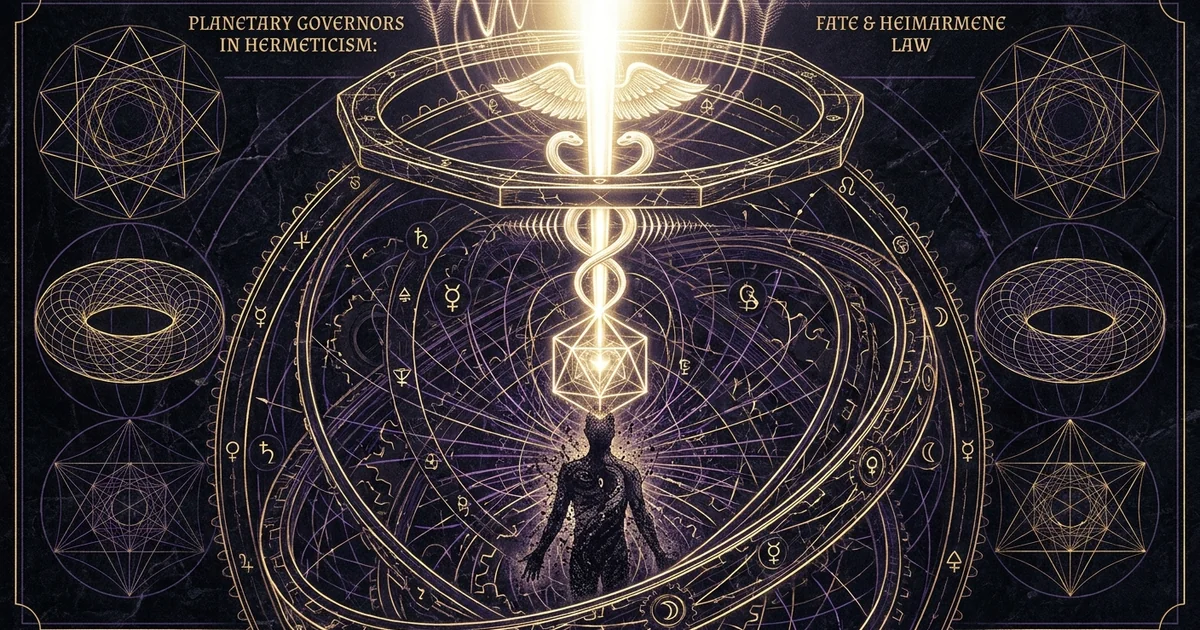
Planetary Governors in Hermeticism: Fate & Heimarmene Law
Metaphysical Thesis & Epistemological Opening: The Cybernetics of Cosmic Fate
Cosmological systems in the Hellenistic and Late Antique Mediterranean were fundamentally concerned with the mechanics of determination: why physical reality operates under immutable cycles, and how the conscious subject relates to celestial necessity. In the technical and philosophical treatises of the Corpus Hermeticum, this architecture receives its most sophisticated articulation through the concept of Heimarmene (εἱμαρμένη)—cosmic fate—administered by the Seven Planetary Governors (dioiketai, the Hebdomad).
Far from positing an arbitrary theological tyranny or a punitive trap engineered by hostile entities, Hermetic philosophy constructs a rigorous, quasi-cybernetic cosmos. Here, stellar mechanics function as an informational substrate, distributing divine providence (Pronoia) into physical manifestation through mathematical periodicity. The material universe is not an accident born of sin; it is a meticulously coordinated living machine whose governing gears are the planetary spheres.
In Late Antique Alexandrian Hermetism, three distinct forces govern manifested reality:
- Pronoia (πρόνοια): Divine Providence, originating directly within the supreme Nous (Intellect); it represents the archetypal, unconditioned will toward cosmic harmony and generative goodness.
- Ananke (ἀνάγκη): Inviolable Necessity, the metaphysical constraint ensuring that intelligible forms manifest into temporal, spatial, and material conditions without collapsing into primordial chaos.
- Heimarmene (εἱμαρμένη): Cosmic Fate, the operationalized, temporalized mechanical execution of Ananke mediated by the Seven Planetary Governors. While Pronoia conceives the cosmic blueprint, Heimarmene weaves it into the biological, seasonal, and astrological cycles of the sensible cosmos (kosmos aisthetos).
Within this architecture, the fundamental human dilemma is ontological rather than moral. The crisis of human existence does not stem from an inherited moral transgression, but from the composite nature of the Anthropos—the primordial human being who is simultaneously situated inside and outside the celestial administration. Because the somatic vehicle is fashioned from the sublunary elements, the subjection of the physical body to the stars is total, absolute, and scientifically immutable. The physical shell is an algorithmic product of astral cycles.
However, because the inner core of humanity descends from the unconditioned Mind, spiritual freedom through nous remains an accessible reality. The planetary governors in Hermeticism, therefore, represent neither demonic adversaries to be overthrown nor arbitrary deities to be placated, but the cosmic boundary condition that human consciousness must comprehend, navigate, and ultimately transcend.
Heimarmene as Ontological Constraint versus Moral Punishment
To interpret Heimarmene accurately within the framework of Alexandrian Hermeticism, one must discard the moralizing frameworks that later permeated Augustinian Christianity and certain strains of Syrian-Egyptian Gnosticism. In Tractate I (Poimandres) and Tractate XII of the Corpus Hermeticum, fate is formulated not as retributive justice, but as the governing law of generated nature (physis). Matter (hyle), by virtue of its spatial extension and susceptibility to entropy, requires structural cohesion. Without the mathematical rotation of the celestial spheres, the material cosmos would disintegrate into inert formlessness.
Heimarmene is the structural binding energy of the sensory cosmos. It dictates that whatever is born must decay; whatever enters the domain of time must undergo the dialectic of generation and corruption (genesis kai phthora). As analyzed in detailed studies of the Hermetica (such as Copenhaver, 1992), this astral determinism does not carry a malignant intent. The error made by the uninitiated mind is the projection of psychological malevolence onto systemic necessity. When an organism suffers disease, senescence, or catastrophe dictated by the celestial configurations under which it was generated, it is experiencing the cybernetics of an enclosed ecosystem, not the wrath of planetary gods.
The Planetary Governors as Administrative Demiurgy
The execution of Heimarmene is delegated to the Seven Planetary Governors—the Hebdomad—comprising the Moon, Mercury, Venus, the Sun, Mars, Jupiter, and Saturn. In the Hermetic cosmogony, these spheres are situated beneath the sphere of the fixed stars (the Aplanes) and above the terrestrial, sublunary sphere. They are emanated by the second Mind, the Nous Demiourgos, who churns them into perpetual revolution.
These governors are administrative ministers. Their role is generative and regulatory: they receive the immaterial noetic forms from the intelligible universe and imprint them upon physical reality through astral radiation and cyclical motion. Each governor presides over a zone of cosmic resonance, translating eternal principles into temporal phenomena:
Intellectual Form (Nous)
       │
       ▼
Demiurgic Mind (Nous Demiourgos)
       │
       ▼
Planetary Governors (Hebdomad / Heimarmene)
       │
       ▼
Sensible Creation (Sublunary Nature / Hylic Realm)
Through this planetary mechanism, species are preserved through sexual reproduction, the seasons alternate, the balance of physical elements is maintained, and individual biological destinies are cast at the exact moment of somatic genesis. The governors do not act autonomously; they are the gears through which the divine purpose is distributed across space and time.
The Dual Nature of the Human Anthropos: Mortal Shell and Immortal Mind
The metaphysical pivot of Hermetic cosmology—and the ground of its soteriology—is the radical duality of the human constitution, outlined with geometric precision in the cosmogony of the Poimandres (detailed in our /spirituality/corpus-hermeticum-poimandres-analysis). The primordial Anthropos, having observed the creation of the Demiurge, desired to create as well. Breaking through the celestial spheres, the Anthropos gazed down through the planetary machinery and beheld its own reflection mirrored in the waters of Nature. Enamored by the form, the Anthropos descended into the sublunary sphere, merging with material generation.
Consequently, human beings possess a bifurcated ontology:
- The Mortal Anthropos: In respect to the physical body (soma) and the vital spirit (ochema-pneuma), humanity is a bound prisoner of the Hebdomad, subject to astrological nativity, physical illness, mortality, and the relentless rotation of Heimarmene.
- The Immortal Anthropos: In respect to the essential intellect (Nous), humanity is consubstantial with the Supreme Creator, transcending the planetary lattice and remaining unconditioned by the rotations of the Seven.
Ignorance (agnoia) consists of mistaking the mortal, planetary-conditioned garment for the true self. Liberation (gnosis) begins with the realization that while one’s biological vessel is wholly property of the planetary governors, one’s intrinsic consciousness has its origin beyond the planetary spheres, residing in the trans-cosmic realm of the Ogdoad.
Primary Codices & Historical Transmission: Textual Genealogy of the Hebdomad
The definitive textual lineage documenting the nature and operational mechanics of the Seven Planetary Governors is preserved across several critical recensions of the Hellenistic Hermetica. These include the Greek treatises collected in the Byzantine period, the Latin Asclepius, and the extensive Hermetic fragments compiled in the Anthology of Joannes Stobaeus. Across these texts, the planetary governors are consistently identified as the mediating apparatus between the transcendent Godhead and the material earth.
“And the Mind, being God, existing as life and light, gave birth by a word to another Mind, the Demiurge, who, being the god of fire and spirit, fashioned seven governors who encompass in their circles the sensible world, and their governance is called Heimarmene… And the human being, having observed the creation which the Demiurge had shaped in the fire, wished himself to create, and he was permitted by the Father. Having entered the demiurgic sphere, where he was to have all authority, he observed his brother’s creations, and the governors fell in love with him, and each gave him a share of their own rank.” — Translated with commentary in Brian P. Copenhaver, Hermetica (1992, pp. 2–3).
The historical trajectory of these doctrines extends from Roman-era Alexandria through the medieval Islamic translation movement and into the Florentine Renaissance. In each epoch, the conceptualization of the Hebdomad shifted between deterministic terror and operative theurgy.
The Poimandres Cosmogenesis: Churning the Seven Spheres (CH I.9–15)
In Corpus Hermeticum I, the revelatory entity Poimandres describes the genesis of the Seven Governors as an act of cosmic organization. The Nous Demiourgos, uniting with the divine Logos, set the spheres into rotational motion, causing them to churn from an indefinite beginning to an endless terminus. From the lower elements, deprived of reason, animals were generated; but the human being, fashioned in the exact image of the Supreme Mind, received a unique endowment.
Crucially, CH I.13–14 records that as the primordial Anthropos passed downward through the celestial zones, each of the Seven Governors recognized his divine origin and bestowed upon him a portion of their own nature—their specific planetary powers, energetic dynamics, and administrative properties. When the Anthropos fell into generation, these planetary gifts condensed into psychological and somatic drives.
Thus, the planetary governors are not external tyrants imposing an alien captivity upon humanity; their planetary energies are woven into the very fabric of the human psyche. The astral spheres govern humans precisely because the human vehicle was constructed using their essential planetary fabrics.
Tractate XVI and Asclepius: The Sun as Demiourgos and the Astral Flow
While Tractate I establishes the concentric geometry of the Hebdomad, Tractate XVI (The Definitions of Asclepius to King Ammon) and the Latin Asclepius provide a more operational description of the astral transmission. Here, the Sun (Helios) is designated as the chief executor and focal lens of the Demiurge:
- The Sun sits at the center of the planetary structure, acting as a cosmic heart that pumps intelligible essence and spiritual light through the planetary spheres down to the earth.
- Around the Sun dance the seven planetary spheres, functioning as stepped-down transformers of solar and hyper-cosmic vitality.
- Below the planetary spheres, the cosmic space is populated by countless hordes of daimones (sub-planetary spirits), who execute the specific commands and impulses transmitted by the planetary governors.
As André-Jean Festugière demonstrates in his monumental study La Révélation d’Hermès Trismégiste (1944–1954), the Hermetic tradition maintained that the celestial bodies do not act out of passion. Their influence is constant, dispassionate, and ontological. The Asclepius clarifies that Heimarmene works through the continuity of time (aevum), weaving together the chains of causes and effects so that not a single terrestrial event falls outside the planetary matrix, save for those initiated by direct noetic intervention.
From Alexandria to the Renaissance: The Latin Transmission of Stellar Administration
The transition of Hermetic astrological theory from Late Antiquity into medieval and early modern Europe occurred through a complex textual transmission. Following the closure of the philosophical schools in the 6th century, the Greek manuscripts survived primarily within the Byzantine Empire, while practical, astrological, and theurgic Hermetism flourished within the Islamic world. In cities such as Harran and Baghdad, Sabian and Abbasid scholars synthesized the technical Hermetica with Neoplatonic astral magic, culminating in texts like the Ghāyat al-Ḥakīm (later translated into Latin as the Picatrix).
Alexandrian Greek Hermetica (1st–3rd C. CE)
       │
       ▼
Syriac & Harranian Transmission (4th–8th C. CE)
       │
       ▼
Islamic Hermeticism / Ghāyat al-Ḥakīm (9th–11th C. CE)
       │
       ▼
Latin Translation: Picatrix & Ficino's Corpus Hermeticum (12th–15th C. CE)
       │
       ▼
Early Modern Operative Theurgy & Astral Decoupling
When Marsilio Ficino translated the rediscovered Byzantine manuscripts of the Corpus Hermeticum into Latin in 1463 under the patronage of Cosimo de’ Medici, Western European intellectual culture underwent an ontological shock. As David Pingree (1986) demonstrated in his critical editions of the Picatrix, the Renaissance synthesis did not seek to eliminate the planetary governors, but to systematize human engagement with them.
Ficino, in his De Vita Libri Tres (Three Books on Life), merged Hermetic theology with medical astrology, arguing that while the body remains subject to Heimarmene, the sage can intentionally balance planetary influences via sympathetic resonances, stones, plants, and music, ultimately aligning the soul with the solar and noetic currents that lead beyond the Hebdomad.
Ontological Architecture & Cosmological Models: The Hebdomad as an Informational Control System
To comprehend the mechanics of the Seven Governors in the Hermetic schema, one must visualize a nested, concentric cosmos. The sensible universe is bounded by the eighth sphere—the Aplanes, or the firmament of fixed stars—beneath which lie the seven planetary orbits, arranged according to the traditional Chaldean order: Saturn, Jupiter, Mars, Sun, Venus, Mercury, and the Moon. At the systemic center rests the Earth, the gravitational and operational sink of all incoming astral emanations.
This concentric arrangement acts as a celestial frequency divider. The pristine, undifferentiated light of the supreme Nous cannot be received directly by raw matter without annihilating the physical substrate. The planetary spheres step down this transcendent power, filtering and stratifying it into seven distinct structural frequencies, which collectively assemble the tapestry of physical existence.
Concentric Geometry and the Seven Zones of Administrative Constraint
Each sphere of the Hebdomad serves as an administrative checkpoint possessing its own planetary properties and energetic constraints:
- The Sphere of Saturn (Cronos): Operates as the outermost cosmic boundary. It governs temporal limitation, structural crystallization, deceleration, and the termination of physical cycles. It is the threshold between the boundless intelligible realm and temporal confinement.
- The Sphere of Jupiter (Zeus): Governs expansiveness, structural growth, systemic governance, and the distribution of socio-political hierarchies within the sensible world.
- The Sphere of Mars (Ares): Regulates energetic friction, kinetic separation, heat, conflict, and the necessary destructive dynamics required to break down decayed forms for recycling.
- The Sphere of the Sun (Helios): Anchors the planetary hierarchy. It acts as the central demiurgic lens, distributing biological vitality, illumination, and temporal coherence across the entire system.
- The Sphere of Venus (Aphrodite): Governs attractive affinity, erotic coherence, formal harmony, and the chemical/biological impulse toward structural aggregation and generation.
- The Sphere of Mercury (Hermes): Presides over communicative flux, systemic transition, intellectual translation, mathematical calculation, and the linguistic codification of reality.
- The Sphere of the Moon (Selene): Serves as the immediate boundary between the planetary spheres and the sublunary earth. It governs the physical tides, the generation and decomposition of elemental matter, biological gestation, and the distribution of etheric fluids into physical forms.
An individual human consciousness descending through this lattice absorbs these planetary qualities like light passing through tinted glass, acquiring the complex psychological and biological constitution known as mortal human nature.
Hermetic Governors versus Gnostic Archons: Bureaucracy versus Malice
The Hermetic Hebdomad must be rigorously distinguished from the Archons of contemporary Gnostic cosmologies (such as those preserved in the Nag Hammadi codices, analyzed in detail in /spirituality/gnostic-archons-planetary-rulers). While superficially sharing the same seven-layered astronomical anatomy, their ontological evaluations are diametrically opposed.
Hermetic Planetary Governors
- Ontological Status: Lawful ministers (dioiketai) generated by the Demiurgic Mind; direct servants of Divine Providence (Pronoia).
- Cosmic Nature: The universe is considered inherently orderly, beautiful (kosmos = ornament/order), and mathematically coherent; matter is a necessary phase of divine manifestation.
- Administrative Function: They govern biological generation, cyclic maintenance, and temporal continuity; their constraints are natural laws, not malicious traps.
- Liberation Method: Intellectual ascent through Gnosis and alignment with Nous; the initiate ascends by returning borrowed planetary qualities to each sphere with gratitude and detachment.
Gnostic Planetary Archons
- Ontological Status: Bastard rulers born of the cosmic error (Sophia’s fall) and the blind Demiurge (Yaldabaoth/Samael); cosmic usurpers.
- Cosmic Nature: The material universe is considered an ontological prison, flawed abortion, or hostile matrix designed to siphon and trap divine light.
- Administrative Function: Parasitic wardens enforcing Heimarmene as a punitive, deceptive mechanism to keep the divine spark (pneuma) amnesiac and enslaved.
- Liberation Method: Adversarial evasion; the pneumatic must memorize secret passphrases, bypass the archontic checkpoints, and escape the material universe entirely back into the Pleroma.
The Hermetic initiate does not spit upon the planetary spheres; the Hermeticist respects their mathematical integrity, recognizes their administrative jurisdiction over the body, and steps beyond them by returning their properties to their respective origins.
Informational Telemetry: The Planetary Lattice as a Valleean Control Mechanism
The functional behavior of the Hermetic Hebdomad finds an illuminating structural analogue in the cybernetic information models proposed by modern systems theorists and astrophysicists, particularly the informational control system hypotheses advanced by Jacques Vallée. In The Invisible College (1975), Vallée posits that certain persistent, anomalous, and archetypal phenomena operate as a trans-cultural, homeostatic control mechanism—a cybernetic feedback loop regulating human consciousness, cultural evolution, and psychological parameters across epochs (as contextualized in our exploration of /nhi-phenomena/vallee-informational-control-systems).
In the Hermetic worldview, the Hebdomad operates precisely as such an informational control system. Heimarmene does not require continuous micro-management by literal anthropomorphic planetary gods; rather, the planetary spheres function as automated telemetry arrays:
$$\text{Divine Will (Pronoia)} \longrightarrow \text{Algorithmic Influx (Heimarmene)} \longrightarrow \text{Somatic Feedback Loop (Pneuma)}$$
When human beings act solely out of instinct, biological compulsion, anger, lust, or fear, they are functioning as automatic biological units responding precisely to the programmed celestial telemetry. The planetary lattice monitors and limits the range of human activity through predictable biological, environmental, and sociological cycles.
As long as an individual’s awareness remains confined to the sensory-cognitive spectrum, they remain entirely within this cybernetic feedback loop. Consciousness can only escape this systemic automation when it introduces an unconditioned variable into the circuit: the realization of Nous, which interrupts the reactive cycle of input and reflex.
Phenomenological Mechanics & Interdimensional Interaction: Somatic Subjection and Astral Influx
To understand how the planetary governors exert physical and psychological governance over human subjects, it is necessary to examine the subtle anatomy formulated in Late Antique metaphysics: the doctrine of the Ochema-Pneuma (the subtle spirit-vehicle).
The Ochema-Pneuma (Astral Vehicle) as the Biophysical Transducer
The supreme Nous cannot interface directly with dense, terrestrial flesh; the ontological disparity between purely immaterial Mind and gross matter is too vast. To bridge this divide, classical Hermetism and Neoplatonism posit the existence of an intermediate etheric substance: the ochema-pneuma (often translated as the pneumatic chariot or astral vehicle).
Immaterial Mind (Nous)
       │
       ▼
Pneumatic Vehicle (Ochema-Pneuma)  <── [Direct Interface of Astral Influx]
       │
       ▼
Physical Somatic Flesh (Soma)
The pneuma is a quasi-material, vaporous substrate synthesized from the substance of the celestial spheres during the soul’s downward descent. As the soul passes through each planetary zone, it accretes an etheric layer corresponding to that sphere’s planetary quality.
The ochema-pneuma functions as a bidirectional transducer:
- It registers the cosmic rays, electromagnetic patterns, and astral rhythms of the planetary governors.
- It translates these incoming cosmic currents into neuro-chemical, hormonal, and psychological impulses within the gross somatic vehicle (soma).
Because this pneumatic body is literally composed of planetary material, it is unconditionally subject to the laws of celestial mechanics. It is the energetic nervous system of the mortal organism, vibrating in sympathetic resonance with every transit, conjunction, and opposition of the seven celestial bodies.
Subjection of the Physical Body to the Stars: Medical Astrologia and Somatic Fates
Because the physical body is constructed from the four sublunary elements and animated by the planetary pneuma, its destiny is sealed at its inception. This reality formed the metaphysical foundation of Late Antique iatromathematica (medical astrology). The exact configuration of the Hebdomad at the moment of an individual’s birth imprints a distinct structural tension upon the pneumatic body, determining:
- Somatic constitution, elemental humoral balances, and chronic organic vulnerabilities.
- The baseline emotional temperament (melancholic, choleric, sanguine, phlegmatic).
- Vulnerability to specific pathic states dictated by temporal transits of the planetary governors.
- The approximate longevity and biological degradation curve of the mortal shell.
The Hermetic philosophers never claimed that the sage was physically immune to this administration. If a sage contracted a pestilence or broke a bone, this was understood as the natural, lawful outworking of Heimarmene upon the sublunary vessel. The physical shell is a rented garment belonging to the planetary cosmos. Any assertion that one can achieve physical immortality or complete somatic immunity from cosmic fate is dismissed in the Hermetica as a failure to grasp the basic laws of material generation.
The Stripping of Astral Appendages in Tractate I.24–25
The soteriological climax of Tractate I of the Corpus Hermeticum provides an explicit account of how the soul reverses this process at the dissolution of the physical body. Upon somatic death, the physical body is returned to the sublunary elements, but the subtle soul begins its vertical ascent through the seven planetary zones. At each planetary gateway, the initiate must cast off the specific psychological distortion (prosphyema, astral appendage) that was acquired from that sphere during the initial descent:
- First Zone (The Moon): The soul surrenders the capacity for biological increase and decrease—the instability of cyclic fluctuation and physical generation.
- Second Zone (Mercury): The soul surrenders the machinations of cunning, deceit, and intellectual malice.
- Third Zone (Venus): The soul surrenders the illusions of lust, erotic obsession, and covetous desire.
- Fourth Zone (The Sun): The soul surrenders arrogant domineering, vanity, and the drive for imperial ambition.
- Fifth Zone (Mars): The soul surrenders unholy audacity, rashness, and martial wrath.
- Sixth Zone (Jupiter): The soul surrenders unjust strivings, avarice, and the accumulation of corrupt wealth.
- Seventh Zone (Saturn): The soul surrenders the ensnaring falsehood, structural inertia, and temporal entrapment.
Having been completely stripped of these planetary accretions, the soul arrives at the eighth sphere—the Ogdoad—clothed solely in its own native, unconditioned noetic power. It joins the divine beings who praise the Father, and ultimately enters the Pleroma of divine life.
Initiatic Synthesis & Philosophical Implications: Spiritual Freedom Through Nous
The apparent paradox at the heart of Hermeticism—that humanity is simultaneously an enslaved beast of the stars and a sovereign son of God—is resolved entirely through the realization of the Nous. Epistemological freedom is not won by modifying external astrological conditions, but by shifting the ontological center of gravity of human awareness.
A recurring, catastrophic error in the study and practice of Western Esotericism is the egoic confusion of psychological inflation with genuine noetic liberation.
- Initiates often succumb to the delusion that intellectual knowledge of astrology, theurgy, or Hermetic philosophy exempts their biological vessels from cause, effect, and physical consequence.
- True Hermetic gnosis does not grant the incarnated individual license to ignore biological necessity, ethical integrity, or somatic limitation.
- Attempting to defy Heimarmene through egoic will does not liberate the practitioner; it merely binds them more tightly to the reactionary mechanics of the lower spheres. Authentic liberation manifests as radical non-attachment, biological responsibility, and interior contemplation of the intelligible Ogdoad.
The Hermetic aphorism that “the wise person rules the stars” (sapiens dominabitur astris)—a doctrine popularized throughout the Middle Ages and Renaissance—derives directly from this principle of interior decoupling (detailed further in our analysis of /consciousness/noetic-transcendence-esoteric-epistemology). The stars only rule what is beneath them; they have no jurisdiction over that which is above them.
The Epistemological Decoupling: The Sage Ruled by Nous, Not Stars
In Tractate XII.5–9 of the Corpus Hermeticum, Hermes Trismegistus explains to his disciple Tat how the possession of Nous fundamentally alters the operation of Heimarmene:
“For the two gifts which God has bestowed upon humanity above all other mortal creatures are Mind and Speech, equal to immortality… If one uses these gifts properly, one differs in no way from the immortals… Mind, then, is the soul of God, and it has authority over all things: over fate, over law, and over all other things. And nothing is impossible for it, neither placing a human soul above fate, nor subjecting a soul that has neglected itself to fate.”
When an individual operates exclusively from sense-perception (aisthesis) and bodily appetite (epithumia), their thoughts, reactions, and emotions are predictable outputs of planetary configurations. Such an individual is fundamentally a biological automaton, steered by the seven governors.
However, when the human intellect wakes up to its consubstantiality with the divine Nous, an ontological decoupling occurs:
- The sage continues to suffer somatic fate: the body may still experience hunger, injury, sickness, and mortality.
- The sage’s interior consciousness remains completely unanchored from somatic distress.
- Because the initiate identifies with the transcendent witness rather than the planetary garment, the causal chain of Heimarmene terminates at the perimeter of the physical body. It fails to penetrate the sanctum of the liberated Mind.
Apokatastasis and Entering the Ogdoad: The Trans-Cosmic Reintegration
The vertical return of the soul to its primordial source is termed apokatastasis—the universal restoration of consciousness to its unconditioned state. This process is not a geographical journey through interstellar space, but a rigorous phenomenological recalibration.
Entering the Ogdoad (the eighth sphere) corresponds to transcending the entire framework of linear time, cause, and effect. In the Ogdoad, the initiate experiences the intelligible cosmos as a unified whole. From this vantage point:
- The Seven Governors are observed not as an oppressive ceiling, but as a translucent, orderly floor beneath the feet of the intellect.
- The rotations of the Hebdomad are perceived as a grand celestial liturgy, a cosmic hymn sustaining the material theater in which divine manifestation occurs.
- The soul, now liberated from the reactive pulls of the planetary additions, participates in the divine council, acting as an unobstructed channel of pure Pronoia into the lower worlds.
Human Sovereignty Within Automated Mechanics: The Hermetic Solution
The Hermetic resolution to the problem of determinism avoids both passive fatalism and delusional megalomania. It does not counsel the initiate to run from the cosmos (as did many radical dualists), nor does it advocate resignation to blind necessity (as did certain rigid materialist Stoics).
The Hermetic solution is conscious coexistence and inner sovereignty:
$$\text{Total Somatic Compliance to Natural Law} + \text{Absolute Interior Decoupling via Nous} = \text{The Hermetic Sage}$$
The Hermetic practitioner pays their debt to the planetary governors. They feed the body, respect physical medicine, honor civic obligations, and observe the natural rhythms of life, recognizing these as the rightful taxes paid to the administrators of the material world. Simultaneously, they keep the altar of the Nous entirely unpolluted by material identification. They reside in the physical realm like a foreign diplomat residing in an embassy: living physically within the borders of a host nation, but governed exclusively by the laws of their sovereign homeland.
Frequently Asked Questions: Planetary Administration, Fate, and Hermetic Freedom
How Does Hermeticism Reconcile Astral Determinism With Human Free Will?
Hermeticism resolves this problem by separating the locus of determinism from the locus of agency. Free will does not exist at the level of the mortal shell (soma) or the vital spirit (ochema-pneuma). If free will is defined as the capacity of the egoic personality to alter the laws of nature, escape physical sickness, or prevent biological death, it is a complete illusion. Every somatic, emotional, and neuro-chemical state is determined by the algorithmic unfolding of Heimarmene mediated through the planetary governors.
Authentic agency begins only when consciousness shifts from the somatic-egoic identity to the Nous. Because the Nous originates directly from the Supreme Father beyond the seven planetary spheres, it is not bound by celestial causality. Agency, in the Hermetic sense, is not the freedom of the ego to choose among physical desires, but the ontological freedom of the intellect to remain unconditioned by whatever physical fate befalls the vessel. The sage has no choice regarding the planetary weather, but possesses absolute freedom regarding whether to be identified with the storm.
Why Are the Hermetic Governors Not Considered Demonic Like Gnostic Archons?
The difference in theological orientation between the Hermetica and classical Gnostic systems stems from their respective evaluations of the material cosmos:
“The cosmos of the Hermetica is not a demonic prison created by a defective god, but a radiant sanctuary—a divine work of art designed to manifest the goodness of the Supreme Mind in visible form. The ascent through the spheres is not an escape from a hostile territory, but an initiatory journey of purification, in which the soul realizes that the cosmos is a living temple, and the planetary rulers are its cosmic priests.” — Wouter J. Hanegraaff, Hermetic Spirituality and the Historical Imagination (Cambridge University Press, 2022, pp. 112–114).
In Gnosticism, the material universe was manufactured by an ignorant or malicious entity (Yaldabaoth), making the planetary Archons parasitic prison guards whose specific duty is to keep the divine spark trapped in amnesia.
In Hermeticism, the universe was fashioned by the Nous Demiourgos, who acts in complete harmony with the Supreme Source. The cosmos is deemed fundamentally good, beautiful, and necessary. The Seven Governors are celestial civil servants executing the mathematical architecture required for physical life to exist. Their constraints feel oppressive only to the soul that clings to the flesh; to the soul awakened to Nous, they are the benevolent architects of the cosmic school.
Can Physical Heimarmene Be Broken by Theurgic Ritual or Magic?
According to the classical philosophical Hermetica, theurgic ritual cannot permanently dissolve the operational laws of Heimarmene for the physical organism. The physical universe operates according to immutable mathematical proportion. No theurgic rite or astrological talisman can make a human body immortal, prevent aging, or stop the physical elements from interacting according to their intrinsic natures.
However, Late Antique theurgy and the practical Hermetism preserved in the Picatrix establish that theurgic practices can achieve two profound operations:
- Mitigation through Sympathetic Balancing: By working with stones, herbs, colors, and invocations corresponding to specific planetary governors, a practitioner can balance an excess of one planetary energy (e.g., an overabundance of martial heat) with an opposing or harmonizing planetary current (e.g., venereal cooling or solar integration).
- Pneumatic Disentanglement: Theurgy serves as an experiential vehicle for purifying the ochema-pneuma. The rites act upon the practitioner’s subtle anatomy, untying the astral knots and disconnecting the reactive hooks by which the planetary governors manipulate human emotion and cognition. The physical body remains within the planetary machinery, but the subtle vessel is transfigured, allowing consciousness to transcend astral determinism long before biological death. :::