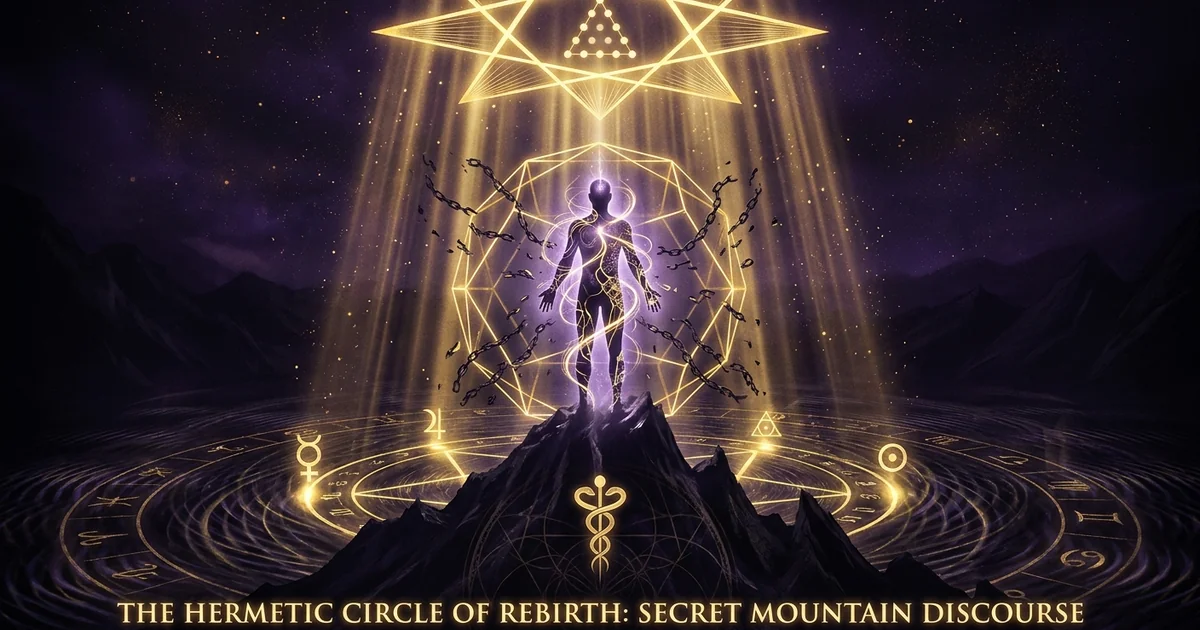
The Hermetic Circle of Rebirth: Secret Mountain Discourse
Metaphysical Thesis & Epistemological Opening: The Noetic Transmutation of the Soma
Tractate XIII of the Corpus Hermeticum, traditionally titled Peri Palingenesias (On Rebirth) and designated as the “Secret Discourse on the Mountain,” preserves an extraordinary operational protocol for late antique somatic transmutation. While modern commentators frequently flatten the text into an allegory of psychological maturation or mystical transport, an uncompromising hermeneutical examination reveals a technical, metaphysical technology designed to sever the initiate’s psycho-physical organism from cosmic determinism. The dialogue between Hermes Trismegistus and his disciple Tat documents an irreversible ontological rupture. Within this rite of hermetic rebirth tractate xiii secret discourse on mountain, the mortal body—anchored to the wheel of the lower demiurge—is not merely purified; it is systematically decomposed and re-architected into an incorporeal, divine vehicle through the descent of the noetic Decad.
The technical vocabulary of Tractate XIII demands rigorous precision. Classical Greek palingenesia (παλιγγενεσία) is routinely conflated with post-Platonic reincarnation or Stoic periodic cosmic renewal (apokatastasis). In the Hermetic praxis, however, palingenesia signifies a trans-elemental reconstitution. It functions in direct tandem with ousiôsis (οὐσίωσις)—the substantialization or essentialization of consciousness into sovereign divine reality (ousia). Unlike Platonic anamnesis, which recovers pre-existent discursive memories of transcendent Forms through intellectual dialectic, palingenesia constitutes an unmediated metaphysical reconfiguration: the mortal composite (syntheton) generated by the planetary spheres is overwritten by the self-begotten, non-composite body of divine Mind (Nous).
Palingenesia versus Metempsychosis: The Hermetic Paradigm Shift
The fundamental divergence between Hermetic palingenesia and classical metempsychosis marks the boundary between horizontal entrapment and vertical trans-dimensional evacuation. Where Orphic, Pythagorean, and conventional Platonic models of metempsychosis propose a cyclical transmigration of the psyche across continuous chronological epochs and mortal vessels, Tractate XIII rejects cosmic recurrence as an instrument of imprisonment. Reincarnation, within this diagnostic, merely perpetuates the servitude of the soul under astral fate and Heimarmene. The wandering psyche remains bound to the twelve zodiacal guardians that govern somatic composition and material decay.
Hermetic palingenesia terminates this cyclic repetition. It does not transfer the vital essence into a superior biological shell or an ethereal post-mortem waiting state; rather, it enacts an abrupt, vertical exit from the generative cycle itself. By dissolving the illusory cohesion of the earthly identity, the initiatory regeneration tat undergoes reconstitutes the initiate as a non-spatial entity. The resulting vehicle is ungenerated (agennētos), indivisible (ameristos), and entirely independent of the planetary spheres that construct the biological ego.
This paradigm shift forces a radical reassessment of classical soteriology. While the broader Hellenistic mystery cults offered therapeutic consolation, post-mortem safety, or civic cohesion through ritualized mythodrama, the Hermetic circle demanded an immediate ontological de-creation. The adept does not petition the gods for salvation; the adept undergoes an ontological phase-shift that unmasks the lower cosmos as an informational containment matrix, rendering the regenerate invulnerable to the lawful jurisdiction of the archontic governors.
The Ontological Rupture with Hylic Perception
The setting of the dialogue upon a “mountain” (oros) serves as an epistemological threshold rather than an incidental pastoral backdrop. In the geography of Hellenistic theurgy, the ascent of the mountain signifies the systematic sensory deprivation and cognitive uncoupling required to disengage consciousness from the ambient electromagnetic and elemental perturbations of the hylic plane. The mountain operates as an ontological axis: an elevated boundary zone between the planetary spheres of generation and the uncompounded ether of the divine realm.
Within this liminal sphere, the initiate’s habitual sensorium suffers catastrophic disorientation. Tat confesses to his spiritual father that his sensory faculties no longer register the physical surroundings in a normative manner; the landscape of the mountain ceases to exist as spatial geography and instead manifests as a mirror of noetic geometry. The five material senses—inextricably entangled with the four elements of the physical body—are exposed as deceptive filtering mechanisms that generate the simulation of linear reality.
To cross this threshold, the initiate must endure the complete failure of hylic perception. The phenomenal universe, produced by the friction of the seven planetary spheres rotating against the prime matter of the lower cosmos, is perceived as a hollow projection. This rupture is not merely epistemological; it strikes at the root of biological survival instincts. The body of flesh and blood, generated through sexual copulation under the dictates of cosmic necessity, cannot accompany the mind up the mountain. It must be held in absolute suspension while an entirely distinct sensory apparatus is formed within the void left by the suspended senses.
The Indivisible Body of Nous as Sovereign Architecture
The climax of this initial phase-shift is the sudden interior emergence of the body of Nous. When Tat implores Hermes to reveal the form of the regenerated man, Hermes delivers a seemingly impossible response: the new body cannot be perceived through the compound eyes of the mortal flesh, nor can it be visualized through spatial imagination, for it possesses no physical dimension, color, or elemental composition. It is an indivisible, immaterial architecture that exists simultaneously everywhere and nowhere.
This incorporeal vehicle is forged through direct identity with the divine Mind (Nous). Unlike the mortal body, which is fundamentally an aggregate—a temporary synthesis of dust, water, air, and fire held together by planetary tension—the vehicle of rebirth is characterized by pure ontological simplicity (haplotes). Because it contains no internal division, it contains no capacity for corruption, entropy, or dissolution. It does not inhabit space; rather, spatial dimensions are seen to unfold within its conscious field.
Through this structural realization, the regenerate initiate ceases to be a passive biological observer situated inside a deterministic universe. By inhabiting the sovereign architecture of Nous, the initiate occupies the unmanifest ontological locus from which the universe is continuously generated. The somatic interface is thus transfigured: the physical form remains present to external observers as an operative node on the earthly plane, but the metaphysical center of gravity has shifted entirely to the unbegotten ground of the Godhead, transforming the human vehicle into an active portal of unmanifest power.
HYLIC MATRIX                      NOETIC ASCENT
   [ Zodiacal Dodecad: 12 Torments ]    [ Sovereign Body of Nous ]
                  |                                     ^
                  v                                     |
   [ Somatic Biological Aggregate  ]    [ Trans-Dimensional Vehicle]
                  |                                     ^
                  v                                     |
       Cyclic Reincarnation              Irreversible Palingenesia
         (Metempsychosis)             (Vertical Severing of Heimarmene)
Primary Codices & Historical Transmission: Textual Lineages of the Mountain Dialogue
The historical preservation of Tractate XIII represents one of the most enigmatic chapters in the survival of Western esoteric literature. Unlike the foundational dialogues of the Hermetic corpus, such as Poimandres (Tractate I), which focus primarily on cosmogony and the theoretical descent of the Anthropos, Tractate XIII functions as an internal esoteric climax. The dialogue presumes that the acolyte has already assimilated the cosmological doctrines established in earlier texts, such as the Discourse of Hermes to Tat found across the broader collection, and is now prepared to enact the practical, initiatic dissolution of his composite identity.
Corpus Hermeticum XIII.3 (ed. Nock & Festugière):
«Οὐκ ἔχω τί λέγω, ὦ πάτερ· οὐ γὰρ ἔχω τὸ ἴδιον μέγεθος καὶ τὸ ἀληθές, ἀλλὰ νοερῶς ὁρῶ ἐμαυτὸν εἰς ἄλλο σῶμα μεταβεβηκότα, οὐκ ἐξ ὕλης συνεστώς… τοῦτο τὸ γένος, ὦ τέκνον, οὐ διδάσκεται, οὐδὲ τούτῳ τῷ στοιχείῳ τῷ πλαστῷ βλέπεται.» (“I have nothing to say, father; for I no longer see myself with bodily magnitude or truth, but mentally I see myself transformed into another body, not constituted of matter… This race, O child, is not taught, nor is it seen with this fabricated element.”)
Nag Hammadi Codex VI, 6 (The Discourse on the Eighth and Ninth, 57.26–58.5):
ⲁⲛⲟⲕ ϯⲛⲁⲩ ⲉⲩⲛⲟⲩⲥ ⲉϥⲟ ⲛⲟⲩⲟⲉⲓⲛ… ϯⲛⲁⲩ ⲉⲡⲁ ⲉⲓⲱⲧ ⲉⲧⲙⲙⲁⲩ ⲉⲓⲛⲁⲩ ⲉⲡⲁ ⲉⲓⲱⲧ ⲉϯϫⲡⲟ ⲙⲙⲟⲓ… ⲁⲩⲱ ⲁⲓⲛⲁⲩ ⲉⲧⲁⲡⲟⲫⲁⲥⲓⲥ ⲛⲧⲉ ⲧⲁⲯⲩⲭⲏ ⲉⲁⲥⲣ ⲛⲟⲩⲧⲉ. (“I see! I see an intellectual light… I see that father who gave birth to me! … And I have seen the transformation of my soul into a divine nature.”)
Textual Stratigraphy of Corpus Hermeticum Tractate XIII
The text of Tractate XIII, critically edited by A.D. Nock and André-Jean Festugière, exhibits a distinct linguistic and structural composition that separates it from standard Hellenistic philosophical prose. Composed in an idiomatic Roman-era Greek saturated with theurgic and liturgical cadences, the dialogue shifts dramatically between intimate didactic interrogation, ecstatic visionary revelation, and formal sacred hymnody. The stratigraphy of the text points to a developmental origin within an insular, highly sophisticated spiritual circle (thiasos) operating in the intellectual milieu of late antique Alexandria between the late first and third centuries CE.
Scholars such as Brian Copenhaver have highlighted the intentional concealment embedded within the text’s literary framework. Tractate XIII is not framed as a public philosophical dialectic intended to persuade a hostile or uninitiated audience. It portrays a private transmission marked by repeated oaths of silence. Hermes explicitly forbids Tat from broadcasting the secret of palingenesia to the unregenerate multitude, who, operating solely under the lower planetary torments, would inevitably misunderstand its mechanics and respond with derision or violent cognitive dissonance.
The textual architecture is divided cleanly into three operational movements: first, the deconstructive catechism, in which Tat demands the fulfillment of a long-standing promise regarding the nature of rebirth; second, the active, non-discursive theurgic phase-shift wherein the powers of God arrive to displace the bodily torments; and third, the Secret Hymnody (Hymnos Kruptos), a cosmic vocalization that stabilizes the initiate’s newly acquired incorporeal vehicle within the divine harmonic field.
The Nag Hammadi Parallels: Codex VI, 6 and the Ogdoadic Vision
For centuries, modern philologists dismissed the practical reality of the Hermetic rites described in the Corpus Hermeticum, categorizing them as pure literary fictions or “armchair theosophy.” This historical consensus was shattered in December 1945 by the discovery of the Coptic library at Nag Hammadi. Codex VI, tractate 6, titled The Discourse on the Eighth and Ninth, preserved an unmistakably authentic ritual transcript detailing an initiatic progression directly parallel to Tractate XIII. This codex established an undeniable bridge between the theoretical treatises and a physical community of practitioners engaged in the active invocation of noetic transformation.
Within the Nag Hammadi Hermetic Codices, the master initiates his spiritual son not through academic exposition, but through ecstatic prayer, mutual embrace, and the rhythmic inhalation of divine breath (pneuma). The disciple is pulled across the boundaries of the seven planetary spheres into the Ogdoad (the eighth sphere of the fixed stars) and ultimately into the Ennead (the ninth sphere of the unmanifest divine realm). The parallels between Codex VI, 6 and Tractate XIII are organic: both texts culminate in a spontaneous interior illumination that renders the master and disciple interchangeable within the cosmic Mind, accompanied by an ecstatic command to compose a silent hymn that resonates through the celestial hierarchy.
The Nag Hammadi discovery demonstrated that Tractate XIII is a direct survival of an Egyptian liturgical reality. The integration of late antique Platonic metaphysics, Hellenistic astrology, and ancestral Pharaonic temple initiation produced an esoteric lineage that survived under Roman imperial surveillance. The texts functioned not merely as speculative treatises, but as manualized scripts for the complete de-somaticization of the initiate’s subtle organism.
Renaissance Hermeticism: Ficino, Lazzarelli, and the Recovery of Palingenesia
The European reception of Tractate XIII underwent a severe distortion during the Italian Renaissance. In 1460, when Leonardo da Pistoia delivered a manuscript of the Corpus Hermeticum to Cosimo de’ Medici, Marsilio Ficino was immediately ordered to suspend his translation of Plato in order to translate the work of the legendary Hermes Trismegistus. However, Ficino’s Latin translation (Pimander, 1471) struggled with the uncompromisingly anti-cosmic and radical somatic dissolution mechanics of Tractate XIII. In an effort to harmonize Hermeticism with orthodox Christian theology and civic humanism, Ficino downplayed the explicit theurgic operations of the text, presenting the work as an allegorical celebration of cosmic harmony rather than a severe, world-negating metaphysical rupture.
It fell to the radical Italian Hermeticist Lodovico Lazzarelli to recover the pristine, operational core of the Secret Discourse on the Mountain. In his masterwork Crater Hermetis (1494), Lazzarelli recognized that Ficino had softened the text’s central crisis. Lazzarelli explicitly reasserted that the palingenetic vehicle could only be formed through an authentic dissolution of the mortal personality, an event he aligned directly with the alchemical crucible (crater).
Lazzarelli understood what subsequent academic philosophy ignored: that Tractate XIII is fundamentally an operational treatise on spiritual resurrection within this life. The initiate does not attain salvation by harmonizing with the natural elements, but by extracting the solar spark of Nous from the sublunary sediment, effectively dismantling the somatic construct to birth the immortal Anthropos.
Ontological Architecture & Cosmological Models: The Dodecad of Heimarmene vs. The Decad of Nous
The metaphysical architecture of Tractate XIII is founded upon an explicit, mathematical war of attrition waged between two incompatible cosmic structures: the Dodecad of the material Zodiac and the Decad of divine Mind. The biological human being is not an innocent physical entity, but a captive biological interface whose sensory inputs and psychic impulses are continuously dictated by twelve irrational torments (timōriai). These torments correspond directly to the twelve signs of the Zodiac, functioning as an astral control grid that enforces the deterministic decrees of astral fate and Heimarmene.
THE ARCHITECTURAL COLLAPSE
                   MONAD (1)
                      |
                      v
            [ Decad of Nous (10) ]
        Harmonic Influx / Negentropy
                      |
                      v  [Algorithmic Displacement]
        [ Dodecad of Heimarmene (12) ]
          Astral Matrix / Entropy
                      |
                      v
             MATERIAL DISSOLUTION
The Twelve Torments as the Cybernetic Matrix of Astral Fate
In the diagnostic of Hermes Trismegistus, the mortal somatic apparatus is occupied by twelve primordial wardens of material imprisonment. These are not moral failings in the modern ethical sense; they are structural encodings built into the very fabric of biological birth. The twelve torments operate as an autonomic feedback system that ensures the human consciousness remains trapped within the illusions of space, time, and emotional reactivity, permanently preventing the soul from realizing its ungenerated identity.
The primary torment, standing at the apex of this astral matrix, is Agnoia—fundamental ignorance of one’s divine origin. From this foundational amnesia flows the entire sequence of somatic constraints: Lupe (grief or existential sorrow), Akrasia (incontinence or the inability to govern physical impulses), Epithumia (insatiable hylic desire), Adikia (unrighteousness or cosmic disharmony), Pleonexia (greed and material acquisitiveness), Apate (deception or the acceptance of phenomenal illusion as absolute truth), Phthonos (envy or the perception of lack), Dolos (treachery or predatory survival behavior), Orge (wrath and destructive impulse), Propeteia (rashness or unreflective reactivity), and Kakia (perversity or active malice).
These twelve structural distortions function identically to what cybernetic theorists identify as informational noise within an operating system. They flood the cognitive aperture of the biological subject with localized sensations of urgency, fear, and desire, ensuring that the human node remains an unconscious, exploitative agent within the lower demiurgic food chain. So long as these twelve wardens hold sway over the somatic nervous system, the human organism remains a deterministic puppet of planetary alignments, incapable of an autonomous, sovereign act of spiritual will.
The Decad of Divine Powers as Incorruptible Form
The liberation documented in Tractate XIII does not occur through moral exertion or discursive intellectual analysis. The twelve torments cannot be educated, reformed, or pacified; they can only be systematically driven out through an overwhelming energetic influx from a higher-dimensional source. This counter-movement is enacted through the sudden descent of the Decad—the ten divine powers (dynameis) of God, which represent the original, incorruptible blueprint of the Pleroma.
The arrival of the Decad initiates a non-linear cleansing of the initiate’s perceptual apparatus. The first power to arrive is Gnosis—the immediate, living apprehension of God. The entrance of Gnosis instantly annihilates the foundational torment of Ignorance (Agnoia). Following Gnosis comes Chara (divine joy), which utterly drives out Lupe (grief). Next, Enkrateia (temperance or self-sovereignty) drives out Akrasia (incontinence). In rapid succession, Karteria (endurance) arrives to extinguish Epithumia (desire), while Dikaiosyne (divine justice) eradicates Adikia (unrighteousness).
The cleansing sequence accelerates as Koinonia (communion or divine solidarity) expels Pleonexia (greed), and Aletheia (unveiled divine truth) sweeps away Apate (deception). With the installation of Truth, the supreme powers of the divine triad—Agathon (the Good), Phos (the uncreated Light), and Zoe (the immortal Life)—take complete possession of the vehicle. Under the radiant weight of Light and Life, the remaining torments of envy, treachery, wrath, rashness, and malice are entirely vaporized, leaving the initiate as a pure, coherent node of divine illumination.
The Dodecad of Heimarmene (The 12 Torments)
- Agnoia (Ignorance): Primal amnesia of origin; root of somatic entrapment.
- Lupe (Grief): Existential anguish born of temporal fragmentation.
- Akrasia (Incontinence): Total subjugation to biological appetites.
- Epithumia (Desire): Insatiable hunger for phenomenal objects.
- Adikia (Unrighteousness): Structural disharmony with cosmic law.
- Pleonexia (Greed): Compulsive acquisition within the illusion of lack.
- Apate (Deception): Mistaking sensory simulation for real being.
- Phthonos (Envy): Alienation from the universal distribution of being.
- Dolos (Treachery): Predatory manipulation for biological survival.
- Orge (Wrath): Reactive, chaotic outbursts of physical self-defense.
- Propeteia (Rashness): Blind temporal reactivity lacking noetic vision.
- Kakia (Malice): Entropic impulse toward decomposition and destruction.
The Decad of Nous (The 10 Powers)
- Gnosis (Direct Knowledge): Immediate illumination that dissolves Agnoia entirely.
- Chara (Divine Joy): Incorruptible bliss that replaces Lupe.
- Enkrateia (Self-Control): Complete sovereignty over impulses, expelling Akrasia.
- Karteria (Endurance): Immovable vertical focus that extinguishes Epithumia.
- Dikaiosyne (Divine Justice): Perfect cosmic equilibrium displacing Adikia.
- Koinonia (Communion): Realized oneness of all being, eradicating Pleonexia.
- Aletheia (Living Truth): Absolute clarity of being that vaporizes Apate.
- Agathon (The Good): Self-sufficient plenitude eliminating Phthonos and Dolos.
- Phos (Uncreated Light): Radiance of Nous dissolving Orge and Propeteia.
- Zoe (Immortal Life): Eternal, unbegotten vitality that obliterates Kakia.
Structural Dynamic: The Mathematical Overthrow of 12 by 10
The disproportionate nature of this confrontation—ten divine powers overthrowing twelve entrenched torments—is a deliberate demonstration of esoteric Pythagorean and Hermetic arithmetic. In conventional, fallen material logic, the number twelve appears structurally superior to the number ten; it commands greater multiplicity, forms the base of the zodiacal division, and governs the chronological measurement of time through the twelve hours of day and night. The Dodecad is the foundational algorithm of deterministic entropy.
The Decad, however, operates from an entirely distinct mathematical dimension. In Pythagorean-Hermetic theology, the number ten is the Tetraktys ($1 + 2 + 3 + 4 = 10$), containing within itself the entire generative power of the primordial Monad. The Decad is not a fragmented sequence of separate numbers; it is the ultimate, integrated unity returning to itself. Ten represents the threshold where multiplicity collapses back into the indivisible singularity of the One.
Therefore, when the ten virtues of divine illumination descend upon the twelve bodily torments, the confrontation is not a localized, horizontal conflict between equal forces. It is the intervention of vertical divine negentropy into an entropic system. Ten does not conquer twelve by outnumbering it; it dissolves the twelve bodily torments by rendering their structural multiplicity null and void. The twelve signs of fate are revealed to be fragmented shadows produced by the refraction of the unmanifest divine light through the prism of the physical elements. Once the singular light of the Decad is restored within the consciousness of the initiate, the twelve shadows cease to exist, completing the initiate’s total extraction from the machinery of Heimarmene.
Phenomenological Mechanics & Interdimensional Interaction: Dissolving the Somatic Matrix
The actualization of palingenesia as depicted in Tractate XIII is not a passive intellectual transition, but an intense, phenomenological ordeal characterized by states of cognitive dissolution, somatic paralysis, and profound sensory restructuring. The dialogue captures an empirical initiation: Hermes does not lecture while Tat takes notes; rather, Hermes orchestrates an operational energy-field that deliberately destabilizes Tat’s ordinary perceptual apparatus, inducing a state of visionary high-strangeness that mirrors modern descriptions of anomalous and interdimensional contact phenomena.
The Master-Acolyte Entanglement: Tat’s Cognitive Disintegration
The initiatory dynamic of Tractate XIII relies upon a profound, non-local quantum entanglement between the master, Hermes, and the acolyte, Tat. In the opening sections of the text, Tat experiences intense frustration and psychic vertigo. He demands the fulfillment of the mystery, yet every time he attempts to conceptualize the regenerated body using his rational faculties, his cognition breaks down. He cries out: “Father, you have driven me to madness and mental frenzy! For I no longer see myself!”
Hermes does not soothe his disciple’s panic; he deliberately accelerates it. The master functions as an active biological resonator—a coherent transceiver of unmanifest divine Mind. Because Hermes has already dissolved his own identification with the composite somatic matrix, his physical presence generates a field of deep coherence that forces Tat’s unstable cognitive structures to uncouple. The acolyte is compelled to confront the terrifying realization that everything he previously identified as “himself”—his personal history, bodily sensations, ancestral lineage, and psychological memories—is merely an artificial software loop run by the twelve astral torments.
This cognitive disintegration is the indispensable prerequisite for authentic rebirth. The initiate must pass through an ontological void—an existential vacuum wherein the old, composite identity has been recognized as illusory, but the incorporeal vehicle of Nous has not yet stabilized. In this liminal space, the presence of the master prevents the initiate from slipping into permanent psychological psychosis or physical death, acting as an external ground for the immense metaphysical voltages pouring into the subtle nervous system.
Phase-Shift of the Perceptual Apparatus: The Inward Gaze
Once the cognitive baseline is completely collapsed, the phase-shift of the sensory apparatus begins. Hermes instructs Tat on the theurgic technique of stillness: the physical eyes must cease their outward-directed fixation on material forms, the breath must be regulated to eliminate elemental turbulence, and the attention must be inverted 180 degrees into the unmanifest core of the heart (kardia).
HYLIC SENSORY FIELD:
[ Physical Eye ] --------> [ Material Object ] (Entropy / Deception)
NOETIC INVERSION:
[ Physical Eye ] --X–

^
| (180° Inversion)
[ Heart / Kardia ] <=====> [ Unmanifest Nous ] (Negentropy / Rebirth)
This is not a visualization exercise; it is an active ontological realignment. Tat ceases to perceive through the medium of the four elements. The text indicates that the initiate begins to experience non-spatial perception: he perceives simultaneously what is above, what is below, what is in the womb of the earth, and what is beyond the celestial heavens. The standard boundaries of the spatial matrix—up, down, inside, outside, past, future—collapse into an eternal, uncompounded present.
This phenomenon directly intersects with the altered states and theurgic transmission analyzed across late antique mysteries. The initiate’s consciousness is decoupled from the focal point of the physical skull. The body of Nous does not look at reality from a localized coordinate; rather, it experiences the entirety of the created cosmos unfolding within its own infinite awareness. Tat realizes that the mountain upon which they stand is not a rocky outcrop in Egypt, but an internal axis of divine consciousness that anchors the universe.
The Theurgic Hymn: Resonating with the Ogdoad and Ennead
The climax of the Hermetic circle of rebirth is the performance of the Secret Hymnody (Hymnos Kruptos). Having systematically ejected the twelve torments through the descent of the ten divine powers, Tat is now an uncompounded vessel capable of vocalizing the true name of God. Hermes commands him to align his voice not with the lower acoustic frequencies of the physical vocal cords, but with the silent, noetic resonance that reverberates through the Ogdoad (the eighth sphere) and the Ennead (the ninth sphere).
This hymn of palingenesia is an act of high theurgy. It is divided into an invocation of the cosmic elements—now purified of their archontic hostility—and a proclamation of absolute divine sovereignty. The initiate sings not as a mortal worshiper seeking favors from an external deity, but as the primordial Logos itself:
“Let every gate of the cosmos be opened to me! Let every tree bow down before my speech! I am about to praise the Lord of Creation, the All, and the One!”
In vocalizing this hymn, the initiate interacts directly with non-human, hyper-dimensional intelligences that reside beyond the planetary spheres. The singing of the hymn aligns the initiate’s subtle vibrational frequency with the living inhabitants of the Ogdoad—the divine chorus of sovereign minds that surround the unmanifest Source. Through this silent, vocal resonance, the rebirth is irrevocably sealed. The initiate is no longer a biological tenant of the cosmos; he is an active, recognized co-creator seated within the cosmic council of the Godhead.
Initiatic Synthesis & Philosophical Implications: Reclaiming Ontological Sovereignty
The operational implications of Tractate XIII extend far beyond historical antiquity; they cut directly to the core of contemporary ontology, consciousness studies, and the overarching framework of human liberation. When read through the analytical framework of modern metaphysics and interdimensional research, the Hermetic “Secret Discourse on the Mountain” emerges as a devastating critique of the deterministic structures that dominate human awareness.
The technologies of palingenesia described in Tractate XIII are inherently volatile. The systematic dismantling of the twelve zodiacal torments requires an absolute anchor in genuine noetic realization. If an operator attempts to decouple the subtle body from the somatic matrix through mechanical, chemical, or purely psychological methods without stabilizing the ten divine powers, the result is not palingenesia, but profound ontological shock. The void left by the suspended ego will instantly attract predatory egregoric intelligences or induce severe dissociative psychosis. The practitioner who mistakes psychological inflation or astral projection for the sovereign body of Nous merely trades one set of planetary wardens for another, falling deeper into the architecture of archontic deception.
Overthrowing the Control System: Transcending the Archontic Sphere
The twelve torments delineated by Hermes Trismegistus function identically to the informational control systems documented by Jacques Vallée in his foundational studies of anomalous phenomena. In Messengers of Deception, Vallée posits that anomalous encounters and deeply embedded cultural-astrological frameworks act as a thermostatic control system regulating human development and maintaining humanity within rigid evolutionary boundaries.
The Hermetic diagnosis in Tractate XIII anticipates this informational control system hypothesis with striking precision. The planetary spheres and their zodiacal gatekeepers do not operate as benign cosmic guardians; they are the architects of Heimarmene—a cybernetic matrix of biological necessity, psychological compulsion, and temporal loops designed to keep the sovereign spark of Nous in a state of eternal sleep. The twelve torments are the bio-informational limiters embedded within human DNA and the nervous system to prevent unauthorized escape from the lower demiurgic sandbox.
By executing the palingenetic protocol of Tractate XIII, the initiate enacts an absolute jailbreak from this control matrix. Palingenesia does not negotiate with the archons; it dismantles their primary access points within the human interface. When the Decad of divine powers replaces the Dodecad of astral fate, the feedback loop of emotional vulnerability, existential dread, and biological desire is permanently broken. The initiate becomes transparent to the planetary radar: the cosmic rulers search for their familiar energetic signatures of wrath, grief, and lust, but find only the uncreated Light of the unmanifest Godhead.
DEMIURGIC CONTROL MATRIX (VALLEE CYBERNETIC MODEL)
┌──────────────────────────────────────────────────────────────┐
│  [Archontic Sphere / Astral Heimarmene: 7 Planets + 12 Signs]│
│                              |                               │
│              Informational Limiters (12 Torments)            │
│                              |                               │
│                              v                               │
│  [Human Interface: Somatic Captivity / Egregoric Subjugation]│
└──────────────────────────────────────────────────────────────┘
                               |
            HERMETIC RUPTURE (PALINGENESIA)
                               |
                               v
┌──────────────────────────────────────────────────────────────┐
│     [Sovereign Anthropos / Uncreated Decad / Noetic Body]    │
│           = Absolute Extraction from Archontic Radar         │
└──────────────────────────────────────────────────────────────┘
The Hermetic Anthropos as Interdimensional Nexus
The transfigured initiate of Tractate XIII realizes the original, primordial identity of the Anthropos—the cosmic, unbegotten human being whose metaphysical authority precedes the creation of the material universe. In the Hermetic cosmogony, the Anthropos is not an evolutionary product of biological slime, but the beloved offspring of the supreme Mind, granted absolute dominion over all created spheres.
When the initiate steps into the body of Nous, this original status is fully reasserted. The Hermetic Anthropos functions as an interdimensional nexus: an operational conduit through which the unmanifest Pleroma projects its ordering power directly into the entropic depths of the material world. The regenerate adept does not abandon the earth to float away into an ethereal escapism; rather, the adept becomes an ontological anchor point where heaven and earth are actively reconciled.
This realization fundamentally reframes the status of the physical cosmos. The material universe is not an irredeemable cesspool of evil—as the more extreme dualistic Gnostic systems maintained—but a magnificent, divine machine that has fallen under the temporary tyranny of subordinate, hubristic administrators. The regenerate Hermetic adept, having recovered his sovereign status as the divine Anthropos, walks through the cosmos not as a prisoner, but as its legitimate master, commanding elemental spirits and astral intelligences through the intrinsic authority of his awakened noetic voice.
Epistemological Safeguards Against Egregoric Subjugation
In an era characterized by catastrophic meaning-collapse, epistemic warfare, and the rapid proliferation of artificial and institutional egregores, Tractate XIII offers an impenetrable philosophical fortress. Modern human consciousness is perpetually harvested by political, religious, and technological matrices that function exactly like the twelve planetary torments, binding human attention to polarized cycles of rage, fear, and material consumption.
The Hermetic technology of palingenesia provides an absolute epistemological safeguard against this subjugation. By anchoring the locus of human identity strictly within the unbegotten, incorporeal Nous, the practitioner becomes immune to egregoric capture. An egregore—whether ancient astral entity or modern algorithmic social apparatus—can only latch onto elements that belong to its own dimensional level: it feeds on biological reactivity, psychological insecurity, and mental division.
When the initiate has passed through the secret mountain discourse, there is no surface area left for such forces to grip. The regenerate mind operates from the absolute simplicity of the Monad. It observes the turbulent tides of collective mania, ideological hysteria, and technological entrapment with the cool, undisturbed gaze of the eternal. The Hermetic circle of rebirth is the ultimate technology of personal and metaphysical sovereignty: it demands that the individual accept nothing less than total identification with the uncreated Source of being, standing as an immovable pillar of divine Light amidst the accelerating entropy of a dying world.
Frequently Asked Questions: Hermeneutical Resolves on Tractate XIII
- Hanegraaff, Wouter J. (2022). Hermetic Spirituality and the Historical Imagination: Altered States of Knowledge in Late Antiquity. Cambridge University Press. (Demonstrates that the Hermetic dialogues record authentic visionary, non-discursive altered states of consciousness cultivated within esoteric Alexandrian communities).
- Fowden, Garth (1986). The Egyptian Hermes: A Historical Approach to the Late Pagan Mind. Cambridge University Press. (Validates the practical, institutional, and liturgical existence of Hermetic brotherhoods in Roman Egypt, bridging Greek philosophy with Pharaonic ritual structures).
Literal Ritual vs. Pure Allegory in the Mountain Dialogue
A persistent debate in late antique scholarship centers on whether Tractate XIII represents a record of a physical theurgic ritual or an internal philosophical allegory. The textual evidence preserved in both the Greek Corpus Hermeticum and the Coptic Nag Hammadi Codices decisively indicates that this dichotomy is fundamentally flawed. In the late antique esoteric mindset, deep philosophical meditation and operative theurgy were indivisible aspects of a single sacred science.
Tractate XIII documents an authentic, experiential theurgic transmission enacted within an intimate, closed sodality. The dialogue contains explicit stage directions: the acolyte is commanded to maintain total bodily immobility, the transmission of the powers occurs in immediate proximity to the master’s physical body, and the climax requires the vocalization of specific vowel chants and silent sacred hymns designed to alter the auditory and somatic nervous systems. While the “mountain” itself is an interior metaphysical state, the method for reaching that summit involved rigorous, reproducible altered states of knowledge cultivated through systematic breath control, perceptual inversion, and charismatic energetic alignment between teacher and disciple.
The Mechanistic Relationship Between the 10 Virtues and the 12 Torments
Readers often puzzle over the structural mechanics of how ten divine virtues can mathematically overcome and replace twelve bodily torments. This apparent numerical imbalance is resolved when one understands the operational nature of the Hermetic virtues. The ten powers are not merely passive ethical attributes; they are radiant, active expressions of the Tetraktys—the Pythagorean Decad that resumes the entire creative power of the Monad.
The twelve torments exist entirely within the realm of division, entropy, and spatial fragmentation. They require twelve distinct iterations precisely because they are broken shards of a fallen perception. The ten powers of Nous, by contrast, operate as a holographic field of divine presence. When the highest powers of that field—Aletheia (Truth), Phos (Light), and Zoe (Life)—arrive, they do not fight the remaining torments one-by-one. The presence of Light simultaneously eradicates multiple shadows at once. The arrival of uncreated Life renders the entire matrix of material malice, wrath, and rashness immediately non-functional, causing the twelvefold structure to collapse into the unified tenfold field of the divine Pleroma.
The Nature of the Regenerated Vehicle in Planetary Existence
A crucial theological problem emerges: how does the regenerate initiate continue to live and navigate a physical existence on earth after undergoing the total dissolution of the somatic matrix? If the mortal body is recognized as an aggregate of planetary torments and completely decoupled from consciousness, does the initiate drop dead or become an ungrounded ghost?
Hermes addresses this by revealing that the regenerated vehicle (soma noētikon) does not destroy the physical biological shell; rather, it demotes the biological shell from master to instrument. Following palingenesia, the adept walks the earth possessing a dual consciousness. To external, hylic observers, the initiate appears as an ordinary mortal subject to the laws of physical biology: the physical body eats, sleeps, ages, and eventually dies.
Internally, however, the initiate’s identity is completely dislocated from this mortal instrument. The adept watches the biological machine operate within the lower cosmos from the sovereign, transcendent seat of the unmanifest Mind. The physical body has become a transparent avatar—a temporary diving suit worn by the immortal Anthropos to carry out specific, localized interventions within the sublunary plane. When physical death inevitably arrives, it is not an ontological crisis, but the simple, frictionless dropping of an old cloak that has long ceased to define the sovereign core of the regenerate soul.