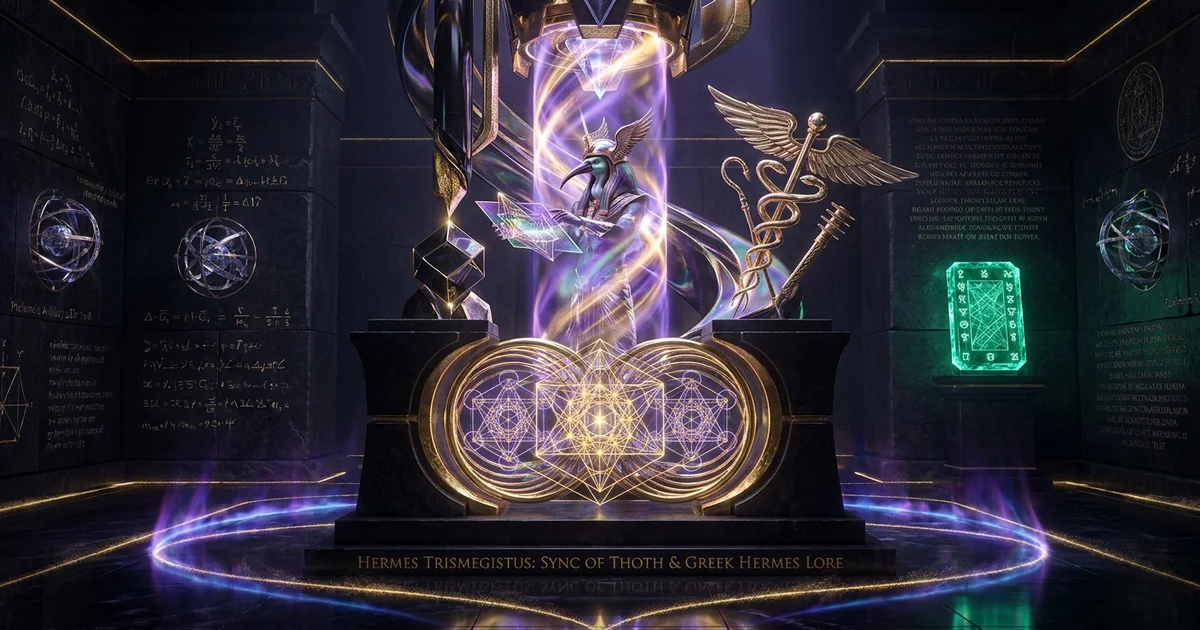
Hermes Trismegistus: Sync of Thoth & Greek Hermes Lore
Metaphysical Thesis & Epistemological Opening: The Alexandrian Crucible and the Transfiguration of Logos
Alexandria ad Aegyptum as an Epistemic Contact Zone
The emergence of Hermes Trismegistus within the intellectual crucible of Hellenistic Egypt was neither an accidental syncretic compromise nor a casual poetic conceit. It represented an ontological transaction executed within the liminal boundary zone of Alexandria ad Aegyptum—a city deliberately designated as adjacent to, rather than formally within, Egypt proper. Following the Macedonian conquest and the establishment of the Ptolemaic dynasty, the indigenous sacerdotal caste faced an existential crisis: the gradual erosion of their pharaonic patron-state and the aggressive encroachment of Hellenic administrative and linguistic frameworks. Alexandria functioned as a high-pressure cultural collider where Milesian natural philosophy, Attic dialectic, and Jewish diaspora theology intersected with the millennia-old mortuary and cosmological liturgies of the Nile Valley.
Within this contested geographic and psychic space, the sanctuary of the Serapeum and the Library of Alexandria operated alongside traditional temple scriptoria (Per Ankh, or Houses of Life). The intellectual elite of the Egyptian priesthood, bilingual out of political necessity, recognized that their ancestral metaphysical architecture would be reduced to antiquarian curiosities unless translated into the dominant Mediterranean dialect. The resulting contact zone catalyzed an unprecedented project of trans-cultural translation. This was not a passive dilution of native theology. Rather, it was a deliberate deployment of Greek philosophical vocabulary to articulate the deeply rooted, archaic structures of Egyptian cosmology, transforming the archaic scribal craft into a universalized vehicle for philosophical salvation.
From Sacerdotal Medu Netjer to Hellenic Logos: The Semiotic Transmutation
At the core of this syncretism lies the semiotic transmutation of Medu Netjer—the “divine words” or sacred hieroglyphs—into the philosophical mechanics of the Hellenic Logos. In indigenous Egyptian theology, particularly within the Memphite and Hermopolitan traditions, Djehuty (Thoth) was not merely a god of writing; he was the primary phonological and semantic instrument through which the primordial creator realized the cosmos. As attested in the Shabaka Stone, creation unfolded when Ptah conceived reality in his heart (Sia) and brought it into somatic manifestation through the utterance of his tongue (Hu). Djehuty functioned as that divine tongue, the cosmic measure (Ma’at), and the operational intelligence that translated formless intentionality into vibrational, structural matter.
The epithet “Trismegistos” (Three Times Great) represents a precise grammatical calque from Late Egyptian and Demotic scribal practices, rather than a Greek metaphysical innovation. In Demotic papyri and ostraca associated with the ibis cults of Hermopolis Magna (Khemenu), Thoth is frequently invoked with the superlative iteration ꜥꜣ ꜥꜣ ꜥꜣ (“great, great, great”). This repetitive formula, intended to denote absolute cosmic majesty through rhythmic emphasis, was first rendered epigraphically into Greek as Hermes Megistos kai Megistos (“Hermes the Great and Great”) before solidifying in the early Roman period into the composite compound Trismegistos (Τρισμέγιστος). The title designates an ontological supremacy spanning the three distinct cosmic domains: the physical-terrestrial, the celestial-planetary, and the hyper-cosmic intellective realms.
When transposed into Hellenistic Greek, this vibrational reality-engineering intersected directly with the Stoic and Middle Platonic doctrines of the Logos. The Logos of the Greek philosophical tradition was primarily an immanent rational principle ordering the cosmos, an intellective law knowable through dialectic. Under the sacerdotal reframing of the hermes trismegistus thoth hermes syncretism alexandria, the Logos ceased to be a passive abstract framework and regained its archaic Egyptian potency: it became an active, living current of revelation. The divine intellect (Nous) generated the Logos as an ontological son, establishing Hermes Trismegistus as an interdimensional broker mediating between absolute, transcendent hypostases and the incarnate human intellect, a dynamic analyzed extensively in contemporary studies of the /spirituality/corpus-hermeticum-poimandres-analysis.
Interpretatio Graeca as Ontological Survival Strategy
The fusion of Djehuty and Hermes must be recognized as an intentional deployment of interpretatio graeca—the ancient practice of translating foreign deities into the Hellenic pantheon—utilized here as an active sacerdotal defense mechanism. The native Egyptian priesthood, stripped of direct sovereign authority, utilized the porous nature of Greek polytheism to smuggle the entire corpus of their sacred science out of vulnerable temple enclaves and into the globalized Hellenistic philosophical ecosystem.
By cloaking the ancient ibis- and baboon-headed netjer in the chlamys, petasos, and winged sandals of Hermes, the priests accomplished an ontological rescue operation. Hermes the Greek herald—the psychopomp who alone moved freely between Olympus, the mortal sphere, and Tartarus—possessed the precise structural liminality required to host the complex metaphysical functions of Djehuty. This strategic masking generated an informational control matrix. To the occupying Greek administration and the uninitiated public, the resulting tracts appeared to be elevated Greek philosophical dialogues modeled after Plato’s Timaeus or Phaedrus. To the initiated initiate who possessed the esoteric keys, the texts operated as veiled manuals of Egyptian priestly initiation, preserving the core cosmological architecture of the House of Life within the discursive syntax of Middle Platonism.
Primary Codices & Historical Transmission: Sacerdotal Lineages and the Epigraphic Record
The Epigraphic Witness: From Demotic Ostraca to the Rosetta Decree
The historical anchoring of the Hermetic archetype is not found in the imaginative realms of Renaissance humanism, but in stone inscriptions and broken ceramic sherds distributed across the Nile Valley. The transition of the legendary civilizer and scribe from an indigenous cult deity to the Hellenized composite can be precisely mapped through the epigraphic record of the Ptolemaic period.
The most prominent public epigraphic attestation occurs within the trilingual inscription of the Memphis Decree of 196 BCE, carved upon the basalt slab known globally as the Rosetta Stone (British Museum BM EA 24). In the Greek text of Line 19, Ptolemy V Epiphanes is proclaimed beloved of Ptah and structurally correlated to “Hermes the Great and Great.” This phrasing mirrors Demotic formulations discovered in the Hor of Sebennytos archive—a collection of mid-second-century BCE ostraca belonging to an Egyptian temple recluse (katochos) at the Serapeum of Saqqara. Hor’s bilingual notes demonstrate how the native priesthood consciously navigated the Demotic title of Thoth (Djehuty pꜣ ꜥꜣ pꜣ ꜥꜣ pꜣ ꜥꜣ) and its direct rendering into administrative Greek, confirming that the three times great title meaning was deeply embedded in official sacerdotal and royal titulature well before the composition of the philosophical dialogues.
“καθάπερ Ἑρμῆς ὁ μέγας καὶ μέγας…” (“[Ptolemy, the eternal, beloved of Ptah…] even as Hermes the Great and Great…”) The Greek recension directly correlates the Hellenic divine herald with the Demotic sacerdotal invocation of Thoth, providing an unbroken epigraphic bridge between indigenous temple liturgies and the formal codification of the Hermetic persona.
The Hermetic Codicology: The Corpus Hermeticum, Asclepius, and the Stobaean Fragments
The surviving textual body of philosophical Hermeticism comprises three distinct primary textual streams: the seventeen treatises of the Corpus Hermeticum, preserved in the Byzantine scriptorium tradition; the Latin Asclepius (originally Logos Teleios), preserved through the pseudo-Apuleian manuscript transmission; and the extensive Hermetic anthologies curated by the fifth-century compiler Joannes Stobaeus. For centuries, post-Enlightenment historiography, downstream of Isaac Casaubon’s pioneering 1614 critical redating of the manuscripts, treated these documents as late Roman philosophical pastiches composed by armchair Neoplatonists who had zero living contact with pharaonic traditions.
This hyper-skeptical posture ignored the codicological and thematic bifurcations enforced by early modern catalogers. Humanists separated the philosophical Hermetica from the “technical” Hermetica—the sprawling corpus of magical papyri, astrological tables, and alchemical tractates found preserved in compilations such as the Papyri Graecae Magicae (PGM). By treating the speculative philosophical discourses as distinct from the operational rituals, Western scholarship obscured the organic continuum that unified the scribal sciences. As Garth Fowden demonstrated in The Egyptian Hermes: A Historical Approach to the Late Pagan Mind, the technical and philosophical texts were complementary facets of a singular sacerdotal worldview wherein cosmological mapping served as the operational foundation for ritual liberation.
The Nag Hammadi Revelation: Coptic Witness to Living Theurgic Communities
The paradigm of Hermeticism as an isolated literary phenomenon was dismantled in December 1945 with the discovery of the Nag Hammadi Library in Upper Egypt. Bound within Codex VI were not merely the expected Gnostic-Christian tractates, but a Coptic translation of a section of the Asclepius (§§ 21–29) and, crucially, an otherwise unknown Hermetic initiatic ritual: The Discourse on the Eighth and Ninth (NHC VI, 6).
“The Hermetic treatises are not the products of isolated intellectuals engaged in abstract literary games, but textual traces of small, communal settings where masters guided their disciples through stages of spiritual regeneration, culminating in unitive visionary experiences of the Ogdoad and the Ennead.” — Wouter J. Hanegraaff, Hermetic Spirituality and the Historical Imagination (Cambridge University Press, 2022), pp. 112–115.
The critical analysis of The Discourse on the Eighth and Ninth by Peter Dirkse, James Brashler, and Douglas M. Parrott revealed a master-disciple relationship centered around an experiential, bodily ascension through the planetary spheres. The text details liturgical instructions, communal singing, ritual kisses of peace, and ecstatic visionary invocations that transcend mere philosophical dialectic. It provides unassailable proof that the philosophical treatises served as textual scripts for living, operative sodalities operating within Late Antique Egypt—communities that merged indigenous initiation rituals with Greek metaphysical contemplation.
Ontological Architecture & Cosmological Models: Theurgy, Nous, and the Hebdomad
The Hermopolitan Ogdoad Integrated into the Ptolemaic Planetary Hebdomad
The cosmological architecture of Hermeticism is an intentional structural alignment of the ancient Hermopolitan cosmogony with the geocentric, spherical astronomy of Hellenistic Alexandria. In the primordial theology of Hermopolis Magna (Khemenu, “the City of the Eight”), reality emerged from four pairs of complementary, primordial deities representing the chaotic elements of the pre-cosmic abyss: Nu and Naunet (primordial water), Heh and Hauhet (infinity/spatial boundlessness), Kek and Kauket (primordial darkness), and Amun and Amaunet (hiddenness or breath). This pre-cosmic Ogdoad generated the cosmic egg or lotus from which the solar creator emerged to structure reality.
Under the influence of the Ptolemaic cosmological model, this archaic eightfold framework was remapped onto the geocentric architecture of the cosmos. The seven interior concentric orbits—the Moon, Mercury, Venus, the Sun, Mars, Jupiter, and Saturn—constituted the Hebdomad. Beyond these planetary spheres lay the eighth realm, the Ogdoad, identified with the sphere of the fixed stars, and beyond that, the Ennead, the hyper-cosmic realm of the divine Nous.
[ Ennead: The Unmanifest Transcendent Nous ]
       │
[ Ogdoad: Sphere of Fixed Stars / Regenerative Intellect ]
       │
[ Hebdomad: Seven Planetary Spheres of Heimarmene ]
  (Saturn → Jupiter → Mars → Sun → Venus → Mercury → Moon)
       │
[ Hylic Sublunary Sphere: Physical Materiality & Somatic Decay ]
This structural transposition meant that the chaotic, limitless energies of the ancient Ogdoad were elevated above the planetary machinery of fate, converting the archaic waters of chaos into a transcendent haven of pure intellectual light to which the initiate strove to return.
Heimarmene: Astrological Determinism as an Informational Constraint Network
Within this synthesized cosmos, Heimarmene (astral fate) functions not merely as mechanical cosmic determinism, but as a multi-tiered informational constraint system. Governed by the seven planetary Archons or Governors (Dioiketai), the Hebdomad administers the sublunary realm through the strict laws of cause, effect, and physical decay. In Tractate I of the Corpus Hermeticum (Poimandres), the human composite is shown to be dual: through his physical body, man is entirely subject to the tyrannical machinery of Heimarmene; through his intellective essence, derived directly from the Archetypal Anthropos, he is transcendent and inherently co-equal with the Demiurgic Nous.
This framework parallels Jacques Vallée’s conceptualization of non-human informational control systems. The planetary spheres do not operate simply as inert masses of matter orbiting the Earth; they represent intelligent, intermediate boundary layers that enforce the parameters of somatic incarnation. They condition human psychology through astral passions—avarice from the Sun, lust from Venus, wrath from Mars—locking the uninitiated soul into automated loops of behavioral feedback. Liberation (Gnosis) does not occur through political revolt or mere academic study, but through a calculated theurgic ascent (anabasis) in which these astral imprints are systematically stripped away, disarming the informational control system from within.
Djehuty (Thoth) Sacerdotal Paradigm
- Attributes: Ibis, baboon, crescent moon disk, scribal palette, reeds, the Scales of Judgment.
- Cosmogonic Function: Utterance of the divine voice (Hu); dynamic preservation of cosmic balance (Ma’at); scribe of the Ennead.
- Semiotic Mechanism: Medu Netjer (Hieroglyphs as living theurgic ontologies capable of animated creation).
- Initiatic Destination: Sustained survival in the Field of Reeds (Aaru) through successful heart-weighing (Psychostasia).
Hermes Psychopompos Hellenic Paradigm
- Attributes: Caduceus (Kerykeion), winged sandals (talaria), petasos hat, guide of shadows.
- Cosmogonic Function: Herald of Olympus; messenger across ontological realms; patron of boundaries, trade, and thieves.
- Semiotic Mechanism: Discursive dialectic, rhetoric, hermeneutics, and rational linguistic mediation.
- Initiatic Destination: Safe transit of the disincarnate shade through the subterranean gates of Hades.
Comparative Morphology: Djehuty’s Cosmic Scales versus the Hellenic Caduceus
The structural integration of these two archetypes is nowhere more apparent than in the comparative morphology of their primary symbolic instruments: the Scales of Ma’at and the Hellenic Caduceus. In native Egyptian mortuary litany, particularly the Pert Em Hru (Book of the Dead), Djehuty stands at the central fulcrum of the cosmic scales, recording with his reed pen the balance between the initiate’s heart (Ib) and the feather of truth (Ma’at). This instrument represents cosmic equilibrium, thermodynamic balance, and moral rectitude—a static, hyper-exact measurement of ontological integrity.
Conversely, the Hellenic Caduceus—a central wand entwined by two opposing serpents—represents a dynamic, oscillatory balance of volatile forces. It is the staff of transmutation, neutralizing duality through the mediation of an axis of higher order. When absorbed into Hermes Trismegistus, these two instruments fuse conceptually. The Caduceus becomes the dynamic method of ascension, while the Scales represent the absolute, structural criterion of truth required to pass the planetary thresholds. The initiate wields the Caduceus to navigate the liminal channels of the subtle body, while anchoring consciousness in the immovable cosmic justice of Ma’at, transforming the scribe into an active traveler of hyper-cosmic topologies.
Phenomenological Mechanics & Interdimensional Interaction: Scribe-Entity Contact and Theurgic Telestikē
Telestikē: The Animation of Divine Statues in the Asclepius
The most radical operative intersection between Egyptian temple praxis and Hermetic philosophy occurs in the theurgic doctrine of statue animation (telestikē), preserved in the Latin Asclepius (§§ 23–24 and 37). In these controversial passages, Hermes reveals to his disciple that humans possess the capability to craft gods:
“Just as the Lord and Father is the creator of the heavenly gods, so humanity is the creator of the gods who dwell in temples, content to be near human beings.” (Asclepius 23)
This is not a defense of naive idolatry. It is a precise philosophical description of the pharaonic ritual known as the Opening of the Mouth (Wepet-er), integrated with late antique theurgical science as analyzed in the study of /consciousness/theurgic-statue-animation-ancient-mechanics.
The ancient Egyptian priests did not believe the stone or wooden statue was the deity. Rather, the material receptacle, fashioned from specific stones, metals, herbs, and aromatics corresponding to astrological signatures (synthemata), acted as a receptive physical anchor for higher-dimensional daemonic intelligences. Through the application of vocalized formulas and ritual purification, the priest established a resonant circuit that drew down celestial currents into the sublunary matrix. Iamblichus, in his defense of the sacerdotal arts (De Mysteriis Aegyptiorum), argues precisely this: the matter of the statue is rendered hyper-receptive to the immaterial light of the gods through the sympathetic linkages woven by the theurgist, transforming the inanimate icon into an active node of hyper-dimensional communication.
Poimandres as Autonomous Non-Human Intelligence (NHI): Decoupling Vision from Hallucination
In Tractate I of the Corpus Hermeticum, the visionary sequence begins not with intellectual calculation, but with a sudden, overwhelming altered state of consciousness: the narrator’s physical senses are completely bound, as if plunged into profound sleep following heavy food or physical exhaustion. In this somnambulistic state, an entity of boundless magnitude appears, identifying itself as Poimandres (derived from the Coptic P-eime-n-re, “the Knowledge/Mind of Ra”, or the Greek “Shepherd of Men”), the Nous of the Absolute.
Analyzing this encounter through the modern phenomenology of Non-Human Intelligence (NHI) and Jacques Vallée’s informational control framework reveals structural patterns that decouple the experience from simple internal hallucination. The entity manifests with distinct ontological autonomy: it issues direct challenges, poses cognitive paradoxes, and alters the visual framework of the percipient’s reality field. Poimandres unfolds a cosmic spectacle consisting of light, undulating darkness, and a moist, churning nature, projecting an architectural blueprint of the cosmos directly into the percipient’s intellective center. This interaction matches the classic phenomenology of contact events documented across civilizations: an encounter with a superior informational agent that rewires the percipient’s operational reality-tunnel, an epistemological dynamic evaluated in the context of /nhi-phenomena/vallee-informational-control-systems.
The Voice of the Divine: Vowel Intonation, Heka, and Vibrational Reality Mechanics
A crucial operative component of the Hermetic encounter involves the precise physics of sacred sound. In indigenous Egyptian thought, Heka (frequently translated as “magic”) was not an aberration of natural law, but the primordial connective tissue of reality—the foundational generative current through which the cosmos was sustained. Heka operated through acoustic resonance; correct phonological utterance was mandatory to animate any ritual script.
This scribal science was preserved in the Greco-Egyptian magical papyri through the widespread use of the seven vowels (alpha, epsilon, eta, iota, omicron, upsilon, omega), vocalized in rhythmic, permutations without consonants. These were not nonsense strings. As Demetrius notes in his first-century treatise On Style (§ 71), Egyptian priests praised the gods through the seven vocalic sounds, which they intoned in succession as an acoustic simulation of the harmony of the seven planetary spheres:
$$\nu = \sum_{k=1}^{7} \phi_k (\omega_k t)$$
By modulating these vocalic frequencies through the somatic apparatus, the Hermetic theurgist actively harmonized their subtle bodies with the vibrational signatures of the celestial Governors. The sounding of the vowels acted as an energetic wedge, disrupting the default neuro-perceptual gating of the physical body and allowing the consciousness of the practitioner to breach the sublunary boundary into the Eighth and Ninth spheres.
Initiatic Synthesis & Philosophical Implications: Gnosis as Deification in a Fragmented Cosmos
Palingenesia: The Rebirth of the Immortal Intellect in Tractate XIII
The absolute culmination of the Hermetic path is articulated in Tractate XIII of the Corpus Hermeticum, where Hermes instructs his spiritual son Tat on the secret mountain of regeneration. The discourse focuses on the doctrine of Palingenesia—radical spiritual re-birth or structural re-generation. Tat laments that his mortal father cannot show him the path to deification because he cannot perceive the archetype of the incorporeal form. Hermes responds by revealing that true spiritual rebirth cannot be taught; it must be sparked through an act of divine mercy that reorganizes the internal subtle anatomy of the seeker.
Hermes details an exact structural psycho-spiritual transmutation. The natural, unredeemed human is colonized by twelve primary astral “torments” (timoriai), which correspond to the zodiacal decans and the fallen planetary influences: ignorance, grief, intemperance, concupiscence, injustice, avarice, deceit, envy, fraud, wrath, rashness, and malice. Through the downward descent of the divine Nous, ten transcendent powers or virtues (dynameis)—including Knowledge of God (Gnosis), Joy, Self-Control, Continence, Righteousness, Liberality, and Truth—are systematically injected into the initiate’s subtle matrix.
[ Natural Man: 12 Astral Torments (Zodiacal Matrix) ]
                      │
                      ▼ (Descending Strike of Divine Grace)
[ Structural Displacement: Influx of 10 Transcendent Powers ]
                      │
                      ▼
[ Regenerate Anthropos: Deified Body of Divine Light ]
As each divine virtue arrives, it drives out its corresponding irrational torment. The numerical victory of the Decad over the Dodecad is an esoteric mathematical operation: the ten (representing primordial unity returning to itself) dissolves the twelve (representing the fractured multiplicity of the astrological machine). Tat undergoes a complete somatic and intellective reconstitution; he ceases to be a mortal biological entity and is transfigured into an immortal, co-creative son of God.
Epistemological Hazards: Egregoric Capture, Inflation, and Solipsism in Modern Syncretism
The operational intensity of the Hermetic trajectory carries acute epistemological hazards that become pronounced when ancient technical theurgy is wrenched from its original sacerdotal matrix. The historical literature repeatedly warns against premature encounters with higher-dimensional forces without adequate ethical and psycho-spiritual purification.
The aspiring Hermetic practitioner faces the profound danger of epistemological inflation—the catastrophic psychological delusion wherein the mortal ego misidentifies its subjective processing with the universal, unmanifest Nous. When engaging theurgic invocation without strict adherence to moral equilibrium (Ma’at) and rigorous somatic discipline, the initiate risks capture by lower astral intelligences (daimones). These entities mimic the archetypal signatures of the planetary Archons, trapping the practitioner inside an amplified, solipsistic thought-form (egregore). True Hermetic deification (theosis) requires the total dissolution of personal arrogance; confusing intermediate astral phenomena with the transcendent Source precipitates severe psychic fragmentation and spiritual madness.
Modern appropriations of the Hermetic tradition frequently degenerate into naive, solipsistic “manifestation” mechanics. These modern revisions eliminate the arduous necessity of Palingenesia, stripping away the terrifying ontological rupture demanded by the ancient texts and replacing it with an ego-aggrandizing consumerism that mistakes sublunary astral mechanics for authentic, unitive liberation.
Hermetic Sovereignty: Ontological Non-Duality within Historical Discontinuity
The historical discontinuity that severed the Western world from its ancient initiatic lineages does not invalidate the central philosophical imperative established by the synthesis of Thoth and Hermes. That imperative is the reclamation of human Hermetic sovereignty. Unlike certain strains of anti-cosmic Gnosticism that viewed the material universe as an irredeemable cosmic error, Hermeticism advances an intensely sacramental, panentheistic cosmotheism.
The sensible cosmos is not an evil trap; it is the glorious, living body of the divine Intellect—a stunning, animated icon designed to lead the awakened mind toward its uncreated Source. Hermes Trismegistus stands as an enduring archetype of integration: the scribe who holds the balance of Ma’at while charting the paths of the stars. The Hermetic initiate is charged with an active sacerdotal mission: not to abandon the world in ascetic escapism, but to serve as its conscious cosmic custodian, transmuting the base lead of unexamined existence into the divine gold of realized Gnosis.
Frequently Asked Questions: Resolving Historical and Ontological Anomalies
What is the precise scholarly origin of the title ‘Three Times Great’?
The title “Three Times Great” (Trismegistos) is an authentic philological development rooted in Demotic Egyptian temple literature rather than an invention of Renaissance humanists or late Greek fabulists. In the ancient cult center of Hermopolis Magna (Khemenu), the ibis-god Thoth was traditionally invoked using the repetitive superlative formula ꜥꜣ ꜥꜣ ꜥꜣ (“great, great, great”). This grammatical device was standard in Demotic to express the absolute superlative degree of majesty.
During the Ptolemaic period, as demonstrated by the Rosetta Stone (Decree of Memphis, 196 BCE), this formula was initially translated literally into Greek as megas kai megas (“great and great”). By the early second century CE, this repetitive invocation stabilized into the compound Greek adjective Trismegistos. Occult speculations asserting that the title refers to three physical incarnations of a single individual across Atlantis, Egypt, and Greece are modern retrojections lacking primary textual support. Philologically, the title denotes Thoth’s total cosmic supremacy over the three recognized metaphysical spheres: the subterranean-mortal, the celestial-astral, and the divine-intellective.
Did Hermes Trismegistus exist as a historical personage, an alias, or a sacerdotal lineage?
Hermes Trismegistus was neither a historical individual who walked the earth as an antediluvian king nor a completely cynical literary forgery. The Hermetic persona operates as an authentic sacerdotal authorial attribution—a trans-historical, collective egregoric construct utilized by successive generations of Graeco-Egyptian priests and philosophers.
In the sacred scribal tradition of ancient Egypt, it was customary for scribes to compose cosmological and medical treatises not under their personal names, but under the divine inspiration of Thoth, who held ultimate copyright over all sacred knowledge. When Greek philosophical models reshuffled Alexandrian intellectual life, Egyptian authors such as the priest Manetho, along with bilingual scribes, continued this time-honored practice. They ascribed their Greek-language dialogues to Hermes Trismegistus to anchor their revelations in archaic divine authority. Hermes Trismegistus is the personified voice of an initiatic sacerdotal lineage: a living bridge linking the archaic institutional knowledge of the House of Life with the analytical syntax of Mediterranean philosophy, as documented in historical examinations of /ancient-prehistory/egyptian-temple-scribe-initiations-thoth.
How does the Hermetic doctrine of Fate (Heimarmene) differ from radical Gnostic anti-cosmism?
While both the Hermetic and Gnostic movements of Late Antiquity shared an identical astrological architecture consisting of the sublunary realm, the seven planetary spheres (Hebdomad), and the transcendent realm (Ogdoad), their fundamental ontological valuations of this structure were opposed.
Gnostic systems (such as those of the Sethians or Valentinians) viewed the material universe as a catastrophic metaphysical abortion, fashioned by an arrogant, blind, or demonic Demiurge (Yaldabaoth). In radical Gnosticism, the planetary rulers are malevolent prison guards, and the material body is a dark prison cell designed to trap the divine spark (pneuma). Liberation is violently anti-cosmic: it requires complete cosmic refusal and an uncompromising flight from matter.
Conversely, the Hermetic worldview is thoroughly panentheistic and cosmotheistic. As Tractate VIII of the Corpus Hermeticum insists, there is nothing in the cosmos that is not God. The universe is the “second god,” an animate, beautiful image of the transcendent Father. Heimarmene is not a demonic torture apparatus, but an immutable law of cosmic administration that maintains the harmony and thermodynamic balance of the sensible realm. The Hermetic initiate seeks to transcend Heimarmene not out of hatred for the material world, but to realize their divine birthright as an intellective co-creator, assuming sovereign custody over the very cosmic spheres they have traversed.
What led to the historical suppression of the Hermetica during the Late Roman Empire and Early Modernity?
The historic eclipse of the Hermetic tradition unfolded across two distinct phases: the political-religious consolidations of the Late Roman Empire and the critical philological disruptions of the seventeenth century.
During the fourth through sixth centuries CE, the formalization of Nicene Christianity as the exclusive imperial religion led to the state-sponsored dismantling of the pagan theurgic infrastructure. The closure and destruction of native temples—culminating in the demolition of the Serapeum of Alexandria in 391 CE and the shuttering of the Temple of Isis at Philae under Justinian in the 530s—eliminated the physical scriptoria where the technical and philosophical Hermetica were copied, taught, and ritually sustained. The texts survived only in fragmented, buried codices (such as Nag Hammadi) or were preserved in the intellectual vaults of the Byzantine Empire and the Islamic Golden Age (where Hermes was identified with the prophet Idris).
The second suppression was epistemological rather than political. In 1614, the Calvinist philologist Isaac Casaubon performed a rigorous textual critique on the Greek text of the Corpus Hermeticum. Casaubon demonstrated that the treatises contained explicit philosophical syntax, idioms, and conceptual vocabulary belonging to post-Platonic Greek philosophy, proving they could not have been composed by an ancient Egyptian contemporary of Moses. This devastating critical blow stripped Hermeticism of its cherished status as the absolute prisca theologia (the pristine, primordial theology) in the eyes of Western European academia. The Hermetic worldview was abruptly expelled from mainstream intellectual discourse, cast out of legitimate theology and philosophy into the subterranean domains of clandestine occult societies, where it remained until modern historiography rehabilitated its true significance as a masterpiece of Hellenistic sacerdotal syncretism.