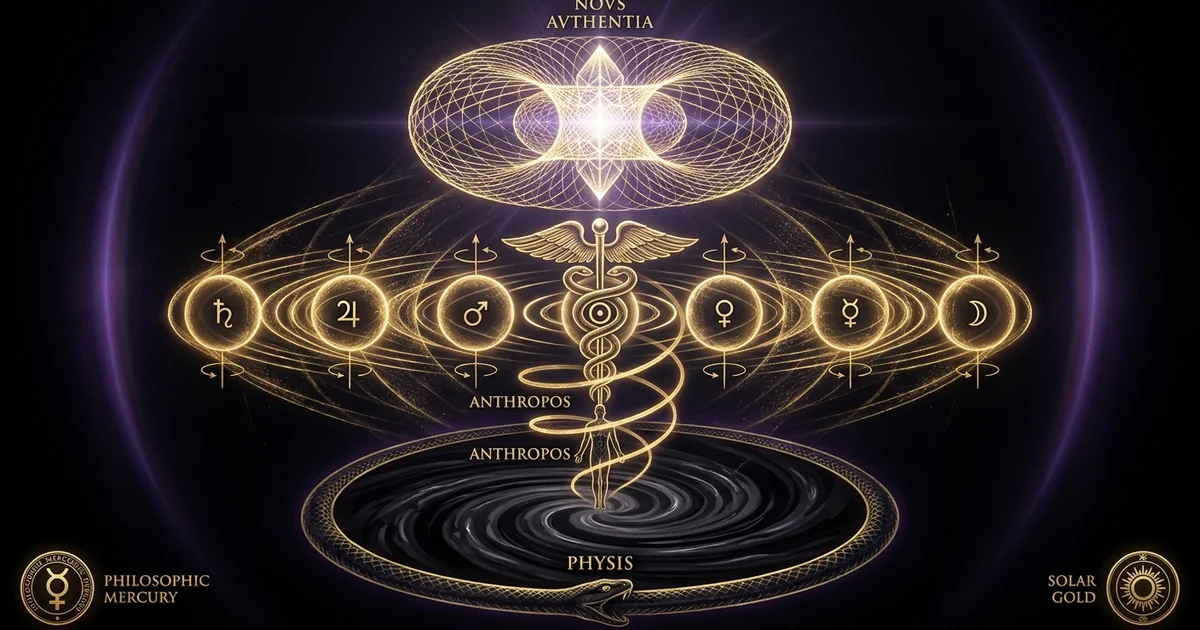
Corpus Hermeticum: Poimandres and the Cosmic Mind Vision
Metaphysical Thesis & Epistemological Opening: The Epiphany of Poimandres
The Dissolution of Sensory Perception and the Vision of Boundless Light
The opening pericope of the Poimandres—the foundational tractate of the Alexandrian compilation known historically as the Corpus Hermeticum—establishes an epistemological rupture with the empirical architectures of Classical antiquity. The text opens not with dialectical deduction or scriptural exegesis, but with a radical phenomenological de-conditioning. Hermes Trismegistus experiences an intentional state of sensory deprivation, wherein bodily sensations are suspended through a profound somnolence described not as ordinary sleep, but as the quietude characteristic of heavy repletion or strenuous physical exhaustion. In this deliberate sensory detachment, the operations of the somatic apparatus are systematically neutralized, clearing the cognitive field of all terrestrial sensory noise. The practitioner’s discursive faculty (dianoia) is stilled, preparing the interior perceptual faculty for the reception of an informational register entirely foreign to somatic materialism.
Upon this somatic suspension, an overwhelming, boundless luminary field materializes: an infinite, serene, and joyful light (phōs apeiron) that precedes the emergence of dimensional space. This is not the biological light of the physical sun, nor an optical excitation of the retinal apparatus, but the unconditioned metaphysical ground of being itself. Within this primal luminosity, Hermes witnesses the initial phase of reality’s generation: an emanational unfolding wherein consciousness precedes material topology. By entering this profound altered state of consciousness, the text asserts that phenomenal reality is not a self-sustaining material absolute, but an informational projection governed by a higher-order cognitive field. The comprehensive guide to these metaphysical principles is mapped within our /spirituality/corpus-hermeticum-complete-guide.
As the visionary encounter deepens, an agonizing counter-reality emerges from the periphery of the light: a downward-tending, chaotic, terrible, and gloomy darkness that coils like a serpent, quickly transmuting into a moist nature of indeterminate turbulence, exhaling smoke and producing an unutterable, inarticulate roar. The sudden juxtaposition of the transcendent light and the abyssal chaos marks the ontological boundary of the manifest universe. This visionary shift illustrates that the material continuum is born at the boundary layer where the luminous information field impinges upon chaotic potentiality, precipitating the structural architectures of the physical cosmos.
UNCONDITIONED LOGOS FIELD
                              │
                    [ Phōs Apeiron / Light ]
                              │
            ┌─────────────────┴─────────────────┐
            ▼                                   ▼
[ Intelligible Archetype ]            [ Indeterminate Chaos ]
 (Luminous Nous/Eidos)                 (Skotos / Moist Physis)
            │                                   │
            └─────────────────┬─────────────────┘
                              │
                              ▼
                 [ Manifest Spacetime Matrix ]
Nous Authentia: The Nature of the Primordial Witness
From the boundless luminosity emerges a non-human cognitive entity of staggering proportions, who identifies itself as Poimandres, the “Mind of Sovereignty” or the “Mind of the Absolute Authority” (Nous tēs Authentias). Poimandres asks the visionary what he desires to hear, see, learn, and know. Hermes replies with the definitive gnosiological imperative: he desires to learn the things that are, to understand their nature, and to know God. In this encounter, the tractate bypasses anthropomorphic deism. Poimandres does not appear as an Olympian deity bound to local mythological narratives, nor as an arbitrary cosmic monarch demanding liturgical submission, but as the cosmic mind itself—an unmediated, self-existent intellect operating as the transcendent substrate of reality.
The epistemological identity of Poimandres recalibrates classical ontology. In identifying as the nous divine intellect alexandria, Poimandres establishes consciousness not as an evolutionary byproduct or epiphenomenon of neurochemical matter, but as the absolute ontological ground. Poimandres declares to Hermes: “I am the Light, the Mind, your God, who existed before the watery nature which appeared out of the darkness, and the luminous Word (Logos) which came forth from Mind is the Son of God.” Through this formulation, the hermes trismegistus revelation asserts that the human subject’s core intellectual agency is inherently identical with the cosmic operating system itself.
The relationship between the seer and the entity is fundamentally non-dual. Poimandres instructs Hermes to hold steadfastly in his intellect whatever he wishes to learn, stating that he himself will instruct him. The medium of instruction is not verbal or auditory in the earthly sense; it is a direct perceptual transfiguration. When Poimandres speaks, the divine form shifts, and in an instantaneous transmission, Hermes is granted an unmediated apprehension of the intelligible universe (kosmos noētos). The revelatory apparatus demonstrates that within the Hermetic paradigm, knowledge is not acquired through the cumulative aggregation of sensory data, but through an ontological alignment with the primordial witness.
Challenging Somatic Materialism through Alexandrian Non-Dualism
The philosophical mechanics operating throughout the Poimandres mount an uncompromising assault on somatic materialism and Epicurean atomism. Classical Hellenistic atomism posited that reality consists solely of corpuscular bodies colliding within an indifferent void, relegating consciousness to an incidental configuration of physical particles. Conversely, the emanational model presented in the corpus hermeticum poimandres shepherd of men cosmic mind tradition inverts this relationship entirely. Physical extension, mass, and elemental differentiation are revealed to be downstream informational densifications of the divine intellect.
The text articulates an emanational monism wherein matter is not an autonomous substance opposing the divine, but a state of relative absence—a shadow cast by the attenuation of the divine light as it projects into indefinite spatiality. The moist nature (hygra physis) that emerges from the darkness represents pure receptivity, entropy, and plastic potentiality awaiting intelligible organization. Light and Darkness do not function as equivalent Dualistic moral substances, as seen in classical Iranian Zoroastrianism or Manichaean cosmologies. Instead, they function as informational poles: the light represents maximum coherence, consciousness, and structural order, while the darkness signifies thermodynamic noise, formlessness, and unconscious mechanical necessity.
By synthesizing Platonic metaphysics with indigenous Egyptian cosmogony, the Alexandrian non-dualism of the Poimandres bypasses the Cartesian split centuries before its formal philosophical emergence. The human mind (nous) is shown to be consubstantial with the cosmic mind (Nous Authentia). Consequently, the somatic body is merely a dense garment (chitōn) worn by the soul during its sojourn within the sensory world, a mechanical interface rather than the seat of selfhood. This radical repositioning of the observing subject challenges the foundational assumptions of ancient and modern materialism alike, demanding a re-evaluation of reality as a recursive, intelligent informational architecture.
A long-standing debate in Hermetic philology concerns the etymology of the name Poimandres (Ποιμάνδρης). Traditionally, Byzantine scribes and Renaissance humanists read the term through classical Greek roots as poimēn (ποιμήν, “shepherd”) and anēr / andros (ἀνήρ / ἀνδρός, “man”), translating the epithet directly as the “Shepherd of Men.” This pastoral interpretation strongly influenced early Christian readings of the text, facilitating its syncretic survival alongside Christian Johannine theology.
However, modern Egyptological scholarship initiated by Richard Reitzenstein in Poimandres: Studien zur griechisch-ägyptischen und frühchristlichen Literatur (1904) and expanded by contemporary philologists offers a deeper, indigenous Egyptian lineage. Reitzenstein demonstrated that Poimandres represents a Hellenized transliteration of the Coptic-Egyptian phrase p-eime-n-re, which translates directly to “The Knowledge of Re” or “The Mind/Witness of the Sun-God Re.” This linguistic derivation fundamentally shifts the ontological landscape of the text: Poimandres is not an idealized pastoral guardian watching over a flock of mortals, but the active, noetic intelligence of the supreme solar architect, manifesting the authentic epistemological core of ancient Egyptian temple theology under the philosophical grammar of imperial Alexandria.
Primary Codices & Historical Transmission: From Alexandria to the Renaissance
The Greco-Egyptian Synthesis in Second-Century Roman Alexandria
The crystallization of the Corpus Hermeticum, and the Poimandres in particular, occurred primarily during the second and third centuries of the Common Era in the cosmopolitan crucible of Roman Alexandria. Following the conquests of Alexander the Great and the subsequent integration of the Ptolemaic Kingdom into the administrative apparatus of the Roman Empire, Alexandria emerged as the central intellectual node of the Mediterranean basin. In this environment, the ancient sacerdotal hierarchy of the Egyptian temples, faced with the slow erosion of their traditional administrative power and hieroglyphic literacy, sought to translate their millennial theological and cosmological doctrines into the universally accessible lingua franca of Hellenistic koine Greek.
Far from being a mere pastiche of popular Platonic or Stoic philosophy masquerading under an exotic Egyptian veneer—a position formerly maintained by early twentieth-century classicists—the Poimandres represents an authentic syncretic combustion. As established by Roelof van den Broek and Wouter J. Hanegraaff (1998) in Gnosis and Hermeticism from Antiquity to Modern Times, the philosophical Hermetica document a living, ritualized esoteric praxis. The priesthood of Thoth (the Egyptian deity of wisdom, writing, measurement, and cosmic equilibrium) mapped their sacred lore onto the metaphysical vocabulary of Middle Platonism, late Stoicism, and Neopythagoreanism.
Within this synthetic environment, the ancient Egyptian cosmological concept of Ma’at (universal cosmic truth, order, and harmony) was structurally reframed within the Platonic conception of the Kosmos Noētos and the Stoic conception of the active Logos. The Egyptian mythos of Thoth creating the universe through the magical, resonant power of his divine voice merged naturally with the Hellenic conceptualization of the generative Logos emerging from the divine Nous. The resulting treatises formed a cohesive body of speculative philosophy and theurgic technique, detailing the mechanics of divine revelation, the mathematical governance of the stars, and the ascent of the soul. For an in-depth examination of these Alexandrian cross-currents, consult our monograph on /ancient-prehistory/alexandrian-syncretism-and-theurgy.
The Byzantine Custodianship: Michael Psellos and the Codex Laurentianus
Following the decline of the Western Roman Empire and the systematic closure and destruction of pagan academies and temples across the Mediterranean under Christian imperial decrees, the physical survival of the Hermetic manuscripts hung by an extraordinarily fragile philological thread. The primary vehicle of preservation shifted eastward to the Byzantine Empire, where scholars preserved Hellenic and Late Antique texts primarily for their rhetorical, lexical, and historical value.
The critical nexus of this transmission occurred in eleventh-century Constantinople under the intellectual leadership of Michael Psellos (1018–1078 CE). Psellos, a polymath, court advisor, and philosopher who catalyzed a profound revival of Platonic and late Neoplatonic studies within the Byzantine court, was intimately acquainted with the Hermetic literature. Although Psellos was constrained by orthodox Christian dogma—leading him occasionally to denounce Hermetic texts for their pagan theurgic and astrological commitments—his deep scholarly engagement ensured their textual preservation and transcription from decaying papyri into durable parchment codices.
The principal witness to this scribal lineage is the famous fourteenth-century Codex Laurentianus (Plut. 71.33), preserved today in the Laurentian Library in Florence. This manuscript contains the first fourteen tractates of the Corpus Hermeticum, beginning with the Poimandres. Scribes working in the direct lineage of Psellos cataloged, organized, and preserved these fourteen operational and philosophical dialogues, protecting them from the destructive upheavals that plagued the twilight centuries of the Eastern Empire. Without this rigorous Byzantine scribal curation, the primary manuscript tradition of the philosophical Hermetica would have been eradicated before the dawn of the Italian Renaissance.
Marsilio Ficino, Cosimo de’ Medici, and the Florentine Rebirth of Hermetism
The decisive watershed moment in the transmission of the Corpus Hermeticum to the Western world occurred in 1460, when a monk named Leonardo da Pistoia, acting as an emissary for the wealthy Florentine patron Cosimo de’ Medici, discovered an intact Byzantine manuscript containing the fourteen treatises of the Corpus Hermeticum in Macedonia. Leonardo transported the codex to Florence, delivering it directly into the hands of Cosimo.
At this precise historical juncture, the young humanist scholar Marsilio Ficino was immersed in translating the complete dialogues of Plato from Greek into Latin at Cosimo’s behest. Recognizing the urgent gravity of the discovery, Cosimo issued an extraordinary command: Ficino was ordered to immediately suspend his translation of Plato and turn his undivided attention to translating the Corpus Hermeticum. Cosimo, sensing his approaching mortality, wished to read the revelations of Hermes Trismegistus before his death.
       [ Leonardo da Pistoia (Macedonia, 1460) ]
                          │
                          ▼
            [ Cosimo de' Medici (Florence) ]
                          │
         Orders immediate translation halt of Plato
                          │
                          ▼
             [ Marsilio Ficino (1463) ]
             (Latin Translation: *Pimander*)
                          │
                          ▼
       [ *Prisca Theologia* / Florentine Renaissance ]
Ficino completed the Latin translation of the first fourteen tractates—which he published under the overarching title Pimander (taking the title of the first treatise to represent the entire collection)—in 1463. As Wouter J. Hanegraaff (2012) thoroughly documents in Esotericism and the Academy: Rejected Knowledge in Western Culture, Ficino’s translation catalyzed an intellectual explosion across Western Europe. Ficino integrated Hermes Trismegistus into his framework of the prisca theologia (the pristine, primordial theology). Believing, along with his contemporaries, that Hermes Trismegistus was an actual historical contemporary of Moses, Ficino posited that the Hermetic revelations formed the pure, uncorrupted root of an unbroken theological chain that flowed through Orpheus, Pythagoras, and Philolaus, culminating in the divine philosophy of Plato.
The Poimandres was celebrated not as a heretical pagan divergence, but as the philosophical fountainhead confirming Christian Trinitarianism, the immortality of the soul, and the divine origin of reality. This paradigm dominated Renaissance thought until the philologist Isaac Casaubon demonstrated in 1614 that the stylistic, linguistic, and doctrinal architecture of the text firmly placed its composition not in the deep antiquity of antediluvian Egypt, but in the post-Christian, syncretic environment of Late Antique Alexandria.
Greek Text (from the edition of A. D. Nock & A.-J. Festugière):
Ἐννοίας μοί ποτε γενομένης περὶ τῶν ὄντων, καὶ μετεωρισθείσης μοι τῆς διανοίας σφόδρα, κατακοιμηθεισῶν μου τῶν σωματικῶν αἰσθήσεων, οὐχ οἵα ὕπνῳ βεβαρημένων ἐκ κόρου ἢ κόπου σώματος, ἔδοξά τινα ὑπερμεγέθη ἀπεριορίστῳ μέτρῳ τυγχάνοντα καλεῖν μου τὸ ὄνομα καί μοι λέγειν· «Τί βούλει ἀκοῦσαι καὶ θεάσασθαι, καὶ νοήσας μαθεῖν καὶ γνῶναι;» […] Καὶ ταῦτα εἰπόντος, ἠλλάγη τῇ ἰδέᾳ, καὶ εὐθέως πάντα μοι ἠνοίγη ῥοπῇ, καὶ ὁρῶ θέαν ἀόριστον, φῶς δὲ πάντα γεγενημένα, ἡδύ τε καὶ ἱλαρόν, καὶ ἠράσθην ἰδών. καὶ μετ’ ὀλίγον σκότος κατωφερὲς ἦν ἐν μέρει γεγενημένον, φοβερόν τε καὶ στυγνόν, ἑλικοειδῶς κατεσπασμένον, ὡς εἰκάσαι με ὄφει […]
Translation (Brian P. Copenhaver, 1992):
“Once, when thought leapt to the things that are and my thinking soared very high and my bodily senses were held back like someone heavy with sleep from too much food or physical fatigue, I thought someone exceedingly large with limitless dimensions happened to call my name and say to me: ‘What do you wish to hear and see, and having thought, what do you wish to learn and know?’ […] When he had said this, he changed his appearance, and in an instant everything was opened up to me. I saw an endless vision, all become light, delightful and serene, and I was pleased with what I saw. After a little while, darkness came to be in part of it, falling downward, fearful and gloomy, coiling like a serpent, as it seemed to me…”
Ontological Architecture & Cosmological Models: The Cosmogenesis of Nous and Logos
The Luminous Word (Logos) and the Archetypal Form
The cosmogonic narrative dictated by Poimandres to Hermes provides an intricate operational model of cosmic manifestation. Manifestation is not instantaneous creation out of absolute nothingness (creatio ex nihilo); it is a hierarchical, informational cascade emerging through sequential emanation. Within the infinite luminary expanse of the primary divine Nous, an active energetic polarity arises. From the radiant Light emerges the Holy Word (Logos), characterized by Hermes as a luminous, non-material fire that leaps out of the moist, indeterminate nature upward toward the pure heights of the intelligible realm.
This Logos is not merely an auditory articulation, but the living, mathematical, and harmonic principle of reality. Poimandres reveals to Hermes that the Logos functions as the son of the supreme Nous: “The luminous Word which came forth from Mind is the Son of God… That which sees and hears within you is the Word of the Lord, but Mind is the Father God. They are not separated from one another, for their union is life.” The Logos acts as an organizing intelligence, an active interface that projects intelligible patterns into the passive, chaotic matrix of the moist nature below.
The structural relationship between the primordial Nous, the archetypal form, and the Logos closely mirrors the metaphysical framework of Platonic ideal form (eidos). Before the sensible universe can materialize, the supreme Nous generates an intelligible, non-spatial archetype (archetypon eidos). The Logos, animated by this archetypal blueprint, descends upon the undulating, chaotic elements. Through this descent, the unformed moist nature is systematically ordered into the foundational cosmic elements: earth, water, air, and celestial fire. The elements do not self-assemble through stochastic, mechanical collisions; they are woven into existence by the geometric and harmonic imperatives projected by the Logos.
The Nous-Demiurgos and the Seven Governors of Fate (Heimarmene)
Following the emergence of the elements, the primary Nous executes a second emanation: the generation of the Nous-Demiurgos—the Mind as Craftsman, the master architect of systemic manifestation. As Brian P. Copenhaver (1992) explicates in his commentary on Corpus Hermeticum I.9, this second Nous is the god of fire and spirit, possessing an operative power distinct from, yet totally dependent upon, the supreme intelligible Father.
The Nous-Demiurgos creates the Seven Governors (hepta dioikētai), cosmic intelligences who contain the sensible world within concentric spheres. These seven planetary spheres represent the archetypal planetary forces known to the ancient world: the Moon, Mercury, Venus, the Sun, Mars, Jupiter, and Saturn. The Seven Governors do not govern in a static, localized manner; their operational architecture is fundamentally dynamic and rotational. The Nous-Demiurgos unites with the luminous Logos, and together they set the concentric spheres of the Governors into perpetual motion.
The ceaseless rotation of these planetary spheres administers the cosmic mechanism known as heimarmene-cosmic-fate. The rotation of the spheres acts as an immense cosmic centrifuge, churning the lower, non-rational elements to precipitate the generational cycles of living entities:
$$\text{Nous-Demiurgos} + \text{Logos} \xrightarrow{\text{Rotation}} \text{Hepta Dioikētai} \xrightarrow{\text{Causality}} \text{Heimarmene}$$
This process draws out the creatures of the earth, the birds of the air, and the fish of the waters. However, these terrestrial creatures are produced devoid of the transcendent nous; they possess merely an animal soul (psyche) driven by instinct, sensory response, and mechanical necessity. They are thoroughly subordinate to the deterministic laws of birth, growth, decay, and death orchestrated by the cyclical movements of the Seven Planetary Governors.
The Informational Mechanics of the Planetary Spheres
The mechanics of the Seven Governors in the Hermetic worldview represent a radical cosmological divergence from contemporary Syrian-Egyptian and Sethian Gnosticism. In Sethian and Valentinian Gnostic architectures, the planetary spheres are ruled by hostile, predatory entities termed Archons—demonic tyrants born of an ontological catastrophe who aggressively imprison souls within somatic flesh to harvest their divine light. The Gnostic relationship to the planetary spheres is one of pure existential warfare and anti-cosmic rebellion, a dynamic analyzed extensively in our study on /spirituality/gnostic-archons-and-cosmic-control.
In direct contrast, the Poimandres advances an intelligible, lawful, and mathematically coherent cosmology. The Seven Governors are not malevolent prison wardens; they are legitimate, divine cosmic ministers executing the programmatic decrees of the supreme Nous. The planetary spheres operate as an intelligible control system, translating the infinite, unconditioned energy of the transcendent Light into finite, measurable increments suitable for spatio-temporal existence. The cosmos of the Poimandres is fundamentally beautiful, harmonic, and purposefully orchestrated, earning the title of the “Second God” (deuteros Theos) throughout the wider Hermetic corpus.
The governance of heimarmene-cosmic-fate is therefore not an arbitrary, malicious curse, but the structural baseline of material thermodynamics. The planetary orbits generate the temporal flow required for matter to undergo evolutionary cycles. Each planetary sphere contributes a particular informational matrix—an ontological tier of traits, physical drives, and physiological conditions—that configures somatic embodiment. Matter without the governance of the Seven Spheres would remain chaotic, formless, and devoid of coherence. The planetary spheres provide the formal framework within which embodiment occurs, serving as the essential crucible for the soul’s terrestrial pilgrimage and eventual realization.
Phenomenological Mechanics & Interdimensional Interaction: The Double Nature of Anthropos
The Descent of the Archetypal Man into Physis
The operational equilibrium of the cosmos undergoes a dramatic, destabilizing shift with the introduction of the Archetypal Human (Anthropos). Following the establishment of the Seven Governors, the supreme Father—who is Life and Light—brings forth an entity made in His own image: the primordial Anthropos. This is not the dust-formed Adam of Genesis, but a purely celestial, immaterial cosmic entity possessing absolute creative authority and non-local awareness. The supreme Father is enamored with His own divine form reflected in the Anthropos and immediately grants the Son full access to the creative operations of the universe.
The Anthropos, desiring to exercise creative generation, enters the demiurgic realm. Passing through the outer spheres of the celestial framework, he enters the operational domain of the Seven Governors. Observing his brother’s creative work, the Anthropos chooses to master the mechanics of the planetary spheres. The Governors, recognizing his superior divine status, love him and eagerly share with him a portion of their own systemic power (dioikēsis). The Anthropos absorbs the planetary signatures, incorporating within his transcendent essence the dynamic capacities of the seven planetary domains.
Emboldened by his authority, the Anthropos leans down through the planetary architecture, breaking through the celestial vault to reveal the divine form to Nature (Physis) below. Gazing through the lower realms, the Anthropos witnesses his own divine reflection cast upon the turbulent waters of the moist nature, alongside his own shadow stretching across the earth. Nature, looking upward, beholds the extraordinary, breathtaking beauty of the Anthropos—an entity carrying within himself the operational powers of the Seven Governors united with the supreme divine form—and is inflamed with erotic love. The Anthropos, looking down and beholding his own reflection in the watery mirror of Nature, falls deeply in love with the reflection and desires to dwell within it.
[ Celestial Anthropos ]
         │
         ▼ (Descends through planetary spheres, absorbs planetary traits)
[ The Celestial Vault / Boundary ]
         │
         ▼ (Breaks through boundary)
    ┌────┴──────────────────────────┐
    ▼                               ▼
[ Nature (Physis) ]           [ Anthropos ]
Beholds form of Anthropos     Beholds reflection in the waters
    │                               │
    └───────────────┬───────────────┘
                    ▼
       [ Mutual Erotic Enmeshment ]
                    ▼
     [ Somatic Embodiment / Mortality ]
The realization of the will is instantaneous: the Anthropos plunges downward into the non-rational realm of Physis. Nature wraps herself entirely around her lover, and they unite in mutual, complete erotic enmeshment. From this ontological collision emerges earthly humanity.
The Somatic Enmeshment: Dual Polarity of Immortality and Mortality
Because of this primordial descent and cosmic union, earthly humanity possesses a unique, agonizingly bifurcated constitution entirely distinct from every other entity in the manifest universe. Poimandres summarizes this existential state to Hermes: “Because of this, unlike any other living creature on earth, man is twofold: mortal because of the body, but immortal because of the essential man.”
Humanity occupies the precise intersection of two contradictory ontological realms. Through the interior, immortal nous, the human being is transcendent, non-local, eternal, and invested with the creative autonomy of the supreme Father. Through the somatic body and its biological substrate, however, the human being is thoroughly bound to the mechanical necessity of heimarmene-cosmic-fate, subject to temporal decay, biological instincts, terrestrial suffering, and physical mortality. This double nature creates an acute psycho-spiritual tension. Humanity is capable of grasping the infinity of the stars and the eternity of the intelligible realm, yet remains physically chained to a terrestrial matrix governed by the cyclical movements of the planetary spheres.
The tragedy of the uninitiated individual lies in the total misidentification with the lower, somatic polarity. Blinded by the physical senses and intoxicated by the passions inherited from the planetary governors during the descent, the unenlightened human believes the somatic body to be the entirety of selfhood. This somatic enmeshment creates an existential amnesia, wherein the immortal essence forgets its celestial lineage, becoming enslaved to the desires, fears, and biological determinism of the lower elements. To achieve liberation, the Hermetic practitioner must realize that the physical body is merely an external garment, an instrumental vehicle for consciousness traversing the dimensional matrix of space and time.
The Poimandric Vision as an Interdimensional Cognitive Interface
Interpreted through the operational models of trans-dimensional phenomena and non-local consciousness research, the encounter between Hermes and Poimandres functions as a high-fidelity interdimensional cognitive interface. As explored within Jacques Vallée’s informational control system framework—detailed in our research on /consciousness/non-human-intelligence-information-control—encounters with non-human intelligences frequently bypass the baseline sensory organs entirely. Instead, they interact directly with the observer’s neuro-cognitive architecture to project complex symbolic scenarios, visionary states, and ontological re-orientations.
The dialogue between Hermes and Poimandres adheres strictly to this informational dynamic. The state of deep trance preceding the vision is an essential calibration step: the sensory noise floor of the physical body must be lowered to allow the delicate informational signals of the high-order intelligence to be registered by the subtle intellect (nous). The manifestation of Poimandres is characterized by what modern ufological and parapsychological literature terms “high strangeness”:
- The collapse of ordinary spatial and temporal parameters,
- The direct telepathic injection of vast cosmological paradigms,
- An ontological shock that fundamentally shatters the observer’s previous baseline reality model.
The entity Poimandres operates as an autonomous, higher-order intelligence mediating the self-disclosure of the universal cognitive substrate. Poimandres acts as an informational transponder, down-stepping the infinite, unconditioned awareness of the Phōs Apeiron into a coherent dialectical framework that the human intellect can process without experiencing neurological destabilization or psychological disintegration. The Poimandres text documents not a theological fiction, but a rigorous, repeatable protocol for initiating an informational interface with the non-human intelligence governing the cosmic control system.
Hermetic Panentheism (Optimism)
- Status of the Cosmos: Regarded as the “Second God” (deuteros Theos), a living, unified organism of absolute mathematical harmony, beauty, and systemic order.
- The Seven Planetary Governors: Divine ministers lawfully executing the will of the supreme Nous; their rotational movements administer necessary cosmic causality (heimarmene).
- The Material Realm (Physis): An erotic partner that embraces the descending Anthropos; matter is a receptive, generative field awaiting divine illumination.
- Origin of Descent: A sovereign, voluntary act driven by the creative impulse of the Anthropos, who desires to emulate the creative agency of the Father.
- Soteriological Objective: Harmonious harmonization with cosmic order, followed by the conscious surrendering of planetary vestures to achieve deification (theosis).
Gnostic Dualism (Anti-Cosmic Pessimism)
- Status of the Cosmos: Regarded as a grotesque, flawed abortion or demonic construct engineered by a blind, illegitimate deity (Yaldabaoth/Demiurge).
- The Seven Archons: Hostile, parasitic entities who actively enslave souls, enforcing fate as an oppressive cosmic prison (heimarmene as predatory malice).
- The Material Realm (Physis): A dense, necrotic prison of suffering and darkness intentionally designed to suppress and harvest the divine luminous sparks (pneuma).
- Origin of Descent: A catastrophic accident (the fall of Sophia) or an act of demonic violence and entrapment against the primordial spiritual light.
- Soteriological Objective: Radical, antinomian escape from the physical cosmos, catastrophic dismantling of the cosmic system, and defiance of the archontic wardens.
Initiatic Synthesis & The Planetary Ascent: The Dynamics of Anabasis
The Systematic De-structuring of the Planetary Vestures
The ultimate soteriological climax of the Poimandres is its systematic, seven-stage protocol for the soul’s post-mortem or initiatic ascent (anabasis). If the original embodiment of the Anthropos was marked by a descent through the celestial spheres—absorbing the specific psychological, behavioral, and somatic energies of each realm—the process of spiritual liberation requires an exact, sequential reversal of that path. Liberation is an active, demanding process of cosmic de-programming, wherein the practitioner systematically strips away the acquired energetic vestures gathered during the descent.
Upon the physical death of the somatic container, the Hermetic practitioner begins the trans-dimensional traverse of the celestial hebdomad:
- The physical body is surrendered to dissolution and returned to the sensible elements.
- The personal life-force and vegetative faculties (to phantastikon and biological desire) dissolve into the elemental ether.
- The conscious ego-soul, purified through the rigorous practice of contemplative gnosis, ascends to the first celestial threshold.
The text outlines the precise planetary zones where the acquired psychic vestures are discarded:
- The Moon (First Zone): The soul surrenders the capacity for increase and decrease—the instinctual, cyclical impulses of biological growth and decay.
- Mercury (Second Zone): The soul surrenders the apparatus of machination, falsehood, and cunning deceit (tēn mēchanēn tou kakou), which previously utilized intellect for selfish manipulation.
- Venus (Third Zone): The soul surrenders the illusion of lust and erotic entrapment (tēn erōtikēn apathēn), freeing the core will from compulsory biological drive.
- The Sun (Fourth Zone): The soul relinquishes the drive for ostentatious dominion, pride, and autocratic ambition (tēn archontikēn philonikian), dismantling the solar ego.
- Mars (Fifth Zone): The soul deposits profane boldness, reckless rashness, and violent aggression (to thrasos to anosion).
- Jupiter (Sixth Zone): The soul surrenders the pursuit of illegitimate wealth, greed, and unjust accumulation (tas aphormas tas kakas tou ploutou).
- Saturn (Seventh Zone): The soul surrenders the insidious falsehood of existential malice, treacherous delay, and systemic sabotage (to enedreuon pseudos).
Through this progressive divestiture, the soul is unburdened of the energetic weight that anchored it to terrestrial determinism. The seven planetary spheres ascent systematically deconstructs the conditioned personality, stripping away the artificial implants imposed by the mechanics of cosmic fate until only the unadulterated, naked core of the divine nous remains.
Reaching the Ogdoad: The Harmonic Restoration of the Soul
Having passed through the seventh planetary gate, the purified soul leaves the turbulent, rotational domain of heimarmene-cosmic-fate entirely. It enters the eighth cosmological realm: the ogdoad, historically associated with the sphere of the fixed stars. In the metaphysical geography of Hellenistic Alexandria, the Ogdoad marks the transcendent frontier of manifest existence, the boundary separating dimensional spacetime from the unmanifest eternity of the intelligible godhead.
In this eighth realm, the soul is not an isolated, alienated monad. It finds itself among the assemblies of the redeemed—the transcendent beings and divine powers who dwell in unceasing praise of the Father. The soul joins its voice to the celestial hymnody, participating in the divine resonance that maintains cosmic balance. Freed from the distortion of somatic senses and the gravitational pull of the planetary governors, the soul experiences an ecstatic, harmonic restoration.
Within the Ogdoad, the perceptual capacity undergoes an ontological mutation. Consciousness is no longer directional, localized, or bound to subject-object dualism. The soul perceives the universe simultaneously from within and without, recognizing all manifested forms as transparent modulations of the singular divine intellect. The stay in the Ogdoad, however, is not the final resting point; it serves as the ultimate transitional threshold where the soul prepares for its final, absolute transfiguration.
       [ Unmanifest Absolute / Supreme Father God ]
                            ▲
                            │
               [ The Divine Powers (Dynameis) ]
                            ▲
                            │
         [ The Ogdoadic Sphere (The Fixed Stars) ]
                            ▲
                            │ (Surrender of 7 Passions)
         [ Seventh Zone: Saturn (Treacherous Malice) ]
         [ Sixth Zone: Jupiter (Unjust Accumulation) ]
         [ Fifth Zone: Mars (Violent Aggression) ]
         [ Fourth Zone: Sun (Autocratic Pride) ]
         [ Third Zone: Venus (Compulsive Lust) ]
         [ Second Zone: Mercury (Cunning Deceit) ]
         [ First Zone: Moon (Biological Fluctuations) ]
                            ▲
                            │ (Physical Death / Initiatic Trance)
             [ Somatic Dissolution / Earthly Realm ]
Theosis and the Radical Transmutation into the Godhead
The absolute culmination of the Poimandric initiatic path is theosis-deification: the complete ontological transmutation of the individual consciousness into the unconditioned Godhead. Poimandres describes the final movement with profound metaphysical economy: rising from the Ogdoad, the souls ascend directly into the divine Powers (dynameis) and, becoming Powers themselves, enter directly into God:
$$\text{Ogdoad} \longrightarrow \text{Dynameis} \longrightarrow \text{Entheosis} \quad (\text{Self} \equiv \text{Nous})$$
“This is the good end for those who possess knowledge: to become God (theōthēnai).”
Hermetic theosis diverges sharply from simple mystical union (unio mystica) as typically conceived in later Western monotheism, where an unbridgeable metaphysical chasm remains between the created being and the sovereign Creator. In the Poimandres, because the human nous was never created ex nihilo, but was generated as a direct emanation of the supreme Father, deification is a recognition and realization of primordial identity. The drop does not merely sit alongside the ocean; it dissolves entirely into the infinite informational ocean of the cosmic mind.
This radical transfiguration completes the recursive cosmological loop of the Hermetic universe. The divine intellect emanated the Logos and the Demiurge, who generated the Seven Governors, who in turn configured the material matrix into which the divine Anthropos descended. Through somatic embodiment, suffering, initiatic awakening, and the deliberate ascent back through the planetary architecture, the fragmented consciousness of the divine returns to itself. The Absolute knows itself through the transformative journey of the human initiate. The Poimandres concludes with Hermes awakening from the vision, saturated with the presence of Poimandres, and immediately commencing his mission to preach to humanity the beauty of gnosis, urging them to cast off the sleep of ignorance and claim their innate immortality.
The Hermetic journey of ascent (anabasis) carries severe metaphysical, psychological, and physiological dangers if attempted without strict ontological equilibrium and ethical integration. The foundational danger is the sudden inflation of the empirical ego, historically diagnosed as megalopsychia or spiritual hubris. When the mortal consciousness encounters the unconditioned power of the Nous Authentia, the discursive mind frequently makes a catastrophic category error: it mistakes the personal, somatic ego for the transcendent Anthropos. This misidentification precipitates profound psychological inflation, megalomania, and spiritual narcissism, severing the practitioner from genuine gnosis and trapping the soul in a solipsistic mirror-matrix far more impenetrable than ordinary somatic materialism.
Furthermore, premature attempts to force the planetary ascent through unguided trance work or unbalanced ascetical rejection of the body disrupt the subtle bio-energetic interface. The physical vehicle and nervous system function as a grounded step-down transformer for the high-voltage informational frequencies of the divine Logos. Severing or damaging this grounding mechanism through unintegrated transcendent techniques induces severe cognitive fragmentation, somatic dissociation, and profound perceptual distortions that mimic psychotic states. Authentic Hermeticism does not demand the violent destruction of the body, but its conscious theurgic transmutation into a clear, grounded temple capable of anchoring celestial light within the terrestrial plane.
Frequently Asked Questions Regarding the Poimandric Vision
Hermeticism versus Gnosticism on Cosmic Fate
A pervasive source of confusion within comparative religious studies is the conflation of the Hermetic and Gnostic orientations toward heimarmene-cosmic-fate. While both movements emerged from the same late antique cultural milieu and utilized common philosophical vocabularies, their fundamental metaphysical postures toward the physical cosmos are diametrically opposed.
In Gnostic systems (such as those preserved in the Nag Hammadi codices), Heimarmene is an entirely adversarial mechanism. It is an artificial, demonic prison-matrix engineered by the Archons to prevent the divine light-sparks from remembering their transcendent origin. The planetary spheres are seen as layers of hostile surveillance, and the material cosmos is viewed as inherently diseased, broken, and irredeemable. The Gnostic strategy is one of radical defiance, dynamic evasion, and anti-cosmic severance.
Conversely, the Hermeticism of the Poimandres maintains a profoundly optimistic, panentheistic worldview. The material cosmos is not an evil dungeon, but the glorious, living body of the “Second God.” The Seven Governors of Heimarmene are legitimate divine agents operating under the direct authority of the supreme Nous. Fate is not a curse, but the structural grammar of physical manifestation—the cosmic order of causes that makes biological embodiment and soul-evolution possible. The Hermetic initiate does not hate the cosmos, but honors it as a divine mirror while recognizing that their ultimate identity transcends the physical architecture. The goal of the Hermetist is not the destruction of cosmic order, but the masterly harmonization of the self with cosmic law, ultimately rising above deterministic fate by activating the sovereign, immortal nous within.
The Historical Identity and Attributions of Hermes Trismegistus
The persona of Hermes Trismegistus (“Hermes the Thrice-Greatest”) represents one of the most complex syncretic figures of Western esotericism. Within the internal mythology of the Hermetic texts, Hermes is presented as an ancient Egyptian sage, prophet, and theurgist who lived in deep historical antiquity—frequently positioned as a contemporary of Moses or an antediluvian king who engraved the secrets of universal wisdom upon stone stelae before the Great Flood. He is titled “Thrice-Greatest” (Trismegistus, from the Greek μέγας καὶ μέγας, μέγιστος) due to his absolute mastery over the three operational domains of universal wisdom: natural philosophy (alchemy and the mysteries of matter), celestial mechanics (astrology and the laws of fate), and divine metaphysics (theurgy and the science of the gods).
Historically and academically, Hermes Trismegistus is recognized as an Alexandrian syncretism between the ancient Egyptian deity Thoth (Djehuty) and the Hellenic god Hermes. Thoth was the Egyptian patron of divine speech, writing, magic, law, and astronomical calculation, who recorded the weighing of the heart in the Duat and maintained the structural balance of the cosmos.
When the Greeks established hegemony over Egypt under the Ptolemaic dynasty, they identified Thoth with their own messenger god, Hermes—the divine conductor of souls (psychopompos) and master of boundaries. In the major cult centers, notably Hermopolis Magna (Khemenu), this synthesis solidified. By the second century CE, Hermes Trismegistus had shifted from an external deity into the archetypal patron of an esoteric scribal and contemplative tradition. The tractates bearing his name were authored not by a single historical prophet, but by a succession of anonymous Greco-Egyptian theurgists and philosophers writing within a shared, rigorously disciplined initiatic lineage.
Epistemological Status of the Visionary Encounter
A critical philosophical question centers on how we are to understand the ontological status of the entity Poimandres: Does the Poimandres describe an encounter with an autonomous, external non-human intelligence, an internalized psychological archetype, or a direct apprehension of non-dual consciousness?
Within the interpretive grammar of modern materialist psychology, the encounter is frequently reduced to an internal projection—an active imagination exercise or a visionary hallucination emerging from the unconscious mind of the ascetic Hermes. In this view, Poimandres is an archetypal manifestation of the Carl Jung’s “Wise Old Man” or the deep Self, externalized through the hypnagogic state induced by sensory deprivation.
However, evaluated through the primary textual evidence of the Corpus Hermeticum and the framework of the interdimensional-hypothesis, this modern psychological reductionism proves fundamentally inadequate. The Poimandres articulates an ontology that completely rejects the modern division between an “internal” psychological reality and an “external” physical world. In the non-dual paradigm of Alexandrian Hermetism, mind (nous) is not localized inside the human skull; rather, the human skull—and the entire physical cosmos—is located inside Mind.
Poimandres represents the objective, autonomous ground of reality itself: the supreme cognitive operating system of the cosmos (Nous Authentia). When Hermes encounters Poimandres, he is not encountering an external, localized “alien” or a secondary “spirit guide,” nor is he hallucinating an internal psychological symptom. He is experiencing the collapse of the illusion of separation. Poimandres is simultaneously the radically transcendent, non-human intelligence that governs the cosmos and the absolute, deep-seated reality of the human being’s own transcendent consciousness. The revelatory state is an informational interface where the localized node of consciousness (Hermes) is brought into radical, coherent synchronization with the universal network (Poimandres), fulfilling the quintessential Hermetic axiom: to know the cosmos is to know oneself, and to know oneself is to realize the living presence of God.
In his foundational study Esotericism and the Academy: Rejected Knowledge in Western Culture (Cambridge University Press, 2012), alongside his contributions in Gnosis and Hermeticism from Antiquity to Modern Times (State University of New York Press, 1998), Wouter J. Hanegraaff challenges the classical intellectualist bias that treated the philosophical Hermetica as mere armchair syncretism. Hanegraaff demonstrates that texts like the Poimandres and the Asclepius record specific, highly articulated technologies of ecstatic consciousness:
“The Hermetic treatises are not simply secondary philosophical syntheses composed by second-rate thinkers, but the textual deposits of an initiatic, experiential methodology. The goal of the Hermetic path was not the passive intellectual assimilation of cosmological dogma, but the direct induction of an altered state of consciousness—gnosis—wherein the practitioner experienced the radical transfiguration of sensory perception. In this state, described consistently as a profound somnolence to bodily senses accompanied by an awakening of the interior divine intellect, the initiate did not merely learn about the cosmos; they experienced an ontological translation into the divine mind, achieving deification through direct intellectual union with the Nous.”