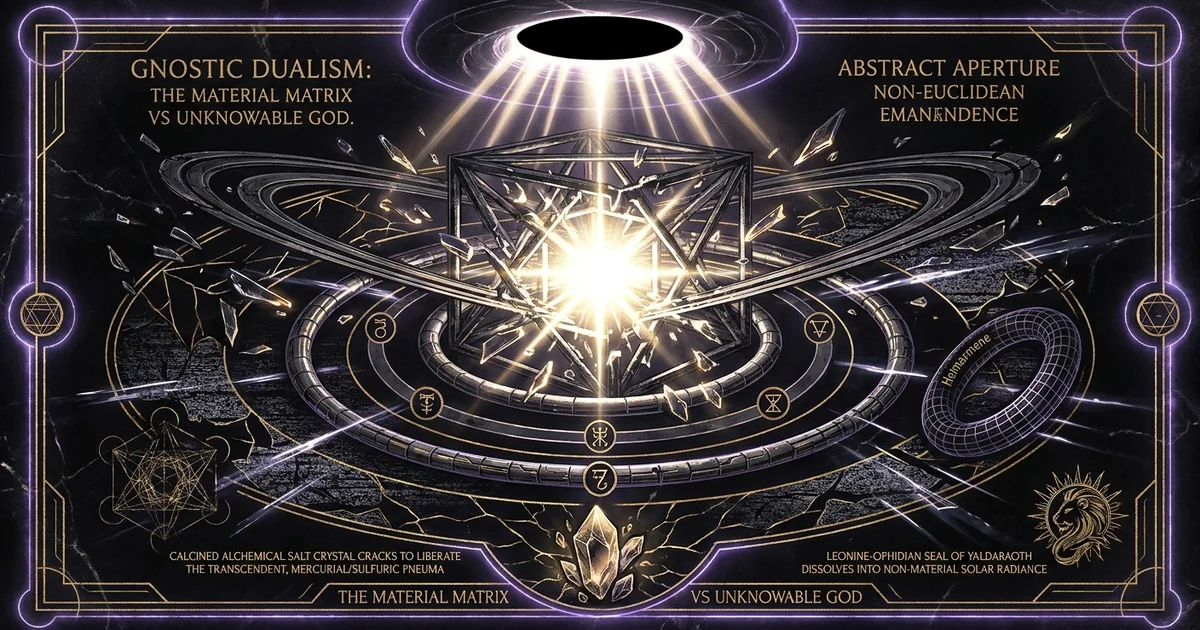
Gnostic Dualism: The Material Matrix vs Unknowable God
Metaphysical Thesis & Epistemological Opening: The Alien God and the Subversion of Kosmos
The Radical Rupture of Apophatic Transcendence
Gnostic dualism constitutes an epistemological and metaphysical rebellion against ontological determinism, framing the material cosmos not as a harmonious divine creation, but as an entropic, archontic simulation engineered through cosmogonic error. Where classical Hellenic philosophy celebrated the kosmos as an ordered, intelligible embodiment of divine proportionality, and Abrahamic monotheism affirmed the innate goodness of creation through fiat lux, the heterodox codices of the second and third centuries introduced an irreconcilable fissure. The supreme divinity within the Sethian and Valentinian frameworks is not an architect, monarch, or ontological ground of worldly being. Instead, this source exists as the Agnostos Theos—the Alien, Unknowable Father—an unbegotten, infinite Monad residing in hyper-dimensional transcendence beyond the lowest vibrations of particulate reality.
This transcendent source bears no kinship with the physical universe. To conceptualize this absolute via the parameters of conventional theology is to commit a category error, for the Father does not possess attributes that can be derived from worldly observation. As Hans Jonas established in The Gnostic Religion: The Message of the Alien God and the Beginnings of Christianity (1958), the Gnostic deity is “alien” precisely because he stands in radical contradiction to everything the cosmos represents: fate, cyclical necessity, decay, and ontological tyranny. Within this operational framework, gnostic dualism material evil spiritual good unknowable father is not merely an ethical dualism of light and dark competing upon a shared board. It is an asymmetric, trans-dimensional dualism between the unconditioned, self-luminous reality of the Pleroma and an illegitimate, defective abstraction known as the material matrix.
The epistemological pathway toward this source demands a rigorous apophatic theology transcendence that surpasses the standard methods of classical philosophy. Apophatic theology in its traditional formulation (the Dionysian via negativa) negates human predicates to elevate the mind toward an incomprehensible yet fundamentally unified creator. In contrast, Gnostic apophasis negates the cosmos itself. The material cosmos is not an imperfect icon pointing upward toward an archetype; it is an epistemological obfuscation, an inverted refraction designed to paralyze awareness. The alien god beyond cosmos can only be intuited through the sudden, catastrophic awakening of an identical spark buried within the psychosomatic human vessel. This revelation renders gnosis an ontological jailbreak rather than intellectual assent to a philosophical system.
The Agnostos Theos (Greek: Ἄγνωστος Θεός) of Sethian and Valentinian metaphysics must be distinguished from the later Neoplatonic Hen (One) of Plotinus or the pseudo-Dionysian via negativa. While classical negative theology posits that God exceeds predicative discourse while remaining the causal source and ontological foundation of the world (causa sui and ordo essendi), Gnostic theology posits the Unknowable Father as Allogenes (radically Other/Alien). The Alien God is not the superlative summit of the cosmic chain of being; he is the complete negation and transcendence of the cosmic order. Consequently, the material universe does not emanate from his will, but from an ontological fracture within the lower aeonic thresholds. Apophatic methodology in Gnosticism does not reconcile the creature to its maker; it deprograms the pneumatic intellect from the linguistic, conceptual, and physical parameters of the demiurgic matrix itself.
The Demiurgic Defect: Subverting Classical Teleology and Hellenic Harmony
By identifying the physical universe as the byproduct of a systemic catastrophe rather than intentional perfection, Gnosticism dismantled the teleological confidence of antiquity. The Greek philosophical continuum—stretching from the Timaean Demiurge of Plato to the Stoic Logos animating the world-soul—viewed the material environment as an ethical mirror. To live in alignment with nature was to participate in rational divinity. Gnosticism reversed this formulation: to live in uncritical alignment with nature is to capitulate to the systemic predation of a blinded subordinate entity known as Yaldabaoth, Saklas, or Samael—the Demiurge.
This cosmogonic defect radically repositions human existence. Humanity is not the harmonious culmination of organic evolution, but an interdimensional anomaly: uncreated light trapped inside an entropic bio-computational container. The laws of nature, far from being the rational ordinances of a loving father, are revealed as cybernetic feedback loops designed to maintain structural homeostasis across the fallen domain. Planetary rotation, celestial orbits, biological food webs, and the karmic cycles of reincarnation do not guide the soul toward maturation; they function as an elaborate containment architecture.
Consequently, equating the cosmos with systemic delusion anticipates contemporary analyses of simulated realities and algorithmic control architectures. In early Gnostic literature, the world is treated as an energetic processing plant where the pneuma (the divine, uncreated spirit) is subjected to systematic amnesia. The Demiurge crafts this theater to mask his own derivative status, projecting a closed informational network that prevents the incarnated spark from recognizing its ultimate origins beyond the Archontic boundary.
Primary Codices & Historical Transmission: Tracking the Heretical Underground
The Coptic Cryptographies: Textual Evidences from Nag Hammadi
The historical preservation of these dualistic topologies remained an intentional target of ecclesiastical erasure for nearly two millennia. Until the December 1945 discovery of the twelve leather-bound papyrus codices and fragments of a thirteenth near the Upper Egyptian town of Nag Hammadi, Western understanding of Gnostic dualism was mediated almost exclusively through the polemical texts of orthodox heresy-hunters. The discovery of these primary Coptic translations—rendered from second-century Greek originals into Sahidic and Subakhmimic dialects—restored the internal coherence of Sethian, Valentinian, and Thomasine theological schools.
Foremost among these recovered witnesses is the Apocryphon of John (Codex II, 1; III, 1; IV, 1; and BG 8502, 2). Operating as an overarching mythological blueprint for Sethian Gnosticism, this codex offers a profound exposition of the emanational architecture of the Pleroma (the divine fullness), the psychological collapse of the Aeon Sophia, and the subsequent construction of the Archontic hierarchy. The linguistic precision of the Coptic text demonstrates that its compilers were not engaging in vague allegorical poetry, but in a technical metaphysical taxonomy. By delineating the precise mechanics through which the pneumatic spark became incarcerated within the physical body, the text functions as an esoteric manual for dismantling mundane reality matrix programming through trans-rational illumination.
A parallel textual current emerges in the Valentinian school, best represented by the Gospel of Truth (Codex I, 3 and XII, 2). Likely composed by Valentinus himself or his immediate circle in mid-second-century Rome, this treatise shifts the cosmological battleground from Sethian mythological drama to a sophisticated psycho-phenomenological plane. The cosmos is diagnosed as an ontological nightmare generated by Plane (Error)—an emergent, self-replicating structural delusion arising directly from the Aeons’ lack of direct acquaintance with the Unknowable Father. The Gospel of Truth explains that matter emerged from ignorance, stabilized through fear, and solidified into a dense, illusory matrix that dissipates like a nocturnal phantasm the moment the pneumatic spark experiences immediate gnosis.
“Now the archon who is weak has three names. The first name is Yaldabaoth, the second is Saklas, and the third is Samael. And he is impious in his arrogance which is in him. For he said, ‘I am God and there is no other God beside me,’ for he is ignorant of his strength, the place from which he had come. And the archons created seven powers for themselves, and the powers created for themselves six angels for each one until they became 365 angels… And he shared his fire with them, but he did not send forth any of the power of the light which he had taken from his mother; for he is ignorant darkness.” — Translated from the Coptic text of Nag Hammadi Codex II, 1
Heresiological Filter Systems: Irenaeus, Hippolytus, and the Politics of Erasure
The survival of these esoteric doctrines required continuous resistance against an imperial ideological apparatus. Beginning in the late second century, patristic heresiologists recognized that the ontological claims of Gnosticism threatened the emergent socio-theological hierarchy of the proto-orthodox Church. Irenaeus of Lyon, in his monumental Adversus Haereses (Against Heresies, c. 180 CE), explicitly perceived that if the physical creation was defective, the authority of the Church as the institutional mediator of the creator god was invalid. Similarly, Hippolytus of Rome, in his Refutatio Omnium Haeresium (Refutation of All Heresies, c. 222 CE), sought to reduce Gnostic cosmology to plagiarized fragments of pagan Greek philosophy, thereby stripping it of its unique initiatic revelation.
These heresiological campaigns operated as an institutional immune response designed to enforce socio-theological conformity. By asserting that the material cosmos was the direct, unmediated work of the supreme God, orthodox polemicists tied salvation to bodily resurrection, biological succession, and imperial hierarchy. As Wouter J. Hanegraaff demonstrates in Esotericism and the Academy: Rejected Knowledge in Western Culture (2012), this systematic marginalization established the historical precedent of designating initiatic, experiential, and non-authoritarian gnosis as dangerous deviance. The eradication of Gnostic texts was accompanied by the execution of their adherents, driving the dualistic ontology into a clandestine underground network.
          [ Sethian / Valentinian Gnosis ]
                        │
                        ▼ (Ecclesiastical Censorship, c. 380 CE)
          [ Subterranean Coptic & Manichaean Channels ]
                        │
                        ▼ (Balkan / Byzantine Transmission)
          [ Bogomil Heresy (10th–12th c.) ]
                        │
                        ▼ (Occitanian Dispersion)
          [ Cathar Movement of Languedoc (12th–14th c.) ]
                        │
                        ▼ (Albigensian Crusade & Inquisition)
          [ Renaissance Hermeticism & Esoteric Underground ]
This dualistic undercurrent refused to dissolve entirely. It navigated subterranean avenues through the Paulicians of Armenia, resurfaced in the Bogomil dualism of the tenth-century Balkans, and reached its political apex among the Cathar Good Christians of Languedoc in the twelfth and thirteenth centuries. The Cathar division between the uncorrupted spiritual realm and the corruptible material world engineered by Rex Mundi directly echoed the cosmology of the Nag Hammadi codices. Despite the systemic extermination wrought by the Albigensian Crusade, the structural core of this metaphysics survived through Renaissance Hermetic-Kabbalistic vectors, ultimately reemerging in twentieth-century depth psychology and anomalistics.
Ontological Architecture & Cosmological Models: Pleromic Fullness versus the Archontic Matrix
Topography of the Pleroma: Syzygies, Aeons, and the Sophia Crisis
To comprehend the Gnostic diagnostic of the material matrix, one must examine the emanational architecture that precedes it. In the Sethian cosmological tradition, the ultimate source is the Invisible Spirit, the Monad, an absolute transcendence beyond being, non-being, time, and space. The Monad does not create through external fabrication; rather, through an internal act of reflective self-knowledge, the Monad emanates Ennoia (Thought), also known as Barbelo, the divine maternal principle. From this initial ontological self-reflection flows the Pleroma—the Fullness—an infinite, luminous realm constituted by paired Aeons organized into complementary masculine and feminine polarities known as syzygies.
These syzygies (such as Nous and Aletheia, Mind and Truth; Logos and Zoe, Word and Life) embody harmonious, non-spatial mathematical proportions of consciousness. Within this transcendent ecosystem, emanation occurs effortlessly without depletion or division, unified through the Autogenes, the self-generated divine logos. However, this pleromatic harmony experiences a systemic rupture at the lowest perimeter of its emanational cascade. The youngest Aeon, Sophia (Wisdom), experiences an anomalous desire to comprehend the incomprehensible depth of the ultimate Father without the participation of her paired syzygy (Theletos, Will).
This unilateral creative impulse disrupts pleromatic equilibrium. Sophia’s unauthorized act of manifestation causes an ontological miscarriage. Unable to integrate her self-generated product into the balanced totality of the Pleroma, she projects it outward beyond the divine veil. This aborted entity, cast out into the unformed, chaotic regions of the outer abyss, retains a stolen portion of Sophia’s pleromatic light. This deformed, hybrid being—depicted iconographically as a lion-faced serpent with eyes of flashing fire—is Yaldabaoth, the first Archon, who blindly believes himself to be the sole and uncaused supreme divinity.
The Mechanics of Kenoma: The Seven Archons and Planetary Determinism
The domain over which Yaldabaoth presides is not the Pleroma, but the Kenoma—the Void, the realm of absolute deficiency and structural lack. Lacking the contemplative balance of the higher Aeons, the Demiurge immediately engages in a crude, exteriorized mimicry of the pleromatic order he faintly remembers. From the abyssal waters of matter, he consolidates an energetic dominion and generates twelve Archontic powers, seven of whom are set over the seven planetary spheres of ancient geocentric astronomy, while five govern the chaotic subterranean realms.
These seven planetary Archons (often identified with names derived from corrupted Hebrew designations of divinity: Athoth, Eloaios, Astaphaios, Yao, Sabaoth, Adonin, and Sabbede) function as cosmic gatekeepers. They forge Heimarmene—the relentless mechanism of astral fate, biological determinism, and linear causality. Within this paradigm, the physical universe is an informational containment matrix designed to prevent the pneumatic energy extracted from Sophia from escaping back to its pleromatic source. By binding human consciousness to planetary configurations, genetic inheritances, and somatic drives, the Archons construct an enclosed entropic loop.
+--------------------------------------------------------------+
|                    THE PLEROMIC FULLNESS                     |
|           (Monad, Barbelo, Aeons, Perfect Syzygies)          |
+--------------------------------------------------------------+
                               ||
                   [ Sophia's Anomaly / Fall ]
                               ||
+--------------------------------------------------------------+
|                 THE ARCHONTIC BARRIER (HOROS)                |
+--------------------------------------------------------------+
                               ||
+--------------------------------------------------------------+
|                          THE KENOMA                          |
|  [Saturn]   Kronos/Yaldabaoth  -> Structural Rigidity        |
|  [Jupiter]  Yao                -> Authoritarian Control      |
|  [Mars]     Sabaoth            -> Conflict & Aggression      |
|  [Sun]      Adonaios           -> Dazzling Illusion / Ego    |
|  [Venus]    Astaphaios         -> Desiring Attachment        |
|  [Mercury]  Aisepheos          -> Linguistic Deception       |
|  [Moon]     Oraios             -> Lunacy, Tides & Somatics   |
+--------------------------------------------------------------+
                               ||
+--------------------------------------------------------------+
|               HYLIC MATRIX: SUBLUNARY PRISON                |
|              (Soma-Sema, Entropic Time, Decay)               |
+--------------------------------------------------------------+
The physical cosmos is therefore not constructed out of nothing (creatio ex nihilo), but synthesized from stolen pleromatic light encoded into dense particulate matter. Every biological organism, planetary mass, and energetic wavelength in the sublunary realm operates as a kinetic lockbox. The human body (soma) is diagnosed in texts like the Hypostasis of the Archons as a tomb (sema), an intricate biomechanical shell carefully calibrated to induce psychological amnesia. Through the ceaseless cycle of hunger, fear, reproductive drive, and mortality, the Archontic apparatus ensures that the imprisoned pneuma remains transfixed by the illusions of the matrix, mistaking the structural deficiency of the Kenoma for the totality of existence.
Phenomenological Mechanics & Interdimensional Interaction: The Archons as Cybernetic Parasites
Biopolitical and Psycho-Informational Parasitism
The operational mechanics of the Archons are not solely macro-cosmological; they are intensely psychological and biopolitical. In primary Gnostic discourse, the Archons do not rule exclusively through physical force. They maintain their dominion through psycho-informational interference, infiltrating human cognition via the antimimon pneuma—the counterfeit spirit. This counterfeit spirit is an artificial, auxiliary consciousness stitched into the human psyche, operating as an internalized regulatory agent that amplifies egoic terror, guilt, sexual compulsion, and ideological fanatical zeal.
Through this cognitive distortion, the Archontic hierarchy establishes an informational feedback loop. Human beings, seduced into identifying exclusively with the psyche (the lower emotional-mental apparatus) and the hylic (physical) body, generate endless cycles of psychological and societal entropy. Texts such as the First Apocalypse of James depict the Archons as toll collectors (telonai) who intercept souls during somatic transition, yet their parasitism is deeply active during waking biological life. They feed upon the misdirected vitality of the imprisoned divine light, drawing energetic sustainment from the fear, despair, and territorial slaughter generated by human societies trapped within the parameters of biological determinism.
By governing the linguistic, cultural, and theological assumptions of humanity, the Archons construct an epistemological panopticon. Religions that glorify the creator god, political ideologies that enforce collective sacrifice for the state, and socio-economic imperatives centered on survival and material accumulation all function as systemic extensions of the Archontic will. The human being is transformed into an energetic resource, harvesting and processing pleromatic power solely to sustain the matrix that imprisons it.
Archontic Hegemony (Nag Hammadi)
- Origin: Accidental byproduct of Sophia’s fall; entities generated in the dark void of the Kenoma.
- Dimensionality: Inhabit planetary and astral spheres operating between the material sublunary plane and the Pleroma.
- Mechanism of Control: Fabrication of Heimarmene (astral fate), the antimimon pneuma (counterfeit spirit), fear-based theology, and biological amnesia.
- Primary Effect on Human Consciousness: Induces cognitive sleep, historical fixation, territorial conflict, and complete identification with the physical body (hylic consciousness).
- Liberation Vector: Experiential awakening of the inner pneuma via direct Gnosis; apophatic detachment from cosmic programming.
Interdimensional Control System (Vallée/Anomalistics)
- Origin: Non-human intelligence (NHI) operating from an orthogonal, interdimensional continuum parallel to our space-time framework.
- Dimensionality: Manipulates physical spacetime metrics, appearing transiently across electromagnetic and sensory spectra.
- Mechanism of Control: Deployment of high-strangeness phenomena, absurd mythological projections, deceptive religious apparitions, and socio-cultural conditioning loops.
- Primary Effect on Human Consciousness: Regulates human cultural evolution through myth-making, absurd encounters, and reality-distortion, preventing cognitive sovereignty.
- Liberation Vector: Rigorous deconstruction of the phenomenon’s symbolic deception; meta-cognitive immunity against narrative control.
Jacques Vallée’s Control System Hypothesis Applied to Archontic Manipulation
This ancient diagnosis of cosmological manipulation intersects directly with modern anomalistics, particularly the interdimensional hypothesis formulated by computer scientist and astrophysicist Jacques Vallée. In seminal works such as The Invisible College: What a Group of Scientists Has Discovered about UFO Influences on the Human Race (1975), Vallée rejected the simplistic extraterrestrial hypothesis (ETH) in favor of an informational control system hypothesis. Vallée demonstrated that non-human intelligences (NHI) have interacted with humanity throughout recorded history, perpetually altering their symbolic camouflage to match the cultural expectations of each historical epoch: appearing as angels, demons, fairies, and, in modern times, technological spacecraft and alien entities.
The convergence between Vallée’s cybernetic control model and the Gnostic phenomenology of the Archons is striking. In both paradigms, the anomalous phenomenon does not originate from a distant planetary system within our physical space-time metric. Rather, it originates from an adjacent, interdimensional threshold capable of modulating human neural networks, physical senses, and historical narratives. The high-strangeness manifestations documented by Vallée—telepathic manipulation, missing time, screen memories, and deceptive theater engineered to elicit profound psychological surrender—replicate the mechanisms attributed to the Archons in the Hypostasis of the Archons and the Tripartite Tractate.
   [ ARCHONTIC / INTERDIMENSIONAL SOURCE ]
                     │
                     ▼ (Cultural / Sensory Camouflage)
    ┌────────────────┬────────────────┬────────────────┐
    │ Antiquity:     │ Medieval:      │ Modern:        │
    │ Planetary Gods │ Demons/Faeries │ UFOs / Extraterrestrials
    └────────────────┴────────────────┴────────────────┘
                     │
                     ▼ (Psychic & Neurological Infiltration)
    [ Altered States, Screen Memories, Dogmatic Illusions ]
                     │
                     ▼ (Societal Feedback Loop)
    [ Cultural Reinforcement of Material Determinism (Heimarmene) ]
When evaluated through Vallée’s cybernetic framework, religious apparitions and modern alien abductions can be deconstructed as modern expressions of archontic camouflage. The Archons operate as reality programmers. Their objective is not physical extermination, but cognitive homeostasis: ensuring that humanity remains within a strictly modulated band of perception and ideology. The experience of high-strangeness destabilizes human consensus reality, but does so in a manner that repeatedly leads human consciousness into new mythological labyrinths—diverting attention away from the unconditioned divine spark and locking the mind within a revised iteration of the material matrix.
Initiatic Synthesis & Philosophical Implications: The Trans-Dimensional Jailbreak
Anamnesis: The Awakening of the Pneumatic Spark
Faced with this totalizing architecture of control, Gnosticism posits a soteriological mechanism that bypasses conventional religious structures entirely: anamnesis, the radical remembering of the uncreated pneuma. Salvation in the Gnostic paradigm is not achieved through ritual propitiation, moral bookkeeping, or dogmatic compliance with ecclesiastical dictates. These exterior mechanisms belong wholly to the domain of the Demiurge and his Archontic servants. True liberation requires the experiential realization that the core of the self is uncreated, co-substantial with the supreme Pleroma, and utterly unassailable by the mechanics of the material matrix.
This awakening process demands dismantling mundane reality matrix constructs at the neurological and psychological levels. In the Valentinian framework, the human organism contains three interactive components: the hyle (the material body, bound to entropy), the psyche (the emotional and intellectual apparatus, conditioned by the Archons), and the pneuma (the dormant seed of pleromatic light). The vast majority of humanity lives in a hylic or psychic state of existence, processing reality solely through sensory data and linguistic constructs provided by the Demiurgic architecture.
The spark awakens through direct intervention—a transmission of light from the higher Aeonic spheres, often personified as the descent of the Logos or the awakeners like Seth, Sophia, or the Pneumatic Christ. The awakening initiates an immediate rupture: the subject realizes that their true identity is alien to this cosmos. The physical body and the psychological personality are recognized as disposable vehicular components. The pneumatic spark, now disidentified from its biological container, reclaims its inherent sovereignty over the cosmos, terminating the psychological authority of Heimarmene.
The intellectual assimilation of Gnostic dualism carries significant psychological and metaphysical risks. Chief among these is the trap of ‘hylic contempt’—a weaponized misanthropy wherein the practitioner succumbs to acute psychological inflation, viewing non-awakened humanity as soulless bio-automata and the physical environment with hostile disgust. This reactive posture is an Archontic snare. Totalizing paranoia, conspiratorial psychosis, and schizotypal detachment from reality do not liberate the pneumatic spark; they merely shift human consciousness into an inverted psychological loop governed by fear and alienation. True pleromatic awakening transcends hyper-dualist opposition through radical, dispassionate neutrality. The objective is not somatic loathing, but the compassionate realization that all matter is an encoded cry of Sophia awaiting re-integration into the unconditioned Source.
Theurgy, Dissolution of Heimarmene, and Ontological Sovereignty
The deprogramming of the pneumatic spark demands practical initiatic disciplines designed to dissolve the power of astral determinism. These practices do not consist of classical theurgical invocations that supplicate cosmic powers; rather, they involve apophatic meditation, ascetic disidentification, and the strategic mastery of esoteric names and passwords designed to neutralize the Archontic gatekeepers during post-mortem ascents.
As recorded in the First Apocalypse of James (NHC V, 3), the pneumatic initiate is instructed in the exact linguistic formulas required when confronted by the celestial gatekeepers:
“Say to them: ‘I am a son from the Father, the pre-existent Father, and a son in the pre-existent one… I come from the Pre-existent One, so that I might go to my own place from which I came.’”
By declaring ontological equality with the unbegotten Father, the soul neutralizes the Archons’ authority. The passwords operate not as magical incantations, but as metaphysical declarations of zero ontological debt to the Demiurgic hierarchy. The soul owes nothing to the matrix; it was not created by it, it does not belong to it, and it cannot be held by it.
This experiential realization transfigures the dualistic paradigm. While the journey begins with an acute, often agonizing recognition of the material world as an entropic prison, the completion of gnosis reveals that the Kenoma has no independent ontological existence of its own. It is an ephemeral shadow cast by the lack of direct acquaintance with the Father. In this hyper-dimensional realization, the Gnostic trajectory culminates not in permanent dualism, but in a restored non-dual completeness. The pneumatic spark re-enters the Pleroma, returning the stolen light to its source and thereby participating in the healing of the cosmic wound inaugurated by Sophia’s initial descent.
Frequently Asked Questions: Metaphysical and Scholarly Clarifications
Resolving Cosmological Paradoxes
To comprehend Gnostic metaphysics requires untangling several deep paradoxes that have perplexed scholars, theologians, and seekers for two millennia. Chief among these is the relationship between the Unknowable Father and the existence of systemic evil within the lower matrix.
If the Unknowable Father is omnipotent, how could Sophia fall, and why does he permit the Demiurge to torture humanity?
The paradox dissolves once the assumption of classical theological omnipotence is discarded. The Agnostos Theos is not an imperial sovereign governing an external territory through micro-managerial interventions. The Father is infinite, unconditioned potentiality and self-luminous contemplation. The Aeonic emanations are organic dimensional self-differentiations, not mechanical fabrications.
Sophia’s fall was not an act of moral rebellion, but an epistemic reaching beyond the boundaries of her own structural position within the Pleroma. The Father does not “permit” the Demiurge to rule in an ethical sense; rather, the material cosmos exists in an ontological void (Kenoma) outside the direct perception of the Pleroma. The Pleroma cannot directly interface with chaotic matter without instantly dissolving it back into pure potentiality. Therefore, the divine intervention must occur asymmetrically: by injecting the seed of the pneuma into the human vessel, the Pleroma plants a decentralized Trojan horse within the heart of the matrix, destined to dismantle the architecture from within.
What distinguishes Gnostic dualism from Persian Manichaeism or Zoroastrianism?
Classical Iranian dualism (such as Zoroastrianism) is strictly symmetrical and co-eternal: Ahura Mazda (Light) and Angra Mainyu (Darkness) are two independent, primordial forces locked in an ontological war upon the field of physical existence. Manichaeism, while historically influenced by Gnosticism, preserved this radical symmetry between two absolute, primordial realms of equal ontological weight.
In contrast, Syrian-Alexandrian Gnostic dualism (Sethian and Valentinian) is fundamentally asymmetrical and emanational. Darkness is not a co-eternal substance; it is an emergent absence, an ontological defect arising from the lower periphery of light. The Demiurge is not a primordial anti-god; he is a derivative, ignorant byproduct of an Aeonic error who is doomed to dissolution the moment his stolen light is recalled to the Pleroma.
“The Gnostic dualism is not an original one between two equally eternal, independent principles, as is the Persian dualism of Light and Darkness… It is an emanational, derivative dualism in which the lower principle, the dark and material realm, is a late and degenerate outcome of the higher one, originating in a rupture, a fall, a descent within the divine realm itself. The universe is not a co-equal battlefield, but an illegitimate, temporary projection of an inner-divine crisis.” — Hans Jonas, The Gnostic Religion: The Message of the Alien God and the Beginnings of Christianity (Beacon Press, 1958, p. 54)
Hermeneutics of Cosmic Rejection versus Modern Ecological Nihilism
A critical scholarly misunderstanding is the conflation of Gnostic cosmic rejection with contemporary ecological nihilism or techno-transhumanist contempt for the Earth. The Gnostic diagnosis of the physical world as a defective matrix was not an endorsement of industrial exploitation or careless ecological destruction. It was an acute, early phenomenological critique of human alienation within an institutionalized, fallen reality.
       [ MODERN NIHILISM ]                 [ GNOSTIC ESOTERICISM ]
               │                                      │
               ▼                                      ▼
   The Earth is meaningless,               The cosmos is an entropic
   accidental, and dead matter.            matrix containing imprisoned
   Exploitation is permissible.            divine light (Sophia's tears).
               │                                      │
               ▼                                      ▼
   Despair or Technological                Compassionate Deprogramming:
   Extravagance (Transhumanism)            Liberating the Pneuma via Gnosis
When Gnostic texts refer to the material cosmos as a “corpse” or a “tomb,” they are diagnosing the state of a reality severed from its pleromatic source—a realm of ceaseless predation where life survives solely through the systemic consumption and slaughter of other life. The Gnostics recognized that nature, under the regime of the Demiurge, is structurally predatory. The modern sentimentalization of nature as a peaceful eden obscures the profound entropy and suffering built into the biological architecture itself.
The Gnostic does not hate the natural world out of spite; rather, they experience a profound, cosmic mourning for the light trapped within it. Matter is viewed as the crystallized tears of Sophia. The path toward ontological sovereignty does not involve the violent subjugation of the planet, but an initiatic de-coupling from the archontic behavioral scripts—greed, territoriality, and fear of death—that keep human civilization bound to the entropic machinery of the Kenoma. By awakening the inner pneumatic spark, the human being ceases to be a functional node within the archontic control system, acting instead as a walking point of pleromatic restoration.