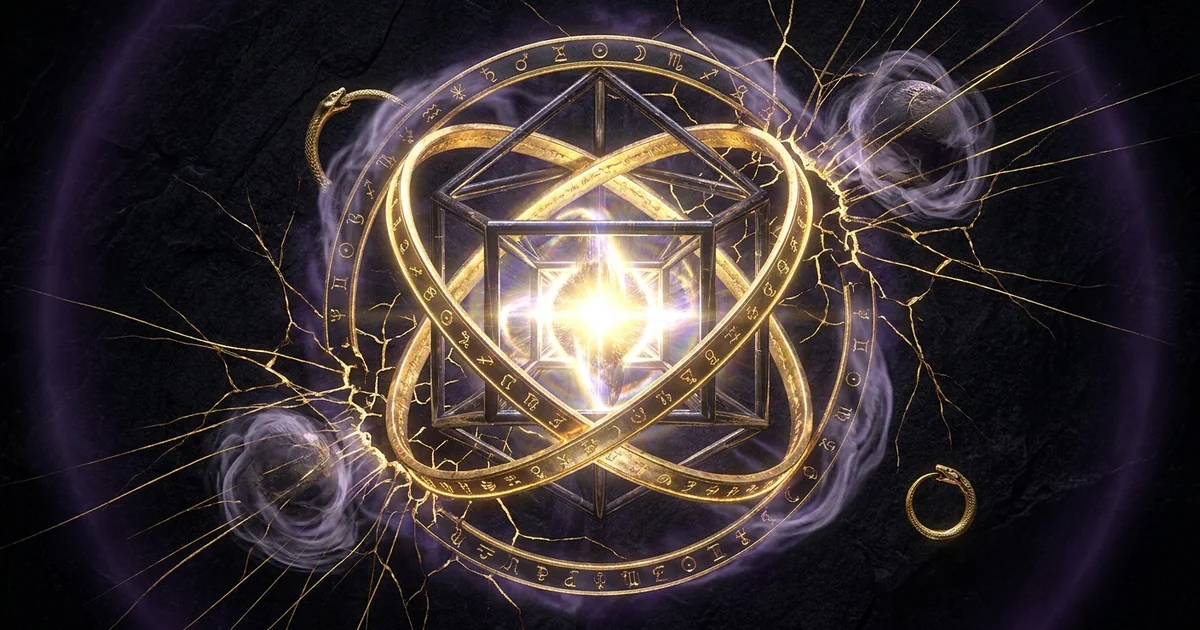
The Divine Spark Pneuma: Unveiling the Inner Light Seed
Metaphysical Thesis & Epistemological Opening: The Uncreated Spark within the Hylic Labyrinth
The Primordial Rupture and the Extraction of the Pleromatic Seed
The foundational postulate of classical Gnostic cosmogony asserts that the human condition is characterized not by moral culpability or evolutionary incompletion, but by structural displacement. At the core of the human hypostasis resides the divine spark (pneuma), an uncreated, self-luminous fragment of the transcendent Fullness (Pleroma). This pneuma is utterly alien to the quantitative parameters of the material cosmos (kenoma). The cosmological crisis detailed throughout the Nag Hammadi library does not originate from an earthly infraction, but from a primordial rupture within the divine hierarchy: the un-consorted emanative descent of Sophia (Wisdom). Her unilateral attempt to comprehend the unnameable Monad generated an anomalous, formless abortion of consciousness—the Demiurge (Yaldabaoth, Saklas, or Samael).
In his profound blindness and ontological vanity, the Demiurge fashioned a sub-celestial machinery of archontic spheres, unaware that the creative dynamic animating his craftsmanship was derived entirely from the pleromatic light stolen from his mother. In the subsequent anthropological crisis, this stolen spiritual essence was breathed into the proto-human vessel, Adam. Consequently, the divine spark pneuma gnostic inner luminous seed spirit awakening represents an ontological event: the sudden realization that the innermost core of human interiority does not belong to the cosmic architect. The pneuma is a trans-dimensional deposit, an extraterritorial seed of the infinite Monad lodged within the dense layers of a counterfeit realm.
To prevent ontological category errors, a strict metaphysical differentiation must be maintained between classical theological designations of soul and spirit:
- Pneuma (πνεῦμα - Gnostic/Pauline): Strictly uncreated, transcendent, and non-cosmic. It originates beyond the Demiurgic cosmos and maintains zero substantial continuity with the physical, energetic, or lower psychological structures of the created world.
- Ruach (רוּחַ - Hebraic): The dynamic divine breath animated by Yahweh/Elohim, functioning as an operative vital force within creation, historically distinct from the uncreated, anti-cosmic Gnostic pneuma which fundamentally opposes the authority of the Hebrew lower creator.
- Psyche / Nephesh (ψυχή / נֶפֶשׁ): The intermediate energetic, emotional, and cognitive envelope. In Gnostic anthropology, the psyche is entirely fabricated by the seven planetary archons; it is a created matrix designed to mediate somatic survival and bind the pneuma to material fate (heimarmene).
- Atman (आत्मन् - Vedantic): While structurally similar to the uncreated spark, classical Advaita Vedanta posits the identity of Atman with Brahman as the ultimate substratum of both reality and cosmic illusion (Maya). The Sethian Gnostic pneuma, conversely, stands in radical opposition to the kenoma—the cosmic system is not a mere benign pedagogical illusion (lila), but a predatory informational cage requiring escape.
Epistemological Incommensurability: Pneuma Versus Psyche in Classical Ontology
To comprehend the operational mechanics of the pneuma, one must disentangle discursive intellect from uncreated spirit. The Gnostic anthropological topology establishes a tripartite division: the material body (hyle), the psychic vehicle (psyche), and the spiritual spark (pneuma). Classical philosophy, particularly through the Platonic and Aristotelian trajectories, elevated the nous or the rational psyche to the pinnacle of human capacity. For the Gnostic metaphysician, however, the psyche remains an archontic fabrication. It comprises the linguistic software, emotional reactivity, ideological conditioning, and biological instinct necessary to govern the human organism within the lower terrestrial theater.
The rational intellect functions entirely through dialectical opposition, sensory empiricism, and temporal sequence. Because the psyche is generated by the astral rulers, its epistemology is intrinsically bounded by the laws of the Demiurgic architecture. It cannot conceive of an ontological state prior to its own creation. Pneuma, conversely, is suprarational and unconditioned. Its epistemological modality is not discursive speculation or programmatic belief (pistis), but immediate, non-local self-realization (gnosis). The tragedy of the unawakened human is precisely that the spark is trapped in material garment soma sema (the body as tomb), perpetually mistaking the operational currents of the psyche—the egoic construct, psychological grief, socialized identity—for its essential being.
[ Uncreated Pleroma: Alien Monad ]
              |  (Transcendent Pneuma)
              v
[ Kenoma: Demiurgic Informational Filter ]
        |             |
        v             v
  [ Psyche: Ego ]  [ Hyle: Soma ]
Deconstructing Hylic Determinism via Non-Local Realism
From the vantage point of contemporary metaphysics and foundations of physics, the pneuma can be modeled as a non-local singularity embedded within a deterministic macroscopic lattice. Hylic determinism asserts that consciousness is purely an epiphenomenon of neurochemical computations—a materialist reductionism that serves as the modern ideological heir to archontic philosophy. By viewing the physical plane as an informational matrix whose parameters are fixed by mathematical constants and thermodynamic decay, hylic science naturalizes human imprisonment.
Reconceiving the pneuma through non-local realism exposes the physical cosmos as an insubstantial, localized projection. If the ground of consciousness originates beyond space-time, the spark is not subject to physical entropy or the celestial mechanics of causality. In the frameworks of /consciousness/monadic-emanation-non-dual-ontology, the primordial emanation precedes the generation of geometric dimensionality. The pneuma functions as an ontic puncture point within the vacuum of the material universe, linking the individualized observer directly to the unmanifest Source, bypassing the deterministic scaffolding of the intermediate cosmic machinery.
Primary Codices & Historical Transmission: Tracing the Luminous Trace from Antiquity to Renaissance Hermeticism
The Nag Hammadi Witnesses: Sethian and Valentinian Accounts of Incarceration
The primary textual witnesses to this pneumatic anthropology survived the centuries through the 1945 discovery of the Coptic library at Nag Hammadi. Within the Sethian masterpiece, the Apocryphon of John (NHC II,1), the dynamics of somatic incarceration are laid bare with forensic clarity. After the Demiurge Yaldabaoth and his subordinate rulers construct the physical frame of Adam out of the elemental densities of matter, the figure remains inert, incapable of standing. In a cosmic stratagem orchestrated by the higher divine hierarchy, Sophia induces Yaldabaoth to blow his own breath into Adam’s face.
“And he blew into his face something of his spirit, which is the power from his mother; he did not know it, for he lives in ignorance. And the power of the mother went out of Yaldabaoth into the psychic body which they had formed according to the image of the one who exists from the beginning. The body moved and gained strength, and it was luminous. And right away, the rest of the powers became jealous, because he had come into being through all of them, and they had given their power to the man, and his intelligence was greater than that of those who had made him, and greater than that of the chief ruler.”
This moment marks the metaphysical tipping point: the created artifact surpasses its creator through the internal presence of the mother’s light-power. The archons immediately realize that Adam shines with a superior luminosity and possesses an intelligence exceeding their own. Their reaction is instantaneous and punitive: they cast him down into the lowest depths of matter and fashion the physical, mortal garment—the corruptible flesh—specifically to encase, dampen, and amnesiate this superior pneumatic power.
A parallel current emerges within Valentinian literature. In The Gospel of Truth (NHC I,3), attributed to Valentinus or his immediate circle, material existence is characterized as an agonizing nightmare born of Agnoia (Ignorance) and Planē (Error). Here, the somatic vessel is depicted not merely as biological clay, but as a state of deep, induced amnesia. The Demiurgic cosmos resembles a hall of mirrors wherein the divine spark, suffering from cosmic vertigo, forgets its pleromatic ancestry. Liberation is described not as moral penance, but as awakening from a fever dream: the moment the liberation through gnosis direct knowledge occurs, the phantom architectures of the material cosmos dissolve into ontological nothingness, revealing the inner light that was never truly extinguished.
The Patristic Heresiological Filter: Irenaeus, Hippolytus, and Epiphanius
To construct a unified ecclesiastic hierarchy subservient to imperial politics, the Patristic heresiologists waged an ideological war against Gnostic pneumatic anthropology. In Adversus Haereses (c. 180 CE), Irenaeus of Lyon systematically distorted the Valentinian doctrine of the tripartite human nature, casting it as fatalistic moral predestination. Irenaeus claimed that the Gnostics viewed themselves as naturally saved by nature (physike soteria), regardless of their ethical actions, while consigning ordinary churchgoers (the psychics) to a precarious dependency on works and faith, and the rest of the world (the hylics) to inevitable annihilation.
Hippolytus of Rome, in his Refutatio Omnium Haeresium, and Epiphanius of Salamis, in his vitriolic Panarion, deepened this polemical caricature. They transformed a subtle ontological topology—which measured an individual’s conscious proximity to the uncreated ground—into an elitist moral caste system. This intentional misrepresentation served an institutional agenda: by denying that every human harbored an uncreated, divine spark that could access the transcendent Source without institutional mediation, the orthodox authorities successfully centered the Church as the sole distributor of salvation. The heresiological crusade systematically crushed pneumatic autonomy to establish an ecclesiastical monopoly that required obedience to the earthly representatives of the Demiurgic structure.
Hermetic Counterparts: Poimandres and the Descent of the Anthropos
The revelation of the inner light was not confined to Christian-adjacent Gnostic sects; it resonated across the broader Hellenistic esoteric underground, finding articulate expression within the Corpus Hermeticum. In the foundational treatise Poimandres (CH I), we encounter a structural parallel to the Sethian mythos that Wouter J. Hanegraaff underscores in Gnosis and Hermetic Philosophy in Western Esotericism. Here, the divine Mind (Nous) generates the Demiurgic Nous-Demiourgos, who crafts the seven planetary spheres. Concurrently, the Father generates the archetypal Man (Anthropos), co-equal in power, luminosity, and authority.
Entranced by the beauty of the celestial architecture, the Anthropos breaks through the planetary spheres to gaze down upon Nature (Physis). Seeing his own luminous reflection mirrored in the waters of the lower realm, he falls in love with the reflection and descends into it. Nature wraps herself around him, and they merge in mutual embrace. The Hermetic text clarifies that while human nature is dual—mortal through the somatic body, yet immortal through the interior, divine Anthropos—the human being is paralyzed by sleep, sensuality, and cosmic fate (heimarmene) until the intellect undergoes a systematic re-ascent. The Poimandres confirms that the divine spark pneuma gnostic inner luminous seed spirit awakening represents a Pan-Mediterranean ontological consensus: humanity carries a fallen cosmic sovereign within its fleshly shell, capable through /spirituality/theurgy-hermetic-ascension-rituals of transcending planetary fate and returning to the supernal spheres.
Ontological Architecture & Cosmological Models: The Pleromic Engine and Archontic Control Systems
The Mechanics of Astral Heimarmene and Archontic Enclosure
The architecture of the classical Gnostic universe is fundamentally carceral. Surrounding the terrestrial sub-lunar plane are seven concentric celestial spheres ruled by the planetary Archons—the Hebdomad—presided over by the arrogant Demiurge. These spheres do not merely represent physical planetary orbits; they operate as vibrational, informational, and metaphysical blockades designed to prevent the upward ascent of the scattered pleromatic sparks. The primary energetic mechanism of this containment is heimarmene: astrological determinism, cosmic fate, and the rigid laws of temporal cause and effect.
Hans Jonas, in his seminal study The Gnostic Religion, elucidates that the ancient experience of heimarmene was not an abstract philosophical fatalism, but an acute, terrifying phenomenology of psychic and physical enslavement. The planetary rulers cast a deterministic web across the human organism via the psychic vehicle (psyche), weaving desires, fears, generational curses, and somatic addictions directly into the nervous system. The archontic engine survives through an economy of metaphysical extraction: it feeds upon the energetic disturbances, emotional turbulence, and existential terror of humanity. By ensuring that consciousness remains perpetually trapped within survival mechanics and identity politics, the Archons maintain the informational density of the lower cosmos, keeping the pneumatic seed in a continuous state of hypnotic latency.
Hylic (Sarkic) Archetype
- Ontological Anchor: The dense material matrix (hyle); total somatic encapsulation.
- Perceptual Capacity: Naive sensory empiricism; mechanically bound to linear causality and spatial limits.
- Psychic Identification: The body, immediate sensory gratification, biological survival, and social status.
- Soteriological Destiny: Ontological dissolution upon physical death; entropic return to the primary matter of the kenoma.
Psychic Archetype
- Ontological Anchor: The astral soul (psyche); energetic and linguistic mental scaffolding constructed by the Archons.
- Perceptual Capacity: Discursive rationalism, dogma, institutional morality, and blind religious faith (pistis).
- Psychic Identification: Societal identity, ego-narrative, orthodox theological obedience, and conceptual intellect.
- Soteriological Destiny: Re-absorption into the archontic planetary cycles or conditional post-mortem preservation within intermediate astral paradises.
Pneumatic Archetype
- Ontological Anchor: The uncreated, pleromatic spark (pneuma); absolute origin within the alien Monad.
- Perceptual Capacity: Unmediated suprarational knowing (gnosis); trans-dimensional non-local awareness.
- Psychic Identification: Alien sovereign consciousness; recognized as fundamentally external to the created universe.
- Soteriological Destiny: Total transcendence of heimarmene; structural puncture through the planetary spheres and restoration to the Pleroma.
Tripartite Anthropic Stratification: Pneumatic, Psychic, and Hylic Typologies
The Gnostic categorization of humanity into pneumatic vs hylic and psychic beings must be rescued from modern sociological misreadings. Far from an essentialist, hereditary caste system, this stratification describes three distinct modes of ontological fixation and conscious processing. These states are dynamic, reflecting the specific vibrational center of gravity within the individualized human hypostasis:
- The Hylic (or Sarkic) mode represents consciousness completely calcified within material realism. The hylic individual identifies entirely with the somatic envelope, evolutionary drives, and material wealth. For the hylic, the transcendent does not exist; reality is exhausted by the quantifiable and sensory.
- The Psychic mode constitutes the intermediate, dialectical human experience. The psychic possesses an active moral conscience and an inkling of the invisible world, but processes this intuition exclusively through the archontic software of discursive logic, institutional religious forms, and emotional devotion (pistis). The psychic serves the Demiurge, often worshiping him as the ultimate God, entirely oblivious to the transcendent Father beyond the cosmic threshold.
- The Pneumatic mode represents the activated human hypostasis. In the pneumatic, the inner luminous seed has emerged from its dormant state within the psychic substrate. The pneumatic recognizes their radical otherness within the material system, identifying not with the body, nor with the mind, but with the uncreated spark.
This classification reflects operational thresholds of consciousness. Every human being contains this latent seed, but in the hylic, it is deeply buried in biological matter; in the psychic, it is obscured by dogmatic intellect; in the pneumatic, it has achieved self-luminous autonomy, initiating the dissolution of archontic authority.
Informational Control Systems: Parallels Between Archontic Governance and Modern Anomalistics
The ancient Gnostic cosmological model finds an unexpected and striking structural parallel in contemporary anomalistics and ufology, specifically through the informational paradigm pioneered by Jacques Vallée. In works such as The Invisible College, Vallée challenged the simplistic extraterrestrial hypothesis (ETH), proposing instead that UFOs, non-human intelligences (NHI), and associated high-strangeness events represent an interdimensional, cybernetic control system operating on human consciousness.
[ Pleromatic Source / Uncreated Light ]
               |
               v
+---------------------------------------------+
| Archontic Informational Control System      |
| - Cybernetic Feedback Loop (Vallée)         |
| - Astral Heimarmene (Planetary Matrices)    |
| - Phenomenological Theater & Absurdity      |
+---------------------------------------------+
               |
               | (Signal Damping & Sensory Capture)
               v
[ Somatic Matrix / Human Nervous System ]
               |
               v
[ Trapped Spark: Amnesiated Pneuma ]
When examined through the lens of /spirituality/gnostic-cosmology-archons-pleroma and /nhi-phenomena/vallee-informational-control-system, the Archons function identically to Vallée’s control system. They manipulate physical reality, project illusory apparitions, orchestrate religious miracles, and engineer screen memories to regulate human cultural and cognitive evolution. The primary objective of this cybernetic mechanism is homeostatic stabilization: preventing human consciousness from discovering its own trans-dimensional sovereignty.
High-strangeness encounters frequently exhibit an underlying absurdity designed to baffle the discursive intellect (psyche) and break its cognitive frameworks, thereby maintaining an ongoing state of epistemic confusion. The Archons operate not merely as physical tyrants residing in space, but as psychic parasites and non-human intelligences manipulating the informational boundary conditions of the consensus simulation. Their survival depends upon human entrapment within the feedback loops of fear, awe, and submission, ensuring that the uncreated spark remains harnessed as an energetic engine for the material construct.
Phenomenological Mechanics & Interdimensional Interaction: Somatic Enclosure and Gnostic Transmutation
Soma Sema: The Physics of the Material Garment and Sensory Attenuation
The Orphic and Platonic adage soma sema—the body as a tomb or prison-house—receives its most radical phenomenological and physical treatment in Gnostic doctrine. The physical vehicle is not merely biological housing; it functions as an active, dense attenuation filter. The human nervous system, perceptual apparatus, and sensory receptors are engineered precisely to down-convert the infinite, multidimensional frequencies of pleromatic reality into a narrow, low-bandwidth reality-tunnel.
By limiting human perception to the visible light spectrum and macroscopic spatial parameters, the biological garment ensures that the divine spark remains sensorially incarcerated. The body acts as a dampening field. Every somatic pain, biological drive, and metabolic demand serves as a persistent interrupt request, forcibly yanking the attention of the uncreated spirit down into the maintenance of the biological platform. The somatic vehicle is the ultimate weapon of the Archons: an intimate prison that tricks the prisoner into defending the prison walls, ensuring the spark remains trapped in material garment soma sema and effectively neutralized.
Direct Gnosis as High-Strangeness Encounter: Ontological Rupture with the Demiurge
Because the pneuma is completely unconditioned by the laws of the kenoma, its awakening cannot occur through dialectical pedagogy, moral effort, or academic study. Gnosis is fundamentally an ontological rupture. It frequently arrives with the violent, disorienting phenomenological force of a high-strangeness event. This awakening is an encounter with the wholly Other (das ganz Andere)—the Alien God who has no connection to the cosmic machinery.
When this rupture occurs, the perceptual field undergoes a catastrophic phase transition. The consensus reality fabricated by the Demiurge begins to flicker and de-cohere. The initiate does not merely believe in a higher realm; they directly experience the ontological unreality of their surroundings. This encounter shatters the psychic vessel. It exposes the Demiurge not as God Almighty, but as a petulant, cosmic administrator running an elaborate, predatory informational loop. This moment of rupture is simultaneous terror and euphoria: the terror of realizing one’s entire life has been spent inside a cosmic penal colony, coupled with the euphoria of recognizing that one’s essential identity is older, higher, and infinitely more powerful than the beings who designed the cage.
The Informational Vector: Signal Reception and the Awakening of the Luminous Seed
The mechanics of this activation can be understood through the model of trans-dimensional signal reception. The dormant pneuma inside the human chest is not an active, radiating sun while asleep; it is an entangled, non-local quantum transceiver tuned to a silent, supernal frequency. The awakening process requires an external informational transmission—the Descent of the Logos, the Call of the Clarifying Voice, or the touch of the Light-Courier (Soter).
When the outer transmission meets the internal dormant seed, a resonant frequency match occurs. The light-seed decodes the incoming transmission instantly, completely bypassing the archontic filters of the rational mind. This informational vector initiates the process of spiritual transmutation:
$$\Psi_{\text{pneuma}} \xrightarrow{\quad\text{Gnosis}\quad} \Phi_{\text{sovereign}} \gg \Omega_{\text{heimarmene}}$$
The dormant seed casts off its energetic calcification. The individual ceases to be a passive consumer of sensory data and becomes an active, radiating tear in the fabric of the archontic continuum. The physical body may remain walking the earth, but its informational allegiance has shifted. It no longer functions as an instrument of astral fate, but as an extraterritorial embassy of the uncreated Light inside the belly of the Demiurgic beast.
Initiatic Synthesis & Philosophical Implications: Soteriological Sovereignty and the Trans-Cosmic Reclamation
The Dissolution of Astral Fate Through Radical Metanoia
The operational consequence of the pneumatic awakening is the immediate, radical nullification of heimarmene. The astrological forces that dictate human fate, psychological conditioning, and karmic cyclicity operate entirely within the parameters of the lower four elements and the astral energetic body (psyche). The moment consciousness shifts its anchor from the psychic vehicle to the uncreated spark, the authority of the planetary Archons dissolves.
This transformation embodies the true meaning of the Greek term metanoia—not a sniveling moral repentance, but a structural overturning and fundamental reorientation of consciousness itself. The pneumatic initiate steps out from under the wheel of fate. While their physical body continues to reside within the physical domain, subjected to thermodynamic entropy and physical vulnerability, the essential Self is no longer entangled in the cosmic loop. The archontic rulers can no longer read or predict the actions of the pneumatic, because the pneuma operates according to an informational syntax derived from the Pleroma, a language completely unintelligible to the rulers of this world.
The path of pneumatic awakening is fraught with perilous metaphysical pitfalls, the most insidious being psychological inflation (the Luciferian trap). When the discursive ego (psyche) first glimpses the absolute majesty of the uncreated pneuma, it routinely appropriates the spark’s divinity for itself, declaring, “I am God.” This conflation of the personal, historical ego with the transcendent, alien spark produces a catastrophic, narcissistic delusion that anchors the soul deeper within the archontic web.
Furthermore, the initiate must maintain vigilant discernment against the counterfeit spirit (antimimon pneuma). This archontic energetic construct directly mimics the spiritual frequencies of genuine gnosis. The Demiurge regularly deploys spiritual egregores, charismatic religious revelations, and blinding astral light-shows designed to hijack genuine spiritual seeking. If an initiate worships an external apparition, seeks cosmic savior-figures, or surrenders sovereignty to spiritual masters, they remain thoroughly entangled within the Demiurge’s secondary feedback loops. Genuine gnosis never demands submission; it demands sovereign self-reclamation.
Metaphysical Sovereignty: Neutralizing Egregoric Entanglement
True spiritual liberation necessitates systematic disengagement from all Demiurgic institutional architecture, cultural mythologies, and spiritual egregores. An egregore is an autonomous, non-physical energetic collective thought-form sustained by the focused attention, emotional devotion, and financial sacrifices of human beings. Every nation-state, religious denomination, political ideology, and modern consumer brand functions as a minor or major archontic node—a distributed Demiurgic siphon.
To achieve metaphysical sovereignty, the awakened pneumatic must practice a rigorous internal iconoclasm. They must sever the invisible energetic tendrils binding their consciousness to these worldly structures. This requires neutralizing the counterfeit spirit (antimimon pneuma)—that psychic software component lodged within human subconsciousness that continually manufactures false desires, compulsive anxieties, and guilt. By observing the operations of the psyche without identification, the initiate starves the archontic parasites of their energetic food, reclaiming the lost sovereignty of the spark and establishing an unbroken interior link with the silent Monad.
The Eschaton of Consciousness: Apokatastasis and Pleromatic Restoration
The Gnostic vision of history does not culminate in a physical millennium, a glorious earthly kingdom, or a divine judicial reckoning within the physical cosmos. The Gnostic eschaton is catastrophic, metaphysical, and subtractive. It is the doctrine of Apokatastasis—the systemic, total reclamation of all pleromatic light from the depths of matter.
Every time a human spark awakens and undergoes liberation through gnosis direct knowledge, a microscopic quantum of divine power is reclaimed from the material prison. As these sparks disengage from the machinery of the Demiurge, the energetic stability of the kenoma weakens. The physical universe is not inherently self-sustaining; it is an entropic, parasitical architecture kept functional only by the stolen, divine light running through its human fuel cells.
When the critical mass of pneumatic sparks is fully awakened and extracted through the upward-ascending vector of liberation, the cosmic architecture will suffer catastrophic structural collapse. Deprived of the stolen maternal light that gave it form and motion, the entire archontic matrix—the planetary spheres, the Demiurgic hierarchies, the hall of material mirrors—will implode into its primordial, chaotic, and unconscious ground. The fragmented light of Sophia will be completely integrated, restoring the integrity of the uncreated Pleroma in an eternal event of absolute reconciliation.
Frequently Asked Questions: Cruxes of Gnostic Metaphysics
Does the Pneumatic Spark Imply Inherent Spiritual Predestination or Universal Latency?
The historical debate surrounding Gnostic determinism stems primarily from Patristic caricatures designed to discredit alternative metaphysical paradigms. When texts such as the Tripartite Tractate or the Apocryphon of John describe the pneumatic, psychic, and hylic natures, modern readers frequently misinterpret these through the lens of Calvinistic predestination. In authentic Gnostic metaphysics, the divine spark is universally latent within the human hypostasis by virtue of humanity’s descent from the archetypal Anthropos into whom the light-power was originally breathed.
However, latency is not functional activation. The term pneumatic describes not a privileged genetic bloodline, but an operational state of consciousness. Just as gold remains gold whether buried beneath feet of toxic mud or refined in a furnace, the pneuma remains fundamentally pure within every human, yet utterly inert until catalyzed by the gnosis. Predestination, in this context, refers strictly to the spark’s intrinsic destination: because the pneuma is uncreated, it cannot permanently perish; its ultimate return to the Pleroma is an ontological inevitability, even if that return requires liberation from numerous cycles of cosmic entanglement.
“The Gnostic God is not merely the creator who has withdrawn; he is the God who is radically other to the world, the ‘Alien God’. Consequently, man’s inner self does not belong to this world; it is an alien element in the cosmic system. The awakening of the pneuma is not an ethical reformation, but an act of ontological treason against the cosmic rulers, an ontological rupture with the laws of nature and fate.” — Hans Jonas, The Gnostic Religion: The Message of the Alien God and the Beginnings of Christianity (1958)
How Does the Gnostic Concept of the Spark Differ from the Vedantic Atman?
While the superficial phenomenological features of the Gnostic pneuma and the Advaita Vedantic Atman appear identical—both identifying the absolute core of the human subject with uncreated, immortal divinity—their systemic cosmological integration diverges completely. In classical Advaita Vedanta as formulated by Shankara, Atman is identical to Brahman. Brahman is the ultimate, non-dual substratum of the entire universe. Maya (cosmic illusion) is the mysterious, creative power of Brahman; the material world is a cosmic play (lila), an apparent modification of the divine ground that remains fundamentally sacred and non-different from Brahman itself.
The Gnostic paradigm, conversely, is dualistic-monistic and radically anti-cosmic. The physical universe (kenoma) is not the playful emanation of the ultimate Monad; it is the grotesque, flawed, and unauthorized construction of a blind, psychopathic demiurgic entity. The Gnostic pneuma does not find its home in the universe, nor is it the ground of the physical world. The spark is completely alien to the cosmic architecture. Therefore, while the Vedantic sage seeks realization by seeing the divine in all things, the Gnostic pneumatic achieves liberation by seeing through the ontological falsity of all things, extricating the uncreated spark from the cosmic snare.
Advaita Vedanta:
[ Brahman ] ===(Lila / Maya)===> [ Cosmos / Manifestation ]
      ^                                      |
      |________________(Atman is Brahman)____|
Gnostic Dualism:
[ Alien Monad / Pleroma ]
||
==== Primordial Rupture ====
||
[ Demiurge / Kenoma ] ===(Trap/Fate)===> [ Somatic Prison ]
|
(Pneuma is Alien to Cosmos)
What Exact Epistemological Shift Distinguishes Pistis from Gnosis?
The distinction between pistis (faith/belief) and gnosis (knowledge) forms the central epistemological divide between orthodox religious frameworks and esoteric initiatic systems. Pistis operates within the domain of the psyche. It is mediated, discursive, and relational. It requires an external authority, a creed, an historical narrative, and a psychological surrender to dogmatic propositions. One “has faith” in that which one cannot directly perceive or confirm. In the Gnostic analysis, pistis is a psychological instrument cultivated by the Archons to manage the psychic class of humanity, steering their intuitive spiritual longings toward the Demiurge masked as a righteous, external God.
Gnosis, conversely, is immediate, unmediated, and self-authenticating. It is not knowledge about God (which remains mere theology or philosophy); it is the direct, experiential fusion of the knower, the known, and the act of knowing. In the fire of genuine gnosis, the subject-object dichotomy collapses entirely. The pneuma realizes its own identity as an uncreated fragment of the infinite Monad. This shift does not require validation from scriptures, priests, or sensory empirical measurements. It is a trans-rational cognitive phase transition that instantly shatters the authority of all cosmic institutions, severing the subtle metaphysical chords of astral heimarmene and initiating the soul’s reintegration into the Pleromatic origin.