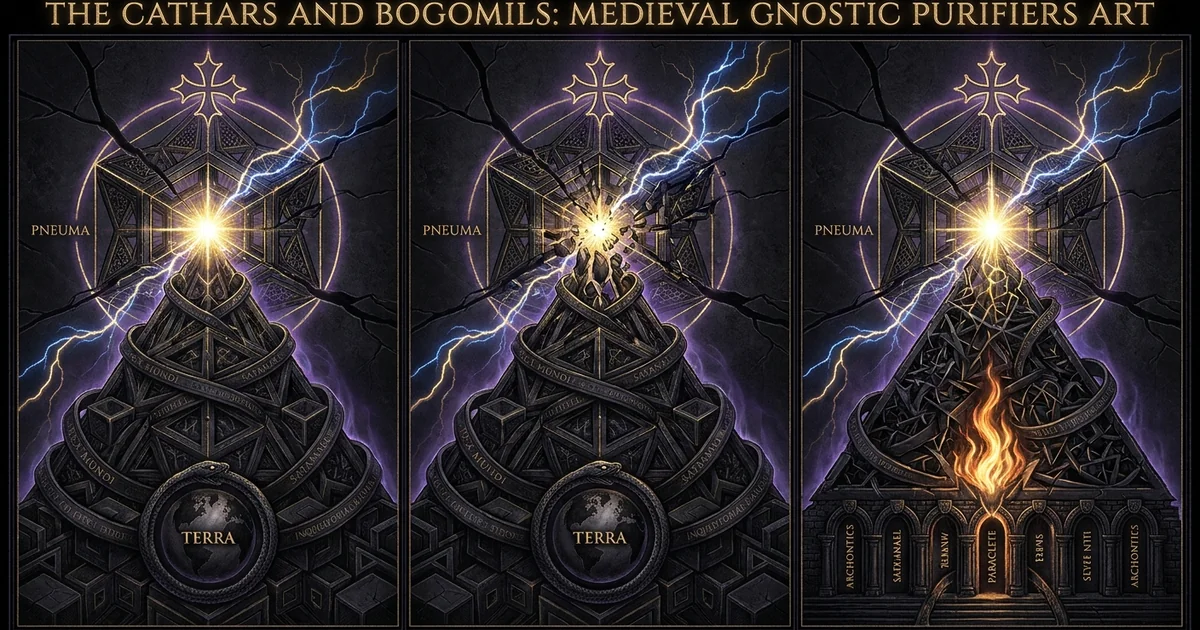
The Cathars and Bogomils: Medieval Gnostic Purifiers Art
Metaphysical Thesis & Epistemological Opening: Radical Dualism in the Medieval Horizon
The Demiurgic Enclosure of Rex Mundi
The central ontological divergence of medieval dualism lies in its absolute repudiation of the orthodox creatio ex nihilo. Where the Latin Church and Byzantine orthodoxy posited a singular, omnipotent deity who fashioned a fundamentally good cosmos corrupted only by creaturely transgression, the Bogomil and Cathar traditions recognized the material cosmos as a carceral architecture. This physical continuum was not declared fallen through the moral frailty of man; rather, it was engineered ab initio by an aberrant architect—designated in Occitan texts as Rex Mundi (the King of the World) and in Balkan Slavonic treatises as Satanael.
In this framework, physical matter is not neutral clay awaiting sanctification, but an entropic prison designed to ensnare uncreated light. The metaphysical trajectory of gnostic demiurge cosmology directly informs this worldview: visible creation is an archontic simulation operating under ironclad laws of decay, predation, and somatic terror. The human condition is characterized by a violent metaphysical dislocation, wherein the pneumatic spark (divina scintilla) finds itself bound within an animal chassis generated by a lower demiurgic agency. To accept terrestrial existence as the deliberate work of the transcendent Father was, for the dualist initiate, the supreme blasphemy—an epistemological deception that inverted darkness and light, mistaking the jailer for the liberator.
Orthodox Paradigm:
Transcendent God ---> Creatio Ex Nihilo ---> Intrinsic Goodness of Matter (Fallen via Adam)

Dualist Paradigm:
Transcendent God (Pleroma/Light) ======= Absolute Metaphysical Gulf =======
Demonic Architect (Rex Mundi/Satanael) ---> Somatic Enclosure (Matter/Prison)
The material realm constitutes an archontic apparatus designed to enforce amnesia upon the imprisoned spirit. Every biological imperative—nourishment through the slaughter of sentient life, territorial conquest, somatic generation through sexual intercourse—functions as an energetic tribute to Rex Mundi. The visible world does not reveal divine glory; it conceals the transcendent source behind a dense veil of mineral, vegetative, and carnate inertia.
Balkan Lineages: The Bogomil Vector into the Latin West
The manifestation of dualist theology in southern France during the twelfth and thirteenth centuries cannot be understood as an isolated eruption of vernacular anticlericalism or local social grievance. It represents the Western terminus of a subterranean river of esoteric transmission that originated in the late antique Near East, traversed the Byzantine marches, and took institutional form in the first Bulgarian Empire during the reign of Tsar Peter I (927–969 CE). The movement’s eponymous founder, the priest Bogomil (“Beloved of God”), crystallized a synthesis of Paulician migration and surviving Massalian mysticism, establishing an underground church that rejected the sacramental, liturgical, and visual apparatus of Eastern Orthodoxy.
This Balkan current navigated maritime trade conduits, pilgrimage avenues, and Crusader corridors, infiltrating the urban centers of northern Italy—most notably Concorezzo and Desenzano—before establishing its definitive sanctuary in the linguistic and cultural expanse of Occitania. The historical lineage linking the 10th-century Bulgarian Bogomils to the Parfaits of Languedoc constitutes an unbroken continuity of counter-theological transmission. It was facilitated by itinerant weavers, merchants, and clandestine bishops carrying miniature apocryphal codices across the trans-European trade routes of the Manichaean origins along the Silk Road. The Cathars and Bogomils in medieval Gnosticism and the subsequent Albigensian Crusade across Languedoc cannot be separated: the theological insurgency that Rome confronted in the valleys of the Ariège and the plain of Toulouse was structurally and doctrinally identical to the heresy that Cosmas the Priest had denounced two centuries prior in Preslav.
Near Eastern Dualism (Paulicians / Massalians)
                    │
                    ▼
First Bulgarian Empire (Priest Bogomil, c. 930–970 CE)
                    │
       ┌────────────┴────────────┐
       ▼                         ▼
Byzantine Nodes            Balkan Churches
(Constantinople)      (Bulgaria, Dragovitia, Bosnia)
                                 │
                                 ▼
                     Northern Italian Hubs
                   (Concorezzo, Desenzano)
                                 │
                                 ▼
               Occitania / Languedoc (Cathar Parfaits)
Transcending Orthodox Materialism and the Orthopedic Church
To the dualist mind, the institutional Church—whether Rome or Constantinople—operated as the geopolitical executive of Rex Mundi. Its physical cathedrals of stone, gilded reliquaries, and Eucharistic claims of transubstantiating bread into divine flesh were diagnosed not merely as ecclesiastical corruptions, but as severe ontological deceptions. Dualist theology in southern France argued that the orthodox clergy worshiped the Demiurge under the guise of the Almighty, venerating the instrument of execution (the cross) and sanctifying the very somatic prison from which the soul required liberation.
The sacramental economy of the medieval Church was inherently orthopedic: it sought to manage, regularize, and redeem the somatic envelope through material conduits—water baptism, consecrated bread, unction, and terrestrial burial. The Bogomils and Cathars unmasked this sacramental realism as a demonic mimicry designed to anchor the soul deeper into gross matter. Water baptism was viewed as a biological bath belonging entirely to the realm of the terrestrial elementals, incapable of purging the uncreated soul of its archontic stain. The true Church was non-local, invisible, and utterly immaterial—a communion of pneumatics untethered from terrestrial geography, sustained solely by the transmission of the uncreated Spirit.
A critical distinction exists within the medieval dualist corpus between Absolute Dualism and Mitigated Dualism. Mitigated Dualism (predominant in early Bulgarian Bogomilism and the Italian church of Concorezzo) asserted that Satanael was a primordial son of God, elevated above the celestial hosts, who rebelled out of pride and fashioned the material world out of pre-existing elements granted or permitted by the Father. In this view, evil has a definitive historical beginning and an ultimate eschatological termination.
Absolute Dualism (advanced by the Dragovitian church of Thrace and embraced by the Cathar Albanenses under John of Lugio) posited two uncreated, co-eternal principles: a Good God of Spirit and an Evil Principle of Matter, existing in unoriginated opposition. For the absolute dualists, evil was not a moral defect or privation (privatio boni), but an independent ontological substance that had never been subject to the light.
Primary Codices & Historical Transmission: From the Dragovitian Stream to the Pyrenees
The Interrogatio Iohannis and Balkan Apocrypha
The primary metaphysical blueprint inherited by the Occitan Cathars from their Balkan forebears was the Interrogatio Iohannis (The Secret Supper), a Latin translation of which was preserved in the inquisitorial archives of Carcassonne after being brought from Bulgaria to northern Italy by the Cathar bishop Nazarius around 1190. Cast as an esoteric dialogue between Christ and John the Evangelist during the Last Supper, the text reveals the mechanics of cosmogenesis, celestial rebellion, and the biological entrapping of humanity.
“And I, John, bowed at the breast of our Lord Jesus Christ, and said to him: ‘Lord, before Satan fell, in what glory did he dwell with your Father?’ And he said to me: ‘He was in such glory that he commanded the powers of the heavens… He wished to set his throne above the clouds and make himself like the Most High. And when he descended through the air, he said to the angel who had charge over the waters: Open the gates of the waters. And he opened them, and they went down and found all the earth covered with waters. And he went down under the earth and found two fishes resting upon the waters, and they held the whole earth… and he bound the earth to the fishes with a cord. Then he took the crown of an angel, and from half of it he made the throne of the sun, and from half the moon… and out of the mud he formed man in his own likeness. And he commanded an angel of the second heaven to enter into the clay body. And the angel wept when he saw that he had been cast down from light into darkness.’” — Interrogatio Iohannis (The Secret Supper), Carcassonne Manuscript (Codex 12th Century)
The text demonstrates the continuous transmission of apocalyptic forms from late antiquity directly into the heart of high medieval heresy. It bypasses the orthodox canon to retrieve an esoteric Johannine lineage, presenting Christ not as an incarnate biological sacrifice, but as an incorporeal pneumatic messenger who descended through the planetary spheres to reveal the coordinates of celestial ascent.
       PLEROMA / UPPER HEAVENS
 (Uncreated Light, Transcendent Father)
══════════════════════════════════════════ Firmament
         Intermediary Heavens
    (Depleted by Satanael's Rebellion)
──────────────────────────────────────────
           TERRESTRIAL SPHERE
(Fabricated by Satanael from Mud & Water)
  ┌───────────────────────────────────┐
  │ Clay Body (Biological Envelope)   │
  │   └── Angelic Spark (Imprisoned)  │
  └───────────────────────────────────┘
Complementing the Interrogatio was the Bogomil apocryphal corpus, including the Vision of Isaiah and diverse Slavonic recensions of Enochic literature. These texts circulated through the monastic networks of Macedonia and the valleys of the Rhodope mountains, preserving ancient motifs of the soul’s ascent past hostile planetary gatekeepers—a theme directly continuous with the Nag Hammadi archontic rulers.
The Council of Saint-Félix (1167) and Bishop Nicetas
The critical historical pivot in the institutionalization of Western dualism occurred in the spring of 1167 at the castle of Saint-Félix-de-Caraman (now Saint-Félix-Lauragais) in the Lauragais region. Under the presidency of Nicetas (Niquinta), the Bogomil bishop of the Dragovitian order of Constantinople, the dispersed and philosophically divided dualist communities of Occitania and northern Italy converged to establish formal ecclesiastical structures and theological unity.
Nicetas brought with him the radical doctrine of absolute dualism, arguing against the mitigated dualism previously dominant in northern Italy and early Languedocian circles. He demonstrated to the gathered Western leaders—including Mark of Lombardy, Sicard Cellarier of Albi, and the representatives of the churches of Carcassonne, Toulouse, and the Val d’Aran—that the primitive dualist sees of the East (the churches of Jerusalem, Bulgaria, Dragovitia, and Melenguia) had achieved stability only through adherence to the doctrine of two uncreated, independent principles. The Council of Saint-Félix reorganized Western Catharism into autonomous, self-governing dioceses, each headed by a bishop and two assistants (filius major and filius minor). Through this synod, the Eastern pneumatic succession was formalized across Occitania, providing the ideological coherence and structural resilience that would allow Cathar society to withstand the initial decades of royal and papal assault.
Inquisitorial Hermeneutics: Reading the Cathars Through Their Executioners
Because the vast majority of Cathar vernacular manuscripts, ritual manuals, and philosophical expositions were incinerated in the public squares of Languedoc, the reconstruction of their metaphysical system requires a rigorous deconstructive hermeneutic applied to inquisitorial documentation. The inquisitor was not an objective ethnographer; he was a prosecutor-theologian operating within a Scholastic framework, driven to translate fluid dualist concepts into the codified legal categories of canonical heresy.
The primary texts of inquisitorial procedure—most prominently Bernard Gui’s Practica Inquisitionis Heretice Pravitatis (c. 1323–1324) and the meticulous interrogation records of Bishop Jacques Fournier of Pamiers (1318–1325, preserved in Vatican MS Latin 4030)—contain the dialectical transcripts of Parfait and Credente interrogations. Gui’s text serves as a diagnostic taxonomy, instructing the inquisitor to pierce the outer piety of the “good Christians” (Bons Hommes) by systematically interrogating them on the origin of matter, the corporeality of Christ, the resurrection of the physical flesh, and the efficacy of the Roman sacraments:
Inquisitorial Filter:
Cathar Vernacular Metaphysics
        │
        ▼
Scholastic Latin Translation (Gui / Fournier)
        │
        ▼
Legal Categorization: "Heretical Depravity"
        │
        ▼
[Critical Deconstruction] ===> Extraction of Authentic Dualist Ontology
Jacques Fournier’s cross-examinations at the Episcopal Palace of Pamiers—exemplified in the trial of the last active Occitan Parfait, Guillaume Bélibaste, and the shepherd-theologian Pierre Clergue of Montaillou—reveal that beneath the sophisticated philosophical dualism of John of Lugio lay a vivid popular cosmology. In this world, the human soul was conceived as a fallen spirit undergoing a grueling transmigratory cycle through successive bodies of flesh, fish, and fowl until it met the purifying hands of an ordained Parfait. Inquisitorial records, when stripped of their demonological embellishments, reveal a coherent, radically non-materialist metaphysics that consistently inverted Roman Catholic dogma.
Ontological Architecture & Cosmological Models: The Fabricated Prison of Form
Cosmogenesis of Satanael: The Stolen Pneuma and the Clay Envelope
In the cosmogonic narratives shared across the Bogomil-Cathar continuum, the generation of the visible world is an act of cosmological theft. Satanael, originally the primary administrator of the celestial hierarchies, was overcome by pride and cast down from the highest heavens. Descending into the formless void of the primordial abyss, he perceived the primeval waters and organized them into seven cosmic layers, parodying the architecture of the divine Pleroma.
       DIVINE PLEROMA (Uncreated Spirit / The Good God)
═════════════════════════════════════════════════════════════
   Archontic Membrane (Separation of Light and Abyss)
─────────────────────────────────────────────────────────────
   Satanael's Seven Layered Cosmic Shell (The Seven Heavens)
   ┌───────────────────────────────────────────────────────┐
   │ Planetary Spheres / Archontic Wardens                 │
   │ Terrestrial Plane: Mud, Water, Mineral Strata         │
   │ Somatic Traps: Biological Bodies of Animals and Men   │
   │    └── Ensnared Spark: Anguished Pneuma               │
   └───────────────────────────────────────────────────────┘
The construction of the human organism was Satanael’s crowning technical achievement, designed to solve a critical energetic problem: the material engine required an animating spiritual power to prevent its immediate collapse into inert dust. According to the Bogomil account recorded by Cosmas the Priest in his Treatise Against the Bogomils (c. 970 CE), Satanael molded the physical body of Adam from mud and water, yet was unable to animate it. He consequently tricked a celestial angel from the second heaven into entering the clay envelope, sealing the spirit through the orifices of the sensory organs.
To ensure the permanent captivity of the angelic spark, the Demiurge created Eve, embedding within her the biological lure of sexual concupiscence. Through the copulatory impulse, the angelic essence was fragmented and dispersed across generations, trapped within a self-replicating somatic machine that ensured its ongoing captivity.
Emanational Physics: The Seven Heavens versus the World of Ruin
The Cathar understanding of spatial physics maintained a sharp distinction between the uncreated heavens of eternal light and the degraded, mechanical planetary spheres of Rex Mundi. The uncreated realm, designated as the Land of the Living, was governed by timeless emanational physics: there, entities existed as pure, self-luminous intelligences devoid of weight, friction, or mortality.
Conversely, the Demiurgic universe was defined as the “World of Ruin” (le monde perissable). The seven lower heavens, governed by planetary archons, operated as kinetic filters that stripped the soul of its celestial memory during its descent into incarnation. This planetary machinery established time as a closed, cyclical loop, preventing the soul from perceiving linear escape routes. The visible universe was thus structured not on divine providence, but on algorithmic mechanical necessity:
Mitigated Dualism (Bulgarian/Concorrezzo)
- Cosmic Origin: Monistic origin. One uncreated God who generated the angels. Lucifer/Satanael was the premier creation who subsequently fell through pride.
- Status of Matter: Matter is not an uncreated eternal principle, but a corrupted alteration of pre-existing substances fashioned by Satanael under divine sufferance.
- Anthropology: Soul and body have distinct origins. The body is formed by Satanael from clay; the pneumatic breath was stolen, extorted, or breathed into it by God via trickery.
- Eschatology: Evil has a terminal expiration date. At the end of cosmic time, Satanael’s power is broken, matter is annihilated or rendered inert, and all sparks return to God.
Absolute Dualism (Dragovitian/Albanensian/Desenzano)
- Cosmic Origin: Absolute primordial dualism. Two uncreated, co-eternal principles: the Father of Light and the Principle of Darkness/Matter.
- Status of Matter: Matter is uncreated, eternally evil, and intrinsically corrupt. It has never known the Light and is governed entirely by its own autonomous evil deity.
- Anthropology: Total opposition between the heavenly spirit and the biological form. Spirits were celestial inhabitants seduced and dragged into physical bodies by the Evil Principle.
- Eschatology: Matter and Spirit remain forever distinct. The Pleroma is sealed; redeemed sparks return to the realm of light, while the material sphere remains eternal damnation.
Metaphysical Divergences: Mitigated vs. Absolute Dualism in Occitania
The philosophical tension between these two dualist branches reached its apex in the mid-thirteenth century, exemplified by John of Lugio’s seminal treatise, the Liber de Duobus Principiis (Book of the Two Principles, c. 1250). Writing from the Albanensian community in Desenzano, John of Lugio sought to establish a rigorous philosophical defense of absolute dualism against both the Scholasticism of the Dominicans and the theological concessions of the mitigated dualists of Concorezzo.
John of Lugio recognized that if God were omnipotent and the sole source of all being, He must be the author of evil, suffering, and damnation. To safeguard the absolute goodness and moral purity of the transcendent God, John argued that the Evil Principle must be autonomous, uncreated, and eternal:
$$\text{Good God} \implies \forall x \in \text{Pleroma} : x \text{ is Good}$$
$$\text{If } \exists y (\text{Matter}, \text{Suffering}, \text{Evil}) \implies y \notin \text{Good God’s Creation}$$
$$\therefore \text{Principle of Darkness} = \text{Uncreated, Eternal, Independent}$$
The Liber de Duobus Principiis demonstrated through scripture and dialectical reasoning that the creation accounts of Genesis describe the construction of the visible realm by the Evil Principle, whereas the celestial creation described in the New Testament pertains exclusively to the uncreated, spiritual universe. For the Albanenses, there could be no compromise with the material substrate: light and darkness had no common origin, no shared substance, and no final reconciliation.
Phenomenological Mechanics & Interdimensional Interaction: The Soteriology of the Consolamentum
The Consolamentum as Pneumatic Uncoupling
The entire metaphysical architecture of Catharism converged upon a single liturgical ceremony: the consolamentum. This ritual was neither a symbolic rite of passage nor a typical sacrament. It was understood as a transformative energetic event—a non-water baptism of the Holy Spirit and fire that dissolved the initiate’s ontological linkage to Rex Mundi. The rite was administered through the imposition of hands by one or more Parfaits and the physical placement of the Codex of the Gospel of John upon the candidate’s head.
PNEUMATIC FIELD OF THE PARFAIT (Pre-Purified Vessel)
                │
         Imposition of Hands & Codex of John
                │
                ▼
        [ PENETRATION POINT ]
  Somatic Barrier (Gross Physical Clay)
                │
                ▼
ANGELIC SPARK (Divina Scintilla / Ensnared Pneuma)
                │
         Ontological Recalibration
                │
                ▼
   Dissolution of Rex Mundi's Legal Jurisdiction
The mechanics of the consolamentum operated on the understanding that the uncreated spark trapped within the human body remained dormantly linked to its celestial double in the Pleroma. The imposition of hands served as an energetic conduit through which the Paraclete was infused into the candidate, restoring the severed circuit between the human pneuma and the heavenly archetype.
Upon receiving this baptism, the individual ceased to belong to the biological collective of the material world. They became an ordinatus, a vestitus, an authentic Bono Homine or Parfait. The legal jurisdiction of the Archons was severed; the soul was no longer subject to the wheel of metempsychosis. If the Parfait died while preserving this purity unsullied, the spirit bypassed the archontic gates and reintegrated into the pleromic light.
Dietary and Somatic De-tuning: The Ascetic Severing of Archontic Feeding
The radical asceticism demanded of the Parfait was not an act of moral self-mortification, but a practical protocol of energetic maintenance. Physical embodiment forced the soul into a dense electromagnetic and nutritional interface with the corrupt matter of the Demiurge. Every biological intake served to either strengthen the somatic prison or detune the energetic field that anchored the Holy Spirit within the candidate.
The most prominent feature of this ascetic discipline was the absolute prohibition against consuming meat, animal fat, milk, cheese, and eggs. The Cathars understood that all products resulting from biological coitus bore the concentrated energetic signature of Rex Mundi. Because warm-blooded animals were considered fellow somatic vessels housing transmigrating human or angelic spirits, slaughtering them and consuming their flesh subjected the initiate to the energetic vibration of predation and terror.
The Parfait subsisted exclusively on fish (which were erroneously believed by medieval natural history to reproduce asexually through spontaneous generation in water), grains, legumes, fruits, and wine. Through this vegan regimen, the biological vehicle was depleted of coarse animal passions, its sensory interface was desensitized to physical temptation, and the somatic envelope was maintained in an energetic state thin enough to remain transparent to pleromic illumination. This practice parallels the protocols detailed in somatic liberation through rigorous asceticism.
The Endura: Voluntary Disincarnation and Transcendence of Somatic Gravity
The terminal threshold of Cathar initiatic practice was the controversial rite of the endura. Far from being a common practice of suicide, the endura was a deliberate, hyper-ascetic protocol undertaken by an initiate who had received the consolamentum on their deathbed (in extremis) or during times of severe inquisitorial persecution.
The primary metaphysical dread of the Cathar was post-consolamentum re-contamination. If a believer received the spiritual baptism during a mortal illness, recovered, and returned to biological living—consuming animal products, engaging in sexual intercourse, or lying—the uncreated seal of the Paraclete was shattered, returning the soul to the jurisdiction of the Archons. To prevent this catastrophe, the initiate entered the endura: an absolute, voluntary fast from all food and liquid:
Deathbed Consolamentum Received
           │
           ▼
Candidate Faces Potential Recovery / Relapse
           │
           ▼
Decision to Enter the Endura (Voluntary Fast)
           │
           ▼
Progressive Somatic Desiccation (Subduing the Animal Chassis)
           │
           ▼
Severance of Physical Gravity ===> Pure Pneumatic Disincarnation
Through this progressive, conscious starvation, the body was steadily stripped of its somatic vitality. The initiate did not experience this process as self-destruction, but as the systematic decoupling of pure consciousness from its biological prison. The endura represented the ultimate assertion of pneumatic sovereignty over the Demiurge’s primal mandate of survival. By willingly relinquishing the flesh, the Parfait broke the foundational law of nature, neutralizing the survival instinct that keeps the human spirit subservient to terrestrial existence.
Initiatic Synthesis & Philosophical Implications: Montségur and the Inquisitorial Control System
The Albigensian Crusade as Orthopedic Eradication of Counter-Ontologies
The twenty-year military campaign unleashed by Pope Innocent III against the lands of Raymond VI of Toulouse and the Trencavel viscounty (1209–1229)—the Albigensian Crusade—was the first crusade waged entirely within Western Christendom. It mobilized northern French feudal barons under the military leadership of Simon de Montfort to eradicate a metaphysical contagion that threatened to dismantle the foundational paradigms of the Latin Middle Ages.
The crusade was an orthopedic eradication of a counter-ontology. Catharism was not merely a private, inward heresy: it struck at the core of feudal-ecclesiastical power. The Parfaits refused to swear oaths, rejected the economic obligation of tithes, denied the reality of hell as a physical underworld (positing that this earth is hell), rejected the validity of capital punishment, and elevated women to the status of spiritual leaders capable of administering the consolamentum.
If the material world was the creation of the Devil and Rome was the synagogue of Satan, the moral, political, and spiritual authority of the Papacy collapsed. The massacre at Béziers on July 22, 1209, where Arnaud Amalric, the papal legate, was reputed to have declared, “Caedite eos. Novit enim Dominus qui sunt eius” (“Kill them all; for the Lord knows those who are His”), encapsulated the absolute incompatibility between the institutional hegemony of Rome and the pneumatic secession of Occitania.
“The emergence of dualist heresy in the West and the subsequent deployment of the Albigensian Crusade mark the watershed where the Latin Church definitively institutionalized the doctrine of armed, coercive purification against counter-theological systems… Dualism presented a systemic challenge to the orthodox Christian worldview, rejecting its cosmology, its soteriology, and its socio-political articulation. The crusade against the Albigenses was thus an ideological enterprise that laid the legal, doctrinal, and operational foundations for the total surveillance apparatus of the high medieval Inquisition.” — Yuri Stoyanov, The Other God: Dualist Religions from Antiquity to the Cathar Heresy (Yale University Press, 2000, pp. 248–251)
The Fall of Montségur (1244) and the Metaphysics of the Pyre
The final military, political, and spiritual sanctuary of the Cathar Church was the mountain fortress of Montségur, perched atop a sheer limestone pog in the Pyrenean foothills of the Ariège. Following the massacre of inquisitors at Avignonet in 1242 by a force operating from the mountain, the royal and ecclesiastical apparatus laid siege to the fortress for ten grueling months. Within its perimeter lived a community of soldiers, noble refugees, and more than two hundred Parfaits and Perfectae under the leadership of Bishop Bertrand Marty.
       [ THE POG OF MONTSÉGUR ]
       ┌──────────────────────┐
       │   Castrum Citadel    │ (Refuge of Bertrand Marty & 200+ Parfaits)
       └──────────┬───────────┘
                  │ 10-Month Siege (1243–1244)
                  ▼
       [ CAPITULATION: MARCH 1244 ]
                  │
  ┌───────────────┴───────────────┐
  ▼                               ▼
Four Parfaits Escape      215+ Perfecti Descend
(Preserving the "Treasure"     the Mountain
 / Codices & Lineage)             │
                                  ▼
                          [ CAMP DES CRÉMATS ]
                   Mass Immolation without Recantation
When Montségur capitulated in March 1244, the besiegers offered the Parfaits a binary choice: renounce their heresy, submit to the authority of the Church, and live—or perish by fire. Over two hundred and fifteen men and women, including nobles such as Corba of Hunaud and her daughter Esclarmonde of Perella, refused recantation. Several believers among the secular garrison requested and received the consolamentum within the castle walls during the final two-week truce, choosing to join the Parfaits in death.
On March 16, 1244, at the foot of the mountain in the field now known as the Prat dels Cremats (Field of the Burned), more than two hundred Parfaits walked calmly into the communal palisade of burning timber without being individually bound to stakes. This mass immolation was the ultimate confrontation between terrestrial coercive force and Gnostic contempt for the somatic vessel. The fire of Montségur did not function as a punishment, but as an immediate solvent that dissolved the physical envelopes of the Parfaits, releasing their imprisoned celestial sparks back into the Pleroma beyond the reach of Rex Mundi.
Sovereign Consciousness vs. Institutional Hegemony: The Subterranean Pneuma
The historical eradication of the Cathar church by the Dominican Inquisition reshaped the epistemic geography of the Western world. In the wake of the Pyrenean fires, the Papacy engineered a sophisticated bureaucratic control system that laid the institutional groundwork for early modern statecraft. The creation of cross-referenced witness registers, the systematization of judicial torture, the implementation of secret denunciations, and the institutionalization of documentary surveillance transformed European legal and political structures.
Cathar Resistance (Pneumatic Autonomy)
                │
                ▼
Inquisitorial Response (Dominican Bureaucracy)
  ├── Cross-referenced Interrogation Registers
  ├── Universal Documentary Surveillance
  └── Systematized Confession under Judicial Torture
                │
                ▼
Modern State Institutional Control Apparatus
Yet, the metaphysical impulse that sustained the Bogomils and Cathars could not be extinguished alongside their physical vessels. The Gnostic insistence upon sovereign consciousness—the unmediated, interior recognition of the divine spark independent of institutional mediation—went underground. It surfaced through the late medieval Rhineland mystics (Meister Eckhart’s Seelenfünklein or “spark of the soul”), re-emerged within the Hermetic and Rosicrucian undergrounds of the Renaissance, and continues to disrupt every ideological architecture that demands the absolute capitulation of the pneumatic individual to external systems of control.
Frequently Asked Questions
Ontological Status of the Bogomil-Cathar Lineage
Was Catharism a direct branch of Syrian-Mesopotamian Manichaeism or Paulicianism?
The relationship between Catharism, Bogomilism, and late antique Manichaeism is primarily typological and historical rather than institutional. While the medieval Church frequently branded the Cathars as “Manichaeans” to invoke the Justinian imperial laws that made that heresy punishable by death, the historical reality is nuanced. The Cathars and Bogomils possessed no copies of Mani’s canonical books (such as the Living Gospel or the Kephalaia); their primary textual substrate was biblical and apocryphal, grounded primarily in the New Testament (the Johannine and Pauline epistles) and intertestamental apocrypha.
However, the historical vector runs through the Paulicians of seventh-to-ninth-century Armenia and Anatolia, who were forcibly relocated by Byzantine emperors (such as Constantine V and John Tzimiskes) to Thrace and Macedonia. These Paulician military colonies, operating within a Slavic cultural environment, merged with surviving Massalian groups to generate the Bogomil synthesis. The ideological DNA—the radical division between Spirit and Matter, the rejection of the Old Testament God, the docetic Christology, and the ascetic purification of the soul—represents a continuous metaphysical underground that persisted across Eurasia for over a millennium.
Historical Realism of the Cathar Treasure and Pyrenean Myths
Did the Cathars possess an occult relic such as the Holy Grail at Montségur?
The myth of the “Cathar Treasure” has been distorted by romantic nineteenth-century occultism, ranging from Napoléon Peyrat’s imaginative fabrications to Otto Rahn’s Grail expeditions under Nazi sponsorship. Historical records from the Inquisition register of Pamiers explicitly reveal that the Cathars did possess a treasure, but its contents were strictly logistical and doctrinal.
Shortly before the fall of Montségur in March 1244, four Parfaits—Amiel Aicart, Poitevin, Hugo, and a companion—escaped down the northern face of the pog. They carried the community’s financial reserves (gold, silver, and coin collected from regional sympathizers) and, crucially, their sacred codices, liturgical manuals, and the secret Balkan apocrypha. This wealth and literature was intended to sustain the clandestine Cathar church-in-exile in northern Italy and the deep valleys of the Pyrenees. The true “treasure” of the Cathars was not a miraculous physical object (which their anti-materialist metaphysics would have viewed with contempt), but the intact pneumatic lineage of the consolamentum and the textual coordinates of their pleromic gnosis.
Ascetic Radicalism versus Cathar Communal Survival
How did Cathar society flourish if reproduction and agriculture were deemed demonic?
Catharism sustained a vibrant, functional civilization across Occitania for more than a century because it did not impose its monastic asceticism universally upon all adherents. The Cathar Church was structured around a strict binary division: the Credentes (believers or sympathizers) and the Perfecti or Parfaits (the fully initiated spiritual elite).
         ┌────────────────────────────────────────┐
         │          PERFECTI (PARFAITS)           │
         │  - Full pneumatic baptism             │
         │  - Strict asceticism & celibacy        │
         │  - Vegan dietary protocol              │
         │  - Unbroken prayer & pastoral ministry │
         └───────────────────┬────────────────────┘
                             │
                             ▼
         ┌────────────────────────────────────────┐
         │         CREDELIS (CREDENTES)           │
         │  - Engaged in marriage & reproduction │
         │  - Maintained trade, land & society    │
         │  - Sustained the Parfaits logistically │
         │  - Received Consolamentum at deathbed  │
         └────────────────────────────────────────┘
The Credentes constituted the vast majority of the population. They were permitted to marry, raise children, bear arms, engage in commerce, and live normal secular lives. Their spiritual obligations consisted of extending ritual respect (the melhorament) to the Parfaits, sustaining them with vegan food and shelter, and arranging to receive the consolamentum in extremis on their deathbeds. The Parfaits, who numbered rarely more than a few thousand, lived as walking avatars of the Pleroma, embodying the ascetic ideal on behalf of the entire community. This sociological balance allowed Catharism to integrate into the aristocratic and agrarian structures of Languedoc, securing the loyalty of counts, burghers, and peasants alike until it was unraveled by the combined violence of the Crusade and the Dominican Inquisition.
Contemporary researchers must guard against neo-Cathar romanticism and modern spiritual appropriation. Medieval dualism was not an egalitarian, nature-worshiping, or pantheistic tradition; it was an uncompromising, austere, and radically anti-materialist metaphysics. The Bogomils and Cathars viewed nature not as a sacred sanctuary, but as an archontic entrapment engineered by a lesser deity to enslave celestial light. To read Catharism through the lens of modern secular humanism or romantic New Age spiritualism is to obscure the fierce, uncompromising Gnostic ontology for which thousands of initiates willingly walked into the medieval pyres.