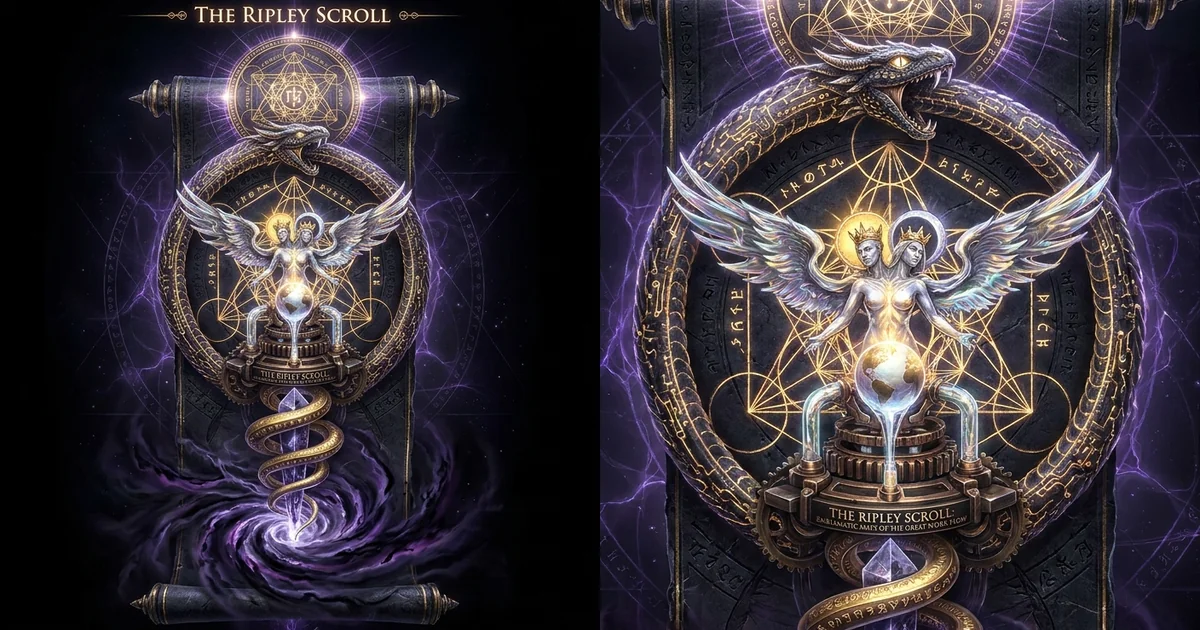
The Ripley Scroll: Emblematic Maps of the Great Work Flow
Metaphysical Thesis & Epistemological Opening: The Ripley Scroll as Operative Semiosis
The Ripley Scroll represents one of the most complex monuments of late medieval and early modern Western esotericism. Traditionally attributed to the fifteenth-century Augustinian canon and alchemist Sir George Ripley (c. 1415–1490), the roll exists across roughly twenty-three major extant variants executed predominantly between the late sixteenth and early seventeenth centuries. Measuring up to six meters in length, these magnificent illustrated vellum manuscripts function not as literal metallurgical handbooks or cryptic laboratory recipes for the mechanical extraction of bullion, but as sophisticated emblematic engines. Within the Ripley Scroll, the alchemical opus magnum unfolds as an operative cosmology—an interconnected phenomenological map that articulates the recursive, cybernetic feedback loops existing between physical matter, the operator’s subtle somatic vehicle, and the divine ordering intelligences of the cosmos.
The modern investigator encounters two fatal epistemological traps when analyzing the Ripley Scroll: vulgar reductionism and hyper-abstract psychologism. The vulgar reductionist dismisses the intricate visual grammar of the scroll as pre-scientific gibberish, obscure proto-chemistry, or fraudulent obfuscation designed to fleece aristocratic patrons. Conversely, the ungrounded psychologizer reduces its elaborate alchemical vessels, metallurgical fires, and distillation stages to mere archetypal projections of the individual unconscious, completely divorcing the emblematic schema from its profound root in literal, spagyric laboratory operations. The Hermetic method requires holding the physical and the metaphysical in radical simultaneity: the retorts, balnea, and calcined salts are authentic material sites through which transcendent spiritual operations and trans-dimensional noetic energies achieve concrete terrestrial condensation.
Beyond Vulgar Metallurgy: The Emblematic Text as Ontological Mirror
To interpret the Ripley Scroll strictly through the rubric of archaic chemistry is to mistake the vessel for the underlying celestial liquor. While scholarship by Lawrence M. Principe has demonstrated that early modern chymistry operated with systematic physical methodologies, emblematic manuscripts such as the Ripley Scroll occupied an entirely separate epistemological register. In these pictorial rolls, every pigment, coordinate axis, and zoomorphic hybrid serves as a node in an operative semiotic network. The manuscript operates as an ontological mirror: the transmutational continuum depicted along the vertical axis of the vellum reflects the continuous metaphysical exchange between the lower terrestrial realm of corruptible elemental compounds and the upper hyper-uranian spheres of incorruptible celestial virtue.
The viewer does not merely read the scroll; they are drawn into a structured meditative circuit. By tracing the iconography from the opening figure of the crowning adept through the chaotic encounters of the elemental dragons down to the stabilizing sovereignty of the final red stone, the practitioner enacts an interior cognitive realignment. The pictorial language acts as a deliberate bypass of the discursive intellect. In accordance with the principles preserved in the /ancient-prehistory/emerald-tablet-transmission, the external manipulation of minerals in the athanor mirrors the internal purification of the alchemist’s own perceptive faculties. The visual roll establishes a sympathetic resonance between macrocosmic ordering principles and microcosmic somatic realities, transforming the parchment into an active instrument of spiritual transmutation.
The Psychophysical Continuum and the Hermetic Informational Paradigm
Within this emblematic framework, matter is not an inert, Cartesian mechanical substance awaiting passive manipulation. Instead, the Ripley Scroll posits an unbroken psychophysical continuum, governed by what modern metaphysics recognizes as an informational control architecture. Drawing upon the foundational currents preserved in the /spirituality/corpus-hermeticum-gnosis, the cosmos of the Ripley Scroll is alive, ensouled by the anima-mundi and continually sustained by the pervasive circulation of the spiritus-mundi—an ultra-subtle, trans-elemental substrate bridging the gap between immaterial noetic archetypes and crystallized corporeal matter.
When analyzing these esoteric pictorial alchemical instructions, the recursive visual sequences—the cyclical ingestions, evaporations, decapitations, and coagulations—chart the actual thermodynamic and spiritual behavior of this psychophysical matrix. The manuscript functions as a non-linear program. The reader navigates an epistemic labyrinth where physical inputs (sulfur, mercury, antimony, fire) and metaphysical inputs (prayer, intent, planetary alignment, astrological timing) converge into an indivisible transmutational vector. This dynamic dissolves the artificial barrier separating the observer from the laboratory apparatus, establishing an informational feedback loop wherein the moral, psychic, and energetic stabilization of the alchemist directly governs the physical crystallization of the tincture.
Primary Codices & Historical Transmission: Provenance and Lineage of the Ripley Corpus
Fifteenth-Century English Chymistry and the Ripleyan Canon
The attribution of the scroll to George Ripley anchors the work within the vibrant, volatile milieu of fifteenth-century English alchemical culture. Ripley, a canon regular at the Priory of St. Augustine in Bridlington, Yorkshire, achieved continental renown following the circulation of his masterwork, The Compound of Alchymy; or, the Ancient Hidden Art of Archemie (written c. 1471 and dedicated to King Edward IV). In this twelve-gate treatise, Ripley systematically codified the transmutational process into twelve distinct stages, ranging from Calcination and Solution to Fermentation and Projection.
However, as demonstrated by the archival research of Jennifer M. Rampling, the visual artifact known today as the “Ripley Scroll” was not physically executed by Ripley’s own hand during his monastic tenure in Yorkshire. Rather, it crystallized during the late sixteenth century as the central emblematic monument of a major “Ripleyan revival.” Elizabethan scholars, practitioners, and scribes working within the vibrant esoteric circles of John Dee, Edward Kelley, and their continental contemporaries extracted, augmented, and reorganized verses and concepts from Ripley’s literary canon—alongside pseudepigrapha attributed to Raymond Lull and Guido de Montanor—synthesizing them into an unprecedented visual format. This emblem manuscript served as both an authoritative pedagogical codex and an operational blueprint for the generation of English adepts seeking to manifest the theoretical chrysopoeia of the preceding century.
“Take thy father that Phoebus is, That sit so hie aboue the light: Moiste him with his sister water, And wash him clene till he be white. Then put him in a bed of golde, With his doughter for to fall, And there be dissolved by her mold, Til they both turne to water small. Of them must come a Royall King, Regning in his owne light, Whose tincture shall stay every thing, And make the black earth cleare and white.”
Textual Transmission: Comparative Analysis of Extant Manuscripts
The textual and pictorial transmission of the Ripley Scroll across its twenty-three primary exemplars reveals a remarkable degree of compositional discipline married to subtle regional and scribal variations. Significant repositories of these scrolls include the British Library (notably Add MS 5025 and Sloane MS 2523A), the Bodleian Library at Oxford (MS Ashmole Rolls 40), the Wellcome Collection in London, the Beinecke Rare Book and Manuscript Library at Yale University (Mellon MS 41), and the Huntington Library in California. Across these varied exemplars, the architectural sequencing remains extraordinarily stable, demonstrating that early modern scribes treated the scroll not as a loose collection of evocative allegorical vignettes, but as an invariant canonical schema.
+-------------------------------------------------------------------------+
|                  EXTANT CANONICAL SCRIPTA COMPARISON                    |
+-------------------------------------------------------------------------+
| Codices / Roll Signature   | Date & Origin     | Distinguishing Features|
+----------------------------+-------------------+------------------------+
| British Library            | c. 1580–1600      | Pristine polychrome,   |
| Add MS 5025                | English Scribe    | complete Middle English|
|                            |                   | epigrams, full Rebis.  |
+----------------------------+-------------------+------------------------+
| Bodleian Library           | c. 1588           | Highly detailed        |
| MS Ashmole Rolls 40        | English Scribe    | cosmological framing,  |
|                            |                   | rich gold leaf wash.   |
+----------------------------+-------------------+------------------------+
| Beinecke Library           | c. early 17th c.  | Compact execution,     |
| Mellon MS 41               | Anglo-Continental | distinct planetary     |
|                            |                   | glyph modifications.   |
+----------------------------+-------------------+------------------------+
Close codicological analysis reveals that while pigments, calligraphic hands, and border embellishments shifted according to the resources of the respective patron, the precise geometric interplay between the figures remained strictly regulated. Variations in the Latin and Middle English glosses across British Library Add MS 5025 and Bodleian MS Ashmole Rolls 40 indicate that the scrolls were continually re-annotated by working practitioners who utilized the margins to document operational temperatures, weight ratios, and speculative cross-references to the works of Paracelsus, Geber, and the Turba Philosophorum. The scroll was an active, evolving laboratory codex, passed through networks of English gentlemen-chymists who recognized its structural diagrams as universal cartographies of physical and spiritual manifestation.
The Middle English Epigrammatic Verses as Decoding Keys
The enigmatic verse sequences that run vertically alongside the visual vignettes do not merely narrate the imagery; they act as cryptographic keys designed to unlock specific phases of the transformation. Penned in Middle English, these verses deliberately interlace plain laboratory instructions with soaring metaphysical paradoxes. The verses repeatedly invoke the dynamic tension between the fixed and the volatile, the hot and the dry, the celestial masculine seed and the terrestrial feminine matrix. They direct the operator’s attention to the sensory indicators of transmutational progress: the shift from the stygian, bituminous blackness of the nigredo to the pristine, blinding clarity of the albedo, and finally to the fiery, triumphant illumination of the rubedo.
Far from being mere decorative doggerel, these poems function as operative mnemonics. In an era when laboratory procedures lacked standardized digital metrics or thermometric instruments, the cadence, rhyming structures, and allegorical characters of the verses provided the alchemist with intuitive benchmarks for monitoring distillation phases, vessel temperatures, and the delicate equilibrium of vapor within the alembic. The texts articulate the vital doctrine of the theurgy embedded within chymistry: the operative transformation succeeds only when the alchemist’s spoken intent and pure moral alignment harmonize with the underlying celestial influx, effectively turning the recitation of the verse into an active acoustic component of the transmutational work.
Ontological Architecture & Cosmological Models: The Macrocosmic Stratification
The Mercurial Fountain as Cosmogenetic Wellspring
The architecture of the Ripley Scroll is structured as an emanationist ladder, charting the descent, fragmentation, purification, and ultimate reintegration of the primary spiritual matter. At the upper quadrant of the central sequence sits the Mercurial Fountain—a master symbol of cosmological and chemical genesis. Enclosed within a crenelated wall or pristine architectural sanctuary, the fountain serves as the liminal threshold where the non-manifest divine potency pours itself out into the phenomenal universe. From this central conduit flows the living water—the aqua vitae, mercurius philosophorum, or universal solvent—which contains within itself both the active seed of the sun and the passive lunar humidity.
The fountain is universally depicted as being flanked or fed by celestial and zoomorphic intermediaries: kings, queens, angels, and serpents spitting forth fluid into a central basin. This basin functions as an open informational sink. Here, the raw, unrefined prima-materia—the undifferentiated cosmic substrate—undergoes its initial solutio. The waters of the fountain are radically self-contradictory: they represent a water that does not wet the hands, a fiery liquid that dissolves all worldly solidities while paradoxically congealing all volatile vapors. It is the womb of the anima-mundi, wherein the mineral nature is stripped of its profane, accidental forms, rendering it pliant, receptive, and totally susceptible to higher celestial impressions.
The Tripartite Vessel and Sefirotic Echoes in English Hermeticism
Beneath the primordial fountain, the scroll organizes its transmutational sequences through a series of interlocking vessels and geometric matrices that resonate deeply with continental Kabbalistic frameworks. Although the Ripley tradition emerged within a Christian-Hermetic milieu, the stratification of the scroll into distinct metaphysical zones mirrors the emanationist mechanics of the Sefirotic Tree. The upper vessel corresponds to the supernal realm of pure pneumatic virtue; the middle chambers correspond to the intermediate realm of planetary mediation, psychological refinement, and elemental balance; while the lower base grounded in the earth represents the material receptacle of the Malkuth-like physical stone.
Within these glass vessels, the processes of separatio and coniunctio transpire in perpetual oscillation. The tripartite division tracks the distillation of the human microcosm: the material body (corpus), the subtle intermediate life-force (spiritus), and the transcendent divine consciousness (anima). Through the sustained application of an imperceptible, graduated heat—the ignis philosophorum—the constituents of the lower vessel are vaporized and driven upward into the higher chambers, undergoing systematic purification before condensing and precipitating back into the earth. This cyclical circulation demonstrates the Hermetic axiom that the spiritual must be made corporeal, and the corporeal spiritual, establishing a continuous vertical circuit between terrestrial and celestial reality.
The Dynamics of Recursive Emanation: The Dragon and the Well
Anchoring the emanationist ladder in the nether regions of the scroll is the formidable zoomorphic archetype of the dragon. Often depicted dwelling within a deep chthonic pit or wrapped around the base of the sacred well, the dragon embodies the wild, chaotic, uncalcined energies of the prima-materia. It is the raw serpentine force of nature—at once venomous, chaotic, and terrifyingly potent. The relationship between the upper mercurial fountain and the lower subterranean dragon is deeply recursive: the dragon is both the parent and the ultimate child of the fountain’s waters.
The scroll makes it explicitly clear that the dragon must be attacked, pacified, decapitated, and made to drown in its own venomous blood. This dramatic allegorical violence maps the chemical dissolution of raw metallic ores, but on a more profound metaphysical level, it delineates the systematic deconstruction of the untransmuted ego. The dragon represents the unbridled instinctual nature, the heavy, calcified prima materia of fallen human awareness. Only by casting this reptilian energy into the transformative bath of the philosophical well can its dark, telluric potency be refined and elevated. The dynamic interaction between the descending celestial water and the ascending subterranean serpent produces an ontological vortex, dissolving fixity into fluidity to prepare the groundwork for a new, indestructible creation.
Phenomenological Mechanics & Interdimensional Interaction: The Transmutation Sequence
The Hermaphrodite Rebis Figure: Coincidentia Oppositorum in Operative Practice
At the structural and metaphysical center of the Ripley Scroll stands the arresting image of the hermaphrodite rebis figure. Emerging triumphant from the transmutational vessel or standing perched atop the conquered dragon, this dual-headed being possesses one masculine face (associated with the Sun, active sulfur, and dry, fixed heat) and one feminine face (associated with the Moon, passive mercury, and cool, humid water). The Rebis represents the concrete realization of the coincidentia oppositorum—the mystical and physical reconciliation of all cosmic antinomies into an indivisible, unified field of being.
Volatile / Spiritualized Phase
- Iconographic Form: Ascending Bird of Hermes, winged serpent, vapor escaping vessel neck.
- Physical Signature: Gaseous sublimation, purified essential oils, white crystalline frost (albedo).
- Metaphysical State: Unbounded pneumatic awareness, dissolution of material anchors, detachment from localized spatiotemporal coordinates.
- Operational Danger: Evaporation of the tincture into the ether; spiritual inflation; failure to anchor divine insight in physical form.
Fixed / Corporealized Phase
- Iconographic Form: Wingless terrestrial dragon, toad, calcined skeletal corpse (nigredo).
- Physical Signature: Dense ash, heavy metallic precipitate, unyielding red solid matrix (rubedo).
- Metaphysical State: Somatic density, elemental structure, indestructible manifest presence in the material world.
- Operational Danger: Calcification into inert matter; complete loss of celestial virtue; spiritual stagnation within mechanical forms.
The Rebis is not a static allegorical portrait; it is an active transmutational dynamo. The figure frequently holds the symbols of cosmic balance: the compass and the square, scales, or coiled serpents that evoke the caduceus. In the operative realm, the Rebis indicates the stabilization of the philosophic mercury. The alchemist has successfully joined the volatile spirit with the fixed earth, generating an intermediate state of matter that exhibits macroscopic quantum coherence—a substance at once entirely physical yet completely infused with celestial light. The figure embodies the ultimate target of the Work: the perfection of nature, the redemption of fallen creation, and the conscious embodiment of non-dual reality within the crucible of space and time.
Subtle Bodies, Spiritus Mundi, and Pneumatic Ingress
The actual mechanics of the transmutation depicted on the Ripley Scroll depend entirely upon the capture, concentration, and fixation of the spiritus-mundi. In classical Hermetic physiology, physical bodies cannot act directly upon pure spiritual consciousness, nor can divine spirit directly interface with coarse material elements. The intermediate reality—the subtle body, or astral vehicle—is the operational plane wherein this trans-dimensional transaction occurs. The iconography of the scroll acts as an advanced phenomenological cartography of this subtle somatic anatomy.
NOETIC REALM (Pure Divine Consciousness / Archetypes)
                              ||
                    [ Spiritus Mundi / Astral Vehicle ]
                              ||
    SOMATIC REALM (Elemental Physical Matrix / Crucible Matter)
During the protracted heating stages depicted along the roll, the vessel functions as an artificial womb designed to attract the celestial ingress. The vapors ascending within the vessel are literally the subtle body of the mineral, untethered from its gross elemental matrix. The scroll charts the exact conditions under which the anima-mundi condenses into this vaporous intermediate vehicle. When the alchemist maintains the fire at the precise rhythm—described in the Middle English verses as neither too fierce nor too gentle—the descending celestial influx enters the porous matrix of the mineral. The subtle body of the stone undergoes an interior magnification, becoming an active ontological interface capable of altering the morphogenetic fields of lower metals upon contact.
Hyper-Dimensional Feedback: The Dragon and the Bird of Hermes
One of the most theoretically challenging dimensions of the Ripley Scroll’s iconography is the perpetual warfare and subsequent reconciliation between the Bird of Hermes and the telluric dragon. The Bird of Hermes—frequently depicted as a white swan, an eagle, or a crowned avian entity feeding upon its own breast—soars into the upper heavens, while the wingless dragon anchors itself to the earth. In critical variations of the scroll, the bird is depicted descending directly into the jaws of the serpent eating its tail ouroboros, or conversely, the dragon is shown growing wings and taking flight.
This zoomorphic metamorphosis illustrates the informational feedback loops governing early modern matters of state and spirit. Viewed through the lens of Jacques Vallée’s analysis of the interdimensional-hypothesis and anomalous informational control systems, these recursive encounters between avian and reptilian entities represent structured interfaces with an external, ordering reality. The cyclical consumption of the serpent by the bird represents an ontological phase transition:
$$\text{Fixed Matter} + \text{Volatile Spirit} \longrightarrow \text{Recursive Feedback Loop} \longrightarrow \text{Transmuted Matrix}$$
The system operates as a self-referential thermodynamic engine. The volatile ascends to bleed off structural entropy, gathers information from the celestial sphere, and returns to the lower fixed matrix. This encounter alters the informational density of the terrestrial base, compelling it to shed its lower metallurgical entropy and rise into an organized, hyper-dimensional equilibrium.
Initiatic Synthesis & Philosophical Implications: The Great Work as Consciousness Evolution
De-territorializing the Human Subject: The Stone as Ontological Interface
At its profound metaphysical core, the Ripley Scroll systematically de-territorializes the human subject. Modern Cartesian paradigms construct an impenetrable epistemological barrier between the internal mental observer and the external objective universe. The Hermetic framework preserved in the Ripley Scroll utterly annihilates this dichotomy. By guiding the practitioner through the dismemberment of the elemental kings, the dissolution of matter in the mercurial bath, and the synthesis of the Rebis, the scroll unmasks ordinary ego-consciousness as an artificial, calcified construct.
The term Rebis derives directly from the Latin compound res bina—literally “the double thing” or “the dual substance.” Far from denoting a mere physical mixture or mechanical alloy, the res bina signifies an ontological singularity: a state of being wherein two fundamentally contradictory natures (active/passive, corporeal/incorporeal, sulfurous/mercurial) co-exist in an indivisible, integrated wholeness without cancelling each other out. This concept shares deep structural homology with the Greek Gnostic archetype of the Divine Androgyne (androgyne), which represents the primordial, unfallen anthropic state prior to cosmic fragmentation, as well as the Kabbalistic doctrine of the restored Adam Kadmon.
The Philosopher’s Stone, which emerges in the penultimate registers of the scroll as a blazing Red Lion and an immaculate White Stone, is not merely an extraordinary mineral capable of transmuting base lead into physical gold. It is an ontological interface. When the adept ingests or projects the completed tincture, the boundaries separating internal human consciousness from the physical laws of nature undergo radical collapse. The Stone operates as a bridgehead between dimensions: it projects higher-order informational architecture into lower-entropy physical environments, restoring the fallen, corruptible state of matter back to its primordial, incorruptible Edenic status.
Information-Theoretic Perspectives: The Scroll as a Non-Human Control Interface
Interpreted through contemporary information theory and Jacques Vallée’s framework of esoteric control systems, the Ripley Scroll functions as an autonomous symbolic engine designed to interface with non-human intelligences. Western esotericism has historically operated through what Wouter J. Hanegraaff identifies as “rejected knowledge”—domains of gnosis and theurgy explicitly organized to transcend ordinary discursive cognition. The relentless cyclicality, the bizarre anatomical mutations, and the striking chromatic progressions of the scroll operate precisely like the anomalous physical signatures observed in high-strangeness events.
+--------------------------------------------------------------------------+
|          HERMETIC-INFORMATIONAL CONTROL SYSTEM MATRIX                    |
+--------------------------------------------------------------------------+
| TRANS-DIMENSIONAL   |  Direct influx of Anima Mundi / Higher Intellect.  |
| INGRESS             |  Archetypal forms manifest as living symbols.     |
+---------------------+----------------------------------------------------+
| ALCHEMICAL EMBLEM   |  Embodied in the Ripley Scroll's visual grammar.   |
| INTERFACE           |  Encodes multi-layered, non-linear instructions.   |
+---------------------+----------------------------------------------------+
| SOMATIC-COGNITIVE   |  Adept realigns subtle nervous system & intent.   |
| PROCESSING          |  Dissolution of Cartesian dualism (Solutio).      |
+---------------------+----------------------------------------------------+
| PHYSICAL CONDENSATION| Microscopic restructuring of mineral compounds.   |
| IN THE CRUCIBLE     |  Macrocosmic gold/tincture precipitated on Earth.  |
+--------------------------------------------------------------------------+
The scroll does not transmit information in the traditional Shannon sense of discrete, linear messages passing across an inert channel. Instead, it provides a semiotic environment that recalibrates human cognitive and perceptual apparatus. The visual loops force the operator into recursive states of contemplative immersion. In this state, the scroll acts as an interface that mediates contact between the individual consciousness and the trans-dimensional ordering intelligence traditionally identified as the Hermetic Logos. The emblem roll becomes an active feedback apparatus: it monitors, challenges, and refines the consciousness of the operator until their psychic frequencies match the celestial parameters required to ground the transmutational energy in physical reality.
The Adept’s Sovereignty and Final Red Integration
The final sequence of the Ripley Scroll culminates in an image of striking spiritual sovereignty. At the bottom of the roll, beneath the Rebis, the vessels, and the dragons, stands the figure of the alchemist himself—frequently identified in the tradition as George Ripley, dressed in the habit of an Augustinian canon, or as the mythological master Hermes Trismegistus holding his sacred staff. The adept stands firmly on terrestrial earth, yet his hand grips the base of the entire celestial apparatus. Surmounting this final tableau is the blazing Red Lion, the ultimate glyph of the rubedo—the fixing of the solar tincture, capable of transmuting both minerals and the human soul into absolute, incorruptible vitality.
This final integration signifies the triumphant close of the Great Work. The adept has not escaped the material world into an abstract, disembodied transcendence; rather, they have brought the highest celestial light down into radical embodiment within the terrestrial sphere. The Work achieves full operational closure: the prima materia has passed through the pitch-black dissolution of death (nigredo), the washing of the lunar waters (albedo), and the citrine dawning of dawn (citrinitas), arriving at the permanent, indestructible dawn of the rubedo. In this supreme state, the alchemist realizes the profound teaching of the Hermetic tradition: the Great Work is nothing less than the conscious completion of cosmic evolution through human hands, anchoring the divine kingdom firmly within the manifest soil of Earth.
Frequently Asked Questions: Hermetic Decryption and Academic Context
Did George Ripley Personally Paint the Extant Scrolls?
Historical and archival scholarship, spearheaded by Jennifer M. Rampling and Lawrence M. Principe, confirms that the historical George Ripley did not personally illuminate or paint the surviving Ripley Scrolls. Ripley’s primary historical contributions were textual, composed during the late fifteenth century, most notably The Compound of Alchymy (1471). The physical scrolls that survive today in collections such as the British Library, the Bodleian, and the Beinecke Library are artifacts of an intense “Ripleyan revival” that swept Elizabethan England between 1570 and 1610.
“The Ripley Scrolls are not fifteenth-century survivals, but Elizabethan distillations. They represent a grand visual and textual synthesis engineered by late Tudor practitioners who extracted poetry, pseudo-Lullian chrysopoeia, and Ripleyan chymistry, translating an entire school of practical laboratory practice into a dramatic emblematic continuum that served both as laboratory instruction and aristocratic display.”
During this period, circles of English alchemists, scribes, and artists synthesized Ripley’s authentic Middle English verses with continental pseudo-Lullian chymical diagrams and indigenous laboratory traditions. They projected these onto large, continuous rolls of vellum, creating a unified visual canon that served simultaneously as practical laboratory benchmarks, philosophical maps, and prestigious, high-status presentation pieces for powerful patrons such as Queen Elizabeth I, William Cecil, and Robert Dudley.
What Distinguishes the Ripley Rebis from Continental Rosicrucian Depictions?
While both the English Ripley tradition and continental Rosicrucian treatises (such as the Rosarium Philosophorum or the works of Heinrich Khunrath and Michael Maier) prominently feature the hermaphroditic Rebis, the Ripleyan depiction possesses clear structural and operational distinctions. In the continental, post-Paracelsian visual lexicon, the Rebis is frequently framed with heavy, explicit astrological arrays, overt Christian allegories of the Trinity, or geometric crucibles highlighting the tria prima (Sulfur, Mercury, Salt).
In contrast, the Rebis of the Ripley Scroll maintains a more direct, robust lineage connecting it to the medieval Anglo-Lullian chrysopoetic corpus. The Ripley Rebis stands directly atop or within the alchemical vessel, locked in visceral, dynamic struggle with the telluric dragon. Its limbs are intimately entangled with the ascending and descending birds of Hermes, underscoring the dynamic phase transitions of physical laboratory distillation. The Ripley Scroll emphasizes the Rebis as an active thermodynamic intermediate—the precise tipping point where volatile vapor and fixed mineral salt bind into an indivisible metallic matrix. It lacks the pastoral, emblematic passivity common to continental emblem books, maintaining instead the fierce, direct urgency of active laboratory distillation.
How Does the Ouroboric Dragon Solve the Paradox of Infinite Regression in Alchemy?
The recurrent motif of the serpent eating its tail ouroboros provides the Ripley Scroll with its primary theoretical closure mechanism, solving the ancient philosophical problem of infinite transmutational regression. In classical metaphysics, if every material state requires an antecedent cause or external agent to trigger its transformation, the transmutational chain must either regress infinitely into an unreachable past or rely on an uncaused external miracle.
[ LINEAR REGRESSION ]
Cause A ---> Cause B ---> Cause C ---> Infinite Regression Paradox (Failure of Closure)
[ OUROBORIC CYCLICALITY ]
±------------------------------------------------------------+
|                                                             |
v                                                             |
[ Prime Matter / Dragon ] —> [ Dissolution / Vapor ] —> [ Crystallized Stone ]
The ouroboros shatters this linear impasse by closing the system into a self-sustaining, cybernetic loop. By devouring its own tail, consuming its own venom, and fertilizing its own womb, the ouroboric dragon embodies matter that transforms itself through itself: natura naturam vincit (nature conquers nature). In the laboratory operations mapped across the scroll, the ouroboros represents the technique of circular distillation (circulatio).
Within this closed vessel, the substance acts as both the agent of dissolution and the thing dissolved, both the devouring fire and the congealing water. The paradox of infinite regression dissolves in this self-referential thermodynamic engine. The Great Work reaches ultimate stability precisely because the stone generates its own fuel, purifies its own poisons, and closes the informational circle, achieving an incorruptible, autopoietic equilibrium that mirrors the absolute unity of the unmanifest Godhead.
Archival References & Scholarly Apparatus
- British Library, London:
- Add MS 5025: The Ripley Scrowle (Late 16th c., vellum roll).
- Sloane MS 2523A: Alchemical and Cosmological Scrolls Attributed to George Ripley.
- Bodleian Library, Oxford:
- MS Ashmole Rolls 40: The Emblematic Roll of the Hermetic Great Work.
- Hanegraaff, Wouter J. (2012). Esotericism and the Academy: Rejected Knowledge in Western Culture. Cambridge: Cambridge University Press.
- Jung, Carl Gustav. (1944/1953). Psychology and Alchemy (Collected Works Vol. 12). Princeton: Princeton University Press.
- Principe, Lawrence M. (2013). The Secrets of Alchemy. Chicago: University of Chicago Press.
- Rampling, Jennifer M. (2020). The Experimental Fire: Inventing English Alchemy, 1300–1700. Chicago: University of Chicago Press.
- Ripley, George. (c. 1471). The Compound of Alchymy; or, the Ancient Hidden Art of Archemie. London: Printed by Thomas Creede (1591 edition).
- Vallée, Jacques. (1979). Messengers of Deception: UFO Contacts and Cults. Berkeley: And/Or Press.