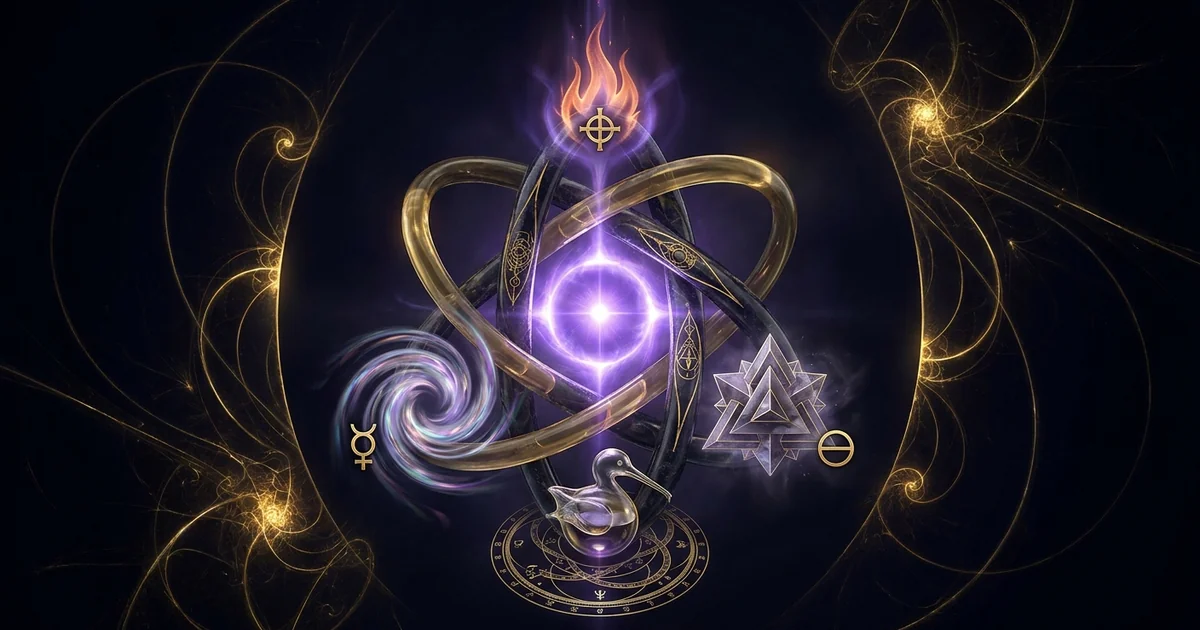
Paracelsus and the Tria Prima: Sulfur, Mercury & Salt Art
Metaphysical Thesis & Epistemological Opening: The Crisis of Humoralism
The Bankruptcy of the Four-Element Galenic Matrix
The medical and natural philosophical consensus of the late medieval European academy rested upon a dogmatic synthesis of Aristotelian physics and Galenic humoral pathology. Within this scholastic framework, terrestrial matter was categorized through the shifting permutations of four primary elements—Earth, Air, Fire, and Water—governed by binary couplings of qualitative contraries: hot, cold, dry, and moist. Human physiological and psychological equilibrium was thought to depend on the proportionate balance of four corresponding internal fluids: yellow bile (choleric), black bile (melancholic), blood (sanguine), and phlegm (phlegmatic). When disease manifested, Galenism identified the etiology as an internal discrasia—a dyscrasia or qualitative imbalance—to be treated through antipathetic evacuation via venesection, emetics, and purges.
Philippus Aureolus Theophrastus Bombastus von Hohenheim, known to intellectual history as Paracelsus (1493–1541), identified this prevailing paradigm not merely as clinically ineffective, but as ontologically bankrupt. Galenism treated biological bodies as passive, inert vessels subject to crude mechanical and qualitative equilibrium, blind to the living, formative spiritual agencies orchestrating material form. By reducing pathology to quantitative excesses or deficits of bodily fluids, the scholastic tradition completely failed to grasp the nature of active, seed-like ontological pathogens—the Semina Morborum—which invaded the human constitution not as passive fluids, but as dynamic, spiritualized entities possessing distinct intentionalities and temporal cycles.
Paracelsus recognized that the Aristotelian hylomorphic doctrine, which posited that passive prime matter (prima materia) is structured by extrinsic immaterial forms, could not account for the metabolic transformations, metallic evolutions, and toxicological crises observed at the mineral vein and the laboratory furnace. The four elements were not the true ultimate constituents of matter; rather, they were secondary envelopes or “matrices” (Elementa) within which deeper, primary metaphysical agents operated.
The Ontological Elevation of the Ternary Principle
In place of the quaternary Aristotelian-Galenic apparatus, Paracelsus introduced a radical ternary cosmology: the Tria Prima—Sulfur, Mercury, and Salt. This triadic structure fundamentally altered Western natural philosophy. The Three Primes were not merely physical chemicals or literal laboratory reagents; they were hypostatic metaphysical principles mediating between the transcendent cosmic archetypes and tangible material manifestation. Paracelsus asserted that physical reality is governed by active cosmic processes rather than static mixtures of hot, dry, wet, and cold qualities.
The introduction of the ternary principle shattered the static dualities and quaternaries of the medieval academy. By positing a cosmos structured by an irrefragable triunity, Paracelsus aligned his chemical ontology with both Christian trinitarian theology and esoteric Neoplatonism. In this architecture, matter is inherently active, self-actualizing, and driven by an inward spiritual impulse. Every mineral, plant, animal, and human body constitutes an individualized hypostatic configuration of the Three Primes.
Rather than viewing matter through the lens of static qualities, Hohenheim interpreted phenomenal reality through dynamic functionality: combustibility, volatility, and coagulative fixity. This conceptual leap transformed natural philosophy from a passive, descriptive taxonomy into an operative ontology. It provided the intellectual foundation for what would later become spagyric medicine, grounding the operational laboratory work of the chymist in a profound understanding of the universe’s triadic divine signature.
Epistemology of the Experientia and the Light of Nature
The epistemological foundation of Paracelsian philosophy demands a violent departure from the syllogistic dialectics of the university lectern. For Hohenheim, scholastic disputation was a sterile enterprise that manipulated dead concepts without ever touching the living core of nature. True knowledge, which he termed Scientia, does not proceed from textual authority—neither Aristotle, Galen, nor Avicenna—but is drawn directly from the Lumen Naturae (the Light of Nature).
The Lumen Naturae represents an interior illumination bestowed by the Creator upon the natural world, an ambient cosmic intelligence that illuminates both the object of inquiry and the perceptual faculties of the adept. To perceive via this Light, the physician-alchemist must cultivate Experientia—not to be confused with modern passive empiricism, but an active, participatory, and initiatic encounter with nature’s operations. The philosopher must read the Signatura Rerum (the Signatures of All Things), wherein the inward spiritual virtues, invisible potencies, and triadic proportions of a substance are expressed through its outer morphological characteristics, color, smell, crystallization, and behavior under the action of heat.
                  DIVINE UNCREATED SOURCE
                             │
                     LUMEN NATURAE
             (The Ambient Cosmic Intelligence)
                             │
     ┌───────────────────────┴───────────────────────┐
     ▼                                               ▼
MACROCOSMIC SIGNATURES                      MICROCOSMIC EXPERIENTIA
(External Forms, Virtues,                (The Adept's Participatory Vision,
Morphology of Phenomenal Matter)            Inner Resonance, and Operative Intuition)
     │                                               │
     └───────────────────────┬───────────────────────┘
                             ▼
                SCIENTIA / THEURGIC GNOSIS
           (Reading the Signatures of Nature)
Through this epistemological lens, nature reveals itself as an open book written in the language of operative signatures. Understanding these signatures requires deep contemplation of universal correspondences, an ontological perspective rooted in the classical Hermetic philosophy of the macrocosm and microcosm detailed in the foundations of hermetic principles of mentalism and correspondence. The adept does not impose intellectual categories onto physical matter; rather, the adept facilitates the self-disclosure of matter by harmonizing the inner spiritual faculties of the microcosm with the macrocosmic astral archetypes.
To interpret the Paracelsian corpus without reducing its concepts to late-Cartesian dualism, the practitioner must master Hohenheim’s specialized metaphysical lexicon:
- Lumen Naturae (The Light of Nature): The invisible, astral radiance infused into the fabric of the created order. It is the counter-pole to the Light of Grace; while Grace reveals divine soteriological truths, the Light of Nature illuminates the occult virtues, spagyric potencies, and structural laws of the material cosmos.
- Archeus (The Internal Demiourgos): The localized, intelligent formative vitality residing within each autonomous entity. Operating primarily within the digestive and metabolic centers of biological forms, the Archeus acts as an internal alchemist that separates the life-giving nutrients from the destructive dross (Cagaster).
- Iliaster (The Primordial Matrix): The pristine, uncorrupted cosmic matrix from which matter precipitated during cosmogenesis. It represents potentiality before its historical degeneration, serving as the ontological target toward which spagyric medicines seek to restore fallen, diseased bodies.
Primary Codices & Historical Transmission: From Jabir to Hohenheim
The Geberian Mercury-Sulfur Binary and Its Arabic Provenance
The conceptual precursors to Hohenheim’s ternary revolution lie in the Islamic golden age of alchemy, most notably within the corpus attributed to Jabir ibn Hayyan (Latinized as Geber, c. 721–815 CE), particularly the foundational treatises Kitāb al-Kimiyā and the later Latin compilation Summa Perfectionis Magisterii. The Jabirian system revolutionized natural philosophy by articulating the Sulfur-Mercury theory of metallic genesis. According to this binary model, all subterranean metals are formed through the interaction of two distinct subterranean exhalations trapped within the earth: a smoky, hot, dry exhalation (philosophical Sulfur) and a watery, cold, moist exhalation (philosophical Mercury).
Within this classical Islamic framework, the identity, purity, and maturation of a specific metal were determined entirely by the internal proportion, cleanliness, and degree of decoction between these two radical principles. Gold represented the ultimate, harmonious, and completely matured fusion of pure, non-combustible Sulfur with brilliant, volatile Mercury, whereas base metals such as lead or tin suffered from impurities, qualitative imbalances, or incomplete subterranean digestion.
While the Geberian binary model served as an exceptionally potent operational paradigm for laboratory metallurgy and mineral transmutation, it remained fundamentally incomplete. It successfully mapped the poles of combustibility and fluidity, yet it lacked an ontological anchor capable of explaining structural consolidation, resistance to dissolution, and the bio-organic formation of physiological tissues.
The Revolutionary Addition of the Saline Fixative Principle
Paracelsus enacted a decisive cosmological rupture by expanding the Geberian binary into an irrefragable trinity. By incorporating Salt (Sal) as an equal, hypostatic co-principle alongside Sulfur and Mercury, Hohenheim addressed the major philosophical blind spot of Arabic and medieval Latin alchemy.
GEBERIAN METALLIC BINARY (8th-14th Century):
Philosophical Sulfur  ──┐
(Combustion, Dry Heat)  ├─► [ Subterranean Decoction ] ─► Metallic Species
Philosophical Mercury ──┘
(Fluidity, Moist Cold)
PARACELSIAN HYPOSTATIC TERNARY (16th Century):
Philosophical Sulfur  ──┐
(Combustibility, Soul)  │
Philosophical Mercury ──┼─► [ TRIPARTITE SIGNATURE ]   ─► Universal Phenomenology
(Volatility, Spirit)    │   (Operative Microcosm)         (Metals, Plants, Humans)
Philosophical Salt    ──┘
(Fixity, Body/Ash)
Salt, in the Hohenheimian taxonomy, is not common mineral table salt (sodium chloride), but the metaphysical principle of corporification, crystallization, tangible resistance, and ultimate fixity. Without the third principle of Salt, physical reality would remain caught in an eternal oscillation between the blazing dissolution of Sulfur and the evaporative volatility of Mercury. Salt arrests the ceaseless interplay of the two fluidic principles, anchoring them into spatial extension and material coagulability.
This formulation fundamentally bridged metallurgy with human pathology and botanical therapeutics. Salt accounts for that which endures: the bone within the flesh, the rigid stem within the herb, the insoluble mineral matrix within the ore, and the alkaline ash that remains after calcination has driven off all moisture and smoke. By grounding the volatile elements in the stability of the saline matrix, Paracelsus formulated an all-encompassing chemical cosmology capable of explaining biological morphogenesis, degeneration, and laboratory transmutation within a singular ontological architecture.
“To understand the Three Primes, let us turn to the simplest illustration that nature provides to our sight: consider wood when it burns. That which burns with flame is Sulfur; nothing burns unless it contains Sulfur. That which rises up as smoke is Mercury; nothing ascends or volatilizes unless it is driven by Mercury. That which remains behind as ash is Salt; nothing returns to fixed earth unless it is preserved by Salt. In these three principles is contained the entire nature of every creature that exists in the terrestrial sphere, and whatever is manifested to our senses is nothing other than these three joined into one single body.”
Rosicrucian and Chymical Reception in Dorn, Fludd, and Boehme
The Paracelsian ternary cosmology rapidly escaped the bounds of toxicological and spagyric tracts, profoundly reshaping European esoteric thought during the late sixteenth and seventeenth centuries. The Frankfurt physician Gerhard Dorn (c. 1530–1584) served as the preeminent philosophical systematizer of Paracelsus. In masterworks such as Clavis Totius Philosophiae Chymisticae (1567) and his contributions to the monumental Theatrum Chemicum (1602), Dorn transposed Hohenheim’s chemical operations into an explicitly theosophical and psychological framework. Dorn demonstrated that the purification of the Tria Prima within the laboratory alembic was inextricably linked to the regeneration of the fallen human soul—a dynamic that modern analytical thought would later interpret as an early cartography of the individuation process, as examined through alchemical psychology and Jungian transmutation.
This ternary paradigm provided the cosmological infrastructure for the emergence of the Rosicrucian manifestos (Fama Fraternitatis, 1614; Confessio Fraternitatis, 1615), wherein the reform of medicine and natural philosophy was proclaimed as the necessary prelude to a universal spiritual dawn. English polymath Robert Fludd (1574–1637) integrated the Paracelsian Tria Prima into massive, lavishly engraved cosmographical treatises that mapped the threefold hypostatic nature of physical matter directly onto the Trinitarian emanations of the Godhead.
Simultaneously, the German visionary mystic Jacob Boehme (1575–1624) appropriated the language of Sulfur, Mercury, and Salt to construct his profound mystical theosophy. In Boehme’s cosmological architecture, the Three Primes ceased to be merely physical or laboratory entities; they became the fundamental dynamics of the uncreated divine nature itself—the dark, astringent contraction of the divine source (Salt), the agonized flash of kinetic awareness (Sulfur), and the luminous, fluidic outpouring of spiritual manifestation (Mercury). Through Dorn, Fludd, and Boehme, Hohenheim’s medical reform achieved its ultimate destiny as a cornerstone of esoteric Western metaphysics.
Ontological Architecture & Cosmological Models: The Hypostatic Triad
Sulfur as the Celestial Fire and Soul (Anima)
Within the triadic architecture of the Paracelsian universe, Sulfur occupies the ontological position of the Celestial Fire and the Soul (Anima). It is the inward, invisible spiritual driver that enables any manifest body to possess warmth, light, vitality, and the capacity for growth. In the phenomenal world, Sulfur reveals its presence through the property of combustibility—it is that structural component of an organism or mineral that takes fire, burns, emits brilliance, or releases sweet-smelling essential oleaginous substances.
Sulfur is the seat of dynamic consciousness and individualized intentionality. It corresponds to the radicale humidum (radical moisture) inflamed and vitalized by the primordial spiritual heat. Metaphysically, Sulfur represents the affective, desiring, and animating nature within the microcosm, acting as an internal sun that warms the cold earth of the corporeal matrix. Without Sulfur, the cosmos would be a frozen, petrified expanse of inert matter, devoid of metabolic acceleration or structural evolution.
Yet, when untamed or dissociated from its sister principles, philosophical Sulfur acts as a devouring, predatory arsonist: it manifests pathologically as systemic inflammations, raging fevers, arterial combustions, and acute psychological manias.
Mercury as the Fluidic Spirit and Vital Pneuma (Spiritus)
Mercury (Argentum Vivum) constitutes the mediating axis of the Paracelsian ternary, embodying the Fluidic Spirit and the vital pneuma (Spiritus). It functions as the universal subtle solvent, the principle of volatility, permeation, fluidity, and transformation. If Sulfur is the distinct, individualizing Soul, Mercury is the animating breath of life—the ubiquitous, dynamic medium of transmission that knits the immaterial soul to the dense, crystalline matrix of the physical body.
       SOUL (Sulfur)
     [ Celestial Fire ]
            │
            ▼
     SPIRIT (Mercury)  ◄── The Universal Solvent & Vital Bridge
    [ Fluidic Pneuma ]
            │
            ▼
       BODY (Salt)
    [ Physical Matrix ]
In laboratory operations, philosophical Mercury reveals itself as that fraction of matter which rises into the dome of the alembic as vapor, steam, smoke, or rectified alcohol; it is fluidic, vaporous, resistant to coagulative fixity, and perpetually seeking escape from terrestrial confinement. Metaphysically, it embodies the transformative, communicative impulse of the cosmos, mirroring the god Hermes as a messenger walking between the subterranean shadows and the supernal light.
Mercury governs all biological transport mechanisms: the nervous system’s subtle electrical fluid, the lymphatic and respiratory tides, and the rapid cognitive fluctuations of the human intellect. In its unpurified, chaotic state, unbound Mercury induces physiological tremors, neurological degeneration, chaotic hallucinations, and erratic cognitive fragmentation.
Salt as the Terrestrial Earth and Physical Corporeality (Corpus)
The third hypostasis, Salt (Sal), is the architectural bedrock of physical corporeality (Corpus). It represents the terrestrial principle of fixity, density, stability, crystallization, and resistance to entropic dissolution. Salt is the structural preservative of nature; without its astringent, organizing power, the radiant heat of Sulfur would instantly consume itself, and the expansive volatility of Mercury would dissipate into the ether.
In the natural world, Salt is the principle that confers tangible dimension, mass, crystallization, texture, and physical density. It is that which remains non-volatile and non-combustible at the bottom of the crucible after the fires of calcination have driven off all volatile spirit and incinerated all sulfureous grease. Salt preserves biological forms from putrefactive decay, serving as the physical tomb and protective vessel within which the radiant spark of the soul remains grounded during its earthly incarnation.
Within human physiology, Salt manifests as the skeletal scaffolding, the mineralized teeth, the dense connective matrix, and the structural integrity of cellular membranes. However, if the saline principle becomes excessively concentrated, astringent, or separated from its fluidic partners, it hardens into pathology, precipitating renal calculi, arthritic calcifications, arterial sclerosis, and profound melancholic petrification.
Sulfur (*Sulfur / Anima*)
- Cosmic Principle: Celestial Fire, Vital Warmth, Unitive Soul.
- Phenomenological Axis: Combustibility, ignition, internal illumination, oily viscosity.
- Physiological Domain: Metabolic heat generation, cardiovascular center, visceral passions, and affective drive.
- Pathological Deviation: Inflammatory fevers, tissue combustion, abscesses, hyper-metabolic exhaustion, psychosis.
- Laboratory Signature: Essential oils, flammable plant resins, volatile lipids, native subterranean brimstone.
Mercury (*Mercurius / Spiritus*)
- Cosmic Principle: Fluidic Spirit, Vital Pneuma, Transformative Bridge.
- Phenomenological Axis: Volatility, evaporation, penetrative permeability, mobility.
- Physiological Domain: Neuro-electrical transmission, respiratory exchange, lymphatic flow, intellectual intuition.
- Pathological Deviation: Neurological tremors, sensory ataxia, fluid dissipation, cognitive mania, vertigo.
- Laboratory Signature: Distilled volatile alcohol, plant essences, sublimates, elemental quicksilver.
Salt (*Sal / Corpus*)
- Cosmic Principle: Terrestrial Earth, Structural Matrix, Physical Corporeality.
- Phenomenological Axis: Fixity, crystallization, coagulative density, astringency.
- Physiological Domain: Skeletal architecture, mineralized tissues, tissue tension, cellular preservation.
- Pathological Deviation: Calculi precipitation, gout, arterial sclerosis, melancholia, tissue calcification.
- Laboratory Signature: Insoluble white ashes, calcined crystalline salts, purified mineral precipitates.
Phenomenological Mechanics & Spagyric Praxis: Solve et Coagula
Spagyric Herbal and Mineral Extraction Protocols
The operative laboratory expression of the Tria Prima is found in the discipline of Spagyria. Paracelsus coined the term from two Greek roots: spao (σπάω, to draw apart, separate, or tear open) and ageiro (ἀγείρω, to collect, bind together, or recombine). Spagyric practice constitutes the physical execution of the classic Hermetic axiom Solve et Coagula (dissolve and coagulate), providing a direct procedural link to the transformational processes first immortalized on the Emerald Tablet and its Hermetic origins.
In contrast to crude destructive heating or simplistic herbal extraction, genuine spagyric medicine requires the complete anatomical deconstruction of a physical substance into its Three Primes, followed by their purification and exalted recombination.
In a botanical spagyric extraction, the dried herb is first subjected to prolonged fermentation and gentle distillation. This process isolates its volatile spirit—the spagyric Mercury—which carries the subtle life-force and volatile aromatic essences of the plant. Next, the remaining botanical mass is subjected to secondary extraction via water and alcohol to isolate the plant’s essential oils, active lipids, and colored resins—the spagyric Sulfur—which embodies the unique virtue, medicinal character, and soul of the organism.
Finally, the exhausted solid physical residue (caput mortuum) is not discarded; rather, it is placed into a crucible and subjected to intensive calcination over direct flame until all dark carbonaceous impurities are burned away, leaving behind a snow-white alkaline ash. From this calcined ash, the crystalline mineral salts—the spagyric Salt of Salt—are leached with pure distilled water, filtered, and evaporated.
When these three purified, exalted fractions are systematically cohobated and reunited into a singular tincture, the resulting spagyric remedy (elixir) possesses an operative potency fundamentally superior to the raw botanical matter from which it was extracted.
The Archeus as Laboratory Worker and Internal Demiourgos
Hohenheim’s revolutionary insight was his recognition that the laboratory furnace and distillation train are physical externalizations of organic human physiology. Deep within every living entity resides the Archeus—the Archeus Faber—an internal, semi-intelligent formative agency acting as an innate alchemist primarily located in the stomach and digestive regions.
When a human consumes food, drink, or medicine, the Archeus initiates a natural spagyric operation. It instantly begins to dissect the ingested matter, separating the pure from the impure, extracting the nourishing Tria Prima necessary for the replenishment of blood, vitality, and skeletal bone, while simultaneously segregating and driving out the non-assimilable, toxic refuse, which Paracelsus termed the Cagaster.
If the Archeus remains vigorous, clear, and unhindered, physiological harmony persists, for the internal alchemist smoothly separates life-giving essences from lethal sediments. However, if the Archeus is overwhelmed by an excessive burden of toxic substances, paralyzed by psychological crisis, or corrupted by an affinity for internal poisons, its separating power falters.
When the Archeus fails to perform this internal Solve et Coagula, the separation of the pure from the impure ceases; the toxic Cagaster precipitates directly into the visceral tissues, causing structural decay, systemic auto-intoxication, and tissue degeneration. Thus, the external human physician does not heal the body directly; rather, the physician administers exalted spagyric medicines whose internal vibrational signatures reactivate and assist the fatigued Archeus, restoring its native capacity to govern internal metabolic separations.
Separation of the Pure from the Impure in Heavy Metal Therapeutics
Perhaps the most controversial and structurally transformative aspect of Paracelsus’s laboratory work was his elevation of toxic mineralogy into the pharmacopeia. Galenic medicine relied almost exclusively on mild, multi-ingredient botanical confections (such as the sprawling, seventy-ingredient theriacs), utterly rejecting heavy metals and minerals as violent, unassimilable poisons. Paracelsus radically overturned this consensus, declaring:
“All things are poison, and nothing is without poison; the dosage alone determines that a thing is not a poison.”
Paracelsus recognized that metals such as antimony, arsenic, and mercury contained exceptionally concentrated, unyielding medicinal virtues, precisely because their internal Tria Prima were tightly bound in dense, indestructible states of elemental fixation. The error of classical physicians was that they administered crude, unpurified minerals, which overwhelmed the biological Archeus and destroyed the organism.
By applying spagyric laboratory operations—sublimation, calcination, cupellation, reverberation, and acid digestion—Hohenheim tore apart the crude mineral bodies, stripping away their lethal, corruptive dross (venenum) to liberate their purified, inner hypostatic virtues (arcanum).
Purified antimony, for instance, stripped of its emetic venom through rigorous furnace operations, became a potent medicine for chronic metabolic disorders, malignant ulcers, and systemic pestilences. Through this method, Paracelsus demonstrated that the toxic nature of a substance was not an absolute, static property, but an ontological condition that could be radically transformed through laboratory theurgy and philosophical fire.
Initiatic Synthesis & Philosophical Implications: Anthropological Transfiguration
The Microcosmic Man as Cooperator Naturae
At the center of Hohenheimian metaphysics stands the profound doctrine of the human being as the exact, structural micro-ontological mirror of the Macrocosm. The human being is not an incidental observer wandering across an alien planetary surface; humanity is the Microcosmus, the ultimate synthesis of all celestial, terrestrial, mineral, and elemental realities compressed into a singular incarnate design.
Every planet revolving through the heavens possesses an interior biological signature within human anatomy: the Sun rules the Heart, the Moon governs the Brain, Jupiter anchors the Liver, Mars directs the Bile, Venus guides the Kidneys, Saturn commands the Spleen, and Mercury orchestrates the Lungs and Cognitive Currents.
MACROCOSM (The Great World)          MICROCOSM (The Human Vessel)
═════════════════════════════════════════════════════════════════════
Planetary Spheres (Saturn, Mars, etc.) ──► Visceral Organ Systems
Elemental Matrices (Earth, Water, etc.) ──► Bodily Matrices & Tissues
Universal Tria Prima (Cosmic Trinity)   ──► Anima, Spiritus, Corpus
The Divine Creative Word (Logos)        ──► The Operative Adept
Because humanity contains within itself the entire architecture of the cosmos, the Paracelsian physician acts not as an intrusive manipulator of nature, but as a consecrated Cooperator Naturae—an active partner and co-worker with nature. Nature is inherently evolutionary, yet it often leaves its works in an incomplete, unripened state. Iron is created in the earth, but nature does not forge the horseshoe; grapes grow upon the vine, but nature does not distill the wine.
The alchemist-physician is called to pick up the work precisely where nature left off, utilizing laboratory fire and spiritual understanding to accelerate the natural evolution of matter, carrying it from its fallen, imperfect state into its perfected, exalted fruition. In doing so, the adept engages in an operative discipline that mirrors the emanationist structures found in mystical systems like the Kabbalistic Tree of Life and Sefirotic emanations, balancing cosmic forces within earthly vessels.
Pathology as the Dissociation of the Three Primes
Through the lens of this cosmic anthropology, Paracelsus formulated an entirely new etiology of human suffering: disease is fundamentally the dissociation or localized rebellion of the Tria Prima. In a healthy human body, Sulfur, Mercury, and Salt operate in unified, mutual equilibrium, held together by the dynamic life-force under the governance of the Archeus. Health is nothing other than this harmonious co-habitation. Disease occurs when one of these principles tears itself away from the triadic unity, attempting to assert independent dominance over the bodily matrix.
When Sulfur becomes untethered, it ceases to gently warm the tissues and breaks out as inflammatory fire. It burns through the organs, producing raging fevers, localized pustules, gouty combustions, hepatitis, and psychological delusions of grandiosity or paranoia.
When Mercury is displaced, it breaks free from the saline anchor and volatilizes prematurely, giving rise to nervous chorea, hydrocephalus, catarrhs, respiratory asthma, involuntary spasms, and cognitive alienation.
When Salt precipitates outside of its harmonious integration with Mercury and Sulfur, its astringent, petrifying quality acts unchecked upon the soft tissues: it solidifies into kidney and gall bladder stones, calcifies the arterial conduits, petrifies the lungs, and induces rigid, melancholic depressions.
Pathology is therefore not an external invader to be assaulted with toxic suppressants; it is an internal civil war within the Three Primes that must be resolved through re-harmonization, purification, and the re-establishment of the broken ternary bond.
Esoteric Medicine as Ontological Restoration and Redemptive Theurgy
The ultimate destiny of Paracelsian medicine transcends physical healing, arriving at the doorstep of redemptive theurgy. Because disease is an ontological fracture—a microscopic echo of the Fall of humanity and nature from their primordial, uncorrupted state—the administration of a true spagyric remedy acts as a sacrament of restoration. When the physician introduces an exalted spagyric arcanum into the body of the patient, they are not merely introducing biological active ingredients; they are delivering an incorruptible, purified archetype of the balanced Tria Prima.
This process directly awakens the subtle, immortal vehicle within the human architecture, which Paracelsus identified as the Corpus Glorificationis—the luminous, astral resurrection body. By presenting the diseased, disordered human Archeus with a perfected, spagyrically resurrected botanical or mineral substance, the remedy acts as a crystalline tuning fork.
The disordered internal primes of the patient harmonize with the perfected primes of the medicine. The internal fire is cooled, the volatile spirit is anchored, the petrified salt is dissolved, and the entire human microcosm is lifted out of its entropic degeneration and brought back into direct alignment with the divine emanation flowing through the Lumen Naturae.
The modern investigator must navigate two equally destructive pitfalls when engaging with the Hohenheimian Tria Prima:
- The Materialist Reduction: The error of modern historians of science who dismiss Paracelsus’s metaphysical and theosophical treatises as medieval baggage, attempting to reduce his work to proto-chemistry, toxicology, and empirical pharmacology. To treat the Tria Prima as mere early designations for combustible gases, elemental mercury, and sodium salts strips the art of its dynamic, archetypal core.
- The Pseudo-Spiritual Disembodiment: The opposite error, rampant in modern New Age and strictly post-Jungian currents, which reduces Paracelsian spagyria entirely to psychological metaphors, archetypal archeology, or disembodied meditative states. Paracelsus repeatedly emphasized that the mysteries of the Tria Prima must be engaged through the physical furnace, the glass alembic, the charcoal flame, and direct contact with material creation. Without tangible laboratory praxis, the philosopher’s stone remains a sterile intellectual fantasy.
Frequently Asked Questions: Resolving Alchemical Paradoxes
How Do the Three Primes Differ from the Elements of Earth, Air, Fire, and Water?
A persistent point of confusion within Renaissance natural philosophy is the exact structural relationship between the ancient four elements and the Paracelsian Three Primes. The fundamental distinction lies in their ontological depth and functional roles:
The Four Elements (Fire, Air, Water, Earth) represent the external, phenomenal “matrices” or clothing of matter. They are the secondary containers within which creation moves.
In contrast, the Tria Prima (Sulfur, Mercury, Salt) are the internal, metaphysical seeds and functional principles that animate, structure, and give specific operational identity to those matrices.
┌─────────────────────────────────────────────────────────────┐
│                 PHENOMENAL MATRICES                         │
│               [ Earth, Air, Fire, Water ]                   │
│                                                             │
│   ┌─────────────────────────────────────────────────────┐   │
│   │               THE TRIA PRIMA                        │   │
│   │   [ Philosophical Sulfur, Mercury, and Salt ]       │   │
│   │                                                     │   │
│   │   The Inner Seeds, Operative Virtues, and           │   │
│   │   Functional Dynamics within the External Elements  │   │
│   └─────────────────────────────────────────────────────┘   │
└─────────────────────────────────────────────────────────────┘
Water, for example, is an external element, but within that element of water, one can find a sulfureous warmth, a mercurial volatility, and a saline crystallization. The Tria Prima reside within the elements as their interior soul, spirit, and body.
While the elements describe states of aggregation (hot/cold/wet/dry), the Three Primes describe intrinsic operational virtues and qualitative dynamics: combustibility, volatility, and fixity. By reaching through the four external elements to directly manipulate the Three Primes, the Paracelsian alchemist operates upon the causal roots of matter rather than its superficial environmental expressions.
Why Was the Inclusion of Salt Revolutionary for Western Metallurgy and Therapeutics?
Before Paracelsus integrated Salt into the foundational cosmological schema, Western metallurgy and alchemical theory were dominated by the classical Geberian binary of Sulfur and Mercury. This binary framework suffered from severe explanatory limitations.
While it could describe why an ore melted under heat (Mercury) or why it took fire or oxidized (Sulfur), it completely failed to explain structural crystallization, structural integrity, resistance to dissolution, and the persistent presence of calcined white ash. Medieval alchemists had no coherent framework to explain why, after driving off all smoke (Mercury) and burning away all flame (Sulfur), a tangible, non-combustible, structural body remained behind in the crucible that possessed distinct medicinal and chemical properties.
By identifying Salt as the third hypostatic prime, Paracelsus solved this metaphysical dilemma:
- Salt provided an ontological account for structural cohesion, corporification, and density.
- It explained how subtle spiritual forces become concretized into physical space.
- In the realm of therapeutics, the inclusion of Salt was transformative. Galenic medicine treated botanical ashes as dead, inert waste to be discarded. Paracelsus demonstrated that the calcined ash contained the crystalline saline heart of the plant—the very matrix that held its physical signature.
By recovering, purifying, and re-incorporating this crystalline Salt into herbal and metallic tinctures, Paracelsian spagyrics introduced entirely new classes of stable, bioavailable mineral medicines that revolutionized pharmacognosy and established the foundational concepts of modern physiological chemistry.
Can Spagyric Medicine Be Reconciled with Modern Chemistry and Pharmacology?
While reductionist modern pharmacology and Paracelsian spagyria operate from fundamentally different metaphysical premises, they share substantial points of practical intersection. Modern pharmacology functions through a mechanistic, reductionist paradigm: it attempts to isolate single “active pharmaceutical ingredients” (APIs) from biological matrices, discarding the remainder of the plant or mineral as inactive ballast. This approach often introduces unintended side effects, as the isolated chemical compound lacks the natural buffering agents, co-factors, and organic matrices present in the living plant.
MODERN PHARMACOLOGY (Reductionist Isolation):
Botanical Whole ──► [ Chemical Stripping ] ──► Isolated Compound (API)
                                                    │
                                           (Ballast Discarded)

PARACELSIAN SPAGYRICS (Holistic Purification & Re-Integration):
Botanical Whole ──► [ Spagyric Separation ] ──► Purified Volatiles (Mercury)
                                            ──► Essential Resins (Sulfur)
                                            ──► Crystalline Minerals (Salt)
                                                    │
                                           (Sacred Cohobation)
                                                    ▼
                                            Harmonized Spagyric Elixir
Spagyric medicine, by contrast, operates holistically. Rather than isolating a single molecule, it purifies and recombines the entirety of the organism’s constitutive parts:
- Its essential volatile oils and terpenes (Sulfur),
- Its fluidic spirits and tinctures (Mercury),
- Its inherent mineral salts, trace elements, and alkaline crystalline structures (Salt).
The spagyric process removes pathogenic organic compounds, toxic cellular debris, and destructive dross while systematically preserving the plant’s complete chemical synergy.
Contemporary research into phytocannabinoids, adaptogens, and complex botanical extracts increasingly confirms the existence of the “entourage effect”—the phenomenon wherein the therapeutic efficacy of a botanical substance depends upon the synergistic interplay of its diverse chemical constituents rather than a single isolated molecule. In this respect, Hohenheim’s five-hundred-year-old spagyric protocol directly anticipated modern systems pharmacology, offering a mature, holistic paradigm that bridges operative natural chemistry with sacred cosmological philosophy.
The transition of alchemy from medieval speculative transmutation to systemic bio-chemical inquiry is rigorously mapped by two twentieth-century historians of science:
- Walter Pagel, Paracelsus: An Introduction to Philosophical Medicine in the Era of the Renaissance (S. Karger, 1958/1982): Pagel documents how Paracelsus’s substitution of the Tria Prima for the Galenic humors laid the intellectual foundations of modern pathology, viewing biological organs as localized chemical laboratories governed by dynamic metabolic agents rather than passive fluidic reservoirs.
- Allen G. Debus, The Chemical Philosophy: Paracelsian Science and Medicine in the Sixteenth and Seventeenth Centuries (Science History Publications, 1977): Debus illustrates how the Paracelsian challenge to the Aristotelian university establishment catalyzed the Scientific Revolution, transforming the furnace and alembic into primary instruments of natural philosophy and prefiguring modern iatrochemistry, toxicology, and chemical biology.