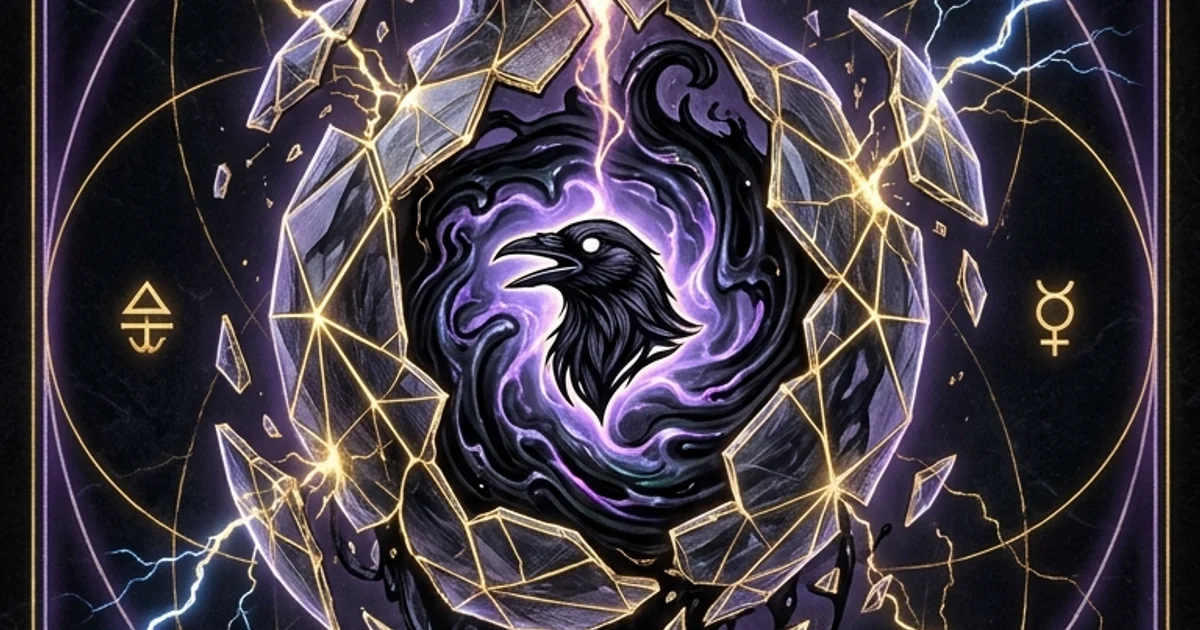
Nigredo (The Black Work): Calcination, Putrefaction Art
Metaphysical Thesis & Epistemological Opening: The Ontological Catastrophe of the Nigredo
The Paradigm of Dissolution: Subverting the Cartesian Subject
The alchemical Nigredo, or “Black Work,” designates an ontological catastrophe wherein the empirical ego’s structural continuity is systematically dissolved within the sealed alembic of metaphysical inquiry. Far from functioning as an analogue for neurotic depression or passive melancholy, this primordial phase constitutes an aggressive epistemological reduction. Modern psychological models often prioritize ego-stability, treating structural destabilization as a clinical pathology to be corrected. Western hermeticism, however, conceives the unredeemed ego—the unrefined materia of fallen Adam—as a coagulated mass of historical sedimentation, cultural conditioning, and somatic fixations that obstruct transpersonal awareness.
To initiate the Great Work (Opus Magnum), this coagulated construct must undergo radical terminal deconstruction. The operative premise of the nigredo black work calcination putrefaction dark night of the soul dynamic is that psychic matter cannot receive higher informational coherence until its inherited matrix has collapsed into absolute entropic zero.
The Western intellectual lineage, beginning with the Cartesian bifurcation of res cogitans and res extensa, insulated the cognitive apparatus from the volatile operations of matter. Alchemical ontology subverts this division. Within the operative hermetic framework preserved from the Hermetic Corpus and Alexandrian alchemy, the metallurgical vessel was never an inert chemical crucible, but an exteriorized topography of the operator’s unconscious.
When the proto-chemist submitted auriferous minerals, lead, or antimony to devastating thermal gradients, the objective transformation of matter operated synchronously with an internal catastrophic collapse. The dissolution of false ego identity is achieved not through intellectual contemplation, but through somatic and phenomenological dismemberment. The practitioner undergoes an experiential confrontation with their self-narrative, exposing it as an ephemeral aggregate of defensive strategies designed to insulate consciousness from primordial chaos.
Materia Prima as the Pre-Cosmic Informational Substratum
The confrontation that defines the initial phase of the Opus requires an intentional collision with the prima materia (first matter). Hermetic and Gnostic cosmologies describe this substance as the undifferentiated, unformed substratum of the cosmos—the pleromatic potentiality that preceded the demiurgic imposition of physical form. In human phenomenological architecture, this prima materia is discovered in what the empirical ego discards: neurotic complexes, somatic terror, instinctual drives, and the collective shadow.
The ego organizes reality through strict categorization, perceptual filtering, and cognitive suppression. By maintaining these boundaries, it sustains the illusion of a coherent, autonomous self. The prima materia is therefore experienced as toxic and threatening; its entry into conscious awareness disrupts linear identity and suspends psychic homeostasis.
DEMIURGIC CONDENSATION (Coagulatio)
  [ Transpersonal Field ] ──> [ Cultural Conditioning ] ──> [ Solidified Ego Matrix ]
                                                                     │
                                                                     ▼
                                                          [ TERROR OF ANOMIE ]
                                                                     │
ALCHEMICAL COLLAPSE (Nigredo)                                        ▼
  [ Prima Materia Revealed ] <── [ Thermal / Moist Rupture ] <── [ Sealed Vas Hermetis ]
Gerhard Dorn, in his sixteenth-century treatise Speculativae Philosophiae, documented this terrifying confrontation with pre-cosmic matter, articulating that no man can construct the living stone of philosophical wisdom without first stripping the mind of its acquired psychic architecture. The prima materia demands that the operator descend into the unmanifest, chaotic substrate of consciousness. This is not a regressive psychological retreat, but a deliberate encounter with the latent unactualized possibilities that lie buried beneath social adaptation. It requires the systematic destabilization of the practitioner’s homeostatic defenses, pulling the subject past the illusions of persona and into contact with the primeval void.
The Greek term melancholia (μέλαινα χολή, melaina chole, literally “black bile”) shares a conceptual lineage with the Latin nigredo and the mythological root Khem (the fertile, pitch-black alluvial soil deposited by the Nile). While classical humoral medicine pathologized melancholia as an excess of cold, dry humor that darkened the spirits, ancient Egyptian sacred metallurgy (khemia) viewed this subterranean blackness not as a void of non-being, but as the hypostatic concentration of all fecundity.
In early esoteric hermeneutics, nigredo signifies hyper-dense informational potentiality. It is the absolute darkness that precedes cosmological fiat; an unformed ontological ground where form is suspended, rendering it the only matrix capable of midwiving the Albedo’s lunar illumination.
The Hermetic Necessity of Putrefactive Rupture
The Nigredo is structurally non-negotiable within esoteric cosmology because spiritual integration without prior somatic-psychic annihilation results in nothing more than narcissistic inflation. Contemporary spiritual systems often attempt an unearned ascent directly toward transcendence, evading the putrefactive rupture demanded by the subterranean gods. The hermetic axiom solve et coagula (dissolve and coagulate) establishes dissolution as an absolute prerequisite. Before genuine spiritual architecture can be established, the base materials must undergo systemic corruption and decay.
This necessity stems from the nature of the vas hermetis (the hermetic vessel). The vessel must remain hermetically sealed so that volatile psychic toxins and instinctual obsessions cannot escape into worldly projection. Denied external release, these internal energies turn inward, attacking and devouring the egoic defenses that generated them. The putrefactive rupture is an aggressive informational phase transition: the practitioner experiences the utter failure of their conventional coping strategies, their spiritualized rationalizations, and their conceptual grasp of divinity.
This total epistemological impasse is the crucible out of which authentic theurgy emerges. The Nigredo strips the intellect of its pride, reducing the philosophical subject to raw, exposed, and vulnerable psychic matter. This systematic reduction exposes the subject directly to the transformative, transpersonal fire of the unconscious.
Primary Codices & Historical Transmission: Lineage of the Caput Corvi
Greco-Egyptian Proto-Alchemy: The Somatic Sacrifices of Zosimos
The historical roots of the Nigredo emerge in Greco-Egyptian Alexandria, where Hellenistic philosophy, Gnostic soteriology, and Egyptian metallurgical practice converged. The earliest foundational codices outlining this blackening process appear in the Authentic Memoirs and Visions of Zosimos of Panopolis (c. 300 CE). Zosimos shifts alchemical instruction away from mechanical chemical receipts toward visionary, phenomenological allegories of initiation.
In these dream accounts, the laboratory apparatus merges with the sacrificial temple. The transition from base matter to sacred gold is depicted as an agonizing sequence of somatic mutilations: dismemberment, decapitation, flaying, and incineration upon an altar of transformation.
"I saw a priest standing before me upon an altar shaped like a bowl. There were fifteen steps leading up to the altar. The priest stood there, and I heard a voice from above saying to me: ‘I have accomplished the descent of the fifteen steps of darkness, and I have completed the ascent of the steps into the light. It is the sacrificer who renews me, casting off the heaviness of the body; and, consecrated by necessity, I have become a spirit.’
And I saw the priest Ion pierced through with a sword, cut into pieces, his limbs severed, his head severed from his body, his flesh mingled with fire, and turned into blackness, the very matter of the art." — Zosimos of Panopolis, On the Excellence of the Art (Codex Parisinus Graecus 2327)
Zosimos establishes that the Nigredo is an embodied, somatic trauma rather than a disembodied allegory. The priest Ion is both the practitioner and the base metal. His physical form is hacked apart, stripped of its biological integrity, and boiled in the alchemical broth until it reduces to black, primeval sludge. The physical descriptions of boiling, calcining, and decomposing minerals—specifically lead, copper, and realgar—mirrored the initiate’s internal experience of psychic dismemberment.
The Hellenistic mind recognized an unyielding isomorphism between matter and consciousness. The physical putrefaction of matter was understood to directly catalyze the putrefaction of the carnal ego, forcing the initiate to experience their own mortality, moral corruption, and existential vulnerability.
Medieval Hermetic Receptions: The Rosarium Philosophorum and Aurora Consurgens
As alchemy traversed from the Islamic world into the Latin West during the twelfth and thirteenth centuries, this Greco-Egyptian imagery was incorporated into Christian mysticism and scholastic metaphysics. The pinnacle of this synthesis appears in the sixteenth-century treatise Rosarium Philosophorum (1550).
The Rosarium details the chemical wedding of the solar King (Sol) and the lunar Queen (Luna). Their union within the fluid medium of the vas hermetis does not generate immediate spiritual transfiguration, but instead results in sudden, catastrophic death. Plate 6 of the treatise depicts the royal pair fused into a singular, two-headed corpse resting within an unsealed stone sepulcher, covered by the earth, accompanied by the inscription: Hier ist ein Verstorbenes begraben (“Here lies a dead corpse buried”).
CONJUNCTIO INFERIOR
          [ Sol ]   +   [ Luna ]
             │             │
             └───┬─────┬───┘
                 │     │
                 ▼     ▼
         [ Catastrophic Fusion ]
                 │
                 ▼
        [ Sarcophagus / Tomb ]
     (Hier ist ein Verstorbenes begraben)
                 │
                 ▼
          [ PUTREFACTIO ]
      Blackening / Caput Corvi
This medieval reception emphasizes the paradox of the conjunctio: the initial convergence of conscious and unconscious polarities inevitably triggers profound putrefaction (putrefactio). In the Aurora Consurgens, a fourteenth-century illuminated manuscript traditionally attributed to Pseudo-Thomas Aquinas, the Nigredo is framed through the apocalyptic poetry of the Song of Songs and the Lamentations of Jeremiah.
The soul speaks from the abyss of decomposition, crying out that its beauty has been darkened by solar fire and submerged into the mud of the pit. The medieval hermeticists grasped an essential operational truth: the spiritual seed cannot germinate unless its protective husk rots within the subterranean darkness of the earth. The tomb and the womb become functionally identical; the sarcophagus of the King and Queen is the indispensable vessel out of which the filius philosophorum (the philosophical child) must be born.
Renaissance Emblematics: Michael Maier and the Ominous Herald of the Raven
During the Renaissance hermetic revival, the iconography of the Nigredo reached its visual and allegorical peak in the emblematic masterworks of Michael Maier, specifically his Atalanta Fugiens (1617). Maier, a count palatine, physician, and personal advisor to Holy Roman Emperor Rudolf II, synthesized hermetic philosophy, mythology, and polyphonic musical fugues into an initiatory system.
Central to Maier’s emblemata is the recurring motif of the caput corvi—the raven’s head. In Emblem XLIII, Maier depicts a rotting corpse lying upon its back across a scorched landscape, while a black raven alights upon its breast, pecking relentlessly into its desiccated flesh.
The caput corvi was recognized across all Renaissance alchemical schools as the definitive indicator of successful mortificatio. Its presence verified that the fire within the athanor had successfully reduced the volatile and combustible substances to an irreducible, unyielding blackness. The raven, a carrion bird that feeds upon the decomposing remains of expired organisms, serves as the psychopomp of the Nigredo. It embodies the active, carnivorous intelligence of death that consumes the residual fixations of the personality.
Maier insists that when the operator witnesses the appearance of this jet-black signifier in the glass, they should rejoice rather than despair. The raven marks the nadir of the descent. It indicates that the material has reached absolute zero, having decayed to the point where further degradation is impossible, thereby opening the operational pathway toward the palingenesis of the Albedo.
Ontological Architecture & Cosmological Models: The Dual Vectors of Calcinatio and Putrefactio
Calcinatio: The Solar Fire and the Ash of Frustrated Desire
The realization of the Nigredo is achieved through two complementary thermodynamic vectors: the dry way of calcinatio and the wet way of putrefactio. Calcinatio operates via relentless, desiccating heat. In the laboratory, this operation subjected dense mineral compounds, bones, or metallic ores to an unshielded, high-intensity flame within an open crucible until all moisture, oils, and volatile components were burned away, leaving a dry, powdery ash.
Ontologically, calcinatio corresponds to the element of Fire. It is the solar, fiery assault upon the instinctual desires, unconscious compulsions, and inflated ego structures that keep consciousness chained to its neuroses.
Psychodynamically, calcinatio manifests as the profound frustration of desire. As Edward F. Edinger demonstrates in Anatomy of the Psyche, the drive toward instinctual gratification is inherently flammable. When a deep emotional complex, an erotic fixation, or an uncontained ambition is denied realization in the outer world—when it is enclosed within an internal crucible and heated by conscious refusal to project or act out—the practitioner experiences the inner fire of calcinatio.
This inner fire is experienced phenomenologically as consuming rage, volcanic frustration, or burning guilt. The solar fire systematically consumes the water of emotional sentimentality and the fat of self-deception, reducing the practitioner’s internal landscape to dry, despondent ash. This ash represents the stripped, structural baseline of the self: an irreducible mineral reality stripped of transient personal narratives.
Putrefactio: The Lunar Moisture and Microbial Decomposition
In contrast to the scorching solar desiccation of calcinatio, putrefactio is the wet, lunar, subterranean vector of the Black Work. In the alchemical vessel, this operation is executed by submerging the calcined ash or the raw matter into stagnant, corrupting fluids—often termed the aqua mercurialis, the venom of the dragon, or horse dung (venter equinus)—providing a slow, moist, consistent thermal environment that facilitates bacterial rot and dissolution.
If calcinatio burns matter with fire, putrefactio drowns it in the subterranean deep. It corresponds to the elements of Water and Earth: cold, heavy, dark, and disintegrative.
Phenomenologically, putrefactio governs the damp rot of despair, unresolved grief, and the unraveling of meaning. It corresponds directly to the classical mystic’s confrontation with the dark night of the soul in transpersonal crisis. Here, the ego is not consumed by the dry, active flame of frustrated passion; instead, it slowly rots away within its own trapped, stagnant waters. The clear boundaries of the personality dissolve into a putrid sludge of unintegrated shadow material.
The structures of belief, spiritual accomplishments, and identity unravel through cognitive decay. Putrefactio reveals the rot inherent in conditioned existence, exposing the repressed rot that lies beneath the constructed veneer of bourgeois persona and social respectability. It is a slow, decomposing transition: the matter must ferment, fester, and give off its foul odor (odor sepulchrorum) until the organizing coherence of the past is completely broken down.
Calcinatio (The Dry Vector)
- Cosmological Element: Primordial Fire (Ignis Gehennae)
- Operational Mechanic: Desiccation, combustion, extreme dehydration, high-heat exposure.
- Resulting Substance: Desiccated white/gray ash, unburnable mineral salts.
- Phenomenological Manifestation: Frustrated desire, consuming rage, burning guilt, agonizing ascetic restraint.
- Structural Purpose: Consumes volatile animal drives and inflated emotional projections.
Putrefactio (The Moist Vector)
- Cosmological Element: Subterranean Water / Heavy Earth (Aqua Foetida)
- Operational Mechanic: Liquefaction, bacterial decay, slow fermentation, unctuous rot.
- Resulting Substance: Putrid black slime, fermenting compost, the dark mud of the Nile.
- Phenomenological Manifestation: Nihilism, profound grief, terminal depression, paralysis of the will.
- Structural Purpose: Dissolves the rigid architecture of the cognitive matrix and breaks down defenses.
Systemic Thermodynamics of the Hermetic Athanor
The dual vectors of calcinatio and putrefactio are not mutually exclusive operations; they operate as complementary thermodynamics within the self-regulating system of the hermetic athanor. The Great Work requires both operations to execute its systemic cycle of transformation. Desiccation without moist putrefaction leaves the alchemical matter trapped in an arid, sterile state—a crystalline, brittle egoism incapable of generation.
Conversely, putrefaction without prior calcination degrades into swampy, boundaryless fragmentation, risking psychosis or somatic dissipation. The alchemist must navigate a deliberate oscillation: matter must be dried by fire, then dissolved in moisture, alternating until its rigid structures yield.
THE THERMODYNAMIC OSCILLATION
   ┌────────────────────────────────────────────────────────┐
   │                                                        │
   ▼                                                        │
[ CALCINATIO ] ──(Desiccated Ash)──> [ PUTREFACTIO ]        │
(Solar Fire / Rage)                 (Lunar Waters / Grief)  │
   │                                        │               │
   │                                        ▼               │
   │                                  [ CAPUT CORVI ]       │
   │                                 (Absolute Zero)        │
   │                                        │               │
   └──────(Iterative Recirculation)─────────┴───────────────┘
This thermodynamic oscillation is sustained by the geometry of the athanor—the furnace designed to hold the vas hermetis under continuous, measured heat. The vessel must be sealed with the “Hermetic seal” (sigillum Hermetis), a lute formed of clay, glass, and animal matter, ensuring that none of the vaporized internal essence escapes.
As the heat within the furnace rises, the moisture contained in the matter vaporizes, rises to the top of the vessel, condenses against the cool upper glass, and falls back down upon the scorched substrate. This continuous circulation (circulatio) repeatedly washes the charred ash in its own bitter sweat, driving the compound down into the blackest black (nigredine nigrius), where it surrenders all resistance and enters absolute inertia.
Phenomenological Mechanics & The Crucible of Consciousness: Confronting the Shadow in the Vas
The Vas Hermetis as an Epistemological Quarantine
The vas Hermetis functions as an epistemological quarantine within which the psychological mechanism of projection is neutralized. In ordinary states of consciousness, the ego maintains psychological equilibrium by projecting its unintegrated, disowned shadow contents onto the external world: enemies, partners, social structures, and cultural scapegoats.
The human mind externalizes its unacknowledged malice, vulnerability, and bestiality to preserve its conscious self-image. The alchemical vessel, however, is sealed against outward projection. It isolates the practitioner from their customary psychological escape routes, demanding absolute honesty with oneself.
By sealing the vessel, the practitioner prevents psychic leakage. Deprived of the ability to project internal contradictions onto outer targets, the subject is forced to observe their psychic reality directly within the crucible. The walls of the vessel reflect the disowned shadow back into the conscious mind. The ego is compelled to recognize that the corruption, the darkness, the hostility, and the pathology it condemned in the external world reside within its own core.
Carl Gustav Jung, analyzing this phenomenological dynamic in Psychology and Alchemy, noted that the Nigredo is felt as an acute moral and ontological crisis. The practitioner must ingest their own poison (venenum), confronting the reality that their carefully constructed identity is an elaborate psychological defense against the depths of their own unconscious.
Confronting Shadow Material in Crucible Dynamics
The crucible experience strips away the defense mechanisms that guard everyday consciousness. In this containment, the initiate confronts the autonomous nature of unconscious complexes. These complexes are not passive, dormant memories; they possess their own instinctual drives, desires, and energetic momentum.
When the Nigredo dissolves the ego’s organizing control, these fragmented sub-personalities rise to the surface, appearing as inner demons, chimeric monstrosities, or the rotting dead of the alchemical wood. This process represents an inescapable encounter with the transpersonal shadow:
- The personal shadow: repressed traumas, denied malicious desires, ancestral guilt, and instinctual longings.
- The archetypal shadow: the raw, archaic bedrock of human terror, violence, and non-human dread inherited across phylogenetic evolution.
- The cultural shadow: the unacknowledged hypocrisies, violence, and rot upon which civilized society is constructed.
Confronting shadow material in the crucible demands sustained phenomenological presence. The practitioner cannot afford to run, rationalize, or deploy spiritual bypass techniques. Every intellectual evasion must be consumed by the fire. The false ego identity unravels as it realizes that consciousness is not the master of its internal territory, but a fragile point of awareness adrift upon an ocean of primeval forces. The Nigredo forces the subject to recognize their personal capacity for evil, their fundamental helplessness, and their deep enmeshment within biological and cosmic machinery.
To undertake the operations of calcinatio and putrefactio without a rigorously secured vas hermetis invites catastrophic psychic fragmentation. If the boundaries of the vessel are breached—whether through intellectual hubris, inadequate ethical grounding, or deep-seated somatic fragility—unconscious shadow material floods the conscious mind uncontained.
This condition results not in alchemical transformation, but in clinical psychosis, borderline dissociation, megalomaniacal inflation, or persistent suicidal despair. The operator becomes consumed by the rot rather than transmuting it, mistaking the putrefying prima materia for the ultimate horizon of existence. Mortificatio must remain strictly contained within conscious, disciplined hermetic limits; otherwise, the Black Work deteriorates into simple ego destruction without the possibility of dawn.
The Dark Night of the Soul Versus Clinical Pathologization
It is essential to establish a rigorous boundary between the alchemical Nigredo—alongside its mystical equivalent, St. John of the Cross’s Dark Night of the Soul—and standard psychiatric categories of major depressive disorder. Clinical psychiatry interprets pervasive despair, anhedonia, and psychic paralysis through a pathologizing, neurobiological lens. Depression is treated as a systemic malfunction of neural chemistry to be eliminated via pharmacological intervention.
While clinical intervention is necessary for genuine pathological breakdowns, this lens systematically overlooks the teleological necessity of spiritual dissolution. The Nigredo is not a chronic mental disorder; it is a profound initiatory threshold.
COMPARATIVE TRAJECTORIES
Clinical Pathology (Uncontained Breakdown):
  [ Intact Ego ] ──> [ Boundary Collapse ] ──> [ Uncontained Dispersion ] ──> [ Chronic Neurosis / Dissociation ]

Alchemical Nigredo (Hermetic Teleology):
  [ Intact Ego ] ──> [ Sealed Vessel ] ──> [ Calcinatio / Putrefactio ] ──> [ Caput Corvi ] ──> [ Seed of Albedo ]
The alchemical perspective recognizes that the dark night possesses purposeful, teleological vectoring. It is not an arbitrary mechanical failure of brain chemistry, but an organized informational clearing designed to break a frozen, obsolete cognitive system. Clinical depression is characterized by passive, uncontained psychic leakage; the individual is tossed about by unintegrated shadows without an operative container, leading to exhaustion and despair.
The Nigredo, when properly contained within an esoteric practice, is an intentional descent. The despair is embraced as a fire of purification. The practitioner recognizes their suffering as an essential phase change—a purposeful dismantling of their false, secular identity, without which their deeper metaphysical ground cannot be reached.
Operational System Architecture: The Flow of Dissolution
The Sequential Stages of Nigredic Unfolding
The transition through the Nigredo is an organized, deterministic process. Alchemical manuscripts, despite their dense allegorical language, outline a precise series of operational phases that trace the collapse of the base material. The transformation begins with the collection of the unrefined materia, progresses through intense thermal and chemical destabilization, passes through the zero point of the caput corvi, and yields the irreducible ground from which the first sparks of the whitening lunar illumination (Albedo) emerge.
Understanding this sequence prevents the practitioner from prematurely aborting the process during its most distressing phases, or from mistaking early thermal friction for authentic spiritual illumination.
The architecture moves deliberately from structural fixity to chaotic fluidity, and finally into an irreducible, purified ground. Each stage applies a specific stressor to the psychic matrix, forcing the release of bound energy and the dissolution of outdated cognitive boundaries.
From Gross Identification to Subterranean Chaos
The process begins with the raw mineral: the practitioner’s conventional, everyday consciousness, entangled with the material world and immersed in cultural conditioning. The initial application of calcinatio challenges this identification.
The solar fire of self-inquiry, disciplined ascetic practice, and the rigorous denial of habitual escapism burns through the outer layers of the persona. The immediate consequence of this fire is the reduction of the individual’s inflated self-image into dry, brittle ash. The ambitions, certainties, and intellectual models that previously sustained the individual crumble under scrutiny.
This ash is then cast into the dark waters of putrefactio. In this subterranean phase, the desiccated fragments of the ego are thoroughly soaked in the unconscious. All linear purpose is lost. The individual enters a state of absolute disorientation—an informational void where previous moral, intellectual, and spiritual compasses fail.
The mind dissolves into primordial mud (limus terrae). The unconscious ceases to be a supportive wellspring of creative insight and instead becomes an overwhelming expanse of dismembering forces. The individual is forced to surrender all claim to personal autonomy, experiencing their identity as an empty, transient wave upon an infinite, primordial sea.
Signatures of Successful Putrefaction
The practitioner must recognize the operational signatures that confirm the matter has completely putrefied within the vessel. The primary indicator is the appearance of the caput corvi (the raven’s head). In laboratory alchemy, this signified that the chemical compound had turned into a deep, velvety, light-absorbing blackness, leaving no trace of color, luminescence, or volatile movement.
Phenomenologically, the caput corvi manifests as absolute interior stillness. The internal friction, anxiety, and panic that marked the onset of the Nigredo fall away. The frantic resistance of the ego exhausts itself. The practitioner enters a state of absolute, unshakeable yielding.
THE THREE SIGNATURES OF OPERATIONAL COMPLETION
  1. Terminal Cessation of Egoic Rebellion (The Raven's Head):
     Dynamic friction yields to radical stillness. The subject stops fighting the void.
  2. The Foul Odor of the Sepulcher (Odor Sepulchrorum):
     The psychic nauseation that accompanies the clear recognition of one's own egoic rot.
  3. Emergence of the Incombustible Salt:
     The discovery of an irreducible point of awareness that survives the fires of Calcinatio
     and the waters of Putrefactio.
When these three signatures align, the Nigredo is complete. The matter cannot decay any further; it has reached its absolute zero point. Attempting to force an early, premature ascent toward the light before these signatures appear risks carrying uncalcined slag into the subsequent operations, contaminating the work and requiring a regression back into the blackness. The initiate must remain motionless in this dead, unmoving space until the transformation shifts under its own internal momentum.
Initiatic Synthesis & Philosophical Implications: Palingenesis from the Ash
The Paradox of the Cauda Pavonis and the Dawn of Albedo
At the absolute bottom of the Nigredo, an unexpected structural reversal occurs. The blackness is not an absolute void of non-existence; it is pregnant with hidden, subterranean light. This paradoxical mystery is articulated in the hermetic axiom: Post tenebras lux (“After darkness, light”). When the material has been reduced to ultimate inertia under the sign of the caput corvi, tiny iridescent points of color begin to flicker across the surface of the blackened matter. This heralds the appearance of the cauda pavonis—the peacock’s tail.
The cauda pavonis is the visual display of the myriad possibilities of being that emerge once the restrictive form of the false ego has been shattered. The iridescent colors indicate that the unified field of consciousness, having been cleansed of its rigid conditioning, is preparing to reconstitute itself upon a higher, unified harmonic.
This shifting play of color marks the end of the Nigredo and the first dawn of the Albedo (the White Work). The blackened earth, thoroughly decomposed, now provides the fertile, nutrient-dense soil required to cultivate the white stone of lunar consciousness. Without the putrefactive decay of the Nigredo, the seed of the spirit remains trapped within its calcified, unyielding shell, unable to sprout.
Reclaiming Sovereignty from Egregoric and Archontic Enmeshment
The philosophical and esoteric implications of the Nigredo reach far beyond individual psychological therapy; they strike at the heart of metaphysical sovereignty. Human beings are deeply enmeshed within collective egregors, cultural scripts, and archontic control patterns that direct consciousness through desire, fear, guilt, and pride. These parasitic systems feed upon the reactive, unintegrated complexes of the lower ego.
By maintaining humanity in a state of superficial agitation—oscillating continuously between shallow pleasure and neurotic anxiety—these control systems ensure that the base matter remains raw, reactive, and easily manipulated.
ARCHONTIC / EGREGORIC CONTROL LOOP
  [ Cultural Indoctrination ] ──> [ Reactive Ego Desires ] ──> [ Parasitic Energetic Harvesting ]
                                                                             │
                                                                             ▼
  [ Metaphysical Liberation ] <── [ Uncompromising Nigredo ] <── [ Rejection of External Projections ]
The Nigredo operates as a total break from this systemic enmeshment. By voluntarily entering the crucible and submitting to calcinatio and putrefactio, the initiate starves these control loops of their fuel. The fiery desiccation burns away the reactive hooks of desire through which outside systems manipulate the individual; the moist putrefaction dissolves the deep-seated cultural conditioning that chained the mind to its social persona.
The initiate becomes completely unpalatable to these predatory structures. A decomposing corpse cannot be seduced, coerced, or deceived. By passing through the absolute zero of the Black Work, the practitioner reclaims their energetic and metaphysical sovereignty, stepping clean out of collective consensus trance and standing stripped, awake, and free within the primordial real.
Non-Dual Ontological Realization: The Black Sun (Sol Niger)
The final initiatic synthesis of the Nigredo is the terrifying and liberating realization of the Sol Niger—the Black Sun. In classical alchemical engraving, the Sol Niger is depicted as an inverted, pitch-black sun radiating dark, invisible rays over a shattered, desolate landscape.
The Black Sun is the supreme symbol of the primordial, unmanifest Absolute: the divine ground prior to the differentiation of light and dark, subject and object, self and other. It is the apophatic divine—the God beyond God of Meister Eckhart and Pseudo-Dionysius the Areopagite—the radiant darkness that blinds mortal intellect with its sheer intensity.
"The Sol Niger is the dark shadow-aspect of the Self. It represents the experience of the numinosum as dark, dangerous, and destructive. The ego in the grip of the Sol Niger is submitted to an ultimate mortificatio, an absolute eclipse of its light.
Yet this darkness is also the prima materia of the supreme value. In the darkness of the Black Sun, the conscious subject discovers that its deepest identity is rooted not in the illuminated phenomenal ego, but in the terrifying, unmanifest mystery of the primordial Self." — Edward F. Edinger, Anatomy of the Psyche: Alchemical Symbolism in Psychotherapy, p. 148
The encounter with the Sol Niger dismantles the last traces of dualistic spiritual striving. The initiate realizes that the light they were desperately seeking in the heavens was an idealized projection of their own fractured ego. The true, indestructible light of the spirit is discovered hidden within the core of the blackness itself.
This is the ultimate secret of the hermetic art: the Philosopher’s Stone is mined directly out of the dung-heap of the prima materia. In the realization of the Black Sun, the subject dies to the temporal illusion of separate existence and wakes to their transpersonal ground. Having survived the absolute death of the Nigredo, the practitioner is finally prepared to advance through the purification of the Albedo and into the blazing, non-dual realization of the Rubedo’s philosophical gold.
Frequently Asked Questions Regarding the Black Work
What is the precise ontological status of despair in spiritual metamorphosis?
Despair is not a pathology within the hermetic framework; it is an epistemological mechanism of extraction. The mind remains trapped within superficial adaptations as long as its worldly strategies continue to provide an illusion of meaning, coherence, and progress. Existential despair marks the absolute structural failure of the ego’s self-contained narrative. It represents the moment the psyche’s false adaptations collapse under the weight of objective metaphysical reality.
Within the vas hermetis, despair functions as an energetic solvent: it strips away vanity, destroys pride, and stops the frantic external search for personal salvation. Rather than treating despair as a clinical symptom to be suppressed or sedated, the hermetic tradition treats it as a sacred fire (ignis sacer). It is an ontological threshold designed to burn through personal illusions until only irreducible, naked reality remains.
How does the alchemical Raven’s Head (Caput Corvi) differ from permanent psychological nihilism?
The critical distinction between the caput corvi and terminal nihilism lies in the presence of teleological containment. In nihilism, the collapse of meaning takes place in an open, uncontained psychic field. The individual recognizes the emptiness of cultural and personal constructs, but lacks an operative container (vas) within which that insight can be concentrated and transformed.
The result is endless, unanchored cynicism, anhedonia, and spiritual paralysis—a state of perpetual putridity that generates no fruit.
The caput corvi, by contrast, is an operational milestone reached through disciplined, hermetic containment. It represents absolute entropy within a closed system. The alchemist does not view this blackness as an absolute, eternal void, but as the zero point of an energetic phase transition.
The raven indicates that the base matter has reached its absolute floor: it can rot no further. This total exhaustion of decay is the necessary operational prerequisite for regeneration. The raven’s head is not a monument to permanent meaninglessness; it is the herald of the dawn, verifying that the matter has been thoroughly purified of its past, setting the stage for the ascent into the Albedo.
How does the practitioner navigate the crucible without experiencing catastrophic ego rupture?
Navigating the crucible of the Nigredo without succumbing to psychosis, dissociation, or severe somatic breakdown requires strict maintenance of the vas hermetis. In an operative spiritual practice, this vessel is sustained through three primary anchors:
- Rigorous Symbolic and Conceptual Literacy: The practitioner must possess a clear intellectual map of the process, understanding that their terror, fragmentation, and grief are predictable phases of the Opus, rather than an arbitrary collapse of sanity.
- Uncompromising Ethical and Somatic Grounding: The operations of the mind must be balanced by embodied disciplines—physical labor, breathwork, clean nutrition, and daily routines. The bodily vessel must remain strong, clean, and anchored while the cognitive structure dissolves.
- Strict Avoidance of Outward Projection: The practitioner must intentionally halt the tendency to blame others, launch external crusades, or pathologize their environment. Every ounce of emotional and existential friction must be turned back inward into the crucible of self-inquiry.
By maintaining these structural boundaries, the practitioner ensures that the destructive energies of calcinatio and putrefactio act exclusively upon the false, transient ego-structures, leaving the underlying seat of transpersonal awareness uninjured, intact, and ready for conscious rebirth.