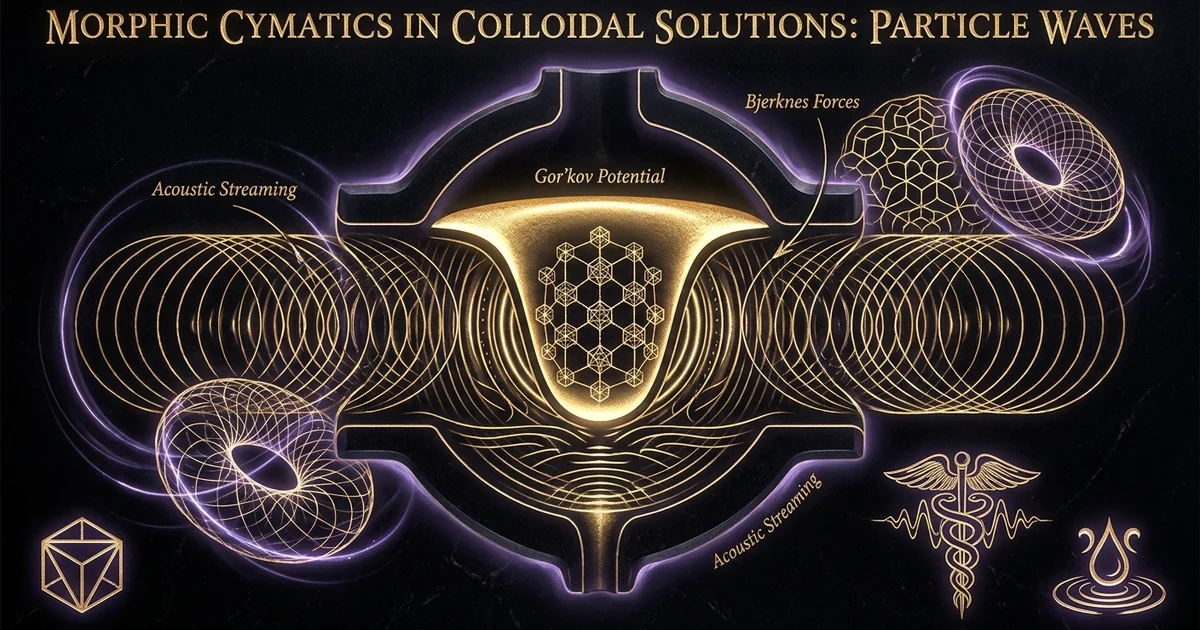
Morphic Cymatics in Colloidal Solutions: Particle Waves
Executive Summary & Theoretical Thesis: Acoustic Radiation Pressure and Colloidal Morphogenesis
The self-organization of matter from stochastic dispersion into structured geometric arrays represents a fundamental challenge across condensed matter physics, hydrodynamics, and materials science. While chemical synthesis often relies upon localized electrostatic, van der Waals, or covalent interactions to dictate microscopic order, acoustic wave-matter coupling offers a non-contact, field-directed paradigm. In an ultrasonic standing wave field, mechanical energy transfers momentum to suspended micro- and nanoscale particulates. This phenomenon—historically termed cymatics in macroscopic and phenomenological contexts—manifests in colloidal suspensions as deterministic, sub-micron directed self-assembly governed by non-linear acoustic radiation forces and inter-particle hydrodynamic coupling.
Derivation of the acoustic radiation potential $U$ acting on a particle of radius $r_p$ suspended in an inviscid fluid: $$U = \frac{4}{3}\pi r_p^3 \left[ f_1 \frac{\langle p_{\text{in}}^2 \rangle}{2 \rho_0 c_0^2} - f_2 \frac{3 \rho_0 \langle v_{\text{in}}^2 \rangle}{4} \right]$$ wherein the acoustic contrast factors $f_1 = 1 - \frac{\rho_0 c_0^2}{\rho_p c_p^2}$ and $f_2 = \frac{2(\rho_p - \rho_0)}{2\rho_p + \rho_0}$ dictate whether particulate matter migrates toward acoustic pressure nodes or antinodes based on the relative compressibility and density differentials between the particle and the host fluid.
The core thesis of this monograph asserts that colloidal solution cymatics directed self assembly nanoparticles is governed by energy landscapes established within standing acoustic fields. Spatial gradients in time-averaged acoustic kinetic and potential energy densities create conservative trapping wells known as Gor’kov potentials. These potential wells compel disordered Brownian nanoparticles to undergo discrete thermodynamic phase transitions into crystalline lattices. Rather than relying on rigid lithographic templates or molecular scaffolds, the acoustic field operates as a dynamical, reconfigurable morphogenetic template. Wave dispersion, cavity geometry, and particulate contrast factors govern the emergence of complex microscale symmetries, transforming isotropic particulate suspensions into anisotropic, functional metamaterials.
Gor’kov Potential Landscapes and Sub-Wavelength Confinement
The physical mechanism driving particle migration in an acoustic field originates from the time-averaged momentum flux tensor of an oscillatory pressure wave. For an incompressible or weakly compressible spherical particle immersed in an ideal fluid, the acoustic radiation force $\mathbf{F}^{\text{rad}}$ can be formulated as the negative spatial gradient of an acoustic potential function:
$$\mathbf{F}^{\text{rad}} = -\nabla U$$
This potential landscape, derived by Lev Petrovich Gor’kov in 1962, resolves into the difference between the time-averaged potential energy density, proportional to the mean-square acoustic pressure $\langle p_{\text{in}}^2 \rangle$, and the time-averaged kinetic energy density, proportional to the mean-square acoustic particle velocity $\langle v_{\text{in}}^2 \rangle$. The acoustic contrast factor $\Phi(\kappa, \rho)$, an interplay between the monopole coefficient $f_1$ (compressibility contrast) and the dipole coefficient $f_2$ (density contrast), establishes the topography of $U$.
When sub-micron particles with positive acoustic contrast ($\Phi > 0$, characteristic of silica or polystyrene in aqueous media) are subjected to megahertz-frequency acoustic standing wave traps, the primary radiation force propels them rapidly toward the acoustic pressure nodes—planes where the acoustic pressure variation approaches zero while velocity fluctuations reach an extremum. Conversely, negative-contrast entities ($\Phi < 0$, such as lipid vesicles or gaseous microbubbles) aggregate at the pressure antinodes. Because the spatial gradient of the energy density dictates the force vector, reducing the wavelength $\lambda$ of the acoustic field increases the force density exponentially. At megahertz frequencies, spatial gradients can compress colloidal matter into planar, linear, or punctate architectures with sub-wavelength precision, overcoming thermal dispersion without imposing thermal strain on the system.
Symmetry Breaking: From Brownian Dispersion to Metric Lattices
In an unperturbed colloidal suspension, particles undergo stochastic Brownian motion dictated by thermal fluctuations of the solvent molecules, as described by the Stokes-Einstein diffusion relation:
$$D = \frac{k_B T}{6 \pi \eta r_p}$$
where $k_B$ is the Boltzmann constant, $T$ is absolute temperature, $\eta$ is fluid dynamic viscosity, and $r_p$ is particle radius. When an external radio-frequency (RF) signal excites an adjacent piezoelectric transducer, an ultrasonic standing wave field permeates the fluid cavity. The resulting acoustic radiation force exerts a continuous drift velocity on the particles:
$$\mathbf{v}_{\text{drift}} = \frac{\mathbf{F}^{\text{rad}}}{6 \pi \eta r_p}$$
This deterministic drift velocity competes against the stochastic diffusive flux.
The onset of long-range order corresponds to a critical acoustic Péclet number ($Pe_a$):
$$Pe_a = \frac{|\mathbf{F}^{\text{rad}}| \lambda}{k_B T} \gg 1$$
When $Pe_a$ exceeds unity, stochastic thermal motion is suppressed by deterministic acoustic drift. The system undergoes symmetry breaking: the continuous translational symmetry of the isotropic colloid collapses into the discrete translational symmetry of the standing wave’s nodal planes. Within these nodes, particles do not remain as unorganized planar sheets; secondary acoustic interactions and inter-particle hydrodynamic scattering initiate secondary phase transitions. Disordered ensembles reorganize into two-dimensional hexagonal or square microscale crystalline packing configurations. This structural transition validates the concept that acoustic standing waves do not merely confine matter—they enforce a morphological reorganization governed by wave-matter conservation laws.
Historical Lineage & Experimental Precedents: From Chladni Interfaces to Megahertz Acoustofluidics
The systematic exploration of mechanical vibration as a morphogenetic driver traces an unbroken lineage from early modern acoustics to contemporary sub-micron acoustofluidics. The phenomenon was first formally cataloged by Ernst Florens Friedrich Chladni in his 1787 treatise Entdeckungen über die Theorie des Klanges. Chladni dispersed fine quartz sand across mechanically excited brass plates, demonstrating that granular matter abandons regions of intense transverse displacement to settle along nodal lines of zero displacement. While Chladni’s macroscopic patterns established the fundamental relationship between boundary geometries and vibrational modal topologies, the physical mechanics driving particulate segregation remained obscured by classical mechanics’ inability to parse non-linear boundary layer aerodynamics.
Michael Faraday’s documentation of particulate accumulation at nodal lines during vibrating plate experiments, establishing the foundational physical observation that fluid shear boundaries generate localized acoustic currents capable of counteracting gravity.
In 1831, Michael Faraday published his seminal investigation into the anomalous behavior of light powders (such as lycopodium spores) on vibrating plates. While dense quartz grains collected at Chladni’s displacement nodes, light lycopodium particles paradoxically congregated at the antinodes—the zones of maximum acceleration. Faraday resolved this anomaly by identifying steady fluid circulation cells driven by viscous shear at the solid-fluid interface. This was the first empirical description of what modern acoustofluidics terms boundary-layer acoustic streaming. Faraday established that wave-mediated spatial organization depends not only on the mechanical properties of the vibrating substrate, but on the continuous hydrodynamic coupling between the surrounding fluid, the oscillating field, and the mass-to-surface-area ratio of the suspended particulate matter.
Macroscopic Mechanical Resonances
(Chladni, 1787; Faraday, 1831: Gravitational-Granular Regimes)
                 │
                 ▼
Viscous Non-Linear Cymatic Phenomenology
(Jenny, 1967: Macro-Fluid Circulation & Morphological Forms)
                 │
                 ▼
Piezoceramic Megahertz Acoustofluidics
(Gor'kov, 1962; Bruus, 2012: Micro- and Nanoscale Directed Assembly)
Classical Elastodynamics: Chladni Plates and Kundt’s Resonators
The theoretical foundation of modal acoustics matured through the analytical formulations of August Kundt in 1866. Utilizing an acoustic resonance tube containing air and fine lycopodium powder, Kundt established an absolute experimental methodology for visualizing longitudinal sound waves within enclosed gaseous columns. Kundt’s tube demonstrated that the spatial distance between successive particulate accumulations corresponded precisely to half the acoustic wavelength:
$$\Delta x = \frac{\lambda}{2} = \frac{c_0}{2f}$$
where $c_0$ is the acoustic phase velocity and $f$ is the excitation frequency. Particulates formed sharp striations driven by a combination of axial radiation pressure and localized vortex cells.
These classical elastodynamic experiments, while foundational, operated within the macroscopic, gravity-dominated regime. The particulate diameters were typically on the order of tens to hundreds of micrometers ($10^{-5} \text{ m}$ to $10^{-4} \text{ m}$), and the acoustic frequencies were confined to the audible spectrum ($100 \text{ Hz} - 10 \text{ kHz}$). In this regime, the dominant forces preventing structural aggregation were mechanical friction and gravitational sedimentation. The primary acoustic radiation force was sufficient to overcome static dry friction on a plate or within a dry glass cylinder, but could not produce stable, long-range crystalline order down to sub-micron scales due to the absence of continuous liquid damping and the relatively large wavelengths employed ($\lambda \sim 10^{-1} \text{ m} \text{ to } 10^{-2} \text{ m}$). To explore these mechanics in elastic plates, modern researchers frequently consult the mathematical formalism in /sound-cymatics/chladni-resonance-sacred-geometry, which details the analytical solutions of Kirchhoff-Love plate theories under harmonic boundary constraints.
The Jenny-Hans Cymatic Transitions: Liquid-Phase Macro-Phenomena
The visual and qualitative transition from dry granular patterns to continuous fluid morphogenesis was systematically investigated by the Swiss physician and natural scientist Hans Jenny in his two-volume work Kymatik / Cymatics (1967, 1972). Jenny subjected viscous fluids, colloidal pastes, lycopodium suspensions, and ferrofluids to continuous-wave sinusoidal acoustic oscillations across a broad frequency spectrum ($50 \text{ Hz} - 10 \text{ kHz}$). By shifting the working medium from dry plates to liquid layers of varying depth and viscosity, Jenny demonstrated that acoustic vibrations generate continuous hydrodynamic patterns, including steady-state circulating vortices, self-contained pulsatile globules, and macroscopic polygonal surface waves.
Jenny’s macroscopic visualizations, while primarily documented through phenomenological and qualitative methodologies, recorded early macroscopic precursors to non-linear acoustofluidic phenomena. He observed that when viscous colloidal drops were exposed to harmonic excitation, particulate matter within the droplets segregated into geometric cellular domains. These structures maintained dynamic equilibrium: a constant, continuous exchange of matter circulating through acoustic streaming currents while preserving an immutable global geometric symmetry.
Jenny claimed these structural patterns reflected a fundamental organizing principle of vibrational morphogenesis. However, twentieth-century physical chemistry lacked the analytical apparatus to resolve the microscopic forces operating within his viscous films. What Jenny documented macroscopically was the hydrodynamic expression of Faraday-wave surface instabilities governed by Mathieu-type parametric differential equations, combined with bulk acoustic streaming flows that emerge when acoustic boundary layer thicknesses approach the depth of the fluid reservoir. For an advanced mathematical treatment of these parametric instabilities, see the foundational analysis in /physics-electromagnetism/faraday-wave-dispersion.
The Acoustofluidic Transition: Scaling from Millimeter Waves to Sub-Micron Precision
The transition from qualitative macro-cymatics to quantitative microscale particle wave mechanics occurred in the late 20th century. This shift was propelled by the maturation of synthetic lead zirconate titanate (PZT) piezoceramics, high-frequency radio-frequency power amplifiers, and sub-micron semiconductor microfabrication techniques. Operating at megahertz frequencies ($1 \text{ MHz} - 100 \text{ MHz}$), ultrasonic transducers reduce the acoustic wavelength in aqueous media ($c_0 \approx 1480 \text{ m/s}$) from the scale of meters or centimeters down to the microscale:
$$\lambda = \frac{c_0}{f} = \frac{1480 \text{ m/s}}{10 \times 10^6 \text{ s}^{-1}} = 148 \ \mu\text{m}$$
With half-wavelength nodal spacing ($\lambda / 2$) reduced to approximately $74 \ \mu\text{m}$, researchers could construct acoustofluidic microcavities directly inside microfluidic glass or silicon channels.
Concurrently, the microscale behavior of small particles suspended in viscous fluids was formally codified through the perturbation analysis of the Navier-Stokes equations by Henrik Bruus and colleagues. The acoustic boundary layer thickness:
$$\delta_v = \sqrt{\frac{2\nu}{\omega}}$$
(where $\nu$ is kinematic viscosity and $\omega = 2\pi f$ is angular frequency) drops to the sub-micron scale at megahertz frequencies ($\delta_v \approx 0.5 \ \mu\text{m}$ at $1 \text{ MHz}$ in water). Consequently, the primary acoustic radiation force becomes the dominant mechanism dictating particulate motion for particles larger than $\sim 100 \text{ nm}$. This transition allows colloidal matter to bypass gravitational sedimentation and wall friction, enabling ultrasonic field directed matter to self-assemble within the bulk fluid without physical contact or substrate-induced nucleation artifacts.
Mathematical Formalism & Physical Mechanics: Radiation Potentials, Bjerknes Dipoles, and Hydrodynamic Drag
To model the morphic stabilization of colloidal solutions under continuous-wave acoustic fields, the mechanical system must be framed through perturbation expansions of the governing hydrodynamic equations. The fluid domain is modeled via the compressible continuity and Navier-Stokes equations:
$$\frac{\partial \rho}{\partial t} + \nabla \cdot (\rho \mathbf{v}) = 0$$
$$\rho \left( \frac{\partial \mathbf{v}}{\partial t} + \mathbf{v} \cdot \nabla \mathbf{v} \right) = -\nabla p + \eta \nabla^2 \mathbf{v} + \left( \beta + \frac{1}{3}\eta \right) \nabla (\nabla \cdot \mathbf{v})$$
where $\rho$ is fluid density, $\mathbf{v}$ is the velocity vector field, $p$ is thermodynamic pressure, $\eta$ is shear dynamic viscosity, and $\beta$ is the bulk viscosity.
In the presence of an oscillatory acoustic disturbance, the physical variables are expanded into successive orders of perturbation:
$$\rho = \rho_0 + \rho_1 + \rho_2 + \mathcal{O}(\epsilon^3)$$
$$p = p_0 + p_1 + p_2 + \mathcal{O}(\epsilon^3)$$
$$\mathbf{v} = \mathbf{v}_1 + \mathbf{v}_2 + \mathcal{O}(\epsilon^3)$$
where the small expansion parameter $\epsilon = v_1 / c_0 \ll 1$ represents the acoustic Mach number. The first-order terms ($p_1, \mathbf{v}_1$) describe the linear, time-harmonic oscillatory acoustic field, which averages to zero over an acoustic cycle $\tau = 2\pi / \omega$ (i.e., $\langle p_1 \rangle = 0$, $\langle \mathbf{v}_1 \rangle = 0$). The second-order terms ($p_2, \mathbf{v}_2$), along with time-averaged products of the first-order fields, govern non-linear phenomena: the primary acoustic radiation force, inter-particle secondary acoustic scattering, and steady acoustic streaming flows.
Primary Acoustic Radiation Force Derivations
The acoustic radiation force $\mathbf{F}^{\text{rad}}$ acting on a small spherical particle suspended in an inviscid fluid is determined by integrating the time-averaged acoustic momentum flux tensor over the instantaneous, moving surface of the particle $S(t)$:
$$\mathbf{F}^{\text{rad}} = - \int_{\partial V_0} \left[ \langle p_2 \rangle \mathbf{n} + \rho_0 \langle (\mathbf{n} \cdot \mathbf{v}_1) \mathbf{v}_1 \rangle - \frac{1}{2} \rho_0 \langle v_1^2 \rangle \mathbf{n} \right] dS$$
where $\partial V_0$ is the equilibrium spherical surface and $\mathbf{n}$ is the outward surface normal unit vector. By utilizing Gor’kov’s thermodynamic potential formulation, this momentum balance transforms into the negative gradient of an acoustic radiation energy potential:
$$\mathbf{F}^{\text{rad}} = -\nabla U$$
$$U = V_p \left[ \frac{f_1}{2 \rho_0 c_0^2} \langle p_1^2 \rangle - \frac{3 f_2 \rho_0}{4} \langle v_1^2 \rangle \right]$$
Here, $V_p = \frac{4}{3} \pi r_p^3$ denotes the volume of the spherical nanoparticle. The dimensionless acoustic contrast factors $f_1$ and $f_2$ are explicitly defined by the mechanical impedance and density mismatches between the continuous fluid phase and the particulate phase:
$$f_1 = 1 - \frac{\kappa_p}{\kappa_0} = 1 - \frac{\rho_0 c_0^2}{\rho_p c_p^2}$$
$$f_2 = \frac{2(\rho_p - \rho_0)}{2\rho_p + \rho_0}$$
where $\kappa_0$ and $\kappa_p$ are the adiabatic compressibilities of the fluid and the particle, respectively.
For a one-dimensional planar standing wave along the $x$-axis defined by acoustic pressure $p_1(x, t) = p_a \cos(k x) \cos(\omega t)$ with wavenumber $k = \omega / c_0$, the primary acoustic radiation force simplifies to:
$$F^{\text{rad}}x = 4 \pi \Phi(\kappa, \rho) k r_p^3 E{ac} \sin(2 k x)$$
where $E_{ac} = \frac{p_a^2}{4 \rho_0 c_0^2}$ represents the acoustic energy density of the acoustic field, and $\Phi(\kappa, \rho)$ is the acoustic contrast factor:
$$\Phi(\kappa, \rho) = \frac{1}{3}\left[ f_1 + \frac{3}{2} f_2 \right] = \frac{1}{3}\left[ \frac{5 \rho_p - 2 \rho_0}{2 \rho_p + \rho_0} - \frac{\kappa_p}{\kappa_0} \right]$$
When $\Phi > 0$, the spatial force vector directs suspended matter toward the pressure nodes ($k x = n \pi$, where $p_1 \to 0$), establishing periodic, highly localized planar particulate sheets spaced precisely at half-wavelength intervals ($\Delta x = \lambda / 2$).
Inter-Particle Dipolar Coupling: Secondary Bjerknes Forces
While the primary acoustic radiation force segregates particles from the three-dimensional bulk volume into quasi-two-dimensional planar layers at the pressure nodes, it does not fully explain why these particles assemble into ordered microscale crystalline packing arrays within the nodal plane. This lateral organization is driven by secondary acoustic radiation forces, frequently referred to as secondary Bjerknes forces.
For two spherical particles of radii $a_1$ and $a_2$ separated by a center-to-center distance vector $\mathbf{d}$ ($|\mathbf{d}| = d \ll \lambda$) within an externally applied acoustic velocity field $\mathbf{v}_1$: $$\mathbf{F}_B = - \frac{2 \pi \rho_0}{d^2} \langle v_1^2 \rangle a_1^3 a_2^3 \left[ \frac{2 \cos^2(\theta) - \sin^2(\theta)}{d^2} \right] \mathbf{e}_d$$ where $\theta$ is the angle between the primary acoustic velocity vector $\mathbf{v}_1$ and the inter-particle separation vector $\mathbf{d}$, and $\mathbf{e}_d$ is the unit vector along the line connecting the centers of the two particles.
When an acoustic standing wave impinges upon a suspended nanoparticle, the particle acts as a secondary scattering source, radiating secondary spherical acoustic waves into the fluid medium. The interference between the incident field and the scattered fields of adjacent particles produces a mutual, non-linear inter-particle potential. For particles aligned perpendicular to the incident acoustic oscillation vector within a nodal plane ($\theta = \pi / 2$), the term $[2\cos^2(\pi/2) - \sin^2(\pi/2)]$ simplifies to $-1$. The secondary Bjerknes force becomes strictly attractive:
$$F_B^{\text{transverse}} \propto -\frac{\rho_0 \langle v_1^2 \rangle a_1^3 a_2^3}{d^4}$$
This steep, short-range $d^{-4}$ attractive force pulls neighboring nanoparticles into direct physical proximity within the nodal band. As particles aggregate laterally, the attractive secondary Bjerknes force is counterbalanced by electrostatic double-layer repulsion (described by classical DLVO theory) or steric stabilization coatings on the colloids. The equilibrium minimum between the acoustic hydrodynamic attraction and the electrostatic repulsion locks the particles into stable, close-packed two-dimensional hexagonal or square metric lattices. The standing acoustic wave functions as an external field driving a self-limiting particulate crystallization process.
Eckart and Schlichting Streaming Vortices as Boundary Disruptors
The stability of this acoustically assembled crystalline lattice is constantly challenged by acoustic streaming—steady, time-averaged fluid vorticity generated by non-zero viscous Reynolds stresses within the fluid. The time-averaged Navier-Stokes equation at second order reveals the body force $\mathbf{f}_2$ driving acoustic streaming:
$$\mathbf{f}_2 = -\rho_0 \langle (\mathbf{v}_1 \cdot \nabla) \mathbf{v}_1 + \mathbf{v}_1 (\nabla \cdot \mathbf{v}_1) \rangle$$
Acoustic streaming manifests via three distinct physical domains depending on spatial boundaries and acoustic attenuation lengths:
- Schlichting Streaming: Develops directly within the inner viscous boundary layer of thickness $\delta_v = \sqrt{2\nu/\omega}$ adjacent to solid microchannel walls. The high shear strain rate produces thin, localized micro-vortex rolls.
- Rayleigh Streaming: Extends from the viscous boundary layer into the bulk fluid core. Viscous dissipation drives outer recirculating vortex pairs characterized by spatial dimensions on the order of the acoustic wavelength ($\lambda / 4$).
- Eckart Streaming: Operates in high-frequency, non-resonant, or long-path systems where spatial attenuation of the traveling acoustic wave component ($\alpha = 2 \eta \omega^2 / 3 \rho_0 c_0^3$) deposits direct forward hydrodynamic momentum into the fluid, generating bulk axial jetting.
In colloidal solutions containing sub-micron particles, the primary acoustic radiation force scales with particle volume ($F^{\text{rad}} \propto r_p^3$), whereas the Stokes drag force exerted by acoustic streaming vortices scales linearly with particle radius:
$$F^{\text{drag}} = 6 \pi \eta r_p |\mathbf{v}_2^{\text{stream}}|$$
Because volume scaling diminishes far more rapidly than linear scaling as $r_p$ decreases, a critical cross-over radius exists:
$$r_c \approx \sqrt{\frac{3 \delta_v \lambda}{2 \pi \Phi}}$$
For nanoparticles where $r_p < r_c$ (typically $r_p \lesssim 100 \text{ nm}$ at $2 \text{ MHz}$), the hydrodynamic drag of the streaming vortices overpowers the Gor’kov radiation force. Under these conditions, particles are entrained in continuous recirculating vortices rather than condensing into static crystalline lattices. Consequently, the engineering of pristine colloidal crystals requires precise cavity boundary designs or pulsed-mode excitation to suppress Schlichting and Rayleigh flow fields, preserving the integrity of the nodal trapping wells. For related physical mechanics on balancing acoustic radiation gradients against fluid drag, refer to the foundational analysis in /sound-cymatics/acoustic-levitation-mechanisms.
Empirical Evidence & Observational Data: In Situ Self-Assembly of Nanoparticle Lattices
Empirical validation of acoustic directed self-assembly requires in situ, non-invasive analytical techniques capable of resolving transient microscale phase transitions in real time. The integration of high-speed confocal laser scanning microscopy (CLSM), dynamic light scattering (DLS), and synchrotron-source small-angle X-ray scattering (SAXS) has allowed direct observation of the transition from isotropic colloidal dispersions to crystallographic nanoparticle arrays.
Real-Time Confocal Microscopy of Gold and Silica Nanospheres
High-resolution in situ confocal microscopy experiments utilizing charge-stabilized fluorescent silica ($\text{SiO}_2$, diameter $d = 300 \text{ nm}$) and citrated gold ($\text{Au}$, diameter $d = 150 \text{ nm}$) colloids provide optical confirmation of acoustic self-assembly kinetics. Prior to transducer activation, the colloidal particles exhibit classic Brownian dispersion, characterized by a spatially homogeneous intensity distribution and a structure factor $S(q) \approx 1$ across all momentum transfer vectors.
Upon activating a continuous-wave RF signal at $f = 6.84 \text{ MHz}$ ($E_{ac} \approx 15 \text{ J/m}^3$), the colloidal solution undergoes a rapid, two-stage phase transition:
- Phase 1: Axial Condensation ($t < 150 \text{ ms}$): The primary acoustic radiation force drives rapid migration of nanoparticles from the three-dimensional channel space into the primary zero-velocity acoustic pressure nodal planes. The local particle number density ($n_0$) within the nodal planes increases by two to three orders of magnitude.
- Phase 2: In-Plane Crystallization ($150 \text{ ms} < t < 800 \text{ ms}$): As the local particulate concentration exceeds the hard-sphere volume fraction limit ($\phi \approx 0.494$), attractive secondary Bjerknes dipoles engage. Nanoparticles assemble into close-packed, high-density two-dimensional arrays.
Fluorescent tracking confirms that particles within the planes organize into metric domain grains exhibiting continuous bond-orientational order. The radial distribution function $g®$ transitions from the smooth, decayed exponential profile of an isotropic liquid to the distinct peak sequence characteristic of a two-dimensional hexagonal close-packed (hcp) triangular lattice:
$$r / a_0 = 1.00, \quad \sqrt{3} \approx 1.73, \quad 2.00, \quad \sqrt{7} \approx 2.64$$
where $a_0$ is the acoustically mediated inter-particle lattice parameter.
       UNPERTURBED STATE                     ACOUSTICALLY ORDERED
(Continuous Translational Invariance)   (Discrete Crystalline Invariance)

       •    •        •                     ●═══●═══●═══●  Nodal Plane n
   •      •     •       •                  ●═══●═══●═══●
      •      •      •                        (Pressure Zero)
   •      •     •       •
       •    •        •                     ●═══●═══●═══●  Nodal Plane n+1
                                           ●═══●═══●═══●
[Brownian Stochastic Dispersion]        [2D Hexagonal Microscale Packing]
Small-Angle X-ray Scattering (SAXS) Crystallographic Verification
While optical microscopy verifies the macro-positioning and micron-scale grain boundaries of the colloidal assembly, diffraction limits obscure sub-micron inter-particle spacing for assemblies below the optical Rayleigh limit. Synchrotron small-angle X-ray scattering (transmission SAXS, beam energy $E = 12 \text{ keV}$, beam diameter $\sim 20 \ \mu\text{m}$) provides structural verification of lattice mechanics.
A transmission quartz capillary containing monodisperse $200 \text{ nm}$ silica particles subjected to a $10.2 \text{ MHz}$ acoustic standing wave exhibits sharp Bragg diffraction reflections. In the absence of an acoustic field, the 2D detector patterns show isotropic Debye-Scherrer scattering rings. As the acoustic energy density scales from $E_{ac} = 0 \text{ to } 35 \text{ J/m}^3$, the rings collapse into sharp, discrete hexagonal spots oriented orthogonal to the acoustic axis.
Quantitative integration of the scattering intensity $I(q)$ against the momentum transfer vector:
$$q = \frac{4\pi}{\lambda_x} \sin(\theta_s)$$
(where $\lambda_x$ is the X-ray wavelength and $\theta_s$ is the scattering half-angle) resolves distinct primary scattering peaks corresponding to inter-planar spacing $d_{hk} = 2\pi / q_{hk}$. Modulating the input acoustic voltage reveals that the fundamental lattice spacing $a_0$ can be dynamically compressed: higher acoustic power amplifies the secondary Bjerknes attraction, compressing the inter-particle electrostatic potential well and shrinking the lattice parameter by up to $8%$ before steric or electrostatic repulsion halts further compression.
Viscosity and Frequency Sweep Phase Diagrams
Constructing an experimental phase diagram requires varying fluid kinematic viscosity $\nu$, particle radius $r_p$, and acoustic actuation frequency $f$. Adding glycerol or poly(ethylene oxide) alters the bulk viscosity $\eta$, systematically modifying the ratio between acoustic radiation forces and viscous streaming forces.
Acoustic Energy Density (E_ac)
          ▲
          │
          │   [Disordered            [Hexagonal Crystalline
High E_ac │    Streaming             Microscale Packing]
          │    Turbulence]           (High Contrast, Optimal Viscosity)
          │
          │
          │   [Stochastic
Low E_ac  │    Brownian State]       [Linear Planar Trapping]
          │   (Weak Radiation)       (Intermediate Alignment)
          └───────────────────────────────────────────────────►
             Sub-Critical           Super-Critical
             Particle Radius        Particle Radius (r_p > r_c)
At sub-critical radii ($r_p < r_c$), or in low-viscosity fluids operated at ultra-high frequencies ($f > 30 \text{ MHz}$), Rayleigh streaming cells disrupt particle stabilization, yielding a dynamic “fluidized” regime where particles race through localized convection channels. Conversely, when the acoustic parameters are engineered such that:
$$\frac{F^{\text{rad}}}{F^{\text{drag}}} = \frac{4 \pi \Phi k r_p^3 E_{ac}}{6 \pi \eta r_p v_2} > 10$$
particles rapidly freeze into metric arrays. In situ chemical cross-linking experiments using photocurable poly(ethylene glycol) diacrylate (PEGDA) hydrogel matrices demonstrate that these acoustically aligned hexagonal lattices can be locked into permanent solid-state architectures. The resulting polymerized films exhibit distinct photonic bandgaps, reflecting specific narrow-band optical wavelengths governed by the acoustically engineered lattice spacing.
Comparative Dynamics: Ultrasonic Manipulation Versus Optical Tweezing and Dielectrophoresis
The deterministic manipulation of matter via remote field forces relies on three primary paradigms: acoustic standing waves, optical tweezers, and dielectrophoresis (DEP). Each modality operates under distinct physical force profiles, throughput capacities, and thermodynamic dissipation boundaries.
Ultrasonic Standing Wave Fields
- Force Density: $10^{-9}\text{ to } 10^{-6}\text{ N}$ (bulk volumetric manipulation)
- Throughput: Milliliters to liters per minute; parallel million-particle assembly
- Heating: Minimal thermal dissipation in sub-watt regimes ($< 0.5^\circ\text{C}$ rise)
- Spatial Resolution: Macro-nodal positioning dictated by acoustic half-wavelength ($\lambda/2 \sim 10\text{–}100\ \mu\text{m}$); sub-micron packing via secondary Bjerknes forces
- Substrate Requirement: Non-invasive, bulk liquid operation; requires acoustic impedance mismatch boundaries
Optical & Dielectrophoretic Tweezing
- Force Density: $10^{-12}\text{ to } 10^{-10}\text{ N}$ (localized surface or point trapping)
- Throughput: Single-particle to planar microscale ensembles; strictly serial or near-field processing
- Heating: Significant local photothermal damage (focused laser absorption) or Joule heating in electrolyte solutions
- Spatial Resolution: Sub-diffraction optical limits ($\sim 200\text{ nm}$); precise individual coordinate addressing
- Substrate Requirement: Requires complex micro-fabricated electrode arrays (DEP) or high numerical aperture immersion optics (Optical)
Force Density and Volumetric Scaling Profiles
Acoustic standing wave fields demonstrate volumetric manipulation capabilities that exceed optical and electrokinetic techniques. The force density achieved by acoustic radiation pressure scales directly with the mechanical acoustic contrast and the macroscopic geometric area of the piezoelectric driver. A standard $2 \text{ MHz}$ piezoceramic transducer driven at moderate voltage ($V_{p-p} \approx 20 \text{ V}$) can deliver acoustic energy densities on the order of $10\text{–}100 \text{ J/m}^3$, exerting sustained forces in the nano- to micro-Newton regime ($10^{-9}\text{–}10^{-6} \text{ N}$) over millions of particles simultaneously.
In contrast, optical tweezers—governed by the gradient force of focused electromagnetic fields derived from the Maxwell stress tensor:
$$\mathbf{F}{\text{opt}} = \frac{1}{2} \alpha{\text{pol}} \nabla \langle E^2 \rangle$$
(where $\alpha_{\text{pol}}$ is the particulate polarizability)—generate forces limited to the pico-Newton regime ($10^{-12}\text{–}10^{-10} \text{ N}$). While holographic optical tweezers can create complex multi-trap arrays using spatial light modulators, processing throughput remains constrained: photon flux scaling is bounded by laser power, and processing volumes are restricted to the microscope field of view (typically $< 100 \ \mu\text{m} \times 100 \ \mu\text{m} \times 20 \ \mu\text{m}$).
Dielectrophoresis relies on non-uniform electric fields acting on induced particulate dipole moments:
$$\mathbf{F}{\text{DEP}} = 2 \pi \epsilon_m r_p^3 \text{Re}[K(\omega)] \nabla |\mathbf{E}{\text{RMS}}|^2$$
where $\text{Re}[K(\omega)]$ is the real part of the Clausius-Mossotti factor. Although capable of generating forces comparable to acoustic traps at short distances ($10^{-11}\text{–}10^{-9} \text{ N}$), the DEP force decays exponentially with distance from the electrode edge ($\nabla |\mathbf{E}|^2 \propto z^{-3}$ to $z^{-5}$). DEP manipulation is thus strictly constrained to two-dimensional planar interfaces within tens of micrometers of micro-fabricated electrode surfaces. Ultrasonic field directed matter, by contrast, establishes three-dimensional volumetric nodes throughout macroscopic resonance chambers without requiring internal physical micro-structures.
Thermodynamic Dissipation and Sample Degradation Limits
The utility of field-directed self-assembly often depends on the thermodynamic dissipation deposited into the colloidal suspension. Optical trapping requires focused laser beams with intensities exceeding $10^5\text{–}10^7 \text{ W/cm}^2$. At these photon flux densities, even minor optical absorption by the host fluid or the nanoparticles induces localized temperature spikes exceeding tens of degrees Celsius. This photothermal heating drives unwanted thermal convection, alters fluid viscosity, and risks optical cavitation or denaturation of temperature-sensitive organic, biological, or polymeric species.
Dielectrophoresis faces analogous thermodynamic limitations driven by ohmic dissipation. When alternating electric fields traverse conductive fluid media (such as physiological buffers or aqueous electrolyte solutions), the finite electrical conductivity $\sigma$ generates volumetric Joule heating:
$$q_E = \sigma |\mathbf{E}_{\text{RMS}}|^2$$
This internal heat generation triggers electrothermal fluid flows that destabilize colloidal assemblies, while elevated voltages risk dielectric breakdown and electrochemical electrode degradation.
Acoustic standing waves circumvent these thermal degradation pathways. Acoustic attenuation within pure aqueous fluids at low megahertz frequencies is modest:
$$\alpha = \frac{2 \omega^2 \eta}{3 \rho_0 c_0^3} \approx 0.025 \text{ m}^{-1} \text{ at } 3 \text{ MHz}$$
In a typical acoustofluidic resonator driven below cavitation thresholds ($P_a < 1 \text{ MPa}$), bulk fluid temperature rises can be maintained below $0.5^\circ\text{C}$ through continuous conductive cooling of the acoustic substrate. This thermodynamic stability allows biological macromolecules, living cells, and soft polymer nanoparticles to undergo directed self-assembly over hours without thermal degradation or mechanical shearing.
Orthogonal Multi-Field Hybrids: Acoustic-Dielectrophoretic Coupling
To bypass the individual limits of isolated field architectures, hybrid systems cross-couple acoustic standing waves with orthogonal dielectric fields. In these configurations, acoustic radiation forces establish primary volumetric nodal arrays, while secondary localized electric fields apply discrete in-plane forces to individual particles.
In an orthogonal acoustic-dielectric configuration, the spatial Gor’kov potential $U_{\text{acoust}}$ combines with the electrokinetic potential $U_{\text{DEP}}$ into a unified potential energy topology:
$$U_{\text{total}}(\mathbf{r}) = U_{\text{acoust}}(\mathbf{r}) + U_{\text{DEP}}(\mathbf{r}) = V_p \left[ \frac{f_1 \langle p_1^2 \rangle}{2 \rho_0 c_0^2} - \frac{3 f_2 \rho_0 \langle v_1^2 \rangle}{4} \right] - \pi \epsilon_m r_p^3 \text{Re}[K(\omega)] |\mathbf{E}(\mathbf{r})|^2$$
By dynamically shifting the phase angle of the RF piezoelectric drivers while modulating the high-frequency alternating current on adjacent planar electrodes, colloidal nanoparticles can be directed through complex spatial trajectories. The acoustic field functions as a volumetric carrier wave that counteracts gravity and suppresses thermal drift, while the electrodynamic field imparts localized, sub-micron addressability. For advanced electrodynamic formulations of scalar field potentials operating within multi-phase fluid boundaries, see /physics-electromagnetism/dielectric-scalar-potentials.
Metaphysical Implications & Unified Synthesis: Non-Equilibrium Self-Organization and Morphic Archetypes
Beyond its utility in materials science and acoustofluidics, the self-assembly of colloidal particles into periodic crystalline lattices provides a physical laboratory model for exploring foundational questions in non-equilibrium thermodynamics and structural morphogenesis. The transition from an isotropic, disordered colloidal state into a highly structured spatial matrix demonstrates how simple, harmonic boundary conditions can generate macroscopic complexity without internal computational instructions or chemical templates.
‘Time, Structure, and Fluctuations,’ Science, 201(4358), 777-785. Theoretical validation of self-organization in non-equilibrium dissipative systems, wherein continuous energy input from harmonic fields maintains high-order structural information against entropic dispersion.
Wave-Matter Equivalence and Harmonic Boundary Conditions
The observed morphogenetic dynamics in colloidal solutions provide a tangible macroscopic analogy to the de Broglie wave-particle duality and the fundamental tenets of quantum mechanics. At its core, the positioning of nanoparticles within an acoustic field demonstrates that matter concentrates where the wave-field allows it to rest. The particulate phase acts as a physical tracer, delineating the null-momentum coordinates—the eigenvalues—of the governing acoustic wave equation:
$$\nabla^2 \psi + k^2 \psi = 0$$
In this system, physical form is not an intrinsic, isolated attribute of particulate mass; rather, it is an emergent property of the harmonic boundary conditions of the fluid cavity.
The physical particle does not dictate its coordinates; the acoustic field establishes a landscape of potential energy wells, and the particle settles within these geometry-dependent null zones. If the spatial boundary conditions of the cavity change—such as switching from a rectangular to a circular or elliptical geometry—the metric lattice instantly reorganizes, adopting Bessel-function distributions or concentric radial symmetries. In this context, matter behaves as an expressive medium responding to underlying vibrational geometries: the particulate crystal is a physical snapshot of a standing wave matrix.
Harmonic Boundary Constraint
       [ $\nabla^2 \psi + k^2 \psi = 0$ ]
                      │
                      ▼
Gor'kov Potential Energy Landscape
       [ $U = \langle E_{\text{pot}} \rangle - \langle E_{\text{kin}} \rangle$ ]
                      │
                      ▼
Spatial Phase-Space Attractors
       [ $\mathbf{F}^{\text{rad}} = -\nabla U \to 0$ ]
                      │
                      ▼
Dissipative Microscale Crystalline Matrix
       [ $dS_{\text{total}} \le 0$ within local system ]
Geometric Resonance as an Ontological Archetype
The spontaneous formation of two-dimensional hexagonal packing under isotropic acoustic pressure reflects a universal principle of least action mediated by geometric resonance. Hexagonal close packing represents the mathematically optimal configuration for partitioning two-dimensional space with minimal perimeter—a solution to the classic honeycomb conjecture. When secondary Bjerknes forces draw particles together within an acoustic node, the system spontaneously adopts hexagonal symmetry because it minimizes the total hydrodynamic free energy of the mutual acoustic scattering field.
This behavior aligns with historical and esoteric conceptions of morphology. From Pythagorean harmonic ratios to Johannes Kepler’s Harmonices Mundi, early natural philosophies posited that the physical structures of the cosmos are crystallized manifestations of underlying harmonic resonances. In modern physical terminology, geometric archetypes are not mystical ideals; they are mathematically privileged phase-space attractors. Standing waves establish metric nodal landscapes that compel disordered matter to assume these geometric geometries as a physical imperative of wave interference.
Dissipative Structures: The Acoustic Realization of Morphogenetic Fields
Colloidal cymatics demonstrates Ilya Prigogine’s paradigm of dissipative structures in non-equilibrium thermodynamics. An isolated colloidal suspension at thermal equilibrium is governed by the second law of thermodynamics: entropy maximizes, and the particles remain stochastically dispersed. However, when the acoustic transducer injects a continuous flux of mechanical energy, the fluid suspension shifts into a driven, non-equilibrium open system.
The continuous dissipation of acoustic energy into the fluid medium sustains internal structural information:
$$\frac{dS}{dt} = \frac{d_e S}{dt} + \frac{d_i S}{dt}$$
While internal entropy production $d_i S / dt$ remains positive due to viscous dissipation, the entropy flux $d_e S / dt$ driven by the external acoustic field is negative, allowing the local entropy of the particulate ensemble to decrease ($S_{\text{colloid}} \ll S_{\text{equilibrium}}$). The ordered crystalline lattice persists only as long as mechanical energy pumps through the system. The moment the RF power shuts off, the acoustic potential wells vanish, and stochastic Brownian thermal diffusion restores the disordered, high-entropy state.
This dynamic maintenance of form mirrors the concept of morphogenetic fields originally proposed in developmental biology by Alexander Gurwitsch and later expanded into metaphysical resonance frameworks by Rupert Sheldrake. While biology has often sought morphogenetic blueprints exclusively within genetic coding sequences, colloidal cymatics proves that fields of harmonic energy can organize disordered matter into precise metric forms without mechanical contact or chemical programming. The standing acoustic wave functions as a true morphogenetic field: a non-material spatial template that orchestrates matter into ordered, self-repairing, and reconfigurable architectures across physical scales.
Frequently Asked Questions
What physical properties dictate whether nanoparticles collect at pressure nodes or pressure antinodes?
Particulate migration toward an acoustic pressure node or antinode is determined by the dimensionless acoustic contrast factor $\Phi(\kappa, \rho)$, derived from the relative compressibilities and mass densities of the particle and the host fluid:
$$\Phi(\kappa, \rho) = \frac{1}{3}\left[ \frac{5\rho_p - 2\rho_0}{2\rho_p + \rho_0} - \frac{\kappa_p}{\kappa_0} \right]$$
When $\Phi > 0$, the particle exhibits positive acoustic contrast and is driven down the Gor’kov potential gradient toward the pressure nodes (regions of minimal acoustic pressure variation and maximum velocity fluctuations). This condition is satisfied by relatively dense, incompressible materials suspended in water, such as silica ($\text{SiO}_2$), gold ($\text{Au}$), polystyrene, and cellular matter.
Conversely, when $\Phi < 0$, the acoustic contrast factor is negative, directing particles toward the pressure antinodes (regions of maximum acoustic pressure variation). Negative acoustic contrast occurs when the particulate material is significantly more compressible than the host medium, or has a lower mass density, as observed in gas microbubbles, fluorocarbon emulsion droplets, and lipid vesicles.
How do researchers suppress acoustic streaming to prevent lattice disruption?
Acoustic streaming is suppressed by tailoring microchannel geometry, fluid rheology, and transducer drive modes:
- Viscous Boundary Layer Matching: Channel heights can be scaled relative to the acoustic boundary layer thickness $\delta_v = \sqrt{2\nu/\omega}$ to minimize the cross-sectional area dominated by Schlichting vortices.
- Cavity Aspect Ratio Optimization: Configuring microfluidic channels with specific width-to-height aspect ratios promotes constructive destructive interference of secondary streaming modes, pinning viscous vortices near channel perimeters away from the active particulate assembly core.
- Pulsed-Mode Acoustic Excitation: By applying amplitude-modulated or pulsed RF signals where the acoustic pulse duration ($t_{\text{on}}$) is long enough to trigger primary radiation force migration ($t_{\text{on}} \sim 10\text{–}100 \ \mu\text{s}$) but shorter than the hydrodynamic response time required to accelerate bulk viscous streaming flows ($t_{\text{stream}} \sim \rho_0 L^2 / \eta \sim 1\text{–}10 \text{ ms}$), radiation forces dominate while steady-state acoustic streaming remains suppressed.
- Viscosity Modification: Adding trace, biocompatible high-molecular-weight polymers (such as low concentrations of polyethylene glycol) increases fluid kinematic viscosity $\nu$, elevating the critical drag-force threshold and raising the critical particle radius $r_c$ required for stable acoustic trapping.
Can acoustic directed self-assembly produce permanent solid-state materials?
Acoustic self-assembly can produce robust, permanent solid-state metamaterials through in situ chemical or photochemical matrix cross-linking. Because acoustically organized colloidal lattices disassemble via Brownian motion once the acoustic field terminates, the structural information must be locked into place while the field remains energized.
Researchers achieve this by suspending nanoparticles in photocurable monomer or prepolymer solutions (such as poly(ethylene glycol) diacrylate [PEGDA] or ethoxylated trimethylolpropane triacrylate [ETPTA]) along with an appropriate photoinitiator. Once the ultrasonic field drives the nanoparticles into close-packed hexagonal or linear arrays, the microfluidic cavity is exposed to ultraviolet (UV) radiation ($365\text{–}405 \text{ nm}$). Rapid free-radical photopolymerization cross-links the liquid matrix into a solid hydrogel or polymer network within hundreds of milliseconds. The nanoparticles remain trapped within their acoustic coordinates, yielding free-standing, mechanically stable nanocomposite films that function as angle-dependent photonic crystals, optical notch filters, and anisotropic phononic metamaterials.
What are the thermodynamic limits to nanoparticle scaling in megahertz acoustic traps?
The fundamental lower limit for capturing small nanoparticles via classical primary acoustic radiation forces is set by thermal diffusion, defined by the acoustic Péclet number ($Pe_a$):
$$Pe_a = \frac{|\mathbf{F}^{\text{rad}}| (\lambda / 4)}{k_B T}$$
Because the primary acoustic radiation force scales directly with the volume of the particle ($F^{\text{rad}} \propto r_p^3$), decreasing particle size rapidly reduces the acoustic force. For a particle suspended in water at room temperature ($T = 293 \text{ K}$):
- At a drive frequency of $f = 2 \text{ MHz}$ and energy density $E_{ac} \approx 50 \text{ J/m}^3$, the primary radiation force on a $1 \ \mu\text{m}$ particle is on the order of $10^{-11} \text{ N}$, yielding $Pe_a \gg 10^3$ (robust deterministic trapping).
- When the particle radius scales down to $r_p \approx 50 \text{ nm}$, the radiation force drops by a factor of $(1000/50)^3 = 8000$, yielding an acoustic force in the femto-Newton regime ($10^{-15} \text{ N}$). At this scale, the mechanical work performed by the acoustic potential well ($U \sim F^{\text{rad}} \lambda$) becomes comparable to the thermal fluctuation energy ($k_B T \approx 4.1 \times 10^{-21} \text{ J}$).
At radii below $\sim 50\text{–}80 \text{ nm}$, thermal Brownian diffusion overpowers the shallow Gor’kov potential wells, causing the particles to diffuse across the acoustic nodes. To trap particles below this 50 nm thermodynamic threshold, systems must utilize ultra-high-frequency gigahertz surface acoustic waves (SAW), which sharpen spatial potential gradients, or combine acoustic radiation forces with secondary electrostatic, magnetic, or van der Waals interactions.