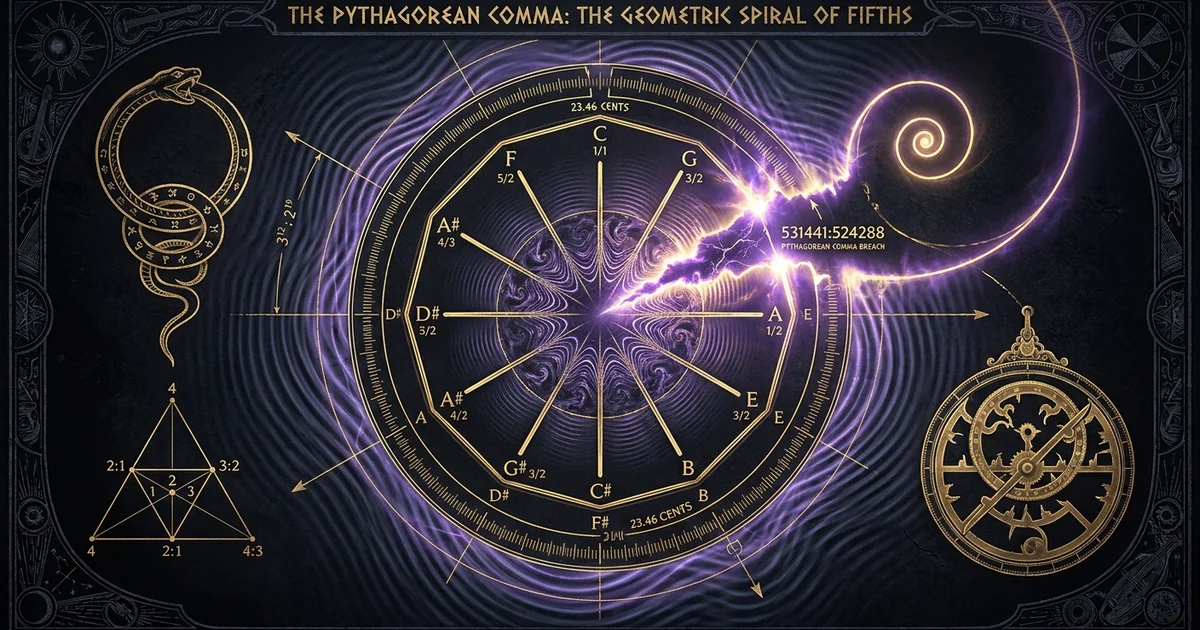
The Pythagorean Comma: The Geometric Spiral of Fifths
Executive Summary & Theoretical Thesis
The Fundamental Incommensurability of Prime Factored Frequencies
The physics of harmonic acoustics and the structural integrity of musical tuning rest upon a fundamental mathematical impossibility: the Diophantine incommensurability between the diapason (the octave ratio, $2:1$) and the diapente (the perfect fifth ratio, $3:2$). Within linear acoustic mechanics, pitch classes are governed by integer frequency ratios derived from the division of vibrating physical media. When generating an extended tonal space through the foundational Pythagorean projection of ascending perfect fifths, the system presupposes that a sequence of purely tuned fifths will eventually reconcile with an integer power of octaves, thereby closing the chromatic continuum into a conservative, cyclic manifold.
This presumption is invalidated by the Fundamental Theorem of Arithmetic. Because 2 and 3 are distinct prime numbers, there exist no non-trivial positive integers $a$ and $b$ such that:
$$2^a = 3^b$$
Consequently, when twelve consecutive iterations of the diapente are mapped against seven iterations of the diapason, the compounding fractional progressions diverge. Rather than returning to the fundamental base frequency $f_0$, the operation yields the canonical mathematical discrepancy designated as the Pythagorean comma ($531441:524288$). The ratio demonstrates that musical pitch spaces defined by rational intervals are topologically open. The system resists complete circular closure, exposing an irreducible microtonal residue that is intrinsically woven into the physics of sound.
Topological Uncoiling: From Cyclic Circle to Logarithmic Spiral
The standard pedagogical representation of harmonic progression—the traditional “circle of fifths”—is a geometric fiction enforced by compromise temperaments. In an unconstrained physical system governed by pure rational harmonics, this circle undergoes a topological uncoiling, transitioning from a two-dimensional closed loop into an infinite, non-Euclidean logarithmic spiral across pitch-frequency phase space. Each complete revolution of twelve fifths fails to rejoin its origin, overshooting the seventh octave by an interval of approximately $23.460$ cents.
This structural defect is not an artifact of human perceptual error or primitive instrument design. It represents a foundational metric distortion within the geometry of resonance itself. When mapped into logarithmic coordinate space, where human pitch perception operates linearly, the progression traces an Archimedean or logarithmic spiral:
$$r(\theta) = r_0 , e^{k \theta}$$
Here, the metric step fails to satisfy periodic boundary conditions. As the spiral propagates through higher frequency domains, the accumulated comma multiples produce an infinitely expanding helical lattice. Every harmonic modulation into a new key signature introduces an acute phase variance relative to the base reference frame. This geometric imperfect closure ensures that harmonic tuning spaces behave as non-compact dynamical manifolds, where every cyclical transformation permanently displaces the physical system from its initial state coordinates.
To formally demonstrate the origin of the Pythagorean comma, consider an initial fundamental frequency $f_0$. Ascending by twelve pure, unbeat (untempered) perfect fifths corresponds to scaling $f_0$ by a factor of $(3/2)^{12}$:
$$f_{12} = f_0 \left(\frac{3}{2}\right)^{12} = f_0 \left(\frac{531441}{4096}\right) \approx f_0 \times 129.74633789$$
Concurrently, ascending by seven pure octaves corresponds to scaling $f_0$ by a factor of $2^7$:
$$f_{\text{oct}} = f_0 (2)^7 = f_0 \times 128$$
The dimensionless ratio quantifying the discrepancy between twelve fifths and seven octaves yields the Pythagorean comma ($\mathrm{PC}$):
$$\mathrm{PC} = \frac{(3/2)^{12}}{2^7} = \frac{3^{12}}{2^{19}} = \frac{531441}{524288} \approx 1.01364326477$$
Expressing this ratio in logarithmic cents, where an octave comprises precisely $1200$ cents:
$$\Delta \Phi = 1200 \cdot \log_2\left(\frac{531441}{524288}\right) = 1200 \cdot [12 \log_2(3) - 19] \approx 23.460010 \text{ cents}$$
This value, nearly one-quarter of a standard equal-tempered semitone ($100$ cents), establishes the precise energetic and topological deficit of the pythagorean comma 531441:524288 ratio musical tuning spiral.
Acoustic Implications for Acoustic Field Coherence
The existence of this irreducible microtonal remainder forces acoustic fields into states of structural tension. When an acoustic chamber or a mechanical instrument is tuned to preserve the absolute rational purity of consecutive intervals, the unmitigated Pythagorean comma causes modal phase slips and localized waveform interference. In physical resonators, boundary reflections require continuous phase-matching to sustain coherent standing waves. The comma disrupts this coherence: the fractional displacement manifests as a spatial mismatch between the nodal lines of higher-order overtones and the physical boundaries of the cavity.
This discontinuity directly alters the behavior of longitudinal waves propagating through compressible media. Because spatial distribution of acoustic pressure is bound to integer multiples of the drive frequency, the accumulation of non-closing fifths generates secondary amplitude modulations. Over time, these modulations manifest as physical beats, parasitic heterodyne sidebands, and shifts in the scalar potential of the surrounding medium.
The pythagorean comma 531441:524288 ratio musical tuning spiral is thus a foundational determinant of modal stability in non-linear acoustics. It dictates the limits of resonance within closed cavities, establishing the threshold at which harmonic order bifurcates into chaotic, dissipative wave distributions. Further physical correlates can be explored in the rigorous framework of /sound-cymatics/cymatic-resonance-foundations.
Historical Lineage & Experimental Precedents
The Monochord Experiments of the Early Academy and Philolaus
The empirical quantification of acoustic intervals originated with the archaic Pythagorean brotherhood and was preserved in the fragments of Philolaus of Croton (c. 470–385 BCE). Philolaus isolated the structural intervals of Greek music theory through rigorous mechanical division of the kanon, or single-stringed monochord. By clamping the monochord at integer ratios along a calibrated track, Philolaus demonstrated that the consonances governing auditory perception correspond directly to the ratios of the tetractys: the diapason ($2:1$), the diapente ($3:2$), and the diatessaron (the fourth, $4:3$).
Philolaus discovered that the difference between a pure fourth and a pure fifth is the epogdoic tone, possessing the ratio $9:8$:
$$\frac{3/2}{4/3} = \frac{9}{8}$$
By subtracting two epogdoic tones from a diatessaron, he isolated the residue known as the diesis or the Pythagorean limma ($256:243$, or $\approx 90.22$ cents). When comparing this limma to the complementary interval required to complete a full major third—the apotome ($2187:2048$, or $\approx 113.69$ cents)—Philolaus uncovered an empirical remainder: the difference between the apotome and the limma was precisely the comma:
$$\frac{2187/2048}{256/243} = \frac{531441}{524288}$$
This initial discovery revealed that acoustic reality refused to yield to simple triangular closure. The fundamental monochord string demonstrated that spatial subdivisions based on lowest-order integers could not be cycled indefinitely without generating structural drift along the bridge of the instrument.
“If a musical interval, being multiplied by itself, makes an interval, and does not make an integer multiple, that interval will not be an integer multiple… The diapason is an integer multiple; the tone is not. Therefore, the tone will not measure the diapason, and six tones will overreach the diapason by the comma.”
— Euclid (attr.), Sectio Canonis (The Division of the Canon, c. 300 BCE), Propositions 9 & 14.
“Those who measure the fifth by twelve parts and the fourth by five, seeking to close the circuit of harmony through the equivalence of multiple fifths with seven diapasons, fail to observe the nature of continuous magnitude in strings. For the canon does not lie: the continuous addition of the sesquialteral proportion leaves behind an irrational excess, which can neither be accommodated by nature nor hidden by perception without altering the true alignment of the kanon.”
— Claudius Ptolemy, Harmonika (Harmonics, c. 170 CE), Book III, Chapter VIII ( Barker, 1989).
The Alexandrian Quantifications of Euclid and Ptolemy
In the Hellenistic period, Euclidean mathematics provided the axiomatic formulation for these acoustic observations. In the treatise Sectio Canonis (attributed to Euclid, c. 300 BCE), the problem was transposed from physical string mechanics into geometric and number-theoretic proofs. Euclid utilized the properties of continuous proportions to prove that an epogdoon ($9:8$) cannot be divided into equal rational halves, nor can any integer power of $9:8$ equate to an integer power of $2:1$. Proposition 14 formalized the physical reality that six consecutive whole tones exceed an octave by precisely the Pythagorean comma:
$$\left(\frac{9}{8}\right)^6 = \frac{531441}{262144} = 2 \times \frac{531441}{524288}$$
Four centuries later, Claudius Ptolemy compiled his definitive Harmonika, critically examining the limits of Pythagorean acoustic arithmetic. Ptolemy deployed the helikon, an acoustic instrument equipped with multiple strings stretched over diagonal bridges. This design permitted simultaneous, comparative measurement of interval combinations.
Ptolemy confirmed that relying exclusively on the $3:2$ ratio forced the circle of fifths discrepancy into sharp acoustic focus. His empirical divisions of the tetrachord demonstrated that preserving pure fifths compromised the third ($81:64$, approximately $407.82$ cents), rendering it harsh, dissonant, and structurally unstable compared to the natural, pure major third ($5:4$, or $386.31$ cents). This empirical divergence presaged the subsequent discovery of the syntonic comma ($81:80$, or $21.51$ cents) and catalyzed centuries of geometric and physical dispute.
Renaissance Temperament Crises and the Advent of the Well-Tempered Solutions
For more than a millennium, the monophonic and non-modulating polyphonic traditions of Western Europe accommodated the Pythagorean tuning paradigm. Instruments were tuned to absolute fifths, and performances systematically avoided the microtonal chasm. However, the rise of complex chromatic polyphony and the development of fixed-pitch keyboard instruments (the organ, harpsichord, and clavichord) precipitated an epistemological and acoustic crisis during the 15th and 16th centuries.
As keyboard instruments proliferated, the accumulated Pythagorean comma could no longer be swept outside the operational compass of musical compositions. Keyboards restricted each octave to twelve discrete physical keys. If eleven of those keys were tuned via pure ascending fifths, the final fifth connecting the last key back to the first absorbed the entire accumulated error of $23.46$ cents. This produced an acutely narrow interval of ratio:
$$\frac{2^{19}}{3^{11}} \approx 1.47981$$
This defective interval became known as the wolf fifth problem tuning. The wolf fifth rattled with violent, rapid amplitude beats, making functional modulation into keys relying on that interval physically intolerable to the ear.
Renaissance instrument builders initially addressed this structural wall through geometric mechanical adaptations. Nicola Vicentino, in his 1555 treatise L’antica musica ridotta alla moderna prattica, constructed the archicembalo—a keyboard instrument featuring thirty-six microtonal keys per octave arrayed across six manuals. Vicentino’s mechanical invention physically realized the open spiral: instead of forcing the circle to close, the archicembalo provided discrete strings for every microtonally shifted enharmonic pitch, distinguishing sharply between $G\sharp$ and $A\flat$.
Vicentino's Archicembalo Configuration (36 Keys per Octave)
======================================================================
Manual I & II: Standard Diatonic/Chromatic pitches (Meantone baseline)
Manual III:    Enharmonic semitones (Differentiating C# from Db, etc.)
Manual IV-VI:  Comma-shifted microtones (Compensating the 531441:524288 divergence)
The physical complexity of maintaining thirty-six strings per octave proved mechanically unstable and practically unsustainable. The acoustic physics community responded through temperaments—deliberately distorting individual intervals to manage the mathematical defect. Quarter-comma meantone temperament distributed the error by narrowing the fifths to prioritize pure natural thirds ($5:4$), which exacerbated the wolf fifth, rendering it unusable on keys beyond a narrow central radius.
By the late seventeenth century, musical theorists like Andreas Werckmeister developed irregular closed temperaments (“well-temperaments”). These distributed the Pythagorean comma unequally among several fifths, eliminating the single catastrophic wolf interval while preserving distinct keys with unique acoustic colorations.
Ultimately, the Industrial Era codified twelve-tone equal temperament ($12$-EDO), which systematically distributed the Pythagorean comma by narrowing every fifth by exactly one-twelfth of the comma:
$$\frac{23.460010}{12} \approx 1.955 \text{ cents}$$
This produced a closed metric space at the cost of eliminating all pure rational fifths and thirds from acoustic instruments. Keyboards abandoned natural rational harmonics to impose an artificial, closed geometry upon physical acoustics. The mathematical consequences of these dimensional compressions are deeply related to structural frameworks found in /sacred-geometry/platonic-solids-wave-harmonics.
Mathematical Formalism & Physical Mechanics
Number Theoretic Constraints: The Diophantine Impasse of Primes 2 and 3
The physics of acoustic intervals operates through linear transformations in the frequency domain. If a string or air column vibrating at fundamental frequency $f_0$ is subjected to harmonic subdivision, the musical intervals generated are governed by the rational set $\mathbb{Q}^+$. The foundational intervals belong to the 3-limit (Pythagorean) set, constrained entirely to prime factors 2 and 3:
$$\mathbb{S}_{2,3} = \left{ 2^p \cdot 3^q ;\middle|; p, q \in \mathbb{Z} \right}$$
A compound interval formed by stacking $m$ iterations of an interval $r_1$ and reducing it by $n$ iterations of an interval $r_2$ is represented multiplicatively:
$$R_{\mathrm{compound}} = \prod_{i=1}^{m} r_{1,i} \cdot \prod_{j=1}^{n} r_{2,j}^{-1}$$
To close the pitch-class circle under pure fifths, there must exist integer solutions to the Diophantine equation mapping $m$ iterations of the diapente ($3/2$) to $n$ iterations of the diapason ($2/1$):
$$\left(\frac{3}{2}\right)^m = 2^n \iff 3^m = 2^{m+n}$$
Let $k = m + n$. Since $m, n \in \mathbb{Z}^+$ and $m \ge 1$, $k > m \ge 1$. The expression becomes:
$$3^m - 2^k = 0$$
According to the Fundamental Theorem of Arithmetic, the prime factorization of any integer greater than 1 is unique up to the order of the factors. The left-hand side is an odd integer for all $m \ge 1$, because:
$$3^m \equiv 1 \text{ or } 3 \pmod 2$$
Conversely, the right-hand side is an even integer for all $k \ge 1$:
$$2^k \equiv 0 \pmod 2$$
An odd integer can never equal an even integer. Therefore, the intersection between the subgroup of octaves $\langle 2 \rangle$ and the subgroup of fifths $\langle 3/2 \rangle$ within the multiplicative group of positive real numbers $\mathbb{R}^+$ contains only the trivial identity:
$$\langle 2 \rangle \cap \left\langle \frac{3}{2} \right\rangle = { 1 }$$
No finite sequence of pure fifths can ever terminate at an integer multiple of an octave. The acoustic continuum cannot be configured as a closed cyclic group under rational multiplication.
Logarithmic Pitch Metrics and Metric Space Topology
Acoustic perception of pitch is intrinsically logarithmic, as characterized by the Weber-Fechner law and the modern psychoacoustic mel scale. Mapping frequency space into a topological pitch metric requires a logarithmic projection from the multiplicative field of frequencies $(\mathbb{R}^+, \times)$ to the additive vector space of pitch heights $(\mathbb{R}, +)$:
$$\psi(f) = 1200 \cdot \log_2\left(\frac{f}{f_0}\right)$$
In this logarithmic metric, the diapason is an invariant translation vector of length $\lambda_{\text{oct}} = 1200$:
$$\psi(2f) - \psi(f) = 1200 \cdot \log_2(2) = 1200 \text{ cents}$$
Similarly, the pure diapente maps to an invariant translation vector of length:
$$\lambda_{\text{fifth}} = 1200 \cdot \log_2\left(\frac{3}{2}\right) = 1200 \cdot (\log_2(3) - 1) \approx 701.955000865 \text{ cents}$$
The linear Diophantine equation representing pitch-class closure over $m$ fifths and $n$ octaves manifests as an evaluation of linear forms in logarithms:
$$\Lambda(m, n) = m \cdot \lambda_{\text{fifth}} - n \cdot \lambda_{\text{oct}} = 1200 \left[ m \log_2(3) - (m+n) \right]$$
Setting $m = 12$ and $n = 7$:
$$\Lambda(12, 7) = 1200 \left[ 12 \log_2(3) - 19 \right] = 1200 \cdot \log_2\left(\frac{531441}{524288}\right) \approx +23.460010 \text{ cents}$$
This non-vanishing value demonstrates that the underlying pitch metric space does not possess the topology of a flat torus $\mathbb{T}^2 = S^1 \times S^1$, as assumed by naive circular music models. Instead, the true pitch topology is an infinite covering space $\mathbb{R}$, which projects along a Riemann surface of infinite sheets.
Every twelfth step fails to close the loop, shifting the trajectory outward along a radial displacement vector of $\Delta r = +23.46$ cents. This demonstrates the geometric imperfect closure that transforms an idealized cyclic circle into a non-Euclidean logarithmic spiral.
Acoustic Wave Superposition, Phase Beats, and the Physics of the Wolf Interval
The physical consequence of this mathematical divergence appears when acoustic instruments force closure by fixing twelve discrete pitch classes across the chromatic scale. When eleven intervals are preserved at the pure $3:2$ ratio, the twelfth closing interval—the “wolf fifth”—absorbs the entire cumulative deficit:
$$R_{\text{wolf}} = \frac{2}{\prod_{i=1}^{11} (3/2)_i \cdot 2^{-k}} = \frac{2^7}{(3/2)^{11}} = \frac{2^{18}}{3^{11}} = \frac{262144}{177147} \approx 1.479816$$
In logarithmic space, this corresponds to:
$$\psi(R_{\text{wolf}}) = 1200 \cdot \log_2\left(\frac{262144}{177147}\right) \approx 701.955 - 23.460 = 678.495 \text{ cents}$$
This interval is $23.46$ cents narrower than a pure fifth, and $21.51$ cents narrower than an equal-tempered fifth ($700$ cents).
When two acoustic sources are excited simultaneously to sound this interval, their physical behavior is defined by the principle of linear wave superposition. Consider two acoustic pressure waves propagating through a gas medium along the spatial coordinate $x$:
$$p_1(x, t) = A_1 \cos(k_1 x - \omega_1 t)$$
$$p_2(x, t) = A_2 \cos(k_2 x - \omega_2 t)$$
For an intended pure fifth, the angular frequencies satisfy $\omega_2 / \omega_1 \approx 3/2$. Sensory consonance requires that the third harmonic of the lower pitch aligns with the second harmonic of the higher pitch:
$$3 \omega_1 - 2 \omega_2 = 0$$
Under these ideal conditions, the higher partials align in phase lock, generating a combined acoustic wave envelope with no periodic fluctuations in its net amplitude.
However, under the excitation of the wolf fifth, where $\omega_2 = R_{\text{wolf}} , \omega_1$:
$$\Delta \omega_{\text{beat}} = |2 \omega_2 - 3 \omega_1| = \left| 2\left(\frac{262144}{177147}\right) - 3 \right| \omega_1 = \left| \frac{524288 - 531441}{177147} \right| \omega_1 = \frac{7153}{177147} \omega_1 \approx 0.04038 \omega_1$$
The acoustic superposition generates secondary amplitude modulations characterized by a heterodyne envelope:
$$p_{\text{total}}(t) = 2 A \cos\left(\frac{\omega_1 + \omega_2}{2} t\right) \cos\left(\frac{\Delta \omega}{2} t\right)$$
This non-vanishing envelope oscillates at an audible beat frequency:
$$f_{\text{beat}} = |2 f_2 - 3 f_1| \approx 0.04038 \cdot f_1$$
If $f_1$ is driven at middle $C\sharp_4$ ($\approx 277.18\text{ Hz}$), the corresponding beat frequency becomes:
$$f_{\text{beat}} \approx 0.04038 \times 277.18 \approx 11.19\text{ Hz}$$
An amplitude modulation rate of $11.19\text{ Hz}$ falls precisely within the auditory sensation roughness window, documented by Hermann von Helmholtz and Arthur H. Benade. At this frequency, the ear cannot resolve the modulation as an independent musical pitch; instead, it registers rapid, violent flutter and dissonance.
The pressure variations continuously degrade the localized scalar potential of the acoustic wavefield, generating physical acoustic phase disruption. These wave dispersion dynamics connect to broader investigations in /physics-electromagnetism/longitudinal-dielectric-waves.
Empirical Evidence & Observational Data
Laboratory Measurement of Acoustic Phase Clashing and Heterodyne Frequencies
To empirically validate the acoustic impact of the Pythagorean comma, laboratory configurations employ dual precision acoustic frequency generators driving compression horn drivers coupled to an acoustic wave tube. The tube is terminated with an anechoic impedance-matched boundary to eliminate parasitic wall reflections. Two frequencies are introduced into the medium: a base reference frequency $f_1 = 200.000\text{ Hz}$ and a secondary frequency $f_2$.
Precision Acoustic Heterodyne Test Configuration:
======================================================================
[ Function Gen 1: f1 = 200.000 Hz ] ---\
                                        ==> [ Anechoic Wave Tube ] --> [ Precision 1/4" Mic ]
[ Function Gen 2: f2 (Pure vs Wolf) ] ---/                                      |
                                                                                v
                                                                   [ Fast Fourier Transform Analyzer ]
When $f_2$ is set to a pure $3:2$ ratio ($300.000\text{ Hz}$), high-resolution Fast Fourier Transform (FFT) analysis displays discrete spectral lines at $200\text{ Hz}$ and $300\text{ Hz}$. Sum and difference intermodulation products ($f_2 - f_1 = 100\text{ Hz}$, $f_2 + f_1 = 500\text{ Hz}$) remain phase-locked, creating a stable, stationary interference pattern along the longitudinal axis of the tube. The pressure gradient $\nabla p$ across the spatial coordinate $x$ retains absolute temporal invariance:
$$\frac{\partial}{\partial t} |\nabla p(x, t)| = 0$$
When $f_2$ is altered to reflect the compressed wolf fifth of the Pythagorean cycle ($f_2 = 200 \times 1.479816 = 295.963\text{ Hz}$), the FFT spectrum registers immediate instability. The third harmonic of $f_1$ ($600.000\text{ Hz}$) and the second harmonic of $f_2$ ($591.926\text{ Hz}$) clash directly within the acoustic cavity.
This produces an energetic sideband flutter at:
$$|600.000 - 591.926| = 8.074\text{ Hz}$$
The microphone picks up high-amplitude heterodyne flutter. Phase-space reconstruction of the detected pressure waveforms displays an open, wandering limit cycle, confirming that the physical air column is undergoing sustained quasi-periodic phase clashing driven by the Pythagorean discrepancy.
Cymatic Modal Node Disruption in Resonant Chladni Plates
The geometric impact of this microtonal comma becomes visually apparent when mapped onto two-dimensional mechanical resonators via Chladni plate instrumentation. A square brass plate ($300\text{ mm} \times 300\text{ mm} \times 1\text{ mm}$) is fixed at its central point to a high-frequency electrodynamic shaker, driven simultaneously by two phase-coherent synthesized signals. Fine-grain silica particulate ($100\text{–}150,\mu\text{m}$) is evenly dispersed across the boundary surface.
The transverse displacement $w(x, y, t)$ of the plate under harmonic mechanical excitation is governed by the biharmonic Kirchhoff-Love plate equation:
$$D \nabla^4 w + \rho h \frac{\partial^2 w}{\partial t^2} = F_{\text{drive}}(x, y, t)$$
Here, $D = \frac{E h^3}{12(1-\nu^2)}$ represents the flexural rigidity of the material, $\rho$ is the mass density of brass, $h$ is plate thickness, $\nu$ is Poisson’s ratio, and $\nabla^4 = \left(\frac{\partial^2}{\partial x^2} + \frac{\partial^2}{\partial y^2}\right)^2$.
Plate Node Geometry: Pure 3:2 Ratio vs. Compressed Wolf Fifth
======================================================================
[ Pure Fifth: f1 + (3/2)f1 ]       [ Wolf Fifth: f1 + (262144/177147)f1 ]
+--------------------------+       +--------------------------+
|      \    |    /         |       |      \  :  /             |
|       \   |   /          |       |    ~  :   :   ~          |
|  ------ + - + ------     |  -->  |  ... :     : ...         |  (Boundary Shear)
|       /   |   \          |       |    ~  :   :   ~          |
|      /    |    \         |       |      /  :  \             |
+--------------------------+       +--------------------------+
  Stable, Crystalline Nodes           Chaotic Particulate Drift
When the electrodynamic exciter is driven by frequencies corresponding to a pure $3:2$ diapente harmonic (e.g., $f_1 = 1200\text{ Hz}$, $f_2 = 1800\text{ Hz}$), the silica particulate rapidly migrates away from the antinodes to consolidate along stable cymatic modal nodes. The resulting geometry displays sharp bilateral and rotational symmetry, forming clean hyperbolic contours and crystalline nodal axes that remain locked in space over time. The structural shear stresses within the mechanical plate achieve continuous equilibrium with the driving field.
When the excitation is transitioned to the unmitigated Pythagorean wolf fifth ($f_1 = 1200\text{ Hz}$, $f_2 = 1775.78\text{ Hz}$), this geometric stability collapses. The $8.44\text{ Hz}$ beat frequency acts as a continuous low-frequency amplitude and phase disturbance. The silica particulate cannot settle into static nodal lines.
The cymatic modal nodes begin to drift, dissolve, and oscillate across the plate’s surface. The nodal boundaries trace chaotic, non-linear trajectories; the crisp lines of particulate disintegrate into diffuse, wandering bands. The shear forces generated by the two out-of-phase standing waves continuously disrupt mechanical equilibrium, physically visualizing the geometric breakdown imposed by the comma.
Pure Pythagorean Tuning
- Mathematical Interval: Pure fractional ratios ($3:2 = 1.500000$, $2:1 = 2.000000$)
- Inherent Metric Topology: Infinite open logarithmic spiral; non-Euclidean covering space
- Key Uniformity: Highly asymmetric; individual keys exhibit distinct rational micro-intervals
- Single Point Defect: Eleven pure fifths force one acute “wolf fifth” ($2^{18}:3^{11} \approx 1.479816$, $-23.46$ cents)
- Heterodyne Wave Form: Perfectly stationary standing waves on pure intervals; violent acoustic beats ($|2f_2 - 3f_1|$) on the wolf interval
- Cymatic Modal Coherence: Maximum nodal stability and sharp geometric symmetry on pure intervals; complete structural breakdown on the wolf interval
Twelve-Tone Equal Temperament (12-EDO)
- Mathematical Interval: Irrational roots of two ($2^{7/12} \approx 1.498307$, $2^{12/12} = 2.000000$)
- Inherent Metric Topology: Artificially closed cyclic group $\mathbb{Z}_{12}$; continuous flat torus
- Key Uniformity: Perfectly isotropic; all twelve transpositional keys are acoustically identical
- Distributed Defect: The Pythagorean comma is divided evenly across all intervals; each fifth is compressed by $-1.955$ cents
- Heterodyne Wave Form: Permanent low-frequency phase drift present across all intervals; no true unbeat rational fifths exist
- Cymatic Modal Coherence: Universal micro-blurring of nodal lines; low-level spatial phase jitter spread uniformly throughout the modal field
Comparative Spectral Analysis: Pure Pythagorean vs. Equal Temperament
Spectral analysis of high-resolution audio traces confirms that equal temperament resolves the wolf fifth only by injecting micro-phase interference across the entire acoustic continuum. By enforcing an identical frequency multiplier of $2^{1/12} \approx 1.059463$ across each semitone, equal temperament narrows every pure fifth by:
$$\delta = \frac{1}{12} \times 23.460010 \approx 1.955001 \text{ cents}$$
In absolute frequency space, driving an equal-tempered fifth based on $A_4 = 440.000\text{ Hz}$ produces:
$$f_{\text{pure fifth}} = 440 \times 1.5 = 660.000\text{ Hz}$$
$$f_{\text{equal fifth}} = 440 \times 2^{7/12} = 659.255\text{ Hz}$$
The difference between the pure and equal-tempered fifth is:
$$\Delta f = 660.000 - 659.255 = 0.745\text{ Hz}$$
FFT tracking of this equal-tempered interval reveals that the third harmonic of the fundamental ($1320.000\text{ Hz}$) and the second harmonic of the equal fifth ($1318.510\text{ Hz}$) clash, producing a persistent beat frequency of:
$$f_{\text{beat}} = |1320.000 - 1318.510| = 1.490\text{ Hz}$$
Equal temperament does not physically eliminate the Pythagorean comma; it diffuses this mathematical error throughout the entire acoustic spectrum. Rather than suffering an isolated, cataclysmic wolf fifth, every fifth in an equal-tempered system experiences slow, continuous phase drift and amplitude modulation.
The pure, crystal-clear standing wave condition characteristic of natural harmonic intervals is systematically degraded. The physical air column is subjected to continuous micro-phase jitter to maintain the illusion of a closed geometric circle.
Metaphysical Implications & Unified Synthesis
The Open Universe Principle: Incommensurability as the Engine of Becoming
The mathematical refusal of the Pythagorean cycle of fifths to close into an integer power of octaves extends beyond acoustic mechanics; it functions as a primary cosmological archetype. If the continuous projection of the diapente ($3:2$) reconciled cleanly with the diapason ($2:1$), musical pitch space would constitute a closed, conservative, and strictly periodic metric. In such a hypothetical system, harmonic evolution would be trapped in an eternal return. Every structural path would terminate at its initial coordinates, preventing the emergence of novel acoustic structures.
The Pythagorean comma acts as an ontological driver: it is an informational gap that prevents energetic stagnation. The non-closure of the system forces cyclic motion to uncoil into continuous helical evolution.
In thermodynamics and field theory, physical systems that are strictly closed tend toward maximum entropy and structural death. Open dynamical systems, by contrast, rely on structural incommensurabilities to drive non-equilibrium phase transformations.
The comma ensures that pitch spaces, acoustic fields, and wave-matter systems remain dynamically open. It introduces a structural asymmetry that compels the harmonic universe into an unending process of emergence, expansion, and structural differentiation.
“The system of twelve tones, as used in modern music, is an artificial compromise. In that system, the circle of fifths is forcibly rounded off into an absolute circle; but nature itself provides no such closure. The mathematical physicist must recognize that the small residue—the Pythagorean comma—is the immutable witness to the truth that harmonic proportions are based upon fractional prime relationships which can never be reconciled by finite cyclic arithmetic. When we force these intervals into equality, we deliberately violate the pure laws of physical resonance, exchanging natural acoustic purity for mechanical transpositional freedom.”
— Hermann von Helmholtz, Die Lehre von den Tonempfindungen als physiologische Grundlage für die Theorie der Musik (On the Sensations of Tone), Chapter XIV (1863; trans. Alexander J. Ellis, 1885).
Harmonic Singularities and Cosmic Evolution in Platonic-Pythagorean Cosmology
In the classical cosmological dialogues of antiquity, most notably Plato’s Timaeus, the crafting of the World Soul (psyche tou pantos) is explicitly modeled upon the division of the monochord via the prime numbers 2 and 3. Plato constructs the cosmic scale by combining intervals of the diapente ($3:2$), the diatessaron ($4:3$), and the epogdoon ($9:8$), leaving behind the fractional residue of the limma ($256:243$). Platonic-Pythagorean cosmology recognized that this mathematical remainder was not an accidental design flaw, but the necessary condition for cosmic materialization.
This acoustic residue mirrors critical macrocosmic cycles, most notably the precession of the equinoxes. Just as the twelve stacked fifths overshoot seven full octaves by a fractional degree, the axial tilt of the Earth traces a slow, unclosed gyroscopic path across the celestial sphere. It completes a precessional revolution of roughly 25,920 years—an epoch historically designated as the “Great Year.”
Johannes Kepler, in his Harmonices Mundi (1619), integrated these microtonal remainders into celestial orbital mechanics. Kepler discovered that the ratios between the maximum and minimum angular velocities of planets relative to the Sun correspond to musical intervals.
Yet, these planetary intervals failed to achieve absolute rational simplicity; they contained tiny discrepancies analogous to the comma. This systemic imperfection served as the physical force driving orbital variation and planetary eccentricity. Without these microtonal residues, planetary systems would freeze into sterile, unyielding geometric orbits, eliminating the dynamic interactions essential to solar system evolution.
Harmonic Microtonal Divergence Across System Scales:
======================================================================
Micro-Scale:  Acoustic String Resonators --> (3/2)^12 != 2^7 (Pythagorean Comma)
Meso-Scale:   Earth-Ionosphere Cavity   --> Dielectric phase shifts (Schumann Resonance)
Macro-Scale:  Orbital / Celestial       --> Precession of Equinoxes (25,920-year drift)
The acoustic comma operates as a universal scaling principle: an embedded structural grain that introduces asymmetric progression across all scalar tiers of physical reality.
Non-Euclidean Geometries of Pitch and Spacetime Analogues
The mathematical structure of the Pythagorean spiral exposes deep parallels with modern non-Euclidean differential geometries and the physics of the dielectric field. In classical Newtonian space, translations within a metric field commute; moving along orthogonal vectors returns an observer to their identical point of origin.
However, in the curved spacetime geometries of general relativity and parallel transport operations, traversing a closed quadrilateral along non-zero curvature tensors yields a directional displacement known as holonomy:
$$\oint_{\Gamma} \Gamma^\lambda_{\mu\nu} , dx^\mu , dx^\nu \neq 0$$
The Pythagorean comma represents the acoustic discrete analog of a geometric holonomy:
Acoustic Parallel Transport: The Holonomy of Pitch Space
======================================================================
           (Pure Fifth Projection x 12)
   f0  ==================================> f12
   ||                                      ||
   || (Octave                              || (Residual
   ||  Scalar                              ||  Holonomy:
   ||  Identity)                           ||  +23.46 Cents)
   \/                                      \/
   f0' <---------------------------------- f_final
           (Pure Octave Reduction x 7)
Tracing a vector across twelve discrete, uncorrupted modular shifts along the $3:2$ geodesic, followed by seven inverse shifts along the $2:1$ geodesic, fails to bring the phase vector back to its origin. The acoustic path generates a holonomic phase residue of $\approx 23.46$ cents. Pitch-frequency space is therefore not a flat, zero-curvature plane, but a discrete manifold characterized by intrinsic topological curvature.
This metric deformation directly influences our understanding of acoustic and longitudinal waves within complex media. When high-intensity acoustic waves deform the physical density of a medium, non-linear modal interactions occur. These dynamic interactions are governed by the same prime-factored frequency relationships that generate the comma.
The microtonal gap establishes the boundary conditions under which coherent wave packets either stabilize into resilient solitary wave envelopes (solitons) or bifurcate into dissipative turbulent cascades. In the electromagnetic domain, this non-closure mirrors the phase behavior of transverse versus longitudinal wave modes propagating along inhomogeneous dielectric field lines.
The Pythagorean comma, far from being a historical footnote of musical tuning, is an intrinsic metric tensor. It demonstrates that the fundamental vibrational continuum of the universe is built upon an unyielding, infinitely generative geometric spiral.
Frequently Asked Questions
Technical Resolution of Common Acoustic Inquiries
Why can the Pythagorean comma not be resolved simply by redefining the octave?
The octave ratio of $2:1$ represents the absolute second harmonic of fundamental physical string and column resonance, governed by the linear standing wave equation:
$$f_n = n \left(\frac{v}{2L}\right)$$
In this system, $n = 2$ represents the first true overtone. In physical mechanics, an octave is not an arbitrary cultural parameter; it is a locked boundary condition where the primary physical node divides the oscillating medium into two identical anti-nodes vibrating in complete phase symmetry.
Attempting to resolve the Pythagorean comma by expanding or compressing the octave (e.g., setting the octave to $2.0136$ or $1.986$) disrupts the integer-multiple alignment between the fundamental and its entire overtone series ($n = 1, 2, 3, 4, \dots$). This produces severe, uncontrollable acoustic beats across all natural overtones, destroying the natural phase lock of physical resonance and creating pervasive dissonance across all basic harmonic intervals.
Why does the circle of fifths fail to close at twelve intervals, rather than some other number?
The choice of twelve intervals represents a near-minimal integer approximation derived from the continuous fraction expansion of the irrational logarithm:
$$\log_2\left(\frac{3}{2}\right) = \log_2(3) - 1 \approx 0.5849625$$
Expressing this value as a continued fraction yields:
$$\log_2\left(\frac{3}{2}\right) = [0; 1, 1, 2, 2, 3, 1, 5, 2, \dots]$$
Evaluating the successive rational convergents produces:
$$\frac{0}{1}, \quad \frac{1}{1}, \quad \frac{1}{2}, \quad \frac{3}{5}, \quad \frac{7}{12}, \quad \frac{24}{41}, \quad \frac{31}{53}, \quad \frac{179}{306}, \dots$$
The convergent $7/12$ provides an exceptionally close rational approximation:
$$\frac{7}{12} \approx 0.583333$$
This yields an error of less than $0.00163$ relative to the true logarithmic value. Twelve iterations of the fifth correspond very closely to seven octaves, which is why twelve emerged historically as the optimal practical division of the scale.
The subsequent rational convergent capable of significantly reducing this microtonal remainder is $31/53$ (fifty-three fifths matching thirty-one octaves). This produces the Mercator comma, which narrows the error to approximately $3.615$ cents. However, building mechanical instruments with 53 discrete pitch keys per octave introduces immense physical and structural hurdles.
Continued Fraction Convergents for log2(3/2):
======================================================================
Convergent:   Fraction:   Decimal Value:    Absolute Error to log2(3/2):
----------------------------------------------------------------------
[0; 1, 1, 2]     3/5         0.600000          +0.015037
[0; 1, 1, 2, 2]  7/12        0.583333          -0.001629  <-- Standard 12-Tone System
[0; ... 3, 1]    24/41       0.585365          +0.000403
[0; ... 1, 5]    31/53       0.584905          -0.000057  <-- Mercator Scale (53-EDO)
Mathematical and Operational Distinctions in Temperament Paradigms
What is the precise physical difference between the Pythagorean Comma and the Syntonic Comma?
The Pythagorean comma ($531441:524288$, $\approx 23.46$ cents) and the Syntonic comma ($81:80$, $\approx 21.51$ cents) arise from distinct mathematical and physical considerations within harmonic tuning:
-
The Pythagorean Comma is an operational discrepancy strictly confined to the 3-limit frequency domain (containing only the prime factors 2 and 3). It quantifies the arithmetic divergence between twelve pure fifths ($3:2$) and seven pure octaves ($2:1$):
$$\mathrm{PC} = \frac{(3/2)^{12}}{2^7} = \frac{531441}{524288} \approx 23.46 \text{ cents}$$
-
The Syntonic Comma (also known as the Didymean comma) introduces the prime factor 5, marking the transition from 3-limit Pythagorean mechanics to 5-limit Just Intonation. It quantifies the difference between four pure fifths reduced by two octaves (the Pythagorean ditone, $81:64$) and the naturally pure major third derived from the 5th harmonic of the overtone series ($5:4$):
$$\mathrm{SC} = \frac{(3/2)^4 \cdot 2^{-2}}{5/4} = \frac{81/64}{5/4} = \frac{81}{80} \approx 21.51 \text{ cents}$$
The Pythagorean comma defines the impossibility of closing the circle of fifths, whereas the Syntonic comma defines the impossibility of reconciling pure fifths with pure major thirds.
The difference between these two commas is an ultra-fine microtonal interval known as the schisma:
$$\text{Schisma} = \frac{531441/524288}{81/80} = \frac{32805}{32768} \approx 1.9537 \text{ cents}$$
This schisma represents the precise amount by which an equal-tempered fifth deviates from a pure Pythagorean fifth. For an exhaustive analysis of alternative, non-standard harmonic systems, consult /sound-cymatics/solfeggio-frequencies-mathematical-scrutiny.
Comparative Microtonal Interval Lattice:
======================================================================
Interval Name:       Ratio:         Cents:       Mathematical Derivation:
----------------------------------------------------------------------
Pythagorean Comma    531441:524288  23.46 cents  (3/2)^12 / 2^7
Syntonic Comma       81:80          21.51 cents  (81/64) / (5/4)
Pythagorean Limma    256:243        90.22 cents  2^8 / 3^5
Pythagorean Apotome  2187:2048     113.69 cents  3^7 / 2^11
Diaschisma           2048:2025      19.55 cents  2^11 / (5^2 * 3^4)
Schisma              32805:32768     1.95 cents  PC / SC
Physical Reality of the Harmonic Spiral
How do modern digital audio synthesis and DSP engines handle the comma in real-time?
Contemporary Digital Signal Processing (DSP) and high-fidelity algorithmic synthesis resolve the Pythagorean comma via dynamic adaptive micro-tuning. Rather than locking musical pitches to a static 12-tone equal-tempered matrix ($2^{n/12}$), modern audio software can run real-time interval analysis on active polyphonic voices:
Dynamic Adaptive Micro-Tuning DSP Pipeline:
======================================================================
[ Audio In / MIDI ] --> [ Polyphonic Voice Tracker ]
                               |
                               v
                    [ Harmonic Context Analyzer ]
                               |
                               v
                 [ Real-time Micro-Pitch Offset Engine ]
                               |
           +-------------------+-------------------+
           |                                       |
           v                                       v
[ Shift Active Thirds (-14 Cents) ]   [ Adjust Fifths (+2 Cents) ]
           |                                       |
           +-------------------+-------------------+
                               |
                               v
                 [ Phase-Aligned Audio Output ]
When two notes form an isolated fifth, the engine dynamically recalculates the frequency of the upper voice to output a true rational ratio of $1.500000$, silencing all second-order beat flutters. If that voice shifts into an active major third, the DSP engine calculates an instantaneous offset of $-13.686$ cents, shifting the voice to a pure $5:4$ ratio ($1.250000$) relative to the root.
In this way, real-time digital synthesis abandons the fixed cyclic circle entirely. The software treats tuning as an open, fluid vector space where pitch is continuously recalculated, adapting in real time to the uncoiling path of the Pythagorean spiral.
Does the Pythagorean comma physically exist in nature, or is it merely an artifact of human music theory?
The Pythagorean comma is an immutable consequence of the laws of wave mechanics and number theory. It appears wherever non-linear physical systems undergo multi-harmonic excitation.
In cavity resonators, nonlinear laser physics, high-amplitude ultrasound propagation, and plasma oscillations, secondary and tertiary harmonics are generated through physical mode-coupling. When a physical medium is driven by two simultaneous sources whose boundary conditions depend on the interaction of primes 2 and 3, the comma emerges as a tangible heterodyne sideband:
$$f_{\text{residue}} = \left| 12 \cdot f_{\text{fifth}} - 7 \cdot f_{\text{octave}} \right|$$
In nonlinear acoustics, this energetic residue triggers micro-phase shifts, spatial displacement of nodal lines, and energy transfers into secondary vibrational modes.
Similarly, the natural frequency spectrum of the Earth-ionosphere cavity (the Schumann resonance) and local variations in the dielectric field are constrained by the physical geometry of spherical wave propagation. In these natural domains, standing wave modes continuously adjust to prime-factored boundary lengths.
The Pythagorean comma is not an arbitrary cultural invention of Western music theory. It is a fundamental physical signature of harmonic wave dispersion, demonstrating that the vibrational geometry of nature is an open, infinitely generative spiral. :::