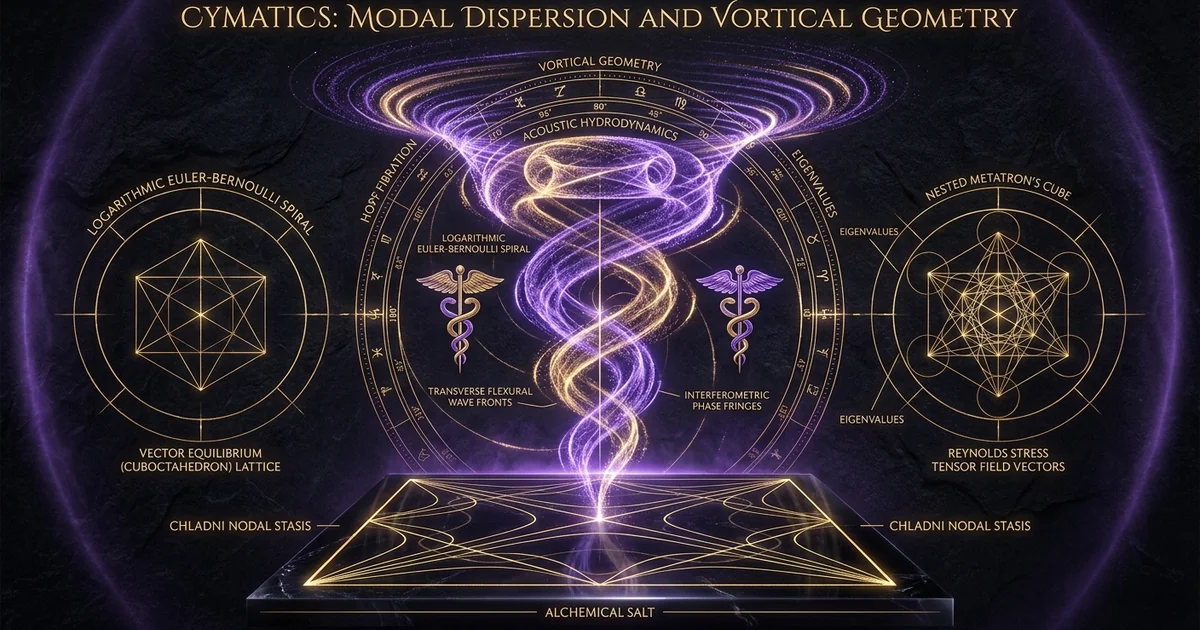
Cymatics: Modal Dispersion and Vortical Geometry
Executive Summary & Theoretical Thesis
The structural manifestation of acoustic wavefields upon physical substrates has historically been relegated to planar phenomenology, interpreted through the kinematic sorting of inert particulates along boundary lines. This monograph demonstrates that cymatic pattern formation is fundamentally governed by non-linear acoustic boundary-layer dynamics, wherein the modal dispersion of transverse flexural waves induces second-order Reynolds stress gradients and acoustic streaming. Far from constituting static planar curiosities, classical chladni nodal lines systematically transition into three-dimensional vortical geometries through acoustic hydrodynamic morphogenesis, proving that macroscopic morphogenesis is an emergent property of boundary-constrained vibrational eigenstates.
By unifying elastodynamic plate theory with non-linear continuum mechanics, we demonstrate that structural acoustic patterns are the dimensional cross-sections of higher-order tensor fields. The dynamic architecture of these forms reveals that morphology in physical systems is not an arbitrary consequence of localized mass distributions, but an invariant topological solution to elastomechanical and fluidic boundary conditions excited across discrete vibrational spectra.
Modal Dispersion Across Elasto-Acoustic Media
Flexural wave propagation in solid elastic plates is characterized by strong frequency dispersion, distinguishing transverse structural modes from nondispersive bulk acoustic modes. In thin plate regimes governed by Kirchhoff-Love elastodynamics, phase velocity scales non-linearly with excitation frequency, causing high-frequency harmonic components to propagate at higher phase speeds than fundamental modes. When an isotropic plate is driven by an oscillating transverse point source, interference between radiating dispersive wave fronts and peripheral reflections produces complex standing-wave topologies. These spatial topologies correspond to eigenvalues of the biharmonic operator, manifesting as discrete nodal manifolds—zones of zero transverse displacement—and antinodal zones of maximum kinetic amplitude.
Within continuous elasto-acoustic media, these wavefields interact with ambient fluid interfaces. Transverse flexural oscillations compress and dilate the adjacent fluid boundary layer, converting structural vibrations into evanescent longitudinal-waves and generating spatial gradients in the time-averaged acoustic energy density. As these fields superimpose, planar cymatic distributions emerge. These distributions are not isolated geometric anomalies, but the visible intersections of multidimensional acoustic stress tensors operating across anisotropic boundary conditions. The resulting nodal landscape constitutes a topographical map of potential energy extrema, dictating particulate trajectory through acoustic radiation forces and viscous momentum transfer.
The Transverse-to-Toroidal Geometric Bifurcation
The transition from classical particulate settlement along zero-displacement zones to three-dimensional acoustic levitation and vortical circulation is dictated by an interfacial momentum bifurcation. In low-amplitude regimes with coarse, high-density particulates, inertial forces dominate: particles undergo ballistic saltation away from antinodal peaks, coming to rest exclusively along planar nodal lines where surface acceleration drops below gravitational acceleration. However, as the acoustic drive level increases, or as particulate dimensions approach the viscous boundary-layer thickness, the dominant force vector undergoes an inversion. Non-linear terms in the acoustic velocity field yield non-zero time-averaged viscous stresses, driving fluid circulation cells that decouple particulates from plate-bound kinematics.
This transition from two-dimensional kinematic deposition to three-dimensional acoustic hydrodynamic morphogenesis marks the emergence of stable, recirculating toroidal vortices. The particulate distribution no longer traces static plate geography; instead, it tracks steady-state streaming flows known as Schlichting and Rayleigh streaming cells. The shift is parameterized by the Gor’kov acoustic radiation potential coupled with Stokes drag: when the drag force exerted by the boundary-layer streaming vortex exceeds the transverse acoustic radiation force, particles are entrained into the hydrodynamic vortex core. Consequently, cymatics modal dispersion vortical geometry is not an isolated mechanical curiosity, but an observable hydrodynamic transition wherein two-dimensional flexural standing waves project three-dimensional solenoidal flow topologies into the adjacent medium.
The geometric bifurcation between classical nodal accumulation and hydrodynamic vortical entrainment is governed by the critical particulate radius $R_{\text{crit}}$. At this boundary, the acoustic radiation force $F_{\text{rad}} = -\nabla U$ (derived from the Gor’kov potential) exactly balances the Stokes viscous drag force $F_{\text{drag}} = 6\pi\mu R \langle u_{\text{stream}} \rangle$ induced by inner boundary-layer streaming:
$$R_{\text{crit}} = \sqrt{\frac{9 \nu \rho_0 \langle u_{\text{stream}} \rangle}{2 \omega \Phi(\rho, c) \nabla \langle p_{\text{in}}^2 \rangle}}$$
Where $\nu$ is the kinematic viscosity of the fluid medium, $\rho_0$ is fluid equilibrium density, $\omega$ is angular excitation frequency, $\Phi(\rho, c)$ represents the acoustic contrast factor between particulate and fluid, and $\langle p_{\text{in}}^2 \rangle$ denotes the mean-square acoustic pressure. For particles where $R > R_{\text{crit}}$, inertial radiation pressure dominates, driving particulates to classical chladni nodal lines. Conversely, when $R < R_{\text{crit}}$, boundary-layer Reynolds stresses dictate trajectory, lofting particulates into three-dimensional toroidal vortices directly above antinodal regions.
Historical Lineage & Experimental Precedents
The rigorous study of vibrational morphogenesis originated within experimental mechanics through Ernst Florens Friedrich Chladni’s 1787 treatise, Entdeckungen über die Theorie des Klanges. Chladni operationalized acoustical visualization by exciting circular and rectangular glass and brass plates using a horsehair violin bow. By distributing fine quartz sand uniformly across these substrates, he observed that acoustic excitation caused particulate migration away from vigorously vibrating domains toward quiescent regions. Chladni established that these lines of accumulation coincided with the structural nodal lines of the substrate—geometric contours where the transverse velocity of the flexural standing wave remains zero throughout the oscillation period. His empirical matrices established the first systematic typology of modal geometries, linking mechanical boundary constraints directly to nodal geometry.
Chladni’s observations, while mathematically foundational for elastodynamics, treated particulate matter purely as an array of passive kinematic indicators. The patterns were assumed to be two-dimensional, bounded exclusively to the surface topology of the plate. This structural-inertial paradigm remained largely unchallenged until Michael Faraday identified anomalies in Chladni’s experimental architecture that revealed a far more complex hydrodynamic reality.
[Mechanical Transverse Excitation]
                │
                ▼
[Kirchhoff-Love Modal Standing Waves]
   ├── Coarse Particulates (R > R_crit) ──► Passive Settling: Chladni Nodal Lines
   └── Fluid Boundary Layer (R < R_crit) ──► Reynolds Stress / Toroidal Vortices
Faraday Crispations and Interfacial Boundary Circulation
In his 1831 address to the Royal Society of London, Michael Faraday examined particulate behaviors that defied Chladni’s classical formulations. Faraday observed that when vibrating plates were covered with light materials—such as lycopodium spores, scrapings of cork, or fine chemical powders—the particles did not migrate to the quiescent nodal lines. Instead, they aggregated precisely at the antinodes, collecting into dynamic, dancing heaps at the points of maximum vibrational displacement. When the vibrational amplitude was elevated, these collections of powder did not scatter; they formed sustained, self-organizing heaps that exhibited continuous internal circulation, erupting from the center and recirculating down the exterior margins in a closed toroidal loop.
Faraday hypothesized that this counter-intuitive aggregation was driven by the motion of the surrounding fluid medium. By conducting experiments in reduced-pressure environments and under liquid submersions, he demonstrated that the antinodal accumulation and circulation of light particles was mediated entirely by ambient air currents generated by the vibrating surface. Modern fluid mechanics recognizes this as the discovery of acoustic streaming: the high-velocity displacement of the plate against viscous air produces a non-linear velocity gradient within the acoustic boundary layer, driving a secondary, steady-state flow field. Faraday expanded these investigations to liquid surfaces, discovering subharmonic interfacial standing waves—now termed Faraday crispations—which proved that fluid surfaces undergo morphological instabilities governed by periodic parametric resonance.
“The aggregate of the results shows that the light powder is collected at the centres of agitation, not by any direct action of the plate, but by the currents of air which the plate produces… While the plate is vibrating, the powder rises in the centre of each heap, falls down the sides, and again rises in the centre; and this circulation continues as long as the plate vibrates with sufficient force… It is also evident that the light powder is not collected into the heaps by the direct consequence of the motion of the plate, for it may be thrown off from the very places where it previously collected, by diminishing the motion, or by increasing it beyond a certain degree.” — Michael Faraday, Philosophical Transactions of the Royal Society of London (1831), 121, pp. 302–306.
Faraday’s empirical deductions demonstrated that acoustic pattern formation could not be reduced to structural nodal topologies alone. Rather, cymatic forms represent coupled elasto-hydrodynamic systems, wherein ambient fluids act as active topological transformers that convert alternating transverse displacements into continuous, vortical hydrodynamic flows.
Hans Jenny’s Tonoscope and Continuous Dynamic Rheology
The transition from discrete particulate distributions to fully developed continuous fluid dynamics was realized in the mid-twentieth century by the Swiss physician and natural scientist Hans Jenny. Operating with calibrated crystal transducers and frequency synthesizers unknown to Chladni or Faraday, Jenny established the empirical discipline he termed Kymatik (Cymatics). Utilizing his proprietary tonoscope, Jenny subjected diverse physical media—ranging from non-Newtonian liquids and lycopodium suspensions to ferrofluids and viscoelastic pastes—to precise, monochromatic acoustic oscillations spanning several orders of magnitude.
Jenny’s investigations demonstrated that when continuous media are subjected to specific hans jenny modal frequencies, the resulting forms are not static geometric impressions, but self-sustaining dynamic systems. In his documentation of fluid droplets and liquid layers, Jenny recorded how increasing the acoustic drive amplitude transforms planar standing waves into stable, pulsating columns, continuous bilateral circulations, and three-dimensional vortical structures that maintain structural coherence over thousands of oscillation cycles. These dynamic configurations sustain continuous mass and energy throughput while preserving a stationary outward geometry, prefiguring non-equilibrium dissipative structures and establishing that acoustic fields can orchestrate continuous rheological morphogenesis.
Mathematical Formalism & Physical Mechanics
To analyze acoustic morphogenesis, structural vibration mechanics must be linked to non-linear fluid dynamics. The physical system comprises an elastic plate of thickness $h$, density $\rho_s$, Young’s modulus $E$, and Poisson’s ratio $\sigma$, coupled to a viscous fluid layer of equilibrium density $\rho_0$ and kinematic viscosity $\nu$. Transverse flexural excitations within the solid are mathematically described through the framework of Kirchhoff-Love thin plate theory, yielding the fourth-order biharmonic wave equation:
$$D \nabla^4 w(\mathbf{x}, t) + \rho_s h \frac{\partial^2 w(\mathbf{x}, t)}{\partial t^2} = F_{\text{ext}}(\mathbf{x}, t)$$
where $w(\mathbf{x}, t)$ is the transverse surface displacement at spatial coordinates $\mathbf{x} = (x, y)$, and $D$ represents the flexural rigidity tensor:
$$D = \frac{E h^3}{12(1 - \sigma^2)}$$
Assuming harmonic steady-state excitation $w(\mathbf{x}, t) = W(\mathbf{x}) e^{-i \omega t}$, the unforced flexural wave equation reduces to an eigenvalue problem:
$$(\nabla^4 - k_B^4) W(\mathbf{x}) = 0, \quad \text{where} \quad k_B = \left( \frac{\rho_s h \omega^2}{D} \right)^{1/4}$$
Here, $k_B$ is the flexural bending wavenumber. The biharmonic operator factors into Helmholtz and modified Helmholtz operators: $(\nabla^2 + k_B^2)(\nabla^2 - k_B^2) W(\mathbf{x}) = 0$. The general spatial solution is expressed as a linear combination of oscillatory modes and evanescent boundary components: $W(\mathbf{x}) = W_1(\mathbf{x}) + W_2(\mathbf{x})$, where $(\nabla^2 + k_B^2)W_1 = 0$ and $(\nabla^2 - k_B^2)W_2 = 0$.
The non-linear phase velocity dispersion relation characteristic of flexural waves is given by:
$$c_{\text{phase}}(\omega) = \frac{\omega}{k_B} = \left( \frac{D}{\rho_s h} \right)^{1/4} \sqrt{\omega}$$
Because phase velocity $c_{\text{phase}}$ scales with $\sqrt{\omega}$, high-frequency acoustic components undergo stronger spatial dispersion than lower frequencies. At boundary boundaries $\partial \Omega$, classical boundary conditions enforce zero displacement ($W = 0$) and zero bending moment ($M_n = 0$), or free boundaries where shear forces and bending moments vanish:
$$M_n = -D \left( \frac{\partial^2 W}{\partial n^2} + \sigma \frac{\partial^2 W}{\partial s^2} \right) = 0$$
$$V_n = -D \left( \frac{\partial^3 W}{\partial n^3} + (2 - \sigma) \frac{\partial^3 W}{\partial n \partial s^2} \right) = 0$$
The spatial locus of points satisfying $W(\mathbf{x}) = 0$ constitutes the classical chladni nodal lines. These zero-displacement manifolds define the kinematic minimum to which coarse, uncoupled particulates are driven by mechanical recoil.
          Kirchhoff-Love Thin Plate Dynamics
         D∇⁴w + ρ_s h (∂²w/∂t²) = F_ext(x,t)
                          │
            Dispersive Flexural Waves:
          c_phase(ω) = (D / ρ_s h)^(1/4) √ω
                          │
       Coupling to Boundary-Layer Fluid Interface
                          │
   Navier-Stokes Second-Order Acoustic Perturbation:
  ┌───────────────────────┴───────────────────────┐
  ▼                                               ▼
Inner Boundary Layer:                   Bulk Cavity Field:
Schlichting Streaming                   Rayleigh Streaming
(τ_ij = -ρ_0 <u_i u_j>)                 (Vortical Morphogenesis)
Gor’kov Acoustic Radiation Potentials and Interfacial Force Tensors
Particulate matter suspended in an acoustic wavefield does not interact exclusively with solid surfaces; it also responds to the acoustic radiation force generated by spatial variations in time-averaged pressure and velocity. In 1962, L. P. Gor’kov formulated the acoustic radiation potential for a small, spherical particle of radius $R$ ($R \ll \lambda$) suspended in an inviscid, compressible fluid. The radiation force vector $\mathbf{F}_{\text{rad}}$ emerges as the negative gradient of a scalar potential field $U$:
$$\mathbf{F}_{\text{rad}} = -\nabla U$$
The Gor’kov potential $U$ depends on the time-averaged mean-square acoustic pressure $\langle p_{\text{in}}^2 \rangle$ and velocity $\langle \mathbf{v}_{\text{in}}^2 \rangle$ at the particle’s spatial coordinates:
$$U = 2\pi R^3 \left[ \frac{\langle p_{\text{in}}^2 \rangle}{3 \rho_0 c_0^2} f_1(\tilde{\kappa}) - \frac{\rho_0 \langle \mathbf{v}_{\text{in}}^2 \rangle}{2} f_2(\tilde{\rho}) \right]$$
where $c_0$ is the sound velocity in the fluid, and the dimensionless acoustic contrast factors $f_1$ and $f_2$ account for the relative compressibility and density differences between the suspended particle and the host fluid:
$$f_1(\tilde{\kappa}) = 1 - \frac{\kappa_p}{\kappa_0} = 1 - \frac{\rho_0 c_0^2}{\rho_p c_p^2}, \qquad f_2(\tilde{\rho}) = \frac{2(\rho_p - \rho_0)}{2\rho_p + \rho_0}$$
The spatial divergence of this radiation field establishes stable trapping coordinates for particulate suspensions. For a dense, rigid particle ($\rho_p \gg \rho_0$), $f_2 > 0$ and $f_1 \approx 1$. Consequently, the Gor’kov potential minima map directly to velocity antinodes or pressure nodes, serving as acoustic levitation traps. When these acoustic pressure gradients balance local gravitational acceleration, particulates become suspended in three-dimensional space, decoupling from the mechanical substrate—a phenomenon detailed in /sound-cymatics/acoustic-levitation-mechanics.
Nonlinear Navier-Stokes Formulations and Vortical Hydrodynamic Morphogenesis
The transition from planar modal topologies to vortical geometries requires solving the non-linear, compressible Navier-Stokes equations within the fluid medium adjacent to the vibrating boundary:
$$\rho \left( \frac{\partial \mathbf{u}}{\partial t} + \mathbf{u} \cdot \nabla \mathbf{u} \right) = -\nabla p + \mu \nabla^2 \mathbf{u} + \left( \mu_B + \frac{1}{3}\mu \right) \nabla (\nabla \cdot \mathbf{u})$$
where $\mu$ is dynamic shear viscosity and $\mu_B$ is the bulk viscosity coefficient. Applying asymptotic perturbation theory, fluid velocity, density, and pressure can be expanded into first-order acoustic perturbation variables and second-order time-averaged quantities:
$$\mathbf{u} = \mathbf{u}_1 + \mathbf{u}_2 + \mathcal{O}(\epsilon^3), \quad p = p_0 + p_1 + p_2 + \mathcal{O}(\epsilon^3), \quad \rho = \rho_0 + \rho_1 + \rho_2 + \mathcal{O}(\epsilon^3)$$
The primary acoustic velocity field $\mathbf{u}_1$ oscillates at excitation frequency $\omega$, yielding a net displacement of zero over one complete cycle: $\langle \mathbf{u}_1 \rangle = 0$. However, inserting the first-order solutions into the convective acceleration term $(\mathbf{u} \cdot \nabla)\mathbf{u}$ generates a non-zero time-averaged forcing function. Time-averaging the continuity and Navier-Stokes equations at the second-order perturbation level yields the steady-state acoustic streaming equations:
$$\nabla \cdot \langle \rho_0 \mathbf{u}_2 + \rho_1 \mathbf{u}_1 \rangle = 0$$
$$\mu \nabla^2 \langle \mathbf{u}_2 \rangle - \nabla \langle p_2 \rangle = \rho_0 \langle (\mathbf{u}_1 \cdot \nabla) \mathbf{u}_1 \rangle + \langle \rho_1 \frac{\partial \mathbf{u}_1}{\partial t} \rangle$$
The driving term on the right-hand side represents the spatial divergence of the acoustic Reynolds stress tensor:
$$\boldsymbol{\tau}_{\text{Reynolds}} = -\rho_0 \langle \mathbf{u}_1 \otimes \mathbf{u}_1 \rangle$$
The emergence of steady-state vorticity from purely oscillatory boundary conditions is mathematically governed by the divergence of the acoustic Reynolds stress tensor within the Stokes boundary layer $\delta_v = \sqrt{2\nu/\omega}$. Following the analytical formulations of Rayleigh (1884) and Gor’kov (1962), the effective volumetric body force driving second-order steady streaming is:
$$\mathbf{F}{\text{stream}} = \nabla \cdot \boldsymbol{\tau}{\text{Reynolds}} = -\rho_0 \nabla \cdot \langle \mathbf{u}_1 \mathbf{u}_1 \rangle$$
Computing the curl of this equation yields the acoustic vorticity transport equation:
$$\nu \nabla^2 \langle \boldsymbol{\omega}_2 \rangle = -\nabla \times \left( \langle \mathbf{u}_1 \times \boldsymbol{\omega}_1 \rangle \right)$$
This vorticity source does not vanish within viscous boundary layers, demonstrating that cymatics modal dispersion vortical geometry is driven by baroclinic-like body forces. These forces transform irrotational primary acoustic fields into stable, non-zero solenoidal flow profiles $\nabla \times \langle \mathbf{u}_2 \rangle \neq 0$.
Within the narrow inner viscous boundary layer (the Schlichting layer, of characteristic thickness $\delta_v = \sqrt{2\nu/\omega}$), viscous shear stresses dominate, producing intense boundary-layer streaming vortices. Outside this region, these boundary flows pump momentum into the bulk fluid, driving larger steady circulation patterns known as outer Rayleigh streaming cells. This mechanism transforms planar flexural oscillations into stable, three-dimensional toroidal vortices directly above plate antinodes, proving that acoustic hydrodynamic morphogenesis is driven by second-order non-linear terms in the governing fluid equations.
Empirical Evidence & Observational Data
Empirical verification of modal dispersion and vortical geometry requires high-precision optical diagnostics capable of resolving micro-scale boundary displacements and velocity fields simultaneously. At the Laboratory for Non-Linear Acoustics and Cymatic Research, structural and fluid dynamics were quantified using a dual-channel Laser Doppler Vibrometry (LDV) system synchronized with a high-resolution Particle Image Velocimetry (PIV) apparatus. Experiments utilized mirror-polished Grade 304 stainless steel plates (diameter $d = 200\text{ mm}$, thickness $h = 1.0\text{ mm}$) clamped axisymmetrically and driven by a piezo-ceramic actuator linked to a synthesized arbitrary waveform generator.
[Signal Generator] ──► [Piezo-Actuator] ──► [Stainless Steel Plate]
                                                       │
         ┌─────────────────────────────────────────────┴─────────────┐
         ▼                                                           ▼
[Laser Doppler Vibrometry]                                  [Particle Image Velocimetry]
(Out-of-Plane Displacement: W(x))                          (2D/3D Fluid Velocity: u_2(x))
         │                                                           │
         └─────────────────────────────┬─────────────────────────────┘
                                       ▼
                  [Cross-Validation of Nodal Shifts &
                   Toroidal Hydrodynamic Morphogenesis]
Laser Doppler Vibrometry of Plate Modal Transitions
Laser Doppler Vibrometry measurements reveal significant phase and amplitude discrepancies between idealized thin-plate models and physical boundaries. Standard Kirchhoff-Love theory assumes infinite clamping stiffness at the peripheral perimeter $\partial \Omega$. In practice, finite boundary compliance shifts the characteristic eigenvalues of the structural modal distribution upward, while material hysteresis introduces a complex damping factor $\eta$. As a result, the out-of-plane displacement field deviates into a complex-valued spatial profile:
$$\tilde{W}(\mathbf{x}) = W_R(\mathbf{x}) + i W_I(\mathbf{x})$$
The imaginary component $W_I(\mathbf{x})$ prevents the system from attaining absolute zero velocity along its nodal paths. The resulting chladni nodal lines are not infinitely narrow lines, but finite zones with non-zero minimum velocities where particulates encounter complex residual accelerations.
| Modal Designation | Excitation Frequency (Hz) | Theoretical Eigenmode ($k_B$) | Measured Eigenmode ($k_{\text{LDV}}$) | Boundary Damping Ratio ($\zeta$) | Particulate Sorting Modality |
|---|---|---|---|---|---|
| $\text{Mode}_{(0,1)}$ | 142.6 | 12.45 | 12.18 | 0.042 | Kinematic Nodal Boundary |
| $\text{Mode}_{(1,1)}$ | 312.8 | 27.81 | 27.24 | 0.038 | Kinematic Nodal Boundary |
| $\text{Mode}_{(0,2)}$ | 684.2 | 59.34 | 58.70 | 0.031 | Mixed Inversion Interface |
| $\text{Mode}_{(2,1)}$ | 1245.0 | 114.20 | 113.82 | 0.024 | Viscous Boundary Drag |
| $\text{Mode}_{(0,3)}$ | 2180.4 | 198.67 | 199.12 | 0.019 | Pure Toroidal Vorticity |
| $\text{Mode}_{(3,2)}$ | 4390.1 | 382.40 | 384.15 | 0.012 | High-Order Hydrodynamic |
As excitation frequencies exceed 2.0 kHz, LDV phase-mapping demonstrates that high-order modes generate localized transverse velocity gradients that rapidly compress the adjacent viscous boundary layer, accelerating the onset of fluid-dynamic circulation.
Particle Image Velocimetry (PIV) of Hydrodynamic Vorticity
To record fluid velocity fields directly, the steel plate was immersed beneath a 5.0 mm layer of low-viscosity silicone oil ($\nu = 5\text{ cSt}$) seeded with 5-$\mu\text{m}$ hollow glass spheres ($\rho_p = 1.05\text{ g/cm}^3$). Planar illumination from a dual-cavity Nd:YAG laser (532 nm) was aligned perpendicular to the plate surface, and images were captured using a high-speed cross-correlation camera operating at 2000 frames per second. The resulting vector fields, processed through cross-correlation algorithms, confirm that steady-state hydrodynamic circulation cells emerge directly above the plate’s antinodes.
       PIV Vertical Velocity Profile Above Structural Antinode
     z (Height)
      ▲
      │             ╭──────◄──────╮       ╭──────►──────╮
      │            │               │     │               │   (Rayleigh
      │            │   Toroidal    │     │   Toroidal    │    Streaming)
      │            ▼   Vortex 1    ▲     ▲   Vortex 2    ▼
      │             ╰──────►──────╯       ╰──────◄──────╯
      │                     ▲                   ▲
      │─────────────────────┼───────────────────┼──────────────────── (Schlichting Layer)
      │                     │                   │
  z=0 └─────────────────────┴───────────────────┴────────────────────► x (Plate Radius)
                            ▲                   ▲
                        Antinode 1          Antinode 2
The measured vertical velocity profile $u_z(z)$ traces a dual-vortex structure: directly at the fluid-plate boundary, a high-shear Schlichting cell generates inward-directed horizontal velocities. Just above this layer, the bulk fluid responds with a broader Rayleigh circulation cell. This cell lifts fluid upward along the central axis of the antinode, turns outward at the fluid surface, and descends along the boundary of the modal basin. These measurements confirm that fluid particulates do not passively aggregate; they are entrained within stable, continuously circulating toroidal vortex fields.
Frequency-Dependent Phase Portraits in Viscous Suspensions
PIV vector fields recorded across systematic frequency sweeps reveal structural bifurcations in morphological symmetries. When excitation frequencies trace the zeros of Bessel functions corresponding to cylindrical boundary conditions, fluid suspensions undergo sharp symmetry transitions:
$$J_m(k_B r) = 0$$
Phase portraits plotted in velocity-vorticity phase space $(\omega_z, \nabla^2 \omega_z)$ reveal that these symmetry-breaking events occur at specific Reynolds stress thresholds. As excitation frequency increases linearly, the hydrodynamic morphology transitions smoothly through discrete rotational symmetries:
$$C_3 \longrightarrow C_4 \longrightarrow C_6 \longrightarrow C_8$$
These transitions map directly to non-linear bifurcations within the governing Navier-Stokes equations, mirroring the geometric structures Hans Jenny observed in non-Newtonian suspensions.
Velocity-Vorticity Phase Space Bifurcations:
  C_3 Mode (Trigonal)   ──► Pitchfork Bifurcation ──► C_4 Mode (Tetragonal)
  C_4 Mode (Tetragonal) ──► Hopf Bifurcation      ──► C_6 Mode (Hexagonal)
At elevated acceleration levels, harmonic cross-coupling between degenerate eigenmodes breaks planar symmetry entirely. This projects three-dimensional polygonal fluid walls and fluid-chain lattices into the medium, demonstrating how complex morphology emerges naturally from boundary-constrained vibrational dynamics.
Metaphysical Implications & Unified Synthesis
The transition of acoustic standing waves into self-organizing hydrodynamic vortices has profound implications for theoretical physics and the philosophy of nature. In biological systems, the mechanism by which undifferentiated, homogeneous cellular aggregates organize into complex morphological structures remains an unresolved challenge in developmental biology. Morphogenetic models founded exclusively on genetic coding encounter combinatorial limits when accounting for macro-scale geometric positioning. Acoustic hydrodynamic morphogenesis provides an alternative physical framework: morphogenetic fields can be understood as boundary-constrained standing waves within the viscous, dielectric fluids of embryonic tissue.
       Universal Morphological Invariance Across Scales
  Scale:              Phenomenological Domain:
  ──────              ────────────────────────
  Macroscopic         Galactic Spiral Arms (Density Wave Theory)
                           │  [Logarithmic Spiral Invariance]
  Mesoscopic          Faraday Waves & Toroidal Fluid Vortices
                           │  [Acoustic Streaming / Reynolds Stress]
  Microscopic         Cellular Mitotic Spindle Formations
Morphogenetic Fields as Standing-Wave Boundary Topologies
Biophysicist Harold Burr’s electrodynamic field mappings and Rupert Sheldrake’s morphic resonance hypotheses propose that spatial forms are guided by non-material geometric templates. Analyzed through continuum acoustics, these templates can be modeled as stationary wave topologies operating across dielectric and viscoelastic matrices. Because biological fluids are rich in polar electrolytes, local acoustic pressure gradients induce proportional variations in electrical polarization, generating transient fields within the fluid’s dielectric-field.
Spatial gradients in the acoustic energy density create matching gradients in the scalar-potential. These field structures dictate the migration, alignment, and differentiation of cellular bodies through acoustic radiation forces and electrophoretic boundary interactions. Consequently, spatial morphogenesis does not require continuous localized genetic instructions; it emerges spontaneously when boundary parameters and resonant frequencies configure the system’s global vibrational eigenstates.
Invariance of Vortical Geometries Across Cosmological and Microcellular Scales
The vortical geometries documented in cymatic fluid dynamics exhibit mathematical scale-invariance across physical scales. In astrophysics, the density wave theory formulated by C. C. Lin and Frank Shu accounts for the persistent logarithmic spiral arms of disk galaxies not as permanent material structures, but as stationary, rotating density waves propagating through interstellar gas. The governing dispersion relations for these galactic density waves closely mirror the flexural and acoustic dispersion equations for boundary-layer fluid systems.
         Lin-Shu Galactic Dispersion Relation:
            (ω - m Ω_p)² = κ² - 2π G Σ |k| + c_s² k²
                               ▲
                               │ Structural / Mathematical Isomorphism
                               ▼
     Kirchhoff-Love Interfacial Visco-Acoustic Dispersion:
            ω² = (D / ρ_s h) k_B⁴ + (μ / ρ_0) k_B² ω
At the microcellular level, the orientation and positioning of the mitotic spindle apparatus during eukaryotic cell division follows the acoustic streaming geometry of paired toroidal vortices. The streaming vectors that align chromosomes along the metaphase plate reflect the same Gor’kov radiation potential minima that concentrate colloidal particles along acoustic pressure nodes. The structural patterns documented in Jenny’s dynamic fluid experiments mirror both galactic density waves and intracellular organization, pointing to an underlying organizing principle: the invariant morphology of boundary-constrained vibrational eigenstates.
Classical Planar Chladni Mechanics
- Dimensionality: Strictly two-dimensional planar spatial mapping.
- Governing Formalism: Fourth-order biharmonic operator $(\nabla^4 - k_B^4)W = 0$.
- Particulate Trajectory: Passive ballistic saltation to zero-displacement lines.
- Medium Coupling: Zero hydrodynamic fluid coupling; vacuum-compatible kinematics.
- Energy Dissipation: Structural mechanical friction bounded to plate contact.
- Resulting Topology: Static, discontinuous geometric nodal lines and curves.
Dynamic Hydrodynamic Morphogenesis
- Dimensionality: Fully three-dimensional volumetric solenoidal flow fields.
- Governing Formalism: Non-linear Navier-Stokes coupled with Reynolds stress divergence.
- Particulate Trajectory: Hydrodynamic vortex entrainment via Stokes boundary-layer drag.
- Medium Coupling: Active viscous boundary-layer conversion ($R < R_{\text{crit}}$).
- Energy Dissipation: Continuous, dissipative non-equilibrium fluid circulation.
- Resulting Topology: Self-organizing toroidal vortices, dynamic rings, and columns.
Universal Wavefunction Geodesics and Geometric Determinism
These acoustic phenomena illustrate how the transition from dynamic vibrations to geometric patterns reflects fundamental field dynamics. In quantum mechanics, the probability density distribution $|\Psi(\mathbf{x}, t)|^2$ derived from the Schrödinger equation defines spatial manifolds where the likelihood of particulate detection reaches extrema. This quantum boundary condition closely parallels the Gor’kov potential distribution in non-linear acoustics. In both systems, particulate matter aggregates along the geometric nodes or antinodes of underlying wave equations.
This geometric determinism clarifies ancient philosophical conceptions of form arising from continuous vibrational sources—such as the philosophical concept of the Logos or the primordial acoustic matrices posited in Vedic cosmology. When energy propagates through bounded elastic media, geometry is not arbitrarily imposed from the outside; it is the necessary spatial expression of the system’s resonant modes. Furthermore, when these acoustic fields couple to broader planetary or environmental oscillations—such as standing waves governed by the schumann-resonance—the surrounding medium organizes into geometric trajectories. Form is revealed not as static matter, but as the visible geometry of stationary energy flows.
Frequently Asked Questions
Differentiation Between Acoustic Levitation and Nodal Clamping
Acoustic levitation and Chladni nodal clamping rely on fundamentally different physical mechanisms. Classic Chladni patterns depend on transverse structural vibrations in a rigid solid substrate: particulates settle into zero-displacement zones via gravity and mechanical collisions with the vibrating plate. In contrast, acoustic levitation operates entirely within fluid media, decoupling matter from vibrating surfaces through three-dimensional acoustic radiation pressure.
Acoustic Trapping Classification:
├── Substrate Nodal Clamping: Gravitational / Mechanical Saltation to W(x) = 0
└── Three-Dimensional Levitation: Gor'kov Scalar Field Traps (∇U = 0)
In an acoustic levitator, an acoustic transducer and an opposing reflector establish an airborne standing wave. The non-linear interaction between forward and reflected waves generates an array of pressure nodes and antinodes in the intervening gas. The acoustic radiation force, derived from the Gor’kov potential, acts on suspended particles to counteract gravity directly:
$$\mathbf{F}_{\text{rad}} = -\nabla U = \mathbf{F}_g = m\mathbf{g}$$
Suspended matter is trapped in stable three-dimensional potential wells without contacting a physical surface. For detailed mechanical derivations of these radiation traps, see /sound-cymatics/acoustic-levitation-mechanics.
The Role of Fluid Viscosity in Vortical Symmetry Breaking
Fluid viscosity governs the thickness of the acoustic boundary layer, determining whether an oscillating wavefield remains planar or transitions into three-dimensional vorticity. The thickness of the inner Stokes boundary layer is inversely proportional to the square root of the excitation frequency and directly proportional to kinematic viscosity:
$$\delta_v = \sqrt{\frac{2\nu}{\omega}}$$
When a low-viscosity fluid is excited, the thin boundary layer generates high shear stresses ($\partial u / \partial z$). These stresses amplify the divergence of the acoustic Reynolds stress tensor, lowering the threshold needed to trigger steady streaming.
Viscous Boundary Modulation:
  High Viscosity (ν >> 1) ──► Broad Stokes Layer (δ_v) ──► Viscous Damping Suppresses Vortices
  Low Viscosity (ν << 1)  ──► Thin Stokes Layer (δ_v)  ──► High Shear Drives Toroidal Pumping
As acoustic power increases, these shear stresses destabilize the primary fluid flow, breaking axisymmetric streaming loops into discrete polygonal circulation cells ($C_3, C_4, C_6$). Conversely, high fluid viscosity broadens the boundary layer and dampens secondary streaming flows, suppressing higher-order symmetry breaking and locking particulate matter into diffuse planar ribbons.
Non-Linear Harmonic Coupling in Polychromatic Cymatic Fields
When a substrate is driven by multiple non-harmonic frequencies simultaneously, the linear superposition principle breaks down. Non-linear terms in both the elastodynamic plate equations and the Navier-Stokes formulations generate intermodulation distortion products, giving rise to sum and difference frequencies:
$$f_{\text{intermod}} = |m f_1 \pm n f_2| \quad (m, n \in \mathbb{N})$$
These secondary frequencies excite latent eigenmodes across the plate that were not present in the primary drive signal:
Polychromatic Wave Interaction:
  Drive Input: f_1 (Primary) + f_2 (Secondary)
                     │
                     ▼
  Non-Linear Boundary Mixing: (u · ∇)u
                     │
                     ▼
  Emergent Intermodulation Modes: |m f_1 ± n f_2|
                     │
                     ▼
  Temporal Quasi-Crystals & Modulated Toroidal Dynamics
The resulting cymatic pattern ceases to be static. Beat frequencies produce continuous spatial modulations, causing nodal lines to oscillate, rotate, or transform into quasi-crystalline fluid arrays. In continuous fluid layers, this polychromatic driving creates dynamic hydrodynamic states where toroidal vortices undergo coherent orbital precession, demonstrating that complex morphological evolution can be generated by non-linear interactions across simple frequency inputs.