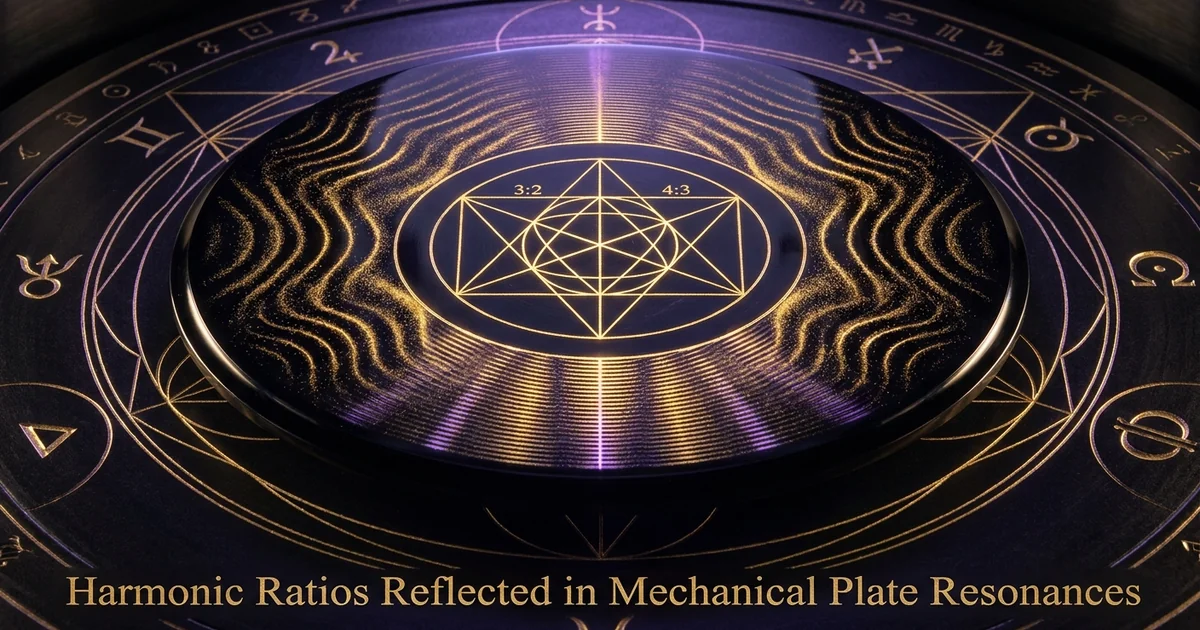
Harmonic Ratios Reflected in Mechanical Plate Resonances
Executive Summary & Theoretical Thesis: The Non-Harmonic Reality of 2D Resonators
The Dimensional Disjunction Between 1D Strings and 2D Elastic Continua
The fundamental canon of classical acoustics, from the monochord experiments of the Pythagorean school to the wave mechanics of Marin Mersenne and Joseph Sauveur, established an enduring paradigm: the acoustic spectrum of an oscillating system is presumed to unfold as an integer series of harmonics. In an idealized one-dimensional resonator—such as a taut string or an open acoustic pipe—the restorative forces are strictly tensile or barometric, yielding a non-dispersive phase velocity where phase velocity $v_p$ equals group velocity $v_g$. Under these 1D conditions, the resonant frequencies scale in strict linear proportion to the spatial mode index, yielding the quintessential harmonic overtone series $f_n = n f_1$. This mathematical simplicity gave rise to the foundational belief that musical consonance, embodied in the fundamental intervals of the octave ($2:1$), the perfect fifth ($3:2$), and the perfect fourth ($4:3$), is an intrinsic property of vibrating matter.
When acoustic investigation transitions from the one-dimensional line to the two-dimensional continuum of the mechanical plate, this harmonic architecture undergoes a radical structural breakdown. A flat, solid plate possesses intrinsic flexural rigidity, meaning its restorative mechanism is governed not by an applied external tension, but by internal bending and torsional moments resisting spatial curvature. This mechanical shift fundamentally alters the governing differential wave equations: the spatial derivative transitions from the second-order d’Alembertian operator to a fourth-order biharmonic operator. Consequently, the dispersion relation linking temporal frequency $\omega$ to spatial wavenumber $k$ ceases to be linear. In two-dimensional isotropic plates, high-frequency flexural waves propagate substantially faster than low-frequency waves, completely dismantling the equidistant integer distribution of overtones.
The resulting frequency spectrum of an unconstrained or edge-supported plate is fundamentally inharmonic, governed not by rational numbers, but by the transcendental roots of Bessel functions and hyperbolic equations. The overtone spectrum of a Chladni plate, far from reinforcing Pythagorean tuning systems as elementary baselines, exhibits a clustered, non-harmonic distribution where overtones drift wide of musical intervals. To understand the harmonic ratios plate resonance overtone spectrum chladni dynamic requires rejecting linear reductionism. Instead, one must investigate how mechanical plate geometries, boundary conditions, and material anisotropies constrain continuous elastic fields into discrete geometric topologies.
Biharmonic Wave Mechanics Versus Classical Integer Multiples
The divergence between string and plate dynamics is rooted directly in the governing elastodynamic partial differential equations. The classical one-dimensional wave equation:
$$\frac{\partial^2 w}{\partial t^2} = c^2 \frac{\partial^2 w}{\partial x^2}$$
yields solutions composed of sinusoidal eigenfunctions whose spatial frequencies are constrained to integer multiples of the fundamental domain: $k_n = n\pi / L$. By contrast, the Kirchhoff-Love equation governing transverse displacements $w(x, y, t)$ of a thin, isotropic elastic plate is expressed as:
$$D \nabla^4 w + \rho h \frac{\partial^2 w}{\partial t^2} = 0$$
where $\nabla^4 = \nabla^2 \nabla^2$ is the biharmonic differential operator, $\rho$ represents mass density, $h$ designates uniform plate thickness, and $D$ denotes the plate’s flexural rigidity. Because the spatial operator is of the fourth order, substituting a traveling wave solution of the form $w(\mathbf{r}, t) = A e^{i(\mathbf{k} \cdot \mathbf{r} - \omega t)}$ reveals an inherently quadratic dispersion relation.
The dispersion relation for flexural waves in a thin, homogeneous, isotropic elastic plate is derived directly from the biharmonic elastodynamic equation:
$$\omega(k) = k^2 \sqrt{\frac{D}{\rho h}} = k^2 \sqrt{\frac{E h^2}{12 \rho (1 - \nu^2)}}$$
where $E$ is Young’s modulus and $\nu$ is Poisson’s ratio. From this formulation, the phase velocity $v_p$ and group velocity $v_g$ are determined:
$$v_p = \frac{\omega}{k} = k \sqrt{\frac{D}{\rho h}}, \quad v_g = \frac{\partial \omega}{\partial k} = 2k \sqrt{\frac{D}{\rho h}} = 2 v_p$$
Because the group velocity is precisely twice the phase velocity, flexural energy travels at a speed proportional to the square root of the temporal frequency ($v_g \propto \sqrt{\omega}$). Consequently, high-frequency spectral components disperse across the plate faster than lower modes. This non-linear dispersion prevents the formation of equidistant harmonic overtones, fundamentally precluding integer Pythagorean intervals in unconstrained two-dimensional plates.
Because the wave mechanics are dispersive, standing waves in a two-dimensional boundary value problem cannot resolve into simple integer multiples of a single fundamental wavelength. The eigenvalues $\lambda_{m,n}$ resulting from the application of zero-traction, clamped, or pinned boundary conditions are transcendental numbers. Consequently, the overtone spectrum of a Chladni plate consists of inharmonic frequency intervals, such as $f_2/f_1 \approx 2.081$, $f_3/f_1 \approx 3.414$, or $f_4/f_1 \approx 5.000$, diverging sharply from the strictly rational ratios of the monochord. Any appearance of harmonic consonance within an isotropic 2D plate is an emergent geometric coincidence or the consequence of highly specific boundary constraints, rather than an inherent acoustic law of the elastic medium.
Topological Emergence of Pythagorean Ratios in Bounded Plates
Despite the intrinsically non-harmonic nature of flexural wave dispersion, classical harmonic ratios re-emerge within mechanical plate systems through the phenomena of spatial modal degeneracy, geometric boundary confinement, and anisotropic profiling. When an elastic plate is shaped into a symmetric geometry—such as a square, equilateral triangle, or circle—the underlying symmetry group (e.g., the dihedral group $D_4$ for a square, or the continuous orthogonal group $O(2)$ for a circle) forces multiple distinct spatial eigenfunctions to share identical, or nearly identical, energy levels.
Under these conditions, any infinitesimal mechanical perturbation or non-linear mode-coupling allows orthogonal eigenmodes to superimpose. This interaction generates intricate nodal patterns—the lines and curves where local transverse displacement is identically zero ($w = 0$). When boundary parameters, such as the aspect ratio of a rectangular plate $L_x / L_y$, are systematically tuned to rational values or quadratic surds, the non-linear eigenvalues can be forced into integer or near-integer relationships.
Thus, the study of pythagorean harmonic proportions in two-dimensional plate resonance does not rely on simple acoustic frequency generation. Instead, it involves analyzing how structural geometry can constrain non-linear, dispersive wavefields into energetic equilibria that reflect rational ratios. As explored in studies on /physics-electromagnetism/standing-wave-dispersion, boundary constraints can cause complex dispersive fields to collapse into ordered, coherent nodal states. The musical interval ratios geometry observed in cymatic configurations do not contradict fourth-order continuum mechanics; rather, they represent topological attractors that emerge when mechanical boundaries enforce modal degeneracies across an elastic domain.
Historical Lineage & Experimental Precedents: From Galilean Sand to Chladni’s Law
Galileo and Hooke: Early Mechanical Visualization of Acoustic Nodes
The empirical study of two-dimensional mechanical resonance began with the observation that vibrating solid materials spontaneously sort particulate matter into discrete geometric configurations. In his 1638 work, Discorsi e dimostrazioni matematiche intorno a due nuove scienze, Galileo Galilei documented that scraping a brass plate with a steel chisel generated a distinct audible pitch while simultaneously causing fine brass dust on the plate’s surface to assemble into a series of parallel, equidistant streaks. Galileo recognized that these dust lines marked spatial regions of minimal motion, providing the first physical demonstration that sound is characterized by spatially periodic standing waves across a continuous medium.
Four decades later, in 1680, Robert Hooke advanced this experimental approach at the Royal Society of London. Hooke mounted a thin glass plate on a central supporting stalk, dusted its surface with fine flour, and excited its perimeter using a horsehair violoncello bow. By altering his bowing point and dampening specific perimeter nodes with his fingers, Hooke produced an array of intersecting, symmetrical patterns. Although Hooke did not develop a comprehensive mathematical framework for these results, his experiments demonstrated that a two-dimensional elastic continuum could sustain complex standing-wave patterns with intersecting lines of rest. This work challenged the assumption that resonant standing waves were confined to linear, one-dimensional domains like the monochord.
These early experiments directly anticipated the formal study of /sacred-geometry/pythagorean-monochord-ratios, challenging whether the natural world is governed solely by 1D integer ratios or by more complex multi-dimensional geometric equilibria.
The Chladni Paradigm (1787) and Empirical Overtone Mapping
The systematic empirical mapping of two-dimensional mechanical plate resonance was established by Ernst Florens Friedrich Chladni in his 1787 monograph, Entdeckungen über die Theorie des Klanges. Chladni constructed an experimental apparatus consisting of circular, square, and rectangular brass and glass plates clamped rigidly at their center or perimeter. By applying fine, dry quartz sand across the surface and drawing a violin bow across the edge while selectively dampening specific perimeter points with his fingertips, Chladni compelled the sand to migrate away from regions of dynamic acceleration (antinodes) and settle along nodal lines of zero transverse displacement ($\dot{w} = 0$).
“Die Töne einer solchen Scheibe lassen sich nicht, wie die einer Saite oder einer Orgelpfeife, durch die einfachen Zahlen 1, 2, 3, 4 usw. ausdrücken, sondern sie folgen ganz anderen, von der Gestalt und den Befestigungsarten abhängigen Gesetzen, deren Verhältnisse oft irrational und weit von unsern musikalischen Intervallen entfernt sind…”
(Translation: “The tones of such a plate cannot be expressed, like those of a string or an organ pipe, by the simple numbers 1, 2, 3, 4, etc.; rather, they follow entirely different laws dependent on shape and boundary conditions, whose proportions are often irrational and far removed from our musical intervals…”) — Ernst F. F. Chladni, Entdeckungen über die Theorie des Klanges (Leipzig: Weidmanns Erben und Reich, 1787), p. 14.
Through thousands of trials, Chladni demonstrated that each resonant tone corresponded to a unique nodal topography. For circular plates clamped at the center, he formulated the empirical relationship known as Chladni’s Law:
$$f \propto (m + 2n)^2$$
where $m$ represents the number of linear radial nodal lines intersecting at the center, and $n$ denotes the number of concentric circular nodal lines.
Chladni’s law was a critical historical development: it showed that the overtone spectrum of a plate does not follow an arithmetic progression ($f_n \propto n$), but roughly scales as the square of a composite topological index $(m + 2n)$. The resulting frequency ratios frequently formed irrational musical intervals, directly conflicting with the natural harmonic series of wind and string instruments. Chladni’s experimental work documented that mechanical surfaces could support stable, geometrically complex nodal architectures that operated outside classical musical tuning frameworks.
+-----------------------------------------------------------------------------------+
|               HISTORICAL PROGRESSION OF MECHANICAL PLATE ACOUSTICS                |
+-----------------------------------------------------------------------------------+
| 1638: Galileo Galilei          | Scraped brass plates; observed dust bands       |
| 1680: Robert Hooke             | Bowed flour-dusted glass; saw 2D nodal lines     |
| 1787: Ernst Chladni            | Published empirical law: f ~ (m + 2n)^2          |
| 1811-1821: Sophie Germain      | Derived biharmonic elasticity operator D∇⁴w      |
| 1850: Gustav Kirchhoff         | Formulated correct free-edge boundary conditions |
| 1961: Mary D. Waller           | Cryogenic CO₂ modal mapping; confirmed invariance|
+-----------------------------------------------------------------------------------+
Sophie Germain, Kirchhoff, and the Mathematical Formalization of Plate Elasticity
Chladni’s 1808 demonstration of his sand figures before the Institut de France prompted Napoleon Bonaparte to sponsor an extraordinary prize through the Paris Academy of Sciences: to provide the definitive mathematical theory of elastic plate vibrations. The challenge occupied the premier mathematicians of Europe, exposing the inadequacy of applying second-order wave equations to flexural systems.
The breakthrough came from Sophie Germain. In a series of memoirs submitted between 1811 and 1821, Germain recognized that the restoring force of an elastic surface depends directly on its mean curvature. Using the calculus of variations, Germain was the first to propose that the strain energy of a flexed plate is proportional to the square of its mean curvature:
$$S = \frac{1}{2} K \iint \left( \frac{1}{R_1} + \frac{1}{R_2} \right)^2 dA = \frac{1}{2} K \iint (\nabla^2 w)^2 dA$$
Through this formulation, Germain derived the fourth-order biharmonic operator $\nabla^4 w = \nabla^2(\nabla^2 w)$ as the foundational spatial operator for plate dynamics. However, her formulation contained minor errors regarding the geometric cross-terms of the boundary integrals, which were subsequently analyzed by Siméon Denis Poisson.
The formal mathematical completion of thin plate theory was achieved in 1850 by Gustav Kirchhoff. In his paper Über das Gleichgewicht und die Bewegung einer elastischen Scheibe, Kirchhoff corrected Poisson’s boundary formulations. He proved that an unconstrained (free-edge) plate requires only two boundary conditions at its perimeter, rather than three, by demonstrating that the twisting moment along an edge dynamically combines with the transverse shear force into an effective shear force.
A century later, Mary D. Waller (Chladni Figures: A Study in Symmetry, 1961) expanded empirical plate dynamics using solid carbon dioxide excitation techniques. Waller discovered that using sublimating solid CO$_2$ against warm metal plates induced acoustic resonance purely via thermal-mechanical self-excitation, without the mechanical dampening caused by a bow. Waller’s extensive modal catalogs verified Kirchhoff’s solutions and demonstrated that 2D nodal topologies preserve strict geometric symmetries governed by spatial point groups, regardless of how driver phases fluctuate over time.
Mathematical Formalism & Physical Mechanics: The Biharmonic Operator and Modal Eigenvalues
Kirchhoff-Love Plate Theory and Flexural Rigidity
The classical mathematical framework governing the transverse elastodynamics of thin plates is founded upon the Kirchhoff-Love kinematic assumptions. These state that:
- Straight lines normal to the mid-surface remain straight after deformation.
- Normals to the mid-surface remain normal to the deformed mid-surface (neglecting transverse shear strains, $\gamma_{xz} = \gamma_{yz} = 0$).
- The transverse normal stress $\sigma_z$ is negligible relative to the in-plane stresses $\sigma_x$ and $\sigma_y$.
Under these assumptions, the displacement field within the plate is fully defined by the mid-surface deflection $w(x, y, t)$. The internal strain energy $U$ resulting from pure bending and torsion across the surface area $A$ is given by:
$$U = \frac{1}{2} D \iint_A \left{ \left( \frac{\partial^2 w}{\partial x^2} + \frac{\partial^2 w}{\partial y^2} \right)^2 - 2(1-\nu) \left[ \frac{\partial^2 w}{\partial x^2} \frac{\partial^2 w}{\partial y^2} - \left( \frac{\partial^2 w}{\partial x \partial y} \right)^2 \right] \right} dx , dy$$
Here, the parameter $D$ represents the flexural rigidity, defined as:
$$D = \frac{E h^3}{12(1 - \nu^2)}$$
where $E$ is Young’s modulus, $h$ is the plate thickness, and $\nu$ is Poisson’s ratio. Flexural rigidity measures the structural resistance of a plate to bending: because it scales cubically with thickness ($D \propto h^3$), while inertial mass scales linearly ($\rho h \propto h$), plate thickness frequency scaling introduces a direct linear proportionality between plate thickness and modal frequency ($f \propto h$). Applying Hamilton’s principle:
$$\delta \int_{t_1}^{t_2} (T - U) , dt = 0$$
where $T = \frac{1}{2} \rho h \iint (\dot{w})^2 dx , dy$ is the kinetic energy, yields the governing biharmonic equation of motion:
$$D \nabla^4 w + \rho h \frac{\partial^2 w}{\partial t^2} = 0$$
Expanding the biharmonic operator in Cartesian coordinates yields:
$$\nabla^4 w = \frac{\partial^4 w}{\partial x^4} + 2 \frac{\partial^4 w}{\partial x^2 \partial y^2} + \frac{\partial^4 w}{\partial y^4}$$
This fourth-order spatial derivative highlights why 2D plate mechanics depart from the second-order 1D wave equation: its solutions require superpositions of both propagating and evanescent fields to fulfill the required edge conditions.
Eigenmode Solutions for Circular Plates via Bessel Differential Operators
For a circular elastic plate of radius $R$, the biharmonic operator is naturally evaluated in polar coordinates $(r, \theta)$:
$$\nabla^2 = \frac{\partial^2}{\partial r^2} + \frac{1}{r}\frac{\partial}{\partial r} + \frac{1}{r^2}\frac{\partial^2}{\partial \theta^2}$$
Assuming time-harmonic motion of the form $w(r, \theta, t) = W(r, \theta) e^{i\omega t}$, the governing elastodynamic equation factors into:
$$(\nabla^4 - k^4) W(r, \theta) = (\nabla^2 + k^2)(\nabla^2 - k^2) W(r, \theta) = 0$$
where the flexural wavenumber $k$ is given by:
$$k = \left( \frac{\rho h \omega^2}{D} \right)^{1/4}$$
The general solution for the spatial deflection $W(r, \theta)$ resolves into a linear superposition of ordinary Bessel functions $J_m(kr)$ and modified Bessel functions $I_m(kr)$:
$$W_m(r, \theta) = \left[ A_m J_m(kr) + C_m I_m(kr) \right] \cos(m\theta - \phi_m)$$
The presence of the modified Bessel function $I_m(kr)$, which grows exponentially toward the plate boundary, accounts for the evanescent edge waves required to satisfy transverse mechanical equilibrium.
+-----------------------------------------------------------------------------------+
|               RADIAL EIGENMODES: BESSEL VS. MODIFIED BESSEL                       |
+-----------------------------------------------------------------------------------+
| Function | Nature      | Behavior as r -> R       | Role in Plate Dynamics        |
|----------|-------------|--------------------------|-------------------------------|
| J_m(kr)  | Oscillatory | Periodic zero-crossings  | Generates nodal circles/rays  |
| I_m(kr)  | Hyperbolic  | Exponential increase     | Satisfies free-edge boundary  |
+-----------------------------------------------------------------------------------+For a thin circular elastic plate with a completely free perimeter at $r = R$, the bending moment $M_r$ and the effective transverse shear force $V_r$ (the Kirchhoff shear force) must vanish identically:
$$M_r \Big|{r=R} = -D \left[ \frac{\partial^2 W}{\partial r^2} + \nu \left( \frac{1}{r}\frac{\partial W}{\partial r} + \frac{1}{r^2}\frac{\partial^2 W}{\partial \theta^2} \right) \right]{r=R} = 0$$
$$V_r \Big|{r=R} = -D \left[ \frac{\partial}{\partial r}(\nabla^2 W) + \frac{1-\nu}{r^2}\frac{\partial^2}{\partial \theta^2}\left( \frac{\partial W}{\partial r} - \frac{W}{r} \right) \right]{r=R} = 0$$
Substituting $W_m(r, \theta) = [A_m J_m(kr) + C_m I_m(kr)]\cos(m\theta)$ into these two equations produces a $2 \times 2$ characteristic matrix. Setting its determinant to zero yields the transcendental secular equation whose roots provide the inharmonic eigenvalues $k_{m,n}$.
Evaluating Kirchhoff’s characteristic determinant for a free plate with $\nu = 0.33$ yields non-integer, transcendental modal roots. For modes designated by $(m, n)$—where $m$ denotes nodal diameters and $n$ denotes nodal circles—the lowest resonant frequencies evaluate to:
$$\begin{aligned} f_{2,0} &= 1.000 , f_{\text{ref}} \quad (\text{fundamental non-axisymmetric quadrupole}) \ f_{0,1} &= 1.728 , f_{\text{ref}} \ f_{3,0} &= 2.327 , f_{\text{ref}} \ f_{1,1} &= 3.911 , f_{\text{ref}} \ f_{4,0} &= 4.120 , f_{\text{ref}} \end{aligned}$$
None of these roots align with the clean integer ratios ($2.000, 3.000, 4.000$) characteristic of the 1D harmonic overtone series. The roots of the Bessel-hyperbolic secular equation ensure that unconstrained circular mechanical resonators produce inharmonic frequency ratios.
Rectangular Plates: Navier Solutions, Boundary Conditions, and Modal Degeneracy
For rectangular plates with side lengths $L_x$ and $L_y$, the modal structure depends heavily on the edge constraints. In the idealized case of a simply supported plate (where displacement $w$ and bending moment $M$ are zero along all four boundaries), the solution can be derived using the Navier method:
$$w(x, y, t) = \sum_{m=1}^{\infty} \sum_{n=1}^{\infty} A_{mn} \sin\left(\frac{m\pi x}{L_x}\right) \sin\left(\frac{n\pi y}{L_y}\right) \cos(\omega_{mn} t)$$
Direct substitution into the biharmonic equation $D\nabla^4 w + \rho h \ddot{w} = 0$ yields the explicit dispersion relationship for each $(m, n)$ mode:
$$\omega_{mn} = \pi^2 \sqrt{\frac{D}{\rho h}} \left[ \left(\frac{m}{L_x}\right)^2 + \left(\frac{n}{L_y}\right)^2 \right]$$
This formulation highlights how two-dimensional geometry alters the acoustic spectrum:
- Quadratic Dependence on Mode Indices: Frequencies scale with the sum of the squares of the spatial wavenumbers, $\omega \propto (m^2/L_x^2 + n^2/L_y^2)$, rather than the linear progression $\omega \propto n$ found in one-dimensional strings.
- Aspect Ratio Tuning: The frequency ratio between two modes $(m_1, n_1)$ and $(m_2, n_2)$ is given by:
$$\frac{\omega_{m_1, n_1}}{\omega_{m_2, n_2}} = \frac{(m_1/L_x)^2 + (n_1/L_y)^2}{(m_2/L_x)^2 + (n_2/L_y)^2} = \frac{m_1^2 + n_1^2 \beta^2}{m_2^2 + n_2^2 \beta^2}$$
where $\beta = L_x / L_y$.
- Modal Degeneracy: In a square plate ($L_x = L_y$, meaning $\beta = 1$), the frequency of mode $(m, n)$ is mathematically identical to that of mode $(n, m)$:
$$\omega_{mn} = \omega_{nm} = \frac{\pi^2}{L^2} \sqrt{\frac{D}{\rho h}} (m^2 + n^2)$$
This modal degeneracy allows any arbitrary linear combination of the two degenerate eigenfunctions to satisfy the boundary conditions:
$$W(x, y) = c_1 \sin\left(\frac{m\pi x}{L}\right) \sin\left(\frac{n\pi y}{L}\right) + c_2 \sin\left(\frac{n\pi x}{L}\right) \sin\left(\frac{m\pi y}{L}\right)$$
Adjusting the coefficients $c_1$ and $c_2$ causes the nodal lines ($W(x, y) = 0$) to morph through a continuous family of topological configurations, transforming intersecting Cartesian grids into hyperbolic arcs, closed central loops, and diagonal symmetries. For a broader analysis of these topological shifts, see /sound-cymatics/chladni-nodal-topologies.
+-----------------------------------------------------------------------------------+
|               SQUARE PLATE MODAL DEGENERACY TOPOLOGY (m=1, n=3)                   |
+-----------------------------------------------------------------------------------+
| Linear Combination     | Geometric Manifestation of Nodal Lines (w = 0)           |
|------------------------|----------------------------------------------------------|
| c₁ = 1, c₂ = 0         | Rigid rectilinear grid: 1 vertical and 3 horizontal lines|
| c₁ = 0, c₂ = 1         | Rigid rectilinear grid: 3 vertical and 1 horizontal lines|
| c₁ = 1, c₂ = 1         | Symmetrical diagonal hyperbolic curves; center node loop |
| c₁ = 1, c₂ = -1        | Orthogonal hyperbolic arcs intersecting plate boundaries |
+-----------------------------------------------------------------------------------+
Empirical Evidence & Observational Data: Laboratory Mapping of Modal Distributions
Piezoelectric and Laser Doppler Vibrometry Measurement of Modal Spectra
Modern empirical studies of mechanical plate resonances have evolved beyond hand-bowed plates and coarse sand visualization. Precision mapping relies on non-contact, high-bandwidth experimental configurations. The plate under investigation is typically driven by an amplified, sweep-frequency sine wave through a central or point-located piezoelectric ceramic actuator (such as lead zirconate titanate, PZT) or a non-contact acoustic transducer. Quantitative visualization of the resulting velocity vector fields is performed using Scanning Laser Doppler Vibrometry (SLDV).
The scanning laser vibrometer directs an optical beam across a calibrated measurement grid on the plate’s surface. By calculating the Doppler frequency shift $\Delta f_D = 2 v_z(x, y, t) / \lambda_{\text{laser}}$ of the backscattered light, the instrument maps the local out-of-plane surface velocity $v_z = \dot{w}$ with sub-nanometer spatial resolution.
These measurements show that granular materials (such as quartz sand or Lycopodium powder) sort themselves via two distinct mechanisms:
- Heavy particles (sand): Ballistic acceleration drives particles away from antinodes toward regions where transverse acceleration is below gravitational acceleration ($a_z = \ddot{w} < g$), clustering them at nodal lines ($w \approx 0$).
- Light particles (Lycopodium spores): Acoustic micro-streaming generates circulating air vortices above antinodal zones, sweeping low-mass particles into antinodal heaps, as first detailed by Michael Faraday in 1831.
Perturbation of Thickness: Engineering Pseudo-Harmonic Plate Spectra
Because an unmodified, uniform isotropic plate exhibits an inharmonic eigenvalue spectrum, establishing harmonic overtone ratios requires altering the plate’s physical parameters. The most effective approach is non-uniform plate thickness frequency scaling, where the plate thickness is profiled as a spatial function $h(x, y)$.
When thickness varies across the surface, the governing elastodynamic equation must incorporate spatial gradients of the flexural rigidity $D(x, y)$:
$$\nabla^2 [D(x, y) \nabla^2 w] - (1-\nu) \left( \frac{\partial^2 D}{\partial x^2}\frac{\partial^2 w}{\partial y^2} - 2\frac{\partial^2 D}{\partial x \partial y}\frac{\partial^2 w}{\partial x \partial y} + \frac{\partial^2 D}{\partial y^2}\frac{\partial^2 w}{\partial x^2} \right) + \rho h(x, y)\frac{\partial^2 w}{\partial t^2} = 0$$
Applying Rayleigh-Ritz perturbation theory shows that localized reductions or increases in plate thickness alter the balance between local bending strain energy and local kinetic energy:
$$\omega_n^2 = \frac{\iint_A D(x, y) \left{ (\nabla^2 w_n)^2 - 2(1-\nu) \left[ \frac{\partial^2 w_n}{\partial x^2}\frac{\partial^2 w_n}{\partial y^2} - \left(\frac{\partial^2 w_n}{\partial x \partial y}\right)^2 \right] \right} dx , dy}{\iint_A \rho h(x, y) [w_n(x, y)]^2 , dx , dy}$$
If material is removed from an area of maximum bending curvature ($\nabla^2 w_n \gg 0$) for mode $n$, the strain energy drops significantly, lowering the resonant frequency $\omega_n$. Conversely, removing material from an area of high displacement amplitude ($w_n \gg 0$) with minimal curvature reduces modal mass, raising $\omega_n$.
By precision milling concentric or radial variations into a plate’s thickness profile, specific modal eigenvalues can be selectively adjusted. This engineering technique makes it possible to shift inherently inharmonic flexural modes into precise integer relationships ($1:2, 2:3, 3:4$). In effect, it forces a two-dimensional continuum to produce the harmonic overtone series typically restricted to one-dimensional systems. This technique is routinely applied in the tuning of orchestral gongs, carillons, and steelpan drums.
+-----------------------------------------------------------------------------------+
|               THICKNESS PROFILING EFFECTS ON MODAL FREQUENCIES                    |
+-----------------------------------------------------------------------------------+
| Machining Operation       | Primary Physical Effect      | Frequency Response     |
|---------------------------|------------------------------|------------------------|
| Thinning at Antinode      | Reduces local modal mass     | Mode frequency rises   |
| Thinning at Nodal Line    | Reduces flexural stiffness   | Mode frequency falls   |
| Perimeter Bevelling       | Reduces edge moment rigidity | High modes shift down  |
| Center Boss Augmentation  | Increases inertial loading   | Base mode drops sharply|
+-----------------------------------------------------------------------------------+
Degenerate Mode Splitting and Chladni Nodal Reconfigurations
In highly symmetric plates, such as ideal squares or circles, structural imperfections can break the underlying symmetry group, an effect known as degenerate mode splitting. If an isotropic square plate ($D_4$ symmetry) is subjected to an uneven mechanical load, an anisotropic crystalline orientation, or a slight dimensional offset ($L_x = L_0 + \epsilon, L_y = L_0$), the degenerate eigenvalue pair $\omega_{mn} = \omega_{nm}$ splits into two distinct frequencies:
$$\omega_1 = \omega_{0} - \frac{\Delta \omega}{2}, \quad \omega_2 = \omega_{0} + \frac{\Delta \omega}{2}$$
When the plate is excited at an intermediate driving frequency $\omega_{\text{drive}} \approx \omega_0$, both orthogonal modes are excited simultaneously, but with an intrinsic phase shift $\theta = \arctan(2\zeta \omega / (\omega_0^2 - \omega^2))$, where $\zeta$ is the damping ratio. The resulting surface displacement pattern evolves dynamically over time:
$$w(x, y, t) = \cos(\omega t) W_{mn}(x, y) + \cos(\omega t - \theta) W_{nm}(x, y)$$
This phase difference causes the particulate matter on the plate to form curved, hyperbolic nodal lines rather than a simple rectangular grid. As documented in experimental research on /sound-cymatics/acoustic-levitation-mechanics, shifting phase angles between overlapping standing-wave modes reshapes acoustic radiation forces across the resonator. In Chladni plates, this modal splitting demonstrates that the visual geometry of nodal lines is governed by phase-coupled eigenmodes operating within an elastic boundary.
Pythagorean Proportions, Geometric Symmetry, and Unified Synthesis
The Monochord Versus the Chladni Plate: 1D Reductionism vs. 2D Holism
The monochord has historically served as the cornerstone of acoustic philosophy. By mechanically dividing a single vibrating string into rational lengths—$1:2$ for the octave, $2:3$ for the fifth, and $3:4$ for the fourth—Pythagorean harmonics linked musical intervals directly to integer ratios. This one-dimensional model provided an intuitive framework: simple spatial subdivisions yielded proportional fundamental intervals, supporting the classical view that physical matter is inherently tuned to integer arithmetic.
However, the physics of two-dimensional mechanical plates reveals that the monochord’s linear harmonic series is an exception rather than a universal acoustic baseline. One-dimensional strings represent an idealized physical scenario where the restoring force acts purely along a single axis, lateral stiffness is assumed to be zero, and boundary geometry is reduced to two fixed points.
+-----------------------------------------------------------------------------------+
|             THE GEOMETRIC EVOLUTION: 1D MONOCHORD TO 2D CHLADNI CONTINUUM         |
+-----------------------------------------------------------------------------------+
| DIMENSION: 1D STRING (Pythagorean)          | DIMENSION: 2D PLATE (Kirchhoff)     |
| Restoring Force: External Tension (T)       | Restoring Force: Internal Rigidity  |
| Equation: c² ∂²w/∂x² = ∂²w/∂t²              | Equation: D∇⁴w + ρh ∂²w/∂t² = 0     |
| Dispersion: None (vp = vg = constant)       | Dispersive (vg = 2vp ∝ √ω)          |
| Spectrum: Linear Integer (1, 2, 3, 4...)    | Spectrum: Transcendental Eigenvalues|
| Nodes: Discrete zero-points                 | Nodes: Continuous 1D lines & curves |
+-----------------------------------------------------------------------------------+
When acoustic systems are extended into two or three dimensions, internal shear, lateral strain, Poisson contraction, and flexural bending moments come into play. Elastic continua naturally resist deformation through biharmonic mechanics rather than simple tension. Consequently, the overtone spectrum of a Chladni plate is intrinsically non-linear and inharmonic.
Pythagorean harmonic proportions do not represent the baseline state of unconstrained vibrating bodies. Instead, they represent a constrained limiting case: the behavior of a multi-dimensional continuum reduced to an idealized, one-dimensional filament.
1D Linear String Systems (Pythagorean Monochord)
- Restorative Mechanics: Pure axial tensile stress ($T$); internal shear resistance and bending stiffness are mathematically neglected.
- Governing Operator: Second-order spatial Laplacian: $\nabla^2 = \frac{\partial^2}{\partial x^2}$.
- Wave Dispersion: Perfectly non-dispersive; group velocity equals phase velocity ($v_g = v_p = \sqrt{T/\mu}$).
- Modal Distribution: Equidistant integer progression: $\omega_n = n \omega_1$, matching the harmonic overtone series.
- Nodal Topology: Zero-dimensional isolated points along the spatial axis ($x_k = k L / n$).
- Harmonic Realization: Consonant musical intervals (octave, fifth, fourth) emerge naturally without requiring modifications to thickness or boundary shape.
2D Biharmonic Plate Systems (Chladni Resonator)
- Restorative Mechanics: Internal bending stiffness and torsional moments defined by flexural rigidity: $D = \frac{E h^3}{12(1-\nu^2)}$.
- Governing Operator: Fourth-order spatial biharmonic operator: $\nabla^4 = \nabla^2 \nabla^2$.
- Wave Dispersion: Dispersive; flexural waves accelerate at higher frequencies ($v_g = 2 v_p \propto \sqrt{\omega}$).
- Modal Distribution: Inharmonic, transcendental eigenvalue spectrum governed by the roots of Bessel-hyperbolic functions.
- Nodal Topology: Continuous one-dimensional nodal curves, hyperbolic arcs, concentric rings, and intersecting lines.
- Harmonic Realization: Consonant intervals are non-natural; they emerge only through engineered boundary shapes, anisotropic materials, or non-uniform thickness profiling.
Symmetry Groups ($D_4, C_\infty$) and the Spatial Realization of Interval Ratios
Although bounded mechanical plates do not naturally produce harmonic overtone series, their nodal configurations are strictly organized by underlying spatial symmetry groups. The shapes assumed by particulate matter across a vibrating plate are geometric expressions of point-group representation theory:
- Square Plates: Governed by the non-abelian dihedral group $D_4$, which contains eight symmetry elements: the identity $E$, rotations by $\pi/2, \pi, 3\pi/2$, two reflections across coordinate axes ($\sigma_x, \sigma_y$), and two diagonal reflections ($\sigma_d$).
- Circular Plates: Governed by the continuous orthogonal symmetry group $O(2) \cong C_{\infty v}$, comprising continuous planar rotations and axial reflections.
+-----------------------------------------------------------------------------------+
|                     SYMMETRY GROUPS AND NODAL MANIFESTATIONS                      |
+-----------------------------------------------------------------------------------+
| Plate Shape | Symmetry Group | Degeneracy Rank | Typical Nodal Topology           |
|-------------|----------------|-----------------|----------------------------------|
| Circle      | O(2) / C_∞v    | Doubly/Infinite | Concentric rings, radial spokes  |
| Square      | D₄             | Doubly (m ≠ n)  | Hyperbolic arcs, diagonal rings  |
| Equilateral | C₃v            | High Mult.      | Hexagonal grids, Y-shaped stars  |
| Rectangle   | D₂             | Non-degenerate  | Orthogonal rectilinear axes      |
+-----------------------------------------------------------------------------------+
These spatial symmetries directly constrain the emergent nodal figures. For a square plate, any modal solution belonging to a two-dimensional irreducible representation forces degenerate modes $W_{mn}$ and $W_{nm}$ to share identical resonant frequencies. When these modes combine, the resulting nodal geometries trace lines that remain invariant under the operations of $D_4$:
$$W(x, y) = \sin\left(\frac{m\pi x}{L}\right)\sin\left(\frac{n\pi y}{L}\right) \pm \sin\left(\frac{n\pi x}{L}\right)\sin\left(\frac{m\pi y}{L}\right) = 0$$
These symmetry groups bridge the gap between abstract group theory and observable physical forms. The particulate lines on a Chladni plate do not trace simple integer ratios; rather, they mark dynamic equilibrium boundaries governed by spatial group symmetries.
Physical Law vs. Harmonic Archetype: Resolving the Esoteric-Scientific Divergence
This mathematical dynamic resolves a longstanding tension between classical esoteric philosophy and modern physical acoustics. Esoteric traditions, from the Hermetic treatises to Johannes Kepler’s Harmonices Mundi, have historically asserted that musical interval ratios reflect universal principles underpinning physical form. Conversely, empirical elastodynamics demonstrates that multi-dimensional matter vibrates inharmonic, transcendental patterns governed by complex partial differential equations.
This apparent divergence can be resolved through a deeper mechanical synthesis:
- Pythagorean Ratios as Topological Boundary Conditions: Classical harmonic intervals should not be viewed as the baseline behavior of unconstrained matter. Instead, they represent discrete attractor states that emerge when complex, multi-dimensional dispersive wavefields are subjected to rational geometric boundaries.
- Symmetry Over Integer Counts: While one-dimensional strings express harmony through scalar frequency multiplication ($f_n = n f_1$), two-dimensional plates express structural equilibrium through spatial symmetry operations ($D_4, O(2)$).
- Harmonization via Geometric Optimization: The emergence of rational harmonic proportions in a Chladni plate requires deliberate physical configuration—such as modifying thickness profiles, tuning aspect ratios, or introducing material anisotropies.
Thus, Pythagorean harmony is not an elementary property of matter in its simplest state. Rather, it represents an optimized physical condition: an equilibrium state achieved when continuous, dispersive mechanical fields are constrained by symmetrical geometric boundaries.
Frequently Asked Questions: Mechanical Plate Resonance and Acoustic Geometry
Why do Chladni plates fail to produce pure Pythagorean octaves naturally?
Chladni plates fail to generate pure $2:1$ octave overtones because of flexural wave dispersion in two-dimensional elastic media. In a one-dimensional string, the restoring force is uniform external tension, producing non-dispersive wave motion where all frequencies travel at the same velocity ($v = \sqrt{T/\mu}$). Consequently, its resonant frequencies scale in a simple linear progression: $f_n = n f_1$.
In a two-dimensional mechanical plate, the restoring force is flexural rigidity ($D$), which resists spatial bending through internal shear stresses and elastic moments. This mechanism is governed by the fourth-order biharmonic operator $\nabla^4$, yielding the dispersion relation $\omega(k) = k^2 \sqrt{D/(\rho h)}$. Because flexural wave speed increases with frequency:
$$v_p(f) = \left(\frac{D}{\rho h}\right)^{1/4} \sqrt{2\pi f}$$
higher-frequency modes travel through the plate faster than lower-frequency modes. This non-linear dispersion shifts the higher eigenvalues upward, pulling them away from exact integer multiples. Furthermore, the boundary conditions for an unconstrained plate require the simultaneous vanishing of both bending moments and transverse shear forces, leading to secular equations composed of transcendental Bessel and hyperbolic functions. The roots of these equations are inherently non-integer, ensuring that unengineered plates produce an inharmonic overtone spectrum.
How does plate thickness frequency scaling alter the nodal pattern geometry?
The effect of plate thickness on nodal geometry depends on whether the thickness variation is uniform or spatially distributed:
$$\begin{aligned} \text{Uniform: } & h(x,y) = h_0 \implies \omega_{mn} \propto h_0, \quad \text{Nodal topology invariant} \ \text{Non-uniform: } & h(x,y) \neq \text{const} \implies \omega_{mn} \text{ shifts selectively}, \quad \text{Nodal topology deforms} \end{aligned}$$
- Uniform Thickness Scaling: If a plate’s thickness $h$ is increased uniformly across the entire surface, the flexural rigidity $D = \frac{Eh^3}{12(1-\nu^2)}$ increases cubically ($h^3$), while the mass per unit area $\rho h$ increases linearly ($h$). Because resonant frequencies scale according to:
$$\omega \propto \sqrt{\frac{D}{\rho h}} \propto \sqrt{\frac{h^3}{h}} = h$$
every resonant frequency shifts upward in direct linear proportion to $h$. Because this scalar factor applies identically across the entire biharmonic operator, the spatial eigenfunctions $W(x, y)$ remain completely unchanged. The resonant frequencies shift, but the nodal lines remain in their exact spatial positions.
- Non-Uniform (Profiled) Thickness Scaling: When thickness is varied spatially as a function $h(x, y)$, the spatial differential operators acquire variable coefficients involving the derivatives $\nabla D(x, y)$ and $\nabla^2 D(x, y)$. This variation alters the local balance of strain energy and kinetic energy, breaking spatial symmetries and shifting the zero-crossings of the eigenfunctions $W(x, y) = 0$. Consequently, non-uniform thickness profiling actively reshapes the nodal lines, allowing for the targeted adjustment of both visual modal patterns and spectral interval ratios.
Can a mechanical plate be engineered to exhibit a true harmonic overtone series?
Yes, a mechanical plate can be engineered to produce a harmonic overtone series, but doing so requires overcoming the plate’s natural flexural dispersion. This can be accomplished through three primary engineering techniques:
+-----------------------------------------------------------------------------------+
|               METHODS FOR ENGINEERING HARMONIC SPECTRA IN PLATES                  |
+-----------------------------------------------------------------------------------+
| Engineering Approach     | Physical Mechanism            | Practical Application  |
|--------------------------|-------------------------------|------------------------|
| Thickness Profiling      | Localized mass/stiffness tuning| Orchestral steelpans   |
| Acoustic Metamaterials   | Sub-wavelength resonance bands | Phononic plate lattices|
| Boundary & Anisotropy    | Orthotropic directional moduli| Tuned xylophone bars   |
+-----------------------------------------------------------------------------------+- Non-Uniform Thickness Machining: By selectively reducing thickness at targeted antinodes to lower modal mass, or thinning near specific nodal lines to lower bending stiffness, individual eigenvalues can be shifted independently. Using optimization algorithms, structural variations can be milled into the plate’s profile to align the first several flexural modes into precise integer ratios ($1:2, 2:3, 3:4$).
- Acoustic Metamaterial and Phononic Crystals: Perforating the plate with sub-wavelength phononic crystal lattices or embedding local resonant structures introduces localized bandgaps. This modifies the effective dispersion relation $\omega(k)$, flattening the wave velocity across targeted frequency bands and counteracting the effects of flexural dispersion.
- Geometric Anisotropy and Boundary Impedance Engineering: Constructing plates from orthotropic composite materials allows Young’s moduli to vary directionally ($E_x \neq E_y$). When paired with non-uniform boundary support impedances, this structural anisotropy can compress the Bessel-dominated spectrum, bringing the plate’s overtones into alignment with classical harmonic intervals.