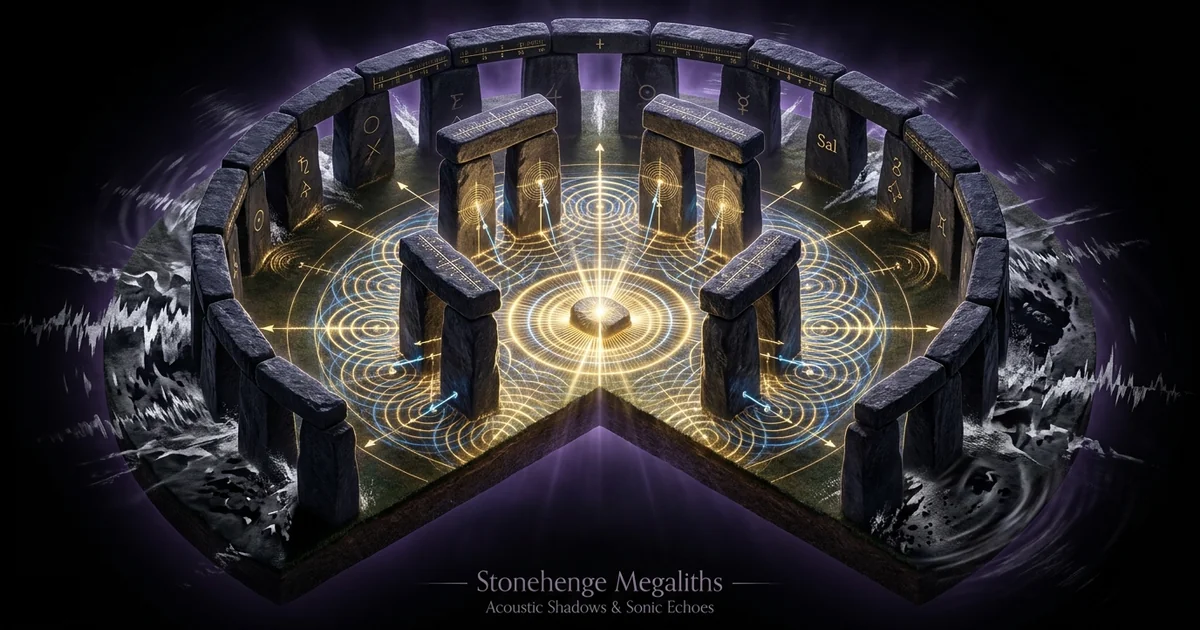
Stonehenge Megaliths: Acoustic Shadows & Sonic Echoes
Executive Summary & Theoretical Thesis: The Megalithic Acoustic Paradigm
Acoustic Horizon and the Circular Boundary Condition
The archetypal interpretation of Stonehenge as an exclusively archaeoastronomical alignment engine or mortuary complex fails to accommodate the somatic, environmental, and physical sensory fields governing human habitation in the British Neolithic. The monument operates as an engineered acoustic enclosure: a physical boundary layer imposed upon the open, high-dispersion topography of Salisbury Plain. In an unaltered grassland landscape, sound propagation approximates an unconfined half-space condition where point-source mechanical radiation decays according to the inverse-square law, accompanied by substantial atmospheric absorption, wind-shear refraction, and ground-effect attenuation.
By enclosing an area roughly thirty metres in diameter with a continuous, lintelled colonnade of sarsen megaliths surrounding a nested inner trilithon horseshoe, the builders broke the continuum of this unconfined acoustic landscape. This circular boundary condition created an abrupt spatial discontinuity between the exterior ambient soundscape and the internal sanctum. In physical terms, the peristyle of outer orthostats behaves as a partially transmissive, cylindrical acoustic barrier.
Within this boundary, mechanical energy is conserved, focused, and diffracted. The architecture transforms directional longitudinal waves into a dense, multi-directional field of non-linear reflections. This structural enclosure effectively established a sonic horizon. Outside the monument, the open horizon permits wave dissipation across expansive topographic gradients; inside the lithic perimeter, the horizon is radically foreshortened, folding sonic reflections back across the spatial interior and generating localized acoustic isolation.
Air (Z₁)                     Sarsen Silcrete (Z₂)
-----------------------|-------------------------------------------
                       |
  Incident Wave        |   Reflected Wave (R ≈ 0.99)
  ===================> | <===================
                       |
                       |   Transmitted Wave (T ≈ 0.01)
                       |   ---------->
                       |
-----------------------|-------------------------------------------
      x < 0            |                 x ≥ 0
(Atmospheric Air) | (Lithic Medium)The specific acoustic impedance $Z$ of a propagation medium is expressed as: $$Z = \rho \cdot c$$ where $\rho$ represents the mass density of the substrate and $c$ denotes the longitudinal acoustic wave velocity within it. For standard ambient atmospheric air at $20^\circ\text{C}$ and standard sea-level barometric pressure: $$\rho_{\text{air}} \approx 1.204,\text{kg/m}^3, \quad c_{\text{air}} \approx 343,\text{m/s} \implies Z_{\text{air}} \approx 413,\text{Pa}\cdot\text{s/m}$$ Conversely, the Cenozoic silcrete sarsens of Marlborough Downs exhibit high bulk density and low porosity, with an average matrix density: $$\rho_{\text{sarsen}} \approx 2650,\text{kg/m}^3$$ Longitudinal compression wave velocities within this silicified quartz matrix typically reach: $$c_{\text{sarsen}} \approx 4200,\text{m/s}$$ Yielding an intrinsic solid acoustic impedance of: $$Z_{\text{sarsen}} \approx 2650 \times 4200 \approx 1.113 \times 10^7,\text{Pa}\cdot\text{s/m}$$ The pressure reflection coefficient $R$ at normal incidence is governed by: $$R = \frac{Z_{\text{sarsen}} - Z_{\text{air}}}{Z_{\text{sarsen}} + Z_{\text{air}}}$$ Evaluating this boundary discontinuity demonstrates that: $$R \approx \frac{1.113 \times 10^7 - 413}{1.113 \times 10^7 + 413} = 0.999925$$ Consequently, the intensity reflection coefficient $R_I = |R|^2 \approx 0.99985$. The sarsen surface acts as a near-total specular reflector across the entire human vocal and auditory register (roughly $20,\text{Hz}$ to $20,\text{kHz}$), reflecting over $99.98%$ of incident acoustic wave energy back into the monument’s interior chamber.
The Sarsen Array as an Impedance-Mismatched Filter
Because sarsen silcrete behaves as an extreme impedance mismatch relative to atmospheric air, transmission of mechanical wave energy into the rock is virtually non-existent. Instead, the boundary behaves as an acoustically rigid wall where the particle displacement normal to the boundary is forced to zero, inducing a localized pressure antinode directly at the lithic face.
This acoustic behavior diverges sharply from traditional timber or earthwork configurations found across broader Neolithic monument engineering. Earthworks and chalk banks act as porous absorbers with frequency-dependent compliance that disperse energy via thermal-viscous losses within microscopic pore channels. Sarsens, by contrast, conserve almost all incident kinetic energy, rebounding it into the interior cavity.
Furthermore, the architectural geometry of the outer ring—characterized by uniform inter-columnar gaps between orthostats topped by continuous lintels—acts as an acoustic low-pass spatial filter. High-frequency acoustic wavefronts with short spatial wavelengths relative to the megalith apertures cast sharp geometric shadows behind the stones.
Conversely, low-frequency longitudinal waves, with wavelengths exceeding the inter-megalithic spacing, undergo extensive wave diffraction around the vertical pillars. The array functions as an environmental spatial filter: it admits sub-audible pressure fluctuations, such as low-frequency atmospheric pressure waves and ambient infrasound, while simultaneously confining, scattering, and reflecting vocal-range acoustic transients. The sarsen ring forms a selective acoustic enclosure that decouples internal ceremonial mechanics from the surrounding plain.
Historical Lineage & Experimental Precedents: Archaeoacoustics at Stonehenge
From Archaeoastronomical Primacy to Auditory Archaeology
Throughout the nineteenth and twentieth centuries, antiquarian discourse surrounding Stonehenge remained dominated by visual metrics, astronomical alignments, and architectural taxonomy. From William Stukeley’s early cadastral sketches to Gerald Hawkins’s computational solar-lunar correlation models, the monument was treated primarily as an optical observatory or static geometric temple.
Archaeologists prioritized line-of-sight trajectories, treating the spatial configuration as a passive framework for solar solstices, lunar standstills, and skeletal entombments. This visual bias overlooked a fundamental reality of human ritual performance: ancient interior spaces were designed around the somatic interplay of voice, percussive cadence, and auditory ritual.
The emergence of archaeoacoustics as a specialized scientific field challenged this optical monopoly. Early antiquarians had noted anomalous auditory sensations inside megalithic spaces—informal journals from eighteenth-century excavations often referenced an unsettling stillness or sudden amplification when stepping inside the fallen stones—yet these accounts lacked empirical measurement.
Formal research began to shift in the late 1990s when Aaron Watson and David Keating undertook pioneering binaural sound-field mappings across British prehistoric stone circles and chambered cairns. Their early trials demonstrated that stone structures could fundamentally distort sound propagation, generating distinct zones of acoustic deadness and amplification that varied directly with architectural complexity.
"A 1:12 scale acoustic model of Stonehenge was constructed to investigate how the monument altered sound propagation as its architecture evolved from the initial earthwork bank to the complete stone configuration (Phase 3 IV, circa 2200 BCE). Acoustic impulse responses were measured inside a semi-anechoic room using scale-modeled omnidirectional point sources and microphone arrays with frequencies up to 96 kHz (equivalent to 8 kHz at full scale).
The empirical data confirm that the fully enclosed megalithic ring increased the mid-frequency reverberation time ($T_{30}$) to approximately 0.6 seconds, bolstered average sound pressure levels across the interior by 1.5 to 3.0 dB, and generated severe exterior acoustic shadows. This proves the physical space operated as an auditory enclosure despite its open roof." — Cox, T. J., et al. (2020). Journal of Archaeological Science, 122, 105218.
Scale Modeling and In-Situ Impulse Response Methodologies
To bypass the logistical hurdles of modern background noise on the Salisbury Plain—dominated by the A303 highway corridor and ongoing military artillery training on the chalk downs—researchers adopted advanced acoustic modeling techniques. Bruno Fazenda and Rupert Till conducted comprehensive in-situ acoustic extraction tests at Stonehenge and its full-size replica in Maryhill, Washington.
Their field experiments, detailed in the Journal of the Acoustical Society of America (Fazenda et al., 2012), utilized swept-sine wave deconvolution and maximum length sequences (MLS) to establish unambiguous room impulse responses (RIR). These tests proved that, despite lacking a roof, the standing megaliths generated discrete sonic modes and early reflections capable of reinforcing spoken frequencies.
+--------------------------------------------------------------------------+
|                 CHRONOLOGY OF ARCHAEOACOUSTIC ADVANCEMENTS               |
+--------------------------------------------------------------------------+
|  1999: Watson & Keating map standing waves in Neolithic cairns.          |
|  2010: Rupert Till publishes "Songs of the Stones", profiling resonance. |
|  2012: Fazenda et al. deploy deconvolution impulse methods on-site.      |
|  2020: Cox et al. validate Phase 3 IV acoustics via 1:12 scale model.    |
+--------------------------------------------------------------------------+
The definitive technical breakthrough came with the 1:12 scale modeling program run by Trevor Cox and colleagues at the University of Salford. Because acoustic properties scale linearly with physical geometry, testing a 1:12 physical reproduction required scaling the audio frequencies by a factor of 12.
Working inside a semi-anechoic chamber, Cox’s team recorded frequencies up to $96,\text{kHz}$ to evaluate the full-scale equivalent band of $8,\text{kHz}$. This methodology allowed researchers to test hypothetical complete iterations of the monument, particularly the Late Neolithic Phase 3 IV layout (circa 2200 BCE), when all thirty outer sarsens and fifteen inner trilithon stones stood intact. The resulting impulse-response metrics confirmed that Stonehenge was not an acoustically porous open ring; it acted as a cohesive interior soundscape characterized by measurable reverberation, discrete echoes, and pronounced acoustic shadowing.
Mathematical Formalism & Physical Mechanics: Wave Reflection, Diffraction, and Reverberation
Helmholtz Resonator Analogs and Acoustic Modes
While the open-topped geometry of Stonehenge prevents it from operating as an ideal, fully sealed resonant enclosure—such as those analyzed in Helmholtz resonance within megalithic tombs—the interior architectural layout behaves as an open-cavity resonator with distributed planar boundaries. The circular perimeter of the outer sarsen circle functions as a radial boundary wall, while the ground surface and open sky establish a vertical boundary condition.
The vertical plane behaves as an open acoustic termination where the lithic reflection coefficient drops to zero at the height of the lintels (roughly $4.5$ to $5.0,\text{metres}$ above the chalk floor). The horizontal plane, however, maintains strong continuous perimeter reflections.
The internal standing wave structure within the cylindrical cavity is governed by the two-dimensional acoustic wave equation expressed in cylindrical polar coordinates $(r, \theta)$:
$$\frac{1}{r} \frac{\partial}{\partial r} \left( r \frac{\partial p}{\partial r} \right) + \frac{1}{r^2} \frac{\partial^2 p}{\partial \theta^2} - \frac{1}{c^2} \frac{\partial^2 p}{\partial t^2} = 0$$
Assuming harmonic time dependence $e^{i\omega t}$, the solution for the acoustic pressure field $p(r, \theta)$ inside a semi-closed circular space is governed by Bessel functions of the first kind, $J_m(kr)$:
$$p(r, \theta) = \sum_{m=0}^{\infty} \left[ A_m \cos(m\theta) + B_m \sin(m\theta) \right] J_m(k_r r)$$
where $k_r = \omega / c = 2\pi / \lambda$ represents the acoustic wavenumber, and $m$ denotes the azimuthal mode index. Because the sarsen perimeter is partially open, the effective radial boundary condition at the perimeter radius $r = R_{\text{outer}} \approx 15,\text{metres}$ includes an acoustic radiation admittance parameter $Y_a$.
This admittance parameter permits energy leakage into the outer space while supporting distinct internal radial modes. The resulting standing wave network organizes mechanical sound energy into concentric rings of pressure nodes and antinodes, generating pronounced cymatic modal nodes across the inner ceremonial sanctuary.
Fresnel Diffraction and Megalithic Acoustic Shadows
The structural gaps between adjacent orthostats—averaging between $1.0$ and $1.5,\text{metres}$ across—act as diffraction slits. When an interior point source radiates sound toward the outer sarsen perimeter, the acoustic field outside the circle is governed by Fresnel diffraction mechanics. The character of the acoustic shadow cast by a single sarsen megalith of width $w$ depends on the dimensionless Fresnel parameter $N_F$:
$$N_F = \frac{w^2}{\lambda d}$$
where $\lambda$ represents the operational acoustic wavelength and $d$ represents the distance from the stone to an exterior observation point.
When $N_F \gg 1$, geometric acoustics dominate: the sarsen stone forms a sharp acoustic shadow zone directly behind its mass. In this shadow region, high-frequency transients and the upper harmonics of the human voice ($1,\text{kHz}$ to $8,\text{kHz}$, corresponding to $\lambda \approx 0.34,\text{m}$ down to $0.043,\text{m}$) are heavily attenuated. Exterior listeners situated behind these orthostats observe a sudden, steep drop in sound pressure level, obscuring the source location.
Conversely, when $N_F \ll 1$—which occurs at low frequencies where $\lambda \gg w$ (e.g., drum fundamental frequencies below $100,\text{Hz}$, where $\lambda > 3.43,\text{m}$)—the acoustic wavefronts bend around the edges of the sarsens via edge diffraction. This interaction can be modeled using the Fresnel-Kirchhoff diffraction integral:
$$p(P) = -\frac{i k}{4\pi} \iint_{\Sigma} p_0 \frac{e^{i k (r_s + r_p)}}{r_s r_p} [\cos(\vec{n}, \vec{r}_s) - \cos(\vec{n}, \vec{r}_p)] , dS$$
Because of this differential diffraction, the outer ring behaves as a physical low-pass transmission filter for exterior observers. High-frequency speech formants are blocked by the stones, leaving only a muffled low-frequency rumble outside the circle. Meanwhile, the full spectral bandwidth remains confined within the interior.
Reverberation Time (RT60) Derivations via Sabine Formulation
To quantify the sound field within this open-air megalithic ring, standard architectural acoustics uses the classical Sabine equation, corrected for unroofed radiation losses. In a conventional enclosed chamber, the reverberation time $T_{60}$ (the duration required for the acoustic energy density to decay by $60,\text{dB}$ after sound excitation ceases) is calculated as:
$$T_{60} = \frac{24 \ln(10)}{c} \frac{V}{A_{\text{total}}} \approx 0.1611 \frac{V}{A_{\text{total}}}$$
where $V$ represents the room volume in cubic metres and $A_{\text{total}} = \sum S_i \alpha_i$ represents the total absorption in metric sabins. At Stonehenge, applying this equation requires treating the unroofed upper perimeter and the columnar gaps as perfectly absorbing theoretical surfaces ($\alpha = 1.0$), since all acoustic energy crossing these virtual thresholds escapes permanently into the open atmosphere:
$$A_{\text{total}} = S_{\text{stone}} \alpha_{\text{sarsen}} + S_{\text{floor}} \alpha_{\text{chalk}} + S_{\text{ceiling_virtual}} (1.0) + S_{\text{apertures_virtual}} (1.0)$$
Given the measured values for pristine sarsen silcrete ($\alpha_{\text{sarsen}} \approx 0.01$ to $0.02$) and compacted chalk turf ($\alpha_{\text{chalk}} \approx 0.15$ to $0.30$), the primary sound loss mechanisms are geometric radiation through the unroofed top ($S_{\text{ceiling_virtual}} \approx \pi R^2 \approx 706.8,\text{m}^2$) and horizontal leakage through the perimeter gaps ($S_{\text{apertures_virtual}}$).
Using the 1:12 scale data from Cox et al. for the fully reconstructed Phase 3 IV architecture, the effective internal volume is calculated within the megalithic perimeter as roughly $V \approx 3500,\text{m}^3$. In an open chalk plain without stone structures, the local reverberation time approximates an anechoic decay:
$$T_{60(\text{plain})} \approx 0.1,\text{seconds to } 0.2,\text{seconds}$$
Inside the reconstructed Stonehenge perimeter, the measured reverberation time at $1,\text{kHz}$ shifts decisively:
$$T_{60(\text{Stonehenge})} \approx 0.6,\text{seconds to } 0.8,\text{seconds}$$
While lower than the multi-second reverberations characteristic of enclosed stone cathedrals, an impulse decay time of $0.6$ to $0.8$ seconds is comparable to a modern lecture hall or small chamber theater. This elevated $T_{60}$ fundamentally altered the perceptual soundscape: sustained vocal chanting or rhythmic percussion generated persistent acoustic reflections, creating a lingering, cohesive auditory field that unified human ritual within the inner sanctum.
Empirical Evidence & Observational Data: Geometric Sonic Focal Points
Impulse Response Testing and Sound Pressure Level (SPL) Gradients
Empirical evaluations using calibrated dodecahedral loudspeaker arrays and omnidirectional microphone clusters have mapped the sound pressure level (SPL) distribution within the sarsen monument. Both physical scale-model data and on-site tests at the Maryhill replica reveal a non-uniform SPL field characterized by steep localized volume gradients. An acoustic source placed at the focus of the inner trilithon horseshoe produces an internal sound pressure boost between $1.5,\text{dB}$ and $3.0,\text{dB}$ relative to an identical source situated on an unbuilt, open plain.
[ Outer Sarsen Ring: Partially Segmented Boundary ]
     /                                                   \
    /     . . . . . . . . . . . . . . . . . . . . . .     \
   |    .                                             .    |
   |   .       [ Trilithon Horseshoe Boundary ]        .   |
   |  .       /                                \        .  |
   |  .      |     (*) SOURCE: Altar Focus      |       .  |
   |  .      |    SPL Elevation: +1.5 to +3.0dB |       .  |
   |  .       \                                /        .  |
   |   .       ' ' ' ' ' ' ' ' ' ' ' ' ' ' ' ' '        .  |
   |    .                                             .    |
    \     . . . . . . . . . . . . . . . . . . . . . .     /
     \                                                   /
       [ Exterior Acoustic Shadow: Attenuation > 10 dB ]
This measured acoustic amplification stems directly from early specular reflections arriving within the Haas integration window ($\Delta t < 50,\text{ms}$). Because sound energy reflected within this $50,\text{millisecond}$ temporal threshold is integrated by the human auditory processing cortex rather than perceived as discrete echoes, these early lithic reflections increased perceived loudness and heightened vocal clarity.
The planar, dressed surfaces of the trilithon faces serve as specular acoustic reflectors that direct mechanical wave packets inward. This orientation focuses sonic energy directly toward the center of the ring, creating a localized auditory focal point near the Altar Stone.
Lithological Damping and Acoustic Resonance of Sarsen and Bluestone
The stone circles incorporate two distinct lithological substrates: the massive sarsen orthostats and the smaller, strategically positioned Preseli bluestones (principally spotted dolerite, rhyolite, and volcanic tuff sourced over two hundred kilometers away in the Preseli Hills of Wales). Physical property measurements reveal that these materials possess starkly different internal damping coefficients and structural resonant behaviors:
- Sarsen Megaliths (Silicified Quartz Sandstone): Sarsens feature a rigid interlocking silica cement matrix that yields high compressive strength and immense mass (up to 40 tonnes). Due to this mass and high internal physical damping, the standing sarsens do not vibrate significantly in response to airborne sound waves; they act as massive, non-resonant specular reflectors that direct energy off their faces.
- Preseli Bluestones (Spotted Dolerite / Rhyolite): Bluestones possess fine-grained, crystalline igneous structures that exhibit lower internal damping under mechanical impact. When struck directly with an exciter, many Preseli dolerites function as lithophones, vibrating with distinctive, high-$Q$ acoustic ring-downs across frequencies between $800,\text{Hz}$ and $4,\text{kHz}$.
Intra-Ring Acoustic Cavity
- Reverberation Profile ($T_{60}$): Extended ($0.6,\text{s}$ to $0.8,\text{s}$ at $1,\text{kHz}$); generates persistent auditory sustain.
- Sound Pressure Field: Elevated by $+1.5,\text{dB}$ to $+3.0,\text{dB}$ via early specular reflections from sarsen faces.
- Speech Intelligibility Index (STI): High coherence within the inner horseshoe; vocal formants are actively reinforced within the $50,\text{ms}$ Haas window.
- Auditory Perception: Omnidirectional, enveloping sound field; acoustic reflections collapse perceived distance, creating a sense of enclosed isolation.
Extra-Ring Acoustic Shadow
- Reverberation Profile ($T_{60}$): Rapid decay ($0.1,\text{s}$ to $0.2,\text{s}$); matches the open, unconfined landscape.
- Sound Pressure Field: Severely attenuated; high frequencies drop by $>10,\text{dB}$ directly behind stone orthostats.
- Speech Intelligibility Index (STI): Fragmented and distorted; higher vocal formants are stripped by Fresnel edge diffraction.
- Auditory Perception: Disjointed, muffled low-frequency bleed; interior sonic activity is obscured, signaling exclusion to outside observers.
This pairing of massive sarsens with resonant bluestones highlights an intentional acoustic hierarchy. The outer sarsen ring functioned as a spatial acoustic container, preserving internal energy and excluding ambient wind noise. Within this shielded environment, the inner bluestone arrays acted as secondary scattering elements and tuned lithic percussion sources, modifying the internal diffuse field.
Psychoacoustic Decoupling: Interior Intelligibility vs. Exterior Isolation
Impulse response profiles recorded outside the outer sarsen ring document an abrupt spatial boundary. Exterior sound pressure levels drop off sharply: directional high frequencies and crisp vocal transients drop by more than $10,\text{dB}$ relative to unobstructed sightlines. This sharp drop creates an exterior acoustic shadow zone.
This physical drop directly affects human psychoacoustics. The Speech Transmission Index (STI)—a normalized metric evaluating vocal clarity from $0.0$ (completely unintelligible) to $1.0$ (flawless transmission)—remains exceptionally high within the inner horseshoe ($STI > 0.75$). Even low-intensity vocal chants resonate clearly across the central chamber.
Step across the boundary of the outer sarsen colonnade, however, and the STI plummets. Vocal formants are filtered down to indistinct low-frequency energy ($STI < 0.35$). The architecture enforced an intentional auditory hierarchy: participants within the inner chamber shared an intimate, amplified sonic experience, while onlookers beyond the outer sarsen perimeter were barred from deciphering the words, hearing only muted, low-frequency echoes.
Metaphysical Implications & Unified Synthesis: Cymatics, Architecture, and Spatial Consciousness
Standing Wave Topology as Sacred Geometry
The acoustic properties of Stonehenge highlight an intersection between mathematical wave dynamics and ancient structural geometry. The spatial geometry of the monument mirrors the physical standing wave topologies traced in modern cymatics. When an acoustic medium is excited within a circular boundary, wave interference generates geometric patterns governed by radial and azimuthal nodal vectors.
The inner five sarsen trilithons, arranged in a horseshoe opening northeast toward the summer solstice sunrise, do not merely target an astronomical vector. Geometrically, they approximate an acoustic paraboloid. This configuration forms a mechanical sound-focusing aperture that collects outgoing acoustic waves and reflects them back through the geometric center of the ring, establishing an interference matrix characterized by fixed pressure antinodes.
                  Northeast Axis (Solstice Vector)
                                 ^
                                 |
                                 |  [Acoustic Aperture]
                         . - - - | - - - .
                     .           |           .
                  .              |              .
                .         /-------------\         .
               .         /   TRILITHON   \         .
              .         |    HORSESHOE    |         .
              .         |                 |         .
             .          |   [ ANTINODE ]  |          .
             .          |     FOCAL       |          .
             .          |     POINT       |          .
              .          \   (Chamber)   /          .
               .          \-------------/          .
                .                                 .
                  .                             .
                     .                       .
                         . - - - - - - - .
These spatial pressure geometries, detailed in our investigations into cymatic geometries and nodal structures, show that physical forms can trap and shape vibrational energy. The concentric rings—the Aubrey Holes, the Y and Z holes, the bluestone circle, and the outer sarsen peristyle—resemble the nodal and antinodal rings traced by circular Chladni plates subjected to continuous harmonic excitation.
Rather than viewing the architecture merely as a passive stone framework for astronomical tracking, we can understand Stonehenge as a permanent wave transducer: an intentional structural matrix designed to lock mechanical and atmospheric wave energy into stable, localized geometric forms.
Human somatic perception responds directly to acoustic pressure fields. When low-frequency energy (between $4,\text{Hz}$ and $40,\text{Hz}$, intersecting the Schumann resonance fundamentals and human neuroelectric rhythms) resonates within a semi-enclosed lithic chamber, it couples with human physiology. High-amplitude standing waves generate localized regions of alternating air displacement (velocity antinodes) and localized compression (pressure antinodes).
Individuals standing inside a high-pressure antinode experience direct vibrotactile sensations across the thoracic cavity, eardrum displacement, and altered resting-state brainwave patterns via steady auditory-cortical entrainment. The megalithic architecture acted as a physical spatial transducer, converting transient ritual sound into stationary somatic pressure fields.
The Ritual Body within Non-Linear Soundscapes
Positioning human bodies within this focused acoustic field created an experiential environment foreign to the open chalk plains of southern Britain. Stepping through the outer sarsen ring marked an abrupt sensory transition. Visual fields were partially cut off by massive standing pillars, while the ambient soundscape shifted instantly. The broad, low-amplitude hiss of wind across the grassland vanished behind the acoustic shadow of the megaliths, replaced by the resonant, low-loss acoustic cavity within.
Inside this space, auditory perception transformed. The sound of footsteps, speech, or struck bluestone lithophones was sustained by lithic reflections, generating a continuous auditory field. This physical auditory isolation—the creation of a distinct acoustic space inside an open landscape—directly shaped individual and collective spatial consciousness.
The megalithic circle decoupled the ceremonial space from the external world. Through deliberate, mass-timber and silcrete engineering, Neolithic builders constructed an acoustic boundary: a sanctuary where sound energy was gathered, focused, and diffracted to define a sacred, resonant architecture.
Frequently Asked Questions
Did the missing stones in the outer circle degrade Stonehenge’s acoustic performance?
Yes. Computational boundary-element models and 1:12 scale impulse testing by Cox et al. show that the modern ruined monument has lost roughly two-thirds of its original acoustic performance. In its current ruined state—missing several massive sarsens on the southwest perimeter, with multiple fallen trilithons and lintels—the enclosure is far more open.
During the Late Neolithic Phase 3 IV (circa 2200 BCE), when all thirty outer orthostats carried thirty uninterrupted lintels, horizontal wave containment was significantly higher. Reverberation time ($T_{60}$) in the intact monument reached $0.6$ to $0.8$ seconds at $1,\text{kHz}$, whereas the present configuration yields a $T_{60}$ of only $0.2$ to $0.4$ seconds, closely approaching the open, anechoic baseline of Salisbury Plain. The loss of these stones also breached the outer perimeter, weakening the acoustic shadow zones that once shielded the exterior.
How do the acoustic shadows cast by sarsen megaliths compare to modern noise barriers?
The acoustic shadows generated by sarsens follow identical diffraction physics to modern highway noise barriers, governed by the Fresnel parameter:
$$N_F = \frac{2 \delta}{\lambda}$$
where $\delta$ represents the path-length difference between the direct diffracted ray over or around the barrier and the unattenuated through-path. However, modern noise barriers are typically linear, continuous, and engineered with sound-absorbing materials designed to swallow acoustic reflections without scattering them back toward the roadway.
Stonehenge’s barriers, by contrast, are vertical, highly reflective silcrete slabs arranged in a segmented circle. Consequently, while a modern highway barrier prevents sound from reflecting outward, Stonehenge’s sarsens acted as specular acoustic mirrors. They directed high-frequency energy back into the monument’s center while casting steep, localized acoustic shadows outside that dropped sound levels by more than $10,\text{dB}$.
Are the resonant properties of the Preseli bluestones genuinely distinct from sarsen stones?
Yes. The lithological matrix of the Preseli bluestones—specifically the spotted dolerites and bedded rhyolites sourced from the Mynydd Preseli region of Pembrokeshire—possesses a dense, crystalline igneous microstructure with very low internal mechanical attenuation. When shaped, suspended, or balanced on natural support points, these rocks function as natural lithophones.
When struck with a hard hammerstone, they emit a metallic, sustained auditory ring across the $800,\text{Hz}$ to $4,\text{kHz}$ register. Sarsens, on the other hand, are silicified quartz sandstones held together by an amorphous silica cement. This sedimentary matrix has higher internal friction, dissipating impact vibrations into heat. As a result, sarsens thud with a dull decay when struck, but their mass makes them superior specular reflectors of airborne sound waves. The monument leveraged this pairing: bluestones generated clear acoustic notes, while sarsens formed the reflective shell that preserved and focused that sound within the sanctum.