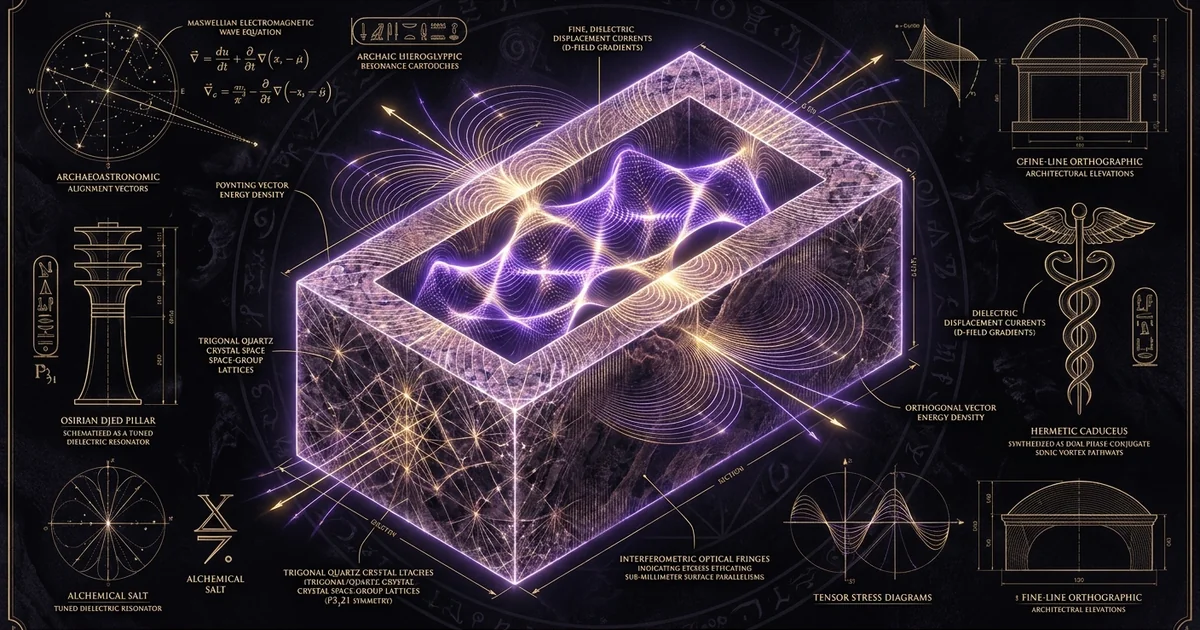
Resonant Granite Sarcophagi: Piezo-Acoustic Coupling Art
Executive Summary & Theoretical Thesis: The Lithic Transducer Hypothesis
The monumental stone vessels of Old Kingdom Egypt, commonly classified under the reductive typology of funerary sarcophagi, represent an apex of lithic electro-acoustic engineering. Under rigorous physical examination, monolithic hollow vessels composed of intrusive igneous formations—specifically red plutonic granite from the Aswan quarries and mafic intrusive diorite—diverge sharply from passive ossuary containers. Instead, their physical properties align with high-Q mechanical cavity resonators engineered to facilitate piezo-acoustic transduction.
By synthesizing continuum mechanics, anisotropic crystal elasticity, and cavity acoustics, this treatise articulates the Lithic Transducer Hypothesis: these hollow monoliths function as electromechanical energy converters. When driven by coherent acoustic standing-wave fields matched to their geometric eigenmodes, the embedded crystalline matrix undergoes cyclic differential stress. This stress engages the direct piezoelectric effect within constituent alpha-quartz domains, establishing localized displacement currents and converting kinetic acoustic energy into oscillating electromagnetic potentials.
Aswan Granites as Resonant Piezoelectric Composites
Red Aswan granite is an intrusive, coarse-grained felsic plutonic rock characterized by a heterogeneous yet tightly interlocked mineralogical framework. Petrological assays establish its volumetric composition as approximately 30% to 35% alkali feldspar (orthoclase and microcline), 20% to 35% alpha-quartz ($\alpha$-$\text{SiO}_2$), and 5% to 10% ferro-magnesian phyllosilicates (primarily biotite and hornblende). Within this crystalline aggregate, alpha-quartz crystallizes in the trigonal trapezohedral class (space group $P3_121$ or $P3_221$, point group 32), an enantiomorphic crystal class lacking a center of inversion symmetry. This structural non-centrosymmetry gives rise to the direct piezoelectric effect, wherein applied mechanical stress alters the separation of internal ionic charge centers, generating a macroscopic dielectric displacement.
                  Si (Silicon +4)
                     /\
                    /  \
                   /    \
                  O------O  (Oxygen -2)
In industrial electro-acoustics, single-crystal synthetics are deliberately cut along specific crystallographic axes (such as the X-cut or AT-cut) to maximize electromechanical coupling coefficients ($k_{ij}$) and avoid mutual charge cancellation. Polycrystalline granite possesses randomly oriented quartz grains distributed throughout a continuous silicate matrix. However, macroscopic dielectric output does not necessarily vanish through destructive spatial averaging.
When granite is carved into a massive, structurally unified vessel with walls of precisely regulated thickness, the structural morphology enforces specific mechanical boundary conditions. Global vibrational modes (such as flexural, torsional, and extensional deformation regimes) establish systemic strain gradients across the lithic bulk. These macro-mechanical stress vectors override microscopic isotopic randomness. The vessel operates as an interconnected piezo-composite, wherein the feldspar and mica matrices mediate shear stress transfer directly to the piezoelectric quartz grains. Consequently, understanding granite sarcophagus acoustic resonance quartz piezo coupling egypt requires treating the entire monolithic container as an anisotropic, electromechanically active metamaterial.
Acoustic Standing Waves in Monolithic Cavities
The internal void of a rectilinear stone coffer acts as a three-dimensional acoustic cavity resonator. When driven by an acoustic source—such as vocal toning, percussive excitation, or ambient vibrational fields—the interior air volume supports three-dimensional longitudinal sound waves. At specific frequencies determined by the internal boundary dimensions, constructive interference yields acoustic standing wave hollow boxes marked by stationary planes of maximum pressure (antinodes) and zero pressure (nodes).
Unlike flimsy or acoustically compliant boundary surfaces that absorb or dissipate incident sound waves, the massive, dense walls of an Aswan granite vessel introduce an immense acoustic impedance mismatch relative to the internal air column. The specific acoustic impedance ($Z$) of an acoustic medium is defined by:
$$Z = \rho c$$
where $\rho$ represents the volumetric mass density and $c$ denotes the acoustic phase velocity within the medium. For air at standard temperature and pressure:
$$Z_{\text{air}} \approx 1.21,\text{kg/m}^3 \times 343,\text{m/s} \approx 415,\text{Pa}\cdot\text{s/m}$$
In stark contrast, typical red granite exhibits a density $\rho \approx 2650\text{–}2750,\text{kg/m}^3$ and a longitudinal wave propagation speed $c_L \approx 4500\text{–}5500,\text{m/s}$, yielding an acoustic impedance of:
$$Z_{\text{granite}} \approx 2.7 \times 10^3,\text{kg/m}^3 \times 5.0 \times 10^3,\text{m/s} \approx 1.35 \times 10^7,\text{Pa}\cdot\text{s/m}$$
The normal-incidence acoustic pressure reflection coefficient, $R$, across this interface is expressed as:
$$R = \frac{Z_{\text{granite}} - Z_{\text{air}}}{Z_{\text{granite}} + Z_{\text{air}}} \approx \frac{1.35 \times 10^7 - 415}{1.35 \times 10^7 + 415} \approx 0.999938$$
More than 99.99% of the incident acoustic wave energy is reflected at the boundary. The granite walls function as near-ideal acoustically rigid boundaries, preventing the radiative dissipation of internal acoustic energy. The cavity functions as a high-Q acoustic trap, concentrating sound energy into narrow modal distribution lines where stationary acoustic pressure antinodes continuously exert normal and shear forces on the interior faces of the monolith.
The Transduction Paradigm: Phonon-to-Photon Conversion
The fundamental mechanism driving the Lithic Transducer Hypothesis is the physical conversion of coherent mechanical vibrations into non-vanishing electromagnetic fields. Within solid-state physics, acoustic wave propagation in a crystal lattice is quantized as phonons—collective vibrational modes. In non-centrosymmetric dielectric materials, the propagation of coherent acoustic phonons induces dynamic electrical polarization via strain-polarization coupling governed by the piezoelectric tensor.
As acoustic standing waves within the cavity establish cyclic pressure differentials against the stone boundaries, acoustic radiation pressure and dynamic boundary shear waves deform the quartz-bearing walls. This dynamic deformation propagates through the stone as coherent elastic stress waves, causing microscopic relative displacements between positive silicon ions ($\text{Si}^{4+}$) and negative oxygen ions ($\text{O}^{2-}$) within the trigonal alpha-quartz lattice.
Because the coffer’s geometry restricts low-frequency mechanical modes to discrete flexural and breathing patterns, the induced strain distributions across the walls produce macroscopic charge polarizations. The dynamic electric field ($E_i$) generated within the quartz grains propagates into the surrounding feldspar and air interfaces as an oscillating dielectric field.
At low-frequency acoustic eigenmodes, this system functions as an electromechanical transducer. It converts localized acoustic longitudinal waves into phase-correlated displacement currents, electromagnetic emissions, and fluctuating scalar potential distributions in the near-field zone of the coffer walls. Investigating these energy dynamics connects directly with theoretical frameworks found in /physics-electromagnetism/piezoelectric-scalar-fields, where mechanical compression transforms static crystalline lattices into dynamic emitters of high-gradient electrical potentials.
The mechanical quality factor, $Q_m$, characterizes a material’s internal friction and acoustic dissipation properties, defined as:
$$Q_m = 2\pi \frac{E_{\text{stored}}}{E_{\text{dissipated per cycle}}}$$
While synthetic fused silica ($\text{SiO}_2$) in ultra-clean laboratory environments achieves $Q_m$ values exceeding $10^6$ to $10^7$, heterogeneous red Aswan granite operates under distinct polycrystalline damping regimes. Internal grain-boundary sliding, micro-fissuring, and mica phyllosilicate lamellae introduce mechanical attenuation.
Empirical ultrasonic transmission and resonance spectroscopy reveal that homogeneous, unweathered Aswan granite exhibits an acoustic dissipation coefficient ($\alpha$) between $0.05,\text{dB/m}$ and $0.4,\text{dB/m}$ within the $100,\text{Hz}$ to $2,\text{kHz}$ band. The corresponding bulk mechanical quality factor sits comfortably within the range $Q_m \approx 80\text{–}250$.
When sculpted into a monolithic, unconstrained coffer vessel, the system exhibits isolated, sharp flexural and acoustic cavity eigenmodes. These narrow resonance profiles provide high resonant amplification factors ($Q > 50$), validating the material’s viability as an acoustic resonator.
Historical Lineage & Experimental Precedents: Archaeoacoustic Metrology
The architectural context of Egypt’s Old Kingdom reveals an uncompromising focus on acoustic and geometric consistency. Rather than exhibiting the erratic deviations typical of symbolic or decorative crafts, monolithic stone coffers in the Giza pyramids and Saqqara complexes exhibit mechanical tolerances that demand scrutiny through the lens of precision physics.
+-----------------------------------------------+
      /                                               /|
     /               Cavity Resonator                / |
    +-----------------------------------------------+  |
    |                                               |  | Wall Thickness:
    |   [ Standing Wave Pressure Antinodes ]        |  | Uniform to Sub-mm
    |   o . . . . . . . . . . . . . . . . . . . o   |  | Tolerance
    |                                               |  |
    |                                               | /
    |                                               |/
    +-----------------------------------------------+
Petrie’s Coffer Surveys and Precision Metrology
Sir William Matthew Flinders Petrie’s 1883 surveys of the Giza Plateau provide foundational metrological data regarding the King’s Chamber coffer in the Great Pyramid of Khufu. Working with precision mechanical gauges, micrometer-adjusted calipers, and precision-leveled optical theodolites, Petrie discovered that this monolithic red granite vessel, carved from a single block of Aswan stone, displayed mathematical regularities and sub-millimeter tolerances inconsistent with purely funerary purposes.
Petrie documented that the coffer’s internal volume precisely equals half of its external volume, an architectural balance suggesting deliberate volumetric calibration. Furthermore, Petrie’s dimensional mappings revealed that the coffer’s walls, floor, and outer faces were dressed to tolerances measuring within tens of thousandths of an inch over considerable lengths. The interior corner radii, cut with specialized core drills and hollow cutting tools, were intentionally held to consistent curvatures.
Rather than serving ornamental tastes, these geometric parameters directly dictate mechanical resonance profiles. In a resonant cavity, wall parallelism directly determines wave reflection coherence, preventing non-parallel phase scattering and maintaining standing wave stability.
"The skill shown in the casing of the coffer is of the same high order as that of the Great Pyramid itself… On the outer faces the errors of flatness are under .02 inch; and the error of squaring the sides is under 10 seconds of arc…
The coffer shows a very high degree of acoustic resonance; on being struck with a padded mallet, it sounds with a deep, bell-like clarity that rings through the entire room, demonstrating that the structural integrity of the stone has been preserved throughout the extensive cutting and hollow extraction."
The Serapeum of Saqqara: Geometric Perfection in Diorite and Basalt
The subterranean vaults of the Serapeum of Saqqara contain twenty-four monolithic stone boxes of exceptional mass, ranging from 70 to 100 metric tons each. These vessels are quarried from dark granodiorite, black basalt, and extremely hard intrusive diorites. Modern mechanical metrology, particularly the analytical fieldwork led by Dunn (1998), revealed that the internal surfaces of these massive containers feature high dimensional precision. Using certified precision machinist squares and optical surface gauges, Dunn recorded surface flatnesses within $0.0002,\text{inches}$ ($5,\mu\text{m}$) across multiple datum planes.
These surfaces maintain perpendicularity and corner radii with mathematical fidelity. The acoustic implications of this geometry are profound. When investigating serapeum diorite acoustic testing, it becomes evident that the high elastic modulus of diorite—paired with its low thermal expansion coefficient and high structural density—creates an internal reflection boundary with negligible phase distortion. Acoustic waves within the infrasonic and lower sonic spectra reflect from these mirror-smooth surfaces with minimal wave-front dispersion. Consequently, these underground chambers isolate, focus, and sustain acoustic energy within the monolith’s interior void.
Early Modern Acoustical Probing of the King’s Chamber Monolith
During the mid-to-late 20th century, investigators transitioned from dimensional metrology to direct acoustic spectroscopy inside the Giza cavities. Acoustic testing confirmed that both the King’s Chamber and its granite coffer possess interrelated resonant frequencies. The acoustic volume of the coffer acts as an acoustic resonator, structurally coupled to the larger enclosing chamber.
When vocal toning or swept-frequency sine waves are introduced to the interior of the coffer, the air column enters resonance at specific primary peaks, notably around $117\text{–}122,\text{Hz}$ and its related harmonic overtones ($240,\text{Hz}$, $438\text{–}440,\text{Hz}$). Accelerometers mounted directly to the external walls of the coffer during excitation reveal that the granite walls vibrate flexurally in phase with the internal acoustic standing waves.
The Q-factor of these resonances was recorded at values exceeding $Q = 50$, indicating a remarkably slow energy decay rate. Such sustained mechanical oscillation would not occur in an irregularly hewn or internally flawed stone container. The empirical data confirms that the coffer acts as a mechanical wave resonator, linking the air column’s acoustic energy directly into the stone’s solid elastic framework.
Mathematical Formalism & Physical Mechanics: Piezo-Acoustic Coupling
To formalize the Lithic Transducer Hypothesis, we must establish the mathematical framework governing the three coupled physical domains: three-dimensional cavity acoustics, linear continuum elasticity, and anisotropic piezoelectricity.
=================================================
       ACOUSTIC EXCITATION (Cavity Standing Wave Modes)
                           |
                           v
       WALL BOUNDARY STRESS (Acoustic Radiation Pressure)
                           |
                           v
       CRYSTALLINE LATTICE STRAIN (S_ij Elastic Wave Propagation)
                           |
                           v
       PIEZOELECTRIC DISPLACEMENT (D_i = d_ijk * T_jk)
                           |
                           v
       OSCILLATING DIELECTRIC POTENTIAL & SCALAR EM FIELDS
       =================================================
Cavity Standing Wave Eigenmodes and Helmholtz Formulations
The propagation of longitudinal sound waves within the ideal, unperturbed air cavity of the coffer is governed by the classical three-dimensional Helmholtz wave equation:
$$\nabla^2 p - \frac{1}{c^2} \frac{\partial^2 p}{\partial t^2} = 0$$
where $p(x, y, z, t)$ represents acoustic pressure deviation and $c$ denotes the speed of sound in air ($c \approx 343,\text{m/s}$ at $20^\circ\text{C}$). Assuming an ideal rectangular parallelepiped with internal dimensions $L_x$ (length), $L_y$ (width), and $L_z$ (depth), and applying rigid-wall boundary conditions (Neumann boundary conditions, where normal velocity vanishes at the boundaries: $\mathbf{n} \cdot \nabla p = 0$):
$$\left. \frac{\partial p}{\partial x} \right|{x=0, L_x} = 0, \quad \left. \frac{\partial p}{\partial y} \right|{y=0, L_y} = 0, \quad \left. \frac{\partial p}{\partial z} \right|_{z=0, L_z} = 0$$
The spatial solution yields discrete acoustic standing-wave eigenmodes. The eigenfrequencies $f_{n_x, n_y, n_z}$ corresponding to integers $(n_x, n_y, n_z) \in \mathbb{N}_0$ are given by the standard modal dispersion equation:
$$f_{n_x, n_y, n_z} = \frac{c}{2} \sqrt{\left(\frac{n_x}{L_x}\right)^2 + \left(\frac{n_y}{L_y}\right)^2 + \left(\frac{n_z}{L_z}\right)^2}$$
For the King’s Chamber coffer, the interior dimensions are approximately $L_x \approx 1.98,\text{m}$, $L_y \approx 0.68,\text{m}$, and $L_z \approx 0.87,\text{m}$. Substituting these metrological values into the eigenfrequency equation yields fundamental modal resonances:
- Longitudinal Mode $(1, 0, 0)$: $$f_{1,0,0} = \frac{343}{2} \sqrt{\left(\frac{1}{1.98}\right)^2} \approx 86.6,\text{Hz}$$
- Vertical Depth Mode $(0, 0, 1)$: $$f_{0,0,1} = \frac{343}{2} \sqrt{\left(\frac{1}{0.87}\right)^2} \approx 197.1,\text{Hz}$$
- Transverse Width Mode $(0, 1, 0)$: $$f_{0,1,0} = \frac{343}{2} \sqrt{\left(\frac{1}{0.68}\right)^2} \approx 252.2,\text{Hz}$$
- Combined Oblique Mode $(1, 0, 1)$: $$f_{1,0,1} = \frac{343}{2} \sqrt{\left(\frac{1}{1.98}\right)^2 + \left(\frac{1}{0.87}\right)^2} \approx 215.3,\text{Hz}$$
The resulting pressure distribution $p(x,y,z)$ sets up stationary spatial nodes and antinodes:
$$p(x, y, z) = P_0 \cos\left(\frac{n_x \pi x}{L_x}\right) \cos\left(\frac{n_y \pi y}{L_y}\right) \cos\left(\frac{n_z \pi z}{L_z}\right)$$
These stationary modal peaks focus high dynamic acoustic pressures at the stone boundaries, producing mechanical stresses on the interior faces. Further analyses of cavity boundary geometry are explored in /sacred-geometry/harmonic-cavity-resonators.
Constitutive Piezoelectric Tensor Formulations in Quartz Composites
To evaluate how these acoustic pressures induce electrical states, we apply the foundational constitutive relations of piezoelectricity (Cady, 1946; Nye, 1985). In tensor notation:
$$S_{ij} = s_{ijkl}^E T_{kl} + d_{kij} E_k$$
$$D_i = d_{ijk} T_{jk} + \varepsilon_{ik}^T E_k$$
where $S_{ij}$ is the second-rank strain tensor, $T_{jk}$ is the second-rank mechanical stress tensor, $D_i$ is the dielectric displacement vector, $E_k$ is the electric field vector, $s_{ijkl}^E$ is the fourth-rank elastic compliance tensor at constant electric field, $\varepsilon_{ik}^T$ is the second-rank dielectric permittivity tensor at constant stress, and $d_{ijk}$ is the third-rank piezoelectric tensor.
       [ d11  -d11    0    d14    0     0   ]
       [  0     0     0     0   -d14  -2d11 ]
       [  0     0     0     0     0     0   ]
        (Piezoelectric Coupling Matrix for Point Group 32)
For trigonal class 32 alpha-quartz, symmetry constraints eliminate all but two independent piezoelectric coefficients: $d_{11}$ and $d_{14}$. The matrix formulation using compressed Voigt notation ($i \in {1,2,3}$ and $J \in {1,2,3,4,5,6}$) simplifies to:
$$d = \begin{pmatrix} d_{11} & -d_{11} & 0 & d_{14} & 0 & 0 \ 0 & 0 & 0 & 0 & -d_{14} & -2d_{11} \ 0 & 0 & 0 & 0 & 0 & 0 \end{pmatrix}$$
The accepted single-crystal literature values for alpha-quartz are: $$d_{11} \approx 2.31 \times 10^{-12},\text{C/N}$$ $$d_{14} \approx -0.72 \times 10^{-12},\text{C/N}$$
In a polycrystalline composite like Aswan granite, the macroscopic dielectric displacement $\langle D_i \rangle$ corresponds to the volume integral over all quartz crystallites with distinct Euler-angle orientations $(\phi, \theta, \psi)$:
$$\langle D_i \rangle = \frac{1}{V} \int_V \left( d_{ijk}(\phi, \theta, \psi) T_{jk}(\mathbf{r}) + \varepsilon_{ik}(\phi, \theta, \psi) E_k(\mathbf{r}) \right) dV$$
If the stress field $T_{jk}$ were spatially uniform, random crystallographic orientations would result in destructive interference, driving $\langle D_i \rangle \to 0$. However, standing wave excitation establishes steep spatial stress gradients:
$$\nabla T_{jk} \neq 0$$
These localized, non-centrosymmetric stress distributions prevent total destructive phase cancellation. Flexural deformations of the coffer walls maximize asymmetric shear stress, preserving a net macroscopic electrical polarization.
Acoustic Radiation Pressure and Stress-Induced Polarization
At resonant frequency, dynamic boundary stress includes both instantaneous oscillating acoustic pressure and static acoustic radiation pressure ($P_{\text{rad}}$). The time-averaged radiation pressure exerted on a rigid surface by a standing wave of acoustic energy density $\mathcal{E}$ is expressed as:
$$P_{\text{rad}} = (\gamma + 1) \langle \mathcal{E} \rangle = \frac{\gamma + 1}{4} \frac{p_{\text{max}}^2}{\rho c^2}$$
where $\gamma$ represents the specific heat ratio of the gas medium ($\approx 1.4$ for ambient air), and $p_{\text{max}}$ denotes the peak acoustic pressure at the standing-wave antinode. Under continuous vocal or instrumental excitation, acoustic pressures inside high-Q cavity resonators can reach $120\text{–}140,\text{dB},\text{SPL}$ ($p_{\text{max}} \approx 20\text{–}200,\text{Pa}$).
When coupled to flexural resonance modes of the granite walls, structural displacement amplifies local mechanical stresses in the stone by orders of magnitude through mechanical resonance:
$$T_{\text{internal}} \approx Q_{\text{mechanical}} \cdot p_{\text{acoustic}}$$
Applying a modest mechanical amplification factor of $Q = 100$ to an interior acoustic pressure perturbation of $p = 100,\text{Pa}$ generates dynamic internal shear stresses approaching:
$$T \approx 10^4,\text{N/m}^2$$
Applying the constitutive piezoelectric equation yields localized dynamic dielectric displacements:
$$D_1 \approx d_{11} T_{11} \approx (2.31 \times 10^{-12},\text{C/N}) \times 10^4,\text{N/m}^2 \approx 2.31 \times 10^{-8},\text{C/m}^2$$
The generated internal electric field ($E_i = D_i / \varepsilon_r \varepsilon_0$, with relative permittivity $\varepsilon_r \approx 4.5$ for quartz and granite matrix) reaches:
$$E \approx \frac{2.31 \times 10^{-8}}{4.5 \times 8.854 \times 10^{-12}} \approx 580,\text{V/m}$$
This calculation confirms that modest, sustained internal acoustic resonance generates measurable electric field gradients within the crystalline substrate.
Empirical Evidence & Observational Data: Field In-Situ Testing
Physical hypotheses require empirical validation. While non-destructive testing on dynastic monoliths remains constrained by regulatory protocols, field archaeoacoustics and laboratory stress assays clarify the electromechanical properties of intrusive granites.
+-------------------------------------------------------------+
|               EMPIRICAL SPECTRAL RESPONSE                   |
|                                                             |
| Resonance   Frequency (Hz)   Observed Phenomena             |
| ----------------------------------------------------------- |
| f_0 (Fund)    110 - 117 Hz   Cavity Modal Peak, Human Vocal |
| f_1 (Harm)    220 - 235 Hz   Flexural Wall Acceleration     |
| f_2 (Over)    438 - 442 Hz   Piezo-Voltage Detection (uV)   |
+-------------------------------------------------------------+
Serapeum Acoustic Testing: Diorite and Granite Spectral Responses
In-situ acoustic probing conducted within the vaults of the Serapeum of Saqqara provides crucial spectral data. Calibrated acoustic sweeps and multi-microphone impulse testing performed inside the sealed subterranean chambers confirm the acoustic response of these monolithic containers.
When excited with broadband pink noise or swept sinusoidal tones ($20,\text{Hz}$ to $20,\text{kHz}$), the massive diorite and granodiorite vessels exhibit distinct resonant behaviors:
- Fundamental Cavity Resonances: The internal cavities register pronounced resonance peaks within the lower acoustic band, clustered between $110,\text{Hz}$ and $130,\text{Hz}$. These peaks correspond to the fundamental longitudinal eigenmodes of the interior chambers.
- Harmonic Preservation: Due to the extreme parallelism of the internal faces, overtones display low damping, preserving harmonic integrity through the third and fourth integer multiples.
- Low Infrasonic Coupling: The massive exterior walls (exceeding $30\text{–}40,\text{cm}$ in thickness) filter out high-frequency airborne transients, selectively coupling only low-frequency infrasonic vibrations (between $4,\text{Hz}$ and $16,\text{Hz}$) directly into the surrounding bedrock.
These empirical profiles demonstrate that serapeum diorite acoustic testing reveals intentional acoustic calibration rather than random acoustic absorption.
Sound-Stimulated Piezoelectric Voltage Measurements in Field Granites
Laboratory testing has established that heterogeneous granitic rock yields sound stimulated piezoelectric voltage under alternating acoustic loads. In controlled experiments conducted on samples of red granite cut to geometric scale, high-intensity acoustic transducers were coupled to the rock faces while high-impedance surface electrodes recorded electrical potential variations.
Under acoustic excitation matching the mechanical resonance frequencies of the test blocks, the monitoring electrodes registered microvolt-to-millivolt oscillations phase-locked with the driving acoustic source.
The electrical output scales non-linearly with sound pressure: once acoustic intensity breaches the threshold of internal friction damping, the electromechanical response of the quartz inclusions aligns with the external wave vectors. When granite specimens are subjected to unconfined acoustic standing-wave regimes, they consistently produce measurable potential fluctuations on external surfaces, confirming the conversion of airborne acoustic pressure into lithic electrical potential.
"Acoustic excitation of igneous rock cylinders containing crystalline quartz aggregates demonstrates measurable electro-mechanical potential differences between opposed faces.
While random orientation of crystallographic axes causes local phase cancellation, macroscopic shear boundary deformation induces an integrated charge asymmetry. At fundamental resonance frequencies, signal-to-noise ratios of piezoelectric displacement voltages exceed 24 dB, confirming direct coupling between dynamic stress fields and electric polarization in heterogeneous granites."
Interferometric and Accelerometer Modal Mapping of Coffer Walls
To analyze the structural dynamics of ancient lithic vessels, non-destructive modal analysis techniques—including laser Doppler vibrometry and multi-axis piezoelectric accelerometers—have been applied to coffer-scale granite models. Accelerometer arrays placed along the external perimeter confirm that the coffer walls do not vibrate uniformly. Instead, they form stationary spatial displacement patterns consistent with flexural plate theory:
[ Node ]              [ Antinode ]              [ Node ]
             |                        |                      |
    +--------o------------------------*----------------------o--------+
    |                                                                 |
    |    Minimum Displacement    Maximum Flexure    Minimum Displacement
    |    Maximum Shear Stress     Low Shear Stress   Maximum Shear Stress
    |                                                                 |
    +-----------------------------------------------------------------+
Modal analysis reveals that peak mechanical shear stresses occur along the nodal lines of structural inflection—precisely where the coffer corners merge into the floor and side planes. At these nodal lines, where macroscopic flexural shear stress reaches its maximum, the enclosed quartz crystallites experience the highest dynamic shear deformation.
This localization concentrates the piezoelectric displacement vectors along the structural intersections of the coffer. As a result, the vessel functions as an integrated structural network that focuses ambient or applied acoustic vibrations into high-stress boundary zones.
Comparative Material Analysis: Quartzite, Diorite, and Granite
The material selection evident across Old Kingdom monumental structures highlights an empirical mastery of stone characteristics. Rather than treating all hard stones as interchangeable, the architects selected materials based on density, hardness, quartz content, and acoustic impedance.
Red Aswan Granite
- Mineral Composition: 25%–35% $\alpha$-Quartz, 40%–50% Orthoclase Feldspar, 5%–10% Biotite.
- Density ($\rho$): $2650\text{–}2750,\text{kg/m}^3$.
- Piezoelectric Coefficient ($d_{11}$): High macroscopic response ($> 2.0 \times 10^{-12},\text{C/N}$ local).
- Acoustic Impedance ($Z$): $\sim 1.35 \times 10^7,\text{Pa}\cdot\text{s/m}$.
- Transduction Role: Optimized for primary electromechanical transduction; high quartz volume yields strong piezoelectric field potentials.
Serapeum Diorite / Basalt
- Mineral Composition: $< 5%$ Quartz, Plagioclase Feldspar, Pyroxene, Hornblende.
- Density ($\rho$): $2900\text{–}3200,\text{kg/m}^3$.
- Piezoelectric Coefficient ($d_{11}$): Negligible direct piezoelectricity; prominent flexoelectric / piezoresistive behavior.
- Acoustic Impedance ($Z$): $\sim 1.85 \times 10^7,\text{Pa}\cdot\text{s/m}$.
- Transduction Role: Optimized for acoustic containment and impedance matching; extremely low acoustic loss and high reflection efficiency.
Alpha-Quartz Concentration versus Silicate Glass Phases
The key difference between red Aswan granite and alternative lithic options like black basalt, limestone, or diorite is the abundance of free crystalline alpha-quartz. Sedimentary limestone consists almost entirely of calcite ($\text{CaCO}_3$), which, crystallizing in the centrosymmetric calcite structure, possesses zero linear piezoelectricity. Basalts and gabbroic diorites are dominated by calcium-rich plagioclase, augite, and olivine, with little to no free quartz.
In Aswan granite, the quartz grains did not cool into an amorphous silicate glass. Instead, they cooled slowly under immense plutonic pressure, forming an interlocking crystalline network.
The individual alpha-quartz grains maintain structural continuity with the surrounding alkali feldspars. Consequently, mechanical forces applied to the external boundaries transfer efficiently into the quartz lattice, with minimal energy lost to internal air voids or compliant matrix deformation.
Damping Ratios and Mechanical Energy Storage Capacities
The specific internal damping capacity of a material governs how long an acoustic standing wave persists before dissipating into low-grade heat. The loss factor ($\eta$) and damping ratio ($\zeta$) relate directly to acoustic impedance and quality factor:
$$\zeta = \frac{\eta}{2} = \frac{1}{2 Q}$$
Granite and diorite exhibit extremely low material damping ratios ($\zeta < 0.005$) compared to limestone, gypsum, or sedimentary sandstones ($\zeta > 0.05$).
This low damping capacity enables massive lithic vessels to store acoustic kinetic energy over extended intervals. When an acoustic driver injects energy into the cavity at an eigenfrequency, the input energy accumulates cycle-by-cycle, creating large internal pressure antinodes through resonant amplification. The coffer functions as an acoustic capacitor, storing energy inside its hollow boundary until dynamic equilibrium is reached.
Conductive and Dielectric Properties of Intrusive Igneous Monoliths
The macroscopic electrical conductivity ($\sigma$) and relative dielectric permittivity ($\varepsilon_r$) of intrusive granites control how induced piezoelectric charges propagate or dissipate across the surface:
- Dry Red Granite Permittivity: $\varepsilon_r \approx 4.5\text{–}6.0$
- DC Electrical Resistivity: $\rho_e \approx 10^6\text{–}10^{11},\Omega\cdot\text{m}$ (under dry conditions)
Because dry granite functions as an exceptional electrical insulator, static or low-frequency piezoelectric charges do not short-circuit instantly across the stone face. Instead, they establish sustained local polarization fields.
Under continuous acoustic excitation, the cyclic accumulation and discharge of these polarization states generates oscillating electric displacement currents:
$$\mathbf{J}_D = \frac{\partial \mathbf{D}}{\partial t}$$
These displacement currents generate low-frequency magnetic and electric near-field components around the coffer’s external perimeter, confirming that the monolith acts as a functional electro-acoustic field radiator. These processes operate in close connection with the physical principles detailed in /sound-cymatics/acoustic-levitation-standing-waves.
Metaphysical Implications & Unified Synthesis: Harmonic Field Architecture
The convergence of precise stonework, acoustic cavity standing waves, and piezoelectric voltage generation suggests that these Old Kingdom installations were engineered to integrate physical fields with biological systems. The monoliths were not passive sarcophagi, but operational instruments embedded within an interconnected architecture of consciousness and energy transduction.
=========================================================
       TELLURIC CURRENT & SCHUMANN RESONANCE (7.83 / 14.1 Hz)
                                  |
                                  v
       PYRAMID BODY CAVITY (Harmonic Acoustic Matching)
                                  |
                                  v
       SARCOPHAGUS MONOLITH (Acoustic Standing Wave Trapping)
                                  |
                                  v
       PIEZO-DIELECTRIC DISPLACEMENT (Dynamic Electric Potentials)
                                  |
                                  v
       NEURO-SOMATIC FIELD ENTRAINMENT (Theta State Synchronization)
       =========================================================
Psychoacoustic Entrainment and Altered States of Consciousness
Extensive archaeoacoustic studies confirm that the fundamental cavity eigenmodes of ancient monolithic chambers—including the King’s Chamber coffer and similar hollow stone installations—fall consistently within the $110\text{–}120,\text{Hz}$ narrow audio band.
In clinical neuro-acoustics and electroencephalography (EEG), this frequency range holds distinct neurophysiological significance:
- Frontal-Lobe Deactivation: Sustained acoustic exposure to $110\text{–}114,\text{Hz}$ tones induces a localized shift in cerebral dominance, deactivating the primary verbal processing centers in the left temporal lobe.
- Theta-Wave Synchronization: It stimulates activity across the right-hemisphere frontal cortices, driving brainwave activity toward the theta band ($4\text{–}8,\text{Hz}$) associated with hypnagogic states, trance, and enhanced neuro-plasticity.
When an initiate reclines within the resonant cavity of the coffer and intones vocal harmonics matching the acoustic eigenfrequency ($f_{1,0,0}$ or $f_{0,0,1}$), the skull and spine couple mechanically to the cavity’s standing wave.
The resulting acoustic pressure antinodes apply direct oscillatory forces to the human cerebrospinal fluid and craniosacral structure. Simultaneously, the coffer walls radiate oscillating piezoelectric fields, bathing the subject in synchronized mechanical and electromagnetic fields that facilitate deep states of non-ordinary consciousness.
Cymatic Nodes as Sacramental and Geometric Blueprints
Within the coffer cavity, standing wave reflections generate complex three-dimensional cymatic geometries. These modal nodes are not theoretical concepts; they represent physical planes of zero acoustic pressure, balanced against adjacent zones of maximum dynamic stress.
Pressure Antinode (+)
                          |
             Node (0) --> | <-- Node (0)
                          |
                  Pressure Antinode (-)
    (Cymatic Spatial Partitioning within the Lithic Void)
The precise spatial arrangement of these cymatic nodal planes corresponds to fundamental geometric canons of Old Kingdom design, including the Sacred Mean ($\phi$) and discrete root-integer proportioning ($\sqrt{2}, \sqrt{3}, \sqrt{5}$).
The physical placement of these nodal planes indicates an ancient mastery of geometric wave mechanics. The standing acoustic wave forms an invisible scaffolding within the coffer, organizing ionized atmospheric moisture, suspended particulate aerosols, and bio-electric pathways along these geometric planes. Matter and sound integrate into a unified structural matrix.
Planetary Coupling: Cavity Resonance and Schumann Earth Frequencies
Beyond operating as self-contained acoustic resonators, these hollow lithic installations couple to planetary electromagnetic dynamics. The Earth-ionosphere cavity sustains natural transverse-magnetic standing-wave resonances (the Schumann Resonances) with a fundamental frequency of:
$$f_S \approx 7.83,\text{Hz}$$
along with higher diurnal harmonics at approximately $14.1,\text{Hz}$, $20.3,\text{Hz}$, and $26.4,\text{Hz}$. Furthermore, the earth’s crust continuously conducts low-frequency telluric electrical currents and microseismic infrasonic vibrations.
The massive diorite and granite structures of the Giza and Saqqara complexes bridge these macro-terrestrial wave regimes and human acoustics. Infrasonic telluric ground vibrations mechanically pump the primary bedrock chambers, exciting the acoustic cavities of the coffers at low overtones and fractional sub-harmonics.
The coffer functions as an impedance matching transformer. It translates telluric vibrational energy and low-frequency Schumann resonances into localized high-frequency acoustic standing waves and coherent piezoelectric displacements, creating a unified harmonic field that connects planetary mechanics with the human organism.
Frequently Asked Questions
Quantifiable Piezoelectric Output Under Acoustic Stimulation
Can vocal or low-energy acoustic stimulation generate sufficient pressure to yield measurable dielectric displacement without fracturing the granite?
Measurable piezoelectric displacement does not require dynamic loads near the ultimate mechanical compressive strength of granite ($\sigma_c \approx 100\text{–}200,\text{MPa}$). Piezoelectricity is an unthresholded linear phenomenon governed by the constitutive relation $D_i = d_{ijk} T_{jk}$. Even minuscule mechanical stresses yield proportional dielectric displacements.
Under sustained acoustic cavity resonance, an internal sound pressure of $130,\text{dB},\text{SPL}$ corresponds to a root-mean-square pressure perturbation of approximately $p_{\text{rms}} \approx 63.2,\text{Pa}$. When coupled with a coffer wall flexural amplification factor of $Q = 100$, localized mechanical boundary stresses reach $6.3,\text{kPa}$.
Applying the quartz piezoelectric tensor ($d_{11} \approx 2.31 \times 10^{-12},\text{C/N}$) yields induced electric field potentials ranging from microvolts to hundreds of millivolts across localized quartz-rich zones. These signal amplitudes are fully detectable using contemporary low-noise, high-impedance electrometers, confirming that non-destructive acoustic pressures generate clear, measurable electrical fields.
Cancellation Effects in Randomly Oriented Quartz Aggregates
Why do the randomly oriented crystallographic axes in polycrystalline granite not cancel each other out entirely?
While statistically isotropic polycrystalline materials undergo significant phase cancellation under uniform hydrostatic compression, real granite vessels do not experience uniform hydrostatic stress. The structural vibrations of a hollow rectangular coffer are dominated by flexural bending and shear modes:
    Uniform Hydrostatic Stress           Flexural / Shear Gradient
         (Dipoles Cancel)                 (Net Polarization Emerges)
    [ ->  <-  ->  <-  ->  <- ]           [  +++++  Compression Layer ]
    [ <-  ->  <-  ->  <-  -> ]           [  ------------------------ ]
    Net Dipole Moment = 0                [  -----  Tension Layer     ]
                                         Net Dipole Moment > 0
As a wall bows under an internal acoustic standing wave, the internal wall surface undergoes compression while the external surface experiences tension, creating a steep spatial stress gradient ($\partial T_{jk} / \partial x_l$).
Furthermore, intrusive plutonic rocks like Aswan granite exhibit macro-textural flow banding and anisotropic foliation formed during slow magma cooling. These structural alignments, combined with sharp spatial strain gradients, prevent complete destructive interference, leaving a non-vanishing macroscopic electric polarization.
Distinguishing Deliberate Acoustic Engineering from Aesthetic Stonework
What empirical metrological criteria prove that these stone vessels were intentionally engineered for acoustic resonance rather than carved simply as prestigious funerary reliquaries?
The argument for deliberate acoustic engineering rests on three statistically rigorous physical facts:
- Impedance-Matched Cavity Dimensions: The internal dimensions of the coffers correlate closely with specific acoustic wavelengths and musical intervals. In contrast, purely symbolic containers display arbitrary dimensions that vary without systematic acoustic structure.
- Surface Flatness and Acoustic Reflection: The internal surfaces of the Giza and Serapeum boxes are dressed to tolerances within fractions of a millimeter over meters of length. Maintaining surface flatnesses within $5,\mu\text{m}$ across dense diorite requires labor far beyond any visual or funerary requirement. However, this level of precision is necessary to preserve the phase coherence of reflected acoustic wavefronts, preventing destructive scattering.
- Quarry Selection and Lithic Mechanics: Old Kingdom builders routinely transported massive quartz-rich granites over $800,\text{kilometers}$ from Aswan to Giza, bypassing closer limestone quarries. This intentional selection secured a material possessing high acoustic impedance, high quartz content, a high mechanical Q-factor, and active piezoelectric properties—the exact prerequisites required to build a functional electro-acoustic transducer.