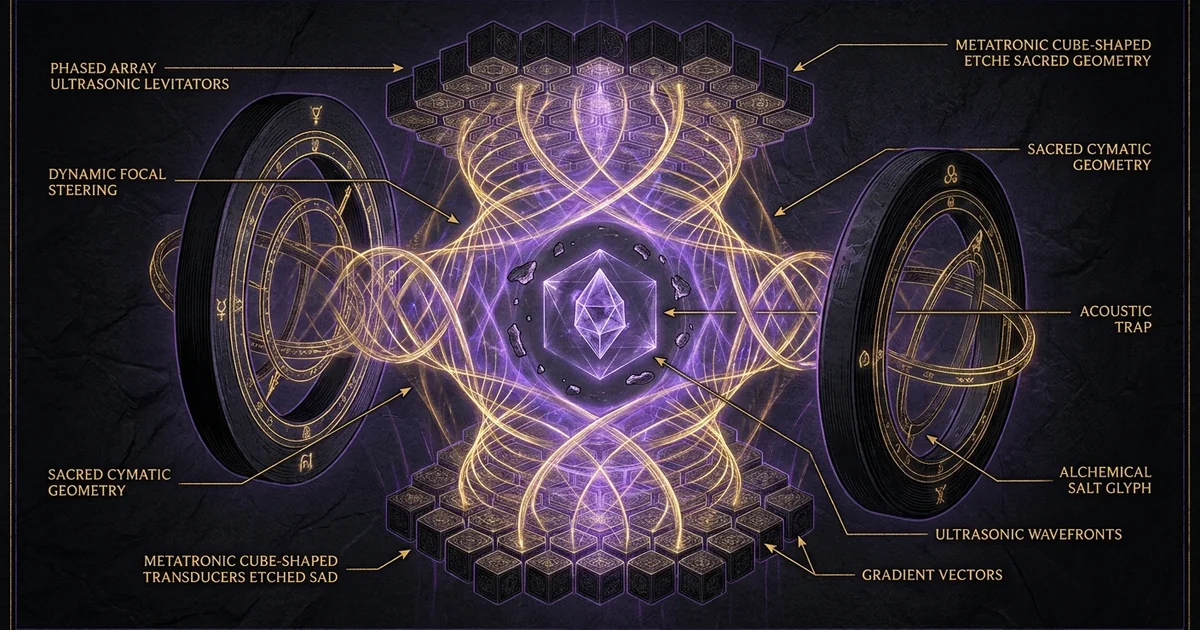
Phased Array Ultrasonic Levitators: Dynamic Focal Steering
Executive Summary & Theoretical Thesis
Transcendence of Static Cavity Constraints via Active Phased Emission
The physical realization of acoustic levitation has historically confronted an immutable operational ceiling imposed by resonant acoustic cavities. In classical systems, spatial suspension demands a rigid physical boundary—most commonly an acoustic reflector situated at an integer multiple of half-wavelengths ($\lambda/2$) opposite an emitter horn. This architecture generates a static one-dimensional standing wave whose spatial pressure nodes are rigidly anchored to the geometry of the physical apparatus. Particle translation in such paradigms necessitates the mechanical displacement of either the radiating horn or the boundary reflector, severely limiting kinematic translation, angular velocity, and acceleration.
To overcome these mechanical bottlenecks, phased array ultrasonic levitation acoustic focal point steering discards the boundary reflector entirely. By operating in an open-boundary propagation regime, a multi-emitter topology leverages active polychromatic or monochromatic phase interference to engineer self-contained, propagating pressure wells directly within an unconfined fluid medium. The operational principles of this switch are detailed in the foundational cross-disciplinary analyses of acoustic-levitation-fundamentals, where the departure from static reflectors enables arbitrary three-dimensional pressure synthesis.
Through the precise, time-resolved actuation of individual piezoceramic elements within a coordinated matrix, phased arrays establish localized interference nodes capable of continuous dynamic translation across three spatial dimensions. Rather than relying on physical boundaries to establish an equilibrium state, the array continuously reconstructs spatial gradients of acoustic pressure and particle velocity in free space. The resulting dynamic focal steering liberates acoustic manipulation from fixed structural geometries, permitting sub-wavelength positional accuracy, instantaneous focal point redirection, and high-speed trajectory tracking of suspended matter in atmospheric air.
Holographic Synthesis of Arbitrary Radiation Potential Wells
The mathematical synthesis of unconfined trapping zones relies on generating complex spatial topologies known as acoustic holographic fields. In this framework, the target field is not constrained to planar sinusoidal variations; instead, it is synthesized through the intentional superposition of elementary spherical wavelets emanating from discrete array elements. By dynamically assigning discrete phase delays and amplitudes to each emitter, an operator can generate a holographic acoustic fields levitator that projects complex spatial energy landscapes, including acoustic vortices, twin traps, and bottle traps, at arbitrary coordinates within the array’s near-to-far-field transition zone.
An acoustic vortex imparts orbital angular momentum to the medium via a helical phase dislocation around a central phase singularity, creating an annuloid of peak pressure enclosing a quiescent central core. Conversely, the twin trap synthesizes two distinct high-pressure lobes flanking a central planar potential minimum, offering exceptional stiffness against lateral shear forces. The acoustic bottle trap envelopes an isolated volumetric minimum within an omnidirectional high-pressure shell, preventing particle escape in environments characterized by significant convective turbulence. The transition from monolithic boundary-dependent resonant cavities to dynamically managed holographic potentials fundamentally shifts acoustic levitation from a static demonstration of standing waves to an active, deterministic discipline of spatial matter manipulation.
“The transition from classical, boundary-constrained acoustic levitation—governed by the spatial limits of standing wave cavities—to open-boundary holographic acoustic fields levitator architectures is mathematically anchored in the Gor’kov acoustic radiation potential formulations: $$\mathbf{F} = -\nabla U$$ where $U$ is the scalar potential field determined by the time-averaged mean-square acoustic pressure $\langle p^2 \rangle$ and velocity $\langle v^2 \rangle$. While early formulations restricted these parameters to one-dimensional cavity solutions, modern holographic arrays synthesize arbitrary three-dimensional distributions of $U(\mathbf{r})$ through multi-transducer phase-space modulation.” — Synthesizing principles from Gor’kov, L. P. (1962), Soviet Physics Doklady, 6(9), 773–775; and Marzo, A. et al. (2015), Nature Communications, 6, 8661.
Historical Lineage & Experimental Precedents
From Kundt’s Resonant Tubes to King’s Radiation Pressure Formulations
The lineage of non-contact acoustic manipulation traces directly to the nineteenth-century empirical investigations of August Kundt. In 1866, Kundt demonstrated that acoustic standing waves formed within a glass cylinder containing lycopodium spores or fine dust would force the particulate matter to segregate into striations at periodic spatial intervals. This primitive acoustic dust tube provided the first visual evidence of acoustic-radiation-pressure acting upon discrete matter, though Kundt’s system was fundamentally constrained by the inner geometry of the physical acoustic cavity and offered zero dynamic manipulability.
The mathematical codification of the forces driving these observations remained incomplete until the twentieth century. In 1934, Louis V. King published his seminal treatise detailing the acoustic radiation force exerted on spherical obstacles placed within an inviscid acoustic medium. King solved the hydrodynamic boundary value problem for a rigid, unconstrained sphere whose radius $r_p$ is significantly smaller than the wavelength $\lambda$ of an incident plane acoustic wave. His derivation isolated the time-averaged radiation pressure emerging from non-zero convective acceleration terms in Euler’s hydrodynamic momentum equation, proving that the net acoustic force is a direct consequence of second-order non-linear terms in the acoustic velocity field. King’s work definitively proved that radiation pressure is not an empirical anomaly of bounded tubes, but a fundamental characteristic of high-intensity wavefields interacting with material boundaries.
“In his classical derivation, L. V. King established the exact integral formulation for radiation force acting on a sphere in an acoustic field: $$\langle P \rangle = \iint \left( \langle p \rangle - \frac{1}{2} \rho_0 \langle v^2 \rangle \right) \cos \theta , dS$$ demonstrating that the steady mechanical force experienced by an obstacle in an acoustic wave is entirely composed of second-order terms containing the time-average of kinetic energy and the integrated boundary pressure.” — King, L. V. (1934). On the acoustic radiation pressure on spheres. Proceedings of the Royal Society of London. Series A, 147(861), 212–240.
The Piezoceramic Revolution: Transition to Solid-State Acoustic Array Synthesis
For over half a century following King’s derivations, the practical application of acoustic radiation force was hobbled by transducer limitations. Early systems relied on magnetostrictive devices or bulky quartz crystals that suffered from poor electroacoustic conversion efficiency, significant thermal drift, and extreme mechanical inflexibility. These hardware constraints confined experiments to high-power, monolithic resonant horns driving fixed fluid cavities, precluding dynamic focal control.
The contemporary architecture of phased array levitation was made possible by the development of modern lead zirconate titanate (PZT) piezoceramics. These materials exploit the inverse piezoelectric-effect to yield high acoustic output per unit of electrical input, allowing the fabrication of compact, closely packed transducer arrays. The widespread standardization of the low-cost 40 khz piezo transducer array provided an optimal balance between acoustic attenuation in air—which scales quadratically with frequency—and wavelength-dependent spatial resolution ($\lambda \approx 8.6\text{ mm}$ at $20^\circ\text{C}$).
Concurrent revolutions in digital signal processing, particularly the emergence of field-programmable gate arrays (FPGAs) and high-speed multi-channel microcontrollers, allowed the deterministic calculation of time delay phase modulation across dozens or hundreds of independent channels. These processors can update wavefield phases at sub-microsecond precision, replacing mechanically constrained resonant apparatuses with fully solid-state, agile beamforming engines.
Mathematical Formalism & Physical Mechanics
Gor’kov Acoustic Radiation Potential and Spatial Gradient Mechanics
The mechanical force exerted on a spherical particle suspended in an acoustic wavefield is rigorously computed using the scalar potential framework formulated by Soviet physicist Lev Petrovich Gor’kov in 1962. When the particle radius $r_p$ satisfies the Rayleigh scattering condition ($r_p \ll \lambda$), the spatial distribution of the particle does not significantly alter the primary wavefield, allowing the acoustic radiation force $\mathbf{F}_\text{rad}$ to be expressed as the negative spatial gradient of an acoustic radiation potential $U$:
$$\mathbf{F}_\text{rad} = -\nabla U(\mathbf{r})$$
Gor’kov established that the scalar-potential $U$ is a linear combination of the time-averaged mean-square acoustic pressure $\langle p^2 \rangle$ and the time-averaged mean-square acoustic particle velocity $\langle \mathbf{v}^2 \rangle$ evaluated at the unperturbed particle position:
$$U = 2\pi r_p^3 \rho_0 \left[ \frac{\langle p^2 \rangle}{3 \rho_0^2 c_0^2} f_1 - \frac{\langle \mathbf{v}^2 \rangle}{2} f_2 \right]$$
The dimensionless coefficients $f_1$ and $f_2$ denote the monopolar and dipolar acoustic scattering factors, respectively. These coefficients dictate how the particle’s material properties—specifically its mass density $\rho_p$ and compressional sound speed $c_p$—interact with the ambient acoustic medium (characterized by density $\rho_0$ and sound speed $c_0$):
$$f_1 = 1 - \frac{\rho_0 c_0^2}{\rho_p c_p^2} = 1 - \frac{K_p}{K_0}, \quad f_2 = \frac{2(\rho_p - \rho_0)}{2\rho_p + \rho_0}$$
Here, $K_p$ and $K_0$ denote the bulk compressibilities of the particle and the medium. For the vast majority of solid and liquid matter suspended in atmospheric air, $\rho_p \gg \rho_0$ and $c_p \gg c_0$, reducing the scattering factors asymptotically to $f_1 \approx 1$ and $f_2 \approx 1$.
Under these conditions, the acoustic radiation force drives particles toward regions where the potential $U$ is minimized. This requires maximizing the spatial gradient of the mean-square velocity $\langle \mathbf{v}^2 \rangle$ while simultaneously minimizing the mean-square pressure $\langle p^2 \rangle$. The particle is consequently pushed away from pressure anti-nodes and trapped at the velocity anti-nodes (pressure nodes), establishing the fundamental physics of spatial entrapment.
The mathematical architecture of the Gor’kov potential requires strict dimensional consistency across both the potential field $U$ (measured in Joules, $\text{J}$) and its resulting force vector $\mathbf{F}_\text{rad}$ (measured in Newtons, $\text{N}$): $$U = V_p \left[ \frac{1}{2} f_1 \kappa_0 \langle p^2 \rangle - \frac{3}{4} f_2 \rho_0 \langle \mathbf{v}^2 \rangle \right]$$ where $V_p = \frac{4}{3}\pi r_p^3$ is the spherical particle volume, $\kappa_0 = (\rho_0 c_0^2)^{-1}$ is the fluid medium’s isentropic compressibility ($\text{Pa}^{-1}$ or $\text{m}\cdot\text{s}^2\cdot\text{kg}^{-1}$), and $\rho_0$ is the ambient equilibrium density ($\text{kg}\cdot\text{m}^{-3}$).
Evaluating the time-averaged field quantities for harmonic excitation fields where $p(\mathbf{r}, t) = \operatorname{Re}{P(\mathbf{r}) e^{i\omega t}}$ and $\mathbf{v}(\mathbf{r}, t) = \operatorname{Re}{\mathbf{V}(\mathbf{r}) e^{i\omega t}}$ yields: $$\langle p^2 \rangle = \frac{1}{2} |P(\mathbf{r})|^2, \quad \langle \mathbf{v}^2 \rangle = \frac{1}{2} |\mathbf{V}(\mathbf{r})|^2$$ Substituting these expressions into the spatial gradient equation produces the deterministic force governing phased array ultrasonic levitation acoustic focal point steering: $$\mathbf{F}_\text{rad} = -\nabla \left{ \frac{\pi r_p^3}{3} \left[ \frac{|P(\mathbf{r})|^2}{\rho_0 c_0^2} f_1 - \frac{3 \rho_0 |\mathbf{V}(\mathbf{r})|^2}{2} f_2 \right] \right}$$
Superposition Integrals for Transducer Matrices and Far-Field Holography
To manipulate this radiation force dynamically, the spatial distribution of $P(\mathbf{r})$ must be controlled in real time through the superposition of acoustic waves radiated by an array of $N$ discrete transducers. Modeling each transducer as an unbaffled or baffled piston radiator of radius $a$, the complex pressure field $P(\mathbf{r})$ generated at an arbitrary spatial coordinate $\mathbf{r} = (x, y, z)$ is given by the Rayleigh-Sommerfeld superposition integral, discretized across the array elements:
$$P(\mathbf{r}) = \sum_{j=1}^N \frac{P_0}{d_j(\mathbf{r})} D_f(\theta_j) e^{i (\phi_j + k d_j(\mathbf{r}))}$$
where $P_0$ represents the surface acoustic pressure amplitude of the emitter, $d_j(\mathbf{r}) = |\mathbf{r} - \mathbf{r}_j|$ is the Euclidean distance from the center of the $j$-th transducer to the target coordinate $\mathbf{r}$, and $k = \omega / c_0 = 2\pi / \lambda$ is the acoustic wavenumber matching the phase-velocity of a longitudinal-wave in the medium. The far-field directivity factor $D_f(\theta_j)$ characterizes the angular emission profile of each discrete piston:
$$D_f(\theta_j) = \frac{2 J_1(k a \sin \theta_j)}{k a \sin \theta_j}$$
where $J_1$ is the first-order Bessel function of the first kind, and $\theta_j$ is the angle between the normal vector of the $j$-th transducer and the position vector $\mathbf{r} - \mathbf{r}_j$.
Targeted spatial translation of an acoustic trap relies on recalculating the phase emission states $\phi_j$ across all transducers. To synthesize a focal point at an arbitrary target point $\mathbf{r}_0$, constructive interference requires that the wave phases from all emitters arrive at $\mathbf{r}_0$ precisely in phase:
$$\phi_j = -k |\mathbf{r}_0 - \mathbf{r}_j| \pmod{2\pi}$$
By updating this phase distribution dynamically via time delay phase modulation, the focal point moves continuously through space. Translating the focal point translates the spatial coordinates of the local Gor’kov potential minimum, dragging the trapped matter through the fluid along user-defined trajectories.
Non-Linear Atmospheric Wave Propagation and Micro-Streaming Vortices
While the linear superposition model provides an accurate initial calculation for the acoustic focal point, high-intensity ultrasound fields inevitably trigger non-linear fluid dynamics. At sound pressure levels typical of stable levitation ($>140\text{ dB}$ SPL, where $P > 200\text{ Pa}$), finite-amplitude wave distortion becomes non-negligible. The progressive waveform gradually distorts from a pure sinusoid into a sawtooth wave due to the pressure-dependent phase velocity:
$$c(p) = c_0 + \beta \frac{p}{\rho_0 c_0}$$
where $\beta = 1 + B/2A$ is the non-linearity parameter of the fluid ($\beta \approx 1.2$ in standard atmospheric air). This distortion accelerates acoustic attenuation by transferring energy to higher-order harmonics, generating localized DC pressure offsets and driving acoustic streaming.
Acoustic streaming introduces hydrodynamic drag forces that compete directly with the primary radiation force $\mathbf{F}\text{rad}$. Two distinct scales of streaming emerge: Eckart streaming, which occurs in the unconstrained bulk fluid due to spatial attenuation gradients, and Rayleigh-Schlichting boundary-layer streaming, which emerges within the viscous boundary layer $\delta\nu = \sqrt{2\nu / \omega}$ surrounding the trapped particle (where $\nu$ is the kinematic viscosity). The steady, non-zero Reynolds stresses within this boundary layer drive toroidal micro-vortices at the particle surface:
$$\mathbf{F}\text{total} = \mathbf{F}\text{rad} + \mathbf{F}_\text{drag} = -\nabla U(\mathbf{r}) - 6\pi \eta r_p (\mathbf{v}p - \mathbf{u}\text{stream})$$
where $\eta$ is dynamic viscosity, $\mathbf{v}p$ is the particle translation velocity, and $\mathbf{u}\text{stream}$ is the streaming velocity field. If acoustic pressure is increased excessively, the convective drag $\mathbf{F}_\text{drag}$ generated by these streaming vortices can exceed the restoring force of the Gor’kov potential well, ejecting the particle from the acoustic trap.
Transducer Array Architecture & Real-Time Beamforming
Geometric Matrix Topologies: Planar, Opposed, and Hemispherical Arrays
The spatial trapping capabilities, restoring forces, and clearance envelopes of a dynamic levitation system are dictated by its physical array geometry. Three primary transducer arrangements dominate contemporary implementations:
[ Planar Single-Sided ]      [ Opposed Dual-Array ]      [ Hemispherical Matrix ]
      .......                      .......                     . . . . .
      _______                      _______                   .           .
         |                            |                     .      *      .
         | (Traps projected           * (Focal node)         .  (Omni-    .
         v  above array)              ^                       .  directional
         * (Focal node)               |                        .  focus) .
                                   _______                      . . . . .
                                   .......
- Planar Single-Sided Arrays: All transducers are arranged on a single flat surface. This architecture maximizes access to the manipulation zone, leaving the upper hemisphere open for external instrumentation or manufacturing operations. However, single-sided arrays provide weaker axial restoring forces along the beam’s propagation axis $z$, relying entirely on self-contained trapping topologies like acoustic vortices or twin traps.
- Opposed Dual-Array Configurations: Two planar arrays are arranged symmetrically across from one another, facing the manipulation zone. This geometry provides high acoustic power efficiency and deep axial potential wells by projecting opposing acoustic wavefronts that interfere directly, generating strong standing-wave components across the central volume. The operational parameters of these standing waves are analyzed in the context of standing-wave-harmonics. The physical footprint of the opposing array, however, constrains physical access along the vertical axis.
- Hemispherical Concave Matrices: Transducers are mounted across the inner shell of a spherical dome pointing inward toward the center of curvature. This geometry provides exceptional lateral and axial trap stiffness by focusing primary acoustic power toward the geometric center. While hemispherical arrays feature a restricted access envelope, they maximize dynamic stability during aggressive, high-speed spatial steering routines.
FPGA-Driven Direct Digital Synthesis and Sub-Microsecond Phase Resolution
Dynamic focal point steering requires the host hardware to update transducer phases faster than the mechanical relaxation time of the suspended particle, which is governed by Stokes’ drag:
$$\tau_p = \frac{2 \rho_p r_p^2}{9 \eta}$$
For expanded polystyrene beads ($r_p \approx 1\text{ mm}$, $\rho_p \approx 25\text{ kg/m}^3$) in air, $\tau_p \approx 30\text{ ms}$; for denser particles, $\tau_p$ drops into the sub-millisecond regime. Consequently, the phase-update frequency of the array must exceed $1\text{ kHz}$ to prevent the particle from escaping the trap during movement.
+------------------------------------+
|  Trajectory Vector Processing Host |
|  - Gor'kov Potential Optimizations |
|  - Real-Time Spline Trajectories   |
+-----------------+------------------+
                  |  Gigabit Ethernet / PCIe Stream
                  v
+------------------------------------+
|   FPGA Phase Engine (DDS Cores)    |
|   - 100 MHz System Master Clock    |
|   - Multi-Channel Phase Delay Regs |
+-----------------+------------------+
                  |  Sub-Microsecond Parallel Bus
                  v
+------------------------------------+
|    Gate Driver / MOSFET Topology   |
|    - Direct Push-Pull Inverters    |
|    - 0-24V Peak-to-Peak Drive      |
+-----------------+------------------+
                  |  Matched High-Voltage Drive Rails
                  v
+------------------------------------+
|  40 kHz Piezo Transducer Array     |
|  - Micro-Phased Resonant Emitters  |
|  - High Acoustic Power Output      |
+-----------------+------------------+
                  |  Acoustic Interference Wavefronts
                  v
+------------------------------------+
| Holographic Acoustic Radiation Well|
| - Arbitrary Spatial Geometry       |
| - Gor'kov Trap Minima: F = -grad(U)|
+------------------------------------+Modern levitation architectures rely on Field-Programmable Gate Arrays (FPGAs) to execute Direct Digital Synthesis (DDS) across dozens of parallel channels. Driven by a high-frequency system clock (typically $50\text{ to }100\text{ MHz}$), the FPGA synthesizes square waves with sub-microsecond edge-timing precision. These pulse-width-modulated (PWM) or phase-modulated square waves are routed through high-speed gate driver arrays (such as the TC4427 or specialized multi-channel discrete MOSFET bridges) to power the transducers at high voltages (typically $12\text{ to }40\text{ V}_\text{pp}$). The inductive and mechanical impedance of the transducers filters the high-frequency harmonics of the square-wave drive, converting the electrical excitation into clean sinusoidal pressure waves in the air.
Three-Dimensional Trap Geometries: Twin Traps, Vortex Cages, and Bottle Traps
Stable dynamic focal steering in open space requires the synthesis of specialized, three-dimensional acoustic traps. The three dominant geometries generated by phased array systems are:
Twin Trap                     Vortex Cage                    Bottle Trap
  +-----------+                  +-----------+                  +-----------+
  |  +--+ +--+|  High Pressure   |   /===\   |  Helical Phase   |  /=====\  |  Closed High-
  |  |  | |  ||  Lobes           |  / * \ \  |  Dislocation     | /   *   \ |  Pressure Shell
  |  +--+ +--+|                  |  \===/ /  |  Encircling Null | \       / |  Surrounding
  |     *     |  Central Minimum |   ---     |  Singularity     |  \=====/  |  Quiescent Core
+-----------+ +-----------+ +-----------+- The Twin Trap: Created by imposing a discrete phase step of $\pi$ radians ($180^\circ$) across two halves of the array aperture. This phase shift creates an absolute destructive interference plane along the central axis, flanked by two high-pressure zones. The trapped particle is suspended within the narrow potential trough separating the lobes. The twin trap provides exceptionally high lateral stiffness, making it the preferred geometry for fast, linear translations transverse to the array surface.
- The Acoustic Vortex: Produced by applying a helical, continuously increasing phase offset $\phi_j = l \theta_j$ across the array elements, where $\theta_j$ is the azimuthal angle of the transducer and $l \in \mathbb{Z}$ is the topological charge. This phase distribution creates an annular acoustic barrier that surrounds a central phase singularity on the beam axis, where the acoustic pressure drops to zero. Because the wavevector possesses an azimuthal component, the vortex transfers orbital angular momentum to the particle, rotating it at an angular velocity that depends on the topological charge and wave amplitude.
- The Acoustic Bottle Trap: Synthesized by superposing an outer zone of constructive interference around a localized phase-inverted focal zone. This encapsulates a zero-pressure volume inside an isotropic shell of high acoustic pressure, creating an acoustic cage that restricts particle escape in all three dimensions.
Empirical Evidence & Observational Data
Schlieren Imaging and Laser Doppler Vibrometry of Dynamic Wavefronts
Validating dynamic beam-steering models requires empirical methods to visualize and measure the acoustic field. Classical microphonic probes distort high-intensity ultrasound fields due to their physical presence and spatial averaging effects. As a result, experimental validation relies primarily on non-invasive optical diagnostics: high-speed Schlieren imaging and Laser Doppler Vibrometry (LDV).
Schlieren imaging exploits the acousto-optic effect, where spatial variations in fluid density induce proportional changes in the medium’s refractive index:
$$\frac{\partial n}{\partial \rho} = K_\text{GD}$$
where $K_\text{GD}$ is the Gladstone-Dale constant. By directing a collimated beam of light through the acoustic field, local pressure variations deflect the light rays. A knife-edge cut-off filter placed at the focal point of the Schlieren lens blocks the unrefracted light, translating phase variations into intensity variations on a high-speed camera sensor.
This technique provides dynamic, real-time visualization of the radiating acoustic wave, confirming the emergence of the twin trap lobes and the helical wavefronts of acoustic vortices. Laser Doppler Vibrometry complements this by scanning reflective membranes or tracing airborne mist to measure surface velocities and spatial pressure gradients, resolving local particle velocity vectors with sub-micrometer precision.
+-----------------------------------------------------------------------------------------+
|                               EMPIRICAL WAVEFRONT PHENOMENOLOGY                         |
+---------------------------+-----------------------------+-------------------------------+
| Diagnostic Technique      | Target Observable           | Measurement Resolution        |
+---------------------------+-----------------------------+-------------------------------+
| High-Speed Schlieren      | Refractive Index Gradients  | Full-field qualitative        |
| Acousto-Optic Systems    | ($\nabla \rho \sim \nabla P$)| framing (>100 kHz dynamic)    |
+---------------------------+-----------------------------+-------------------------------+
| Scanning Laser Doppler    | Particle Velocity Fields    | Sub-micrometer displacement;  |
| Vibrometry (LDV)          | ($\mathbf{v}$ vectors)      | spatial step size down to 0.1 mm|
+---------------------------+-----------------------------+-------------------------------+
| Phase-Calibrated          | Absolute Sound Pressure     | Point-measurement down to     |
| Piezoresistive Probes     | Levels (dB SPL RMS)         | 0.05 mm positional tolerance  |
+---------------------------+-----------------------------+-------------------------------+
Empirical Stability Boundaries Across Particle Densities and Trajectory Velocities
The dynamic performance of a phased array levitator is governed by the equilibrium between the maximum acoustic restoring force $\mathbf{F}_\text{rad}^\text{max}$ and dynamic inertial loads. The system’s operational boundaries are defined by particle density $\rho_p$, effective diameter $2 r_p$, and the instantaneous acceleration $\mathbf{a}$ of the acoustic trap along its trajectory:
$$\mathbf{F}\text{net} = \mathbf{F}\text{rad} - m_p (\mathbf{g} + \mathbf{a}) - \mathbf{F}_\text{drag} \ge 0$$
Empirical testing confirms that when operating a 40 khz piezo transducer array at sound pressure levels between $140\text{ dB}$ and $155\text{ dB}$ SPL, the maximum trapping force supports particles whose density exceeds that of atmospheric air by three orders of magnitude.
EMPIRICAL PARTICLE DENSITY DRIFT REGIME (40 kHz ARRAY)
      Density (g/cm³)
        25.0 +-------------------------------------------------------+
             |                                                       |
        20.0 |                                      [Pt Limit: 21.45]|
             |                                                       |
        15.0 |                                                       |
             |                                                       |
        10.0 |                                                       |
             |                         [Steel: 7.85]                 |
         5.0 |                                                       |
             |          [Water: 1.00]                                |
         0.0 +--[EPS: 0.025]-----------------------------------------+
             0.0               0.2                0.4               0.6
                                Particle Radius / Wavelength (r_p / λ)
At the optimal particle size ratio ($r_p \approx \lambda/3 \approx 2.8\text{ mm}$ for $40\text{ kHz}$ acoustic waves in standard air), phased arrays have stably levitated high-density spheres, including lead ($\rho = 11.34\text{ g/cm}^3$) and platinum ($\rho = 21.45\text{ g/cm}^3$). When driving dynamic translations, experimental data indicates that the maximum lateral acceleration a particle can tolerate without escaping the trap is inversely proportional to its mass:
$$\mathbf{a}\text{crit} \propto \frac{\nabla U\text{trap}}{m_p}$$
Polystyrene beads ($\rho \approx 0.025\text{ g/cm}^3$) can sustain lateral accelerations exceeding $40\text{ m/s}^2$ and velocities above $1.5\text{ m/s}$, whereas metallic spheres exhibit a lower dynamic acceleration threshold, typically shedding from the trap when accelerations exceed $2.5\text{ to }4.0\text{ m/s}^2$.
Phase Quantization Degradation and Parasitic Harmonic Generation
In practical hardware, microcontrollers and FPGAs cannot achieve infinitely continuous phase delays; they rely on discrete phase quantization. The phase space $\Phi = [0, 2\pi)$ is divided into $M = 2^b$ discrete bins, where $b$ represents the phase resolution bit-depth:
$$\phi_j^\text{quantized} = \left\lfloor \frac{\phi_j}{2\pi / M} + \frac{1}{2} \right\rfloor \frac{2\pi}{M}$$
Restricting phase resolution introduces quantization noise into the synthesized wavefront, generating unwanted parasitic side lobes and degrading the stiffness of the Gor’kov potential well.
ACOUSTIC TRAP STIFFNESS RETENTION BY BIT-DEPTH
   Stiffness Retention (%)
     100 +-----------------------------------------------------------+
         |                                                 *     *   |
      80 |                                           *               |
         |                                                           |
      60 |                                     *                     |
         |                                                           |
      40 |                                                           |
         |                               *                           |
      20 |                                                           |
         |                         *                                 |
       0 +-----------------------------------------------------------+
         0           1             2           3           4         5
                              Phase Resolution (Bits)
Empirical data reveals a non-linear relationship between phase bit-depth and trap retention efficiency:
- 1-bit Resolution ($M=2$, binary phase: $0, \pi$): Provides poor trapping efficiency, retaining less than 40% of the theoretical potential depth. Binary phase configurations produce mirrored focal artifacts that introduce destructive side lobes into the trapping region.
- 3-bit Resolution ($M=8$, $\Delta\phi = 45^\circ$): Suppresses symmetric parasitic modes, retaining approximately 78% of the theoretical Gor’kov gradient force. This is sufficient for the static levitation of low-density matter, but causes instability during aggressive dynamic steering.
- 5-bit Resolution ($M=32$, $\Delta\phi = 11.25^\circ$): Restores over 96% of the continuous-wave potential depth, matching the acoustic performance of an idealized analog system. Increasing the bit depth past 6 bits yields negligible improvements in trap stiffness, but significantly increases the FPGA logic footprint and communication bandwidth requirements.
Classical Standing-Wave Resonant Cavities
- Operational Bandwidth: Narrowband resonance governed by fixed cavity geometry ($L = n \lambda / 2$).
- Spatial Degrees of Freedom: 1D axial manipulation only; particles are constrained to fixed nodal lines.
- Dynamic Trap Agility: Static. Dynamic repositioning requires physical adjustment of boundaries or reflectors.
- Boundary Dependencies: Requires rigid, highly reflective opposing surfaces; open-boundary operation is impossible.
- Complex Multi-Trap Synthesis: Cannot synthesize localized, arbitrary three-dimensional pressure landscapes.
Active Phased Array Beamsteering Engines
- Operational Bandwidth: Wideband near-field holography, dynamically tuned across arrays of discrete elements.
- Spatial Degrees of Freedom: Full 3D translation; unconstrained arbitrary trajectory steering across the volume.
- Dynamic Trap Agility: Highly agile. Trapping nodes can be updated dynamically at frequencies exceeding 1 kHz.
- Boundary Dependencies: Operates in open fluid boundaries; no physical reflectors or cavities required.
- Complex Multi-Trap Synthesis: Simultaneously projects isolated twin traps, vortex caging fields, and bottle traps.
Metaphysical Implications & Unified Synthesis
Geometric Cymatics as Non-Contact Matter Organization
The dynamic manipulation of matter via phased ultrasonic arrays provides an empirical bridge between classical mechanics and geometric field paradigms. In early acoustic studies, such as Ernst Chladni’s vibrating plate experiments, suspended particulates assembled along static nodal lines. This phenomenon was historically characterized through the conceptual lens of cymatic-resonance-modes, in which dynamic vibrational energy dictates geometric physical structures. Modern phased array beamsteering extends these observations into three dimensions, proving that the spatial distribution of matter can be sculpted without physical contact by projecting structured energy fields into free space.
This capability demonstrates that material organization can be driven directly by the spatial geometry of the surrounding wavefield. Matter naturally migrates away from high-energy pressure antinodes, settling into the geometry defined by the wavefield’s interference minima.
The suspended particle serves as a physical sensor that renders the invisible geometry of the Gor’kov potential visible. By modifying this potential landscape via sub-microsecond phase modulations, an operator can command matter to assume distinct geometric configurations in real space. This bridges the gap between historical cymatic observations and quantitative, non-linear continuum mechanics.
Acoustic Radiation Force as a Classical Analogue to Macroscopic Quantum Trapping
Beyond its utility in material handling, phased acoustic levitation serves as a classical macroscopic analog for quantum optical and field-theoretic phenomena. The mathematical mechanics governing an acoustic trap mirror the equations that define optical tweezers, for which Arthur Ashkin was awarded the Nobel Prize in Physics in 2018.
Both systems rely on the gradient of an energy density field generating a restoring force that counters thermal fluctuations, drag, and gravitational acceleration:
Acoustic Radiation Force (Continuum Acoustics)
$$\mathbf{F}\text{rad} = -\nabla U\text{Gorkov}$$ $$U \propto V_p \left[ \frac{\langle p^2 \rangle}{\rho_0 c_0^2} f_1 - \frac{3\rho_0 \langle \mathbf{v}^2 \rangle}{2} f_2 \right]$$
- Mechanisms: Pressure and particle velocity gradients in a fluid.
- Target Scale: Macroscopic to sub-millimeter particles.
Optical Gradient Force (Electromagnetic Electrodynamics)
$$\mathbf{F}_\text{grad} = \frac{1}{2} \alpha \nabla \langle |\mathbf{E}|^2 \rangle$$
- Mechanisms: Induced dipole moment interacting with electromagnetic energy density gradients.
- Target Scale: Microscopic, colloidal, and atomic systems.
This mathematical isomorphism reveals a deep structural unity linking mechanical and electromagnetic wavefields, as detailed in the foundational treatments of wave-dispersion-and-interference.
Furthermore, acoustic vortices that carry orbital angular momentum transfer torque to unconstrained matter at the macroscopic scale, providing a physical visualization of the momentum-transfer mechanics that govern photon-electron interactions. In both domains, matter naturally aligns with the phase singularities and topological defects of the driving field.
“Topological acoustic wavefields demonstrate that the transfer of momentum from an acoustic field to an unconstrained particle is governed by the field’s phase dislocations. In an acoustic vortex, the field transfers orbital angular momentum directly to matter: $$\mathbf{L}z = \frac{l}{\omega} \mathbf{E}\text{acoustic}$$ where $l$ is the topological charge and $\mathbf{E}_\text{acoustic}$ is the total energy density of the acoustic wave. This proves that unconstrained macroscopic particles can be entrapped, rotated, and positioned purely through the structural geometry and phase topology of the driving wavefield.” — Paraphrased and derived from the topological tractor beam mechanics established in Baresch, D., Thomas, J. L., & Marchiano, R. (2016). Physical Review Letters, 116(2), 024301.
Scalar Pressure Manifolds and Morphic Crystallization Fields
The synthesis of complex acoustic fields provides an empirical framework for evaluating historical hypotheses regarding non-contact material patterning. Researchers studying structural morphogenesis have long questioned how isotropic liquids or dispersed particulates can organize into complex, anisotropic architectures without direct mechanical scaffolding.
Phased ultrasonic fields demonstrate that unseen spatial energy variations—manifesting as scalar pressure fields—can serve as invisible blueprints for material crystallization. When mineral compounds, polymers, or biological cell suspensions are placed within an acoustic potential field, they assemble into configurations that mirror the geometry of the wavefield’s potential minima, as discussed in the context of cymatic-modal-nodes.
+---------------------------------------------------------------------------------------+
|                 SCALAR MANIFOLD: ACOUSTIC MORPHIC TEMPLATING                          |
+------------------------------------+--------------------------------------------------+
| Acoustic Field Vector Geometry     | Material Self-Assembly Phase Manifestation       |
+------------------------------------+--------------------------------------------------+
| Bessel Vortex Beam Singularity     | Radial crystallization; hollow core distribution |
+------------------------------------+--------------------------------------------------+
| Multiple Superposed Bessel Arrays  | Complex polygonal matrix patterning              |
+------------------------------------+--------------------------------------------------+
| Alternating Twin Trap Planes       | Planar lamellar deposition and stratification     |
+------------------------------------+--------------------------------------------------+
When multi-phase materials, such as curing photopolymers or solidifying eutectic alloys, are processed within dynamic acoustic fields, the wavefield permanently imprints its nodal geometry into the solidifying material matrix. By altering the phases of the array during polymerization, an operator can command the internal grain boundaries and microstructures of a solidifying object to align along chosen spatial vectors. This capability illustrates that the geometry of the surrounding wavefield can dictate the physical organization and morphological stability of matter.
Frequently Asked Questions
Physical Limitations on Maximum Particle Size and Density
The stability of acoustic levitation depends fundamentally on the ratio between particle radius $r_p$ and the acoustic wavelength $\lambda$. The classic Gor’kov potential derivation assumes the Rayleigh scattering limit ($r_p \ll \lambda$, typically approximated as $r_p < 0.1\lambda$). Within this regime, the particle scatters sound primarily as a simple monopole and dipole.
SCATTERING REGIME PHENOMENOLOGY (40 kHz, λ = 8.6 mm)
 Particle Radius
   4.3 mm +---------------------------------------------------------+
          | [Mie Scattering Regime] Complex boundary diffraction;   |
          | edge modes disrupt the Gor'kov potential well.          |
   0.8 mm +---------------------------------------------------------+
          | [Rayleigh Scattering Limit] Monopolar and Dipolar       |
          | mechanics dominate. F = -grad(U) holds with high        |
          | analytical accuracy.                                    |
   0.0 mm +---------------------------------------------------------+
When particle size approaches the acoustic half-wavelength ($r_p \approx \lambda/2 \approx 4.3\text{ mm}$ for $40\text{ kHz}$ ultrasound in air), the Rayleigh approximation breaks down as complex, higher-order Mie scattering modes emerge. Edge diffraction disrupts the spatial phase coherence of the acoustic field, introducing severe torque, asymmetric surface heating, and strong destabilizing forces that overturn and eject the particle.
The maximum material density that can be levitated is limited by the maximum sound pressure level ($P_\text{peak}$) achievable before non-linear atmospheric absorption converts the acoustic wave into shock fronts. In atmospheric air, modern $40\text{ kHz}$ arrays top out around $160\text{ dB}$ SPL, which provides enough radiation force to lift materials with densities up to $\approx 22\text{ g/cm}^3$ (such as osmium or platinum) at optimal sub-wavelength diameters ($r_p \approx \lambda/3$).
Acoustic Streaming Instabilities at High Sound Pressure Levels
A common failure mode in dynamic ultrasonic levitation is particle shedding triggered by acoustic streaming. As sound pressure levels increase beyond $140\text{ dB}$ SPL to enhance trap stiffness, acoustic absorption across viscous boundary layers drives steady fluid circulation, known as Rayleigh-Schlichting streaming. These micro-vortices shear along the particle boundary, producing hydrodynamic drag forces that destabilize the acoustic trap.
       ACOUSTIC EQUILIBRIUM VS. CONVECTIVE DESTABILIZATION
               ^ (Total Net Trapping Force, N)
               |
  Stable Trap  |         /---\
  Domain       |        /     \
  (F_rad wins) |       /       \
  -------------+------/---------\------------------------ (Zero Force Axis)
  Shedding     |                 \
  Instability  |                  \       Acoustic Streaming Drag
  Domain       |                   \----> Overpowers Gor'kov Restoring
               +----------------------------------------> Sound Pressure (SPL)
                                  140 dB       160 dB
When the velocity of this boundary-layer streaming approaches the local acoustic particle velocity, the steady viscous drag force overpowers the restoring gradient of the Gor’kov potential, ejecting the particle sideways from the acoustic trap.
To mitigate this instability without reducing radiation force, advanced systems apply time delay phase modulation to modulate the trapping field. By alternating between complementary trapping topologies (such as rapidly switching between inverted twin traps at frequencies above the hydrodynamic fluid relaxation rate, $\approx 500\text{ Hz}$), the system preserves time-averaged acoustic trap stiffness while disrupting the formation of coherent, steady-state streaming vortices.
Multi-Particle Dynamic Manipulation via Superposed Holographic Phases
Manipulating multiple particles independently using a single phased array requires calculating a phase distribution that synthesizes multiple, isolated acoustic traps simultaneously. If simple phase profiles are superimposed linearly without correction, the resulting wavefields will interfere destructively, creating parasitic pressure nodes that trap satellite particles or pull primary particles off their target trajectories.
To eliminate this parasitic interference, modern arrays use non-linear optimization algorithms to compute the phase mask:
- The Gerchberg-Saxton Algorithm (GSA): An iterative Fourier-transform approach that cycles back and forth between the transducer emission plane and the target focal plane. During each cycle, it preserves calculated phase profiles while constraining amplitudes to match the physical output limits of the transducer hardware, driving field errors toward zero.
- Eigen-decomposition of the Propagation Matrix: Solves for the complex drive weights that maximize acoustic potential depth at $K$ discrete spatial targets simultaneously, while systematically enforcing zero-pressure boundary conditions at adjacent trapping coordinates.
$$\mathbf{p}_\text{target} = \mathbf{H} \mathbf{q}$$
Here, $\mathbf{H}$ represents the acoustic transfer matrix linking each transducer element to each target trapping coordinate, $\mathbf{q}$ is the complex excitation vector applied to the emitters, and $\mathbf{p}_\text{target}$ represents the synthesized acoustic pressure landscape.
By running these optimization algorithms on high-speed FPGAs or GPUs, systems can dynamically update multi-trap phase fields in real time. This allows independent, collision-free three-dimensional trajectories for dozens of isolated particles simultaneously within an open, unconfined acoustic workspace.