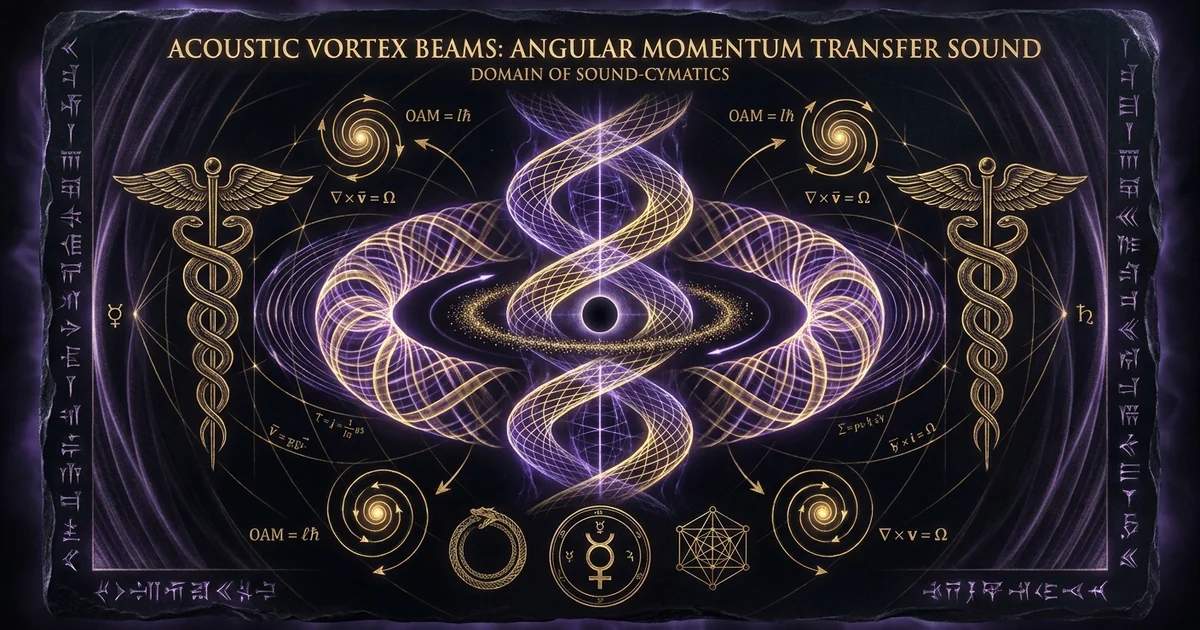
Acoustic Vortex Beams: Angular Momentum Transfer Sound
Executive Summary & Theoretical Thesis: Topological Phase Singularities in Acoustic Wavefields
Helical Wavefront Topology and the Acoustic Spanner Effect
Acoustic vortex beams represent an extraordinary departure from traditional planar or spherically symmetric ultrasonic propagation. Unlike conventional acoustic fields characterized by flat or uniformly curved surfaces of constant phase, an acoustic vortex is distinguished by an azimuthal phase dislocation of the form $\exp(i l \theta)$, where $\theta$ denotes the polar angle in cylindrical coordinates and $l \in \mathbb{Z}$ defines the topological charge. This mathematical topology forces a helical winding of the wavefronts along the designated axis of beam propagation. Because the acoustic phase becomes mathematically indeterminate along the central coordinate axis ($r = 0$), the physical acoustic pressure must vanish identically at this locus, creating an isolated null-pressure core surrounded by an annular envelope of elevated mechanical energy density.
This geometrical phase singularity generates an azimuthal component of fluid particle velocity, yielding a macroscopic, circulating flux of acoustic energy that spirals around the propagation axis. When such an acoustic vortex interacts with an elastic, dissipative, or reflective medium, the intrinsic azimuthal energy flow imparts a steady mechanical torque to the target. This phenomenon—colloquially designated the “acoustic spanner” effect—provides a contact-free mechanism for rotating micro- and macro-scale matter purely through the conversion of dynamic wave momentum. The continuous transfer of angular momentum transforms the acoustic field from a purely translational propulsion mechanism into a versatile torsional tool capable of micro-rheological interrogation, high-precision particle manipulation, and selective cellular sorting without physical shear fixtures.
Orbital vs. Spin Angular Momentum in Longitudinal Media
To understand the mechanics of acoustic torque transfer, one must clearly distinguish between spin angular momentum (SAM) and orbital angular momentum (OAM). In electrodynamics, as explored in the context of optical angular momentum, spin is intrinsically linked to the polarization state of the transverse electric and magnetic vector fields; circular polarization carries an intrinsic spin of $s = \pm \hbar$ per photon. Conversely, acoustic waves propagating through ideal, non-viscous fluid media are strictly longitudinal-waves, wherein fluid element displacement is constrained to be collinear with the local wave propagation vector ($\mathbf{k}$).
Because isotropic fluids do not support transverse shear displacements, classical acoustic wavefields cannot sustain intrinsic spin angular momentum in the unconfined bulk. Instead, any angular momentum manifested by the beam must be extrinsic and geometric—that is, it must constitute pure orbital-angular-momentum (OAM). This acoustic OAM does not originate from the microscopic rotation of individual fluid molecules about their respective centroids, but from the macroscopic, phase-directed trajectory of the fluid velocity vector field $\mathbf{u}(\mathbf{r}, t)$ circulating about the central phase singular axis. While evanescent acoustic fields and localized boundary layers near rigid interfaces can display localized, transverse-like elliptical particle motions that emulate pseudo-spin states, the long-range, axial torque carried by paraxial and non-paraxial vortex beams is fundamentally governed by topological phase dislocations embedded within the spatial geometry of the wavefront.
The Paradigm Shift: Mechanical Work via Wavefront Dislocation
The realization that wavefront geometry alone can perform mechanical work without physical shear implements a fundamental paradigm shift within non-linear acoustics and momentum transport physics. Classical acoustics long treated radiation forces primarily as translational phenomena governed by axial acoustic radiation pressure, utilized extensively in single-axis acoustic-levitation systems to trap matter at stationary velocity nodes. In such classic configurations, the net time-averaged torque applied to an isotropic sphere centered on the beam axis remains identically zero due to azimuthal symmetry.
The incorporation of a phase-dislocation shatters this azimuthal symmetry. The introduction of an azimuthal phase gradient $\partial \Phi / \partial \theta = l$ establishes an uninterrupted circular gradient in the acoustic kinetic energy density. This gradient exerts a continuous, non-conservative acoustic-radiation-torque on suspended objects. Mechanical torque is transferred in direct proportion to the beam’s topological-charge $l$ per unit of absorbed or scattered acoustic energy. Consequently, the mechanical rotation of suspended matter no longer requires anisotropic target shapes, asymmetric material friction, or multifocal beam-steering trajectories; the acoustic field itself acts as a macroscopic, non-contact torsional drive whose operational limits are governed entirely by wave dynamics, topological invariants, and fluid-boundary dissipation.
Historical Lineage & Experimental Precedents: From Wave Dislocations to Dynamic Acoustic Spanners
Nye-Berry Singularities and the Geometry of Wavefront Tears
The formal theoretical conceptualization of phase dislocations within wave trains traces back to the seminal work of J. F. Nye and M. V. Berry in 1974. Investigating the structural stability of generic scalar and vector wavefields, Nye and Berry demonstrated that the surfaces of constant phase within any propagating wave can develop topological tears, or dislocations, analogous to crystalline defects within solid-state lattices. They demonstrated that along certain nodal lines within three-dimensional space, the wave amplitude must vanish, while the phase undergoes an integer multiple of $2\pi$ circulation along any closed path enclosing the defect line:
$$\oint_{C} \nabla \Phi \cdot d\mathbf{s} = 2\pi l, \quad l \in \mathbb{Z}$$
For over two decades following the Nye and Berry paper, the study of wave dislocations was predominantly confined to physical optics, electron microscopy, and theoretical wave mechanics. The acoustic community recognized structural phase cancellations in complex reverberant cavities or scattered fields, but these were treated as passive geometric anomalies or noise artifacts rather than coherent dynamic vectors capable of exerting sustained radiation torque. The transition from topological curiosity to deliberate acoustic momentum engineering required experimental methodologies capable of synthesizing pure, single-order helicoidal acoustic wavefronts at high ultrasonic intensities.
- Nye, J. F., & Berry, M. V. (1974). Dislocations in wave trains. Proceedings of the Royal Society of London. A. Mathematical and Physical Sciences, 336(1605), 165–189.
- Hefner, B. T., & Marston, P. L. (1999). An acoustical helicoidal wave and beam generated by a ferroelectric transducer with a spiral-shaped backplate. The Journal of the Acoustical Society of America, 106(6), 3313–3316.
- Thomas, J. L., & Marchiano, R. (2003). Pseudoangular momentum and torque for acoustic vortex beams. Physical Review Letters, 91(24), 244302.
Ferroelectric Spiral Architectures and Early Transducer Arrays
The laboratory synthesis of isolated, high-purity acoustic vortex beams was achieved in the late 1990s through the mechanical and geometric design of ultrasonic transducers. A benchmark advance occurred in 1999 when B. T. Hefner and P. L. Marston constructed a macroscopic acoustic helicoidal wave source using a specialized ferroelectric transducer. Rather than utilizing complex electronic phase-delay systems, Hefner and Marston fabricated a piezoceramic element featuring a spiral-shaped backplate whose axial thickness varied continuously as a function of the azimuthal coordinate $\theta$. This physical geometry enforced a step-dislocation at the zero-azimuth boundary, translating the continuous spatial thickness gradient directly into a continuous phase ramp spanning $0$ to $2\pi$ across the active aperture.
Subsequent investigations quickly shifted from static, mechanically fixed transducer plates to multi-element piezoelectric phased arrays. In 2003, J. L. Thomas and R. Marchiano provided the definitive experimental and theoretical verification of pseudo-angular momentum transport in acoustic vortex fields. By employing a circular array of ultrasonic transducers driven with sequentially incremented electronic phase delays, Thomas and Marchiano generated stable, paraxial vortex beams in water, demonstrating the physical generation of non-zero time-averaged acoustic torque and validating the linear proportionality between topological charge and transferred angular momentum. Their work experimentally bridged the gap between microscopic acoustic energy circulation and macroscopic mechanical work.
+--------------------------------------------------------------------------+
| CHRONOLOGICAL PROGRESSION OF ACOUSTIC VORTICITY                          |
|                                                                          |
| 1974: Nye & Berry establish mathematical framework for wave dislocations |
| 1992: Allen et al. demonstrate optical orbital angular momentum          |
| 1999: Hefner & Marston synthesize acoustic helicoidal waves via spirals  |
| 2003: Thomas & Marchiano measure acoustic radiation torque on absorbers  |
| 2011: Zhang & Marston formulate non-paraxial angular momentum theorems   |
| 2016: Baresch et al. realize single-beam acoustical tweezers trapping    |
+--------------------------------------------------------------------------+
Evolution of Programmable Ultrasonic Phased Metasurfaces
The arrival of programmable ultrasonic phased arrays operating in the multi-megahertz regime fundamentally liberated acoustic vortex generation from bulky, single-frequency geometric backplates. Modern systems deploy dense, two-dimensional matrices of micro-machined capacitive or piezoelectric transducers (CMUTs/PMUTs) capable of individual phase, frequency, and amplitude modulation. These dynamic arrays allow the on-the-fly synthesis of high-order topological charges ($|l| \ge 1$), the real-time translation of the singular core in three dimensions, and the coaxial superposition of opposing topological states ($l_1 = +m$, $l_2 = -m$) to produce standing angular geometries.
Concurrently, the science of acoustic metamaterials has introduced passive and active metasurfaces capable of imprinting helical phase profiles onto standard planar acoustic waves across sub-wavelength propagation distances. By employing arrays of coiling-up-space labyrinths, Helmholtz resonance cavities, or phononic crystal units with azimuthally modulated acoustic impedances, these thin acoustic metasurfaces convert incident longitudinal plane waves into sharply focused, vortex beams bearing engineered OAM. These developments have transformed the acoustic spanner from an elaborate laboratory apparatus into a compact platform for microfluidic rheology, cellular sorting, and targeted non-invasive therapeutics.
Mathematical Formalism & Physical Mechanics: Helmholtz Solutions and Torque Quantization
Bessel-Gauss Solutions and Azimuthal Phase Modulation
In an isotropic, lossless, compressible fluid medium, the propagation of monochromatic, small-amplitude acoustic waves is governed by the linear scalar Helmholtz equation:
$$\nabla^2 p(\mathbf{r}) + k^2 p(\mathbf{r}) = 0$$
where $p(\mathbf{r})$ represents the complex acoustic pressure amplitude, $k = \omega / c_0$ denotes the acoustic wavenumber, $\omega$ is the temporal angular frequency, and $c_0$ is the equilibrium speed of sound in the host medium. Adopting a cylindrical coordinate frame $\mathbf{r} = (r, \theta, z)$ with the $z$-axis aligned parallel to the primary propagation vector, the Helmholtz operator decomposes into:
$$\left( \frac{\partial^2}{\partial r^2} + \frac{1}{r}\frac{\partial}{\partial r} + \frac{1}{r^2}\frac{\partial^2}{\partial \theta^2} + \frac{\partial^2}{\partial z^2} + k^2 \right) p(r, \theta, z) = 0$$
To satisfy the prerequisite boundary conditions of an isolated, non-divergent phase dislocation bearing an integer topological charge $l$, the general separable acoustic pressure field takes the form:
$$p(r, \theta, z, t) = A(r, z) \exp(i l \theta) \exp(i k_z z - i \omega t)$$
Substituting this ansatz into the radial coordinate equations yields the classical Bessel equation of order $l$. For an ideal non-diffracting acoustic vortex beam, the transverse radial profile is accurately modeled by a $J_l$ Bessel function:
$$p(r, \theta, z) = P_0 J_l(k_r r) \exp(i l \theta) \exp(i k_z z)$$
where $k_r$ and $k_z$ represent the radial and longitudinal components of the wavevector, satisfying the dispersion relation $k^2 = k_r^2 + k_z^2$. Due to the analytical behavior of Bessel functions near the origin, wherein $J_l(k_r r) \sim (k_r r)^{|l|} / (2^{|l|} |l|!)$ as $r \to 0$, the acoustic pressure identically vanishes along the central propagation axis ($r = 0$) for all non-zero topological charges ($|l| \ge 1$).
Acoustic Pressure Amplitude Distribution (l = 1 Bessel-Gauss Beam):
|p®|
^
|          * * *                  * * *
|        *       *              *       *
|       *         *            *         *
|      *           *          *           *
|     *             *        *             *
|----±--------------±-----±--------------±—> r (Radial axis)
r=0 (Null Core)  r_max               r_max
In physically realizable finite-aperture systems, these structures are modified by a Gaussian envelope factor $\exp(-r^2 / w_0^2)$, producing finite-energy Bessel-Gauss beams that preserve the central phase singular null while ensuring finite integrated beam power over space.
Radiation Stress Tensor and Non-Zero Pseudo-Angular Momentum
The emergence of macroscopic physical torque from a purely longitudinal acoustic wave requires moving beyond linear acoustics into second-order, time-averaged dynamics. The non-linear mechanical stress exerted by the fluid field on any surrounding boundary is characterized by the time-averaged Reynolds stress tensor $\langle \mathbf{T} \rangle$, supplemented by the acoustic contribution to the isotropic fluid pressure:
$$\langle T_{ij} \rangle = -\rho_0 \langle u_i u_j \rangle + \frac{1}{2} \left( \rho_0 \langle u^2 \rangle - \frac{\langle p^2 \rangle}{\rho_0 c_0^2} \right) \delta_{ij}$$
where $\rho_0$ is the ambient, unperturbed medium density, $\mathbf{u} = -\nabla p / (i \omega \rho_0)$ is the fluid particle velocity vector derived from the first-order momentum equation, $\delta_{ij}$ represents the Kronecker delta, and angle brackets $\langle \dots \rangle$ denote temporal averaging over a full acoustic period $\tau = 2\pi / \omega$.
The time-averaged acoustic radiation force vector $\langle \mathbf{F} \rangle$ and torque vector $\langle \mathbf{\Gamma} \rangle$ acting on an immersed object bounded by a closed surface $S_0$ are obtained by integrating the time-averaged momentum flux over $S_0$:
$$\langle \mathbf{F} \rangle = - \oint_{S_0} \langle \mathbf{T} \rangle \cdot \mathbf{n} , dS$$
$$\langle \mathbf{\Gamma} \rangle = - \oint_{S_0} \mathbf{r} \times \left( \langle \mathbf{T} \rangle \cdot \mathbf{n} \right) dS$$
where $\mathbf{n}$ is the outward-pointing unit normal vector to the control surface $S_0$.
Because the acoustic vortex possesses an explicit azimuthal velocity component:
$$u_\theta(r, \theta, z) = \frac{1}{\rho_0 \omega r} \frac{\partial p}{\partial \theta} = \frac{i l}{\rho_0 \omega r} p(r, \theta, z)$$
the off-diagonal shear components of the time-averaged stress tensor (notably $\langle T_{r\theta} \rangle$ and $\langle T_{z\theta} \rangle$) do not integrate to zero over an enclosed boundary enclosing or intercepting the vortex axis. This finite, non-zero cross-product $\mathbf{r} \times \langle \mathbf{T} \rangle$ generates a continuous axial torque vector oriented along $\pm \hat{\mathbf{z}}$, collinear with the beam axis and polarized in direct accordance with the sign of the topological charge $l$.
Let an acoustic beam illuminate an axisymmetric particle situated coaxially within the acoustic field. By applying the divergence theorem to the conservation of pseudo-angular momentum within a fluid control volume bounded internally by the particle surface $S_p$ and externally by an arbitrary far-field spherical surface $S_\infty$, the net axial radiation torque $\Gamma_z$ acting on the particle can be formally evaluated via the far-field scattering amplitudes:
$$\Gamma_z = \frac{1}{\omega} \sum_{n=1}^{\infty} \sum_{m=-n}^{n} m \cdot \Pi_{n,m}^{\text{ext}}$$
where $\Pi_{n,m}^{\text{ext}}$ denotes the extinction power associated with the $(n, m)$ spherical partial-wave expansion modes. In the regime where the acoustic wave undergoes absorption within the target or through immediate viscous dissipation at the particle-fluid interface, the acoustic radiation torque relates directly to the total time-averaged power absorbed by the object, $P_{\text{abs}}$:
$$\Gamma_z = \frac{l}{\omega} P_{\text{abs}} + \Gamma_{\text{scat}}$$
Here, $\Gamma_{\text{scat}}$ is the torque imparted purely through asymmetric, non-specular acoustic scattering. In an axisymmetric scattering geometry where the structural scatterer preserves the intrinsic cylindrical symmetry of the incident field, the scattering term satisfies an identical conservation invariant, solidifying the universal acoustic ratio:
$$\frac{d\Gamma_z}{dt} \Big/ \frac{dE}{dt} = \frac{l}{\omega}$$
This relationship establishes that every acoustic quantum of mechanical energy $\hbar \omega$ absorbed or coherently deflected from a vortex beam carries with it a discrete orbital angular momentum equal to $l\hbar$.
Torque-to-Energy Flux Invariants in Viscous Scattering Regimes
The foundational invariant $\Gamma_z / P_{\text{abs}} = l / \omega$ derived above parallels the famous Beth and Allen criteria established for transverse electrodynamic beams. However, a crucial fluid mechanical nuance arises when transitioning from an ideal inviscid fluid to a real, thermo-viscous medium. In physical liquids, the presence of dynamic shear viscosity $\eta$ and bulk viscosity $\eta_B$ gives rise to an acoustic viscous boundary layer—termed the Stokes boundary layer—of characteristic thickness:
$$\delta_v = \sqrt{\frac{2\nu}{\omega}} = \sqrt{\frac{2\eta}{\rho_0 \omega}}$$
where $\nu = \eta / \rho_0$ is the kinematic viscosity of the fluid.
Within this thin boundary layer surrounding any suspended target, the fluid velocity must transition from the circulating azimuthal velocity of the external acoustic field to the instantaneous surface velocity of the rotating body to satisfy the non-slip boundary condition. This intense velocity shear gradient induces viscous dissipation, converting acoustic kinetic energy directly into localized vorticity and heat.
Remarkably, as established by Zhang and Marston (2011), the fundamental invariant $\Gamma_z = (l / \omega) P_{\text{absorbed}}$ holds strictly valid even in the presence of viscous boundary layers, provided that $P_{\text{absorbed}}$ is rigorously defined to include both internal bulk thermal absorption within the solid and viscous dissipated energy inside the Stokes boundary layer. The mechanical torque experienced by the object is thus intimately tied to the total thermodynamic dissipation of the beam’s energy flux, solidifying the coupling between topological wave design and physical work.
Empirical Evidence & Observational Data: Precision Micro-Rotation and Levitational Dynamics
Laboratory Realization of Single-Beam Micro-Rotators
Direct laboratory confirmation of controlled, contact-free rotation driven by acoustic vortex beams has been verified across diverse experimental systems ranging from kilohertz audible acoustic setups down to multi-megahertz single-beam acoustical tweezers. In a landmark realization, Baresch, Thomas, and Marchiano (2016) demonstrated complete three-dimensional trapping and controlled angular manipulation of individual micro-particles using a single, focused acoustic vortex beam operating in the megahertz frequency regime. By employing a spherical cap transducer array segmented into sectors with programmed phase delays, they generated a tightly focused $l = 1$ topological vortex trap capable of overcoming both gravitational and scattering forces simultaneously.
Focused Spherical Array Aperture
             \   |   /
              \  |  /
               \ | /       Azimuthally Phased Wavefronts
                \|/        [exp(i * l * theta)]
                 V
                 |
               ( O )       Levitated Elastic Particle
                 |         Trapped at the Annular Focus
                /|\
               / | \       Continuous Orbital Torque Imparted
              /  |  \      Terminal Rotation: Omega_term
             /   |   \
Suspended micro-particles of dense polystyrene, fused quartz, and biological spheroids (ranging from $10,\mu\text{m}$ to several millimeters in diameter) were captured within the central axial pressure minimum. When centered, these particles did not remain stationary; rather, they underwent continuous, steady-state physical rotation about the beam axis. The rotational direction inverted symmetrically upon reversing the electronic sign of the topological charge from $l = +1$ to $l = -1$, directly proving that the mechanical work was driven by the helicity of the acoustic wavefronts rather than spurious acoustic streaming asymmetries or thermal convection currents.
Viscous Boundary Layer Dissipation and Terminal Spin Velocities
An isolated particle subjected to a constant acoustic radiation torque $\Gamma_z$ does not accelerate indefinitely. Its terminal angular velocity $\Omega_{\text{term}}$ is strictly governed by the hydrodynamic drag torque $\Gamma_{\text{drag}}$ exerted by the host fluid. In the low Reynolds number regime ($\text{Re} \ll 1$), the resistive torque acting on an axisymmetric sphere of radius $R$ rotating steadily in a fluid of dynamic viscosity $\eta$ is given by the classical Stokes drag law:
$$\Gamma_{\text{drag}} = 8 \pi \eta R^3 \Omega_{\text{term}}$$
Equating the time-averaged acoustic radiation torque $\Gamma_z$ to the hydrodynamic resistance yields the theoretical terminal rotational velocity:
$$\Omega_{\text{term}} = \frac{\Gamma_z}{8 \pi \eta R^3} = \frac{l , P_{\text{abs}} + \omega \Gamma_{\text{scat}}}{8 \pi \eta \omega R^3}$$
In experimental setups operating in deionized water at a drive frequency of $f = 2.5,\text{MHz}$ ($\omega \approx 1.57 \times 10^7,\text{rad/s}$), micro-particles illuminated by calibrated vortex fields routinely achieve terminal spin frequencies ranging from several Hertz to over $100,\text{Hz}$. Precision laser vibrometry and high-speed microscopic tracking confirm that $\Omega_{\text{term}}$ scales linearly with acoustic source power (and thus with acoustic energy density $E_{\text{ac}} \propto p_0^2$) until non-linear hydrodynamic drag corrections or secondary fluid streaming regimes are engaged.
Absorption-Dominated Torque (Dissipative Targets)
- Primary Mechanism: Viscous and thermal dissipation inside the fluid Stokes boundary layer ($\delta_v$) and the particle’s internal matrix.
- Topological Invariant: Adheres strictly to the Beth-Marston mechanical invariant: $\Gamma_z = (l / \omega) P_{\text{abs}}$.
- Material Sensitivity: Maximized in high-loss viscoelastic polymers, soft biological tissues, and porous micro-structures.
- Angular Velocity Scaling: Scales monotonically with the linear absorption coefficient and internal dissipative acoustic moduli.
- Thermal Footprint: Yields measurable localized thermal dissipation proportional to mechanical power transfer.
Scattering-Dominated Torque (High-Impedance Targets)
- Primary Mechanism: Coherent spatial redistribution and deflection of the incident helical wavevector components ($\mathbf{k}{\text{inc}} \to \mathbf{k}{\text{scat}}$).
- Topological Invariant: Governed by partial-wave phase shifts: $\Gamma_z = \omega^{-1} \sum m \Pi_{n,m}^{\text{ext}}$, independent of thermal conversion.
- Material Sensitivity: Maximized in high-impedance elastic media (e.g., gold, steel, diamond, dense ceramics) where $Z_{\text{target}} \gg Z_{\text{fluid}}$.
- Angular Velocity Scaling: Highly oscillatory with target size parameter $kR$; governed by morphological resonance peaks.
- Thermal Footprint: Minimal thermal dissipation; torque is transferred via momentum conservation without significant medium heating.
Empirical Torque Efficiencies Across Varied Acoustic Impedance Regimes
The empirical efficiency of momentum transfer from an acoustic vortex to a suspended object is strongly conditioned by the acoustic impedance mismatch between the object and the host fluid:
$$\xi_Z = \frac{Z_{\text{object}}}{Z_0} = \frac{\rho_s c_s}{\rho_0 c_0}$$
where $\rho_s$ and $c_s$ denote the density and longitudinal sound speed of the solid material, and $\rho_0$ and $c_0$ characterize the fluid medium.
When an object has a matched impedance ($\xi_Z \approx 1$), such as certain soft hydrogels or specific biological macromolecules suspended in physiological saline, coherent acoustic reflection drops toward zero. In this domain, the observed torque is driven almost exclusively by internal thermo-viscous dissipation ($P_{\text{abs}}$), producing smooth terminal spin dynamics that closely follow the ideal $(l / \omega) P_{\text{abs}}$ scaling.
Conversely, when dense, high-impedance particles ($\xi_Z \gg 1$)—such as gold microspheres ($\xi_Z \approx 42$) or glass beads ($\xi_Z \approx 8$)—are illuminated, acoustic scattering dominates the interaction. Experimental measurements by Thomas and Marchiano confirm that under high-impedance conditions, the acoustic radiation torque undergoes resonant amplifications and suppressions as the dimensionless particle size parameter $x = k R$ traverses discrete resonant scattering modes. The scattered wavefield redistributes the incident helical wavevectors into far-field azimuthal trajectories, carrying away quantized pseudo-angular momentum and producing reactive mechanical torques that can exceed pure absorption-mediated torque by orders of magnitude.
Metaphysical Implications & Unified Synthesis: Cymatic Vorticity and Universal Hydrodynamic Geometries
Topological Invariance across Acoustic and Electrodynamic Fields
The empirical demonstration that longitudinal sound waves carry quantized orbital angular momentum exposes deep unities across disparate domains of classical and quantum field theory. Historically, longitudinal sound was categorized as a simple scalar pressure oscillation, devoid of the rich geometric properties characteristic of transverse electromagnetic or quantum spinor fields. However, recognizing that the spatial phase factor $\exp(i l \theta)$ enforces identical mathematical behaviors across both classical sound and coherent light reveals that orbital angular momentum is a property of wave topology rather than field polarization.
This topological equivalence reveals an invariance across classical field physics: whenever a propagating field sustains an isolated nodal singularity around which the phase angle circulates, it inherently manifests orbital angular momentum. This relationship holds whether the field is governed by Maxwell’s equations (photons), the Schrödinger or Dirac equations (matter waves), or the non-linear Navier-Stokes equations (acoustic phonons). The acoustic spanner serves as a tangible, macroscopic analogue for these field invariants, demonstrating that mechanical torque can be projected across empty fluid space purely by sculpting the geometry of phase.
“The existence of dislocations in wave trains is not a consequence of the specific physics of light or sound, but a universal property of complex scalar fields in space-time. Whenever two conditions—the vanishing of both the real and imaginary parts of the field amplitude—are simultaneously satisfied, a singularity emerges. Around this line of zero amplitude, the phase must circulate by an integer multiple of $2\pi$, establishing a topological invariant that couples spatial geometry directly to kinematic angular momentum.” — Berry, M. V. (1981). Singularities in Waves and Rays. Les Houches Lecture Series, Session XXXV, North-Holland Publishing.
Hydrodynamic Toroidal Geometries and Ancient Cymatic Paradigms
The physical architecture of an acoustic vortex—characterized by an annular shell of elevated energy density surrounding an axial void—parallels the dynamic geometry of the toroidal vortex ring found across classical hydrodynamics, plasma physics, and geophysical meteorology. In macroscopic hydrodynamics, smoke rings, ocean eddies, and atmospheric cyclonic columns embody self-stabilizing rotational configurations that conserve helicity across vast spatial and temporal scales. The acoustic vortex beam demonstrates that these toroidal flow patterns can be generated within the acoustic domain, demonstrating a structural unity across fluid mechanics.
These configurations also provide a rigorous physical grounding for classical observations in cymatics, first recorded systematically in the Chladni plate geometries of the eighteenth and nineteenth centuries. Where Chladni’s planar vibrations generated static, two-dimensional cymatic-modal-nodes that segregated particulate matter into passive geometric lines, the acoustic vortex introduces a dynamic temporal dimension. The nodal line ceases to be a static line of rest; it becomes a dynamic axis of phase circulation that directs, sorts, and rotates matter. This development elevates early speculative cymatic concepts—which viewed acoustic vibration as a primary architect of natural form—into the domain of quantitative, non-linear fluid dynamics and momentum transport.
+--------------------------------------------------------------------------+
| GEOMETRIC COMPARISON: MODAL NODES VS. ACOUSTIC VORTICES                  |
|                                                                          |
| 1. Planar Cymatics (Chladni Resonances):                                 |
|    - Mathematical Profile: p(x,y) = A * cos(k_x * x) * cos(k_y * y)      |
|    - Nodal Geometry: Static 1D lines of absolute mechanical rest         |
|    - Momentum State: Zero net orbital angular momentum                   |
|    - Physical Effect: Particulate matter passively collects at nodes     |
|                                                                          |
| 2. Acoustic Vortex Helicity (Orbital Angular Momentum):                  |
|    - Mathematical Profile: p(r,theta,z) = J_l(k_r * r) * exp(i * l * th) |
|    - Nodal Geometry: 1D helical phase singularity (axial null)           |
|    - Momentum State: Quantized OAM (Gamma_z / P_abs = l / omega)         |
|    - Physical Effect: Continuous contact-free dynamic torque transfer    |
+--------------------------------------------------------------------------+
Chirality as an Organizing Principle in Non-Linear Morphogenesis
At the intersection of non-linear wave mechanics and physical morphogenesis, chirality emerges as a fundamental organizing principle. In chemical synthesis and molecular biology, the symmetry-breaking preference for homochirality remains a central puzzle: biological macromolecules (DNA, L-amino acids, D-sugars) exhibit single-handed chiral conformations that are essential for molecular life. Standard homogeneous environments provide no energetic bias toward one enantiomer over another.
Acoustic vortex fields break this spatial mirror symmetry. Because the helical phase front $\exp(i l \theta)$ has an explicit handiness dictated by the sign of $l$, an acoustic vortex represents a chiral physical environment. When interacting with chiral micro-objects, structural enantiomers, or asymmetric macromolecular clusters, the absorption and scattering cross-sections differ slightly between opposite handedness states ($l > 0$ versus $l < 0$). This differential radiation torque enables the acoustic separation and enantiomeric sorting of chiral matter purely through wave interactions. The acoustic spanner demonstrates that pure longitudinal vibrations, when structured with topological chirality, act as non-contact morphological engines capable of organizing and segregating matter according to geometric handedness.
Frequently Asked Questions: Advanced Technical and Dynamic Clarifications
Phase Dislocation Stability in Inhomogeneous Media
Does an acoustic vortex beam maintain its quantized orbital angular momentum and topological charge when propagating through inhomogeneous, scattering, or turbulent media?
The topological charge $l$ of an acoustic vortex beam is a topologically protected invariant under continuous, smooth perturbations of the propagating medium. If an acoustic vortex traverses an inhomogeneous medium characterized by smooth, large-scale variations in refractive index (where the spatial variation scale $L_{\text{grad}} \gg \lambda$), the central phase singularity may bend, translate off-axis, or experience phase aberrations, but its net topological charge remains conserved:
$$l = \frac{1}{2\pi} \oint_C \nabla \Phi \cdot d\mathbf{s}$$
However, when the beam encounters sharp, non-axisymmetric scatterers, micro-bubbles, or turbulent eddies whose spatial scales are comparable to the acoustic wavelength ($\lambda$), the higher-order singularity can become structurally unstable. Under such conditions, an acoustic vortex of topological charge $|l| > 1$ typically splits into $|l|$ individual, isolated singularities of elementary charge $l = \pm 1$. The sum of the topological charges of these split singularities remains strictly conserved unless a singularity is driven outside the integration contour or annihilates against an oppositely charged singularity ($l = +1$ colliding with $l = -1$).
Even when structural splitting occurs, the total orbital angular momentum flux integrated across the complete transverse plane remains conserved in the absence of external non-axisymmetric boundaries, verifying that the macroscopic torque potential is preserved throughout medium distortion.
Distinction Between Acoustic Spin and Orbital Angular Momentum
Can an acoustic beam ever possess intrinsic spin angular momentum (SAM), or is acoustic torque always strictly orbital (OAM)?
In an unconfined, ideal, inviscid fluid medium, acoustic waves are purely longitudinal. The fluid velocity field is strictly irrotational away from singularities ($\nabla \times \mathbf{u} = 0$), which completely precludes the existence of intrinsic transverse spin angular momentum. Consequently, in bulk fluid propagation, all transferred acoustic torque is purely orbital angular momentum (OAM) derived from the macroscopic spatial phase distribution $\exp(i l \theta)$.
However, modern acoustic field theory has identified that localized acoustic spin angular momentum can manifest within specialized, highly confined wave geometries. When two mutually orthogonal acoustic waves propagate with a temporal phase difference of $\pi/2$—or within the evanescent decay field generated at a solid-fluid boundary or within acoustic metamaterial waveguides—the instantaneous fluid velocity vector $\mathbf{u}(\mathbf{r}, t)$ can trace out an ellipse over a single acoustic period. This elliptical particle motion constitutes a non-zero local curl:
$$\mathbf{S}_{\text{spin}} \propto \rho_0 , \text{Im}(\mathbf{u}^* \times \mathbf{u}) \neq 0$$
This acoustic spin density is an intrinsic local property analogous to the circular polarization of light. It exists independently of any macroscopic spatial phase singularity. Nonetheless, for paraxial acoustic vortex beams manipulating micro-particles in bulk fluid away from boundaries, the mechanical torque driving the acoustic spanner is overwhelmingly orbital in nature, governed directly by the macroscopic winding number $l$.
Scaling Limits for Macro-Object Rotation and Acoustical Levitation
What physical constraints dictate the maximum mass and dimensional scaling of objects that can be rotated via an acoustic vortex?
The capacity to levitate and rotate macroscopic objects via acoustic vortex beams is bounded by three interrelated physical constraints: the available acoustic power density, the acoustic impedance mismatch, and the geometric ratio between object radius $R$ and acoustic wavelength $\lambda$ (the size parameter $x = k R$).
Acoustic Trapping Stability Regimes:
Rayleigh Regime (kR << 1)       Mie/Intermediate Regime (kR ~ 1)      Geometric Regime (kR >> 1)
±------------------------------±-----------------------------------±----------------------------+
| Dominant Force:               | Dominant Force:                    | Dominant Force:             |
| Gradient Acoustic Force       | Resonant Partial-Wave Scattering   | Ray-Acoustic Momentum       |
| Particle sits in null core;   | Maximum torque transfer efficiency;| Particle spans annular ring;|
| low absolute torque transfer. | strong levitation stability.       | complex surface reflections.|
±------------------------------±-----------------------------------±----------------------------+
To maintain stable three-dimensional levitation without contact support, the axial gradient force must counteract gravity:
$$\langle F_z \rangle \ge M g = \frac{4}{3} \pi R^3 \rho_s g$$
In the Rayleigh scattering regime where the particle is much smaller than the wavelength ($k R \ll 1$), the acoustic radiation forces scale with volume ($R^3$), while the particle can remain centered within the annular pressure ring. As the object diameter increases into the geometric acoustics regime ($k R \gg 1$), the object exceeds the dimensions of the central pressure null. The object surface intercepts the outer annular ring of maximum pressure, experiencing non-uniform surface stresses that can eject it radially from the vortex trap unless specialized opposing multi-beam configurations are deployed.
Furthermore, driving macroscopic objects requires high acoustic power densities ($I_{\text{ac}} > 10,\text{kW/m}^2$). At these extreme acoustic intensities, the propagation medium undergoes non-linear acoustic distortion: shock fronts form, the local attenuation coefficient increases dramatically, and intense acoustic cavitation (the nucleation and collapse of vapor micro-bubbles) occurs in liquids. Cavitation clouds disrupt the coherent phase dislocation of the vortex, scattering the beam and limiting torque transfer.
Consequently, stable single-beam levitation and rotation are typically optimized when the object dimension is on the order of the acoustic wavelength ($k R \sim 1$) operating below the cavitation threshold of the host liquid. For larger macro-scale objects, multi-transducer levitation rings operating at lower audible or low-ultrasonic frequencies ($20,\text{kHz}$ to $40,\text{kHz}$) are required to retain stability while delivering high mechanical torque.