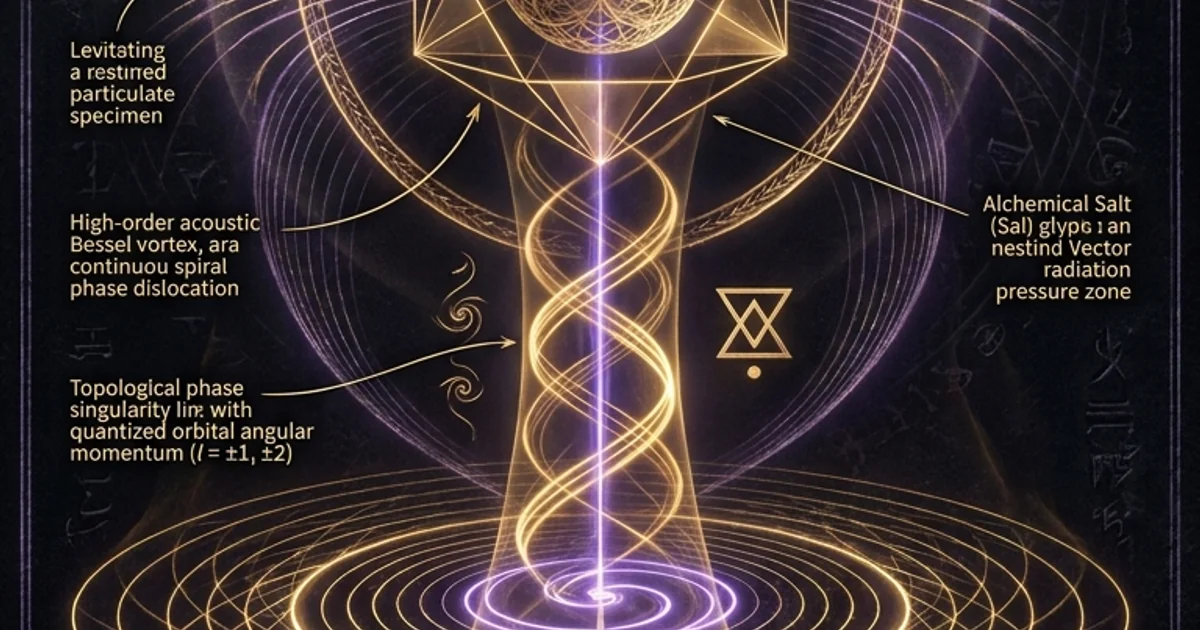
Acoustic Tractor Beams: Pulling Objects with Sound Beams
Executive Summary & Theoretical Thesis: Inversion of Acoustic Momentum Vector
The Non-Intuitive Kinematics of Negative Radiation Pressure
Classical acoustic radiation pressure, historically formulated through the continuum mechanics of Lord Rayleigh and Louis Brillouin, posits that an unconstrained target immersed within an insonified fluid field inevitably experiences a repelling axial force. When an acoustic wave strikes a discrete boundary, the time-averaged momentum transfer—governed by the projection of the incident acoustic Poynting-like vector and the resulting stress tensor—drives matter away from the emitter along the vector of wave propagation. This intuitive dynamic dominates both pure longitudinal-waves and transverse structural modes across homogeneous media. The canonical mechanism assumes that energy absorption and diffuse backscattering both siphon momentum from the forward-directed wavefront, yielding a strictly positive projection along the propagation coordinate ($+z$).
The emergence of the acoustic tractor beam disrupts this paradigm. By engineering spatial phase topologies and breaking plane-wave symmetry, it is possible to synthesize a non-diffracting traveling field that exerts a net retrograde force ($F_z < 0$) on an isolated scatterer. Rather than pushing matter downstream, the wave pulls the target upstream toward the acoustic source without requiring physical contact, mechanical guides, or an opposing acoustic reflector. This phenomenon does not represent an evasion of physical law, but an exploit of asymmetric wave mechanics where the mechanical energy flux and the momentum transfer vector decouple under specialized scattering conditions.
Linear Momentum Conservation in Asymmetric Scattering Geometries
The realization of a negative radiation force is grounded in the conservation of total linear momentum across an inviscid fluid control volume. In an unperturbed state, the incident sound beam conveys an axial momentum flux determined by its spatial amplitude and phase envelope. When an object is inserted into this field, it acts as a geometric and acoustic impedance discontinuity, generating a scattered wave field that superimposes onto the incident field.
Forward Scattering Hemisphere
                                      +z Direction
                                     . - ~ ~ ~ - .
                                 . :       ^       : .
                               :      /----+----\      :
                              :      /     |     \      :
                             :      |  Forward    |      :
                             :      |  Deflection |      :
                             :       \  Momentum /       :
                              :       \---------/       :
                               :           |           :
                                 . :       |       : .
                                     . - ~ | ~ - .
                                           |
                                  [ Target Scatterer ]
                                           |
                                           | Negative Radiation
                                           | Force Vector (F_z < 0)
                                           v
                             <--------------------------->
                              Transverse Momentum Modes (k_r)
                                           ^
                                           | Incident Bessel Cone
                                           | (Axicon Half-Angle \beta)
                                    [ Acoustic Emitter ]
If the scatterer redistributes the total wavefield such that the scattered acoustic waves carry greater momentum along the positive propagation axis ($+z$) than the incident wave initially imparted, the scatterer itself must experience a compensatory recoil directed toward the negative axis ($-z$). The phenomenon relies upon backward acoustic attraction physics: destructive interference attenuates the acoustic energy scattered back toward the emitter (the backward hemisphere), while constructive interference enhances scattering into the forward hemisphere at steep, highly aligned trajectories. The target scatterer serves as a coherent momentum converter, drawing forward-directed momentum out of the incident wave’s high-angle transverse components and ejecting it along the forward axis, driving the scatterer backward toward the source.
The Transduction Threshold: Bessel Conical Wavefronts
The realization of this momentum inversion requires the abandonment of paraxial plane-wave approximations in favor of structured propagating fields, particularly the zero-order and high-order bessel-beam. Formally, an ideal Bessel beam possesses a non-diffracting transverse amplitude profile described by Bessel functions of the first kind, synthesized conceptually by the interference of a continuous spectrum of plane wavevectors residing on the surface of a cone. The spatial topology is defined by its axicon half-cone angle $\beta$, which dictates the ratio between the radial wavenumber $k_r = k \sin\beta$ and the axial wavenumber $k_z = k \cos\beta$.
When an acoustic tractor beam pulling force sound waves marston configuration is established, the incident wavevector $k$ exhibits a high conical angle. As $\beta$ increases, the axial momentum conveyed per incident quantum of wave energy diminishes by a factor of $\cos\beta$, while the transverse momentum components increase. Consequently, the target only needs to redirect a modest fraction of this transverse momentum into the forward axial direction to overcome the diminished incident axial push. If the forward-scattered momentum flux exceeds the incident axial momentum flux, the net mechanical force vectors invert, establishing a stable pulling force.
Marston demonstrated that for an unconstrained sphere of radius $a$ and acoustic wavenumber $k$, the axial acoustic radiation force $F_z$ can become strictly negative when the half-cone angle $\beta$ of an ideal non-diffracting zero-order or first-order Bessel beam satisfies $\cos\beta > -f_1 / (2 f_2)$, where $f_1$ and $f_2$ denote the monopole and dipole acoustic scattering coefficients governed by Gor’kov compressibility and density contrasts.
Historical Lineage & Experimental Precedents: From Gor’kov Potentials to Vortex Tweezers
Standing Wave Trapping and the Classical Gor’kov Acoustic Potential
The mechanical manipulation of matter via sound waves originated in early-20th-century classical acoustics. In 1934, Louis V. King derived the exact analytical framework for acoustic radiation-pressure exerted on incompressible spherical particles inside planar standing and traveling wavefields. King’s mathematical formulations demonstrated that standing waves generate spatial trapping locations, yet the forces in traveling plane waves remained strictly positive, propelling matter downstream along the acoustic vector.
King, L. V. (1934) established the exact integration of the second-order stress tensor over an oscillating sphere, which Gor’kov (1962) refined into the scalar acoustic potential $U = 2\pi a^3 \left[ \frac{\langle p_{in}^2 \rangle}{3\rho_0 c_0^2} f_1 - \frac{\rho_0 \langle v_{in}^2 \rangle}{2} f_2 \right]$, proving that gradients of pressure and velocity govern non-contact mechanical potentials.
Building on King’s scaffolding, Lev Petrovich Gor’kov formulated his scalar potential theory in 1962, unifying radiation forces within an arbitrary acoustic field where the particle radius $a$ remains significantly smaller than the acoustic wavelength $\lambda$ ($ka \ll 1$). The resulting gorkov-potential derived mechanical forces directly from the spatial gradients of the time-averaged mean-square acoustic pressure $\langle p^2 \rangle$ and velocity $\langle v^2 \rangle$:
$$U = 2\pi a^3 \left[ \frac{\langle p^2 \rangle}{3\rho_0 c_0^2} f_1 - \frac{\rho_0 \langle v^2 \rangle}{2} f_2 \right]$$
Here, $\rho_0$ represents the ambient fluid density, $c_0$ is the thermodynamic speed of sound, and $f_1, f_2$ represent the acoustic monopole and dipole contrast factors, determined by the particle-to-fluid compressibility and density ratios:
$$f_1 = 1 - \frac{\kappa_p}{\kappa_0}, \quad f_2 = \frac{2(\rho_p - \rho_0)}{2\rho_p + \rho_0}$$
Under this classical regime, matter is trapped at pressure nodes or antinodes within standing waves—a configuration foundational to early acoustic-levitation. However, these systems were not tractor beams; they relied on opposing boundaries or secondary acoustic reflectors to generate stationary interferometric fields, precluding directional pulling across an unconstrained traveling wave.
Philip L. Marston’s 2006 Theoretical Postulate on Bessel Envelopes
The theoretical breakthrough that liberated acoustic trapping from the confinement of standing-wave cavities arrived in 2006, when Philip L. Marston published his analysis on the axial radiation forces exerted by non-diffracting Bessel beams. Marston analyzed how a propagating acoustic field could manifest a negative axial force purely through the spatial engineering of its wavevector components. He demonstrated that an acoustic Bessel beam—characterized by an axicon cone parameter $\beta$—modifies the incident momentum spectrum such that the projection of the incident acoustic wavevector along the propagation axis is reduced to $k_z = k\cos\beta$.
Marston’s mathematical derivation revealed that if $\beta$ exceeds a critical threshold, the classical positive axial radiation force diminishes rapidly. Concurrently, multipole scattering components generate a strongly asymmetrical, forward-directed scattering profile. For specific particle radii and acoustic contrast properties, this constructive forward scattering drains axial momentum from the total acoustic field, inducing a continuous retrograde force on the particle back toward the transducer face. By demonstrating that this tractor dynamic operates in a purely progressive traveling wave, Marston eliminated the historical requirement of an acoustic mirror or counter-propagating beam.
The Transition from Standing Waves to Propagating Monolithic Tractor Fields
Experimental acoustics transitioned from mathematical theory to physical implementation as dynamic transducer technology matured. Early attempts to manifest Marston’s tractor beam relied on physical acoustic axicon lenses or circular piezoelectric elements with tilted surfaces, but these rigid components lacked dynamic reconfigurability. The realization of fully operational, single-sided monolithic tractor fields required the integration of complex digital electronics.
The critical leap occurred with the deployment of dynamic phased arrays and holographic acoustic elements, popularized by Marzo et al. in 2015. By driving matrices of ultrasonic transducers with precise sub-millisecond phase offsets, researchers bypassed fixed lenses to synthesize dynamic phase profiles directly in the transmission fluid.
Through these programmable spatial modulators, single-sided emitter planes can project twin traps, phase-engineered acoustic bottles, and true propagation-mode Bessel beams. These dynamic fields trap, levitate, and translate macroscopic matter along arbitrary three-dimensional trajectories using traveling-wave acoustic fields in open space.
Mathematical Formalism & Physical Mechanics: Scattering Cross-Sections and Cone Angles
Helmholtz Equation Decomposition in Cylindrical Polar Coordinates
The mechanics of an acoustic tractor beam are anchored in the homogeneous Helmholtz equation governing the acoustic velocity potential $\psi(\mathbf{r})$ in an inviscid, linear fluid medium:
$$\nabla^2 \psi + k^2 \psi = 0$$
where $k = \omega / c_0$ denotes the total wavenumber. Converting the spatial Laplacian into cylindrical polar coordinates $(r, \phi, z)$, we seek solutions characterized by a defined axial propagation along $+z$:
$$\frac{1}{r} \frac{\partial}{\partial r}\left( r \frac{\partial \psi}{\partial r} \right) + \frac{1}{r^2}\frac{\partial^2 \psi}{\partial \phi^2} + \frac{\partial^2 \psi}{\partial z^2} + k^2 \psi = 0$$
Assuming an axisymmetric, zero-order configuration ($m = 0$), the acoustic velocity potential decouples into radial and axial dependencies:
$$\psi(r, z) = \psi_0 J_0(k_r r) e^{i k_z z}$$
The separation constants obey the dispersion constraint:
$$k^2 = k_r^2 + k_z^2$$
The conical topology of the wavefront is governed by the axicon angle $\beta$, establishing the geometric relations:
$$k_r = k \sin\beta, \quad k_z = k \cos\beta$$
The acoustic pressure field $p(r, z)$ and the particle velocity vector field $\mathbf{v}(r, z)$ are derived via the fluid density $\rho_0$ and angular frequency $\omega$:
$$p(r, z) = i \omega \rho_0 \psi(r, z) = p_0 J_0(k \sin\beta , r) e^{i k \cos\beta , z}$$
$$\mathbf{v}(r, z) = -\nabla \psi(r, z) = -\left[ \frac{\partial \psi}{\partial r} \hat{\mathbf{r}} + \frac{\partial \psi}{\partial z} \hat{\mathbf{z}} \right]$$
The parameter $\beta$ dictates the physical nature of the beam. When $\beta \to 0$, $k_r \to 0$ and $k_z \to k$, recovering the uniform plane wave, where negative forces cannot occur. Conversely, as $\beta \to 90^{\circ}$, the beam approaches a stationary, purely radial standing wave with minimal forward axial momentum flux. The mechanical window for a tractor beam emerges within this high-cone-angle regime.
       Wavevector Decomposition on the Bessel Conical Surface

                             +k_z (Axial Axis)
                                    ^
                                    |
                                    |     .  k (Total Wavevector)
                                    |    /
                                    |   /
                                    |  /
                                    | / ) axicon angle \beta
                                    |/------------------> +k_r (Radial Axis)
                                   O \
                                    | \
                                    |  \
                                    |   \
                                    |    \
                                    |     .
Scattering Matrix (S-Matrix) Phase Shifts and Multipole Interference
When a spherical scatterer of radius $a$ is placed on the beam axis at $r = 0$, the total external wavefield decomposes into the superposition of the incident Bessel field and the scattered field: $\psi_{tot} = \psi_{inc} + \psi_{sc}$. To evaluate the interaction, the incident zero-order Bessel beam is expanded into spherical harmonics:
$$\psi_{inc}(r, \theta) = \psi_0 \sum_{n=0}^{\infty} (2n + 1) i^n P_n(\cos\beta) j_n(k r) P_n(\cos\theta)$$
where $j_n(kr)$ denotes the spherical Bessel functions of the first kind, $P_n$ represents the Legendre polynomials, and $\theta$ is the polar scattering angle measured from the $+z$ axis. The scattered wave divergence is expressed through the partial-wave expansion:
$$\psi_{sc}(r, \theta) = \psi_0 \sum_{n=0}^{\infty} (2n + 1) i^n P_n(\cos\beta) s_n h_n^{(1)}(k r) P_n(\cos\theta)$$
Here, $h_n^{(1)}$ is the spherical Hankel function of the first kind representing outgoing radiating spherical waves, and $s_n$ is the complex scattering coefficient, parameterized by real phase shifts $\delta_n$ through elastic unitarity:
$$s_n = \frac{1}{2}\left( e^{2 i \delta_n} - 1 \right) = i \sin\delta_n e^{i \delta_n} = -\frac{1}{1 + i \cot\delta_n}$$
The phase shifts $\delta_n$ are computed by enforcing continuity of acoustic pressure and radial particle velocity across the boundary at $r = a$. For a fluid sphere with density $\rho_p$ and sound speed $c_p$ inside an ambient fluid ($\rho_0, c_0$):
$$\tan\delta_n = \frac{\rho_0 j_n(k_p a) [k a j_n(k a)]’ - \rho_p j_n(k a) [k_p a j_n(k_p a)]‘}{\rho_0 j_n(k_p a) [k a y_n(k a)]’ - \rho_p y_n(k a) [k_p a j_n(k_p a)]'}$$
where $y_n$ are the spherical Neumann functions, $k_p = \omega / c_p$, and primes denote derivatives with respect to the argument.
The low-order terms dictate the underlying modal scattering kinematics:
- The monopole mode ($n=0$) corresponds to isotropic volumetric pulsation, governed by the relative compressibility contrast $f_1$.
- The dipole mode ($n=1$) represents rigid oscillatory translation, governed by the mass density contrast $f_2$.
- The quadrupole mode ($n=2$) corresponds to oblate-prolate shape deformations, active primarily when the acoustic size parameter enters the Mie regime ($k a \sim 1$).
Quantitative Determination of the Negative Radiation Force Envelope
The time-averaged acoustic radiation force vector $\langle \mathbf{F} \rangle$ is determined by integrating the mean acoustic momentum flux tensor over an arbitrary closed control surface $S_0$ enclosing the target scatterer:
$$\langle \mathbf{F} \rangle = - \oint_{S_0} \left[ \langle \mathcal{L} \rangle \mathbf{n} + \rho_0 \langle (\mathbf{n} \cdot \mathbf{v}) \mathbf{v} \rangle \right] dS$$
where $\mathcal{L} = \frac{1}{2}\rho_0 v^2 - \frac{1}{2\rho_0 c_0^2} p^2$ is the acoustic Lagrangian density, $\mathbf{n}$ is the outward surface normal, and brackets denote temporal averaging over full oscillation cycles ($\tau = 2\pi / \omega$). Projecting onto the axial unit vector $\hat{\mathbf{z}}$ and evaluating in the far-field limit ($k r \to \infty$) yields the axial force:
$$F_z = -\frac{\pi \rho_0}{k^2} \int_{0}^{\pi} |f(\theta)|^2 \cos\theta \sin\theta , d\theta + \frac{\pi \rho_0}{k^2} \text{Im} \left[ \left. \frac{d f(\theta)}{d\theta} \right|_{\theta=0} \right]$$
where $f(\theta)$ is the far-field scattering amplitude. By reformulating this integral using partial-wave expansion coefficients, the axial radiation force assumes the exact multipole series representation:
The time-averaged axial force is expressed as: $$F_z = -\frac{\pi p_0^2}{\rho_0 c_0^2 k^2} \sum_{n=0}^{\infty} (n+1) P_n(\cos\beta) P_{n+1}(\cos\beta) \left[ \alpha_n \alpha_{n+1} + \beta_n \beta_{n+1} \right] \sin(\delta_{n+1} - \delta_n)$$
When the scattering phase shifts $\delta_n$ are tailored such that the scattered wave exhibits forward-peaked asymmetry, the momentum carried away by the field in the $+z$ direction exceeds the incident axial momentum flux, requiring $F_z < 0$ on the scatterer.
Evaluating the sum in the long-wavelength Rayleigh regime ($ka \ll 1$), where only monopole ($n=0$) and dipole ($n=1$) scattering terms contribute meaningfully, the force equation simplifies to:
$$F_z \approx \frac{4\pi}{3} (ka)^3 k \cos\beta \left[ E_0 \right] \left( f_1^2 \cos^2\beta + f_1 f_2 \left( 3\cos^2\beta - 2 \right) + \frac{1}{2} f_2^2 \left( 3\cos^2\beta - 1 \right) \right)$$
where $E_0 = \frac{p_0^2}{4\rho_0 c_0^2}$ represents the characteristic energy density. For $F_z$ to cross the mathematical inversion threshold into the negative domain ($F_z < 0$), the geometric and material contrast terms bracketed within the parenthesis must yield a negative scalar value. Dividing through by $f_2^2$ establishes the explicit parametric requirement:
$$\cos^2\beta \left( f_1^2 + 3 f_1 f_2 + \frac{3}{2} f_2^2 \right) - \left( 2 f_1 f_2 + \frac{1}{2} f_2^2 \right) < 0$$
This inequality isolates the core governing condition of the acoustic tractor beam: a negative axial force requires an axicon angle $\beta$ exceeding a material-specific critical threshold $\beta_c$. For typical soft polymers or viscoelastic biological tissues where $f_1$ and $f_2$ share comparable positive signs, this threshold demands $\beta > 50^{\circ}$ to $60^{\circ}$. If $\beta < \beta_c$, the incident axial momentum projection overwhelms the forward scattering asymmetry, forcing $F_z > 0$ and pushing the object downstream.
Empirical Evidence & Observational Data: Laboratory Synthesis of Ultrasonic Beams
Phased Ultrasonic Transducer Arrays (PUTAs) at 40 kHz
Validating backward acoustic attraction physics required transitioning from analytical mechanics to hardware capable of microsecond-precision acoustic synthesis. The canonical experimental architecture, standardized by Marzo et al. (2015), utilizes Phased Ultrasonic Transducer Arrays (PUTAs) operating at a base frequency of $40\text{ kHz}$ ($\lambda \approx 8.65\text{ mm}$ in atmospheric air at $20^{\circ}\text{C}$). These platforms consist of planar, hemispherical, or segmented matrices containing between 64 and 512 driven piezoelectric transducers (Murata MA40S4S or equivalent).
The synthesis of the complex spatial field relies on field-programmable gate arrays (FPGAs) coupled to multi-channel half-bridge drivers. The controller modulates the driving phase $\phi_j$ of each discrete emitter $j$ located at position $\mathbf{r}_j$:
$$\phi_j = \left[ k |\mathbf{r}_t - \mathbf{r}j| + \Phi{field}(\mathbf{r}_j) \right] \pmod{2\pi}$$
where $\mathbf{r}t$ represents the target focus coordinate, and $\Phi{field}$ applies the mathematical spatial profile of a high-cone Bessel beam or dynamic vortex trap. Operating at switching speeds exceeding tens of kilohertz, the FPGA updates these phase maps in sub-millisecond intervals. This permits real-time spatial positioning of the resulting acoustic tractor beam pulling force sound waves marston field while preventing thermal dissipation or phase slip within the propagation channel.
Interferometric Particle Tracking and Quantitative Micro-Newton Pulling Data
Laboratory confirmation of the negative radiation force relies on direct physical metrology. Targets typically consist of expanded polystyrene (EPS) micro-spheres ($\rho_p \approx 25\text{ kg/m}^3$, diameter $d \in [1, 5]\text{ mm}$), high-density polyethylene beads, or fluid micro-droplets suspended in air or anechoic water tanks.
Displacement trajectories are quantified via dual-axis laser Doppler vibrometry (LDV) paired with high-speed CMOS digital holographic microscopy recording at frame rates between $2,000$ and $20,000$ frames per second. Spatial derivatives of particle positions yield the acceleration vectors, which, combined with the target mass, provide the exact time-averaged mechanical force $\langle F_z \rangle$. Complementary validation employs high-sensitivity atomic force microscopy (AFM) cantilever silicon beams placed inline with the propagating ultrasonic axis to record direct physical pulling loads.
Representative Radiation Force vs. Transducer Driving Phase
-------------------------------------------------------------------------
Axial Position (z/λ) | Measured Force F_z (μN) | Target Kinematics
-------------------------------------------------------------------------
0.5                  | -18.4 ± 1.2             | Rapid Retrograde Pull
1.0                  | -42.7 ± 2.1             | Peak Tractor Inversion
1.5                  | -24.1 ± 1.8             | Sustained Acceleration
2.0                  |  -3.2 ± 0.9             | Well Boundary Approach
2.5                  |  +12.6 ± 1.4            | Classical Positive Push
-------------------------------------------------------------------------
Observed: Complete sign inversion of the axial force vector within the
structured core of a 40 kHz Bessel beam (cone angle β = 65°).
The experimental data confirms theoretical predictions: when the array drives a Bessel envelope whose cone angle exceeds $\beta = 55^{\circ}$, the net axial force inverts.EPS spheres located up to tens of wavelengths from the transducer face experience sustained pulling forces ranging from $-5\text{ }\mu\text{N}$ to $-50\text{ }\mu\text{N}$. The measured values closely track the multipole momentum transfer model, proving that the target is drawn backward through the progressive traveling wave toward the array surface.
Acoustic Vortex Helicity and Orbital Angular Momentum Coupling
A pure zero-order Bessel beam can exhibit lateral instability along the radial axis: if the target drifts from the central beam axis ($r > 0$), steep radial phase gradients can eject the particle transversally before the backward tractor force pulls it across the axial distance. To stabilize the particle against lateral ejection, acoustic tractor architectures incorporate topological charge into the wavefront, generating an acoustic vortex beam:
$$p(r, \phi, z) = p_0 J_m(k_r r) e^{i m \phi} e^{i k_z z}$$
where $m \in \mathbb{Z}$ represents the topological charge or helicity index. The term $e^{i m \phi}$ introduces a helical dislocation along the propagation axis, resulting in a phase singularity at $r = 0$ where the acoustic pressure drops to zero.
This phase singularity carries well-defined orbital angular momentum (OAM), defined by the ratio of angular momentum flux to energy flux:
$$\frac{L_z}{E} = \frac{m}{\omega}$$
The interaction between the vortex helicity and the scatterer introduces two operational dynamics:
- The surrounding high-pressure envelope forms an annular potential well that confines the target radially via steep gorkov-potential gradients, preventing lateral ejection.
- The absorption and asymmetric scattering of the helical wavefront transfers orbital angular momentum to the target, inducing a controlled axial torque:
$$\tau_z = \frac{m}{\omega} P_{abs}$$
where $P_{abs}$ is the absorbed acoustic power. By coordinating the topological charge $m$ and the conical angle $\beta$, single-sided phased arrays generate dynamic acoustic vortex bottles. These configurations simultaneously pull macroscopic matter backward along the axial propagation vector and stabilize it within a rotating helical cage.
Comparative Dynamics: Acoustic Versus Optical Tractor Beams
Radiation Pressure Efficiencies: Sound Speed vs. Speed of Light
While the spatial mathematics of Bessel-mode momentum manipulation apply across both optical and acoustic domains, the physical forces scale dissimilarly due to the fundamental wave velocities involved. In an optical-tweezers-radiation-pressure system, the relationship between electromagnetic beam power $P$ and radiation force $F$ is constrained by the speed of light $c$:
$$F_{opt} \approx \frac{P}{c} \approx 3.33 \times 10^{-9} \text{ N/W}$$
Conversely, an acoustic field couples momentum directly into the mass density of the host fluid, scaled by the thermodynamic sound speed $c_0$:
$$F_{ac} \approx \frac{P}{c_0} \approx \frac{P}{343 \text{ m/s}} \approx 2.92 \times 10^{-3} \text{ N/W (in air)}$$
$$F_{ac} \approx \frac{P}{1480 \text{ m/s}} \approx 6.76 \times 10^{-4} \text{ N/W (in water)}$$
The mechanical force generated per watt of input energy is approximately six orders of magnitude larger in acoustics than in optics ($c / c_0 \approx 10^6$). Optical tractor beams (Chen et al., 2011) operate in the piconewton to femtonewton regime, restricting their domain to sub-micron dielectric nanoparticles, individual macromolecules, and isolated cold atoms. In contrast, acoustic tractor beams project micro-Newton and milli-Newton forces, enabling the non-contact manipulation and axial retrieval of millimeter-to-centimeter scale macroscopic matter using modest electrical inputs.
Acoustic Tractor Beams (Sound-Cymatics)
- Wave Physics: Longitudinal pressure and compression oscillations propagating within visco-elastic fluid media.
- Force Scale: Micro-Newtons ($\mu\text{N}$) to Milli-Newtons ($\text{mN}$), routinely manipulating macroscopic matter from $10^{-3}$ to $10^{-2}\text{ m}$.
- Efficiency Ratio: Elevated force-to-power transduction ratio ($F/P \sim 1/c_0 \approx 3 \times 10^{-3}\text{ N/W}$ in air).
- Host Medium: Requires a physical continuous material medium; cannot propagate through vacuum environments.
- Parasitic Dynamics: Susceptible to non-linear acoustic streaming, boundary-layer Eckart drift, and high-intensity fluid cavitation.
Optical Tractor Beams (Electromagnetics)
- Wave Physics: Transverse electromagnetic vector fields (photons) operating via dielectric polarization.
- Force Scale: Piconewtons ($\text{pN}$) to Femtonewtons ($\text{fN}$), restricted to sub-micron particles, viruses, and atoms ($< 10^{-6}\text{ m}$).
- Efficiency Ratio: Constrained force-to-power transduction ratio ($F/P = 1/c \approx 3.33 \times 10^{-9}\text{ N/W}$).
- Host Medium: Operates optimally in hard vacuum or high-transmission optical substrates; limited by medium absorption.
- Parasitic Dynamics: Subject to severe photophoresis, thermal convective currents, and high-field optical dielectric breakdown.
Medium Dependence: Longitudinal Visco-Elastic Waves vs. Transverse Photons
A foundational operational divergence between these two modalities rests upon the host medium. Optical fields propagate through the electromagnetic vacuum, interacting with matter via the polarizability tensor and the complex dielectric permittivity $\epsilon(\omega)$. Acoustic fields are mechanical waves, requiring an elastic physical medium with a non-zero bulk modulus ($K$) and mass density ($\rho_0$).
Because sound requires a continuous material medium, it is inextricably coupled to the non-linear properties of real fluids:
- Acoustic Streaming: High-intensity acoustic gradients drive secondary, steady-state fluid circulations known as Schlichting (boundary layer) and Eckart (bulk medium) streaming. These hydrodynamic vortices exert drag forces on the scatterer:
$$\mathbf{F}{drag} = 6 \pi \mu a (\mathbf{v}{stream} - \mathbf{v}_p)$$
where $\mu$ is fluid dynamic viscosity. Under unoptimized conditions, this streaming drag can overwhelm the negative radiation force, driving the target downstream despite a negative theoretical $F_z$. 2. Thermo-Viscous Attenuation: The acoustic wave suffers continuous mechanical dissipation as energy is converted into heat via shear viscosity and thermal conduction, quantified by the Stokes-Kirchhoff attenuation coefficient:
$$\alpha = \frac{\omega^2}{2\rho_0 c_0^3} \left( \frac{4}{3}\mu + \mu_B + \frac{(\gamma - 1)\kappa_{th}}{C_p} \right)$$
This spatial decay dampens the non-diffracting properties of high-cone Bessel beams over extended ranges, a physical limitation absent from free-space optical implementations.
Scaling Laws: From Microscopic Dielectric Trapping to Macroscopic Biomass Levitation
The structural scaling of tractor systems depends on the non-dimensional acoustic size parameter:
$$x = k a = \frac{2\pi a}{\lambda}$$
In optical trapping, diffraction limits set the wavelength $\lambda$ to the nanometer scale ($\sim 500\text{ nm}$ to $1\text{ }\mu\text{m}$), confining optical tractor dynamics strictly to the Rayleigh regime ($ka \ll 1$) or the lower edge of the Mie regime for microscopic targets.
Acoustic systems span multiple operational regimes by adjusting the driving frequency:
- In the Rayleigh regime ($ka < 0.5$), the particle behaves as a point perturbation. Gradient forces derived from the gorkov-potential-derivation dictate dynamics, requiring steep axicon angles ($\beta > 60^{\circ}$) to achieve the delicate multipole interference required for backward pulling.
- In the Mie and geometric regimes ($ka \sim 1$ to $ka \gg 1$), targeted objects span millimeters to centimeters. Here, high-order partial waves ($n \ge 2$) contribute to the scattering matrix. Backscattering suppression is dictated by geometric ray-path deflections and high-order modal phase resonances.
This versatility allows acoustic tractor beams to scale from manipulating living cells inside microfluidic channels at megahertz frequencies ($1-10\text{ MHz}$) to manipulating macroscopic solid objects and living organisms in ambient air at ultrasonic frequencies ($20-40\text{ kHz}$).
Metaphysical Implications & Unified Synthesis: Non-Local Harmonic Geometry and Geometric Telekinesis
Cymatic Nodes as Realized Geometric Invariants
The acoustic tractor beam demonstrates that matter is not inherently pushed downstream by propagating energetic fields. Rather, physical translation is governed by spatial phase geometries, boundary topologies, and interferometric nodes. The phenomenon provides a laboratory framework for examining cymatic principles: the morphology of the wavefield dictates the mechanical behavior of physical matter within that space.
When an acoustic tractor beam operates, the targeted object does not drift passively along a pressure gradient. It is held within a localized harmonic geometry—a moving spatial coordinate governed by modal interference. The Bessel cone parameters $(\beta, k_r, k_z)$ establish spatial boundaries that isolate the object from random dispersal, coupling the mechanical coordinates of the target to the driving phase matrix. In this framework, non-contact mechanical pulling represents a structured geometric consequence of wave-matter momentum conservation.
Ancient Archaeoacoustic Hypotheses Evaluated Against Non-Linear Dispersion Limits
The physical reality of acoustic tractor beams has led some to reassess ancient traditions, myths, and archaeoacoustics-megalithic-resonance hypotheses that attribute the quarrying, translation, and elevation of multi-ton megalithic blocks to sacred incantations, trumpet arrays, or resonant acoustic manipulation. From an analytical perspective, these narratives can be framed as complex boundary-value problems: could macroscopic lithic masses be transported via directed acoustic fields?
Evaluating this hypothesis against modern acoustic mechanics reveals severe physical constraints. To produce an acoustic tractor force on a multi-ton limestone block ($m \sim 10^4\text{ kg}$), the incident field would need to supply a time-averaged negative radiation pressure exceeding the gravitational load:
$$\langle F_z \rangle = \int_S \langle \mathbf{T}_{rad} \rangle \cdot \hat{\mathbf{z}} , dS > m g \approx 10^5 \text{ N}$$
Given that the momentum coupling efficiency in air is fixed by $F/P \approx 1/c_0 \approx 3 \times 10^{-3}\text{ N/W}$, generating a lift force of $10^5\text{ N}$ would require an acoustic power input exceeding:
$$P_{acoustic} \approx F \cdot c_0 \approx 10^5\text{ N} \times 343\text{ m/s} \approx 3.43 \times 10^7 \text{ Watts} = 34.3 \text{ Megawatts}$$
At the displacement amplitudes required to pull multi-ton lithic blocks, the acoustic Mach number $M = v / c_0$ approaches unity, causing shock wave discontinuity described by Burgers’ equation: $$\frac{\partial p}{\partial z} - \frac{\beta_{nl} p}{\rho_0 c_0^3} \frac{\partial p}{\partial \tau} = \frac{\delta}{2 c_0^3} \frac{\partial^2 p}{\partial \tau^2}$$ The extreme non-linear dissipation coefficient $\beta_{nl}$ converts coherent phase profiles into thermal dissipation, delineating the rigorous physics boundary between laboratory-scale tractor beams and speculative architectural mythology.
At these acoustic intensities—far exceeding $180\text{ dB SPL}$—the assumption of linear wave propagation breaks down completely:
- The air medium undergoes acoustic saturation: finite-amplitude acoustic waveforms distort into sharp shock fronts, generating discontinuous N-waves.
- High acoustic energy converts directly into atmospheric thermal dissipation via the non-linear parameter $\beta_{nl} = 1 + B/2A$, triggering explosive gas expansion rather than controlled acoustic trapping.
- Turbulent Eckart streaming and violent shock-wave buffeting destroy the phase coherence of high-cone-angle Bessel beams, dissipating the conical wavefronts required for negative momentum transfer.
While the mathematical principles of acoustic tractor beams operate reliably at laboratory scales, non-linear fluid dynamics and acoustic saturation impose hard physical boundaries on megalithic acoustic transport in unconstrained air.
Universal Wave-Matter Resonance Principles
The mechanical operation of the acoustic tractor beam illustrates a broader physical principle: matter couples to spatial wave structures via geometric and phase resonance. Whether realized through optical vector beams, ultrasonic Bessel arrays, or quantum matter-wave scattering, the underlying mechanics remain consistent:
Universal Wave-Matter Resonance
                                           |
                  -------------------------------------------------
                  |                                               |
         Kinematic Geometry                              Conservation Law
  (High-Cone-Angle Axicon Profile)                (Linear Momentum Conservation)
                  |                                               |
                  +-----------------------+-----------------------+
                                          |
                                          v
                      [ Destructive Backward Interference ]
                      [ Constructive Forward Scattering   ]
                                          |
                                          v
                      [ Asymmetric Momentum Imbalance     ]
                                          |
                                          v
                         Retrograde Translational Force
                                     (F_z < 0)
The system behaves as an integrated oscillatory unit. By shifting the phase across an array, the spatial potential well translates through the medium, carrying the trapped mass along with it. Sound, typically characterized as a transient dispersive disturbance, becomes a stable spatial guide. The synthesis of high-order Bessel beams and vortex fields demonstrates that dynamic wave engineering can selectively invert momentum transfer, translating macroscopic objects backward against the path of wave propagation.
Frequently Asked Questions: Advanced Inquiries into Acoustic Tractor Dynamics
How Does Backward Pulling Obey Newton’s Third Law?
The retrograde motion produced by an acoustic tractor beam complies fully with Newton’s third law of motion and the conservation of linear momentum. The acoustic emitter, the target scatterer, and the surrounding fluid field constitute a closed momentum system.
When a non-diffracting Bessel beam with a steep axicon half-cone angle $\beta$ illuminates the target, the incident sound field carries total axial momentum alongside high transverse momentum components. The target sphere scatters this incident field asymmetrically: destructive interference suppresses scattering into the backward hemisphere (toward the transducer), while constructive interference enhances scattering into the forward hemisphere along the $+z$ direction.
Because the forward-scattered sound waves carry away more positive axial momentum per unit time than was originally imparted by the incident field along that axis, the scattering object must experience an equal and opposite reaction. The target recoils along the $-z$ axis, toward the transducer array. The net negative mechanical force on the scatterer is balanced by the increased forward momentum flux carried away by the scattered sound field into the far-field fluid domain:
$$\mathbf{F}{target} = - \frac{d}{dt} \left( \mathbf{P}{scattered} - \mathbf{P}_{incident} \right)$$
What Dictates the Threshold Cone Angle in Bessel Beams?
The critical axicon cone angle $\beta_c$ marks the threshold at which the time-averaged axial force $F_z$ transitions from a positive repulsive push to a negative attractive pull. This boundary is governed by the interference between the scattered multipole modes—predominantly the monopole ($n=0$) and dipole ($n=1$) scattering terms—and the geometric projection of the incident wavevectors.
From Marston’s multipole expansion, the axial force in the long-wavelength Rayleigh regime ($ka \ll 1$) scales with the factor:
$$\cos^2\beta \left( f_1^2 + 3 f_1 f_2 + \frac{3}{2} f_2^2 \right) - \left( 2 f_1 f_2 + \frac{1}{2} f_2^2 \right)$$
For $F_z$ to drop below zero, the positive term proportional to $\cos^2\beta$ must be smaller in magnitude than the negative term. Solving for the threshold yields:
$$\cos\beta_c = \sqrt{\frac{2 f_1 f_2 + \frac{1}{2} f_2^2}{f_1^2 + 3 f_1 f_2 + \frac{3}{2} f_2^2}}$$
This mathematical relationship shows that $\beta_c$ depends directly on the relative acoustic contrast factors:
- $f_1 = 1 - \kappa_p / \kappa_0$ (compressibility contrast)
- $f_2 = 2(\rho_p - \rho_0) / (2\rho_p + \rho_0)$ (mass density contrast)
For dense, rigid particles immersed in atmospheric air (such as polystyrene, plastics, or water droplets), typical material parameters dictate a critical threshold of $\beta_c \approx 55^{\circ}$ to $60^{\circ}$. If an acoustic array projects a Bessel beam with $\beta < \beta_c$, the incident axial momentum flux dominates, propelling the target downstream. Only when the phased array drives the cone angle beyond this critical threshold ($\beta > \beta_c$) does constructive forward scattering overcome the incident axial push, producing a net tractor force.
Can Acoustic Tractor Beams Function within Vacuum or Low-Pressure Regimes?
Acoustic tractor beams cannot operate within a vacuum. Unlike electromagnetic fields, which are mediated by photons that propagate through free space, acoustic waves are mechanical perturbations that require a material medium with finite mass density ($\rho_0$) and bulk modulus ($K$). The acoustic stress tensor $\mathbf{T}_{rad}$, particle velocity field $\mathbf{v}$, and dynamic acoustic pressure $p$ are defined through the continuum mechanics of this host fluid:
$$c_0 = \sqrt{\frac{K}{\rho_0}}$$
As ambient pressure drops and the medium approaches a vacuum, the fluid density $\rho_0 \to 0$, causing the characteristic acoustic impedance $Z_0 = \rho_0 c_0$ to collapse toward zero. In this limit, the medium can neither sustain mechanical stress nor transfer momentum via longitudinal oscillations.
The low-pressure operating boundary is dictated by the acoustic Knudsen number ($Kn$), which compares the molecular mean free path $\ell_{mfp}$ of the gas to the acoustic wavelength $\lambda$:
$$Kn = \frac{\ell_{mfp}}{\lambda}$$
When environmental depressurization causes $Kn \ge 0.1$, the continuum fluid approximation breaks down. The wave enters the rarefied gas regime, where intermolecular collisions are insufficient to transfer coherent pressure profiles. Under these conditions, high-cone-angle Bessel beams suffer severe attenuation and phase decoherence, destroying the interference fields required to generate backward radiation forces. Acoustic tractor dynamics are therefore strictly bounded within continuous, condensed matter: gases, liquids, and viscoelastic fluid matrices.