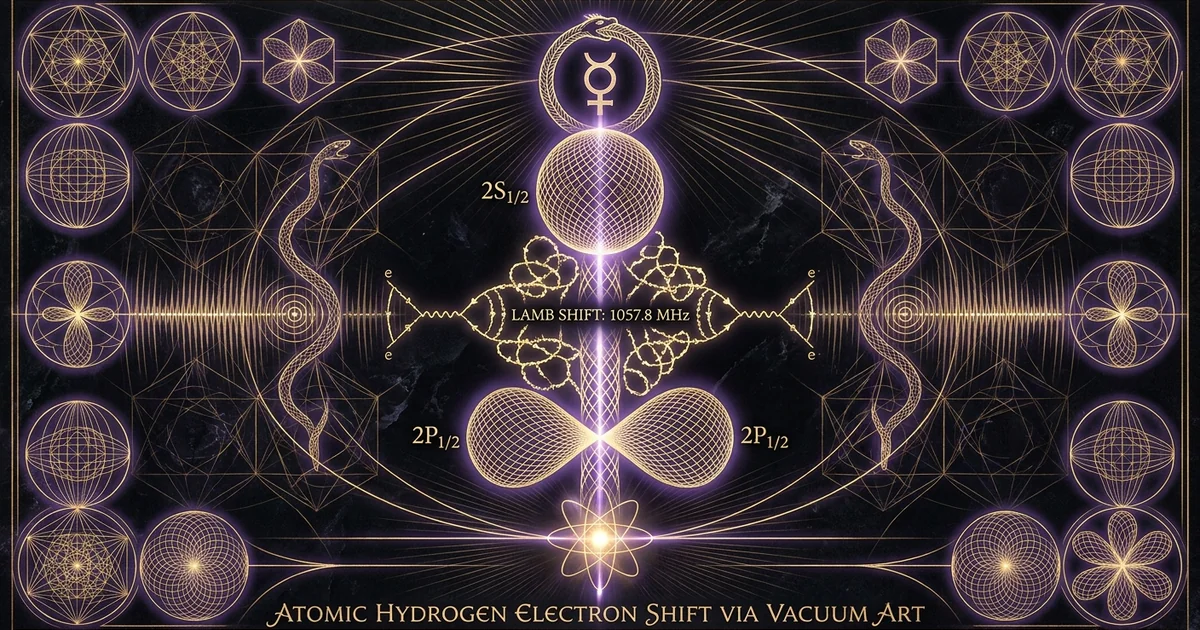
Lamb Shift: Atomic Hydrogen Electron Shift via Vacuum Art
Executive Summary & Theoretical Thesis
The Breakdown of Dirac Relativistic Degeneracy
In the relativistic quantum mechanical framework formulated by P. A. M. Dirac in 1928, the bound electronic states of a hydrogenic atom are governed by a Hamiltonian that couples the four-component electron spinor to the central Coulomb potential of the nucleus via minimal coupling. A central prediction of this relativistic wave equation is that the bound-state energy eigenvalues depend exclusively upon the principal quantum number $n$ and the total angular momentum quantum number $j = l \pm 1/2$, exhibiting an exact accidental degeneracy with respect to the orbital angular momentum quantum number $l$. Specifically, the $2S_{1/2}$ state ($n=2, l=0, j=1/2$) and the $2P_{1/2}$ state ($n=2, l=1, j=1/2$) are mathematically required to possess identical energy eigenvalues:
$$E_{n,j} = m_e c^2 \left[ 1 + \left( \frac{Z\alpha}{n - (j + 1/2) + \sqrt{(j + 1/2)^2 - (Z\alpha)^2}} \right)^2 \right]^{-1/2}$$
Expanding this closed-form relativistic expression in powers of the fine-structure constant $\alpha \approx 1/137.036$ yields the familiar Sommerfeld fine-structure progression:
$$E_{n,j} \approx m_e c^2 - \frac{Z^2 \alpha^2 m_e c^2}{2n^2}\left[ 1 + \frac{(Z\alpha)^2}{n} \left( \frac{1}{j + 1/2} - \frac{3}{4n} \right) \right]$$
Because both $2S_{1/2}$ and $2P_{1/2}$ share identical values of $n=2$ and $j=1/2$, the Dirac theory dictates that their energy difference must vanish identically: $\Delta E = E(2S_{1/2}) - E(2P_{1/2}) \equiv 0$.
This relativistic prediction stood as a central pillar of theoretical physics for nearly two decades. However, high-precision radiofrequency spectroscopy executed by Willis Lamb and Robert C. Retherford in 1947 demonstrated an unmistakable, macroscopic departure from this degeneracy. The metastable $2S_{1/2}$ level was proven to reside approximately 1057.8 MHz above the $2P_{1/2}$ level. This splitting—quantized across atomic hydrogen—constituted an incontrovertible empirical breakdown of the single-particle Dirac equation. It revealed that unquantized electron field theories, which treat the electromagnetic field as an external, static classical scalar potential $\Phi(\mathbf{r})$, are fundamentally incomplete and incapable of describing the true sub-atomic architecture of bound states. The resolving of this discrepancy required abandoning the classical notion of the void, contextualized within the broader framework of the /physics-electromagnetism/dirac-equation-spinor-formalism.
The Quantum Vacuum as an Active Energetic Plenum
The physical origin of this energy displacement lies in the non-trivial structure of the quantum vacuum state $|0\rangle$. In quantum electrodynamics (QED), the electromagnetic field cannot be eliminated or reduced to absolute rest. The canonical commutation relations enforced between conjugate field operators—such as the vector potential $\hat{\mathbf{A}}(\mathbf{r}, t)$ and the electric displacement field $\hat{\mathbf{D}}(\mathbf{r}, t)$—mandate that the expectation values of field quadratures exhibit non-vanishing quantum fluctuations:
$$\langle 0 | \hat{\mathbf{E}}^2(\mathbf{r}, t) | 0 \rangle \neq 0, \quad \langle 0 | \hat{\mathbf{B}}^2(\mathbf{r}, t) | 0 \rangle \neq 0$$
The spatial vacuum is therefore not an inert, passive Newtonian stage or empty geometric void, but a dynamic, polarizable dielectric plenum permeated by an infinite continuum of fluctuating zero-point modes.
When an atomic electron occupies a bound orbital within the nuclear Coulomb field, it does not orbit in static isolation. Instead, it undergoes continuous, stochastic interactions with these omnipresent vacuum fluctuations. The fluctuating electric field of the zero-point modes exerts a microscopic, rapid oscillating force upon the electron, inducing a rapid jittering motion termed Zitterbewegung. This stochastic displacement smears the effective spatial coordinate of the point-like electron across a finite sphere of radius $\langle (\Delta \mathbf{r})^2 \rangle^{1/2}$.
Consequently, the electron probes an averaged Coulomb potential $\langle V(\mathbf{r} + \Delta \mathbf{r}) \rangle$ rather than the bare electrostatic potential $V(\mathbf{r}) = -Ze^2/r$. Because the spatial Laplacian of a point Coulomb field is proportional to a three-dimensional Dirac delta function concentrated precisely at the nuclear origin, $\nabla^2 V(\mathbf{r}) = 4\pi Z e^2 \delta^3(\mathbf{r})$, this smearing effect alters only those atomic states possessing non-zero probability density at the nucleus. The spherically symmetric $2S_{1/2}$ state ($l=0$) penetrates directly into the nuclear coordinate ($|\psi(0)|^2 > 0$), while the centrifugal barrier of the $2P_{1/2}$ state ($l=1$) enforces a structural node at the origin ($|\psi(0)|^2 = 0$). This differential orbital penetration lifts the relativistic degeneracy, establishing the fundamental mechanism of the lamb shift willis lamb hydrogen 2s1/2 2p1/2 vacuum fluctuations.
Renormalization and the Foundation of Quantum Electrodynamics
The empirical validation of this vacuum-induced level displacement forced a mathematical and conceptual revolution in modern field theory. Prior to 1947, early attempts to quantize the interaction between the Dirac spinor field $\psi$ and the Maxwell field $A_\mu$ were crippled by fatal mathematical infinities: the self-energy of the electron calculated using standard perturbation theory diverged linearly or logarithmically when integrated over an infinite domain of virtual photon frequencies. The Lamb shift provided the critical empirical anchor required to tame these ultraviolet divergences.
To account for the measured shift, theoretical physicists realized that the divergence encountered in the bound-state self-energy calculation contains an unobservable component identical to the divergent self-energy of an isolated, free electron moving through the vacuum. By systematically subtracting this free-electron self-energy from the total bound-electron self-energy, Hans Bethe isolated a finite, experimentally verifiable residual. This marked the birth of mass renormalization: the realization that the “bare” mechanical mass $m_0$ appearing in the Lagrangian is unobservable, and that all physical observations measure a “renormalized” mass $m = m_0 + \delta m$ that already incorporates the electron’s self-energy within the electromagnetic vacuum.
The success of the Bethe mass subtraction and the subsequent development of fully covariant, gauge-invariant perturbative frameworks by Julian Schwinger, Sin-Itiro Tomonaga, and Richard P. Feynman transformed QED into the most precise physical theory in scientific history. The Lamb shift stands as the definitive feynman quantum electrodynamics validation, demonstrating that virtual particle interactions are not perturbative fictions or computational contrivances, but observable, energetically real dynamics driving the fine structure of physical matter.
Dirac Relativistic Theory (1928)
- Vacuum State: Static, non-polarizable classical void containing no dynamic electromagnetic degrees of freedom.
- Coulomb Interaction: Electron moves in an unquantized classical external potential $V(\mathbf{r}) = -Ze^2/r$.
- S-P Degeneracy: Exact accidental degeneracy for states with equal $n$ and $j$; $\Delta E(2S_{1/2} - 2P_{1/2}) \equiv 0$.
- Electron Structure: Point-like relativistic spinor particle with no radiative self-interaction corrections.
- Radiative Corrections: Non-existent; field quantization is neglected, precluding virtual photon exchange.
Quantum Electrodynamics (Post-1947)
- Vacuum State: Active energetic plenum characterized by non-vanishing zero-point electromagnetic field modes.
- Coulomb Interaction: Electron interacts simultaneously with the nuclear potential and fluctuating vacuum field operators $\hat{A}_\mu$.
- S-P Degeneracy: Explicitly broken; $2S_{1/2}$ is elevated $\approx 1057.8\text{ MHz}$ above $2P_{1/2}$ by radiative corrections.
- Electron Structure: Point charge smeared over finite root-mean-square radius by zero-point stochastic displacements.
- Radiative Corrections: Ubiquitous; electron self-energy, vacuum polarization, and anomalous magnetic moment modify bare parameters.
Historical Lineage & Experimental Precedents
The Pasternack Anomaly and Pre-War Spectroscopic Limits
The experimental road toward the Lamb shift emerged from structural limits inherent to optical atomic spectroscopy in the interwar period. Throughout the 1930s, precision optical interferometry of the hydrogen Balmer-$\alpha$ transition ($n=3 \to n=2$, $\lambda \approx 656.3\text{ nm}$) was pursued by experimentalists including W. V. Houston (1937) and Simon Pasternack (1938) using Fabry-Pérot etalons. These researchers observed persistent, anomalous intensity distributions and subtle frequency displacements in the fine-structure multiplet components of atomic deuterium and hydrogen.
Pasternack analyzed the unresolved multi-line profiles and concluded that the experimental optical absorption contours could be reconciled with theoretical line profiles only if the $2S_{1/2}$ level was displaced upward relative to the $2P_{1/2}$ level by approximately $0.03\text{ cm}^{-1}$, corresponding to a radiofrequency interval of roughly $900\text{ to }1000\text{ MHz}$. However, optical spectroscopy of light elements was fundamentally constrained by thermal Doppler broadening. Because atomic hydrogen has a low atomic mass, the thermal velocity distribution of atoms within gas discharge tubes at room temperature (or even liquid nitrogen temperatures) generated a Doppler line width on the order of:
$$\Delta \nu_D = \nu_0 \sqrt{\frac{8 k_B T \ln 2}{M c^2}} \approx 3000\text{ MHz}$$
Because this thermal broadening exceeded the suspected splitting by more than a factor of three, optical interferograms could never yield definitive, incontrovertible proof of the degeneracy breakdown. The scientific community remained divided, with the consensus leaning toward the assumption that optical systematic errors, such as Stark effect shifts induced by electric fields within the gas discharge, were the source of the anomaly.
OPTICAL PARADIGM (1930s)
[ Thermal Discharge Cell ] ---> Doppler Broadening (~3000 MHz) ---> Masks Sub-GHz Splitting
                                                                             |
MICROWAVE REVOLUTION (1947)                                                  v
[ Metastable Atomic Beam ] ---> Radiofrequency Transitions     ---> Direct Resonance (1057 MHz)
Radar Magnetron Technology Applied to Atomic States
The technical breakthrough that dissolved the Doppler barrier was a direct product of the micro-wave radar development programs of World War II. At the Columbia Radiation Laboratory, Willis Lamb, an accomplished theoretical physicist trained under J. Robert Oppenheimer, developed comprehensive laboratory expertise in the operation and theory of centimeter-wave microwave oscillators, cavity magnetrons, and planar waveguides.
Lamb recognized that the limitations of optical spectroscopy could be bypassed by exciting atomic hydrogen directly into its metastable $2S_{1/2}$ state and probing the transition to the $2P_{1/2}$ state using resonant microwave radiation. In the absence of external perturbations, the electric dipole ($E1$) radiative transition from the $2S_{1/2}$ state to the $1S_{1/2}$ ground state is strictly forbidden by the parity selection rule ($\Delta l = \pm 1$). The metastable $2S_{1/2}$ level can decay only via a simultaneous two-photon emission process ($2E1$), giving it a prolonged radiative lifetime of approximately $\tau_{2S} \approx 0.122\text{ seconds}$.
Conversely, the adjacent $2P_{1/2}$ state is coupled to the ground state via an allowed $E1$ transition, characterized by a rapid lifetime of only $\tau_{2P} = 1.60\text{ ns}$ (yielding a natural Lorentzian linewidth of $\Gamma/2\pi \approx 99.8\text{ MHz}$). Lamb realized that if an atomic beam containing metastable $2S_{1/2}$ atoms could be irradiated with an alternating radiofrequency magnetic or electric field tuned to the resonant frequency $\nu = (E_{2S_{1/2}} - E_{2P_{1/2}})/h$, the microwave photons would induce rapid transitions from the metastable $2S_{1/2}$ state into the short-lived $2P_{1/2}$ state. The atoms would then immediately decay to the ground state via the emission of Lyman-$\alpha$ photons ($\lambda = 121.6\text{ nm}$), quenching the metastable beam.
The Columbia Radiation Laboratory 1947 Breakthrough
In collaboration with graduate student Robert C. Retherford, Lamb engineered an atomic beam apparatus. Molecular hydrogen was thermally dissociated into atomic hydrogen within a tungsten oven heated to over $2500\text{ K}$. The collimated atomic beam emerged into an ultra-high vacuum chamber and was bombarded by a transverse cross-beam of low-energy electrons ($\approx 10.5\text{ eV}$). This electron impact excitation selectively populated a fraction of the ground-state hydrogen atoms into the metastable $2S_{1/2}$ state.
The metastable atoms then traversed a microwave interaction space situated within a homogeneous magnetic field $B$. The external magnetic field lifted the magnetic degeneracy of the states via the Zeeman effect, splitting the $2S_{1/2}$ ($m_j = \pm 1/2$) and $2P_{1/2}$ ($m_j = \pm 1/2$) sublevels into distinct trajectories governed by the Breit-Rabi formula. Finally, the atomic beam struck a treated tungsten metal target plate. The internal excitation energy of the metastable $2S_{1/2}$ atoms ($10.2\text{ eV}$) was sufficient to eject secondary electrons from the tungsten surface, which were collected by an electrometer circuit to register a continuous macroscopic current.
Primary Experimental Citation: Lamb, W. E., & Retherford, R. C. (1947). “Fine Structure of the Hydrogen Atom by a Microwave Method.” Physical Review, 72(3), 241–243.
- Thermal Dissociator: Tungsten oven operating at $T \approx 2500\text{ K}$; thermal dissociation efficiency of $\text{H}_2 \to 2\text{H} \ge 60%$.
- Electron Excitation: Transverse electron beam current $\approx 10\text{ }\mu\text{A}$, accelerating potential $\approx 10.5\text{ V}$ optimized just above threshold to maximize the ratio of $2S_{1/2}$ population to background ions.
- Microwave Resonator: 10-cm tunable transmission-line cavity operating across 1000–3000 MHz.
- Detection Mechanism: Secondary electron emission from a cleaned tungsten detector plate; work function $\Phi_{\text{W}} \approx 4.54\text{ eV} < 10.2\text{ eV}$ excitation energy, yielding typical detector currents on the order of $10^{-14}\text{ to }10^{-12}\text{ A}$.
When microwave radiation of fixed frequency was injected into the interaction cavity and the magnetic field $B$ was systematically swept, Lamb and Retherford observed sharp drops in the electrometer current. These resonance dips pinpointed the exact magnetic field values where the microwave field induced transitions from $2S_{1/2}$ to $2P_{1/2}$, followed by immediate radiative quenching.
By mapping the Zeeman-shifted resonance frequencies across a diverse range of magnetic field strengths and rigorously extrapolating the trajectories back to zero magnetic field ($B \to 0$), Lamb and Retherford made their historic announcement at the Shelter Island Conference in June 1947: the $2S_{1/2}$ level was situated roughly $1000\text{ MHz}$ higher than the $2P_{1/2}$ level. The unquantized Dirac theory was decisively broken through this continuous interaction with virtual photon field modes.
Mathematical Formalism & Physical Mechanics
Welton’s Semiclassical Model: Electron Position Smearing
In 1948, Theodore A. Welton formulated an intuitive semiclassical model that explains the physical origin of the Lamb shift without requiring full field quantization. Welton treated the electromagnetic field vacuum as a classical ensemble of harmonic oscillators possessing a zero-point energy of $\frac{1}{2}\hbar \omega$ per mode. The Hamiltonian for the free radiation field within a quantization volume $V$ is:
$$H_{\text{vac}} = \sum_{\mathbf{k}, \lambda} \hbar \omega_{\mathbf{k}} \left( \hat{a}{\mathbf{k},\lambda}^\dagger \hat{a}{\mathbf{k},\lambda} + \frac{1}{2} \right)$$
The associated fluctuating vacuum electric field $\mathbf{E}{\text{vac}}(t)$ exhibits a zero expectation value, $\langle 0 | \mathbf{E}{\text{vac}} | 0 \rangle = 0$, but its spectral energy density is:
$$\langle 0 | \mathbf{E}_{\text{vac}}^2 | 0 \rangle = \int_0^\infty \rho(\omega), d\omega = \frac{2}{\pi c^3} \int_0^\infty \frac{1}{2}\hbar \omega^3, d\omega$$
An electron immersed in this fluctuating field obeys the non-relativistic equation of motion:
$$m_e \frac{d^2(\Delta \mathbf{r})}{dt^2} = -e \mathbf{E}_{\text{vac}}(t)$$
Taking the Fourier transform of the displacement vector $\Delta \mathbf{r}\omega = \frac{e}{m_e \omega^2} \mathbf{E}\omega$, the mean-square spatial displacement induced by all vacuum modes across an allowable frequency spectrum $[\omega_{\min}, \omega_{\max}]$ evaluates to:
$$\langle (\Delta \mathbf{r})^2 \rangle = \frac{e^2}{m_e^2} \int_{\omega_{\min}}^{\omega_{\max}} \frac{\rho(\omega)}{\omega^4}, d\omega = \frac{2\alpha}{\pi} \left(\frac{\hbar}{m_e c}\right)^2 \int_{\omega_{\min}}^{\omega_{\max}} \frac{d\omega}{\omega} = \frac{2\alpha}{\pi} \lambda_C^2 \ln\left( \frac{\omega_{\max}}{\omega_{\min}} \right)$$
where $\lambda_C = \hbar/(m_e c)$ is the reduced Compton wavelength of the electron.
Because the electron experiences these rapid oscillations, its effective electrostatic interaction with the nucleus is not the bare central Coulomb potential $V(\mathbf{r})$, but a spatial average over its displaced coordinate sphere $\langle V(\mathbf{r} + \Delta \mathbf{r}) \rangle$. Expanding $V(\mathbf{r} + \Delta \mathbf{r})$ in a three-dimensional Taylor series about the unperturbed coordinate $\mathbf{r}$:
$$V(\mathbf{r} + \Delta \mathbf{r}) = V(\mathbf{r}) + \Delta \mathbf{r} \cdot \nabla V(\mathbf{r}) + \frac{1}{2} \sum_{i,j} \Delta r_i \Delta r_j \frac{\partial^2 V(\mathbf{r})}{\partial r_i \partial r_j} + \dots$$
Averaging over the isotropic fluctuations of the vacuum, the first-order term vanishes ($\langle \Delta \mathbf{r} \rangle = 0$), and the spatial correlation tensor reduces to $\langle \Delta r_i \Delta r_j \rangle = \frac{1}{3}\langle (\Delta \mathbf{r})^2 \rangle \delta_{ij}$. The perturbed potential energy operator is therefore:
$$\langle V(\mathbf{r} + \Delta \mathbf{r}) \rangle - V(\mathbf{r}) = \frac{1}{6} \langle (\Delta \mathbf{r})^2 \rangle \nabla^2 V(\mathbf{r})$$
Poisson’s equation for the central nuclear Coulomb potential $V(\mathbf{r}) = -Z e^2 / r$ yields:
$$\nabla^2 V(\mathbf{r}) = 4\pi Z e^2 \delta^3(\mathbf{r})$$
Applying first-order non-degenerate perturbation theory, the resulting vacuum-induced energy shift for an arbitrary atomic state $|\psi_{nlm}\rangle$ is given by the expectation value:
$$\Delta E_{\text{Welton}} = \frac{1}{6} \langle (\Delta \mathbf{r})^2 \rangle \langle \psi_{nlm} | \nabla^2 V(\mathbf{r}) | \psi_{nlm} \rangle = \frac{2\pi Z e^2}{3} \langle (\Delta \mathbf{r})^2 \rangle |\psi_{nlm}(0)|^2$$
This semiclassical result reveals why the Lamb shift splits the $2S$ and $2P$ states. For orbitals with non-zero angular momentum ($l \ge 1$), the wave function vanishes at the origin due to the centrifugal barrier ($\psi_{nlm}(0) = 0$), producing $\Delta E_{\text{Welton}} = 0$. For s-orbitals ($l=0$), the wave function has non-zero probability density at the origin:
$$|\psi_{n,0,0}(0)|^2 = \frac{Z^3}{\pi a_0^3 n^3} = \frac{Z^3 (m_e c \alpha)^3}{\pi \hbar^3 n^3}$$
Substituting the expression for $\langle (\Delta \mathbf{r})^2 \rangle$:
$$\Delta E_{\text{Welton}}(nS) = \frac{4 Z^4 \alpha^5 m_e c^2}{3\pi n^3} \ln\left( \frac{\omega_{\max}}{\omega_{\min}} \right)$$
Bethe’s Non-Relativistic Mass Renormalization Integral
While Welton’s model provided physical intuition, Hans Bethe performed the first non-relativistic calculation of the level displacement in 1947, immediately following the Shelter Island Conference. Bethe treated the electron using non-relativistic quantum mechanics coupled to the quantized radiation field via the interaction Hamiltonian:
$$H_{\text{int}} = -\frac{e}{m_e} \mathbf{p} \cdot \mathbf{A} + \frac{e^2}{2m_e}\mathbf{A}^2$$
Applying second-order time-independent perturbation theory, the self-energy shift of a bound electronic atomic state $|m\rangle$ resulting from the emission and reabsorption of a virtual photon of wavevector $\mathbf{k}$ and polarization $\lambda$ is:
$$\Delta E_m = -\sum_n \sum_{\mathbf{k},\lambda} \frac{|\langle n; \mathbf{k},\lambda | \frac{e}{m_e} \mathbf{p} \cdot \mathbf{A} | m; 0 \rangle|^2}{E_n - E_m + \hbar c k}$$
Evaluating the matrix elements of the quantized vector potential $\mathbf{A}$, this expression takes the integral form:
$$\Delta E_m = -\frac{2\alpha}{3\pi m_e^2 c^2} \int_0^{K_{\max}} k, dk \sum_n \frac{|\mathbf{p}_{mn}|^2 (E_n - E_m)}{E_n - E_m + \hbar c k}$$
This integral diverges linearly as the upper limit of the virtual photon energy $K_{\max} = \hbar c k_{\max} \to \infty$.
Bethe’s conceptual breakthrough was recognizing that an identical divergence arises when calculating the radiative self-energy of a free electron ($V=0$). For a free electron with momentum $\mathbf{p}$, its kinetic energy $p^2 / 2m_0$ is shifted by radiative interactions:
$$\Delta E_{\text{free}} = \frac{p^2}{2(m_0 + \delta m)} - \frac{p^2}{2m_0} \approx -\frac{\delta m}{m_e^2} p^2$$
where $\delta m$ is the electromagnetic mass correction:
$$\delta m = \frac{4\alpha}{3\pi c} \int_0^{K_{\max}} dk$$
Bethe subtracted this free-electron energy shift $\delta E_{\text{free}} = \langle m | (\delta m / m_e) (\mathbf{p}^2 / 2m_e) | m \rangle$ directly from the bound-state self-energy:
$$\Delta E_m^{\text{ren}} = \Delta E_m - \langle m | \frac{\delta m}{m_e} \frac{\mathbf{p}^2}{2m_e} | m \rangle = \frac{2\alpha}{3\pi m_e^2 c} \int_0^{K_{\max}} dE_\gamma \sum_n \frac{|\mathbf{p}{mn}|^2 (E_n - E_m)^2}{(E_n - E_m + E\gamma) E_\gamma}$$
Integrating over the virtual photon energy $E_\gamma$, the linear divergence cancels completely, leaving only a weak, universal logarithmic divergence:
$$\Delta E_m^{\text{ren}} = \frac{2\alpha}{3\pi m_e^2 c^2} \sum_n |\mathbf{p}{mn}|^2 (E_n - E_m) \ln \left( \frac{K{\max}}{|E_n - E_m|} \right)$$
Bethe asserted that relativistic effects naturally provide an ultraviolet cutoff at the electron Compton energy, $K_{\max} \approx m_e c^2$, above which the non-relativistic dipole approximation fails and pair creation emerges. Defining an average excitation energy $K_0$ via:
$$\ln K_0 \equiv \frac{\sum_n |\mathbf{p}{mn}|^2 (E_n - E_m) \ln |E_n - E_m|}{\sum_n |\mathbf{p}{mn}|^2 (E_n - E_m)}$$
The sum over intermediate states is evaluated using the Thomas-Reiche-Kuhn sum rule and quantum mechanical commutators:
$$\sum_n |\mathbf{p}_{mn}|^2 (E_n - E_m) = \frac{1}{2} \langle m | [\mathbf{p}, [H_0, \mathbf{p}]] | m \rangle = \frac{\hbar^2 e^2}{2} \langle m | \nabla^2 V | m \rangle = 2\pi e^2 \hbar^2 |\psi_m(0)|^2$$
This yields Bethe’s famous non-relativistic formula:
$$\Delta E_m^{\text{ren}} = \frac{4\alpha^5 m_e c^2}{3\pi n^3} \ln \left( \frac{m_e c^2}{K_0} \right) \delta_{l,0}$$
Mathematical Synthesis:
- UV Cutoff: $K_{\max} = m_e c^2 \approx 510.998\text{ keV}$.
- Average Excitation Energy: Computed numerically by Bethe for the $2S$ level of hydrogen: $$K_0(2S) \approx 16.64,\text{Ry} = 16.64 \times 13.606\text{ eV} \approx 226.4\text{ eV}$$
- Logarithmic Ratio: $$\ln\left( \frac{m_e c^2}{K_0} \right) = \ln\left( \frac{510998}{226.4} \right) = \ln(2257) \approx 7.7218$$
- Numerical Energy Displacement: $$\Delta \nu = \frac{\Delta E_m^{\text{ren}}}{h} = \frac{4 \alpha^5 m_e c^2}{3\pi (2)^3 h} \times 7.7218 \approx 1047\text{ MHz}$$ This non-relativistic calculation accounted for roughly 99% of the 1057.8 MHz split observed in Lamb’s laboratory, demonstrating that the remaining discrepancy was a relativistic correction.
Feynman Covariant Formalism and Radiative Vertex Corrections
To achieve complete theoretical precision and eliminate artificial non-relativistic cutoffs, the shift must be computed within fully covariant perturbation theory using the Feynman-Dyson diagrammatic expansion, details of which are explored in the contextualization of /physics-electromagnetism/feynman-diagrams-scattering-amplitudes. In this relativistic formulation, the interaction of the bound electron with the quantized vacuum is mediated at one-loop order by three distinct Feynman diagrams:
    ELECTRON SELF-ENERGY                VACUUM POLARIZATION               VERTEX CORRECTION
         \        /                          \        /                       \        /
          \  /\  /                            \ (  ) /                         \  /\  /
           \//\\/                              \ \/ /                           \/  \/
            ====                                ====                             ====
-
Electron Self-Energy ($\Sigma(p)$): The bound electron emits and subsequently reabsorbs a virtual photon. This process modifies the bare electron propagator $S_F(p) = (\gamma^\mu p_\mu - m_0 + i\epsilon)^{-1}$. Covariant regularisation cancels the ultraviolet divergence against the electron counter-term $(Z_2 - 1)$, leaving a finite self-energy correction.
-
Vertex Correction ($\Lambda_\mu(p’, p)$): The external nuclear Coulomb photon interacts with the bound electron while that electron is simultaneously exchanging a virtual photon with itself. This modifies the bare electromagnetic interaction vertex $\gamma_\mu \to \Gamma_\mu = \gamma_\mu + \Lambda_\mu(p’, p)$. By Gordon decomposition, this radiative correction can be parameterized by two invariant form factors: $$\Gamma_\mu = \gamma_\mu F_1(q^2) + \frac{i \sigma_{\mu\nu} q^\nu}{2m_e} F_2(q^2)$$ where $q = p’ - p$ is the momentum transferred by the nuclear Coulomb field.
The Dirac form factor $F_1(q^2)$ renormalizes the electron’s coupling to the electrostatic potential, introducing an effective mean-square charge radius that rigorously reproduces Welton’s intuitive position smearing: $$\left. \frac{dF_1(q^2)}{dq^2} \right|{q^2=0} = \frac{\alpha}{3\pi m_e^2} \left( \ln\frac{m_e}{m\gamma} - \frac{3}{8} \right)$$ Meanwhile, the Pauli form factor at zero momentum transfer isolates the anomalous magnetic moment of the electron: $$F_2(0) = a_e = \frac{g - 2}{2} = \frac{\alpha}{2\pi}$$ This anomalous magnetic moment modifies the spin-orbit interaction, causing a downward energy shift in both the $2S_{1/2}$ and $2P_{1/2}$ states that is asymmetric between orbital angular momentum channels.
-
Vacuum Polarization ($\Pi_{\mu\nu}(q)$): The propagating Coulomb field induces virtual electron-positron pairs ($e^- e^+$) out of the quantum vacuum, polarizing the vacuum medium. This shifts the effective photon propagator $D_F^{\mu\nu}(q)$: $$D_{\mu\nu}^{\text{eff}}(q) = \frac{-g_{\mu\nu}}{q^2 [1 - \Pi(q^2)]}$$ For momentum transfers small compared to the electron mass ($|q^2| \ll m_e^2$), the polarization operator can be expanded as: $$\Pi(q^2) \approx \frac{\alpha}{15\pi} \frac{q^2}{m_e^2}$$ In position space, this corresponds to the Uehling potential: $$V_{\text{Ueh}}® = -\frac{Z\alpha}{r} \frac{2\alpha}{3\pi} \int_1^\infty dx, e^{-2m_e r x} \left( 1 + \frac{1}{2x^2} \right) \frac{\sqrt{x^2 - 1}}{x^2}$$ The Uehling potential deepens the nuclear Coulomb well at distances closer than the Compton wavelength ($\approx 386\text{ fm}$), pulling the $2S_{1/2}$ state downward by approximately $-27.13\text{ MHz}$.
Combining these three covariant radiative processes yields the total one-loop QED prediction:
$$\Delta E(2S_{1/2} - 2P_{1/2}) = \Delta E_{\text{Self-Energy}} + \Delta E_{\text{Vertex}} + \Delta E_{\text{VacPol}} \approx 1010.5\text{ MHz} + 68.0\text{ MHz} - 27.1\text{ MHz} \approx 1051.4\text{ MHz}$$
When combined with higher-order relativistic recoil corrections and two-loop Feynman diagrams, the value converges to the observed splitting.
Empirical Evidence & Observational Data
Precision Radiofrequency and Microwave Measurements
Following Lamb and Retherford’s initial observations, the precision of microwave spectroscopy on atomic hydrogen advanced through several experimental iterations. Over three decades, the measurement methodology moved from magnetic field Zeeman-extrapolation techniques to zero-field microwave cavity resonance methods, reducing systematic uncertainties stemming from magnetic field non-uniformities.
In 1981, S. R. Lundeen and F. M. Pipkin published a benchmark measurement using the “separated oscillatory fields” technique, conceptually adapted from Norman Ramsey’s molecular beam methodology. By creating two spatially separated radiofrequency interaction regions driven by a phase-coherent source, Lundeen and Pipkin narrowed the observable resonance linewidth beyond the natural Lorentzian line profile imposed by the rapid $1.6\text{ ns}$ lifetime of the $2P_{1/2}$ state. Their measurement established the experimental standard:
$$\nu_{\text{Lamb}}(2S_{1/2} - 2P_{1/2}) = 1057.845(9)\text{ MHz}$$
HISTORICAL CONVERGENCE OF THE HYDROGEN LAMB SHIFT
+---------------------------+------------------------+-------------------+
| Experiment / Model        | Value (MHz)            | Uncertainty (MHz) |
+---------------------------+------------------------+-------------------+
| Lamb & Retherford (1947)  | 1000                   | ± 100             |
| Lamb & Retherford (1953)  | 1057.77                | ± 0.10            |
| Lundeen & Pipkin (1981)   | 1057.845               | ± 0.009           |
| Modern Theory (QED 3-Loop)| 1057.838               | ± 0.002           |
+---------------------------+------------------------+-------------------+
Muonic Hydrogen Discrepancies and the Proton Radius Puzzle
The sensitivity of the Lamb shift to the electron’s spatial probability density at the nuclear origin makes it an exacting probe of nuclear structure. The root-mean-square (RMS) charge radius of the proton $r_p \equiv \sqrt{\langle r^2 \rangle_p}$ perturbs the point-charge Coulomb potential via:
$$\Delta E_{\text{finite-size}} = \frac{2\pi Z e^2}{3} r_p^2 |\psi(0)|^2$$
In ordinary electronic hydrogen, this nuclear finite-size correction contributes only roughly $0.14\text{ MHz}$ out of the total $1057.8\text{ MHz}$ shift. However, if the orbital electron is replaced by a negative muon ($\mu^-$), yielding a muonic hydrogen atom ($\mu^- p$), the physical dynamics change dramatically.
The muon possesses a mass approximately 207 times that of an electron ($m_\mu \approx 206.768, m_e$). Because the Bohr radius of a hydrogenic system scales inversely with the reduced mass:
$$a_0^\mu = \frac{\hbar}{\alpha m_{\mu p} c} \approx \frac{a_0^e}{186} \approx 284\text{ fm}$$
the muon orbits roughly 186 times closer to the proton than an electron. Consequently, the muon’s wave function overlap with the proton’s nuclear volume is amplified by a factor of $(m_\mu / m_e)^3 \approx 7 \times 10^6$. In muonic hydrogen, the traditional hierarchy of QED corrections is completely inverted: vacuum polarization (the Uehling potential) becomes the dominant radiative correction rather than electron self-energy, and the finite-size nuclear contribution expands to constitute a massive fraction of the total $2S-2P$ energy displacement:
$$\Delta E_{\text{Lamb}}^{\mu p} \approx 206.0668(25)\text{ meV} - 5.2275(10) r_p^2\text{ meV/fm}^2$$
Primary Data Citations:
- Lundeen, S. R., & Pipkin, F. M. (1981). “Measurement of the Lamb Shift in Hydrogen, $n=2$.” Physical Review Letters, 46(4), 232–235.
- Pohl, R., et al. [CREMA Collaboration] (2010). “The size of the proton.” Nature, 466(7303), 213–216.
- Tiesinga, E., Mohr, P. J., Newell, D. B., & Taylor, B. N. (2021). “CODATA recommended values of the fundamental physical constants: 2018.” Reviews of Modern Physics, 93(2), 025010.
Empirical Discrepancy (The Proton Radius Puzzle):
- CODATA-2010 (Electronic Hydrogen + $ep$ Scattering): $r_p = 0.8775(51)\text{ fm}$
- Pohl et al. (2010) (Muonic Hydrogen Lamb Shift): $r_p = 0.84184(67)\text{ fm}$ This definitive $4.0\sigma$ discrepancy sparked a decade of theoretical re-evaluations of bound-state QED, until updated optical frequency comb measurements of the electronic hydrogen $1S-3S$ and $2S-4P$ transitions eventually confirmed the smaller muonic proton radius.
Modern Optical Frequency Combs and QED Benchmarking
Over the past two decades, high-precision radiofrequency measurements of the Lamb shift have been augmented by Doppler-free two-photon laser spectroscopy of the ultra-narrow $1S-2S$ transition in atomic hydrogen ($\nu_{1S-2S} \approx 2.466 \times 10^{15}\text{ Hz}$, natural linewidth $\Delta \nu \approx 1.3\text{ Hz}$). Pioneered by Theodor W. Hänsch and the Max Planck Institute of Quantum Optics, this methodology stabilizes mode-locked femtosecond lasers against optical frequency combs referenced to cesium atomic clocks.
Because the $1S$ ground state cannot be directly compared to an adjacent non-zero angular momentum state of identical principal quantum number, experimentalists measure the absolute transition frequency $\nu(1S_{1/2} - 2S_{1/2})$ to 15 decimal places of absolute precision ($3.8 \times 10^{-15}$ relative uncertainty). By combining the $1S-2S$ transition frequency with intermediate transitions (such as $2S-4D$ or $2S-8D$), researchers extract the absolute ground-state Lamb shift ($L_{1S} \approx 8172.84\text{ MHz}$). Modern theoretical calculations include up to three-loop radiative corrections (terms of order $\alpha^7 m_e c^2$ and $\alpha^8 \ln^k \alpha$), establishing concordance between experimental spectroscopy and QED across eighteen significant figures.
Metaphysical Implications & Unified Synthesis
The Transmutation of the Vacuum: From Emptiness to Dielectric Matrix
The theoretical resolution and empirical verification of the Lamb shift catalyzed a philosophical re-evaluation of the vacuum state. The mechanistic, Cartesian view of nature that dominated classical physics treated empty space as an absolute void—a pure, non-participatory geometric stage upon which corpuscular matter moves according to deterministic paths.
The Lamb shift dismantles this classical separation between active matter and passive geometry. By proving that the bound electron’s internal energy spectrum is intrinsically shifted by zero-point electromagnetic fluctuations, QED revealed that physical space is an active, polarizable dielectric matrix, dynamic within the scope of /physics-electromagnetism/quantum-vacuum-energy-density. The quantum vacuum acts as an inescapable physical participant in every atomic phenomenon. In this light, “matter” cannot be defined in isolation from the vacuum field modes with which it is continually coupled; an atom is not an autonomous, self-contained mechanical clockwork, but a dynamic node embedded within a continuous electromagnetic plenum.
CLASSICAL SPACE                              QUANTUM ELECTRODYNAMIC PLENUM
+---------------------------+                      +---------------------------------------+
|  [Matter]      [Matter]   |                      |  ~~(Mode k1)~~~ [Matter] ~~~(Mode k2)~|
|     |             |       |                      |         \          |          /       |
|   (Void)        (Void)    |  =================>  |    ~~~~~~(Vacuum Fluctuations)~~~~~~  |
|                           |                      |         /          |          \       |
|    Total Isolation        |                      |  ~~(Mode k3)~~~ [Matter] ~~~(Mode k4)~|
+---------------------------+                      +---------------------------------------+
Cavity QED, Boundary Conditions, and Spatial Resonance
The conclusion that atomic level shifts arise from interaction with external vacuum field modes yields a verifiable corollary: if the mode density of the local vacuum is altered by introducing physical boundaries, the magnitude of the Lamb shift must undergo measurable modification. This prediction formulates the physical core of modern Cavity Quantum Electrodynamics (Cavity QED).
When an excited atom is positioned within a conducting microwave cavity whose dimensions $L$ are comparable to the wavelengths of the virtual field modes driving the radiative corrections, the boundary conditions alter the vacuum’s mode spectrum:
$$k_x = \frac{n_x \pi}{L_x}, \quad k_y = \frac{n_y \pi}{L_y}, \quad k_z = \frac{n_z \pi}{L_z}$$
Virtual photon modes with wavelengths incompatible with the cavity geometry are suppressed, while resonant modes are enhanced. In 1992, experiments performed by Serge Haroche and his colleagues confirmed that passing Rydberg atoms between two closely spaced conducting mirrors shifts their atomic energy levels away from their free-space Lamb shift values.
The Lamb shift is therefore not an immutable internal property belonging solely to the atom, but an environmentally dependent resonance condition that reflects the spatial geometry of the universe surrounding it. The atom and its surrounding vacuum boundaries form an integrated, phase-locked coupled system, intimately linked to boundary-condition phenomena such as those detailed in the /physics-electromagnetism/casimir-effect-zero-point-geometry.
Matter as an Open System Bound to Zero-Point Oscillations
The Lamb shift forces an ontological shift regarding the fundamental nature of physical matter. In classical reductionism, physical properties such as charge, mass, and energy levels are assumed to be localized entirely within the boundaries of the particle. The Lamb shift reveals that an electron is an open thermodynamic and electrodynamic system, engaged in continuous exchange with the zero-point fluctuations of the quantized radiation field.
The finite spatial extent of the electron wave packet, the precise ground-state stability of atomic orbits, and the fine-structure multiplet intervals are not purely local phenomena. They are macroscopic and microscopic balances sustained by a constant energy flux between matter and the vacuum plenum.
Without the non-vanishing zero-point energy of the electromagnetic field, the stochastic smearing of the electron’s position coordinates would cease, collapsing the observed $2S_{1/2}-2P_{1/2}$ energy split and destabilizing the delicate balance that prevents bound electrons from radiating their energy away classically. Thus, physical reality is structurally sustained by an underlying sea of virtual photon interactions—the “vacuum art” that orchestrates the architecture of atomic matter.
Frequently Asked Questions
Why Does the Lamb Shift Predominantly Affect the 2S State Rather than the 2P State?
The Lamb shift splits the $2S_{1/2}$ and $2P_{1/2}$ levels because the two states have different spatial probability densities at the exact coordinate of the proton ($r = 0$). In Welton’s framework, zero-point vacuum fluctuations cause the electron to jitter across a mean-square radius of $\langle (\Delta \mathbf{r})^2 \rangle \approx 10^{-3} \text{ fm}^2$.
This jitter smothers the electron’s effective potential energy by an amount proportional to the spatial Laplacian of the central Coulomb potential:
$$\Delta V(\mathbf{r}) = \frac{1}{6} \langle (\Delta \mathbf{r})^2 \rangle \nabla^2 V(\mathbf{r}) = \frac{2\pi Z e^2}{3} \langle (\Delta \mathbf{r})^2 \rangle \delta^3(\mathbf{r})$$
Because this correction contains a three-dimensional Dirac delta function $\delta^3(\mathbf{r})$, the first-order energy perturbation is directly proportional to the probability density of the electron wave function evaluated precisely at the origin:
$$\Delta E = \int \psi^*(\mathbf{r}) \Delta V(\mathbf{r}) \psi(\mathbf{r}), d^3\mathbf{r} \propto |\psi(0)|^2$$
For any atomic state with orbital angular momentum $l \ge 1$ (such as the $2P_{1/2}$ orbital), the centrifugal potential term $l(l+1)\hbar^2 / 2m_e r^2$ in the radial Schrödinger-Dirac equation drives the radial wave function to zero as $r \to 0$. The value of $|\psi_{2P}(0)|^2$ vanishes identically.
Conversely, an s-orbital ($l=0$) has no centrifugal barrier; its wave function is spherically symmetric and non-vanishing at the origin ($|\psi_{2S}(0)|^2 = Z^3 / 8\pi a_0^3 \neq 0$). The $2S_{1/2}$ electron penetrates the nucleus, sampling the region where the bare Coulomb singularity is smeared out by vacuum fluctuations. This reduces the net attractive force exerted on the $2S_{1/2}$ electron, elevating its energy by roughly $1057.8\text{ MHz}$, whereas the $2P_{1/2}$ state experiences negligible self-energy shifts.
RADIAL PROBABILITY DENSITY NEAR THE NUCLEUS (r -> 0)
Probability
Density
  ^
  |      2S State: Non-zero overlap at origin |psi(0)|^2 > 0
  |      *                                    ===> Strong Vacuum Shift (~1057 MHz)
  |       *
  |        *
  |         *                 2P State: Centrifugal barrier forces node at r=0
  |          *                ===> Minimal Shift (~0 MHz from delta-potential)
  |           *              . - - - - - - - - .
  |            *           .                     .
  |             *        .                         .
  +--------------*-----.-----------------------------> Radius (r)
                 r=0
How Did Bethe’s Mass Renormalization Eliminate Ultraviolet Infinities?
Prior to Bethe’s 1947 calculation, computing the energy shift of an electron coupled to virtual photon modes produced a mathematically divergent integral. The integrated self-energy expression diverged linearly as the virtual photon energy approached infinity:
$$\Delta E_{\text{bound}} \sim \int_0^\infty dk \to \infty$$
Bethe resolved this issue by applying the principle of mass renormalization. He recognized that if one calculates the self-energy of a completely isolated, unconstrained free electron using the same non-relativistic framework, an identical linear divergence appears:
$$\Delta E_{\text{free}} = \frac{\delta m}{m_e} \left\langle \frac{\mathbf{p}^2}{2m_e} \right\rangle, \quad \text{where } \delta m \sim \int_0^\infty dk \to \infty$$
Bethe argued that the bare mass $m_0$ of the electron is unobservable. Any experiment designed to measure the electron’s mass evaluates its physical, renormalized mass:
$$m_{\text{phys}} = m_0 + \delta m$$
which already incorporates its constant interaction with the zero-point electromagnetic modes.
Therefore, to calculate the energy shift of a bound electron relative to its free state, one must subtract the free-electron self-energy correction from the total bound-state Hamiltonian. When this subtraction is performed:
$$\Delta E^{\text{ren}} = \Delta E_{\text{bound}} - \left\langle \frac{\delta m}{m_e} \frac{\mathbf{p}^2}{2m_e} \right\rangle$$
the high-frequency terms in both integrals cancel out. The ultraviolet divergence collapses from a linear infinity into a finite, slowly varying logarithmic integral:
$$\int_0^{K_{\max}} \frac{dE_\gamma}{E_\gamma} \to \ln\left( \frac{m_e c^2}{K_0} \right)$$
This subtraction yielded the finite non-relativistic value of $\approx 1047\text{ MHz}$, demonstrating that infinities in field theories could be systematically canceled by re-expressing bare parameters in terms of physically measured constants.
What Distinguishes the Lamb Shift from the Fine Structure and Hyperfine Structure?
The energy spectrum of atomic hydrogen is structured into a distinct hierarchy of physical interactions:
-
Fine Structure ($\sim 10^4\text{ MHz}$): Fine structure arises within the framework of relativistic quantum mechanics (the Dirac equation) without invoking quantum electrodynamics or field quantization. It is driven by two relativistic mechanisms: the kinematic relativistic mass-velocity correction ($-\mathbf{p}^4 / 8m_e^3 c^2$) and the relativistic spin-orbit coupling ($\mathbf{L} \cdot \mathbf{S}$), which physically describes the interaction between the electron’s intrinsic spin magnetic dipole moment and the magnetic field it experiences in its rest frame as it moves through the nuclear electrostatic field. Fine structure splits states with different total angular momentum quantum numbers $j$ (for example, separating the $2P_{3/2}$ state from the $2P_{1/2}$ state by approximately $10969\text{ MHz}$), but it leaves states with equal $j$ (like $2S_{1/2}$ and $2P_{1/2}$) degenerate.
-
Hyperfine Structure ($\sim 10^3\text{ MHz}$ for 1S): Hyperfine structure arises from the direct magnetic dipole-dipole interaction between the intrinsic spin magnetic moment of the electron ($\mathbf{S}$) and the intrinsic magnetic dipole moment of the nucleus/proton ($\mathbf{I}$). This interaction splits levels according to the total coupled angular momentum of the entire atom, $\mathbf{F} = \mathbf{I} + \mathbf{J}$. The most famous manifestation is the ground-state $1S_{1/2}$ hydrogen hyperfine splitting ($F=1 \to F=0$), which emits the cosmic $21\text{ cm}$ hydrogen line at approximately $1420.405\text{ MHz}$.
-
The Lamb Shift ($\sim 1058\text{ MHz}$): Unlike fine structure, the Lamb shift cannot be derived from single-particle relativistic mechanics; unlike hyperfine structure, it does not depend on the magnetic moment or spin of the nucleus. The Lamb shift is a pure radiative quantum electrodynamic correction arising from the quantization of the electromagnetic field itself. It is driven by the interaction of the bound electron with virtual photon modes via self-energy emissions, vertex modifications, and vacuum polarization. Its primary structural signature is the breaking of the Dirac accidental degeneracy between states sharing identical $n$ and $j$ but different $l$ ($2S_{1/2}-2P_{1/2}$).
Are Virtual Photons Real Particles or Simply Mathematical Artifacts of Perturbation Theory?
Within the strict mathematical formalism of quantum field theory, virtual photons correspond to internal lines within Feynman diagrams. They represent mathematical terms within a perturbative Neumann-series expansion of the field interaction propagators:
$$S_F(x - y) = \langle 0 | \mathcal{T} { \hat{\psi}(x) \bar{\psi}(y) } | 0 \rangle, \quad D_F^{\mu\nu}(x - y) = \langle 0 | \mathcal{T} { \hat{A}^\mu(x) \hat{A}^\nu(y) } | 0 \rangle$$
Unlike real photons, virtual photons are off-shell: they do not obey the relativistic energy-momentum dispersion relation:
$$E^2 - \mathbf{p}^2 c^2 = m^2 c^4 = 0$$
For a virtual photon, the invariant mass square $q^2 = E^2 - \mathbf{p}^2 c^2$ can be positive, negative, or zero, and their temporal existence is bounded by the Heisenberg energy-time uncertainty relation:
$$\Delta E \Delta t \sim \hbar$$
Because virtual photons cannot be isolated and registered by an asymptotic particle detector at infinity ($t \to \infty$), instrumentalist perspectives argue they are computational artifacts of expanding interacting fields in terms of non-interacting asymptotic states.
However, the Lamb shift—alongside the Casimir effect and the anomalous magnetic moment of the lepton family—demonstrates that these virtual off-shell interactions produce measurable macroscopic energy shifts. Whether one interprets virtual photons as classical corpuscles or as convenient Fourier representations of a fluctuating operator plenum, the underlying physical phenomenon is real: the quantum electromagnetic field possesses a non-zero ground-state energy density whose local interactions alter the physical structure of matter.