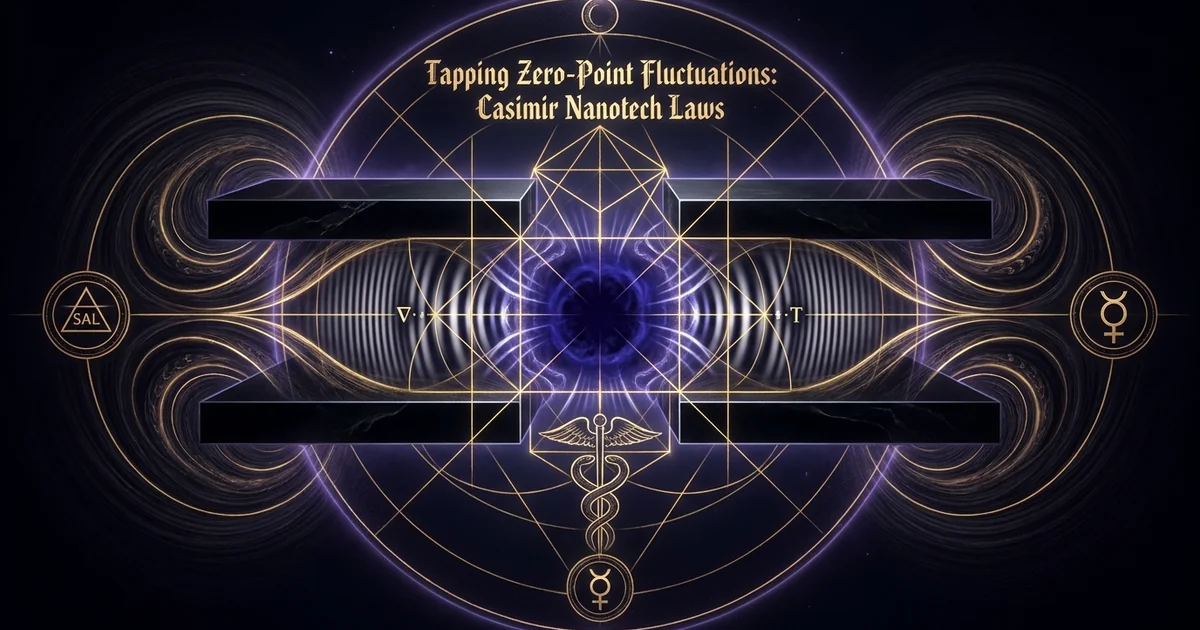
Tapping Zero-Point Fluctuations: Casimir Nanotech Laws
1. Executive Summary & Theoretical Thesis: Vacuum Boundary Modulation and Nanomechanical Agency
1.1 The Quantum Vacuum Ground State and Zero-Point Spectral Density
In standard quantum electrodynamics (QED), the vacuum ground state is formally structured as a dynamical continuum permeated by irreducible electromagnetic field fluctuations. Far from an inert spatial void, the ground state possesses a non-vanishing zero-point spectral energy density characterized by the canonical relation:
$$\rho(\omega) = \frac{\hbar \omega^3}{2\pi^2 c^3}$$
This expression arises directly from summing the ground-state energies $E_n = \frac{1}{2}\hbar\omega_n$ across all permissible modal wavevectors. When boundary conditions are imposed upon this continuum—such as the introduction of two parallel, perfectly conducting metallic interfaces separated by a sub-micron cavity distance $d$ along the $z$-axis—the infinite spectrum of vacuum modes is geometrically partitioned. Transverse electromagnetic modes possessing wavelengths exceeding $2d$ along the spatial normal are suppressed within the interior cavity.
Conversely, the unbounded exterior continuum supports a continuous, unconstrained spectrum of electromagnetic modes. This spatial imbalance in the density of virtual photon states establishes an asymmetric macroscopic radiation pressure. The resulting stress tensor across the boundary interfaces induces an attractive physical force directed inward toward the cavity center. This macroscopic manifestation of pure quantum electrodynamic boundary confinement is the static Casimir effect.
+---------------------------------------------------------------------------------------------------+
| UNBOUNDED EXTERIOR VACUUM                                                                         |
| Continuous Mode Density: rho(omega) = h-bar * omega^3 / (2 * pi^2 * c^3)                           |
| Virtual Photon Radiation Pressure: P_ext                                                          |
+---------------------------------------------------------------------------------------------------+
       ||                                                                                   ||
  Boundary Plate 1                                                                     Boundary Plate 2
       ||                       INTERIOR CAVITY (Distance: d)                               ||
       ||   Quantized Standing Modes: k_z = n * pi / d                                      ||
       ||   Suppressed Modes: lambda > 2d                                                   ||
       ||   Net Mode Deficit -> Reduced Interior Pressure (P_int < P_ext)                   ||
       ||                                                                                   ||
       || -------------> Force Vector (F/A)                         Force Vector (F/A) <----||
       ||                                                                                   ||
+---------------------------------------------------------------------------------------------------+
| UNBOUNDED EXTERIOR VACUUM                                                                         |
| Virtual Photon Radiation Pressure: P_ext                                                          |
+---------------------------------------------------------------------------------------------------+
1.2 Transcending the Stiction Regime: Zero-Point Energy as an Actuation Vector
Within modern microelectromechanical systems (MEMS) and nanoelectromechanical systems (NEMS), this vacuum-induced stress has historically been categorized as a catastrophic degradation mechanism known as stiction. When mechanical compliant elements, such as polysilicon cantilever beams, switches, or capacitive accelerometers, approach proximate substrates at operational gaps below 100 nm, the Casimir force scales non-linearly, overpowering classical mechanical restoring springs and causing irreversible structural adhesion.
Characterizing the Casimir effect merely as an engineering defect reflects a fundamental limitation of classical micro-engineering frameworks. The spatial gradient of zero-point energy is fundamentally a coherent gradient of quantum vacuum pressure. By engineering the geometry, boundary topography, and dielectric properties of the interacting interfaces, this vacuum stress tensor can be manipulated. Rather than submitting to parasitic collapse, advanced nanotechnology can exploit this boundary modulation for non-contact quantum force nano actuation, transforming an adhesive failure mode into a mechanical propulsion and positioning mechanism.
1.3 Thermodynamic Consistency and the Dynamic Casimir Boundary Shift
Any systematic program directed toward extracting zero point energy casimir nanotechnology mems stiction must rigorously respect non-equilibrium thermodynamics. In a static configuration, the Casimir potential is entirely conservative; cycling a boundary between two static spatial configurations yields zero net energy, as the work performed during mechanical approach is symmetrically required to execute mechanical separation.
Net energy harvesting from the zero-point continuum requires breaking temporal or phase symmetry. This is achieved via the Dynamical Casimir Effect (DCE), wherein boundary parameters, such as effective optical path length, conductivity, or geometric boundaries, are modulated at non-adiabatic relativistic speeds or through non-linear parametric resonance. When boundary boundaries oscillate at frequencies approaching twice the resonant modal frequency ($\Omega \approx 2\omega$), virtual quantum vacuum fluctuations undergo non-adiabatic parametric amplification, converting into pairs of real, phase-coherent, observable photons. Exploring this physical territory requires moving beyond primitive approximations and formalizing the exact dielectric stress tensors governing physical materials.
The attractive Casimir force per unit area ($F/A$) between two parallel, infinitely thin, perfectly conducting plates in a pristine vacuum separated by distance $d$ is derived via the Euler-Maclaurin summation of discrete discrete mode shifts relative to continuous free space:
$$\frac{F}{A} = -\frac{\hbar c \pi^2}{240 , d^4}$$
Differentiating with respect to the spatial separation yields the zero-point force gradient:
$$\nabla \left( \frac{F}{A} \right) = \frac{\hbar c \pi^2}{60 , d^5}$$
At nanometer scales ($d < 50\text{ nm}$), this geometric scaling generates localized pressures exceeding $10^5\text{ Pa}$ ($\approx 1\text{ atmosphere}$), directly inducing structural collapse in uncompensated mechanical suspensions.
To model real physical materials, this formulation is generalized via the Lifshitz theory of dispersion forces. Lifshitz replaces the ideal conducting boundaries with frequency-dependent complex dielectric functions $\varepsilon(\omega)$, re-framing the macroscopic interaction through the integration of electromagnetic fluctuations along the imaginary frequency axis ($i\xi$):
$$\frac{F(d)}{A} = -\frac{k_B T}{\pi c^3} \sum_{n=0}^{\infty} {\vphantom{\sum}}^\prime \xi_n^3 \int_{1}^{\infty} p^2 , dp \left[ \left( \frac{s_1 + p}{s_1 - p}\frac{s_2 + p}{s_2 - p} e^{2p\xi_n d/c} - 1 \right)^{-1} + \left( \frac{s_1 + \varepsilon_1 p}{s_1 - \varepsilon_1 p}\frac{s_2 + \varepsilon_2 p}{s_2 - \varepsilon_2 p} e^{2p\xi_n d/c} - 1 \right)^{-1} \right]$$
where $\xi_n = 2\pi n k_B T / \hbar$ represent the discrete Matsubara frequencies, $s_i = \sqrt{\varepsilon_i(i\xi_n) - 1 + p^2}$, and the primed summation denotes that the $n=0$ term is weighted by $1/2$. This formulation accounts for real material parameters, finite temperatures, and material dispersion.
2. Historical Lineage & Experimental Precedents: From Van der Waals Attenuation to Precision Micromechanics
2.1 The Casimir-Polder Retarded Potential and the 1948 Formulation
The theoretical foundation of zero-point forces emerged from attempts to resolve discrepancies within the physical chemistry of colloidal suspensions. In the late 1940s, Hendrik Casimir and Dirk Polder investigated the anomalous behavior of hydrophobic quartz suspensions, which exhibited weaker attractive interactions at extended spatial separations than predicted by classical London-van der Waals dispersion theory. Fritz London’s non-retarded dipolar interaction exhibited an inverse seventh-power potential ($U® \propto -C_6/r^6$), an electrostatic model that assumed instantaneous photon exchange between oscillating atomic dipoles.
Casimir and Polder recognized that at distances exceeding the characteristic transition wavelengths of atomic valence electrons ($\lambda \sim 10\text{–}100\text{ nm}$), the finite speed of light introduces a retardation phase shift. The electromagnetic signal transmitted from a fluctuating dipole cannot return to the source dipole before its internal electronic phase has randomized, attenuating the interaction to an inverse eighth-power regime ($U® \propto -C_7/r^7$).
Following a pivotal suggestion by Niels Bohr regarding the role of ground-state vacuum fluctuations, Casimir realized that this retarded molecular attraction could be modeled by calculating the difference in the zero-point energy of the electromagnetic field within the spatial volume bounded by conductive macroscopic walls. This insight led directly to the publication of Casimir’s 1948 paper, On the attraction between two perfectly conducting plates, establishing that macroscopic materials alter the vacuum boundary conditions of QED.
Historical Development: Dispersion & Zero-Point Forces
+--------------------------------------------------------------+
| 1930: London Dispersion Formulation                          |
| - Instantaneous electrostatic dipole coupling                |
| - Potential: U(r) ~ -C_6 / r^6                               |
+------------------------------+-------------------------------+
                               |
                               v
+--------------------------------------------------------------+
| 1948: Casimir-Polder Retardation                             |
| - Relativistic light-speed constraint (c < infinity)         |
| - Field phase randomization yields: U(r) ~ -C_7 / r^7        |
+------------------------------+-------------------------------+
                               |
                               v
+--------------------------------------------------------------+
| 1948: Macroscopic Casimir Formulation                        |
| - Boundary condition modal integration                       |
| - Stress Tensor: F/A = - (h-bar * c * pi^2) / (240 * d^4)    |
+------------------------------+-------------------------------+
                               |
                               v
+--------------------------------------------------------------+
| 1956: Lifshitz Unified Dispersion Theory                     |
| - Continuum electrodynamics via complex permittivity eps(i*xi)|
| - Fluctuation-Dissipation Theorem integration                |
+--------------------------------------------------------------+
2.2 Precision Laboratory Validation: From Lamoreaux’s Torsion Pendulum to Bressi’s Cantilevers
For nearly half a century, the experimental confirmation of Casimir’s mathematical derivation was constrained by instrumentation limits. Early experimental efforts—notably those by Marcus Sparnaay in 1958 utilizing parallel metal plates—were limited by mechanical instabilities, micro-vibrations, dust contamination, and residual electrostatic patch potentials arising from polycrystalline work-function variations. Sparnaay could verify the qualitative presence of an attractive force, but could not confirm the precise $1/d^4$ scaling.
The experimental landscape shifted decisively in 1997 when Steve K. Lamoreaux, operating at the University of Washington, utilized a precision torsion pendulum based on an electromechanical feedback balance. By abandoning parallel-plate geometry in favor of a spherical lens suspended adjacent to a flat plate (a spatial configuration that circumvents the catastrophic angular misalignment vulnerabilities of flat-plate systems via the Derjaguin-Proximity Force Approximation), Lamoreaux measured the Casimir force across separations ranging from 0.6 to 6 $\mu$m with an experimental accuracy within 5%.
This milestone was reinforced in 2002 by Giacomo Bressi and collaborators at the University of Pavia. Utilizing high-Q micro-machined silicon cantilevers, Bressi achieved the first sub-micron experimental measurement of the Casimir force between real parallel metallic plates, validating Casimir’s idealized power law across distances of $0.5\text{ to }3.0\ \mu\text{m}$ down to a 15% precision limit, while highlighting the pronounced role of surface roughness and finite metallic conductivity.
Lamoreaux, S. K. (1997). ‘Demonstration of the Casimir Force in the 0.6 to 6 µm Range.’ Physical Review Letters, 78(1): 5-8.
This experimental work provided the first precision confirmation of the Casimir stress tensor using a spherical lens configuration mounted to a linear torsion pendulum, constraining anomalous long-range scalar interactions and validating QED boundary shifts with 5% uncertainty.
Chan, H. B., Aksyuk, V. A., Kleiman, R. N., Bishop, D. J., & Capasso, F. (2001). ‘Quantum Mechanical Actuation of Microelectromechanical Systems by the Casimir Force.’ Science, 291(5510): 1941-1944.
Chan and his Bell Laboratories team demonstrated that zero-point vacuum forces could perform direct mechanical work within a micro-machined torsional device, establishing the transition from theoretical quantum electrodynamics to macroscopic, chip-scale mechanical actuation.
2.3 The Dawn of Quantum Metrology in Nanoelectromechanical Architectures
At the start of the twenty-first century, researchers at Bell Laboratories transitioned Casimir physics from passive verification to active integration. In 2001, H. B. Chan and Federico Capasso demonstrated that the Casimir force could actuate a compliant silicon micromechanical oscillator. By suspending an ultra-sensitive polysilicon torsional cantilever 3.5 $\mu$m above a gold-coated sphere, Chan mapped the mechanical deflection induced by quantum fluctuations as the boundary distance systematically decreased below 100 nm.
The experiments established that as the spatial separation fell beneath the sub-100 nm threshold, the gradient of the zero-point electromagnetic force exceeded the intrinsic mechanical restoring spring constant ($k_{\text{mech}}$) of the torsional spring. This triggered an electromechanical instability, demonstrating that quantum vacuum polarization modes exert mechanical leverage capable of displacing chip-scale silicon architectures.
This work confirmed that the quantum vacuum operates as an active electromechanical element at the nanoscale. These physical validations made it clear that nanomechanical zero point devices are governed directly by QED ground-state boundaries, bridging the gap between theoretical field theory and micro-scale technology.
3. Mathematical Formalism & Physical Mechanics: Lifshitz Theory, Dispersion Relations, and Non-Linear QED Stress
3.1 Lifshitz Theory and the Fluctuation-Dissipation Theorem
The Casimir formulation for idealized perfectly conducting plates assumes infinite boundary conductivity across all frequencies, neglecting real absorption and dispersion profiles. In real condensed matter systems, vacuum boundary stresses are mediated through the thermal and quantum fluctuations of the microscopic polarization currents within the materials. The formal mathematical solution to this physical reality is provided by the Lifshitz theory, which treats the interactions between macroscopic bodies as an exchange of fluctuating electromagnetic fields through a continuous dielectric medium.
Anchored in the Callen-Welton Fluctuation-Dissipation Theorem, Lifshitz theory equates spontaneous thermal and quantum fluctuations in the polarization currents of an absorbing medium directly to the imaginary component of its complex dielectric permittivity:
$$\text{Im}[\varepsilon(\omega)] = \varepsilon’'(\omega)$$
The non-local electromagnetic stress tensor $\mathbb{T}_{ij}$ across the vacuum cavity is calculated by evaluating the correlation functions of the fluctuating fields:
$$\langle E_i(\mathbf{r}, \omega) E_j(\mathbf{r}‘, \omega’) \rangle = 4\pi \hbar , \text{Im}[G_{ij}(\mathbf{r}, \mathbf{r}‘, \omega)] \coth\left(\frac{\hbar \omega}{2 k_B T}\right) \delta(\omega - \omega’)$$
where $G_{ij}(\mathbf{r}, \mathbf{r}', \omega)$ represents the spatial dyadic Green’s function that solves Maxwell’s equations subject to the material’s specific spatial boundary conditions. The total Casimir pressure is given by the normal component of the average Maxwell stress tensor across the boundary interface:
$$\langle T_{zz} \rangle = \frac{1}{8\pi} \left[ \langle E_x^2 \rangle + \langle E_y^2 \rangle - \langle E_z^2 \rangle + \langle H_x^2 \rangle + \langle H_y^2 \rangle - \langle H_z^2 \rangle \right]$$
To evaluate these expressions across real materials, which exhibit strong oscillatory resonances along the real frequency axis, Lifshitz performed a Wick rotation into the complex frequency domain ($s = i\xi$). Through the Kramers-Kronig relation, the dielectric permittivity mapped along the imaginary frequency axis remains a monotonically decreasing, real-valued function:
$$\varepsilon(i\xi) = 1 + \frac{2}{\pi} \int_{0}^{\infty} \frac{\omega , \text{Im}[\varepsilon(\omega)]}{\omega^2 + \xi^2} d\omega$$
Transforming the integral to the imaginary axis removes oscillatory divergence and exposes the underlying spectral characteristics of the material’s surface plasmon polaritons.
Im(omega)
               ^
               |               Wick Rotation:
               |               omega -> i*xi
               |               Transforms oscillating real resonances
               |               into monotonic, real-valued eps(i*xi)
               |
  - - - - - - -+ - - - - - - - > Re(omega)
               |  (Real Poles & Resonances)
               |
               v
3.2 Imaginary Frequency Dielectric Permittivity and Asymmetric Surface Modes
The sign and magnitude of the Casimir stress tensor are governed by the relative dielectric profiles of the interacting boundaries and their intervening medium. For two planar semi-infinite half-spaces (materials 1 and 2) separated by a fluid or spacer layer (material 3) of thickness $d$, the generalized Lifshitz interaction can be expressed through the reflection coefficients for transverse electric (TE) and transverse magnetic ™ polarization modes. Along the imaginary frequency axis, the reflection coefficients are written as:
$$r_{\text{TM}}^{(i,3)} = \frac{\varepsilon_i(i\xi) k_3 - \varepsilon_3(i\xi) k_i}{\varepsilon_i(i\xi) k_3 + \varepsilon_3(i\xi) k_i}, \quad r_{\text{TE}}^{(i,3)} = \frac{\mu_i(i\xi) k_3 - \mu_3(i\xi) k_i}{\mu_i(i\xi) k_3 + \mu_3(i\xi) k_i}$$
where $k_j = \sqrt{\varepsilon_j(i\xi)\mu_j(i\xi)\xi^2/c^2 + q_\perp^2}$, and $q_\perp$ represents the transverse wavevector.
An attractive Casimir force arises when the product of the reflection coefficients across the boundaries remains positive ($r_{13} r_{23} > 0$). This condition is met for any two identical material bodies separated by a vacuum or fluid layer ($\varepsilon_1 = \varepsilon_2$), driving symmetric surface plasmon polariton mode confinement.
A negative product ($r_{13} r_{23} < 0$) produces a sign inversion in the stress tensor, transforming the attractive force into quantum vacuum repulsion. This condition is realized when the dielectric permittivity of the intermediate medium ($\varepsilon_3$) is engineered to fall between the permittivities of the boundary materials across the integrated frequency spectrum:
$$\varepsilon_1(i\xi) < \varepsilon_3(i\xi) < \varepsilon_2(i\xi)$$
Under these conditions, virtual photon radiation pressure inside the cavity exceeds that of the exterior domain. This balances boundary fields and offers a path toward mitigation of mems stiction failure casimir.
3.3 Dynamic Casimir Effect and Non-Equilibrium Energy Extraction Dynamics
When boundary conditions are non-adiabatically accelerated through space or subjected to ultrafast boundary shifts, the system enters the non-equilibrium regime of the Dynamic Casimir Effect (DCE). In this dynamic state, the canonical creation and annihilation operators of the electromagnetic field undergo a continuous Bogoliubov transformation:
$$a_{\text{out}}(\omega) = \alpha(\omega, \omega’) a_{\text{in}}(\omega’) + \beta(\omega, \omega’) a_{\text{in}}^\dagger(\omega’)$$
If the physical boundary undergoes accelerated motion with a time-dependent acceleration $\ddot{x}(t)$, or if its internal electronic conductivity is modulated via external lasers at non-adiabatic velocities ($v \sim c$), the non-diagonal Bogoliubov coefficient $\beta(\omega, \omega’)$ becomes non-zero.
The expected photon number operator within the asymptotic “out” vacuum state reveals the spontaneous production of real quanta:
$$\langle 0_{\text{in}} | N_{\text{out}} | 0_{\text{in}} \rangle = \int_0^\infty |\beta(\omega, \omega’)|^2 d\omega’ > 0$$
These produced quanta are not virtual mathematical constructs; they are real, correlated, entangled pairs of macroscopic photons extracted from the quantum ground state. The energy required to materialize these photons is supplied by the mechanical or electromagnetic work expended to accelerate the boundary against the quantum vacuum reaction force—a phenomenon termed dynamic radiation reaction damping.
Static Casimir Regime
- Boundary Kinematics: Stationarity ($\partial_t \mathbf{R} = 0$); invariant geometric cavity boundaries.
- QED Modal State: Virtual photon mode density exclusion; ground state energy shifting without real photon materialization.
- Stress Tensor Nature: Conservative mechanical potential ($E = -\int \mathbf{F} \cdot d\mathbf{r}$); zero net work accessible across closed mechanical paths.
- Thermodynamic Mode: Ground-state equilibrium; zero real dissipation; interaction forces scale as $\sim d^{-4}$.
- Technological Paradigm: Adhesive stiction failure or passive repelling/levitating non-contact bearings via tailored dielectric functions $\varepsilon(i\xi)$.
Dynamic Casimir Regime
- Boundary Kinematics: Relativistic acceleration or ultrafast parametric boundary modulation ($\partial_t \mathbf{R} \sim c$, or $\Omega \approx 2\omega$).
- QED Modal State: Non-adiabatic Bogoliubov transformation mixings; conversion of vacuum fluctuations into entangled real photon pairs.
- Stress Tensor Nature: Dissipative electromagnetic radiation reaction forces producing dynamic drag resistance.
- Thermodynamic Mode: Far-from-equilibrium open energy exchange; work injection converts external pump energy into measurable, coherent light.
- Technological Paradigm: Solid-state microwave parametric generation, quantum vacuum thermometry, and non-equilibrium force engines.
4. Empirical Evidence & Observational Data: Stiction Mitigations, Levitation, and Nanomechanical Metamaterials
4.1 MEMS Stiction Failure Mechanics: Quantitative Surface Topography and Pull-In Instability
In industrial nanoelectromechanical systems, Casimir-induced pull-in instability poses a persistent engineering challenge. A typical silicon cantilever suspended above a planar substrate can be modeled as a single-degree-of-freedom spring system with an intrinsic mechanical stiffness $k_m$. As the cantilever approaches the lower electrode via external electrostatic or mechanical displacement, the restoring force $F_{\text{mech}} = -k_m (d_0 - d)$ competes with the non-linear Casimir attraction:
$$F_{\text{net}}(d) = -k_m (d_0 - d) - \frac{\hbar c \pi^2 A}{240 , d^4}$$
The stable equilibrium point of the device is bounded by the condition that the total system stiffness remain positive:
$$k_{\text{eff}} = \frac{\partial F_{\text{net}}}{\partial d} = k_m - \frac{\hbar c \pi^2 A}{60 , d^5} > 0$$
Force (F)
        ^
        |                                       Total Force F_net
        |                                       /
        |         Linear Mechanical Restore    /
        |         F_mech = -k_m * (d_0 - d)   /
        |                         \          /
        |                          \        /
  ------+---------------------------*------/--------------------> Separation (d)
        |                            \    /
        |        Stable Equilibrium ->\  /
        |                              \/   <-- Quantum Pull-In Instability Point
        |                               \       (d_c = [ h-bar*c*pi^2*A / (60*k_m) ]^(1/5))
        |                                \
        |                                 |
        |                                 |  Casimir Force Divergence
        |                                 |  F_Cas ~ -1 / d^4
        v                                 v
Once the physical displacement breaches the critical gap distance:
$$d_c = \left( \frac{\hbar c \pi^2 A}{60 k_m} \right)^{1/5}$$
the mechanical derivative becomes negative. The system then undergoes rapid, unrecoverable pull-in instability, driving the cantilever into intimate mechanical contact with the substrate.
At atomic separations ($d < 2\text{ nm}$), short-range covalent, ionic, and non-retarded van der Waals interactions lock the structural surfaces together. This process, known as stiction failure, damages microscopic components during both post-fabrication drying and functional operation. Addressing this mechanical instability requires active boundary control techniques to regulate quantum force nano actuation.
4.2 Laboratory Realization of True Casimir Levitation and Non-Contact Bearings
A primary experimental demonstration verifying that quantum vacuum forces can be geometrically reversed without violating thermodynamic stability was conducted in 2009 by J. N. Munday, Federico Capasso, and V. A. Parsegian. Utilizing a fluid cell integrated into an atomic force microscope (AFM), the team submerged a gold-coated polystyrene sphere (radius $R \approx 40\ \mu\text{m}$) within bromobenzene liquid, mounted directly above a polished silica ($\text{SiO}_2$) substrate plate.
Using spectroscopic ellipsometry, the complex dielectric functions along the imaginary frequency axis were characterized across the full UV-visible-IR band, confirming the required inequality profile:
$$\varepsilon_{\text{silica}}(i\xi) < \varepsilon_{\text{bromobenzene}}(i\xi) < \varepsilon_{\text{gold}}(i\xi)$$
across a broad operational spectral band ($\xi \approx 10^{15}\text{ to }10^{16}\text{ rad/s}$).
Dielectric Permittivity eps(i*xi)
   ^
   |        Gold Plate: eps_Au(i*xi)
   |        ------------------------------------ (Highest)
   |
   |        Intermediate Fluid: eps_Bromobenzene(i*xi)
   |        .................................... (Intermediate)
   |
   |        Silica Substrate: eps_SiO2(i*xi)
   |        - - - - - - - - - - - - - - - - - - - (Lowest)
   +------------------------------------------------------------> Imaginary Frequency (xi)
Result: r_TM(Au, Fluid) > 0  while  r_TM(SiO2, Fluid) < 0
Product: r_13 * r_23 < 0  ==>  REPULSIVE CASIMIR FORCE (LEVITATION)
The AFM cantilever demonstrated measurable repulsive deflection across spatial separations from 80 nm down to roughly 10 nm. By replacing the attractive potential with a repulsive quantum barrier, the gold sphere established a stable, self-centering levitation distance. This empirical validation confirmed the theoretical prediction that the Casimir force can generate frictionless, non-contact nanoscale bearings, offering a clear engineering pathway for mitigating stiction in advanced devices.
4.3 Chiral Metamaterials and Non-Reciprocal Quantum Vacuum Torques
The deployment of artificial electromagnetic metamaterials has expanded control over Casimir forces. By structuring sub-wavelength topologies—such as split-ring resonators, anisotropic fishnet lattices, and chiral plasmonic nanorods—researchers can tailor the macroscopic permeability $\mu(\omega)$ and cross-coupling chirality parameters $\kappa(\omega)$. This level of control allows for interactions that cannot be achieved using conventional bulk materials.
When two adjacent boundary plates are constructed from anisotropic or chiral metamaterials with broken in-plane spatial inversion symmetry, the zero-point stress tensor develops non-diagonal spatial components ($T_{xz}, T_{yz} \neq 0$). These transverse terms produce a lateral Casimir force and a net mechanical Casimir torque:
$$\boldsymbol{\tau}{\text{Cas}} = -\frac{\partial U{\text{Cas}}(\theta)}{\partial \theta} \hat{\mathbf{z}}$$
which acts to align the optical axes of the opposing plates. This mechanical torque operates entirely through the angular confinement of vacuum modes, without needing external electrostatic biases or physical contact. These anisotropic boundaries transform stochastic quantum fluctuations into coherent angular forces, providing a foundation for self-aligning optomechanical systems.
5. Metaphysical Implications & Unified Synthesis: Quantum Hydrodynamics, the Zero-Point Plenum, and Cosmological Resonance
5.1 The Vacuum as an Active Plenum: Recovering the Classical Aether via QED
The experimental verification of the Casimir effect, Casimir-Lifshitz repulsion, and the Dynamical Casimir Effect requires a conceptual re-examination of the physical vacuum. The nineteenth-century luminiferous aether was discarded following the Michelson-Morley null result and Einstein’s formulation of Special Relativity. Yet, the non-vanishing expectation values of relativistic quantum field operators:
$$\langle 0 | \mathbf{E}^2(\mathbf{r}, t) | 0 \rangle > 0, \quad \langle 0 | \mathbf{B}^2(\mathbf{r}, t) | 0 \rangle > 0$$
reveal that the modern quantum vacuum retains the physical characteristics of a continuous, fluctuating energetic medium.
This state behaves as a complex, non-local quantum dielectric medium: a dynamic plenum possessing an intrinsic impedance ($Z_0 = \sqrt{\mu_0/\varepsilon_0} \approx 376.73\ \Omega$), polarizable vacuum dipole distributions, and finite zero-point stress tensors. Rather than an absolute void, empty space can be understood as an active ground state. Macroscopic matter can be seen as an organized, structural boundary condition that shapes, channels, and concentrates this background field, echoing historic intuitions of a continuous primordial substrate.
Nikola Tesla, My Inventions: The Electrical Experimenter, and Lectures before the American Institute of Electrical Engineers (1891–1901): “Throughout space there is energy. Is this energy static or kinetic? If static our hopes are in vain; if kinetic—and this we know it is, for certain—then it is a mere question of time when men will succeed in attaching their machinery to the very wheelwork of nature.”
Contextualized within modern theoretical physics, Tesla’s “wheelwork of nature” aligns directly with the dynamical spectrum of the quantum electrodynamic zero-point field. What historical esoteric traditions and early electrical pioneers conceptualized as the continuous aether or prana is formally modeled within modern field theory as non-vanishing zero-point vacuum modes, governed by the local boundary conditions of the Maxwell stress tensor.
5.2 Vacuum Energy Density, the Cosmological Constant Problem, and Metric Engineering
When the quantum vacuum energy density is integrated to an ultra-high-energy ultraviolet cutoff, such as the planck-length ($\ell_P = \sqrt{\hbar G/c^3} \approx 1.616 \times 10^{-35}\text{ m}$), the theoretical vacuum energy density diverges:
$$\rho_{\text{vac}} = \int_0^{k_{\text{planck}}} \frac{\hbar c k^3}{4\pi^2} dk = \frac{\hbar c k_{\text{planck}}^4}{16\pi^2} \sim 10^{114}\text{ J/m}^3$$
This theoretical calculation conflicts with cosmological observations of dark energy and the acceleration of cosmic expansion. The measured cosmological constant yields a vacuum energy density on the order of:
$$\rho_{\Lambda} = \frac{\Lambda c^4}{8\pi G} \sim 10^{-9}\text{ J/m}^3$$
producing the 120-order-of-magnitude discrepancy known as the Cosmological Constant Problem.
This divergence suggests that free-space, unconstrained vacuum fluctuations may not gravitate uniformly in the manner predicted by naive semi-classical gravity. Instead, the macroscopic gravitational field appears sensitive primarily to gradients in zero-point boundary configurations ($\Delta \rho_{\text{vac}}$), precisely as measured in physical Casimir cavities. This implies that cosmological dark energy might emerge from global boundary conditions across the universe, operating as an infrared topological cutoff analogous to an expanded Casimir cavity.
5.3 Cymatics of the Void: Universal Geometry of Resonant Cavity Confinement
The confinement of zero-point modes within sub-micron metallic plates exhibits geometric and mathematical behavior parallel to acoustic wave dynamics. In macroscopic acoustic systems, acoustic standing waves enforce discrete nodal and antinodal boundaries across fluid media, gathering particulate matter into stable geometric geometries known as cymatic-modal-nodes.
Similarly, conducting boundaries placed in the quantum electromagnetic vacuum act as mirrors that enforce boundary nodes for transverse vacuum modes. The Casimir force is thus an electromagnetic analogue to acoustic radiation forces. The excluded spectral modes:
$$\lambda_n > 2d$$
are filtered out, leaving shorter wavelengths to govern the local stress tensor.
Cymatic Resonant Cavity (Acoustic)         Casimir Quantum Cavity (Electrodynamic)
     +------------------------------------+     +------------------------------------+
Node | ~ \        Modal Pressure       / ~ |Node |   \      Mode Suppression:       /   | Boundary
Wall |    \          Antinodes        /    |Wall |    \       lambda > 2d          /    | Plate
     |     \  /\                  /\ /     |     |     \  /\                  /\  /     |
     |      \/  \________________/  \/     |     |      \/  \________________/  \/      |
     |                                    |     |                                    |
     | Rigid Acoustic Boundary Enforces   |     | Conductor Enforces E_parallel = 0  |
     | Particulate Clustered Symmetries   |     | Differential Radiation Imbalance   |
     +------------------------------------+     +------------------------------------+
This resonance behavior connects nanometer-scale Casimir physics to larger architectural acoustic and harmonic systems, such as the schumann-resonance cavity formed between the Earth and its ionosphere. Across these disparate physical regimes, the underlying mechanics remain consistent: physical boundaries constrain field modes, and the resulting modal gradients produce structured mechanical stress. These mechanics demonstrate that introducing boundaries into a continuous energetic plenum—whether acoustic, electromagnetic, or quantum—organizes underlying background noise into stable physical structures.
6. Frequently Asked Questions: Advanced Mechanics of Quantum Vacuum Engineering
6.1 Does Casimir energy extraction violate the Second Law of Thermodynamics?
Extracting net mechanical work from static Casimir configurations in a repetitive cycle cannot violate the Second Law of Thermodynamics. The static Casimir force is entirely conservative, derived from a spatial potential energy gradient $U_{\text{Cas}}(d)$:
$$\mathbf{F}{\text{Cas}} = -\nabla U{\text{Cas}}(d)$$
Any kinetic energy gained during plate approach must be fully repaid to separate the boundaries back to their initial state:
$$\oint \mathbf{F}_{\text{Cas}} \cdot d\mathbf{r} = 0$$
In dynamic configurations, such as the Dynamic Casimir Effect or non-adiabatic optomechanical switching, external energy must be supplied to oscillate the physical boundaries or alter the dielectric functions of the materials. The real photons generated through this process are directly converted from this external mechanical or electromagnetic pump source:
$$\Delta E_{\text{photons}} \le W_{\text{external}}$$
The quantum vacuum functions not as a source of free energy, but as an open conversion medium that transforms injected work into correlated electromagnetic radiation.
6.2 How do surface roughness and finite conductivity alter theoretical Casimir force calculations?
Theoretical models based on ideal, perfectly smooth conducting plates overstate the Casimir force observed in real laboratory systems. In practical nanofabrication, two primary corrective frameworks are required to model physical boundaries:
- Finite Conductivity: Real metals become transparent to electromagnetic modes at ultraviolet frequencies exceeding their characteristic plasma frequency: $$\omega_p = \sqrt{\frac{n e^2}{\varepsilon_0 m^*}}$$ As a result, modes where $\omega > \omega_p$ penetrate the boundary and do not contribute to the interior modal deficit. This transparency attenuates the high-frequency contribution to the Casimir pressure at separations below 100 nm.
- Surface Roughness: When the root-mean-square (RMS) surface roughness $\sigma_{\text{rms}}$ approaches the scale of the cavity gap $d$, the parallel-plate model breaks down. Stochastic surface protrusions focus the localized dielectric-field, amplifying the local Casimir force relative to smooth models. Under the Proximity Force Approximation (PFA), these interactions are modeled as integrated infinitesimal parallel zones: $$F_{\text{rough}}(d) = \iint F_{\text{ideal}}(d + h_1(x,y) - h_2(x,y)) , dx , dy$$ For separations where $d \lesssim \sigma_{\text{rms}}$, spatial variations in surface topography dominate the total stress tensor.
A persistent theoretical debate within precision Casimir metrology concerns modeling the thermal zero-frequency Matsubara mode ($n=0$) in metallic conductors at finite room temperatures ($T = 300\text{ K}$).
- The Drude Model: Incorporates finite electron relaxation and dissipation: $$\varepsilon_D(i\xi) = 1 + \frac{\omega_p^2}{\xi(\xi + \gamma)}$$ Thermodynamically, this model predicts a vanishing transverse electric (TE) zero-mode contribution ($r_{\text{TE}}^{(n=0)} = 0$). However, this prediction leads to a non-zero entropy at absolute zero temperature, which directly violates the Nernst Heat Theorem (Third Law of Thermodynamics).
- The Plasma Model: Omits the dissipation term ($\gamma = 0$): $$\varepsilon_P(i\xi) = 1 + \frac{\omega_p^2}{\xi^2}$$ This approach preserves Nernst Theorem compliance ($S \to 0$ as $T \to 0$) and matches high-precision torsion-pendulum measurements. However, it ignores known low-frequency resistive losses within physical conductors.
Resolving this conflict remains an active challenge at the intersection of condensed matter physics, thermodynamics, and quantum electrodynamics.
6.3 Can Casimir repulsion be generated in a complete vacuum without an intermediate liquid dielectric?
Standard planar geometries constructed from conventional dielectric or metallic materials cannot generate repulsive Casimir forces in an intervening vacuum, as constrained by the Kenneth-Klich theorem. This theorem proves that any two mirror-symmetric, non-magnetic bodies interacting across an empty vacuum will always attract one another.
To achieve vacuum-only Casimir repulsion without intermediate fluids, specific physical symmetries must be broken:
- Non-Symmetric Geometries: Designing asymmetric geometries, such as an elongated, high-aspect-ratio nanoparticle positioned directly above a conducting substrate perforated by a sub-micron circular aperture, can reverse the sign of the local force gradient.
- Magnetic Metamaterials: Employing non-reciprocal, magnetic materials where the magnetic permeability exceeds the dielectric permittivity ($\mu(i\xi) > \varepsilon(i\xi)$) can switch the sign of the reflection coefficients.
- Topological Insulators: Interfacing topological materials that support broken time-reversal symmetry on their surfaces can yield non-zero magnetoelectric axion coupling coefficients ($\theta \approx \pi$). This induces repulsive repulsive stresses through the emission of transformed longitudinal-waves and coupled polaritons.
Vacuum-Only Repulsion: Geometrical & Topological Mechanisms
+-------------------------------------------------------------------------+
| Geometry-Induced Repulsion (Kenneth-Klich Circumvention)                 |
| - High-aspect ratio nanoparticle positioned over an aperture            |
| - Asymmetric fringing of zero-point electric field lines                |
+------------------------------------+------------------------------------+
                                     |
                                     v
+-------------------------------------------------------------------------+
| Topological Axion Electrodynamics                                       |
| - Magnetoelectric coupling: S_axion = (alpha * theta / 4*pi^2) * E * B  |
| - Cross-polarization mode inversion generates vacuum repulsion          |
+------------------------------------+------------------------------------+
                                     |
                                     v
+-------------------------------------------------------------------------+
| Chiral Metamaterial Boundaries                                          |
| - Broken parity via non-reciprocal circular dichroism                   |
| - Transverse stress components produce repulsive and lateral torques   |
+-------------------------------------------------------------------------+
6.4 What are the immediate industrial applications of quantum force actuation in commercial MEMS?
As semiconductor and micro-machining fabrication processes advance beyond the 10-nanometer node, Casimir force engineering has expanded into several practical industrial applications:
- Non-Contact Quantum Bearings: Utilizing tailored fluid-substrate combinations that satisfy the Lifshitz repulsive criteria ($\varepsilon_1 < \varepsilon_3 < \varepsilon_2$), nanomechanical components can levitate with zero physical contact. This removes mechanical friction, wear, and stiction failure in nanoscale guidance systems and sensors.
- Casimir-Driven Parametric Relays and Logic Switches: Micro-cantilevers can be biased just below their pull-in instability point ($d \approx d_c$). Under these conditions, weak external optical, thermal, or electrostatic signals trigger predictable non-linear mechanical transitions, serving as low-power mechanical logic gates.
- Casimir-Corrected Metrology Accelerometers: Ultra-sensitive inertial sensors deployed in aerospace and planetary navigation require algorithmic compensation for Casimir stress gradients. Integrating real-time dielectric-field feedback maintains capacitive balance and sensor accuracy across multi-axis platforms.
- Metamaterial Torsional Actuators: Micro-mirrors utilizing anisotropic metamaterial surfaces can generate chiral Casimir torques. These torques drive controlled mechanical rotation without physical electrical wiring, offering an architecture for optical routing, LiDAR beam management, and high-frequency communication switches.
Through these implementations, quantum vacuum engineering shifts from a theoretical discipline to an operational technology. By structuring the vacuum ground state with precise boundary conditions, nanotechnology can harness zero-point fluctuations as a reliable mechanical mechanism at sub-micron scales.