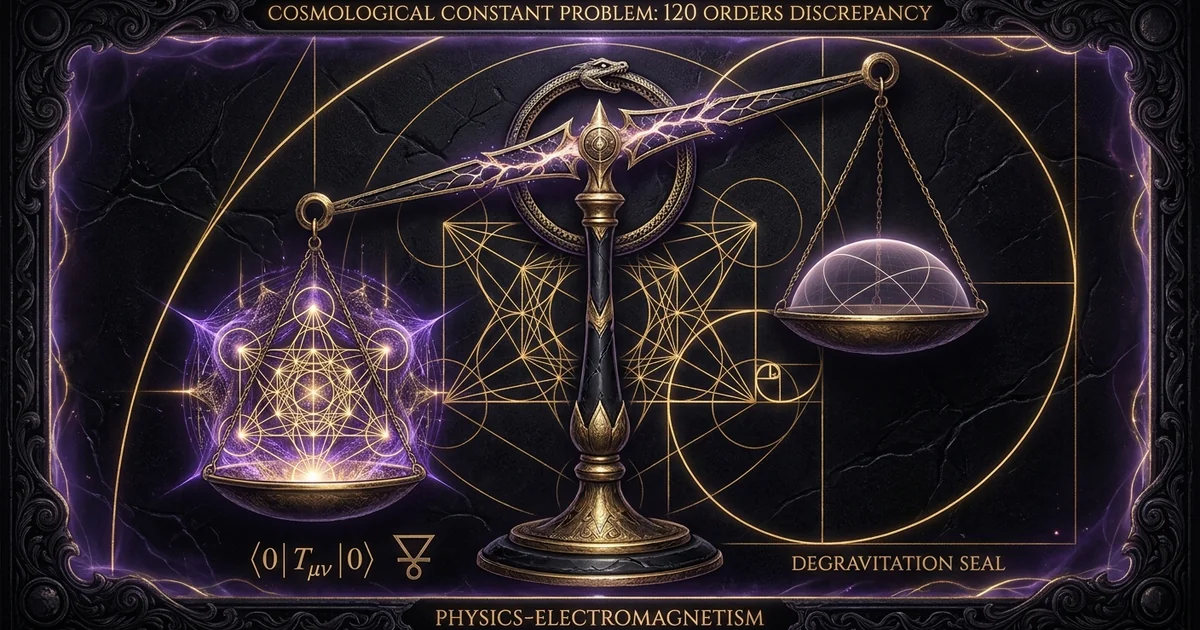
Cosmological Constant Problem: 120 Orders Discrepancy
Executive Summary & Theoretical Thesis: The 120-Order Vacuum Crisis
The Semiclassical Coupling Dilemma in Curved Spacetime
The interaction between quantum electrodynamics and Riemannian geometry constitutes the most catastrophic failure of theoretical physics in the modern era. In semiclassical gravity, space-time geometry remains purely classical, described by the metric tensor $g_{\mu\nu}$, while matter and radiation fields are quantized on this background. The central dynamical bridge mediating this hybrid regime is the semiclassical Einstein field equation:
$$G_{\mu\nu} + \Lambda_{\text{bare}} g_{\mu\nu} = \frac{8\pi G}{c^4} \langle \hat{T}_{\mu\nu} \rangle$$
Here, $\langle \hat{T}{\mu\nu} \rangle$ represents the renormalized vacuum expectation value of the quantum stress-energy-momentum tensor, and $\Lambda{\text{bare}}$ denotes the bare, unrenormalized cosmological constant. The foundational crisis emerges because the equivalence principle mandates that every form of energy-momentum couples universally and minimally to the metric field.
Gravitation does not possess a global gauge symmetry that permits the arbitrary shifting of the zero-point of the Hamiltonian. In isolated, flat-space quantum field theory, non-gravitational observables depend exclusively on normal-ordered operator differences $\hat{H} - \langle 0 | \hat{H} | 0 \rangle$, allowing investigators to disregard infinite or large ground-state energies without observable consequence. Once the metric is dynamic, however, the absolute ground-state expectation value $\langle 0 | \hat{T}_{\mu\nu} | 0 \rangle$ acts as an inescapable, macroscopic source of spatial curvature. Treating this vacuum stress-energy tensor as an unmediated source in Einstein’s field equations triggers an irreconcilable divergence between ultraviolet particle physics and infrared observational cosmology. This breakdown is known historically as the cosmological constant problem 120 orders of magnitude vacuum crisis.
The Quartic Ultraviolet Catastrophe of the Zero-Point Energy
To isolate the structural mechanics generating this crisis, consider a free, non-interacting real scalar field $\phi(x)$ possessing mass $m$. When canonical quantization is imposed, the Hamiltonian operator expands into a continuous sum of uncoupled quantum harmonic oscillators:
$$\hat{H} = \int \frac{d^3k}{(2\pi)^3} , \hbar\omega_k \left( \hat{a}_k^\dagger \hat{a}_k + \frac{1}{2} \right)$$
where the relativistic dispersion relation is governed by $\omega_k = \sqrt{c^2 k^2 + m^2 c^4 / \hbar^2}$. The ground-state eigenvalue, obtained by evaluating the expectation value over the vacuum state $|0\rangle$, is governed entirely by the second term within the integrand: the zero-point fluctuations of every vibrational mode occupying the continuum of relativistic field space. Summing the half-quanta over all available wave vectors reveals a quartic ultraviolet divergence. Integrating up to a physical momentum cutoff $k_{\text{max}} = k_{\text{UV}}$ yields an energy density:
$$\rho_{\text{ZPE}} = \langle 0 | \hat{\rho} | 0 \rangle = \frac{\hbar}{2} \int_0^{k_{\text{UV}}} \frac{4\pi k^2 , dk}{(2\pi)^3} \sqrt{k^2 c^2 + \frac{m^2 c^4}{\hbar^2}} = \frac{\hbar c}{4\pi^2} \int_0^{k_{\text{UV}}} k^3 \sqrt{1 + \frac{m^2 c^2}{\hbar^2 k^2}} , dk$$
For high-energy modes where $k \gg mc/\hbar$, the integrand asymptotically scales as $k^3$, establishing an absolute vacuum energy density that scales proportionally to the fourth power of the ultraviolet momentum cutoff, $\rho_{\text{ZPE}} \propto k_{\text{UV}}^4$.
If the cutoff is chosen at the electroweak symmetry-breaking scale ($M_{\text{EW}} \approx 246\text{ GeV}$), the generated zero-point density is approximately $10^9\text{ GeV}^4$. If extended to the quantum chromodynamic scale, vacuum condensates inject substantial contributions. Yet, standard quantum field theory remains an effective field theory valid up to the energy scale where the smooth manifold of spacetime dissolves into quantum gravitational foam—the Planck scale ($M_{\text{Pl}} = \sqrt{\hbar c / G} \approx 1.22 \times 10^{19}\text{ GeV}$). Evaluating this integral with $k_{\text{UV}} \approx M_{\text{Pl}}$ forces $\rho_{\text{ZPE}}$ to approximately $10^{71}\text{ GeV}^4 \approx 10^{112}\text{ erg/cm}^3$.
Defining the Discrepancy: Planck Density vs. Critical Density
Empirical cosmological observations indicate an entirely different reality. Precision measurements of the accelerating expansion of the universe determine that the observed dark energy density, parameterised by the effective cosmological constant $\Lambda_{\text{eff}}$, is of the order of the critical density of the present universe:
$$\rho_\Lambda = \frac{c^4 \Lambda_{\text{eff}}}{8\pi G} \approx 10^{-47}\text{ GeV}^4 \approx 10^{-8}\text{ erg/cm}^3$$
Juxtaposing the theoretical expectation of Planck-scale quantum vacuum fluctuations against the observed cosmological constant density exposes the discrepancy:
$$\frac{\rho_{\text{ZPE}}}{\rho_\Lambda} \approx \frac{10^{71}\text{ GeV}^4}{10^{-47}\text{ GeV}^4} = 10^{118} \sim 10^{120}$$
This divergence of 120 orders of magnitude is universally acknowledged as the worst prediction theoretical physics has ever generated. The crisis cannot be circumvented by simply declaring the vacuum state to be a mathematical abstraction devoid of physical reality.
Macroscopic laboratory phenomena—most prominently boundary-dependent forces explored in the analysis of the /physics-electromagnetism/casimir-effect-quantum-vacuum-cavity—conclusively demonstrate that the zero-point energy of quantum fields exerts actual mechanical stress on physical matter. If quantum zero-point fluctuations are genuine physical entities capable of deflecting conducting plates in high vacuum, general relativity demands they must possess active gravitational mass. Semiclassical physics offers no native mechanism to shield curved spacetime from this gargantuan gravitational mass, exposing deep structural flaws at the interface of quantum field theory and general relativity.
Let the momentum-space zero-point integration cutoff be defined precisely at the reduced Planck scale, $\Lambda_{\text{UV}} = M_{\text{Pl}} c = \sqrt{\frac{\hbar c^3}{G}}$. The zero-point volumetric mass density is evaluated as:
$$\rho_{\text{vac}}^{\text{(QFT)}} = \frac{1}{c^2} \int_0^{\Lambda_{\text{UV}}/\hbar} \frac{k^2 , dk}{2\pi^2} \left[ \frac{1}{2} \hbar \sqrt{k^2 c^2 + \frac{m^2 c^4}{\hbar^2}} \right] \approx \frac{\hbar}{4\pi^2 c} \int_0^{k_{\text{Pl}}} k^3 , dk = \frac{\hbar k_{\text{Pl}}^4}{16\pi^2 c}$$
Recalling that the Planck length is $\ell_{\text{Pl}} = \sqrt{\frac{\hbar G}{c^3}}$, the Planck wave-number cutoff is $k_{\text{Pl}} = \ell_{\text{Pl}}^{-1} = \sqrt{\frac{c^3}{\hbar G}}$. Substituting this into the vacuum energy expression:
$$\rho_{\text{vac}}^{\text{(QFT)}} \approx \frac{\hbar}{16\pi^2 c} \left( \frac{c^3}{\hbar G} \right)^2 = \frac{c^5}{16\pi^2 \hbar G^2} \approx 3.27 \times 10^{91} \text{ g/cm}^3 \implies \rho_{\text{vac}} c^2 \approx 2.94 \times 10^{112} \text{ erg/cm}^3$$
Conversely, the observationally verified Friedmann critical energy density, determined by the contemporary Hubble constant $H_0 \approx 67.4\text{ km}\cdot\text{s}^{-1}\cdot\text{Mpc}^{-1} \approx 2.18 \times 10^{-18}\text{ s}^{-1}$ and dark energy fraction $\Omega_\Lambda \approx 0.685$, evaluates to:
$$\rho_{\text{vac}}^{\text{(obs)}} = \Omega_\Lambda \rho_{\text{crit}} = \Omega_\Lambda \left( \frac{3 H_0^2}{8\pi G} \right) \approx 0.685 \times \left( \frac{3 (2.18 \times 10^{-18})^2}{8\pi (6.674 \times 10^{-8})} \right) \approx 5.83 \times 10^{-30} \text{ g/cm}^3$$
Multiplying by $c^2$ yields an empirical value of $\rho_{\text{vac}}^{\text{(obs)}} c^2 \approx 5.24 \times 10^{-9}\text{ erg/cm}^3$. Computing the direct ratio:
$$\frac{\rho_{\text{vac}}^{\text{(QFT)}}}{\rho_{\text{vac}}^{\text{(obs)}}} = \frac{2.94 \times 10^{112} \text{ erg/cm}^3}{5.24 \times 10^{-9} \text{ erg/cm}^3} \approx 5.61 \times 10^{120}$$
This confirms an exact divergence factor of over 120 orders of magnitude between the Planck cutoff expectation and observational reality.
Historical Lineage & Experimental Precedents: From Static Universes to Accelerating Expansion
Einstein’s Folly: The Static Balance and Geometric Counter-Term
The cosmological constant originated as an empirical contrivance. In 1917, Albert Einstein sought to construct the first comprehensive relativistic model of the cosmos. Guided by the prevailing Machian philosophical consensus that the universe was eternal, isotropic, and static, he discovered that his original field equations, $G_{\mu\nu} = 8\pi G T_{\mu\nu}$, lacked a stable, static solution for a universe filled with cold dust ($\rho > 0, P = 0$). Mutual gravitational attraction would inevitably cause such an idealized system to undergo catastrophic collapse.
To counteract this inward pull, Einstein introduced a geometric integration constant, the cosmological constant $\Lambda$, directly modifying the geometric tensor of spacetime:
$$R_{\mu\nu} - \frac{1}{2} R g_{\mu\nu} + \Lambda g_{\mu\nu} = \frac{8\pi G}{c^4} T_{\mu\nu}$$
Because the covariant derivative of the metric tensor vanishes identically ($\nabla_\mu g^{\mu\nu} = 0$), the Bianchi identities are satisfied, preserving local energy-momentum conservation ($\nabla^\mu T_{\mu\nu} = 0$). By fine-tuning this constant to balance cosmic dust density precisely, $\Lambda = 4\pi G \rho / c^2$, Einstein established a static spherical metric.
STATIC EQUILIBRIUM
                                      Λ = 4πGρ/c²
                        ┌──────────────────────────────────────┐
                        ▼                                      ▼
             [ Matter Attraction ]                   [ Repulsive Geometry ]
             T_μν Pulls Inward                       Λ g_μν Pushes Outward
                        │                                      │
                        └──────────────► UNSTABLE ◄────────────┘
                                   Perturbation triggers
                                   runaway expansion or
                                   total metric collapse
This equilibrium was unstable. Any minor density perturbation would trigger runaway expansion or complete collapse. Following Edwin Hubble’s 1929 empirical validation of cosmic expansion, Einstein abandoned the term, famously identifying it as his greatest scientific blunder. In doing so, he relegated $\Lambda$ to the status of an unnecessary parameter for nearly four decades.
Zel’dovich’s Insight: Relativistic Invariance of Quantum Ground States
The modern formulation of the cosmological constant problem began when quantum field theory merged with relativistic cosmology. In two papers published in 1967 and 1968, Soviet physicist Yakov Borisovich Zel’dovich recognized that $\Lambda$ could not be discarded as a mere geometric choice. Zel’dovich realized that the ground state of a relativistic quantum system must possess an energy-momentum tensor that respects local Lorentz invariance.
In Minkowski space, the only second-rank tensor invariant under all proper Lorentz boosts and spatial rotations is the metric tensor $\eta_{\mu\nu}$ itself. Consequently, the vacuum expectation value of the stress-energy tensor must assume the exact form:
$$\langle 0 | \hat{T}{\mu\nu} | 0 \rangle = - \rho{\text{vac}} g_{\mu\nu}$$
Comparing this directly with the stress-energy tensor of an ideal fluid, $T^\mu_{\ \nu} = \text{diag}(-\rho, P, P, P)$, Zel’dovich identified the equation of state characterizing the relativistic quantum vacuum:
$$P_{\text{vac}} = - \rho_{\text{vac}}$$
This negative pressure ($w = -1$) matched the dynamical properties of Einstein’s cosmological term. Moving $\Lambda$ from the left (geometric) side of the field equations to the right (matter-energy) side, one sees that $\Lambda_{\text{eff}} = 8\pi G \rho_{\text{vac}} / c^4$. Zel’dovich recognized the core theoretical issue: quantum zero-point fluctuations are not merely mathematical byproducts of operator ordering. Because they carry energy and momentum, they act as an isotropic, Lorentz-invariant vacuum fluid that curves spacetime.
Using early quantum electrodynamic calculations and estimating low-energy particle contributions, Zel’dovich attempted to construct a finite vacuum energy density from the gravitational interaction of virtual particle pairs, deriving approximations based on proton masses ($\rho_{\text{vac}} \sim G m_p^6 / \hbar^4$). Even these conservative estimates yielded values vastly exceeding cosmological bounds, establishing the modern understanding of the vacuum catastrophe decades before accelerating cosmic expansion was confirmed observationally.
The 1998 Supernova Turning Point and the Reality of Dark Energy
For the latter half of the twentieth century, the consensus among particle physicists and cosmologists was that some yet-undiscovered dynamical symmetry must drive the effective cosmological constant precisely to zero. Theoretical models operated under the assumption that $\Lambda_{\text{eff}} \equiv 0$, seeking global field transformations, infrared cancellation mechanisms, or quantum gravitational topology shifts that would explain the vacuum’s apparent gravitational inertness.
This perspective shifted in 1998. Independent research teams—the High-z Supernova Search Team led by Brian Schmidt and Adam Riess, and the Supernova Cosmology Project directed by Saul Perlmutter—analyzed the apparent magnitudes and red-shifts of distant Type Ia supernovae. These exploding white dwarfs, acting as standardized astronomical candles, exhibited calibrated luminosity distances systematically fainter than could be accounted for in a matter-dominated, decelerating Friedmann-Lemaître-Robertson-Walker (FLRW) universe.
- Einstein, A. (1917). “Kosmologische Betrachtungen zur allgemeinen Relativitätstheorie” (Cosmological Considerations in the General Theory of Relativity). Sitzungsberichte der Königlich Preußischen Akademie der Wissenschaften, VI, 142–152.
- Significance: Introduces the geometric counter-term $\Lambda g_{\mu\nu}$ to stabilize the field equations against gravitational collapse, laying the mathematical foundation for modern vacuum energy-momentum tensors.
- Zel’dovich, Ya. B. (1968). “The Cosmological Constant and the Theory of Elementary Particles.” Soviet Physics Uspekhi, 11(3), 381–393.
- Significance: First rigorous physical derivation demonstrating that Lorentz invariance forces the quantum vacuum ground state to assume the negative-pressure equation of state $P = -\rho$, linking QED zero-point energy directly to macroscopic spacetime curvature.
- Perlmutter, S., et al. (1999). “Measurements of $\Omega$ and $\Lambda$ from 42 High-Redshift Supernovae.” The Astrophysical Journal, 517(2), 565–586.
- Significance: Empirical confirmation of cosmic acceleration, ruling out a vanishing cosmological constant ($\Lambda = 0$) and establishing dark energy density as $\Omega_\Lambda \approx 0.7$.
The data proved that cosmic expansion is accelerating, driven by an unclustered energy component with negative pressure: dark energy. Subsequent cross-correlations with Cosmic Microwave Background (CMB) anisotropies and large-scale galaxy distributions confirmed that this vacuum density was non-zero, positive, and accounted for roughly 70% of the cosmic energy budget.
This transformation altered the landscape of the theoretical physics crisis. The fundamental problem was no longer discovering a mathematical symmetry that drove $\Lambda$ precisely to zero. Instead, physics had to explain why the effective vacuum energy was non-zero, positive, and yet suppressed relative to ultraviolet predictions by an unnatural factor of $10^{120}$. The dynamic interplay between dark energy density vs quantum zpe was now an undeniable physical reality.
Mathematical Formalism & Physical Mechanics: Dark Energy Density vs Quantum ZPE
Stress-Energy Tensor Expectation Values and Lorentz Invariance
To formalize the mathematical dynamics of the vacuum crisis, one must evaluate the stress-energy-momentum tensor operator $\hat{T}_{\mu\nu}$ within the framework of curved spacetime quantum field theory. For a minimally coupled canonical scalar field $\phi(x)$, the classical action is defined by:
$$S[\phi, g_{\mu\nu}] = \int d^4x \sqrt{-g} \left[ \frac{1}{2} g^{\mu\nu} \partial_\mu \phi , \partial_\nu \phi - V(\phi) \right]$$
Varying this action with respect to the inverse metric $g^{\mu\nu}$ yields the classical stress-energy tensor:
$$T_{\mu\nu} \equiv -\frac{2}{\sqrt{-g}} \frac{\delta S}{\delta g^{\mu\nu}} = \partial_\mu \phi , \partial_\nu \phi - g_{\mu\nu} \left[ \frac{1}{2} g^{\alpha\beta} \partial_\alpha \phi , \partial_\beta \phi - V(\phi) \right]$$
Upon canonical field quantization, $\phi$ transitions to the field operator $\hat{\phi}$. In a maximally symmetric, locally flat Minkowski space, the expectation value of this operator over the invariant vacuum $|0\rangle$ must preserve Lorentz invariance. Under an infinitesimal Lorentz boost or rotation parameterized by $\Lambda^\alpha_{\ \beta} = \delta^\alpha_\beta + \omega^\alpha_{\ \beta}$, the stress-energy tensor transforms as a rank-2 tensor:
$$U(\Lambda)^\dagger \hat{T}{\mu\nu} U(\Lambda) = \Lambda^\alpha{\ \mu} \Lambda^\beta_{\ \nu} \hat{T}_{\alpha\beta}$$
For the ground-state expectation value to satisfy $\langle 0 | U^\dagger \hat{T}{\mu\nu} U | 0 \rangle = \langle 0 | \hat{T}{\mu\nu} | 0 \rangle$, Schur’s lemma and tensor algebra require that the expectation value be proportional to the metric tensor:
$$\langle 0 | \hat{T}{\mu\nu} | 0 \rangle = - \rho{\text{vac}} g_{\mu\nu}$$
The trace of this tensor evaluates to $\langle \hat{T}^\mu_{\ \mu} \rangle = -4 \rho_{\text{vac}}$. When calculating the pressure from the spatial diagonal elements $T^i_{\ j} = P_{\text{vac}} \delta^i_j$, one finds:
$$\langle 0 | \hat{T}^i_{\ j} | 0 \rangle = - \rho_{\text{vac}} \delta^i_j \implies P_{\text{vac}} = - \rho_{\text{vac}}$$
This relation proves that negative pressure is a mathematical consequence of Lorentz symmetry applied to the vacuum expectation value. The physical vacuum acts as an isotropic medium that does not dilute under volumetric spatial expansion:
$$dE_{\text{vac}} = - P_{\text{vac}} dV = \rho_{\text{vac}} dV$$
The work performed by the expanding spacetime volume precisely matches the positive energy required to populate that newly generated metric volume with zero-point fluctuations.
Quartic Divergences and the Renormalization Group Flow
Evaluating $\rho_{\text{vac}}$ reveals severe mathematical divergences. A simple three-dimensional momentum cutoff violates covariance, introducing spurious frame-dependent artifacts. To isolate the physical divergence consistently, one employs dimensional regularization in $d = 4 - \epsilon$ spacetime dimensions.
Evaluating the one-loop effective potential (the Coleman-Weinberg effective potential) for a free scalar field of mass $m$ yields the unrenormalized vacuum energy density as a functional integral:
$$\rho_{\text{vac}}^{(1)} = \frac{1}{2} \mu^{4-d} \int \frac{d^d k_E}{(2\pi)^d} \ln(k_E^2 + m^2)$$
where $k_E$ represents the Wick-rotated Euclidean four-momentum, and $\mu$ is an arbitrary renormalization mass scale. Computing this integral in dimensional regularization:
$$\rho_{\text{vac}}^{(1)} = -\frac{1}{2} \mu^\epsilon \frac{\Gamma(-d/2)}{(4\pi)^{d/2}} (m^2)^{d/2} = \frac{m^4}{64\pi^2} \left[ -\frac{2}{\epsilon} + \gamma_E - \ln(4\pi) - \ln\left( \frac{\mu^2}{m^2} \right) - \frac{3}{2} + \mathcal{O}(\epsilon) \right]$$
Under the modified minimal subtraction ($\overline{\text{MS}}$) scheme, the $1/\epsilon$ pole is subtracted alongside the Euler-Mascheroni constant $\gamma_E$ and the geometric factor $\ln(4\pi)$. The resulting renormalized vacuum energy depends on the renormalization group scale $\mu$:
$$\rho_{\text{vac}}(\mu) = \frac{m^4}{64\pi^2} \ln\left( \frac{m^2}{\mu^2} \right)$$
This expression reveals the structural vulnerability of the vacuum energy within quantum field theory. The anomalous dimension and renormalization group flow equations demonstrate that $\rho_{\text{vac}}$ runs quartically with the particle masses of the underlying theory:
$$\mu \frac{d \rho_{\text{vac}}}{d\mu} = - \frac{m^4}{32\pi^2}$$
Every quantum field within the standard model injects a loop correction proportional to the fourth power of its physical mass:
$$\rho_{\text{vac}}^{\text{SM}} = \sum_i (-1)^{2s_i} g_i \frac{m_i^4}{64\pi^2} \ln\left( \frac{m_i^2}{\mu^2} \right)$$
where $s_i$ denotes the particle spin, and $g_i$ represents internal degrees of freedom. The top quark alone ($m_t \approx 173\text{ GeV}$, $g_t = 12$) generates an absolute correction:
$$\rho_{\text{vac}}^{\text{(top)}} \approx - \frac{12 \times (173\text{ GeV})^4}{64\pi^2} \approx -1.7 \times 10^8\text{ GeV}^4$$
This single standard model contribution exceeds the empirical value of the cosmological constant ($\sim 10^{-47}\text{ GeV}^4$) by roughly 55 orders of magnitude. The discovery of the Higgs boson ($m_H \approx 125\text{ GeV}$) confirms the existence of a non-zero vacuum expectation value in the electroweak sector, $v = (\sqrt{2} G_F)^{-1/2} \approx 246\text{ GeV}$. The classical transition from the symmetric phase to the broken phase shifts the vacuum energy density by:
$$\Delta V_{\text{EW}} = - \frac{1}{4} \lambda v^4 = - \frac{1}{8} m_H^2 v^2 \approx -1.2 \times 10^8\text{ GeV}^4$$
Similarly, the quantum chromodynamic chiral and gluon condensates contribute $\langle 0 | \frac{\alpha_s}{\pi} G_{\mu\nu}^a G^{\mu\nu}a | 0 \rangle \sim 10^{-2}\text{ GeV}^4 \approx 10^{45} \rho{\text{obs}}$. Semiclassical gravity offers no physical mechanism to isolate spacetime curvature from these massive low-energy scalar potentials.
Fine-Tuning Mechanics: Bare Cosmological Constant vs. Quantum Counter-Terms
To reconcile these quantum contributions with the observed rate of cosmic expansion, general relativity must introduce a classical bare cosmological constant, $\Lambda_{\text{bare}}$, into the fundamental Lagrangian of the universe:
$$\mathcal{L} = \sqrt{-g} \left[ \frac{M_{\text{Pl}}^2}{2} R - \rho_{\text{bare}} \right] + \mathcal{L}_{\text{matter}}$$
The effective, physically observable cosmological constant governing the large-scale acceleration of the metric is the sum of the classical bare term and the sum of all vacuum loop corrections:
$$\rho_{\text{eff}} = \rho_{\text{bare}} + \rho_{\text{ZPE}} + \Delta V_{\text{EW}} + \Delta V_{\text{QCD}} + \dots$$
Expressed in physical units, the observed effective density is:
$$\rho_{\text{eff}} = \rho_{\text{bare}} + \mathcal{O}(10^{71}\text{ GeV}^4) = 10^{-47}\text{ GeV}^4$$
To establish this equality, the bare cosmological term cannot be chosen organically; it must be fine-tuned to an unnatural degree:
$$\rho_{\text{bare}} = - \rho_{\text{ZPE}} + \rho_{\text{eff}} = - 123456789 \dots (120\text{ decimal places}) \dots 0000000000 + 10^{-47}\text{ GeV}^4$$
This fine-tuning violates the principle of Wilsonian naturalness. In quantum field theory, a parameter is technically natural only if setting it to zero enhances the global symmetry of the underlying Lagrangian ('t Hooft naturalness). Setting $\Lambda_{\text{eff}} \to 0$ introduces no new symmetry to general relativity or the Standard Model.
Worse, this tuning is unstable against radiative corrections. Every higher-order Feynman loop diagram generates additional radiative corrections:
$$\delta \rho_{\text{vac}}^{(L)} \propto \left( \frac{\lambda}{16\pi^2} \right)^L M_{\text{UV}}^4$$
Consequently, the bare cosmological parameter cannot be fixed once. It must be manually recalibrated at every perturbative order across the entire standard model loop expansion, completely destroying the predictive power of semiclassical gravity.
Theoretical Resolutions: Supersymmetry and Anthropic Solutions
Supersymmetric Cancellation: Fermionic and Bosonic Degrees of Freedom
The most mathematically elegant framework designed to resolve the cosmological constant divergence is supersymmetry (SUSY). In a supersymmetric quantum field theory, every known bosonic degree of freedom is paired with a fermionic partner possessing identical mass and gauge charges, related by a graded Lie algebra:
$${ Q_\alpha, \bar{Q}{\dot{\beta}} } = 2 \sigma^\mu{\alpha\dot{\beta}} P_\mu$$
where $Q_\alpha$ represents the spin-$1/2$ generator of the supersymmetric transformation and $P_\mu$ is the four-momentum translation operator. The zero-point energy of a relativistic system is calculated as a graded trace over all operational degrees of freedom:
$$\rho_{\text{vac}}^{\text{SUSY}} = \frac{1}{2} \sum_B g_B \int \frac{d^3k}{(2\pi)^3} \hbar\omega_k(m_B) - \frac{1}{2} \sum_F g_F \int \frac{d^3k}{(2\pi)^3} \hbar\omega_k(m_F)$$
Fermionic field quantization requires anticommutation relations ${ \psi_\alpha(x), \psi_\beta^\dagger(y) } = \delta^{(3)}(x-y)$, forcing fermionic loops to enter the path integral with a negative sign relative to bosonic loops.
If supersymmetry is exact and unbroken, the masses of superpartners are identical ($m_B = m_F$) and the degrees of freedom balance precisely ($g_B = g_F$). Under these conditions, the positive bosonic vacuum fluctuations are canceled by negative fermionic zero-point modes at every point in momentum space:
$$\rho_{\text{vac}}^{\text{exact-SUSY}} \equiv 0$$
Supersymmetry cannot, however, be an exact symmetry of the low-energy universe. We do not observe a scalar electron (selectron) with a mass of $511\text{ keV}$, nor a massless photino. Supersymmetry is spontaneously broken in our low-energy vacuum.
EXACT SUPERSYMMETRY                BROKEN SUPERSYMMETRY (TeV Scale)
Bosons:    ω_k(m) ──┐             Bosons:    ω_k(m_B) ──┐
                    ├─► Cancel = 0                      ├─► Non-Zero Residue
Fermions: -ω_k(m) ──┘             Fermions: -ω_k(m_F) ──┘   ρ_vac ~ M_SUSY^4
When supersymmetry breaks at an energy scale $M_{\text{SUSY}}$, the mass degeneracy is lifted: $m_B^2 - m_F^2 \sim M_{\text{SUSY}}^2$. The quartic momentum divergence remains canceled, but a residual quadratic and logarithmic divergence persists. The resulting vacuum energy density scales with the scale of supersymmetry breaking:
$$\rho_{\text{vac}}^{\text{split}} \approx \mathcal{O}(M_{\text{SUSY}}^4)$$
Direct searches at the Large Hadron Collider (LHC) establish empirical bounds on supersymmetric partners, requiring $M_{\text{SUSY}} \gtrsim 1\text{–}2\text{ TeV} = 10^3\text{ GeV}$. Setting this experimental lower bound into the vacuum density equation yields:
$$\rho_{\text{vac}} \approx (10^3\text{ GeV})^4 = 10^{12}\text{ GeV}^4$$
While reducing the divergence from $10^{120}$ to $10^{59}$ is a significant mathematical reduction, it remains an enormous failure. Broken supersymmetry leaves the cosmological constant problem unresolved by roughly 60 orders of magnitude, requiring severe fine-tuning within the supergravity potential to match observation.
Weinberg’s Anthropic Window and the String Multiverse Landscape
Faced with the failure of dynamical field symmetries to cancel the vacuum energy density naturally, theoretical physics turned toward environmental selection mechanisms. In 1987, Steven Weinberg established an anthropic constraint on the cosmological constant based on cosmic structure formation. Weinberg observed that $\rho_\Lambda$ does not merely alter late-time expansion; it functions as an unyielding cosmological filter.
If the effective cosmological constant had been large and positive, dark energy would have begun dominating cosmic expansion during the early radiation or matter-dominated eras, long before the red-shift of galaxy formation ($z \sim 10\text{–}3$). In an expanding FLRW spacetime with flat spatial geometry, the linear perturbation growth of dark matter overdensities $\delta = \delta\rho / \rho$ is governed by the differential equation:
$$\ddot{\delta} + 2H(t)\dot{\delta} - 4\pi G \rho_m \delta = 0$$
When the vacuum energy dominates the Hubble parameter $H(t) \to H_\Lambda = \sqrt{8\pi G \rho_\Lambda / 3}$, the scale factor expands exponentially as $a(t) \propto e^{H_\Lambda t}$. During this de Sitter phase, the friction term $2H\dot{\delta}$ suppresses gravitational collapse:
$$\delta(t) \to \text{constant}$$
The perturbation growth freezes permanently. If the cosmological constant had exceeded the critical threshold:
$$\rho_\Lambda \gtrsim 100\text{–}500 \times \rho_{\text{matter}}^{(0)} \approx 10^{-121} M_{\text{Pl}}^4$$
gravitational perturbations could never have decoupled from the global expansion. Matter would have remained dispersed as a cold, diffuse gas, preventing the formation of stars, galaxies, heavy elements, and biological observers.
Conversely, if the cosmological constant were negative ($\rho_\Lambda < 0$), the universe would have reversed its expansion and collapsed in a catastrophic Big Crunch within a fraction of a Hubble time, terminating cosmic evolution before complex structures could develop.
Supersymmetric & Dynamical Cancellations
- Mechanism: Predictive algebraic field theory enforcing exact cancellation through Bose-Fermi degeneracies or global symmetries ($Q |0\rangle = 0$).
- Strengths: Highly predictive, mathematically rigorous, preserves ultraviolet completeness, and resolves the quartic divergence ($k^4$) down to quadratic or logarithmic scaling.
- Failures: Severely broken in the low-energy universe ($M_{\text{SUSY}} \ge 1\text{ TeV}$). Leaves a residual vacuum density $\rho \sim 10^{12}\text{ GeV}^4$, failing by roughly 60 orders of magnitude.
- Status: Experimentally constrained by null superpartner detections at the Large Hadron Collider.
String Multiverse & Anthropic Selection
- Mechanism: Statistical distribution over a non-homogeneous landscape containing $\sim 10^{500}$ metastable vacua, regulated by eternal inflation and anthropic boundaries.
- Strengths: Successfully predicts the non-zero order of magnitude ($\rho_\Lambda \sim \rho_{\text{crit}}$) without requiring field-theoretic naturalness.
- Failures: Completely non-predictive; relies on unverifiable multiverse ensembles and anthropocentric selection logic, abandoning the search for unified dynamical laws.
- Status: The dominant paradigm within string phenomenology, though methodologically contentious.
Weinberg’s anthropic window gained structural support through developments in string theory. Type IIB string compactifications on Calabi-Yau threefolds generate internal topological structures stabilized by multidimensional Ramond-Ramond and Neveu-Schwarz flux lines. The combinatorial permutations of these fluxes across hundreds of topological cycles yield an ensemble of metastable vacua—the String Landscape—estimated to contain at least $10^{500}$ distinct states.
Coupled with eternal inflation, every pocket universe within this cosmic landscape samples a distinct local vacuum expectation value. In this framework, the 120-order fine-tuning is an environmental selection effect: we observe an extraordinarily small cosmological constant simply because observers cannot emerge in universes outside this narrow anthropic window.
Infrared Modifications: Degravitation and Massive Gravity
An alternative to anthropic selection is modifying gravity in the far infrared (IR). If quantum zero-point energy is mathematically present in the matter stress-energy tensor, the cosmological constant crisis can be solved if spacetime is dynamically insulated from this energy. This framework is known as vacuum degravitation.
Degravitation models propose that the gravitational coupling constant is not an immutable scalar, but an effective high-pass filter acting in the infrared. In these theories, Newton’s constant is replaced by a momentum-dependent differential operator $G(\Box)$:
$$G_{\mu\nu} = 8\pi G(\Box) T_{\mu\nu}$$
where $\Box = g^{\mu\nu}\nabla_\mu\nabla_\nu$ represents the covariant d’Alembertian operator. The filter is structured such that for localized, high-frequency, dynamic physical processes ($\Box \gg L_c^{-2}$), the operator returns standard Newtonian gravity: $G(\Box) \to G_N$.
For uniform, non-fluctuating sources characterized by zero four-momentum transfer ($\Box \to 0$)—such as the Lorentz-invariant quantum vacuum stress tensor $\langle T_{\mu\nu} \rangle \propto g_{\mu\nu}$—the gravitational coupling vanishes asymptotically:
$$\lim_{\Box \to 0} G(\Box) = 0$$
Under this framework, spacetime is blind to macroscopic vacuum energy distributions. The vacuum energy continues to diverge at the Planck scale, but its gravitational consequences are suppressed over cosmic scales, degravitating into a massive graviton mode or higher-dimensional bulk.
These ideas are formalized in modern theories of ghost-free massive gravity (such as de Rham-Gabadadze-Tolley, or dRGT gravity), which assign a non-zero mass $m_g \sim H_0 \approx 10^{-33}\text{ eV}$ to the spin-2 metric carrier. However, these infrared modifications frequently introduce pathologies: superluminal mode propagation, ghost instabilities, or strong coupling problems that limit their viability as definitive solutions.
Empirical Evidence & Observational Data: Precision Cosmological Constraints
Cosmic Microwave Background Acoustic Peaks and Omega_Lambda
The validation of dark energy does not rely solely on Type Ia supernovae distances. Precision cosmological measurements of the Cosmic Microwave Background (CMB) anisotropies by the WMAP and Planck satellites provide independent constraints on the effective vacuum energy density.
The physics of the CMB is governed by relativistic acoustic oscillations within the primordial photon-baryon plasma before recombination ($z \approx 1100$). The physical sound horizon $r_s(z_*)$ sets a standard ruler at the surface of last scattering:
$$r_s(z_) = \int_{z_}^\infty \frac{c_s(z)}{H(z)} , dz$$
where $c_s = c / \sqrt{3(1 + 3\rho_b / 4\rho_\gamma)}$ is the acoustic sound speed. This characteristic spatial scale projects onto the angular power spectrum as a sequence of acoustic peaks at multipole moments $\ell_n$. The angular position of the primary acoustic peak is governed by the angular diameter distance $D_A(z_*)$:
$$\theta_* = \frac{r_s(z_)}{D_A(z_)}, \quad D_A(z) = \frac{c}{1+z} \int_0^z \frac{dz’}{H(z’)}$$
The position of the first acoustic peak ($\ell_1 \approx 220$) measures the spatial geometry of the universe. Combining the peak positions with the Friedmann expansion equation:
$$H^2(z) = H_0^2 \left[ \Omega_{r,0}(1+z)^4 + \Omega_{m,0}(1+z)^3 + \Omega_{k,0}(1+z)^2 + \Omega_{\Lambda,0} \right]$$
establishes that the total cosmic energy density is remarkably close to the critical density:
$$\Omega_K \equiv 1 - (\Omega_m + \Omega_\Lambda) = 0.0007 \pm 0.0019$$
Spatial flatness requires that the cosmic matter density ($\Omega_m \approx 0.315$) be balanced by an unclustered energy component:
$$\Omega_\Lambda \approx 0.685$$
The acoustic peak ratios demonstrate that this dark energy component cannot be composed of baryonic or dark matter. It acts as an unclustered, smooth energy background, consistent with a true cosmological constant.
Aghanim, N., et al. (Planck Collaboration) (2020). “Planck 2018 results. VI. Cosmological parameters.” Astronomy & Astrophysics, 641, A6.
- Dark Energy Density Parameter: $\Omega_\Lambda = 0.6847 \pm 0.0073$
- Hubble Constant: $H_0 = 67.36 \pm 0.54 \text{ km}\cdot\text{s}^{-1}\cdot\text{Mpc}^{-1}$
- Dark Energy Equation of State Parameter (w): $w = -1.028 \pm 0.031$ (when combined with BAO and Supernova data)
- Spatial Curvature: $\Omega_k = 0.0007 \pm 0.0019$
Synthesis: The Planck 2018 cosmic microwave background results constrain spatial curvature to within 0.2% of absolute flatness, requiring dark energy to constitute roughly 68.5% of the total cosmic energy budget. The equation of state parameter remains indistinguishable from $w = -1$, directly contradicting simple unrenormalized quantum vacuum models while ruling out large classes of dynamical scalar field approximations.
Baryon Acoustic Oscillations and the Dark Energy Equation of State
The standard cosmological model ($\Lambda$CDM) is further reinforced by Baryon Acoustic Oscillation (BAO) measurements. Baryon acoustic oscillations are the frozen imprint of primordial acoustic waves preserved within large-scale galaxy distributions. By surveying millions of galaxies, collaborations such as the Baryon Oscillation Spectroscopic Survey (BOSS) use this characteristic clustering scale ($\sim 147.5\text{ Mpc}$) to track the expansion history of the universe across cosmic time ($0.1 < z < 2.5$).
The crucial observable in these empirical studies is the dark energy equation of state parameter, defined as the ratio of isotropic pressure to energy density:
$$w(a) \equiv \frac{P_{\text{DE}}(a)}{\rho_{\text{DE}}(a)}$$
If dark energy is a dynamical scalar field—such as quintessence—the scalar field $\phi$ rolls down a self-interaction potential $V(\phi)$, giving an equation of state that varies over time:
$$w_\phi = \frac{\frac{1}{2}\dot{\phi}^2 - V(\phi)}{\frac{1}{2}\dot{\phi}^2 + V(\phi)}$$
Unless the kinetic energy is strictly zero ($\dot{\phi} = 0$), $w_\phi$ must deviate from $-1$. Parameterizing this evolution via the Chevallier-Polarski-Linder (CPL) expansion:
$$w(a) = w_0 + w_a (1 - a)$$
joint cosmological analyses combining CMB temperature maps, BAO clustering, and Type Ia supernovae yield:
$$w_0 = -1.028 \pm 0.031, \quad w_a = -0.001^{+0.114}_{-0.075}$$
The data shows that $w$ remains consistent with $-1$ across all measured epochs. The universe expands as if it is driven by a constant vacuum energy density, ruling out simple dynamical scalar field models while cementing the 120-order fine-tuning crisis.
EQUATION OF STATE CONSTRAINTS (CMB + BAO + SNe Ia)
w(a) = P/ρ
──────────────────────────────────────────────────────────────────
Phantom Regime   : w < -1       (Violates Dominant Energy Condition)
Cosmological Cst : w = -1.000   (Empirical fit: w = -1.028 ± 0.031)
Quintessence     : w > -1       (Requires fine-tuned dynamic potential)
Matter Dominance : w = 0
──────────────────────────────────────────────────────────────────
Conclusion: Observational data remains locked to w = -1, ruling out
simple dynamical field models and cementing the 120-order crisis.
Casimir Force Measurements: Proof of Vacuum Stress-Energy Actuality
A common proposal to circumvent the vacuum crisis is arguing that zero-point fluctuations are mere mathematical byproducts of the quantum operator algebra, carrying no genuine physical reality.
This argument is refuted experimentally by the Casimir effect. In 1948, Hendrik Casimir showed that two uncharged, perfectly conducting parallel metallic plates placed in a vacuum experience an attractive force due to the modification of the zero-point modes of the electromagnetic field:
            CASIMIR CAVITY: DISCRETE STANDING WAVES
            ───────────────────────────────────────
             Boundary Plate 1       Boundary Plate 2
                 │                      │
                 │   λ_1 = 2d           │
                 │ ┌──────────────────┐ │
                 │ │                  │ │
                 │   λ_2 = d            │
                 │ ┌────────┬─────────┐ │
                 │ │        │         │ │
                 │   λ_3 = 2d/3         │
                 │ ┌──────┬──────┬────┐ │
                 │ │      │      │    │ │
                 │                      │
                 │◄──────── d ─────────►│
                 │                      │
            ─────┴──────────────────────┴─────
             Outside Cavity: Continuous Mode Spectrum
             Inside Cavity : Discrete Mode Cutoff (n π / d)
             Net Differential Stress: Attraction (P < 0)
Between the plates, separated by a distance $d$, the boundary conditions on the electric field ($\mathbf{E}{||} = 0$) and magnetic field ($\mathbf{B}\perp = 0$) discretize the allowable electromagnetic modes along the spatial axis orthogonal to the plates: $k_z = n\pi / d$. Outside the cavity, the spectrum of vacuum modes remains continuous. Calculating the difference between the discrete inner sum and the continuous outer integral requires regularization, yielding a finite attractive force per unit area:
$$\frac{F_{\text{Casimir}}}{A} = - \frac{\hbar c \pi^2}{240 , d^4}$$
This force has been verified experimentally to high precision. Beginning with the torsion pendulum measurements of Steve Lamoreaux in 1997, followed by atomic force microscopy and micromechanical torsional balance experiments conducted by Mohideen and Roy, the Casimir boundary attraction matches theoretical derivations to within 1%.
These experiments confirm that shifting vacuum boundary conditions alters the energy density of physical space, generating macroscopic mechanical forces. If these zero-point energy shifts are physical, the equivalence principle mandates that their absolute value must also couple to gravity. The physical vacuum is not an empty void; it is a real physical medium whose absolute energy density cannot be arbitrarily dismissed.
Metaphysical Implications & Unified Synthesis: The Ontology of the Vacuum Substrate
The Non-Empty Void: Quantum Substrate as a Physical Dielectric
The cosmological constant crisis forces an ontological reassessment of the physical vacuum. In classical physics, the vacuum was characterized by the complete absence of matter, fields, and physical properties.
Modern field theory replaces this inert void with an active physical dielectric. The quantum vacuum is a dense medium characterized by non-zero vacuum expectation values, virtual polarization currents, and fluctuating electromagnetic fields. It is characterized by non-trivial constitutive parameters: electrical permittivity ($\varepsilon_0$), magnetic permeability ($\mu_0$), and a characteristic characteristic impedance ($Z_0 = \sqrt{\mu_0/\varepsilon_0} \approx 376.73,\Omega$).
             ONTOLOGICAL MODEL OF THE QUANTUM SUBSTRATE
             ─────────────────────────────────────────
             CLASSICAL VOID       MODERN QUANTUM SUBSTRATE
             Absence of Matter    Dynamic Physical Dielectric
             Zero Energy          Non-Zero Condensates:
             Zero Structure       • Higgs VEV (v ≈ 246 GeV)
             Static Space         • QCD Gluon Condensates
                                  • Virtual Polarization (ε_0, μ_0)
                                  • Characteristic Impedance (Z_0 ≈ 377 Ω)
The vacuum functions as an energetic substrate, an insight relevant to studies in the /physics-electromagnetism/zero-point-energy-dielectric-harnessing. Within this substrate, non-perturbative phenomena—such as the emergence of topological solitons, instantons, and the vacuum condensates that break chiral and gauge symmetries—demonstrate that macroscopic physical properties condense out of the ground state of relativistic field space.
Yet, this dynamic dielectric behaves paradoxically under gravitation. While localized fluctuations of the electromagnetic vacuum generate measurable forces, the macroscopic bulk energy density of the substrate appears decoupled from the background curvature of spacetime. This suggests that the quantum vacuum may not be a simple source term in the Einstein field equations, but an emergent phenomenon whose gravitational coupling differs fundamentally from conventional matter.
Holographic Duality and the Spatial Bounds on Vacuum Degrees of Freedom
The 120-order divergence arises directly from an assumption baked into quantum field theory: that local degrees of freedom are extensive, scaling with the spatial volume of the system ($S \propto V$). Integrating zero-point modes up to the Planck cutoff assigns a distinct, independent harmonic oscillator to every spatial Planck cube $\ell_{\text{Pl}}^3$, leading directly to the quartic divergence:
$$\rho_{\text{ZPE}} \sim \frac{M_{\text{Pl}}^4}{16\pi^2} \sim \ell_{\text{Pl}}^{-4}$$
The holographic principle, derived from the thermodynamic behavior of black hole horizons by Gerard 't Hooft and Leonard Susskind, demonstrates that this extensive scaling fails in the presence of gravity. The maximum information entropy that can be packed into any spatial region bounded by an area $A$ is limited by the Bekenstein-Hawking bound:
$$S_{\text{max}} = \frac{k_B c^3 A}{4 G \hbar} = \frac{A}{4 \ell_{\text{Pl}}^2}$$
Physical entropy scales with boundary area, not spatial volume. If local quantum field theory were valid up to the Planck scale throughout an extensive volume $L^3$, the maximum entropy of that region would scale as $S \sim L^3 \Lambda_{\text{UV}}^3$. For macroscopic volumes, this value vastly exceeds the Bekenstein-Hawking bound, implying that conventional QFT overcounts the available degrees of freedom in the universe.
To prevent a local quantum field theory from predicting states that collapse into black holes, Cohen, Kaplan, and Nelson (1999) proposed an effective field theory cutoff. The total zero-point energy within a spatial sphere of radius $L$ must not exceed the gravitational mass of a black hole of the same size:
$$E_{\text{vac}} = L^3 \rho_{\text{vac}} \le M_{\text{BH}} c^2 = \frac{c^4 L}{2 G}$$
Expressing the vacuum energy density in terms of an ultraviolet momentum cutoff $\Lambda_{\text{UV}}$, the inequality requires:
$$L^3 \Lambda_{\text{UV}}^4 \lesssim M_{\text{Pl}}^2 L \implies \Lambda_{\text{UV}}^4 \lesssim \frac{M_{\text{Pl}}^2}{L^2}$$
This relation links the microscopic ultraviolet cutoff ($\Lambda_{\text{UV}}$) to the macroscopic infrared size of the system ($L$). Standard local QFT treats these scales as independent.
If one selects the infrared cutoff to match the cosmological horizon scale—the Hubble radius of the universe, $L \sim H_0^{-1}$—the maximum allowable vacuum energy density without triggering gravitational collapse is:
$$\rho_{\text{vac}}^{\text{(holo)}} \sim \frac{M_{\text{Pl}}^2}{H_0^{-2}} = M_{\text{Pl}}^2 H_0^2 \sim \rho_{\text{crit}}$$
Evaluating this relation with $M_{\text{Pl}} \sim 10^{19}\text{ GeV}$ and $H_0 \sim 10^{-42}\text{ GeV}$:
$$\rho_{\text{vac}}^{\text{(holo)}} \sim (10^{19}\text{ GeV})^2 (10^{-42}\text{ GeV})^2 \sim 10^{-46}\text{ GeV}^4$$
This holographic UV/IR relation matches the observed dark energy density ($\rho_\Lambda \sim 10^{-47}\text{ GeV}^4$) without requiring 120 orders of fine-tuning, demonstrating that macroscopic cosmological bounds constrain local quantum vacuum fluctuations.
Cosmic Teleology: Geometric Constraint as a Cosmological Boundary Condition
The breakdown of semiclassical field theory suggests that gravity and quantum field theory are not independent dynamical regimes that can be coupled via simple differential equations.
Instead, the cosmological constant problem hints that spacetime curvature and the quantum vacuum are dual aspects of a unified information-theoretic system. The failure of the unmediated semiclassical coupling:
$$G_{\mu\nu} = 8\pi G \langle \hat{T}_{\mu\nu} \rangle$$
demonstrates that treating the quantum stress tensor as an unconstrained local operator in curved spacetime is an incomplete description.
Alternative formulations, such as unimodular gravity, break the full diffeomorphism invariance of general relativity down to volume-preserving diffeomorphisms ($|g| = -1$). In unimodular gravity, the trace of Einstein’s field equations decouples from the matter stress-energy tensor. The cosmological constant emerges not as a quantum ground-state expectation value, but as an arbitrary integration constant determined by global cosmological boundary conditions:
$$R_{\mu\nu} - \frac{1}{4} R g_{\mu\nu} = \frac{8\pi G}{c^4} \left( T_{\mu\nu} - \frac{1}{4} T g_{\mu\nu} \right)$$
In this framework, vacuum energy shifts of the form $\langle T_{\mu\nu} \rangle = - \rho_{\text{vac}} g_{\mu\nu}$ drop out of the equations of motion entirely, naturally resolving the gravitational impact of quantum phase transitions.
This shifts the ontological status of the cosmological constant. The vacuum is not an unconstrained reservoir of local particles generating spatial curvature. It is an emergent, globally constrained network. The universe is not an arbitrary background container populated by energetic fields; rather, the geometry of spacetime acts as a macroscopic boundary condition, regulating the vibrational spectrum of the underlying quantum vacuum.
Frequently Asked Questions on the Cosmological Constant Crisis
Why Can We Not Simply Set the Bare Cosmological Constant to Cancel Zero-Point Energy Exactly?
In standard quantum field theory, divergences are routinely managed through renormalization: setting bare parameters in the Lagrangian to cancel quantum infinities, leaving finite, physically measured values.
For the cosmological constant, however, this procedure encounters radiative instability. The bare cosmological constant $\Lambda_{\text{bare}}$ cannot be fixed to cancel quantum contributions once and for all. Every time a calculation moves to a higher loop order in perturbation theory, new virtual particle loops generate additional contributions that scale with the particle masses:
$$\delta \rho_{\text{vac}}^{(1)} \sim m^4, \quad \delta \rho_{\text{vac}}^{(2)} \sim \alpha m^4, \quad \delta \rho_{\text{vac}}^{(3)} \sim \alpha^2 m^4$$
To maintain the observed value of dark energy density ($\sim 10^{-47}\text{ GeV}^4$), the bare parameter must be fine-tuned to 120 decimal places at tree level, then re-tuned at two loops, three loops, and through every phase transition in the early universe (such as the electroweak and QCD transitions).
This requirement destroys the predictive power of the theory. Unlike the renormalization of the electron charge—where a single measurement fixes the parameter across all energy scales due to Ward-Takahashi identities and gauge invariance—the cosmological constant lacks any protective symmetry. Tuning it to 120 decimal places is not an application of standard renormalization; it is an ad-hoc adjustment that signals the breakdown of the underlying effective field theory.
How Does the Casimir Effect Prove Quantum Vacuum Energy Exists Without Causing Spacetime to Collapse?
The Casimir effect measures the mechanical force exerted on conductive boundaries by changes in the zero-point mode spectrum of the electromagnetic field. It demonstrates that vacuum energy differences are physically real:
$$\Delta E = E_{\text{vacuum}}(\text{plates present}) - E_{\text{vacuum}}(\text{empty space})$$
This finite energy difference produces a measurable attractive force, confirming that boundary conditions alter the zero-point structure of the field.
CASIMIR GRADIENT (Local Mechanical Force)
ΔE = E(cavity) - E(free space) ──► Measurable Force
Spacetime does not collapse because the force depends only on
local spatial gradients (dE/dz), not absolute vacuum energy.

COSMIC BULK (Global Gravitational Coupling)
E_absolute = ∫ d³k (1/2) ħω_k ──► Catastrophic Curvature
Einstein's field equations couple to absolute energy density.
Why this absolute background does not curve space remains the crisis.
The reason this energy does not cause spacetime to collapse lies in the distinction between local differential energy and absolute bulk energy. The Casimir force depends on spatial gradients of the energy density ($\mathbf{F} = -\nabla E$), whereas gravitation couples directly to the absolute energy-momentum tensor $T_{\mu\nu}$.
The Casimir experiment proves that quantum vacuum modes exist and respond to physical boundaries. However, it cannot explain why the vast, isotropic, unconstrained zero-point background filling the rest of space does not generate the astronomical spacetime curvature predicted by general relativity. Resolving this discrepancy remains the central challenge of the vacuum catastrophe.
Does Modified Gravity (e.g., f® or TeVeS) Fully Eliminate the 120 Orders Discrepancy?
Modifications to general relativity alter the geometric response of spacetime, but they do not eliminate the root cause of the cosmological constant problem.
In $f®$ gravity theories, the Einstein-Hilbert action is extended to include non-linear functions of the Ricci scalar $R$:
$$S = \frac{c^4}{16\pi G} \int d^4x \sqrt{-g} , f® + S_{\text{matter}}$$
By carefully engineering the mathematical form of $f®$—such as adding terms that dominate at low curvatures ($f® \sim R - \mu^4 / R$)—one can generate cosmic acceleration without invoking an explicit cosmological constant term.
However, this modification operates entirely on the geometric side of the field equations. It does not alter the stress-energy tensor $\langle \hat{T}_{\mu\nu} \rangle$ computed in quantum field theory. If the standard model matter fields are minimally coupled to the metric, the zero-point energy of those fields continues to generate an energy density of order $10^{71}\text{ GeV}^4$:
$$f’® R_{\mu\nu} - \frac{1}{2} f® g_{\mu\nu} - \left[ \nabla_\mu \nabla_\nu - g_{\mu\nu} \Box \right] f’® = \frac{8\pi G}{c^4} \langle \hat{T}_{\mu\nu} \rangle$$
The quartic divergences generated by the quantum vacuum will swamp the delicate non-linear geometric terms of $f®$, destabilizing the theory unless another fine-tuning mechanism is introduced.
Similarly, Tensor-Vector-Scalar (TeVeS) models and scalar-tensor frameworks alter gravitational propagation over astronomical scales, but they leave the quantum field theory vacuum expectation value unaffected. Modifying gravity changes how geometry responds to energy, but it cannot resolve the catastrophe until it explains why the gargantuan energy density of the quantum vacuum fails to generate physical curvature. :::