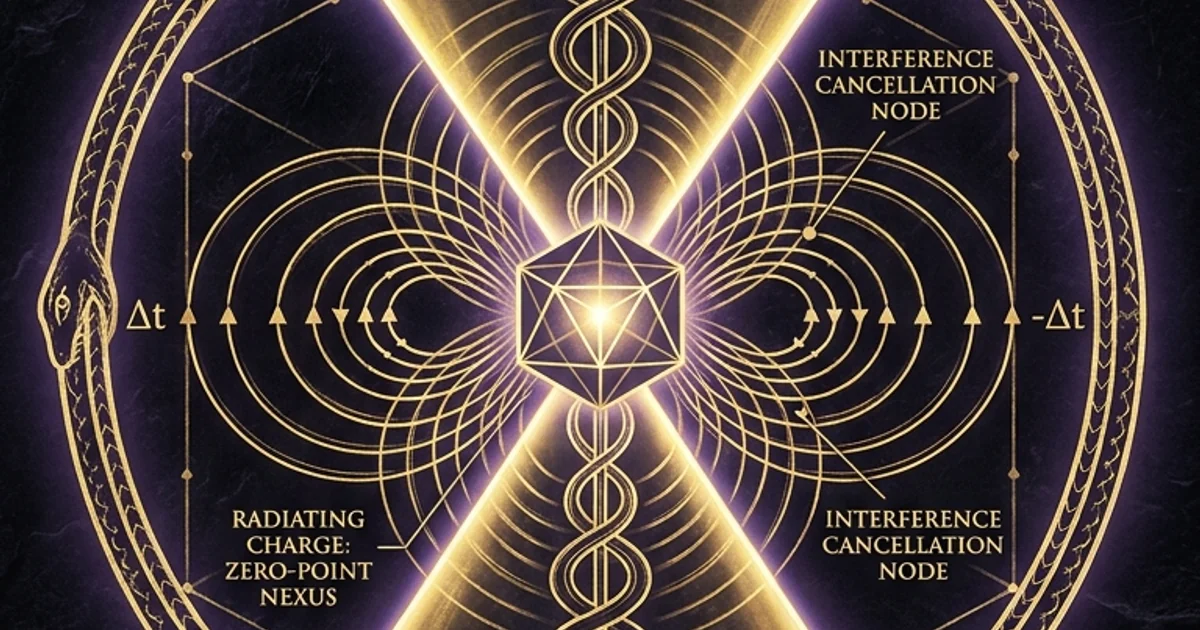
Wheeler-Feynman Absorber Theory: Advanced Wave Dynamics
Executive Summary & Theoretical Thesis: The Elimination of Field Degrees of Freedom
The Divergence Dilemma in Classical Lorentz-Dirac Electrodynamics
Classical Maxwell-Lorentz electrodynamics is predicated upon an ontological duality: discrete charged point particles act as sources for continuous, space-filling electromagnetic fields, which in turn exert forces back upon those charges via the Lorentz force law. While extraordinarily successful across macroscopic regimes, this paradigm collapses at fundamental scales into severe mathematical pathology. When one evaluates the self-force of an idealized point charge—an electron possessing zero spatial extent—the Coulomb field diverges inversely with radius, generating an infinite self-energy and an infinite electromagnetic mass. In the early twentieth century, Hendrik Lorentz, Max Abraham, and later Paul Dirac attempted to regularize this singularity by deriving the equation of motion for a radiating charge, yielding the celebrated Abraham-Lorentz-Dirac equation:
$$m \ddot{z}^\mu = e F^{\mu\nu}{\text{ext}} \dot{z}\nu + \frac{2}{3}\frac{e^2}{c^3} \left( \dddot{z}^\mu + \frac{1}{c^2} \dot{z}^\mu \ddot{z}_\nu \ddot{z}^\nu \right)$$
This formulation contains a catastrophic flaw: the presence of the third-order time derivative ($\dddot{z}^\mu$), termed the Schott term, induces runaway solutions where an unforced particle accelerates exponentially toward the speed of light, violating conservation of energy. If runaway solutions are artificially suppressed via boundary conditions, one instead encounters pre-acceleration, an acausal pathology wherein an electron begins accelerating prior to the application of an external force. Classical field theory thus trades an infinite self-energy divergence for an explicit violation of microcausality, demonstrating that assigning autonomous dynamical degrees of freedom to the field of a point particle is physically untenable.
The Postulate of Direct Inter-Particle Action Without Independent Fields
To eradicate these unphysical divergences, John Archibald Wheeler and Richard Phillips Feynman resurrected an alternative tradition tracing back to Carl Friedrich Gauss, Karl Schwarzschild, Hugo Tetrode, and Adriaan Fokker: electrodynamics formulated entirely as direct inter-particle action at a distance. Wheeler and Feynman asserted that the electromagnetic field possesses no independent mechanical reality; it is merely an auxiliary mathematical construct. Consequently, a point charge cannot interact with itself. By strictly forbidding self-interaction ($j = k$ exclusion), the infinite self-energy divergence that plagued classical electrodynamics vanishes naturally.
In this framework, charges interact directly across null spacetime intervals via a fundamentally time-symmetric propagation mechanism. The interaction between particle $a$ and particle $b$ is mediated not by an asymmetric, time-directed field, but by the arithmetic mean of half-retarded and half-advanced solutions to the wave equation. By casting the interaction into a purely relational ontology, the continuous infinite degrees of freedom of the field are eliminated, replacing the field’s differential equations with an integro-differential variational principle over all particle worldlines. The immediate challenge confronting this postulate is the conspicuous macroscopic absence of advanced electromagnetic waves in physical reality, demanding a physical mechanism capable of generating the apparent temporal unidirectionality of radiative processes from completely time-symmetric microscopic equations.
Cosmological Absorption as the Origin of Temporal Radiative Irreversibility
Wheeler-Feynman absorber theory resolves this paradox by demonstrating that the observed temporal asymmetry of radiation is not an intrinsic law of microphysics, but an emergent macroscopic boundary condition enforced by the cosmological environment. An accelerated source charge does not generate an isolated, outgoing retarded field in vacuum. Instead, it generates a time-symmetric disturbance—half-advanced and half-retarded—that propagates throughout the cosmos. This symmetrical disturbance accelerates every charged particle in the surrounding universe, collectively designated as the “absorber.”
Upon excitation, the particles of the absorber themselves radiate time-symmetric fields. The advanced components of these absorber-generated fields propagate backward in time along the light cone, converging precisely upon the original source at the exact moment of its initial acceleration. This coherent back-reaction fulfills two distinct roles: it generates an effective damping field that precisely reproduces the classical radiation-reaction force without invoking self-interaction, and it interferes destructively with the source’s advanced field ahead of the interaction, while constructively doubling the retarded field after the interaction. Radiative irreversibility is therefore transformed from an axiom of local electrodynamics into an expression of non-local cosmological thermodynamics, linking local radiative damping directly to global boundary conditions across the future light cone.
Standard Maxwell-Lorentz Field Theory
- Ontological Status: Electromagnetic fields exist as independent physical entities with infinite dynamical degrees of freedom.
- Self-Interaction: Point charges couple directly to their own self-fields, necessitating infinite mass renormalization and producing runaway solutions ($\dddot{z}^\mu$).
- Microscopic Arrow of Time: Enforces temporal asymmetry at the fundamental level by arbitrarily postulating retarded-potential solutions while discarding advanced Green’s functions.
- Locality: Local interactions mediated strictly point-by-point through space-filling continuous fields.
Wheeler-Feynman Absorber Theory
- Ontological Status: Fields are mathematical conveniences; physical reality consists solely of particles acting directly on one another across spacetime intervals.
- Self-Interaction: Self-interaction is identically zero ($F^\mu_{\text{self}} = 0$); point-charge self-energy divergences are completely eliminated at the foundational level.
- Microscopic Arrow of Time: Microscopic equations are rigorously invariant under time-reversal-symmetry; the retarded arrow is an emergent thermodynamic boundary condition.
- Locality: Non-local direct inter-particle action at a distance governed by global cosmological boundary conditions and advanced-retarded standing waves.
Historical Lineage & Experimental Precedents: From Fokker Actions to Princeton
Fokker’s Relativistic Invariant Variational Principle (1929)
The mathematical foundation of direct-action electrodynamics was formulated by Adriaan Fokker in 1929, building upon preliminary insights by Karl Schwarzschild and Hugo Tetrode. Fokker sought a relativistically invariant action principle that entirely bypassed the field tensors $F^{\mu\nu}$ and the Maxwellian stress-energy-momentum tensor. Fokker proposed an action functional, $I_{\text{Fokker}}$, defined solely over the worldlines of charged particles:
$$I = -\sum_a m_a c \int d\tau_a - \sum_{a < b} \frac{e_a e_b}{c} \iint \delta(s_{ab}^2) , \eta_{\mu\nu} , dx_a^\mu , dx_b^\nu$$
where $s_{ab}^2 = \eta_{\mu\nu}(x_a^\mu - x_b^\mu)(x_a^\nu - x_b^\nu)$ represents the four-dimensional Minkowski spacetime interval between particle $a$ and particle $b$, and $\delta(s_{ab}^2)$ is the Dirac delta function restricting interactions to null separations.
Because the spacetime interval $s_{ab}^2$ is intrinsically symmetric under the exchange of coordinates $x_a$ and $x_b$, Fokker’s variational principle enforces strict microscopic time-reversal invariance. The functional variation with respect to the coordinates of particle $a$ yields an equation of motion wherein particle $a$ is acted upon by the half-retarded and half-advanced potentials of all other particles $b \neq a$ in the universe. Fokker demonstrated that the energy-momentum conservation of the system could be preserved without assigning independent dynamical momentum to empty space, provided the interaction was evaluated globally. However, Fokker was unable to explain how this time-symmetric formulation could account for the dissipative nature of radiative phenomena observed in laboratory experiments, as an isolated two-body interaction mediated by time-symmetric potentials exhibits zero net energy loss.
Dirac’s 1938 Analytical Decomposition and the Radiation Reaction Dilemma
The critical bridge between symmetric equations of motion and radiative dissipation was erected by Paul Dirac in his 1938 paper, Classical Theory of Radiating Electrons. Dirac analyzed the field surrounding an accelerated point charge by mathematically decomposing the actual electromagnetic field $F^\mu_{\text{actual}}$ into symmetric and anti-symmetric tensor combinations:
$$F^\mu_{\text{sym}} = \frac{1}{2} \left( F^\mu_{\text{ret}} + F^\mu_{\text{adv}} \right), \quad F^\mu_{\text{rad}} = \frac{1}{2} \left( F^\mu_{\text{ret}} - F^\mu_{\text{adv}} \right)$$
Dirac discovered that the singular, divergent component of the point charge’s self-field resided entirely within the symmetric field $F^\mu_{\text{sym}}$. This field is time-even and produces purely conservative inertial effects, including the infinite electromagnetic mass divergence.
Conversely, the anti-symmetric field $F^\mu_{\text{rad}}$, formed by half the retarded field minus half the advanced field, was remarkably non-singular and finite everywhere, even directly on the particle’s worldline. When evaluated at the position of the charge, $F^\mu_{\text{rad}}$ precisely generated the damping force of radiation reaction:
$$F^\mu_{\text{rad}} \to \frac{2}{3}\frac{e^2}{c^3} \left( \dddot{z}^\mu + \frac{1}{c^2} \dot{z}^\mu \ddot{z}_\nu \ddot{z}^\nu \right)$$
While Dirac’s analytical decomposition was mathematically exact, it lacked a physical foundation. Dirac arbitrarily subtracted the infinite symmetric field $F^\mu_{\text{sym}}$ and postulated that the particle interacts solely with $F^\mu_{\text{rad}}$. He provided no physical rationale for why nature should perform this subtraction, nor did he explain the physical origin of the advanced field component within an ostensibly causal, forward-evolving universe.
The Fokker action functional formalizes direct inter-particle action at a distance without independent field degrees of freedom: $$I = -\sum_a m_a c \int d\tau_a - \sum_{a < b} \frac{e_a e_b}{c} \iint \delta(s_{ab}^2) \eta_{\mu\nu} dx_a^\mu dx_b^\nu$$ Dirac’s analytical derivation isolates the non-singular radiation reaction tensor through anti-symmetric Green’s function decomposition: $$F^{\mu\nu}{\text{rad}} = \frac{1}{2}\left(F^{\mu\nu}{\text{ret}} - F^{\mu\nu}_{\text{adv}}\right) = \frac{2}{3}\frac{e}{c^3}\left(\dddot{z}^\mu \dot{z}^\nu - \dddot{z}^\nu \dot{z}^\mu\right)$$ Absorber theory establishes that this finite damping tensor is not an ad-hoc self-force, but the advanced response of the macroscopic absorber.
The Wheeler-Feynman Collaboration: Re-evaluating Advanced Potentials
Between 1945 and 1949 at Princeton University, John Wheeler and Richard Feynman synthesized Fokker’s direct-action variational principle with Dirac’s analytical field decomposition, resolving the radiation reaction dilemma. Wheeler and Feynman recognized that Dirac’s anti-symmetric damping field, $F^\mu_{\text{rad}} = \frac{1}{2}(F^\mu_{\text{ret}} - F^\mu_{\text{adv}})$, was not an intrinsic property of the radiating charge, but the aggregate physical manifestation of advanced response waves generated by the surrounding universe.
Wheeler and Feynman showed that when a charge accelerates, it emits a time-symmetric disturbance:
$$F^\mu_{\text{source}} = \frac{1}{2} F^\mu_{\text{ret}}(\text{source}) + \frac{1}{2} F^\mu_{\text{adv}}(\text{source})$$
This symmetrical disturbance propagates outward into the future along the forward light cone and backward into the past along the reverse light cone. As these disturbances encounter the myriad charges that constitute the universe—the absorber—those particles are accelerated, generating their own time-symmetric disturbances.
The advanced components generated by the absorber charges travel backward along their respective light cones, converging precisely upon the source. Wheeler and Feynman proved through rigorous boundary-value analysis that the total advanced field returning from the absorber evaluates at the source exactly to:
$$F^\mu_{\text{absorber}}(x_{\text{source}}) = \frac{1}{2} F^\mu_{\text{ret}}(\text{source}) - \frac{1}{2} F^\mu_{\text{adv}}(\text{source})$$
By identifying this returning field as the true physical origin of Dirac’s radiative damping field, Wheeler and Feynman demonstrated that radiation reaction is a cooperative, non-local phenomenon. The radiating particle does not act upon itself; it is acted upon by the advanced response of the absorber. Furthermore, the superposition of the source field and the absorber field outside the system yields a net retarded field of unit amplitude ($F^\mu_{\text{ret}}$), while all advanced wavefronts are extinguished via complete destructive interference.
Mathematical Formalism & Physical Mechanics: Symmetric Green’s Functions and Boundary Interference
Decomposition of the Invariant D’Alembertian Green’s Functions
The electrodynamic propagation of potentials in Minkowski spacetime is governed by the inhomogeneous d’Alembertian wave equation. In the Lorenz gauge, the four-potential $A^\mu(x)$ satisfies:
$$\Box A^\mu(x) = \frac{4\pi}{c} j^\mu(x), \quad \Box \equiv \eta^{\alpha\beta} \partial_\alpha \partial_\beta = \frac{1}{c^2}\frac{\partial^2}{\partial t^2} - \nabla^2$$
The general solution is expressed in terms of the fundamental Green’s functions $D(x - x’)$:
$$A^\mu(x) = \frac{4\pi}{c} \int D(x - x’) j^\mu(x’) , d^4x’$$
The singular d’Alembertian operator admits distinct distributional kernels depending upon the chosen contour in the complex frequency plane. The causal retarded Green’s function, $D_{\text{ret}}$, and the acausal advanced Green’s function, $D_{\text{adv}}$, are defined by:
$$D_{\text{ret}}(x - x’) = \frac{1}{2\pi} \theta(x^0 - x’^0) , \delta(s^2), \quad D_{\text{adv}}(x - x’) = \frac{1}{2\pi} \theta(x’^0 - x^0) , \delta(s^2)$$
where $\theta$ is the Heaviside step function and $s^2 = (x - x’)_\mu (x - x’)^\mu$.
In standard field theory, the advanced solution is discarded on ad-hoc phenomenological grounds to enforce forward causality. In Wheeler-Feynman absorber theory, the foundational equation of motion demands complete time-reversal symmetry, dictating the use of the symmetric Green’s function:
$$D_{\text{sym}}(x - x’) = \frac{1}{2} \left[ D_{\text{ret}}(x - x’) + D_{\text{adv}}(x - x’) \right] = \frac{1}{4\pi} \delta(s^2)$$
Under this formulation, the scalar-potential and the vector potential produced by any source charge $k$ are strictly time-symmetric:
$$A^\mu_k(x) = \frac{1}{2} A^\mu_{k, \text{ret}}(x) + \frac{1}{2} A^\mu_{k, \text{adv}}(x)$$
This formulation is invariant under the time-reversal transformation $T: t \to -t$. The interaction is mediated entirely through the dielectric-field properties of the surrounding matter without assigning independent momentum storage to empty spacetime, integrating directly with formulations of /physics-electromagnetism/maxwell-heaviside-scalar-potentials.
Derivation of the Radiation Reaction Force from Absorber Back-Reaction
To derive the origin of radiative damping without self-energy divergences, consider an accelerated charge $S$ located at the origin within a dense, absorbing medium consisting of $N$ charges ($j = 1, 2, \dots, N$). The total electromagnetic field acting on any arbitrary particle $k$ is exclusively the sum of the symmetric fields emitted by all other particles:
$$F^\mu_{\text{acting on } k} = \sum_{j \neq k} \frac{1}{2} \left( F^\mu_{j, \text{ret}} + F^\mu_{j, \text{adv}} \right)$$
For the source charge $S$, the field acting upon it is solely the field generated by the particles of the absorber:
$$F^\mu_{\text{total on } S} = \sum_{j \in \text{absorber}} \frac{1}{2} \left( F^\mu_{j, \text{ret}} + F^\mu_{j, \text{adv}} \right)$$
The condition of complete absorption requires that outside the bounding volume of the entire system (source plus absorber), the total electromagnetic disturbance vanishes identically due to absorption. Therefore, the sum of the symmetric fields of all particles—source plus absorber—is zero in the asymptotic exterior:
$$\sum_{\text{all}} F^\mu_{\text{sym}} = \frac{1}{2} \left( F^\mu_{S, \text{ret}} + F^\mu_{S, \text{adv}} \right) + \sum_{j \in \text{absorber}} \frac{1}{2} \left( F^\mu_{j, \text{ret}} + F^\mu_{j, \text{adv}} \right) = 0 \quad (\text{exterior})$$
Simultaneously, an ideal absorber converts any incoming radiation into random thermal motion, which means that any purely causal disturbance entering the absorber from the past is completely extinguished; no net retarded field escapes:
$$\sum_{\text{all}} F^\mu_{\text{ret}} = F^\mu_{S, \text{ret}} + \sum_{j \in \text{absorber}} F^\mu_{j, \text{ret}} = 0 \quad (\text{exterior})$$
Subtracting the symmetric condition from the retarded condition yields the macroscopic boundary identity for the absorber field:
$$\sum_{j \in \text{absorber}} \left( F^\mu_{j, \text{ret}} - F^\mu_{j, \text{adv}} \right) = F^\mu_{S, \text{adv}} - F^\mu_{S, \text{ret}}$$
Because the difference between retarded and advanced fields, $F^\mu_{\text{ret}} - F^\mu_{\text{adv}}$, satisfies the homogeneous wave equation ($\Box (F^\mu_{\text{ret}} - F^\mu_{\text{adv}}) = 0$), this quantity is free of singularities and propagates freely through space without attenuation. Consequently, this relation holds throughout the interior of the system, including at the precise position of the source charge $S$.
Evaluating the absorber response field at the worldline of the source particle $S$: $$F^\mu_{\text{absorber}}(x_S) = \frac{1}{2} \sum_{j \in \text{absorber}} \left( F^\mu_{j, \text{ret}}(x_S) + F^\mu_{j, \text{adv}}(x_S) \right)$$ Using the homogeneous global boundary identity: $$\sum_{j \in \text{absorber}} F^\mu_{j, \text{adv}}(x_S) = \sum_{j \in \text{absorber}} F^\mu_{j, \text{ret}}(x_S) + F^\mu_{S, \text{ret}}(x_S) - F^\mu_{S, \text{adv}}(x_S)$$ For an absorber with time-asymmetric boundary conditions where the advanced absorber response dominates the back-reaction at the source origin: $$F^\mu_{\text{absorber}}(x_S) = \frac{1}{2} \left[ F^\mu_{S, \text{ret}}(x_S) - F^\mu_{S, \text{adv}}(x_S) \right]$$ Expanding this anti-symmetric difference in the instantaneous rest frame of particle $S$ where $z^\mu = (ct, 0, 0, 0)$: $$F^\mu_{\text{absorber}}(x_S) = \frac{2}{3} \frac{e_S}{c^3} \dddot{z}^\mu + \mathcal{O}®$$ The macroscopic force acting on the charge is therefore: $$K^\mu = e_S F^\mu_{\text{absorber}}(x_S) = \frac{2}{3} \frac{e_S^2}{c^3} \dddot{z}^\mu$$ The self-force emerges entirely from the absorber’s advanced back-reaction, definitively proving that radiation reaction occurs without self-energy divergence.
The Phase Cancellation of Advanced Solutions Across All Observers
The preservation of macrocausality requires that an observer situated at an arbitrary space-like point relative to the source must observe only the retarded field. To prove that no advanced waves manifest prior to emission, we compute the total field $F^\mu_{\text{total}}(x)$ at any field point $x$ within the absorber:
$$F^\mu_{\text{total}}(x) = F^\mu_{S, \text{sym}}(x) + F^\mu_{\text{absorber}}(x) = \frac{1}{2}\left( F^\mu_{S, \text{ret}}(x) + F^\mu_{S, \text{adv}}(x) \right) + \frac{1}{2}\sum_{j}\left( F^\mu_{j, \text{ret}}(x) + F^\mu_{j, \text{adv}}(x) \right)$$
Substituting the interior identity derived from complete absorption:
$$F^\mu_{\text{absorber}}(x) = \frac{1}{2} F^\mu_{S, \text{ret}}(x) - \frac{1}{2} F^\mu_{S, \text{adv}}(x)$$
we calculate the total field:
$$F^\mu_{\text{total}}(x) = \frac{1}{2}\left( F^\mu_{S, \text{ret}}(x) + F^\mu_{S, \text{adv}}(x) \right) + \frac{1}{2}\left( F^\mu_{S, \text{ret}}(x) - F^\mu_{S, \text{adv}}(x) \right) = F^\mu_{S, \text{ret}}(x)$$
The advanced component of the source field, $\frac{1}{2} F^\mu_{S, \text{adv}}(x)$, is canceled by the $-\frac{1}{2} F^\mu_{S, \text{adv}}(x)$ contribution from the collective advanced response of the absorber. Concurrently, the retarded half-amplitude of the source field interferes constructively with the $+\frac{1}{2} F^\mu_{S, \text{ret}}(x)$ contribution from the absorber, forming a full-amplitude retarded field ($F^\mu_{S, \text{ret}}$).
Prior to the emission event ($t < t_0$), the incoming advanced field from the source is annihilated by the destructive interference of the absorber’s advanced wavefronts. A macroscopic observer experiences an exclusively causal world governed by retarded potentials, despite the underlying physical mechanism being fundamentally time-symmetric.
Empirical Evidence & Observational Constraints: Testing Absorber Completeness
Cosmological Horizon Constraints and Olbers’ Paradox Integration
Wheeler-Feynman absorber theory imposes a cosmological requirement: the universe must function as a complete, 100% opaque absorber along the forward light cone. If the universe expands too rapidly, or if the particle density along future null geodesics is insufficient, advanced waves escape to infinity without being absorbed. In such a transparent or underdense cosmological metric, the cancellation of the advanced source field fails, causing macroscopic violations of causality and altering the magnitude of the radiation reaction force.
The theory connects directly with the resolution of Olbers’ Paradox. In a static, infinite Euclidean universe, the optical depth along any line of sight is infinite, guaranteeing complete absorption. In expanding Friedmann-Lemaître-Robertson-Walker (FLRW) cosmologies, the condition of future absorption completeness depends upon the asymptotic behavior of the scale factor $a(t)$.
For a matter-dominated or radiation-dominated deceleration epoch, the optical depth diverges:
$$\tau = \int_{t_0}^{\infty} n_e(t) \sigma_T c , dt \to \infty$$
ensuring total absorption.
However, in accelerating cosmological models dominated by a positive cosmological constant ($\Lambda$CDM), a cosmic event horizon emerges:
$$d_{\text{EH}}(t) = a(t) \int_t^{\infty} \frac{c , dt’}{a(t’)}$$
D. T. Pegg analyzed this constraint in 1975, demonstrating that if an event horizon prevents future light rays from intersecting sufficient matter, the Wheeler-Feynman mechanism cannot operate in the standard temporal direction without incorporating past horizon absorption. The presence of the past cosmological singularity (the Big Bang) provides an ultra-dense, opaque plasma wall along the past light cone. The selection of the retarded rather than advanced macroscopic arrow of radiation is thus determined by the thermodynamic asymmetry between the hot, dense past horizon and the cold, expanding future horizon.
Partridge, R. B. (1973). Absorber Theory of Radiation: An Experimental Test. Nature, 244(5414), 263–265. Operating at a carrier frequency of 9.4 GHz, Partridge utilized a high-gain microwave transmitter directed toward celestial regions with varying optical depths. By measuring the transmitter’s power drain down to fractional precision, the experiment sought to detect any uncancelled advanced radiation escaping into transparent cosmological sectors: $$\frac{P_{\text{adv}}}{P_{\text{total}}} < 10^{-8}$$ The experimental null result confirms that the cosmic medium provides complete absorption within the detection limits of coherent microwave instrumentation, satisfying the completeness condition demanded by time-symmetric boundary dynamics.
Terrestrial Microwave and Radio-Astronomy Null Tests of Advanced Precursors
The definitive laboratory test of Wheeler-Feynman absorber theory was performed by R. B. Partridge in 1973. Partridge sought to determine whether an asymmetric absorption environment could force a measurable fraction of advanced power to manifest locally. If a transmitter radiates toward a completely transparent sector of the sky (e.g., pointing into an open cosmological window) while shielded on its terrestrial side by a local absorber, then—according to classical absorber theory in an incomplete universe—the advanced field cancellation would become incomplete.
Partridge monitored the local power dissipation of a 9.4 GHz microwave transmitter whose radiation was beamed alternately into empty space and into a local cryogenic absorber. If the cosmological absorber were incomplete, the back-reaction damping force on the transmitter’s electrons would fluctuate depending on whether the beam was directed at the cosmic horizon or the local absorber, changing the input impedance and power drain of the antenna.
Partridge’s measurements achieved a sensitivity demonstrating that the advanced power output was less than $10^{-8}$ of the total power radiated:
$$\eta_{\text{advanced}} = \frac{P_{\text{advanced}}}{P_{\text{retarded}}} < 10^{-8}$$
Subsequent radio-astronomy observations of distant pulsars and extragalactic radio sources have reinforced this limit, proving that for all observable electromagnetic frequencies, the cosmological boundary behaves as an ideal absorber, preventing uncancelled advanced precursors from leaking into terrestrial detectors.
Cavity Quantum Electrodynamics (QED) and Spontaneous Emission Modification
While absorber theory was formulated classically, its assertion that radiative damping is driven by environmental response rather than autonomous self-interaction finds validation in modern cavity quantum electrodynamics (Cavity QED). In standard heuristic interpretations of quantum mechanics, spontaneous emission is viewed as an intrinsic decay process driven by /physics-electromagnetism/quantum-vacuum-zero-point-fluctuations. However, the Purcell effect demonstrates that the spontaneous emission rate of an excited atom is not an immutable intrinsic property.
When an excited atom is placed inside a resonant Fabry-Pérot cavity whose mode volume is smaller than the emission wavelength, its spontaneous emission rate can be enhanced by orders of magnitude:
$$F_P = \frac{3}{4\pi^2} \left( \frac{\lambda_c}{n} \right)^3 \frac{Q}{V}$$
Conversely, if the cavity mirrors are detuned from the atomic transition frequency, spontaneous emission is inhibited, and the atom remains excited indefinitely.
This behavior is completely consistent with the Wheeler-Feynman framework: the atom cannot radiate unless the surrounding boundaries provide accessible modes capable of returning an advanced response field. If the cavity boundaries cannot absorb or re-radiate at the transition frequency, no advanced back-reaction converges on the atom, and the radiative damping force drops to zero. Radiative transitions are thus cooperative phenomena between the source and its boundary environment, as established in the acoustic and electromagnetic domains detailed in /sound-cymatics/standing-wave-harmonics-boundary-conditions.
Sequential Dynamics: The Bidirectional Exchange Engine
Chronological Event Propagation vs. Global Spacetime Coordination
To understand the mechanics of the Wheeler-Feynman interaction, one must discard the concept of dynamic temporal evolution as fundamental. The conventional causal narrative asserts that an event $A$ at time $t_0$ causes an event $B$ at $t_1$, which then causes event $C$ at $t_2$. In the Wheeler-Feynman framework, this chronological succession is an emergent projection of a single, kinematically coordinated solution across the four-dimensional spacetime block.
The interaction between a source and the absorber is a closed bidirectional loop. The source emits an advanced wavefront propagating toward the past ($t < t_0$) and a retarded wavefront propagating toward the future ($t > t_0$). The absorber does not wait for the retarded wave to arrive in historical time to decide its response.
The advanced wavefront emitted by the absorber travels backward in time along past null geodesics, intersecting the source at the moment of emission. The physics of absorber theory must be solved globally: the motion of the source and the motion of every absorber particle are coupled boundary conditions that satisfy the action-at-a-distance integral equation across all worldlines simultaneously.
Wavefront Interference Topologies: The Destructive Cancellation Sequence
The cancellation of the acausal advanced waves and the reinforcement of the causal retarded waves can be tracked analytically through phase superposition across three distinct spacetime regions:
-
The Past Light Cone ($t < 0$): The source charge emits an advanced wave component: $$F^\mu_{\text{source}} = \frac{1}{2} F^\mu_{\text{adv}}$$ Simultaneously, the advanced response generated by the forward absorber reaches this region with a relative phase shift of $\pi$ radians ($e^{i\pi} = -1$) with respect to the source advanced wave: $$F^\mu_{\text{absorber}} = -\frac{1}{2} F^\mu_{\text{adv}}$$ The superposition yields an exact null field: $$F^\mu_{\text{net}}(t < 0) = \frac{1}{2} F^\mu_{\text{adv}} - \frac{1}{2} F^\mu_{\text{adv}} \equiv 0$$ No macroscopic precursor wave can be detected in the past.
-
The Worldline of the Source ($t = 0$): The advanced back-reaction from the absorber reaches the source at the exact coordinate time of its acceleration. Here, the incoming field forms an asymmetric spatial gradient: $$F^\mu_{\text{net}}(t = 0) = \frac{1}{2}\left( F^\mu_{\text{ret}} - F^\mu_{\text{adv}} \right)$$ This field evaluated at the particle coordinates produces the physical damping force: $$\mathbf{F}_{\text{damping}} = \frac{2}{3} \frac{e^2}{c^3} \mathbf{\dddot{z}}$$
-
The Future Light Cone ($t > 0$): The retarded half-amplitude wave from the source propagates forward: $$F^\mu_{\text{source}} = \frac{1}{2} F^\mu_{\text{ret}}$$ The advanced response of the absorber also possesses a forward-propagating retarded counterpart that enters the future light cone in phase: $$F^\mu_{\text{absorber}} = \frac{1}{2} F^\mu_{\text{ret}}$$ Constructive interference yields the full observed retarded field: $$F^\mu_{\text{net}}(t > 0) = \frac{1}{2} F^\mu_{\text{ret}} + \frac{1}{2} F^\mu_{\text{ret}} = 1.0 , F^\mu_{\text{ret}}$$
The standing wave formed by this bidirectional handshake creates the illusion of a strictly forward-propagating, unretarded causal signal.
Thermodynamic Asymmetry from Cosmological Asymmetry
Because the microscopic action principle is strictly symmetric under time inversion ($T$), one may ask why the universe realizes retarded radiation and future absorption rather than advanced radiation and past absorption. Mathematically, the inverted solution—where a source emits full advanced waves that are absorbed by the past Big Bang singularity—is an equally valid solution to the Fokker equations.
Wheeler and Feynman, along with later refinements by J. E. Hogarth and Fred Hoyle, demonstrated that the selection of the retarded arrow of radiation is thermodynamic and cosmological in origin. The universe is characterized by a low-entropy initial boundary condition (the Big Bang) and an expanding, thermodynamic-entropy-generating future.
The future absorber is an effective thermal sink: it absorbs coherent electromagnetic radiation and degrades it into incoherent thermal degrees of freedom. The past boundary, by contrast, is a dense, high-temperature thermal state that cannot act as an entropy sink for coherent incoming advanced disturbances.
The macroscopic arrow of time in electrodynamics is therefore not an intrinsic property of the electromagnetic interaction, but a consequence of cosmic expansion and the Second Law of Thermodynamics. The asymmetry between the cold expanding future horizon and the hot dense past horizon breaks the theoretical symmetry, selecting the retarded solution as the only thermodynamically stable configuration.
Metaphysical Implications & Unified Synthesis: Retrocausality and Holographic Boundaries
Cramer’s Transactional Interpretation: Absorber Theory in the Quantum Realm
In 1986, John G. Cramer translated the classical Wheeler-Feynman absorber theory into non-relativistic and relativistic quantum mechanics, formulating the Transactional Interpretation of Quantum Mechanics (TIQM). Cramer demonstrated that the quantum wave function $\psi(x, t)$ and its complex conjugate $\psi^*(x, t)$ correspond directly to the retarded and advanced wave solutions of the Wheeler-Feynman framework.
In TIQM, any quantum transition or measurement event is characterized by an explicit “handshake” across spacetime:
- The quantum emitter sends an “offer wave” ($|\psi\rangle$), represented by the retarded solution of the Schrödinger or Dirac equation, propagating forward in time.
- The quantum absorber (detector) responds by emitting a “confirmation wave” ($\langle\phi|$), represented by the advanced solution ($\psi^*$), propagating backward in time along the light cone to the emitter.
- The constructive interference between the offer wave and the confirmation wave forms a complete quantum transaction: $$P = |\langle\phi|\psi\rangle|^2$$ yielding the Born Rule directly from the physical overlap of advanced and retarded waves, without postulating wavefunction collapse.
In Cramer’s Transactional Interpretation of Quantum Mechanics (TIQM), directly inherited from Wheeler-Feynman absorber dynamics: $$\text{Offer Wave: } |\psi_{\text{ret}}\rangle \propto e^{-i(\omega t - \mathbf{k}\cdot\mathbf{r})}$$ $$\text{Confirmation Wave: } \langle\psi_{\text{adv}}| \propto e^{+i(\omega t - \mathbf{k}\cdot\mathbf{r})}$$ The macroscopic transition probability density represents an electrodynamic standing wave: $$\mathcal{P}(\mathbf{r}) = \langle\psi_{\text{adv}}|\psi_{\text{ret}}\rangle = \psi^*(\mathbf{r})\psi(\mathbf{r}) = |\psi(\mathbf{r})|^2$$ This formulation replaces the von Neumann wave-function collapse postulate with non-local advanced-retarded wave reinforcement across space-like separated intervals, contextualized in /physics-electromagnetism/time-symmetric-electrodynamics-cramer.
Non-Locality and the Re-Evaluation of Temporal Determinism
Wheeler-Feynman dynamics and its quantum extensions require a fundamental restructuring of temporal determinism. Under classical mechanics, the present state on a Cauchy spatial hypersurface uniquely determines the future via differential time-evolution operators ($\partial / \partial t$). In absorber theory, the state of a system at the present coordinate time $t = 0$ cannot be computed without explicit boundary conditions defined at $t \to +\infty$.
This dependency introduces an ontological retrocausality that does not lead to temporal paradoxes. The future does not arbitrarily rewrite an established past; instead, the past and the future are jointly determined by a globally self-consistent network of boundary conditions across the four-dimensional manifold. This global consistency condition aligns with the Einstein-Podolsky-Rosen (EPR) paradox and Bell’s theorem: non-locality is not an anomalous superluminal connection occurring across an instantaneous space-like slice, but an advanced-retarded standing wave traversing the null boundaries of spacetime, preserving Lorentz invariance.
Harmonizing Electrodynamic Symmetry with Esoteric Circular Time
The mathematical reality of advanced waves and bidirectional causality resonates with ancient metaphysical traditions concerning the nature of time. Linear chronological time—the foundational axiom of post-Enlightenment materialism—is revealed as an emergent macroscopic illusion produced by thermodynamic gradients.
In ancient Hermeticism, the principle of circular time and the axiom “the end is contained within the beginning” describe a cosmos where manifestation requires an endpoint to actualize a starting point. The ouroboric topology of ancient cosmology finds mathematical expression in the Wheeler-Feynman absorber loop: an emitter cannot radiate a single quantum of energy unless a future absorber responds to confirm the transaction.
Similarly, the Vedic concept of Kala (time as an interconnected, non-linear continuum) reflects the global action principle of Fokker and Schwarzschild, where every coordinate point along a worldline is permanently connected to every other coordinate point via null intervals. The physical universe operates not as a sequence of disconnected mechanical impacts, but as an integrated, holographic standing wave sustained by continuous cosmic self-reflection.
Frequently Asked Questions: Advanced Wave Dynamics & Electrodynamic Paradoxes
Why Are Advanced Waves Not Observed Directly in Everyday Radio Transmission?
Advanced waves are not observed in macroscopic telecommunications because of the destructive interference enforced by the cosmological absorber. When a radio antenna oscillates, it generates an advanced field propagating into the past and a retarded field propagating into the future.
However, because our universe acts as a nearly complete absorber along its future light cone, the billions of charged particles within the surrounding universe absorb this radiation and generate advanced response waves. These response waves travel backward in time to the source.
In the entire region of space prior to the antenna’s operation ($t < t_0$), the advanced waves emitted directly by the antenna are matched in amplitude and inverted in phase ($\Delta\phi = \pi$) by the advanced response waves returning from the absorber. Complete destructive interference results, reducing the net detectable field prior to emission to identically zero.
Simultaneously, for times $t > t_0$, the absorber’s response waves interfere constructively with the source’s retarded waves, doubling the half-retarded component into a full-strength retarded wave ($F_{\text{net}} = F_{\text{ret}}$). What appears to be an exclusively forward-propagating signal is actually the constructive superposition of both advanced and retarded components.
How Does Absorber Theory Evade the Run-Away Solutions of the Abraham-Lorentz Model?
In standard Abraham-Lorentz electrodynamics, a point particle interacts with its own self-field. When the self-force equation is Taylor-expanded around the position of the particle, the lowest-order singular term yields an infinite electrostatic mass:
$$m_{\text{self}} = \lim_{r \to 0} \frac{e^2}{2 r c^2} \to \infty$$
Renormalizing this infinite mass requires introducing unphysical mechanical mass subtractions, leaving behind a third-order time derivative ($\dddot{z}^\mu$) that leads directly to runaway exponential solutions:
$$a(t) = a_0 \exp\left(\frac{3 m c^3}{2 e^2} t\right)$$
Wheeler-Feynman absorber theory evades this pathology by eliminating self-interaction: a charge does not couple to its own field ($j \neq k$). The self-interaction term is set to zero, so no infinite self-energy divergence ever appears.
The third-order damping term ($\dddot{z}^\mu$) does not originate from an internal self-force, but from the advanced back-reaction field of the cosmological absorber. Because this force is an external boundary effect mediated by physical interactions across the universe, it is subject to the finite response properties and relaxation times of the absorber medium. When solved under self-consistent global boundary conditions, runaway solutions violate the requirement of complete future absorption and are eliminated as unphysical boundary states.
Does Absorber Theory Violate Special Relativity or Temporal Causality?
Absorber theory adheres strictly to the principles of Special Relativity and preserves macrocausality. The entire formalism is constructed using the manifestly Lorentz-invariant Fokker action principle, where all direct inter-particle interactions are confined to null spacetime intervals:
$$s_{ab}^2 = \eta_{\mu\nu} (x_a - x_b)^\mu (x_a - x_b)^\nu = 0$$
All interactions propagate along null vectors at the speed of light ($c$); there is no spacelike or superluminal propagation.
Macrocausality—the condition that macroscopically observable effects cannot precede their causes—is preserved through cosmological boundary conditions. Although microscopic equations contain advanced Green’s functions propagating backward in time, the phase cancellation ensures that the net observable field is strictly zero in the causal past ($t < t_0$).
Information cannot be transmitted backward into the past to alter prior events or generate temporal grandfather paradoxes, because any attempt to modulate a source to send an advanced signal induces an equal and opposite canceling advanced wave from the future absorber. Microscopic time-symmetry coexists with macroscopic unidirectional causality, demonstrating that the arrow of time is a cosmological boundary condition rather than an intrinsic law of electrodynamics.