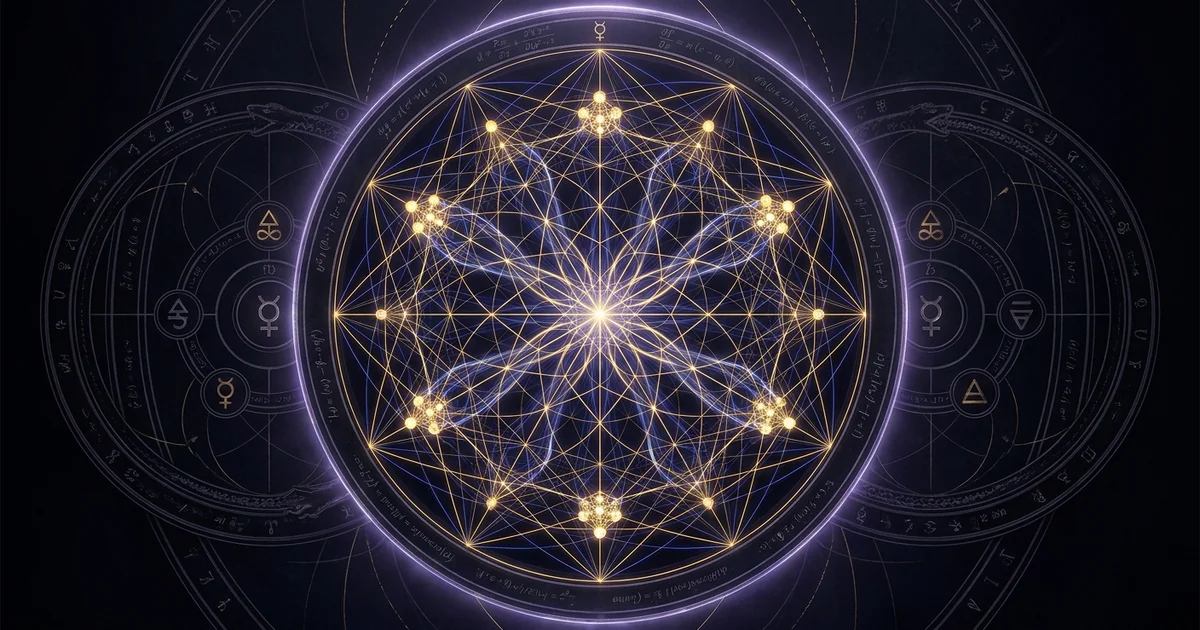
E8 Lie Group: Unified Theory of All Known Physical Forces
Executive Summary & Theoretical Thesis
Geometric Reductionism Beyond the Standard Model
The central paradox of contemporary high-energy physics resides in the bifurcated architecture of modern field theory. The Standard Model of particle physics operates as a Yang-Mills gauge theory structured upon the compact Lie group $SU(3)_C \times SU(2)L \times U(1)Y$, defined across a semi-Riemannian spacetime manifold governed by General Relativity. This configuration treats the external geometry of spacetime—encoded in the metric tensor $g{\mu\nu}$ and the Levi-Civita or spin connection $\omega^{ab}\mu$ of the Poincaré or Lorentz group $SO(3,1)$—as an arena distinct from the internal fiber bundles that host the electroweak and strong force charges. This duality introduces deep conceptual incongruities at the Planck threshold, where quantum fluctuations of the metric should theoretically destabilize the smooth manifold structure foundational to Yang-Mills fiber bundles. An authentic unified field theory must abandon this extrinsic coupling between the base manifold and internal charge spaces, reconstructing both spacetime geometry and internal gauge transformations as manifest projections of a singular, self-consistent algebraic structure. The pursuit of geometric reductionism posits that all matter fields, gauge bosons, and spacetime metrics originate from the structural properties of an encompassing Lie algebra.
Base Manifold (M4) <--- [Decoupled Fiber] ---> Internal Groups: SU(3) x SU(2) x U(1)
                      vs.
Principal E8 Bundle  ---> Spacetime Frame + Gauge Symmetries (Unified Connection A)
Within this geometric imperative, modern developments in unified field mechanics at the Planck scale (/physics-electromagnetism/unified-field-mechanics-planck-scale) demand a radical reassessment of gauge connections. The physical universe does not merely host fields; it expresses the intrinsic topology of an invariant geometric object. If physical reality is fundamentally non-dual at the high-energy boundary, the dynamic frame field (the solder form or tetrad $e^a_\mu$) that endows differential manifolds with metrical distance must share an identical gauge origin with the non-Abelian gluons and electroweak vector fields. This unification requires a mathematical substrate possessing sufficient dimensionality, exceptional symmetry, and rigid structural invariants to simultaneously accommodate gravitational dynamics and the non-Abelian charges of the subatomic spectrum.
The 248-Dimensional Gauge Connection Hypothesis
The theoretical proposal articulated by A. Garrett Lisi in 2007 advanced a definitive hypothesis: the totality of fundamental forces and material constituents can be encoded within the adjoint representation of the largest exceptional simple Lie group, $E_8$. Under this formulation, designated colloquially as the e8 exceptional simple lie group an exceptionally simple theory of everything garrett lisi, the fundamental dynamical variable is an $E_8$-valued 1-form connection field $A$, defined globally across a 4-dimensional base manifold $M$:
$$A = A_\mu^I T_I , dx^\mu$$
Here, the index $I$ spans the 248 generators $T_I$ of the Lie algebra $\mathfrak{e}_8$, and $\mu \in {0, 1, 2, 3}$ designates the spacetime coordinate differentials. Rather than segregating matter fermions and interaction bosons into fundamentally distinct mathematical classes (spinor modules versus adjoint vectors), the model proposes that all particles correspond to distinct root vectors within the 248-dimensional adjoint representation of $\mathfrak{e}_8$.
Formalizes the hypothesis that the 248 dimensions of E8 encompass all known fundamental particles and gauge bosons along with 20 predicted states, unified through an E8 connection 1-form A defined on a 4-dimensional base manifold.
In this architecture, unifying standard model with gravity ceases to be an operation of quantizing metric fluctuations on a fixed background. Instead, it becomes an exercise in mapping physical field degrees of freedom to the elements of an overarching Cartan-Killing metric space. The 248 dimensions of the algebra are exhaustively assigned: 12 generators correspond to the Standard Model gauge bosons ($W^\pm, Z^0, \gamma,$ and the eight gluons); 6 generators map to the gravitational spin connection $\omega^{ab}$ of the Lorentz group $SO(3,1)$; 4 generators correspond to the gravitational frame field (tetrad $e^a$), acting as gauge translation generators; and the remaining generators map to the three generations of quarks, leptons, their antiparticles, and an ensemble of scalar Higgs and predicted auxiliary fields. This configuration establishes a single, uninterrupted fiber system over the spacetime manifold.
Resolving Spacetime and Internal Fiber Symmetries
The principal mathematical mechanism underlying this synthesis relies on the operational framework of a principal-bundle over $M^4$ whose structure group is the non-compact or compact real form of $E_8$. Historically, attempts to merge the Lorentz group with internal symmetries were abandoned due to no-go theorems that govern the trivial Cartesian product structure of the full symmetry group. However, by treating gravitation as a gauge theory formulated via a MacDowell-Mansouri mechanism, the gravitational field ceases to be an external background and integrates directly into the gauge connection 1-form.
In a MacDowell-Mansouri framework, the spin connection $\omega^{ab}$ and the tetrad $e^a$ assemble into an overarching connection for the de Sitter group $SO(4,1)$ or anti-de Sitter group $SO(3,2)$. Lisi expands this logic by embedding the de Sitter connection into the broader maximal subalgebras of $E_8$. The curvature 2-form associated with this generalized connection:
$$F = dA + A \wedge A$$
naturally computes both the Riemann curvature tensor of spacetime, the Cartan torsion of the frame field, and the Yang-Mills field strengths of the strong and electroweak forces in a single exterior derivative operation. Consequently, the geometric symmetry of fundamental particles reveals that spacetime curvature and subatomic force interactions are mathematically identical phenomena: they are directional holonomies across distinct sub-algebras of a master Lie connection.
Historical Lineage & Algebraic Foundations
The Killing-Cartan Classification of Exceptional Structures
The mathematical lineage of $E_8$ traces back to the monumental classification of finite-dimensional simple Lie algebras executed by Wilhelm Killing between 1888 and 1890, and rigorously completed by Élie Cartan in his 1894 doctoral thesis. Cartan demonstrated that every complex simple Lie algebra belongs either to one of four infinite classical families—$A_n = \mathfrak{sl}(n+1)$, $B_n = \mathfrak{so}(2n+1)$, $C_n = \mathfrak{sp}(2n)$, $D_n = \mathfrak{so}(2n)$—or to one of precisely five exceptional Lie algebras: $\mathfrak{g}_2$ (dimension 14), $\mathfrak{f}_4$ (dimension 52), $\mathfrak{e}_6$ (dimension 78), $\mathfrak{e}_7$ (dimension 133), and $\mathfrak{e}_8$ (dimension 248).
Archival categorization of the five exceptional Lie algebras, establishing E8 as the largest and most complex simple Lie group with dimension 248, rank 8, and an invariant fundamental representation identical to its adjoint representation.
The exceptional structures represent maximal geometric symmetries that cannot be embedded within the infinite families without structural truncation. The terminal structure of this sequence, $E_8$, possesses rank 8, signifying that its maximal abelian subalgebra—the cartan-subalgebra $\mathfrak{h}$—is 8-dimensional. Crucially, while all other Lie groups possess fundamental representations of dimension strictly smaller than their adjoint representations (for example, the fundamental representation of $SU(N)$ is $N$-dimensional, whereas its adjoint is $(N^2-1)$-dimensional), $E_8$ is unique among all simple Lie groups: its lowest-dimensional, non-trivial, fundamental irreducible representation is the adjoint representation itself, precisely 248-dimensional. It contains no smaller linear carrier spaces; it acts upon itself through the Lie bracket with absolute structural closure.
The 248 dimensional root system of $\mathfrak{e}_8$ consists of an 8-dimensional cartan-subalgebra complemented by 240 non-zero root spaces, each corresponding to a one-dimensional root vector in the dual space $\mathfrak{h}^*$. The geometry of these roots represents the absolute pinnacle of packing density, symmetry, and rigidity in eight Euclidean dimensions, crystallizing the absolute limit of exceptional algebraic behavior.
MacDowell-Mansouri Gauge Formulation of Gravitation
The technical bridge allowing gravity to participate in this exceptional algebraic framework was constructed by S. W. MacDowell and F. Mansouri in 1977. Classical General Relativity, as formulated by Albert Einstein and later cast into first-order differential form by Palatini, relies on an independent tetrad $e^a = e^a_\mu dx^\mu$ and a spin connection $\omega^{ab} = \omega^{ab}_\mu dx^\mu$ associated with the local Lorentz symmetry $SO(3,1)$. MacDowell and Mansouri demonstrated that by expanding the local gauge group from the Lorentz group $SO(3,1)$ to the de Sitter group $SO(4,1)$ (or anti-de Sitter $SO(3,2)$), one can unify the tetrad and spin connection into a single 1-form gauge field:
$$\mathbb{A}\mu = \frac{1}{2} \omega\mu^{ab} M_{ab} + \frac{1}{R} e_\mu^a P_a$$
where $M_{ab}$ are the Lorentz rotation generators, $P_a$ are the de Sitter translation generators, and $R$ is a characteristic length scale associated with the cosmological constant $\Lambda = 3/R^2$. The corresponding curvature 2-form $\mathbb{F} = d\mathbb{A} + \mathbb{A} \wedge \mathbb{A}$ yields:
$$\mathbb{F}^{ab} = R^{ab} - \frac{1}{R^2} e^a \wedge e^b, \quad \mathbb{F}^a = \frac{1}{R} \left( de^a + \omega^a_{\ b} \wedge e^b \right) = \frac{1}{R} T^a$$
where $R^{ab}$ is the standard Riemann curvature 2-form, and $T^a$ is the Cartan torsion 2-form. The gravitational action can then be written not through an ad-hoc metric contraction, but through a topological Euler-type action with a symmetry-breaking mechanism:
$$S_{\text{MM}} = -\frac{1}{4g^2} \int_{M^4} \epsilon_{abcd} , \mathbb{F}^{ab} \wedge \mathbb{F}^{cd}$$
Varying this action directly generates the Einstein-Hilbert action with a cosmological constant term, alongside the Gauss-Bonnet topological invariant. In this setting, the metric $g_{\mu\nu} = \eta_{ab} e^a_\mu e^b_\nu$ becomes a secondary, derived composite object. The MacDowell-Mansouri formulation established that the gravitational frame field is fundamentally a gauge field of the translation generators, proving that gravitation can be cast as an exact parallel to non-Abelian Yang-Mills theory.
From Grand Unified Theories (GUTs) to E8 Algebra
The evolution of internal gauge theories throughout the late 20th century moved progressively toward higher-dimensional Lie groups capable of subsuming the disparate coupling constants of the Standard Model into a single master symmetry. The $SU(5)$ model of Georgi and Glashow unified the electroweak and strong forces into a rank-4 group, but failed to accommodate right-handed neutrinos and suffered from rapid, empirically ruled-out proton decay rates. This was succeeded by the $SO(10)$ model, which embedded the 15 Standard Model fermions of a single generation, plus one right-handed neutrino, into an elegant 16-dimensional chiral spinor representation.
SU(3) x SU(2) x U(1)  --->  SU(5)  --->  SO(10)  --->  E6  --->  E8
[Rank 4 Standard Model]    [Rank 4 GUT]   [Rank 5 GUT]  [Rank 6 GUT]  [Rank 8 Master Group]
To resolve the arbitrary replication of the three generations, theorists moved to exceptional structures, beginning with the rank-6 group $E_6$, which naturally incorporates $SO(10) \times U(1)$. The mathematical hierarchy dictates that $E_6$ embeds into $E_7$, which in turn embeds into $E_8$. In string theory frameworks, particularly heterotic $E_8 \times E_8$ superstring theory, the 248-dimensional algebra appeared as a necessary condition for modular invariance and anomaly cancellation in 10 dimensions. However, whereas string theory isolates $E_8$ as an internal gauge symmetry acting in a higher-dimensional background, the non-supersymmetric gauge connection approach adopts the maximal, self-dual terminus of this progression directly on 4D spacetime. At this terminal boundary, the algebra incorporates octonions, division algebras, and the exceptional geometric automorphism known as triality, offering a comprehensive mathematical apparatus for uniting standard model with gravity.
Mathematical Formalism & Physical Mechanics
Roots, Weights, and the Gosset 4_21 Polytope
The structural foundation of the Lie algebra $\mathfrak{e}_8$ is defined by its root system, which resides in an eight-dimensional Euclidean vector space $\mathbb{R}^8$ equipped with the standard inner product $\langle \cdot, \cdot \rangle$. The root system $\Phi(E_8)$ comprises exactly 240 vectors of uniform squared length $|\alpha|^2 = 2$. In the standard Cartesian basis ${e_1, e_2, \dots, e_8}$ of $\mathbb{R}^8$, the 240 root vectors decompose into two distinct sets:
$$\Phi(E_8) = \Phi_{\text{int}} \cup \Phi_{\text{half}}$$
The set $\Phi_{\text{int}}$ contains 112 vectors possessing integer coordinates, defined by:
$$\Phi_{\text{int}} = \left{ \pm e_i \pm e_j \mid 1 \leq i < j \leq 8 \right}$$
The set $\Phi_{\text{half}}$ contains 128 vectors possessing half-integer coordinates with an even number of minus signs:
$$\Phi_{\text{half}} = \left{ \frac{1}{2} \sum_{i=1}^8 (-1)^{k_i} e_i \ \middle|\ \sum_{i=1}^8 k_i \equiv 0 \pmod 2 \right}$$
These 240 root vectors constitute the vertices of the gosset-polytope, designated in the Coxeter-Dynkin notation as $4_{21}$. The Gosset polytope is the unique semi-regular polytope in eight dimensions whose facets consist of 2,160 regular 7-simplices and 17,280 regular 7-cross-polytopes.
The Cartan matrix $A_{ij} = \frac{2\langle \alpha_i, \alpha_j \rangle}{\langle \alpha_i, \alpha_i \rangle}$ of $E_8$ is an $8 \times 8$ symmetric, positive-definite matrix with determinant $\det(A) = 1$:
$$A = \begin{pmatrix} 2 & -1 & 0 & 0 & 0 & 0 & 0 & 0 \ -1 & 2 & -1 & 0 & 0 & 0 & 0 & 0 \ 0 & -1 & 2 & -1 & 0 & 0 & 0 & 0 \ 0 & 0 & -1 & 2 & -1 & 0 & 0 & 0 \ 0 & 0 & 0 & -1 & 2 & -1 & 0 & -1 \ 0 & 0 & 0 & 0 & -1 & 2 & -1 & 0 \ 0 & 0 & 0 & 0 & 0 & -1 & 2 & 0 \ 0 & 0 & 0 & 0 & -1 & 0 & 0 & 2 \end{pmatrix}$$
Because $\det(A) = 1$, the $E_8$ root lattice $\Lambda(E_8)$ is unimodular and even (even-self-dual): $\Lambda(E_8) = \Lambda^*(E_8)$. The 248 dimensions of the Lie algebra are precisely partitioned into the 8-dimensional abelian Cartan subalgebra $\mathfrak{h}$ and the 240 one-dimensional root spaces $\mathfrak{g}_\alpha$ corresponding to $\alpha \in \Phi(E_8)$:
$$\mathfrak{e}8 = \mathfrak{h} \oplus \bigoplus{\alpha \in \Phi(E_8)} \mathfrak{g}_\alpha$$
Geometrically, the Gosset $4_{21}$ polytope encodes the densest known sphere packing in eight dimensions, a mathematical absolute verified by Maryna Viazovska’s 2016 proof. In Lisi’s formulation, this packing corresponds directly to the physical state space: every fundamental quantum particle—every quark, lepton, gauge boson, and frame component—is mapped to a specific vertex within this 8-dimensional geometric manifold, anchoring the geometric symmetry of fundamental particles in Euclidean lattice theory. For additional reading on hyperdimensional geometries, see /sacred-geometry/hyperdimensional-polytopes-platonic-solids.
Decomposition of e8 via Maximal Subalgebras
To correlate the 248 algebraic generators with observable elementary particles, the exceptional algebra $\mathfrak{e}_8$ must undergo progressive decomposition through its maximal subalgebras. The primary physical decomposition pathways trace through orthogonal and exceptional subgroups:
$$\mathfrak{e}_8 \supset \mathfrak{so}(16)$$
$$\mathfrak{e}_8 \supset \mathfrak{e}_7 \oplus \mathfrak{su}(2)$$
$$\mathfrak{e}_8 \supset \mathfrak{e}_6 \oplus \mathfrak{su}(3)$$
$$\mathfrak{e}_8 \supset \mathfrak{so}(3,1) \oplus \mathfrak{so}(7,1) \oplus \text{spinors}$$
Under the maximal subalgebra $\mathfrak{so}(16)$, the 248-dimensional adjoint representation decomposes into the 120-dimensional adjoint representation of $\mathfrak{so}(16)$ and a 128-dimensional irreducible chiral spinor representation $\Delta_{128}$:
$$\mathbf{248} \to \mathbf{120} \oplus \mathbf{128}$$
The 120 generators of $\mathfrak{so}(16)$ are further broken down by isolating the Lorentz algebra $\mathfrak{so}(3,1)$ alongside internal symmetries. Under the embedding $\mathfrak{so}(16) \supset \mathfrak{so}(4) \oplus \mathfrak{so}(12) \cong \mathfrak{so}(3,1) \times \mathfrak{so}(12)$, the adjoint decomposes as:
$$\mathbf{120} \to (\mathbf{6}, \mathbf{1}) \oplus (\mathbf{1}, \mathbf{66}) \oplus (\mathbf{4}, \mathbf{12})$$
Here, the $(\mathbf{6}, \mathbf{1})$ represents the Lorentz transformations corresponding to the gravitational spin connection $\omega^{ab}\mu$. The $(\mathbf{4}, \mathbf{12})$ comprises the gravitational frame fields (tetrads $e^a\mu$) coupled to an internal space, while the $(\mathbf{1}, \mathbf{66})$ contains the standard Yang-Mills gauge sectors. By descending further through $\mathfrak{so}(12) \supset \mathfrak{su}(3)_C \times \mathfrak{su}(2)_L \times \mathfrak{u}(1)_Y \times \dots$, the internal forces emerge alongside residual grand-unified generators.
The $\mathbf{128}$ half-spinor representation corresponds algebraically to $\Phi_{\text{half}}$ in the root lattice. It is within this 128-dimensional subspace that the matter sector—quarks and leptons—is formally positioned. In standard Lie group representation theory, fermions are treated as elements of spinor representations, whereas gauge bosons occupy the adjoint representation. Lisi’s construction bypasses this classical paradigm by asserting that both the $\mathbf{120}$ gauge elements and the $\mathbf{128}$ matter elements occupy the single adjoint $\mathbf{248}$ space of $\mathfrak{e}_8$, treating matter as an algebraically shifted manifestation of the gauge connection.
Curvature 2-Form and the Modified BF Action
The physical dynamics of the unified connection 1-form $A$ are governed by a gauge action constructed within the language of differential forms. The total $E_8$ connection 1-form is expanded along the generators $T_I$:
$$A = \sum_{I=1}^{248} A^I T_I = \omega + \frac{1}{R} e + A_{\text{SM}} + \psi$$
where $\omega$ is the spin connection, $e$ is the frame field, $A_{\text{SM}}$ denotes the Standard Model gauge fields, and $\psi$ designates the Grassmann-valued fermion fields entering via the spinor root sectors. The corresponding curvature 2-form is given by the Maurer-Cartan structural equation:
$$F = dA + A \wedge A = \frac{1}{2} F_{\mu\nu}^I T_I , dx^\mu \wedge dx^\nu$$
The dynamics cannot be dictated by a standard Yang-Mills action $\int \text{Tr}(F \wedge *F)$ directly on a 4-manifold without invoking an a priori background metric, which would contradict the foundational premise of background independence. Instead, the theory employs a modified BF-type topological theory with an invariant scalar-potential. The action is expressed as:
$$S_{\text{BF}} = \int_{M^4} \langle B \wedge F \rangle - \frac{1}{2} \langle B \wedge \zeta(B) \rangle$$
where $B$ is an $\mathfrak{e}_8$-valued 2-form auxiliary field, $\langle \cdot, \cdot \rangle$ represents the invariant Cartan-Killing metric on $\mathfrak{e}_8$:
$$\langle T_I, T_J \rangle = \text{Tr}(\text{ad}{T_I} \circ \text{ad}{T_J})$$
and $\zeta$ is a linear symmetry-breaking constitutive map that acts on the $B$ field, projecting specific components into the Hodge dual configurations required to dynamically recover the Palatini action for gravitation and the Maxwell-Yang-Mills action for gauge sectors. Variation of the action with respect to $B$ yields the field equation:
$$F = \zeta(B) \implies B = \zeta^{-1}(F)$$
Substituting this back into the action produces an effective Lagrangian density:
$$\mathcal{L}_{\text{eff}} = \frac{1}{2} \langle F \wedge \zeta^{-1}(F) \rangle$$
When evaluated across the sub-algebras, the Riemann curvature $R^{ab}$, the torsion $T^a$, and the field strengths $F_{\text{YM}}$ of the strong and electroweak fields undergo simultaneous integration:
$$\mathcal{L}{\text{eff}} = \frac{1}{16\pi G} \epsilon{abcd} \left( R^{ab} \wedge e^c \wedge e^d + \frac{\Lambda}{6} e^a \wedge e^b \wedge e^c \wedge e^d \right) - \frac{1}{4} \text{Tr}(F_{\text{YM}} \wedge * F_{\text{YM}}) + \mathcal{L}_{\text{matter}}(\psi, A)$$
This action resolves the traditional schism between gravitational and quantum gauge dynamics by formulating both as functional limits of a broken topological $E_8$ gauge action.
Empirical Critiques and the Coleman-Mandula Boundary
The Distler-Garibaldi No-Go Theorem
Despite the geometric elegance of the $E_8$ framework, the theory encountered formidable mathematical objections from the high-energy physics community. The most definitive refutation of the model’s unassisted structure was established by Jacques Distler and Skip Garibaldi in their 2010 treatise, ‘There is no “Theory of Everything” inside $E_8$’.
Supersymmetric GUTs (SO(10) / E6 SUSY)
- Evades Coleman-Mandula via $\mathbb{Z}_2$-graded Lie superalgebras.
- Requires unobserved superpartners (gluinos, squarks, selectrons).
- Separates spacetime coordinates from internal gauge fiber bundles.
- Accommodates 3 chiral generations via family replication representations.
Lisi E8 Connection Theory
- Attempts evasion via MacDowell-Mansouri connection and BRST ghost mixing.
- Replaces superpartners with gravitational frame fields and Higgs vectors.
- Fuses spacetime tetrad $e$ and gauge connection $A$ into a single 1-form.
- Fails to generate three chiral generations without mirror fermion anomalies.
Distler and Garibaldi applied rigorous representation theory to analyze whether the real, non-compact Lie group $E_{8(-24)}$ or any other real form of $E_8$ could decompose to contain the minimal spectrum of the Standard Model: one generation of chiral fermions, the Lorentz group $SO(3,1)$, and the gauge groups $SU(3) \times SU(2) \times U(1)$.
Their proof demonstrated that any embedding of the Lorentz group and the Standard Model gauge groups inside a real Lie group $E_8$ necessarily forces the fermion representations to be non-chiral with respect to the electroweak gauge group $SU(2)_L \times U(1)_Y$. In the Standard Model, chirality is paramount: the left-handed quarks and leptons transform as doublets under $SU(2)_L$, whereas right-handed quarks and leptons transform as singlets. Distler and Garibaldi proved that under the centralizer of the Standard Model within $E_8$, the adjoint representation decomposes such that for every left-handed doublet, there exists an equivalent right-handed doublet transforming identically under the gauge group—a phenomenon known as “mirror fermions”:
$$\mathbf{248} \to \bigoplus_i \left( R_i \oplus R_i^* \right)$$
Because mirror fermions have not been observed up to the TeV scale, and because their presence would prevent the generation of standard chiral fermion masses via the Higgs mechanism without excessive gauge-breaking anomalies, the unassisted identification of the 248 roots with standard chiral-fermion states fails the requirements of physical particle physics.
The Chirality and Three-Generation Problem
The second fundamental obstruction is the Three-Generation Problem. The observable universe contains precisely three sequential families of quarks and leptons:
$$(u, d, e, \nu_e), \quad (c, s, \mu, \nu_\mu), \quad (t, b, \tau, \nu_\tau)$$
In Lisi’s initial paper, it was hypothesized that the three generations might emerge from the phenomenon of triality—an outer automorphism of the Lie algebra $\mathfrak{so}(8)$ that cyclically permutes its 8-dimensional vector representation $8_v$, its left-handed chiral spinor representation $8_s$, and its right-handed chiral spinor representation $8_c$. Lisi assigned the three generations to three equivalent $\mathfrak{so}(8)$ embeddings within $\mathfrak{e}_8$.
         Triality Automorphism in SO(8)
                     8_v (Vector)
                    /   \
                   /     \
    8_s (Spinor) <--------> 8_c (Conjugate Spinor)
However, Bertram Kostant (2010), alongside Distler and Garibaldi, established that this assignment is mathematically unviable within the confines of a single $E_8$ algebra. While $\mathfrak{so}(8)$ exhibits triality as an isolated algebraic operation, the embedding of $\mathfrak{so}(8)$ inside $\mathfrak{e}_8$ is rigid. The outer automorphism of $\mathfrak{so}(8)$ does not extend to an outer automorphism of $\mathfrak{e}_8$, because $E_8$ has a trivial outer automorphism group:
$$\text{Out}(E_8) = \text{Aut}(E_8) / \text{Inn}(E_8) \cong {1}$$
When one embeds the first generation of fermions into $E_8$, the remaining roots are mathematically locked; they cannot be freely rotated via triality to produce two independent, non-overlapping generations without calling upon generators outside the 248 dimensions of the algebra. Consequently, an algebraic accounting of the 248 dimensional root system reveals that $E_8$ possesses sufficient room for at most one non-chiral generation accompanied by exotic vector-like states, leaving the second and third generations completely unaccounted for within the static Lie algebra.
Circumvention Pathways via BRST and Non-Associative Geometry
To preserve the conceptual foundations of $E_8$ unification in the face of these no-go theorems, theoretical physics has pursued several circumvention avenues that alter the mathematical framework. The primary obstruction identified by the coleman-mandula-theorem states that any non-trivial Lie group unification of spacetime symmetries (the Poincaré group) and internal symmetries ($SU(N)$) must yield an S-matrix that is identically trivial (i.e., no scattering occurs), unless one introduces graded Lie algebras (supersymmetry).
Lisi and collaborators have responded by clarifying that the $E_8$ connection is fundamentally an off-shell gauge theory. The Coleman-Mandula theorem applies strictly to the on-shell asymptotic states of the $S$-matrix in flat Minkowski spacetime; it does not apply to broken gauge theories, topological BF theories, or spacetime geometries characterized by non-zero cosmological constants ($\Lambda \neq 0$) and local de Sitter curvature. Furthermore, by framing the fermion states not as classical Lie algebra elements, but as anti-commuting Grassmann fields living inside an off-shell Becchi-Rouet-Stora-Tyutin (BRST) superconnection:
$$\mathcal{A} = A_\mu^I T_I dx^\mu + c^I T_I$$
where $c^I$ are the ghost fields, the Grassmann grading naturally circumvents the pure Lie algebra constraints, transforming the structure into a superconnection akin to the Quillen formulation.
A second pathway abandons traditional Lie algebras in favor of non-associative division algebras and exceptional Jordan algebras. Because the octonions $\mathbb{O}$ are non-associative, their automorphism group is the exceptional Lie group $G_2$, and their transformation towers terminate naturally in $E_8$. By elevating the base structure to an infinite-dimensional Kac-Moody algebra ($E_9, E_{10}$) or an affine $E_8$ current algebra, theorists seek to derive the three chiral generations from the longitudinal and transverse vibration modes of non-associative geometric manifolds, evading the finite-dimensional constraints of the Distler-Garibaldi proof.
Empirical Signatures & Observational Boundaries
Collider Bounds on Predicted Gauge and Scalar Bosons
A physical theory stands or falls by its predictive capacity and experimental testability. The $E_8$ connection framework requires the existence of exact particle states corresponding to the roots that do not map to known Standard Model particles or classical gravitational components. Specifically, after subtracting the 12 Standard Model gauge bosons, the 6 Lorentz generators, the 4 tetrad components, and the single generation of quarks and leptons, the 248 dimensions yield an ensemble of precisely 20 predicted new states:
$$\Delta N = 248 - (12 + 6 + 4 + \text{Fermion Roots}) = 20 \text{ residual degrees of freedom}$$
These predicted states decompose into two primary categories: new scalar fields and exotic vector bosons. The most notable are the “w-bosons” (distinct from the weak $W^\pm$ bosons), which manifest as scalar doublets transforming under the electroweak group:
$$w = \begin{pmatrix} w^+ \ w^0 \end{pmatrix}$$
These scalars act as auxiliary Higgs-like fields that drive the symmetry breaking between the gravitational frame and the electroweak sector.
Data collected from the Large Hadron Collider (LHC) during Runs 1, 2, and 3 at $\sqrt{s} = 13\text{–}13.6 \text{ TeV}$ have systematically pushed the mass exclusion limits for exotic vector bosons and additional scalar doublets. The non-observation of flavor-changing neutral currents (FCNC) mediated by exotic gauge bosons sets a lower operational bound:
$$M_{E_8 \text{ exotics}} \gtrsim 2.5 \text{ to } 5.0 \text{ TeV}$$
If these particles do not emerge within the sensitivity reach of the High-Luminosity LHC (HL-LHC) or the proposed Future Circular Collider (FCC-hh operating at $100 \text{ TeV}$), the low-energy realization of the theory will be definitively ruled out, forcing the characteristic unification scale up to the inaccessible Planck threshold ($10^{19} \text{ GeV}$).
Graviweak Coupling and Torsion Signatures
A foundational empirical consequence of unifying the tetrad with electroweak gauge fields within a single Lie connection is the phenomenon of “graviweak” unification. In standard field theory, the gravitational coupling constant $G$ and the weak interaction coupling $g_w$ are divorced by over thirty orders of magnitude:
$$\frac{G M_W^2}{\hbar c} \sim 10^{-33}$$
In the $E_8$ paradigm, this hierarchy is an artifact of low-energy symmetry breaking. At the characteristic unification scale, the spin connection $\omega^{ab}$ and the weak connection $A_{\mu}^{SU(2)}$ are rotated into one another by the generators of $\mathfrak{e}_8$.
This direct linkage predicts that at high energy densities, strong gravitational fields must couple directly to the weak isotopic currents of fermions, generating measurable spacetime torsion:
$$T^\lambda_{\ \mu\nu} = \Gamma^\lambda_{\ \mu\nu} - \Gamma^\lambda_{\ \nu\mu} \neq 0$$
In standard General Relativity, the torsion tensor vanishes identically due to the metric-compatible Christoffel connection. In the $E_8$ gauge framework, torsion is driven by the fermionic axial current density:
$$T^{\mu\nu\rho} \propto G \bar{\psi} \gamma^{[ \mu} \gamma^\nu \gamma^{\rho ]} \psi$$
Precision laboratory experiments utilizing spin-polarized torsion pendulums, alongside atomic co-magnetometer arrays designed to detect Lorentz invariance violation and anomalous spin-spin couplings, establish stringent boundaries on these background torsion fields. The non-detection of anomalous sidereal variations in spin-precession frequencies restricts the axial torsion background to:
$$\langle T_{0jk} \rangle < 10^{-31} \text{ GeV}$$
This tight constraint requires the symmetry-breaking mechanism that separates the weak and Lorentz sectors to be exceptionally rapid and clean across cosmological epochs. For detailed treatments of Maxwellian electromagnetic formalisms operating under these gauge bounds, see /physics-electromagnetism/quantum-electrodynamics-maxwell-formalism.
Cosmic Microwave Background Polarization Anomalies
Because the $E_8$ connection unifies the gravitational frame field with chiral gauge transformations, parity violation inherent to the weak interaction can potentially leak into the gravitational wave sector during the inflationary era. This produces a phenomenon known as gravitational Chern-Simons coupling:
$$\mathcal{L}{\text{CS}} \sim \theta R{\mu\nu\rho\sigma} \tilde{R}^{\mu\nu\rho\sigma}$$
where $\theta$ is an effective axionic scalar field derived from the phase of the $E_8$ connection.
This parity-violating gravitational interaction induces an asymmetry between the amplitudes of left-handed and right-handed primordial tensor perturbations (gravitational waves) generated during cosmic inflation:
$$P_T^L(k) \neq P_T^R(k)$$
Such an asymmetry generates a non-zero cross-correlation between the temperature anomalies and the $B$-mode polarization patterns of the Cosmic Microwave Background (CMB), known as the $TB$ and $EB$ angular power spectra:
$$C_\ell^{TB} \neq 0, \quad C_\ell^{EB} \neq 0$$
Under the standard $\Lambda\text{CDM}$ cosmological model governed by pure Einstein-Hilbert gravity, these cross-correlation spectra vanish identically due to parity conservation. Observational data from the Planck satellite and ground-based polarimeters such as BICEP/Keck Array and the South Pole Telescope constrain these parity-violating cross-correlations to near-zero levels. Ongoing measurements by the Simons Observatory and CMB-S4 will provide definitive bounds, either discovering the chiral gravitational signatures predicted by the $E_8$ superconnection or restricting its high-energy Chern-Simons parameter space to zero.
Metaphysical Implications & Unified Synthesis
Spacetime as an Algebraic Crystallization
The transition from an extrinsic spacetime metric to an internal $E_8$ gauge connection induces a profound philosophical shift in our understanding of ontological reality. In classical Newtonian physics, space and time serve as an immutable stage upon which physical drama occurs. In General Relativity, the stage becomes an active participant, curving in response to mass-energy. Yet, even in Einstein’s vision, the metric remains an extrinsic continuous field defined over an underlying smooth manifold.
The $E_8$ geometric unification dissolves the manifold entirely. Spacetime ceases to be a primitive ontological substrate; instead, it emerges as an algebraic crystallization of pure group theory. The four dimensions of spacetime, the metric distances between events, and the inertial trajectories of matter are simply manifestations of the relations between the non-compact generators of $\mathfrak{e}_8$.
Pure Group Theory (E8 Lie Algebra)
               |
               v (Algebraic Crystallization)
Dynamic Gauge Connection (A = w + e + A_SM + psi)
               |
               v (Projection to Base Manifold)
Emergent Phenomena: Metric Spacetime (x, t) + Matter + Quantum Forces
What human perception characterizes as “empty space” is the vacuum expectation state of an all-encompassing exceptional connection. What we observe as “matter” is the localized topological excitation of this connection along specific root vectors. Spacetime does not contain the Lie group; the Lie group projects the illusion of spacetime. This represents the absolute fulfillment of the Cartesian and Einsteinian dream: the complete conversion of kinematics, dynamics, and matter into pure, unbroken geometry.
Morphogenetic Geometry and Gosset Polytope Projections
The physical manifestations of the $E_8$ root lattice exhibit striking parallels with geometric standing waves, structural morphology, and cymatic wave fields. When the 240 root vectors of the Gosset $4_{21}$ polytope are projected orthographically onto a two-dimensional plane using the appropriate Coxeter plane projection angles, the resulting pattern displays a breathtaking arrangement of eight concentric regular 30-gons, governed rigorously by the golden ratio $\phi = \frac{1+\sqrt{5}}{2}$.
Peter McMullen and H.S.M. Coxeter demonstrated that projecting the 8-dimensional Gosset $4_{21}$ root system onto the 2-dimensional Coxeter plane produces an exact geometric arrangement of 240 vertices structured into concentric rings. The radii of these rings are precisely related by powers of the golden ratio $\phi$:
$$r_n = \phi^k r_0$$
This geometric coherence establishes that the maximum-packing configuration of 8-dimensional space intrinsically contains pentagonal and decagonal quasicrystalline symmetries. These self-similar geometric footprints mirror the boundary dynamics of physical wave systems, demonstrating that the structural geometry of the microcosm projects the structural harmonies observed across complex morphogenetic systems.
These geometric arrangements are not merely aesthetic; they reflect the mathematical laws governing how energy distributes itself when constrained by boundary conditions of maximum symmetry. Just as acoustic frequencies create distinct geometric nodal lines in fluid or particulate substrates—a phenomenon examined thoroughly in /sound-cymatics/modal-harmonics-geometric-standing-waves—the fundamental fields of nature represent modal standing waves vibrating within the hyperdimensional cavities of the $E_8$ lattice. The masses and charges of elementary particles are the fundamental eigenvalue frequencies of these exceptional geometric rotations.
The Non-Dual Holonomy of Physical Reality
At its deepest metaphysical horizon, the $E_8$ Lie group paradigm points toward an absolute, non-dual holonomy of the natural world. The historic reductionist program of physics sought to explain the whole by fragmenting it into constituent components: atoms, quarks, virtual exchange bosons, and spacetime coordinates. However, the mathematical properties of $E_8$ resist this fragmentation.
Because the fundamental representation of $E_8$ is identical to its adjoint representation ($\mathbf{248} = \mathbf{248}$), the algebra contains no smaller sub-representations through which it can be constructed. It acts upon itself via its own internal Lie bracket:
$$[X, Y] \in \mathfrak{e}_8 \quad \forall X, Y \in \mathfrak{e}_8$$
It is a completely self-referential mathematical reality. There is no external observer, no separate gauge apparatus, and no disconnected background manifold. The observer, the instrument of measurement, the particle being measured, and the spacetime continuum across which the measurement takes place are identical algebraic operators executing rotations within an unbroken Lie group. Physical existence is revealed as an irreducible, self-interacting geometric holonomy, demonstrating that the apparent multiplicity of the universe is the dynamic, multi-faceted projection of a single, exceptionally simple mathematical unity.
Frequently Asked Questions
Technical Resolution of the Triality Generation Deficit
Question: Why does the triality automorphism of the subgroup $SO(8)$ fail to naturally yield the three generations of Standard Model fermions within a single $E_8$ group, and what formal extensions are required to resolve this deficit?
Answer: The outer automorphism group of the Lie algebra $\mathfrak{so}(8)$ is isomorphic to the symmetric group on three elements, $\text{Out}(\mathfrak{so}(8)) \cong S_3$. This mathematical property allows for the cyclic permutation of the vector representation $8_v$ and the two chiral half-spinor representations $8_s$ and $8_c$. Superficially, this suggests an elegant mechanism for generating the three observed families of quarks and leptons from a single algebraic archetype.
However, the three-generation hypothesis fails within standard $E_8$ because when $\mathfrak{so}(8)$ is embedded as a subgroup of the simple Lie algebra $\mathfrak{e}_8$, its outer automorphisms do not extend to outer automorphisms of $\mathfrak{e}_8$. The outer automorphism group of $E_8$ is strictly trivial:
$$\text{Out}(E_8) = {1}$$
Consequently, within the fixed 248-dimensional adjoint representation of $\mathfrak{e}_8$, the representations of the commutant algebra are uniquely fixed by the embedding. One cannot “rotate” the internal spinor modules to create two additional, independent copies of the fermion spectrum.
To overcome this structural barrier, theorists must look beyond finite-dimensional Lie algebras to infinite-dimensional affine or Kac-Moody algebras:
$$\mathfrak{e}_9 = \mathfrak{e}_8 \otimes \mathbb{C}[t, t^{-1}] \oplus \mathbb{C} c$$
$$\mathfrak{e}_{10} = \text{Hyperbolic extension of } \mathfrak{e}_8$$
Within an infinite-dimensional Kac-Moody framework, the three generations emerge naturally as the first three grade levels or Fourier modes of a closed, pulsating string-like current algebra. Alternatively, adopting a non-associative octonionic Jordan algebra (such as the exceptional Albert algebra $\mathfrak{h}_3(\mathbb{O})$) allows the $S_3$ permutation symmetry to act externally on the matrix entries, generating three identical generations without triggering the rigidity constraints of the standard Cartan classification.
Distinction Between String Theory E8 x E8 and Lisi’s E8
Question: How does Garrett Lisi’s proposed use of the $E_8$ Lie group differ fundamentally from the appearance of $E_8 \times E_8$ in Heterotic Superstring Theory?
Answer: The conceptual and mathematical divergence between these two approaches is vast, centering on dimensionality, supersymmetry, and the role of spacetime:
-
Dimensionality and Structure Group: In heterotic superstring theory (specifically the $E_8 \times E_8$ formulation derived by Gross, Harvey, Martinec, and Rohm in 1985), the theory is formulated in a 10-dimensional target space. The symmetry group is the product of two distinct $E_8$ groups, yielding a total dimension of $248 + 248 = 496$. This 496-dimensional gauge group is required strictly to cancel the green-Schwarz gravitational and gauge anomalies in ten dimensions. In contrast, Lisi’s model is formulated directly on a 4-dimensional spacetime manifold, utilizing a single, non-compact real form of $E_8$ ($248$ dimensions total).
-
Supersymmetry: Heterotic string theory requires strict $\mathcal{N}=1$ spacetime supersymmetry in 10 dimensions to maintain mathematical stability and eliminate tachyons. The Standard Model particles emerge through the compactification of the six extra spatial dimensions on a Calabi-Yau threefold:
$$M_{10} = M_4 \times K_6$$
The gauge group $E_8 \times E_8$ is broken down by the background spin connection on $K_6$ embedding into the gauge group (typically breaking one $E_8$ into a GUT group such as $E_6$, while the second $E_8$ acts as a “hidden sector” mediating dark matter). Lisi’s approach explicitly rejects supersymmetry, attempting to accommodate both fermions and bosons within the single adjoint representation of a non-supersymmetric connection.
-
Status of Gravity: In string theory, gravity does not arise as a gauge field of $E_8$. The graviton emerges as a massless closed-string vibrational mode in the 10-dimensional spacetime background. In Lisi’s framework, gravity is an intrinsic, local gauge theory of MacDowell-Mansouri type directly integrated into the $E_8$ 1-form connection alongside the electroweak and strong forces.
Falsifiability and Future Experimental Tests at the Energy Frontier
Question: What definitive experimental signatures could conclusively falsify the $E_8$ unified gauge connection hypothesis at next-generation particle colliders and astrophysical observatories?
Answer: A scientific model must offer explicit falsification criteria. The $E_8$ connection theory makes sharp qualitative and quantitative predictions that clearly delineate it from both the Standard Model and conventional supersymmetric GUTs:
-
Absence of Superpartners: The $E_8$ unified gauge model requires the complete absence of low-energy supersymmetry. The definitive detection of supersymmetric partners—such as gluinos, selectrons, or squarks—at the High-Luminosity Large Hadron Collider (HL-LHC) or the Future Circular Collider (FCC) would structurally falsify the pure non-supersymmetric $E_8$ gauge connection framework.
-
Massive Exotic Scalar Doublets (w-bosons): The theory strictly demands the existence of 20 auxiliary states beyond the Standard Model, including an exotic scalar doublet $w$ that mediates frame-gauge interactions. If high-luminosity hadron collision searches in the di-boson, di-lepton, and missing transverse energy ($E_T^{\text{miss}}$) channels systematically exclude all non-Standard-Model scalar doublets up to the $10 \text{ TeV}$ threshold, the low-energy realization of the model will be definitively refuted.
-
Non-Vanishing Parity-Violating Gravitational Waves: High-precision measurements of the Cosmic Microwave Background’s $B$-mode polarization by experiments such as LiteBIRD, CMB-S4, and the Simons Observatory will rigorously measure the $TB$ and $EB$ angular power cross-correlation spectra:
$$\Delta C_\ell^{EB} \to 0$$
If the primordial tensor perturbations show zero parity violation to within one part in $10^6$, the graviweak Chern-Simons coupling predicted by the direct unification of the tetrad with weak gauge fields will be effectively ruled out.
-
Mirror Fermion Isolation: As proven by the Distler-Garibaldi theorem, standard $E_8$ embeddings mandate the existence of vector-like “mirror fermions” that transform under opposite chiral representations. If future precision electroweak tests and Higgs decay branching ratio measurements ($\Gamma(H \to \gamma\gamma), \Gamma(H \to Z\gamma)$) continue to confirm the strict chirality of the fermion sector without the slightest dilution from vector-like mirror mixings, the unextended $E_8$ adjoint connection model will remain experimentally untenable.