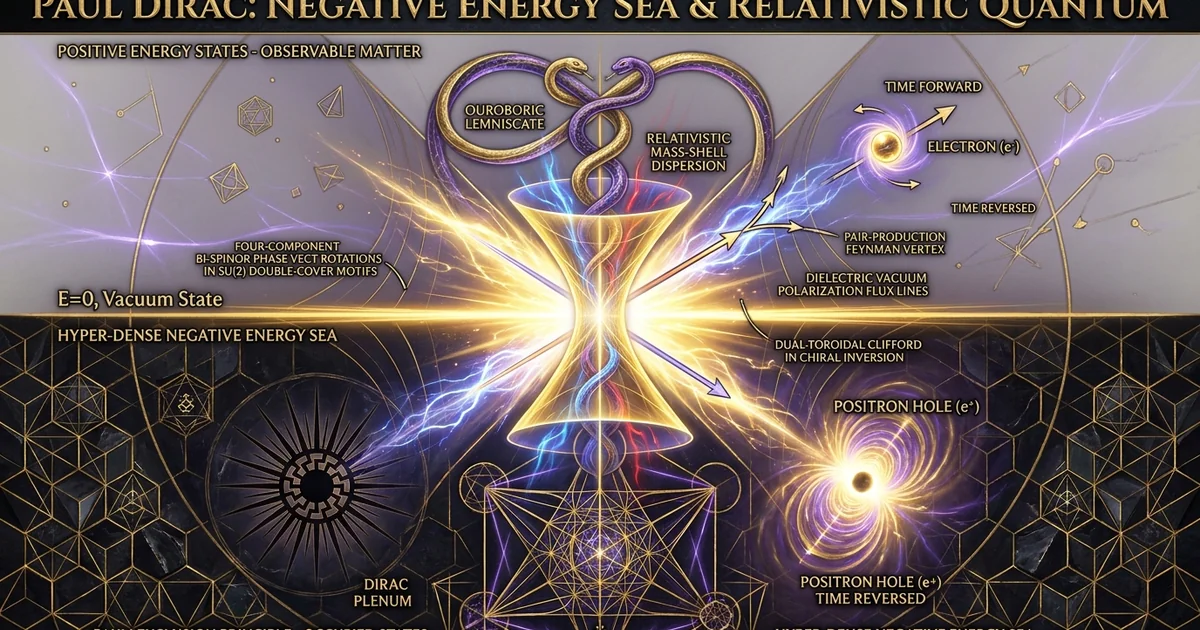
Paul Dirac: Negative Energy Sea & Relativistic Quantum
Executive Summary & Theoretical Thesis
The Relativistic Invariance Dilemma in Early Quantum Mechanics
The synthesis of special relativity and wave mechanics in the late 1920s presented a profound theoretical crisis. Erwin Schrödinger’s non-relativistic equation, while accurately describing the spectral phenomenology of the hydrogen atom, was inherently non-covariant; it treated temporal coordinates via a first-order differential operator while spatial coordinates appeared as second-order Laplacians. When theoretical physicists sought to construct a Lorentz-covariant analogue by directly elevating the relativistic energy-momentum invariant,
$$E^2 = c^2\mathbf{p}^2 + m^2c^4$$
into an operator identity, they arrived at the Klein-Gordon formulation. However, this second-order equation generated pathological dynamics: its temporal derivatives yielded non-conserved, indefinite probability densities that fundamentally violated the axiomatic statistical interpretation established by Max Born. Quantum mechanics demanded a wave equation strictly linear in the temporal partial derivative $\partial_t$ to safeguard positive-definite probability distributions, yet special relativity insisted that space and time must be treated on an identical footing within the four-gradient operator $\partial_\mu \equiv (\frac{1}{c}\partial_t, \boldsymbol{\nabla})$.
This theoretical impasse paralyzed relativistic quantum mechanics. If spatial derivatives remained second-order while the temporal derivative was restricted to first-order, the theory collapsed into spatial non-locality and frame-dependent asymmetry, precluding covariance under the Lorentz group $SO(1,3)$. Conversely, elevating time to a second-order derivative permitted unphysical, negative probability densities that undermined the probabilistic framework of quantum state vectors evolving unitarily in a Hilbert space. The challenge was not merely algebraic; it concerned the preservation of unitarity, causality, and relativistic kinematics within a unified operator formalism. The resolution demanded an entirely original mathematical infrastructure capable of factorizing quadratic relativistic dispersion into linear spatial and temporal differential operators without forfeiting spectral completeness or physical coherence.
Linearization of the Hamiltonian and the Emergence of Four-Spinors
In 1928, Paul Adrien Maurice Dirac achieved this resolution through the conceptual linearization of the relativistic Hamiltonian. Rather than operating on scalar wavefunctions, Dirac postulated that the square root of the spatial Laplacian operator could be extracted linearly through a set of hypercomplex, non-commuting matrix coefficients:
$$i\hbar \frac{\partial \psi}{\partial t} = \hat{H}\psi = \left( c \boldsymbol{\alpha} \cdot \mathbf{p} + \beta m c^2 \right) \psi$$
To satisfy the relativistic dispersion relation $E^2 - c^2\mathbf{p}^2 - m^2c^4 = 0$ upon squaring the Hamiltonian operator $\hat{H}^2\psi = (c^2\mathbf{p}^2 + m^2c^4)\psi$, the algebraic coefficients $\alpha_1, \alpha_2, \alpha_3,$ and $\beta$ could not be ordinary complex scalar quantities. Instead, they were required to satisfy the mutually anticommuting relations of a Clifford algebra: $\alpha_i \alpha_j + \alpha_j \alpha_i = 2\delta_{ij}$, $\alpha_i \beta + \beta \alpha_i = 0$, and $\beta^2 = I$.
Because these matrices must be Hermitian to preserve the self-adjointness of the Hamiltonian and possess traces of zero to allow eigenvalues of equal and opposite sign, their minimum irreducible matrix representation requires a dimension of $N = 4$. Consequently, the relativistic wave equation forced the electron wavefunction $\psi(\mathbf{x}, t)$ to expand from a scalar or two-component Pauli spinor into a four-component complex field—a Dirac bi-spinor. This expansion was not an arbitrary phenomenological assumption, but an inescapable geometric imperative of spacetime covariance. Within these four degrees of freedom, the electron’s intrinsic angular momentum ($S = \hbar/2$) and gyromagnetic ratio ($g = 2$) emerged spontaneously from the spacetime geometry, devoid of the empirical ad hoc insertions that characterized non-relativistic spin models.
+---------------------------------------------------------------------------------------------------+
| Positive Energy Spectrum: Continuum of Observable Physical Electrons                             |
| E ∈ [+mc², +∞)                                                                                    |
+---------------------------------------------------------------------------------------------------+
                                                  ▲
                                                  │  Forbidden Band Gap
                                                  │  ΔE = 2mc² ≈ 1.022 MeV
                                                  ▼
+---------------------------------------------------------------------------------------------------+
| Negative Energy Continuum: Fully Occupied Dirac Sea (Pauli Exclusion Bound)                       |
| E ∈ (-∞, -mc²]                                                                                    |
+---------------------------------------------------------------------------------------------------+
The Ontology of the Vacuum: Hole Theory as a Paradigm Shift
The mathematical elegance of the Dirac Hamiltonian concealed a radical physical consequence. Because the spectrum of the relativistic wave equation is fundamentally symmetric about zero, the operator $\hat{H}$ admits two disjoint energy branches for any momentum eigenvalue $\mathbf{p}$:
$$E(\mathbf{p}) = \pm \sqrt{c^2\mathbf{p}^2 + m^2c^4}$$
In a classical context, negative energy roots are easily discarded as non-physical mathematical artifacts. In a quantum mechanical regime governed by dynamic coupling to the Maxwellian electromagnetic field, however, these negative energy eigenspaces cannot be arbitrarily eliminated. An electron occupying an initial positive energy state ($E \ge +mc^2$) would undergo continuous radiative transitions via spontaneous photon emission, cascading down into infinitely unbound, lower negative energy states ($E \le -mc^2$). Ordinary atomic matter would destabilize instantaneously, collapsing into an infinite negative-frequency radiation sink within fractions of a nanosecond.
The free Dirac Hamiltonian $\hat{H} = c\boldsymbol{\alpha}\cdot\mathbf{p} + \beta mc^2$ possesses a continuous spectrum partitioned into two unbounded domains separated by an energy gap of width $\Delta E = 2mc^2 \approx 1.022\text{ MeV}$: $$\sigma(\hat{H}) = (-\infty, -mc^2] \cup [+mc^2, +\infty)$$ The positive branch $\sigma_+ = [+mc^2, +\infty)$ corresponds to physical, observable electron states. The negative branch $\sigma_- = (-\infty, -mc^2]$ represents the negative-frequency eigenspaces. Under minimally coupled $U(1)$ electrodynamics, transition matrix elements $\langle \psi_- | \hat{H}{\text{int}} | \psi+ \rangle \neq 0$ are non-vanishing. Without a stabilizing principle, every physical atomic orbital collapses into the negative continuum via catastrophic radiative decay.
To prevent this catastrophic instability, Dirac invoked the pauli exclusion principle. He proposed that the vacuum state is not an empty spatial void, but rather an unobservable, infinitely dense fermionic ocean—the dirac sea negative energy states positron vacuum hole theory paradigm. In this construct, every single state within the subterranean negative continuum $(-\infty < E \le -mc^2)$ is completely saturated by an electron. Because electrons are fermions obeying Fermi-Dirac statistics, no positive-energy electron can decay into the occupied negative branch due to the absolute prohibition of multiple orbital occupancy.
Physical reality as observed is thus defined relative to this completely filled background. If an energetic photon possessing energy $h\nu \ge 2mc^2$ interacts with this saturated medium, it can elevate a negative-energy electron out of the continuum into the positive spectrum, generating an observable electron ($E \ge +mc^2$) and leaving behind an unoccupied state: a “hole.” This absence of negative charge, negative energy, and negative momentum behaves precisely as an autonomous physical particle endowed with positive charge $+e$, positive inertial mass $+m$, and positive energy. Dirac thus transformed the absolute void of classical physics into a polarized plenum vs empty space, executing the foundational anti-matter prediction 1928 and fundamentally reconstituting the ontology of the quantum vacuum.
Historical Lineage & Experimental Precedents
Failure of the Klein-Gordon Second-Order Time Derivative
The theoretical lineage culminating in Dirac’s formulation began with the independent attempts of Oskar Klein (1926) and Walter Gordon (1926) to construct a relativistic scalar wave equation. Operating directly from the relativistic mass-shell condition, they replaced the classical four-momentum $p_\mu$ with the differential operator $\hat{p}\mu = i\hbar\partial\mu$, arriving at the expression:
$$\left( \Box + \frac{m^2c^2}{\hbar^2} \right) \psi = \left( \frac{1}{c^2}\frac{\partial^2}{\partial t^2} - \nabla^2 + \frac{m^2c^2}{\hbar^2} \right) \psi = 0$$
While mathematically covariant, the equation’s second-order temporal derivative introduced irreconcilable physical paradoxes. The derivation of the conserved continuity equation $\partial_\mu j^\mu = 0$ yielded a conserved probability density of the form:
$$\rho = \frac{i\hbar}{2mc^2} \left( \psi^* \frac{\partial \psi}{\partial t} - \psi \frac{\partial \psi^*}{\partial t} \right)$$
Because the wavefunction $\psi$ and its temporal derivative $\partial_t \psi$ can be assigned arbitrary independent values at any initial Cauchy surface, the sign of $\rho$ is mathematically indeterminate and can assume negative values across spatial regions. A negative probability density defied the probabilistic interpretation established by Max Born, rendering statistical mechanics incoherent within a first-quantized interpretation.
Furthermore, attempts to project out positive-energy states were frustrated by the fact that the presence of an external electromagnetic scalar potential $A_0$ dynamically coupled the positive and negative energy solutions, continually generating negative probability densities during temporal evolution. Theoretical physicists recognized that resolving the Klein-Gordon equation’s failures required an entirely different structural approach—one that preserved the linearity of time derivatives found in the non-relativistic Schrödinger formulation.
Dirac’s 1928 Deduction and the Initial Proton Misidentification
Dirac tackled this issue during late 1927 at St. John’s College, Cambridge. He realized that linearity in the temporal derivative $\partial_t$ could only be preserved in a relativistic framework if the spatial derivatives $\partial_i$ were also constrained to the first order. Through iterative matrix transformations, Dirac arrived at his iconic equation, publishing his findings in early 1928 in the Proceedings of the Royal Society of London. The equation was an immediate triumph; it effortlessly derived the Thomas precession factor of 2, correctly yielded the anomalous magnetic moment of the electron without empirical adjustment, and reproduced the fine structure of the hydrogen atom to high precision.
P. A. M. Dirac (1928), ‘The Quantum Theory of the Electron’:
“The problem of the relativity quantum mechanics of the electron has been attacked by various authors, who have applied the methods of the wave mechanics to the relativistic equations… The wave equation usually taken is that of Klein and Gordon… This equation, however, is not of the form required by the general principles of quantum theory, according to which the wave equation must be linear in $\partial/\partial t$… In the present paper we shall put forward a new wave equation which satisfies all the conditions, and which leads to the result that the electron has the spin $\frac{1}{2}\frac{h}{2\pi}$ and the magnetic moment $\frac{eh}{4\pi mc}$ usually assumed.”
C. D. Anderson (1933), ‘The Positive Electron’:
“A 15,000-gauss magnetic field was employed… A lead plate 6 mm thick was inserted across the horizontal diameter of the chamber… From the curvature of the path and the specific ionization along the track, the energy of the particle is deduced… It is concluded that the particle is a positive electron, possessing a mass comparable to that of the ordinary electron and a charge equal in magnitude to the charge of the electron.”
Despite this structural success, Dirac remained burdened by the physical implications of the negative energy spectrum. When he published “A Theory of Electrons and Protons” in 1930, he hesitated to posit an entirely unknown elementary entity. Constrained by the contemporary experimental dogma that nature comprised only two fundamental particles—electrons and protons—Dirac attempted to identify the unoccupied negative energy “holes” as protons:
$$\text{Hole} \stackrel{?}{=} \text{Proton } (p^+)$$
This identification immediately encountered insurmountable theoretical contradictions. Hermann Weyl demonstrated through rigorous spatial inversion and particle-hole symmetry considerations that a hole in the negative electron sea must possess an inertial mass precisely equal to the electron itself ($m_{\text{hole}} \equiv m_e$).
Shortly thereafter, J. Robert Oppenheimer showed that if holes were indeed protons, hydrogen atoms would annihilate via spontaneous electron-hole transitions ($\tau \approx 10^{-10}\text{ seconds}$), destabilizing all macroscopic matter in the universe. Confronted by these mathematical realities, Dirac conceded in 1931 that the hole represented an entirely novel physical particle: an “anti-electron” possessing the precise mass of the electron but exhibiting a positive elementary charge ($+e$).
Anderson’s 1932 Cloud Chamber Confirmation of the Positron
The definitive empirical verification of Dirac’s theoretical construct came in August 1932 from Carl David Anderson at the California Institute of Technology. Investigating the composition of cosmic radiation using a vertical Wilson cloud chamber placed within a powerful 15,000-gauss uniform magnetic field, Anderson introduced a 6-millimeter lead plate across the center of the chamber to establish particle trajectories and measure directional energy loss:
$$-\frac{dE}{dx} = f(v, \rho, Z)$$
On August 2, 1932, Anderson recorded a cosmic ray event displaying a track that traversed the lead plate. By measuring the track’s curvature before and after traversing the plate, he proved that the particle was travelling upward. The upward trajectory, combined with the orientation of its curvature within the applied magnetic field, established that the particle possessed a positive electric charge. Concurrently, the specific ionization density along the track and the particle’s range precluded the possibility of it being a proton; a proton of that magnetic rigidity would have produced heavily ionized, dense tracks with a significantly shorter path length.
The particle’s charge-to-mass ratio ($e/m$) matched that of the negative electron to within experimental margins, establishing the empirical existence of the positron. Dirac’s speculative hole theory transitioned from a radical mathematical hypothesis into an established physical reality, earning Dirac and Anderson Nobel Prizes in 1933 and 1936, respectively.
Mathematical Formalism & Physical Mechanics
Clifford Algebra and the Four Dirac Gamma Matrices
The mathematical architecture of the Dirac theory is defined by the Clifford algebra $C\ell_{1,3}(\mathbb{R})$. Expressed in covariant four-vector notation, the Dirac equation for a free fermion of rest mass $m$ takes the canonical form:
$$(i\hbar \gamma^\mu \partial_\mu - mc) \psi(x) = 0$$
where the Einstein summation convention is implied over the Minkowski spacetime indices $\mu \in {0, 1, 2, 3}$. The dynamic characteristics of the equation are dictated by the gamma matrices $\gamma^\mu$, which satisfy the fundamental Clifford algebra anticommutation relation:
$${\gamma^\mu, \gamma^\nu} \equiv \gamma^\mu \gamma^\nu + \gamma^\nu \gamma^\mu = 2g^{\mu\nu} I_4$$
Here, $g^{\mu\nu} = \text{diag}(+1, -1, -1, -1)$ represents the Minkowski metric tensor, and $I_4$ denotes the four-dimensional identity operator. In the standard Dirac-Pauli representation, these $4 \times 4$ matrices are expressed using the $2 \times 2$ Pauli spin matrices $\boldsymbol{\sigma} = (\sigma_x, \sigma_y, \sigma_z)$ and the $2 \times 2$ identity matrix $\mathbb{I}_2$:
$$\gamma^0 = \begin{pmatrix} \mathbb{I}_2 & 0 \ 0 & -\mathbb{I}_2 \end{pmatrix}, \quad \gamma^i = \begin{pmatrix} 0 & \sigma_i \ -\sigma_i & 0 \end{pmatrix} \quad (i = 1, 2, 3)$$
Through this algebraic structure, the Dirac Hamiltonian $\hat{H}$ is recovered via the relations $\boldsymbol{\alpha} = \gamma^0 \boldsymbol{\gamma}$ and $\beta = \gamma^0$. The non-trivial four-dimensional representation means that the wavefunction $\psi(x)$ transforms not as a spacetime four-vector, but as a complex bi-spinor under the Lorentz group $SL(2, \mathbb{C})$. Its infinitesimal transformation under an arbitrary Lorentz transformation $\Lambda^\mu_{\ \nu} = \delta^\mu_{\ \nu} + \omega^\mu_{\ \nu}$ is governed by the spinorial generators:
$$S^{\mu\nu} = \frac{i}{4}[\gamma^\mu, \gamma^\nu]$$
This formulation directly links the geometry of spacetime to spinorial dynamics, establishing deep connections with the affine connections and contortion tensors developed in /physics-electromagnetism/einstein-cartan-torsion-spin-tensors.
Plane Wave Solutions and Negative Energy Projection Operators
To analyze the spectral properties of the Dirac operator, we apply a plane-wave ansatz to the field equation:
$$\psi_p(x) = u(p) e^{-\frac{i}{\hbar} p \cdot x} \quad \text{and} \quad \psi_p(x) = v(p) e^{+\frac{i}{\hbar} p \cdot x}$$
where $p \cdot x = p_\mu x^\mu = Et - \mathbf{p} \cdot \mathbf{x}$. Substituting these ansätze into the covariant Dirac equation produces momentum-space algebraic constraints for the positive-energy four-spinors $u(p)$ and the negative-energy four-spinors $v(p)$:
$$(\gamma^\mu p_\mu - mc) u(p) = 0, \qquad (\gamma^\mu p_\mu + mc) v(p) = 0$$
Assuming the particle’s rest frame ($\mathbf{p} = 0$, $p_0 = mc$), the solutions decouple cleanly into orthogonal eigenspaces:
$$u^{(1)}(0) = \begin{pmatrix} 1 \ 0 \ 0 \ 0 \end{pmatrix}, \quad u^{(2)}(0) = \begin{pmatrix} 0 \ 1 \ 0 \ 0 \end{pmatrix}, \quad v^{(1)}(0) = \begin{pmatrix} 0 \ 0 \ 1 \ 0 \end{pmatrix}, \quad v^{(2)}(0) = \begin{pmatrix} 0 \ 0 \ 0 \ 1 \end{pmatrix}$$
The spinors $u^{(s)}(p)$ span the physical positive-energy solutions ($E = +\sqrt{c^2\mathbf{p}^2 + m^2c^4}$), corresponding to spin-up and spin-down electrons. Conversely, $v^{(s)}(p)$ span the negative-energy continuum ($E = -\sqrt{c^2\mathbf{p}^2 + m^2c^4}$).
To isolate these eigenspaces without explicit coordinate transformations, we define the Lorentz-invariant energy projection operators:
$$\Lambda_+(p) = \frac{\slashed{p} + mc}{2mc}, \qquad \Lambda_-(p) = \frac{-\slashed{p} + mc}{2mc}$$
where we employ the Feynman slash notation $\slashed{p} \equiv \gamma^\mu p_\mu$. These operators are orthogonal, idempotent projectors that decompose the four-spinor Hilbert space:
$$\Lambda_\pm^2(p) = \Lambda_\pm(p), \quad \Lambda_+(p)\Lambda_-(p) = 0, \quad \Lambda_+(p) + \Lambda_-(p) = I_4$$
Application of $\Lambda_-(p)$ extracts the negative-energy components that populate the underlying Dirac sea, demonstrating that the negative solutions are an intrinsic, mathematically invariant feature of relativistic spacetime.
Pauli Exclusion Dynamics and the Mechanics of Pair Production
Because electrons satisfy Fermi-Dirac statistics, the occupation number of any state defined by momentum $\mathbf{p}$ and spin projection $s$ is governed by the fermionic expectation value $\langle n_{\mathbf{p}, s} \rangle \in {0, 1}$. Dirac’s foundational ontological postulate asserts that the physical vacuum state $|\Omega\rangle$ corresponds to a condition of complete saturation for the negative-energy eigenspace:
$$\langle \Omega | n_{\mathbf{p}, s}^{(-)} | \Omega \rangle = 1, \qquad \langle \Omega | n_{\mathbf{p}, s}^{(+)} | \Omega \rangle = 0 \quad (\forall \mathbf{p}, s)$$
When an external electromagnetic perturbation—such as an energetic gamma photon or an intense external dielectric field—couples to the system via the interaction Hamiltonian $\hat{H}{\text{int}} = e\gamma^0 \gamma^\mu A\mu$, it induces transitions between spectral states.
If the incident photon possesses energy exceeding twice the electron rest-mass energy:
$$\hbar \omega \ge 2mc^2 \approx 1.022\text{ MeV}$$
it can be absorbed by a negative-energy electron within the sea. The negative-energy electron is excited across the forbidden band gap of $2mc^2$ into an unoccupied positive-energy state ($E \ge +mc^2$), transitioning into an observable, free physical electron.
The absence of an electron in the negative continuum alters the physical properties of the vacuum state. The total charge of the unperturbed sea is formally infinite and negative: $Q_{\text{vac}} = \sum (-\infty) \times (-e)$. By establishing this baseline state as the zero-charge reference ($Q_{\text{measured}} \equiv 0$), the removal of a single negative-energy electron characterized by parameters $(-e, -|E|, -\mathbf{p}, -\mathbf{s})$ reveals a hole that behaves as a localized physical state characterized by:
$$Q_h = -(-e) = +e, \quad E_h = -(-|E|) = +|E|, \quad \mathbf{p}_h = -(-\mathbf{p}) = +\mathbf{p}, \quad \mathbf{s}_h = -(-\mathbf{s}) = +\mathbf{s}$$
This process represents the mechanics of electron-positron pair creation ($\gamma \to e^- + e^+$). Conversely, when an observable electron falls into an unoccupied hole, both particles vanish from the observable spectrum, releasing their combined energy as annihilation gamma photons ($e^- + e^+ \to 2\gamma$). This restores local saturation to the Dirac sea.
Empirical Evidence & Observational Data
Pair Production and Annihilation Cross-Sections
The physical validity of Dirac’s hole theory was substantiated by precision measurements of high-energy photon attenuation through matter. The cross-section for pair production in the Coulomb field of an atomic nucleus of charge $Z$ was calculated by Hans Bethe and Walter Heitler using relativistic Born approximations:
$$\sigma_{\text{pair}} = Z^2 \alpha r_0^2 \left[ \frac{28}{9} \ln\left( \frac{2\hbar\omega}{mc^2} \right) - \frac{218}{27} \right]$$
where $\alpha \approx \frac{1}{137}$ is the fine-structure constant and $r_0 = \frac{e^2}{4\pi\varepsilon_0 mc^2}$ is the classical electron radius.
Modern high-energy particle physics confirms this scaling with high precision. At threshold energies ($\hbar\omega \to 2mc^2$), the cross-section exhibits sharp relativistic suppression governed by Coulomb phase-space factors. At asymptotic energies, nuclear screening effects limit the logarithmic growth, precisely matching the theoretical predictions derived from Dirac’s four-spinor formulation.
Furthermore, electron-positron annihilation at low energies provides direct experimental evidence for Dirac’s hole mechanics. When slow-moving positrons interact with matter, they form an exotic, bound hydrogen-like state known as positronium before terminal annihilation. The singlet state (parapositronium, $^1S_0$, mean lifetime $\tau \approx 125\text{ picoseconds}$) decays into two collinear gamma-ray photons:
$$e^- + e^+ \longrightarrow \gamma_1 + \gamma_2$$
Due to conservation of four-momentum in the center-of-mass frame, each emitted gamma quantum possesses an energy precisely equal to the rest mass energy of an electron:
$$E_\gamma = mc^2 \approx 510.9989\text{ keV}$$
This signature $511\text{ keV}$ emission line is observed extensively across nuclear spectroscopy and astrophysics, providing quantitative proof of the continuous exchange of matter with the underlying vacuum plenum.
Vacuum Polarization, Uehling Potential, and the Lamb Shift
The conceptual evolution of the Dirac sea from a static collection of negative-energy states to an active, responsive dielectric medium is demonstrated by the phenomenon of vacuum polarization. In the presence of a localized external charge distribution—such as the bare positive charge of an atomic nucleus—the virtual electrons populating the Dirac sea are physically perturbed. Negative charges are drawn slightly toward the nucleus, while the corresponding positive holes are displaced outward:
$$\mathbf{P}{\text{vac}} = \chi{\text{vac}} \mathbf{E}$$
This macroscopic dielectric response screens the bare charge, rendering the physically observed charge $e$ a running coupling constant dependent on the momentum transfer $q^2$.
E. A. Uehling (1935), ‘Polarization Effects in the Positron Theory’:
“The interpretation of the positron theory leads to the conclusion that the electrostatic field of a charge distribution is modified in the neighborhood of the charge by the induction of a dipole density in the vacuum… For distances of the order of the Compton wavelength $\hbar/mc$, the Coulomb potential is supplemented by a short-range potential.”
W. E. Lamb & R. C. Retherford (1947), ‘Fine Structure of the Hydrogen Atom by a Microwave Method’:
“The $2^2S_{1/2}$ and $2^2P_{1/2}$ levels of the hydrogen atom, which according to the Dirac theory should have identical energies, are found to be separated by approximately $1000\text{ MHz}$… This effect is completely outside the realm of the unquantized Dirac theory.”
Mathematically, this vacuum polarization alters the electrostatic Coulomb potential via the Uehling potential. For an atomic nucleus with bare charge $Z$, the effective electrostatic potential $V®$ at a distance $r$ is:
$$V® = -\frac{Ze^2}{4\pi\varepsilon_0 r} \left[ 1 + \frac{2\alpha}{3\pi} \int_1^\infty dx , e^{-2mr x / \hbar} \left( 1 + \frac{1}{2x^2} \right) \frac{\sqrt{x^2 - 1}}{x^2} \right]$$
At macroscopic distances ($r \gg \frac{\hbar}{mc}$), the integral vanishes exponentially, recovering the standard Coulomb potential $\propto 1/r$. However, at distances on the order of the electron Compton wavelength ($\lambda_C \approx 3.86 \times 10^{-13}\text{ m}$), the exponential term activates, strengthening the electrostatic attraction experienced by the electron.
This short-range correction was directly verified in the classic 1947 experiments of Willis Lamb and Robert Retherford. According to the exact solution of the single-particle Dirac equation in a central Coulomb field, the $2S_{1/2}$ and $2P_{1/2}$ orbitals of hydrogen must be degenerate due to an accidental $O(4)$ dynamic symmetry. Lamb and Retherford demonstrated through microwave spectroscopy that the $2S_{1/2}$ level is displaced upward by approximately $1057\text{ MHz}$.
While the majority of this displacement ($+1084\text{ MHz}$) is caused by the interaction of the electron with electromagnetic zero-point energy fluctuations, the vacuum polarization contribution derived from Dirac’s polarized plenum induces a negative shift of precisely $-27\text{ MHz}$. The match between the observed energy level shift and quantum electrodynamic calculations confirms that the quantum vacuum acts as an active physical dielectric.
Transition from Hole Theory to Quantum Electrodynamics (QED)
Although Dirac’s single-particle hole theory achieved remarkable predictive successes, it suffered from structural asymmetries. Most notably, it treated electrons as fundamental dynamic entities while treating positrons as emergent absences in a background sea. The transition to fully covariant Quantum Electrodynamics, formulated by Richard Feynman, Julian Schwinger, and Shin’ichirō Tomonaga, replaced this formulation through the second quantization of the Dirac spinor field:
$$\hat{\psi}(x) = \sum_{s=1}^2 \int \frac{d^3p}{(2\pi\hbar)^{3/2}} \sqrt{\frac{m}{E_{\mathbf{p}}}} \left[ \hat{b}{\mathbf{p}, s} u^{(s)}(p) e^{-\frac{i}{\hbar}p\cdot x} + \hat{d}^\dagger{\mathbf{p}, s} v^{(s)}(p) e^{+\frac{i}{\hbar}p\cdot x} \right]$$
In this operator formalism, the unobservable infinite negative-energy sea is replaced by the canonical anticommutation relations imposed directly on the particle destruction operators $\hat{b}{\mathbf{p}, s}$ and antiparticle creation operators $\hat{d}^\dagger{\mathbf{p}, s}$:
$${\hat{b}{\mathbf{p}, s}, \hat{b}^\dagger{\mathbf{p}‘, s’}} = \delta_{ss’} \delta^{(3)}(\mathbf{p} - \mathbf{p}‘), \qquad {\hat{d}{\mathbf{p}, s}, \hat{d}^\dagger{\mathbf{p}’, s’}} = \delta_{ss’} \delta^{(3)}(\mathbf{p} - \mathbf{p}')$$
The vacuum state $|0\rangle$ is redefined as the state annihilated by all particle and antiparticle destruction operators:
$$\hat{b}{\mathbf{p}, s} |0\rangle = 0 \quad \text{and} \quad \hat{d}{\mathbf{p}, s} |0\rangle = 0 \quad (\forall \mathbf{p}, s)$$
This formulation eliminates the need to track an explicit sea of negative-energy particles. Through Wick’s normal ordering operation, infinite vacuum ground-state energies and charges are formally shifted to zero:
$$: \hat{H} : = \sum_s \int d^3p , E_{\mathbf{p}} \left( \hat{b}^\dagger_{\mathbf{p}, s} \hat{b}{\mathbf{p}, s} + \hat{d}^\dagger{\mathbf{p}, s} \hat{d}_{\mathbf{p}, s} \right)$$
Simultaneously, the Feynman-Stueckelberg interpretation demonstrated that a negative-energy spinor running backward in temporal coordinate space ($e^{+iEt/\hbar}$) is formally and mathematically isomorphic to a positive-energy antiparticle moving forward in time. Despite these technical developments, hole theory remains an isomorphic, mathematically consistent representation of fermionic physics in low-energy regimes. It was the crucial theoretical bridge that led from classical mechanics to modern operator field theory.
Metaphysical Implications & Unified Synthesis
The Polarized Plenum versus Democritean Atomism
The physical confirmation of Dirac’s hole theory dissolved the foundation of Democritean atomism, which had dominated Western physical thought since classical antiquity. The Democritean framework posits a binary universe composed of impenetrable, hard corpuscles navigating through an inert, non-participatory vacuum—the absolute void ($\tau \grave{o}$ $\kappa \epsilon \nu \acute{o} \nu$). In this classical view, empty space serves as a passive container, devoid of internal dynamics, energy, or structure.
Dirac’s relativistic quantum mechanics replaced this inert container with an infinitely dense, responsive medium—a polarized plenum vs empty space. In this ontology, matter is no longer an isolated, self-subsisting entity wandering through nothingness. Instead, physical matter emerges as a dynamic, localized excitation of the vacuum substrate itself. The absolute void is mathematically impossible; what classical mechanics characterized as empty space is revealed to be a saturated fermionic ocean exhibiting high susceptibility to electromagnetic, gravitational, and topological perturbations.
This conceptual shift links directly with the modern understanding of the vacuum found in /physics-electromagnetism/quantum-vacuum-zero-point-energy-casimir and the longitudinal electrodynamic displacements detailed in /physics-electromagnetism/maxwell-dielectric-displacement-longitudinal-waves.
Democritean / Classical Void
- Ontology: Absolute Nothingness; inert, passive geometrical void.
- Matter Dynamics: Discrete, isolated hard corpuscles traversing empty space.
- Vacuum State: Energy, charge, and matter densities identically zero ($\rho = 0$).
- Electrodynamic Role: Passive spatial container; uniform permittivity $\varepsilon_0$.
- Perturbations: None supported; absolute space is completely rigid and unreactive.
Diracian Polarized Plenum
- Ontology: Continuous, saturated fermionic substrate (Dirac Sea / QFT Vacuum).
- Matter Dynamics: Localized energetic excitations (quasiparticles and topological holes).
- Vacuum State: Infinite virtual energy ground state with zero-point oscillations.
- Electrodynamic Role: Active, polarizable dielectric medium exhibiting screening.
- Perturbations: Supports pair creation, virtual currents, and coherent field modes.
Topological Defects, Solitons, and Condensed Matter Analogues
The mechanics of Dirac’s subterranean fermionic ocean find clear empirical analogues within modern condensed matter physics. In these crystalline contexts, the mathematical structures of relativistic quantum field theory re-emerge not from fundamental spacetime symmetries, but as effective, low-energy quasiparticle dynamics.
A prominent example occurs in graphene—a two-dimensional honeycomb lattice of $sp^2$-hybridized carbon atoms. The electronic band structure of graphene generates valence and conduction bands that intersect linearly at two inequivalent points in the Brillouin zone ($K$ and $K’$). Near these “Dirac points,” the dispersion relation mimics the relativistic mass-shell condition for massless fermions:
$$E(\mathbf{k}) = \pm \hbar v_F |\mathbf{k}|$$
where $v_F \approx 10^6\text{ m/s}$ represents the Fermi velocity, acting as an effective speed of light. The filled valence band in undoped graphene acts as a condensed matter realization of the Dirac sea. Elevating an electron into the conduction band leaves behind an unoccupied state in the valence band—a hole—governed by the two-dimensional Dirac equation.
       CONDUCTION BAND (Observable Electrons)
                \             /
                 \           /
                  \  +v_F|k|/
                   \       /
  Dirac Point ------>  X  <------ Energy Gap E_g = 0
                   /       \
                  /  -v_F|k|\
                 /           \
                /             \
         VALENCE BAND (Dirac Sea of Electrons)
Similarly, in one-dimensional polyacetylene chains, as formalized by the Su-Schrieffer-Heeger (SSH) model, topological domain walls between dimerized bond phases generate fractionalized zero-energy soliton states. These solitons duplicate the charge-conjugation and hole dynamics of relativistic fermions.
These condensed matter systems demonstrate that the Dirac sea is not merely an abstract mathematical convenience: the physical behavior of holes as autonomous, positively charged quasiparticles within a saturated fermionic background is an invariant mechanical property of Fermi systems across disparate energetic scales.
Zero-Point Geometry and the Re-Enchantment of the Aether
The emergence of the polarized plenum within relativistic electrodynamics bridges the gap between historical field theories and contemporary physics. Throughout the nineteenth century, physicists such as James Clerk Maxwell and Michael Faraday relied upon the mechanical concept of an all-pervading luminiferous aether to explain how electromagnetic disturbances propagate without action-at-a-distance. While the Michelson-Morley experiment and Einstein’s special relativity rejected the mechanical, drag-inducing aether tied to a preferred Galilean frame of reference, Dirac’s formulation revived the underlying physical intuition within a Lorentz-invariant geometry.
The Diracian vacuum, together with its quantum field-theoretic extension, endows spacetime with active dynamic properties:
- It possesses non-vanishing dielectric permittivity $\varepsilon_0$ and magnetic permeability $\mu_0$.
- It supports macroscopic energy shifts, as demonstrated by the Casimir effect.
- It exhibits spontaneous virtual pair creation.
- It couples directly to global resonance modes, such as those analyzed in /physics-electromagnetism/schumann-resonance-ionospheric-electrodynamics.
By demonstrating that the void is a dense, polarizable physical medium, Dirac eliminated the conceptual divide between matter and empty space. Matter is composed of crystallized localized excitations of this universal medium, constantly interacting with the subterranean degrees of freedom of the vacuum. This perspective reconciles fundamental field theory with an interconnected ontological paradigm: the cosmos does not consist of fragmented corpuscles suspended in an empty void, but rather an unbroken, dynamically active physical plenum.
Frequently Asked Questions
Why Does the Infinite Negative Charge of the Sea Not Produce an Infinite Coulomb Field?
Dirac’s postulate that every negative-energy state throughout the universe is occupied implies an infinite negative charge density:
$$\rho_{\text{unrenormalized}} = -e \sum_{\mathbf{p}, s} 1 \longrightarrow -\infty$$
Under classical Maxwellian electrodynamics, an infinite charge density would generate an infinite electrostatic scalar potential and infinite divergent Coulomb forces, rendering macroscopic space physically unstable.
Dirac addressed this paradox by defining the unperturbed, fully occupied vacuum state as the gauge baseline for all electrostatic measurements:
$$\rho_{\text{physical}} \equiv \rho_{\text{total}} - \rho_{\text{vacuum}} = 0$$
Only localized perturbations—departures from this uniform background saturation—manifest as physically observable electric charge. In modern quantum field theory, this conceptual subtraction is achieved rigorously through operator normal ordering ($: \hat{J}^\mu :$). By placing all annihilation operators to the right of creation operators, the expectation value of the four-current operator within the vacuum vanishes identically:
$$\langle 0 | : \hat{J}^\mu(x) : | 0 \rangle = 0$$
Furthermore, general relativity demands that any uniform vacuum energy density must couple gravitationally via the cosmological constant term:
$$T_{\mu\nu}^{\text{vac}} = \Lambda g_{\mu\nu}$$
The enormous discrepancy between the formal theoretical divergence of this zero-point energy and the small, empirically observed cosmological constant constitutes the well-known cosmological constant problem. However, in the domain of electrodynamics, the infinite background charge of the sea remains undetectable because measurement instruments register only gradients—differences in potential relative to the vacuum state.
How Does Modern Quantum Field Theory Overcome the Asymmetry Between Bosons and Fermions in Vacuum Theory?
The Dirac sea model relies entirely on the pauli exclusion principle, which prevents multiple identical fermions from occupying the same quantum state. This fermionic property is enforced mathematically by the anticommutation relations of the field operators:
$${\hat{\psi}\alpha(\mathbf{x}), \hat{\psi}\beta^\dagger(\mathbf{y})} = \delta_{\alpha\beta}\delta^{(3)}(\mathbf{x} - \mathbf{y})$$
This prevents negative-energy electrons from cascading infinitely downward. However, integer-spin particles (bosons) obey Bose-Einstein statistics and satisfy commutation relations:
$$[\hat{\phi}(\mathbf{x}), \hat{\pi}(\mathbf{y})] = i\hbar \delta^{(3)}(\mathbf{x} - \mathbf{y})$$
Bosons are not constrained by the Pauli exclusion principle. Consequently, an infinite sea of negative-energy bosons could not stabilize itself: an infinite number of bosons could collapse into the same negative-energy state, triggering an uncontrollable, runaway cascade.
Modern Quantum Field Theory (QFT) resolves this asymmetry by abandoning the single-particle wave mechanics paradigm entirely. Instead of viewing relativistic equations as describing individual particles, QFT treats them as equations of motion for operator-valued fields. Through canonical quantization:
- Both fermion and boson fields are expanded in terms of positive-energy creation and annihilation operators for particles and antiparticles ($b^\dagger, b$ and $d^\dagger, d$).
- Both particles and antiparticles are assigned positive physical energy: $$E = +\sqrt{c^2\mathbf{p}^2 + m^2c^4} > 0$$
- The negative-frequency plane wave components ($e^{+ip\cdot x/\hbar}$) are reinterpreted via the Feynman-Stueckelberg framework as the annihilation of positive-energy antiparticles moving forward in time.
This symmetric operator framework places bosons and fermions on an equivalent ontological footing, deriving antiparticles for both species without invoking an infinitely populated subterranean sea for bosons.
Can Holes Exist in Bosonic Fields Governed by the Klein-Gordon Equation?
Within historical single-particle hole theory, holes cannot exist in bosonic fields governed by the Klein-Gordon equation. Because bosons do not obey the Pauli exclusion principle, the concept of a “saturated” subterranean sea is physically impossible. Any attempt to populate a negative-energy bosonic continuum would lead to immediate collapse, as an arbitrary number of bosons would condense into lower negative-energy states via stimulated emission.
Fermionic Dirac Sea (STABLE):
State 1:  [ ● ]  Occupied (Pauli Bound)
State 2:  [ ● ]  Occupied (Pauli Bound)
State 3:  [ ○ ]  UNOCCUPIED HOLE = POSITRON (+e, +m)
Cascade prevented by Pauli exclusion principle.

Hypothetical Bosonic Sea (CATASTROPHICALLY UNSTABLE):
State 1:  [ ●●●●●●●●... ∞ ] Continuous Runaway Influx
State 2:  [ ●●●●●●●●... ∞ ] No Saturation Density Exists
Cascade is infinite and unconstrained.
In modern quantum field theory, however, antiparticles of bosonic fields (such as $\pi^+$ and $\pi^-$ mesons) are fully realized without requiring hole mechanics. This is achieved by quantizing the complex scalar Klein-Gordon field:
$$\hat{\phi}(x) = \int \frac{d^3p}{(2\pi\hbar)^{3/2}\sqrt{2E_{\mathbf{p}}}} \left[ \hat{a}(\mathbf{p})e^{-\frac{i}{\hbar}p\cdot x} + \hat{b}^\dagger(\mathbf{p})e^{+\frac{i}{\hbar}p\cdot x} \right]$$
Here, $\hat{a}(\mathbf{p})$ destroys a positively charged boson of positive energy $E_{\mathbf{p}}$, while $\hat{b}^\dagger(\mathbf{p})$ creates a negatively charged antiboson—also endowed with positive energy $E_{\mathbf{p}}$. The conserved current operator for this scalar field:
$$\hat{j}^\mu = i \left( \hat{\phi}^\dagger \partial^\mu \hat{\phi} - (\partial^\mu \hat{\phi}^\dagger) \hat{\phi} \right)$$
yields a well-defined charge density that can assume positive or negative values without generating unphysical negative probability densities. The “hole” concept is thus unique to fermionic systems, while antiparticles remain a universal feature of all relativistic quantum field theories.
What Distinguishes the Dirac Sea from 19th-Century Luminiferous Aether?
Although both concepts characterize the vacuum as an energetic physical medium rather than an empty void, the Dirac sea differs fundamentally from the classical nineteenth-century luminiferous aether across three core physical dimensions:
-
Lorentz Covariance vs. Preferred Rest Frame: The classical luminiferous aether of Maxwell, Fresnel, and Lorentz was conceived as a mechanical, particulate medium that occupied a specific, preferred frame of reference—the rest frame of the universe. Movement relative to this frame was expected to produce an observable “aether wind,” a concept conclusively refuted by the Michelson-Morley experiment. In contrast, the Dirac sea is fully Lorentz-invariant. Because the negative-energy states occupy the complete invariant phase space: $$d\mu(p) = \theta(-p^0) \delta(p^2 - m^2) d^4p$$ the saturated Dirac vacuum appears identical to all inertial observers undergoing arbitrary Lorentz boosts and spatial rotations: $$U(\Lambda)|\Omega\rangle = |\Omega\rangle$$ There is no preferred rest frame, and no directional “drag” or aether wind can ever be detected.
-
Fermionic Quantum Statistics vs. Classical Continuum Mechanics: The nineteenth-century aether was modeled using the principles of classical elasticity, hydrodynamics, or gyroscopic mechanics (analogous to an elastic solid or an incompressible fluid). In contrast, the Dirac sea is governed by relativistic quantum mechanics and Fermi-Dirac statistics. It is formed by the discrete, spinorial solutions of a hypercomplex matrix operator operating under the absolute constraints of the Pauli exclusion principle.
-
Dynamic Polarizability and Pair Creation: The classical aether was an immutable, eternal background whose sole role was to serve as the passive medium for propagating electromagnetic waves. The Dirac sea, conversely, participates directly in high-energy interactions. It can be dynamically polarized by external electromagnetic fields, exhibits virtual radiative corrections (such as the Uehling potential and the Lamb shift), and can be structurally broken through pair creation, directly transmuting its negative-energy components into observable matter and antimatter.
Far from being a simple return to classical mechanics, Dirac’s hole theory transformed the vacuum into an active, Lorentz-invariant relativistic quantum plenum.