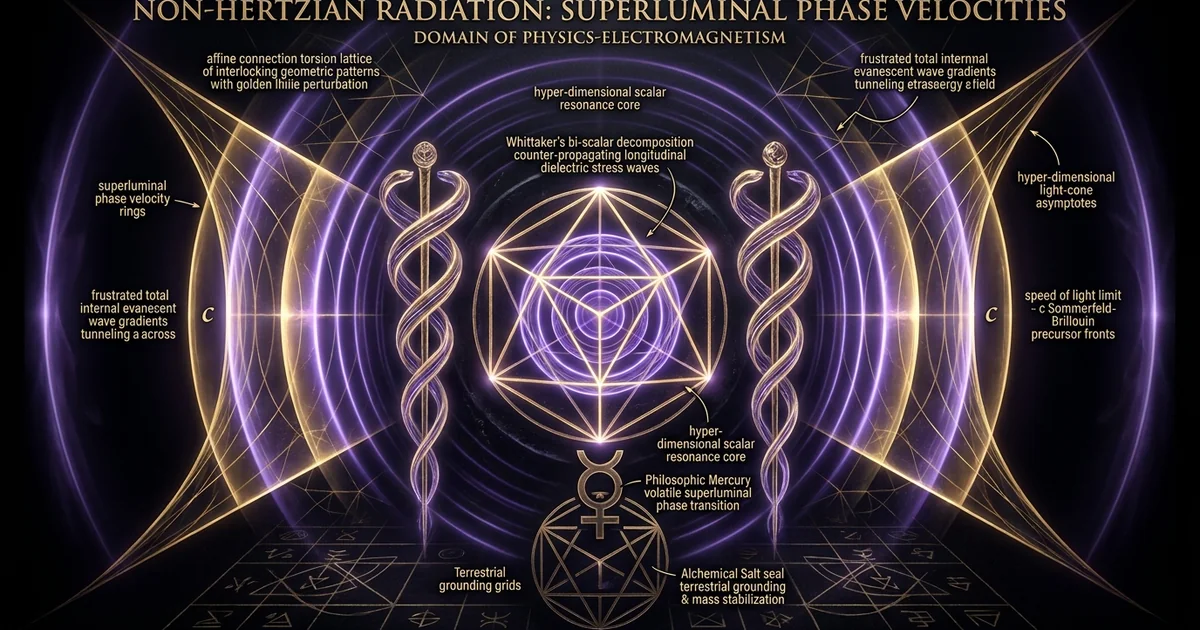
Non-Hertzian Radiation: Superluminal Phase Velocities
Executive Summary & Theoretical Thesis
The Transverse Electromagnetic Consensus vs. Longitudinal Stress Modes
The canonical architecture of classical electrodynamics, codified by Oliver Heaviside, Heinrich Hertz, and Josiah Willard Gibbs from James Clerk Maxwell’s original twenty quaternion field equations, rests upon an axiomatic reduction: the systemic exclusion of divergence-free longitudinal electric stress modes in unbounded free space. Under the standard Maxwell-Heaviside reduction, electromagnetic radiation is defined exclusively as a transverse wave phenomenon (TEM modes). In this framework, the spatial perturbations of the electric field vector $\mathbf{E}$ and the magnetic induction vector $\mathbf{B}$ oscillate strictly perpendicular to one another and orthogonal to the directional vector of energy propagation, defined by the cross product comprising the classical Poynting vector:
$$\mathbf{S} = \frac{1}{\mu_0} (\mathbf{E} \times \mathbf{B})$$
Within this transverse consensus, curl-free solutions ($\nabla \times \mathbf{E} = 0$) where $\nabla \cdot \mathbf{E} \neq 0$ are categorized as non-propagating quasi-static artifacts, or mathematically expunged via the Lorenz gauge condition:
$$\nabla \cdot \mathbf{A} + \frac{1}{c^2} \frac{\partial \Phi}{\partial t} = 0$$
This mathematical convention forces the electromagnetic vector potential $\mathbf{A}$ and the scalar potential $\Phi$ into a subservient, strictly relativistic causal relationship.
This reductionist framework fundamentally obscures alternative electrodynamic solutions wherein mechanical stress translates through the dielectric medium via longitudinal displacement gradients. Non-Hertzian electrodynamics, conversely, rehabilitates the uncoupled longitudinal dielectric stress wave. Rather than relying on the reciprocal cross-induction of transverse magnetic and electric curls, longitudinal electro-scalar waves propagate via cyclic rarefactions and compressions of the localized dielectric-field density. In such configurations, the curl components vanish while the divergence terms fluctuate dynamically, yielding propagation dynamics unconstrained by the transverse boundary geometry that governs standard radiative dipoles.
By treating the dielectric continuum as a compressible, polarizable energetic matrix, non-Hertzian formulations reintroduce modes of electrodynamic action wherein force vectors align parallel to the wavevector $\mathbf{k}$, decoupling the energetic envelope from classical radiation resistance and the standard dipole attenuation profile.
Phase Velocity Mechanics and the Relativistic Causality Boundary
A persistent conceptual stumbling block in non-Hertzian field theory is the manifestation of faster than light phase velocity ($v_p > c$). In standard isotropic media, the phase velocity of an electromagnetic disturbance is defined as:
$$v_p = \frac{\omega}{\text{Re}(k)}$$
where $\omega$ denotes the angular frequency and $k$ represents the complex wavenumber. When an electromagnetic mode undergoes propagation through anomalous dispersion bands, geometrically constrained sub-cutoff wave-guides, or reactive near-field induction regimes, the real component of the wavenumber approaches zero while its spatial variations retain global phase coherence. Consequently, $v_p$ diverges toward infinity ($v_p \to \infty$).
The emergence of superluminal phase velocity ($v_p > c$) or superluminal group velocity ($v_g = d\omega/dk > c$) does not violate the Lorentz covariance of Special Relativity, provided that the analytic structure of the dielectric response obeys the Kramers-Kronig dispersion relations. In the rigorous asymptotic analysis formulated by Arnold Sommerfeld and Léon Brillouin, the true information-bearing signal velocity is dictated exclusively by the arrival of the earliest non-zero precursor—the Sommerfeld front:
$$v_{\text{front}} = \lim_{\omega \to \infty} \frac{\omega}{k(\omega)} = c$$
This front velocity is determined via contour integration over the Bromwich contour enclosing the high-frequency poles of the complex refractive index $n(\omega)$. Because the physical medium cannot polarize instantaneously at infinitely high frequencies, $\lim_{\omega \to \infty} n(\omega) = 1$, ensuring that the causal discontinuous front never exceeds $c$. Superluminal phase velocities represent the synchronized, acausal coordination of pre-established spatial states rather than the ballistic transport of invariant rest mass or non-equilibrium thermodynamic entropy.
The existence of superluminal phase velocity constitutes an operational reality of boundary-value electrodynamics. In evanescent tunneling regimes and non-Hertzian near-field interactions, the spatial phase configuration coordinates simultaneously across macroscopic distances. The wave is not transported as an advancing transverse wavefront of decoupled energetic quanta; rather, it manifests as a spatially distributed standing wave whose phase transitions occur in near-zero time across bounded geometric spaces.
The Reactive Near-Field as a Non-Radiative Dielectric Continuum
The physical locus of non-Hertzian radiation lies in the reactive induction zone, often designated the near-field regime, formally bounded by the sub-wavelength radial limit:
$$r \ll \frac{\lambda}{2\pi}$$
Within this spatial domain, the dynamic characteristics of the electrodynamic field deviate fundamentally from the transverse far-field zone. In the far-field regime ($r \gg \lambda/2\pi$), the outward radiating energy density decays according to the classical inverse-square law ($1/r^2$), with the electric and magnetic fields maintaining an invariant in-phase ratio governed by the intrinsic impedance of free space ($Z_0 = \sqrt{\mu_0/\epsilon_0} \approx 377\ \Omega$). Energy in this domain is perpetually decoupled from the source radiator, flowing irrevocably outward into the thermodynamic sink of the cosmic background.
In the near-field reactive induction domain, however, the energy is not shed into radiative space. Instead, it is stored cyclically within the surrounding local dielectric-field and magnetic field structures, characterized by steep spatial gradient decays:
$$E_{\text{near}} \propto \frac{1}{r^3}, \quad E_{\text{electrostatic}} \propto \frac{1}{r^2}$$
Here, the complex Poynting vector demonstrates that the real part of energy transmission is negligible compared to its imaginary, reactive component:
$$\mathbf{S} = \mathbf{S}{\text{real}} + i\mathbf{S}{\text{reactive}}, \quad \text{where } |\mathbf{S}{\text{reactive}}| \gg |\mathbf{S}{\text{real}}|$$
This reactive zone acts as an oscillating dielectric reservoir that exchanges reactive power with the transmitting boundary without radiative dissipation. Within this localized volume, longitudinal dielectric displacement currents dominate over transverse currents.
When high-voltage, high-frequency transients act upon this regime, the surrounding spatial volume behaves as an incompressible, non-dispersive continuum. This permits phase-locked non-Hertzian modes to interface directly with external resonant environments—such as planetary cavities or crystalline matrices—achieving high spatial coherence prior to the onset of radiative thermalization. For comprehensive treatments of these reactive boundary behaviors, see /physics-electromagnetism/near-field-electrodynamics.
Historical Lineage & Experimental Precedents
Nikola Tesla’s Colorado Springs Observations (1899) and Wardenclyffe Systems
The formal inception of non-Hertzian field physics emerged through the experimental campaigns conducted by Nikola Tesla at his Colorado Springs experimental station between May 1899 and January 1900. Utilizing his magnifying transmitter—a specialized three-coil asymmetric resonant transformer designed for extreme displacement current generation—Tesla observed anomalous stationary electrical waves produced by lightning discharges and localized terrestrial charging.
His quantitative logging of these events established that terrestrial ground currents did not attenuate according to the transverse dipole radiation patterns validated by Heinrich Hertz. Instead, the Earth behaved as a bounded, highly conductive spherical capacitor containing an elastic, incompressible dielectric medium.
Tesla’s experimental configuration prioritized longitudinal current injection via deep earth-ground terminations coupled to an elevated terminal elevated to extreme electrical scalar potentials ($\Phi > 10^7\text{ V}$). By driving this planetary dielectric boundary at ultra-low frequencies (ELF) matched to the resonant characteristics of the terrestrial globe, Tesla calculated nodal wave propagation velocities across the terrestrial diameter. In his experimental notes and subsequent intellectual property filings, Tesla posited that these stationary waves traveled with a phase velocity that was mathematically variable over the spherical surface, reaching an apparent velocity along the equatorial circumference relative to the transmitter axis of:
$$v_p = \frac{\pi}{2} c \approx 471,000\text{ km/s}$$
This observation reflects the projection geometry of an axial wavefront traversing a spherical conductor. The node at the antipode experiences an apparent infinite phase velocity as the wave closes symmetrically upon the pole. This represents a foundational empirical measurement of a non hertzian radiation superluminal phase velocity tesla wave.
At Wardenclyffe, Long Island (1901–1905), Tesla intended to scale this methodology to industrial proportions, attempting to establish global wireless telecommunication and power distribution through the controlled excitation of the planetary telluric charge reservoir, entirely bypassing the spatial attenuation that limits transverse aerial systems. Detailed analysis of these planetary ground modes is documented in /physics-electromagnetism/telluric-currents-earth-resonance.
“Most generally described, the novel utility of my invention consists in the transmission of electrical energy to any point on the globe, not through the air or by means of transverse ether waves radiating into space, but by conduction through the earth and the dielectric medium of the atmosphere… The phenomenon of stationary waves discovered by me shows that the electrical energy is transferred through the earth without sensible diminution of intensity, the electrical waves passing from the source to the antipodal point with an apparent velocity which, according to my measurements, is equal to that of light at the poles, but increases progressively toward the equator, where it attains a value approximately 471,240 kilometers per second. This superluminal phase displacement along the surface represents the geometric consequence of the diametric passage of the wave through the planetary mass.”
[ Elevated Terminal: High-V Scalar Potential ]
                         |
                 (Secondary / Extra Coil)
                         |
    [ Transponder Base / Distributed Ground Injection ]
                         |
 ~~~~~~~~~~~~~~~~~~~~~~~~v~~~~~~~~~~~~~~~~~~~~~~~~
  EARTH CONDUCTIVE LITHOSPHERE (Dielectric Waveguide)
  --> Longitudinal Telluric Stress Front
  --> Planar Anti-Podal Phase Convergence (vp -> infinity)
 ~~~~~~~~~~~~~~~~~~~~~~~~~~~~~~~~~~~~~~~~~~~~~~~~~
Whittaker’s 1903–1904 Potentials: Undistorted Longitudinal Waves
The mathematical validation of Tesla’s empirical observations materialized through the analytical work of the British mathematician Edmund Taylor Whittaker. In two groundbreaking papers published in 1903 and 1904, Whittaker undermined the assumption that the Maxwellian field is inherently and exclusively transverse. In his 1903 paper, On the Partial Differential Equations of Mathematical Physics, Whittaker proved that the ordinary three-dimensional wave equation:
$$\nabla^2 \phi - \frac{1}{c^2}\frac{\partial^2 \phi}{\partial t^2} = 0$$
can be resolved without loss of generality into an infinite summation of plane waves traveling in all directions, establishing that any classical undulatory disturbance can be synthesized from interacting pairs of conjugate standing waves.
More critically, in his 1904 treatise, On an Expression of the Electromagnetic Field Due to Electrons by Means of Two Scalar Potential Functions, Whittaker established that the entirety of the electromagnetic field—both the magnetic induction $\mathbf{B}$ and the electric field $\mathbf{E}$—can be derived entirely from two independent scalar potential functions, often designated $\mathcal{F}$ and $\mathcal{G}$, avoiding the classical vector potential $\mathbf{A}$ and scalar potential $\Phi$. The fields are generated via differential operators acting upon these scalar sources:
$$\mathbf{E} = \nabla \times \nabla \times (\mathcal{F} \hat{\mathbf{k}}) - \frac{1}{c} \nabla \times \frac{\partial (\mathcal{G} \hat{\mathbf{k}})}{\partial t}$$
$$\mathbf{B} = \frac{1}{c} \nabla \times \frac{\partial (\mathcal{F} \hat{\mathbf{k}})}{\partial t} + \nabla \times \nabla \times (\mathcal{G} \hat{\mathbf{k}})$$
Whittaker demonstrated that when an electromagnetic disturbance is mediated by these bi-scalar potentials, there exist exact mathematical solutions that represent longitudinal stress waves propagating along the axis of structural symmetry. These waves maintain their structure without suffering transverse dispersion or standard spatial attenuation.
Whittaker’s bi-scalar potentials directly demonstrated that what classical electrodynamics designates as a static electrostatic field or an electro-dynamic dipole is inherently an active, dynamic interferometric superposition of advanced and retarded longitudinal wave pairs moving in opposite temporal or spatial directions. This framework provided an analytical basis for scalar-potential modes and unshielded energy transmission across polarizable media, as expanded in /physics-electromagnetism/whittaker-potentials-scalar-waves.
The Classical Divergence: Heinrich Hertz’s Verification and its Constraints
The divergence between commercial 20th-century radio engineering and the longitudinal non-Hertzian framework stems from the historical interpretation of Heinrich Hertz’s experimental demonstrations at the University of Karlsruhe in 1887–1888. Hertz utilized end-loaded center-spark dipole oscillators with small physical dimensions relative to the laboratory space, intentionally tuned to decimetric wavelengths ($\lambda \sim 1\text{ to }6\text{ meters}$). By applying parabolic zinc reflectors, Hertz focused the electromagnetic perturbations, observing reflection, refraction, and transverse polarization identical to optical phenomena, thereby verifying Maxwell’s prediction that light is an electromagnetic wave.
However, Hertz’s experimental configuration possessed fundamental architectural constraints:
- His dipoles were physically isolated from the surrounding telluric environment, operating under conditions that maximized the far-field radiative coupling coefficient while minimizing reactive induction storage.
- The spatial boundary conditions of his spark resonators favored high-frequency radiative damping, causing the vast majority of input energy to dissipate as transverse spherical waves characterized by $E \perp B \perp k$.
- He consciously dismissed the longitudinal displacement currents occurring within the dielectric medium as negligible fringing artifacts of the capacitor plates.
When Oliver Heaviside and Heinrich Hertz mathematically recast Maxwell’s equations, they systematically excised Maxwell’s original mechanical ether-stress equations, along with the longitudinal electro-kinetic momentum terms. The subsequent engineering paradigm, led by Guglielmo Marconi, adopted Hertz’s transverse radiation approach due to the low physical footprint and manageable design requirements of resonant high-frequency aerial dipoles.
This technological path achieved long-distance signaling through aerial skywave refraction against the ionosphere. However, it completely abandoned Tesla’s alternative strategy: using ultra-low-frequency reactive induction and longitudinal ground-wave excitation to establish non-dissipative standing-wave systems throughout the planetary cavity.
Mathematical Formalism & Physical Mechanics
Whittaker Bi-Scalar Decomposition and Electro-Scalar Potentials
To fully formalize the mechanics of non-Hertzian fields, classical gauge theory must be expanded beyond the restrictive Coulomb and Lorenz conditions. Consider the four-potential $A^\mu = (\Phi/c, \mathbf{A})$ in Minkowski spacetime. Under the Whittaker decomposition, the spatial vector potential $\mathbf{A}$ and the scalar potential $\Phi$ are constructed from two scalar functions, $\mathcal{F}$ and $\mathcal{G}$, which satisfy the homogeneous scalar Helmholtz equation in sourceless regimes:
$$\nabla^2 \mathcal{F} - \frac{1}{c^2}\frac{\partial^2 \mathcal{F}}{\partial t^2} = 0, \quad \nabla^2 \mathcal{G} - \frac{1}{c^2}\frac{\partial^2 \mathcal{G}}{\partial t^2} = 0$$
Assuming an invariant axis of propagation oriented along the unit vector $\hat{\mathbf{z}}$, the vector and scalar potentials take the form:
$$\mathbf{A} = \frac{1}{c} \frac{\partial \mathcal{F}}{\partial t}\hat{\mathbf{z}} + \nabla \times (\mathcal{G} \hat{\mathbf{z}})$$
$$\Phi = -\frac{\partial \mathcal{F}}{\partial z}$$
Computing the associated electric and magnetic field topologies reveals an explicit decomposition into two distinct structural modes:
$$\mathbf{E} = -\nabla \Phi - \frac{\partial \mathbf{A}}{\partial t} = \nabla\left(\frac{\partial \mathcal{F}}{\partial z}\right) - \frac{1}{c^2}\frac{\partial^2 \mathcal{F}}{\partial t^2}\hat{\mathbf{z}} - \nabla \times \left(\frac{\partial \mathcal{G}}{\partial t}\hat{\mathbf{z}}\right)$$
$$\mathbf{B} = \nabla \times \mathbf{A} = \frac{1}{c}\nabla \times \left(\frac{\partial \mathcal{F}}{\partial t}\hat{\mathbf{z}}\right) + \nabla \times \nabla \times (\mathcal{G} \hat{\mathbf{z}})$$
When $\mathcal{G} = 0$ and the scalar function $\mathcal{F}$ is configured as a standing or traveling wave whose spatial gradient is purely longitudinal ($\nabla_\perp \mathcal{F} = 0$), the transverse magnetic field components vanish identically:
$$\mathbf{B} = 0$$
Under this specific condition, the electric field collapses to a strictly longitudinal formulation:
$$\mathbf{E}_L = \left[ \frac{\partial^2 \mathcal{F}}{\partial z^2} - \frac{1}{c^2}\frac{\partial^2 \mathcal{F}}{\partial t^2} \right]\hat{\mathbf{z}}$$
Because $\mathcal{F}$ satisfies the scalar wave equation, the bracketed term in standard unbounded space evaluates to zero unless driven by high-voltage boundary currents that create non-equilibrium charge gradients. In those active boundary domains, $\nabla \cdot \mathbf{E} \neq 0$, generating an electro-scalar mode that is entirely curl-free:
$$\nabla \times \mathbf{E}_L = 0, \quad \frac{\partial \mathbf{B}}{\partial t} = 0$$
This represents a non-Hertzian, electro-acoustic wave: a longitudinal oscillation of the dielectric field vector that propagates without inducing a transverse magnetic field component.
Dispersion Relations in Reactive Media and Imaginary Wavevectors
The propagation of electromagnetic perturbations through an arbitrary linear, isotropic, and homogeneous medium is governed by the dispersion relation derived from the vector wave equation:
$$k^2 = \frac{\omega^2}{c^2}\epsilon_r(\omega)\mu_r(\omega)$$
where $\epsilon_r$ and $\mu_r$ are the relative complex permittivity and permeability, respectively. The complex wavenumber is formally decoupled into its real and imaginary constituents:
$$k = \beta + i\alpha$$
Here, $\beta = \text{Re}(k)$ represents the phase-propagation factor, while $\alpha = \text{Im}(k)$ designates the spatial attenuation or extinction coefficient.
In classically propagating Hertzian waves, $\beta > 0$ and the phase velocity is mathematically constrained by:
$$v_p = \frac{\omega}{\beta} = \frac{c}{n} \le c \quad (\text{for } n \ge 1)$$
However, within reactive media, photonic crystal bandgaps, plasma reflection zones below the Langmuir plasma frequency ($\omega < \omega_p$), or cutoff waveguides, the effective relative permittivity becomes negative or purely imaginary:
$$\epsilon_r(\omega) = 1 - \frac{\omega_p^2}{\omega^2} < 0$$
Under these boundary conditions, the wavenumber transforms into a purely imaginary quantity:
$$k = i\alpha = i \frac{\omega}{c}\sqrt{\left|\epsilon_r(\omega)\mu_r(\omega)\right|}, \quad \beta \to 0$$
When $\beta$ approaches zero, the mathematical definition of phase velocity undergoes a formal divergence:
$$v_p = \lim_{\beta \to 0} \frac{\omega}{\beta} \to \infty$$
This zero-wavenumber state designates an evanescent field characterized by uniform spatial phase: every localized dipole within the reactive continuum oscillates in phase coherence. The spatial phase front does not travel through space as an advancing wave; rather, it changes instantaneously throughout the reactive induction volume.
The spatial amplitude envelope exhibits an exponential decay dictated by $\alpha$:
$$E(z, t) = E_0 e^{-\alpha z} e^{i(\beta z - \omega t)} \xrightarrow{\beta \to 0} E_0 e^{-\alpha z} e^{-i\omega t}$$
This confirms that near field reactive energy can undergo instantaneous spatial phasing across localized macroscopic domains without exhibiting causal discontinuities.
Evanescent Boundary Layers and Poynting Vector Orthogonality
Within the evanescent boundary layer, the energetic dynamics decouple completely from classical far-field radiation. Evaluating the time-averaged Poynting vector for an evanescent non-Hertzian mode demonstrates this decoupling:
$$\langle \mathbf{S} \rangle = \frac{1}{2} \text{Re}\left(\mathbf{E} \times \mathbf{H}^*\right)$$
Substituting the fields for a purely longitudinal or evanescent transverse-magnetic ™ barrier mode reveals an exact phase orthogonality between the electric and magnetic components: the electric field vector $\mathbf{E}$ and the magnetic intensity vector $\mathbf{H}$ are in exact temporal quadrature ($\pi/2$ or $90^\circ$ out of phase). Consequently:
$$\text{Re}\left(\mathbf{E} \times \mathbf{H}^*\right) = 0$$
The real time-averaged Poynting flux through the evanescent boundary layer is zero:
$$\langle \mathbf{S} \rangle_{\text{real}} = 0$$
Energy does not flow through the barrier via radiative transmission. Instead, the imaginary component of the Poynting vector dominates:
$$\mathbf{S}_{\text{reactive}} = \frac{1}{2} \text{Im}\left(\mathbf{E} \times \mathbf{H}^*\right) \neq 0$$
This represents a localized reactive standing field that circulates energy locally within the boundary layer, storing and returning it to the resonator terminals during every quarter-cycle of oscillation.
When a secondary receiving resonator is positioned within this reactive boundary layer (near field reactive energy coupling), the evanescent field undergoes Frustrated Total Internal Reflection (FTIR). Under these conditions, the complex barrier wavenumber remains imaginary, but energy is exchanged through non-radiative induction. The phase across the tunneling barrier remains invariant, demonstrating evanescent wave propagation characterized by superluminal tunneling velocities—a phenomenon historically documented as the Hartman effect.
Transverse Hertzian Radiative Waves
- Vector Topology: Transverse Electromagnetic (TEM); $\mathbf{E} \perp \mathbf{B} \perp \mathbf{k}$. Divergence-free: $\nabla \cdot \mathbf{E} = 0$.
- Far-Field Spatial Attenuation: Decays via the geometric inverse-square law: $\propto 1/r^2$ for energy density; fields decay as $1/r$.
- Phase Velocity Boundary: Strictly bounded by relativistic constraints: $v_p = c/n \le c$ in classical transparent vacuum/media.
- Thermodynamic Nature: Open thermodynamic process: real Poynting flux sheds into space as radiant entropy; decoupled from source.
- Coupling Mechanism: Far-field transverse radiation; requires resonant receiving apertures matching cross-sectional beam profiles.
Longitudinal Non-Hertzian Reactive Modes
- Vector Topology: Longitudinal electro-scalar stress modes; $\mathbf{E} \parallel \mathbf{k}$; $\mathbf{B} \to 0$. Scalar potential gradients: $\nabla \Phi \neq 0$.
- Far-Field Spatial Attenuation: Decays via high-order reactive power laws: $\propto 1/r^3$ to $1/r^6$ locally; non-attenuating when forming standing waves.
- Phase Velocity Boundary: Superluminal phase capacity: $v_p = \omega/\beta \to \infty$ within reactive induction zones ($\beta \to 0$).
- Thermodynamic Nature: Closed thermodynamic system: purely imaginary Poynting vector ($\mathbf{S}_{\text{real}} = 0$); reactive energy stores and recirculates.
- Coupling Mechanism: Near-field evanescent induction and telluric resonance; couples strictly through matched mutual reactance.
Empirical Evidence & Observational Data
Microwave Tunneling Experiments: The Nimtz and Chiao Measurements
Modern laboratory validation of superluminal phase and group velocities within non-Hertzian evanescent regimes emerged through precision microwave experiments conducted in the 1990s. Günter Nimtz and his collaborators at the University of Cologne systematically investigated evanescent mode propagation inside undersized, cutoff rectangular waveguides—structures functionally equivalent to photonic tunneling barriers.
Nimtz introduced microwave pulses centered at $8.7\text{ GHz}$ into an initial waveguide of standard dimensions, which then interfaced with a constricted section whose cutoff frequency $f_c$ was higher than the signal carrier frequency ($f < f_c$). Under these boundary conditions, the transverse wave propagation constant transforms into an imaginary value:
$$k_z = \sqrt{\left(\frac{\omega}{c}\right)^2 - \left(\frac{m\pi}{a}\right)^2 - \left(\frac{n\pi}{b}\right)^2} \in \mathbb{C}$$
Within this cutoff region, the microwave disturbance propagates as a purely evanescent, non-Hertzian mode.
By employing high-resolution network analyzers to detect the wavepacket’s transit time across the barrier, Nimtz observed that the wave packet traversed the barrier in a temporal interval that was largely independent of the barrier’s physical length. For barrier lengths between $10\text{ mm}$ and $114\text{ mm}$, the measured transit time remained clamped near a static value of approximately $130\text{ ps}$. Calculating the effective group velocity yielded:
$$v_g = \frac{\Delta z}{\Delta t} \approx 4.7 c$$
Simultaneously, Raymond Chiao, Paul Kwiat, and Aephraim Steinberg at the University of California, Berkeley, conducted quantum optical analogs using single-photon tunneling through 1D multi-layer dielectric mirrors (photonic bandgaps). Utilizing a Hong-Ou-Mandel interferometer, they demonstrated that individual optical wavepackets traversed the evanescent barrier at superluminal group velocities ($v_g \approx 1.7 c$).
These experiments confirmed the Hartman effect: within evanescent, non-radiative tunneling barriers, the phase shift $\Delta \phi$ saturates at a constant value, causing the barrier transit time ($\tau = d\phi/d\omega$) to become zero in the thick-barrier limit.
“In our experiments with photonic barriers (undersized waveguides and periodic dielectric structures), evanescent modes are characterized by an imaginary wavenumber $k = i\alpha$. The measured propagation time across these barriers was found to be exceptionally short and structurally independent of the barrier length. Signals carrying complex modulation envelopes (including frequency-modulated musical waveforms) traversed the evanescent region at group velocities $v_g$ ranging from $4.7c$ to $5.3c$. The modulation structure remained coherent despite high barrier attenuation ($\sim 30\text{ to }60\text{ dB}$). The phase profile across the barrier was instantaneous within experimental limits, validating the non-dispersive, zero-time characteristics predicted by the Hartman effect.”
Corum & Corum RF Helical Resonator Laboratory Replications
Bridging the gap between contemporary microwave optics and Nikola Tesla’s historic Colorado Springs configurations, Kenneth L. Corum and James V. Corum conducted rigorous, laboratory-grade replications of Tesla’s magnifying transmitters. Utilizing high-frequency vector network analyzers, distributed parameter models, and transmission line theory, the Corum research team investigated slow-wave distributed helical transmission lines (helical RF resonators).
Their research established that high-voltage distributed helical resonators do not behave as classical lump-inductor coils, nor do they radiate as conventional vertical dipole antennas. Instead, a quarter-wave helical coil operates as a slow-wave waveguide where the structural geometry forces the transverse electrical components to cancel, while axial displacement currents maximize the creation of longitudinal, curl-free scalar potentials:
$$v_{\text{slow}} \ll c \quad (\text{along the helical winding path})$$
However, when measuring the spatial distribution of the resulting standing wave along the exterior axis of the resonator, the Corums identified anomalous phase distributions within the surrounding reactive induction zone. The phase of the electric field along the axial surface maintained near-zero phase shift, exhibiting apparent superluminal phase velocities:
$$v_p = \frac{\omega}{\beta_{\text{axial}}} \gg c$$
The Corums demonstrated that Tesla’s magnifying transmitter configuration functioned as a specialized phase-velocity transformer. The system converts low-impedance transverse driving currents into high-impedance longitudinal dielectric stress gradients, launching an evanescent surface mode into the earth-ground connection that establishes stationary standing-wave distributions across conductive boundaries.
Near-Field Reactive Energy Storage in Ultra-High-Q Resonators
To interrogate the non-Hertzian nature of reactive near-field fields without radiative damping, modern research utilizes ultra-high-Q whispering gallery mode (WGM) dielectric micro-resonators and superconducting RF (SRF) cavities. When a micro-cavity constructed from materials such as fused silica or single-crystal sapphire is driven at its eigenfrequencies, the internal electromagnetic fields undergo continuous total internal reflection.
The field penetrating beyond the geometric perimeter of the cavity into free space is purely evanescent, characterized by:
$$\mathbf{E}® = \mathbf{E}_0 e^{-\kappa(r - R)}$$
where $\kappa = \sqrt{\beta^2 - k_0^2}$ designates the decay constant into the surrounding medium.
In these systems, loaded quality factors exceed $Q > 10^9$ to $10^{11}$, indicating that the ratio of stored reactive energy to radiated energy per cycle is extraordinarily high:
$$Q = \omega_0 \frac{U_{\text{stored}}}{P_{\text{loss}}} \implies P_{\text{loss}} \to 0$$
Because the field is decoupled from the radiating far-field zone, the phase distribution throughout the perimeter of the reactive evanescent layer forms a continuous, phase-locked standing field. Measurements via near-field scanning optical microscopy (NSOM) indicate that perturbations introduced into this evanescent zone do not induce far-field radiative emissions.
Instead, they manifest as instantaneous reactive load shifts back into the driving resonator circuit—a behavior mathematically identical to the macro-scale resonant ground circuits deployed by Tesla and analyzed in acoustic contexts via /sound-cymatics/acoustic-levitation-standing-waves.
Metaphysical Implications & Unified Synthesis
The Quantum Vacuum as a Non-Dispersive Dielectric Ether
The emergence of non-Hertzian radiation and superluminal phase velocities demands a structural re-evaluation of the classical vacuum. In standard relativistic electrodynamics, the vacuum is frequently conceptualized as absolute emptiness. However, the physical reality formalized by quantum electrodynamics (QED) and non-Hertzian dynamics reveals the vacuum as an active, polarizable energetic matrix characterized by non-zero vacuum expectation values:
$$\langle 0 | \mathbf{E}^2 | 0 \rangle \neq 0, \quad \langle 0 | \mathbf{B}^2 | 0 \rangle \neq 0$$
This vacuum behaves like a compressible dielectric continuum—conceptually identical to the non-particulate “ether” postulated by Maxwell and Tesla. Within this energetic medium, the fundamental constants $\epsilon_0$ and $\mu_0$ represent the macroscopic permittivity and permeability of the quantum vacuum:
$$c = \frac{1}{\sqrt{\epsilon_0 \mu_0}}$$
Under non-equilibrium conditions characterized by intense scalar potential gradients ($\nabla \Phi$) or sharp phase-coherent transients, the polarizability of this dielectric matrix can be perturbed. In such regimes, the effective local refractive index $n$ can be modulated:
$$n_{\text{eff}} = \sqrt{\epsilon_{\text{eff}} \mu_{\text{eff}}} < 1$$
This variation directly permits the propagation of evanescent, faster than light phase velocity fronts. The quantum vacuum does not merely facilitate the ballistic passage of transverse energetic quanta; it functions as an interconnected dielectric substrate capable of supporting collective, longitudinal phase modulations that operate beyond the structural bounds of transverse electromagnetic fields.
+--------------------------------------------------------------+
|            QUANTUM VACUUM AS A CONTINUOUS DIELECTRIC         |
|  - Permittivity (epsilon_0)       - Permeability (mu_0)      |
|  - Localized Dipolar Fluctuations - Reactive Energy Matrix   |
+--------------------------------------------------------------+
         ^                                            ^
         | (Compressional Stresses)                   | (Phase Resonance)
         v                                            v
+------------------------------------+   +------------------------------------+
| LONGITUDINAL STRESS WAVES (E || k) |   | SUPERLUMINAL PHASE HARMONIZATION   |
| Whittaker Potentials (F, G)        |   | Acausal Geometric Coupling         |
+------------------------------------+   +------------------------------------+
Acausal Phase Harmonization and Macro-System Entanglement
The physical mechanics of superluminal phase velocity clarify the foundational divide between classical causal mechanics and non-local macroscopic phenomena. While special relativity preserves causal thermodynamics—ensuring that thermodynamic work, mass-energy transport, and classical Shannon entropy cannot exceed the boundary velocity $c$—phase velocity ($v_p$) operates independently of entropy dissipation.
Phase is an informational and geometric property of oscillating fields. When a standing non-Hertzian wave is established across a spatial boundary, the phase nodes synchronize acausally:
$$v_p \to \infty \implies \Delta t_{\text{phase}} = \frac{\Delta x}{v_p} \to 0$$
This synchronization implies that geographically separated spatial nodes can maintain phase-locked coherence without exchanging causal transverse photon packets. The entire field geometry moves in unified phase resonance.
This condition parallels the non-local correlation structures observed in multi-particle quantum entanglement:
$$|\Psi\rangle = \frac{1}{\sqrt{2}}\left(|0\rangle_A |1\rangle_B - |1\rangle_A |0\rangle_B\right)$$
In these systems, state collapse does not rely on superluminal signal propulsion, but on the intrinsic topological unity of the underlying quantum potential landscape. Non-Hertzian electrodynamics provides a macroscopic field analogue: by structuring electromagnetic fields via the scalar potential $\Phi$ and Whittaker potentials, energetic networks achieve instantaneous spatial phase harmonization across distributed macroscopic systems.
Geometry of the Standing Wave: Planetary Cavity Resonances as Static Informational Fields
When applied to macroscopic systems, non-Hertzian radiation transforms planetary geometries into resonant, non-radiating energetic cavities. The terrestrial system—comprising the conductive lithosphere bounded by the conductive ionosphere, separated by the atmospheric dielectric—forms a spherical cavity resonator characterized by fundamental Schumann resonances:
$$f_n = \frac{c}{2\pi R_\oplus} \sqrt{n(n+1)}$$
Standard transverse telecommunications treat these terrestrial boundaries as passive reflective surfaces that introduce multipath interference and attenuation. Conversely, a non-Hertzian transmitter excites the cavity as a unified, single-ended dielectric resonator.
By matching the transmission frequency to the planetary resonant modes and injecting charge via low-loss ground coupling, the system creates standing wave structures rather than divergent traveling waves. In a standing wave:
$$\psi(r, t) = 2 A \cos(k r) \cos(\omega t)$$
the spatial nodal distribution $\cos(k r)$ is time-invariant: it does not “propagate” through space, but oscillates in place.
The phase transitions at these spatial nodes occur simultaneously throughout the planetary cavity. The terrestrial environment ceases to function as a dissipative transmission channel and becomes an energized informational field, maintaining standing potentials that can be accessed via matched resonant receivers. These spatial energy distributions manifest identical geometries to cymatic patterns in acoustic systems, as examined in /sacred-geometry/cymatic-geometry-nodal-points.
Frequently Asked Questions
Does Superluminal Phase Velocity Violate Special Relativity?
No. The foundational postulate of Special Relativity states that physical causality—the invariant ordering of cause and effect mediated by the transport of mass, energy, or discontinuous physical information—cannot propagate faster than the speed of light in a vacuum ($c$). The phase velocity $v_p = \omega/k$ measures only the rate of advance of a continuous, single-frequency mono-chromatic phase state across space:
$$v_p = \frac{\omega}{\text{Re}(k)}$$
An infinite, continuous monochromatic wave carries zero Shannon information because its future cycle is entirely predictable from its past.
To transmit actual discontinuous information, the wave must be modulated (e.g., via amplitude, frequency, or phase step-discontinuities), which introduces a broader frequency spectrum. The propagation velocity of this causal discontinuity is governed strictly by the Sommerfeld-Brillouin front velocity:
$$v_{\text{front}} = \lim_{\omega \to \infty} \frac{\omega}{k(\omega)} = c$$
This front velocity rigorously preserves $c$ under all conditions. Superluminal phase velocities represent the geometric or spatial alignment of pre-existing energetic fields; they do not transport localized four-momentum or violate the Lorentz transformation matrix.
How Do Longitudinal Waves Propagate Through a Vacuum Without a Medium?
In standard physics, acoustic longitudinal waves require a mechanical atomic medium (e.g., gases, liquids, or crystalline lattices) to provide restoring forces via physical mass displacement. Because the classical vacuum lacks atomic matter, classical theory asserts that longitudinal electromagnetic waves cannot propagate through empty space.
However, modern field theory resolves this apparent contradiction by recognizing that the quantum electrodynamic (QED) vacuum is not empty: it possesses an active ground-state energy density characterized by quantum fluctuations, virtual electron-positron pairs, and zero-point displacement fields.
When formalized through Whittaker’s bi-scalar decomposition, longitudinal non-Hertzian modes propagate via spatial and temporal gradients of scalar potentials ($\Phi$ and $\mathbf{A}_L$). These gradients induce compressional and rarefactional stresses within the vacuum’s intrinsic dielectric displacement current density:
$$\mathbf{J}_D = \epsilon_0 \frac{\partial \mathbf{E}}{\partial t}$$
The vacuum itself acts as an elastic dielectric matrix. The longitudinal wave does not displace particulate matter; it modulates the local polarizability and electric displacement density of spacetime itself.
What Differentiates Near-Field Reactive Energy from Classical Far-Field Radiation?
The core distinction between near-field reactive energy and classical far-field radiation is structural and thermodynamic:
- Far-Field Radiation ($r \gg \lambda/2\pi$): Here, the electric and magnetic fields oscillate strictly in temporal phase ($\Delta \theta = 0^\circ$). The energy is decoupled from the radiating antenna and flows outward irreversibly, characterized by a real time-averaged Poynting vector ($\mathbf{S}_{\text{real}} \neq 0$). The fields decay slowly as $1/r$, and the energy density attenuates as $1/r^2$.
- Near-Field Reactive Induction ($r \ll \lambda/2\pi$): In this regime, the electric and magnetic fields oscillate in temporal quadrature ($\Delta \theta = 90^\circ$ or $\pi/2$). As a result, the real component of the Poynting vector vanishes ($\mathbf{S}{\text{real}} = 0$), while the imaginary component dominates ($\mathbf{S}{\text{reactive}} \neq 0$).
Energy in the near field is not radiated; it is stored cyclically in the surrounding space, collapsing back into the resonant circuit during every cycle. The field components decay steeply through high-order power laws ($1/r^3$ to $1/r^6$). Only when a matched receiving resonator enters this reactive induction zone is this non-propagating energy transferred, operating via non-radiative boundary coupling rather than transverse wave emission.
How Can Scalar Potentials Exert Force if Electromagnetic Field Vectors Are Null?
In the Maxwell-Heaviside reduction, scalar ($\Phi$) and vector ($\mathbf{A}$) potentials were long viewed as arbitrary mathematical abstractions, devoid of independent physical reality, because the physical forces acting on charged particles are conventionally calculated via the field vectors:
$$\mathbf{E} = -\nabla \Phi - \frac{\partial \mathbf{A}}{\partial t}, \quad \mathbf{B} = \nabla \times \mathbf{A}$$
$$\mathbf{F} = q(\mathbf{E} + \mathbf{v} \times \mathbf{B})$$
If $\mathbf{E} = 0$ and $\mathbf{B} = 0$, classical electrodynamics predicts that no force or physical effect can be manifested upon a charged system.
The classical presumption that null field vectors imply null physical action was experimentally disproven by the Aharonov-Bohm effect (1959). In a quantum mechanical framework, a charged particle passing through a region where the magnetic field $\mathbf{B} = 0$ and electric field $\mathbf{E} = 0$, but where the potentials $\mathbf{A} \neq 0$ or $\Phi \neq 0$, acquires a measurable quantum phase shift:
$$\Delta \phi = \frac{q}{\hbar} \oint \left(\mathbf{A} \cdot d\mathbf{r} - \Phi , dt\right)$$
This phase shift introduces physical interference shifts in electron beam trajectories, proving that the scalar and vector potentials are physically primary, gauge-invariant topological entities that act directly upon the complex phase of quantum wavefunctions. Longitudinal Whittaker waves operate via these pure potential modulations, exerting direct physical and quantum actions across domains where classical transverse fields $\mathbf{E}$ and $\mathbf{B}$ cancel to zero.
Consequently, non-Hertzian radiation composed of balanced scalar potential configurations can transmit physical force, drive quantum phase coherence, and induce localized displacement currents in distant targets without generating the classical transverse electromagnetic fields that define conventional radio communications.