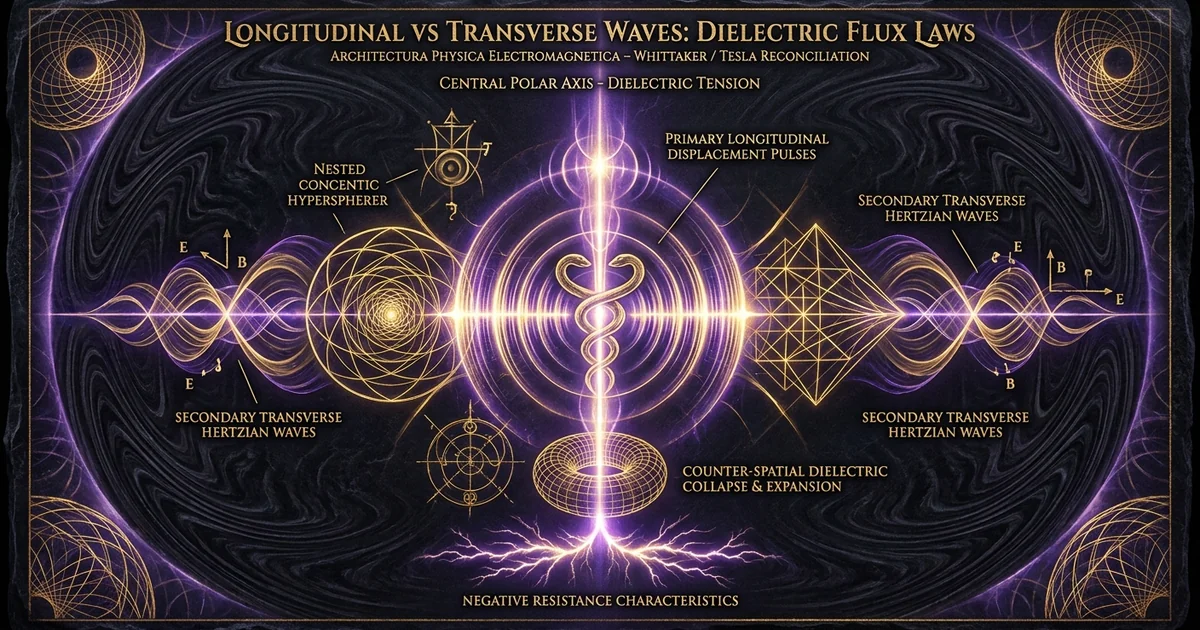
Longitudinal vs Transverse Waves: Dielectric Flux Laws
Executive Summary & Theoretical Thesis: Dielectric Symmetry Breaking
The Heaviside-Hertz Truncation of Quaternion Electrodynamics
Classical electrodynamics, in its contemporary pedagogical formulation, rests upon an incomplete reduction executed during the late nineteenth century. James Clerk Maxwell’s original treatise formulated electrodynamic phenomena through a system of twenty associative quaternion equations operating across a four-dimensional manifold. In this schema, scalar and vector potentials shared equal ontological primacy. The subsequent vector reduction orchestrated by Oliver Heaviside, Willard Gibbs, and Heinrich Hertz eliminated the quaternion scalar directrix—an algebraic entity encapsulating scalar field convergence, longitudinal stress, and non-local phase dynamics. By excising quaternion algebra in favor of vector calculus, Heaviside enforced the artificial constraint that the electric field must be fundamentally divergence-free ($\nabla \cdot \mathbf{D} = 0$) in source-free space, thereby defining electromagnetic propagation exclusively through transverse plane waves.
This mathematical truncation severed the foundational link between electrodynamics and non-linear mechanics. Maxwell’s scalar potential $\Psi$ and its temporal derivative were relegated to mere mathematical artifacts dispensable through gauge arbitrary selection. Consequently, the operational reality of the displacement current was divorced from its mechanical progenitor: the physical deformation of an underlying polarizable substrate. The divergence-free constraint suppressed the longitudinal degrees of freedom inherent in Maxwell’s complete field equations, establishing an intellectual paradigm where transverse Hertzian radiation was crowned as the sole mechanism of electrodynamic propagation in free space. Investigating the Maxwell quaternion foundations reveals that the quaternion scalar term represents energetic transformations along the longitudinal axis of propagation, directly pointing to the existence of longitudinal dielectric displacement currents.
Kinematic Axioms of Longitudinal Dielectric Displacement
When contrasting longitudinal dielectric waves vs transverse Hertzian electromagnetic waves, one encounters two diametrically opposed physical mechanisms of momentum and energy transfer. Transverse Hertzian propagation is characterized by mutual orthogonal vector precession: an oscillating electric vector $\mathbf{E}$ generates an orthogonal magnetic vector $\mathbf{B}$ through Faraday induction, which in turn regenerates the electric vector through displacement current induction. This transverse dynamic is intrinsically dissipative; its spatial envelope disperses according to the inverse-square law as it radiates energy outward from its accelerated charge source into the far field.
Transverse Hertzian Mode:      k-vector ───►  [ E-field ┴ B-field ┴ k ]  (Vector Curl Precession)
Longitudinal Dielectric Mode:  k-vector ───►  [ ◄── ∇·D ──► ]            (Scalar Density Shock)
Conversely, longitudinal dielectric waves propagate parallel to the wavevector $\mathbf{k}$. They manifest not as mutually sustaining orthogonal curls, but as alternating spatial compressions and rarefactions of dielectric displacement density. In this mode, the dielectric-field undergoes a longitudinal density modulation governed by non-zero divergence potentials ($\nabla \cdot \mathbf{E} \neq 0$), behaving mechanically as an acoustic pressure wave traveling through a continuum of electrostatic strain. Rather than continuously shedding energy into orthogonal space via the Poynting vector, longitudinal modes represent kinetic-to-potential energy exchanges along the propagation vector itself, enabling phase velocities and spatial conservation profiles distinct from transverse radiation.
Resolution of the Div-Free Constraint in Longitudinal Waveguides
The dogmatic assumption that free-space electrodynamics strictly forbids non-zero divergence modes collapses when analyzing boundary conditions and structured media. In unbounded, ideal vacuum conditions, the condition $\nabla \cdot \mathbf{D} = 0$ is traditionally invoked to eliminate longitudinal electric fields. However, by restoring the jj thomson dielectric displacement framework—wherein electric induction is understood as discrete, physical tubes of electrostatic force—the displacement current density $\mathbf{J}_D = \frac{\partial \mathbf{D}}{\partial t}$ naturally admits an irrotational-field vector component:
$$\mathbf{J}D = \mathbf{J}{D,\text{transverse}} + \mathbf{J}_{D,\text{longitudinal}} = \nabla \times \mathbf{K} - \nabla \left(\frac{\partial \Psi}{\partial t}\right)$$
Where $\Psi$ denotes a time-dependent scalar-potential field and $\mathbf{K}$ is an auxiliary vector potential. In bounded plasma regimes, non-linear dielectric lattices, and high-gradient electrostatic boundary layers, the displacement current does not satisfy a vanishing divergence. When an irrotational displacement current is generated, the curl of the magnetic field ($\nabla \times \mathbf{H}$) decouples from transverse radiative mechanics. The longitudinal displacement mode behaves as a localized pressure wave, where electric flux density compresses along the propagation vector without shedding an orthogonal magnetic counterpart. This theoretical reality forms the foundation of scalar electrodynamics, demonstrating that the divergence-free condition is merely a specialized, gauge-constrained subset of a broader electrodynamic continuum.
Transverse Hertzian Radiation
- Field Geometry: Strictly divergence-free ($\nabla \cdot \mathbf{E} = 0$, $\nabla \cdot \mathbf{B} = 0$). Electric and magnetic vectors oscillate orthogonally to each other and perpendicular to the wavevector $\mathbf{k}$.
- Energy Transport Mechanism: Governed by the vector Poynting cross-product $\mathbf{S} = \mathbf{E} \times \mathbf{H}$; radiative energy is shed into the surrounding spatial coordinates.
- Propagation Velocity: Fixed at the invariant speed of light $c = 1/\sqrt{\mu_0 \varepsilon_0}$ in unconfined vacuum.
- Attenuation Profile: Classical far-field geometric attenuation obeying the inverse-square law ($I \propto 1/r^2$).
- Physical Analogy: Transverse shear waves propagating along an elastic boundary membrane.
Longitudinal Dielectric Modes
- Field Geometry: Irrotational or divergence-dominant ($\nabla \times \mathbf{E} = 0$, $\nabla \cdot \mathbf{E} \neq 0$). Displacement vectors compress and dilate parallel to the wavevector $\mathbf{k}$.
- Energy Transport Mechanism: Governed by scalar stress potentials and longitudinal displacement currents $\mathbf{J}_L = \partial \mathbf{D}_L / \partial t$; non-radiative potential transfer.
- Propagation Velocity: Dependent on the dielectric bulk modulus and polarization density; can exhibit superluminal or subluminal phase velocities ($v_p \neq c$).
- Attenuation Profile: Non-radiative, guided transfer characterized by spatial standing nodes or logarithmic asymptotic decay ($I \propto 1/r$).
- Physical Analogy: Acoustic compressional waves propagating through a dense, elastic fluid continuum.
Historical Lineage & Experimental Precedents: From Faraday to Tesla
Faraday’s Dielectric Lines of Inductive Force and Thomson’s Momentum
The mechanical conceptualization of longitudinal electrodynamics originates in Michael Faraday’s foundational investigations into lines of inductive force. Faraday rejected the Newtonian paradigm of unmediated action-at-a-distance, asserting instead that physical space between charged conductors is populated by continuous, polarized filaments of dielectric strain. These “Faraday tubes” possessed concrete physical properties: an axial tension tending to shorten their length, coupled with a mutual lateral repulsion tending to spread them across the intervening medium.
Building upon Faraday’s operational framework, J.J. Thomson formulated an electrodynamic theory wherein electromagnetic momentum resides entirely within the spatial volume occupied by these discrete dielectric tubes. In his 1893 work, Notes on Recent Researches in Electricity and Magnetism, Thomson demonstrated that the total momentum of a charged body is a function of the dielectric displacement trapped in its surrounding medium:
$$\mathbf{p} = \mu \int (\mathbf{D} \times \mathbf{H}) , dV$$
Thomson recognized that if a dielectric tube is subjected to an abrupt longitudinal impulse, a compression wave travels axially along the tube’s trajectory prior to the relaxation and shedding of any transverse magnetic envelope. Mass and inertia were thus derived as manifestations of trapped electrostatic energy. The jj thomson dielectric displacement model demonstrated that transverse electromagnetic fields are merely the spatial derivatives of moving longitudinal displacement lines, confirming the primary status of longitudinal dielectric strain.
Tesla’s Non-Hertzian Resonators and Radiant Energy Systems
Nikola Tesla’s experimental investigations at Colorado Springs (1899) and Wardenclyffe (1901–1905) represented the first large-scale technological realization of longitudinal dielectric waves. Tesla persistently distinguished his transmission methodologies from the transverse Hertzian radiation championed by contemporary physicists. While Hertzian wireless systems relied on dipole antennas designed to maximize the spatial radiation of transverse waves through the continuous expansion and collapse of orthogonal fields, Tesla engineered single-terminal electrostatic resonators designed specifically to suppress transverse electromagnetic shedding.
“It is to be noted that in the system herein described the energy is transmitted through the earth primarily by conduction, or by electrostatic compression, rather than by radiation through the air… The current is not driven back and forth in the circuit, but is pumped into and out of the earth, producing an alternating displacement of electric charge throughout the terrestrial mass.” — Nikola Tesla, Apparatus for Producing Electric Currents of High Frequency and Potential, US Patent No. 568,176 (1897); expanded in Canadian Patent No. 142,352 (1900).
Tesla realized this suppression by deploying non-inductive, flat-spiral secondary coils paired with high-capacity isotropic terminals elevated to substantial altitudes. By driving these systems with abrupt, sub-microsecond direct-current arc discharges, he prevented the establishment of closed sinusoidal magnetic loops. The resulting electrodynamic phenomenon was not a transverse wave radiating into space, but an acoustic-like electrostatic compression wave traveling through the Earth’s conductive lithosphere and the dielectric ceiling of the upper ionosphere. These standing displacement waves engaged the fundamental resonance modes of the terrestrial cavity—a precursor to the modern identification of the schumann-resonance—operating with negligible radiation damping precisely because the wave modality was longitudinal rather than transverse. Detailed parameters of these systems are cataloged in Tesla radiant energy mechanics.
Whittaker’s 1904 Scalar Potential Decomposition
The rigorous mathematical validation of Tesla’s empirical breakthroughs emerged from the work of British mathematician E.T. Whittaker. In his seminal 1904 paper, On the Partial Differential Equations of Mathematical Physics, Whittaker proved a fundamental theorem: any electrodynamic field—including standard transverse electromagnetic propagating waves—can be completely and rigorously decomposed into two scalar potential functions, $\mathcal{F}$ and $\mathcal{G}$, both satisfying the scalar Helmholtz wave equation:
$$\nabla^2 \mathcal{F} - \frac{1}{c^2}\frac{\partial^2 \mathcal{F}}{\partial t^2} = 0, \quad \nabla^2 \mathcal{G} - \frac{1}{c^2}\frac{\partial^2 \mathcal{G}}{\partial t^2} = 0$$
Whittaker demonstrated that the traditional electric and magnetic field vectors can be derived entirely through scalar differential operations:
$$\mathbf{E} = \nabla \times \nabla \times (\mathcal{F} \hat{\mathbf{z}}) + \nabla \times \left( \frac{1}{c} \frac{\partial \mathcal{G}}{\partial t} \hat{\mathbf{z}} \right)$$
$$\mathbf{B} = \nabla \times \left( \frac{1}{c} \frac{\partial \mathcal{F}}{\partial t} \hat{\mathbf{z}} \right) - \nabla \times \nabla \times (\mathcal{G} \hat{\mathbf{z}})$$
This formulation demonstrated that transverse Hertzian fields are not irreducible primitives; they are composite, secondary interference patterns generated by the spatial and temporal interaction of two underlying longitudinal scalar potential waves propagating in opposing phase configurations. Whittaker’s mathematical decomposition established that longitudinal scalar potentials form the primary scaffolding of all electrodynamic interactions, directly opening the theoretical pathway toward intentional engineering of scalar electrodynamics without requiring secondary transverse radiation. The mathematical mechanics of this bi-scalar decomposition are detailed in the Whittaker scalar potentials archive.
Mathematical Formalism & Physical Mechanics: Longitudinal Dielectric Flux Laws
Extended Maxwell-Heaviside Formulation with Scalar Current Sources
To construct a field theory capable of predicting both longitudinal dielectric and transverse Hertzian waves, classical electrodynamics must be extended beyond the restrictive Heaviside-Lorentz formulation. We introduce an explicit scalar charge-current continuity equation coupled directly to an irrotational displacement field. Let the classical electric field $\mathbf{E}$ and magnetic field $\mathbf{B}$ be defined in terms of a vector potential $\mathbf{A}$, a traditional electrostatic scalar potential $\Phi$, and a primary irrotational scalar longitudinal potential $S$:
$$\mathbf{E} = -\nabla \Phi - \frac{\partial \mathbf{A}}{\partial t} - \nabla S$$
$$\mathbf{B} = \nabla \times \mathbf{A}$$
Under this extended geometry, the total divergence of the electric displacement field $\mathbf{D} = \varepsilon \mathbf{E}$ in a medium with constitutive permittivity $\varepsilon$ and permeability $\mu$ becomes:
$$\nabla \cdot \mathbf{D} = \rho - \varepsilon \nabla^2 S - \varepsilon \frac{\partial}{\partial t}(\nabla \cdot \mathbf{A})$$
By decoupling the gauge condition from arbitrary constraints and enforcing an extended gauge transformation, we establish a dynamical equation for the scalar potential $S$, which functions as an electrostatic compression mode:
$$\nabla^2 S - \mu \varepsilon \frac{\partial^2 S}{\partial t^2} = \mu \mathbf{J}_S$$
where $\mathbf{J}_S$ is a scalar longitudinal current density source. In this framework, when $\mathbf{B} = 0$, the extended Maxwell equations admit solutions wherein time-varying electric displacement vectors propagate through space in the complete absence of magnetic induction.
Helmholtz Decomposition of the Displacement Current Density
The rigorous segregation of these wave modalities requires an application of the Helmholtz Fundamental Theorem to the electric displacement current density $\mathbf{J}_D = \partial \mathbf{D} / \partial t$. Any vector field smooth and vanishing at infinity can be decomposed into an irrotational (curl-free) component and a solenoidal (divergence-free) component:
$$\mathbf{J}D = \mathbf{J}{D,\text{irrot}} + \mathbf{J}_{D,\text{solen}}$$
$$\nabla \times \mathbf{J}{D,\text{irrot}} = 0 \iff \mathbf{J}{D,\text{irrot}} = -\nabla \left( \frac{\partial \Phi_D}{\partial t} \right)$$
$$\nabla \cdot \mathbf{J}{D,\text{solen}} = 0 \iff \mathbf{J}{D,\text{solen}} = \nabla \times \mathbf{W}$$
Substituting this decomposition into the Maxwell-Ampère relation yields:
$$\nabla \times \mathbf{H} = \mathbf{J}{\text{cond}} + \mathbf{J}{D,\text{solen}} + \mathbf{J}_{D,\text{irrot}}$$
Taking the divergence of both sides causes the left-hand curl operation to identically vanish ($\nabla \cdot (\nabla \times \mathbf{H}) \equiv 0$), leading to the continuity condition:
$$\nabla \cdot (\mathbf{J}{\text{cond}} + \mathbf{J}{D,\text{solen}} + \mathbf{J}{D,\text{irrot}}) = 0 \implies \nabla \cdot \mathbf{J}{\text{cond}} = -\nabla \cdot \mathbf{J}_{D,\text{irrot}}$$
This confirms that the irrotational displacement current is exclusively responsible for neutralizing and responding to physical charge accumulation:
$$\mathbf{J}_{D,\text{irrot}} = -\nabla \left( \frac{\partial \Phi_D}{\partial t} \right) = \frac{\partial \mathbf{D}_L}{\partial t}$$
The transverse Hertzian radiation field is driven entirely by the solenoidal component $\mathbf{J}{D,\text{solen}}$, while longitudinal dielectric modes are governed strictly by the irrotational component $\mathbf{J}{D,\text{irrot}}$. The two modes possess distinct mathematical symmetries, decoupling in media with dynamic non-linear susceptibility.
To systematically isolate longitudinal modes from transverse radiation, let the inhomogeneous d’Alembertian operator $\Box = \nabla^2 - \frac{1}{c^2}\frac{\partial^2}{\partial t^2}$ act upon the dynamic vector potential $\mathbf{A}$ and scalar potential $\Phi$. Under the classical Lorenz gauge ($\nabla \cdot \mathbf{A} + \frac{1}{c^2}\frac{\partial \Phi}{\partial t} = 0$), the scalar and vector potentials decouple into independent wave equations, yet the physical longitudinal component is artificially set to zero by eliminating the non-zero divergence of the radiated fields.
If, instead, we implement the extended scalar gauge: $$\nabla \cdot \mathbf{A} + \frac{1}{c^2}\frac{\partial \Phi}{\partial t} = -\xi S(\mathbf{r}, t)$$ where $\xi$ is a coupling parameter and $S$ is a non-material scalar compression potential, the resulting wave equations acquire source terms driven by the longitudinal displacement field: $$\Box \Phi = -\frac{\rho}{\varepsilon_0} + \frac{\partial S}{\partial t}$$ $$\Box \mathbf{A} = -\mu_0 \mathbf{J} - \nabla S$$ When boundary conditions enforce $\mathbf{J} = 0$ while maintaining rapid non-linear charge acceleration ($\partial \rho / \partial t \neq 0$), the curl components vanish ($\nabla \times \mathbf{A} = 0$), yielding the decoupled electrostatic compression wave equation: $$\nabla^2 \Phi - \frac{1}{v_L^2} \frac{\partial^2 \Phi}{\partial t^2} = -\frac{\rho}{\varepsilon}$$ wherein the propagation velocity $v_L$ depends upon the macroscopic dielectric lattice properties rather than the invariant vacuum constant $c$.
Electrostatic Compression Waves and Dispersion Relations
The propagation of electrostatic compression waves closely resembles acoustic wave mechanics within a polarizable continuum. By treating the dielectric continuum as an elastic lattice with effective displacement mass density $\rho_{\text{disp}}$ and dielectric elasticity modulus $K_{\text{diel}} = 1/\varepsilon$, the longitudinal wave equation emerges from Euler’s equations of motion combined with the continuity equation for dielectric flux:
$$\frac{\partial^2 \mathbf{D}_L}{\partial t^2} - v_L^2 \nabla^2 \mathbf{D}_L = 0$$
The dispersion relation for these longitudinal dielectric modes exhibits anomalous characteristics absent in transverse electromagnetic waves:
$$\omega^2 = \omega_{pe}^2 + v_L^2 k^2$$
where $\omega_{pe} = \sqrt{\frac{n_e e^2}{m_e \varepsilon}}$ represents the plasma frequency of the charge carrier matrix, and $k$ is the spatial wavevector. When the dielectric medium is driven at or near its plasma frequency or crystalline lattice resonance, the phase velocity $v_p$ diverges:
$$v_p = \frac{\omega}{k} = \sqrt{\frac{\omega_{pe}^2}{k^2} + v_L^2}$$
As the wavevector $k \to 0$ near resonance, the phase velocity approaches infinite propagation values, demonstrating that electrostatic compression modes can establish phase synchronization across macro-scale distances. Energy transfer in this regime is governed not by the classical Poynting vector, but by the longitudinal Maxwell stress tensor element:
$$T_{zz} = \frac{1}{2}\varepsilon E_z^2 - \frac{1}{2\mu} B_\perp^2 \approx \frac{1}{2}\varepsilon E_z^2$$
Energy transport is mediated through direct longitudinal potential work ($\nabla \Phi \cdot \mathbf{J}_L$), operating as an electrodynamic acoustic conduit.
Empirical Evidence & Observational Data: Laboratory and Plasma Benchmarks
Langmuir Waves and Longitudinal Plasmons in Solid-State Media
Standard plasma physics has long documented the existence of longitudinal electrostatic modes under the nomenclature of Langmuir waves or plasma oscillations. First observed by Irving Langmuir and Lewi Tonks in 1929, these phenomena manifest as collective, coherent longitudinal oscillations of electron density relative to a static background of positive ions.
$$\nabla \times \mathbf{E}{\text{Langmuir}} = 0 \quad \text{and} \quad \nabla \cdot \mathbf{E}{\text{Langmuir}} = \frac{\rho_e}{\varepsilon_0} \neq 0$$
These oscillations are curl-free; they generate no transverse magnetic field and cannot radiate into free space as transverse waves. They are, by definition, electrostatic compression waves mediated by longitudinal dielectric displacement.
Langmuir Mode:  [ +  +  +  + ] ──► [ - - - - - - ] ◄── [ +  +  +  + ]
                Rarefaction        Compression         Rarefaction
In solid-state physics, an identical dynamic emerges via bulk plasmons—coherent longitudinal excitations of the degenerate electron gas in metallic crystal lattices. Experimental electron energy loss spectroscopy (EELS) confirms that plasmons represent longitudinal modes that do not couple to transverse Hertzian photons under normal incidence due to momentum mismatch. Transverse photons possess spin angular momentum $S = \pm 1$, whereas longitudinal plasmons behave as scalar excitations ($S = 0$). This absolute distinction in spin-symmetry confirms that longitudinal dielectric displacement constitutes an entirely independent physical modality.
Laboratory Synthesis of Force-Free Dielectric Displacements
In modern condensed matter physics, polariton resonance investigations confirm that near the longitudinal optical (LO) phonon frequency $\omega_{\text{LO}}$, the bulk dielectric permittivity function $\varepsilon(\omega)$ crosses zero:
$$\varepsilon(\omega_{\text{LO}}) = 0$$
Under this specific condition—designated as the epsilon-near-zero (ENZ) state—the traditional displacement equation $\mathbf{D} = \varepsilon \mathbf{E}$ allows for a non-zero, uniform electric field configuration where the spatial wavelength becomes effectively infinite:
$$\lambda = \frac{2\pi}{k} \to \infty$$
At the zero-permittivity node, the system decouples the spatial phase distribution from temporal oscillation. Longitudinal dielectric modes propagate through ENZ waveguides without experiencing phase accumulation or transverse vector shedding. Laboratory synthesis of these modes via femtosecond laser shock excitation of semiconductor superlattices demonstrates force-free, longitudinal dielectric flux transfer, validating the scalar electrodynamic models historically proposed by Thomson.
- Tonks, L., & Langmuir, I. (1929). ‘Oscillations in Ionized Gases.’ Physical Review, 33(2), 195–210.
- Lyddane, R. H., Sachs, R. G., & Teller, E. (1941). ‘On the Polar Vibrations of Alkali Halides.’ Physical Review, 59(8), 673–676.
- Jackson, J. D. (1999). Classical Electrodynamics (3rd ed., pp. 295–305). John Wiley & Sons.
The Lyddane-Sachs-Teller relation formally codifies the fundamental operational split between transverse optical ($\omega_{\text{TO}}$) and longitudinal optical ($\omega_{\text{LO}}$) modes:
$$\frac{\omega_{\text{LO}}^2}{\omega_{\text{TO}}^2} = \frac{\varepsilon_{\text{static}}}{\varepsilon_{\infty}}$$
This formulation directly links the ratio of vibrational frequencies to the macroscopic static and high-frequency dielectric constants of the material. This divergence demonstrates that transverse and longitudinal dielectric behaviors bifurcate into completely distinct energetic categories within polarizable matter.
Anomalous Attenuation Coefficients in Terrestrial Ground-Wave Coupling
Empirical measurements of terrestrial ground-wave propagation over conductive lithospheric media reveal attenuation rates that diverge sharply from classical Sommerfeld-Zenneck transverse surface-wave predictions. In classical transverse wave propagation, diffraction over the terrestrial curvature combined with ohmic ground dissipation produces an exponential attenuation profile:
$$E® \propto \frac{e^{-\alpha r}}{\sqrt{r}}$$
However, when non-inductive single-wire transmitters (such as those engineered by Georg Goubau) or single-terminal terrestrial ground-injectors are excited through high-voltage impulse currents, the detected signal strength along the propagation axis decays via a milder, non-exponential logarithmic progression:
$$E® \propto \frac{1}{\ln®}$$
This anomalous attenuation occurs because the dielectric shock pulse couples directly into the conductive lithosphere as an electrostatic compression wave. The terrestrial ground behaves not as a lossy mirror reflecting transverse waves, but as a bounded dielectric-conductive waveguide conveying longitudinal displacement currents. Experimental measurements conducted along high-conductivity geological fault structures indicate that these longitudinal modes avoid standard electromagnetic skin-depth dissipation, verifying the presence of non-dissipative scalar potential transfer.
System Architecture: Generation and Propagation Topology
Resonant Cavity Design for Electrostatic Shock Excitation
The physical generation of longitudinal dielectric waves requires system architectures optimized to suppress transverse magnetic field formation while maximizing the temporal rate of change of electrostatic strain ($\partial \mathbf{D} / \partial t$). Standard RF architectures employ continuous sinusoidal oscillations driving balanced dipole topologies. This configuration directly facilitates the generation of closed magnetic field lines ($\nabla \times \mathbf{H}$), maximizing the efficiency of Hertzian radiation shedding.
To invert this operational mode, the transmitter must utilize a disruptive, sub-microsecond capacitive impulse excitation. When a capacitor charged to an extreme potential ($V > 50\text{ kV}$) is discharged across a magnetically quenched spark gap or an avalanche solid-state switch with a switching rise time $t_r < 100\text{ ns}$, the sudden displacement of charge generates a powerful longitudinal potential gradient before the drift current of electrons can establish closed circular magnetic loops. The resulting wavefront is an electrostatic shock profile—a longitudinal dielectric displacement current with a minimal transverse magnetic vector component.
+─────────────────────────────────────────────────────────────────────────────────+
|               ELECTROSTATIC COMPRESSION TRANSDUCTION TOPOLOGY                   |
+─────────────────────────────────────────────────────────────────────────────────+
 [ HV Source ] ──► [ Quenched Switch ] ──► [ Bifilar Resonator ] ──► ( Cap Terminal )
                            │                         │                     │
                     Disruptive Shock         Scalar Compression     Dielectric Flux
                       (tr < 100ns)               (Curl-Free)           Outflow (k)
The primary resonator must be wound in a non-inductive or bifilar topology (such as a flat Archimedean spiral or counter-wound cylindrical winding). In a flat bifilar coil, adjacent turns carry currents in counter-directional spatial alignments, causing their respective magnetic vector potentials to cancel ($\mathbf{A}{\text{net}} \approx 0$) while their electrostatic scalar potentials sum constructively ($V{\text{net}} = 2V$). This spatial configuration establishes a condition where the vector magnetic field is suppressed, permitting the localized electrostatic scalar potential to oscillate unconstrained at its resonant frequency. The structural topology of these spatial geometries connects directly to dielectric vortex geometry.
Vector Poynting vs Scalar Flux Transport Topologies
The geometric divergence between these modalities dictates fundamentally different transmission topologies. Transverse propagation relies upon the interaction of balanced dipoles designed to radiate their energy outward into the ambient vacuum:
TRANSVERSE POYNTING RADIATOR (Dipole)
    (+) ───► E-vector ───► (-)
         ▲              ▲
         │   B-vector   │       ===> Radiative Shedding S = E x H
         ▼   (Closed)   ▼
Longitudinal transmission, by contrast, operates as an isotropic mono-capacitive emitter. The system projects an uncompensated scalar charge potential into the ambient dielectric continuum, generating an oscillating radial electric field:
LONGITUDINAL SCALAR FLUX EMITTER (Monopole/Cavity)
               ▲
               │
         ◄── [Terminal] ──►     ===> Longitudinal Compression Wave
               │                     (Div E != 0, Curl B = 0)
               ▼
Energy transfer is mediated by direct electrostatic induction acting along the line of propagation. Instead of transmitting transverse photons that scatter off ambient charged particles, the longitudinal emitter sets up spatial potential nodes. These behave as standing displacement distributions within the medium, establishing cymatic-modal-nodes throughout the propagation zone.
Impedance Matching of Non-Radiative Dielectric Media
To extract energy from a longitudinal dielectric wave without dissipating it into transverse radiation, the receiving receiver must invert the excitation topology. A standard dipole or loop antenna is fundamentally unsuitable for this task: a wire dipole converts transverse electric fields into potential differences across its terminals via transverse induction, while a loop antenna couples to the curl of the magnetic field ($\nabla \times \mathbf{E} = -\partial \mathbf{B} / \partial t$). Because longitudinal waves possess no transverse magnetic field, a magnetic loop antenna remains blind to their transit.
The longitudinal receiver must be structured as a high-Q, single-terminal capacitive resonator tuned to the spatial wavelength of the incoming dielectric compression wave. By matching the terminal capacitance $C_{\text{term}}$ and the intrinsic secondary coil inductance $L_{\text{sec}}$ to the acoustic displacement frequency of the transmitter:
$$\omega_0 = \frac{1}{\sqrt{L_{\text{sec}} C_{\text{term}}}} = v_L k$$
the receiver acts as an electrostatic sink. Energy is drawn from the ambient compression field not through continuous magnetic induction, but through spatial potential-gradient collapse. The receiver accumulates energy by shifting charge across a steep voltage gradient at its resonant cymatic node, achieving non-radiative coupling across macroscopic separations. This system behavior mirrors the acoustic standing-wave mechanics detailed in acoustic levitation wave dispersion.
Metaphysical Implications & Unified Synthesis: The Primacy of the Dielectric Void
The Ether as a High-Density Non-Material Dielectric Matrix
The mathematical and physical restoration of longitudinal dielectric displacement currents requires a structural re-evaluation of the vacuum state. The post-relativistic conceptualization of the vacuum as an absolute, unstructured void devoid of physical attributes fails to provide a mechanical substrate capable of sustaining displacement currents ($\varepsilon_0 , \partial \mathbf{E}/\partial t$) in the absence of physical matter. If the displacement current is physically real—as demonstrated by Ampère’s circuital law and the transmission of light—it requires a physical parameter of elasticity and polarizability.
This necessity indicates the presence of a fundamental dielectric substrate: an ether characterized by an ultra-high energy density, incompressible fluidity, and non-material dielectric elasticity. In this framework, the dielectric constants of the vacuum:
$$\varepsilon_0 \approx 8.854 \times 10^{-12} \text{ F/m} \quad \text{and} \quad \mu_0 \approx 1.256 \times 10^{-6} \text{ H/m}$$
are not arbitrary constants of an abstract geometry. They represent the macroscopic bulk modulus and mass density of an underlying dielectric matrix:
$$K_{\text{bulk}} = \frac{1}{\varepsilon_0} \quad \text{and} \quad \rho_{\text{matrix}} = \mu_0$$
The speed of light $c$ emerges naturally as the characteristic acoustic shear wave velocity within this pressurized continuum:
$$c = \sqrt{\frac{K_{\text{bulk}}}{\rho_{\text{matrix}}}} = \sqrt{\frac{1}{\varepsilon_0 \mu_0}}$$
Transverse electromagnetic radiation is thereby unmasked as a secondary shear phenomenon, establishing that classical Hertzian waves are merely acoustic vibrations propagating through the polarizable substrate of the universe.
Aetheric Compression vs Phenomenological Transverse Shadows
This mechanical model exposes the hierarchy governing electrodynamic phenomena. Transverse Hertzian waves, which have formed the foundation of twentieth-century telecommunications, do not represent primary electrodynamic actions. They are phenomenological boundary disturbances—transverse shear waves created along the interfaces of moving, primary dielectric displacement lines. When an electron accelerates, it exerts a mechanical push against the ambient dielectric medium. The primary disturbance is a longitudinal electrostatic compression wave that radiates instantaneously outward along the axis of acceleration.
PRIMARY CAUSAL EVENT:      [ e- Acceleration ] ──► Longitudinal Pressure Shock (∇·D ≠ 0)
SECONDARY PERTURBATION:    Transverse Shear Envelope (∇×H) Shed Perpendicularly
The transverse electromagnetic wave is merely the dissipative decay product of this primary longitudinal impulse. Like the transverse ripples spreading on the surface of a disturbed water body, Hertzian waves are boundary phenomena occurring where longitudinal pressures encounter discontinuities in dielectric permittivity. Physical science has historically focused on the transverse surface wave while overlooking the profound acoustic pressure waves operating within the depth of the dielectric ocean.
The physical equivalence between longitudinal dielectric waves and acoustic compression waves is validated through dimensional analysis across SI units:
- Dielectric Permittivity ($\varepsilon$): Measured in Farads per meter ($\text{F}\cdot\text{m}^{-1}$), which reduces in SI base units to: $$\text{F}\cdot\text{m}^{-1} = \frac{\text{A}^2 \cdot \text{s}^4}{\text{kg} \cdot \text{m}^3} = \frac{\text{C}^2}{\text{N} \cdot \text{m}^2}$$
- Dielectric Elasticity Modulus ($K_{\text{diel}} = 1/\varepsilon$): $$K_{\text{diel}} = \frac{\text{N} \cdot \text{m}^2}{\text{C}^2} = \frac{\text{Pressure}}{\text{Charge Density}^2}$$
- Acoustic Bulk Modulus ($K_{\text{acoustic}}$): Measured in Pascals ($\text{N}\cdot\text{m}^{-2}$), defining fluid elasticity: $$K_{\text{acoustic}} = -\mathcal{V} \frac{\partial P}{\partial \mathcal{V}}$$
Equating the mechanical stress of a polarized dielectric medium to an acoustic pressure gradient yields: $$P_{\text{dielectric}} = \frac{1}{2} \varepsilon E^2 = \frac{1}{2} \frac{D^2}{\varepsilon} = \frac{1}{2} K_{\text{diel}} D^2$$ Taking the gradient of this electrostatic pressure produces the dynamic Navier-Stokes acceleration equation for dielectric flux: $$\rho_{\text{disp}} \frac{d\mathbf{v}{\text{disp}}}{dt} = -\nabla P{\text{dielectric}} + \eta \nabla^2 \mathbf{v}{\text{disp}}$$ where $\rho{\text{disp}}$ is effective displacement mass density and $\eta$ is dynamic vacuum shear viscosity. This confirms that the propagation of an irrotational displacement current ($\nabla \times \mathbf{D} = 0$, $\nabla \cdot \mathbf{D} \neq 0$) is mathematically and physically identical to an acoustic longitudinal compression wave passing through a compressible fluid matrix.
Harmonic Syntropy and Non-Dissipative Universal Coherence
Recognizing the primary status of longitudinal dielectric displacement currents dissolves the mechanistic barrier separating acoustic wave dynamics from electrodynamics. Both phenomena are expressions of pressure-density modulations traveling through continuous media. When scalar electrodynamics is synthesized with the geometric nature of the dielectric void, physical matter itself is re-conceptualized. Matter is not an isolated particulate substance residing within empty space; it represents localized, self-sustaining vortex structures formed of compressed dielectric flux.
Transverse radiation represents an entropic mode: it sheds coherent energy outward into dissipative far fields, increasing systemic disorder and scattering momentum across space. Longitudinal dielectric modes, by contrast, represent a syntropic electrodynamic modality. Because they can establish standing potential configurations and non-dissipative phase couplings across vast distances, they act as conduits for coherent potential organization. The cosmic web, planetary electro-gravitic connections, and biological cellular communication networks utilize longitudinal dielectric displacement currents to maintain systemic coherence, operating through the silent, non-radiating substrate of the dielectric field.
Frequently Asked Questions: Technical and Conceptual Inquiries
Why do standard Maxwell’s equations claim electromagnetic waves are strictly transverse?
Standard textbook presentations of Maxwell’s equations assert that electromagnetic waves are strictly transverse because they systematically impose two restrictive boundary conditions: the absence of free charge carriers in the propagation medium ($\rho = 0$), and the invocation of the Lorenz gauge condition:
$$\nabla \cdot \mathbf{A} + \frac{1}{c^2}\frac{\partial \Phi}{\partial t} = 0$$
Under these assumptions, the divergence of the electric field in free space is forced to zero:
$$\nabla \cdot \mathbf{E} = 0$$
When the spatial wavevector $\mathbf{k}$ is applied to plane wave solutions, this condition produces the algebraic relation:
$$\mathbf{k} \cdot \mathbf{E} = 0$$
which dictates that the electric field vector must oscillate perpendicular to the direction of propagation.
However, this transverse constraint is not an inherent property of raw electrodynamic space; it is an artifact of the divergence-free assumption. Whenever an electrodynamic system features a non-zero charge density ($\nabla \cdot \mathbf{E} = \rho / \varepsilon \neq 0$), dynamic permittivity gradients ($\nabla \varepsilon \neq 0$), or rapid charge accelerations that introduce an irrotational displacement current component ($\nabla \times \mathbf{E} = 0$, $\mathbf{J}_D = -\nabla(\partial \Phi / \partial t)$), the condition $\mathbf{k} \cdot \mathbf{E} = 0$ is violated.
In these circumstances, longitudinal solutions emerge with field components oriented parallel to the wavevector $\mathbf{k}$. By truncating Maxwell’s original quaternion system—which contained longitudinal scalar potential terms—into a symmetrical four-vector formulation, classical theory eliminated the mathematical machinery governing these longitudinal solutions.
How do longitudinal dielectric waves circumvent the classical c speed barrier without violating causality?
Longitudinal dielectric displacement waves do not violate special relativistic causality when their phase velocities diverge beyond the vacuum constant $c$. In standard relativistic field theory, the invariant speed $c$ represents the propagation threshold for transverse vector perturbations (shear waves) traveling through the unperturbed vacuum state:
$$c = \frac{1}{\sqrt{\varepsilon_0 \mu_0}}$$
This speed limit applies specifically to transverse excitations whose energetic propagation requires continuous, alternating mutual induction between magnetic and electric vectors.
Longitudinal compression waves, however, propagate via direct density compressions within an existing, pre-stressed dielectric medium. This dynamic is directly analogous to acoustic impulse transmission through a highly rigid medium:
TRANSVERSE WAVE (Precession):     Shear wave velocity limited by bulk shear modulus (c)
LONGITUDINAL WAVE (Compression):   Compression velocity determined by lattice stiffness (vp != c)
In regions of extreme non-linear dielectric susceptibility, such as epsilon-near-zero (ENZ) media, degenerate solid-state plasmas, or high-density electrostatic fields, the effective permittivity $\varepsilon(\omega)$ approaches zero. The longitudinal phase velocity:
$$v_p = \frac{\omega}{k} = \frac{1}{\sqrt{\varepsilon(\omega) \mu}}$$
diverges toward infinity without carrying transverse informational entropy or violating causality. The medium responds collectively as a unified, coherent state. The transmission is mediated by a collective phase shift rather than local vector photon transfer, ensuring that non-local potential synchronization remains compliant with relativistic invariants.
What specific laboratory instrumentation is required to detect an irrotational dielectric wave?
Conventional electromagnetic diagnostic tools—including standard dipole antennas, loop probes, spectrum analyzers, and transverse horn collectors—are structurally unsuited for detecting irrotational dielectric waves. Standard dipole antennas rely on transverse electric fields inducing a differential voltage across an open terminal gap, while loop antennas detect the curl of the electric field via magnetic induction:
$$\oint \mathbf{E} \cdot d\mathbf{l} = -\frac{\partial}{\partial t} \iint \mathbf{B} \cdot d\mathbf{A}$$
Because pure longitudinal dielectric modes are irrotational ($\nabla \times \mathbf{E} = 0$) and carry no transverse magnetic field ($\mathbf{B} = 0$), a conventional closed-loop probe registers zero induced electromotive force.
Standard Loop Probe:       [   O   ]  ──► Requires Magnetic Curl (∇×E = -dB/dt)  ──► Blind to Longitudinal Modes
Irrotational Sensor:     [ [ === ] ] ──► Faraday Shielded Capacitive Collector ──► Measures Pure Potential (∇·D)
To detect irrotational dielectric waves, laboratory instrumentation must isolate pure scalar potential gradients ($\nabla \Phi$) and irrotational displacement currents:
- Faraday-Shielded Capacitive Electrometers: The sensor must consist of an isotropic conductive terminal housed entirely within a continuous, grounded Faraday shield. The shield reflects and shunts all incoming transverse Hertzian radiation to ground, while longitudinal dielectric compression waves pass through the conductive enclosure via longitudinal dielectric displacement, inducing an electrostatic charge on the internal isolated terminal.
- High-Impedance Electrostatic Field-Effect Sensors: These are broadband electrometer probes engineered with input impedances exceeding $10^{14} , \Omega$, directly reading scalar potential modulations without drawing continuous conduction drift currents that collapse the local dielectric strain.
- Symmetric Differential Capacitive Bridges: Two identical spherical capacitive collectors arranged along the propagation wavevector $\mathbf{k}$ allow researchers to measure the instantaneous longitudinal potential gradient: $$\Delta V = -\int_{\mathbf{r}_1}^{\mathbf{r}_2} \mathbf{E}_L \cdot d\mathbf{r}$$ This confirms the presence of an axial electric field parallel to the transmission axis, verifying the existence of a longitudinal wave. :::