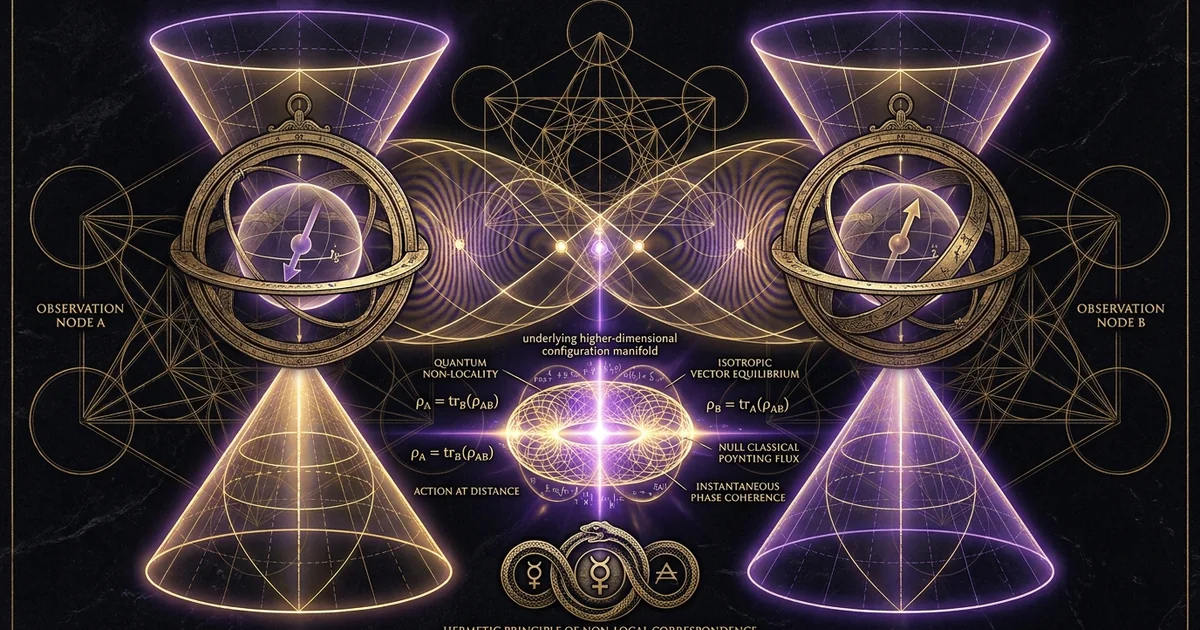
Quantum Non-Locality: Action at Distance Without Signals
Executive Summary & Theoretical Thesis
The Non-Separability Dilemma in Entangled Systems
The foundational premise of classical physics posits that composite physical architectures are fundamentally reducible to the sum of their individual, spatially localized components. In the tensor product structure of quantum mechanical Hilbert spaces, this classical intuition of ontological reductionism breaks down completely. When two physical subsystems $A$ and $B$, described by respective Hilbert spaces $\mathcal{H}_A$ and $\mathcal{H}B$, interact and enter an entangled configuration, the composite state vector $|\Psi{AB}\rangle \in \mathcal{H}_A \otimes \mathcal{H}_B$ cannot be factorized into individual pure states of the form $|\psi_A\rangle \otimes |\psi_B\rangle$.
This non-factorizability, formally defined by a Schmidt rank $r > 1$ in the Schmidt decomposition $|\Psi_{AB}\rangle = \sum_{i=1}^r \lambda_i |u_i\rangle \otimes |v_i\rangle$ (where $\lambda_i > 0$ and $\sum \lambda_i^2 = 1$), demonstrates that the definite physical properties of the total system do not supervene upon the intrinsic physical properties of its isolated constituents. Instead, the joint state possesses holistic attributes that systematically evade description through separate local state assignments. In the context of quantum non-locality, the non-separability dilemma demonstrates that measuring an observable $\hat{A}$ on subsystem $A$ alters the joint condition of the system without conveying a physical mediating wave through intermediate spacetime.
Within the operational frameworks explored in quantum measurement problem and wavefunction collapse, this holistic character is not an artifact of epistemic uncertainty, but an ontic feature of the physical state. The system cannot be partitioned into independent physical domains without destroying the phase relations and cross-subsystem coherences that govern its observable behavior.
Microscopic Non-Locality vs. Macroscopic Causality
The persistence of non-local correlations across arbitrary spatial separations presents a profound theoretical challenge to special relativity. A fundamental tenet of relativistic field theory is the microcausality condition: any two space-like separated local observables $\hat{O}_A(x)$ and $\hat{O}_B(y)$, satisfying a negative Minkowski interval $(x - y)^2 < 0$, must commute identically:
$$[\hat{O}_A(x), \hat{O}_B(y)] = 0$$
This algebraic condition guarantees that local operations conducted at spacetime coordinate $x$ cannot alter the expectation values or probability distributions of measurements performed at coordinate $y$. Consequently, the existence of quantum non-locality does not imply the existence of faster-than-light telegraphic signaling.
       Spacetime Interval ds² < 0
 Alice [x] <-----------------------> Bob [y]
    │                                   │
Local POVM                          Local POVM
 M_i† M_i                            N_j† N_j
    │                                   │
    ▼                                   ▼
 Tr_B(ρ_AB) = ρ_A                   Tr_A(ρ_AB) = ρ_B
 (Invariant to y)                   (Invariant to x)
The preservation of causality within relativistic frameworks occurs because quantum non-locality operates strictly as an outcome-outcome correlation rather than an operation-outcome causation. In any experimental run, the local measurement results registered by an observer at coordinate $x$ appear entirely stochastic, governed by the local reduced density operator. It is only when the disparate, local classical measurement records are subsequently brought together and compared via subluminal channels that the non-local statistical correlation emerges.
This strict separation ensures that macroscopic causality remains unviolated: no dynamic perturbation, mechanical impulse, or controllable bit of information travels across the spacelike interval. Microscopic non-locality thus bypasses classical notions of localized causal mechanisms while preserving macroscopic relativistic invariance.
Let a bipartite pure quantum state be defined on the composite Hilbert space $\mathcal{H}_{AB} = \mathcal{H}_A \otimes \mathcal{H}_B$, where $\dim(\mathcal{H}_A) = d_A$ and $\dim(\mathcal{H}B) = d_B$. The state $|\Psi\rangle \in \mathcal{H}{AB}$ is separable if and only if there exist normalized vectors $|\psi_A\rangle \in \mathcal{H}_A$ and $|\psi_B\rangle \in \mathcal{H}_B$ such that $|\Psi\rangle = |\psi_A\rangle \otimes |\psi_B\rangle$. Under the Schmidt decomposition theorem, any bipartite pure state can be uniquely written (up to phase) as:
$$|\Psi\rangle = \sum_{k=1}^{K} \sqrt{\lambda_k} , |u_k\rangle_A \otimes |v_k\rangle_B$$
where $K \le \min(d_A, d_B)$, the coefficients satisfy $\lambda_k > 0$ with $\sum_{k=1}^K \lambda_k = 1$, and ${|u_k\rangle_A}$, ${|v_k\rangle_B}$ form orthonormal bases for the respective subspaces. The state is non-separable (entangled) if and only if the Schmidt rank satisfies $r(\Psi) = K > 1$, which is equivalent to the condition that the von Neumann entropy of the reduced density operator is strictly positive:
$$S(\rho_A) = -\mathrm{Tr}(\rho_A \log_2 \rho_A) > 0, \quad \text{where } \rho_A = \mathrm{Tr}_B(|\Psi\rangle\langle\Psi|)$$
This non-vanishing entropy establishes that local realism cannot account for the joint probability distributions generated by the state, thereby violating the Bell-CHSH inequalities without invoking dynamic signaling.
Axiomatic Foundations of Spatial Independence
The metric structure of Minkowski spacetime and relativistic invariance dictates that any two events separated by an invariant interval:
$$ds^2 = c^2 dt^2 - dx^2 - dy^2 - dz^2 < 0$$
possess no invariant chronological ordering. Observers in different inertial frames will disagree on the temporal sequence of two space-like separated measurements, with frame $\mathcal{F}$ registering event $A$ before event $B$, and frame $\mathcal{F}'$ registering event $B$ before event $A$. Because a temporal ordering cannot be established invariantly, any dynamic model that posits a directional, causal influence propagating from the first measurement event to the second is fundamentally incompatible with the principles of special relativity.
Spatial separation within configuration space operates under completely different algebraic constraints than spatial separation in three-dimensional physical space. In classical field theories, physical interactions are mediated by continuous field variables that propagate locally through spacetime points, constrained by the boundary conditions of hyperbolic partial differential equations.
In quantum mechanics, however, the fundamental state vector evolves within an abstract, $3N$-dimensional configuration space (for an $N$-particle system). When two particles separate in physical 3-space, their unified state does not split into two distinct field excitations traveling along divergent trajectories. The physical distance between the particles in Minkowski spacetime does not correspond to an asymptotic decoupling of their shared state vector in Hilbert space.
Spatial independence is an emergent classical property that holds only for unentangled, factorizable quantum systems. Once quantum entanglement is established, the concept of spatial distance loses its status as an absolute decoupling parameter, revealing an underlying physical reality characterized by holistic relational interdependence rather than point-like autonomy.
Historical Lineage & Experimental Precedents
The EPR Reductio Ad Absurdum and the Reality Criterion
The foundational debate regarding quantum non-locality originated in 1935 when Albert Einstein, Boris Podolsky, and Nathan Rosen published their seminal critique of the quantum mechanical formalism. The primary objective of the EPR paper was not to demonstrate that quantum mechanics was mathematically incorrect, but rather to prove that it constituted an incomplete description of physical reality. To advance their thesis, EPR established two operational criteria:
- The Criterion of Completeness: Every element of the physical reality must have a counterpart in the physical theory.
- The Criterion of Physical Reality: If, without in any way disturbing a system, we can predict with certainty (i.e., with probability equal to unity) the value of a physical quantity, then there exists an element of physical reality corresponding to this physical quantity.
Einstein, Podolsky, and Rosen deployed these criteria within a hypothetical bipartite system consisting of two particles, labeled 1 and 2, which interact briefly and subsequently separate to macroscopic distances. The joint wavefunction of the system is described by an entangled continuous-variable state characterized by precise relative position and total momentum correlations:
$$\Psi(x_1, x_2) = \frac{1}{2\pi\hbar} \int_{-\infty}^{\infty} e^{\frac{i}{\hbar} p (x_1 - x_2 + x_0)} , dp = \delta(x_1 - x_2 + x_0)$$
Because the momentum operator $\hat{P}_{total} = \hat{p}_1 + \hat{p}2$ commutes with the relative position operator $\hat{X}{rel} = \hat{x}_1 - \hat{x}_2$, both physical observables can possess simultaneous eigenvalues:
$$[\hat{x}_1 - \hat{x}_2, , \hat{p}_1 + \hat{p}_2] = 0$$
By performing a measurement of position $\hat{x}_1$ on particle 1, an observer can predict with certainty the position of particle 2 ($x_2 = x_1 + x_0$) without in any way physically disturbing particle 2, assuming that no physical interaction can propagate instantaneously across a space-like interval.
Under the EPR criterion of reality, this implies that particle 2 must possess a pre-existing element of reality corresponding to its spatial coordinate. Alternatively, the observer could choose to measure the momentum $\hat{p}_1$ of particle 1, thereby predicting with certainty the momentum of particle 2 ($p_2 = -p_1$) without disturbing it, implying that particle 2 also possesses a pre-existing element of reality corresponding to its momentum.
Because standard quantum mechanics forbids the simultaneous assignment of exact values to non-commuting observables ($[\hat{x}_2, \hat{p}_2] = i\hbar$), EPR concluded that the quantum state vector cannot provide a complete specification of physical reality, requiring the postulation of underlying, determinative local hidden variables.
“If, without in any way disturbing a system, we can predict with certainty (i.e., with probability equal to unity) the value of a physical quantity, then there exists an element of physical reality corresponding to this physical quantity… No reasonable definition of reality could be expected to permit this.” — Einstein, A., Podolsky, B., & Rosen, N. (1935). Can Quantum-Mechanical Description of Physical Reality be Considered Complete? Physical Review, 47(10), 777–780.
“In a theory in which parameters are added to quantum mechanics to determine the results of individual measurements, without changing the statistical predictions, there must be a mechanism whereby the setting of one measuring device can influence the reading of another instrument, however remote. Moreover, the signal involved must propagate instantaneously, so that such a theory could not be Lorentz invariant.” — Bell, J. S. (1964). On the Einstein Podolsky Rosen Paradox. Physics Physique Fizika, 1(3), 195–200.
Bell’s Analytical Theorem and Inequality Benchmarks
For nearly three decades following the publication of the EPR paper, the controversy remained relegated to the domain of untestable philosophy, with Niels Bohr’s complementary interpretation accepted as the standard view. Bohr argued that an entangled bipartite system forms an indivisible experimental phenomenon, rendering the EPR reality criterion invalid because the experimental arrangements for measuring position and momentum are mutually exclusive.
In 1964, John Stewart Bell dramatically transformed this philosophical impasse into a concrete, empirically verifiable mathematical theorem. Bell demonstrated that any theoretical model based on the conjunction of two seemingly indisputable classical assumptions—realism (the assumption that measurement outcomes are determined by pre-existing properties independent of observation) and locality (the assumption that measurements performed at space-like separation cannot influence one another)—imposes strict statistical limits on the correlations achievable between separated subsystems.
Bell formulated this proof by defining a local hidden-variable parameter space $\Lambda$ governed by a normalized probability distribution $\rho(\lambda)$, where $\int_{\Lambda} \rho(\lambda) , d\lambda = 1$. Let $A(\mathbf{a}, \lambda) = \pm 1$ represent the dichotomic outcome of a spin measurement along the unit axis $\mathbf{a}$ at detector $A$, and let $B(\mathbf{b}, \lambda) = \pm 1$ represent the dichotomic outcome of a spin measurement along the unit axis $\mathbf{b}$ at detector $B$. The operational condition of local causality dictates that the outcome $A$ cannot depend on the remote detector setting $\mathbf{b}$, nor can the outcome $B$ depend on the local setting $\mathbf{a}$:
$$P(A, B \mid \mathbf{a}, \mathbf{b}, \lambda) = P(A \mid \mathbf{a}, \lambda) \cdot P(B \mid \mathbf{b}, \lambda)$$
The classical expectation value of the joint measurement is therefore expressed as:
$$E(\mathbf{a}, \mathbf{b}) = \int_{\Lambda} A(\mathbf{a}, \lambda) B(\mathbf{b}, \lambda) \rho(\lambda) , d\lambda$$
By considering four alternative measurement settings—two for detector $A$ ($\mathbf{a}, \mathbf{a}‘$) and two for detector $B$ ($\mathbf{b}, \mathbf{b}’$)—John Clauser, Michael Horne, Abner Shimony, and Richard Holt (CHSH) generalized Bell’s inequality into an experimentally viable benchmark:
$$S_{CHSH} = |E(\mathbf{a}, \mathbf{b}) - E(\mathbf{a}, \mathbf{b}‘) + E(\mathbf{a}’, \mathbf{b}) + E(\mathbf{a}‘, \mathbf{b}’)| \le 2$$
Quantum mechanical formalism explicitly violates this inequality. For a bipartite system prepared in the singlet bell-state:
$$|\psi^-\rangle = \frac{1}{\sqrt{2}} \left( |\uparrow\downarrow\rangle - |\downarrow\uparrow\rangle \right)$$
the quantum correlation function between projection operators along vectors $\mathbf{a}$ and $\mathbf{b}$ is determined by the inner product of the measurement axes:
$$E_{QM}(\mathbf{a}, \mathbf{b}) = \langle \psi^- | (\boldsymbol{\sigma} \cdot \mathbf{a}) \otimes (\boldsymbol{\sigma} \cdot \mathbf{b}) | \psi^- \rangle = -\mathbf{a} \cdot \mathbf{b} = -\cos(\theta_{ab})$$
If the analyzer angles are configured coplanarly with angular offsets of $\theta_{a,b} = \pi/4$, $\theta_{b,a’} = \pi/4$, $\theta_{a’,b’} = \pi/4$, and $\theta_{a,b’} = 3\pi/4$, the quantum CHSH parameter evaluates to:
$$S_{QM} = \left| -\cos\left(\frac{\pi}{4}\right) + \cos\left(\frac{3\pi}{4}\right) - \cos\left(\frac{\pi}{4}\right) - \cos\left(\frac{\pi}{4}\right) \right| = \left| -\frac{\sqrt{2}}{2} - \frac{\sqrt{2}}{2} - \frac{\sqrt{2}}{2} - \frac{\sqrt{2}}{2} \right| = 2\sqrt{2} \approx 2.828$$
This mathematical result, known as Cirel’son’s bound, demonstrates that quantum mechanics maximally violates the CHSH inequality by a factor of $\sqrt{2}$, fundamentally excluding any local hidden-variable theory. Detailed experimental configurations verifying this violation are examined in Bell inequality experimental tests.
The Evolution of Optical and Atomic Aspect-Type Experiments
The physical verification of Bell’s theorem demanded rigorous experimental validation capable of isolating entangled quantum systems from environmental decoherence while eliminating potential observational loopholes. The earliest experimental attempts, conducted by Stuart Freedman and John Clauser in 1972 using atomic cascade transitions in calcium, successfully demonstrated violations of the Freedman-type inequality, but these systems utilized static polarizers and inefficient detection arrays. This architectural limitation left open the locality loophole (the possibility that the detectors exchanged subluminal coordination signals) and the detection loophole (the possibility that the observed sample was unrepresentative of the ensemble).
In 1982, Alain Aspect, Jean Dalibard, and Gérard Roger achieved a decisive experimental breakthrough by incorporating fast optical switches into an atomic calcium cascade system. The orientation of the polarizing filters was dynamically altered while the photons were in flight, across a spatial baseline of 12 meters.
The switching mechanism operated at a frequency of 50 MHz, alternating the measurement directions at intervals of roughly 10 nanoseconds. Because the optical transit time across the baseline was approximately 40 nanoseconds, the setting choice for each photon was established across a space-like interval relative to the detection of its entangled partner:
$$\Delta t_{switch} < \frac{L}{c}$$
Aspect’s experimental findings confirmed the quantum mechanical prediction, violating the CHSH inequality by dozens of standard deviations and demonstrating non-local statistical correlation without communication.
Nevertheless, these initial optical experiments suffered from low detector quantum efficiencies, requiring the “fair-sampling assumption” to rule out the possibility that the particle selection was systematically biased. Over the subsequent four decades, experimental physics engaged in an empirical campaign to eliminate the locality, detection, and freedom-of-choice loopholes simultaneously within a singular experimental architecture.
Mathematical Formalism & Physical Mechanics
The Density Matrix Formulation of Bipartite States
A rigorous mathematical analysis of the No-Signaling Theorem requires formulating the quantum state within the algebraic framework of the density-matrix acting on a composite Hilbert space $\mathcal{H}_{AB} = \mathcal{H}_A \otimes \mathcal{H}B$. Let $\mathcal{S}(\mathcal{H}{AB})$ denote the set of positive semi-definite, trace-class linear operators of unit trace:
$$\rho_{AB} \in \mathcal{S}(\mathcal{H}{AB}), \quad \rho{AB} \ge 0, \quad \mathrm{Tr}(\rho_{AB}) = 1$$
An arbitrary bipartite density operator may be expanded in terms of local operator bases ${\hat{A}_i} \subset \mathcal{B}(\mathcal{H}_A)$ and ${\hat{B}_j} \subset \mathcal{B}(\mathcal{H}_B)$, where $\mathcal{B}(\mathcal{H})$ denotes the algebra of bounded linear operators on $\mathcal{H}$:
$$\rho_{AB} = \sum_{i,j} c_{ij} , \hat{A}_i \otimes \hat{B}_j$$
If the system is prepared in a pure, maximally entangled state, such as any of the four canonical bell-state configurations:
$$\begin{aligned} |\Phi^\pm\rangle &= \frac{1}{\sqrt{2}} \left(|00\rangle \pm |11\rangle\right) \ |\Psi^\pm\rangle &= \frac{1}{\sqrt{2}} \left(|01\rangle \pm |10\rangle\right) \end{aligned}$$
the corresponding density operator is given by the projector $\rho_{AB} = |\Phi^+\rangle\langle\Phi^+|$.
The macroscopic state space also accommodates separable mixed states, defined as convex combinations of product density matrices:
$$\rho_{AB}^{sep} = \sum_k p_k , \rho_A^{(k)} \otimes \rho_B^{(k)}, \quad \sum_k p_k = 1, \quad p_k \ge 0$$
The distinguishing physical characteristic of an entangled state is that it cannot be written in the form of $\rho_{AB}^{sep}$. This property manifests mathematically as non-positive partial transpositions under the Peres-Horodecki criterion (PPT), confirming that the inter-subsystem correlations exceed classical joint probability distributions.
The Partial Trace and Local Invariance under Remote Operations
To evaluate the physical observables accessible strictly to an observer localized at terminal $A$ (conventionally designated Alice), one must compute the reduced-density-operator $\rho_A$ by performing the partial-trace operation over the degrees of freedom of subsystem $B$ (conventionally designated Bob). The partial trace map $\mathrm{Tr}_B: \mathcal{B}(\mathcal{H}_A \otimes \mathcal{H}_B) \to \mathcal{B}(\mathcal{H}_A)$ is the unique trace-preserving linear completely positive map defined such that for all $\hat{X} \in \mathcal{B}(\mathcal{H}_A)$ and $\hat{Y} \in \mathcal{B}(\mathcal{H}_B)$:
$$\mathrm{Tr}_B(\hat{X} \otimes \hat{Y}) = \hat{X} , \mathrm{Tr}(\hat{Y})$$
Explicitly, let ${|b_k\rangle}$ form an arbitrary orthonormal basis spanning the Hilbert space $\mathcal{H}_B$. The reduced density operator $\rho_A$ is expressed as:
$$\rho_A = \mathrm{Tr}B(\rho{AB}) = \sum_k (\mathbb{I}A \otimes \langle b_k|) , \rho{AB} , (\mathbb{I}_A \otimes |b_k\rangle)$$
The physical significance of the reduced density operator $\rho_A$ lies in its complete description of all local expectation values. For any physical observable $\hat{O}_A$ acting strictly within subsystem $A$, its counterpart in the composite space is represented by the operator $\hat{O}_A \otimes \mathbb{I}_B$. The expectation value evaluates to:
$$\begin{aligned} \langle \hat{O}A \rangle &= \mathrm{Tr}{AB}\left( \rho_{AB} (\hat{O}_A \otimes \mathbb{I}_B) \right) \ &= \sum_k \langle b_k | \mathrm{Tr}A \left( \rho{AB} (\hat{O}_A \otimes \mathbb{I}_B) \right) | b_k \rangle \ &= \mathrm{Tr}_A \left( \left[ \sum_k (\mathbb{I}A \otimes \langle b_k|) \rho{AB} (\mathbb{I}_A \otimes |b_k\rangle) \right] \hat{O}_A \right) \ &= \mathrm{Tr}_A (\rho_A \hat{O}_A) \end{aligned}$$
This derivation proves that all observable physical properties, probability distributions, and spectral outcomes accessible to Alice depend exclusively on her local reduced density operator $\rho_A$, completely independent of the remote degrees of freedom in $\mathcal{H}_B$.
Mathematical Proof of the No-Signaling Theorem
The No-Signaling Theorem formalizes the physical assertion that faster-than-light communication via entangled quantum states is impossible. Consider an arbitrary, potentially entangled bipartite state $\rho_{AB}$. Suppose Bob, situated at a spacelike-interval from Alice, performs a generalized quantum measurement described by a Positive Operator-Valued Measure (POVM).
A POVM on $\mathcal{H}_B$ is defined by a collection of measurement operators ${\hat{M}_m}$ satisfying the completeness relation:
$$\sum_m \hat{M}_m^\dagger \hat{M}_m = \mathbb{I}_B$$
When Bob performs this measurement, if outcome $m$ occurs, the composite density operator undergoes transformation according to the Lüders-Kraus postulate:
$$\rho_{AB} \to \rho_{AB}^{(m)} = \frac{(\mathbb{I}_A \otimes \hat{M}m) \rho{AB} (\mathbb{I}_A \otimes \hat{M}m^\dagger)}{\mathrm{Tr}{AB}\left( (\mathbb{I}_A \otimes \hat{M}_m^\dagger \hat{M}m) \rho{AB} \right)}$$
The probability that Bob obtains the specific outcome $m$ is given by:
$$P(m) = \mathrm{Tr}_{AB}\left( (\mathbb{I}_A \otimes \hat{M}_m^\dagger \hat{M}m) \rho{AB} \right)$$
Because Alice is separated from Bob by a space-like interval, she has no access to Bob’s individual measurement outcomes. Therefore, her physical state must be evaluated over the non-selective measurement ensemble, which averages over all possible outcomes Bob could have obtained:
$$\rho_{AB}’ = \sum_m P(m) , \rho_{AB}^{(m)} = \sum_m (\mathbb{I}_A \otimes \hat{M}m) \rho{AB} (\mathbb{I}_A \otimes \hat{M}_m^\dagger)$$
To determine whether Bob’s local action has influenced Alice’s subsystem, we calculate Alice’s post-measurement reduced density operator $\rho_A’$ by tracing out subsystem $B$:
$$\begin{aligned} \rho_A’ &= \mathrm{Tr}B(\rho{AB}') \ &= \mathrm{Tr}_B \left( \sum_m (\mathbb{I}_A \otimes \hat{M}m) \rho{AB} (\mathbb{I}_A \otimes \hat{M}_m^\dagger) \right) \ &= \sum_m \sum_k (\mathbb{I}_A \otimes \langle b_k|) (\mathbb{I}_A \otimes \hat{M}m) \rho{AB} (\mathbb{I}_A \otimes \hat{M}_m^\dagger) (\mathbb{I}_A \otimes |b_k\rangle) \end{aligned}$$
Using the cyclic property of the trace operation within the bounded Hilbert space $\mathcal{H}_B$, we commute the operator $\hat{M}_m^\dagger$:
$$\begin{aligned} \rho_A’ &= \sum_m \mathrm{Tr}_B \left( (\mathbb{I}_A \otimes \hat{M}m) \rho{AB} (\mathbb{I}_A \otimes \hat{M}_m^\dagger) \right) \ &= \mathrm{Tr}_B \left( \sum_m (\mathbb{I}_A \otimes \hat{M}_m^\dagger \hat{M}m) \rho{AB} \right) \ &= \mathrm{Tr}_B \left( \left( \mathbb{I}_A \otimes \sum_m \hat{M}_m^\dagger \hat{M}m \right) \rho{AB} \right) \end{aligned}$$
Substituting the completeness relation $\sum_m \hat{M}_m^\dagger \hat{M}_m = \mathbb{I}_B$ yields:
$$\rho_A’ = \mathrm{Tr}_B \left( (\mathbb{I}_A \otimes \mathbb{I}B) \rho{AB} \right) = \mathrm{Tr}B(\rho{AB}) = \rho_A$$
This mathematical identity demonstrates that the reduced density operator governing Alice’s subsystem remains invariant under any local operation performed by Bob. The local probability distribution for any projection operator $\hat{\Pi}_a$ available to Alice:
$$P(a \mid \text{Bob acts}) = \mathrm{Tr}_A(\rho_A’ \hat{\Pi}_a) = \mathrm{Tr}_A(\rho_A \hat{\Pi}_a) = P(a \mid \text{Bob does nothing})$$
is unchanged. Consequently, no unitary-operator $\hat{U}_B$, non-unitary projection, or generalized POVM performed at Bob’s terminal can alter the statistical distribution of measurements observed at Alice’s terminal.
The causal dynamics preserve relativity: statistical correlation without communication is fundamentally distinct from mechanical energy propagation. Even the non-local topological shifts mediated by a magnetic scalar-potential via the scalar potentials and Aharonov-Bohm effect obey this principle, requiring local phase accumulation rather than superluminal data transmission.
Empirical Evidence & Observational Data
Loophole-Free Bell Tests: Delft, Vienna, and NIST
The definitive empirical validation of quantum non-locality culminated in 2015, when three independent research groups systematically and simultaneously closed all primary experimental loopholes: the locality loophole, the detection/fair-sampling loophole, and the freedom-of-choice loophole.
       Loophole Closure Architecture (Hensen et al., 2015)

  Location A: NV Center A               Location B: NV Center B
  ┌───────────────────────┐             ┌───────────────────────┐
  │ Fast RNG Choice (a)   │             │ Fast RNG Choice (b)   │
  │ Spin Readout (A)      │             │ Spin Readout (B)      │
  │ η > 75% Efficiency    │             │ η > 75% Efficiency    │
  └──────────┬────────────┘             └──────────┬────────────┘
             │                                     │
             └──────────────┐       ┌──────────────┘
                            ▼       ▼
                     Location C: Entanglement Swap
                     Coincidence Detection Hub
                     Δx = 1.3 km Baseline
The first loophole-free demonstration was achieved by Ronald Hensen and colleagues at the Delft University of Technology. The Delft experiment utilized nitrogen-vacancy (NV) diamond defect centers separated by a geographic distance of 1.28 kilometers across the university campus. The electronic spins of the NV centers served as stationary quantum bits, initialized and read out through spin-dependent fluorescence with an average readout fidelity exceeding 96%, effectively closing the detection loophole.
Entanglement between the separated NV centers was established through entanglement swapping: each NV center emitted a single photon entangled with its spin, and these photons were directed to an intermediate central location where a Bell-state measurement projected the distant spins into an entangled state. Fast physical random number generators selected the measurement bases in less than 110 nanoseconds, while the measurement process was completed within 4.1 microseconds.
Because the direct communication time at light speed between the nodes was 4.27 microseconds, the space-like separation criterion was satisfied:
$$\Delta t_{measure} + \Delta t_{setting} = 4.21,\mu\text{s} < \frac{d}{c} = 4.27,\mu\text{s}$$
The experiment observed a statistically significant violation of the CHSH inequality, reporting $S = 2.42 \pm 0.20$, refuting local realism with a $p$-value of $0.039$.
Shortly thereafter, independent research teams at the National Institute of Standards and Technology (NIST) and the University of Vienna confirmed these findings using optical photons with high-efficiency transition-edge sensors. The NIST collaboration (Giustina et al.) utilized high-efficiency superconducting transition-edge microcalorimeters ($\eta > 75%$) to record polarization-entangled photon pairs generated via spontaneous parametric down-conversion, producing a Bell violation with a $p$-value of $2.3 \times 10^{-7}$.
Concurrently, the Vienna group (Shalm et al.) established a space-like separated baseline across the city architecture, rejecting local realism with a confidence level exceeding $11$ standard deviations ($p < 10^{-31}$).
- Delft NV-Center Experiment (Hensen et al., 2015):
- Spatial Baseline ($L$): $1.28 \times 10^3 \text{ m}$
- Transit Time ($\Delta t = L/c$): $4.27,\mu\text{s}$
- Cycle Time ($\Delta t_{total}$): $4.18,\mu\text{s}$ (Space-like condition verified)
- Detection Efficiency ($\eta$): $> 96%$
- CHSH Parameter ($S$): $2.42 \pm 0.20$
- NIST Optical Experiment (Giustina et al., 2015):
- Spatial Separation: $185 \text{ m}$
- Detector Efficiency ($\eta_{TES}$): $75.3% \pm 0.8%$
- Sample Size ($N$): $1.8 \times 10^8 \text{ events}$
- $p$-value: $2.3 \times 10^{-7}$
- Vienna Optical Experiment (Shalm et al., 2015):
- Spatial Separation: $580 \text{ m}$
- Observed Violation: $p = 3.74 \times 10^{-31}$
- Freedom-of-Choice: Cosmic and quantum random-number generators implemented.
Space-Borne Experiments: The Micius Satellite Teleportation Link
To verify the Lorentz invariance and distance-independence of quantum non-locality across planetary scales, the Quantum Experiments at Space Scale (QUESS) project launched the Micius satellite in 2016. Operating from a low Earth orbit at an altitude of approximately 500 to 1,200 kilometers, the satellite contained an onboard spontaneous parametric down-conversion source capable of producing polarization-entangled photon pairs at an emission rate of $5.9 \times 10^6$ pairs per second.
In 2017, the Micius collaboration demonstrated entanglement distribution to two ground stations located in Delingha and Lijiang, China. The direct geometric distance between the receiving ground stations was 1,203 kilometers, with an effective ground-to-space path length ranging up to 2,000 kilometers.
The two optical channels traversed the turbulent atmospheric boundary layer and significant free-space vacuum paths. Despite severe attenuation and relativistic relative motion between the satellite and the ground stations, the experimental team observed a CHSH parameter of:
$$S = 2.37 \pm 0.09$$
violating the local realistic upper bound of 2 by more than 4 standard deviations.
This experiment verified that quantum entanglement persists across space-like intervals exceeding 1,200 kilometers, refuting theoretical conjectures that gravitational field gradients or spacetime curvature would induce spontaneous decoherence over macroscopic baselines.
Statistical Convergence and the Absolute Absence of Signal Modulation
A critical component of modern non-locality research involves measuring the channel capacity of entangled states for classical communication. In accordance with Eberhard’s theorem, an experimentalist cannot modulate the local marginal probabilities registered at a remote detector.
Let $N(a, b)$ denote the number of coincidence counts observed for settings $a$ and $b$, and let $N_A(a)$ denote the total single-detector events recorded by Alice. Empirical measurements of the transmission rate of classical information over space-like separated channels confirm this zero-capacity threshold:
$$\mathcal{C} = \sup_{p(a)} I(A; B) = \sup_{p(a)} \sum_{a,b} p(a) , P(b \mid a) \log_2 \left(\frac{P(b \mid a)}{P(b)}\right) = 0 \text{ bits/s}$$
Long-term statistical monitoring across millions of entanglement cycles confirms that the single-particle counts recorded at Alice’s detector obey a binomial distribution with a success probability:
$$P(A = +1) = \frac{1}{2} \pm \epsilon$$
where the deviation $\epsilon$ converges toward zero within standard Poissonian noise boundaries ($\epsilon < 10^{-6}$).
Even when Bob manipulates his analyzer between perpendicular orientations or subjects his particles to strong magnetic fields, Alice’s local counting statistics exhibit no detectable shift. This confirms that the observed quantum non-locality represents a pure, zero-signaling correlation that cannot be leveraged for faster-than-light communication.
Metaphysical Implications & Unified Synthesis
Ontological Holism: The Indivisibility of Configuration Space
The empirical refutation of local realism compels a major revision of ontological models of nature. Classical physics conceptualizes the cosmos through mechanistic atomism: the universe is viewed as an assembly of distinct point particles possessing intrinsic properties, moving through a fixed spacetime container, and interacting exclusively via local, contact-type or continuous field-mediated forces.
Quantum mechanics fundamentally undermines this atomistic paradigm. The state of an $N$-particle system does not exist in three-dimensional physical space $\mathbb{R}^3$, but as an indivisible continuous entity across the $3N$-dimensional configuration space:
$$\Psi = \Psi(\mathbf{r}_1, \mathbf{r}_2, \dots, \mathbf{r}_N; t)$$
When particles become entangled, configuration space cannot be factorized into separate three-dimensional vector components. As an ontological consequence, physical reality forms a non-separable relational whole.
Individual particles are not fundamentally autonomous objects that coordinate via superluminal signals; rather, they are emergent, localized manifestations of a single, indivisible quantum system. What appears in physical space as two separate entities separated by thousands of kilometers constitutes, within the underlying algebraic structure of quantum mechanics, a unified phenomenon.
Classical/Tachyonic Signal Model
- Mechanism: Postulates dynamic superluminal carriers (tachyons, pilot-wave forces) traversing Minkowski spacetime.
- Relativistic Status: Violates Lorentz invariance; creates closed timelike curves, leading to temporal grandfather paradoxes.
- Distance Dependence: Dependent on dynamic attenuation, field dissipation, or intermediate physical substrate metrics.
- Algebraic Form: Governed by asymmetric, non-commuting operations across space-like intervals ($[\hat{O}_A, \hat{O}_B] \ne 0$).
- Ontology: Classical atomism; individual localized objects coordinating via faster-than-light signaling.
Quantum Holistic Interdependence
- Mechanism: Non-separable configuration space; instantaneous correlation without physical transmission.
- Relativistic Status: Preserves microcausality and Lorentz invariance; no dynamic energy or telegraphic signals are transmitted.
- Distance Dependence: Metric-independent; invariant under space-like transformations ($ds^2 < 0$) within pure state coherence.
- Algebraic Form: Governed by commuting projection operators ($[\hat{O}_A \otimes \mathbb{I}, \mathbb{I} \otimes \hat{O}_B] = 0$) and partial trace invariance.
- Ontology: Holism; emergent localization supervening upon a non-separable algebraic state space.
Peaceful Coexistence of Quantum Field Theory and Special Relativity
The synthesis between quantum non-locality and special relativity is often described through Abner Shimony’s principle of “peaceful coexistence.” This principle highlights how quantum mechanics and special relativity avoid operational contradiction, despite operating on fundamentally different assumptions regarding the structure of physical reality.
Special relativity is formulated as a theory of spacetime kinematics and dynamics. It establishes that:
- The speed of light $c$ is an invariant universal constant.
- The causal order of events is defined by the light-cone structure.
- No energy, momentum, or controllable information can travel along a space-like trajectory ($v > c$).
Quantum Field Theory (QFT) incorporates these constraints through the microcausality axiom, which ensures that field operators at space-like intervals commute (or anti-commute for fermions):
$$[\hat{\phi}(x), \hat{\phi}(y)] = 0, \quad \forall (x - y)^2 < 0$$
Quantum non-locality does not violate these relativistic constraints because it does not involve the dynamic transmission of mass, energy, or information across spacetime. Peaceful coexistence reveals that the prohibition against superluminal signaling does not require absolute spatial autonomy.
Relativity governs the causal propagation of perturbations within spacetime, whereas quantum non-locality describes the non-causal correlations that emerge from the geometry of Hilbert spaces. The two theories occupy distinct logical domains: relativity guarantees that operations remain local, while quantum theory demonstrates that states remain globally interconnected.
Non-Separability as a Cosmic Geometric Principle
Contemporary theoretical physics increasingly recognizes that non-separability and quantum entanglement may serve as foundational building blocks for spacetime itself. Under the holographic principle and the AdS/CFT correspondence, the geometric connectivity of classical spacetime is mathematically dual to the entanglement structure of the underlying boundary conformal field theory.
The Ryu-Takayanagi formula formalizes this relationship, equating the area of an extremal surface $\gamma_A$ in the bulk spacetime to the von Neumann entanglement entropy $S_A$ of a boundary region $A$:
$$S_A = \frac{\mathrm{Area}(\gamma_A)}{4 G_N}$$
This relationship suggests that the smooth metric continuum described by general relativity is an emergent phenomenon generated by underlying networks of quantum entanglement. As popularized by the $\text{ER} = \text{EPR}$ conjecture (formulated by Juan Maldacena and Leonard Susskind), two entangled particles are physically connected by non-traversable Einstein-Rosen bridges (microscopic wormholes) within a higher-dimensional geometry.
From this theoretical perspective, quantum non-locality is not an anomalous deviation from local spacetime rules. Instead, spacetime itself is an approximate, macroscopic projection generated by non-local quantum state entanglements. Non-separability thus reveals itself not merely as an odd property of microscopic particles, but as the fundamental geometric principle that knits the physical universe together.
Frequently Asked Questions
Why Can’t Entangled Photons Be Used for Instantaneous Telecommunication?
The fundamental reason entangled photons cannot be used for instantaneous telecommunication is established by the No-Signaling Theorem: the local reduced density operator $\rho_A$ of an entangled subsystem is invariant under any measurement, transformation, or operation executed on the paired subsystem $B$.
Consider an observer, Alice, monitoring an entangled photon from a Bell pair:
$$|\Psi^+\rangle = \frac{1}{\sqrt{2}} \left(|H\rangle_A |V\rangle_B + |V\rangle_A |H\rangle_B\right)$$
If Alice measures the polarization of her photon without consulting Bob, her detection system registers a sequence of completely random outcomes: horizontal ($H$) with a probability of 50%, and vertical ($V$) with a probability of 50%. The density matrix describing her local measurements is maximally mixed:
$$\rho_A = \mathrm{Tr}_B(|\Psi^+\rangle\langle\Psi^+|) = \frac{1}{2} |H\rangle\langle H| + \frac{1}{2} |V\rangle\langle V| = \frac{1}{2}\mathbb{I}_2$$
If Bob, located light-years away, decides to transmit a bit value of “1” by measuring his photon along the horizontal/vertical basis, he collapses his local photon into either $|H\rangle$ or $|V\rangle$. Consequently, Alice’s photon collapses into the orthogonal state.
However, because Bob cannot dictate which specific eigenvalue emerges from his measurement, Alice’s local reduced density operator remains completely unchanged:
$$\rho_A’ = \frac{1}{2} |V\rangle\langle V| + \frac{1}{2} |H\rangle\langle H| = \frac{1}{2}\mathbb{I}_2$$
If Bob instead decides to transmit a bit value of “0” by measuring his photon along the diagonal/anti-diagonal basis, Alice’s photon collapses into a diagonal state. Yet, when evaluated over the ensemble of possible outcomes, her local reduced density operator still yields:
$$\rho_A’’ = \frac{1}{2} |D\rangle\langle D| + \frac{1}{2} |A\rangle\langle A| = \frac{1}{2}\mathbb{I}_2$$
Because Alice’s local density matrix remains identically $\frac{1}{2}\mathbb{I}_2$ regardless of what Bob does, no local physical measurement can inform her whether Bob measured his particle, which basis he selected, or what outcome he obtained. The non-local correlation can only be revealed after Alice receives Bob’s classical measurement results over a subluminal channel ($v \le c$) and compares their respective logs.
Without this classical communication link, Alice’s data sequence is indistinguishable from local thermal noise.
How Does Non-Locality Evade the Grandfather Paradox of Special Relativity?
In special relativity, any hypothetical signal capable of propagating faster than light in one inertial frame of reference will, according to the Lorentz transformations:
$$\Delta t’ = \gamma \left(\Delta t - \frac{v \Delta x}{c^2}\right)$$
propagate backward in time ($\Delta t’ < 0$) in an alternative reference frame moving with relative velocity $v > c^2 \Delta t / \Delta x$. If controllable, telegraphic signals could be transmitted superluminally, an experimenter could build a causal feedback loop: sending a signal to a remote station, which relays it back to the sender before the initial message was dispatched.
This leads directly to temporal contradictions, such as the grandfather paradox, where an effect precedes its own cause and prevents its initiation.
                  Temporal Ordering Ambiguity

         Frame S:               Frame S':
     t                          t'
     ▲                          ▲
     │  Event A (t_A)           │  Event B (t'_B)
     │   ●                      │   ●
     │        Event B (t_B)     │        Event A (t'_A)
     │         ●                │         ●
─────┼──────────────► x   ──────┼──────────────► x'
     │  t_A < t_B               │  t'_B < t'_A

   (No invariant causal arrow across spacelike intervals)
Quantum non-locality avoids this causal contradiction because it does not involve the propagation of a controllable signal. Across a spacelike-interval, the time-ordering of events $A$ and $B$ is relative: observers in frame $\mathcal{S}$ observe measurement $A$ occurring before measurement $B$, while observers in frame $\mathcal{S}'$ observe measurement $B$ occurring before measurement $A$.
Because quantum non-locality generates only random, symmetric statistical correlations, there is no invariant “cause” and “effect” in the joint measurement record. Frame $\mathcal{S}$ can consistently interpret event $A$ as collapsing the wavefunction, with event $B$ reflecting that correlation.
Conversely, frame $\mathcal{S}'$ can interpret event $B$ as collapsing the wavefunction, with event $A$ reflecting the correlation.
Both physical descriptions yield identical joint probabilities:
$$P(A_i, B_j \mid \mathbf{a}, \mathbf{b}) = \mathrm{Tr}\left(\rho_{AB} (\hat{\Pi}_a^i \otimes \hat{\Pi}_b^j)\right)$$
Because neither party can encode information into the system, no signal propagates into the past in any reference frame. Consequently, closed timelike curves cannot be constructed, preserving the chronology protection conjecture and the causal structure of spacetime.
Does Wavefunction Collapse Constitute a Physical Process in Spacetime?
The physical status of wavefunction collapse remains one of the central problems in contemporary quantum foundations. The answer depends heavily on the chosen interpretive framework:
- Epistemic Interpretations (Copenhagen, Quantum Bayesianism): Wavefunction collapse is not a physical process in spacetime. Instead, the state vector $|\Psi\rangle$ represents an observer’s state of knowledge regarding the probabilistic distribution of potential future measurements. Under this view, “collapse” is simply a Bayesian update of subjective probabilities upon the acquisition of new empirical data, fully analogous to classical probability conditioning:
$$P(X \mid Y) = \frac{P(X \cap Y)}{P(Y)}$$
When viewed as an informational update, the instantaneous change of the wavefunction across space-like distances does not involve physical action-at-a-distance.
- Ontic Collapse Interpretations (Ghirardi-Rimini-Weber, Penrose Dynamical Collapse): Wavefunction collapse is treated as a real, non-linear physical process occurring in spacetime. These theories postulate modifications to the Schrödinger equation, introducing stochastic, non-unitary jump terms that trigger spontaneous localization of the wave packet:
$$d|\psi\rangle = \left[ -\frac{i}{\hbar} \hat{H} dt + \sum_i \left( \hat{L}_i - \langle \hat{L}_i \rangle \right) dW_i - \frac{1}{2} \sum_i \left( \hat{L}_i^\dagger \hat{L}_i - 2\langle \hat{L}_i \rangle \hat{L}_i + \langle \hat{L}_i \rangle^2 \right) dt \right] |\psi\rangle$$
These models intentionally incorporate microscopic non-localities, but balance their noise variables $dW_i$ to ensure the exact mathematical cancellation of superluminal signaling on macroscopic scales.
- Many-Worlds Interpretation (Everettian Quantum Mechanics): Objective collapse does not occur at all. The global state vector $|\Psi_{universe}\rangle$ evolves unitarily according to the Schrödinger equation. When a measurement is performed on an entangled state, the measuring apparatus decoheres into an entangled superposition with the system:
$$|\Psi\rangle = \frac{1}{\sqrt{2}}\left(|0\rangle_A |1\rangle_B |A_0\rangle |B_1\rangle + |1\rangle_A |0\rangle_B |A_1\rangle |B_0\rangle\right)$$
In this view, non-locality is an apparent artifact of an observer being structurally localized within a single decohered branch of an indivisible, deterministic multiverse. Spacetime remains strictly local; the non-local correlation simply tracks branching structures across the universal Hilbert space.
Across every major interpretation, the consensus holds that wavefunction collapse cannot be modeled as an electrodynamic wave, mechanical pressure front, or dynamic field excitation propagating through three-dimensional physical space.