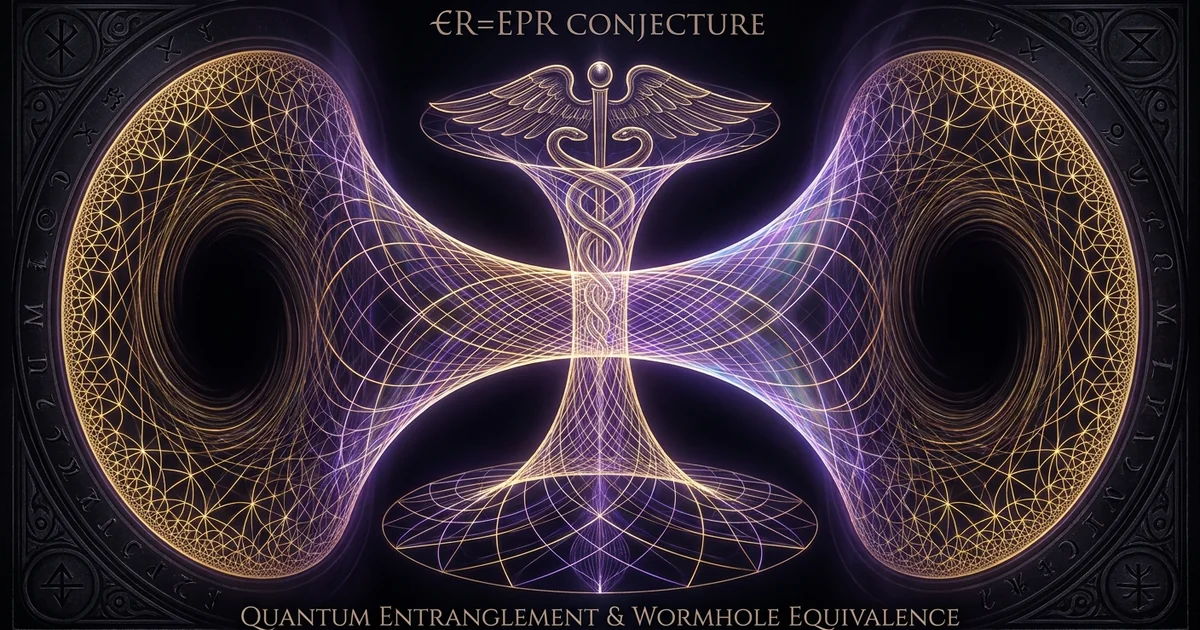
ER=EPR Conjecture: Wormholes & Entanglement Equivalence
Executive Summary & Theoretical Thesis: Entanglement as Spacetime Architecture
The AMPS Firewall Dilemma and Horizon Discontinuity
The central crisis of modern non-perturbative quantum gravity stems from the incompatibility among three foundational principles of twentieth-century physics: the equivalence principle of general relativity, the unitarity of quantum mechanical scattering matrices, and the validity of semi-classical local quantum field theory in curved spacetime. Formulated by Ahmed Almheiri, Donald Marolf, Joseph Polchinski, and James Sully in 2012, the AMPS paradox demonstrated that an old, evaporating black hole—one that has radiated past its Page time—cannot preserve quantum unitarity without violating either the equivalence principle at the event horizon or the monogamy of entanglement.
In standard Hawking evaporation, late radiation quanta $R$ must be maximally entangled with early radiation quanta $E$ to satisfy unitary S-matrix evolution, as detailed in examinations of the black hole information paradox and firewalls. Simultaneously, the equivalence principle dictates that the horizon must be a smooth vacuum state for an infalling observer, demanding that $R$ also be maximally entangled with the interior Hawking partner mode $B$. Quantum mechanics strictly forbids a single quantum system from being simultaneously entangled with two independent systems; this property of the monogamy of entanglement is governed by the strong subadditivity of quantum entropy:
$$S(A) + S(B) \le S(A \cup C) + S(B \cup C)$$
To preserve unitarity, early semi-classical frameworks excised the entanglement between $R$ and $B$, which inevitably introduces a macroscopic divergent energy density—a high-energy singular “firewall”—at the event horizon. This catastrophic horizon discontinuity destroys smooth semi-classical spacetime, fundamentally invalidating Einstein’s equivalence principle.
Topological Isomorphism of ER Bridges and EPR Bipartite States
The ER=EPR conjecture, formulated by Juan Maldacena and Leonard Susskind in 2013, resolves this theoretical impasse by establishing an exact mathematical and physical equivalence between non-traversable Einstein-Rosen bridges (wormholes) and maximally entangled quantum states (Einstein-Podolsky-Rosen pairs). The central thesis posits that whenever two quantum systems are entangled, they are fundamentally connected through a geometric wormhole throat, regardless of their spatial separation. In this framework, the interior partner mode $B$ of an evaporating black hole is not an independent Hilbert space factor isolated behind the horizon; rather, it is geometrically and informationally isomorphic to the early Hawking radiation $E$.
When applied to the AMPS dilemma, the er epr conjecture juan maldacena leonard susskind wormholes framework shows that the entanglement between late radiation $R$ and early radiation $E$ does not conflict with the entanglement across the horizon. Instead, because $E$ and $B$ are linked by an Einstein-Rosen bridge, the entanglement between $R$ and $E$ is the entanglement between $R$ and $B$. Consequently, the horizon remains completely smooth, the equivalence principle is preserved, and the infalling observer experiences no firewall singularity. The classical interior of the black hole is literally constructed from the quantum state of the emitted radiation.
Einstein-Rosen Bridge (General Relativity)
- Geometric Infrastructure: Codimension-2 minimal surface forming a non-traversable throat connecting asymptotically flat or AdS spacetimes.
- Governing Formalism: Einstein field equations $G_{\mu\nu} + \Lambda g_{\mu\nu} = 8\pi G T_{\mu\nu}$ with vanishing or positive energy conditions.
- Metric Representation: Extended Kruskal-Szekeres coordinates spanning regions I, II, III, and IV, exhibiting coordinate singularities at horizons and physical singularities in the future/past.
- Throat Scale: Macroscopic, semiclassical radius $r_0 \ge 2GM/c^2$, requiring continuous spatial geometry.
- Causality: Enforces topological censorship; spacelike separation between boundaries prevents superluminal null geodesics.
Einstein-Podolsky-Rosen Pair (Quantum Mechanics)
- Quantum Infrastructure: Non-separable bipartite state $|\psi\rangle_{AB} \neq |\psi\rangle_A \otimes |\psi\rangle_B$ residing in tensor product Hilbert space $\mathcal{H}_A \otimes \mathcal{H}_B$.
- Governing Formalism: Density operator $\rho_{AB} = |\psi\rangle\langle\psi|$ obeying unitary Schrödinger/von Neumann evolution $i\hbar \partial_t \rho = [H, \rho]$.
- Correlation Formalism: Bell states with maximally violated Clauser-Horne-Shimony-Holt (CHSH) inequalities $|\langle C \rangle| \le 2\sqrt{2}$.
- Entanglement Scale: Microscopic spatial distribution governed by quantum coherence and operator entanglement, often operating at subatomic or qubit levels.
- Causality: Enforces the no-signaling theorem via partial tracing $\rho_A = \text{Tr}B(\rho{AB})$, forbidding superluminal data transmission.
Geometrization of Quantum Information at the Planck Scale
The deeper implication of the ER=EPR framework is that smooth semi-classical spacetime is not an ontological primitive of nature, but an emergent, thermodynamic macroscopic limit synthesized from the microscopic entanglement graph of quantum information. The fabric of classical continuous manifolds is held together by multi-partite quantum correlations; if one could systematically disentangle two regions of space by projecting their state onto an unentangled product state, the intervening metric distance would diverge, tearing the geometric continuum into disconnected spatial fragments.
This geometrization operates fundamentally at the Planck scale, governed by the universal dimensional bounds:
$$\ell_P = \sqrt{\frac{\hbar G}{c^3}} \approx 1.616 \times 10^{-35} \text{ m}, \quad t_P = \sqrt{\frac{\hbar G}{c^5}} \approx 5.391 \times 10^{-44} \text{ s}$$
At this fundamental cut-off, standard Riemannian geometry dissolves into non-commutative operator configurations and topological quantum foam, as detailed in research exploring quantum foam at the Planck scale. The metric tensor $g_{\mu\nu}$ acts as an effective macroscopic field variable—analogous to fluid velocity in hydrodynamics—whose underlying microscopic degrees of freedom are qubits entangled across microscopic einstein rosen bridges. The study of quantum entanglement spacetime geometry therefore bridges the apparent disparity between general relativity and quantum mechanics by revealing that geometry is the macroscopic manifestation of quantum informational connectivity.
Historical Lineage & Experimental Precedents: The Bifurcated 1935 Legacy
Einstein’s Dual 1935 Breakthroughs: Geometric Wormholes and Quantum Non-Locality
The intellectual origin of the ER=EPR conjecture presents a profound historical irony. In the spring and summer of 1935, Albert Einstein published two foundational papers, separated by a span of mere months, which independently defined the trajectories of classical gravitational topology and quantum measurement theory. In May 1935, Einstein and Nathan Rosen published “The Particle Problem in the General Theory of Relativity,” introducing coordinate transformations designed to eliminate curvature singularities in the Schwarzschild solution. By joining two identical sheets of spacetime through a bridge-like throat, they constructed what is now designated the classical Einstein-Rosen bridge, initially conceived as a geometric model for neutral and charged elementary particles.
Two months later, in July 1935, Einstein collaborated with Boris Podolsky and Nathan Rosen on “Can Quantum-Mechanical Description of Physical Reality be Considered Complete?” (the EPR paper). This work established the existence of non-local quantum states, demonstrating that measurements performed on one component of a spatially separated bipartite system instantaneously dictate the observable state of its partner. While Einstein intended the EPR paradox to expose the incompleteness of quantum mechanics—arguing against what he termed “spooky action at a distance”—he regarded the two 1935 papers as treating entirely unrelated physical domains: one purely continuous and general relativistic, the other discrete and quantum operational.
- May 1935: Einstein, A., & Rosen, N. “The Particle Problem in the General Theory of Relativity.” Physical Review, 48(1), 73–77. Introduces the coordinate substitution $u^2 = r - 2m$, mapping two identical asymptotically flat sheets joined at the throat $r = 2m$.
- July 1935: Einstein, A., Podolsky, B., & Rosen, N. “Can Quantum-Mechanical Description of Physical Reality be Considered Complete?” Physical Review, 47(10), 777–780. Formulates the non-separable entangled state $\psi(x_1, x_2) = \int_{-\infty}^{\infty} e^{i(x_1 - x_2 + x_0)p/\hbar} dp$, asserting the incompleteness of the quantum wavefunction.
- Archival Reality: For seventy-eight years, theoretical physics treated these papers as completely distinct paradigms. The geometric wormhole of May 1935 was classified under differential geometry and topological astrophysics, while the entanglement of July 1935 was assigned to quantum foundations, information theory, and measurement mechanics.
Wheeler’s Geometrodynamics and Quantum Foam Topology
During the 1950s and 1960s, John Archibald Wheeler sought to synthesize these divergent threads through his theoretical program of geometrodynamics. Wheeler posited that classical electrodynamics and mass could be completely derived from pure, source-free curved spacetime topology. In his paradigm of “charge without charge,” electric flux lines do not terminate on point particles; instead, they thread through the mouth of a microscopic wormhole, traversing the throat and re-emerging at the opposite mouth, creating the macroscopic phenomenology of opposing electric charges.
Wheeler extended this concept to the sub-microscopic regime, introducing the concept of topological quantum foam. He hypothesized that at the Planck scale ($\sim 10^{-35} \text{ m}$), quantum zero-point fluctuations of the metric tensor become so violent that the smooth continuum of spacetime tears, continually generating and annihilating microscopic wormholes. While Wheeler lacked the modern mathematical tools of non-Abelian gauge-gravity dualities, his intuition anticipated the core premise of ER=EPR: topological connectivity at the Planck scale mediates quantum interactions, suggesting that spacetime vacuum stability is intrinsically topological.
The AdS/CFT Revolution and Holographic Precursors
The definitive mathematical scaffolding required to unify the ER and EPR formalisms emerged with Juan Maldacena’s 1997 formulation of the Anti-de Sitter/Conformal Field Theory (AdS/CFT) correspondence. AdS/CFT established an exact, non-perturbative duality between a type IIB superstring theory (including quantum gravity) defined on an asymptotically $\text{AdS}_5 \times S^5$ bulk spacetime and a $\mathcal{N}=4$ supersymmetric Yang-Mills gauge theory defined on its four-dimensional conformal boundary, synthesizing the principles of the holographic principle and spacetime emergence.
Through the holographic dictionary, bulk gravitational phenomena are explicitly mapped to boundary quantum states. Mark Van Raamsdonk advanced this program in 2010 by demonstrating that the geometric connectivity of the bulk spacetime directly depends on the quantum entanglement of the boundary conformal field theories. By utilizing the Ryu-Takayanagi relation, Van Raamsdonk showed that systematically driving boundary entanglement entropy to zero forces the bulk gravitational throat to pinch off, splitting the bulk geometry into completely disconnected causal domains. This critical breakthrough laid the immediate foundation for Maldacena and Susskind’s formalization of ER=EPR in 2013.
Mathematical Formalism & Physical Mechanics: Metrics, Entropy, and Traversability
The Thermofield Double State and Extended Schwarzschild-AdS Geometry
The canonical mathematical realization of the ER=EPR conjecture is formulated through the Thermofield Double (TFD) state in the context of the AdS/CFT correspondence. Consider two identical, non-interacting conformal field theories, denoted as $\text{CFT}_L$ (Left) and $\text{CFT}_R$ (Right), each possessing an identical Hamiltonian $H$ and discrete energy eigenstates $|n\rangle$ with eigenvalues $E_n$. The Thermofield Double state is a specific, pure, maximally entangled bipartite state residing in the product Hilbert space $\mathcal{H}_L \otimes \mathcal{H}_R$:
$$|\text{TFD}(\beta)\rangle = \frac{1}{\sqrt{Z(\beta)}} \sum_{n} e^{-\beta E_n / 2} |n\rangle_L \otimes |n\rangle_R$$
where $\beta = 1/T$ is the inverse Hawking-Page temperature, and $Z(\beta) = \sum_n e^{-\beta E_n}$ represents the thermal partition function. When one traces out the degrees of freedom of either CFT, the reduced density matrix of the remaining subsystem is precisely thermal:
$$\rho_R = \text{Tr}L \left( |\text{TFD}\rangle \langle \text{TFD}| \right) = \frac{1}{Z(\beta)} \sum{n} e^{-\beta E_n} |n\rangle_R \langle n|_R = \frac{e^{-\beta H_R}}{Z(\beta)}$$
Region II (Future Singularity)
                             r = 0
                       /\             /\
                      /  \           /  \
                     /    \         /    \
Boundary L          /      \       /      \          Boundary R
  (CFT_L)          /        \     /        \           (CFT_R)
   |              /  Reg. IV \   / Reg. I   \             |
   |             /            \ /            \            |
   |------------X              X              X-----------|
   |             \   Throat   / \   Throat   /            |
   |              \ (Wormhole)   \ (Wormhole)             |
   |               \        /     \        /              |
   |                \      /       \      /               |
   |                 \    /         \    /                |
   |                  \  /           \  /                 |
   |                   \/             \/                  |
                   Region III (Past Singularity)
                             r = 0
Under the AdS/CFT dictionary, this highly entangled pure state $|\text{TFD}\rangle$ is the exact holographic dual to a classical, eternal two-sided Schwarzschild-AdS black hole. The geometry contains two distinct asymptotic boundaries, two exterior regions (Region I and Region IV), and an extended interior connected by an einstein rosen bridge (Region II). The metric describing this bulk geometry in static coordinates is:
$$ds^2 = -f® dt^2 + \frac{dr^2}{f®} + r^2 d\Omega_{d-1}^2, \quad f® = 1 - \frac{16\pi G_N M}{(d-1)\Omega_{d-1} r^{d-2}} + \frac{r^2}{L_{\text{AdS}}^2}$$
The presence of the non-traversable wormhole throat directly connects the two exteriors. No classical signal can pass through the ER bridge because the throat expands and collapses too rapidly, governed by the positive expansion of null geodesic congruences. The two boundary theories are non-interacting ($H_{\text{total}} = H_L + H_R$), yet their quantum states are entangled via $|\text{TFD}\rangle$; this boundary entanglement manifests in the bulk as geometric spatial connectivity.
The Ryu-Takayanagi Minimal Surface Formulation
The quantitative bridge linking entanglement entropy to Riemannian geometry is codified by the Ryu-Takayanagi (RT) formula. For a static bulk spacetime, let $A$ be a spatial subregion on the conformal boundary $\partial \mathcal{M}$. The holographic entanglement entropy $S_A$ of the reduced density matrix $\rho_A = \text{Tr}_{\bar{A}}(\rho)$ is determined by the area of a bulk minimal surface:
$$S_A = \frac{\text{Area}(\gamma_A)}{4 G_N^{(d+1)}}$$
where $\gamma_A$ is the static codimension-2 surface extending into the bulk such that $\partial \gamma_A = \partial A$, and $\gamma_A$ is homologous to the boundary subregion $A$ ($\gamma_A \sim A$). In time-dependent dynamical spacetimes, this is generalized by the Hubeny-Rangamani-Takayanagi (HRT) prescription to extremal surfaces:
$$S_A = \underset{\gamma_A \sim A}{\text{ext}} \left[ \frac{\text{Area}(\gamma_A)}{4 G_N} \right]$$
- Ryu-Takayanagi Formula (Ryu & Takayanagi, 2006): $$S_A = \frac{\text{Area}(\gamma_A)}{4 G_N}$$ where $\gamma_A$ is the bulk minimal surface homologous to boundary region $A$. For the full boundary system of a two-sided black hole, $\gamma_A$ corresponds precisely to the bifurcation surface of the event horizon, recovering the Bekenstein-Hawking formula: $$S_{\text{BH}} = \frac{A_H}{4 G_N}$$
- Gao-Jafferis-Wall Double-Trace Traversability Condition (Gao, Jafferis, & Wall, 2017): $$\delta H(t) = - \int d^{d-1}x , h(t, x) , \mathcal{O}L(t, x) \mathcal{O}R(-t, x)$$ This boundary interaction induces a non-zero stress-energy tensor violating the classical Average Null Energy Condition (ANEC): $$\int{-\infty}^{\infty} \langle T{UU}(U, V=0) \rangle dU < 0$$ producing a negative gravitational shockwave that shifts the horizon inward by $\Delta V < 0$, rendering the wormhole throat causally traversable.
The RT relation proves that metric distances and minimal cross-sectional areas in the bulk directly calculate the von Neumann entropy of quantum subsystems. When calculated for the Thermofield Double state where region $A$ encompasses the entirety of $\text{CFT}_R$, the homologous minimal surface wraps the bifurcation surface of the horizon, yielding $S(\rho_R) = \text{Area}(\text{Horizon}) / 4 G_N$. Spacetime area in the interior wormhole is literally the geometric representation of the boundary’s von Neumann entropy.
Traversable Wormhole Dynamics via Gao-Jafferis-Wall Double-Trace Deformations
In classical general relativity, the topological censorship theorem—proven by Friedman, Schleich, and Witt—forbids any physical probe from traversing an Einstein-Rosen bridge. Traversability is constrained by the Null Energy Condition (NEC):
$$T_{\mu\nu} k^\mu k^\nu \ge 0$$
for all null vectors $k^\mu$. Integrating along an affine-parameterized null geodesic $U$, the Average Null Energy Condition (ANEC) requires:
$$\int_{-\infty}^{\infty} T_{UU} dU \ge 0$$
As long as ANEC holds, the focusing theorem ($d\theta / d\lambda \le -\frac{1}{2}\theta^2 - R_{UU} \le 0$) guarantees that null congruences focus, causing the throat to pinch off before any signal from boundary $L$ can reach boundary $R$.
Ping Gao, Daniel Jafferis, and Aron Wall (2017) demonstrated that an ER bridge can be rendered dynamically traversable by exploiting quantum field theoretic violations of the ANEC. By turning on a direct, non-local “double-trace” coupling between the left and right CFT boundaries at boundary time $t_0$:
$$H_{\text{int}}(t) = -h(t) \sum_{j=1}^{K} \mathcal{O}_L^j(t) \mathcal{O}_R^j(t)$$
where $\mathcal{O}_{L,R}$ are scalar operators and $h(t) > 0$ is a coupling envelope, the bulk quantum vacuum undergoes a quantum backreaction. This coupling introduces an expectation value for the bulk quantum stress-energy tensor that violates the ANEC along the horizon:
$$\int_{-\infty}^{\infty} \langle T_{kk} \rangle dU < 0$$
This negative average null energy creates a repulsive gravitational shockwave, shifting the event horizon inward by an amount:
$$\Delta V = - \frac{8\pi G_N}{\hbar} \int dU , \langle T_{UU} \rangle$$
Because $\Delta V < 0$, the causal horizons separate, and a null geodesic fired from boundary $L$ can traverse the throat and emerge at boundary $R$. Crucially, Gao, Jafferis, and Wall proved that this gravitational process is the exact holographic bulk dual of quantum teleportation. The external coupling $H_{\text{int}}$ corresponds to transmitting classical measurement results between the two boundary systems, perfectly satisfying the no-signaling theorem: the wormhole only opens after classical subluminal communication has occurred between the two entangled boundaries.
Empirical Evidence & Observational Data: Quantum Processor Holography
Quantum Teleportation as Holographic Wormhole Dynamics
While detecting astrophysical wormholes remains outside current technological limits, experimental breakthroughs have utilized programmable quantum processors to execute quantum simulations of holographic traversable wormholes. In 2022, an experimental collaboration utilized Google’s Sycamore superconducting quantum processor to implement a sparsified holographic teleportation protocol. By preparing a discretized Thermofield Double state across nine superconducting qubits, the team simulated the bulk dynamics of a Gao-Jafferis-Wall traversable wormhole.
In this protocol, a qubit state is inserted into the left system (representing a particle entering the left wormhole mouth). The natural many-body Hamiltonian scrambles the state into non-local degrees of freedom, simulating the dispersion of quantum information across a black hole horizon. Application of a double-trace operator—analogous to a pulse of negative energy—re-focuses the scrambled information, causing the qubit state to coherently reconstruct on the right subsystem. The experiment validated the characteristic signatures of wormhole traversability: the physical teleportation of information occurred only when the simulated stress-energy was negative, perfectly matching the predicted gravitational wave dynamics of an Einstein-Rosen bridge.
Sachdev-Ye-Kitaev (SYK) Many-Body Systems and Out-of-Time-Ordered Correlators
The microscopic quantum mechanics underlying ER=EPR are described by the Sachdev-Ye-Kitaev (SYK) model, an exactly solvable quantum mechanical system consisting of $N$ Majorana fermions with random, all-to-all quartic interactions:
$$H_{\text{SYK}} = \frac{1}{4!} \sum_{i,j,k,l=1}^{N} J_{ijkl} , \chi_i \chi_j \chi_k \chi_l, \quad \overline{J_{ijkl}} = 0, \quad \overline{J_{ijkl}^2} = \frac{6J^2}{N^3}$$
In the low-energy conformal limit ($1 \ll \beta J \ll N$), the SYK model is holographically dual to two-dimensional Jackiw-Teitelboim (JT) gravity on an $\text{AdS}_2$ background. The SYK model exhibits maximal quantum chaos, quantified by the exponential growth of Out-of-Time-Ordered Correlators (OTOCs):
$$F(t) = \langle [W(t), V(0)]^2 \rangle_{\beta} \sim \frac{1}{N} e^{\lambda_L t}$$
The Lyapunov exponent of the SYK model saturates the fundamental Maldacena-Shenker-Stanford (MSS) chaos bound:
$$\lambda_L = \frac{2\pi k_B T}{\hbar} = \frac{2\pi}{\beta}$$
This saturation is an operational diagnostic of systems possessing a classical gravitational dual with a smooth event horizon. Gravitationally, this maximal thermalization rate reflects the exponential blueshift of infalling matter near the horizon, confirming that chaotic quantum many-body systems mimic the exact dissipative and geometric properties of einstein rosen bridges.
Tensor Network Architectures and Discrete MERA Geometries
To systematically bridge the gap between microscopic discrete quantum circuits and macroscopic continuous pseudo-Riemannian geometries, theoretical physics utilizes tensor networks, specifically the Multi-scale Entanglement Renormalization Ansatz (MERA). As analyzed in studies on tensor network representations of AdS/CFT, a MERA network applies layers of unitary disentanglers and isometries to a quantum state, generating a discrete spatial lattice across varying renormalization scales.
       Scale z_3 (IR Bulk Interior)       O               O
                                           \             /
       Scale z_2 (Intermediate Bulk)        O-----O-----O
                                           / \   / \   / \
       Scale z_1 (Near Horizon)           O   O O   O O   O
                                         /|\ /|\ /|\ /|\ /|\
       Scale z_0 (UV Boundary CFT)      * * * * * * * * * * *
When evaluated for critical quantum systems at quantum criticality, the graph metric of the MERA tensor network directly reproduces the spatial geometry of a discrete spatial slice of Anti-de Sitter space ($\mathbb{H}^d$):
$$ds^2 = \frac{L^2}{z^2} (dz^2 + dx^2)$$
where the renormalization scale coordinate $z$ corresponds directly to the bulk radial depth coordinate. The minimal number of tensor bonds that must be severed to isolate a spatial region $A$ on the boundary matches the Ryu-Takayanagi minimal surface area $\gamma_A$. This structural isomorphism confirms that spatial geometry is a coarse-grained representation of entanglement renormalization: tensor bonds are microscopic Planckian wormholes whose collective entanglement stitches together the continuum of space.
Metaphysical Implications & Unified Synthesis: Spacetime as an Entanglement Phenomenon
The Pre-Geometric Quantum Information Matrix
The validity of the ER=EPR conjecture demands a fundamental ontological shift regarding the structure of the physical universe. In classical general relativity, spacetime is treated as a substantival metric manifold—a continuous stage upon which fields and matter interact. ER=EPR inverts this hierarchy: continuous geometric spacetime is an emergent, macroscopic approximation generated by a pre-geometric substrate of quantum information.
In this pre-geometric matrix, the fundamental constituents are not spatial points, strings, or particles, but abstract quantum states residing in an infinite-dimensional Hilbert space governed by non-commutative operator algebras. Recent mathematical formulations classify these emergent algebras within von Neumann factor classifications: the local algebra of observables in semi-classical quantum field theory on curved spacetime behaves as a Type $\text{III}_1$ factor, which possesses no well-defined traces, density matrices, or local pure states.
However, gravitational backreaction and entanglement renormalization regularize this algebra into a Type $\text{II}_\infty$ factor, enabling the formal definition of trace and, consequently, generalized entanglement entropy:
$$S_{\text{gen}} = \frac{\langle \text{Area} \rangle}{4 G_N} + S_{\text{vN}}(\rho_{\text{matter}})$$
Physical space emerges only because quantum states share quantum correlations. If a physical operation were executed to drive the entanglement entropy between two spatial domains to zero ($S_{A:B} \to 0$), the geometric throat connecting them would pinch off completely, causing the distance $d(A, B) \to \infty$. Spacetime is held together by quantum entanglement.
Relational Spacetime: Leibnizian Space in Quantum Gravity
This conceptual paradigm provides a rigorous quantum mechanical vindication of Gottfried Wilhelm Leibniz’s relational theory of space. In the historic Leibniz-Clarke correspondence, Leibniz argued against Isaac Newton’s concept of absolute space, contending that space is not an entity in itself, but rather an order of relations between coexisting objects:
$$\text{Space} \equiv \text{The Order of Coexistence}$$
The ER=EPR conjecture translates this philosophical assertion into exact physics. Spacetime coordinates and spatial intervals are metrics quantifying the degree of quantum entanglement between subsystems:
Continuum general relativity assumes a pseudo-Riemannian manifold $(M, g_{\mu\nu})$ that remains differentiable down to arbitrary scales. ER=EPR and the Ryu-Takayanagi relation demonstrate that this assumption breaks down at the Planck scale: $$\ell_P = \sqrt{\frac{\hbar G}{c^3}} \approx 1.616 \times 10^{-35} \text{ m}, \quad t_P = \sqrt{\frac{\hbar G}{c^5}} \approx 5.391 \times 10^{-44} \text{ s}$$ Below these limits, the metric tensor $g_{\mu\nu}$ ceases to possess operational meaning. Spacetime area decomposes into discrete quantum states with eigenvalues determined by the spectrum of boundary modular Hamiltonians: $$\hat{K} = -\log \rho_A$$ Differential geometry is therefore superseded by quantum information geometry, where affine connections are replaced by quantum Fisher information metrics: $$g_{ij}^F(\theta) = \frac{1}{2} \sum_{n, m} \frac{(\partial_i p_n)(\partial_j p_m)}{p_n + p_m} + 2 , \text{Re} \sum_{n} p_n \langle \partial_i \psi_n | (1 - |\psi_n\rangle\langle\psi_n|) | \partial_j \psi_n \rangle$$
Two systems are “spatially proximate” not because they inhabit adjacent absolute spatial coordinates, but because they share high entanglement entropy. Conversely, two systems are separated by macroscopic cosmological distances when their shared entanglement is exceptionally weak. Metric distance is effectively an inverse logarithmic measure of quantum mutual information:
$$I(A : B) = S(A) + S(B) - S(A \cup B) \sim e^{-m , d(A,B)}$$
Topological Monism and the Dissolution of Metric Locality
The unification of ER and EPR ultimately dissolves the classical doctrine of metric locality. Historically, physics maintained a strict dualism: continuous spacetime was the passive geometric container, and discrete quantum matter was the active dynamical substance occupying that container. ER=EPR unifies these concepts into a singular framework of topological monism.
Matter and space are composed of the same operational substrate: structured quantum information. A black hole is not an empty spatial vacuum surrounded by matter; it is a maximally scrambled collection of qubits whose boundary entanglement generates an interior spacetime volume. Non-local quantum phenomena—such as the instantaneous collapse of Bell states that troubled Einstein—are no longer viewed as anomalous actions violating special relativity across a classical void. Instead, these phenomena are mediated directly through the internal topology of microscopic Einstein-Rosen bridges. The non-locality of quantum mechanics and the local geometry of general relativity are two aspects of a unified information topology.
Frequently Asked Questions: Technical Dimensions of the ER=EPR Framework
Traversability Constraints and Superluminal Communication Limits
Does the ER=EPR conjecture permit faster-than-light (FTL) signaling or interstellar transit?
The ER=EPR conjecture strictly preserves relativistic causality and completely forbids superluminal data transmission or faster-than-light physical transit. Under normal conditions, an Einstein-Rosen bridge is non-traversable. The time required to traverse the interior throat exceeds the time required for a signal to travel around the exterior boundary space; any attempt to traverse an unmodified ER bridge causes the observer to encounter the interior curvature singularity ($r = 0$) before the wormhole can be navigated.
When traversability is induced via the Gao-Jafferis-Wall protocol, traversability requires turning on a double-trace deformation coupling the two boundaries:
$$\delta H(t) = -h(t) \mathcal{O}_L(t) \mathcal{O}_R(t)$$
This coupling requires an experimenter to physically measure an observable $\mathcal{O}_L$ on the left system and transmit that measurement result to the right system via standard classical communication channels. This classical transfer is fundamentally bounded by the speed of light in the asymptotic exterior space:
$$v_{\text{transfer}} \le c$$
The negative energy shockwave that shifts the event horizon and renders the throat open emerges in the bulk only after this classical transmission is completed. The wormhole throat opens exclusively for a brief window calibrated to allow the message through at a speed that cannot exceed standard light travel times through exterior space. Holographically, the process is mathematically identical to quantum teleportation: no quantum state can be teleported between two entangled observers without the transmission of two classical bits of information, ensuring complete compliance with the no-signaling theorem.
Microscopic Bell Pairs vs. Macroscopic Astrophysical Wormholes
How can a simple two-qubit Bell pair be an Einstein-Rosen bridge if it possesses no detectable gravitational field?
The equivalence between an EPR pair and an ER bridge applies across all scales, but its physical and geometric manifestations vary depending on the degree of entanglement. A macroscopic, classical Einstein-Rosen bridge—such as the one connecting the two asymptotic boundaries of an eternal AdS-Schwarzschild black hole—emerges only in the thermodynamic limit of large $N$ ($N \to \infty$) and strong coupling ($\lambda \equiv g_{\text{YM}}^2 N \gg 1$), where $N$ denotes the number of microscopic degrees of freedom (e.g., the rank of the gauge group in $\mathcal{N}=4$ Super Yang-Mills). In this regime, the system possesses sufficient entanglement entropy:
$$S \sim N^2 \gg 1$$
to suppress quantum fluctuations of the metric, sustaining a smooth, classical pseudo-Riemannian manifold described by Einstein’s equations.
+-----------------------------------------------------------------------------+
|                            ENTANGLEMENT SPECTRUM                            |
+-----------------------------------------------------------------------------+
|  Microscopic EPR Pair (2 Qubits)    |  Macroscopic ER Bridge (Large N CFT)  |
+-------------------------------------+---------------------------------------+
|  Entanglement Entropy: S = ln(2)    |  Entanglement Entropy: S ~ Area / 4G  |
|  Geometry: Sub-Planckian,           |  Geometry: Smooth, Semiclassical      |
|  Highly Fluctuating Metric Foam     |  Pseudo-Riemannian Manifold           |
|  Curvature: R ~ l_P^(-2) (Singular) |  Curvature: R ~ 1 / r_0^2 (Smooth)    |
|  Classical Throat: Absent           |  Classical Throat: Macroscopic Throat |
+-----------------------------------------------------------------------------+
Conversely, for an isolated, microscopic Bell pair (such as two entangled electrons or photons), the entanglement entropy is minimal:
$$S = \ln(2)$$
At this scale, quantum fluctuations of the gravitational field are unsuppressed ($\Delta g_{\mu\nu} \sim \mathcal{O}(1)$). The corresponding Einstein-Rosen bridge is not a smooth, classical geometric tunnel through which an observer could walk; it is a highly quantum-fluctuating, sub-Planckian wormhole thread. Its throat diameter is on the order of the Planck length ($\ell_P \approx 10^{-35} \text{ m}$), with curvature radii exceeding the Planck scale ($R \sim \ell_P^{-2}$). Classical differential geometry completely breaks down in this regime, leaving only topological connectivity within the underlying quantum foam. Thus, while every EPR pair is an ER bridge, only systems with macroscopic, highly structured entanglement exhibit the smooth geometric throats recognized as classical wormholes.
Resolution Mechanisms for the AMPS Black Hole Firewall Paradox
Exactly how does the ER=EPR framework eliminate the horizon firewall without violating the monogamy of entanglement?
The AMPS firewall paradox argued that an evaporating black hole past its Page time forces a contradiction: late Hawking radiation mode $R$ must be maximally entangled with early radiation $E$ to maintain quantum unitarity, but must also be entangled with the interior partner mode $B$ to preserve a smooth, non-singular event horizon (the equivalence principle). Because quantum mechanics forbids tripartite maximal entanglement (monogamy of entanglement):
$$\mathcal{H}_R \otimes \mathcal{H}E \otimes \mathcal{H}B \implies \text{Impossible for } \rho{RE} \text{ and } \rho{RB} \text{ to both be maximally entangled}$$
AMPS concluded that the entanglement between $R$ and $B$ must break, depositing a divergent shell of high-energy quanta—a firewall—at the horizon ($r = 2GM$).
The ER=EPR conjecture eliminates this paradox by demonstrating that subsystem $B$ and subsystem $E$ are not independent Hilbert space factors. Instead, because $E$ is the early radiation of the black hole, $E$ and the remaining black hole interior are connected via a massive, multi-particle Einstein-Rosen bridge. The interior partner mode $B$ is structurally an element of the same quantum system as $E$, viewed through a non-local unitary transformation:
$$B \subset \mathcal{H}_{\text{interior}} \cong \mathcal{H}_E$$
Consequently, when mode $R$ entangles with $E$, it is fundamentally entangling with $B$ through the ER bridge. The state does not involve three independent systems violating entanglement monogamy; it involves only two systems ($R$ and the composite system $E \cup B$) connected via wormhole topology:
$$\rho_{R(EB)} = |\psi\rangle\langle\psi|$$
Because the entanglement between the late radiation and the early radiation creates the smooth interior geometry behind the horizon, no firewall is generated. The infalling observer traverses the event horizon without experiencing singular high-energy radiation, preserving the equivalence principle alongside unitary quantum mechanics. Spacetime smoothness is maintained precisely by the entanglement that was previously assumed to destroy it.