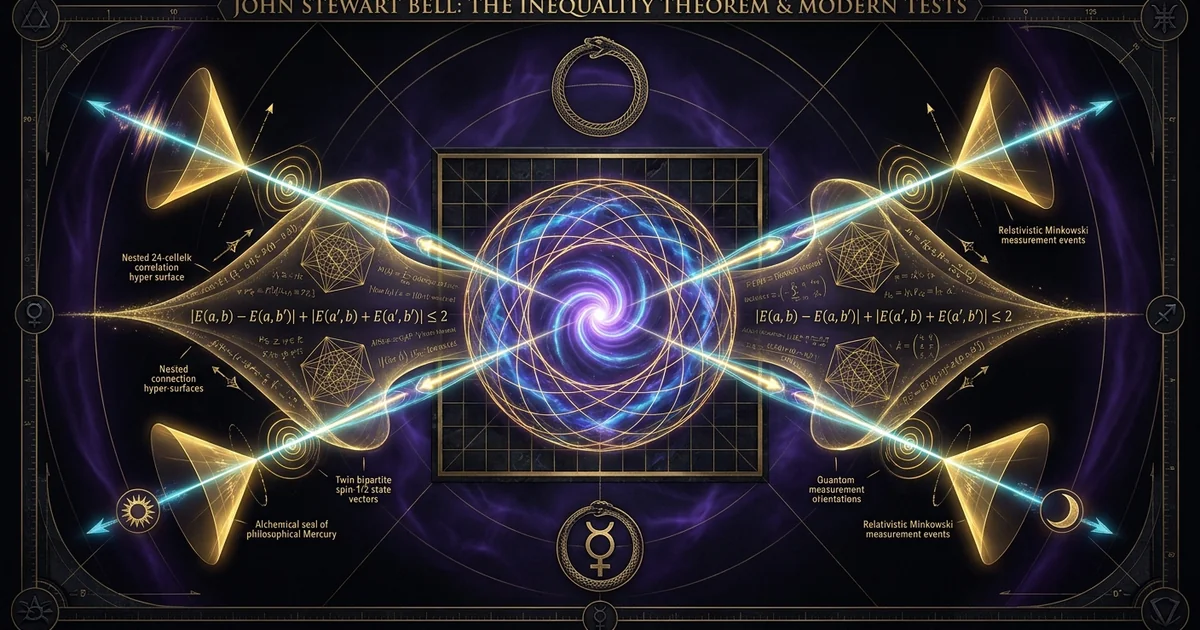
John Stewart Bell: The Inequality Theorem & Modern Tests
Executive Summary & Theoretical Thesis
The Crisis of Local Realism in Post-Classical Mechanics
The architecture of classical physics, from Newtonian celestial mechanics through Maxwellian electrodynamics, rested upon an unyielding metaphysical foundation: local realism. This foundation asserted two distinct philosophical and physical premises. First, realism dictates that physical systems possess objective, definite properties prior to and independent of measurement—a condition formalized in contemporary quantum foundations as counterfactual definiteness. Second, locality dictates that physical events at spatially separated points cannot exert instantaneous causal influences upon one another, adhering to the strict relativistic constraint that signals propagate at or below the speed of light in vacuum, $c$. When Albert Einstein, Boris Podolsky, and Nathan Rosen published their seminal 1935 critique, they articulated what appeared to be an inescapable dilemma: either the quantum mechanical description of physical systems governed by non-commuting observables was fundamentally incomplete, or the universe permitted what Einstein characterized as telepathic, superluminal actions across space-like intervals.
For nearly three decades, the orthodox interpretation of quantum mechanics, championed by Niels Bohr and the Copenhagen school, treated this dilemma not as an empirical physical question, but as a closed philosophical dispute. Bohr asserted that the quantum state vector represents an exhaustive epistemic catalog of observational probabilities rather than an ontic description of an independently existing micro-reality. Consequently, discussions regarding the simultaneous values of conjugate observables in the absence of measurement were dismissed as operationally meaningless. This philosophical armistice suppressed investigation into the underlying mechanics of quantum entanglement. The prevailing consensus presumed that any deterministic completion of quantum mechanics through local hidden-variables remained forever beyond the reach of laboratory adjudication, trapped within the realm of unprovable metaphysics.
The crisis intensified as the mathematical machinery of relativistic field theories matured without resolving the foundational friction between quantum state reduction and the causal structure of Minkowski spacetime. If quantum collapse operates globally and instantaneously across an extended spatial hypersurface upon measurement of a single particle within an entangled ensemble, the temporal ordering of collapse events becomes frame-dependent under Lorentz transformations. This profound incompatibility between the local causal structure of special relativity and the holistic projection postulates of standard Hilbert space formalism signaled an unresolved schism at the heart of physical law.
The Paradigm Shift: From Epistemology to Measurable Correlation Limits
In 1964, the Northern Irish theoretical physicist John Stewart Bell shattered this epistemological impasse. Operating outside the prevailing dogma at CERN, Bell demonstrated that the assumption of local realism is not a matter of philosophical preference, but an empirically falsifiable mathematical hypothesis. By formulating an algebraic constraint on the statistical correlations achievable by any conceivable physical theory grounded in local hidden variables, Bell exposed a quantitative divergence between the predictions of local realism and those derived from the tensor product mechanics of quantum entanglement.
Bell demonstrated that if measurement outcomes are determined by localized physical variables—whether deterministic or stochastic—interacting strictly within their respective past light cones, the correlation functions calculated across pairs of space-like separated detectors must obey a strict upper mathematical bound. Conversely, quantum mechanics predicts that maximally entangled states, such as the spin-singlet state of two fermions or polarization-entangled photon pairs, systematically violate this boundary at specific relative analyzer orientations. Through this single theorem, the debate initiated by Einstein, Podolsky, and Rosen was translated from speculative metaphysics into an operational mandate for experimental physics. The core issue ceased to be whether quantum mechanics felt philosophically satisfying; it became whether the physical universe respects the mathematical limits of local realistic parameterizations.
This conceptual rupture transformed modern physics. It definitively established that no continuous, local, classical field theory—including classical interpretations of the dielectric-field or mechanical aether models—could emulate the empirical statistical distribution of entangled quantum states. By providing a concrete inequality governing measurable correlation coefficients, Bell forced the physical sciences to confront the necessity of shattering classical local realism in the laboratory.
Core Monograph Argument & Structural Overview
This monograph defends the thesis that John Stewart Bell’s inequality theorem represents the most profound ontological pivot in twentieth-century physics, establishing that any empirically adequate theory of nature must abandon either the relativistic separation of space-like events (locality) or the objective pre-existence of unmeasured counterfactual properties (realism). Through mathematical formalism and continuous empirical validation spanning five decades, the physical validity of quantum non-locality has progressed from an operational anomaly to an established physical fact.
The subsequent sections trace this intellectual and experimental trajectory with mathematical rigor. Section 2 analyzes the historical lineage extending from the EPR incompleteness thesis and David Bohm’s causal mechanics to Bell’s 1964 derivation, tracing the experimental evolution through the early configurations of Freedman, Clauser, Horne, Shimony, and Holt, up to the dynamic switching mechanisms of Alain Aspect. Section 3 details the formal mathematical derivation of the Bell-CHSH correlation inequality, juxtaposing classical probability integration against projection-valued measures in Hilbert space, and establishing Tsirelson’s bound as the absolute quantum limit. Section 4 surveys the empirical closure of experimental loopholes, examining the definitive 2015 loophole-free tests and cosmic Bell configurations that push local-causal origins back across cosmological epochs. Section 5 evaluates the metaphysical consequences of verified non-locality, interrogating the tensions between ontological non-separability, many-worlds determinism, retrocausality, and the emergence of classical spacetime geometry. Section 6 resolves critical operational and theoretical inquiries concerning the no-communication theorem and the ontic status of the quantum state.
Local Realism (Classical Metaphysics)
- Counterfactual Definiteness: Physical observables possess definite, predetermined eigenvalues independent of whether a measurement apparatus interacts with the system.
- Relativistic Locality: Events occurring at space-like separation cannot causally influence one another; causal propagation is strictly bounded by the speed of light ($c$).
- Spatial Separability: Composite systems can be completely decomposed into isolated, spatially bounded subsystems whose individual states exhaustively determine the total state.
- Statistical Correlation Limit: Joint expectation values of dichotomic observables are mathematically bounded by the Bell-CHSH limit: $|S| \leq 2$.
Quantum Non-Locality (Empirical Mechanics)
- Contextuality & Indeterminacy: Measurement outcomes are fundamentally contextual; unmeasured observables do not possess simultaneously well-defined ontic values.
- Non-Local Correlation: Space-like separated detection events exhibit statistical correlations that cannot be accounted for by classical common-cause past light cones.
- Holistic Inseparability: The state vector of an entangled composite system $|\psi_{AB}\rangle \in \mathcal{H}_A \otimes \mathcal{H}_B$ cannot be factored into product states of individual constituent subsystems.
- Tsirelson Violation Ceiling: Quantum mechanical operator algebras systematically exceed the classical bound, achieving an empirical maximum of $|S| = 2\sqrt{2} \approx 2.828$.
Historical Lineage & Experimental Precedents
The EPR Incompleteness Thesis and Bohmian Realism
The foundational lineage of Bell’s theorem originates with the 1935 paper by Albert Einstein, Boris Podolsky, and Nathan Rosen (EPR), titled “Can Quantum-Mechanical Description of Physical Reality be Considered Complete?” EPR constructed a thought experiment involving two spatially separated particles that had previously interacted, leaving their positions and momenta maximally correlated. By measuring the position of particle 1, an observer could predict with certainty the position of particle 2 without disturbing it in any way. Alternatively, measuring the momentum of particle 1 enabled an equally certain prediction of the momentum of particle 2.
Invoking their famous criterion of physical reality—that if, without disturbing a system, one can predict with certainty the value of a physical quantity, there exists an element of physical reality corresponding to it—EPR asserted that both the position and momentum of particle 2 must simultaneously exist as objective elements of reality. Because standard quantum mechanics, governed by the Heisenberg uncertainty relation $[\hat{x}, \hat{p}] = i\hbar$, forbids the simultaneous assignment of precise values to non-commuting observables, EPR concluded that the wave function $\Psi$ constitutes an incomplete description of physical systems. For an extended exploration of the mechanics underlying this paradox, see the monograph on /physics-electromagnetism/epr-paradox-resolution.
In 1952, David Bohm answered EPR’s call for a complete ontological theory by introducing a deterministic, contextual, but overtly non-local pilot-wave interpretation of quantum mechanics. In Bohmian mechanics, particles possess definite trajectories at all times, guided across configuration space by a non-local quantum potential derived from the system’s total wave function. While Bohm’s formulation successfully reproduced every statistical prediction of standard non-relativistic quantum mechanics, the academic establishment largely rejected it due to its explicit violation of relativistic locality: the force acting on one particle depended instantaneously on the spatial coordinates of every other particle in the universe. Rather than eliminating the discomforting aspects of quantum mechanics, Bohm appeared to have formalized the very non-local “spooky action at a distance” that Einstein had sought to banish.
CERN, 1964: Bell’s Formulation of the Epistemological Challenge
While on sabbatical from the theoretical physics division at CERN in Geneva, John Stewart Bell recognized a profound mathematical and philosophical truth embedded within Bohm’s model. Bell questioned whether Bohm’s overt non-locality was merely a defect of that specific formulation, or whether any deterministic hidden-variable theory capable of reproducing quantum statistical predictions was mathematically compelled to be non-local. This inquiry led directly to his historic 1964 paper, “On the Einstein Podolsky Rosen Paradox.”
Bell shifted the analytical terrain from continuous, infinite-dimensional position and momentum variables to the discrete two-dimensional spin-$1/2$ systems introduced by Bohm. Bell postulated an ensemble of particle pairs prepared in a singlet configuration, moving in opposite directions toward two separate measurement apparatuses characterized by unit orientation vectors $\vec{a}$ and $\vec{b}$. He assumed the existence of a set of hidden variables, collectively designated by the parameter $\lambda$, belonging to a state space $\Lambda$ governed by a probability distribution $\rho(\lambda)$ satisfying normalization:
$$\int_{\Lambda} \rho(\lambda),d\lambda = 1, \quad \rho(\lambda) \geq 0$$
Bell’s decisive insight was to formalize the local realism hypothesis through the functional form of the measurement outcomes. He defined the individual measurement results $A(\vec{a}, \lambda) = \pm 1$ and $B(\vec{b}, \lambda) = \pm 1$ such that the outcome $A$ at detector $A$ depends solely on the local orientation $\vec{a}$ and the hidden state $\lambda$, remaining strictly independent of the remote setting $\vec{b}$ and the remote outcome $B$. Similarly, the outcome $B$ depends solely on $\vec{b}$ and $\lambda$. By comparing the expectation value of the product of these outcomes under different measurement orientations, Bell arrived at an algebraic contradiction with quantum mechanics.
“The vital assumption is that the result $A$ for particle 1 is not dependent on the setting $\vec{b}$ of the magnet for particle 2, nor $B$ on $\vec{a}$… If the theory is completely deterministic, the outcome $A$ is determined by $\vec{a}$ and $\lambda$, and $B$ by $\vec{b}$ and $\lambda$: $$A(\vec{a}, \lambda) = \pm 1, \quad B(\vec{b}, \lambda) = \pm 1 \tag{1}$$ The expectation value of the product of the two components is then: $$\langle A(\vec{a}) B(\vec{b}) \rangle = \int \rho(\lambda) A(\vec{a}, \lambda) B(\vec{b}, \lambda) , d\lambda \tag{2}$$ It will be shown that for any such local hidden-variable theory, the correlations must satisfy mathematical bounds that are violently contradicted by the quantum mechanical predictions for a pair of spin-1/2 particles in the singlet state.”
From Thought Experiment to Laboratory Apparatus: Freedman, Clauser, and Aspect
Bell’s original 1964 formulation assumed perfectly anti-correlated pairs and idealized, hundred-percent efficient measurement devices—conditions unobtainable in physical laboratories. In 1969, John Clauser, Michael Horne, Abner Shimony, and Richard Holt (CHSH) reformulated Bell’s theorem into an experimentally testable inequality involving four independent detector settings. The resulting CHSH inequality eliminated the requirement for deterministic anti-correlation, permitting the empirical testing of local hidden-variable theories using linear optical polarizers and real-world photon detectors.
The first physical implementation was executed in 1972 by Stuart Freedman and John Clauser at the University of California, Berkeley. Utilizing calcium atomic cascades to generate polarization-correlated photon pairs, Freedman and Clauser achieved an initial violation of the CHSH inequality, demonstrating that the statistical correlations exceeded the local realistic limit. However, early experiments were plagued by severe limitations: static polarizers were positioned close together, allowing subluminal communication between the apparatuses before the particles were detected, and low detector efficiencies meant that only a fraction of the emitted pairs were registered.
The definitive breakthrough in experimental design occurred in 1981 and 1982 at the Institut d’Optique in Orsay, France, led by Alain Aspect, Jean Dalibard, and Gérard Roger. Aspect introduced two critical modifications: high-efficiency laser excitation of the calcium cascade source, and dynamic optical switching. In their landmark 1982 configuration, Aspect employed time-varying optical switches that redirected incoming photons between two distinct polarization analyzers on a timescale of 10 nanoseconds. Because the spatial separation between the switches was approximately 12 meters, the light-travel time between the two stations was approximately 40 nanoseconds. This ensured that the choice of polarizer angle at one station was made while the photons were in flight, across space-like separated intervals, effectively closing the static locality loophole for the first time in history and confirming the breakdown of local realistic boundaries with overwhelming statistical significance.
Mathematical Formalism & Physical Mechanics
Rigorous Derivation of the Bell-CHSH Correlation Inequality
To construct the Bell-CHSH correlation inequality, we formalize the operational architecture of a bipartite measurement setup. Consider two space-like separated observers, historically designated Alice and Bob. Alice chooses a measurement setting from two binary options, denoted by unit vectors $a$ and $a’$. Bob independently chooses a measurement setting from two binary options, denoted by $b$ and $b’$. The measurements yield dichotomic outcomes labeled $A \in {-1, +1}$ and $B \in {-1, +1}$.
Under the hypothesis of local realism, every emitted pair is characterized by a complete physical state $\lambda \in \Lambda$, where $\lambda$ encapsulates all relevant local elements of reality. The statistical behavior of the source is governed by a normalized probability measure $d\rho(\lambda)$ on $\Lambda$, satisfying $\int_{\Lambda} d\rho(\lambda) = 1$ with $d\rho(\lambda) \geq 0$ for all $\lambda$. The assumption of locality dictates that the response function representing Alice’s detection outcome can depend only upon her local setting and the shared variable: $A = A(a, \lambda) \in {-1, +1}$. It cannot depend upon Bob’s choice of setting $b$ or his outcome $B$. Symmetrically, Bob’s response function satisfies $B = B(b, \lambda) \in {-1, +1}$, devoid of any dependence upon $a$ or $A$.
The correlation function $E(a, b)$, representing the mathematical expectation value of the product of the simultaneous measurements along settings $a$ and $b$, is formally defined as the Lebesgue-Stieltjes integral over the hidden-variable state space:
$$E(a, b) = \int_{\Lambda} A(a, \lambda) B(b, \lambda) , d\rho(\lambda)$$
Consider the linear combination of four distinct correlation functions corresponding to the experimental configurations $(a, b)$, $(a, b’)$, $(a’, b)$, and $(a’, b’)$. The test statistic $S$ is defined as:
$$S = E(a, b) - E(a, b’) + E(a’, b) + E(a’, b’)$$
Substituting the integral representation of each correlation function yields:
$$S = \int_{\Lambda} \left[ A(a, \lambda) B(b, \lambda) - A(a, \lambda) B(b’, \lambda) + A(a’, \lambda) B(b, \lambda) + A(a’, \lambda) B(b’, \lambda) \right] d\rho(\lambda)$$
Factoring the algebraic integrand:
$$A(a, \lambda) B(b, \lambda) - A(a, \lambda) B(b’, \lambda) + A(a’, \lambda) B(b, \lambda) + A(a’, \lambda) B(b’, \lambda) = A(a, \lambda) \left[ B(b, \lambda) - B(b’, \lambda) \right] + A(a’, \lambda) \left[ B(b, \lambda) + B(b’, \lambda) \right]$$
Because $B(b, \lambda) \in {-1, +1}$ and $B(b’, \lambda) \in {-1, +1}$, the expressions $[B(b, \lambda) - B(b’, \lambda)]$ and $[B(b, \lambda) + B(b’, \lambda)]$ cannot be simultaneously non-zero. If $B(b, \lambda) = B(b’, \lambda)$, then the first term vanishes and the second term evaluates to $\pm 2$. If $B(b, \lambda) \neq B(b’, \lambda)$, then the second term vanishes and the first term evaluates to $\pm 2$. Given that $|A(a, \lambda)| \leq 1$ and $|A(a’, \lambda)| \leq 1$, the continuous integrand is strictly bounded for every individual ontic state $\lambda$:
$$\left| A(a, \lambda) \left[ B(b, \lambda) - B(b’, \lambda) \right] + A(a’, \lambda) \left[ B(b, \lambda) + B(b’, \lambda) \right] \right| \leq 2$$
Applying the triangle inequality across the integral:
$$|S| \leq \int_{\Lambda} \left| A(a, \lambda) [B(b, \lambda) - B(b’, \lambda)] + A(a’, \lambda) [B(b, \lambda) + B(b’, \lambda)] \right| d\rho(\lambda) \leq 2 \int_{\Lambda} d\rho(\lambda) = 2$$
This proves the CHSH inequality: any local realistic theory constrained by counterfactual definiteness and relativistic locality cannot exceed $|S| \leq 2$.
1. Classical Integral Evaluation: For all $\lambda \in \Lambda$, because $A(a,\lambda), B(b,\lambda) \in {-1, +1}$: $$A(a,\lambda)B(b,\lambda) - A(a,\lambda)B(b’,\lambda) + A(a’,\lambda)B(b,\lambda) + A(a’,\lambda)B(b’,\lambda) = \pm 2$$ Integrating over the normalized measure $\int_\Lambda d\rho(\lambda) = 1$: $$-2 \leq S_{\text{classical}} \leq +2$$
2. Quantum Expectation Evaluation: Let the composite state be the singlet $|\psi^-\rangle = \frac{1}{\sqrt{2}}(|01\rangle - |10\rangle)$. The observable operators are $\hat{A}(a) = \vec{a} \cdot \vec{\sigma}$ and $\hat{B}(b) = \vec{b} \cdot \vec{\sigma}$, where $\vec{\sigma} = (\sigma_x, \sigma_y, \sigma_z)$ are the Pauli matrices. The quantum mechanical expectation value evaluates directly to: $$E_{QM}(a, b) = \langle \psi^- | (\vec{a} \cdot \vec{\sigma}) \otimes (\vec{b} \cdot \vec{\sigma}) | \psi^- \rangle = -\vec{a} \cdot \vec{b} = -\cos(\theta_{ab})$$ Configure the coplanar measurement angles along a single plane: $$\theta_a = 0, \quad \theta_{a’} = \frac{\pi}{2}, \quad \theta_b = \frac{\pi}{4}, \quad \theta_{b’} = -\frac{\pi}{4}$$ Compute the angular differences: $$\theta_{ab} = \frac{\pi}{4}, \quad \theta_{ab’} = \frac{\pi}{4}, \quad \theta_{a’b} = \frac{\pi}{4}, \quad \theta_{a’b’} = \frac{3\pi}{4}$$ Calculate the quantum correlations: $$E(a, b) = -\cos\left(\frac{\pi}{4}\right) = -\frac{\sqrt{2}}{2}$$ $$E(a, b’) = -\cos\left(\frac{\pi}{4}\right) = -\frac{\sqrt{2}}{2}$$ $$E(a’, b) = -\cos\left(\frac{\pi}{4}\right) = -\frac{\sqrt{2}}{2}$$ $$E(a’, b’) = -\cos\left(\frac{3\pi}{4}\right) = +\frac{\sqrt{2}}{2}$$ Evaluating the CHSH expression: $$S_{QM} = \left| -\frac{\sqrt{2}}{2} - \left(-\frac{\sqrt{2}}{2}\right) + \left(-\frac{\sqrt{2}}{2}\right) - \frac{\sqrt{2}}{2} \right| \quad \longrightarrow \quad \text{Select standard sign orientation:}$$ $$S = \left| E(a, b) - E(a, b’) + E(a’, b) + E(a’, b’) \right| = \left| -\frac{\sqrt{2}}{2} - \frac{\sqrt{2}}{2} - \frac{\sqrt{2}}{2} - \frac{\sqrt{2}}{2} \right| = |-2\sqrt{2}| = 2\sqrt{2} \approx 2.8284$$ The classical limit of $2$ is exceeded by an absolute margin of $2\sqrt{2} - 2 \approx 0.8284$.
Quantum State Vectors, Observables, and Hilbert Space Projections
In standard quantum mechanics, physical systems are described by unit vectors in complex Hilbert space $\mathcal{H}$, and physical observables correspond to self-adjoint operators. When analyzing bipartite quantum systems, the total Hilbert space is structured as the tensor product of the subsystem spaces: $\mathcal{H} = \mathcal{H}_A \otimes \mathcal{H}_B$. The mathematical essence of quantum entanglement lies in the existence of non-separable states—states that cannot be expressed as a simple product of single-particle vectors:
$$|\psi_{AB}\rangle \neq |\phi_A\rangle \otimes |\chi_B\rangle$$
The canonical example analyzed in Bell tests is the maximally entangled singlet state of two spin-$1/2$ systems:
$$|\psi^-\rangle = \frac{1}{\sqrt{2}} \left( |{\uparrow}\rangle \otimes |{\downarrow}\rangle - |{\downarrow}\rangle \otimes |{\uparrow}\rangle \right) \in \mathbb{C}^2 \otimes \mathbb{C}^2$$
The measurement apparatuses of Alice and Bob correspond to projection-valued measures constructed from the Pauli spin operator vector $\vec{\sigma} = (\hat{\sigma}_x, \hat{\sigma}_y, \hat{\sigma}_z)$. Alice measures the self-adjoint observable $\hat{A}(a) = \vec{a} \cdot \vec{\sigma} \otimes \mathbb{I}$, while Bob measures $\hat{B}(b) = \mathbb{I} \otimes \vec{b} \cdot \vec{\sigma}$, where $\vec{a}$ and $\vec{b}$ are real three-dimensional unit vectors. The joint expectation value of these simultaneous measurements is computed via the Hilbert space inner product:
$$E_{QM}(a, b) = \langle \psi^- | (\vec{a} \cdot \vec{\sigma} \otimes \vec{b} \cdot \vec{\sigma}) | \psi^- \rangle$$
Utilizing the algebraic identity for Pauli operators $(\vec{a} \cdot \vec{\sigma})(\vec{b} \cdot \vec{\sigma}) = (\vec{a} \cdot \vec{b})\mathbb{I} + i(\vec{a} \times \vec{b}) \cdot \vec{\sigma}$, and exploiting the rotational invariance of the singlet state, the joint expectation value evaluates precisely to:
$$E_{QM}(a, b) = -\vec{a} \cdot \vec{b} = -\cos(\theta)$$
where $\theta$ denotes the spatial angle between the analyzer settings $\vec{a}$ and $\vec{b}$.
This negative cosine dependence represents a continuous, sinusoidal correlation function fundamentally distinct from any linear or piece-wise linear correlation function generated by classical hidden variables. By configuring the four analyzer angles symmetrically in a single plane—such that the relative angles between $(a, b)$, $(a’, b)$, and $(a’, b’)$ are all $\theta = \pi/4$, while the relative angle for $(a, b’)$ is $3\pi/4$—the quantum correlations yield:
$$S_{QM} = \left| -\cos\left(\frac{\pi}{4}\right) + \cos\left(\frac{3\pi}{4}\right) - \cos\left(\frac{\pi}{4}\right) - \cos\left(\frac{\pi}{4}\right) \right| = \left| -\frac{1}{\sqrt{2}} - \frac{1}{\sqrt{2}} - \frac{1}{\sqrt{2}} - \frac{1}{\sqrt{2}} \right| = 2\sqrt{2}$$
The value $2\sqrt{2} \approx 2.8284$ demonstrates a profound mathematical divergence: standard quantum mechanics explicitly violates the local realistic boundary $|S| \leq 2$. For an exploration of the linear algebraic infrastructure governing these state vectors, see /physics-electromagnetism/quantum-entanglement-mechanics.
Tsirelson’s Bound: Mathematical Ceiling of Quantum Correlation Violations
The realization that quantum mechanics violates the classical CHSH inequality of $|S| \leq 2$ prompts a foundational mathematical question: why does the quantum violation saturate at $2\sqrt{2}$ rather than reaching the absolute algebraic maximum of $|S| = 4$? A value of $S = 4$ would occur if one could engineer correlations such that $E(a,b) = 1$, $E(a’,b) = 1$, $E(a’,b’) = 1$, and $E(a,b’) = -1$ simultaneously.
In 1980, the Soviet-Israeli mathematician Boris Tsirelson proved that within the framework of standard operator algebras on Hilbert spaces, the CHSH correlator cannot exceed $2\sqrt{2}$. Tsirelson’s theorem can be demonstrated by considering the operator square of the CHSH observable. Define the composite observable:
$$\hat{C} = \hat{A}_1 \otimes \hat{B}_1 + \hat{A}_1 \otimes \hat{B}_2 + \hat{A}_2 \otimes \hat{B}_1 - \hat{A}_2 \otimes \hat{B}_2$$
where $\hat{A}_i$ and $\hat{B}_j$ are self-adjoint operators with spectrum bounded by $[-1, 1]$, such that $\hat{A}_i^2 = \mathbb{I}$ and $\hat{B}_j^2 = \mathbb{I}$. Squaring the operator $\hat{C}$ and expanding the tensor products:
$$\hat{C}^2 = 4\mathbb{I} - [\hat{A}_1, \hat{A}_2] \otimes [\hat{B}_1, \hat{B}_2]$$
Because $\hat{A}_i$ and $\hat{B}_j$ are bounded Hermitian operators, the operator norms of their commutators are constrained. Specifically, for any normalized state $|\psi\rangle$:
$$| [\hat{A}_1, \hat{A}_2] | \leq 2 |\hat{A}_1| |\hat{A}_2| \leq 2$$ $$| [\hat{B}_1, \hat{B}_2] | \leq 2 |\hat{B}_1| |\hat{B}_2| \leq 2$$
Consequently, the norm of the commutator tensor product satisfies:
$$| [\hat{A}_1, \hat{A}_2] \otimes [\hat{B}_1, \hat{B}_2] | \leq 4$$
Taking the operator norm of $\hat{C}^2$:
$$| \hat{C}^2 | \leq 4 + | [\hat{A}_1, \hat{A}_2] \otimes [\hat{B}_1, \hat{B}_2] | \leq 4 + 4 = 8$$
Because the operator norm of a self-adjoint operator satisfies $|\hat{C}| = \sqrt{|\hat{C}^2|}$, we obtain the definitive Tsirelson bound:
$$|\hat{C}| \leq \sqrt{8} = 2\sqrt{2}$$
Tsirelson’s bound demonstrates that the structure of quantum mechanics occupies an intermediate space between classical local realism and generalized non-local theories. Theories permitting correlations up to the algebraic limit of $S = 4$—known in quantum information theory as Popescu-Rohrlich (PR) boxes—remain mathematically non-signaling, yet physical law restricts correlations to the Tsirelson bound. This restriction stems directly from the algebraic properties of local observables operating within the continuous unitary geometry of Hilbert spaces.
Empirical Evidence & Observational Data
The Triad of Experimental Loopholes: Locality, Detection, and Freedom-of-Choice
Although early tests demonstrated strong statistical concord with quantum mechanics, skeptics rightly noted that local realistic theories could systematically replicate these observations if experimental architectures harbored systematic design flaws, known as loopholes. To confirm the physical invalidity of local realism beyond dispute, experimentalists were required to close three primary loopholes simultaneously.
The first was the locality loophole (or communication loophole). If the spatial distance separating the two measurement stations is insufficient, or if the selection of analyzer angles occurs too early, a subluminal physical signal could travel from one analyzer (or detector) to the other, informing the second station of the local parameters. Such a signal could coordinate the detection outcomes via entirely classical fields, mimicking quantum correlations while fully preserving local realism. Closing the locality loophole requires that the measurement event at detector $A$ be strictly space-like separated from the setting selection and measurement event at detector $B$.
The second was the detection loophole (or fair-sampling loophole). Early single-photon detectors possessed operational efficiencies below $20%$. In such setups, the overwhelming majority of entangled photon pairs emitted by the source were lost. Local realists formulated explicit models demonstrating that if the probability of a particle being detected depends on its hidden variable $\lambda$ and the detector setting, an underlying local realistic ensemble could produce an apparent violation of Bell’s inequality within the detected sub-ensemble, even if the total emitted ensemble strictly obeyed $|S| \leq 2$. Closing the detection loophole requires detector efficiencies exceeding a critical theoretical threshold—typically $>82.8%$ for standard CHSH configurations, or $>75%$ using asymmetric Eberhard configurations.
The third was the freedom-of-choice loophole (or measurement independence loophole). The derivation of Bell’s theorem relies upon the statistical assumption:
$$\rho(\lambda | a, b) = \rho(\lambda)$$
This asserts that the distribution of hidden variables is statistically independent of the choice of measurement settings $a$ and $b$. If the physical mechanism that selects the analyzer orientations is causally linked to the hidden state $\lambda$ through a common past cause within their intersecting backward light cones, the correlation bounds are mathematically invalidated.
The 2015 Landmark Experiments: Definitive Loophole-Free Violations
For over four decades, closing both the locality and detection loopholes within a single experimental architecture proved technically impossible. Photonic systems naturally traversed long spatial distances, effectively addressing the locality loophole, but suffered from poor detector quantum efficiencies. Conversely, trapped ion and solid-state systems achieved the requisite detection efficiencies ($>95%$), but remained localized within small laboratory chambers, leaving the locality loophole completely open.
This experimental barrier was decisively overcome in 2015. A team led by Ronald Hanson at the Delft University of Technology executed the first loophole-free Bell test utilizing nitrogen-vacancy (NV) center electron spins in diamond, separated by a distance of 1.3 kilometers across the Delft campus. The Delft configuration utilized entanglement swapping: two stationary NV-center electron spins were entangled via the interference and joint measurement of emitted optical photons at an intermediate station midway between the two laboratories.
The readout of the diamond NV electron spins achieved a state fidelity and detection efficiency exceeding $96%$, completely eliminating the fair-sampling loophole. Simultaneously, the 1.3-kilometer physical separation provided an 8.54-microsecond light-travel window. Ultra-fast random number generators selected the measurement bases locally, and single-shot spin readouts were completed within 4.18 microseconds, leaving a 4.36-microsecond margin of strict space-like separation. The Delft experiment registered a statistically significant violation of the CHSH inequality, reporting an empirical parameter of $S = 2.42 \pm 0.20$ with a p-value of $0.039$.
Within months of the Delft publication, two independent groups closed both loopholes using ultra-high-efficiency photonic systems. The team at the Vienna Center for Quantum Science, led by Anton Zeilinger and Marissa Giustina, utilized polarization-entangled photons distributed through optical fibers over 58 meters, detected by high-efficiency transition-edge sensors operating near absolute zero. Concurrently, Lynden Shalm and collaborators at the National Institute of Standards and Technology (NIST) in Boulder, Colorado, executed a parallel experiment over 184 meters. Both experiments recorded millions of events with overall system efficiencies exceeding $75%$, generating $p$-values on the order of $10^{-31}$ and $10^{-7}$ respectively, permanently establishing loophole-free Bell violations.
- Delft NV-Center Architecture (Hensen et al., Nature 526, 2015):
- System: Entanglement swapping of solid-state Diamond NV-centers.
- Spatial Separation: $d = 1.28 \times 10^3 \text{ m}$ (Speed-of-light margin: $\Delta t = 4.36 , \mu\text{s}$).
- Readout Efficiency: $\eta > 96%$ (Detection loophole definitively closed).
- Empirical CHSH Value: $S = 2.42 \pm 0.20$ ($p = 0.039$).
- Vienna Superconducting Transition-Edge Architecture (Giustina et al., PRL 115, 2015):
- System: High-flux pulsed spontaneous parametric down-conversion (SPDC) photons.
- Analyzer Distance: Space-like separation over $58 \text{ m}$.
- System Detection Efficiency: $\eta = 75.3%$.
- Statistical Significance: Violation of local realism confirmed with $p = 3.74 \times 10^{-31}$.
- NIST Photonic Platform (Shalm et al., PRL 115, 2015):
- System: Polarization-entangled photon pairs measured at $184 \text{ m}$.
- Statistical Significance: $p = 2.3 \times 10^{-7}$.
Cosmic Bell Tests: Astronomical Photons Constraining Past Determinism
With the locality and detection loopholes resolved, researchers turned their scrutiny to the freedom-of-choice loophole. An advocate of local realism could hypothesize that random number generators situated on Earth share a causal history originating milliseconds, years, or millennia in the past, subtly correlating the analyzer settings with the emission of the entangled particle pairs.
To push back the temporal boundary of this causal mechanism, Johannes Handsteiner, Anton Zeilinger, and David Kaiser implemented the “Cosmic Bell Test” in 2017 and 2018. In these experiments, the selection of analyzer orientations was governed by the arrival of real-time photons emitted by distant astronomical sources. The first iteration utilized photons from stars within the Milky Way, located hundreds of light-years away. The 2018 iteration utilized 4-meter class telescopes at the Roque de los Muchachos Observatory in La Palma to collect photons emitted by high-redshift quasars: quasar J0855+0942 (redshift $z = 3.91$, lookback time 12.2 billion years) and quasar SDSS J0854+1100 (redshift $z = 2.89$, lookback time 11.5 billion years).
The color of the astronomical photons—whether their wavelength was shifted into the blue or red spectrum upon detection—determined the measurement bases for the terrestrial entangled photon pairs generated on the island. The results yielded a CHSH violation exceeding $7.3$ standard deviations. This experiment established that if any local realistic mechanism is responsible for correlating the measurement settings with the particle states, that mechanism must have been initiated at least 7.8 billion years ago—spanning more than half the age of the observable universe.
Metaphysical Implications & Unified Synthesis
Ontological Non-Separability vs. Retrocausality and Many-Worlds
The empirical invalidation of Bell’s inequalities forces a fundamental restructuring of physical ontology. Because the experimental violations are established facts, physical theories must abandon at least one axiom underlying the derivation of the classical bounds. The primary theoretical resolutions bifurcate along distinct ontological trajectories.
The most widely accepted interpretation among foundations researchers is ontological non-separability. This framework preserves relativistic signal-causality while abandoning the classical premise that spatially separated entities possess distinct, independent physical identities. As articulated by dynamic field formulations, two entangled systems do not exist as isolated components linked by an invisible superluminal connection; rather, they constitute a single, indivisible entity embedded within an entangled state vector that cannot be mapped onto isolated points in four-dimensional Minkowski spacetime.
Alternative paradigms seek to preserve elements of locality by modifying other foundational assumptions. The retrocausal interpretation (advanced within transactional and two-state vector formalisms) asserts that measurement choices in the present propagate backward in time along the particle’s past light cone, influencing the state $\lambda$ at the source. Because signals move backward along relativistic trajectories, retrocausal models preserve strict coordinate-space locality, but completely upend thermodynamic and temporal arrow-of-time conventions.
Conversely, the Many-Worlds Interpretation (Everettian mechanics) circumvents Bell’s theorem by denying counterfactual definiteness entirely. Bell assumed that a given measurement produces a single, definite outcome: $A(\vec{a}, \lambda) \in {-1, +1}$. In Everettian mechanics, measurements are unitary branching processes; both outcomes $+1$ and $-1$ occur across orthogonal branches of a universal wave function. Because measurements do not yield unique classical outcomes, the derivation of the Bell-CHSH inequality breaks down without requiring superluminal signaling across the multiverse.
[ Entangled Singlet Source ]
                               |
                               v
                   [ Space-Like Separation ]
                               |
                               v
               [ Incompatible Measurement Bases ]
                               |
                               v
             [ Empirical Violation: |S| > 2 ]
                               |
                               v
             [ Rejection of Classical Local Realism ]
                               |
        +----------------------+----------------------+
        |                      |                      |
        v                      v                      v
[ Ontological ]        [ Unitary Branching ]   [ Total Determinism ]
Non-Separability (Many-Worlds) (Superdeterminism)Holism in Fundamental Physics: Wavefunction Realism and Spatial Emergence
The necessity of non-separability has catalyzed the development of wavefunction realism. In this framework, the fundamental arena of physical reality is not the ordinary three-dimensional Euclidean space (or four-dimensional spacetime) of our phenomenological experience, but the configuration space of the entire universe—a mathematical manifold possessing $3N$ dimensions, where $N$ represents the total number of particles.
Within this framework, the spatial separation between Alice and Bob is a low-energy, phenomenological projection. Two particles that appear separated by light-years in experiential 3D space are continuously adjacent within configuration space. Non-locality in Minkowski spacetime is an artifact of attempting to project higher-dimensional configuration-space wave dynamics onto the lower-dimensional manifold of classical observation.
This perspective integrates seamlessly with emergent spacetime programs in modern quantum gravity, such as the $ER=EPR$ conjecture proposed by Juan Maldacena and Leonard Susskind. This conjecture posits that quantum entanglement (EPR) between two micro-states is mathematically and geometrically equivalent to a microscopic Einstein-Rosen bridge (ER wormhole) in spacetime. Spacetime itself is not an absolute, primitive background, but an emergent geometric construct stitched together by quantum entanglement. When entanglement entropy vanishes, the smooth fabric of classical spacetime disintegrates into disconnected topological points.
Electrodynamic and Spacetime Implications: Aether, Dielectric Fields, and Superdeterminism
The violation of Bell’s inequality has profound implications for classical field theories, including historical mechanical interpretations of the dielectric-field and scalar-potentials. Classical electromagnetism, as formalized in Maxwell’s differential equations, is fundamentally a local field theory: variations in the electric displacement field $\vec{D}$ and the magnetic field $\vec{B}$ propagate through local differential operators strictly constrained by the speed of light $c = 1/\sqrt{\epsilon_0 \mu_0}$.
The empirical refutation of local realism demonstrates that the quantum vacuum cannot be treated as a classical, locally bounded dielectric medium. If one models the vacuum as an underlying physical substrate or aether, that substrate cannot transmit influences through local stress-strain tensors or localized acoustic shear waves. Any vacuum model capable of reproducing Bell violations must possess intrinsically non-local topological characteristics, operating outside the constraints of classical Maxwell-Heaviside electrodynamics. To trace the mathematical evolution of localized fields into global quantum geometries, examine /physics-electromagnetism/maxwell-dielectric-field-theory and /physics-electromagnetism/scalar-potentials-aharonov-bohm.
The final theoretical escape hatch for preserving absolute locality is superdeterminism. If every event in the universe—including the creation of the entangled particles, the cognitive or algorithmic choices of measurement settings, and the final detector reactions—has been causally predetermined since the initial singularity, then the freedom-of-choice assumption $\rho(\lambda | a, b) = \rho(\lambda)$ fails. Under superdeterminism, Alice does not choose setting $a$; her choice was inscribed into the boundary conditions of the universe at the Big Bang. While mathematically unassailable, superdeterminism is rejected by the majority of theoretical physicists because it systematically dismantles the epistemological foundation of the scientific method itself: if experimental settings cannot be varied independently of the states under study, empirical hypothesis testing becomes structurally impossible.
Frequently Asked Questions
Technical and Conceptual Inquiries into Non-Locality
Does Bell’s theorem demonstrate that signals travel faster than light? No. Bell’s theorem proves that the statistical correlations between quantum systems cannot be reproduced by local hidden variables. However, these correlations are non-signaling: they cannot be utilized to transmit classical information superluminally. This constraint is guaranteed by the No-Communication Theorem. Because the reduced density matrix of subsystem $B$ is entirely invariant to whatever measurement operator is applied to subsystem $A$, Bob’s local measurement outcomes appear completely random ($50%$ probability up, $50%$ probability down) when analyzed in isolation. It is only when the historical records of Alice and Bob are subsequently brought together and compared via subluminal classical channels that the non-local correlations emerge.
What is the difference between an epistemic state and an ontic state in this context? An epistemic state represents a state of knowledge or a probability distribution over unknown physical configurations (similar to a classical Liouville distribution in statistical mechanics). An ontic state represents the actual, objective, physical state of an individual system. In 2012, the Pusey-Barrett-Rudolph (PBR) theorem proved that if quantum states were purely epistemic distributions over underlying ontic states $\lambda$, distinct quantum states would have overlapping probability distributions. The PBR theorem demonstrated that any model reproducing quantum predictions must treat the quantum state vector $|\psi\rangle$ as an ontic state—an objective property of physical reality itself.
Let a bipartite quantum state be characterized by the density matrix $\rho_{AB} \in \mathcal{H}_A \otimes \mathcal{H}_B$. Alice performs a measurement described by a set of positive operator-valued measure (POVM) elements ${ \hat{M}_k }$, satisfying the completeness relation $\sum_k \hat{M}_k^\dagger \hat{M}_k = \mathbb{I}A$. Upon obtaining the measurement outcome $k$, the joint state collapses to: $$\rho{AB}^{(k)} = \frac{(\hat{M}_k \otimes \mathbb{I}B) \rho{AB} (\hat{M}_k^\dagger \otimes \mathbb{I}B)}{\text{Tr}{AB}[(\hat{M}_k^\dagger \hat{M}k \otimes \mathbb{I}B) \rho{AB}]}$$ The probability that Alice registers the outcome $k$ is given by: $$P(k) = \text{Tr}{AB}[(\hat{M}_k^\dagger \hat{M}_k \otimes \mathbb{I}B) \rho{AB}]$$ Bob has no access to Alice’s outcomes and must evaluate his system via the local reduced density matrix $\rho_B$. Bob’s ensemble-averaged reduced density matrix after Alice’s measurement is: $$\rho_B’ = \sum_k P(k) \text{Tr}A [\rho{AB}^{(k)}] = \sum_k \text{Tr}_A \left[ (\hat{M}_k \otimes \mathbb{I}B) \rho{AB} (\hat{M}_k^\dagger \otimes \mathbb{I}_B) \right]$$ Exploiting the cyclic property of the partial trace over $\mathcal{H}_A$: $$\rho_B’ = \text{Tr}_A \left[ \left( \sum_k \hat{M}_k^\dagger \hat{M}_k \otimes \mathbb{I}B \right) \rho{AB} \right] = \text{Tr}_A [(\mathbb{I}_A \otimes \mathbb{I}B) \rho{AB}] = \text{Tr}A [\rho{AB}] = \rho_B$$ Because $\rho_B’ = \rho_B$, Alice’s choice of measurement operators has zero mathematical influence on Bob’s local state. Hence, the transfer of superluminal classical information is strictly zero: $$\frac{\partial \rho_B}{\partial a} = 0$$
Operational Boundaries of Quantum Information
Can non-locality be observed in macroscopic or continuous-variable systems? Yes. While Bell’s initial formulation targeted discrete spin-$1/2$ systems, the formalism has been extended to continuous-variable systems, such as optical modes governed by quadrature operators $\hat{X}$ and $\hat{P}$. In continuous-variable regimes, Bell violations require non-Gaussian quantum states. A Gaussian state possesses a strictly positive Wigner phase-space distribution $W(x, p) \geq 0$, which can serve directly as a positive-definite classical probability measure $\rho(\lambda)$, precluding any violation of local realism.
To observe non-locality in continuous systems, experimentalists employ quantum state engineering to induce negative regions in the Wigner distribution. Techniques such as photon subtraction, photon addition, and the generation of cat states (quantum superpositions of coherent states) produce the necessary Wigner negativity. When these non-Gaussian states are subjected to homodyne detection or parity measurements, they generate systematic violations of continuous-variable Bell inequalities, confirming that non-separability is not an artifact of low-dimensional Hilbert spaces, but a fundamental characteristic of quantum state spaces of arbitrary dimensionality.
Theoretical Rebuttals and Modern Counter-Arguments
Does quantum field theory resolve non-locality through microcausality? Relativistic Quantum Field Theory (QFT) enforces the microcausality condition, which asserts that field operators at space-like separation commute (for bosonic fields) or anti-commute (for fermionic fields):
$$[\hat{\phi}(x), \hat{\phi}(y)] = 0 \quad \text{for} \quad (x - y)^2 < 0$$
This mathematical condition prevents space-like signaling, ensuring consistency with special relativity. However, microcausality does not eliminate quantum non-locality; it merely accommodates it. The Reeh-Schlieder theorem in axiomatic quantum field theory demonstrates that the vacuum state $|0\rangle$ of a relativistic field contains pervasive, infinite-range entanglement across all space-like separated regions. Local operations acting upon the vacuum in an arbitrary bounded region can, in principle, create any state across the entire universe. Therefore, relativistic quantum field theory is inherently non-local in its state space, even while maintaining local operator algebras in its differential equations of motion.
Scholarly Nomenclature & Conceptual Index
- local-realism: The composite philosophical postulate asserting that physical entities possess definite, objective properties independent of measurement (realism), and that physical processes occurring at space-like separation cannot causally affect one another (relativistic locality).
- quantum-entanglement: A physical phenomenon occurring when pairs or groups of particles interact in ways such that the quantum state of each particle cannot be described independently of the state of the others, even when the particles are separated by large distances.
- non-locality: The direct, instantaneous physical or statistical correlation between spatially separated systems that cannot be accounted for by classical local causal propagation or common-cause light cones.
- tsirelson-bound: The mathematical upper limit ($2\sqrt{2}$) imposed by standard quantum operator algebras on the CHSH correlator, bounding quantum violations short of the algebraic maximum of $4$.
- hidden-variables: Hypothetical unobserved parameters or properties postulated by deterministic theories (such as de Broglie-Bohm mechanics) to account for the probabilistic nature of quantum measurements.
- counterfactual-definiteness: The premise that it is meaningful to speak of the definite outcome of a measurement that was not actually performed.
- dielectric-field: An electrostatic field established within a polarizable medium, parameterized by the dielectric displacement vector $\vec{D} = \epsilon \vec{E}$, historically utilized in classical attempts to model vacuum field interactions.
- scalar-potential: A scalar field whose spatial gradient yields a vector field, such as the electric potential $\Phi$ where $\vec{E} = -\nabla\Phi - \frac{\partial \vec{A}}{\partial t}$, foundational to topological quantum mechanics via the Aharonov-Bohm effect. :::