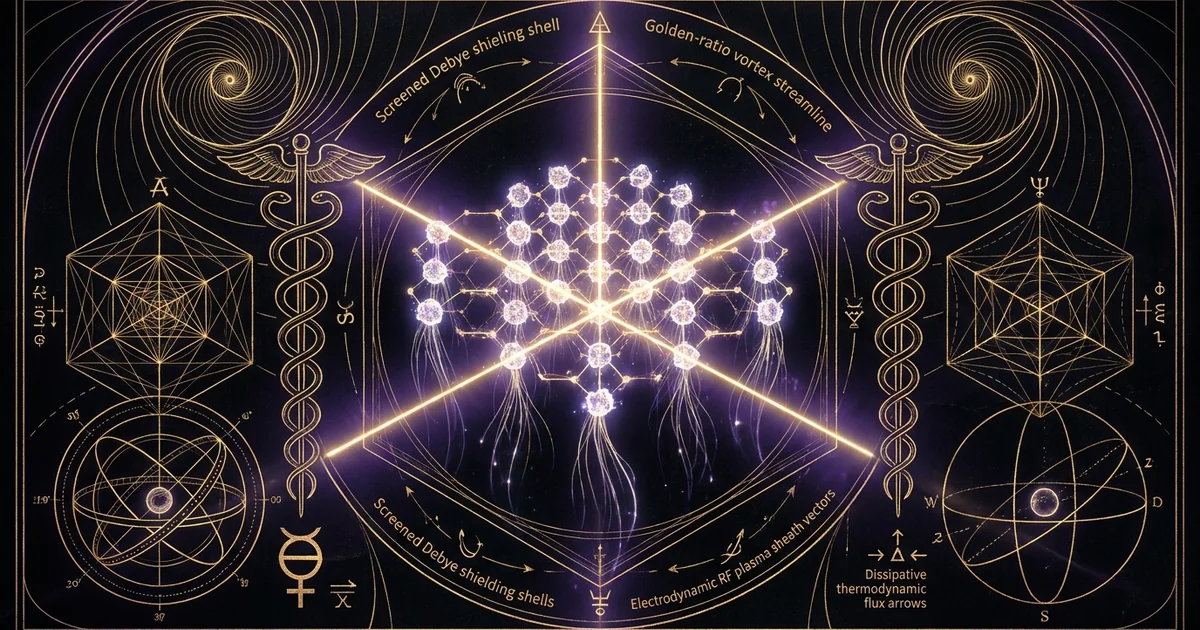
Plasma Crystal Formations: Charged Dust Self-Patterns
Executive Summary & Theoretical Thesis
Thermodynamics of Open Dissipative Mesoscopic Systems
Complex dusty plasmas—multiphase ionized media comprising electrons, positive ions, neutral gas atoms, and charged mesoscopic solid particulates—represent a radical departure from classical Hamiltonian condensed matter physics. Rather than existing as isolated thermodynamic systems that progress inexorably toward maximum entropy via internal Gibbsian free energy minimization, dusty plasmas function as open dissipative structures. In these architectures, macroscopic ordering is driven by continuous non-equilibrium fluxes of mass, charge, and energy. The solid particulate phase, typically composed of monodisperse dielectric microparticles (such as melamine-formaldehyde or silica spheres with diameters on the order of $1$ to $10,\mu\text{m}$), is immersed in an ambient low-temperature, weakly ionized radio-frequency (RF) or direct-current (DC) discharge.
The mesoscopic particulate ensemble continuously absorbs kinetic energy and momentum from the surrounding ionized background while dissipating this energy into the neutral gas background via neutral friction (Epstein drag). Because energy is constantly injected via electromagnetic fields and evacuated through neutral collisions and boundary losses, the system operates far from thermodynamic equilibrium. Self-organization within this medium is therefore an emergent phenomenon of dissipative steady states, wherein macroscopic structural coherence is purchased at the cost of global entropy production in the environment. The localized spatial ordering of the dust particles represents an electrodynamic minimization of potential energy within an externally sustained scalar field, operating under physical laws that unite classical electrostatics, kinetic theory, and open-system non-equilibrium thermodynamics.
+---------------------------------------------------------------------------------------------------+
|                                  OPEN DISSIPATIVE FLUX BALANCE                                    |
|                                                                                                   |
|    RF / DC Electric Field Energy Influx                                                           |
|             |                                                                                     |
|             v                                                                                     |
|    [ Ambient Plasma (e-, i+) ] ---> Charging Currents (I_e + I_i = 0) ---> [ Mesoscopic Grain ]   |
|             |                                                                     |               |
|             v                                                                     v               |
|    Supersonic Ion Drift (u_i)                                              Epstein Drag Losses    |
|             |                                                               (Heat to Neutrals)    |
|             v                                                                     |               |
|    Non-Reciprocal Ion Wake Fields <-----------------------------------------------+               |
|             |                                                                                     |
|             v                                                                                     |
|    Ordered Lattice Condensation (Plasma Crystal: Γ* > 170)                                        |
+---------------------------------------------------------------------------------------------------+
The Coulomb Coupling Threshold for Phase Condensation
The physical prerequisite for the transition of a dusty plasma from an uncorrelated gaseous state into a correlated liquid or crystalline lattice is dictated by the classical one-component plasma (OCP) framework, modified by dielectric shielding. Because the thermal velocity of electrons vastly exceeds that of positive ions ($v_{\text{th},e} = \sqrt{k_B T_e / m_e} \gg v_{\text{th},i} = \sqrt{k_B T_i / m_i}$) in typical low-temperature laboratory discharges ($T_e \sim 1\text{–}3,\text{eV}$, while $T_i \approx T_n \sim 0.025\text{–}0.03,\text{eV}$), the microparticles collect electrons at an initial rate orders of magnitude higher than ions. This charging disparity persists until the grain’s floating surface potential drops sufficiently negative to deflect the majority of incoming thermal electrons while focusing positive ions toward its boundary.
As a consequence of this charging dynamic, each individual microparticle accumulates a monumental net negative charge, typically $Q_d = -Z_d e$, where $Z_d \sim 10^3\text{–}10^5$ elementary charges. When these highly charged dust grains are confined within a localized spatial domain, their interparticle potential energy can dramatically exceed their kinetic energy. The ratio governing this interaction is the coulomb-coupling-parameter $\Gamma$, defined as:
$$\Gamma = \frac{Q_d^2}{4\pi\varepsilon_0 d , k_B T_d}$$
where $d = (3 / 4\pi n_d)^{1/3}$ denotes the average interparticle distance (derived from the dust number density $n_d$), $\varepsilon_0$ is the vacuum permittivity, and $T_d$ represents the kinetic temperature of the dust particulate ensemble.
In pure, unscreened Coulomb systems, Monte Carlo and molecular dynamics simulations demonstrate that when $\Gamma < 1$, the particulate ensemble behaves as an ideal gas; when $\Gamma \sim 1\text{–}10$, short-range correlations emerge, indicative of a fluid regime; and when $\Gamma$ surpasses the critical threshold of $\Gamma_c \approx 170\text{–}178$, the system undergoes a first-order phase transition into an ordered, solid state known as a plasma crystal. In complex plasmas, this transition is mediated by the screening effect of the surrounding plasma sheath—a manifestation of debye-shielding—which converts the long-range Coulomb potential into a short-range Yukawa (screened Coulomb) interaction. When adjusted for this shielding length, the effective coulomb-coupling-parameter-dust provides the rigorous boundary criterion under which spontaneous crystallization occurs.
Paradigm Shift: From Ideal Gaseous Plasmas to Structured Condensed Matter
For decades following the seminal investigations of Irving Langmuir in the 1920s, plasma physics was fundamentally categorized as the study of disordered, high-entropy, fully or partially ionized gaseous media where thermal kinetic energy completely overwhelms inter-particle electrostatic interactions ($\Gamma \ll 1$). The realization that classical plasma architectures could support long-range crystalline order without requiring cryogenic temperatures or ultra-high magnetic fields ignited a profound paradigm shift across modern physics. Dusty plasma physics transformed from an esoteric engineering nuisance—originally studied within the semiconductor fabrication industry due to particulate contamination during plasma etching—into a premier macroscopic model for condensed matter physics.
Because the crystalline lattice constants in a plasma crystal are on the order of hundreds of micrometers ($100\text{–}500,\mu\text{m}$), and the corresponding characteristic dynamical plasma frequencies are exceptionally low ($\omega_{pd} \sim 10\text{–}100,\text{rad/s}$), the trajectory of every individual “atom” in the crystal can be resolved optically in real time using conventional digital video cameras and laser sheet illumination. Consequently, plasma crystals complex dusty plasma self organization morfill research permits the direct, kinetic-level visualization of fundamental solid-state phenomena: defect propagation, dislocation climbs, phase boundary nucleation, shear stresses, and phonon transport. It bridges the microscopic atomistic domain with observable continuum mechanics, transforming our understanding of how collective order nucleates within an open dielectric-field.
Thomas, H., Morfill, G. E., Demmel, V., Goree, J., Feuerbacher, B., & Möhlmann, D. (1994). Plasma crystal: Coulomb crystallization in a dusty plasma. Physical Review Letters, 73(5), 652–655.
Significance: This foundational paper reported the first direct experimental observation of Coulomb crystallization in a weakly ionized radio-frequency gas discharge. The authors demonstrated that monodisperse polymer microspheres suspended in the sheath region of a plasma chamber spontaneously arrange into hexagonal and body-centered cubic lattices when the electrostatic coupling energy vastly exceeds the kinetic energy of the particulate phase, verifying Ikezi’s theoretical prediction.
Historical Lineage & Experimental Precedents
Ikezi’s 1986 Fluid Postulate and the Langmuir Precedents
The historical trajectory of plasma crystallization can be traced back to Irving Langmuir’s foundational experiments regarding particulate-laden arcs and the development of plasma sheath theory. However, the theoretical leap explicitly predicting that laboratory dust clouds could solidify into crystalline structures was formulated by Hiroyuki Ikezi at AT&T Bell Laboratories in 1986. Ikezi synthesized the classical physics of one-component plasmas (OCPs)—originally formulated to describe dense astrophysical matter such as the degenerate interiors of white dwarfs and Jovian planetary cores—with the microphysics of charged particulates in terrestrial low-temperature plasmas.
Ikezi, H. (1986). Coulomb solid of small particles in plasma. Physics of Fluids, 29(6), 1764–1766.
Core Theoretical Insight: Ikezi recognized that because the dust grain charge scales with its radius ($Q_d \propto r_d$), mesoscopic particulates suspended in low-temperature plasmas can acquire charges on the order of $10^3\text{–}10^4$ elementary charges. Applying the classical criterion for Wigner crystallization ($\Gamma \ge 170$) and accounting for Debye screening via a modified Yukawa potential, Ikezi proved that condensation into a “Coulomb solid” was achievable under accessible laboratory discharge parameters, provided the dust temperature remained tightly coupled to the room-temperature neutral gas background.
Despite Ikezi’s clear mathematical roadmap, experimental realization was obstructed for nearly a decade by the practical challenges of suspending, charging, and non-destructively observing sub-millimeter particles within terrestrial vacuum chambers without triggering destructive arcing, rapid neutral-gas drag evacuation, or fatal gravitational sedimentation.
Terrestrial Laboratory Confinement in RF and DC Sheaths
The experimental breakthrough finally occurred independently and concurrently in 1994 across multiple international laboratories. Most notably, Hubertus Thomas, Gregor Morfill, and their collaborators at the Max Planck Institute for Extraterrestrial Physics (Garching, Germany), alongside J. H. Chu and Lin I at National Central University (Taiwan), announced the unambiguous synthesis and imaging of plasma crystals. The critical engineering hurdle overcome by both groups was the neutralization of terrestrial gravity.
For a spherical microparticle of radius $r_d \approx 5,\mu\text{m}$ and mass density $\rho \approx 1.5,\text{g/cm}^3$, the gravitational downward force is:
$$F_g = m_d g = \frac{4}{3}\pi r_d^3 \rho g \approx 7.7 \times 10^{-12},\text{N}$$
To prevent the particles from sedimenting to the chamber floor, an equivalent upward electrostatic levitation force $F_E = Q_d E$ must be exerted. In the quasi-neutral plasma bulk, the ambient electric field $E$ is virtually zero ($E \sim 0.1\text{–}1,\text{V/cm}$), which is entirely inadequate to counter $F_g$.
The experimental solution leveraged the strong non-linear electric fields inherent to the electrode sheath region. In a radio-frequency discharge operating at $13.56,\text{MHz}$, the lower electrode acquires a time-averaged negative self-bias due to the high mobility of electrons relative to ions. Above this electrode, a non-neutral sheath forms characterized by a profound electric field pointing toward the boundary ($E \sim 10^2\text{–}10^3,\text{V/cm}$). When monodisperse dust microspheres are injected into this discharge, they fall through the bulk until they reach the upper boundary of the lower sheath. Here, the upward electrostatic force precisely balances the downward gravitational force:
$$Q_d E(z_{\text{eq}}) + m_d g = 0$$
Under these conditions, the particles settle into a stable two-dimensional equilibrium plane, where the horizontal interparticle forces remain purely repulsive and screened-Coulombic. Under optimized neutral gas pressures (typically $10\text{–}100,\text{Pa}$ of Argon or Krypton), the neutral gas efficiently cools the kinetic energy of the grains via Epstein drag to $T_d \approx 300,\text{K}$. As a consequence, $\Gamma$ surges past the Ikezi threshold, and the particles spontaneously lock into crystalline lattices exhibiting long-range six-fold hexagonal order.
+---------------------------------------------------------------------------------------------------+
|                         TERRESTRIAL RF DISCHARGE LEVITATION MECHANICS                             |
|                                                                                                   |
|    Quasi-Neutral Bulk Plasma: n_e ≈ n_i,  E ≈ 0 V/m                                              |
|    ...........................................................................................    |
|    Sheath Boundary: Supersonic Ion Acceleration (Bohm Criterion: u_i ≥ c_s)                       |
|                                                                                                   |
|           |                                                                                       |
|           | Downward Gravity (F_g = m_d * g)                                                      |
|           v                                                                                       |
|      [ Dust Grain ]  <--- Equilibrium Plane: F_g + F_E = 0                                       |
|           ^                                                                                       |
|           | Upward Sheath Electric Field Force (F_E = Q_d * E_sheath)                             |
|           |                                                                                       |
|    ...........................................................................................    |
|    Powered RF Lower Electrode (-V_bias, 13.56 MHz)                                                |
+---------------------------------------------------------------------------------------------------+
The PKE-Neftex Legacy: Orbital Microgravity Platforms
While terrestrial experiments verified Ikezi’s theoretical prediction, gravitational confinement fundamentally compromised the study of three-dimensional plasma crystals. Terrestrial gravity forces the particles into exceptionally thin layers—predominantly two-dimensional monolayers or severely compressed, vertically anisotropic stratified stacks. The strong vertical electric field required to counter $m_d g$ induces supersonic ion streaming past the grains, triggering asymmetrical wakefields and instabilities that destroy true isotropic three-dimensional ordering.
To unlock stress-free, homogeneous three-dimensional wigner-crystallization-microgravity systems, researchers recognized the imperative to eliminate the gravitational vector entirely. This prompted a pioneering Russian-German scientific collaboration led by Gregor Morfill (Max Planck Institute) and Vladimir Fortov (Institute for High Energy Densities, Russian Academy of Sciences). Following initial verification runs on parabolic flight aircraft and sounding rockets, the Plasmakristall-Experiment (PKE-Neftex) was deployed to the International Space Station (ISS) in 2001.
Operating inside the Zvezda Service Module, PKE-Neftex (and its technological successors, PK-3 Plus and PK-4) established that under orbital microgravity conditions ($g \approx 10^{-4}\text{–}10^{-6},g_0$), microparticles no longer require intense electric sheath fields for levitation. Instead, they can be uniformly dispersed across the extensive, isotropic, quasi-neutral bulk plasma of the discharge chamber. The pke-neftex-experiments-iss conclusively revealed vast three-dimensional crystalline domains containing millions of particles, exhibiting face-centered cubic (fcc), hexagonal close-packed (hcp), and body-centered cubic (bcc) symmetries, free from the mechanical stresses and wake-induced shear flows that plague terrestrial research setups.
Mathematical Formalism & Physical Mechanics
Grain Charging Dynamics and Orbital Motion Limited (OML) Theory
The exact magnitude of the electrostatic charge $Q_d$ acquired by a spherical microparticle of radius $r_d$ suspended within an unmagnetized plasma is determined by the balance of microscopic electronic and ionic currents incident upon its surface. In the collisionless regime—where the dust grain radius is substantially smaller than both the electron/ion mean free paths ($\lambda_{\text{mfp}} \gg r_d$) and the plasma Debye length ($\lambda_D \gg r_d$)—the charging kinetics are rigorously formulated via Orbital Motion Limited (OML) theory, initially derived by Mott-Smith and Langmuir.
Let the dust grain possess a floating surface potential $V_s$ relative to the unperturbed ambient plasma potential (which we define as $V_p = 0$). Because the grain charges negatively ($V_s < 0$), the local electrostatic field repels electrons while attracting positive ions. Under the assumption of Maxwellian velocity distributions for both background species, the electron current collection $I_e$ is governed solely by those electrons possessing sufficient kinetic energy to overcome the repulsive electrostatic barrier:
$$I_e(V_s) = -e , n_e , \pi r_d^2 \left( \frac{8 k_B T_e}{\pi m_e} \right)^{1/2} \exp\left( \frac{e V_s}{k_B T_e} \right)$$
Conversely, positive ions are accelerated toward the grain along angular momentum-conserving orbital trajectories. Integrating the collection cross-section across the accelerated distribution yields the ion current $I_i$:
$$I_i(V_s) = e , n_i , \pi r_d^2 \left( \frac{8 k_B T_i}{\pi m_i} \right)^{1/2} \left( 1 - \frac{e V_s}{k_B T_i} \right)$$
In an isolated steady state, the dust grain behaves as a floating electrostatic probe; it draws no net current from the plasma. The floating surface potential $V_s$ is therefore unambiguously resolved by setting the total current flux to zero:
$$\sum I = I_e(V_s) + I_i(V_s) = 0$$
Substituting the functional forms of $I_e(V_s)$ and $I_i(V_s)$ into this equilibrium condition yields the transcendental equation:
$$\exp\left( \frac{e V_s}{k_B T_e} \right) = \left( \frac{n_i}{n_e} \right) \left( \frac{m_e T_i}{m_i T_e} \right)^{1/2} \left( 1 - \frac{e V_s}{k_B T_i} \right)$$
Assuming a spherical particulate modeled as an isolated capacitor, the net charge $Q_d$ is linearly coupled to its floating surface potential via its vacuum capacitance $C = 4\pi\varepsilon_0 r_d$:
$$Q_d = C V_s = 4\pi\varepsilon_0 r_d V_s$$
For standard argon discharge parameters ($T_e \approx 2,\text{eV}$, $T_i \approx 0.03,\text{eV}$, $m_i / m_e \approx 73400$), the normalized potential settles at $e V_s / k_B T_e \approx -2.5$. For a typical microparticle of radius $r_d = 2.5,\mu\text{m}$, the floating potential evaluates to $V_s \approx -5,\text{V}$, resulting in a massive net negative charge:
$$Q_d \approx 4\pi (8.854 \times 10^{-12},\text{F/m}) (2.5 \times 10^{-6},\text{m}) (-5,\text{V}) \approx -1.38 \times 10^{-15},\text{C} \approx -8600,e$$
This massive localized charge underpins the extreme electrostatic coupling that drives the formation of plasma crystals.
Screened Yukawa Potential and Non-Reciprocal Wake Fields
In a vacuum, the interaction between two charged dust grains would follow the long-range Coulomb potential $U_C® = Q_d^2 / (4\pi\varepsilon_0 r)$. Within a plasma, however, mobile electrons and ions dynamically polarize around the negative grain, establishing a screening space-charge cloud. This phenomenon of debye-shielding restricts the spatial reach of the particulate’s field. Under isotropic, thermal conditions, the interaction potential is accurately characterized by the Yukawa (or Debye-Hückel) screened scalar potential:
$$U® = \frac{Q_d^2}{4\pi\varepsilon_0 r} \exp\left( -\frac{r}{\lambda_D} \right)$$
The characteristic linearized Debye screening length $\lambda_D$ accounts for the combined dielectric response of both electrons and ions:
$$\lambda_D = \left( \frac{1}{\lambda_{De}^2} + \frac{1}{\lambda_{Di}^2} \right)^{-1/2} = \left( \frac{\varepsilon_0 k_B T_e}{n_e e^2} + \frac{\varepsilon_0 k_B T_i}{n_i e^2} \right)^{-1/2}$$
Because $T_i \ll T_e$ in low-temperature plasmas, the ion Debye length $\lambda_{Di}$ is substantially smaller than the electron Debye length $\lambda_{De}$ ($\lambda_{Di} \ll \lambda_{De}$). Consequently, when the plasma is at rest, the screening cloud is dominated by positive ions, yielding $\lambda_D \approx \lambda_{Di}$.
+---------------------------------------------------------------------------------------------------+
|                        ION WAKEFIELD FORMATION & NON-RECIPROCAL FORCES                            |
|                                                                                                   |
|    Supersonic Ion Stream (u_i > c_s)                                                              |
|        |     |     |     |     |                                                                  |
|        v     v     v     v     v                                                                  |
|             ( -Q_d )  <=== Upper Dust Grain (Particle 1)                                          |
|            /        \                                                                             |
|           /  Ion     \  Trajectory Deflection                                                     |
|          v  Focusing  v                                                                           |
|             ( +q_w )  <=== Downstream Positive Ion Wake (Focus Point)                             |
|                |                                                                                  |
|                v                                                                                  |
|             ( -Q_d )  <=== Lower Dust Grain (Particle 2)                                          |
|                                                                                                   |
|    Force Asymmetry:                                                                               |
|    Particle 1 experiences upward attraction toward wake (+q_w):  F_{2->1}                         |
|    Particle 2 experiences downward repulsion + wake attraction:   F_{1->2}                         |
|    Result: F_{1->2} ≠ -F_{2->1} (Breakdown of Newton's Third Law / Non-Hamiltonian System)        |
+---------------------------------------------------------------------------------------------------+
However, in terrestrial laboratory systems where grains are levitated in the electrode sheath, this isotropic Yukawa framework breaks down. Inside the sheath, positive ions are directed toward the negative electrode at drift velocities $u_i$ that exceed the ion sound speed (the Bohm criterion: $u_i \ge c_s = \sqrt{k_B T_e / m_i}$). As these supersonic ions flow past a negatively charged dust grain, their trajectories are electrostatically deflected inward behind the particle.
This creates a concentrated downstream space-charge region of positive ions known as an ion wakefield. The wake functions as an effective localized positive charge $+q_w$ positioned a fraction of a Debye length downstream from the grain ($z_w \sim 0.5\text{–}1.5,\lambda_{Di}$). The presence of this wakefield breaks the spatial symmetry of the electrostatic potential:
$$\Phi(\mathbf{r}) = \frac{Q_d}{4\pi\varepsilon_0 r}\exp\left(-\frac{r}{\lambda_D}\right) + \Phi_{\text{wake}}(\mathbf{r} - \mathbf{d}_w)$$
The physical consequence of this wakefield is the complete disruption of action-reaction symmetry. For two vertically aligned dust grains in a streaming sheath:
- The upper grain exerts a repulsive force on the lower grain via its screened charge, augmented by the downstream attraction of its wake.
- The lower grain acts upon the upper grain primarily through its screened negative charge, but cannot exert an equivalent upstream wake force.
Therefore, the interparticle forces violate Newton’s third law:
$$\mathbf{F}{1\to 2} \neq -\mathbf{F}{2\to 1}$$
This non-reciprocity demonstrates that dusty plasma crystals confined in directional sheaths are non-Hamiltonian systems. The streaming ions act as an external energy reservoir that continuously pumps free energy into the vertical modes of the crystal lattice. This mechanism frequently drives self-excited vertical oscillations, transverse optical phonon instabilities, and spontaneous lattice melting. For additional insights on non-equilibrium vector and scalar field interactions, see the analysis in Dielectric Permittivity and Scalar Fields.
The Effective Coupling Parameter and Phase Boundary Derivations
To quantify the phase transition boundaries in screened systems, the classical Coulomb coupling parameter $\Gamma$ must be mapped to a screened Yukawa space. The structural properties of a Yukawa system are governed by two dimensionless parameters: the lattice screening parameter $\kappa$ and the bare Coulomb coupling parameter $\Gamma$.
The lattice screening parameter is defined as the ratio of the interparticle distance $d$ (or the Wigner-Seitz radius $a_{\text{ws}} = (3 / 4\pi n_d)^{1/3}$) to the Debye screening length $\lambda_D$:
$$\kappa = \frac{d}{\lambda_D}$$
Because the Yukawa interaction decays exponentially compared to the pure Coulomb field, the effective electrostatic coupling between adjacent particles at distance $d$ is diminished. To first order, the effective coupling parameter $\Gamma^*$ can be approximated via the direct potential energy scaling:
$$\Gamma^* = \Gamma \exp(-\kappa)$$
While the simple exponential approximation $\Gamma^* = \Gamma \exp(-\kappa)$ provides an intuitive baseline, rigorous molecular dynamics simulations and the thermodynamic fluid-solid boundary mapping established by O. S. Vaulina and S. A. Khrapak demonstrate that the true phase boundary requires a higher-order expansion to account for multi-particle screening contributions across coordination shells. The generalized effective coupling parameter $\Gamma_{\text{eff}}$ governing the crystallization phase boundary is formulated as:
$$\Gamma_{\text{eff}} = \Gamma \left( 1 + \kappa + \frac{1}{2}\kappa^2 \right) \exp(-\kappa)$$
Under this unified parameterization, the liquid-solid phase condensation boundary for any arbitrary Yukawa system—spanning from the pure Coulomb limit ($\kappa \to 0$) to strongly screened regimes ($\kappa \sim 1\text{–}5$)—converges onto a universal critical value:
$$\Gamma_{\text{eff}} \approx 170.8^{+2.0}_{-1.5}$$
When $\Gamma_{\text{eff}} > 170.8$, the free energy of the crystalline lattice (typically hcp or bcc depending on $\kappa$) drops below the free energy of the disordered Yukawa liquid, driving spontaneous thermodynamic crystallization.
Empirical Evidence & Observational Data
Structural Metrics: Pair Correlation Functions g® and Bond-Orientational Order
The experimental verification of crystallization in dusty plasmas relies upon quantitative metrics imported from statistical mechanics and crystallography, applied to the direct positional coordinates of the microparticles. By illuminating the dust cloud with a thin, expanded sheet of continuous-wave laser light (typically Nd:YAG at $\lambda = 532,\text{nm}$) and capturing the scattered light via charge-coupled device (CCD) or CMOS cameras, investigators track the precise spatial positions $\mathbf{r}_i = (x_i, y_i, z_i)$ of tens of thousands of particles simultaneously.
The primary diagnostic for translational order is the radial pair correlation function $g®$, which defines the probability of finding a particle at a radial distance $r$ from an arbitrary reference particle, normalized by the ideal gas density:
$$g® = \frac{V}{4\pi r^2 N^2} \left\langle \sum_{i=1}^N \sum_{j \neq i}^N \delta(r - |\mathbf{r}_i - \mathbf{r}_j|) \right\rangle$$
In a disordered dusty plasma liquid, $g®$ displays a broad, rapidly decaying initial peak corresponding to the first nearest-neighbor coordination shell, after which $g® \to 1$ as $r \to \infty$. When the discharge parameters are tuned to drive $\Gamma_{\text{eff}} > 170$, the radial pair distribution undergoes a dramatic transformation:
- The primary peak sharpens significantly, its amplitude frequently exceeding $g® > 3.0$.
- Secondary, tertiary, and quaternary coordination shells emerge with sharp definition over distances of many lattice constants ($r > 10,d$).
- The second coordination peak exhibits a distinct splitting into two sub-peaks—the definitive structural signature of hexagonal close-packed (hcp) and face-centered cubic (fcc) ordering.
Radial Pair Distribution Function g(r) Across Phase States:
g®
^
|             Crystalline State (Γ* > 170)
4|                  /

|                 /  \      Splitting of 2nd Peak
3|                /    \          /\  /

|               /      \        /  /  \         /

2|              /        \      /        \       /

|             /          \    /          \     /

1|  Gas:      /   Liquid   \  /            -–/      ------ (Ideal Gas: g® -> 1)
|  g®≈1   /              /
0±---------±--------------±------------------±----------->
0          r=d            r≈1.73d             r≈2d          r (Distance)
To quantify the orientational coherence of the lattice independent of translational decay, researchers employ the two-dimensional hexatic bond-orientational order parameter $\psi_6(\mathbf{r}_j)$ for each particle $j$:
$$\psi_6(\mathbf{r}j) = \frac{1}{N{\text{nn}}} \sum_{k=1}^{N_{\text{nn}}} \exp\left( 6 i \theta_{jk} \right)$$
where $N_{\text{nn}}$ represents the number of nearest neighbors (determined via Voronoi tessellation, ideally $N_{\text{nn}} = 6$ for a triangular/hexagonal net), and $\theta_{jk}$ is the angle of the bond vector connecting particle $j$ to neighbor $k$ relative to an arbitrary reference axis. In a perfect triangular plasma crystal, the ensemble average magnitude $|\langle \psi_6 \rangle| \to 1$, whereas in an isotropic fluid state, $|\langle \psi_6 \rangle| \to 0$. Experimental measurements routinely demonstrate $|\langle \psi_6 \rangle| > 0.85$ over correlation areas exceeding thousands of interparticle sites, definitively confirming the presence of long-range bond-orientational order.
ISS Microgravity Results: PK-3 Plus and PK-4 3D Structural Tomography
The definitive structural validation of three-dimensional plasma crystals was achieved through orbital experiments aboard the International Space Station utilizing the PK-3 Plus and PK-4 experimental inserts. The PK-3 Plus chamber employed a parallel-plate RF discharge chamber driven symmetrically push-pull at $13.56,\text{MHz}$. By scanning the illumination laser sheet through the dust cloud via high-precision stepper motors while simultaneously recording video frames at high frame rates, researchers executed the first full three-dimensional structural tomography of a macroscopic plasma crystal in history.
The microgravity data revealed several profound phenomena unavailable to terrestrial experimentation:
- Phase Coexistence and Polymorphism: PK-3 Plus confirmed that in the absence of gravitational compression, three-dimensional dusty plasma crystals self-assemble into alternating domains of face-centered cubic (fcc) and hexagonal close-packed (hcp) lattices, with body-centered cubic (bcc) structures appearing predominantly at lower screening parameters ($\kappa \le 1$). This resolved the theoretical debate regarding whether Yukawa systems prefer fcc or bcc configurations, demonstrating that the free energy differences between these states are on the order of $10^{-4},k_B T$ per particle, leading to dynamic stacking faults and structural polymorphism.
- Void Formation and Electrodynamic Balancing: The microgravity experiments uncovered the ubiquitous formation of a central particle-free “void” inside large three-dimensional dust clouds. This void is driven by an outbound ion drag force: ions created in the dense center of the RF discharge stream toward the outer walls, exerting a net outward momentum transfer via Coulomb collisions with the dust grains that balances the inward electrostatic confinement force. Under low-frequency electrical modulation, this void can be closed, allowing the synthesis of completely homogeneous, isotropic, monolithic single crystals containing up to $10^6$ microparticles.
Phonon Mode Dispersion: Transverse Shear and Longitudinal Acoustic Waves
Because the particles within a plasma crystal maintain localized equilibrium positions while retaining kinetic degrees of freedom, the crystalline lattice supports the propagation of collective vibrational modes: collective sound waves known as phonon modes. In three-dimensional bulk plasma crystals, the system supports both longitudinal acoustic modes (compressional waves where particle displacement is parallel to the wavevector, $\mathbf{k} \parallel \mathbf{\xi}$) and transverse acoustic modes (shear waves where displacement is perpendicular to the wavevector, $\mathbf{k} \perp \mathbf{\xi}$).
The longitudinal dust acoustic wave (DAW) is governed by the inertia of the dust grains providing the mass, while the restoring force is mediated by the screened electrostatic potential of the surrounding plasma. In the long-wavelength limit ($k \to 0$), the dispersion relation reads:
$$\omega_L(k) \approx k \cdot C_{\text{DAW}} = k \left( \frac{\omega_{pd} \lambda_D}{\sqrt{1 + k^2 \lambda_D^2}} \right)$$
where $\omega_{pd} = \sqrt{n_d Q_d^2 / \varepsilon_0 m_d}$ is the characteristic dust plasma frequency.
Crucially, the emergence of transverse shear waves serves as the definitive mechanical proof of the solid state. Liquids and gases cannot support shear stresses; their shear modulus is identically zero ($\mu = 0$). In contrast, experiments on plasma crystals—conducted by using focused laser beams as optical tweezers to exert localized radiation pressure and launch shear impulses—demonstrated the propagation of transverse shear waves with a well-defined shear sound speed:
$$C_T = \sqrt{\frac{\mu}{\rho_d}}$$
where $\rho_d = n_d m_d$ is the mass density of the dust lattice. By mapping the full phonon dispersion curves across the first Brillouin zone using spatial Fourier transforms of the particle velocity field, researchers have directly measured the shear modulus $\mu$ and the bulk modulus $K$ of the plasma crystal, establishing that the mechanical elasticity of these charged dust arrays scales directly with the derivative of the screened Yukawa force field. For an analysis of acoustic propagation and nodal patterns in resonant fields, refer to Acoustic Levitation and Standing Wave Nodes.
Dispersion Relations of Collective Lattice Modes:

Frequency (ω)
 ^
 |                Longitudinal Acoustic Mode (DAW)
 |                     . - - - ~ ~ ~ (Asymptotic limit: ω -> ω_pd)
 |                 . '
 |             . '
 |         . '    Transverse Shear Mode (Solid State Signature)
 |       /    . '
 |      / . '
 |     / '
 |    /
 |   /
 |  /
 0+------------------------------------------------------------>
 0                         Brillouin Zone Edge (k = π/d)    Wavevector (k)
Metaphysical Implications & Unified Synthesis
Dissipative Morphogenesis: Form as a Dynamic Open Steady State
The realization of plasma crystals offers profound conceptual implications that transcend traditional reductionist physics. For centuries, Western science conceptualized crystals as static, low-temperature, dead matter—rigid structures locked into spatial immobility through the absolute minimization of thermal kinetic energy, exemplifying the Third Law of Thermodynamics ($S \to 0$ as $T \to 0$). The plasma crystal entirely shatters this classical archetype.
A plasma crystal is fundamentally an open, non-equilibrium dissipative structure in the exact sense formulated by Ilya Prigogine. It maintains its structural integrity, its spatial periodicity, and its crystallographic symmetries solely by continuously consuming high-grade electrostatic and electromagnetic energy from an external power supply, converting that energy through microscopic charging and streaming currents, and exporting it as thermal entropy into the neutral gas background. The moment the ambient power source is disconnected, the Debye sheaths collapse, the charges $Q_d$ vanish via electron-ion recombination on the grain surfaces, the Yukawa potential wells disappear, and the crystal dissolves in milliseconds.
Classical Cryogenic Crystal:
[ Static State ] ---> Minimized Kinetic Energy (T -> 0) ---> Zero Entropy Export Required
Dissipative Plasma Crystal:
[ High-Flux Plasma ] —> Energy Influx —> Continuous Entropy Export —> Dynamic Geometric Form
The plasma crystal demonstrates that complex, ordered geometric form does not require an internal equilibrium state. Rather, form is an attractor: a dynamic, stationary state through which high volumes of energy and matter must perpetually transit. This bridges the physical mechanics of ionized gases directly with biological morphogenesis, where living organisms preserve complex physical forms exclusively through continuous metabolic throughput and the export of internal entropy to the surrounding biosphere.
Macroscopic Wigner Crystallization vs. Classical Solidification
The conceptual lineage of plasma crystallization is directly linked to Eugene Wigner’s 1934 theoretical postulate that a gas of electrons immersed in a uniform neutralizing positive background (the Jellium model) will spontaneously crystallize into a body-centered cubic lattice when the electron density drops below a critical value. In Wigner’s formulation, the crystallization is a quantum mechanical effect driven by the dominance of classical electrostatic repulsion over quantum kinetic energy (Fermi energy) at low densities: the kinetic energy scales as $r_s^{-2}$, whereas the potential energy scales as $r_s^{-1}$, where $r_s$ is the mean electron spacing.
In complex dusty plasmas, we observe the ultimate classical, macroscopic manifestation of this principle. The mesoscopic microparticles emulate the charged electrons, while the surrounding electron-ion plasma mimics the neutralizing background. However, unlike cryogenic electron Wigner crystals—which require millikelvin temperatures, strong magnetic fields, and can only be indirectly probed via macroscopic transport measurements—the plasma crystal functions at room temperature ($T \approx 300,\text{K}$) and is directly visible to the human eye via scattered light.
Equilibrium Wigner Crystallization
- Thermodynamic Environment: Thermodynamically closed or near-equilibrium system; isolated cryogenics.
- Force Carrier: Pure, long-range Coulomb potential $U® \propto 1/r$.
- Mechanics: Hamiltonian dynamics; strict adherence to Newton’s third law of reciprocity.
- Observational Access: Indirect quantum transport, resonance measurements, sub-micron scattering methods.
- Energy Balance: Static energy minimization; zero required continuous throughput of power.
Complex Dusty Plasma Crystals
- Thermodynamic Environment: Open, non-equilibrium dissipative system; room-temperature ambient gas.
- Force Carrier: Screened Yukawa potential $U® \propto \frac{1}{r}\exp(-r/\lambda_D)$ plus asymmetric wakefield.
- Mechanics: Non-Hamiltonian dynamics; broken action-reaction symmetry due to directional ion streaming.
- Observational Access: Direct, real-time kinetic particle tracking velocimetry (PTV) via optical imaging.
- Energy Balance: Dynamic steady-state; relies upon constant power injection and Epstein drag dissipation.
Harmonic Cymatics and Geometrical Self-Organization Across Scales
The spatial patterns realized in plasma crystals—dominated by six-fold hexagonal rings, triangular nets, and close-packed polyhedra—demonstrate that specific geometrical archetypes are scale-free physical attractors. In dusty plasmas, these geometries are electrodynamic solutions to the problem of distributing mutually repelling, screened Yukawa charge centers within a confining potential well.
This process mirrors the mechanics of harmonic cymatics, wherein physical particles (such as lycopodium powder or sand grains) spread across a vibrating acoustic diaphragm spontaneously migrate away from high-energy antinodes and settle into the quiet, minimum-energy nodal lines of the standing wave field. In the plasma crystal, the confining electric sheath potential, combined with the collective self-consistent scalar fields generated by the charged grains themselves, functions as an electrodynamic counterpart to the acoustic plate. The dust grains migrate precisely to the cymatic-modal-nodes of this self-organizing potential landscape, locking themselves into high-symmetry crystallographic configurations.
Harmonic Correspondence Across Scales:
[ Acoustical Cymatics ]  —> Acoustic Wavefield —> Particle Trapping at Standing Nodal Lines
[ Plasma Crystallization ] —> Screened Yukawa Potential —> Self-Assembly at Potential Minima (Lattice Sites)
[ Planetary Rings / Astro ] —> Birkeland Currents & EM Fields —> Dust Patterning on Astrophysical Scales
This structural correspondence reveals that the spontaneous self-organization of matter into regular, crystalline geometry is a universal property of wave-matter interactions. Whether looking at the microscopic scale of atoms arranging into metallic matrices, the mesoscopic domain of micron-sized dust grains condensing into plasma crystals, or the cosmic scale of planetary rings (such as the dusty spoke patterns observed in Saturn’s rings) and galactic filaments, the physical laws remain unified. The universe employs identical electrodynamic, dissipative, and geometric strategies to bring forth organized form from chaotic backgrounds. For deep analysis of current filaments operating across astrophysical scales, see Birkeland Currents and Plasma Filaments; for the formal geometric classifications of these structures, see Platonic Solids and Crystallographic Symmetry.
Frequently Asked Questions
Analytical Clarification of Key Theoretical Inquiries
Why is orbital microgravity strictly necessary to analyze three-dimensional plasma crystals if two-dimensional crystals can be generated in terrestrial laboratories?
Terrestrial experimentation is fundamentally constrained by Earth’s gravitational acceleration $g$. For a typical polymer microparticle ($r_d \sim 1\text{–}5,\mu\text{m}$), the gravitational force $F_g = m_d g$ is on the order of $10^{-12}\text{–}10^{-11},\text{N}$. In a laboratory discharge, the only region possessing an electric field strong enough to generate an opposing upward electrostatic force ($F_E = Q_d E$) is the non-neutral sheath directly above the lower electrode. This confines the particulate cloud to an exceptionally narrow, highly compressed horizontal layer, resulting in two-dimensional monolayer crystals or stratified, vertically squashed multi-layers.
Furthermore, within this sheath, positive ions are accelerated downward at supersonic velocities toward the electrode. This supersonic drift produces prominent positive ion wakes directly underneath each microparticle. The resulting wakefield introduces extreme vertical force non-reciprocities and drives parasitic vertical lattice oscillations and shear instabilities that disrupt three-dimensional bulk ordering.
In an orbital microgravity environment (such as that aboard the ISS), $F_g \to 0$. Consequently, the strong vertical electric field is no longer required for levitation. The dust grains can be dispersed into the large, isotropic, field-free, quasi-neutral bulk of the plasma. In this regime, ion streaming is negligible, the screened Yukawa potential remains isotropic, and the particles are free to form true, stress-free, three-dimensional bulk crystals (fcc, hcp, and bcc) containing millions of lattice sites, completely devoid of gravitational compression artifacts.
How does the downstream ion wake potential break Newton’s third law without violating the fundamental conservation laws of physics?
Newton’s third law states that for every action, there is an equal and opposite reaction ($\mathbf{F}{1\to 2} = -\mathbf{F}{2\to 1}$). This law holds strictly for isolated systems whose interactions are mediated by conservative, two-body internal potentials governed by standard Hamiltonian mechanics.
In a dusty plasma sheath, the interacting dust particles do not constitute an isolated system. The microparticles are immersed within an open, streaming flux of background plasma ions driven by an external power supply. The formation of an ion wake is a collective downstream focusing effect: an upper dust grain focuses the passing ion stream into a region of localized positive space charge behind it. A lower grain is attracted to this positive wake, experiencing an additional force that the upper grain does not experience in return from the lower grain (because the ions are streaming unidirectionally downward and cannot transmit the wake effect upstream).
This produces an apparent breakdown of action-reaction symmetry when considering the dust grains in isolation: $\mathbf{F}{\text{upper}\to\text{lower}} \neq -\mathbf{F}{\text{lower}\to\text{upper}}$. However, this does not violate universal conservation laws. The “missing” momentum and energy are continuously transferred to and from the external drive system: the streaming background ion fluid and the RF power source sustaining the discharge sheath. The dust-wake assembly is a classic non-Hamiltonian system, where free energy from the flowing ion reservoir is continually fed into the internal modes of the dust crystal.
What is the thermodynamic resolution of a highly ordered dust crystal forming within an intrinsically chaotic, high-entropy gas discharge?
The spontaneous condensation of a disordered, high-entropy dust cloud into a crystalline lattice with high translational and orientational order appears, at first glance, to challenge the Second Law of Thermodynamics ($\Delta S \ge 0$).
This paradox is resolved by recognizing that the dust particulate phase is merely one sub-component of a larger, open thermodynamic system. The reduction in the configurational entropy of the dust grains ($\Delta S_{\text{dust}} < 0$) during crystallization is accompanied by a much larger, positive entropy production in the surrounding environment ($\Delta S_{\text{environment}} > 0$). The total entropy change of the universe remains strictly positive:
$$\Delta S_{\text{total}} = \Delta S_{\text{dust}} + \Delta S_{\text{plasma}} + \Delta S_{\text{neutrals}} > 0$$
The dust grains acquire their ordered configuration because they continuously absorb energy from the electric field, interact through screened Yukawa potential wells, and dissipate kinetic energy to the neutral gas atoms via continuous Epstein drag collisions. The random thermal energy dissipated into the neutral gas background increases the entropy of the thermal reservoir at a rate that vastly exceeds the localized entropy reduction achieved by the ordering of the dust particles. The plasma crystal is thus a classical Prigogine dissipative structure: it exports its internal configurational entropy to the surrounding gas, sustaining its local geometric order via continuous external dissipation.