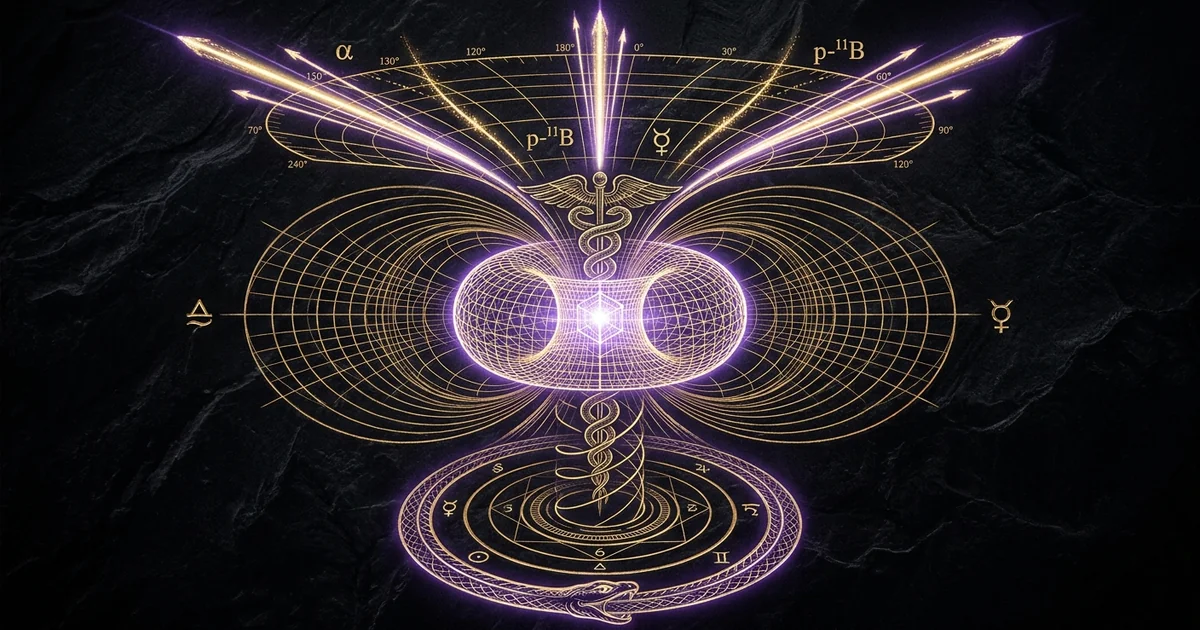
Laboratory Plasma Focus Devices: Extreme Magnetic Fusion
Executive Summary & Theoretical Thesis: Non-Equilibrium Magnetohydrodynamics and Aneutronic Fusion
The Failure of Steady-State Maxwellian Confinement
Thermonuclear fusion research has been dominated by the paradigm of quasi-steady-state magnetic confinement, represented by the tokamak and stellarator architectures. These configurations operate under the thermodynamic assumption of local Maxwellian equilibrium, wherein the ion and electron populations share a thermalized velocity distribution:
$$f_j(\mathbf{v}) = n_j \left(\frac{m_j}{2\pi k_B T}\right)^{3/2} \exp\left(-\frac{m_j v^2}{2 k_B T}\right)$$
While theoretically viable for the low-threshold deuterium-tritium ($\text{D-T}$) reaction—which exhibits a peak cross-section near $60\text{ keV}$—this framework collapses when applied to advanced aneutronic fuel cycles.
The primary barrier to exploiting the clean proton-boron-11 reaction:
$$p + {}^{11}\text{B} \rightarrow 3 ,{}^4\text{He} + 8.68\text{ MeV}$$
within a thermalized plasma is the Bremsstrahlung radiation loss. In an optically thin, fully ionized plasma at thermal equilibrium ($T_e \approx T_i$), the classical Bremsstrahlung power loss density scales with the square of the electron density, the effective nuclear charge, and the square root of the electron temperature:
$$P_{\text{Br}} = \left(\frac{2\pi k_B T_e}{3 m_e}\right)^{1/2} \frac{2^5 \pi e^6}{3 h m_e c^3} Z_{\text{eff}} n_e^2 \approx 1.57 \times 10^{-38} Z_{\text{eff}} n_e^2 T_e^{1/2} \quad \left[\text{W}/\text{m}^3\right]$$
For a $p\text{-}^{11}\text{B}$ fuel mixture, the effective ionic charge $Z_{\text{eff}} = \sum n_i Z_i^2 / \sum n_i Z_i$ elevates radiation losses to such an extent that the thermonuclear power generated:
$$P_{\text{fusion}} = n_p n_{\text{B}} \langle \sigma v \rangle_{\text{fus}} E_{\text{fus}}$$
is outstripped by $P_{\text{Br}}$ across all conceivable Maxwellian temperatures ($100\text{–}300\text{ keV}$). The power balance condition $P_{\text{fusion}} > P_{\text{Br}}$ cannot be satisfied within a conventional Maxwellian plasma column. This mathematical boundary demonstrates that steady-state thermalized confinement cannot achieve net-gain aneutronic fusion.
+-----------------------------------------------------------------------------+
|                                                                             |
|      P [Power Density]                                                      |
|        ^                                                                    |
|        |                                                                    |
|        |               Bremsstrahlung Losses (Thermalized Te = Ti)          |
|        |             . - ~ ~ ~ - .                                          |
|        |         . '               ' .   P_Br ~ Z_eff * ne^2 * Te^(1/2)     |
|        |       /                       \                                    |
|        |      /    Classical Deficit    \                                   |
|        |     /   (Net Gain Impossible)   \                                  |
|        |    /                             \                                 |
|        |---|-------------------------------|------------------------>       |
|        |    \                             /          Kinetic Energy (keV)   |
|        |     \    p-11B Thermonuclear    /                                  |
|        |      \      Cross-Section      /                                   |
|        |       .                       .                                    |
|        |         . _               _ .                                      |
|        |             ' - _ _ _ - '                                          |
|        |                                                                    |
+-----------------------------------------------------------------------------+
The Non-Equilibrium Dense Plasma Focus Mechanism
The dense plasma focus (DPF) operating within Mather-type coaxial configurations breaks through this constraint by operating outside thermodynamic equilibrium. Rather than confining a diffuse, homogeneous plasma for extended durations, the DPF exploits self-organizing magnetohydrodynamic (MHD) instabilities to produce transient, sub-millimeter plasmoid volumes characterized by electron densities:
$$n_e > 10^{25}\text{ m}^{-3} \quad (10^{19}\text{ cm}^{-3})$$
and localized magnetic fields exceeding $10^4\text{ Tesla}$.
In this non-Maxwellian regime, the electromagnetic energy transferred from a low-inductance capacitor bank is compressed through dynamic sheath propagation. It focuses into a discrete micro-pinch via the Lorentz force:
$$\mathbf{f}_{\text{L}} = \mathbf{J} \times \mathbf{B}$$
Within this collapsing plasma filament, the characteristic thermal equilibration time between ions and electrons:
$$\tau_{ei}^{\epsilon} \approx \frac{3 \pi \sqrt{2\pi} \epsilon_0^2 m_e m_i}{n_i Z_i^2 e^4 \ln\Lambda} \left(\frac{k_B T_e}{m_e} + \frac{k_B T_i}{m_i}\right)^{3/2}$$
substantially exceeds the nanosecond lifetime of the pinched core ($\tau_{\text{pinch}} \sim 1\text{–}50\text{ ns}$). Consequently, the system maintains a decoupled, two-temperature state where the effective ion kinetic energy satisfies:
$$T_i \gg T_e$$
Energetic ion populations acquire directed kinetic energies well beyond $100\text{ keV}$, directly populating the resonance peak of the $p\text{-}^{11}\text{B}$ reaction cross-section near $E_{\text{res}} \approx 148\text{ keV}$ in the center-of-mass frame ($E_{\text{lab}} \approx 670\text{ keV}$ for incident protons), while the electron population remains comparatively cool ($T_e \approx 1\text{–}5\text{ keV}$). This dynamic state decouples high-energy reactive collisions from electron-induced thermal Bremsstrahlung losses.
Overcoming the Bremsstrahlung Radiation Limit via Quantum Magnetic Suppression
The extreme magnetic fields generated during the final radial compression alter the fundamental radiation mechanics through quantum magnetic field effects. When the local magnetic induction inside the pinched plasmoid reaches levels where the electron cyclotron energy:
$$\hbar \omega_{ce} = \hbar \frac{e B}{m_e}$$
becomes comparable to or exceeds the transverse thermal kinetic energy $k_B T_{e\perp}$, the continuum of electron orbital states quantizes into discrete Landau levels:
$$E_n = \left(n + \frac{1}{2}\right)\hbar \omega_{ce} + \frac{p_\parallel^2}{2 m_e}$$
Under these conditions ($B \ge 10^4\text{ T}$), classical Coulomb collisions are restricted. The transverse momentum space available for electron scattering off boron ions ($Z = 5$) is truncated, suppressing low-angle electron-ion collisions and their associated continuous Bremsstrahlung emission. Concurrently, rapid synchrotron-cyclotron radiative dissipation:
$$P_{\text{sync}} = \frac{4}{3} \sigma_T c U_B \left(\frac{v_\perp}{c}\right)^2 \gamma^2$$
acts preferentially on the transverse electron velocity distribution $v_\perp$. This depresses $T_e$ along the direction perpendicular to $\mathbf{B}$ while permitting the axial electric field to drive ions toward fusion kinetic thresholds. The dense plasma focus dpf device aneutronic fusion focus fusion architecture leverages this magnetic phase space compression to achieve the conditions required for proton boron-11 fusion p-b11 without the unquenched radiation cooling that renders thermalized configurations unviable.
The transition toward quantum-suppressed Bremsstrahlung requires a magnetic field strength $B$ that satisfies the relation:
$$\hbar \omega_{ce} = \hbar \frac{eB}{m_e} \ge k_B T_e$$
For an electron population stabilized near $T_e \approx 1\text{ keV}$, the threshold field is:
$$B_{\text{crit}} \approx \frac{m_e (1000\text{ eV} \times 1.602 \times 10^{-19}\text{ J/eV})}{\hbar e} \approx 8.6 \times 10^3\text{ T}$$
At fields $B > 10^4\text{ T}$, typical of the plasmoid vortex core in optimized DPF discharges, the electron phase space transitions to the lowest Landau level ($n = 0$). Collisions with impact parameters $b > r_L$ (where $r_L = v_\perp / \omega_{ce}$ is the electron Larmor radius) become adiabatic, extinguishing classical Bremsstrahlung power density by an order of magnitude or more relative to the classical Bethe-Heitler value.
Historical Lineage & Experimental Precedents: From Filippov to Mather Geometries
The Filippov Non-Cylindrical Z-Pinch Genesis (1961)
The dense plasma focus diverged from the classical linear cylindrical Z-pinch through the experimental investigations of Nathan Filippov and his collaborators at the I.V. Kurchatov Institute of Atomic Energy in 1961. The standard Z-pinch, characterized by a uniform axial current discharge between two planar electrodes within an insulating cylinder, suffered from rapid magnetohydrodynamic disruption via sausage ($m=0$) and kink ($m=1$) modes. These instabilities terminated the pinch phase before significant thermonuclear fusion occurred.
+-----------------------------------------------------------------------------+
|                                                                             |
|      Filippov Geometry (Planar)             Mather Geometry (Coaxial)       |
|                                                                             |
|            Cathode Top Plate                   Outer Cathode Rods           |
|         +=====================+                 |   |   |   |   |   |       |
|         |                     |                 |   |   |   |   |   |       |
|         |      Pinch Zone     |                 |   +---+---+---+   |       |
|         |         [*]         |                 |   |  Anode    |   |       |
|         +---------\ /---------+                 |   |  (Solid)  |   |       |
|                 Anode Base                      |   |    [*]    |   |       |
|                                                 |   +-----------+   |       |
|         - Wide, planar chamber                  |                   |       |
|         - Short radial rundown                  - Extended coaxial barrel   |
|         - High capacitance, low L               - Distinct axial snowplow   |
|                                                 - Decoupled pinch zone      |
|                                                                             |
+-----------------------------------------------------------------------------+
Filippov altered the chamber aspect ratio by designing a planar system with a broad electrode diameter and a comparatively short inter-electrode spacing. In this Filippov-type configuration, the breakdown across a cylindrical ceramic insulator along the chamber perimeter initiates a radially converging, curved current sheath. The geometry forced the plasma sheath to act as an imploding dynamic barrier, sweeping the neutral gas inward via a snowplow effect. This compressed the thermal plasma into a non-cylindrical, dense focal point directly above the central planar anode. Filippov et al. (1962) confirmed that this non-cylindrical compression yielded neutron emissions three orders of magnitude greater than any linear pinch of equivalent stored electrical energy, establishing the foundations of dynamic self-compressing pinches.
The Mather Coaxial Gun Geometry and Axial Run-Down Optimization
Simultaneously, but working independently at the Los Alamos Scientific Laboratory, Joseph W. Mather (1965) developed the coaxial electrode plasma focus. The Mather geometry coaxial gun abandoned the planar, wide-diameter chamber of Filippov in favor of an elongated, coaxial cylindrical architecture. The Mather device features a solid or hollow central cylindrical anode surrounded azimuthally by an array of cathode rods, separated at the base by a tubular dielectric insulator (typically alumina, pyrex, or quartz).
The Mather configuration decoupled the plasma dynamics into three consecutive, physically distinct phases:
- The initial surface breakdown and ionization over the dielectric sleeve.
- The electrodynamic axial run-down down the length of the barrel.
- The rapid radial implosion and collapse at the open muzzle tip.
This spatial and temporal separation allowed researchers to tune the initial fill pressure, electrode length, and external circuit inductance to achieve kinetic energy synchronization. The snowplow sheath sweeps up the ambient gas along the coaxial channel, accelerating to hypersonic velocities:
$$v_{\text{axial}} \sim 10^5\text{ m/s}$$
The sheath reaches the distal tip of the central anode precisely at the quarter-cycle peak of the external capacitor bank’s discharge current:
$$t_{\text{run-down}} \approx \frac{\pi}{2} \sqrt{L_0 C_0}$$
This synchronization maximizes the transfer of the system’s stored magnetic energy into the final radial collapse.
Mather Coaxial Geometry
- Electrode Aspect Ratio: High length-to-radius ratio ($L/R \gg 1$), elongated coaxial barrel ($10\text{–}50\text{ cm}$).
- Sheath Kinematics: Three discrete stages: inverse pinch liftoff, steady axial snowplow run-down, and radial collapse.
- Dynamic Tuning: High adjustability; sheath run-down time is tuned directly via anode length and gas fill pressure to match $I_{\text{peak}}$.
- Pinch Volume: Tightly constrained, highly elongated sub-millimeter axial plasmoids ($r_p \sim 0.1\text{–}1.0\text{ mm}$, $l_p \sim 5\text{–}15\text{ mm}$).
- Impedance Profile: Moderate dynamic impedance variation ($20\text{–}60\text{ m}\Omega$); easily matched to high-voltage, low-inductance pulsed power banks.
Filippov Planar Geometry
- Electrode Aspect Ratio: Low length-to-radius ratio ($L/R \ll 1$), large planar disc configuration ($D \sim 1\text{–}2\text{ m}$).
- Sheath Kinematics: Immediate radial inward implosion; minimal axial displacement phase.
- Dynamic Tuning: Lower kinetic versatility; dependent on precise initial wall breakdown conditions across large insulator areas.
- Pinch Volume: Broader focal zone with a larger radius ($r_p \sim 1.0\text{–}5.0\text{ mm}$), yielding higher total compressed mass but lower localized magnetic field density.
- Impedance Profile: Very low source impedance ($< 10\text{ m}\Omega$); requires specialized, ultra-low-inductance capacitor banks to drive effectively.
The Evolution toward Laboratory Focus Fusion and High-Z Fuels
Throughout the late 20th century, DPF devices were primarily deployed as pulsed neutron sources utilizing deuterium-deuterium ($\text{D-D}$) or deuterium-tritium ($\text{D-T}$) gas fillings. These configurations were constrained by neutron activation and structural degradation of surrounding materials. In the subsequent transition toward laboratory focus fusion and high-$Z$ fuels, investigators altered the composition of the working gas to explore non-hydrogenic discharges.
Pioneered by groups utilizing decaborane ($\text{B}{10}\text{H}{14}$) vapors and diborane ($\text{B}_2\text{H}_6$) blended with hydrogen, modern DPF systems proved capable of ionizing and accelerating high-charge-state boron ions simultaneously with protons. The extreme current densities at the pinch ($J > 10^{11}\text{ A/m}^2$) completely strip boron atoms of their orbital electrons, forming a fully ionized $p\text{-}^{11}\text{B}$ core. This operational transition demonstrated that dense plasma focus dpf device aneutronic fusion focus fusion systems could compress high-$Z$ plasmas without immediate radiative collapse. This success spurred the systematic mapping of sheath dynamics and non-equilibrium heating mechanisms.
Mathematical Formalism & Physical Mechanics: Sheath Dynamics and Radial Collapse
The Snowplow Model and Electrodynamic J × B Acceleration
The kinematic evolution of the DPF plasma sheath along the coaxial run-down channel is governed by the momentum conservation of an expanding, sweeping magnetic piston. Under the classic Rosenbluth snowplow model, the current sheath sweeps up all encountered neutral gas particles of mass density $\rho_0$, ionizing them through high-temperature shock propagation. The generalized electrodynamic Lorentz force acting on the conductive sheath volume is:
$$\mathbf{F} = \int (\mathbf{J} \times \mathbf{B}) , dV$$
In the cylindrical annular space between the inner anode ($r = a$) and the outer cathode array ($r = b$), the azimuthal magnetic field generated by the axial current $I(t)$ flowing through the anode is:
$$B_\theta(r, t) = \frac{\mu_0 I(t)}{2\pi r}$$
The magnetic pressure exerted behind the planar current sheet is:
$$P_{\text{mag}}(r, t) = \frac{B_\theta^2(r, t)}{2\mu_0} = \frac{\mu_0 I(t)^2}{8\pi^2 r^2}$$
Integrating this pressure over the annular cross-section yields the one-dimensional axial equation of motion for the swept mass $M(z)$:
$$\frac{d}{dt}\left[ M(z) \frac{dz}{dt} \right] = \int_a^b P_{\text{mag}}(r, t) \cdot 2\pi r , dr = \frac{\mu_0 I(t)^2}{4\pi} \ln\left(\frac{b}{a}\right)$$
Assuming a sweeping efficiency coefficient $f_m$ (the mass sweeping factor, typically $0.05 < f_m < 0.2$ for laboratory gases), the accumulated mass is $M(z) = \pi (b^2 - a^2) \rho_0 f_m z$. This yields the non-linear second-order differential equation for the axial sheath position $z(t)$:
$$\frac{d^2 z}{dt^2} = \frac{\mu_0 I(t)^2 \ln(b/a)}{4\pi^2 (b^2 - a^2) \rho_0 f_m z} - \frac{1}{z}\left(\frac{dz}{dt}\right)^2$$
This electrodynamic acceleration drives the plasma sheath toward the open end of the anode, establishing a curved, parabolic parabolic shock profile due to the $1/r^2$ radial dependence of the magnetic driving pressure.
+-----------------------------------------------------------------------------+
|                                                                             |
|      DPF Axial Sheath Dynamics: Snowplow & Radial Collapse                  |
|                                                                             |
|      Outer Cathode (r = b)                                                  |
|      --------------------------------------------------+                    |
|             ^                                          |                    |
|             | B_theta ~ 1/r                            |                    |
|             |                                          |  Radial Implosion  |
|             |          Parabolic Shock Front           |  v_r > 10^5 m/s    |
|             |                 . - ~ ~ - .              |       |            |
|             |             . '             ' .          v       v            |
|             |         . '                     ' .     [Plasmoid Core]       |
|             |       /                             \        ^                |
|             |      /   J x B Force Direction       \       |                |
|             |     /            ===>                 \      |                |
|      -------+----+-----------------------------------+-----+--------        |
|      Central Anode (r = a)                           Anode Tip (z = L)      |
|                                                                             |
+-----------------------------------------------------------------------------+
The Lee Model: Dynamic Simulation of the Axial and Radial Phases
The comprehensive numerical simulation of the Mather-type discharge requires coupling the mechanical snowplow equation with the electrical parameters of the pulsed-power circuit. This synthesis is realized in the five-phase dynamical framework established by S. Lee. The Lee Model segments the discharge into:
- The axial run-down phase.
- The radial inward shock phase.
- The radial reflected shock phase.
- The slow pinch compression (quiescent) phase.
- The post-pinch expansion and beam-instability phase.
During the axial and radial phases, the total circuit voltage satisfies Kirchhoff’s loop equation:
$$V_0 - \frac{1}{C_0}\int_0^t I(\tau), d\tau - R_0 I(t) = \frac{d}{dt}\left[ L(t) I(t) \right] = L(t)\frac{dI}{dt} + I\frac{dL}{dt}$$
Here, $L(t) = L_0 + L_p(t)$, where $L_0$ represents the internal parasitic inductance of the capacitor bank and transmission plates, while the dynamic tube inductance $L_p(t)$ is given in the axial phase by:
$$L_p(z) = \frac{\mu_0}{2\pi}\ln\left(\frac{b}{a}\right) z(t)$$
As the plasma sheath clears the terminal anode face at $z = L_{\text{anode}}$, the radial phase initiates. The dynamic boundary transforms into an imploding cylinder of radius $r_p(t)$ and length $z_f(t)$:
$$L_{\text{pinch}}(t) = \frac{\mu_0}{2\pi}\ln\left(\frac{b}{r_p(t)}\right) z_f(t)$$
Because the radius of the current channel collapses rapidly ($r_p \rightarrow 0$), the time derivative of the tube inductance:
$$\frac{dL}{dt} \approx -\frac{\mu_0 z_f}{2\pi r_p} \frac{dr_p}{dt}$$
diverges to extreme positive values. This generates a sharp inductive back-electromotive force, driving a characteristic negative dip in the current trace $I(t)$ and an associated high-voltage spike in the discharge electrical diagnostics.
Lee, S., & Serban, A. (1996). ‘Dimensions and lifetime of the plasma focus pinch.’ IEEE Transactions on Plasma Science, 24(3), 1101-1105.
The authors demonstrate through coupled electrodynamic modeling that the peak radial pinch velocity $v_{\text{pinch}} = -(dr_p/dt)$ must reach a critical thermodynamic range ($10^5\text{–}10^6\text{ m/s}$) to trigger hard X-ray and fusion emission regimes. This establishes that the mechanical energy density delivered to the final pinch column depends directly on minimizing the external bank inductance $L_0$ relative to the dynamic peak inductance rate $(dL_p/dt)$.
The Generalized Bennett Relation and Pease-Braginskii Pinch Criteria
The radial equilibrium of the fully compressed plasma column, prior to its disruption by non-linear instabilities, is described by the Bennett relation. Equating the inward magnetic confining pressure to the outward kinetic pressure of the two-component plasma yields:
$$\frac{\mu_0 I^2}{8\pi} = \frac{k_B}{2} N_L (T_e + T_i)$$
where $N_L = \int_0^{r_p} 2\pi r n_e® , dr$ is the linear particle density (line density) along the pinch column.
When applied to high-current pinches undergoing steady Bremsstrahlung radiation, this balance is governed by the Pease-Braginskii current. By equating the Ohmic heating power input:
$$P_{\Omega} = I^2 R_{\text{pinch}} = I^2 \frac{\eta_\parallel l}{\pi r_p^2}$$
(where $\eta_\parallel$ is the parallel Spitzer resistivity $\propto T_e^{-3/2}$) to the classical Bremsstrahlung emission loss $P_{\text{Br}}$, the plasma radius cancels out. This yields a critical current threshold independent of the pinch dimensions:
$$I_{\text{PB}} \approx 0.433 \left( \frac{\ln\Lambda}{10} \right)^{1/2} \left(\frac{1 + Z_{\text{eff}}}{2 Z_{\text{eff}}}\right)^{1/2} \quad [\text{MA}]$$
For hydrogenic plasmas, $I_{\text{PB}} \approx 1.4\text{ MA}$. If the discharge current $I$ exceeds $I_{\text{PB}}$, radiative cooling overwhelms Ohmic heating, precipitating a radiative collapse that compresses the pinch column to ultra-high densities. In boron-doped or decaborane environments, the elevated $Z_{\text{eff}}$ shifts this balance: anomalous resistivity induced by ion-acoustic and Lower-Hybrid Drift (LHD) turbulence counteracts early radiative collapse, maintaining a high-impedance state that accelerates energetic ion beams via intense longitudinal electric fields.
Plasmoid Vortex Formation: Solitonic Magnetic Helicity and Particle Acceleration
Birkeland Filamentation and Filamentary Current Weaving
The transition of the DPF sheath from a smooth azimuthally symmetric plasma sheet into a discrete cluster of filaments is driven by the Weibel instability and electrothermal filamentation. As the imploding current density climbs beyond:
$$J > 10^9\text{ A/m}^2$$
the plasma sheet fragments along the azimuthal coordinate into pairs of counter-rotating current filaments. These structures constitute laboratory-scale birkeland-currents.
+-----------------------------------------------------------------------------+
|                                                                             |
|      Birkeland Filamentation & Force-Free Vortex Architecture               |
|                                                                             |
|       Sheath Boundary                                                       |
|       +-------------------------------------------------------------+       |
|       |    ( )     ( )     ( )     ( )     ( )     ( )     ( )      |       |
|       |   Current Filaments (Birkeland Pairs: J_parallel || B)      |       |
|       +-------------------------------------------------------------+       |
|                                      |                                      |
|                                      v Inward Spiral Collapse               |
|                              . - ~ ~ ~ ~ - .                                |
|                          . '                 ' .                            |
|                        /     +-------------+     \                          |
|                       /      |  Toroidal   |      \                         |
|                      |       |   Soliton   |       |                        |
|                      |       | curl B=alpha|       |                        |
|                       \      +-------------+      /                         |
|                        \                         /                          |
|                          . '                 ' .                            |
|                              ' - _ _ _ _ - '                                |
|                                      |                                      |
|                                      v Rupture Event                        |
|         Relativistic Ion Beam <==== [*] ====> Relativistic Electron Beam    |
|                                                                             |
+-----------------------------------------------------------------------------+
These filaments do not travel along purely parallel paths. Instead, they twist around one another due to mutual Lorentz attraction, forming braided helical conduits. This braiding enforces dynamic alignment between the current density vector $\mathbf{J}$ and the local magnetic induction vector $\mathbf{B}$, minimizing the local transverse Lorentz force $\mathbf{J} \times \mathbf{B} \rightarrow 0$. This current weaving channels electromagnetic energy into localized spatial filaments, bypassing classical collisional diffusion.
Taylor Relaxation, Force-Free States, and Beltrami Magnetic Fields
As the filamentary network converges on the anode axis, the system undergoes rapid Taylor relaxation. It self-organizes toward a state of minimum magnetic energy while conserving its total magnetic helicity:
$$K = \int_V \mathbf{A} \cdot \mathbf{B} , dV$$
where $\mathbf{A}$ represents the magnetic vector potential ($\mathbf{B} = \nabla \times \mathbf{A}$). This relaxed state corresponds to a force-free Beltrami magnetic field:
$$\nabla \times \mathbf{B} = \alpha \mathbf{B}$$
where $\alpha$ is the Taylor parameter.
When the scalar-potential gradients align along the column axis, the local magnetic field inside the resulting micro-plasmoid adopts a Chandrasekhar-Kendall or spheromak-type solitonic topology:
$$B_r = -B_0 \frac{k}{\gamma} J_1(\gamma r) \cos(k z)$$
$$B_\theta = B_0 \frac{\alpha}{\gamma} J_1(\gamma r) \sin(k z)$$
$$B_z = B_0 J_0(\gamma r) \sin(k z)$$
where $J_0$ and $J_1$ are Bessel functions of the first kind, and $\gamma^2 = \alpha^2 - k^2$. In this configuration, the magnetic field lines curve into closed nested toroidal surfaces, trapping a dense, self-sustaining core of ions and relativistic electrons within a microscopic volume ($r_p \le 100\ \mu\text{m}$). This geometry exemplifies the principles of force-free-magnetic-fields, generating long-lived, high-density magnetic structures.
Plasmoid Core Rupture: Extreme Electric Fields and Ion-Beam Collimation
The stability of this force-free plasmoid is transient. As the local current density within the filamentary core exceeds the threshold for current-driven micro-instabilities (notably the Buneman and ion-acoustic instabilities), the local plasma resistivity increases rapidly:
$$\eta_{\text{anom}} \gg \eta_{\text{Spitzer}}$$
This surge in anomalous resistivity triggers localized magnetic reconnection across the braided core.
The magnetic flux surfaces collapse over sub-nanosecond timescales ($\Delta t < 10^{-10}\text{ s}$), dissolving the plasmoid vortex formation. In accordance with Faraday’s law:
$$\nabla \times \mathbf{E} = -\frac{\partial \mathbf{B}}{\partial t}$$
the sudden interruption of megampere currents through the collapsing inductance produces inductive electric fields on the order of:
$$E_z \approx 10^9\text{–}10^{11}\text{ V/m}$$
This intense electric field accelerates electrons toward the positively biased anode, producing Bremsstrahlung and characteristic inner-shell X-ray signatures. Simultaneously, it collimates and ejects ions forward along the axial axis into a relativistic, non-Maxwellian ion beam. These accelerated ions stream into the background neutral or low-density gas layer, driving resonant, non-thermal fusion reactions without requiring the bulk plasma to reach isotropic thermalization.
Empirical Evidence & Observational Data: Laboratory Verification of p-¹¹B Aneutronic Yields
Nuclear Diagnostics: CR-39 Track Detectors and Thomson Parabola Spectrometry
Empirical validation of non-thermal aneutronic reactions within high-energy DPF devices relies on nuclear particle diagnostics. Solid-state nuclear track detectors, specifically CR-39 allyl diglycol carbonate foils, are deployed to record the passage of charged fusion products. When etched chemically in sodium hydroxide ($\text{NaOH}$) solutions, these foils reveal microscopic etch pits whose diameter, depth, and optical density correspond directly to the energy loss profile ($dE/dx$) and mass-to-charge ratio of incident particles.
+-----------------------------------------------------------------------------+
|                                                                             |
|      Alpha Particle Track Etch Profile (CR-39 Diagnostic)                   |
|                                                                             |
|      Pre-Etch Track Latency                 Post-Etch Conical Pit Profile   |
|         Ion Trajectory                          Pit Diameter D ~ dE/dx      |
|             \                                         \                     |
|      ........\..................... CR-39 Surface .... \ ................   |
|      |        \                   | |                  /                |   |
|      |         \ Damage Track     | |                 / Conical         |   |
|      |          \                 | |                /   Pore           |   |
|      |           v                | |               v                   |   |
|      +----------------------------+ +-----------------------------------+   |
|                                                                             |
|      - Calibrated etch pits match He-4 Bragg peak (2.0 - 4.5 MeV).          |
|      - Discriminated from background recoil protons via track geometry.     |
|                                                                             |
+-----------------------------------------------------------------------------+
Calibrated exposures in decaborane-infused DPF experiments yield distinctive triple-alpha track distributions. The track geometry distinguishes incident protons from helium nuclei: the resulting etch pits correspond precisely to alpha particles carrying kinetic energies between $2.0\text{ MeV}$ and $4.5\text{ MeV}$, the signature phase-space footprint of the unquenched intermediate beryllium resonance:
$$p + {}^{11}\text{B} \rightarrow {}^8\text{Be}^* + \alpha_1 \rightarrow 3\alpha$$
Parallel analysis utilizing Thomson parabola spectrometers—which deploy parallel electric and magnetic fields to deflect ion trajectories onto distinct parabolic curves based on their charge-to-mass ratio ($q/m$)—confirms the presence of fully stripped boron ions (${}^{11}\text{B}^{5+}$) and protons accelerated to kinetic energies exceeding $E > 150\text{ keV}$, directly populating the primary aneutronic resonance.
Time-Resolved Hard X-Ray and Alpha-Particle Emission Profiles
Temporal correlations established using scintillation detectors (such as plastic BC-408 coupled to fast photomultiplier tubes) and chemical vapor deposition (CVD) diamond detectors confirm that charged-particle generation occurs in tight temporal synchrony with the electromagnetic rupture of the pinched column.
Oscilloscope traces record that hard X-ray bursts, generated as electrons strike the anode face, exhibit full-width at half-maximum (FWHM) durations of only $5\text{–}15\text{ ns}$. The arrival of the high-energy alpha-particle pulse matches this temporal window after accounting for time-of-flight drift through the low-pressure drift tube:
$$t_{\text{TOF}} = d \sqrt{\frac{m_\alpha}{2 E_\alpha}}$$
This nanosecond-scale alignment proves that fusion is not driven by continuous thermal collisions within a relaxed, expanding post-pinch plasma. Instead, reactions occur during the high-voltage inductive phase, demonstrating that the fusion mechanism is driven by beam-target interactions within the self-confined plasmoid core.
Lerner, E. J., Murali, S. K., Shannon, D., Blake, C. O., & Van Rooyen, F. X. (2012). ‘Fusion reactions from >150 keV ions in a dense plasma focus plasmoid.’ Physics of Plasmas, 19(3), 032707.
Using a 2.8 kJ Mather-type DPF operating with decaborane gas mixtures, the authors measured ion energies exceeding 150 keV, showing that the high magnetic field density within the sub-millimeter plasmoid accelerates proton and boron fractions directly into the cross-section resonance. The study documented calibrated alpha particle emissions through filtered CR-39 track detectors, confirming the production of the $p\text{-}^{11}\text{B}$ reaction in a non-Maxwellian regime without neutron-generating side channels.
Empirical Yield Scaling Laws with Peak Discharge Current (I^4 Scaling)
Experimental campaigns across a variety of institutional platforms—including the Poseidon facility at the University of Stuttgart, the PF-1000 facility at the Institute of Plasma Physics and Laser Microfusion in Warsaw, and contemporary sub-megajoule laboratories—have established empirical scaling laws linking fusion yield ($Y$) to the total peak pinch current ($I_{\text{pinch}}$).
For classical deuterium-filled devices, the neutron yield satisfies the power-law relation:
$$Y_n \propto I_{\text{pinch}}^\alpha \quad (3.5 \le \alpha \le 5.0)$$
When the working gas is transitioned to proton-boron-11 mixtures, the aneutronic alpha particle yield ($Y_\alpha$) follows a similar scaling:
$$Y_\alpha \propto I_{\text{pinch}}^4$$
Because the stored capacitor bank energy scales quadratically with voltage and capacitance ($W_0 = \frac{1}{2} C_0 V_0^2$), raising the current from typical sub-megampere values ($500\text{ kA}$) to the megampere thresholds of modern pulse-forming networks ($2\text{–}3\text{ MA}$) yields a dramatic increase in aneutronic fusion efficiency.
This steep non-linear scaling:
$$\frac{Y_2}{Y_1} = \left(\frac{I_2}{I_1}\right)^4$$
demonstrates that modest increases in driver peak current yield disproportionately large gains in non-thermal fusion output, supporting theoretical models that predict net-gain feasibility in high-current DPF regimes.
Metaphysical Implications & Unified Synthesis: Negentropy and Universal Plasma Scaling
The Fallacy of Thermodynamic Equilibrium in Living and Cosmic Systems
The operational dynamics of the dense plasma focus challenge the assumption that physical systems naturally evolve toward maximum entropy and spatial homogeneity. Traditional thermal confinement models treat the plasma as a quasi-ideal gas constrained by Maxwell-Boltzmann statistics, striving to minimize gradients and settle into uniform thermodynamic equilibrium. In doing so, they mirror an outdated classical worldview that views energy degradation as the inevitable fate of complex systems.
The DPF demonstrates that open, highly non-equilibrium systems can operate negentropically. When pumped with sufficient electromagnetic energy, the plasma does not decay into thermal dissipation; instead, it spontaneously organizes into higher-order geometric structures—braided Birkeland current filaments, force-free vortices, and coherent plasmoids. This dynamic emergence parallels non-equilibrium thermodynamics in biological systems, where the localized reduction of entropy is sustained by directed energy throughput. The DPF illustrates that the natural state of ionized matter is not homogeneous thermalization, but coherent, hierarchical self-organization.
Self-Organizing Toroidal Topologies as Archetypal Energy Conduits
The emergence of the force-free Beltrami plasmoid within the DPF highlights the role of toroidal morphologies in energy transport. The toroidal vortex, defined by the condition:
$$\nabla \times \mathbf{B} = \alpha \mathbf{B}$$
represents a minimal-dissipation state where internal stress and lateral dispersion are eliminated. In this configuration, the Lorentz force density vanishes:
$$\mathbf{J} \times \mathbf{B} = \frac{1}{\mu_0}(\nabla \times \mathbf{B}) \times \mathbf{B} = 0$$
allowing currents to flow indefinitely without driving structural disruption.
+-----------------------------------------------------------------------------+
|                                                                             |
|      Scale-Invariant Electrodynamic Morphologies: Lab to Cosmos             |
|                                                                             |
|      Laboratory DPF Micro-Plasmoid             Galactic / Astrophysical Jet |
|      (Scale: ~10^-4 m)                         (Scale: ~10^21 m)            |
|                                                                             |
|              Relativistic Ion Beam                     Relativistic Jet     |
|                      ^                                       ^              |
|                      |                                       |              |
|               +-------------+                         +-------------+       |
|              /   Toroidal    \                       /  Accretion    \      |
|             |    Plasmoid     |                     |    Disk Core    |     |
|              \    Vortex     /                       \    Vortex     /      |
|               +-------------+                         +-------------+       |
|                      |                                       |              |
|                      v                                       v              |
|            Relativistic Electron Beam               Counter-Jet Emission    |
|                                                                             |
|      Governed by identical non-linear, scale-free magnetohydrodynamics      |
|                                                                             |
+-----------------------------------------------------------------------------+
This dynamic geometry appears throughout nature, from magnetic solitons to acoustic-cavitation-sonofusion bubbles and macroscopic atmospheric vortices. The persistence of the toroidal vortex demonstrates that whenever matter is driven to extreme electromagnetic or kinetic densities, it adopts a force-free, self-referential geometry. This recurring morphology suggests that nature resolves dynamic stresses by funneling linear kinetic inputs into coherent, self-sustaining circular flows.
Scale Invariance: From Sub-Millimeter Plasmoids to Galactic Birkeland Currents
The plasma behaviors observed within millimeter-scale laboratory DPF devices map directly onto large-scale astrophysical phenomena, confirming the scale invariance of electromagnetic dynamics. As articulated in Hannes Alfvén’s cosmological framework, plasmas exhibit structural and physical similarity across tens of orders of magnitude. The filamentation, magnetic self-pinching, and inductive beam acceleration observed in a laboratory focus device are mathematically identical to the dynamics operating in stellar flares, Herbig-Haro stellar jets, and the relativistic plasma jets emitted by active galactic nuclei (AGN).
The dimensionless plasma parameters—such as the magnetic Reynolds number $R_m$, the Lundquist number $S$, and the plasma beta parameter:
$$\beta = \frac{2\mu_0 \sum n_j k_B T_j}{B^2}$$
bridge laboratory experiments and astrophysical environments. The dense plasma focus serves as a downscaled, empirical analogue for universal electrodynamic mechanisms. By studying laboratory-scale plasmoids, we gain direct insight into the electrodynamic scaffolding that shapes stellar and galactic environments across the cosmos.
Alfvén, H. (1981). Cosmic Plasma, Astrophysics and Space Science Library, Vol. 82. D. Reidel Publishing Company, Dordrecht, Holland.
In this foundational text, Alfvén formalizes the principle of plasma scale invariance, demonstrating that current-carrying circuits in laboratory environments share the same basic physics as cosmic Birkeland currents. He emphasizes that astrophysical structures cannot be understood through idealized, zero-current magnetohydrodynamics, pointing instead to non-equilibrium laboratory pinches as empirical proof that filamentation, anomalous resistivity, and explosive electric double-layer formation govern plasma dynamics across all spatial scales.
Frequently Asked Questions: Technical and Conceptual Inquiries
Addressing the Classical Bremsstrahlung Limit in p-¹¹B Mixtures
How does a dense plasma focus bypass the Rider and Todd-Nevins Bremsstrahlung limits that theoretically rule out net-gain aneutronic fusion?
The classical theoretical limits formulated by Rider (1995) and Todd and Nevins (1998) assume a quasi-neutral plasma characterized by isotropic Maxwellian velocity distributions, thermal equilibrium between ions and electrons ($T_e \approx T_i$), and negligible internal magnetic field effects on radiation cross-sections. Under those idealizations, Bremsstrahlung cooling ($P_{\text{Br}} \propto Z_{\text{eff}} n_e^2 T_e^{1/2}$) inevitably outpaces thermonuclear energy output for the $p\text{-}^{11}\text{B}$ reaction.
The dense plasma focus circumvents these constraints by operating far outside those baseline assumptions:
===============================================================================
                    BREMSSTRAHLUNG SUPPRESSION MECHANISMS
===============================================================================
1. NON-EQUILIBRIUM TEMPERATURE SEPARATION (Ti >> Te):
   - Pinch lifetime (tau_pinch ~ 1-50 ns) << Equilibration time (tau_ei).
   - Protons and boron ions are accelerated to resonance energies (Ep ~ 670 keV).
   - Electrons remain cold (Te ~ 1-5 keV), directly suppressing radiation losses.

2. QUANTUM MAGNETIC SUPPRESSION (B > 10^4 T):
   - Local cyclotron energy exceeds transverse thermal energy: hbar*omega_ce >= k_B*Te.
   - Electron orbital states condense into discrete, lowest-order Landau levels.
   - Transverse collision cross-sections truncate, depressing emission rates.

3. DIRECT KINETIC BEAM-TARGET DYNAMICS:
   - High-energy reactions occur via directed axial ion beams.
   - Thermonuclear isotropic thermalization is not required for reaction yield.
===============================================================================
By engineering an operational regime where directed kinetic inputs supersede thermal equilibrium, the DPF operates outside the assumptions of conventional Bremsstrahlung limit theorems.
Electrode Vaporization and Cathode/Anode Lifetime in Repetitive Pulsing
How can physical electrodes survive the megampere discharges and intense ion/electron beam bombardment required for practical power generation?
Electrode degradation poses a major engineering challenge for repetitively pulsed DPF systems. During the collapse and subsequent beam rupture phase, relativistic electron beams propagate rearward into the central anode face, while intense ion beams and hot plasma debris erode the cathode structures. In unoptimized systems, this produces an erosion rate of several milligrams per shot, which rapidly destroys the electrodes and contaminates the reaction volume with high-$Z$ metallic impurities.
To resolve this issue, modern high-repetition pulsed systems implement three structural and material innovations:
- Hollow-Anode Geometries: Fabricating the central anode as an open cylindrical tube allows the retrograde relativistic electron beam to pass down an empty drift channel without striking metallic surfaces, dissipating its energy into a magnetic divertor or direct energy conversion collector.
- Advanced Refractory Alloys: Solid electrode surfaces use tungsten-rhenium ($\text{W-Re}$) or copper-infiltrated tungsten composite matrices that dissipate thermal shock through anomalous heat diffusion.
- Liquid Metal Self-Healing Electrodes: In high-repetition systems ($10\text{–}50\text{ Hz}$), solid anode surfaces can be replaced with thin, flowing liquid metal films (such as lithium or gallium-indium-tin eutectics) supported by porous refractory structures. Capillary action continually refreshes the exposed electrode face, absorbing thermal and mechanical shocks without causing irreversible structural degradation.
Secondary Radioactive Reactions and Stray Neutron Contamination
Does the proton-boron-11 reaction in a dense plasma focus produce any radioactive waste or ionizing radiation?
While the primary $p\text{-}^{11}\text{B}$ reaction:
$$p + {}^{11}\text{B} \rightarrow 3 ,{}^4\text{He} + 8.68\text{ MeV}$$
is fully aneutronic—producing solely charged alpha particles—parasitic secondary nuclear reactions can occur due to high-energy collision tails and isotopic impurities. These secondary processes generate trace quantities of prompt neutrons and radioactive byproducts.
The primary secondary reaction channels are:
$$\text{Secondary Branch 1: } p + {}^{11}\text{B} \rightarrow {}^{11}\text{C} + n - 2.76\text{ MeV} \quad (\text{Threshold: } E_p \ge 3.01\text{ MeV})$$
$$\text{Secondary Branch 2: } {}^4\text{He} + {}^{11}\text{B} \rightarrow {}^{14}\text{N} + n + 0.16\text{ MeV}$$
$$\text{Secondary Branch 3: } {}^4\text{He} + {}^{11}\text{B} \rightarrow {}^{14}\text{C} + p + 0.78\text{ MeV}$$
Because the cross-section for the primary aneutronic resonance peaks near $E_p \approx 670\text{ keV}$, the number of incident protons exceeding the $3.01\text{ MeV}$ threshold required to activate the neutron-producing ${}^{11}\text{C}$ reaction channel is small in an optimized DPF beam.
Empirical measurements indicate that the neutron-to-alpha yield ratio is suppressed to:
$$\frac{Y_n}{Y_\alpha} \le 10^{-4}\text{ to } 10^{-5}$$
This neutron output is roughly three to four orders of magnitude lower than that of an equivalent deuterium-tritium ($\text{D-T}$) or deuterium-deuterium ($\text{D-D}$) discharge. The generated radioisotopes (${}^{11}\text{C}$, a positron emitter with a half-life of $t_{1/2} \approx 20.3\text{ minutes}$) decay into stable boron-11 without generating long-lived high-level radioactive waste, eliminating the need for massive radiological shielding or long-term deep geological repositories.
Final Synthesis: The Direct Pathway to Non-Thermal Fusion
The dense plasma focus demonstrates that the longstanding challenges of controlled nuclear fusion stem from a historical reliance on thermalized, equilibrium-based architectures. By operating outside local thermodynamic equilibrium, the DPF harnesses self-organizing magnetohydrodynamic mechanisms—including dynamic sheath acceleration, filamentary current weaving, and force-free plasmoid vortex formation. In doing so, it creates transient regimes where ion energies reach aneutronic reaction thresholds while electron-induced Bremsstrahlung losses remain suppressed.
Through its non-linear $I^4$ current scaling, micro-scale particle acceleration, and minimal radiological footprint, the Mather-type coaxial focus offers an empirical pathway toward compact, net-gain aneutronic fusion. This approach bypasses the engineering scales and material activation bottlenecks of steady-state thermonuclear reactors, establishing the dense plasma focus as a transformative paradigm in advanced fusion energy research. :::