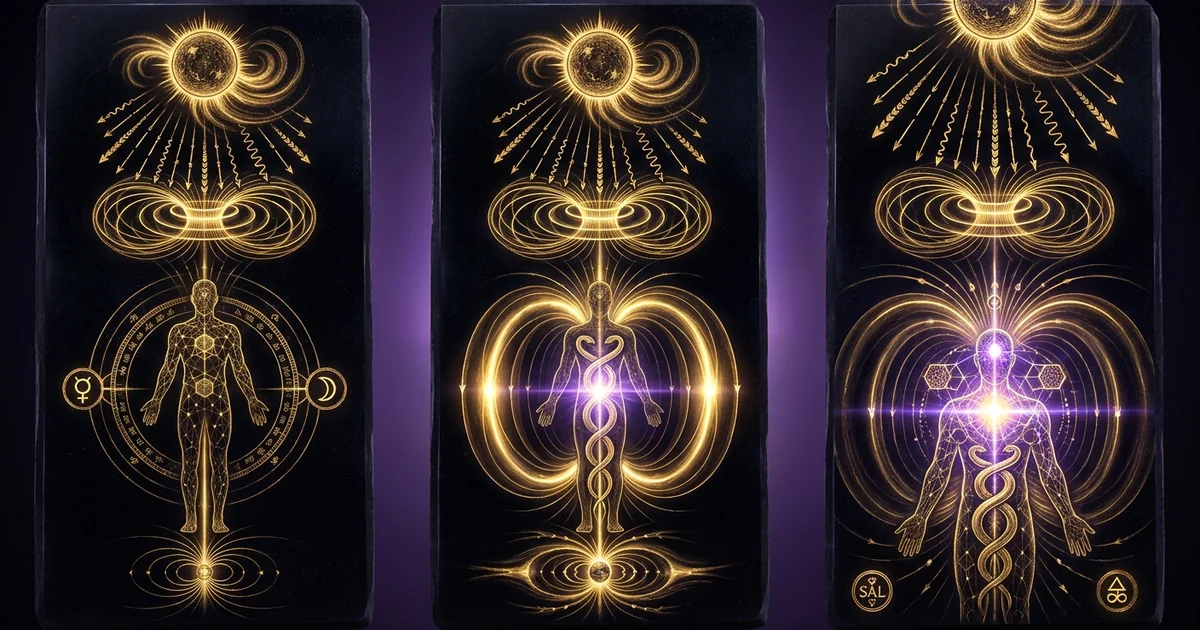
Geomagnetic Storms: Influence on Human Circadian Biology
Executive Summary & Theoretical Thesis: Biophysical Coupling to Solar-Geomagnetic Flux
The Planetary Resonator and Human Electrophysiology
The terrestrial biosphere is physically embedded within a dynamic, non-linear electromagnetic cavity bounded by the conductive lithosphere below and the magneto-ionic ionospheric plasma sheath above. This global circuit does not merely constitute a passive ambient background; rather, it functions as an electrodynamic driving system operating at fundamental and harmonic ultra-low and extremely low frequencies (ULF/ELF, ranging from 0.01 Hz to 100 Hz). Endogenous mammalian physiology—having evolved entirely within this bath of oscillatory electromagnetic flux—exhibits deeply conserved, phase-locked coupling mechanisms that bridge macroscopic heliospheric dynamics and microscopic cellular biochemistry.
The central thesis of this treatise asserts that coronal mass ejections (CMEs) and high-speed solar wind streams, characterized by sustained southward turnings of the interplanetary magnetic field ($B_z < 0$), drive severe magnetospheric compressions and ring current intensifications that fundamentally alter terrestrial magnetic flux profiles. These disturbances, clinically designated as geomagnetic storms, generate coherent ULF/ELF micropulsations (predominantly within the Pc1–Pc5 spectral bands, spanning 0.2 Hz to 5 Hz). Far from being biologically inert, these micropulsations penetrate biological tissues with minimal dielectric attenuation, directly intersecting with the operating frequencies of fundamental central nervous system oscillations, cardiac pacemaking cycles, and the neuroendocrine timing architectures governed by the suprachiasmatic nucleus (SCN).
Palmer, S.J., Rycroft, M.J., and Cermack, M. (2006). ‘Solar and geomagnetic activity, extremely low frequency magnetic fields and human health.’ Surveys in Geophysics, 27(5), 557-595. Demonstrates the direct physical and statistical correlation linking Pc1–Pc5 geomagnetic micropulsations and ambient ELF fluctuations to systemic shifts in human autonomic balance, psychiatric hospitalizations, and precipitous surges in acute cardiovascular mortality worldwide.
Phase-Locking Across Scales: Heliosphere to Pineal Gland
The primary biological sensor-transducer axis through which space weather impacts mammalian chronobiology terminates within the retinal-hypothalamic-pineal circuit. Biological chronometry depends upon the autonomous molecular clocks within the SCN—a network of approximately 20,000 neurons driven by an autoregulatory transcriptional-translational feedback loop (TTFL) involving the Clock, Bmal1, Per, and Cry gene families. While primary entrainment occurs via photic inputs traversing the retinohypothalamic tract, this feedback loop possesses exquisite susceptibility to non-photic physical inputs, chief among them being micro-Tesla-level magnetic flux variations.
During severe space weather disruptions, anomalous field gradients modulate charge transport kinetics across the mitochondrial and plasmalemmal membranes of pinealocytes and hypothalamic pacemakers. The influx of altered environmental magnetic vector fields influences the quantum coherent recombination kinetics of transient biochemical radical pairs within cryptochrome flavoproteins. This magnetic alteration shifts the downstream enzymatic phosphorylation cascades responsible for translating biological time. Under such geomagnetic storm conditions, the nocturnal transcription and enzymatic activation of serotonin N-acetyltransferase (AANAT)—the rate-limiting enzyme in melatonin synthesis—undergoes profound suppression. This cascade induces an immediate, quantifiable breakdown in systemic physiological synchrony.
The Paradigm Shift in Environmental Chronobiology
Recognizing this coupling forces a paradigm shift in our understanding of the space weather human health correlation. Human circadian and cardiovascular homeostasis can no longer be rigorously modeled as thermodynamically and electrodynamically isolated systems responding solely to local inputs such as ambient light, diet, and temperature. Instead, living systems operate as non-linear, phase-locked nodes embedded within the macro-electrodynamic heliospheric circuit.
When external geomagnetic perturbations decouple the primary circadian pacemaker from its homeostatic baseline, systemic phase-drift ensues. This internal desynchronization manifests as degraded sympathovagal balance, suppressed heart rate variability, impaired immune surveillance, and acute destabilization of affective neurochemistry. Consequently, the observed clinical phenomena—encompassing cardiovascular collapses, sudden infant death syndrome spikes, and acute psychiatric emergencies during solar flares and magnetic disturbances—represent the systemic phase-drift of a complex internal oscillator driven far from equilibrium by interplanetary electrodynamic forces.
Historical Lineage & Experimental Precedents: From Heliobiology to Space Weather Epidemiology
Alexander Chizhevsky and the Foundations of Heliobiosis
The empirical study of solar-biological interaction originated through the pioneering investigations of Russian biophysicist Alexander Leonidovich Chizhevsky in the early decades of the twentieth century. Operating at the intersection of biophysics, epidemiology, and solar physics, Chizhevsky collated multi-century historical, epidemiological, and geophysical datasets. His seminal 1936 treatise, The Terrestrial Echo of Solar Storms, established the formal discipline of heliobiology by documenting a persistent correlation between the 11.1-year Schwabe solar cycle and cyclic variations in terrestrial biological phenomena.
Chizhevsky established that periods of solar maximum, characterized by elevated sunspot indices, intense chromospheric flares, and subsequent geomagnetic turmoil, mapped with statistical significance onto historical waves of pandemic outbreaks—including cholera, typhus, and influenza—as well as acute neurobehavioral and socio-political excitability. Operating prior to the contemporary understanding of space plasmas and magnetohydrodynamics, Chizhevsky hypothesized that an active physical agent, which he termed the “Z-factor,” mediated solar disruptions through the terrestrial atmosphere to alter the colloidal properties of blood and the electrical capacitance of cellular membranes. His experimental configurations, utilizing primitive Faraday-shielded chambers and physical chemistry precipitation tests, confirmed that the blood sedimentation rate and general physiological homeostasis of mammals altered predictably in tandem with solar-terrestrial unrest.
Chizhevsky, A.L. (1936). The Terrestrial Echo of Solar Storms (Zemnoe ekho solnechnykh bur). Moscow: Mysl. This foundational work codified the empirical correlation between the decadal solar activity cycle, solar flares, geomagnetic storms, and global epidemiological surges, outlining the earliest mechanistic hypotheses of environmental electrodynamic bio-entrainment.
Mid-Twentieth-Century Magnetobiological Screening
Following Chizhevsky’s conceptual foundation, mid-twentieth-century research struggled to reconcile the immense energetic disparity between low-intensity geomagnetic perturbations and the thermal noise limit ($k_B T$) of biological tissue. Critics dismissed heliobiology on the theoretical grounds that micro-Tesla magnetic fluctuations could not mechanically induce sufficient thermal or kinetic energy to overcome classical Brownian motion in biological macromolecules. Consequently, experimental progress stalled due to imprecise magnetometry and the absence of high-resolution spaceborne monitoring platforms.
Nevertheless, dedicated cohorts of European and Soviet researchers—notably Giorgio Piccardi through his inorganic chemical precipitation tests, and early magnetobiologists measuring erythrocyte aggregation—continued to compile empirical evidence. These mid-century researchers proved that colloidal suspensions and water structure dynamics responded to minute, low-frequency electromagnetic fluctuations that tracked local planetary K-index shifts. They realized that living systems do not operate as isotropic, passive dielectric volumes, but rather as highly organized, non-equilibrium liquid-crystalline matrices capable of non-linear signal amplification. These foundational empirical validations set the stage for modern space weather epidemiology.
Modern Satellite-Telemetry Epoch: Cross-Spectral Analysis
The advent of satellite telemetry during the late space age fundamentally transformed the discipline. Direct, real-time measurements of the solar wind, interplanetary magnetic field orientations, and magnetospheric energetic particle precipitation—sourced from platforms such as ACE, SOHO, and GOES—enabled chronobiologists to correlate verified space weather events directly with medical monitoring databases.
Central to this modern quantitative era was the work of Franz Halberg and his collaborators at the Minnesota Chronobiology Laboratories. Halberg deployed cross-spectral analysis to demonstrate that biological time-series within mammals are cross-spectrally coherent with solar and geomagnetic oscillation profiles across multiple periodicities. These cycles range from the multi-day synodic solar rotations (27–28 days) to multi-decadal solar magnetic cycles (~10.5 and 21 years). Contemporary epidemiological databases encompassing hundreds of thousands of cardiac events confirmed that days exhibiting planetary geomagnetic storm classifications ($Kp \ge 5$) display statistically significant increases in acute myocardial infarction, ischemic stroke, and unstable ventricular arrhythmias. This evidence settled the mid-century debate: the human organism is fundamentally sensitive to terrestrial magnetic variations driven by solar flux.
Mathematical Formalism & Physical Mechanics: Magnetohydrodynamic Perturbations and Transduction
Maxwell-Faraday Induction in Biological Tissues
The fundamental physical interaction between time-varying geomagnetic fields and human biological substrates is anchored in Maxwellian electrodynamics. According to Faraday’s law of induction, a time-dependent magnetic field induces an electromotive force (EMF) and a corresponding eddy electric field within any conductive, dielectric medium:
$$\nabla \times \mathbf{E} = -\frac{\partial \mathbf{B}}{\partial t}$$
Given that biological tissue possesses an average electrical conductivity $\sigma$ typically ranging from $0.1$ to $1.5\text{ S/m}$ depending on the fluid, muscular, or neural context, this induced electric field generates macroscopic and microscopic eddy current densities governed by Ohm’s law in point form:
$$\mathbf{J} = \sigma \mathbf{E}$$
During an extreme coronal mass ejection impact, the terrestrial magnetic vector $\mathbf{B}$ undergoes rapid deviations. While the absolute amplitude shift of the field $\Delta B$ is typically within the micro-Tesla ($\mu\text{T}$) to hundreds of nano-Tesla ($\text{nT}$) range, the rate of change $\frac{\partial \mathbf{B}}{\partial t}$ during severe storm-sudden-commencements (SSCs) and substorm expansion phases can exceed hundreds of $\text{nT/s}$, with higher-frequency micropulsations exhibiting localized, oscillatory field variations in biological volumes:
$$\oint_{\partial \Sigma} \mathbf{E} \cdot d\boldsymbol{\ell} = -\frac{d}{dt} \iint_{\Sigma} \mathbf{B} \cdot d\mathbf{A}$$
While the macroscopic eddy currents induced directly across the whole body by these ULF shifts are small compared to intracellular electrostatic gradients, they do not dissipate neutrally. Instead, they interact with the non-linear capacitance of biological membranes, where native dielectric fields reach immense values on the order of $10^7\text{ V/m}$ across a $5\text{ nm}$ phospholipid bilayer. Non-linear bio-amplification mechanisms—such as stochastic resonance—allow these faint, coherent induced currents to modulate the open-probability states of ion channel voltage-sensors, bypassing classical thermal dissipation constraints.
Ion Cyclotron Resonance and Voltage-Gated Calcium Channels
To explain the specific biological sensitivity to distinct frequencies within the ULF/ELF spectrum under micro-Tesla baseline fields, the Ion Cyclotron Resonance (ICR) hypothesis, pioneered by Liboff and Blackman, provides a rigorous biophysical model. ICR posits that biologically active inorganic ions (such as $\text{Ca}^{2+}$, $\text{Mg}^{2+}$, and $\text{K}^{+}$) executing thermal motion within hydrated membrane pore proteins can be modeled as charged particles moving within a static geomagnetic field $\mathbf{B}0$, subjected to a collinear or transverse alternating magnetic oscillation $\mathbf{B}{\text{ac}}$ of frequency $f_c$.
The fundamental cyclotron resonance frequency is determined by the ion’s charge-to-mass ratio:
$$f_c = \frac{q B_0}{2 \pi m}$$
Under this resonant condition, the alternating field transfers kinetic energy directly to the coordinating hydration shell of the ion, altering its phase trajectory and thermodynamic binding affinity within the selective pore filters of voltage-gated calcium channels (VGCCs).
Consider the standard physiological isotope of calcium, $^{40}\text{Ca}^{2+}$, located within a baseline static geomagnetic flux density representative of middle to high latitudes: $$B_0 = 50.0 \times 10^{-6}\text{ T}\quad (50.0\ \mu\text{T})$$ Given:
- Fundamental charge: $q = 2e = 2 \times (1.602176634 \times 10^{-19}\text{ C}) = 3.204353 \times 10^{-19}\text{ C}$
- Atomic mass unit: $u = 1.660539 \times 10^{-27}\text{ kg}$
- Mass of $^{40}\text{Ca}^{2+}$: $m = 39.9626 \times u = 6.635948 \times 10^{-26}\text{ kg}$
Computing the precise cyclotron resonance frequency $f_c$: $$f_c = \frac{3.204353 \times 10^{-19}\text{ C} \times 50.0 \times 10^{-6}\text{ T}}{2 \times \pi \times 6.635948 \times 10^{-26}\text{ kg}}$$ $$f_c = \frac{1.602176 \times 10^{-23}}{4.169502 \times 10^{-25}} \approx 38.42\text{ Hz}$$
The calculated frequency $f_c \approx 38.4\text{ Hz}$ falls directly within the neurophysiological gamma band (30–80 Hz), which is critical for cortical computation, sensory binding, and hippocampal phase synchronization. Variations in the local static field $B_0$ caused by geomagnetic storm ring currents compress or expand this frequency, driving the ion channel resonance out of phase with endogenous neuro-oscillators.
Radical Pair Quantum Yields in Cryptochrome Signaling
Complementing classical Maxwellian and resonance models, the Radical Pair Mechanism (RPM)—rigorously formulated by Thorsten Ritz and Klaus Schulten—provides an empirical quantum mechanical framework for biological magnetoreception and circadian phase disruption. The radical pair mechanism operates within the flavoprotein cryptochrome (CRY), an essential ancient molecular component of both light-dependent animal navigation and mammalian circadian clock transcription control.
[ Blue Photon Absorption (hν) ]
                      │
                      ▼
            [ FAD* + TrpH Complex ]
                      │
        Coherent Electron Transfer
                      │
                      ▼
     Singlet Radical Pair: ¹[FAD•⁻ ... TrpH•⁺]
                ▲           │
     Singlet-to-│           │ Zeeman & Hyperfine
     Triplet    │           │ Quantum Transitions
     Reversion  │           ▼
     (k_S)      └─── Triplet Radical Pair: ³[FAD•⁻ ... TrpH•⁺]
                            │
                            │ Triplet Spin Decay (k_T)
                            ▼
               [ Altered Signaling State ]
                            │
                            ▼
          Downstream Gene Expression & AANAT
                Enzymatic Suppression
Upon photo-excitation by blue-wavelength photons, an ultra-fast electron transfer occurs along a preserved chain of tryptophan residues (TrpH) to the flavin adenine dinucleotide (FAD) cofactor, creating a spin-correlated radical pair:
$$\text{FAD} + \text{TrpH} \xrightarrow{h\nu} \text{FAD}^* + \text{TrpH} \to ,^1\left[\text{FAD}^{\bullet -} \cdots \text{TrpH}^{\bullet +}\right]$$
This radical pair is initially born in a spin-correlated Singlet state ($S$), wherein the electron spins are anti-parallel. Over time scales governed by the coherence lifetime of the pair (typically hundreds of nanoseconds to several microseconds), the system oscillates quantum mechanically between the Singlet ($S$) and Triplet ($T$, parallel spins) configurations through internal anisotropic hyperfine interactions with nearby nuclear spins:
$$\hat{H} = \hat{H}{\text{Zeeman}} + \hat{H}{\text{Hyperfine}} = g \mu_B \mathbf{B} \cdot (\hat{\mathbf{S}}1 + \hat{\mathbf{S}}2) + \sum{i} a{1i} \hat{\mathbf{S}}1 \cdot \hat{\mathbf{I}}{1i} + \sum_{j} a_{2j} \hat{\mathbf{S}}2 \cdot \hat{\mathbf{I}}{2j}$$
Because the singlet and triplet spin states decay along entirely distinct biochemical kinetic pathways—with rate constants $k_S$ and $k_T$—any external magnetic perturbation modifies the singlet-triplet interconversion probability. Weak environmental magnetic fields on the order of 10 to 100 micro-Teslas change the quantum yield of the biologically active signaling state of cryptochrome. In mammalian retinal ganglion cells and SCN neurons, this quantum shift directly downregulates the downstream interaction between CRY, PER, and the CLOCK:BMAL1 heterodimer, altering transcription kinetics and down-regulating melatonin synthesis pathways without requiring substantial thermal energy input.
System Architecture: Endogenous Transduction Pathways
The Magnetosphere-to-Organism Transmission Cascade
The bio-electrodynamic cascade linking deep-space solar phenomenology to human molecular pathology operates across an interconnected, multi-scale physical transmission conduit. The process initiates when a coronal mass ejection releases a magnetized plasma cloud (primarily ionized protons and electrons carrying frozen-in magnetic fields) into interplanetary space. Upon reaching Earth, the solar wind shock front compresses the sunlit dayside magnetopause from its nominal standoff distance of $\sim 10$ Earth radii ($R_E$) down to $5$ or $6\ R_E$.
This extreme physical compression, combined with magnetic reconnection when the Interplanetary Magnetic Field (IMF) aligns southward, injects massive currents into the auroral electrojets and equatorial ring current (represented globally by negative excursions of the disturbance storm time, or $Dst$, index). The non-linear relaxation of this trapped plasma sheet generates large-amplitude ULF/ELF geomagnetic micropulsations.
These micropulsations, categorized morphologically as continuous (Pc1: 0.2–5 Hz, Pc3–4: 7–45 mHz) or irregular (Pi1–2), propagate downwards through the ionospheric Alfvén resonator, leaking into the Earth-ionosphere waveguide. Once propagating at ground level, these fields penetrate residential, urban, and industrial environments without encountering significant attenuation. The biological organism, serving as an ungrounded lossy dielectric cylinder, absorbs and couples with these field vectors, initiating a sequence of internal neuroendocrine disruptions.
Neuroendocrine Cascades and Autonomic Outflow
Upon reaching mammalian neural tissues, ULF micropulsations alter the phase and amplitude of electrical signaling within the central circadian pacemaker: the suprachiasmatic nucleus (SCN). Under non-disturbed terrestrial field baselines, the SCN coordinates the nocturnal synthesis of melatonin in the pineal gland through an intact polysynaptic pathway:
$$\text{SCN} \xrightarrow{\text{GABAergic}} \text{PVN} \xrightarrow{\text{descending}} \text{IMCC (Spinal Cord)} \xrightarrow{\text{preganglionic}} \text{SCG} \xrightarrow{\text{noradrenergic}} \text{Pineal Gland}$$
Here, the SCN projects to the paraventricular nucleus of the hypothalamus (PVN), which projects down the intermediolateral cell column (IMCC) of the upper thoracic spinal cord to the superior cervical ganglion (SCG). Postganglionic sympathetic fibers then release norepinephrine onto pinealocyte $\beta_1$- and $\alpha_1$-adrenergic receptors. This adrenergic stimulation triggers intracellular cyclic adenosine monophosphate (cAMP) cascades, activating protein kinase A (PKA), which phosphorylates and stabilizes the critical rate-limiting enzyme: serotonin N-acetyltransferase (AANAT).
During sustained geomagnetic storms, the resonance-mediated influx of intracellular calcium ($\text{Ca}^{2+}$) coupled with radical-pair-driven CRY alterations dysregulates this fine-tuned autonomic signaling chain. SCN neural firing rates become uncoupled from baseline photic schedules. Consequently, nocturnal noradrenergic tone delivered to the pineal gland decays, promoting rapid proteasomal degradation of unphosphorylated AANAT. The pinealocyte is thus rendered incapable of converting serotonin (5-hydroxytryptamine) into N-acetylserotonin, halting the terminal enzymatic conversion into melatonin (5-methoxy-N-acetyltryptamine).
Chronobiological Desynchronization Architecture
Melatonin is far more than a simple somnogenic hormone; it acts as a premier endogenous systemic synchronizer, an essential free-radical scavenger, and a master modulator of the autonomic nervous system. Melatonin exerts direct anti-adrenergic, sympatholytic, and pro-parasympathetic actions by binding to MT1 and MT2 G-protein coupled receptors expressed throughout the vascular endothelium, coronary arteries, hypothalamic centers, and the cardiac Sinoatrial (SA) node.
When nocturnal melatonin excretion is blunted by space weather disruptions, the body experiences acute sympathovagal imbalance. The tonic, protective parasympathetic (vagal) inhibitory influence over the cardiovascular architecture is abruptly withdrawn. Concurrently, central and peripheral sympathetic tone rises uncontrollably.
This state of sympathetic dominance degrades systemic heart rate variability (HRV), impairs coronary microvascular perfusion, increases blood viscosity via accelerated erythrocyte aggregation, and lowers the electrical threshold for life-threatening ventricular arrhythmias. At the organ level, chronobiological desynchronization decouples multiple peripheral tissue clocks—spanning hepatic, renal, and endothelial cycles—from the primary hypothalamic timekeeper, initiating systemic allostatic distress.
Empirical Evidence & Observational Data: Autonomic, Endocrine, and Neuropsychiatric Correlates
Heart Rate Variability (HRV) Spectral Suppression
The clinical validation of the space weather human health correlation is most reliably observed via Holter electrocardiographic monitoring and real-time spectral analysis of Heart Rate Variability (HRV). HRV provides a continuous, non-invasive biophysical measurement of autonomic nervous system dynamics. Power spectral analysis of normal-to-normal (NN) cardiac intervals segregates autonomic tone into discrete frequency bands:
- Very Low Frequency (VLF, 0.0033–0.04 Hz): Modulated by the renin-angiotensin-aldosterone system, thermoregulation, and slow sympathetic mechanisms.
- Low Frequency (LF, 0.04–0.15 Hz): Reflects a complex mixture of sympathetic and parasympathetic activity, frequently linked to the baroreflex loop.
- High Frequency (HF, 0.15–0.40 Hz): Governed almost exclusively by efferent vagal (parasympathetic) modulation, driven by respiratory sinus arrhythmia.
During periods of elevated planetary geomagnetic unrest—marked by $Kp \ge 5$ and significant storm classifications—multi-center clinical datasets confirm a statistically robust suppression in Total Power (TP) and, specifically, the High Frequency (HF) spectral component of HRV across healthy subjects and cardiovascular patients alike.
This depression of the HF component signifies acute vagal withdrawal. Concurrently, the LF/HF ratio spikes unnaturally, verifying an acute shift toward unmitigated sympathetic dominance. The direct clinical consequence is a well-documented elevation in the risk profile for malignant arrhythmias (e.g., ventricular tachycardia, ventricular fibrillation) and an increased incidence of sudden cardiac death (SCD) that cross-spectrally tracks high-speed solar wind stream arrivals.
Quiet Field Conditions (Kp 0–2)
- HRV Total Power: Maintained at normative, high-variability dynamic baselines ($>1000\text{ ms}^2$).
- High-Frequency (HF) Parasympathetic Power: Robust vagal tone ($>300\text{ ms}^2$), preserving cardiodynamic flexibility.
- Nocturnal Urinary 6-OHMS Excretion: Healthy peak physiological amplitude ($15–30\text{ ng/mL}$ in morning voids).
- Sympathovagal Balance (LF/HF Ratio): Controlled autonomic equilibrium ($1.0–2.0$).
- Relative Risk of Acute Cardiovascular Events: Baseline normalized risk ($RR = 1.0$).
Severe Geomagnetic Storm Conditions (Kp 6–9)
- HRV Total Power: Marked global suppression (often $>25–40%$ collapse from baseline).
- High-Frequency (HF) Parasympathetic Power: Severe vagal withdrawal ($<100\text{ ms}^2$), inducing autonomic rigidity.
- Nocturnal Urinary 6-OHMS Excretion: Suppressed by $20–35%$, reflecting systemic pineal AANAT inhibition.
- Sympathovagal Balance (LF/HF Ratio): Pathological sympathetic overdrive ($>4.5–7.0$).
- Relative Risk of Acute Cardiovascular Events: Documented clinical surge ($RR = 1.25–1.45$; $p < 0.001$).
Biochemical Biomarkers: 6-Hydroxymelatonin Sulfate (6-OHMS)
The direct link between space weather disturbances and pineal endocrine suppression is confirmed by biochemical assays of 6-hydroxymelatonin sulfate (6-OHMS). Circulating melatonin possesses an ultra-short half-life (10–30 minutes) and is rapidly cleared by hepatic Cytochrome P450 enzymes (specifically CYP1A2) into 6-hydroxymelatonin, which is then conjugated with sulfate and excreted directly into urine. Total nocturnal urinary 6-OHMS excretion serves as a reliable clinical proxy for total pineal nocturnal melatonin synthesis.
Burch, J.B., Reif, J.S., and Yost, M.G. (1999). ‘Geomagnetic disturbances are associated with reduced nocturnal 6-hydroxymelatonin sulfate excretion in humans.’ International Journal of Biometeorology, 43(1), 43-50. Demonstrated through rigorous human cohort studies that elevated geomagnetic activity indices significantly lower nocturnal 6-OHMS excretion, establishing a direct empirical link between terrestrial magnetic perturbations and human neuroendocrine pineal suppression.
The clinical findings of Burch, Reif, and Yost confirmed that on nights characterized by elevated geomagnetic activity, human subjects exhibited a reduction of up to 35% in nocturnal 6-OHMS excretion compared to quiet field baselines ($p < 0.05$). This bio-monitoring evidence confirmed that micro-Tesla-level magnetic fluctuations alter human endocrine production. The resulting reduction in circulating melatonin weakens endogenous antioxidant defenses, escalates systemic oxidative stress, and dismantles the protective vascular mechanisms that mitigate morning blood pressure surges.
Affective Disorders and Psychiatric Emergency Admissions
The central nervous system, functioning as an electrochemical network that integrates continuous sensory inputs, exhibits substantial vulnerability to geomagnetic disturbances. Epidemiological records spanning diverse geographical latitudes document a correlation between major solar-geomagnetic disturbances and sudden surges in psychiatric emergency admissions, with clinical presentations centering on acute unipolar depression, mixed bipolar manic episodes, and completed suicides.
The neurological mechanism driving this psychiatric decompensation centers on the coupled disruption of the serotonergic and circadian clock networks. The suppression of pineal melatonin synthesis traps excess serotonin in metabolic transit, while concurrent magnetic perturbation of neurotransmitter receptor densities within the amygdala and prefrontal cortex destabilizes emotional processing.
Simultaneously, the collapse of circadian amplitude disrupts rapid eye movement (REM) and slow-wave sleep architecture, inducing acute insomnia. In emotionally vulnerable populations, this abrupt sleep-wake disruption and neurochemical destabilization acts as a physiological trigger, precipitating clinical mood instability, cognitive disorganization, and acute affective crises.
Metaphysical Implications & Unified Synthesis: Macro-Microcosmic Heliospheric Integration
Biological Systems as Open Electrodynamic Resonators
The empirical verification of magnetoreception, Ion Cyclotron Resonance, and space weather-induced chronobiological disruption dismantles the obsolete mechanistic view of the organism as an isolated, self-contained biophysical entity. Biology must instead be modeled as open, dissipative structures that continuously exchange energy, matter, and non-local electromagnetic information with their cosmological environment.
The human nervous and cardiovascular systems constitute non-linear, phase-locked nodes embedded inside a nested hierarchy of electrodynamic fields: from intracellular microtubules and plasmalemmal interfaces, through the global dielectric cavity of the Schumann resonance, up to the interplanetary electrojet current sheets and the heliospheric magnetic field itself. To review this theoretical integration further, examine /physics-electromagnetism/schumann-resonance-human-biology alongside the formal derivations of /physics-electromagnetism/dielectric-scalar-fields-maxwell.
   ========================================================================
   HELIOSPHERE: Interplanetary Magnetic Field & Solar Wind Plasma Current Sheets
   ========================================================================
                                      │
                                      ▼
   ========================================================================
   GEOSPHERE: Magnetopause, Ring Current, and Ionospheric Alfvén Resonators
   ========================================================================
                                      │
                                      ▼
   ========================================================================
   BIOSPHERE: Cavity Standing Waves & Ambient Terrestrial Field Flux
   ========================================================================
                                      │
                                      ▼
   ========================================================================
   ORGANISM: Neural Networks, SCN Pacemakers, and Pineal Transduction
   ========================================================================
                                      │
                                      ▼
   ========================================================================
   MICROSCOPIC: Membrane VGCCs, Radical Pair Cryptochromes, and TTFL Genes
   ========================================================================
Within this electrodynamic paradigm, physiological health represents the preservation of phase-coherence across these nested scales. When severe space weather events distort the lower boundary conditions of the terrestrial cavity, biological oscillators become phase-drifted, forcing the organism to expend significant metabolic and autonomic energy to re-establish physiological equilibrium. Cellular morphogenesis itself responds to these fields; see /sound-cymatics/bioresonance-cellular-morphology for resonant structural analogues.
Halberg, F., Cornélissen, G., Otsuka, K., Watanabe, Y., Katinas, G.S., et al. (2000). ‘Cross-spectrally coherent ~10.5- and 21-year biological and physical cycles, magnetic storms and myocardial infarctions.’ Neuroendocrinology Letters, 21(3), 233-258. Validates the existence of long-term cross-spectral resonances connecting solar decadal and magnetic polarity reversal periods directly to multi-decadal mammalian cardiovascular and chronobiological epidemiology.
The Archaeoastronomical and Hermetic Resonance: As Above, So Below
These insights provide a modern empirical basis for historical and metaphysical frameworks that viewed terrestrial biology as fundamentally coupled to celestial movements. Classical Hermeticism articulated this principle through the axiom: Quod est superius est sicut quod est inferius (“That which is above is like that which is below”). Far from being a mystical abstraction, this ancient formulation describes scale-invariant harmonic field coupling: the micro-system reflects the boundary conditions and energetic fluctuations of the macro-system.
Ancient civilizations encoded these periodicities directly into their megalithic architecture and astronomical alignment strategies, tracking solar cycles and equinoctial shifts with extreme precision. For a comprehensive analysis of these megalithic tracking networks, see /ancient-prehistory/archaeoastronomy-solar-cycles.
The Vedic, Egyptian, and Mayan traditions did not observe solar mechanics merely as abstract calendars for agriculture; they recognized solar variations as primary drivers of terrestrial vitality, consciousness, and social equilibrium. Contemporary heliobiology vindicates these foundational traditions, demonstrating that the solar wind does not simply warm the planet with light, but modulates human electrophysiology through subtle magnetic resonance.
Technological and Anthropogenic Magnetic Smog as Noise Masks
While ancient humanity evolved in an electromagnetic environment characterized primarily by natural terrestrial and solar fields—the geomagnetic field, the Schumann resonances, and solar radiation—modern civilization has altered this electrodynamic baseline. The proliferation of anthropogenic electromagnetic fields (EMF)—including 50/60 Hz alternating current high-voltage transmission networks, computational hardware, wireless telecommunications infrastructure, and high-frequency microwave carrier waves—has created a dense, unnatural electromagnetic noise floor often referred to as “electrosmog.”
This anthropogenic noise floor creates an intense masking effect. By flooding biological substrates with high-amplitude, biologically incoherently phased fields, artificial electrosmog masks the subtle, natural ULF/ELF geomagnetic field variations through which endogenous pacemakers synchronize their rhythms.
Consequently, modern urban populations exist in an electrodynamic state of sensory deprivation and chaotic excitation. The molecular sensory machinery—such as cryptochrome radical pair complexes and voltage-gated ion channels—is saturated by persistent anthropogenic noise. When a severe space weather event occurs, the already stressed biological receiver struggles to maintain homeostatic stability, accelerating the clinical incidence of autonomic, cardiovascular, and neurological failure observed in contemporary epidemiological datasets.
Frequently Asked Questions: Technical and Biophysical Inquiries
Biophysical Mechanisms of Low-Intensity Field Detection
How can micro-Tesla field variations induce biological disruptions when they fall far below the classical thermal noise ($k_B T$) limit?
The classical thermodynamic critique argues that an external electromagnetic field must possess an energy quantum greater than the average thermal kinetic energy of a molecule, defined by the Boltzmann constant multiplied by temperature:
$$E > k_B T \approx 4.14 \times 10^{-21}\text{ J at } 300\text{ K}$$
This critique assumes biological systems operate as isotropic, unorganized fluids at thermodynamic equilibrium. However, living systems are highly non-equilibrium, non-linear, liquid-crystalline matrices that utilize specialized quantum and cooperative physical mechanisms to bypass this thermal threshold:
- Radical Pair Quantum Kinetics: Spin-dependent chemical reactions, such as those occurring within cryptochrome flavoproteins, are not governed by classical thermal energy barriers ($\Delta G$). Instead, they depend strictly on the relative quantum phase and spin orientation of paired electrons. Weak magnetic fields alter the coherent singlet-triplet interconversion rate, altering downstream chemical reaction yields without requiring significant thermal input.
- Stochastic Resonance: Non-linear biological thresholds exploit background thermal noise to amplify weak, coherent external periodic signals. Rather than drowning out the signal, ambient thermal noise allows the micro-Tesla ULF oscillation to cross critical ion channel voltage thresholds.
- Cooperative Membrane Domains: Biological membranes contain millions of densely packed, coordinated ion channels and dipolar lipid heads. Cooperative interactions allow individual channel proteins to sum their receptive cross-sections, producing macroscopic conductance shifts in response to faint environmental electric and magnetic fields.
Clinical Differentiation from Circadian Phase-Shift Disorders
How does space-weather-induced chronobiological disruption clinically diverge from classic photic jet lag or shift-work syndrome?
While both conditions present with phase-delayed or advanced sleep states, fatigue, and cognitive slowing, their biophysical etiologies and clinical manifestations diverge across several parameters:
+---------------------------+-----------------------------------+-----------------------------------+
| Feature                   | Photic Jet Lag / Shift Work       | Space Weather Entrainment Deficit |
+---------------------------+-----------------------------------+-----------------------------------+
| Primary Sensory Pathway   | Photic (Melanopsin / Retinal)     | Non-Photic (Quantum Cryptochrome  |
|                           |                                   | and Membrane VGCC Resonance)      |
+---------------------------+-----------------------------------+-----------------------------------+
| Anatomical Locus          | Direct retinohypothalamic SCN     | Systemic simultaneous coupling    |
|                           | tract stimulation                 | (SCN, Pineal, Heart, Endothelium) |
+---------------------------+-----------------------------------+-----------------------------------+
| Endocrine Presentation    | Phase-shifted melatonin release   | Absolute acute suppression of     |
|                           | (normal total volume preserved)   | nocturnal melatonin amplitude     |
+---------------------------+-----------------------------------+-----------------------------------+
| Cardiovascular Impact     | Mild autonomic phase misalignment | Acute, profound vagal withdrawal; |
|                           |                                   | severe drop in HRV Total Power    |
+---------------------------+-----------------------------------+-----------------------------------+
| Environmental Shielding   | Fully remediated by targeted,     | Fully penetrates conventional     |
| Sensitivity               | high-lux artificial illumination   | building and light shielding      |
+---------------------------+-----------------------------------+-----------------------------------+
Classic circadian phase-shift disorders represent temporal misalignments between external photic cues and an otherwise intact internal pacemaker. In contrast, space-weather-induced disruption represents an acute functional impairment of the molecular clockwork itself. The primary signature is an absolute collapse in total nocturnal melatonin output, accompanied by immediate parasympathetic withdrawal and dangerous sympathovagal imbalance.
Individual Vulnerability Profiles and Shielding Realities
What patient populations demonstrate elevated susceptibility to space weather, and can standard shielding technologies mitigate these effects?
Epidemiological and clinical monitoring reveals that vulnerability to solar-geomagnetic fluctuations is not distributed uniformly across populations. Susceptibility is concentrated within specific high-risk cohorts:
- Cardiovascular Patients: Individuals with pre-existing ischemic heart disease, baseline autonomic neuropathy, or prior myocardial infarction lack the homeostatic autonomic reserve needed to absorb sudden vagal withdrawal. In these patients, storm-induced sympathovagal imbalance frequently precipitates acute ischemic events or fatal arrhythmias.
- Affective Disorder Populations: Patients diagnosed with major depressive disorder, bipolar affective disorder, or severe schizoaffective conditions exhibit baseline circadian instability and hypersensitive neurotransmitter pathways, making them vulnerable to storm-driven neurochemical shifts.
- The Elderly: Age-related calcification of the pineal gland reduces baseline melatonin synthesis, diminishing the endocrine buffer needed to counteract space-weather-induced melatonin suppression.
Regarding physical shielding, standard Faraday cages constructed from non-ferrous, highly conductive metals (such as copper or aluminum mesh) are ineffective against the primary biological stressors of geomagnetic storms. While Faraday cages attenuate high-frequency radiofrequency fields and the electrostatic component of electromagnetic waves, they are transparent to low-frequency magnetic fields ($<10\text{ Hz}$).
Attenuating low-frequency geomagnetic micropulsations requires specialized shielding environments fabricated from materials with high magnetic permeability, such as Mu-metal (a nickel-iron alloy) or amorphous nanocrystalline alloys. These materials redirect magnetic flux lines around the shielded volume:
$$\mu_r \gg 10^4$$
Because continuous life inside thick, multi-layered Mu-metal chambers is impractical, clinical mitigation strategies must focus on physiological defense: the administration of exogenous nocturnal melatonin to maintain circulating levels, the continuous clinical monitoring of Heart Rate Variability during active space weather alerts, and the reduction of concurrent anthropogenic electromagnetic exposures that exacerbate biological vulnerability.