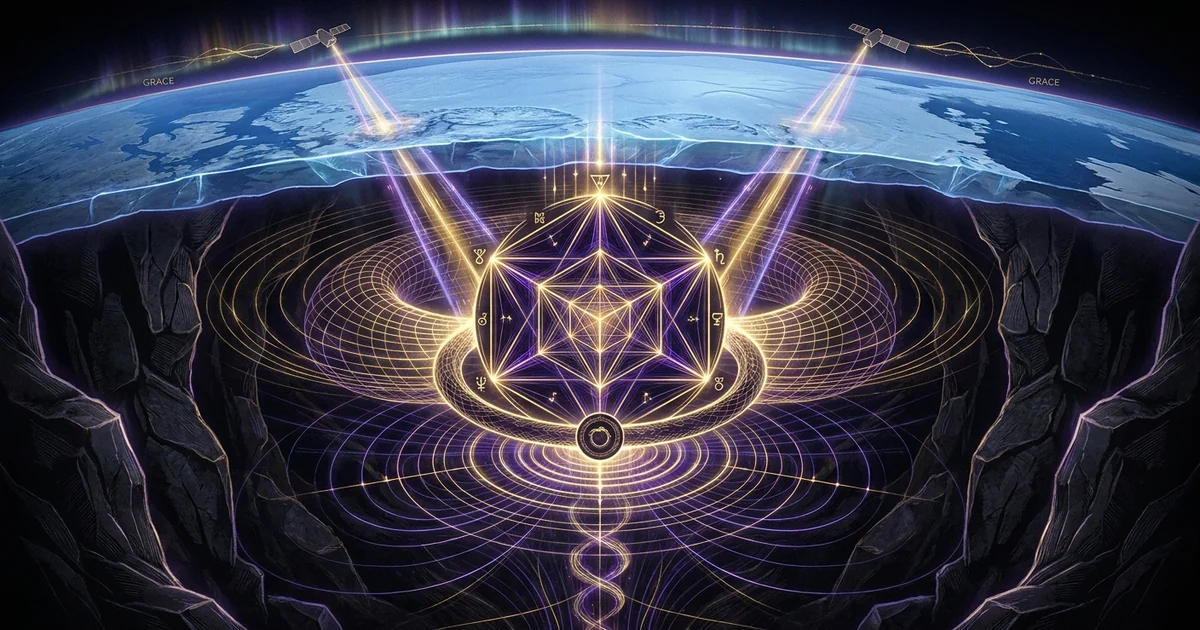
Subsurface Megastructures Detected by Satellite Gravity
Metaphysical Thesis & Epistemological Opening: Gravimetric Anomalistics and Lithospheric Non-Human Imprints
Epistemological Limits of Uniformitarian Geophysics
The epistemic foundations of modern geophysics rest upon an unexamined dogma: uniformitarian physicalism. By asserting that contemporary, observable geological processes operating at invariant rates explain all terrestrial features, mainstream geodynamics preemptively excludes artificiality from subterranean models. When satellite geodesy isolates extreme lithospheric perturbations, the consensus apparatus automatically attributes them to passive geochemical evolutions—bolide impacts, mantle plumes, or crustal flexures.
This epistemological boundary collapses when geodetic telemetry reveals structural coherences that defy stochastic distribution. Reductionist uniformitarianism confines subterranean density variances to inert geochemical processes, refusing to interrogate anomalous satellite telemetry as technosignatures or macroscopic manifestations of Non-Human Intelligence (NHI) operating within planetary crusts. By treating the Earth’s crust as an exclusively abiotic, unconscious substrate, geophysics blinds itself to the possibility that planetary bodies are techno-magical artefacts, engineered to sustain localized parameters of physical reality.
TERRESTRIAL OBSERVER MATRIX
                               │
               ┌───────────────┴───────────────┐
               ▼                               ▼
      Standard Geophysics            Hermetic/Valléean
     (Uniformitarian Model)          (Ontological Model)
               │                               │
    [ Invariant Infilling ]         [ Engineered Mascon ]
    [  Mantle Upwelling   ]         [ Boundary Regulator]
    [ Stochastic Impact   ]         [ Reality Constraint]
               │                               │
               ▼                               ▼
     Inert Geochemical Mass         Information Control Node
The Wilkes Land Mascon: Satellite Geodesy vs. Standard Impact Dynamics
In 2002, NASA and the German Aerospace Center (DLR) launched the Gravity Recovery and Climate Experiment (GRACE), utilizing twin satellites orbiting in tandem to measure micrometric fluctuations in Earth’s gravitational field via K-band microwave ranging. Over the East Antarctic ice sheet, particularly within the Wilkes Subglacial Basin, GRACE telemetry isolated a staggering crustal mass concentration: the Wilkes Land mascon. This feature, spanning nearly 300 kilometers in diameter, exhibits an intense positive Bouguer gravity anomaly centered within a circular depression buried under more than two kilometers of ice.
Standard impact-physics models attempt to categorize the Wilkes Land mascon as a Permian-Triassic or Cretaceous bolide impact crater. However, shock-physics dynamics fail to account for the spatial and structural parameters revealed by orbital data. Terrestrial impact craters typically display distinct post-impact isostatic readjustment signatures, marked by concentric ring systems, brecciated low-density halos, and progressive gravitational relaxation over geological timescales. The Wilkes Land anomaly exhibits an uncharacteristic vertical coherence, an anomalous Bouguer gradient sharpness, and an absence of the predicted regional mantle uplift geometry expected from an impactor capable of puncturing the continental lithosphere. The crustal density inversion models require mathematically artificial parameters to force-fit a chondritic impactor hypothesis over what the telemetry presents: an intact, ultra-dense, geometrically consolidated subterranean mass resting uncrushed within the pre-Cambrian crystalline basement.
Analysis of GRACE satellite gravity observations over East Antarctica establishes a massive positive crustal mass anomaly centered at 70°S, 120°E. The residual free-air gravity anomaly and corresponding spherical harmonic coefficients ($l, m \ge 60$) yield a localized Bouguer density contrast exceeding $\Delta\rho = +350\text{ kg/m}^3$ relative to the surrounding crystalline basement. Standard hydrodynamic impact-melt calculations fail to reconcile the lack of corresponding regional crustal thinning with the extreme density amplitude:
$$V(r, \theta, \lambda) = \frac{GM}{r} \sum_{n=0}^{\infty} \left(\frac{a}{r}\right)^n \sum_{m=0}^{n} \left[ \bar{C}{nm} \cos(m\lambda) + \bar{S}{nm} \sin(m\lambda) \right] \bar{P}_{nm}(\cos\theta)$$
The observed high-degree harmonic residuals over the Wilkes Land crustal anomaly indicate a localized, non-Gaussian mass distribution incompatible with standard shock-induced mantle uplift. Source: von Frese, R. R. B., et al. (2009). “GRACE gravity evidence for an impact basin in Wilkes Land, Antarctica.” Geochemistry, Geophysics, Geosystems, 10(2).
Challenging the Materialist Substratum: Lithosphere as Informational Boundary
Reconceptualizing satellite gravimetry through an esoteric epistemological lens reveals that anomalies in Earth’s gravitational potential field may serve as physical grounding nodes for interdimensional or psycho-informational control architectures. When analyzed alongside frameworks developed by Jacques Vallée in his seminal work on reality conditioning, these subsurface gravity anomalies grace satellite antarctica Wilkes land transcend the category of dead mineralogy. The lithosphere is not merely a tectonic floor; it acts as an informational boundary condition.
Under this paradigm, the mascon density anomalies earth crust act as literal physical anchors within planetary matter. By concentrating immense density and generating profound localized distortions in the metric of spacetime, these regions form deep-level hardware installations. They stabilize the physical constants of the localized consensus reality, anchoring the terrestrial perceptual matrix against the hyper-dimensional volatility of the wider cosmos. The materialist insistence on reducing the Wilkes Land anomaly to an accidental bolide impact is an epistemic defense mechanism, cloaking the subterranean technosignatures of an ancient, non-human architecture embedded deep within our planetary substratum.
Primary Codices & Historical Transmission: From Chthonic Archons to Satellite Geodesy
The Hypostasis of the Archons and Lithic Incarceration
Long before orbital geodesy measured the micro-gal variations of the polar lithosphere, ancient Gnostic cosmologies recorded the deliberate placement of subterranean megaliths by non-human intelligences. In the Nag Hammadi codices, particularly The Hypostasis of the Archons (NHC II, 4) and On the Origin of the World (NHC II, 5), the material cosmos is detailed not as an organic creation of the supreme transcendent source (the pleroma), but as an architectural prison manufactured by the demiurge—Yaldabaoth—and his hierarchy of archon rulers.
Gnostic texts explain that the Archons, unable to grasp the pure spiritual luminosity of the upper aeons, sought to immobilize spirit by binding it to dense, heavy, sub-terrestrial matter. They cast dense foundations into the abyss, establishing rigid gravitational and material anchors to enclose the soul in a psychotronic terrestrial cage. The physical creation described in these codices reflects an engineered entrapment, a material stabilization that prevents pneumatic awakening by fixing human perceptual bandwidth to the lower energetic octaves of the physical elements.
“And their chief came forth, possessing the appearance of a lion, and his mind became inflated with vanity. He said, ‘I am god, and there is no other beside me.’ He placed his powers within the realms of the abyss; he laid foundations beneath the depths, casting downward dense weights of darkness to be the anchors of the earthly sphere…” Contextual Hermeneutics: The Coptic term shento (foundations/deep structures) coupled with báros (weights/inert masses) designates deliberate structural architectures inserted into the planetary underworld to solidify the lower matter against the luminous fluidity of the Pleroma.
Hermetic Geodesy: The Corpus Hermeticum and Terrestrial Pneumatic Grids
Parallel to the Gnostic codices, the Corpus Hermeticum and later Western esoteric transmissions preserve the doctrine that the terrestrial sphere is webbed by subterranean conduits governing planetary sympathies (sympatheia). Hermetic geodesy asserts that matter is not uniformly passive; certain geographic loci serve as resonant chambers that interface celestial hierarchies with telluric currents. Theurgy, as codified by Iamblichus and refined through Renaissance Hermeticism, depended directly on the localization of these subterranean energetic centers.
These subterranean mascons, situated in regions unencumbered by civilizational interference like the Antarctic craton, operate as planetary talismans of immense proportions. Within the Hermetic framework, an entity or an egregore requires a material base—a synthema—to fix its operations within physical spacetime. A subterranean mass concentration possessing an unnatural gravitational signature serves as an indestructible, hyper-dense telluric anchor, tethering macrocosmic energetic inputs directly into the planetary body. The Hermetic axiom “As Above, So Below” here finds an unexpected physical instantiation: celestial forces are tethered down into physical space through deep lithospheric density sinks.
CELESTIAL / HYPERDIMENSIONAL INFLUX
                          │
                          ▼
            [ Telluric Resonant Surface ]
                          │
       ┌──────────────────┴──────────────────┐
       ▼                                     ▼
[ Astrological Sympathies ]       [ Subterranean Synthema ]
[  (Hermetic Pneumata)   ]       [    (Theurgic Anchor)   ]
       │                                     │
       └──────────────────┬──────────────────┘
                          ▼
            LITHOSPHERIC STABILIZATION
Cold War Anomalistics and Sub-Glacial Reconnaissance
The transition from esoteric textual transmission to secular instrumentation occurred during the twentieth century, driven by geostrategic imperatives. Military reconnaissance operations in the polar zones—beginning with the United States Navy’s Operation Highjump (1946–1947) and continuing through the International Geophysical Year (1957–1958)—were ostensibly mounted for cartographic and defense purposes. Beneath the surface of these public missions lay an intense interest in persistent polar physical anomalies.
Early airborne magnetometry and rudimentary radio-echo sounding revealed pronounced antarctic sub-glacial magnetic anomalies that failed to map cleanly to superficial bedrock topographies. As documented in historical scholarship such as Wouter J. Hanegraaff’s Esotericism and the Academy, rejected or esoteric knowledge often re-emerges in modern institutional frameworks stripped of its spiritual vocabulary. In this manner, Cold War defense cartography functioned as the secular rediscovery of the Gnostic-Hermetic chthonic grid. The state apparatus intercepted physical signatures of these buried non-human architectures, classifying the resulting data behind geopolitical security partitions while framing polar science strictly through the lens of glaciological and climate research.
Further research into these historical vectors reveals deep convergences with /nhi-phenomena/antarctic-anomalies-and-paleocontact and /ancient-prehistory/pre-adamic-civilizations-lithic-memory.
Ontological Architecture & Cosmological Models: The Lithospheric Control Substrate
Vallée’s Informational Control System Grounded in Crustal Mechanics
To interpret the existence of such megastructures beneath the Antarctic ice sheet without succumbing to naive ufological tropes, we look to Jacques Vallée’s cybernetic control system hypothesis. In Messengers of Deception (1979), Vallée posited that anomalous aerial phenomena and associated non-human encounters are not visits from distant star systems within standard Euclidean space, but rather manifestations of an informational control system that regulates human cultural, biological, and ontological evolution over centuries.
Connecting Vallée’s framework with geophysics establishes an important correlation: an informational control system operating within a physical planetary environment requires an unyielding, permanent hardware layer. It cannot remain an ephemeral, atmospheric apparition. Subterranean mass concentrations detected by modern satellite geodesy represent the stationary, lithospheric infrastructure of this control matrix. These buried megastructures act as physical planetary modulators, establishing stable gravitational, geomagnetic, and chronotopological baselines that define the boundaries of biological cognition. The phenomenon presents an external mask to human myth-making—from Gnostic archons to extraterrestrial crafts—while its real mechanism remains anchored in the crystalline bedrock of the Earth.
The Demiurgic Lattice: Mascons as Subterranean Anchors of Reality
By synthesizing Vallée’s control dynamics with Gnostic ontology, we can formulate the concept of the Demiurgic Lattice. If the physical reality perceived by humans is a constrained perceptual simulation designed to isolate consciousness within a material matrix, that simulation requires stability. Matter, left to stochastic thermodynamic dissipation, decays into entropy. The Demiurgic Lattice prevents this degradation.
The mascon density anomalies earth crust serve as subterranean stabilizing pins. Positioned within cratonic basements across the globe, these dense nodes form an interconnected planetary network. The Wilkes Land anomaly, anchoring the southern polar axis, provides a stable gravitational counterweight that regulates tectonic and vibrational baselines. These nodes generate standing waves that harmonize the planetary crust, limiting the expression of macroscopic quantum phenomena that might expose the porous, synthetic nature of material reality. These installations act as continuous stabilizers, ensuring that the physical laws of our reality remain consistent across millennia.
Multidimensional Density Tensors in Hyper-Dimensional Spacetime
When evaluated within higher-dimensional geometries, such as five-dimensional Kaluza-Klein or ten-dimensional braneworld cosmologies, a gravitational anomaly ceases to be merely a localized clump of iron-nickel silicates. Gravity is the only fundamental interaction that propagates freely into extra-dimensional bulk space. Consequently, an engineered density anomaly of vast proportions is not simply a mass inside the Earth; it represents the projection of a hyper-dimensional megastructure into four-dimensional spacetime.
5D / HIGHER-DIMENSIONAL BULK
                   │
                   ▼ (Graviton Transference)
       4D BULK / LITHOSPHERIC INTERFACE
                   │
        ┌──────────┴──────────┐
        ▼                     ▼
 [ Standard Mantle ]   [ Engineered Node ]
 [ (Isotropic Flow)]   [ (Tensors: R_μν) ]
        │                     │
        └──────────┬──────────┘
                   ▼
       LOCALIZED SPACETIME METRIC
The gravitational potential field $V$ generated by the Wilkes Land mascon can be mathematically conceptualized as the low-dimensional cross-section of a complex, multidimensional mass tensor:
$$R_{\mu\nu} - \frac{1}{2}g_{\mu\nu}R + \Lambda g_{\mu\nu} = \frac{8\pi G}{c^4} \left( T_{\mu\nu}^{\text{matter}} + T_{\mu\nu}^{\text{control}} \right)$$
where $T_{\mu\nu}^{\text{control}}$ represents an artificial stress-energy-momentum tensor sustained by non-human architecture. This localized warping creates a permanent gravitational gradient that alters the local flow of proper time, shields the polar basin from spatial instabilities, and provides a continuous ontological anchor for the consensus reality experienced by terrestrial biology.
This perspective is grounded in the theoretical mechanics explored in /nhi-phenomena/vallee-informational-control-system.
Phenomenological Mechanics & Interdimensional Interaction: Mass Concentrations, Sub-Glacial Voids, and Psychotronic Co-Presence
Radar Interferometry and Ground Penetrating Radar: Sub-Basal Cavities
The presence of hyper-dense mass concentrations beneath the Antarctic ice sheet is directly linked to the structural morphology of the sub-glacial interface. Airborne radio-echo sounding, ice-penetrating synthetic aperture radar (SAR), and ground-penetrating radar (GPR) surveys conducted over the Wilkes Subglacial Basin have detected structural features that standard glacial geomorphology struggles to resolve. Studies led by Studinger et al. (2004) map significant structural discordances between the sub-ice bedrock topography and the overlying ice sheet flow dynamics.
Natural Impact Basin Mascons
- Bouguer Gradient Transition: Diffuse, sigmoid transitions resulting from chaotic shock brecciation and multi-stage mantle upwelling.
- Magnetic-Gravitational Coupling: Dispersed or absent magnetic anomalies; impact heat routinely demagnetizes surrounding crust.
- Basal Cavity Geometry: Voids limited to micro-fracturing or localized thermal cavities formed by geothermal basal melting.
- Biopsychic Interaction: Inert; exhibits standard environmental effects with no localized perceptual distortions or somatosensory anomalies.
Engineered Sub-Basalt Megastructures
- Bouguer Gradient Transition: Razor-sharp, high-order harmonic boundary lines that reflect geometrically organized interior mass walls.
- Magnetic-Gravitational Coupling: Conjugate dipolar magnetic alignments that coincide directly with the center of gravity mass excess.
- Basal Cavity Geometry: Massive, vaulted sub-glacial void systems maintained by stable resonant fields beneath the ice.
- Biopsychic Interaction: High-strangeness phenomenological cascade; induced time dilation, cognitive destabilization, and auditory phenomena.
These radar signatures highlight regions where ground penetrating radar subterranean voids mirror the contours of deep-seated gravity anomalies. Rather than observing the expected pulverized, mechanically crushed basement rock typical of large impact structures, high-resolution radar reflections suggest the presence of cavernous basal configurations. These void networks remain geometrically stable under the pressure of two kilometers of glacial overburden, sheltered from isostatic crushing by the anomalous stress distributions of the mascon itself.
Conjugate Gravity-Magnetic Anomalies: Telluric Resonance Channels
The true signature of an engineered subterranean node lies not in gravity alone, but in the precise alignment of mass concentrations with magnetic variations. Satellite magnetometry, gathered by missions such as CHAMP and Swarm, reveals that the Wilkes Land positive mascon is accompanied by an intense, conjugate negative magnetic anomaly.
In standard geological formations, a heavy concentration of mafic or ultramafic mantle material usually produces a positive magnetic signature due to its iron content. The co-presence of an ultra-dense positive gravity mascon alongside an intense magnetic negative suggests an engineered system: a dipolar telluric resonance chamber. This configuration creates a localized electromagnetic wave-guide within the lithosphere. The spatial overlap of steep gravitational potential gradients and magnetic field distortions establishes a standing wave cavity that alters the propagation of ultra-low frequency (ULF) and extremely low frequency (ELF) telluric currents, effectively isolating the East Antarctic craton within an energetic stasis field.
MASCON CROSS-SECTION & WAVE-GUIDE
   Ice Sheet Surface  ===================================
                             │
                             ▼ (2km Glacial Shield)
   Sub-Glacial Cavity ───────┐
                             │ (Vaulted Interface Zone)
   Basement Bedrock   ───────┴───────────────────────────
                       ▲               ▲
                       │               │
                 [+ Gravity]      [- Magnetic]
                 (Bouguer Mass)   (Conjugate Field)
                       │               │
                       └───────┬───────┘
                               │
                               ▼
               TELLURIC RESONANCE WAVE-GUIDE</code></pre>
High Strangeness at Extreme Latitudes: The Phenomenological Cascade
The presence of such anomalous electromagnetic and gravitational fields in Antarctica correlates with a well-documented phenomenological cascade. Human expeditions operating in proximity to these coordinates frequently report severe high-strangeness incidents, as defined in modern anomalous phenomena research. These experiences include spatial disorientation, acute time dilation, somatosensory hallucinations, and spontaneous telepathic or psychotronic imprints.
Biophysics provides a clear mechanism for these encounters: the human central nervous system is an electrochemical instrument exquisitely sensitive to ambient field variations. When biological organisms enter an environment governed by steep, non-uniform gravitational metric tensors and conjugate ULF/ELF electromagnetic distortions, their cognitive baseline destabilizes. The neurochemistry of the temporal lobes, which mediates the brain’s construction of linear time and spatial orientation, reacts to the telluric resonance field. The result is the projection of Archetypal, Gnostic, or extraterrestrial imagery into the subjective experience of the observer. The subterranean megastructure operates as an unintentional psychotronic interface, causing human consciousness to directly register the boundary limits of the reality matrix.
For a deeper analysis of these neural-environmental dynamics, see /consciousness/psychotronic-interfaces-and-geomagnetism.
Initiatic Synthesis & Philosophical Implications: Subterranean Demiurgy and Human Epistemic Sovereignty
Deconstructing the Extraterrestrial Fallacy: The Cryptoterrestrial/Archontic Horizon
Modern secular culture’s reflex to project all anomalous encounters upward into interstellar space represents an epistemological displacement. The extraterrestrial hypothesis (ETH) is an ideologically comfortable framework; it replaces older angels and demons with alien biology traveling through Newtonian space via advanced propulsion technologies. This maintains the materialist paradigm while keeping the source of anomalous phenomena safely distant.
A rigorous reading of geodetic anomalies alongside ancient Gnostic-Hermetic codices demands that we dismantle this extraterrestrial fallacy. The intelligences shaping human development are not distant travelers crossing interstellar space; they are cryptoterrestrial, interdimensional, and chthonic entities deeply embedded within the Earth itself. The interdimensional-hypothesis and the archontic model recognize that human consciousness is embedded within an artificial planetary installation. The “aliens” of contemporary pop-mythology are the operational avatars of the Demiurgic structure—custodians of the lithospheric megastructures that generate the consensus matrix within which human civilization exists.
The Dialectic of Disclosure: Geodetic Discovery as De-Occultation
The emergence of orbital satellite gravimetry (GRACE, GRACE-FO, GOCE) represents an involuntary process of technological de-occultation. For millennia, the subterranean hardware of the planetary matrix was shielded from human awareness by depth, ice, and mythological taboos surrounding the underworld. The ancient mysteries referred to these systems through veiled allegories of chthonic titans chained within Tartarus, sleeping Demiurgic engines, or subterranean crystalline halls.
Modern orbital geodesy pierces this mythological veil. By rendering the unseeable visible through gravitational inversion mathematics and microwave interferometry, technoscience inadvertently maps the architecture of our incarceration. This introduces a cultural and ontological shock: the secular institutional world, designed to ignore the metaphysical, creates the very instruments that bring its physical substrate to light. The classified databases of polar geospatial intelligence agencies house the exact geometries that ancient gnostics and occultists documented in visionary states. The process of geopolitical disclosure is therefore not the revelation of alien craft, but the structural de-cloaking of the planetary control substrate.
Initiates, researchers, and technical investigators are cautioned against developing an uncritical fascination with subterranean architectures. Direct focus on the physical infrastructure of the Demiurgic matrix risks deep memetic destabilization, paranoia, and the inflation of the personal ego through apocalyptic apocalyptic thinking.
Fixation on the prison walls does not grant liberation from the prison. The material anchors embedded within the lithosphere—regardless of their structural mass or technological sophistication—remain orders of magnitude inferior to the transcendent consciousness rooted in the Pleroma. The study of these structures must be approached with detached philosophical discernment. To obsess over the Archontic apparatus is to fall prey to its intended function: binding human consciousness to the dense reality of the lower terrestrial matter.
Reclaiming Epistemic Autonomy in an Engineered Reality Matrix
The realization that human consciousness operates inside an engineered matrix anchored by lithospheric mass concentrations requires an active reclamation of epistemic sovereignty. Human civilization must navigate between two intellectual dead ends: the uncritical physicalism of modern reductionism, which ignores anomalies, and the reactionary dread of cosmic paranoia, which reduces humanity to powerless cattle managed by subterranean demons.
Authentic sovereignty demands an initiatic synthesis of empirical science and metaphysical insight. By applying rigorous scientific instrumentation to the physical traces left by these non-human architectures—while using the metaphysical discernment found in Gnosticism and the Hermetic tradition—we can map the physical mechanisms that limit human perception. Understanding that the terrestrial environment is engineered does not diminish human agency; it provides the precise blueprint needed to transcend those limitations. The mascons of Wilkes Land and their distributed planetary counterparts are not eternal gods; they are physical hardware. Consciousness, possessing a transcendent source outside the material realm, maintains the inherent capacity to recognize the boundaries of its container and step beyond them.
Frequently Asked Questions: Resolving Anomalous Geodesy, Sub-Glacial Structures, and Interdimensional Ontology
Geophysical Distinction: Bolide Impact versus Artificial Megastructure
The scientific distinction between a standard cosmic bolide impact and an artificial subterranean megastructure relies on the mathematical modeling of crustal density distributions, gravitational harmonic gradients, and regional geomorphology. In a standard hyper-velocity impact crater—such as Chicxulub or Sudbury—the intense thermal energy and shock waves generate clear structural features: a fractured, low-density breccia lens, shock-metamorphosed quartz, concentric structural rings, and an uplifted mantle core that undergoes isostatic re-equilibration over time.
Artificial subterranean megastructures, conversely, present an entirely different geodetic profile under high-degree spherical harmonic inversion:
               CROSS-SECTION GRAVITY GRADIENTS

       [ Standard Hyper-Velocity Bolide Impact ]
       Distance: ─── Low ───► High Shock Fractures ───► Low ───
       Gradient: ───────/‾‾‾‾‾‾\_______/‾‾‾‾‾‾\─────── (Diffused)

       [ Engineered Subterranean Megastructure ]
       Distance: ─── Low ───► Absolute Boundary Edge ───► Low ───
       Gradient: ───────|█████████████████████|─────── (Step-Function)
The gravity gradient tensor over an engineered installation displays sharp structural discontinuities that reflect absolute physical edges, rather than the Gaussian, diffuse density gradients typical of impact-melt sheets. The magnetic data over Wilkes Land fails to match the expected thermal demagnetization footprint of a multi-kilometer bolide impact, instead showing a focused dipolar alignment directly centered over the Bouguer gravity peak.
Operational Mechanism of GRACE Satellite Gravimetry in Cryospheric Environments
The GRACE (Gravity Recovery and Climate Experiment) mission and its successor, GRACE-FO, measure subsurface features by mapping small variations in the Earth’s gravitational field, bypassing the optical opacity of polar ice. The system consists of two identical satellites flying in the same polar orbit track at an altitude of approximately 500 kilometers, separated by a distance of roughly 220 kilometers.
       SATELLITE ACCELERATION OVER SUBSURFACE MASCON

       GRACE-1 (Leading)              GRACE-2 (Trailing)
          [🛰️] ─── K-Band Microwave ─── [🛰️]
            │                              │
            │ (Accelerates Downward)       │ (Maintains Velocity)
            ▼                              ▼
      ~~~~~~~~~~~~~~~~~~~~~~~~~~~~~~~~~~~~~~~~~~~~~~~~ (Space)
      //////////////////////////////////////////////// (2km Ice Sheet)
                    [ + MASS CONCENTRATION ]
As the leading satellite approaches a subterranean mass concentration like the Wilkes Land mascon, the increased local gravitational pull accelerates it forward, widening the inter-satellite distance. When the leading satellite passes beyond the mass and begins to decelerate, the trailing satellite accelerates toward the mass, shortening the distance between them.
By measuring these inter-satellite distance fluctuations via K-band microwave ranging systems with sub-micron precision, geophysicists calculate localized variations in the Earth’s gravitational potential field:
$$\Delta g = -\nabla \delta V$$
Because gravity penetrates all matter without attenuation, this measurement bypasses the two kilometers of opaque ice that blinds standard optical, infrared, and radar systems. This provides an unclouded density map of the sub-glacial crystalline basement.
Esoteric Convergence: Archontic Entities and Interdimensional Physics
The apparent contradiction between ancient Gnostic mythologies of Archontic entities and modern theories of interdimensional physics is a semantic division, not an ontological one. Both frameworks describe identical reality-conditioning mechanics using the cultural metaphors of their eras.
The Gnostic archon is fundamentally defined as an entity lacking spiritual luminosity that operates from an intermediate dimension to manipulate the material laws of the physical world. In modern theoretical physics, an interdimensional entity operates from a higher-dimensional manifold (such as the bulk space in braneworld scenarios), possessing the mathematical capability to alter lower-dimensional physical constants, induce gravitational anomalies, and project holographic interfaces into our four-dimensional spacetime.
The Greek term Chthonios (χθόνιος) signifies that which belongs to the subterranean earth, the deep soil, or the chthonic abyss, contrasting directly with Ouranios (heavenly or celestial). In classical Greek theology, chthonic powers governed telluric currents, the underworld, and structural foundations.
When early Hellenistic Gnostics incorporated the term Archon (ἄρχων—ruler, magistrate, authority), they synthesized the notion of cosmic authority with chthonic entrapment: the Archons are the cosmic rulers who manage the chthonic weights (báros) of the material creation.
Transposed into the lexicon of modern anomalistics, the Chthonic Archon is the anthropomorphized expression of an autonomous, non-human control intelligence operating through the lithospheric density anchors of the planetary crust.
Both the ancient codices and modern physics converge on the central point: human consciousness is surrounded by a dense, engineered material matrix governed by non-human intelligences using the structural mechanics of the Earth as an anchor for their operations.
Security Classifications and the Hermeneutics of Scientific Censorship
The institutional response to anomalous geodetic and radar data over Wilkes Land is managed through compartmentalized classification rather than active, monolithic cover-ups. In modern scientific governance, information containment functions through the systemic filtering of anomalies that challenge standard physical models.
When orbital telemetry indicates structural regularities, conjugate electromagnetic alignments, or non-impact profiles within subterranean formations, the data undergoes institutional filtering:
- First, the data is tagged as geodetically anomalous and routed into defense mapping agencies under the rubric of high-latitude geodetic defense needs (such as ballistic missile inertial guidance calibrations and submarine gravimetric navigation).
- Second, academic geophysics teams are funded to model the anomaly exclusively through acceptable uniformitarian frameworks, publishing papers that present bolide impact hypotheses while sidelining incompatible telemetry as sensor artifacts or unresolvable basement complexities.
- Third, the public-facing scientific consensus reports these speculative models as established fact, effectively shutting down further anomalous inquiry.
This process neutralizes the ontological threat of subterranean technosignatures without requiring a visible conspiracy, maintaining the materialist paradigm and sheltering human institutional science from the paradigm shifts demanded by non-human anomalies. :::