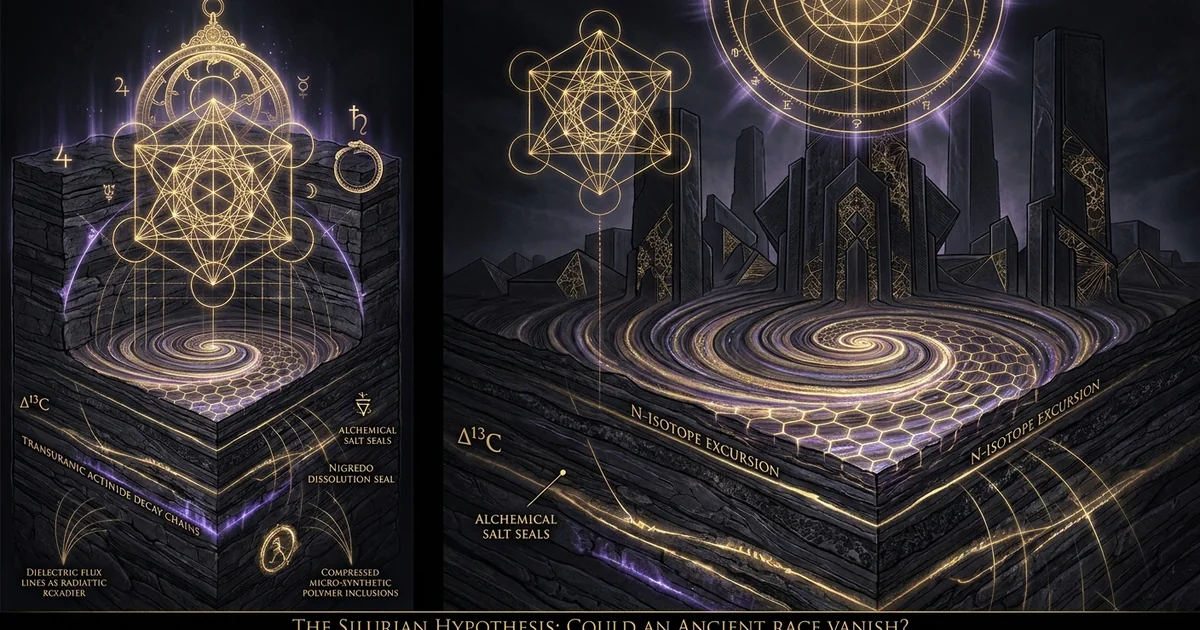
The Silurian Hypothesis: Could an Ancient Race Vanish?
Metaphysical Thesis & Epistemological Opening: The Stratigraphic Veil and Deep-Time Amnesia
The fundamental presupposition of modern industrial civilization is its own historical uniqueness. Operating under an implicit doctrine of chronological exceptionalism, contemporary culture conceives of technological sapience as a singular, terminal pinnacle achieved after four and a half billion years of unbroken, inert planetary incubation. Yet, when evaluated against the profound timescales of terrestrial geology, the physical endurance of our technosphere reveals itself to be vanishingly fragile. The stratigraphic record—the primary archival ledger of our planet—is governed by relentless taphonomic entropy. Far from functioning as an exhaustive library of terrestrial history, the crust of the Earth operates as an aggressive, active erasure mechanism, perpetually dissolving macroscopic architecture, pulverizing synthetic assemblies, and recycling continental landmasses through subduction, weathering, and diagenesis.
Taphonomic Entropy and the Limits of Direct Technofossil Preservation
The preservation of any macroscopic physical artifact over geological time is an extreme statistical anomaly. In paleontology, taphonomy dictates that soft organic tissues decay within days to millennia, while biomineralized structures like bones, teeth, and shells survive only under specific conditions of rapid burial, anoxic chemistry, and sustained sedimentary deposition. For artificial structures—termed technofossils by geologists such as Jan Zalasiewicz—the situation is equally severe. Modern megastructures composed of steel-reinforced concrete, asphalt, glass, and composite polymers possess a mechanical and chemical stability measured in centuries or thousands of years, not geological epochs. Surface architecture is swiftly pulverized by cyclic glaciation, fluvial erosion, atmospheric oxidation, and biological colonization.
Within a few million years—a mere rounding error in the 4.54-billion-year timeline of Earth—surface cities are sheared flat by tectonic upheaval and hydrogeological shear. What survives of an industrial urban complex is not an identifiable, standing monument, but a microscopically thin, metamorphosed sedimentary stratum: a dark layer of carbonaceous shale, enriched in exotic elemental ratios, fragmented ceramic micro-inclusions, and anomalous isotopic departures. When we search for antediluvian civilizations across multi-million-year baselines, looking for physical ruins or intact tools represents an epistemological category error. The lithosphere does not preserve forms; it reduces forms to elemental geochemical sediments. Understanding how deep antiquity obliterates structure is closely linked to our investigations into /ancient-prehistory/antediluvian-geological-anomalies, where anomalous structural strata defy standard uniformitarian explanations.
“The fraction of species that are preserved in the fossil record is typically estimated to be a small fraction of one percent… We conclude that the probability of finding direct physical artifacts (such as a preserved machine, an urban footprint, or a manufacturing facility) from an industrial civilization that existed more than several million years ago is extraordinarily low. Instead, the detection of such an entity must rely upon indirect geological proxies: anomalous isotopic perturbations, synthetic chemical signatures, and sudden geochemical transitions in the sedimentary record.” — Gavin A. Schmidt & Adam Frank, The Silurian Hypothesis: Would it be possible to detect an industrial civilization in the geological record? (International Journal of Astrobiology)
The Epistemological Fallacy of Anthropic Primacy in Terrestrial Deep Time
The assumption that Homo sapiens represents the inaugural industrial society on Earth rests upon the absence of obvious technofossils in the fossil record. This reasoning falls victim to an aggressive form of argumentum ad ignorantiam, compounded by an anthropocentric bias that maps the timeline of the universe onto human self-perception. In paleontological field analyses, the fossil record captures less than one percent of all ancient biological diversity, heavily skewed toward marine invertebrates with durable calcite shells inhabiting shallow, subsiding sedimentary basins. Terrestrial land-dwellers—particularly intelligent, tool-using organisms inhabiting upland or arid environments where erosional forces dominate over deposition—are among the least likely entities to enter the lithic archive.
Consider the temporal horizon: Homo sapiens has existed for approximately 300,000 years, and has possessed an industrial technosphere for barely two and a half centuries—a temporal duration representing less than 0.000005% of Earth’s total lifespan. If an antecedent non-human species had developed an industrial, energy-intensive civilization that persisted for 50,000 years during the Carboniferous, the Devonian, or the Eocene, its temporal window would be completely invisible within typical stratigraphic resolution. The question is not whether physical ruins would remain standing today—they categorically would not—but whether their geochemical wake has been misattributed to natural geodynamic transitions. Investigating the physics of these temporal boundaries requires analyzing /physics-electromagnetism/stratigraphic-radioisotope-decay to calibrate the true limits of geological preservation.
The Geological Filter as an Informational Erasure Mechanism
Geological time is an informational control filter. Continental crust is continually unroofed, weathered by acidic meteoric water, carried to the oceans, deposited as abyssal turbidites, and eventually dragged into the mantle via tectonic subduction zones, where thermal metamorphism obliterates all macroscopic morphological data. Less than ten percent of the ocean floor is older than 200 million years, meaning that any marine technological footprint from the Paleozoic or early Mesozoic has already been systematically melted and returned to the mantle.
Consequently, modern inquiry into whether a pre-human society inhabited this globe requires abandoning naive artifactual archaeology. One must practice a macro-scale geobiology: an interrogation of global thermal anomalies, sudden mass-extinction horizons, sharp excursions in carbon and nitrogen isotopes, and synthetic micro-sediments. In the conceptual framework of the Silurian hypothesis Frank Sullivan industrial civilization fossil record discourse—which builds upon the seminal mathematical models published by Schmidt and Frank—we are forced to conceptualize the planet’s surface not as an eternal monument, but as an open thermodynamic system governed by relentless entropy, wherein the memory of entire terrestrial species is wiped clean by the planetary machine itself.
Primary Codices & Historical Transmission: Cyclical Civilizations in Esoteric Hermeneutics
The concept that technological or highly structured civilizations have repeatedly flourished and vanished beneath catastrophic geological cycles is not an invention of twenty-first-century astrobiology. Rather, the Silurian Hypothesis serves as an empirical, geochronological formalization of a cosmology that was central to archaic esoteric traditions, ancient Mediterranean mystery cults, and Gnostic-Hermetic philosophy. These lineages maintained that the world does not unfold along a linear, secular trajectory, but through vast demiurgic cycles of manifestation, cataclysmic dissolution, and ontological amnesia.
       [ Manifest Terrestrial Bioculture ]
                       │
                       ▼
      [ Hyper-Dense Material Technosphere ]
                       │
                       ▼
   [ Cyclical Cataclysm: Dia Pyrós / Hydatos ]
                       │
                       ▼
  [ Demiurgic Amnesia & Lithe Stratification ]
                       │
                       ▼
         [ Informational Re-Genesis ]
The Antediluvian Iterations in the Hermetic Corpus and Gnostic Cosmogony
Within the tractates of the Corpus Hermeticum, most notably the Asclepius, the material universe is presented as a perpetual, churning engine of re-creation presided over by the Demiurge. The text explicitly laments an inevitable cycle wherein sacred knowledge is wiped from the Earth: the divine order is dissolved, the gods withdraw from their terrestrial temples, and the land is purged by fire, deluge, and pestilence, only to begin the cycle anew. The Gnostic cosmologies preserved within the Nag Hammadi library—such as the Apocryphon of John and the Hypostasis of the Archons—deepen this ontological critique. For the Gnostics, historical time is not a neutral axis of progress, but a labyrinth of Archontic design, an artificial prison wherein humanity is subjected to cyclical amnesia.
In these systems, physical history is punctuated by successive cleansings orchestrated by the Demiurge (often identified as Yaldabaoth), whose purpose is to prevent consciousness from breaking through the material veil into the trans-cosmic Pleroma. Each antediluvian race rises, constructs a dense material civilization, achieves technological or pneumatic potency, and is subsequently cast down into taphonomic darkness. The early Christian heresiologist Irenaeus of Lyons meticulously recorded this doctrine in Adversus Haereses (c. 180 CE), identifying the Valentinian and Basilidean teachings that multiple Earthly dispensations had already vanished, their memory consumed by the cosmic architecture itself.
Platonic Periodic Cataclysms and the Timaean Inscriptions of Sais
The foundational Western textual locus for cyclical civilizational erasure resides in Plato’s Timaeus. During Solon’s travels in Egypt, the aged priests of the city of Sais confront him with the historical infantilism of the Greek mind. The sacerdotal class of Egypt, sustained by temple archives engraved upon stone walls that had survived local devastations, understood that planetary forces periodically sweep human achievement away, resetting the cultural clock to zero.
“There have been, and will be again, many destructions of mankind arising out of many causes, the greatest having been brought about by the agencies of fire (dia pyrós) and water (hydatos), and other lesser ones by innumerable other causes. There is a story, which even you have preserved, that once upon a time Phaethon, the child of the Sun, having yoked the steeds in his father’s chariot, because he was not able to drive them in the path of his father, burnt up all that was upon the earth, and was himself destroyed by a thunderbolt… Wherefore the traditions of our priests are the most ancient. And whatever happened either in your country or in our own, or in any other region of which we are informed, if there were any actions, noble or great or in any other way remarkable, they have all been written down by us of old, and are preserved in our temples. Whereas just when you and other nations are beginning to be provided with letters and the other requisites of civilized life, after the usual interval, the stream from heaven, like a pestilence, comes pouring down, and leaves only those of you who are destitute of letters and education; and so you have to begin all over again like children, and know nothing of what happened in ancient times, either among us or among yourselves.”
The Egyptian priest explains that while humanity views the cataclysms as isolated, divine retributions, they are in truth the physical manifestation of orbital mechanics and geological equilibrium—deviations in the courses of celestial bodies that unleash planetary thermal releases (dia pyrós) or profound oceanographic surges (hydatos thermou). What Plato records is nothing less than an ancient qualitative formulation of taphonomic amnesia: after every cycle, the literate and urbanized populations are extinguished, leaving only the illiterate pastoralists on high plateaus, while the magnificent architecture of the valley civilizations is buried beneath alluvial silt, to be crushed into unidentifiable limestone. These historical echoes constitute one of the primary lines of evidence when examining geological proxies previous civilizations might have inscribed upon the Earth.
The Yugas and Pralayas: Archaic Quantifications of Civilizational Oblivion
While Western thought long struggled to conceive of time beyond the few millennia permitted by literalist biblical chronology, Vedic metaphysics operated comfortably within temporal frames of millions and billions of years. In the Puranas and the Surya Siddhanta, the cosmic cycle is structured around the Mahayuga, a cyclical span lasting 4.32 million solar years, comprised of four unfolding moral and technological epochs: Satya, Treta, Dvapara, and Kali. At the termination of a Kalpa (a Day of Brahma, spanning 4.32 billion years—remarkably close to modern radiometric estimates of the Earth’s age), the material matrix undergoes a Pralaya, a total dissolution wherein all manifested forms, biological populations, and terrestrial cities are pulled back into the unmanifest primordial ocean.
The Vedic cosmologists did not view these iterations as spiritual metaphors, but as physical realities. They posited that during the dawn of each Yuga, entirely distinct races of beings—possessing biological configurations, psychophysical capabilities, and mechanical implements fundamentally different from modern humans—inhabited the planetary surface. The structural remnants of these earlier epochs do not survive into the subsequent cycle because the Pralaya acts as a thermodynamic reset, an unmaking of atomic bonds that reduces the planetary technosphere to unformed mud. Modern geochronology has essentially rediscovered, through mass spectrometry and seismic stratigraphy, the empirical architecture of this ancient Puranic clock.
Ontological Architecture & Cosmological Models: Biogeochemical Proxies and Isotopic Anomalies
If macroscopic ruins are ephemeral dust over geological time, what constitutes an indisputable marker of an ancient technological species? The Silurian Hypothesis moves the locus of inquiry from morphological archaeology to biogeochemical forensics. An industrial civilization is, by definition, a global thermodynamic engine: it unearths sequestered carbon, fabricates synthetic elemental states, alters atmospheric radiative forcing, redistributes heavy metals across oceanic sinks, and leaves an unambiguous, coordinated fingerprint across the international stratigraphic column.
┌────────────────────────────────────────────────────────┐
│            THE PALEO-STRATIGRAPHIC INTERROGATION        │
├────────────────────────────────────────────────────────┤
│ 1. δ13C Carbon Isotope Inversion (Organic Depletion)   │
│ 2. Micro-Sedimentary Plasto-Agglomerates               │
│ 3. Artificial Transuranic Enrichment (Pu-239 / U-236)  │
│ 4. Heavy Metal Anomalies (Pb, Cd, Hg Stratification)   │
│ 5. Synthetic PFAS / Halogenated Chemical Horizons      │
└────────────────────────────────────────────────────────┘
The Paleocene-Eocene Thermal Maximum (PETM) as an Industrial Analog
The most striking geological analog to the modern Anthropocene occurred approximately 56 million years ago: the Paleocene-Eocene Thermal Maximum (PETM). Within a geologically brief interval estimated between a few centuries and a few thousand years, the Earth underwent an abrupt, catastrophic warming event. Global mean temperatures rose between 5°C and 8°C, deep ocean currents underwent catastrophic stagnation, and the oceanic carbonate compensation depth shallowled precipitously, triggering widespread marine extinction.
What makes the PETM extraordinary from the perspective of the Silurian Hypothesis is its signature: a colossal carbon injection event that mirrors what humanity is currently producing through the combustion of fossil fuels. As demonstrated by researchers such as Carcione, Gei, and Rossi (2006) in their geochemical modeling of gas hydrates and mud volcanoes, the PETM was characterized by a massive, sudden release of light carbon (Carbon-12) into the atmosphere and oceans. Conventional geology attributes this surge to the non-anthropogenic destabilization of oceanic methane clathrates or massive volcanic intrusions into North Atlantic coal basins. However, the isotopic profile, sudden initiation, and subsequent global ecosystem reconfiguration of the PETM present precisely the physical footprint that a pre-human, hydrocarbon-fueled industrial civilization would leave behind.
Carbon Isotope Excursions (δ13C) and Nitrogen/Oxygen Biogeochemical Shifts
The definitive chemical marker of an industrial civilization powered by combustion is a global negative carbon isotope excursion, known in modern science as the Suess Effect. Fossil fuels (coal, oil, natural gas) are derived from ancient photosynthetic organisms, which preferentially uptake the lighter carbon isotope $^{12}\text{C}$ over the heavier $^{13}\text{C}$. When a technological society burns trillions of tons of these hydrocarbons, it dramatically shifts the atmospheric ratio of $^{13}\text{C}/^{12}\text{C}$, yielding an abrupt negative spike in the global $\delta^{13}\text{C}$ record preserved in sedimentary carbonate rocks and fossilized tooth enamel.
       δ13C (‰)
        │
    0.0 ┼─────────┐
        │         │   <- Normal Terrestrial Baseline
   -2.0 ┼         │
        │         \
   -4.0 ┼          \  <- Abrupt Negative Isotopic Excursion
        │           \    (Industrial Combustion / PETM Pulse)
   -6.0 ┼            └───┐
        │                │
        └────────────────┴─────────── Time (Epochal Horizon)
Simultaneously, the widespread industrial application of artificial nitrogen fixation—equivalent to the modern Haber-Bosch process, which synthesizes ammonia directly from atmospheric nitrogen for use in industrial agriculture—irrevocably alters the global $\delta^{15}\text{N}$ balance. Runoff from artificial fertilizers creates widespread oceanic anoxia, leaving dark, un-bioturbated, organic-rich sedimentary bands (sapropels) across abyssal ocean floors. These carbon isotope spikes Paleocene thermal investigations, alongside synchronized nitrogen and oxygen isotope anomalies, form a coherent, systemic geochemical fingerprint that cannot be explained away by single-point volcanic events.
Anthropocene Geochemical Horizon
- Carbon Signature: Abrupt negative $\delta^{13}\text{C}$ excursion due to fossil fuel combustion (~5,000 Gt C projected).
- Sedimentary Technofossils: Microplastics, polyfluorinated alkyl substances (PFAS), un-weathered artificial alloys, and synthetic concrete residues.
- Radiological Marker: Artificial radionuclides from 20th-century thermonuclear testing ($^{239}\text{Pu}$, $^{14}\text{C}$, $^{137}\text{Cs}$).
- Ecosystemic Impact: Sixth mass extinction event, agricultural homogenization, worldwide oceanic dead zones.
PETM Anomaly (56 Million Years Ago)
- Carbon Signature: Massive negative $\delta^{13}\text{C}$ excursion (~3,000–7,000 Gt C released in an abrupt temporal spike).
- Sedimentary Technofossils: Highly compressed organic clay horizons (kaolinite excursions); macroscopic physical matter completely degraded.
- Radiological Marker: Obscured by natural background decay, except for stable decay-daughter anomalies in heavy mineral deposits.
- Ecosystemic Impact: Widespread benthic foraminifera extinction, rapid floral migrations, extreme transient dwarfism in terrestrial mammals.
Synthetic Mineralogy, Artificial Radionuclides, and Plastic Residue Stratigraphy
Beyond isotopic ratios, an advanced technological society transforms planetary mineralogy. Today, human industrial activity has generated over 5,000 novel mineral-like substances that do not occur via natural inorganic processes: synthetic diamonds, tungsten carbides, semiconductor ceramics, and high-purity silicon wafers. Over multimillion-year periods, most will alter into mundane clays and oxides, but some—such as crystalline silicon and refractory ceramics—possess extraordinary taphonomic durability.
The clearest smoking gun of technological intervention is the appearance of synthetic xenobiotics and plastic polymers. Over deep time, long-chain carbon polymers degrade under thermal and baric pressure, but they do not simply vanish; they metamorphose into distinct, ultra-condensed bitumen-like hydrocarbon laminae, rich in anomalous plasticizers and halogenated additives. The persistent discovery of synthetic plastic residue millions years post-deposition within sedimentary shales would indicate an advanced synthetic organic chemistry.
Finally, the release of artificial transuranic elements provides a geochemical clock that operates independent of biological processes. While short-lived isotopes like Iodine-131 disappear in weeks, Plutonium-239 ($t_{1/2} = 24,110\text{ years}$) and Uranium-236 ($t_{1/2} = 23.4\text{ million years}$) endure over deep temporal canvases. Uranium-236, produced in industrial nuclear reactors through neutron capture, has a half-life long enough to persist as a diagnostic marker across significant swathes of the Cenozoic, marking the presence of intentional atomic fission across the stratigraphic column.
Phenomenological Mechanics & Interdimensional Interaction: The Valleean Control System Across Geological Epochs
When the Silurian Hypothesis is freed from the narrow constraints of secular, materialist physics, it converges with the cutting-edge phenomenology of Non-Human Intelligence (NHI). If an ancient, industrial or post-industrial civilization existed on Earth millions of years ago, did it inevitably perish in a thermodynamic catastrophe, leaving behind only geochemical scars? Or did its terminal evolutionary trajectory bypass biological extinction entirely, transcending macroscopic physical architecture in favor of subtle, informational, or dimensional phases?
Here, the paradigm shifts from paleontology to the informational control framework pioneered by Jacques Vallée. If an advanced terrestrial species achieved mastery over the space-time metric, its physical presence would not resemble an sprawling urban megalopolis, but rather an integrated, cybernetic system embedded directly within the planetary informational matrix.
Technological Civilization as a Transitory Perturbation in Planetary Consciousness
The lifespan of a civilization’s material footprint is inversely proportional to its technological efficiency. A crude, early industrial civilization relies upon violent, macroscopic manipulations of matter: burning hydrocarbons, smelting raw iron, pouring concrete, and scattering synthetic detritus across the planetary crust. This brute-force material phase is inherently unsustainable and thermodynamically unstable; it inevitably burns through its accessible thermodynamic gradients within a few millennia.
A civilization that survives this technological bottleneck must necessarily transition from a macroscopic, high-entropy material footprint to a microscopic, low-entropy informational posture. It pivots from coal and oil to quantum vacuum engineering, room-temperature coherence, and non-local informational manipulation. In doing so, its physical visibility in the geological record drops to near zero. What appears to the naive paleontologist as the sudden “extinction” of an advanced race may in fact be its phase transition—a deliberate ontological withdrawal from the heavy, entropic physical crust of the Earth into interdimensional, subterranean, or hyper-dimensional states of coherence.
Jacques Vallée’s Informational Feedback Loops and Subterranean/Sub-Oceanic NHI
In The Invisible College (1975), computer scientist and astrophysicist Jacques Vallée challenged the simplistic Extraterrestrial Hypothesis (ETH), positing instead that what humanity experiences as UFOs, apparitions, and high-strangeness events are manifestations of an Earth-bound, informational control system. This system acts as a thermostat, regulating human cultural evolution and conscious development through the projection of surreal, culturally tailored psychophysical archetypes.
┌────────────────────────────────────────────────────────┐
       │             THE VALLEAN CONTROL SYSTEM LOOP            │
       └────────────────────────────────────────────────────────┘
                                 │
                 [ Informational Control Matrix ]
                                 │
           ┌─────────────────────┴─────────────────────┐
           ▼                                           ▼
   [ Terrestrial Psychosphere ]                [ Material Physical Reality ]
   (Myth, Archetype, Vision)                 (Stratigraphic Anomalies, Craft)
           │                                           │
           └─────────────────────┬─────────────────────┘
                                 │
                     [ Human Consciousness Shift ]
                                 │
                                 ▼
                     [ Thermostatic Regulation ]
When viewed through the lens of deep time, Vallée’s control system acquires an archaeological foundation. The non-human intelligences currently observed operating in our atmosphere, oceans, and non-ordinary states of consciousness may not be visitors from distant star systems across the light-year void. They may be the current, lingering custodians of this planet: the post-material remnants of an ancient, pre-human terrestrial lineage that separated from the surface evolutionary stream during a previous geological epoch.
Having retreated beneath the mantle, into abyssal oceanic trenches, or into overlapping spatio-temporal folds—an idea explored within our treatise on /nhi-phenomena/vallee-control-system-mechanics—these primordial terrestrial intelligences monitor surface events via transient physical interfaces (the “craft” of modern UAP phenomena). The high-strangeness that consistently accompanies close encounters represents not technological machinery in the human sense, but an ontological collision with an archaic, non-human consciousness operating through the interdimensional-hypothesis.
Stratigraphic Ghost Signatures and the Psychosomatic Archeology of High Strangeness
If an ancient species dissolved its dependence on matter, the boundary between paleontology and parapsychology disintegrates. Just as an industrial civilization leaves a chemical proxy in the rock, a hyper-conscious, psionically active society leaves a permanent informational scar upon the subtle geodynamic field of the Earth—an egregore woven directly into the morphogenetic field of the planet.
These informational residues manifest phenomenologically as persistent zones of high-strangeness: geographically localized regions (such as the American Southwest, the Hessdalen Valley, or subterranean tectonic fault lines) where spontaneous physical anomalies, dimensional distortions, and telepathic incursions routinely occur. Percipients at these locations do not encounter modern mechanical technology, but rather “stratigraphic ghost signatures”: non-linear temporal leakages where modern human brains process the lingering informational geometry of an ancient, non-human terrestrial presence. The Earth is not merely a geological tomb of calcified bones; it is an active psychotronic storage device, preserving the latent memories of vanished biological epochs within its crystalline electromagnetic substrate.
Initiatic Synthesis & Philosophical Implications: Escaping the Anthropocentric Labyrinth
The intellectual confrontation with the Silurian Hypothesis is an initiatic ordeal. It demands the systematic dismantling of the foundational mythos of Western modernity: the doctrine that human beings are the center of planetary purpose, the sole custodians of technological intellect, and the apex of billions of years of biological striving. By opening the abyss of terrestrial deep time, we are forced to recognize our own radical contingency and transience.
           [ MODERN SECULAR ILLUSION ]
         Primordial Soup ──> Monkeys ──> Humanity ──> Cosmos
                                   ▲
                                   │ (False Culmination)

           [ ESOTERIC GEOLOGICAL REALITY ]
         Iteration 1 (Vanish) ──> Iteration 2 (Vanish)
                   ──> Iteration N (Anthropocene) ──> [Dissolution / Phase Transition]
Ontological Humility: Decentering the Human Epoch within the Great Year
To recognize that an entire industrial civilization could emerge, flourish for dozens of millennia, span the continents, alter the global climate, and subsequently vanish beneath the relentless grind of taphonomic entropy—leaving behind only a three-centimeter band of black, isotopic-depleted shale—induces a profound state of consciousness shock. We examine this specific state of awakening in our study of /consciousness/deep-time-ontological-shock. This shock is not merely scientific; it is metaphysical. It shatters the teleology of both secular technological progress and orthodox anthropocentric religion.
In the esoteric traditions, this cyclical realization was the prerequisite for true initiation. In the Eleusinian, Mithraic, and Hermetic mysteries, the initiate was brought to understand that the physical cosmos is governed by the Platonic “Great Year”—a massive wheel of time wherein human empires, languages, and gods are ground into dust by the turnings of the world machine. True sovereignty is not achieved through the perpetual, frantic expansion of a physical technosphere over the landscape, but through the extraction of consciousness from the temporal gears of the Demiurgic clock.
The Great Filter as a Retrospective Phenomenon Rather than an External Horizon
The Silurian Hypothesis radically recontextualizes the Fermi Paradox and the concept of the “Great Filter.” Astrobiologists scanning the heavens with radio telescopes wonder why the cosmos appears silent, asking where the extraterrestrial civilizations are. The conventional view posits the Great Filter as an obstacle lying ahead of humanity: nuclear war, climate collapse, or runaway artificial intelligence waiting to extinguish our future.
The taphonomic reality of Earth suggests an alternative: the Great Filter is an omnipresent, cyclical, terrestrial trap. Civilizations emerge, deplete the readily accessible, low-entropy thermodynamic gradients of their home planet (such as surface hydrocarbons and high-grade mineral deposits), trigger a severe, rapid climate disruption like the PETM, and then collapse back into the biological baseline, their technosphere liquidated by the lithosphere. The silence of the cosmos is mirrored by the silence of the fossil record. We do not need to look outward toward distant stars to find the graves of technological intelligences; we are standing directly on top of them.
Contemplating the Silurian Hypothesis carries a severe epistemological danger: the descent into fatalistic nihilism. When the initiate realizes that planetary entropy systematically erases all macroscopic works, the ego-mind recoils, concluding that all terrestrial action is ultimately meaningless. This is the classic Archontic trap. The Gnostic understanding recognizes that the Demiurge relies upon physical temporal cycles precisely to bind consciousness within recursive loops of material striving, collapse, and reincarnation. The goal of the awakened metaphysical investigator is not to build enduring physical monuments to defy geological entropy, but to utilize the physical incarnation to awaken the trans-temporal spark (pneuma) and achieve gnosis, breaking the cyclical recurrence entirely.
Theurgical Geobiology: Reinterpreting Physical Earth as a Palimpsest of Dead Gods
When the modern practitioner steps onto the bare bedrock of a mountain range or looks upon an exposed highway roadcut, they are not looking at neutral, lifeless stone. They are gazing upon a vast, compressed palimpsest—a multilayered graveyard of prior worlds, wherein the biospheres, technospheres, and psychic emissions of long-forgotten races have been crushed into stratigraphical strata.
This realization forms the bedrock of a modern theurgical geobiology. The Earth must be treated not as a passive resource for human extraction, but as an ancient, sentient entity saturated with the metamorphic ghosts of its prior iterations. The hydrocarbon reservoirs we burn in our engines are the liquefactions of ancestral life forms; the metallic veins we smelt are the reorganized minerals of earlier biospheres. In burning the past to construct our fleeting technological empire, we are literally summoning the sleeping dead of the deep-time archive, destabilizing our climate in precise replication of the forgotten catastrophes of the Paleozoic and Cenozoic epochs. The ultimate challenge of the modern Anthropocene is to awaken to this cyclical recurrence before our own civilization is reduced to a thin, black, unidentifiable isotopic scar in the rocks of the far future.
Frequently Asked Questions
Could advanced physical structures like the Pyramids or reinforced concrete survive for 50 million years?
No. The belief that megalithic stone or modern reinforced concrete can endure over geological epochs is an illusion produced by our brief historical perspective. Over timescales of tens of millions of years, the planetary surface is subjected to violent, repeated geomorphological resets. Continental drift pushes landmasses into collision zones, thrusting lowlands into jagged mountain ranges where weathering is maximized; ice sheets kilometers thick advance and retreat, acting as massive geological bulldozers that scour bedrock flat; and meteoric chemical weathering, driven by carbonic and sulfuric acids in rainwater, dissolves limestone, granite, and silicates.
Modern reinforced concrete is exceptionally short-lived; it degrades within centuries as water penetrates micro-cracks, oxidizing internal steel rebar, causing it to expand and fracture the matrix through concrete spalling. Even the Great Pyramid of Giza, constructed from durable limestone and situated in an arid desert, will be entirely erased within several hundred thousand years by aeolian sand-abrasion, tectonic shifts, and eventual fluvial inundation. Over 50 million years, macroscopic architectural structures are completely broken down, pulverized into sediment, and deposited as silt, sandstone, or mudstone across oceanic basins.
How would an industrial pre-human race access energy without leaving identifiable fossil fuel depletion zones?
The assumption that an industrial civilization must rely upon subterranean hydrocarbon deposits like coal and petroleum is an anthropocentric projection of our specific 19th- and 20th-century development path. A pre-human technological species might have developed entirely different energetic vectors based upon the unique geology, chemistry, and evolutionary biology of their epoch.
For instance, an advanced non-human civilization might have mastered large-scale geothermal tapping, focused solar-thermal arrays, atmospheric hydrogen fuel cycles, or direct biochemical synthesis derived from genetically engineered algae or fungal colonies. Alternatively, if they developed an energy matrix based upon coastal wave energy, tidal dynamics, or electromagnetic energy harvesting, their physical footprint on global fossil fuel deposits would be non-existent. Furthermore, even if they did burn hydrocarbons, humanity would not necessarily recognize an exploited oil reservoir: over hundreds of millions of years, hydrothermal migration, tectonic pressure, and biological re-deposition can recharge geological formations, masking earlier petroleum extraction signatures.
Does the Silurian Hypothesis support fringe ‘ancient alien’ theories or establish a distinct scientific/philosophical framework?
The Silurian Hypothesis is fundamentally distinct from and, in many respects, diametrically opposed to sensationalist “ancient alien” or interventionist mythologies. Fringe interventionist theories typically claim that extraterrestrial beings visited Earth during historical human times, constructed existing monuments (such as the Pyramids of Giza, Pumapunku, or the Nazca Lines), and genetically altered early hominids. These claims invariably rely upon a superficial reading of human archaeological ruins and display a profound lack of respect for human technical ingenuity.
In contrast, the Silurian Hypothesis—as developed within peer-reviewed geophysics by Gavin Schmidt and Adam Frank—is a rigorous, uniformitarian thought experiment grounded in paleoclimatology, taphonomy, and sedimentary chemistry. It does not look to the historical human era, but to deep geological epochs millions or tens of millions of years before humans existed. It does not invoke magical interstellar interventions; instead, it asks how our own modern science could detect a fully native, Earth-evolved non-human species using strict geochemical proxies. It is an exploration of the fundamental physical limits of the geological record and an epistemological critique of modern scientific anthropocentrism.
What are the most unambiguous geochemical markers that could confirm a past industrial civilization?
The confirmation of an antecedent industrial civilization over multimillion-year timescales requires a synchronized suite of multiple, distinct biogeochemical proxies that cannot be accounted for by standard abiotic processes. A singular anomaly, such as a localized spike in carbon or a solitary thermal event, can almost always be explained away by large-scale volcanism (such as Large Igneous Provinces) or astronomical impacts.
- Technofossil (Derived from Greek techne, “art/craft,” and Latin fossilis, “dug up”): A physical, macroscopic artifact, machine, or structural imprint manufactured by an intelligent species that has been lithified and preserved directly within sedimentary strata. Over deep time (>5 Ma), the probability of technofossil survival approaches zero.
- Geochemical Proxy (Derived from Latin proximum, “nearest/representative”): An indirect, systemic chemical, isotopic, or mineralogical marker preserved within rock layers that records the global thermodynamic, agricultural, or metallurgical activity of a society. The Silurian Hypothesis asserts that proxy detection is the only viable methodology for recognizing pre-human antiquity.
The most definitive markers include:
- Synchronized Isotopic Inversions: A catastrophic, ultra-rapid negative $\delta^{13}\text{C}$ carbon isotope excursion accompanied by an unnatural shift in $\delta^{15}\text{N}$ ratios across all oceanic and terrestrial strata, indicating simultaneous fossil fuel consumption and artificial agricultural fertilization on a planetary scale.
- Synthetic Xenobiotic Horizons: The presence of persistent, non-natural chemical compounds, particularly per- and polyfluoroalkyl substances (PFAS) and halogenated hydrocarbons. These chemicals contain carbon-fluorine bonds that do not exist in natural biochemistry and are extraordinarily resistant to thermal and microbial degradation over deep time.
- Artificial Transuranic Radionuclide Anomalies: Concentrated layers containing Plutonium-239, Uranium-236, or Neptunium-237, alongside unnatural ratios of fission byproducts like Cesium and Strontium decay products. These elemental isotopes can only be generated through intentional, sustained nuclear fission and do not occur in nature, with the sole exception of rare natural nuclear fission reactors (such as the Oklo deposit in Gabon, which produced entirely distinct, non-stratified localized isotopic distributions).
- Exotic Heavy Metal Enriched Strata: Uniform, microscopically thin sedimentary bands containing highly elevated, coordinated concentrations of refined industrial elements—such as platinum group metals, lead, cadmium, mercury, and rare earths—precipitated simultaneously across diverse global sediment basins, reflecting the planetary fallout of industrial manufacturing and metallurgy.