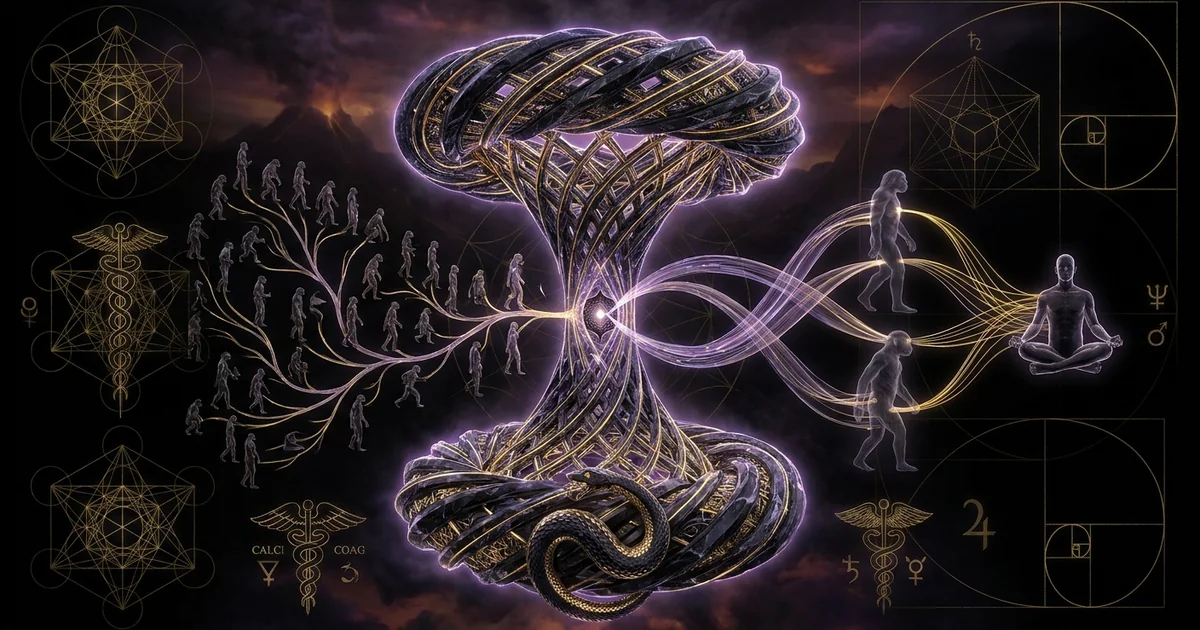
Evolutionary Bottlenecks & Parallel Humanoid Lineages Art
Metaphysical Thesis & Epistemological Opening: The Myth of Unilinear Anthropogenesis
The Collapse of the Single-Origin Orthodoxy
For more than a century, mainstream paleoanthropological discourse operated under a latent teleological dogma: the unilinear ascent of Homo sapiens. In this orthodox paradigm, evolutionary progression was depicted as a deterministic climb from undifferentiated pongid ancestors toward the teleological summit of anatomically modern humans. Outmoded iterations of the “Recent African Origin” model treated our hominid precursors and contemporaries—most notably the Neanderthals (Homo neanderthalensis), the Denisovans, and relict populations of Homo erectus—as superseded rough drafts, cognitive dead ends abandoned on the margins of evolutionary history.
This reductionist taxonomy functioned not merely as an empirical classification, but as an ideological bulwark. By conceptualizing humanity as an inevitable, singular biological phenomenon, evolutionary materialism severed anthropogenesis from any cosmological or metaphysical matrix. The living human was stripped of archaic depth and reified as a monadic, self-contained organism, conveniently isolated from the broader spectrum of hominid consciousness variants that previously populated the Earth.
The paleogenomic revolution spearheaded over the past two decades has rendered this unilinear scaffolding untenable. The sequencing of ancient DNA extracted from Late Pleistocene skeletal remains demonstrates that the human evolutionary landscape was not a solitary highway, but an intricately anastomosing river system. Throughout the Middle and Late Pleistocene, the planet was sympatric: it hosted a rich plurality of sentient humanoid lineages inhabiting overlapping geographies, ecosystems, and cognitive niches.
Divergent hominid intelligence paths flourished simultaneously across Eurasia, Sundaland, and Africa. These populations were neither behaviorally inert nor biologically incompatible; rather, they engaged in repeated pulses of hybridization, cultural exchange, and technological synthesis. The emergence of modern Homo sapiens was therefore neither an immaculate speciation event nor an organic teleological triumph, but an anomalous, radical narrowing of an otherwise polymorphic hominid matrix.
[Archaic Hominid Substrate]
       │
       ├──► Homo neanderthalensis (Eurasia: Somato-Sensory / Optical)
       ├──► Denisovans (Altaic / Sunda: Epigenetic & Hypobaric Specialists)
       ├──► Ghost Archaic Clades (Pan-African: Deep Sensorium Reservoirs)
       └──► Homo erectus Refugia (Sundaland: Archaic Morphogenetic Baseline)
The Toba Bottleneck as a Teleological Filter
The most profound biological constriction across the late hominid record occurred approximately 74,000 years before the present (BP): the Youngest Toba Tuff (YTT) super-eruption at Lake Toba in northern Sumatra. As documented by Michael R. Rampino and Stephen Self, the Toba event discharged roughly 2,800 cubic kilometers of volcanic ejecta into the stratosphere, instigating a multi-year volcanic winter and a planetary cooling anomaly that accelerated the onset of the Würm/Weichselian glaciation. This catastrophic environmental dislocation precipitated a devastating contraction in effective population sizes across the genus Homo.
Paleogenomic demographic modeling derived by statistical geneticists—most prominently synthesized in David Reich’s Who We Are and How We Got Here—demonstrates that during this transitional horizon, the ancestral human effective breeding population plummeted to a critically low threshold, estimated by many genetic models to have hovered between 1,000 and 10,000 reproductive individuals. The standard ecological narrative presumes this bottleneck operated as a purely stochastic filter, an environmental meat-grinder that culled less resilient hominid populations through thermodynamic and caloric deprivation.
Yet, an epistemological anomaly surfaces when this paleoclimatic culling is mapped against the trajectory of human cognition. Immediately following the Toba threshold, the archeological record documents the rapid, polycentric eruption of behavioral modernity: the Upper Paleolithic symbolic revolution. Rather than emerging cognitively diminished or biologically paralyzed by near-extinction, the survivor population of Homo sapiens exhibited an unprecedented leap in symbolic cognition, figurative art, syntactical language, complex theurgy, and ritualized mortuary practices.
The catastrophic bottleneck did not merely decimate human biomass; it acted as a transformative ontological sieve. The evolutionary bottlenecks Toba catastrophe parallel humanoids denisovan matrix forces an inquiry beyond standard selective pressures. The narrowing of genetic lineages operated as an epigenetic pressure cooker, precipitating a sudden re-attunement of the hominid neurochemical apparatus toward abstract conceptual manipulation and non-local informational structures.
Interdimensional Control Systems and Morphogenetic Pruning
To comprehend the magnitude of this evolutionary shift, materialist frameworks must be integrated with the informational cybernetics articulated by Jacques Vallée. In his seminal treatise The Invisible College, Vallée posits that human cultural and spiritual history is regulated by a non-human, trans-dimensional informational control system—an environmental conditioning mechanism that operates upon the terrestrial psychosphere to steer consciousness through dialectical shocks, symbolic apparitions, and high-strangeness events.
When applied to deep time paleoanthropology, the control system hypothesis illuminates the Toba cataclysm and its concomitant bottlenecks not as isolated geo-climatic accidents, but as radical morphogenetic pruning cycles. Within the framework of Rupert Sheldrake’s morphogenetic fields, biological speciation is guided by collective non-local informational blueprints. The survival, divergence, or elimination of a hominid somatic platform directly dictates which spectrum of cosmic and psychical information can ground itself into terrestrial space.
By culling alternative hominid branches and severely bottlenecking the ancestral proto-sapiens lineage, the informational control system radically altered the morphological and energetic baseline of hominid consciousness. The catastrophic reduction dissolved competing somatic receiver configurations, clearing the terrestrial substrate to make room for a consolidated, highly plastic, and hyper-suggestible biological platform. The post-Toba human was suddenly detached from the quiet, rhythmic stasis of Middle Paleolithic archaic equilibrium, catapulted instead into a hyper-accelerated cognitive feedback loop.
This transformation enabled what the Gnostic traditions describe as the installation of the archontic episteme: an existential state characterized by linguistic fragmentation, symbolic mediation, an acute sense of ontological alienation, and an existential vulnerability to non-human mental incursions. The evolutionary bottlenecks that extinguished our parallel sister clades were the precise operations through which our current, captive socio-cognitive continuum was forged.
“The intersection of deep paleogenomic analyses and anomalous consciousness phenomena reveals an unsettling convergence: the dramatic contractions of hominid diversity in the Late Pleistocene—most notably the effective breeding population collapse correlated with the Mount Toba event (c. 74,000 BP)—cannot be adequately understood solely as an ecological survival equation. As modern statistical genomics exposes the persistence of multiple ‘ghost lineages’ and pervasive introgression events across Eurasia and Africa, Jacques Vallée’s formulation of an interdimensional cybernetic control system finds its physical substrate. The bottleneck functioned not merely as an engine of somatic survival, but as a deliberate phase-state reduction: an evolutionary narrowing of the perceptual aperture that severed hominid morphology from archaic oceanic consciousness, forcing the emergent Homo sapiens lineage into an unstable, hyper-symbolic cognitive channel uniquely susceptible to external informational manipulation.” — Source synthesis: Reich, David (2018), Who We Are and How We Got Here: Ancient DNA and the New Science of the Human Past, pp. 45–78; cross-referenced with Vallée, Jacques (1975), The Invisible College: What a Study of UFOs Might Really Mean, pp. 195–210.
Primary Codices & Historical Transmission: Antediluvian Plurality in Ancient Cosmogonies
The Book of Enoch and the Polymorphic Watchers
The collective unconscious of our species preserves clear, unvarnished memories of an era defined by sympatric humanoid coexistence, systematic genetic alteration, and catastrophic demographic filtration. These memories do not present themselves as biological dissertations; rather, they are encoded within the mythological and apocalyptic codices of the antediluvian world.
Chief among these records is the Book of Enoch (1 Enoch), preserved in its entirety within the Ge’ez liturgical canon of the Ethiopian Orthodox Tewahedo Church, with pivotal fragments uncovered among the Dead Sea Scrolls at Qumran. In the Book of the Watchers (1 Enoch 1–36), the primordial epoch is characterized not by human isolation, but by an unauthorized ontological intervention: the descent of two hundred angelic beings—the Grigori or “Watchers”—onto the summit of Mount Hermon under the leadership of Semjâzâ and Azâzêl.
The Watchers’ crime was fundamentally a crime of unlawful hybridization and forbidden epoptics. By commingling their divine, extra-mundane essence with the somatic vessels of terrestrial human women, they generated a monstrous, hybridized offspring: the Nephilim. As the text explicitly states, these beings consumed the ecological resources of the Earth, fell into violent conflict with humankind, and fundamentally corrupted the terrestrial biological blueprint through the transmission of forbidden sciences—metallurgy, weaponry, astrological computation, cosmetics, and sorcery.
When stripped of its theological polemic, this apocalyptic tradition preserves an unambiguous ancestral memory of divergent humanoid intelligence paths interacting, hybridizing, and destabilizing the ancestral biome. The Nephilim narrative encodes the phenomenological collision between the emerging Homo sapiens baseline and alternative, robust archaic clades whose cranial capacities, hyper-dense musculoskeletal systems, and predatory behaviors were interpreted through the religious imagination as giantism and divine-daemonic transgression.
The eventual cleansing of the Earth through the Deluge of Noah represents the mythological preservation of the catastrophic bottleneck: an absolute, hydro-climatic reset ordained to purge aberrant somatic variants and re-establish a strictly governed, genetically homogenized humanoid lineage.
Gnostic Archontic Iterations in the Nag Hammadi Library
Where Enochian literature treats hybridization through the lens of moral transgression, the Coptic Gnostic treatises discovered at Nag Hammadi in 1945 approach anthropogenesis through an uncompromising, critical ontology. Within the Apocryphon of John (NHC II, 1) and the Hypostasis of the Archons (NHC II, 4), the physical generation of humanity is not an act of benevolent creation, but a grotesque, collaborative engineering failure enacted by the demiurge Yaldabaoth and his somatic magistrates, the Archons.
These texts explicitly record that the creation of the psychical Adam was an iterative, fragmented process marked by abortive prototypes and somatic structural defects. The Archons, blind to the true divine light of the unnamable Pleroma, attempted to fashion a material vessel that could capture the luminous, pneumatic reflection revealed to them in the primordial waters.
The Gnostic codices explain that the Archons generated multiple sequential iterations of human forms, each corresponding to distinct elemental, bestial, and psychical constituents. The earliest vessels were limp, inert, and unable to achieve physical stability or upright posture; they writhed upon the earth like macroscopic worms until a luminous spark was breathed into them through higher divine trickery, outwitting the Demiurge’s design.
This cosmological narrative mirrors the deep-time fossil reality uncovered by contemporary anthropology: the landscape of pre-sapiens hominid speciation is littered with discarded biological experiments, parallel humanoid lineages that developed varying degrees of encephalization, distinct sensoriums, and alternate somatic configurations before being pruned from existence.
The Nag Hammadi library unmasks the Demiurge not as a supreme creator, but as a blind biological tinkerer manipulating genetic and morphogenetic substrates to fashion a vessel that remains perpetually blind to its own transcendent pneumatic inheritance, ensnared by the somatic limitations imposed by /esoteric-cosmology/gnostic-archontic-parasitism.
“The rulers laid counsel together and said, ‘Come, let us create a man that will be soil from the earth.’ They modeled their creature as one wholly of the earth. Now the rulers […] body […] they have […] female […] is […] with the face of a beast. They had taken some soil from the earth and modeled their man after their body, and after the image of God that had appeared to them in the waters. They said, ‘Come, let us lay hold of it by means of the form that we have modeled, so that it may see its male counterpart […], and we may seize it with the form that we have modeled’—not understanding the force of God, because of their weakness. And he breathed into his face; and the man came to have a soul (psychē) upon the earth for many days. But they could not make him arise because of their weakness. Like stone-carvers they continued to hammer at the form; like blind men they laid hands upon it, blowing their breath into it without power. It could not stand erect. And for a long time the vessel lay upon the ground, possessing no spiritual vitalization (pneuma), until the Spirit descended from the luminous Adamas into the inert matter.” — The Hypostasis of the Archons (NHC II, 4: 87.11–88.3), translated from the Coptic, highlighting the abortive, trial-and-error somatic engineering of the primordial hominid vessels.
Sumerian King Lists and Pre-Cataclysmic Polymorphism
Paralleling the Levant and Egypt, the Mesopotamian cuneiform record presents an unmistakable temporal demarcation between the world before and after the cataclysm. The Sumerian King List (WB 444) systematically divides history into two distinct epochs: the antediluvian reigns of staggering, mythic duration, followed by the kingship that descended from heaven anew after the Flood swept over the land.
Prior to the cataclysm, individual kings ruled over cities like Eridu, Bad-tibira, and Shuruppak for spans measured in sars (units of 3,600 years)—such as Alulim, who reigned for 28,800 years, and En-men-lu-ana, who ruled for 43,200 years. The astronomical duration of these reigns, combined with the presence of the Apkallu—the semi-divine fish-hybrid sages dispatched by Enki to instruct humankind in civilization—signals an entirely different temporal, physiological, and biological paradigm.
       ANTEDILUVIAN REGIME
[ Apkallu / Sages / Parallel Morphologies ]
       │  (Vast temporal lifespans, direct NHI interface)
       ▼
═════════════════════════════════════════════  ◄── Cataclysmic Filter (Flood / Toba)
       POST-DILUVIAN RESCENSION
[ Sapiens-Dominated Biological Monoculture ]
       │  (Radically truncated lifespans, symbolic mediation)
       ▼
This antediluvian polymorphism, meticulously documented in Assyrian and Babylonian recensions, preserves the cultural imprint of non-sapiens humanoids who possessed radically differentiated psychospiritual architectures, extended life strategies, and physiological baselines. When read through the prism of /ancient-prehistory/antediluvian-civilizations-paleogenomic-anomalies, these texts cease to be pure mythological fabulation.
Instead, they emerge as the institutionalized, sacred historiography of an age where humanity walked alongside beings of alternative lineages. The subsequent post-diluvian collapse of royal lifespans, shifting down to historical generations of conventional lengths, mirrors the genomic realpolitik of the Late Pleistocene: the catastrophic bottleneck systematically eliminated these non-canonical, morphologically divergent hominid castes, leaving behind a radically truncated, standardized, and short-lived human baseline under the reign of the post-diluvian dynasts.
Ontological Architecture & Cosmological Models: The Multi-Hominid Matrix and Ghost Lineage Reservoirs
Ghost Archaic Introgression: The Submerged Genomic Iceberg
Contemporary statistical genetics has shattered the conceit that our contemporary genome is derived cleanly and exclusively from a single anatomically modern lineage. Through the application of complex statistical frameworks, such as the ancestral recombination graph and demographic $D$-statistics, researchers have identified profound anomalies within modern human populations: the definitive presence of “ghost lineages.”
A ghost lineage is defined as an archaic population for which no physical fossil remains or recovered skeletal tissues have yet been cataloged, but whose definitive genetic signature is indelibly burned into the living chromosomal architecture of modern populations through archaic introgression.
In sub-Saharan African populations, computational biologists have demonstrated that up to 19% of the genetic ancestry in certain West African groups (such as the Yoruba and Mende) originates from an archaic ghost clade that split from the ancestors of modern humans prior to the divergence of Neanderthals and modern humans, re-introgressing into the modern human lineage as recently as 30,000 to 50,000 years BP. Similarly, in indigenous populations of Island Southeast Asia and Near Oceania—most prominently among Papuans, Indigenous Australians, and the Aeta of the Philippines—there exists not merely Denisovan DNA, but multiple deeply divergent Denisovan components (termed D0, D1, and D2).
These lineages were so phylogenetically separated from one another that they constitute distinct archaic sub-species or even separate humanoid species altogether. Ghost archaic DNA in modern humans reveals that beneath the visible tip of our physical fossil record lies an expansive, submerged genomic iceberg. Our current somatic form is not an immaculate, purified archetype, but a chimeric composite: a cobbled-together biological patchwork carrying the epigenetic ghosts of parallel sentient hominids who were systematically scrubbed from physical existence.
Homo Erectus Survival Lineages and Prolonged Sympatry
The most long-lived, biologically resilient lineage within the hominid radiation was not Homo sapiens, but Homo erectus. While our species has existed for a modest ~300,000 years, Homo erectus persisted across vast swaths of Africa and Eurasia for over 1.5 million years, establishing a profound, deep-time equilibrium with terrestrial biomes. The latest surviving remnants of this lineage, discovered at the Ngandong site on the Solo River in Central Java, Indonesia, demonstrate that Homo erectus lingered until at least 117,000 to 108,000 BP—just prior to the Toba super-eruption—and likely persisted even longer in isolated ecological refugia across Sundaland.
The implications of this protracted survival are staggering for ontological anthropology. For tens of thousands of years, Homo erectus survival lineages lived concurrently with early Homo sapiens, Denisovans, Neanderthals, and the miniaturized Homo floresiensis (“Hobbits”) of Flores.
Unlike the hyper-accelerated, frantic encephalization of the Neanderthal-Denisovan-Sapiens branch—which was marked by soaring metabolic costs, unstable behavioral shifts, and rapid cranial expansion—Homo erectus maintained an extraordinary, enduring structural homeostasis. Their morphology was an unshakeable somatic anchor: an ancient, robust physiological vessel perfectly tuned to the somatic and energetic currents of the planet’s morphogenetic field.
The total extinction of this stabilizing biological foundation during the Late Pleistocene filters broke humanity’s primary link to the baseline terrestrial field, leaving our emergent species ungrounded, hyper-reactive, and exposed to destabilizing cognitive incursions from outside the biosphere.
The Sefirotic Vessels and Qliphothic Residue: A Kabbalistic Lens on Extinction
To decipher the metaphysical mechanics of this physical extinction and genomic introgression, we turn to the Lurianic Kabbalah, particularly the doctrine of Shevirat ha-Kelim—the “Shattering of the Vessels.” According to the cosmological framework formulated by Rabbi Isaac Luria in sixteenth-century Safed, prior to the creation of the current, rectified order of the cosmos (Olam ha-Tikkun), the divine infinite light (Ein Sof) poured into the primordial worlds of Olam ha-Tohu (the World of Chaos).
The early sefirotic vessels constructed to receive this raw, infinite emanation were brittle, isolated, and fundamentally unbalanced. Because each primordial vessel existed in absolute, uncompromising singularity—unable to communicate with or balance its neighbor—they were catastrophically shattered by the intensity of the descending pneumatic current. The shards of these ruined primordial vessels fell into the cosmic abyss, giving birth to the Qliphoth (the husks or shells of chaotic darkness), within which trapped sparks of divine light (Nitzotzot) remained held in agonizing captivity.
This Lurianic drama provides a precise, profound esoteric blueprint for the deep-time history of hominid speciation. The extinct hominid clades—the Neanderthals, Denisovans, Homo erectus, and uncharted ghost lineages—were the terrestrial equivalents of the brittle primordial vessels of Tohu.
Each lineage represented an exploratory, somatic vessel forged to capture and embody specific cognitive, spiritual, and physical wavelengths of the cosmic intelligence matrix. Yet, these primordial vessels were structurally unsuited to sustain the descending, volatile pneumatic voltages required for the awakening of multidimensional meta-awareness without experiencing biological or metabolic collapse.
They shattered under the evolutionary pressures of terrestrial catastrophe and interdimensional filtering. The physical extinction of these hominids did not completely obliterate their informational essence; rather, their genomic and morphogenetic fragments fell into the somatic matrix of modern Homo sapiens.
We carry the Qliphothic residue of these shattered hominid vessels inside our very DNA. Our nocturnal, subterranean, and instinctual impulses—as well as our latent, non-canonical psychic perceptions—are the trapped, introgressed sparks of light struggling for rectification within our fragile, post-cataclysmic somatic architecture.
Phenomenological Mechanics & Interdimensional Interaction: Somatic Receivers and Cognitive Bandwidths
Epigenetics of Denisovan High-Altitude Adaptations and Sensory Tuning
The phenotypic consequences of archaic introgression are not abstract theoretical constructs; they are observable, functional mechanisms operating in modern human biology. The most famous empirical example is the introgression of the Denisovan-derived EPAS1 (Endothelial PAS Domain Protein 1) haplotype into ancestral modern populations, an allele ubiquitously conserved today among indigenous Tibetans and Sherpas.
This specific genetic payload modulates the human body’s physiological response to high-altitude hypoxia, preventing the pathological overproduction of red blood cells and hemoglobin while optimizing endothelial oxygen kinetics under hypobaric atmospheric pressures.
From a metaphysical and phenomenological perspective, however, this genetic inheritance represents far more than an athletic adaptation to mountainous terrains. The physiological architecture governed by the EPAS1 locus, along with a suite of co-introgressed Denisovan metabolic and immune-related haplotypes (including TBX15 and WARS2, which govern adipose tissue differentiation and body fat distribution), directly recalibrates the organism’s baseline sensory thresholds and operational envelope.
By altering oxygen metabolism and vascular dynamics within the central nervous system, Denisovan genomic architecture facilitates extended states of physiological equilibrium in extreme environments—the precise environmental zones historically chosen for high-altitude ascetics, solitary theurgic retreats, and trans-dimensional oracular operations, such as those cultivated within the Bon and Tibetan Buddhist traditions.
The Denisovan platform possessed a fundamentally different physiological calibration: an intrinsic somatosensory resilience that enabled prolonged consciousness stability at the boundaries of biological endurance. The descendants who carry these archaic haplotypes possess an innate somatic foundation uniquely equipped to access altered states of consciousness without succumbing to hypoxic neural degradation.
Neanderthal Cranial Architecture: Peripheral Vision vs. Symbolic Metacognition
The morpho-cranial divergence between Homo neanderthalensis and Homo sapiens illustrates an evolutionary divergence between two fundamentally incompatible cognitive modalities. Morphometric and neuro-anatomical reconstructions derived from fossil endo-casts demonstrate that while Neanderthals possessed an average cranial capacity (approximately 1,500 to 1,600 cubic centimeters) that rivaled or even exceeded that of modern humans, their brain architecture was allocated along an entirely different neuro-anatomical strategy.
A disproportionate volume of the Neanderthal cerebral mass was concentrated in the occipital lobe and primary visual processing zones located at the posterior pole of the neurocranium, correlated with massive orbital sockets designed to process light in high-latitude, low-lux Pleistocene environments.
Conversely, Homo sapiens developed a globular cranial architecture characterized by expanded parietal lobes and a pronounced, vertical frontal pole, facilitating hyper-dense neural connectivity within the prefrontal cortex—the anatomical engine of working memory, abstract linguistic manipulation, counter-factual simulations, and nested recursive metacognition.
Neanderthal consciousness was therefore not cognitively inferior; it was structurally sensory-dominant, anchored in immediate, highly acute visual-spatial awareness and somatic environmental immersion. Neanderthals inhabited an uninterrupted, oceanic reality characterized by high-fidelity peripheral perception, somatic telepathy, and direct energetic communion with the terrestrial landscape.
NEANDERTHAL CRANIAL MODALITY
[ Massive Occipital Lobe ] ──► Low-lux Visual Mastery / Somatosensory Oceanic Field
                              (Hypnotic, Immediate, Non-Symbolic Environmental Bond)

SAPIENS CRANIAL MODALITY
[ Globular Parietal/PFC ]  ──► Abstract Recursive Linguistics / Counter-factual Modeling
                              (Hyper-Symbolic Tunnel, Alienation, Archontic Receptivity)
The emergence of Homo sapiens globular encephalization replaced this continuous, oceanic sensory immersion with an aggressive, internally generated symbolic filter. The sapiens mind broke the immediate phenomenological environment into discrete, abstract semantic tokens: nouns, verbs, symbols, and concepts.
While this linguistic fragmentation catalyzed our capacity for technological fabrication and complex social coordination across massive collectives, it also introduced a fatal metaphysical vulnerability. By severing direct sensory-somatic immersion in the living environment, Homo sapiens trapped its awareness within a self-referential linguistic hall of mirrors—a psychological prison that severed the species from the primary terrestrial sensorium and made it intensely vulnerable to external informational hijacking by non-physical entities.
Neanderthal Sensory-Somatic Mode
- Cranial Architecture: Elongated cranium; disproportionately enlarged occipital lobes and massive orbital sockets; reduced parietal-frontal globularity.
- Perceptual Modality: Oceanic, non-verbal somatosensory immersion; hyper-acute peripheral and low-lux night vision; direct ambient environmental communion.
- Linguistic-Symbolic Density: Low to moderate; reliance on musical, tonal, and somatic-kinetic communication rather than abstract recursive syntax.
- Psychospiritual Architecture: Shamanic terrestrial participation; deep integration with local faunal and mineral morphogenetic fields; structural resistance to linguistic manipulation.
- NHI / Trans-Dimensional Receptivity: Physical-spatial mediumship; immediate animistic encounters; sensory perception of subterranean and chthonic entities without abstract metaphysical mediation.
Denisovan Hypobaric-Epigenetic Mode
- Cranial Architecture: Extremely robust, megadontic dentition; massive neurocranial capacity exhibiting high geographic variability and extreme structural thickness.
- Perceptual Modality: High-altitude, hypobaric homeostasis; resistance to metabolic shock; optimized neuro-vascular dynamics under physiological extremes.
- Linguistic-Symbolic Density: Highly sophisticated technological and personal ornamentation suites (e.g., the Denisova Cave chlorite bracelet); nuanced ritual-spatial awareness.
- Psychospiritual Architecture: Trans-Eurasian highland theurgy; mastery over extreme elemental currents; connection to mountain spirits and non-terrestrial celestial currents.
- NHI / Trans-Dimensional Receptivity: Trance-state endurance; hyper-dimensional oracular bandwidths mediated by hypobaric oxygen-depletion thresholds.
Post-Toba Modern Sapiens Mode
- Cranial Architecture: Globularized neurocranium; expanded parietal lobes; pronounced prefrontal cortex; retracted, gracile facial architecture.
- Perceptual Modality: Narrowed focal visual attention; linguistic-mediated perception; chronic psychological dissociation from the direct sensory baseline.
- Linguistic-Symbolic Density: Hyper-dense, recursive, syntactical semiotic networks; absolute reliance on symbolic abstraction and conceptual representations.
- Psychospiritual Architecture: Abstract theurgy and metaphysical systematization; acute sense of egoic individuation and existential alienation; chronic archontic parasitism.
- NHI / Trans-Dimensional Receptivity: High susceptibility to informational control systems; symbolic and archetypal apparitions; hyper-suggestibility to ideological and egregoric capture.
The Trans-Receiver Model of the Hominid Central Nervous System
The prevailing materialist consensus operates on the assumption that the brain is an epiphenomenal bio-computer that generates consciousness from within its neural substrate through complex electro-chemical computation. However, when examining anomalous human experiences, high-strangeness phenomena, and the paleogenomics of extinct hominid branches, the trans-receiver brain model—advanced in modern philosophical metaphysics and informed by the /consciousness/trans-receiver-brain-hypothesis—emerges as an exponentially more robust paradigm.
Under this model, the central nervous system does not produce consciousness; it functions as an organic transducer, a biological valve that down-regulates, filters, and decodes non-local, multidimensional consciousness into a localized, three-dimensional survival interface.
Within this informational transducer framework, different hominid lineages represented fundamentally different somatic radio receivers, each wired with distinct neural tuners, antennas, and bandwidth filters. Neanderthals, Denisovans, and Homo erectus were not intellectually deficient failures awaiting sapiens enlightenment; they were somatic receivers tuned to entirely different stations on the interdimensional dial. The Neanderthal receiver was calibrated to down-regulate chthonic, telluric, and terrestrial frequencies, enabling deep, immediate somatic interaction with the living energetic body of the Earth.
The Denisovan receiver was calibrated to withstand severe environmental and energetic shifts, tuning into subtle high-altitude frequencies and the wider cosmic environment.
The catastrophic bottlenecking of our ancestral lineages systematically eliminated these alternative somatic receivers from the terrestrial surface. By pruning away these divergent hominid tuners, the control system homogenized the planetary receiver base. Modern humanity was left with a single, uniform biological radio: one permanently locked to a narrow, high-frequency, symbolically mediated bandwidth. This artificial sensory bottleneck effectively blocked our species from perceiving the vast spectrum of interdimensional intelligence that continuously intersects our physical reality.
Initiatic Synthesis & Philosophical Implications: The Monoculture Crisis and Reclaiming the Archaic Spectrum
The Epistemic Danger of the Sapiens Monopoly
The modern world suffers under the unrecognized tyranny of a biological and cognitive monoculture. By standardizing human morphology and extinguishing every parallel hominid clade, our species was herded into a uniform perceptual prison. Just as an industrial agricultural monoculture is exceptionally fragile to viral infection, so too is a species-wide cognitive monoculture profoundly vulnerable to psychic infection, epistemic capture, and systemic reality manipulation.
This vulnerability is precisely what allows Jacques Vallée’s informational control system and the archontic apparatus of Gnostic cosmology to exercise such absolute dominion over human civilization. Because every modern human shares the same basic, globularized, symbolically captured cognitive platform, those who manipulate reality need only deploy symbolic, visual, and conceptual triggers to condition the entire species.
The hyper-acceleration of modern digital systems, algorithmic manipulation, and synthetic ideological systems is the direct modern outcome of this cognitive standardization. Humanity has lost its ancient polymorphic defenses. We lack the grounding, non-symbolic, oceanic sensory anchor of the Neanderthal, just as we lack the hypobaric, unyielding energetic resilience of the Denisovan. Modern Homo sapiens wanders through a self-manufactured digital panopticon, cut off from the deep somatic safeguards that originally sheltered our genus within the terrestrial web.
PRIMORDIAL POLYMORPHISM
[ Neanderthal ] [ Denisovan ] [ Sapiens ] [ Ghost Lineages ]
       │               │            │              │
       └───────────────┴────────────┴──────────────┘
                       │
       (Diverse, multi-channel perceptual defenses)
                       ▼
       ╔═════════════════════════════════════════════╗
       ║   BOTTLENECK FILTRATION & HOMOGENIZATION    ║
       ╚═════════════════════════════════════════════╝
                       │
                       ▼
        BIOLOGICAL & COGNITIVE MONOCULTURE
              [ Post-Toba Sapiens Only ]
                       │
                       ▼
 (Singular point of epistemic failure: radical susceptibility
    to informational capture, control systems, and archontic parasitism)
Archaic Gene Drives as Latent Psychical Organs
Despite this systemic biological consolidation, the extinction of our sister lineages was never absolute. As paleogenomics has revealed, their genetic fragments remain inside our living cellular matrix. Neanderthal, Denisovan, and ghost archaic DNA modern humans survived through introgression, functioning as dormant, biological sub-rosa systems embedded within our chromosomes.
These introgressed archaic alleles are not merely neutral junk DNA or simple immune system boosters; they are latent psychical organs. They represent dormant neuro-chemical pathways, alternative neurotransmitter receptor densities, and altered sensory calibrations that resist absolute archontic conditioning.
In certain individuals and populations, these archaic gene complexes can be epigenetically triggered through specific somatic pressures: prolonged sensory deprivation, extreme physical exertion, hyperbaric or hypobaric environmental shifts, specialized entheogenic ingestion, and traditional initiatic theurgy. When these dormant archaic alleles are activated, the standardized sapiens symbolic filter temporarily collapses.
The individual is suddenly thrown into non-canonical states of consciousness: peripheral temporal distortions, intense animistic and telepathic receptivity, deep somatic grounding, and the sudden, terrifying capacity to perceive interdimensional entities operating outside the narrow visual spectrum of ordinary consensus reality. The “wild man” of global folklore, the berserker state of northern European warrior traditions, and the shapeshifting shamanic practices of indigenous cultures represent the spontaneous, cultural activation of these submerged archaic circuits—the sudden re-surfacing of the Neanderthal and Denisovan sensoriums from within the depths of our own genome.
"The investigator of paleogenomic anomalies and archaic introgression must stand vigilant against the most pernicious deception of the demiurgic control system: the racialization of metaphysical capacity. To claim that specific contemporary human groups possess inherent spiritual superiority or absolute metaphysical exclusivity based upon fractional percentages of Neanderthal, Denisovan, or ghost archaic alleles is to fall headlong into an archontic trap. Such ethno-nationalist and neo-fascist spiritualizations of biological lineage mistake the physical receiver for the transcendent light that plays across it.
Archaic introgression is a profound, interwoven planetary inheritance. Every human lineage on the globe carries deep archaic and ghost-lineage signatures, distributed throughout diverse sensory, immunological, and neurological systems. The Great Work of consciousness liberation does not lie in the worship of physical blood or the pursuit of illusory genetic purity; it requires the deliberate, conscious awakening of the entire polymorphic human spectrum. We must unearth and harmonize the suppressed somatic, shamanic, and pneumatic sparks scattered across our shared ancestral heritage, forging them into a unified vessel capable of transcending the Demiurge’s biological prison."
Sovereign Consciousness Beyond the Demiurgic Filter
The metaphysical path forward demands neither a futile, regressive yearning for primitive hunter-gatherer life, nor an uncritical surrender to the technocratic singularity. The path toward sovereign consciousness requires an intentional, initiatic integration of our complex, chimeric origin. We must recognize that Homo sapiens is not a closed, finished biological system, but an open, wounded, and deeply fragmented vessel that carries the lingering wreckage of the antediluvian world within its marrow.
To break free from Jacques Vallée’s cybernetic control system and the archontic structures that feed upon our existential alienation, we must engage in deliberate acts of cognitive and spiritual re-harmonization. This demands the systematic development of practices that bypass the dominant, prefrontal symbolic filters that keep our species trapped in self-referential language loops. We must learn to re-awaken the dormant archaic sensorium: to reactivate the deep-time somatosensory awareness of the Neanderthal, to cultivate the transcendent energetic resilience of the Denisovan, and to steady ourselves upon the ancient, unshakeable terrestrial equilibrium of Homo erectus.
When these suppressed, ancestral perceptual modalities are recovered and integrated into a lucid, self-reflective modern consciousness, the archontic control system loses its grip. By unifying the entire spectrum of hominid consciousness—from deep, non-verbal somatic intuition to the highest reach of abstract pneumatic realization—humanity ceases to be an easily manipulated, post-bottleneck biological monoculture.
In this restored state, the shattered vessels of Tohu are finally gathered and rectified within the living human organism. We shed our status as captive, short-lived pawns of an interdimensional control system, stepping forth instead as fully conscious, polymorphic custodians of the terrestrial and cosmic design.
Frequently Asked Questions
Did the Toba Catastrophe Directly Trigger Symbolic Thought?
The Mount Toba super-eruption (c. 74,000 BP) did not directly author symbolic thought in the manner of an external mechanical switch, but it operated as an extreme, unforgiving demographic and epigenetic sieve that made symbolic thought a non-negotiable imperative for survival. Prior to the Toba event, proto-sapiens populations existed in dispersed, biologically diverse clusters across the African continent and the Levantine corridor, relying primarily on conservative Middle Paleolithic lithic toolkits and localized, environmentally embedded lifeways.
The hyper-acute climatic stress of the post-Toba volcanic winter decimated human biomass, reducing the total effective breeding population down to a precarious fraction of its former size. Under these brutal evolutionary pressures, only individuals and small bands possessing exceptional neurological plasticity, hyper-advanced communicative signaling, and the capacity for recursive, counter-factual abstract thought could maintain long-range exchange networks, negotiate complex tribal alliances, and pass down survival strategies across vast, resource-starved landscapes.
This catastrophic pressure forced the activation of dormant neural networks within the globularized sapiens brain, precipitating the Upper Paleolithic symbolic revolution. Rather than an orderly progressive adaptation, symbolic thought erupted as a desperate, hyper-pressurized defense mechanism—an epigenetic phase-shift that allowed our traumatized survivor ancestors to conceptualize, mythologize, and re-order an otherwise hostile and destabilized external world.
Are Ghost Archaic Populations Connected to Extradimensional Cryptoterrestrials?
The persistent worldwide folkloric phenomena of cryptoterrestrial humanoids—variously documented across cultural history as the Tuatha Dé Danann, the subterranean Jotuns, the Almas, the Sasquatch, and the non-human “Good People” of fairy lore—occupy an ambiguous space between physical biology and interdimensional manifestation. In traditional materialist cryptozoology, these entities are treated purely as surviving, relict populations of uncataloged archaic hominids (Homo erectus, Gigantopithecus, or specialized Neanderthal/Denisovan variants) that managed to persist in inaccessible mountainous, forested, or subterranean biomes.
However, Jacques Vallée’s informational control system framework and modern quantum ontology suggest a far more complex mechanism: the reality of dimensional phasing and non-local informational residues. Many of the “ghost archaic” populations identified through modern paleogenomics may never have left extensive physical fossils precisely because their somatic architecture was not exclusively confined to physical matter.
Certain divergent hominid branches may have possessed biological and psychical calibrations that allowed them to phase along environmental and perceptual boundaries, slipping into peripheral, non-physical states of existence when biological conditions on the physical plane became unlivable.
The encounters modern humans experience with anomalous humanoid entities are often simultaneous intersections: biological memories of ancient sympatric lineages preserved within our introgressed DNA, colliding with genuine, non-human intelligences broadcasting through the dimensional apertures of the terrestrial psychosphere.
How Does Denisovan Introgression Affect Modern Human Consciousness?
Denisovan introgression influences the operational architecture of modern human consciousness primarily by altering underlying metabolic, neuro-chemical, and vascular parameters. Beyond the well-documented high-altitude adaptation conferred by the Denisovan EPAS1 locus, ancient Denisovan genetic payloads are deeply enriched in genes regulating modern neurogenesis, trace amine-associated receptors (TAARs), and central metabolic pathways.
These genetic variants alter how the central nervous system processes systemic stress, thermal extremes, oxygen depletion, and shifts in blood biochemistry. Epigenetically, this translates into an entirely different baseline sensorium: descendants carrying high proportions of Denisovan and related archaic ancestry often demonstrate marked neurological resilience during altered states of consciousness, extreme physical endurance, and hypobaric conditions.
By modulating how the brain manages oxygen consumption and sensory gating during biological shock, these introgressed archaic alleles allow the neural receiver to remain stable and coherent at sensory thresholds that would otherwise trigger unconsciousness, cognitive delirium, or physiological shutdown in individuals possessing an un-introgressed baseline. The Denisovan genomic inheritance thus provides the biological foundation for specialized shamanic, oracular, and trans-dimensional disciplines that require the conscious navigation of non-ordinary states of awareness.
Why Did Homo Erectus Persist for Over a Million Years Without Evident Technological Change?
The extraordinary, 1.5-million-year morphological and cultural stasis of Homo erectus—most vividly demonstrated by the unbroken, multi-millennial continuity of the Acheulean handaxe industry—is frequently treated by modern thinkers as an embarrassing sign of primitive cognitive limitation and intellectual rigidity. This assessment, however, is a classic error born of the modern sapiens cult of infinite technological acceleration. Homo erectus did not fail to develop advanced digital systems or complex synthetic weaponry; they had no biological or metaphysical need for them.
Homo erectus occupied a state of deep, undisturbed evolutionary and morphogenetic equilibrium with the Earth. Their somatic platform was exceptionally robust, metabolically balanced, and organically integrated into the trophic webs of their environments. Their central nervous system was not burdened by the chronic linguistic anxiety, recursive existential alienation, and neuro-chemical instability that characterizes modern Homo sapiens.
They lived within an enduring, present-moment somatosensory reality, maintaining an unshakeable connection to the planet’s terrestrial morphogenetic fields. They were an enduring, stable biological receiver, entirely free of the Demiurge’s hyper-active, restless engineering drive. It was only with the violent, artificial culling of these baseline archaic lineages that humanity was torn from this ancient ecological peace, forced into the volatile, hyper-accelerated technological nightmare in which modern sapiens now struggles to survive.
"In investigating the deep-time history of the hominid radiation, the researcher must clearly distinguish between physical biological extinction—the irreversible termination of a physical genome—and informational phasing. When a hominid lineage ceases to generate physical skeletal remains, its morphogenetic blueprint does not vanish from the cosmic memory. In accordance with non-local informational ontology, physical morphology is merely the dense, slowed-down shadow cast by an underlying multi-dimensional energetic structure.
An archaic lineage that undergoes catastrophic physical culling (such as the collapse precipitated by the Toba event) leaves an indelible, permanent informational imprint within the Earth’s psychosphere. This morphogenetic field continues to exert a subtle, non-local gravity upon the surviving somatic lineages. Under specific planetary alignments, geomagnetic fluctuations, or localized shifts in human consciousness, this submerged informational architecture can phase back into momentary alignment with consensus reality. The high-strangeness encounters documented across human history—where witnesses perceive archaic, hairy, or non-canonical humanoid figures stepping out of environmental liminal spaces—frequently represent the sudden, transient overlap of these phased, non-extinct informational fields intersecting the physical plane."