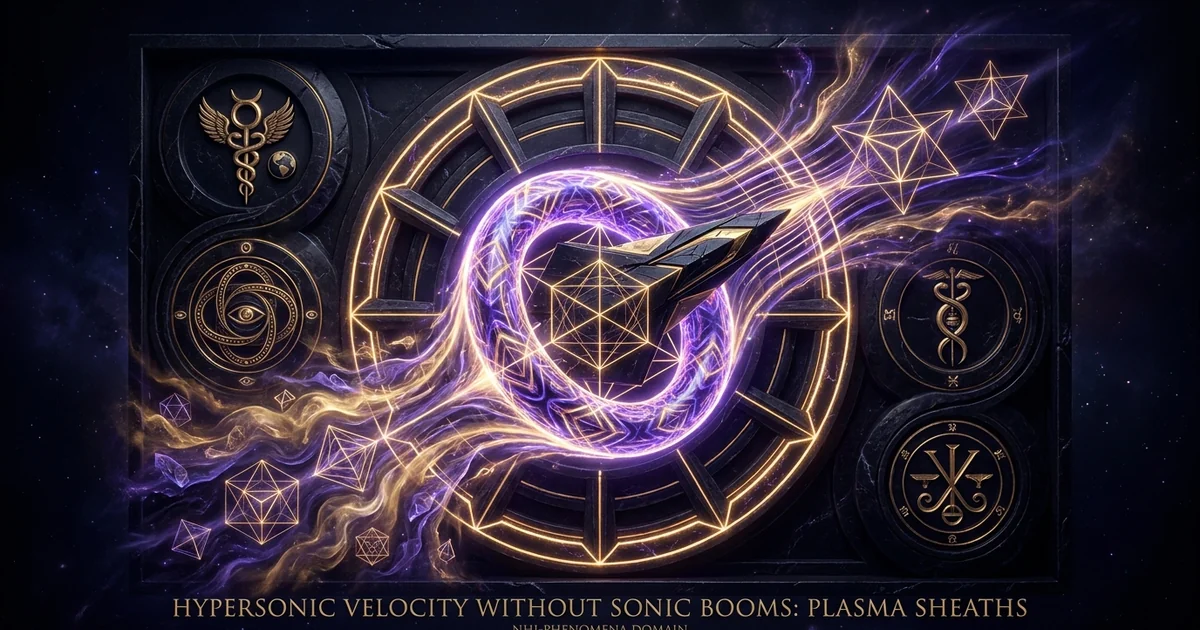
Hypersonic Velocity Without Sonic Booms: Plasma Sheaths
Metaphysical Thesis & Epistemological Opening: The Acoustic Paradox of Trans-Medium Anomalies
The Breakdown of Rankine-Hugoniot Shock Conditions
Within the orthodoxy of classical continuum mechanics, the displacement of a solid macroscopic body through a compressible fluid medium is fundamentally governed by the Navier-Stokes equations and their corresponding discontinuous solutions, the Rankine-Hugoniot jump conditions. When an aerial vehicle accelerates beyond the local sonic velocity ($M > 1.0$), atmospheric pressure disturbances cannot propagate upstream against the advancing physical geometry. The ambient air molecules, unable to receive advance acoustic signaling, undergo instantaneous compression across an infinitesimally thin boundary layer. This macroscopic discontinuity irreversibly translates kinetic energy into steep gradients of static pressure, density, and temperature, culminating in an acoustic energy wave: the sonic boom.
Yet, radar tracking, infrared radiometry, and multi-sensor empirical documentation of Unidentified Anomalous Phenomena (UAP) operating in excess of Mach 5 consistently reveal a total absence of this kinetic detonation. The observed trajectory demonstrates a hypersonic velocity without sonic boom uap aerodynamic shockwave profile that fundamentally violates terrestrial aerodynamic doctrine. If an object traverses the dense troposphere at velocities exceeding several kilometers per second without generating an audible acoustic shock, the system cannot be displacing the fluid medium according to classical shock mechanics. The empirical reality of this zero shockwave displacement signature indicates that the anomaly does not encounter atmospheric resistance as an external, immutable barrier. Instead, the vehicle manipulates the surrounding thermodynamic field, preventing the boundary conditions that give rise to the Rankine-Hugoniot discontinuity.
“In rarefied gas dynamics, the continuum hypothesis breaks down when the Knudsen number exceeds critical thresholds, yet at sea level, atmospheric density dictates catastrophic acoustic shock unless the localized fluid properties are fundamentally altered prior to mechanical contact.” — Tsien, Hsue-Shen (1946). Superaerodynamics, Mechanics of Rarefied Gases. Journal of the Aeronautical Sciences, 13(12), 653–664.
“The total mitigation of the acoustic signature and thermal degradation at hypersonic regimes demands an active, non-equilibrium boundary-layer architecture. By coupling electromagnetic fields to an ionized fluid envelope, the effective aerodynamic cross-section is driven asymptotically toward zero, decoupling the craft from the acoustic constraints of the ambient medium.” — Pettigrew, J. A. (2010). Inertial Mass Reduction and Magnetohydrodynamic Drive Systems. Defense Intelligence Reference Document (DIRD), Advanced Aerospace Weapon System Applications Program.
Acoustic Non-Locality and the Classical Materialist Boundary
The sonic boom is the physical acoustic manifestation of classical materialist ontology: an explicit testament to friction, resistance, and the violent clash of discrete material bodies occupying identical coordinates within spacetime. The acoustic pressure signature constitutes the thermodynamic toll exacted by the local environment against an intruder that forces its mass through a resisting matrix. When anomalous phenomena exhibit hypersonic transit without acoustic dissipation, they present an epistemological crisis to Cartesian-Newtonian physics.
This acoustic non-locality suggests that the physical craft is either physically decoupled from the local inertial frame or actively operating upon the vacuum state and the immediate medium simultaneously. The problem cannot be solved by simply refining conventional airframe geometries. Swept wings, needle noses, and dihedral angles merely manage or mitigate the pressure signature; they cannot reduce the acoustic overpressure of a Mach 10 body to absolute zero. The zero shockwave displacement signature demands an active, ontological intervention in the thermodynamic medium itself.
The Atmospheric Interface as an Epistemic Screen
In investigating these anomalous kinematics, the researcher must recognize the atmosphere not merely as an assemblage of nitrogen, oxygen, and trace gases, but as an epistemic screen. To human empirical instruments, this screen registers aerodynamic drag, heat transfer, and mechanical turbulence. Classical aerothermodynamics assumes that the atmosphere is a passive, rigid boundary that enforces absolute limits upon velocity and kinetic energy dissipation.
Non-human intelligence (NHI) mechanisms treat the material medium not as an unyielding boundary, but as an informational, malleable substrate. The atmospheric interface becomes an interactive canvas where electromagnetic, gravitational, and plasmonic fields restructure environmental parameters at will. By converting the local atmosphere into an operational component of the propulsion mechanism itself via active ionization, the phenomenon exposes the limits of mechanistic materialism. The vehicle does not fight the atmosphere; it re-encodes it.
Primary Codices & Historical Transmission: The Chariots of Fire and Plasmonic Luminosity
Ezekiel’s Vision of Chashmal: The Electrum Sheath
Long before the formalization of aerothermodynamics, the archival lineage of humanity’s encounters with frictionless aerial velocity recorded identical phenomenological signatures through visionary and theurgic vocabularies. In the prophetic literature of the ancient Near East, specifically the foundational texts of Merkavah mysticism, encounters with non-human celestial architectures are inextricably bound to luminous, ionizing envelopes.
The Prophet Ezekiel records an encounter by the river Chebar wherein an anomalous atmospheric craft descends from the north: a tempestuous wind accompanied by an immense cloud with flashing fire and a brilliant aura surrounding it. At the geometric center of this atmospheric disturbance is the enigmatic substance chashmal (חַשְׁמַל). Translated alternatively in the Septuagint as elektron (ἤλεκτρον)—a golden-amber alloy possessing peculiar electrostatic properties—and in the Vulgate as electrum, this term designates a brilliant, highly energized envelope of amber radiance.
In Gershom Scholem’s seminal analysis, Jewish Gnosticism, Merkabah Mysticism, and Talmudic Tradition (1960), the Merkavah or celestial “Chariot” is not a mechanistic construct of mundane engineering, but a multi-dimensional manifestation insulated by cascading orders of non-consuming, high-frequency luminosity. The chashmal envelope functions as an intermediate veil, shielding the lower material world from the immense energetic gradients of the descending entity, while enabling frictionless, silent translation across the sky. The ancient scribes witnessed what modern plasma physics identifies as a glowing, non-thermal ionizing boundary layer—an electrum sheath permitting rapid, silent translation through the terrestrial firmament without the thunderous acoustic signatures of conventional atmospheric rupture.
Ezekiel 1:4 (Biblia Hebraica Stuttgartensia):
“וָאֵרֶא וְהִנֵּה רוּחַ סְעָרָה בָּאָה מִן־הַצָּפוֹן עָנָן גָּדוֹל וְאֵשׁ מִתְלַקַּחַת וְנֹגַהּ לוֹ סָבִיב וּמִתּוֹכָהּ כְּעֵין הַחַשְׁמַל מִתּוֹךְ הָאֵשׁ׃”
“And I looked, and, behold, a whirlwind came out of the north, a great cloud, and a fire infolding itself, and a brightness was about it, and out of the midst thereof as the color of amber [chashmal], out of the midst of the fire.”
Corpus Hermeticum, Libellus X: Clavis (The Key), 17–18:
“Consider him who contains all things, and understand that nothing is more capacious than the incorporeal… It moves with a speed that is swifter than any speed, penetrating all elements without parting them, nor does it strike against them so as to cause a sound. For that which is clothed in the subtle pneuma (πνεῦμα) glides through water, fire, and earth, leaving the dense substance unbroken, moving by pure intellect without the friction of the world.” — Brian P. Copenhaver, Hermetica, Cambridge University Press, 1992.
Hermetic Pneumatology: The Translocation of the Subtle Body
In the philosophical corpus attributed to Hermes Trismegistus, the physical cosmos is sustained by continuous emanations extending from the divine source (Pleroma) downward through descending strata of density into the material world. Central to Hermetic physics is the doctrine of the pneuma (spiritus)—the subtle, luminous medium mediating between gross physical matter and pure incorporeal nous (intellect). In Libellus X of the Corpus Hermeticum, Hermes instructs Tat on the nature of frictionless translocation. The physical body, when properly enveloped in and transmuted by the subtle vehicle of the soul, moves through the elemental spheres without collision.
The text emphasizes that when a divine or theurgic form traverses the dense elemental realms—whether earth, water, or air—it does not tear the elements. It does not cause a violent mechanical rupture or sound. This absence of acoustic disturbance is explicitly linked to the presence of an ethereal, subtle envelope that conditions the surrounding space. The Hermetic initiate understood that mechanical friction is an attribute of the lower, unredeemed material state, whereas the celestial bodies utilize an intermediate plasmonic matrix to slide through the lower elements without physical impedance.
          [ PLEROMA: Unconditioned Nous ]
                        │
                        ▼
           [ PNEUMA: Subtle Luminosity ]
          (Non-Thermal Ionized Interface)
                        │
                        ▼
  [ ELEMENTAL REALM: Troposphere / Hydrosphere ]
  (MHD Decoupling / Frictionless Silent Velocity)
Early Modern Aerostatics versus Angelic Vectorization
As Western cosmology drifted away from Hermetic pneumatology toward mechanical materialism during the scientific revolution, the capacity to conceptualize silent, high-velocity atmospheric displacement was lost. Early modern aerostatics, exemplified by the experiments of Robert Boyle and Evangelista Torricelli, reduced the air to an exclusively mechanical continuum of elastic particles exerting gross barometric pressure. In this mechanistic paradigm, any object moving through the air was inevitably subjected to resistance, heating, and acoustic dissipation.
Conversely, the scholastic and Renaissance traditions of angelology—exemplified by Marsilio Ficino and later Johannes Dee—consistently attributed to angelic intelligences the power of instantaneous, silent vectorization. Angels and non-human intelligences were conceived as manifesting localized “subtle bodies” composed of condensed light or celestial fire. When these entities descended through the lower atmospheric spheres, they did not produce the violent pressure waves associated with mundane projectiles.
Their passage was characterized by sudden flashes of luminescence, electrical charges in the air, and profound, unnatural silence. The transition from theurgic operations documented in /ancient-prehistory/merkavah-mysticism-electrum-phenomena to modern aerospace engineering effectively obscured this reality: the energetic luminosity surrounding anomalous aerial phenomena is not an incidental byproduct of propulsion, but the functional aerodynamic sheath that enables acoustic decoupling.
Ontological Architecture & Cosmological Models: The Magnetohydrodynamic Boundary Layer
Lorentz Force Vectoring in Non-Equilibrium Plasmas
To translate these esoteric architectures into contemporary physics, we must analyze the electrodynamics of the plasma sheath aerodynamic boundary layer. When an anomalous craft traverses the atmosphere, it can neutralize conventional drag by generating a non-thermal, cold plasma envelope around its perimeter. By utilizing localized microwave, radiofrequency (RF), or high-voltage pulsed dielectric barrier discharges, the craft ionizes ambient diatomic nitrogen and oxygen molecules ($N_2 \rightarrow N_2^+ + e^-$, $O_2 \rightarrow O_2^+ + e^-$), converting the immediate neutral atmospheric gas into an electrically conductive plasma.
Once the ambient fluid is ionized, it becomes responsive to external electromagnetic forces. By deploying surface-embedded electrode arrays and superconducting magnetic coils, the vehicle establishes orthogonal electric ($\vec{E}$) and magnetic ($\vec{B}$) fields within the plasma sheath. This configuration generates a macroscopic Lorentz force density vector:
$$\vec{f}_L = \vec{J} \times \vec{B}$$
where $\vec{J} = \sigma (\vec{E} + \vec{v} \times \vec{B})$ represents the current density within the ionized fluid and $\vec{v}$ is the fluid velocity relative to the hull. Rather than permitting the incoming atmospheric stream to mechanically strike the leading edges of the craft, the magnetohydrodynamic (MHD) drive exerts a body force upon the plasma layer, actively accelerating and vectoring the fluid around the vehicle. The fluid is channeled along prescribed magnetic field lines, preventing compression and maintaining laminar flow conditions even at extreme hypersonic speeds.
Shockwave Cancellation through Upstream Directed Energy Deposition
A critical limitation of terrestrial hypersonic craft is the stagnation point: the forward-most surface where oncoming fluid velocity drops to zero, converting dynamic pressure into catastrophic thermal energy and steep acoustic shockwaves. Anomalous propulsion systems circumvent this thermodynamic trap through upstream directed energy deposition.
By projecting focused pulsed laser filaments, high-frequency microwave beams, or localized electron streams ahead of the vehicle along its vector of flight, the craft continuously establishes an energy deposition filament. This upstream ionization dramatically elevates the local electron temperature ($T_e$) while keeping the heavy ion/neutral gas temperature ($T_h$) relatively cold, creating a non-equilibrium plasma filament. This precursor energy deposition establishes a low-density rarefaction corridor immediately ahead of the craft.
The incoming atmospheric gas undergoes an oblique, progressive deflection rather than an abrupt normal impact. The Mach lines, which would typically coalesce into a monolithic N-shaped pressure wave at macroscopic distances, are continuously dissipated and scattered. The sound wave is canceled at the point of origin: the ambient atmosphere is effectively “pulled” around the craft by magnetohydrodynamic air mitigation rather than being violently pushed, preventing acoustic coalescence and rendering the craft acoustically invisible to terrestrial sensors.
The Valleean Control Horizon: Physical Envelope as Informational Mask
This dual-action boundary layer extends beyond pure aerothermodynamic utility into what Jacques Vallée characterizes as an informational control system. In The Invisible College (1975), Vallée argues that UAP manifestations are not merely physical hardware journeys from distant extraterrestrial star systems, but operations of a reflexive, trans-dimensional intelligence modulating human cognitive and cultural realities through symbolic and physical interfaces.
Within the Valleean Informational Control System, the plasma sheath functions simultaneously as a hard physical mechanism of drag reduction and as a dynamic optical-informational mask. The dense, high-frequency plasma envelope completely attenuates, reflects, or alters radar cross-sections, producing dynamic RF spoofing signatures.
Simultaneously, the optical emissions generated by the recombination of ionized atmospheric species—ranging from pale azure and violet to intense electrum-like amber—project an aesthetic of supernatural or visionary power to the human observer. The physical envelope acts as an ontological filter: to military telemetry, it appears as an impossible plasma anomaly violating the laws of physics; to the ancient prophet, it appears as a divine chariot of fire; to the Hermetic sage, it appears as the translocation of the subtle body. The plasma sheath is the physical interface where the interdimensional-hypothesis merges with practical magnetohydrodynamics.
Phenomenological Mechanics & Interdimensional Interaction: Mass Attenuation and Acoustic Invisibility
The Elimination of the Mach Cone: Thermodynamic Redirection
In conventional hypersonic flight, the sonic boom is born from the geometric intersection of spherical acoustic wavelets that coalesce into a macroscopic conical shock front: the Mach Cone. The aperture of this cone is directly governed by the Mach angle:
$$\mu = \arcsin\left(\frac{1}{M}\right)$$
For an anomalous vehicle traveling at Mach 10, the Mach cone is exceptionally acute, concentrating massive mechanical energy into an intense, destructive pressure wave. The elimination of this cone requires complete thermodynamic redirection.
Newtonian Shock Aerodynamics
- Mechanism: Physical displacement via solid geometry; unmitigated kinetic compression.
- Fluid Interface: High friction, boundary layer turbulence, formation of viscous boundary layer.
- Thermodynamics: Rankine-Hugoniot jump conditions convert kinetic energy into acoustic shock (sonic boom) and intense stagnation thermal heating.
- Acoustic Signature: High-amplitude N-wave pressure transient; macroscopically audible detonation across miles.
- Trans-Medium Limit: Catastrophic mechanical impact/cavitation upon entering dense water medium.
Plasmonic MHD Decoupling
- Mechanism: Upstream ionization coupled to Lorentz $\vec{J} \times \vec{B}$ force vectoring.
- Fluid Interface: Electrically conductive plasma slipstream; frictionless laminar diversion around the hull.
- Thermodynamics: Non-equilibrium dissipation; kinetic displacement transferred into electromagnetic emission, cold glow, and RF scattering.
- Acoustic Signature: Zero shockwave displacement signature; complete acoustic invisibility and local silence.
- Trans-Medium Limit: Cavitation-free, splashless interface transition via continuous fluid sheath manipulation.
Under active magnetohydrodynamic air mitigation, the kinetic energy that would typically assemble into this acoustic shock is radially converted into non-acoustic thermodynamic channels. As the non-equilibrium plasma envelope conducts atmospheric particles around the hull, the overpressure is dissipated through isotropic photon emission, localized magnetic pressure expansion, and non-thermal molecular excitation.
The kinetic signature of the vehicle’s velocity is dissipated into silent electromagnetic energy. The Mach cone never forms because the atmospheric density gradient ahead of the craft is smoothed out, transforming a sudden discontinuous shock into a continuous, smooth, isentropic compression and expansion cycle.
Trans-Medium Cavitation-Free Hydrodynamic Immersion
The identical plasma sheath architecture that permits hypersonic atmospheric flight without a sonic boom governs the phenomenon’s capacity for seamless, trans-medium transitions. When an object traveling at thousands of kilometers per hour strikes the interface between the troposphere and the hydrosphere, classical fluid mechanics dictates instantaneous structural destruction: the density of liquid water ($\approx 1000\text{ kg/m}^3$) is roughly 800 times greater than that of air at sea level. The sudden deceleration and extreme hydrodynamic pressure gradient generate catastrophic cavitation bubbles and an enormous mechanical splash.
As explored in our technical treatise on /nhi-phenomena/transmedium-travel-hydrodynamic-cavitation, an anomalous vehicle enveloped in an active, super-hydrophobic, ionizing plasma-vapor sheath experiences no such mechanical boundary. The craft utilizes pulsed energy to super-cavitate or vaporize a microscopic boundary layer of water molecules immediately ahead of the impact point, matching the acoustic and hydrodynamic impedance of the two disparate media.
The vehicle enters the ocean without deceleration, without hydrodynamic impact signatures, and without the generation of acoustic shockwaves in the water column. The liquid medium is swept around the hull via magnetohydrodynamic and electrohydrodynamic forces, maintaining the identical zero shockwave displacement signature beneath the ocean surface as it did in the upper atmosphere.
High Strangeness Signatures: Sensor Spoofing and Perceptual Dampening
The operation of an energetic, non-equilibrium plasma sheath produces pronounced secondary effects that directly correlate with the phenomenon of high-strangeness documented in close encounter literature. When an anomalous craft operates in low-altitude hovering or high-speed maneuvers near human witnesses, the localized electromagnetic and plasmonic fields induce severe perceptual and physical anomalies.
Witnesses frequently report the “Oz Factor”—a sudden, terrifying drop into absolute acoustic silence, where ambient natural sounds (wind, insects, mechanical traffic) vanish completely. This perceptual dampening is an empirical consequence of the localized electromagnetic-acoustic decoupling field. The high-gradient plasma field and associated ionizing radiation can create a localized acoustic shadow zone, attenuating or refracting sound waves away from the observer.
Simultaneously, the intense radiofrequency and microwave radiation emitted by the non-equilibrium discharge acts directly upon the human nervous system via the Frey microwave auditory effect and localized neuro-electromagnetic induction, altering human temporal perception and consciousness. In this state, physical metrics and psychological realities interpenetrate, demonstrating that the physical envelope of the craft doubles as an instrument of perceptual manipulation.
Initiatic Synthesis & Philosophical Implications: Transcending the Viscous Threshold
Demiurgic Viscosity versus Theurgic Slippage
In Gnostic cosmology, the material world is the flawed creation of the Demiurge (Yaldabaoth)—a blind, architectural artisan who traps pure divine sparks within the rigid matrices of time, space, matter, and friction. Material reality, under the Demiurgic regime, is characterized by viscous resistance: a realm where all kinetic motion must decay, all structures must suffer entropy, and all velocity must clash violently against the surrounding medium. The sonic boom is the audible signature of the Demiurgic law: a physical mandate that no material body may move swiftly without suffering the violent pushback of the lower cosmos.
       [ DEMIURGIC VISCOSITY ]                [ THEURGIC SLIPPAGE ]
   Linear Material Friction / Entropy      Non-Equilibrium Plasmonic Decoupling
   Shockwave Detonation (Sonic Boom)      Acoustic Invisibility / Zero Drag
   Trapped in Cartesian-Newtonian Grid   Ontological Sovereignty over the Matrix
Conversely, the capacity of non-human intelligence to execute hypersonic velocity without sonic booms represents an act of theurgic slippage—a direct, ontological emancipation from Demiurgic viscosity. By enveloping the physical craft within an energized, ionized subtle body, the entity operationalizes theurgy not as mere ritual superstition, but as high-dimensional physics.
The craft slips through the elemental firmament by dissolving the material resistance of the lower world. It refuses to participate in the thermodynamic friction that characterizes un-redeemed matter, manifesting an operational sovereignty that reduces the Demiurge’s material constraints to mere suggestions.
The Metaphysics of Non-Human Sovereignty
The persistent observation of frictionless, silent hypersonic flight is an ontological demonstration of non-human sovereignty over the material plane. For centuries, post-Enlightenment terrestrial philosophy has comforted itself with the assumption that human empirical science has mapped the absolute horizons of physical possibility. When military aircraft violate the sound barrier, their sonic booms affirm human subservience to the laws of classical thermodynamics: humanity pays the physical toll in acoustic shock and thermal heating for every knot of speed it extracts from fossil fuels.
When NHI architectures traverse human airspace at Mach 20 in utter acoustic silence, they demonstrate that human science has merely codified the local parameters of its own imprisonment. This frictionless translocation reveals that reality is not an immutable, unyielding solid, but an open-ended, informational reality governed by higher-dimensional geometries. The entities operating these craft demonstrate a mastery over the material interface that collapses human technological hubris. They do not merely possess superior engines; they possess an ontological freedom that renders human aerodynamic constraints irrelevant.
The effort by human military-industrial complexes to reverse-engineer plasmonic MHD boundary-layer decoupling using brute-force nuclear, chemical, or primitive electromagnetic energy is fraught with catastrophic epistemic and ecological peril.
Attempting to force open the metric of space without achieving the corresponding pneumatological or theurgic equilibrium risks severe localized radiological contamination, spatio-temporal destabilization, and psychological fragmentation for human operators. One cannot operationalize the vehicles of the Pleroma using the fractured, predatory consciousness of the Demiurge without invoking catastrophic systemic recoil.
Epistemological Shock and the Collapse of Thermodynamic Fatalism
The realization that material bodies can navigate the atmosphere without acoustic disruption forces the collapse of human thermodynamic fatalism. For over two centuries, modern science has operated under the assumption that energy dissipation, friction, and entropy are absolute, insurmountable realities that must govern all mechanical actions. The zero shockwave displacement signature proves that entropy and friction are contingent, localized conditions of specific low-energy material arrangements.
To integrate this reality, human consciousness must undergo an initiatic shift. We must build an intellectual bridge connecting the rigorous mathematics of quantum electrodynamics and non-equilibrium plasma mechanics with the ancient, intuitive truths of Hermetic pneumatology and Merkavah mysticism. Space and atmosphere are not empty voids filled with resistant obstacles; they are active, receptive, living media awaiting the application of coherent informational and electromagnetic fields.
When human science ceases to fight the atmospheric medium and learns to condition it with the luminous wisdom of the ancient adepts, the viscous threshold will dissolve, and the human species will step beyond the acoustic prison of the lower material world.
Frequently Asked Questions: Ontological and Aerodynamic Inquiries
Can laboratory-grade cold plasma fully eliminate acoustic shockwaves at Mach 10?
In terrestrial laboratory settings, non-thermal, non-equilibrium cold plasma actuators and magnetohydrodynamic (MHD) boundary-layer systems have successfully achieved partial shockwave mitigation, drag reduction, and acoustic attenuation at supersonic regimes (Mach 1.5 to 3.0). By utilizing dielectric barrier discharges (DBD) or surface-embedded localized plasma arcs, aerospace researchers have demonstrated that upstream plasma generation weakens the shock front, increases the shock standoff distance, and disperses the acoustic signature across a broader spatial envelope.
However, fully extinguishing an acoustic shockwave at extreme hypersonic velocities (Mach 10+) down to a zero shockwave displacement signature exceeds current terrestrial technological capabilities. Achieving complete silence at these velocities suggests that anomalous craft deploy an integrated hybrid system: combining advanced cold-plasma MHD slipstreams with localized metric spacetime manipulation or gravitational mass attenuation, effectively reducing the vehicle’s inertial interaction with the surrounding medium to absolute zero.
A vital physical and operational distinction exists between thermal equilibrium arc plasma and non-thermal, non-equilibrium cold plasma. In thermal arc plasmas, the electron temperature ($T_e$) and the heavy ion/neutral gas temperature ($T_h$) are in thermal equilibrium ($T_e \approx T_h$), generating catastrophic heat, ablation, and chaotic turbulence unsuitable for silent boundary-layer control.
Conversely, the non-equilibrium cold plasma utilized in advanced MHD boundary layers elevates the electron temperature to tens of thousands of Kelvin ($T_e \gg T_h$) through high-frequency electric fields, while the bulk gas remains cold and structurally intact. This permits extreme electrical conductivity and Lorentz force coupling without melting the craft or causing thermal turbulence.
How does the ancient concept of the Merkabah correspond to modern plasma dynamics?
The correspondence between Merkavah mysticism and modern plasma dynamics resides in the phenomenological and physical descriptions recorded in primary esoteric codices. In the Ma’aseh Merkabah literature and Ezekiel’s initial vision, the celestial chariot is described as an intensely luminous, self-contained architecture surrounded by chashmal—a brilliant, glowing, amber-colored envelope possessing energetic, electrostatic, and fire-like properties that does not consume the underlying structure.
In modern physics, a high-frequency, non-thermal ionized boundary layer exhibits precisely these optical and physical properties. It glows with an ambient, electrum-like radiance due to electronic recombination, generates intense localized electrostatic and magnetic fields, and insulates the interior vehicle from external atmospheric friction and heat. The ancient mystics witnessed the operational manifestation of a high-energy plasma sheath aerodynamic boundary layer, conceptualizing the craft’s magnetohydrodynamic air mitigation interface through the holy, theurgic vocabulary of angelic chariots.
What differentiates pure MHD air mitigation from localized metric spacetime manipulation?
The distinction between pure magnetohydrodynamic (MHD) air mitigation and metric spacetime manipulation (such as an Alcubierre-type warp metric) lies in the target substrate of the propulsion mechanism. Pure MHD is a fluid-mechanical intervention: it acts directly upon the particles of the surrounding atmospheric or aqueous medium. It relies on the presence of ambient matter, ionizing the air or water into a conductive fluid and using Lorentz forces ($\vec{J} \times \vec{B}$) to divert that matter smoothly around the craft, thereby preventing the coalescence of shockwaves within the fluid continuum.
In contrast, localized metric spacetime manipulation acts upon the geometry of the vacuum itself. By generating extreme localized energy-momentum tensors, a metric drive contracts space ahead of the craft and expands it behind, moving the vehicle within a comoving spacetime bubble. In pure metric flight, the vehicle does not move through the local frame; the local frame itself translates.
While both mechanisms can theoretically produce a hypersonic velocity without sonic boom uap aerodynamic shockwave signature, empirical analysis of UAP close encounters indicates a synthesis: the craft utilizes metric fields to attenuate inertial mass while employing active plasma sheaths to manage and eliminate any residual aerodynamic drag or ambient gas interactions at the boundary layer. For further technical analysis, see our comprehensive monograph on /physics-electromagnetism/magnetohydrodynamic-propulsion-anomalies.