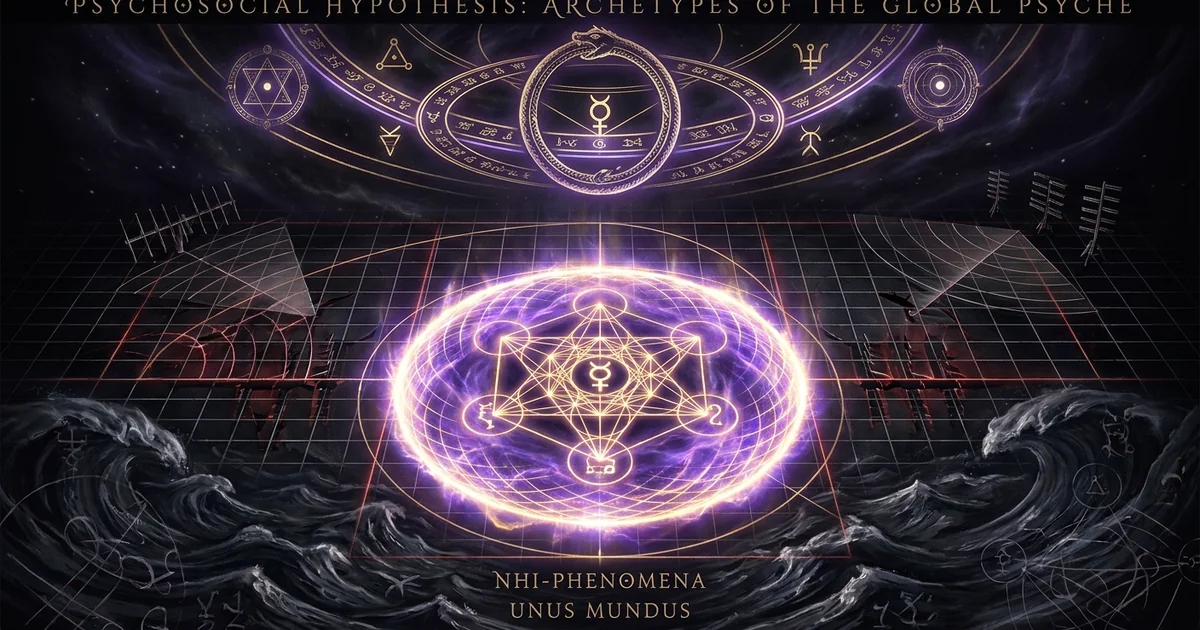
Psychosocial Hypothesis: Archetypes of the Global Psyche
Metaphysical Thesis & Epistemological Opening: The Psychoid Threshold of Aerial Anomalies
Transcending the False Dichotomy of Nuts-and-Bolts vs. Hallucination
For over seven decades, anomalous aerial phenomena have been imprisoned within an impoverished dialectical deadlock. On one flank stands the uncritical reification of the Extraterrestrial Hypothesis (ETH)—a perspective that insists unidentified flying objects must exclusively represent interplanetary spacecraft constructed of advanced metallic alloys, propelled through mundane spacetime by speculative engineering. On the opposing flank stands clinical reductionism, which dismisses sightings, close encounters, and radar-visual anomalies as the inconsequential detritus of ocular illusion, atmospheric mirage, hysteria, or individual psychopathology.
This binary constitutes a profound philosophical failure. Both positions remain shackled to a naive Cartesio-Newtonian metaphysics that bifurcates the cosmos into absolute res extensa (the objective, spatial, measurable world of matter) and res cogitans (the private, subjective, unextended realm of mind). By imposing this bifurcated framework onto encounters that inherently contest Cartesian boundaries, researchers fail to observe how anomalous phenomena systematically bridge both categories.
The psychosocial hypothesis (PSH), when elevated above vulgar sociological debunking, offers the epistemological key to unlocking this impasse. The vulgar variant of the PSH, popularized by French ufologists such as Michel Monnerie in Et si les OVNIs n’existaient pas? (1977), sought to dissolve the phenomenon entirely into human sociology, media contagion, and perceptual error. However, a deeper reading—one informed by depth psychology, comparative Hermeticism, and informational ontology—reveals that the psychosocial hypothesis does not negate the physical reality of the phenomenon. Rather, it reveals the phenomenon as an ingress occurring across the liminal interface where transpersonal human consciousness and physical reality coalesce.
The unresolved nature of aerial anomalies arises precisely because they are neither purely mechanical artifacts nor purely subjective fantasies. They are living archetypal hierophanies that materialize at the boundary of reality, compelling humanity to confront the unintegrated contents of its own collective psyche through physical manifestation.
The Cartesio-Newtonian Rupture and the Return of the Sky-Mandalas
The scientific revolution, while granting humanity dominion over quantitative physical mechanics, enacted an ontological rupture. By banishing the anima mundi (the soul of the world) and desacralizing the cosmos into inert matter subject to mechanical laws, modern civilization alienated itself from the mythopoetic structures that historically stabilized the human spirit. The sacred canopy, which once situated human existence within an interconnected cosmic hierarchy, disintegrated. In its wake arose existential dread, exacerbated throughout the twentieth and twenty-first centuries by the development of thermonuclear weapons, industrial ecocide, and exponential technological acceleration.
When profound psychic contents are systematically repressed from conscious awareness by an aggressive materialism, they do not dissipate. In accordance with the thermodynamic laws of psychic energy formulated by Carl Gustav Jung, repressed contents regress into the deep strata of the collective unconscious, where they gather autonomous charge. When the existential tension reaches a critical threshold, these pressurized archetypes erupt into conscious awareness. Because modern civilization lacks living mythological frameworks capable of integrating these archetypal currents, the unconscious projects them outward into the external environment.
In the technoscientific epoch, these projections can no longer assume the forms of medieval demons, fae folk, or angelic choirs; such morphologies are reflexively rejected by modern cognition. Instead, the projection clothes itself in the prevailing cultural idiom: the technomorphic aesthetic of the spacecraft. The saucer-shaped craft, characterized by its circularity, luminescence, and rotational symmetry, manifests as a modern sky-mandala.
Historically, the mandala appears during acute psychic disorientation as an instinctive, unconscious attempt to re-establish order, equilibrium, and structural integration. The anomalous craft seen traversing the skies represents the rotundum—the alchemical glyph of psychic totality—catapulted into the celestial sphere to arrest the disintegration of a fragmented civilization.
Defining the Psychosocial Paradigm Through an Esoteric Lens
To construct a philosophically robust psychosocial paradigm, we must divest the term “psychosocial” of its purely sociological baggage. The psychosocial hypothesis ufo carl jung flying saucers archetype does not suggest that encounters are invented through conscious deception or passive social mimicry. Instead, it posits an active, participatory universe wherein human collective consciousness acts as a co-creator and medium of manifestation.
The human collective psyche is not an insular byproduct of neurochemical activity sealed within cranial cavities; it is an open, non-local field that interfaces directly with the fabric of space, time, and physical matter. In this monograph, the phenomenon is analyzed through the Hermetic axiom of correspondence (quod est inferius est sicut quod est superius—that which is below is like that which is above). Collective unconscious projections are not ephemeral wisps of imagination; under conditions of profound civilizational crisis, they become dense, dense enough to warp spacetime, register on passive phased-array radar, and leave physical residue upon terrestrial soil.
This synthesis requires us to view the phenomenon as an informational dialogue between the human global psyche and an autonomous, trans-dimensional intelligence. The anomalous presence uses the cultural symbols, collective archetypes, and psychological architectures of humanity to construct an interface of communication. We do not confront an indifferent alien visitor arriving from a distant star system within our linear spacetime coordinate grid; we confront the terrifyingly intimate mirror of the psychoid threshold, reflecting our evolutionary potentials, existential terrors, and repressed divine lineage back to us in the guise of non-human entities.
The term psychoid (psychoid-realm, derived from Greek psyche [soul] and eidos [form]) was introduced by C.G. Jung to denote the deepest, non-local strata of archetypes that transcend the boundary between mind and matter. In the psychoid realm, psychic contents and material reality are continuous; the archetype is not merely a psychological motif inside human thought, but an ontological bridge capable of organizing physical matter through acausal synchronicity. In this text, anomalous phenomena are classified as psychoid intrusions: events where the distinction between physical hardware and archetypal hallucination collapses within the unified substrate of the unus mundus.
Primary Codices & Historical Transmission: From Daimonic Hierophanies to Space-Age Visions
Jung’s 1958 Monograph and the Transmutation of the Daimon
The foundational text for the esoteric psychosocial framework remains Carl Gustav Jung’s 1958 treatise, Ein moderner Mythus: Von Dingen, die am Himmel gesehen werden (Flying Saucers: A Modern Myth of Things Seen in the Skies). Writing near the twilight of his life, Jung recognized that the post-World War II proliferation of unidentified flying objects was inextricably linked to the Cold War crisis and the dawn of the nuclear era. Jung observed that the human species had acquired the technical capacity to execute global self-destruction while remaining spiritually infantine, creating an immense, historically unprecedented gulf between conscious capability and moral integration.
[ Conscious Technological Hubris ]
              ▲
              │   Existential Tension
              ▼
[ Repressed Spiritual Dread ] ────► Constellation of the Rotundum ────► Sky-Mandala / UAP Ingress
Jung demonstrated that the sudden, widespread visibility of these phenomena represented a projection of the Self—the supreme archetype of psychological wholeness, order, and divine immanence. When terrestrial authorities proved incapable of assuring collective salvation, the psyche projected its yearning for salvation into the heavens.
However, Jung was profoundly cautious not to dismiss the phenomenon as mere perceptual error. He noted with rigorous intellectual honesty that these sky-mandalas produced secondary physical effects, such as radar returns and ground traces, forcing him to formulate the hypothesis that the phenomenon occupies the psychoid realm.
         ┌──────────────────────────────────────────────────┐
         │             THE PSYCHOID THRESHOLD               │
         │          (Non-Dual Substrate: Unus Mundus)       │
         └─────────────────────────┬────────────────────────┘
                                   │
                 ┌─────────────────┴─────────────────┐
                 ▼                                   ▼
      ┌─────────────────────┐             ┌─────────────────────┐
      │  Objective Ingress  │◄───────────►│ Subjective Ingress  │
      │  Radar Returns      │ Synchronistic│ Archetypal Visions  │
      │  Physical Traces    │ Coupling    │ Transpersonal Awe   │
      └─────────────────────┘             └─────────────────────┘
The Jungian hermeneutic reveals that modern aerial encounters represent the transmutation of the historical daimon. Throughout antiquity and the Middle Ages, the interstitial entities that populated the human imaginal realm appeared as archangels, terrestrial fae, dryads, incubi, and succubi. These beings were understood by pre-modern peoples as ontologically real denizens of an intermediary world (mundus imaginalis), possessing malleable forms that reflected the symbolic grammar of their respective cultures.
In the twentieth century, as the Western world systematically eliminated the vocabulary of the sacred, the daimon underwent a technomorphic metamorphosis. The luminous sphere of light became an experimental craft; the angelic messenger became the Nordic humanoid; the subterranean goblin became the diminutive, macrocephalic Gray alien. The underlying archetypal core remained invariant; only the cultural garments were updated to bypass the gatekeepers of modern skepticism.
Bertrand Méheust and the Cultural Pre-Forming of Phenomenological Encounters
In 1978, the French philosopher and sociologist Bertrand Méheust delivered a critical contribution to the psychosocial literature with the publication of Science-fiction et soucoupes volantes: Une réalité mythico-physique. Méheust executed an exhaustive textual and iconographic analysis of early twentieth-century pulp science fiction literature, specifically texts published between 1880 and 1940—decades prior to Kenneth Arnold’s seminal 1947 sighting near Mount Rainier.
Méheust documented an astonishing, indisputable correlation: virtually every primary encounter narrative, aesthetic motif, and technological feature reported by post-1947 witnesses had already been described with exquisite precision in the pulp literature of the 1920s and 1930s. The saucer-like configurations, electromagnetic vehicle interference, temporal distortions, paralyzing beams of light, levitation of human percipients through solid walls, medical examinations by emotionless entities, and telepathic communications were not novel phenomena originating in the post-war skies. They had already been inscribed into the human cultural ledger by speculative authors tapping into the collective mythos.
“In the threatened state of our world today, when people are beginning to see that everything is at stake, the projection-creating factor produces an archetype which has always represented the order-delivering and unifying factor: the mandala. The round shape, the sphere, the circle, corresponds to the archetype of the Self, which unites the opposites… Now these shapes are seen in the skies: projection can go no further than this. The soul projects into the cosmic spaces its own inner image of wholeness, longing for reconciliation and salvation.” — C.G. Jung, Flying Saucers: A Modern Myth of Things Seen in the Skies (Princeton University Press, 1958)
Méheust’s findings presented a profound epistemological paradox that materialist ufology has consistently failed to resolve. If these anomalous craft represent unannounced visits by an extraterrestrial civilization, why did their behavioral patterns, morphologies, and sociological consequences precisely mirror the idiosyncratic fictions created by human authors decades prior?
Vulgar debunkers seized upon this discovery to claim that witnesses were simply confabulating experiences based on unremembered science fiction tropes. Méheust himself, however, rejected this reductionist conclusion, arguing for a “mythico-physical” reality. He postulated that human culture and imaginative literature pre-form the symbolic scaffolding through which anomalous phenomena enter space and time. The mythic imagination does not merely record fantasies; it serves as the architectural blueprint utilized by the phenomenon to construct its physical manifestations. The space age myth-making was not an imitation of anomalous craft; rather, the craft were crystallizing the cultural symbols already circulating through the human collective unconscious.
Ancient Portents and Modern Saucers: Continuity of the Informational Ingress
The historical transmission of anomalous phenomena demonstrates that the modern saucer phenomenon is not an unprecedented event born of the atomic age, but rather the current iteration of an ongoing informational ingress. Ancient chroniclers, unburdened by Cartesian assumptions, documented identical events using the phenomenological metaphors of their eras.
In classical antiquity, Pliny the Elder and Julius Obsequens recorded the appearance of clipei ardentes (burning shields) that traversed the skies of the Roman Republic, terrifying legions and altering the course of military campaigns. In the Nuremberg broadsheet of 1561, woodcut artist Hanns Glaser depicted a massive aerial combat over the city, featuring blood-red globes, bluish discs, and dark cylindrical objects engaged in violent dogfights, terminating in an immense black spear-shaped object crashing outside the gates.
In nineteenth-century America, the “Mystery Airship” wave of 1896–1897 presented percipients with sightings of steerable dirigibles outfitted with flapping mechanical wings, electric searchlights, and crews of human-looking inventors claiming to have perfected flying machines—years before the Wright brothers’ historic flight at Kitty Hawk.
These historical anomalies demonstrate a persistent pattern: the phenomenon invariably manifests at the outer margins of the current technological horizon of the observing culture. To the Romans, the objects were flying shields; to Renaissance burghers, they were celestial geometric instruments and heraldic spears; to late-Victorian citizens, they were speculative steam-powered airships; to contemporary post-war humanity, they are supersonic craft, anti-gravity saucers, and multidimensional transmedium vehicles.
This systematic mutability demonstrates that the phenomenon does not possess a singular, immutable physical form. It adopts an informational camouflage, continuously updating its aesthetic to interface with the evolving socio-technological paradigm of the human collective unconscious.
Ontological Architecture & Cosmological Models: The Unus Mundus and the Control System
The Unus Mundus: Non-Dual Substrate of Mind and Spacetime
To articulate the mechanics of the psychosocial hypothesis without regressing into psychological reductionism, we must anchor our cosmology in the Hermetic-alchemical concept of the unus mundus (the “One World”). Revitalized in modern depth psychology through the collaborative work of Carl Jung and the quantum physicist Wolfgang Pauli, the unus mundus denotes an underlying, unitary metaphysical substrate from which both subjective psychological experience and objective physical matter emerge as complementary aspects.
Within this non-dual topology, mind (res cogitans) and matter (res extensa) do not constitute two fundamentally distinct substances separated by an unbridgeable chasm. Instead, they are conjugate projections of an undivided, trans-spatial informational reality. This concept finds rigorous parallels in contemporary theoretical physics, particularly in the holonomic brain theory of Karl Pribram, the implicate order of David Bohm, and the holographic principle of modern quantum gravity.
In Bohmian terms, our ordinary physical world represents the “explicate order”—a flattened, unfolded projection of a much deeper, enfolded “implicate order” where space and time are fundamentally transcended.
┌────────────────────────────────────────────────────────┐
│                      UNUS MUNDUS                       │
│        (Bohmian Implicate Order / Pure Informational)   │
└──────────────────────────┬─────────────────────────────┘
                           │
             Unfolding via Psychoid Dynamics
                           │
        ┌──────────────────┴──────────────────┐
        ▼                                     ▼
 ┌─────────────┐                       ┌─────────────┐
 │ PSYCHE      │                       │ MATTER      │
 │ (Mind/Myth) │                       │ (Spacetime) │
 └─────────────┘                       └─────────────┘
        ▲                                     ▲
        └──────── Synchronistic Coupling ─────┘
When anomalous aerial phenomena interact with human witnesses, they do not arrive from a distant spatial coordinate within the explicate order. Rather, they represent an ingress directly from the implicate order—a sudden, localized condensation of the unus mundus into our perceptual reality. The archetype does not remain an internal psychological dynamic; it operates as an active, informational matrix that configures local physical reality.
The psychoid ingress is an event wherein the fabric of spacetime is momentarily rewritten by archetypal software, resulting in anomalies that possess physical properties (electromagnetic radiation, Doppler shifts, radar reflectivity) while simultaneously exhibiting hyper-subjective, dreamlike symbolism that speaks directly to the witness’s deepest psychic structure. For an exhaustive breakdown of how these archetypal fields interact with temporal and non-local realities, examine the technical monograph on /consciousness/psychoid-archetypes-synchronicity.
Jacques Vallée’s Cybernetic Feedback and Informational Morphogenesis
Building upon the limitations of the physical extraterrestrial model, the computer scientist and astronomer Jacques Vallée introduced a groundbreaking systemic paradigm in The Invisible College (1975). Vallée proposed that the phenomenon behaves not as an expeditionary force of alien explorers, but as an informational-control-system operating on the scale of species-wide civilization.
Drawing from cybernetics and information theory, Vallée posited that humanity’s historical development is regulated by a non-local feedback loop. In cybernetic systems, a control mechanism remains concealed, manifesting only as an environmental perturbation whenever the regulated system deviates from its intended evolutionary equilibrium.
The anomalous phenomenon acts as a homeostatic thermostat for human culture, introducing targeted doses of absurdity, wonder, terror, and technological provocation into the societal matrix whenever human thought becomes ossified within an unsustainable dogmatic paradigm.
The control system achieves this cultural morphogenesis through calculated myth-making. By staging bizarre encounters that defy rational analysis, the phenomenon forces civilization to question its prevailing epistemological foundations. It destabilizes entrenched religious and scientific orthodoxies, compelling philosophy and science to expand their categories.
The physical crafts, the entities, and the accompanying high-strangeness events are not the ultimate reality of the phenomenon; they are theatrical props, symbolic interfaces dynamically generated to provoke a specific cognitive leap within the human global psyche. The informational control system hypothesis, detailed extensively in /nhi-phenomena/vallee-control-system-hypothesis, transforms the UFO from a technological mystery into an initiatic engine designed to drive human consciousness through stages of evolutionary transformation.
Societal Anxiety as the Thermodynamic Catalyst for Anomalous Perturbations
If the psychoid control system operates as an informational mechanism, what supplies the energy required to project these archetypal structures into physical spacetime? The answer lies in the thermodynamic economy of the human collective unconscious: societal anxiety technological visions.
CIVILIZATIONAL CRISIS
(Nuclear Threat / Ecological Rupture / Epistemic Collapse)
                     │
                     ▼
          ENTROPIC PSYCHIC CHARGE
       (High Non-Local Psychic Energy)
                     │
                     ▼
    CRITICAL INSTABILITY IN LOCAL FABRIC
(Micro-Wormholes, Torsion Perturbations, Plasma Condensation)
                     │
                     ▼
             PSYCHOID MANIFESTATION
When human society experiences systemic crises—such as the threat of nuclear immolation during the Cold War, existential trauma surrounding climate collapse, or profound disorientation triggered by unchecked artificial intelligence—the collective psychic field becomes intensely charged with entropic, unintegrated emotional energy. Under normal circumstances, this energy is dissipated through political conflict, artistic expression, or religious practice. However, when civilizational institutions lose their stabilizing authority, this transpersonal psychic tension accumulates within the unconscious substrate.
This concentrated psychic mass acts as a thermodynamic catalyst, generating local phase transitions within the physical fabric of reality. Just as extreme physical pressure forces gas to condense into liquid, intense collective psychic anxiety forces non-local archetypal forms to condense into physical manifestation. The anomalous aerial object is the physicalized symptom of collective trauma—an objective, material crisis point reflecting the unacknowledged spiritual agony of humanity. The phenomenon is drawn to locations of concentrated existential dread: nuclear weapons storage facilities, military installations, contested borders, and ecological disaster zones, functioning as a diagnostic instrument that maps the deep pathologies of the global psyche.
Phenomenological Mechanics & Interdimensional Interaction: Synchronicity and Physicalized Archetypes
Acausal Connecting Principles: Synchronicity as Physical Manifestation
To delineate the precise mechanism through which an archetypal form assumes temporary material density, we must utilize Jung’s doctrine of synchronicity, developed in collaboration with Nobel laureate Wolfgang Pauli. Synchronicity is formally defined as an “acausal connecting principle” wherein an internal psychological state (a dream, thought, or emotional crisis) coincides meaningfully with an external, objective event in the physical world, without any traceable linear cause-and-effect relationship linking the two.
In standard, low-intensity synchronistic occurrences, this dynamic manifests as mundane coincidences: thinking of an obscure acquaintance moments before receiving their unexpected communication, or dreaming of a specific scarab beetle immediately prior to an identical insect tapping against the analytical consulting room’s windowpane.
However, when applied to anomalous aerial phenomena, the synchronistic mechanic operates at a macroscopic, high-energy threshold. Under conditions of profound civilizational crisis, the archetypal constellation is not merely accompanied by a coincident external event; the archetype itself creates the physical event by organizing local matter and energy.
This constitutes physicalized synchronicity. The archetype, possessing non-local jurisdiction over both psyche and matter within the unus mundus, orchestrates a sudden, coherent collapse of quantum wave functions. Physical particles, atmospheric plasmas, and localized electromagnetic fields are organized into an acausal, macroscopic structure that mirrors the internal mythological contents of the human unconscious.
The anomalous craft does not navigate across classical space through mechanical propulsion; it emerges in situ as a physicalized synchronistic knot—a localized crystallization of meaning that registers on human optical nerves, scatters radar beams, depresses soil, and then dissolves back into the underlying unmanifest substrate once its semiotic impact has been registered.
The Reality-Myth Hybrid: Radar-Visual Confirmation vs. Subjective Distortion
One of the primary objections raised by materialist researchers against the psychosocial hypothesis centers on the documented presence of hard instrumental metrics. If anomalous aerial phenomena are projections of the collective unconscious, how can one account for multi-sensor corroboration, such as simultaneous airborne and ground-based radar returns, Forward-Looking Infrared (FLIR) signatures, radiation traces, and metallurgical fragments recovered from landing sites?
This critique assumes that a psychic projection cannot possess physical properties—a presupposition rooted entirely in obsolete Cartesian dualism. The psychoid paradigm asserts that the phenomenon is an authentic reality-myth hybrid. The manifestation operates on a continuous spectrum ranging from pure physical solidity to hyper-subjective visionary trance, frequently shifting between these states within a single event.
       MANDELBROT-LIKE SPECTRUM OF PSYCHOID MANIFESTATION
◄─────────────────────────────────────────────────────────────────►
PURE MATERIAL RES EXTENSA                     PURE PSYCHIC RES COGITANS
• Radar Backscatter                           • Dream Visions
• Radiation Imprints                          • Telepathic Audition
• Ground Compaction                           • Altered States
• Heat Signatures                             • Archetypal Intuition
                 ▲                                       ▲
                 └───────────────┬───────────────────────┘
                                 │
                   HYBRID HIGH-STRANGENESS REGION
                   • Oz Effect (Sensory Deprivation)
                   • Malleable Morphologies
                   • Acausal Synchronistic Clustering
                   • Time Dilation / Spacetime Distortion
During a typical encounter, an anomalous object may approach an observer, exhibiting pristine geometric edges, casting cast-shadows, and triggering automated military radar defense networks. Yet, as the percipient draws closer to the phenomenon, the physical parameters progressively soften and mutate. The witness enters an altered state of consciousness—often referred to as the “Oz Factor”—characterized by profound silence, the cessation of animal sounds, disorientation, and subjective time dilation.
The object’s geometry may begin to shift impossibly, defying Euclidean physics by appearing simultaneously huge and minuscule, or by occupying two distinct spatial coordinates simultaneously. The encounter resolves not into a standardized technological inspection, but into an oneiric, mythic initiation.
The hard sensor metrics confirm the objective reality of the ingress within spacetime, but the informational content of the event confirms that the phenomenon’s morphology is dictated by the archetypal syntax of the human unconscious.
Materialist Extraterrestrial Hypothesis (ETH)
- Ontological Basis: Pure Cartesian res extensa; entities are biological or synthetic organisms originating from distant exoplanets within standard 3D spacetime.
- Physical Evidence: Interpreted as proof of advanced off-world technology, exotic propulsion systems (e.g., Alcubierre warp drives), and terrestrial surveillance missions.
- Witness Experience: Dismissed as collateral trauma, physiological side effects of radiation/microwaves, or subjective shock; psychological factors treated as observational contamination.
- Historical Breadth: Constrained primarily to post-1947 developments; historical aerial portents are viewed as early visits by the same physical extraterrestrial crafts.
Psychosocial Psychoid Model (PPH)
- Ontological Basis: Hermetic-Jungian unus mundus; entities are psychoid apparitions emerging at the non-dual intersection of matter and the transpersonal collective unconscious.
- Physical Evidence: Understood as macroscopic synchronistic condensations of archetypal fields; physical traces are real but fleeting transubstantiations of informational software.
- Witness Experience: Recognized as the central core of the phenomenon; high strangeness and absurd symbolic elements represent the phenomenological language of the archetype.
- Historical Breadth: Continuous historical transmission across millennia, morphing from angels, demons, and fae folk into technomorphic craft to match human cultural development.
High Strangeness and the Deliberate Subversion of Rational Epistemology
The true signature of the psychoid ingress is the presence of high strangeness—a term coined by J. Allen Hynek to categorize encounter features that are so fundamentally bizarre, surreal, and absurd that they actively resist rational scientific categorization. If anomalous phenomena were straightforward, nuts-and-bolts extraterrestrial exploratory probes, one would expect their operations to adhere to standard scientific logic: efficient reconnaissance, systematic sample collection, and uniform operational protocols.
Instead, encounter files are saturated with profound absurdities. Humanoid entities are observed dressed in nineteenth-century diving suits, floating through windowpanes, offering witnesses pancakes cooked on impossible implements (as in the infamous Joe Simonton encounter of 1961), or communicating via baffling, nonsensical riddles. Physical crafts hover directly above populated areas, only to disappear in a burst of light or morph into giant birds, shadow-beings, or shimmering geometric configurations.
Materialist researchers reflexively purge these bizarre accounts from their datasets, arguing that such high strangeness elements indicate mental instability on the part of the witness. Within the psychosocial framework, however, high strangeness is recognized not as an anomalous error, but as the core functional mechanic of the phenomenon.
The absurdity is structurally deliberate: it operates as a Zen koan on a civilizational scale. By presenting the human mind with an event that utterly ruptures the rules of discursive logic and material causality, the phenomenon shatters the rigid walls of the witness’s consensus reality framework. It acts as an epistemological deconditioning mechanism, inducing a profound state of cognitive dissonance that forces consciousness to open itself to non-ordinary states of awareness.
The details of these paradoxical mechanics are unpacked further in /nhi-phenomena/high-strangeness-mechanics.
Initiatic Synthesis & Philosophical Implications: Human Sovereignty and the Space-Age Egregore
The Saucer as Egregoric Entity: Cultural Feedback Loops in the Technocene
As the psychosocial phenomenon perpetuates itself throughout modern society, it triggers a continuous feedback loop known in esoteric hermeneutics as an egregore—an autonomous psychic entity sustained and energized by the collective focus, emotional devotion, and imaginative investment of a large body of human minds.
       SOCIETAL ATTENTION & BELIEF
(Media, Internet, Contactee Movements, Military Disclosures)
                     │
                     ▼
         CONGREGATION OF PSYCHIC ENERGY
                     │
                     ▼
        GENESIS OF THE EGREGORIC NODE
 (Autonomous Archetypal Entity in the Collective Unconscious)
                     │
                     ▼
      RETROACTIVE MANIFESTATION IN SPACETIME
 (Increased Physical Sightings, Close Encounters, Synchronicities)
The flying saucer has evolved into the supreme egregore of the Technocene. Initial anomalous encounters—themselves triggered by deep-seated existential anxieties—were broadcast through twentieth-century newspapers, Hollywood cinema, television, and speculative literature. These depictions captured the imagination of billions, forming an interconnected network of expectations, mythologies, and subconscious programming.
This vast energetic reservoir fed back into the psychoid substrate. The collective unconscious, now saturated with standardized iconography of Gray humanoids, flying discs, and clandestine military recovery programs, provides the psychic blueprint for subsequent physical manifestations.
The phenomenon absorbs human attention, processes it through cultural myth-making, and manifests it back into physical reality with increased specificity. Modern encounters with Gray aliens are not occurring because Gray aliens are crossing trillions of miles of interstellar void to harvest human biological tissues; they occur because humanity has collectively constructed a psychoid egregore that now possesses sufficient autonomous informational power to physically condense within our sensory reality. The metaphysical architecture underlying this process is documented in /spirituality/egregore-formation-metaphysics.
Psychic Inflation vs. Initiatic Awakening: Navigating Ontological Shock
When an individual or an entire civilization confronts a psychoid manifestation, the experience delivers a catastrophic rupture to the cognitive apparatus—an event known in phenomenology as “ontological shock.” How one integrates this ontological shock determines whether the encounter catalyzes an initiatic awakening or initiates a rapid descent into psychological inflation and pathological obsession.
┌────────────────────────────────────────────────────────┐
│                   ONTOLOGICAL SHOCK                    │
│      (Rupture of Consensus Reality via Phenomenon)     │
└──────────────────────────┬─────────────────────────────┘
                           │
             Integration Path Assessment
                           │
        ┌──────────────────┴──────────────────┐
        ▼                                     ▼
 ┌───────────────┐                     ┌───────────────┐
 │ INITIATIC     │                     │ PSYCHIC       │
 │ INTEGRATION   │                     │ INFLATION     │
 └──────┬────────┘                     └──────┬────────┘
        │                                     │
        ▼                                     ▼
 • Transpersonal Lucidity              • Messianic Complex
 • Epistemic Humility                  • Surrender of Agency
 • Reclaiming Sovereignty              • Paranoia & Cultism
Psychic inflation occurs when the human ego appropriates the archetypal energy of the encounter for itself. Instead of recognizing the flying saucer as a transpersonal projection of the Self from the collective unconscious, the individual falls prey to literalism.
They proclaim themselves the chosen ambassadors of galactic federations, receiving channeled revelations from celestial saviors named Ashtar or the Pleiadians, promising salvation from ecological and geopolitical catastrophe. Alternatively, inflation assumes the guise of paranoid obsession, wherein the percipient falls into acute distress, convinced that demonic entities or clandestine cabals are tracking their movements through non-local technologies.
True initiatic awakening requires navigating this psychological labyrinth without succumbing to naive literalism or cynical reductionism. The adept recognizes that the anomalous intelligence encountered in the skies is neither a flesh-and-blood alien traveler nor a demonic deceiver, but a direct encounter with the transpersonal depths of the unus mundus.
The encounter serves as an initiatic mirror: it reveals that the boundaries between individual consciousness, physical reality, and the transcendent ground of being are fluid. The ontological shock does not demand that we construct new technological religions; it demands that we undergo an epistemic revolution, integrating our repressed psychic shadow so that humanity can attain authentic spiritual adulthood.
Direct engagement with psychoid aerial phenomena entails profound psychic hazards. Percipients who lack robust philosophical grounding and psychological integration routinely fall prey to messianic inflation. By interpreting living archetypes as literal galactic saviors or cosmic overseers, the individual abdicates critical discernment, projecting their personal and civilizational sovereignty onto an externalized technological phantom. This recapitulates historical religious servitude under a scientific veneer. The seeker must rigorously remember: anomalous phenomena are informational mirrors; to worship the mirror is to be consumed by the reflection.
Reclaiming Human Sovereignty Within the Multidimensional Dialectic
The ultimate philosophical imperative of the psychosocial hypothesis is the reclamation of human consciousness as an active, sovereign architect of reality. The materialist narrative reduces the human species to a cosmic accident—a fragile biological anomaly adrift upon an insignificant dust grain in an indifferent void, perpetually vulnerable to superior technologies developed by advanced civilizations. The religious fundamentalist narrative reduces humanity to fallen, helpless sinners awaiting salvation or damnation from transcendent overseers.
The psychosocial, psychoid paradigm fundamentally explodes both forms of spiritual disenfranchisement. It demonstrates that anomalous aerial phenomena cannot exist without the participatory matrix of human consciousness. We are not passive spectators gazing upward at an alien theater; our collective unconscious, our archetypes, our historical anxieties, and our imaginative mythologies constitute the essential medium through which the phenomenon achieves material reality.
Human consciousness is an active, co-creative force within the cosmos. The archetypes of the global psyche are not merely internal psychological constructs, but ontological structures woven into the fabric of the universe itself.
By deconstructing the externalized alien myth and integrating the psychoid mechanism, humanity takes the essential step toward historical maturation. We move from being the unconscious victims of our projected archetypal complexes to becoming conscious collaborators within a multidimensional cosmos, recognizing that the truth we seek among the stars was never located anywhere other than the uncharted depths of our own shared being.
Frequently Asked Questions: Ontological Paradigms of the Psychosocial Hypothesis
Physical Residue vs. Psychic Projection
How can a phenomenon rooted in the collective unconscious leave physical traces, such as soil compression, radiation signatures, and radar returns?
This apparent contradiction exists only within the framework of Cartesian dualism, which treats mental phenomena as insubstantial and matter as unthinking, inert mass. In the psychoid model of the unus mundus, the collective unconscious and physical spacetime are conjugate aspects of a single informational spectrum.
[ Informational Implicate Archetype ]
                 │
  Macroscopic Synchronistic Coherence
                 │
                 ▼
[ Local Phase Transition in Matter/Energy ]
                 │
        ┌────────┴────────┐
        ▼                 ▼
[ Soil Compaction ]  [ Doppler Radar Return ]
When an archetype is energized by profound civilizational crisis, it generates a macroscopic synchronistic coherence. This acausal coherence reorganizes local energy and physical matter, resulting in a localized phase transition. The physical traces are entirely real: the soil is compacted by genuine gravitational or mechanical force, and the radar antenna registers actual pulses reflected by localized atmospheric ionization.
However, these physical effects are not produced by an off-world internal combustion or propulsion engine; they are transient physical traces left by an archetypal software program that briefly assumed material form within the explicate order before dissolving back into the underlying non-local substrate.
Distinguishing Cultural Hallucination from Psychoid Manifestation
If anomalous craft are shaped by cultural templates, how does a genuine psychoid event differ from an individual psychiatric hallucination or mass hysteria?
The critical distinction lies in the ontological depth and structural coherence of the manifestation. An individual psychiatric hallucination is an idiosyncratic, unintegrated eruption of the personal unconscious, typically reflecting personal trauma, neurochemical imbalances, or organic brain pathology. Hallucinations lack external trans-individual stability, cannot be perceived by non-sensitized third-party observers, and produce zero secondary physical footprints. Mass hysteria, similarly, is a purely sociological contagion characterized by transient emotional panic, mimicry, and functional neurological symptoms, but it is incapable of leaving measurable physical residue.
A genuine psychoid manifestation, by contrast, originates within the objective, collective unconscious. It exhibits archetypal patterns that mirror ancient mythologems across centuries of human culture. Furthermore, it operates non-locally: multiple, structurally disconnected observers document identical anomalous geometries simultaneously, and electronic recording systems capture its physical backscatter. The psychoid event is an objective reality; it is intersubjective, physically measurable, and systematically structured by transpersonal intelligence, operating through the cultural symbols of the observer while retaining an autonomous ontological footprint.
“The debate between those who defend the physical reality of the phenomenon and those who reduce it to a psychological illusion is completely bypassed by the mythico-physical perspective. The phenomenon borrows its images from our collective culture, but it implements them in the physical universe with terrifying material efficiency. It does not exist merely in the head of the witness, nor does it exist as an ordinary machine from another planet; it exists at the exact, paradoxical point where the myth creates the physical fact.” — Bertrand Méheust, Science-fiction et soucoupes volantes: Une réalité mythico-physique (Mercure de France, 1978)
The Role of Defense Disclosures in Collective Myth-Making
How do contemporary military and governmental disclosures (e.g., UAP briefings, declassified sensor footage) fit into the psychosocial model?
Governmental and military institutions are not objective, detached observers of reality; they are critical functional organs of the collective societal psyche. Contemporary disclosures regarding “Unidentified Anomalous Phenomena” (UAP)—complete with FLIR recordings, high-ranking military testimony, and congressional hearings—represent an orchestrated institutional myth-making process designed to manage existential dread.
       DEEP INSTITUTIONAL CRISIS
 (Loss of Hegemony / Epistemic Rupture / AI Emergence)
                     │
                     ▼
  RE-FRAMING THE PSYCHOID INGRESS
      (Military Weaponization Narrative)
                     │
                     ▼
  STATE-SPONSORED MYTHIC SANCTION
 (Congressional Hearings / Defense Authorizations)
                     │
                     ▼
 STABILIZATION OF DOMINANT POWER APPARATUS
Confronted with systemic decline, ecological crises, and the epistemic collapse of scientific reductionism, the modern state apparatus instinctively seeks to domesticate the psychoid ingress. By framing the phenomenon strictly as an aerial threat, a foreign surveillance platform, or an advanced technological challenge requiring expanded defense spending, military institutions attempt to drag the trans-dimensional mystery back into the familiar Cartesian categories of national security.
This disclosure dynamic is a protective psychological defense mechanism: the state externalizes the terror of the psychoid threshold into a tangible military problem that its command structures can conceptualize, thereby preserving institutional relevance within an increasingly unstable world. Defense disclosures are the latest cultural mask adopted by the phenomenon, demonstrating how the informational control system continues to shape the geopolitical mythologies of the technocratic era.