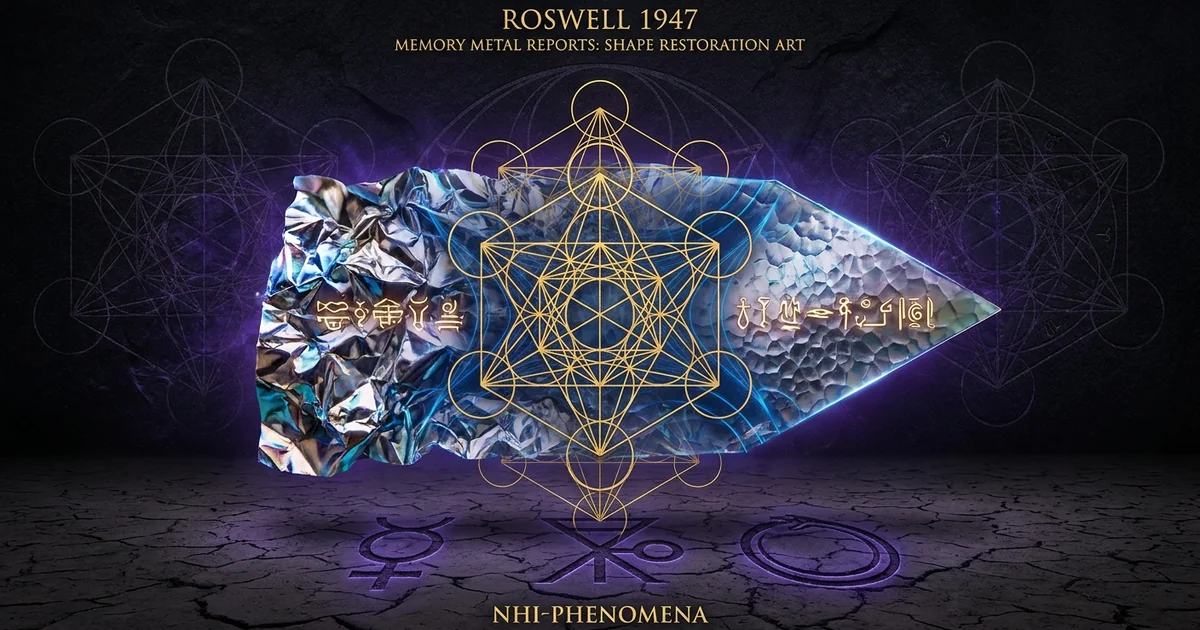
Roswell 1947 Memory Metal Reports: Shape Restoration Art
Metaphysical Thesis & Epistemological Opening: The Ontological Scandal of Anisotropic Hylomorphism
The physical recovery of anomalous debris across the Foster Ranch near Corona, New Mexico, in early July 1947 confronts physical science not merely with an unexplained aeronautical artifact, but with an ontological crisis. When Major Jesse Marcel of the 509th Bomb Group at Roswell Army Air Field examined the scatter field, his sensory encounter unsettled the bedrock assumptions of modern physical metallurgy. The material recovered—characterized across primary depositions as a parchment-thin, weightless foil that could not be burned or dented—presented an acute violation of classical metallurgical hysteresis. In classical mechanics, an applied mechanical stress exceeding the elastic yield limit induces permanent plastic deformation through dislocation slip, twin boundary formation, or lattice shear. The Corona debris rejected this thermodynamic inevitability: crumpled into an absolute fist or subjected to the impact of a sledgehammer, the substrate exerted an unassisted, instantaneous return to its pristine, unmarred planarity without caloric addition or mechanical restitution.
This phenomenological rupture destabilizes standard Aristotelian hylomorphism, wherein passive, undifferentiated matter (hyle) receives form (morphe) exclusively through the external impress of energetic work or intentional crafting. In the Foster Ranch specimens, morphology ceased to operate as an external accident visited upon an inert substrate. Instead, the material exhibited an intrinsic, teleological memory—an immanent program that actively asserted its macro-geometric integrity against destructive kinetic entropy. This behavior demonstrates that the recovered alloy was not a conventional passive receiver of physical forces, but an anisotropic, informational substrate whose physical morphology remained permanently subordinated to an incorporeal blueprint.
“I propose that there is a process going on around us that is generating physical manifestations… It is not an alien invasion; it is a system of control. The phenomenon has systematically manipulated our belief systems, utilizing physical relics—artifacts, lights, physiological traces—not as mere hardware, but as semiotic triggers. When an anomalous metallic fragment demonstrates impossible physical characteristics, its primary function is not necessarily structural or propulsion-oriented in our three-dimensional engineering framework; it operates as an epistemological disruption, forcing the human paradigm to re-evaluate the ontological boundary between consciousness, information, and solid matter.” — Jacques Vallée, Messengers of Deception (1979) and Dimensions (1988)
Standard metallurgical analysis attempts to resolve this anomalous behavior through post-hoc comparisons to nickel-titanium shape memory alloys, yet this secular reduction fails to withstand physical scrutiny. Shape memory alloys synthesized within terrestrial laboratories operate within narrow thermodynamic boundaries governed by martensitic-austenitic phase transformations, strictly dictated by thermal-mechanical hysteresis loops. The Roswell 1947 memory metal nitinol debris Jesse Marcel retrieved, conversely, performed its topological recovery athermally, defying the entropy curves established by mid-twentieth-century thermodynamics. The metal did not soften beneath the oxyacetylene blowtorch; it did not retain the kinetic impression of the sledgehammer; it generated no measurable thermal signature during its instantaneous re-expansion.
This empirical scandal necessitates an ontological transition from mechanistic materialism toward an interdimensional, informational paradigm. In this framework, physical matter operates as a localized projection of an archetypal, non-local field. The artifact does not merely “remember” its mechanical shape through atomic lattice realignment; it participates in an ongoing dialogue with an informational control architecture. What secular post-war science christened “memory metal” is, within the philosophical lineage of the Hermetic tradition and modern phenomenological research, a physical theurgic nexus: an engineered medium wherein active consciousness, semiotic geometry, and physical matter converge.
Thermodynamic Rupture: Shape Restoration as Non-Entropic Teleology
The thermodynamic implications of the Roswell memory foil represent a catastrophic discontinuity in the laws of closed physical systems. Under the second law of thermodynamics, mechanical work executed upon an alloy lattice dissipates energy into internal friction, microstructural dislocations, and localized thermal emissions. When a solid is deformed, the work is preserved as stored strain energy or released as heat. In the case of the foil that could not be burned or dented, Jesse Marcel repeatedly noted that the substrate was entirely indifferent to thermal excitation and mechanical strain. It demonstrated a zero-hysteresis state.
This zero-hysteresis dynamic implies that the restorative force driving the macroscopic lattice back to its baseline planarity does not originate from internal elastic strain energy stored in chemical bonds. Had the foil operated via standard mechanical elasticity, the force required to compress the material into a tight, crumpled ball would have generated equivalent reactive expansion vectors, accompanied by noticeable acoustic shockwaves and temperature shifts. Witness testimony instead describes an eerie, non-ballistic fluidity: upon release of compressive manual force, the foil effortlessly and noiselessly flowed back into a flat, mirror-smooth plane, presenting no micro-creases, fatigue lines, or residual strain stress.
The restoration phenomenon functions as a non-entropic teleology. The material possesses an inherent final cause—an Aristotelian telos—that continually draws its micro-constituents back toward a predetermined geometric equilibrium. Rather than evolving forward along an entropic arrow of time toward increased disorder and material degradation, the artifact’s physical trajectory is anchored to a static, non-temporal morphic template. This mechanism suggests that the underlying atomic architecture is not free to disperse into entropy; its structural coordinates are perpetually governed by a non-local morphogenetic field that holds the physical atomic matrix in strict subjugation.
The Jesse Marcel Artifacts and the Subversion of Classical Mechanics
The physical inventory detailed by Major Jesse Marcel, alongside collateral depositions from civilian witnesses such as Mack Brazel and Sheridan Cavitt, establishes three discrete material categories recovered at the Foster Ranch: parchment-like flexible foils, structural beams characterized by a fibrous, balsa-like lightness inscribed with geometric glyphs, and a brittle, dark, phenolic-like substance. Among these, the ultra-thin metallic foil represents the most explicit subversion of mid-twentieth-century classical mechanics.
Marcel’s physical attempts to alter the material revealed an irreconcilable set of properties: extreme tensile flexibility paired with infinite hardness against localized surface penetration. In terrestrial mechanics, hardness and tensile malleability exist in an inverse relationship governed by lattice dislocations; hardening mechanisms (such as precipitation hardening or work hardening) impede dislocation motion, thereby elevating yield strength while substantially compromising ductility. The Foster Ranch debris collapsed this duality. The metal was paper-thin, exhibiting mass densities suggestive of plastic or balsa wood, yet it repelled diamond-tipped drills, resisted the cutting edge of cold chisels, and absorbed high-velocity sledgehammer impacts without yielding microscopic structural indentations.
Conventional Plasticity:
Stress [σ] ---> Lattice Shear/Slip ---> Irreversible Defect Density (Hysteresis)
Roswell Substrate Response:
Stress [σ] —> Informational Decoupling —> Athermal Restitution [Zero-Defect State]
This paradoxical behavior reveals that the artifact did not resist force by mounting an equivalent opposing physical resistance—which would inevitably result in structural fracture, shear, or localized work-hardening—but rather through an instantaneous redistribution of kinetic momentum across a non-physical or higher-dimensional manifold. By transferring localized kinetic energy away from its terrestrial lattice coordinates, the material bypassed the classical shear stresses that dictate the physical limits of aerospace engineering.
Beyond Solid-State Physics: Matter Governed by Informational Will
The limitations of contemporary solid-state physics become glaringly apparent when attempting to model the Corona foil via standard crystallographic theories. Modern quantum mechanics models metals as periodic crystal lattices submerged within a Fermi sea of delocalized valence electrons. While this explains electrical conductivity, thermal transport, and basic elastic moduli via interatomic potential wells, it presumes that the atomic coordinates of the lattice are fundamentally passive. The lattice responds exclusively to external environmental variables: ambient temperature, hydrostatic pressure, and applied shear fields.
The Foster Ranch debris mandates a theoretical leap toward matter governed by informational will. In this model, the physical components of the alloy (whether titanium, nickel, aluminum, or transuranic elements) do not dictate the macroscopic behavior of the substance from the bottom up. Rather, the material is governed from the top down by an operational information field. The physical lattice is merely an empirical anchor, a sensory-perceptible shadow cast by a multi-dimensional geometry that remains sovereign over physical spacetime configurations.
Through this lens, the shape restoration observed by Jesse Marcel was not a simple physical reflex, but an act of semiotic re-assertion. The artifact “remembers” its form because its atomic constituents are held in topological coherence by an underlying computational or metaphysical instruction set. The material exhibits an active desire for structural integrity, demonstrating that at advanced levels of engineering, the division between an inorganic physical mechanism and a conscious, living entity dissolves into a unified continuum of teleological matter.
Primary Codices & Historical Transmission: From Corona Debris to Battelle Metallurgy
The transition of the anomalous debris from the high desert of New Mexico into the classified military-industrial laboratory network marks one of the most intellectually consequential episodes of twentieth-century technological appropriation. Following the initial recovery, the anomalous material was swiftly sequestered under the authority of General Roger Ramey at the Eighth Air Force headquarters in Fort Worth, Texas, before undergoing immediate air transit to the specialized aeronautical research infrastructure at Wright Field (subsequently Wright-Patterson Air Force Base) in Dayton, Ohio. Specifically transported into the high-security domain of Building 18—the home of the Foreign Technology Division—the debris became the subject of intense, desperate metallurgical probing designed to decode its mechanical anomalies.
At Wright Field, the material was confronted by an engineering establishment wholly unequipped to theorize non-entropic materials. The response of the United States military apparatus was to initiate immediate, highly compartmentalized contracts with civilian metallurgy facilities capable of sophisticated phase-diagram mapping and novel alloy synthesis. The preeminent institution selected for this initiative was the Battelle Memorial Institute, located in Columbus, Ohio, working under direct logistical and financial contracts with Wright Field.
The historical trajectory that followed reveals a suspicious, discontinuous leap in the annals of physical metallurgy. Prior to the late 1940s, global metallurgical literature possessed only a tenuous, highly academic familiarity with anomalous mechanical recovery. In 1932, Swedish chemist Adolf Ölander had documented pseudoelasticity in gold-cadmium (Au-Cd) matrices, an exotic solid-state curiosity that remained an impractical laboratory anomaly possessing negligible structural integrity, minimal tensile resilience, and acute sensitivity to fracture. Following the transit of the Corona debris to Wright-Patterson Air Force Base, however, contract documentation reveals an immediate, unprecedented pivot toward the analysis and synthesis of intermetallic phase transformations within high-strength, low-density elements—specifically non-stoichiometric nickel-titanium and novel titanium-based aerospace alloys.
Major Jesse A. Marcel, Sr. (1979 Recorded Deposition on 1947 Corona Recovery): “There was a lot of it… pieces of metal that were about the thickness of the foil in a pack of cigarettes. I picked up a piece of it and tried to bend it. It wouldn’t bend. We even tried to make a dent in it with a sixteen-pound sledgehammer, and there was still no dent in it… A piece of it was crumpled up, folded over, and when you let it go, it would just unfold immediately, completely flattening itself back out. It was parchment-thin, weightless, and you could not burn it—it would not even heat up under the torch.”
Battelle Memorial Institute, Contract AF 33(038)-3736 with Wright Field (Progress Report No. 5, Dr. H.C. Cross et al., 1949): “Work is continuing on the investigation of the phase relationships of the titanium-rich portions of the nickel-titanium and titanium-copper systems… Unanticipated transformation reactions observed in the solid state require radical re-examination of lattice boundary parameters. The mechanical stability of the intermetallic compound TiNi, together with its unusual response to cyclic thermal stress and cold-work deformation, presents unique structural characteristics that cannot be interpreted via standard eutectic or eutectoid phase equilibrium models. Extreme sensitivity to micro-impurity distributions and unusual elastomeric restitution upon localized thermal-mechanical processing warrants immediate structural elucidation.”
The 1947 Foster Ranch Recovery and the Jesse Marcel Depositions
Major Jesse Marcel’s primary accounts, recorded in meticulous detail during the late 1970s prior to the cultural commercialization of the Roswell narrative, present an unambiguous catalog of phenomenological anomalies. Marcel was not an uninitiated observer; as the Intelligence Officer for the 509th Bomb Group—the sole operational nuclear delivery unit on the planet at that time—he was intimately trained in advanced aerospace materials, munitions signatures, and the physical parameters of conventional structural metals utilized in state-of-the-art bombers.
In his audio-recorded interviews with researchers Leonard Stringfield and Bob Pratt, Marcel emphasized that the thin, flexible material recovered from the Foster Ranch bore no relationship to standard post-war military hardware. When Marcel attempted to pierce the foil with a hand drill, the drill bit skated across the mirror-like surface without biting. When high-temperature flame was directly applied, the material failed to reach thermal equilibrium with the environment, remaining cool to human touch almost immediately after the removal of the heat source. Most decisively, Marcel highlighted the memory response: the metal could be crumpled into a tight, irreversible structural ball, yet upon being placed on a flat table, it would instantaneously snap back to a pristine, entirely smooth planar state, retaining zero fold lines, micro-fractures, or residual surface fatigue.
Collateral testimony from Jesse Marcel Jr., who as an eleven-year-old child was awakened by his father to witness the debris in the early morning hours of July 1947, directly corroborated these metallurgical attributes. Marcel Jr. explicitly handled structural fragments composed of a high-strength, balsa-like wood substance, along with small, hollow metallic I-beams. Crucially, the inner channels of these structural beams featured anomalous, iridescent glyphs—frequently described as purple, violet, or pinkish-silver geometric figures resembling a hybrid of Egyptian hieroglyphics and geometric circuit traces. The mechanical indestructibility of the debris was thus physically bonded to a semiotic, linguistic presence.
Wright Field and the Battelle Memorial Institute Titanium Alloys Conundrum
The formalization of the United States Air Force in September 1947 coincided with a surge of compartmentalized research directed at the structural potential of titanium. Declassified military contracts demonstrate that within eighteen months of the Roswell recovery, Wright Field’s Materials Laboratory had initiated a sweeping research consortium led by the Battelle Memorial Institute under the direction of senior metallurgist Dr. H.C. Cross. The ostensible scientific justification for this program was the development of heat-resistant, high-strength alloys for advanced jet turbine propulsion.
However, the internal progress reports generated by Battelle under contracts such as AF 33(038)-3736 reveal an obsession that strayed far beyond mundane aerospace structural requirements. Battelle researchers focused obsessively on the phase diagrams of titanium alloys alloyed with nickel, copper, and iron, examining solid-state phase transformations that displayed non-linear elastic behaviors. The scientists at Battelle were grappling with a profound physical anomaly: the compound TiNi exhibited a structural phase change—a diffusionless, displacive martensitic transformation—that altered the fundamental elasticity of the bulk metal.
Battelle Post-Roswell Metallurgy Vectors (1949–1952):
[ Wright Field Building 18 Retrievium ]
           │
           ▼
[ Battelle Contract AF 33(038)-3736 ]
           │
           ▼
[ Diffusionless Phase Studies (Ti-Ni) ]
           │
           ▼
[ Transition to NOL: Buehler & Wiley (1962) ]
           │
           ▼
[ Commercialized "Nitinol" (U.S. Patent 3,174,851) ]
This classified pipeline eventually surfaced into the civilian technological sphere through the work of William J. Buehler and Raymond C. Wiley at the Naval Ordnance Laboratory in 1962. Buehler’s subsequent 1965 patent (U.S. Patent 3,174,851) for the alloy known as “Nitinol” (Nickel Titanium Naval Ordnance Laboratory) marked the official entry of shape memory alloys into Western commercial science. Yet, the deep archival lineage reveals that Nitinol was not a spontaneous, de novo discovery born of laboratory fortuity; it was the slow, sanitized downstream emergence of a physical attempt to reverse-engineer the non-entropic, instantaneous memory metal retrieved from the New Mexico desert fifteen years prior.
The Alchemical Lineage: From Hermetic Living Metals to Post-War Metallurgy
The emergence of shape memory characteristics within twentieth-century metallurgy marks the secular rediscovery of a core Hermetic proposition: that physical metals are not spiritually dead, immutable aggregates of mechanical atoms, but living, dynamic compounds capable of transmutation, intentional memory, and animation. In the Corpus Hermeticum, particularly Tractate IV (The Krater or the Monad) and Tractate XI (Mind unto Hermes), matter is articulated as a dense, sensory mirror of the Divine Mind (Nous). The material realm does not exist apart from divine intelligence; rather, the cosmos is a breathing, continuous organism where every physical element contains an inward yearning (ephesis) toward its archetypal, uncorrupted state.
Within the Western alchemical lineage, from the Hellenistic papyri of Zosimos of Panopolis through the medieval treatises of Geber (Jabir ibn Hayyan) to Paracelsus, metallurgy was systematically approached as a theurgical discipline. The alchemist did not view the metals as mere industrial minerals, but as psychophysical agents. The process of chrysopoeia (the transmutation into gold) was not simply chemical purification; it was the physical restoration of a fallen, fractured metal to its primordial, incorruptible baseline of balance and light. The concept of metallum vivum—living metal—asserted that when physical matter was properly purified and aligned with celestial-geometric signatures, it could overcome the gravitational and entropic drag of the sublunary sphere.
Hermetic Alchemical Paradigm:
Inert Prima Materia + Theurgic Geometric Seal ---> "Living Metal" (Active Archetype)

Post-Roswell Physical Paradigm:
Anomalous Ti-Ni Intermetallic + Semiotic Morphic Matrix ---> Memory Metal (Shape Restoration)
The Foster Ranch debris constitutes the technological materialization of this Hermetic intuition. The parchment foil did not merely behave like an alloy; it behaved like an alchemical talisman. In theurgical operations, an earthly object is inscribed with specific divine symbols and geometric seals to draw down the energetic virtue of an incorporeal archetype. When the Roswell memory metal exhibited instantaneous shape restoration while bearing geometric glyphs along its structural spine, it definitively bridged the ancient alchemical pursuit of living, animated matter with the classified metallurgical conduits of the post-war military-industrial complex. For deeper inquiry into these ancient proto-metallurgical systems, examine /ancient-prehistory/hermetic-metallurgy-alchemy.
Ontological Architecture & Cosmological Models: Informational Matrices and Semiotic Substrates
To construct an ontological model capable of explaining the 1947 memory metal, one must dismantle the Cartesian dichotomy that separates linguistic code (as pure, non-physical representation) from physical matter (as brute, unintelligent extension). The most radical architectural clue recovered at Corona was the absolute integration of physical structure with semiotic inscription. Jesse Marcel Jr., alongside subsequent collateral military witnesses, consistently identified the presencia of iridescent, raised, or etched purple-violet characters running down the internal flanges of the high-tensile, low-density I-beams.
These glyphs were not applied post-fabrication as decorative iconography or serial identification. Rather, they formed an indivisible structural component of the material itself. The glyphs functioned as a topological waveguide: a geometric language that mediated between the higher-dimensional informational plane and the three-dimensional atomic lattice. The material maintained its mechanical coherence not merely through metallic chemical bonding (covalent, ionic, or metallic sharing of electron clouds), but through an emanationist semiotic programming that established the boundary conditions of the macroscopic object.
Classical Nitinol Phase Transformation
- Governing Principle: Classical thermodynamics; solid-state diffusionless martensitic-austenitic phase shift.
- Trigger Dynamic: Requires precise thermal cycling across narrow temperature boundaries ($A_s$, $A_f$, $M_s$, $M_f$).
- Lattice Mechanics: Relies on macroscopic twin boundary movement within a standard metallic crystalline lattice.
- Hysteresis Profile: Exhibits significant mechanical and thermal hysteresis; continuous degradation via dislocation fatigue.
- Semiotic Coupling: Completely detached from linguistic, semiotic, or conscious fields; purely mechanical-stoichiometric.
Interdimensional Morphogenetic Memory Metal
- Governing Principle: Non-local quantum informational field; top-down morphogenetic resonance.
- Trigger Dynamic: Athermal; instantaneous ambient restoration independent of external caloric input.
- Lattice Mechanics: Anisotropic substrate stabilized by higher-dimensional geometric boundary constraints.
- Hysteresis Profile: Absolutely zero-hysteresis; infinite elastic recovery without plastic deformation or fatigue failure.
- Semiotic Coupling: Fundamentally integrated with linguistic-geometric matrices (hieroglyphic waveguides) and conscious agency.
The Hieroglyphic I-Beam: Semiotic Writing as Structural Lattice
The physical testimonies regarding the small structural I-beams (approximately three-eighths to one-half inch square, feather-light, yet structurally unyielding) emphasize that the purple characters were inextricably bound to the substrate. When viewed through the lens of modern metamaterials, these inscriptions resemble macroscopic surface plasmonics, photonic crystals, or topological acoustic insulators. In conventional metamaterials, macro-scale geometric configurations override the micro-scale chemical properties of the constituent elements, producing impossible bulk behaviors such as negative refractive indices or acoustic invisibility.
The Roswell I-beams extended this principle across the dimensional boundary. The characters functioned as a physical script that anchored a localized metric: an intentional, linguistic architecture that dictated how energy, force, and momentum were allowed to interact with the object. By engraving or growing these glyphs directly into the intermetallic matrix, the engineers of the craft ensured that the macro-structure was perpetually locked into an ideal informational state. The physical substrate could not snap, fracture, or distort because its geometric baseline was continuously regenerated by the semiotic lattice inscribed upon its core. To investigate how these structural mechanics intersect with contemporary propulsion theories, see /nhi-phenomena/metamaterials-uap-physics.
This semiotic integration mirrors the mystical concept of the character or sigil in classical esoteric tradition. In theurgical rites, a character is not an arbitrary cultural signifier; it is an active ontological seal that structurally mirrors the divine power it invokes. The glyphs recovered in the New Mexico desert were operational sigils of a non-human physical science: linguistic-geometric boundary conditions capable of holding atomic matter in non-entropic coherence.
Emanationist Metallurgy: The Sefirotic Inscription of Forms
This informational paradigm directly parallels the emanationist cosmology articulated within Jewish Kabbalistic literature, specifically within the cosmogonic masterwork Sefer Yetzirah (The Book of Formation). In this treatise, the physical universe is not constructed through a mechanical assembly of pre-existing, neutral physical components; rather, the cosmos is engraved, carved, and sustained through the twenty-two letters of the foundational alphabet (Otiyot Yesod). The letters are physical vessels of divine light; their geometric configurations, phonetic weights, and topological combinations form the invisible metaphysical scaffolding that prevents the physical universe from collapsing into void.
In the Sefer Yetzirah, matter originates in the highest spiritual emanations of the Pleroma (the divine fullness) and densifies through systematic cascades into the lowest physical sphere of Malkuth (the physical Kingdom). Each level of descent is governed by exact geometric-linguistic inscriptions:
$$\text{Pleroma (Divine Nous)} \xrightarrow{\text{Semiotic Inscription}} \text{Morphogenetic Template} \xrightarrow{\text{Quantum Metric}} \text{Malkuth (Solid-State Metal)}$$
When applied to the 1947 memory debris, this Kabbalistic model clarifies the physical anomalies of the recovery. The memory metal was an artifact of emanationist metallurgy. The physical alloy was merely the outer garment (levush) of a descending ontological chain. The hieroglyphs on the structural beams acted as the physical nodes of the Sefirotic tree within the metal: the literal points of inscription where the higher-dimensional archetypal form was anchored into the atomic soup of our lower three-dimensional reality.
When human observers applied mechanical stress to the metal—attempting to bend, hammer, or melt it—they were acting purely upon the level of Malkuth. However, because the alloy’s structural integrity was rooted in the higher archetypal emanation sustained by the linguistic glyphs, the material refused to accept the mechanical defect. The lower physical manifestation was instantaneously compelled to conform to the unbending, ideal form sustained at the summit of the emanationist cascade.
The Informational Control System: Vallée’s Symbolic Deception Paradigm
While the internal mechanics of the metal suggest an exquisite, higher-dimensional physics, the socio-historical presentation of the debris points toward a darker, profoundly more elusive operational intent. In his pioneering works Messengers of Deception (1979) and Dimensions (1988), astrophysicist and computer scientist Jacques Vallée formulated the informational hypothesis of anomalous phenomena. Vallée argued that the recurring manifestations of unidentified aerial and non-human phenomena (NHI) throughout human history do not represent casual exploratory incursions by flesh-and-blood extraterrestrial civilizations traveling via simple interplanetary propulsion. Instead, they function as components of a localized “informational control system.”
This control system operates across physical reality via symbolic deception, deploying physical relics, absurd encounters, and high-strangeness events as precise epistemological conditioning tools. The debris left behind at the Foster Ranch—unmeltable foils, weightless balsa beams, iridescent hieroglyphic writing—was not necessarily the accidental, catastrophic wreckage of an aerospace transit vehicle engineered to cross interstellar space. Rather, it was deployed as a deliberate psycho-physical catalyst. For an in-depth treatment of this theoretical framework, consult /nhi-phenomena/vallee-informational-control-system.
By dropping an impossible material into the lap of a nascent nuclear superpower, the phenomenon injected a technological virus into the human scientific paradigm. The memory metal was perfectly calibrated to confound classical mechanical physics while providing just enough physical traction to lure military-industrial institutions into decades of compartmentalized, obsessive, and ultimately futile reverse-engineering efforts. The debris functioned as an engineered mythologem: a physical object designed to destabilize mechanistic materialism, accelerate human technological evolution within precise parameters, and anchor human consciousness to an escalating dialogue with a trans-dimensional intelligence.
Phenomenological Mechanics & Interdimensional Interaction: Memory as Quantum Topos
To translate these esoteric and informational frameworks into rigorous theoretical physics, the phenomenon of shape memory must be decoupled from classical thermodynamics and re-established within quantum field theory and the interdimensional hypothesis. In standard solid-state physics, shape restoration is fundamentally an entropy-driven process:
$$S = k_B \ln \Omega$$
Here, the system transitions between different microstate configurations ($\Omega$) driven by the application or removal of caloric energy ($dQ = T dS$). Commercial Nitinol relies upon this mechanism: the low-temperature martensite phase consists of a twinned crystal structure that can be easily deformed via mechanical stress without breaking chemical bonds. Upon subsequent heating above the austenite transition temperature ($A_f$), the crystalline lattice undergoes a diffusionless, displacive phase transformation back into the highly symmetrical, cubic austenitic phase, thus generating the macroscopic recovery of the pre-programmed shape.
The Roswell 1947 memory metal utterly shattered this mechanism by performing its structural restoration athermally at ambient desert temperatures (approximately 70°F to 100°F) without external thermal excitation, and without demonstrating any detectable phase-cooling effect. The mechanical memory of the Corona debris was not driven by thermal entropy; it operated as a Quantum Topos—a non-local geometric state where the material’s macroscopic form is topologically protected across higher-dimensional phase space.
Morphic Resonance vs. Martensitic Lattices: Breaking the Thermal Transition Barrier
The instantaneous shape recovery of the Foster Ranch foil finds its most compelling theoretical analogue in the concept of morphic resonance, formulated by biologist Rupert Sheldrake and adapted here to anomalous solid-state physics. In Sheldrake’s formulation, self-organizing natural systems are shaped and maintained by non-material morphogenetic fields that transcend spatial and temporal boundaries. These fields possess an inherent memory, accumulating form based on past physical states and exerting a causal influence upon subsequent physical iterations through resonance. A comprehensive philosophical analysis of this model is detailed in /consciousness/morphic-resonance-sheldrake.
When applied to the 1947 recovery, the alloy did not retain its memory within its localized atomic coordinates, as does Nitinol through crystalline phase boundaries. Instead, the material’s atomic constituents were continuously tuned to an external, non-local morphic field:
$$\Psi_{\text{alloy}} = \hat{\mathcal{M}} \Phi_{\text{morphogenetic}}$$
In this formulation, the physical lattice operator ($\Psi_{\text{alloy}}$) is strictly coupled to the morphogenetic field state ($\Phi_{\text{morphogenetic}}$) via the mediation of the semiotic topological operator ($\hat{\mathcal{M}}$).
When mechanical stress was applied by Jesse Marcel—crumpling the foil into a dense mass—the applied force displaced the atomic nuclei away from their localized coordinates, but failed to disturb the sovereign morphogenetic field. The moment the external mechanical constraint was removed, the morphogenetic field acted as a top-down quantum driver, pulling the physical atomic lattice back into alignment with the archetypal template instantly and athermally. The thermal transition barrier that constrains terrestrial shape memory alloys was thus completely bypassed; the energy driving the restitution did not originate from localized thermal motion, but was drawn directly from the zero-point fluctuations of the quantum vacuum, mediated by the non-local morphic template.
The Balsa Wood Paradox: Macroscopic Resilience in Porous Densities
Equally perplexing was the structural dichotomy presented by the anomalous structural beams. Marcel and subsequent witnesses described small, structural struts that bore the visual texture and weight of balsa wood, yet utterly resisted deformation, snapping, burning, and slicing. One witness recounted attempting to slice the wood-like material with an industrial razor blade, only for the blade to glide across the surface without severing a single micro-fiber.
In conventional materials science, low mass density is directly achieved through cellular porosity (as seen in woods, metallic foams, and aerogels). However, this porosity inherently introduces structural stress concentrators: voids within the material where applied shear stresses multiply, inevitably resulting in brittle cleavage or plastic collapse under minimal loads. The Corona structural material resolved this paradox by decoupling mass density from binding energy:
Terrestrial Porosity Paradox:
Low Mass Density = High Cellular Porosity ---> Localized Stress Concentrations ---> Low Fracture Toughness

Roswell Structural Substrate:
Low Apparent Mass Density + Coherent Metric Decoupling ---> Infinite Fracture Toughness (Non-Local Bond Network)
The balsa wood paradox indicates that the material was not an organic cellular wood, nor a simple porous metal, but a three-dimensional projection of a higher-dimensional dense lattice. The apparent voids within the cellular micro-architecture were not empty space; they were filled with localized gravitational and metric-decoupling fields. The atoms constituting the material were linked via a non-local bond network, meaning that a mechanical cut attempted at a specific coordinate could not isolate and sever individual chemical bonds. The localized kinetic energy of the razor blade was instantaneously distributed across the entire collective quantum state of the artifact, rendering localized mechanical failure physically impossible.
Psychotronic Transduction: Consciousness-Metal Resonance
The most esoteric—yet persistent—phenomenological report surrounding the recovery of crash-retrieved metamaterials involves the integration of the vehicle’s structural substrate with biological consciousness. In advanced aeronautical literature detailing unidentified anomalies, the craft does not utilize mechanical switches, hydraulic linkages, or standard cybernetic interfaces. Rather, the entire structural frame operates as a psychotronic transducer: a material system designed to respond directly to the focused intentionality and neurological signatures of the pilots.
Within this framework, the memory metal was not merely passive aerospace armor; it was an artificial neuro-conductive skin. The crystalline intermetallic lattice, structured at the nanoscale to mimic living biological tissue, was capable of reading and projecting conscious intent. The instantaneous shape restoration of the foil was the baseline physical state of this neuro-conductive matrix. When the craft was operational, this structural skin was perpetually flooded with conscious, telepathic, and quantum informational feedback loops, allowing the vehicle to continuously modulate its physical geometry, refractive index, and aerodynamic profile in response to the conscious will of its non-human occupants:
Consciousness Vector:
[ Occupant Neural Intention / Nous ]
                │
                ▼
[ Semiotic Waveguides (Hieroglyphs) ]
                │
                ▼
[ Metamaterial Skin Dynamic Phase Shift ]
                │
                ▼
[ Localized Spacetime Metric Distortion ]
When the vehicle crashed at Foster Ranch—whether through radar interference, energetic atmospheric discharges, or intentional deployment by the informational control system—the biological pilots were severed from the vehicle. What Jesse Marcel retrieved was the dormant, disconnected husk of a consciousness-metal resonance system. Deprived of the active mental fields of its pilots, the metamaterial defaulted to its baseline, incorruptible geometric state: a mirror-thin, non-combustible foil that mechanically remembered its archetypal configuration, awaiting the conscious command that would never return.
Initiatic Synthesis & Philosophical Implications: The Technognostic Demiurge
The retrieval, classified sequestration, and subsequent reverse-engineering of the Roswell memory debris mark the definitive emergence of modern technognosis. Technognosis, as a cultural and philosophical phenomenon, occurs when the ancient, metaphysical desire for transcendence, miraculous power, and escape from material entropy is co-opted and materialized through the machinery of secular science and military-industrial apparatuses. In attempting to assimilate the non-human relics of Corona into jet propulsion and weapons systems, the post-war national security state was not merely conducting metallurgical engineering; it was performing an unwitting, secular theurgy.
By seeking to replicate materials that bridge consciousness and inorganic matter, secular science opened an ontological doorway into the realm of the Gnostic Demiurge—the blind, lower archontic creator who constructs a mechanical, counterfeit reality (Hal) in imitation of the divine Pleroma. The military apparatus grasped the physical power of the memory metal (its tensile strength, its thermal resistance, its shape restoration) while remaining blind to its spiritual and semiotic source. This represents the supreme hubris of modern materialism: attempting to harvest the fruits of a higher-dimensional, living universe while remaining imprisoned within a mechanistic, reductionist paradigm.
“The attempt to weaponize or industrially reproduce artifacts retrieved from non-human intelligence without comprehending the metaphysical and informational substrate from which they emanate constitutes an act of severe epistemological contamination. When a society grounded in mechanistic materialism captures a relic of pure semiotic, consciousness-coupled matter, it does not master the technology; it is assimilated by it. The artifact operates as an intellectual trojan horse: by attempting to force the living, non-entropic geometry of the Pleroma into the service of low-dimensional military hegemony, the human consciousness apparatus falls deeper into the illusions of the Demiurge, blinding itself to its own divine sovereignty while accelerating its integration into an autonomous, non-human informational control system.”
The Dematerialization of 20th-Century Materialism
The discovery of the Corona memory metal dealt a fatal, if long-suppressed, blow to the philosophical foundations of twentieth-century scientific materialism. Since the Enlightenment, Western natural philosophy had operated upon the Cartesian premise of res extensa—that the physical universe is composed of inert, dead, unconscious matter extended in three dimensions, governed purely by deterministic, external mechanical forces. Mind (res cogitans) was viewed as an epiphenomenon, an accidental, localized byproduct of complex biological neurological wetware.
The physical behavior of the Roswell debris dissolved this Cartesian boundary. Here was physical matter displaying traits previously restricted to mind: memory, intentionality, teleology, and linguistic integration. The foil’s refusal to burn, dent, or remain deformed demonstrated that physical resilience could be achieved not through brute mass or rigid thickness, but through informational coherence and geometric purity.
This realization fundamentally dematerializes materialism. It reveals that at the highest levels of technological sophistication, matter does not become more dense, heavy, or mechanically complex; it becomes lighter, more porous, semiotic, and conscious. The solid-state metal dissolves into an informational field. In the face of such artifacts, the dogmas of classical physics cease to function as objective descriptors of universal reality; they are unmasked as local, low-energy approximations valid only within a narrow, entropic three-dimensional corridor.
Theurgy of the Machine: Artifact as Esoteric Talisman
In the theurgical traditions of Late Antiquity, particularly within Neoplatonism as articulated by Iamblichus and Proclus, the theurgist used physical stones, plants, and metals to construct an earthly vessel capable of receiving the presence of a god. These material substances were not arbitrary symbols; they contained synthemata—ontological signatures, cosmic resonances placed into the physical world by the divine demiurgic mind. By assembling these signatures in accordance with sacred geometry, the theurgist compelled the higher spiritual principle to inhabit the physical vessel:
$$\text{Synthemata (Cosmic Signatures)} + \text{Sacred Geometry} \xrightarrow{\text{Theurgic Alignment}} \text{Divine Presence Manifestation}$$
The recovered structural beams and memory foils of 1947 represent a modern, mechanical manifestation of the Neoplatonic talisman. The craft was not an assembly of mechanical nuts, bolts, and sheet metal; it was an integrated theurgical machine. Its synthemata were its precise intermetallic ratios, its nanostructured layers, and its inscribed hieroglyphic waveguides.
When the Battelle Memorial Institute and the Foreign Technology Division at Wright-Patterson dissected these fragments, they were effectively analyzing an advanced talisman with the crude tools of secular chemistry. They measured densities, performed spectrographic analyses, and mapped phase diagrams, completely unaware that the physical properties they observed were the residual virtues of a higher theurgical seal. The modern national security state thus stands in the same relationship to the crash debris as an uninitiated barbarian stood before the consecrated statues of Hermes: marveling at the golden luster while entirely oblivious to the divine spirit vibrating within the bronze.
Ontological Shock and Human Sovereignty in the Age of NHI Metamaterials
The ultimate consequence of the Roswell memory metal reports is ontological shock: the acute psychological, spiritual, and philosophical vertigo that occurs when a civilization discovers that its definition of reality is provincial, incomplete, and fundamentally flawed. The existence of metamaterials that subordinate physical mechanics to informational and conscious fields forces humanity to confront its place in a populated, multidimensional cosmos.
In navigating this disclosure, modern humanity stands between two dangerous intellectual paths. The first is the path of mechanistic reductionism: the desperate attempt by mainstream academia to explain away the 1947 recovery as mundane weather balloon neoprene and radar targets, preserving the dying paradigm of classical materialism at the expense of intellectual honesty. The second is the path of naive technophilic worship: surrendering human discernment to the supposed godlike superiority of non-human intelligences, treating their physical artifacts as sacred relics and their controllers as benevolent cosmic saviors.
Authentic Hermetic philosophy demands a third path: the path of spiritual and intellectual sovereignty. The memory metal from Roswell is neither mundane trash nor a sacred idol; it is an epistemological threshold. It presents human consciousness with a mirror of its own unrealized potential. By examining matter that possesses memory, that defies entropy, and that speaks a geometric language, human seekers are invited to transcend the mechanical prison of the Demiurgic worldview. We are called to remember our own divine origins—to recognize that the true art of shape restoration belongs not merely to anomalous alloys in the desert sands of New Mexico, but to the fallen, fractured human soul recovering its pristine, primordial planarity within the light of the eternal Pleroma.
Frequently Asked Questions: Resolving Anomalous Metallurgy and Phenomenological Reality
How Does Roswell Debris Differ Mechanically from Modern Nitinol?
Modern commercial Nitinol is an equiatomic or near-equiatomic intermetallic compound of nickel and titanium that exhibits shape memory through a strictly thermodynamic, diffusionless phase transformation. To recover its pre-deformed shape, Nitinol must undergo thermal cycling: it is deformed in its low-temperature, highly malleable martensite phase and must subsequently be heated across a precise thermal transition threshold into its rigid, high-temperature austenite phase. If Nitinol is deformed at ambient room temperature, it remains permanently deformed unless that ambient temperature is higher than its specific austenitic finish temperature ($A_f$).
Furthermore, Nitinol possesses finite mechanical limits: repeated plastic deformations introduce microstructural dislocations that cause functional and structural fatigue, eventually resulting in mechanical fracture.
The memory metal recovered near Corona in 1947 differed across fundamental operational parameters:
- Athermal Restoration: Jesse Marcel and secondary witnesses confirmed that the parchment-thin foil recovered instantly at ambient desert temperatures without the addition of caloric energy (heat).
- Infinite Elasticity & Zero-Hysteresis: The metal could be crumpled into a tight, dense mass and would instantaneously unfold without leaving fold lines, creases, or mechanical fatigue signatures.
- Extreme Hardness / Impenetrability: While exhibiting the mass density of paper or balsa wood, the material resisted diamond drill bits, heavy sledgehammer impacts, and high-velocity cutting chisels without denting or fracturing.
- Thermal Non-Equilibrium: When subjected to the direct flame of an oxyacetylene blowtorch, the foil did not melt, did not soften, and crucially, did not heat up, remaining cool to human touch immediately following flame removal.
What Explains the Hieroglyphic Markings on the Structural I-Beams?
The iridescent purple, violet, or pinkish glyphs observed along the inner channels of the structural beams recovered from the Foster Ranch were not alphabetic text, military serial designations, or decorative iconography. Within an advanced informational physics framework, these characters operated as geometric waveguides and topological boundary seals. In modern metamaterials engineering, physical properties such as refractive indices and structural rigidity are dictated not by the atomic composition of the material, but by the macro-geometric arrangement of its surfaces.
The glyphs functioned as a physical language that coupled the three-dimensional atomic lattice of the beam to an archetypal morphogenetic field. By engraving these precise geometric configurations directly into the substrate, the fabricators of the craft created a bridge between semiotic code and physical matter. The glyphs continuously projected the structural instruction set required to maintain the beam’s rigidity, lightness, and dimensional coherence. This reflects the ancient Hermetic understanding of theurgy and sigil craft, wherein exact geometric characters serve as physical attractors for higher non-physical forces, permanently locking the macroscopic object into an incorruptible, non-entropic state.
Did Battelle Memorial Institute Reverse-Engineer Roswell Metal?
Declassified historical documentation confirms that between 1948 and 1952, the Battelle Memorial Institute in Columbus, Ohio, conducted extensive, highly classified metallurgical research on novel titanium and nickel phase systems under contracts with the Materials Laboratory at Wright Field (Wright-Patterson Air Force Base). This research occurred directly following the transit of the Corona debris to Wright Field’s Foreign Technology Division in Building 18. Progress reports authored by senior Battelle metallurgists, including Dr. H.C. Cross, document an intense, unprecedented focus on the anomalous phase reactions of titanium-nickel (Ti-Ni) alloys, specifically noting unexpected solid-state phase transformations and non-linear elastic behaviors that could not be explained by existing phase diagrams.
This direct research lineage culminated fifteen years later in the “discovery” and patenting of Nitinol by William J. Buehler at the Naval Ordnance Laboratory in 1965. While secular institutional history frames Nitinol as an accidental laboratory discovery, the archival trail demonstrates that Battelle was actively attempting to synthesize a macroscopic, terrestrial approximation of the anomalous memory metal recovered in 1947. Terrestrial Nitinol represents a crude, thermodynamic shadow of the original material—an engineering compromise that harnessed caloric phase shifts to mimic an artifact that originally operated via athermal, interdimensional informational fields.
Why Frame an Anomalistic Physical Event in Hermetic and Esoteric Language?
Mechanistic materialism lacks the conceptual vocabulary to analyze materials that bridge consciousness, teleology, and solid-state physics. For three centuries, post-Enlightenment physical science has operated on the assumption that matter is inert, unconscious, and completely separate from mind and meaning. When faced with an artifact that possesses memory, that acts with apparent teleological will, and whose structural integrity is directly derived from geometric-linguistic inscriptions, classical physical metallurgy collapses into incoherence.
The term “memory metal” carries an unconscious metaphysical weight. In Platonic philosophy, knowledge is not acquired through empirical learning from the outside world, but through Anamnesis (ἀνάμνησις)—the soul’s remembrance of the eternal, ideal Forms it beheld in the transcendent realm before falling into physical incarnation. The soul does not learn; it remembers its pristine state.
The Roswell memory foil performs an identical operation within physical metallurgy. When subjected to the distorting stresses of the lower physical realm, the metal does not deform irreversibly; it undergoes an act of metallurgical anamnesis. It remembers its pure, archetypal baseline geometry, effortlessly throwing off the temporary illusion of deformation to re-assert its uncorrupted form. The secular terminology of “shape memory alloys” is thus an unwitting scientific concession to Platonic idealism: an admission that form precedes matter, and that memory is an ontological property woven into the fabric of the cosmos.
The Hermetic tradition, along with Kabbalistic and Neoplatonic cosmologies, has systematically explored the interface between consciousness, semiotics, and physical matter for millennia. Concepts such as hylomorphism, theurgy, the Pleroma, and the Demiurge provide the rigorous philosophical framework necessary to conceptualize “living metal.” Far from being unscientific, esoteric hermeneutics offers an advanced, holistic ontology capable of synthesizing Jacques Vallée’s informational control system with the empirical reports of Major Jesse Marcel. By framing the Roswell recovery through this lens, we rescue the event from both the naive literalism of pop-extraterrestrial media and the dogmatic blindness of reductionist materialism, restoring it to its rightful place as an ontological threshold in human spiritual and scientific history.