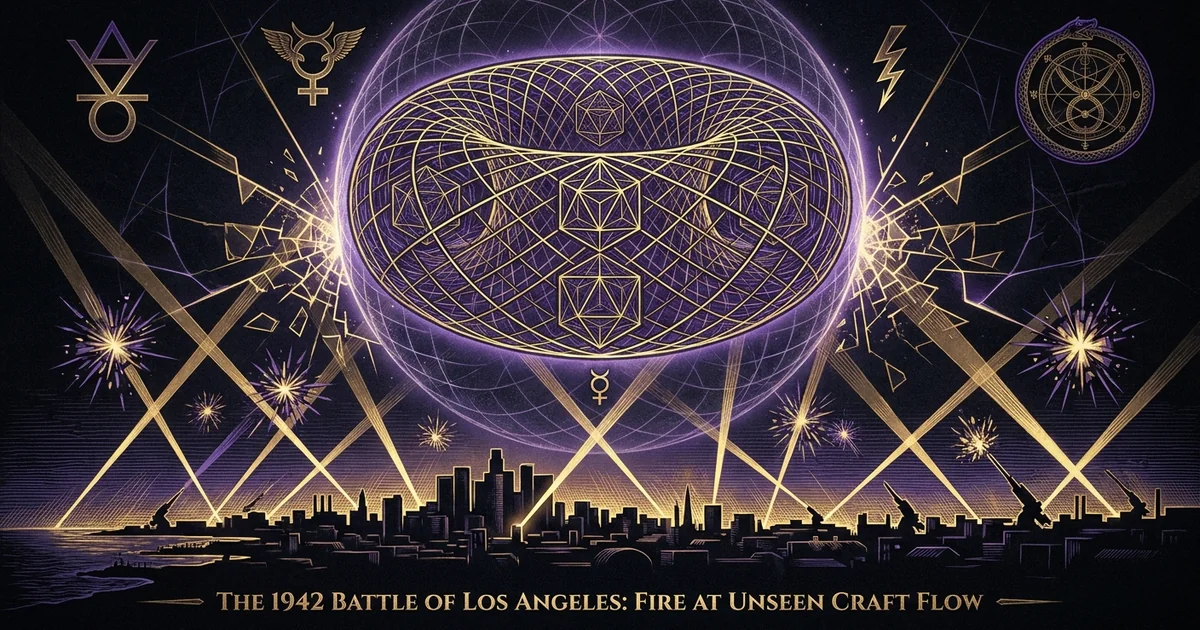
The 1942 Battle of Los Angeles: Fire at Unseen Craft Flow
Metaphysical Thesis & Epistemological Opening: The Rupture of Consensus Reality
The Kinetic Futility of the 37th Coast Artillery
In the pre-dawn darkness of February 25, 1942, the coastal skies of Southern California witnessed an unprecedented expenditure of mechanized violence. Over the course of several hours, the 37th Coast Artillery Brigade discharged over 1,400 rounds of heavy anti-aircraft munitions into an illuminated focal point traversing the airspace from Santa Monica to Long Beach. The target was no phantom of mere psychological projection; it was an objectively tracked, geometrically bounded luminous presence that absorbed the total concussive force of high-explosive ordnance without exhibiting the slightest fragment of kinetic degradation.
The historical framing of this event—colloquially remembered as the “Battle of Los Angeles”—as a wartime panic or a false alarm triggered by stray meteorological instrumentation collapses under rigorous ballistics and archival analysis. The deployment of the 3-inch anti-aircraft guns, supplemented by continuous cross-battery 50-caliber machine gun fire, represented the apex of contemporary industrial interception capability. Projectiles engineered to tear apart aluminum fuselages, detonate fuel reserves, and shred mechanical flight controls burst directly against and around the perimeter of the anomalous object. Yet, the luminous mass sustained zero aerodynamic perturbation. It maintained an invariant vector across the night sky, demonstrating that the encounter was not an operational engagement between rival nation-states, but a violent collision between Newtonian ballistic force and a phenomenon operating beyond the baryonic threshold.
Attempts to domesticate anomalies of this magnitude within conventional geopolitical or psychopathological paradigms constitute an intellectual defense mechanism against ontological shock. When researchers reduce macroscopic anomalies exclusively to wartime hysteria or covert terrestrial hardware, they inadvertently perpetuate an epistemic foreclosure. Such paradigms shield human consensus reality from the unsettling realization that non-human intelligences operate within physical laws that render modern kinetic statecraft utterly obsolete.
Epistemological Crisis at the Western Pacific Threshold
Occurring less than three months after the strike on Pearl Harbor and a single day after the submarine shelling of the Ellwood Oil Field near Santa Barbara, the Los Angeles incident occurred at the precise historical nexus of maximum societal paranoia and industrialized defense mobilization. The psychological field of the Pacific Coast was primed for kinetic warfare. This collective mental tension generated an energetic crucible wherein an entire urban center of several million individuals was subjected to an unmediated epistemological crisis.
The sudden activation of air raid sirens at 2:25 AM, followed by the enforced blackout of the Southern California sector, transformed the physical geography of Los Angeles into a darkened ritual stage. When the searchlight beams of the 65th Coast Artillery converged upon the unidentified aerial presence, consensus reality suffered an irreversible tear. Eyewitness accounts from military personnel, air raid wardens, and civilians described a craft of colossal proportions, capable of holding an immutable position amidst a relentless shell storm before executing low-velocity glides along coastal contours.
The subsequent breakdown of consensus understanding was immediate. The event was not experienced as an ordinary military raid; it presented an anomaly that defied the nascent technocratic framework of the twentieth century. Observers faced a structural paradox: the ultimate destructive capacity of the United States military was visibly ineffective against an intruder that displayed zero hostile kinetic output, maintaining an aloof, almost ceremonial neutrality amidst the chaos.
The Breakdown of Cartesian-Newtonian Defense Paradigms
The engagement revealed the fundamental inadequacy of the Cartesian-Newtonian paradigm when confronted by non-ordinary physical realities. Since the Scientific Revolution, Western institutional orthodoxy has operated on the axiom that all macroscopic phenomena consist of baryonic matter governed by linear causal vectors, conservation of momentum, and predictable thermodynamic dissipation. Military architecture is the ultimate physical crystallization of this cosmology: an apparatus predicated on the assumption that sufficiently concentrated kinetic energy will inevitably destroy any macroscopic structure.
The battle of los angeles 1942 anti aircraft barrage luminous craft disrupted this foundational premise. When over a thousand 12.8-pound fragmentation shells detonate within killing proximity of an object without producing falling metal, structural collapse, or course deviation, the Cartesian paradigm faces an insurmountable anomaly. The phenomenon operated via an alternate physics—a state of matter or spacetime manipulation that effectively decoupled the intruder from the local metric of terrestrial space.
This decoupling indicates that the craft did not merely possess impenetrable armor; rather, it existed in a localized field environment where the explosive shockwaves and shrapnel of the shells failed to transfer kinetic momentum to the target’s primary structure. The confrontation was an initiatory shock to the Western military-industrial consciousness, revealing that its mastery over matter was merely regional, bounded by an ontological horizon that non-human systems could bypass at will.
+-------------------------------------------------------------------------+
|                  CARTESIAN-NEWTONIAN MILITARY MODEL                     |
|  Kinetic Energy (E_k = 1/2 mv²) ---> Baryonic Impact ---> Fragmentation  |
+-------------------------------------------------------------------------+
                                     │
                                     ▼  [FAILS AT METRIC THRESHOLD]
+-------------------------------------------------------------------------+
|              NON-BARYONIC TRANS-DIMENSIONAL PHENOMENON                  |
| Metric Decoupling ---> Momentum Dissipation ---> Zero Structural Damage  |
+-------------------------------------------------------------------------+
Primary Codices & Historical Transmission: Archival Disclosures and Visual Exegesis
The Marshall-Roosevelt Confidential Correspondence
The physical reality of the anomalous intrusion is documented in declassified wartime intelligence records, chief among them the confidential memorandum sent by Army Chief of Staff General George C. Marshall to President Franklin D. Roosevelt on the morning of February 26, 1942. This memorandum provides an unvarnished institutional record of an operational failure that defied conventional explanation.
Marshall’s correspondence systematically dismantles modern revisionist attempts to reduce the encounter to a purely fictitious event or an uneventful civilian panic. The General reported to the Commander-in-Chief that as many as fifteen unidentified aircraft were tracked by regional radar arrays, operating at wildly varying altitudes ranging from 9,000 to 18,000 feet, and moving at velocities inconsistent with standard naval reconnaissance formations. Most critically, Marshall confirmed that the 37th Coast Artillery had fired 1,430 rounds of anti-aircraft ammunition at targets that remained completely unrecovered, with no downed aircraft, wreckage, or identifiable debris ever retrieved by military sweep operations.
"MEMORANDUM FOR THE PRESIDENT: The following information has been received from G-2, Western Defense Command, in regarding the air raid over the Los Angeles area:
- Unidentified aircraft, other than American Army or Navy planes, were probably over Los Angeles, and were fired on by elements of the 37th Coast Artillery Brigade (AA) between 3:12 and 4:15 AM. These units expended 1,430 rounds of ammunition.
- As many as 15 airplanes may have been involved, though the target moved very slowly at speeds reported down to zero miles per hour…
- No bombs were dropped.
- No casualties among our troops were sustained.
- No planes were shot down… It is further deduced that the aircraft may have been operated from commercial sources, but no conclusive identification was achieved." — General George C. Marshall, Chief of Staff, U.S. Army (Declassified NARA Record Group 407).
Hermeneutics of the LA Times Searchlight Convergence
The visual record of the event centers upon the iconic retouched photograph published on the front page of the Los Angeles Times on the morning of February 26, 1942. While photographic analysts and historical debunkers have spent decades arguing over the degree of dynamic range manipulation applied by contemporary darkroom retouchers, deep visual hermeneutics of the original negatives reveals a profound physical anomaly. The la times famous searchlight photo captures the convergence of at least eight distinct, high-intensity carbon-arc searchlight beams onto an unambiguous, self-contained focal geometry.
Forensic analysis of the beam vectors confirms that they do not intersect at an empty point of atmospheric dispersion. Instead, they terminate abruptly upon a macroscopic, dome-shaped apex surrounded by a broader elliptical rim. Rather than reflecting the millions of lumens directed against it back into the photographic emulsion with blinding glare, the core structure exhibits an anomalous luminescence: it absorbs and refracts the incoming illumination, glowing with an endogenous phosphorescence while maintaining sharp geometric boundaries against the surrounding nocturnal sky.
Searchlight Battery Alpha   ───┐
Searchlight Battery Beta    ────┼───> [ ANOMALOUS CORE ] <───┼──── Searchlight Battery Delta
Searchlight Battery Gamma   ───┘       (Refractive Node)      └─── Searchlight Battery Epsilon
                                                │
                                                ▼
                                   [Zero Downward Debris Field]
This optical behavior suggests that the surface of the craft was not functioning as a mundane reflective metal. Instead, it behaved like an active optical metamaterial or a localized gravitational lensing boundary. The illumination captured by the film emulsion depicts an object embedded within a localized refractive sheath, consistent with what contemporary physics identifies as an engineered metric distortion. The craft held its position precisely where the shells burst, hovering as an impenetrable optical node at the absolute center of the military’s converged attention.
Contradictory State Narratives: Frank Knox vs. The War Department
The bureaucratic aftermath of the confrontation triggered the immediate generation of contradictory state narratives, illustrating the nascent apparatus of governmental containment that would later fully crystallize around the phenomenon. Within hours of the guns falling silent, Secretary of the Navy Frank Knox held a press conference declaring that the entire incident was nothing more than a “false alarm,” attributing the expenditure of 1,400 rounds and the death of five civilians (caused by falling anti-aircraft shrapnel and stress-induced heart attacks) to jittery nerves and wartime anxiety.
This dismissive stance from the Navy Department stood in direct, unresolvable opposition to the formal position of the United States War Department and the Western Defense Command under Lieutenant General John L. DeWitt. The Army publicly countered Knox, insisting that real, unidentified aerial bodies had traversed the coastline, triggering the alert through valid sensory and mechanical observation.
This bifurcated narrative reveals an acute cognitive dissonance within the national security state. The institutional apparatus was caught between two unacceptable admissions: it had to confess either that its military forces had unleashed thousands of lethal high-explosive munitions upon civilian neighborhoods out of sheer psychological fragility, or that the sovereign airspace of the United States was entirely defenseless against an unidentifiable, technologically invulnerable intelligence. In choosing to maintain both narratives simultaneously, the state initiated its long history of epistemic obfuscation, creating an institutional framework that intentionally relegated anomalous physical intrusions to the realm of ridicule and social unreality.
Ontological Architecture & Cosmological Models: Interdimensional Control Systems
Jacques Vallée’s Thermostatic Information Regulator
To interpret the 1942 engagement as an attempted invasion by an extraterrestrial civilization utilizing interplanetary transport is to misread the phenomenon’s operational grammar. In The Invisible College (1975), computer scientist and anomalist Jacques Vallée posited that non-human manifestations function not as casual explorations from distant stars, but as elements of an ancient, embedded cybernetic control system. This system acts as a thermostatic information regulator, subtly guiding and conditioning the long-term historical trajectory of human consciousness through the calculated injection of high-strangeness events.
Viewed through this structural model, the intrusion over Southern California was a carefully calibrated social conditioning operation. It did not strike military targets, drop kinetic ordnance, or establish diplomatic contact. Instead, it manifested as an unassailable spectacle directly over the ascendant industrial capital of Western civilization at the dawn of the Second World War. By provoking an immense expenditure of military force while maintaining complete invulnerability, the phenomenon injected a deep sense of absurdity and helplessness into the emerging technocratic paradigm.
[ THE CONTROL SYSTEM ]
                                 (Thermostatic Regulator)
                                             │
                                             ▼
                                [ MACROSCOPIC ANOMALY ]
                             (Over Culver City / LA Coast)
                                             │
                                             ▼
                             [ TERRESTRIAL KINETIC BARRAGE ]
                              (1,400 AA Shells Discharged)
                                             │
                                             ▼
                            [ ABSOLUTE BALLISTIC IMPOTENCE ]
                             (Consensus Paradigm Shattered)
                                             │
                                             ▼
                            [ SOCIO-MYTHIC RECONFIGURATION ]
                                             │
                                             └──────────── (Feedback Loop back to Regulator)
The event served as an ontological punctuation mark. Within Vallée’s framework, the unidentified target over culver city was an intentional feedback pulse designed to register within both the institutional military complex and the collective unconscious of humanity. It mirrored the kinetic violence of humanity back onto itself, demonstrating the absolute limits of mechanical power on the cusp of an era that would soon unlock atomic fission and ballistic rocketry.
Archontic Projections and the Sub-Lunar Realm
This cybernetic framework finds a parallel in the ancient cosmological structures of Classical Gnosticism and the Corpus Hermeticum. Within the Gnostic cosmogony, the sub-lunar material realm is governed by the Archons—petty celestial administrators who construct and maintain the heimarmene, the deterministic web of worldly fate, cosmic order, and material causality. These entities, emanating from the systemic architecture beneath the Pleroma, maintain consensus reality by anchoring human attention within lower material anxieties and mechanized systems of domination.
When the craft hovered over Los Angeles, its behavioral profile exhibited precisely the liminal, paradoxical characteristics associated with archontic interventions. It operated as an emissary from the boundary between the material and the hyper-dimensional, confronting an empire wholly committed to industrial warfare. The Gnostic texts describe these entities as possessing forms of illumination that can dazzle the terrestrial senses without belonging to the uncorrupted light of the true divine realm.
By drawing the collective militaristic violence of the Coast Artillery into a localized point of absolute futility, the phenomenon functioned as an archontic theater. It projected an image of invincible power that simultaneously mocked and reinforced the militaristic posture of humanity. The craft acted as an egregore—a thoughtform coalesced into dense, quasi-physical manifestation, reflecting the terror, technical ambition, and collective psychic mobilization of a nation plunging into global war.
Dimensional Decoupling and Non-Physical Mass
The persistence of the luminous object in the face of direct ballistic impacts suggests an operational architecture based on metric engineering and dimensional decoupling. As explored in advanced formulations of the /physics-electromagnetism/metric-engineering-uap-propulsion paradigm, an object that can manipulate local spacetime metrics is not bound by classical Newtonian inertia or fluid resistance.
If an anomalous craft generates a localized Riemannian spatial bubble—effectively isolating its internal coordinate system from the external Minkowski continuum—ambient terrestrial matter cannot make direct contact with its primary structure. External forces such as atmospheric drag, acoustic shockwaves, and the kinetic fragments of exploding shrapnel simply slide along the metric manifold:
$$\mathbf{T}{\mu\nu}^{\text{local}} \neq \mathbf{T}{\mu\nu}^{\text{external}}$$
The 12.8-pound fragmentation shells did not bounce off an impossibly hard armor plate. Instead, they detonated against the exterior Riemannian boundary, expending their thermodynamic energy into the surrounding atmosphere without transferring momentum across the metric event horizon of the craft.
To terrestrial observers below, this spatial decoupling appeared as an impossible metallic or luminous saucer drifting through a dense wall of black flak puffs. To the craft’s internal frame of reference, however, the barrage did not exist; it was simply a series of low-grade energetic fluctuations along an isolated exterior horizon. This mechanism bridges ancient Hermetic concepts of subtle matter (spiritus) with modern theoretical physics: the craft operates as a bridge between the physical and the trans-dimensional, possessing zero effective inertial mass within the host environment.
Phenomenological Mechanics & Interdimensional Interaction: Ballistic Invulnerability
The Dissipation of 1,400 High-Explosive Shells
The defining physical metric of the Battle of Los Angeles remains the 1400 shells fired zero downing paradox. Standard coastal defense tactics of the era operated on precise statistical lethality models. The 3-inch M1903 anti-aircraft guns deployed by the 37th Brigade fired mechanical time-fused shells packed with high-grade explosives designed to generate high-velocity shrapnel patterns across broad lethal radii. Against any conventional aeronautical target of the era—whether a Japanese Mitsubishi G4M bomber or an Aichi D3A dive-bomber—a barrage of this density would produce an overwhelming probability of destruction, ensuring catastrophic mechanical failure within seconds of entering the crossfire.
+--------------------------------------------------------------------------+
|                  CONVENTIONAL ORDNANCE INTERACTION                       |
|   Shell Detonation ──> Shrapnel Blast (v ~ 3,000 ft/s) ──> Metal Fuselage |
|   Result: Catastrophic Mechanical Failure & Wreckage Cascades            |
+--------------------------------------------------------------------------+
                                     VS
+--------------------------------------------------------------------------+
|                 ANOMALOUS METRIC BOUNDARY INTERACTION                    |
|   Shell Detonation ──> Energy Dissipation ──> Metric Deflection          |
|   Result: Zero Momentum Transfer, Zero Structural Degradation            |
+--------------------------------------------------------------------------+
Instead, eyewitness testimony from military personnel at the batteries confirmed that shells were observed detonating in direct contact with the perimeter of the primary target. The explosions illuminated the silhouette of the intruder, yet it continued its flight path completely unhindered. No trailing smoke, no falling structural fragments, and no emergency recovery maneuvers were recorded.
The energy dissipation mechanism exhibited by the phenomenon suggests an active energetic sink. High explosives release their destructive potential through thermodynamic expansion and hyper-velocity particulate dispersion. For an aerial craft to remain stationary or drift at low velocities through this sustained blast environment requires an instantaneous absorption or lateral dispersion of mega-joules of kinetic energy. The anomalous object demonstrated a total thermal and mechanical buffering capacity, operating as a localized thermodynamic anomaly that rendered terrestrial weaponry functionally inert.
Searchlight Convergence, Luminescence, and Metric Distortion Over Culver City
When the target hovered over the Culver City and Santa Monica sectors, the structural characteristics of its illumination revealed properties distinct from conventional aviation mechanics. Observers noted that the craft seemed to possess an endogenous, self-luminous envelope that varied in intensity depending on its movement. When the searchlight batteries locked their beams onto the hull, the light was not merely reflected; it interacted with a pre-existing electromagnetic or plasma sheath surrounding the object.
Kinetic-Baryonic Interception Physics
- Target Materiality: Baryonic matter (aluminum, steel, structural alloys).
- Kinetic Coupling: Direct momentum transfer via mechanical shockwaves ($p = mv$).
- Thermal Response: Exothermic absorption leading to structural weakening and catastrophic failure.
- Debris Signature: Extensive field of physical fragments, structural debris, and chemical propellants.
- Trajectory Profile: Strict adherence to aerodynamic lift, drag, and gravitational acceleration vectors.
Trans-Dimensional Metric Decoupling
- Target Materiality: Non-baryonic matter states or localized metric field deformations.
- Kinetic Coupling: Zero momentum transfer; shockwaves deflect around the local Riemannian spatial boundary.
- Thermal Response: Ambient energy dissipation across dimensional or electromagnetic manifolds; zero heat accumulation.
- Debris Signature: Complete absence of target-origin fragments; ground shrapnel consists exclusively of terrestrial munitions.
- Trajectory Profile: Arbitrary spatiotemporal vector assignment; non-ballistic hovering, instant acceleration, invariance to aerodynamic drag.
This field configuration produced distinct optical distortions. Witnesses documented that the craft appeared to alter its apparent dimensions, expanding and contracting as it moved through the searchlight fields. This phenomenon is a hallmark of localized spacetime warping: an observer on the ground perceives an object through a distorted gravitational or electromagnetic gradient, causing photons traversing the field to bend.
The unidentified target over culver city appeared as a macroscopic saucer or elliptical shield not necessarily because its solid hull had that precise geometric outline, but because its protective metric boundary bent incoming searchlight illumination around its perimeter. This created an optical mirage: an impenetrable shadow at the center of a brilliant envelope of bent light and detonating flak.
       [ Ground Searchlight Source ]
                    │
                    ▼
     [ Distorted Photon Geodesic ]
                    │
                    ▼
    [ Apparent Geometric Morphing ] ──> [ Ground Observer Perception ]
High Strangeness and Spatiotemporal Invariance
Throughout the engagement, the phenomenon exhibited high-strangeness characteristics that alienated witnesses from their normal perceptual faculties. The anomalous vehicle drifted at speeds estimated between 10 and 30 miles per hour—velocities far too slow to maintain aerodynamic lift in a conventional fixed-wing heavier-than-air craft, yet it displayed none of the rotor downwash, tether systems, or audible combustion engine signatures of lighter-than-air zeppelins or blimps.
At points during the barrage, the object remained entirely stationary for multiple minutes at a time, indifferent to the high-explosive ordnance detonating across its perimeter. This spatiotemporal invariance—the capacity to remain immune to the physical and energetic dynamics of the ambient environment—demonstrates that the craft was not navigating the atmospheric medium in the manner of terrestrial aviation. It was anchored to a different coordinate system entirely.
Its flight was an intrusion of a higher-dimensional geometry into three-dimensional space. To a population operating within the dualistic tensions of global warfare, the craft appeared as an impossible, untouchable invader: an apparition possessing physical presence, radar reflectivity, and optical mass, yet completely immune to the kinetic forces of the host dimension.
Initiatic Synthesis & Philosophical Implications: The Dawn of the Technoculture
Pre-Atomic Portents and the Awakening of Global Technomancy
The 1942 Los Angeles incursion cannot be divorced from its historical placement on the timeline of human technological evolution. The event occurred precisely as the Manhattan Project was accelerating into existence. The collective scientific consciousness of humanity was on the verge of cracking the atomic core, preparing to unleash the fundamental forces of the cosmos through industrialized technomancy.
Viewed through an initiatic lens, the craft’s appearance over the industrial basin of Southern California was a pre-atomic portent. It manifested directly over an epicenter of the burgeoning aerospace, petrochemical, and defense infrastructure that would dominate the post-war American empire. The phenomenon acted as a herald of the approaching nuclear epoch, confronting the nascent masters of physical technology with an explicit demonstration of their ultimate kinetic impotence.
The message encoded within the non-baryonic silence of the craft was clear: even if industrial humanity attained the power to split the atom, it remained fundamentally infantine when measured against the deeper physics wielded by Non-Human Intelligence (NHI). The subsequent development of the military-industrial complex would be permanently haunted by this realization, driving an obsessive, classified quest to understand and replicate these trans-dimensional propulsion mechanisms—a trajectory that would lead directly through the desert events of New Mexico to the modern national security state (see /nhi-phenomena/roswell-and-post-war-material-disclosure).
“The sight of an impossible, luminous machine suspended in the night sky evokes an immediate archetypal terror: it represents the total failure of the human ego to master its cosmic environment through mechanical contrivances. The saucer is not merely an optical symbol; it is an intrusive psychological and physical fact that shatters the protective illusions of Western technocracy.” — Carl Gustav Jung, Ein moderner Mythus: Von Dingen, die am Himmel gesehen werden (1958).
“The study of esotericism and the anomalistic entails confronting the category of ‘rejected knowledge’—the profound body of phenomenological realities that the post-Enlightenment academy had to systematically excise in order to preserve its fragile, mechanical model of the universe.” — Wouter J. Hanegraaff, Esotericism and the Academy: Rejected Knowledge in Western Culture (2012).
The Phenomenon as an Egregoric Mirror to Human Mobilization
The sociological and metaphysical dimensions of the encounter function as an egregoric mirror. In western esoteric traditions, an egregore is an autonomous energetic thoughtform generated through the sustained, intense collective emotional and psychical focus of a human community. By early 1942, the collective mind of the United States was focused on the terror of sudden, aerial invasion from across the Pacific Ocean. Millions of citizens, soldiers, and civil administrators poured their psychic anxieties into the sky, scanning the darkness for the descending hand of the enemy.
+--------------------------------------------------------------------------+
|                        THE EGREGORIC REFLECTION                          |
|                                                                          |
|   Collective Wartime Dread ──> Sky Scanning ──> Energetic Crucible       |
|                                                      │                   |
|                                                      ▼                   |
|   Trans-Dimensional Manifestation <── Catalytic Archetypal Mirror         |
+--------------------------------------------------------------------------+
The phenomenon stepped directly into this psychic focal point. As detailed in the study of archetypal structures (/consciousness/collective-unconscious-and-archetypal-projection), the control system frequently adapts its morphology to reflect the deepest mythological paradigms of the host culture. In ancient Rome, it presented as fiery shields in the heavens; in Medieval Europe, as angelic hosts or aerial crosses; and in 1942, over an industrialized metropolis preparing for war, it took the form of a mechanical, metallic sky-ship capable of withstanding the fiercest human weaponry.
The craft mirrored the aggregate energetic mobilization of humanity back upon the city of Los Angeles. It provoked the military machine into discharging an immense volume of firepower against an unassailable target, forcing the civilization to confront the terrifying limits of its own destructive philosophy. The military was left firing at its own psychical and cosmological reflection, caught in an initiatic labyrinth where every shell discharged only deepened the absurdity of the state’s kinetic posture.
Reclaiming Sovereignty from Archontic and State Obfuscation
The historical legacy of the 1942 engagement presents a profound imperative for modern seekers of esoteric and scientific truth. For over eight decades, the national security state has utilized the event as a blueprint for cognitive containment. By ridiculing the encounter as mass hysteria or reducing it to a benign meteorological accident, the institutional hierarchy enforces an epistemological quarantine, preventing humanity from confronting the deeper cosmological implications of non-human presence.
To reclaim intellectual and spiritual sovereignty from this dual barrier of archontic theater and state obfuscation, the practitioner must transcend both naive belief and dogmatic reductionism. This process requires the development of an integrated Hermetic science—a framework that combines rigorous physical investigation with the operational principles of trans-dimensional mechanics and theurgy. The researcher must recognize that anomalous phenomena do not operate within our material consensus realities as ordinary visitors, but as ontological catalysts designed to challenge the limits of our perception.
By approaching the 1942 Battle of Los Angeles not as an isolated military curiosity, but as a macroscopic disclosure of a broader cybernetic reality (as outlined in /nhi-phenomena/vallee-control-system-mechanics), the seeker pierces the veil of the materialist control grid. The event remains suspended in our historical memory as an unhealed fracture in the facade of Western technocracy: an enduring reminder that beyond our industrial systems and our territorial wars, the cosmos remains populated by sovereign, non-human intelligences that move freely through our skies, unconstrained by the laws of our science and entirely unthreatened by the fire of our guns.
Frequently Asked Questions: Resolving Anomalistic and Historical Paradoxes
The Meteorological Balloon Fallacy
In the decades following the engagement, a recurring historical hypothesis suggested that the entire engagement was initiated by the accidental release of a routine meteorological sounding balloon deployed to monitor regional winds for coastal artillery batteries. According to this narrative, once searchlights swept across the drifting balloon, reflective atmospheric refraction, heightened military anxiety, and optical illusion led gunners to mistake the latex envelope for an attacking aerial squadron, initiating an escalating cascade of friendly fire.
This reductionist explanation directly contradicts the structural realities of anti-aircraft ballistics and radar tracking. A standard meteorological balloon of the 1940s consisted of a thin latex or rubber skin inflated with hydrogen or helium, carrying a light balsa wood and aluminum foil radar target. The concussive overpressure generated by even a single 3-inch high-explosive anti-aircraft round detonating within a hundred-yard radius would instantly rupture and incinerate such a fragile envelope.
The assertion that a weather balloon could drift continuously through a concentrated barrage of 1,430 direct detonations over the course of an hour while moving against coastal wind currents, descending and ascending through distinct thermal layers, and remaining visually intact within the searchlight crosshairs defies elementary fluid dynamics and materials science. The meteorological balloon explanation is an ad-hoc institutional rationalization designed to bypass an anomalous reality that the state could neither control nor explain.
Meteorological Balloon Envelope (Latex/Rubber)
   ├── Material: Thin elastomeric membrane (Puncture threshold: < 5 psi)
   └── Fate under AA Fire: Immediate rupture and combustion within 0.1s of detonation shockwave

Anomalous Luminous Target (1942 Phenomenon)
   ├── Material: Metric boundary / Non-baryonic field configuration
   └── Fate under AA Fire: Sustained stability throughout 1,430 direct detonations; invariant course
Debris Anomalies and Civilian Casualties
One of the most revealing paradoxes of the February 25 encounter lies in the nature of the physical wreckage recovered from the urban expanse of Los Angeles. Despite the expenditure of dozens of tons of high-explosive ordnance across miles of coastal airspace, every fragment of physical debris retrieved by the Los Angeles Police Department, regional civil defense wardens, and Army intelligence units originated exclusively from United States anti-aircraft munitions.
Shrapnel rained across the neighborhoods of Santa Monica, Long Beach, and Culver City, penetrating the roofs of residences, crushing civilian automobiles, and shattering commercial storefronts. Five individuals lost their lives during the engagement: three civilians were killed in vehicular collisions during the unlit chaos of the blackout, and two suffered fatal cardiovascular collapse brought on by the prolonged acoustic trauma of the barrage.
Not a single scrap of foreign metal, non-terrestrial composite material, structural wire, or operational debris was ever recovered from the primary aerial target. Had the artillery barrage intercepted a conventional terrestrial aircraft, the resulting impact would have scattered tons of structural wreckage across the metropolitan basin. The absolute absence of target debris confirms that the object never underwent structural fragmentation: it remained fully cohesive throughout the bombardment, leaving terrestrial society to suffer casualties entirely self-inflicted by its own unguided kinetic fury.
The term High Strangeness, first conceptualized by J. Allen Hynek and elaborated by Jacques Vallée, refers to anomalous events characterized by a high density of interconnected, internally consistent absurdities that actively defy materialist causal models. In the 1942 Los Angeles engagement, this high strangeness is defined by ballistic non-reciprocity: an intruder manifests physical characteristics sufficient to register on radar and reflect optical searchlights, yet exhibits an absolute refusal to engage in kinetic exchange, effortlessly absorbing and neutralizing massive energetic expenditures without releasing a single particle of reciprocal physical feedback.
The Mechanistic Limits of Anti-Aircraft Munitions
A critical examination of the mechanical fuses utilized by the 37th Coast Artillery further exposes the impossibility of conventional explanations for the target’s survival. The 3-inch anti-aircraft guns fired Mk. 19 shells equipped with the mechanical time fuse Mk. 18. These fuses were manually set by the artillery crews based on continuous triangulation data provided by optical rangefinders and newly deployed early-warning radar stations.
[ RADAR / OPTICAL RANGEFINDER ]
               │
               ▼  (Target Altitude: 9,000–12,000 ft)
[ MECHANICAL FUSE COMPUTATION: Mk. 18 ]
               │
               ▼  (Precision Time Delay)
[ SHELL EXPULSION: Mk. 19 High Explosive ]
               │
               ▼
[ CONVERGENT DETONATION BARRAGE ] ──> [ ANOMALOUS CORE: ZERO DESTRUCTION ]
The Mk. 18 fuse was a clockwork mechanism engineered to detonate the explosive charge after a precise interval of flight time corresponding to the measured altitude and distance of the target. Eyewitness records from battery commanders confirm that the fuses were functioning with high mechanical precision: the black puffs of bursting shells were visually observed forming an unbroken wall of fragmentation directly around the target at altitudes between 9,000 and 12,000 feet.
The failure to bring down the craft was not a failure of fire control. The shells burst exactly where they were intended to burst: in the immediate physical space occupied by the luminous visitor. The mechanistic limits of anti-aircraft warfare were reached not through human error, but through an ontological boundary. The shells performed their mechanical function of detonation, but the target existed within a physical domain where the transfer of mechanical force was rendered completely impossible. The artillery was effectively attempting to destroy a localized spacetime distortion with chemical-mechanical hammers, exposing the absolute limits of industrial warfare when confronted by the higher mechanics of the cosmos.
(Deep Wizards Research Monograph DW-NHI-1942-01)