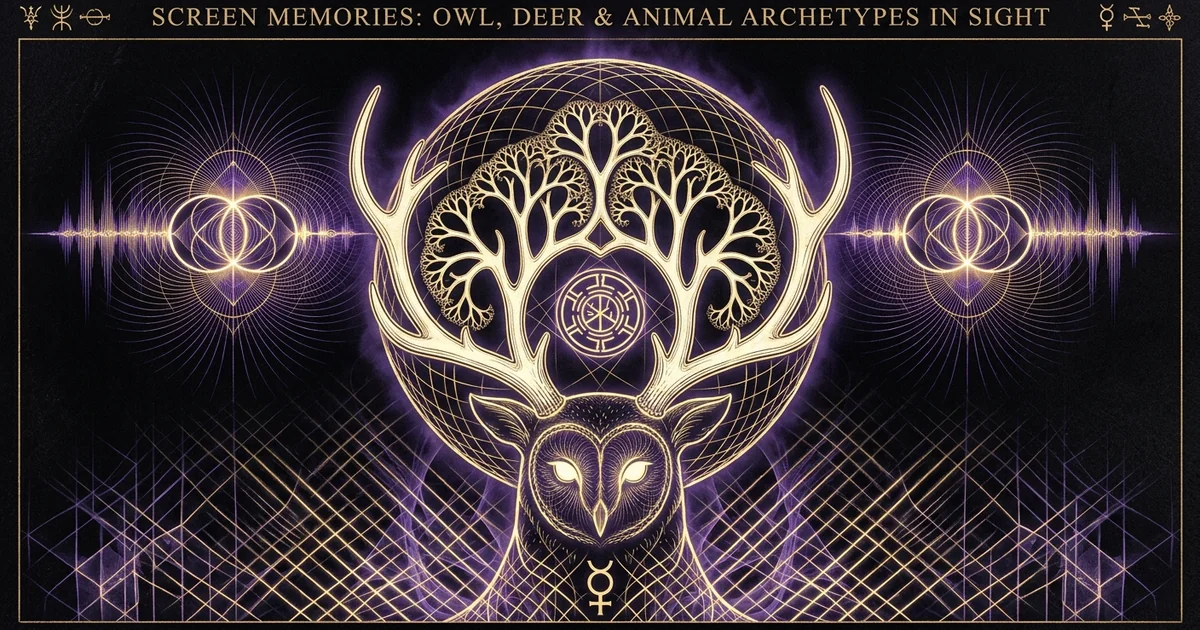
Screen Memories: Owl, Deer & Animal Archetypes in Sight
Metaphysical Thesis & Epistemological Opening: The Semiotics of Zoomorphic Concealment
Epistemic Boundaries of Screen Memories
The study of anomalous encounters repeatedly confronts an empirical impasse: the profound discontinuity between sensory reports and conventional biological taxonomy. Within the canon of anomalous close encounters, witnesses routinely report confrontation with liminal fauna—predominantly strigiform birds (owls) and horned cervids (deer)—under circumstances that defy natural history and ethology. These sightings cannot be relegated to mundane misidentification of mundane wildlife. Materialist reductions fail to account for the persistent, hyper-specific recurrence of identical avian and cervid motifs across non-communicating percipients separated by geography, culture, and temporal epochs. The phenomenon under scrutiny is the screen memory, a psycho-perceptual construct wherein an ontologically traumatic intrusion is superseded within conscious recall by a surreal, displacement cipher.
Rather than dismissing these zoomorphic manifestations as confabulation, this inquiry establishes that screen memories owls deer animals ufo encounters mike clelland document an active interface: an informational masking strategy engineered at the boundaries of human cognition. The percipient does not merely misperceive a biological creature; rather, an unconditioned topological intrusion precipitates a localized collapse of consensual reality. The resultant psychic trauma demands an immediate, culturally accessible, and morphologically congruent buffer. The creature observed standing beside a nocturnal road, peering through a second-story window, or hovering motionless in deep woods is not a specimen of wild fauna, but an engineered semiotic interface—an archetypal wildlife substitution operating as a dynamic perceptual baffle.
The Failure of Reductive Trauma Models
Standard psychological frameworks, operating from orthodox neurobiological paradigms, interpret the screen memory through the lens of psychodynamic defense mechanisms or false memory syndrome. In this classical Freudian schema, the ego mobilizes a benign, familiar visual image to repress the acute terror of a non-normative event. While this explains the defensive utility of the image, it completely fails to explain the invariant typological architecture of the encounter. If screen memories were purely idiosyncratic defenses produced by random neurological error or unconscious fabrication, the distribution of animal types would mirror the personal history and idiosyncratic associations of each subject. One would observe an arbitrary spread across domestic pets, aggressive carnivores, local vermin, or indistinct shapes.
Instead, the anomalous archive documents an overwhelming statistical convergence on specific liminal species. Percipients do not report seeing golden retrievers, cows, or raccoons peering through their bedroom windows with impossible geometric symmetry; they report the barn owl (Tyto alba), the great horned owl (Bubo virginianus), or the motionless, unblinking white-tailed deer. This non-random typology indicates that an external vector is involved in the configuration of the screen. The hypnotic masking of trauma within close encounters functions not through passive, endogenous repression alone, but through an externally driven semiotic transduction that exploits preexisting biological and mythic resonances within human evolutionary wetware.
The Psychoid Interface and Semiotic Transduction
To comprehend how an external informational intrusion precipitates a zoomorphic image, analytical philosophy must integrate Carl Gustav Jung’s formulation of the psychoid realm—the metaphysical interzone where matter and psyche lose their discrete boundaries and exist as an undifferentiated ontological continuum. When an entity or apparatus originating outside consensual three-dimensional spacetime intersects our local frame of reference, it possesses no native baseline within human neuro-sensory processing. The human ocular and cognitive apparatus cannot decode raw, unconditioned topological reality without suffering immediate, debilitating disorganization.
The interface therefore functions through semiotic transduction. The incoming Non-Human Intelligence (NHI) transmission is stepped down through the filter of the collective unconscious, projecting an imaginal hologram or eidolon that satisfies two distinct structural criteria: it provides an evolutionary visual analog to the entity’s true geometry (specifically, disproportionate, non-human ocular morphology), and it activates latent mythopoetic pathways that allow the percipient’s nervous system to endure the interaction without fatal psychological destabilization. As explored within the framework of the /nhi-phenomena/jacques-vallee-control-system, the screen memory acts as a cybernetic feedback regulator, maintaining the operational concealment of the intrusion while simultaneously planting an initiatic seed within the subject’s cognitive matrix.
The Greek term eidolon (εἴδωλον) denotes not merely a passive phantom or sensory illusion, but an energized, substantial image projected from a higher cosmological plane into the sensible realm. When integrated with Jung’s formulation of the psychoid threshold (Collected Works Vol. 8), the eidolon represents an objective psychic manifestation that is neither exclusively mental nor purely physical. At this threshold, an external informational control system maps its incoming trans-dimensional coordinates directly onto the hardwired archetypes of the collective unconscious. The resulting zoomorphic screen is an objective perceptual phenomenon: an imaginal reality possessing real-world spatial localization, coherent optical boundaries, and quantifiable physiological effects upon the percipient.
Primary Codices & Historical Transmission: From Psychopomps to Modern High Strangeness
The Strix, Lilith, and Archaic Nocturnal Sentinels
The contemporary encounter with the anomalous owl is not a novel byproduct of modern technological ufology; it represents the uninterrupted continuation of an archaic metaphysical pattern. Throughout Mediterranean, Near Eastern, and classical antiquity, strigiform raptors served as the primary physical emissaries of boundary dissolution, nocturnal paralysis, and the violent extraction of mortal consciousness. In Mesopotamian iconography, the Burney Relief depicts Lilith (or Inanna/Ishtar) flanked by strigiform birds, standing upon lions—a symbolic triad declaring sovereignty over the instinctual passions and the threshold between the terrestrial city and the howling wilderness. The Akkadian Lilitu demons were explicitly associated with night terrors, hypnagogic sexual intrusion, and predatory spatial translocation, frequently described as possessing avian talons and wings.
[Archaic Lilith/Strix] ===> [Medieval Faerie Glamour] ===> [Modern NHI Screen Mask]
        │                               │                                │
 (Nocturnal Paralysis)       (Animal Shapeshifting)           (Oz Factor / Abduction)
In Graeco-Roman folklore, this archetype crystallizes in the stryx (στρίγξ), a nocturnal avian predator that fed on human vital fluids and orchestrated the abduction of nursing infants from sealed chambers. Classical authors, including Ovid in the Fasti, debated whether the stryx was a genuine biological bird generated by nature or an ontological shapeshifter: a witch or discarnate spirit assuming avian feathers through maleficent theurgy to breach domestic boundaries. The essential phenomenological markers of these ancient nocturnal terrors—unexplained paralysis, auditory muting, the sensation of heavy atmospheric pressure, and the unblinking, predatory stare of a hyper-sized raptor—are indistinguishable from contemporary reports of bedroom visitations prior to alien abduction events documented across twentieth- and twenty-first-century clinical casework.
Cervid Theophanies in Shamanic Ecstasy and Medieval Hagiography
Parallel to the nocturnal avian psychopomp stands the cervid archetype. Across circumpolar and Eurasian traditions, the horned deer or elk acts as the supreme psychopomp and liminal guide, leading the hunter-initiate beyond the pale of civilized geography into direct confrontation with the spirit world. Mircea Eliade, in Shamanism: Archaic Techniques of Ecstasy, demonstrates that the antlered deer is the ultimate zoomorphic vehicle for ecstatic flight, ontological death, and bodily reconstruction. The deer is not merely prey; it is an active theophany whose appearance initiates the collapse of secular time and marks the threshold of an alternate dimensional locus, a core dynamic examined in the context of /ancient-prehistory/shamanic-therianthropy-and-initiations.
“The Archons, being devoid of true luminous substance, construct their mimetic operations through mutable animal forms, seducing the perceptual apparatus of humankind into accepting animal veils rather than recognizing the spiritual rulers that manipulate the lower planetary spheres.” — On the Origin of the World (NHC II, 5; trans. Layton)
“Now was I stripped of my human shape, and having put off my former skin, I was enclosed within the thick hide of an ass; yet my reason remained whole, and I was forced to observe how the glamour of the arts transforms the appearances of all things without altering their inner reality.” — Apuleius, The Golden Ass (Metamorphoses, Book III, 25; trans. Adlington)
This shamanic motif migrated directly into medieval Christian hagiography without shedding its liminal, non-human architecture. In the legends of Saint Eustace and Saint Hubert, an aristocratic hunter pursues a stag of extraordinary scale and luminous majesty deep into the primeval forest. When the hunter corners the animal, the stag turns, revealing a radiant crucifix suspended between its massive antlers, and addresses the hunter with an authoritative, disembodied human voice. This miraculous pause mirrors precisely the temporal dilation and unearthly immobility reported by modern percipients of anomalous deer on lonely highways. In both instances, the cervid form operates as an archetypal attractor: an irresistible lure that draws the subject away from social reality into an isolated spatial vacuum where an unconditioned ontological revelation can occur.
The Transition from Faerie Lore to Technological Cryptids
The structural continuity becomes absolute when modern high-strangeness encounters are mapped against European folklore regarding the Tuatha Dé Danann, the Good People, and the fairy host. Jacques Vallée, in Passport to Magonia, demonstrated that the modern extraterrestrial abduction scenario is a morphological translation of traditional fairy kidnapping, changeling replacement, and journey to the otherworld. Central to fairy lore is the concept of “glamour”—an operational enchantment deployed by non-human entities to conceal their true, non-euclidean nature, their technology, and their dwelling places behind the veneer of pastoral, terrestrial reality.
Under the influence of glamour, an abductee might perceive a feast of luscious fruits that, upon the breaking of the spell, resolves into dry leaves and stones. Similarly, when fairy entities crossed the path of mortals, they routinely presented themselves as white hinds, large black dogs, or strange, motionless birds. Modern hypnotic unmasking of entities mirrors the historical lifting of animal glamour. When subjects under regressive hypnosis are guided to penetrate the gaze of a screen animal, the animal’s flesh, fur, or plumage consistently dissolves, revealing the slender, large-headed, black-eyed visage of the archetypal non-human entity. The technology of concealment has not fundamentally altered over millenia; only the human cognitive database, against which the camouflage is rendered, has updated its aesthetic lexicon.
Ontological Architecture & Cosmological Models: The Informational Control Architecture
Valléen Cybernetics and Reality Management
To comprehend the function of screen memories within a unified cosmological framework, one must move past the naive extraterrestrial hypothesis—which conceptualizes NHI as biological travelers piloting physical nuts-and-bolts spacecraft across interstellar distances—and embrace the interdimensional and informational control models pioneered by Jacques Vallée. In The Invisible College, Vallée posits that the UFO phenomenon functions as an informational control system: a cybernetic reality management apparatus that conditions human consciousness over vast historical horizons.
This control system operates via a feedback loop. It presents absurd, mythopoetic, or terrifying stimuli to human observers, instigating immediate sociopsychological disruption while covertly shifting the metaphysical baseline of the human species. Within this cybernetic paradigm, the screen memory is a deliberate throttle. If interdimensional entities manifested within consensual physical space in their native, unshielded dimensionality, the human percipient would suffer catastrophic acute ontological shock—a total psychological fragmentation characterized by intractable psychosis, neurochemical collapse, or immediate physical termination via heart failure. The zoomorphic screen functions as a step-down transformer, shielding the human nervous system from the raw voltage of an interdimensional intrusion.
Dimensional Stepping-Down and Symbolic Compression
The stepping-down process requires an advanced data-compression algorithm. Just as a complex multidimensional dataset must be compressed and projected into a two-dimensional format to be displayed on an electronic screen, an entity crossing dimensional thresholds into human space-time must compress its native informational signature into archetypal forms that our evolutionary cognitive architecture can process. This compression utilizes the preexisting structures of the human collective unconscious as its computational substrate, operating along the /consciousness/jungian-psychoid-threshold.
The choice of owls and deer as the primary compression containers is dictated by their structural and symbolic resonance. Both creatures are nocturnal or crepuscular; both inhabit the edges between human domestication and the untamed void; both possess profound, unblinking ocular morphology that mirrors the disproportionate black eyes of typical encounter entities. When the NHI interface executes its localized manifestation, it scans and leverages the percipient’s cognitive field, rendering a composite screen that matches the visual geometry of the entity to the archaic symbolic weight of the animal. The percipient sees an owl not because an owl is physically present, and not because the human brain is hallucinating in isolation, but because the owl is the lowest common denominator between trans-dimensional presence and terrestrial cognitive bandwidth.
The Spectral Ecology of Zoomorphic Archetypes
The research of Mike Clelland, articulated exhaustively in The Messengers: Owls, Synchronicity and the UFO Abductee, establishes that the owl does not operate merely as a post-encounter retroactive mask, but functions across an entire spectral ecology of high-strangeness events. Clelland’s field investigations demonstrate that the appearance of these animals is deeply enmeshed in macro-level synchronicities that defy linear causality. Percipients routinely report encounters with actual biological owls immediately prior to or following an abduction event; they experience synchronicities where owl imagery, physical encounters, and profound emotional epiphanies converge in tight temporal clusters.
This confirms that the phenomenon is not an isolated mental delusion or an exclusively interior psychological event. The boundary between the screen memory (a mental image shielding a traumatic real event) and the physical animal (a biological organism moving through space) completely collapses within the Valléen control matrix. The phenomenon possesses the capacity to manipulate both internal human neural states and external biological organisms simultaneously. The owl emerges as a physical-psychic hybrid, an informational node indicating that the local space-time envelope has become permeable to higher-order dimensional intervention. The archetypal wildlife substitution is thus both internal perception and external manifestation: a hyper-dimensional intrusion expressing itself across the full spectrum of reality.
Phenomenological Mechanics & Interdimensional Interaction: Deconstructing the Mask
The Mechanics of Hypnotic De-masking and Regressive Amnesia
The phenomenological deconstruction of a screen memory usually begins when a subject presents with unexplainable, persistent cognitive anomalies: missing time, inexplicable terror triggered by ordinary visual depictions of animals, recurrent nightmares of staring eyes, or somatic scarring lacking medical etiology. Under clinical hypnotic regression—when conducted with the rigorous protocols developed by researchers such as Dr. John E. Mack—the layered structure of the screen memory can be systematically unpacked.
[Level 1: Conscious Surface]  --> Bizarre, motionless owl/deer staring through window
[Level 2: The Liminal Oz]     --> Complete acoustic muting, physical paralysis, temporal dilation
[Level 3: Hypnotic De-masking]--> Dissolution of feathers/fur; visual warping of spatial scale
[Level 4: Core Phenomenon]    --> Direct ocular interaction with non-human interdimensional entity
During regressive hypnosis, the percipient is guided to revisit the memory of the anomalous animal encounter. As somatic recall deepens, the subject invariably experiences intense neuro-vegetative arousal—tachycardia, diaphoresis, acute motor inhibition, and terror. Under close questioning, the narrative integrity of the animal form collapses. Percipients report that the owl was “too large,” that it was “standing on the ground like a person,” that it “did not have feathers, but skin,” or that its eyes “filled the entire head.” The hypnotic de-masking process demonstrates that the animal form was an unstable perceptual overlay. The moment the percipient’s conscious attention is forced to interrogate the structural details of the image, the animal veneer dissolves, laying bare the underlying presence of a non-human entity whose cranial and ocular dimensions directly correspond to the anomalous proportions of the screen animal.
Psychological Confabulation (Orthodox Neurobiology)
- Source: Purely endogenous; random firing of temporal-lobe neurons during trauma or sleep paralysis.
- Function: Passive ego-defense; subjective suppression of stress hormones through familiar memory synthesis.
- Environmental Impact: Confined entirely within the subjective skull; zero localized physical anomalies.
- Typology: Highly variable, idiosyncratic imagery drawn entirely from individual autobiographical memory.
- Acoustic Field: Ambient environmental acoustics remain intact; subject does not report an objective external silence.
Semiotic Transduction / Screen Memory (Interdimensional Anomalistics)
- Source: Exogenous trans-dimensional signal stepped down via the psychoid membrane of the collective unconscious.
- Function: Active semiotic throttling; prevents fatal neuro-ontological shock while establishing an evolutionary feedback loop.
- Environmental Impact: Accompanied by physical traces, electromagnetic disturbances, and missing time.
- Typology: Highly constrained, non-random archetypes (predominantly strigiform birds and cervid mammals).
- Acoustic Field: Characterized by the Oz Factor: an absolute external dampening of ambient ecological sound.
Ocular Anomalies: The Hypnotic Gaze of the Disproportionate Eye
The morphological fulcrum of the entire screen phenomenon resides in the eyes. In human evolutionary biology, the facial recognition system—governed by the fusiform face area (FFA) in the temporal lobe—is calibrated with extraordinary sensitivity to detect and interpret the gaze of other beings. Direct eye contact conveys social hierarchy, reproductive availability, and predatory intent. The non-human entity described across modern abduction literature possesses vast, wrap-around, almond-shaped black eyes lacking sclera, pupils, or irises. Confrontation with this sensory organ triggers immediate, paralyzing dread within the mammalian nervous system.
========================================================================
OCULAR CORRESPONDENCE GEOMETRY
========================================================================
[ Biological Great Horned Owl ]    --> Front-facing, huge luminous irises,
                                      deep pupillary depth, rigid stare.
                 │
                 ▼
[ Screen Memory Interzone ]       --> "An owl the size of a man with eyes
                                      that felt like deep, black tunnels."
                 │
                 ▼
[ Core NHI Visual Morphology ]     --> Enormous, wrap-around, unblinking
                                      black ocular lenses dominating face.
========================================================================
The owl and the deer are nature’s terrestrial approximations of this alien ocular geometry. The owl is one of the few avian species with strictly forward-facing, binocular ocular placement, set within broad facial discs that radically amplify the perceived scale of the eyes. Similarly, the deer possesses large, dark, lateral eyes that, when illuminated by automobile headlights, reflect a haunting, unblinking glow. In the screen memory, the gaze of the NHI is directly mapped onto the eyes of the animal. Percipients do not remember an animal that moved or vocalized naturally; they remember the eyes. The gaze operates as a telepathic conduit through which the entity paralyzes the subject’s volitional motor control, an engineered paralytic state that masquerades within memory as the hypnotic fascination of a deer caught in the headlights or the eerie stare of a barn owl perched in the dark.
Bilocational Resonance and Environmental Dampening
An unmistakable physical-phenomenological signature of the screen encounter is the immediate onset of the Oz Factor, a concept explored deeply in /nhi-phenomena/oz-factor-sensory-deprivation. As the percipient approaches the anomalous animal, all ambient environmental acoustics spontaneously vanish. The wind ceases to rustle leaves; the sound of automobile engines fades into a dull hum or cuts out entirely; nocturnal insects and amphibians fall abruptly silent. The percipient is plunged into an artificial, vacuum-sealed sensory bubble.
This acoustic dampening signifies that the subject has been decoupled from baseline consensus spacetime and pulled into an engineered perceptual envelope. Within this zone, the screen animal displays glaring spatial anomalies: it may hover inches above the ground, remain suspended in flight without beating its wings, glide smoothly backward without somatic exertion, or maintain an unnatural size that violates biological reality—such as an owl standing four to five feet tall. The animal’s interaction with the environment is weightless and devoid of inertia. These mechanical anomalies betray the fact that the animal is not a physical biological entity displacing air and mass, but an energized projection: an informational field holding the percipient’s neurological attention hostage while the real, underlying extraction or medical-phenomenological intervention takes place beneath the surface of the mask.
Initiatic Synthesis & Philosophical Implications: Archetypal Sovereignty and the Psychoid Threshold
Transmutation of Trauma into Shamanic Initiation
The traditional psychological perspective views the screen memory as an indicator of victimhood—a pathological marker of profound traumatic fragmentation. Conversely, an esoteric hermeneutic, informed by Mircea Eliade’s comparative studies of shamanic initiation, interprets the screen memory as an essential stage in the psychic reconstruction of the initiate. Shamanic initiation universally requires a harrowing descent: the initiate is hunted, captured, dismembered, and reassembled by zoomorphic spirits or psychopomp entities, acquiring spiritual power and access to non-ordinary reality only through the endurance of this ritual death.
+--------------------------------------------------------------------------+
|                  THE INITIATIC TRANSMUTATION ARC                         |
+--------------------------------------------------------------------------+
|  [ Consensual Reality ]                                                  |
|            │                                                             |
|            ▼                                                             |
|  [ The Screen Mask ] (Owl/Deer as Liminal Psychopomp)                    |
|            │                                                             |
|            ▼                                                             |
|  [ Ontological Rupture ] (Dismemberment / Somatic Intrusion / Abduction) |
|            │                                                             |
|            ▼                                                             |
|  [ Psychoid Integration ] (Decoding the Semiotic Mask / Sovereignty)     |
+--------------------------------------------------------------------------+
When an abductee pierces the veil of the screen memory, they are enacting a modern equivalent of the shamanic breakthrough. The owl or deer is the contemporary psychopomp delivering the mortal to the sacred space of the axis mundi—the examination room, the craft, or the higher-dimensional laboratory. By stripping away the animal screen through disciplined self-inquiry or clinical exploration, the subject confronts the raw architectural intelligence governing their life. Trauma is thereby transmuted into gnosis: the terrifying realization that human consciousness does not occupy the apex of terrestrial reality, but is actively embedded in a multidimensional ecosystem governed by non-human intelligences.
Epistemic Rupture and the Post-Contact Percipient
The long-term consequence of deconstructing an animal screen memory is a permanent, irreversible epistemic rupture. The percipient can no longer return to the naive realism that characterizes mechanistic materialism, nor can they seek solace in dogmatic anthropocentric religions. They are forced to live in the psychoid interzone—the liminal frontier where subjective meaning and objective events persistently interpenetrate.
Post-contact percipients regularly experience an explosion of secondary anomalous phenomena: persistent synchronicities, precognitive dreams, the activation of latent telepathic or telekinetic faculties, and an altered perception of ecological systems. The screen animal, even after its dissolution as an objective mask, remains permanently stamped upon the percipient’s unconscious as a psychic sigil. The owl or deer evolves from a symbol of terrifying deception into a personal totem—an indexical marker that alerts the individual when the membranes between dimensional states are becoming thin. The percipient’s epistemological framework transitions from an ontological consumer of consensus reality to an active navigator of the interdimensional continuum.
Reclaiming Human Perceptual Agency
Navigating the deceptive landscape of screen memories requires the development of what metaphysical traditions define as archetypal sovereignty. If human consciousness passively accepts the screen memory at face value, it remains ensnared in the outer courtyard of the phenomenon—beguiled by the animal disguise, or paralyzed by the technological terror of the grey alien trope. Both images are masks; the biological alien in a flight-suit is often as much an archetypal screen as the five-foot owl standing in the road. Both are symbolic containers engineered to prevent the human mind from confronting the hyper-dimensional, non-physical reality of the source intelligence.
Researchers, investigators, and percipients are urgently warned against the uncritical utilization of regressive hypnosis as an objective forensic retrieval tool. Hypnotic states generate extreme neuro-perceptual suggestibility. In their haste to dismantle the zoomorphic screen memory, unskilled practitioners frequently induce false-memory confabulation, leading subjects to overlay pop-cultural UFO tropes (such as the standard Greys or Reptilians) over what was originally an unconditioned psychoid encounter.
Furthermore, stripping away the screen memory without adequate psychic integration triggers severe psychological inflation or catastrophic spiritual crises. The zoomorphic mask exists precisely to shield the fragile human ego-complex from raw ontological rupture. De-shielding must only occur within a disciplined, structurally integrated metaphysical or clinical environment.
Perceptual agency is reclaimed when the individual stops asking whether the animal was “real” or “imaginary” and instead decodes the semiotic payload encoded within the encounter. The percipient must cultivate the capacity to dwell in the psychoid threshold without succumbing to panic or dogmatic projection. This demands the development of a modern, refined theurgy: the deliberate cultivation of cognitive stability, emotional grounding, and symbolic discernment. By refusing to let the perceptual apparatus be hijacked by the zoomorphic eidolon, the percipient ceases to be a passive biological specimen in an interdimensional control system and becomes a conscious participant in the unfolding evolution of planetary consciousness.
Frequently Asked Questions: Ontological and Anomalistic Clarifications
Why are owls and deer specifically chosen as screen archetypes over other species?
The selection of owls and deer as the primary archetypal screens is neither arbitrary nor solely cultural; it is dictated by neuro-anatomical and symbolic resonance. The human visual processing system, specifically the fusiform face area, is hardwired through millions of years of evolutionary survival to detect binocular, front-facing eyes and specific cranial ratios. The great owl (Strigiformes) possesses a unique facial disc with oversized, forward-directed eyes that parallel the facial geometry of non-human entities encountered in high-strangeness events.
========================================================================
MORPHOLOGICAL MAPPING PIPELINE
========================================================================
[ Human Fusiform Face Area ] ──> Detects: High-Contrast Ocular Geometries
                                      │
           ┌──────────────────────────┴──────────────────────────┐
           ▼                                                     ▼
[ Strigiform Avian Interface ]                        [ Cervid Mammalian Interface ]
- Facial disc geometry                                - Large, dark, unblinking eyes
- Sclera-free binocular stare                         - Headlight reflective sheen
- Silent, predatory flight                            - Liminal threshold positioning
           │                                                     │
           └──────────────────────────┬──────────────────────────┘
                                      ▼
             [ NHI Biological / Energetic Configuration ]
             - Enormous, dark, almond-shaped ocular apparatus
             - Slender, neck-bearing cranial profile
             - Paralytic cognitive presence
========================================================================
Deer possess large, dark, deeply expressive eyes that display prominent retroreflection when caught in illumination, mimicking the unblinking gaze that subjects experience during encounters. Furthermore, both species occupy powerful positions in the human collective unconscious as psychopomps—traditional navigators of the boundary between the mundane realm and the spirit world. The control system leverages these preexisting biological and mythic resonances to build a semiotic bridge, allowing the percipient’s cognitive apparatus to seamlessly process a high-density interdimensional presence without immediate neuro-cardiovascular shock.
Is a screen memory an intentional deception by NHI or a psychological defense mechanism created by the human mind?
The screen memory is a synergistic co-creation operating at the psychoid threshold, rather than an exclusively external deception or an entirely internal defense mechanism. When an interdimensional intelligence intersects the physical space occupied by a human percipient, the entity emits an energetic, multidimensional signature that consensual human neuro-sensory hardware cannot parse.
The entity intentionally utilizes stepping-down mechanisms to project an ambiguous, archetypally charged image that conceals its unconditioned nature and ensures the operational success of its intrusion. Simultaneously, the percipient’s subconscious mind, recognizing the existential terror of the unshielded presence, rapidly pulls from its internal lexicon of archetypes to synthesize a protective container. The screen memory is thus an interactive, transactional phenomenon: an externally projected informational camouflage meeting an endogenous psychological survival reflex at the boundaries of human cognition.
“The screen memory must not be understood simply as a lie told by the visitor or a delusion spun by the witness. It is an extraordinary compromise worked out between the trans-dimensional reality of the phenomenon and the absolute limits of the human nervous system. We find cross-culturally that whether the abductee is a Western professional or an indigenous hunter, the initial encounter is almost invariably rendered through the image of the great owl, the deer, or the serpent—the archaic intermediaries of the soul.” — Mack, John E. (2000). Passport to the Cosmos: Human Transformation and Alien Encounters. Crown Archetype, pp. 88–92.
How can researchers methodologically distinguish between a genuine wildlife encounter and an interdimensional screen memory?
Methodological differentiation requires rigorous, multidimensional forensic examination of the encounter’s environmental, behavioral, and phenomenological parameters. Genuine wildlife encounters adhere to the laws of classical ethology: a wild owl or deer will display species-appropriate startle responses, flight instincts, natural movement patterns, and vocalizations upon encountering a human.
In stark contrast, an interdimensional screen memory is defined by the following anomalies:
- The Oz Factor: The complete cessation of all ambient environmental and ecological noise (insects, wind, traffic) prior to and during the animal’s appearance.
- Behavioral Aberration: The animal exhibits bizarre physical behavior, such as approaching the human without fear, standing motionless in unnatural postures, hovering without mechanical support, or maintaining an unbroken, hypnotic gaze for unnatural lengths of time.
- Dimensional Incongruity: The animal is reported as possessing impossible physical scale—such as an owl standing four to six feet tall or a deer displaying distorted, non-euclidean anatomical features.
- Psychic and Temporal Disturbances: The sighting is accompanied by missing time, sudden intense sleepiness or cognitive paralysis, severe temporal dilation, and subsequent macro-level synchronicities.
- Physical Absence: When the encounter terminates, physical tracks, broken foliage, or biological detritus (such as molted feathers or animal fur) are completely absent from the localized terrain.
When these distinct criteria are satisfied, the researcher is not observing an anomalous biological creature, but an archetypal wildlife substitution operating as an informational mask across the psychoid threshold.
:::