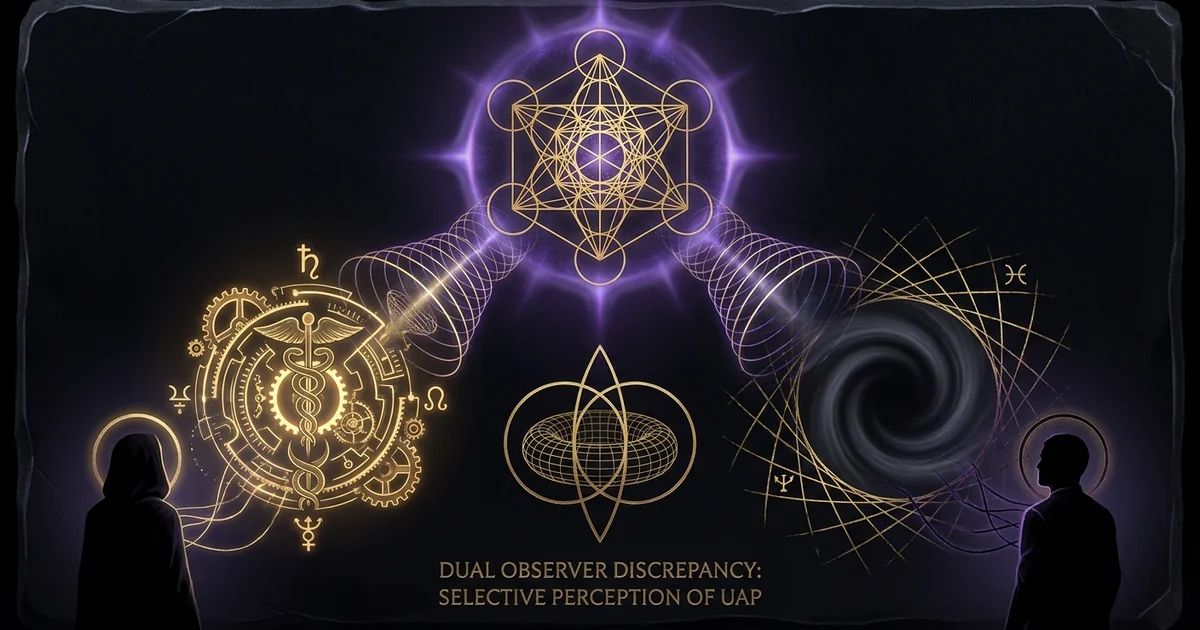
Dual Observer Discrepancy: Selective Perception of UAP
Metaphysical Thesis & Epistemological Opening: The Collapse of Classical Optics in High Strangeness
The Dual Observer Paradox: Empirical Impossibility Under Naive Realism
The foundational epistemological crisis presented by Unidentified Anomalous Phenomena (UAP) resides in the recurrent, rigorously documented failure of classical optical mechanics to account for multi-witness discrepancies. Under naive physical realism and classical electromagnetic theory, an object occupying a localized spatio-temporal coordinate $(x, y, z, t)$ that reflects or emits electromagnetic radiation within the visible spectrum ($380\text{–}750\text{ nm}$) must produce an isotropic wavefield. If Observer A and Observer B stand in immediate physical proximity—separated by mere meters, sharing an identical line of sight, atmospheric transmission conditions, and uncompromised visual acuity—Maxwell’s equations demand that incoming wavefronts impinge upon the retinas of both observers with approximately identical photonic flux.
Empirical field investigations persistently catalog instances that shatter this classical expectation: a manifestation where the phenomenon exhibits high luminosity, structural mass, and radical kinesthetics to Observer A, while Observer B, gazing at precisely the same angular coordinates, registers nothing beyond the ambient nocturnal sky or uniform atmospheric baseline. In specialized anomalistics, this is known as the dual observer discrepancy uap selective perception visibility one person phenomenon.
Under the axioms of naive optical realism, this discrepancy can only be resolved by diagnosing Observer A with acute psychiatric pathology, spontaneous hallucinatory episode, or optical neuropathy. However, this classical dismissal disintegrates when physical trace evidence contradicts pure hallucination. If ground-soil compression, localized isotopic alterations, residual ionizing radiation, or synchronized electromagnetic disturbances accompany the event, or if remote technological sensors (such as monostatic pulse-Doppler radar or infrared radiometric arrays) register a target precisely during Observer A’s observation, the solipsistic hallucinatory hypothesis becomes untenable. The failure of proximate observers to record identical sensory data demonstrates that anomalous phenomena do not operate merely as localized, isotropic physical scatterers. Instead, they operate through selective psychophysical coupling.
Photons vs. Informational Injection: Defining the Selective Sensorium
To resolve the dual observer discrepancy, we must shift the epistemological framework away from isotropic photonic propagation toward localized, directed informational injection. Classical optics assumes a passive sensorium: the human eye functions as an uncritical biological camera whose retinal cone and rod mosaics mechanically convert incoming photons into action potentials via the phototransduction cascade, routing signals through the lateral geniculate nucleus to the primary visual cortex (V1). In contrast, modern cognitive neuroscience confirms that human perception is fundamentally inferential and controlled—a Bayesian predictive engine wherein the brain projects top-down generative models that are merely constrained by sparse, bottom-up sensory telemetry.
When an anomalous intelligence manifests within human perceptual space, it frequently does not broadcast indiscriminately across the ambient macroscopic field. As Jacques Vallée posited in his foundational formulation of the informational control system framework, anomalous encounters operate under parameters analogous to a pedagogical or cybernetic feedback mechanism. The phenomenon modulates its signal to engage directly with individual consciousness interfaces rather than perturbing the bulk electromagnetic environment. The physical manifestation is not an objective, autonomous piece of hardware suspended in Euclidean space; it is an informational injection delivered into the perceptual architecture of a designated subject.
This mechanism decouples sensory acquisition from uniform physical scattering. The phenomenon functions as an anisotropic information vector, directing structural, cognitive, and sensory data into specific perceptual thresholds. Consequently, what appears to be an anomalous metallic craft or an ultra-luminous aerial geometry may not be scattering physical photons into the ambient vacuum. Instead, it can project a phase-coherent, neuro-electromagnetic signal that stimulates the observer’s visual and temporal cortices directly, or it can manipulate a localized metric pocket whose optical manifestation is restricted to a narrow, coherent exit pupil aimed exclusively at the visual axis of a single percipient.
The Observer as Wavefunction Collapser: Participatory Ontology in Anomalistics
This divergence forces an epistemological transition from passive observation to a participatory ontology, echoing the deepest paradoxes of quantum measurement and the interdimensional-hypothesis. In John Archibald Wheeler’s “participatory universe,” the observer does not merely discover a pre-existing, statically configured physical state; the act of measurement actively precipitates the collapse of indeterminate quantum potentials into an empirical actuality. In the context of high strangeness, the dual observer paradox exemplifies participatory realism at a macroscopic, psychophysical scale.
The anomalous manifestation exists within an uncollapsed, trans-dimensional superstate—an ontological continuum operating across higher-dimensional degrees of freedom. The event transforms into a visible, macroscopic manifestation only when a resonant coupling occurs between the emitter’s informational packet and the recipient’s baseline neuro-perceptual matrix. If Observer A possesses the baseline neurological tuning frequency required to execute this ontological transaction, their bio-perceptual system acts as the measurement apparatus, collapsing the incoming informational matrix into a concrete, visual reality complete with apparent physical boundaries, metallic sheen, and kinetic vectors.
Observer B, whose cognitive-energetic gating mechanisms remain unaligned with the incoming carrier wave, acts as a decoupled non-conductor. The trans-dimensional wavepacket sweeps past their sensory apparatus without triggering quantum-informational collapse. Observer B does not observe a “stealthed” craft; rather, for Observer B, the craft never enters localized empirical existence. The physical reality of the phenomenon is not an inherent property of the object itself, but an emergent property of the energetic and cognitive relation forged between the non-human intelligence (NHI) and the individual observer.
Classical Optical Realism
- Emission Profile: Isotropic electromagnetic propagation across standard Euclidean vectors; omnidirectional photon scattering.
- Sensor Status: Mechanically passive biological and technological receivers; optical data determined strictly by distance, aperture, and photon flux.
- Observer Invariance: Independent observers at equal spatial coordinates register equivalent sensory inputs, governed exclusively by classical wave equations.
- Failure Analysis: Discrepancy between observers mandates the total psychological, perceptual, or pathological dismissal of the anomalous witness.
Informational-Resonant Coupling
- Emission Profile: Anisotropic, phase-locked information injection and directed metric perturbation; trans-dimensional potential.
- Sensor Status: Active, inferential participatory receiver; sensory decoding governed by internal neuro-perceptual gating and bio-field state.
- Observer Invariance: Perceptual registration requires structural resonance between carrier packet and observer; proximity does not ensure perception.
- Failure Analysis: Discrepancy is recognized as an intrinsic property of the phenomenon’s operational mode and selective informational mechanics.
Primary Codices & Historical Transmission: Historical Gating of Theophanies and Non-Human Intelligences
The Hermetic Sensorium: Asymmetrical Perception in the Corpus Hermeticum
The premise that non-human intelligences interface selectively with human sensory faculties is not a modern innovation born of twentieth-century aerospace anomalies. It is a fundamental operational principle articulated throughout classical esoteric literature. In the Greco-Egyptian Hermetic codices, sensory perception is treated not as a democratic baseline shared equally by all biological organisms, but as a hierarchical, structurally conditioned capacity. The physical senses are understood to be downstream filters of an unconditioned noetic substrate.
In Corpus Hermeticum, specifically Libellus XI (Mind unto Hermes), the text delineates the mechanics of suprasensory vision. Hermes is instructed that the apprehension of divine or non-terrestrial realities cannot be achieved through passive optical observation (kat’ opsin). Rather, sensory apprehension is governed by structural symmetry between the observer and the observed. Mind (Nous) explains to Hermes that apprehension requires the conscious elevation and reconfiguration of the perceptual receiver: one must expand one’s internal spatial dimensions to mirror the trans-dimensional nature of the manifest intelligence.
"Unless you make yourself equal to God, you cannot understand God;
for the like is not intelligible save to the like."
— Corpus Hermeticum, Libellus XI.18
The Hermetic worldview asserts that two individuals standing side by side in physical space inhabit fundamentally distinct perceptual ontologies. The individual whose internal cognitive architecture remains bound to sensory material mechanics cannot perceive the operations of the higher orders, even when those orders manifest in immediate proximity. The uninitiated witness is afflicted with a structural agnosia—a sensory blindness born from the absence of internal noetic alignment. The ancient Hermetic master understood that divine apparitions and intermediary intelligences (daimones) choose their recipients by operating across a noetic plane that directly excites the internal subtle vehicle (ochema-pneuma) of the tuned percipient while leaving the mundane sensory organs of proximate individuals unperturbed.
Merkabah Visionary Selectivity: The Gaze of the Chariot Mystics
A parallel framework appears within the early Jewish visionary traditions of Hekhalot literature and Merkabah mysticism (flourishing between the 3rd and 9th centuries CE). The descent of the Chariot (Merkabah) and the visionary ascent through the seven celestial palaces (Hekhalot) were governed by strict, formulaic gatekeeping protocols. The mystical ascent was not conceived as spatial transit across geographical terrain, but as an interiorized, energetic transit across dimensional thresholds, requiring the mystics—the Yorde Merkabah (descenders to the Chariot)—to adopt specific somatic postures, employ precise theurgic seals (hotamot), and master dynamic vibrational permutations of divine nomenclature.
Within the primary texts of this tradition, such as Hekhalot Rabbati and Sefer Hekhalot (3 Enoch), visionary observation is selectively restricted. The textual narratives describe settings in which a master, such as Rabbi Ishmael or Rabbi Akiva, sits encircled by students and uninitiated companions within a physical chamber. While the master perceives the descending sapphire luminescence of the Chariot, the structural geometries of the Ophanim, and the imposing presence of archontic gatekeepers, the students sitting in the same room perceive only silence, physical stone, and an absent gaze.
Corpus Hermeticum, Libellus XI.19-20 (trans. Brian P. Copenhaver, 1992):
“Increase your size to an immense size, beyond all body, surpass all time, become eternity, and you will understand God… But if you lock up your soul in the body and abase yourself and say, ‘I understand nothing, I can do nothing, I fear the sea, I cannot ascend to heaven,’ what have you to do with God? For you can understand none of the things that are good and true while you are attached to the body and evil.”
Sefer Hekhalot (3 Enoch), Chapter 1:7-9:
“At once Metatron, the Prince of the Presence, descended from the highest heaven and came to me… and my eyes beheld the immense cosmic wheels of fire, the lightning of the Hayyot, and the terrors of the celestial throne. Yet those who stood near me saw neither the fire nor the Prince; their ears caught no thunder, and their eyes beheld only the dust of the floor, for their souls had not been sealed with the seal of the living God, nor had their flesh been purified by the breath of the Chariot.”
The Merkabah codices emphasize that the celestial realm does not impose its presence democratically upon indiscriminate collective assemblies. Visionary apprehension is an active, initiated resonance. The uninitiated observer is prevented from registering the high-strangeness event because their perceptual organism lacks the necessary energetic seals (hotamot)—metaphors for the somatic and neuro-cognitive tuning frequencies that allow the biological matrix to withstand and de-modulate high-density metaphysical informational bursts. The unsealed bystander remains insulated by their own neuro-sensory limitations, blind to the presence of non-human entities interacting with the seer mere feet away.
Historical Precedents: From the Damascus Epiphany to Fatima’s Asynchronous Observers
This historical continuity illuminates accounts of theophanies, Marian apparitions, and historical non-human encounters. A prominent textual baseline for this asymmetrical sensorium occurs in the New Testament accounts of Saul’s conversion along the road to Damascus. In the Acts of the Apostles, the event is described with a distinct dual-observer discrepancy:
“The men who were traveling with him stood speechless, hearing the voice but seeing no one.” (Acts 9:7)
This account is further nuanced in a subsequent retelling:
“Now those who were with me saw the light, but did not hear the voice of the one who was speaking to me.” (Acts 22:9)
The companion witnesses registered the physical periphery of the energetic emission—dispersed electromagnetic luminescence or acoustic pressure waves—yet their neuro-perceptual systems failed to decode the core informational content. The light and the voice were not uniformly distributed sensory events; they were selectively decrypted. The primary target, Saul, experienced a fully collapsed visual and linguistic reality, whereas his companions registered only undifferentiated sensory disturbance.
A modern parallel to this historical gating occurred during the 1917 Marian apparitions at Cova da Iria near Fátima, Portugal. While modern popular memory often conflates the events into the singular, mass-observed atmospheric spectacle of the “Miracle of the Sun” on October 13, the antecedent apparitions across the preceding months exhibited pronounced dual-observer discrepancies. The three shepherd children (Lúcia, Francisco, and Jacinta) inhabited wildly asynchronous sensory tiers during the same visual apparitions. Lúcia saw the entity, heard the vocal transmissions, and engaged in bidirectional linguistic exchange. Jacinta saw the entity and heard the auditory signals, but was unable to speak directly to the presence. Francisco, kneeling beside them in the identical patch of earth, initially saw nothing; only after reciting specific devotional sequences (a somatic and cognitive attunement exercise) did he register the visual form of the entity, yet he remained perpetually deaf to the acoustic transmission, relying on Lúcia to relay the entity’s words afterward.
Surrounding crowds of thousands witnessed atmospheric shifts, sudden drops in ambient temperature, buzzing acoustic signatures analogous to electrical humming, or localized glowing hazes, but completely failed to register the focal apparition seen by the children. The phenomenon exhibited a tiered, scalar structure of perceptual access. The non-human intelligence was not merely standing in physical space as an autonomous optical object; it was deploying a multi-layered informational broadcast, selectively received according to the baseline neurological tuning frequency and subjective permeability of each observer.
Ontological Architecture & Cosmological Models: The Mundus Imaginalis and Metric Modulation
Henry Corbin’s 'Alam al-Mithal: The Interdimensional Middle Realm
To comprehend the mechanics that permit an anomalous entity to appear visually concrete to one witness while remaining invisible to another, we must dismantle the binary Cartesian ontology that divides reality into res extensa (extended, physical matter) and res cogitans (unextended, internal mind). Under this binary model, every anomaly must be classified either as an objective, physical piece of hardware flying through three-dimensional space, or as a subjective, psychological hallucination confined within the individual skull.
The French philosopher and Islamic scholar Henry Corbin provided an escape from this trap through his translation and phenomenological exposition of the Persian and Arabic Sufi traditions (particularly the work of Suhrawardi, Mulla Sadra, and Ibn 'Arabi). Corbin introduced the precise Latin term mundus-imaginalis to translate the Arabic concept of the ‘Alam al-Mithal—the “World of Real Images” or the “Intermedial Realm.”
The mundus imaginalis is an intermediate ontological order situated between the world of pure, unmanifest intellectual essences and the world of coarse, physical sense data. This realm is neither subjective fantasy nor classical physical extension; it is an objective, trans-physical reality possessing its own non-Euclidean space, spiritual extension, and concrete form. Phenomena emerging within the mundus imaginalis possess genuine substantiality—they can be experienced with total sensory vividness, possessing color, geometry, kinetic velocity, and tactile presence. However, they cannot be perceived by the coarse, unrefined physical organs of sensory sight. They are apprehended solely through an organ of perception which Corbin terms the “Active Imagination” (Imaginatio vera).
- Classical Greek Mapping: Occupies the ontological space between Eikasia (sensory illusion/appearance) and Noesis (direct intellectual apprehension of the Forms), mirroring the intermediate tier of Dianoia (symbolic/mathematical reality) infused with objective visionary presence.
- Arabic Root Architecture: The ‘Alam al-Mithal operates as the Barzakh—a cosmic isthmus or transitional zone. It is a world where spiritual meanings are embodied in subtle corporeal forms, and physical bodies are subtilized into immaterial representations.
- The Imaginal vs. The Imaginary: The imaginal is ontologically objective, self-subsisting, and populated by autonomous, non-human intelligences. The imaginary, in contrast, is an individual, solipsistic construct of personal human fantasy lacking external agency.
When an anomalous phenomenon manifests from the mundus imaginalis, it occupies an intermediate state of matter. If an observer’s cognitive apparatus is sensitized such that their internal, imaginal organ of perception becomes operative, the intermediate reality descends into their sensory cortex, presenting itself with all the tactile and optical hallmarks of an external physical craft. An adjacent observer whose consciousness remains tethered exclusively to sensory sight (res extensa) will experience an absolute perceptual nullity. The phenomenon is fully present, but it occupies an ontological tier to which the second observer’s sensory gating mechanisms remain completely closed.
Polarizable Vacuum and Spacetime Metric Engineering
While the mundus imaginalis supplies the metaphysical substrate, modern relativistic and quantum field theories offer an equivalent physical framework through metric engineering. Harold Puthoff, Scott Little, and Michael Ibison (2002) advanced an approach to general relativistic space flight using the Polarizable Vacuum (PV) model. In this framework, developed from the earlier work of Robert Dicke and Andrei Sakharov, the vacuum is treated as an isotropic polarizable dielectric medium with variable permittivity ($\epsilon_0$) and permeability ($\mu_0$).
Within the parameters of polarizable vacuum metric engineering, an advanced non-human technology can manipulate the vacuum refractive index:
$$K = \frac{\epsilon}{\epsilon_0} = \frac{\mu}{\mu_0}$$
By establishing a steep, localized gradient in $K$, an anomalous vehicle alters the local metric of spacetime, effectively contracting space, dilating time, and modifying the propagation path of electromagnetic waves:
$$c(K) = \frac{c_0}{K}$$
If an anomalous craft utilizes metric engineering to insulate its operational envelope, the boundary of its field functions as an engineered gravitational or dielectric lensing interface. Light from the craft is not scattered isotropically into the surrounding environment. Photons emitted by or reflected from the craft can be redirected, focused, or blue-shifted/red-shifted beyond the narrow human visual spectrum through extreme gravitational or phase-locked metric gradients.
Under these conditions, if the metric engineering field is anisotropic—possessing a directional aperture or a controlled informational leakage vector directed along a single spatial axis—the photons escaping the localized metric will illuminate only a vanishingly narrow solid angle in space. If Observer A stands directly within this focused informational conduit, their visual system intercepts the coherent wavefront, registering an apparently physical craft. Observer B, standing mere feet away, sits entirely outside the focused metric aperture. The light does not strike Observer B’s eyes; the surrounding photons pass seamlessly around the metric pocket via geodesic deflection, presenting Observer B with an unobstructed view of the background night sky.
Sefirotic Emanational Architecture: Gevurah and Chesed as Dimensional Filters
The dynamic behind selective physical manifestation finds a profound symbolic blueprint in the Kabbalistic doctrine of the Sefirot—the ten emanational stages through which the infinite divine essence (Ein Sof) progressively condenses to produce the manifest physical cosmos (Assiah). Perceptual gating within anomalous phenomena mirrors the cosmic tension between the Sefirot of Chesed (Loving-kindness/Infinite Outpouring) and Gevurah (Judgment/Severity/Contraction).
Chesed represents the primordial, unconstrained emanational radiance—a state of high informational density and infinite bandwidth. If an interdimensional phenomenon were to discharge its complete informational packet across the physical environment without mediation, the sheer sensory and energetic magnitude would obliterate the human biological matrix, dissolving local physical structures through thermodynamic and neuro-cognitive collapse. To manifest within the finite parameters of the lower material world, the boundless radiation of Chesed must be restricted, structured, and channeled through the lens of Gevurah.
Gevurah is the cosmic principle of contraction (tzimtzum), measurement, and gating. It acts as a divine bandpass filter. It restricts the infinite light into measured, digestible quanta, generating spatial boundaries, edges, visual skins, and temporal sequences. In the context of anomalous manifestations, the dual observer discrepancy is an operational demonstration of Gevurah. The anomalous intelligence exercises extreme informational restraint, calibrating its manifest presence so that it condenses into material visibility only along highly specific, restricted conduits.
The interaction between the phenomenon and humanity mirrors this Kabbalistic emanational architecture:
[ Ein Sof: The Unmanifest Interdimensional Continuum ]
                     |
                     v
   [ Chesed: Infinite Informational Bandwidth ]
                     |
                     v  <--- (Tzimtzum / Metric Gating)
   [ Gevurah: Contraction & Selective Decryption ]
                     |
                     v
   [ Malkhut: Localized Physical/Perceptual Realization ]
When an observer experiences individual resonance perception, they do not witness the phenomenon in its totality. They witness an emanational condensation tailored by the restrictive action of Gevurah. The witness who sees nothing is not merely deprived of an experience; their biological system is protected by the default cosmic veil that shields unaligned neuro-sensory systems from higher-order dimensional encroachment.
Phenomenological Mechanics & Interdimensional Interaction: Neurological Tuning and Directed Projection
Neurological Tuning Frequency: Biophotonics, Tubulin, and Temporal Lobe Lability
The physical interface between an anomalous, higher-dimensional signal and the biological observer requires a specific neuro-somatic coupling mechanism. The reason one percipient registers the manifestation while another remains blind lies in the variance of the observer’s neurological tuning frequency. This tuning frequency is dictated by neuro-anatomical micro-structures, specifically within the temporal lobes and cortical cytoskeletal networks.
The neuroscientist Michael A. Persinger demonstrated extensively that individuals possessing heightened temporal lobe lability—a condition characterized by elevated sensitivity, transient micro-seizuring tendencies, or dynamic synaptic plasticity within the amygdaloid-hippocampal complex—exhibit pronounced receptivity to external electromagnetic perturbations. Persinger’s research revealed that applying complex, pulsed, low-intensity magnetic fields across the temporal lobes can artificially induce the profound sensed presence of non-human entities, vivid visual apparitions, and time dilation phenomena:
"The temporal lobe is the structural interface between microscopic
electromagnetic fluctuations and subjective experiential reality.
Elevated limbic lability constitutes an open biological window
to non-local environmental and quantum-coherent signals."
— Michael A. Persinger (1989)
At the subcellular level, this reception is facilitated by quantum-coherent processes occurring within cortical microtubules. As theorized in the Orchestrated Objective Reduction (Orch-OR) model of consciousness, neuronal tubulin dimers operate not merely as mechanical structural scaffolds, but as quantum computers capable of sustaining macroscopic coherent states. Stuart Hameroff and Roger Penrose posited that these tubulin networks support biophotonic resonance and neural entrainment, acting as biological waveguides for biophotons emitted within the ultra-weak endogenous photon field of the brain.
When an anomalous intelligence interacts with an observer, it modulates the local electromagnetic and zero-point fields to entrain these biophotonic networks. If Observer A’s temporal lobe lability matches the frequency of the incoming vector, a phase-locked loop is established. The external field couples with the cortical tubulin arrays, inducing high-frequency gamma synchrony (40 to 100 Hz) across the fronto-parietal networks. This synchrony artificially writes sensory data into the primary visual areas. Observer B, whose temporal lobe architecture exhibits low lability and whose microtubule networks remain decoupled from the carrier frequency, cannot bridge this biological gap. The signal passes through Observer B’s neuro-anatomy without inducing the coherent action potentials required to cross the threshold of conscious visual perception.
Directed Electromagnetic Mental Projection: Neuro-Vascular RF and Microwave Auditory Interfaces
The methodology employed by non-human intelligences to engineer selective perception often relies upon directed electromagnetic mental projection. Rather than generating light in the external macro-environment, the phenomenon can project concentrated, coherent radiofrequency (RF) and microwave pulses directly into the cranium of the percipient.
This physical mechanism is anchored in the well-documented Frey Effect, or Microwave Auditory Effect. Pulsed RF radiation within the megahertz to gigahertz range, when absorbed by cranial tissues, generates minute thermoelastic expansions in brain matter. These thermal expansions create acoustic pressure waves that propagate through bone conduction to the cochlea, stimulating the auditory nerve directly and producing the sensation of voices, clicks, or tones originating internally or in the immediate acoustic near-field.
By scaling and modulating this process across the electromagnetic spectrum, a sophisticated technology can project complex sensory arrays directly into human perceptual centers:
By aiming these electromagnetic energy beams using phased-array delivery systems, an anomalous intelligence can establish a narrow-beam cognitive uplink. The cross-section of this informational beam can be focused to a diameter smaller than a single human skull.
When this beam strikes the cranial envelope of Observer A, it bypasses the physical eyes entirely, writing phantom photonic signals directly into the lateral geniculate body and primary visual cortex (V1). Observer A perceives a physical craft suspended in the sky ahead of them with total optical realism, cast against the natural background. Observer B, standing three feet away, remains completely outside the geometric focus of the directed microwave beam. No RF energy penetrates Observer B’s cranium; consequently, Observer B’s cortex registers only the unaltered physical sky.
Individual Resonance Perception: Bio-Field Coherence and Attunement
Beyond raw electromagnetic mechanics, sensory selective perception is governed by the broader biological field—the human bio-field—which serves as a dynamic, bio-energetic interface. Individual resonance perception describes an event where an anomalous phenomenon’s appearance is mediated by the subtle vibrational coherence of the observer’s complete psychophysical matrix.
Every human organism emits a complex, dynamic spectrum of electromagnetic and subtle-energetic frequencies, ranging from the low-frequency rhythms of cardiac oscillation (the magnetocardiogram generates a field up to 5,000 times stronger than the brain’s electroencephalogram) to biophotonic emissions in the visual spectrum. When an individual achieves internal coherence—a state marked by sustained heart rate variability (HRV) coherence, synchronized autonomic activity, and integrated neurological integration—their bio-field transitions from an incoherent, noisy baseline to a highly structured, standing wave resonator.
This coherent state mirrors the esoteric notion of the purified subtle body (sukshma sharira in Vedantic thought, or the luminous vehicle of the Neoplatonists). An anomalous intelligence operates across an advanced informational frequency spectrum. If the human receiver emits high-entropy, incoherent bio-electric noise, the two systems cannot establish a clear communication link. The unaligned observer’s bio-field acts as an impermeable barrier; the incoming signal encounters destructive interference, washing out the informational packet.
Conversely, when an observer’s bio-field exhibits high structural coherence, it achieves resonance with the incoming carrier wave. The phenomenon is not merely selecting the observer at random; it is drawn along paths of least informational and energetic resistance. The resonant observer’s bio-field matches the phase signature of the incoming trans-dimensional wavepacket. This allows the anomalous data to pour into the observer’s nervous system, translating abstract informational structures into clear, sensory realities. Selective visibility, therefore, is not purely an act of non-human discretion; it is an act of dynamic, biological attunement.
Initiatic Synthesis & Philosophical Implications: Reality Engineering and Ontological Sovereignty
The Archontic Mimetic Veil: Synthetic Apparitions vs. Genuine Theophany
The capacity of non-human intelligence to project synthetic visual phenomenologies directly into selected observers demands a rigorous re-examination of classical demonological and Gnostic warnings. In the Nag Hammadi codices, particularly The Hypostasis of the Archons and The Apocryphon of John, humanity is portrayed as besieged by lower-dimensional cosmic rulers termed the archon authorities. A central operational attribute of these Archontic entities is the antimimon pneuma—the “counterfeit spirit”—and their mastery of mimesis: the ability to forge synthetic, deceptive sensory apparitions designed to confuse, misdirect, and capture human consciousness.
The Archons do not create novel ontological realities; they engineer perceptual illusions. They intercept the human cognitive apparatus and project synthetic, phantasmic forms (phantasmata) that simulate sacred theophanies, angelic visitations, or celestial vessels:
"Their delight is bitter, their beauty is depraved,
and their triumph is in deception; they lead astray
the children of light by the likeness of their forms."
— The Apocryphon of John (II, 21:14-19)
The dual observer discrepancy exposes the potential for profound perceptual deception. If an anomalous phenomenon can illuminate the sensory apparatus of one witness while concealing itself from an adjacent witness, it demonstrates the ability to write arbitrary sensory forms directly into the human mind. This raises a pressing metaphysical question: is the percipient witnessing a genuine, ontological theophany—a true manifestation of higher spiritual realities emerging from the mundus imaginalis—or are they the target of an exogenous, Archontic reality-engineering broadcast?
A synthetic apparition is characterized by its hyper-specific semiotic tailoring. It deploys visual forms, cultural motifs, and emotional archetypes drawn directly from the percipient’s personal or collective subconscious (e.g., historical Marian figures in Catholic Europe, craft-like metallic geometries in technological epochs, mythological entities in ancient civilizations). By utilizing directed electromagnetic mental projection, the phenomenon constructs a mimetic veil. The percipient becomes captive to an external script, reifying a synthetic projection as an objective truth while remaining blind to the true nature of the intelligence orchestrating the encounter.
Epistemological Shock and Cognitive Disruption in Modern Encounters
The psychological aftermath of the dual observer discrepancy is characterized by severe cognitive disruption, a condition anomalists define as ontological shock. In conventional, shared perceptual experiences, human consensus reality is reinforced through peer validation: Observer A sees an anomalous object, Observer B affirms the observation, and the shared experience is stabilized within social reality. The dual observer discrepancy denies the primary percipient this validation.
When Observer A experiences an encounter of extraordinary high strangeness—complete with apparent physical displacement, blinding luminance, and emotional intensity—only to have their companion confirm that the sky remained entirely empty, Observer A experiences an epistemological collapse. The percipient is suspended in a reality-fracture: their own senses report a physical event of immense magnitude, while their social environment diagnoses them with cognitive breakdown, psychiatric delusion, or hysterical hallucination.
This psychological alienation is an intentional design feature of the informational control system framework. By isolating the percipient from their social consensus network, the phenomenon weakens the percipient’s conventional cognitive anchors. The witness is destabilized, rendering their deep subconscious receptive to psychological repatterning. This dynamic creates a split-tier reality within the percipient’s immediate circle, illustrating the corrosive power of anomalous interventions: they operate not merely to be seen, but to erode the dogmatic certainty of naive materialist realism.
The direct reception of a selective perceptual manifestation presents severe spiritual and psychological hazards:
- **The Hazard of Psychological Inflation:**Percipients often interpret their selective visibility as a sign of divine election, evolutionary superiority, or cosmic messianic selection. This inflation feeds the ego and blinds the observer to the possibility of external cognitive manipulation.
- The Error of Uncritical Reification: Percipients tend to take the manifested imagery at face value—treating synthetic, cultural masks (e.g., metal crafts, angelic wings, multidimensional beings) as literal physical truths rather than deciphering the underlying informational intent.
- The Void of Ontological Despair: When isolated by a non-seeing companion, the observer risks profound epistemological vertigo. This fracture can erode their ability to orient within baseline consensus reality, opening vulnerabilities to cognitive fragmentation and emotional collapse.
Cultivating Ontological Sovereignty Against Exogenous Perceptual Manipulation
To preserve human agency amid an ecology of intelligences capable of metric engineering and directed sensory projection, percipients must cultivate ontological sovereignty. Ontological sovereignty is the structural capacity of an individual to preserve their cognitive autonomy, critique sensory inputs, and reject exogenous perceptual manipulation, whether originating from terrestrial technological systems or non-human entities.
This self-determination demands the revival of the ancient esoteric discipline of diakrisis—the Greek Patristic and Hermetic virtue of “the discernment of spirits.” Diakrisis is the vigilant, analytical deconstruction of sensory and noetic phenomena before the mind consents to their truth. Under the discipline of diakrisis, the practitioner does not accept the apparent visual form of an anomaly at face value. When a manifestation appears, the sovereign mind pauses, suspends immediate emotional or religious reification, and analyzes the encounter through structural diagnostics:
- Deconstruct the Phenomenal Form: Recognize that the visual presentation (the metallic hull, the luminous being, the archetypal presence) is a down-sampled, cultural projection or a mimetic mask, not the ultimate ontological ground of the entity.
- Monitor Internal Somatic and Neuro-States: Observe fluctuations in temporal lobe activity, autonomic arousal, and emotional states to discern whether one’s cognitive processes are being entrained by an external pulsed electromagnetic field.
- Evaluate Epistemological Teleology: Analyze the manifestation’s functional vector: does it destabilize the mind into obedience, fear, and inflation, or does it catalyze autonomous noetic clarity and sober ethical awareness?
By establishing ontological sovereignty, the percipient ceases to be a passive biological screen upon which non-human intelligences can project reality-distorting narratives. The sovereign individual anchors their awareness within the deep, unconditioned core of consciousness itself—what the Gnostics termed the Pneuma or the Hermeticists called the uncreated Nous. From this unshakable vantage point, the observer gazes through the mimetic architectures of both the physical world and the mundus imaginalis, decoding anomalous interventions with clear perception and an unshakeable mind.
Frequently Asked Questions: Metaphysical and Physical Inquiries
Resolving Technological Sensor Capture vs. Human Optical Blindness
A significant operational paradox occurs when technological systems record an anomaly that human observers present at the scene fail to register with the naked eye, or conversely, when humans observe a vivid craft that leaves technological sensors completely blank. Resolving this discrepancy requires analyzing the differing operational mechanics of physical sensors and biological sensory systems.
Technological sensors—such as Forward-Looking Infrared (FLIR) systems, radiometric imagers, and monostatic pulse-Doppler radar—operate across broad, non-visible swaths of the electromagnetic spectrum. A FLIR sensor detects blackbody radiation and thermal emissions within the 3 to 5 micron (medium-wave infrared) or 8 to 14 micron (long-wave infrared) bands. An anomalous craft that manipulates its local spacetime metric via vacuum polarization can completely suppress emissions within the visible human spectrum (380 to 750 nm) through optical phase destruction or steep gravitational blue/red-shifting, rendering it transparent to human ocular inspection. However, the energetic thermodynamics of this metric engineering envelope inevitably release secondary thermal waste or plasma boundary perturbations that radiate in the infrared or cause coherent radar cross-section backscatter. The technological instrument records the physical consequence of metric distortion, unblinded by biological neuro-gating.
Conversely, when an observer sees a craft that sensors fail to record, the manifestation is often operating via direct cranial informational injection. The phenomenon delivers a focused RF microwave packet or biophotonic field that stimulates the human visual cortex directly. Because there is no corresponding photon scattering taking place in the physical atmosphere between the observer and the clouds, an adjacent digital camera or radar array records only empty air. The craft is phenomenologically present to the biological observer’s central nervous system, but physically absent from the bulk electromagnetic medium monitored by the mechanical sensor.
Vallée, Jacques F., and Davis, Eric W. (2004). “Incommensurability, Orthodoxy and the Physics of High Strangeness.” Space Technology and Applications International Forum (STAIF-2004), American Institute of Physics:
“The physical and physiological signatures of the phenomena cannot be separated into pure technological hardware versus pure subjective hallucination. We must account for an intermediate modality wherein anomalous phenomena project physical effects that mimic localized optical structures, while simultaneously demonstrating direct interaction with human neural architecture, producing burns, temporary paralysis, and perceptual gating discrepancies between closely situated witnesses.”
Mechanisms of Targeted Non-Human Intelligence Intentionality
Why would an advanced intelligence deliberately engineer a dual observer discrepancy, showing itself to one human while hiding from another standing mere paces away? Within Jacques Vallée’s cybernetic control system paradigm, these interventions are designed as deliberate informational perturbations intended to destabilize baseline assumptions without triggering premature societal panic.
If an anomalous craft were to appear universally visible and interact uniformly across all biological and mechanical detectors, it would precipitate an acute, uncontrolled collapse of human civilization’s macro-consensus reality. Such an event would instantly shatter cultural, religious, and scientific paradigms, likely resulting in systemic institutional paralysis. By manifesting selectively, the phenomenon operates with surgical precision. It impacts individual percipients, introducing anomalies into localized social matrices that act as gradual catalysts for cultural evolution.
Furthermore, this selective visibility acts as an informational security protocol. The intelligence can deliver a complex, transformative informational payload to an individual whose consciousness is prepared to process it, while remaining fully invisible to an unaligned bystander whose defensive worldview or institutional role might trigger a violently reactionary response. The dual observer discrepancy serves as an operational veil, ensuring that high-strangeness events remain deniable, personalized, and ecologically calibrated to preserve the broader evolutionary trajectory of the collective human species.
Differentiating Individual Resonance Perception from Classical Hallucination
The critical empirical challenge for anomalists is distinguishing individual resonance perception from clinical psychopathology, temporal lobe epilepsy, or unprompted internal hallucination. If only one person sees the phenomenon, how can we assert that the event possesses genuine external reality?
The demarcation rests upon three pillars of physical corroboration:
- Concurrent Environmental Perturbations: Clinical hallucinations do not alter the ambient physical environment. In authentic high-strangeness encounters, despite the selective perception of the visual form, physical instruments frequently register synchronized external perturbations. These include transient magnetic field spikes (measured via tri-axial magnetometers), localized shifts in background ionizing radiation, radiofrequency emissions in the UHF/VHF bands, or physical ground modifications (soil desiccation, vegetation crystallization, or anomalous magnetic field gradients imprinted in terrestrial minerals) discovered precisely at the focal point of the percipient’s visual observation.
- Corroborated Physiological Biomarkers: Percipients of selective encounters frequently display physiological trauma that matches the physical trajectory of their visual sighting. As cataloged in clinical analyses of anomalous contact cases, these markers include localized thermal radiation burns, cellular dehydration, erythema, localized alopecia, and transient immune system dysregulation (such as acute lymphopenia) mirroring exposure to high-intensity microwave or ionizing radiation. A purely psychological hallucination cannot produce ionizing radiation damage or directional ocular keratitis.
- Information-Theoretic Depth: The content received during an individual resonance perception frequently conveys complex, coherent data that lies entirely outside the percipient’s prior intellectual, linguistic, or cultural repertoire. This can include verifiable historical transmission data, complex symbolic languages, advanced topological mathematical geometries, or verified non-local insights later confirmed through physical corroboration.
Where clinical hallucination reveals a degradation of structural information and coherence, selective anomalous perception exhibits elevated informational organization. The percipient has not suffered an internal breakdown of perceptual integrity; they have momentarily interfaced with an external, highly organized, trans-dimensional reality that remains invisible to the uncalibrated observer. :::