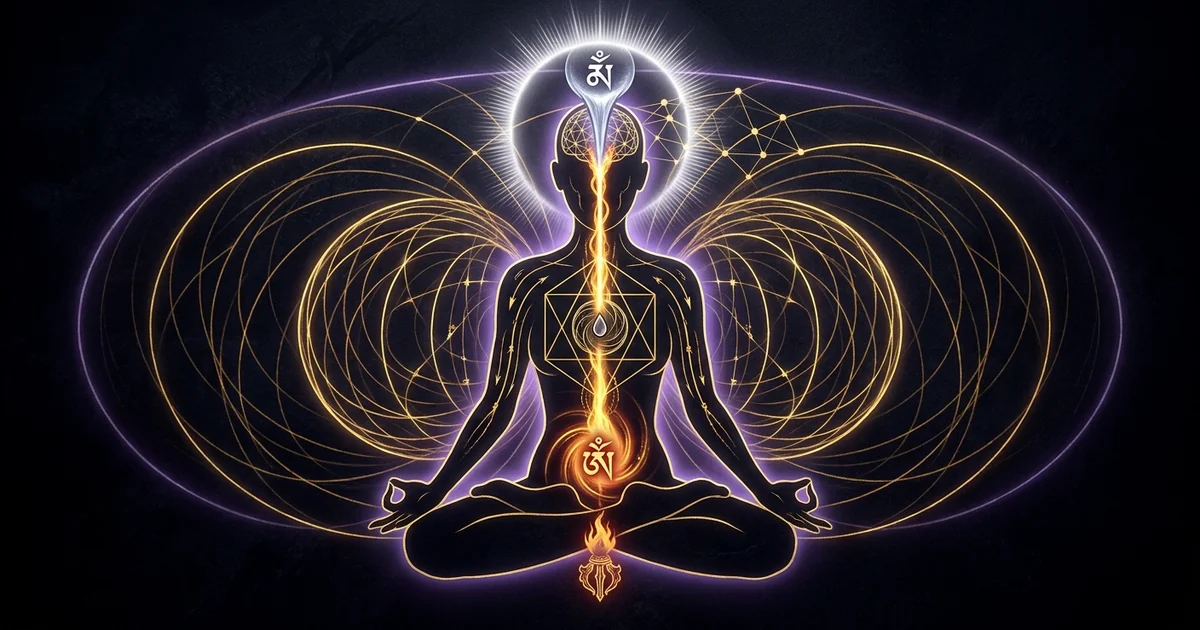
Six Yogas of Naropa: Foundation of the Inner Fire Yoga
Protocol Overview & Neurophysiological Thesis
Lineage Epistemology: Tilopa to Naropa and the Primacy of Chandali
Within the Mahamudra and Anuttarayoga Tantra traditions of Indo-Tibetan Buddhism, the system known as the Six Dharmas—codified by the Mahasiddha Tilopa and transmitted sequentially to Naropa, Marpa Lotsawa, and Jetsun Milarepa—represents a definitive psycho-energetic technology. At the operational apex of this system sits the practice of Inner Fire (gtum mo, Skt. caṇḍālī). Far from operating as an isolated ascetic feat or mere somatic thermoregulation, Inner Fire constitutes the structural engine for the entire teleological architecture detailed in the Six Yogas of Naropa overview.
Without the bio-energetic ignition of chandali mystical heat, the downstream practices—the Illusory Body (sgyu lus), the transitional mechanics analyzed in Bardo Yoga and death transitions, the cognitive stabilization of Dream Yoga and lucid dreaming lineage methods, the radical transference of consciousness ('pho ba), and the direct realization of Clear Light ('od gsal)—remain functionally inert. The historical Marpa-Tilopa lineage maintains that the transmutation of somatic winds serves as the non-negotiable substrate upon which cognitive non-duality is engineered. The six yogas of Naropa tummo inner fire foundation Tibetan lineage insists that somatic energetics cannot be separated from epistemological liberation; bodily vital winds and subtle conscious states are non-dual reflections of a single underlying continuum.
“By binding the vital winds at the navel wheel, the blazing of the fire of Candali consumes the eighty-four thousand afflictions; the nectar of the white moon at the crown is melted, and through the descent of the four joys, non-dual primordial awareness is spontaneously realized.”
— Tilopa, Karnatantra (The Whispered Lineage of the Six Dharmas), translated in Mullin (1996).
In his authoritative commentary The Book of Three Inspirations, Je Tsongkhapa emphasizes that among the six dharmas, Inner Fire is the root: if heat does not blaze at the navel to melt the bodhicitta droplets, the subtle body winds remain trapped in the lateral conduits, rendering the subsequent yogas of illusory body and luminosity structurally unachievable.
Subtle Anatomy: Interlocking the Central Channel (Uma) and Vital Winds (Lung)
The theoretical framework rests on the architecture of the subtle-body (sūkṣma-śarīra, rtsa rlung thig le), which maps an intricate network of channels (rtsa, Skt. nāḍī), energetic winds (rlung, Skt. prāṇa), and concentrated psychophysical essences (thig le, Skt. bindu). In baseline waking consciousness, the subtle body winds lung circulate almost exclusively through two lateral pathways: the left channel (rkyang ma, Skt. lalanā), which models passive, cooling, cognitive-mental factors, and the right channel (ro ma, Skt. piṅgalā), which governs active, heating, sensorimotor engagements.
This lateral bifurcation bifurcates perception itself, perpetually sustaining subject-object dualism, affective reactivity, and conceptual proliferation (prapañca). The overarching objective of Inner Fire yoga is the forceful cessation of lateral circulation and the diversion of these dualistic winds into the median conduit: the central channel (dbu ma, Skt. avadhūtī). The central channel runs vertically from the perineum along the anterior border of the spinal column to the crown fontanelle, curving forward to terminate between the eyebrows.
When the lateral winds are arrested and integrated into the avadhūtī, discursive thought collapses. Somatically, this withdrawal manifests as a profound transformation of the autonomic-nervous-system, in which typical bifurcations between parasympathetic rest and sympathetic excitation collapse into an extraordinary hybrid state: extreme metabolic arousal and heat production co-occurring with deep central-nervous-system quiescence.
The Transpersonal Objective: Sublimating Prana into Non-Dual Luminosity
The generation of somatic heat is an epiphenomenon of deeper bio-electromagnetic and spiritual mechanics. In Western discourse, somatic heat production is frequently misinterpreted through a purely survivalist lens—an adaptive mechanism designed to endure Himalayan alpine extremes. While physiological thermogenesis is undeniably real, within the tantric framework it is merely a signpost of central-channel ingress.
The primary transpersonal imperative of Inner Fire is the combustion of karmic propensities encoded within the prāṇa-rlung matrix. As the subtle winds are compressed through the navel center, an intense friction arises at the energetic junction of the central channel. This friction ignites the subtle-body potential symbolized by the vertical stroke of the syllable AH (a-shad). The ascending thermal energy travels upward through the avadhūtī, transmuting coarse neural processing and melting the white, quiescent generative essence (bindu, byang sems dkar po) localized at the crown wheel (sahasrāra).
As this celestial fluid descends sequentially through the throat, heart, and navel wheels, the yogin experiences the Four Joys (ānanda, dga’ ba bzhi), systematically stripping away sensory and conceptual dualities. The somatic heat acts as a biological catalyst that loosens the knots (rtsa mdud) binding the heart wheel, creating the physiological conditions necessary for the manifestation of the Mother Clear Light—the foundational, unconditioned state of awareness designated in Dzogchen and Mahamudra as rigpa.
Biophysical Mechanisms & Brainwave Dynamics
Sympathetic-Adrenomedullary (SAM) Axis Hyperactivation and Brown Adipose Tissue
From a rigorous neurophysiological standpoint, Inner Fire yoga achieves what was long considered an impossibility in autonomic medicine: the conscious, voluntary elevation of human core and peripheral body temperatures through non-shivering thermogenesis. Modern empirical investigations demonstrate that this thermal shift relies upon profound hyperactivation of the sympathetic-adrenomedullary (SAM) axis, paired with targeted downstream activation of brown adipose tissue (BAT). Unlike classic meditative traditions originating from Theravada frameworks, which cultivate deep parasympathetic dominance characterized by decreases in heart rate, oxygen consumption, and peripheral vascular resistance, Vajrayana tantric practices act as active, high-arousal energetic technologies.
The pioneering physiological assays conducted by Benson et al. (1982) demonstrated that Himalayan adepts could consciously elevate peripheral digit temperatures by as much as 8.3°C without metabolic shivering. Decades later, advanced biometric investigations by Kozhevnikov et al. (2013) and complementary arousal-relaxation analyses by Amihai & Kozhevnikov (2014) parsed the discrete neurocognitive mechanisms involved.
Their data revealed that non-meditators and novice practitioners utilizing solely the somatic component (isometric muscular engagement paired with the specialized kumbhaka or “Vase Breath”) achieved marked peripheral warming, yet core body temperature elevations were limited. In contrast, advanced yogins integrating the specialized micro-visualization of internal flame within the central channel demonstrated sustained core body temperature increases extending into the high-grade febrile range (surpassing 38.3°C), mediated by massive sympathetic tone escalation without triggering somatic panic cascades.
The recruitment of brown adipose tissue serves as a central metabolic mechanism. Brown adipocytes, characterized by high mitochondrial density and the pervasive expression of uncoupling protein-1 (UCP-1 or thermogenin), reside primarily along the parasternal, interscapular, and perirenal axes, adjacent to the deep vascular pathways tracing the central channel. Sympathetic outflow, triggered by central command descending from the ventromedial and dorsomedial hypothalamic nuclei, causes the rapid release of norepinephrine onto $\beta_3$-adrenergic receptors of brown adipocytes.
This cascades an intracellular signaling sequence via cyclic adenosine monophosphate (cAMP) and protein kinase A (PKA), activating lipolysis. The liberated free fatty acids directly activate UCP-1 within the inner mitochondrial membrane. UCP-1 short-circuits the proton electrochemical gradient normally driving ATP synthase, dispersing the proton-motive force exclusively as metabolic heat:
$$\Delta \mu_{\text{H}^+} \xrightarrow{\text{UCP-1}} Q_{\text{thermal}}$$
This endogenous heat rapidly warms the contiguous venous blood arrays, elevating core thermal capacitance and distributing warmth across the microvasculature.
+--------------------------------------------------------------------------+
|                  NEURO-SOMATIC THERMOGENIC CASCADE                       |
+--------------------------------------------------------------------------+
| 1. Focused Micro-Visualization (Frontoparietal Network)                  |
|    --> Cortical recruitment driving Dorsomedial/Paraventricular Hypo     |
| 2. Downward & Upward Somatic Compression (Kumbhaka)                      |
|    --> Bilateral subdiaphragmatic visceral baroreceptor activation       |
| 3. Massive Sympathetic Outflow (Norepinephrine release via SAM Axis)    |
|    --> Binding to Beta-3 Adrenergic Receptors on Brown Adipose Tissue    |
| 4. Mitochondrial UCP-1 Uncoupling                                        |
|    --> Proton gradient collapse generating direct endothermic heat       |
| 5. Core Blood Warming & Insular Re-mapping                               |
|    --> Re-calibration of hypothalamic setpoint & non-shivering heat     |
+--------------------------------------------------------------------------+
Cortical Rhythms: Alpha-Theta Desynchronization and Sustained Gamma Bursts (40–100 Hz)
Electroencephalographic (EEG) investigations of Inner Fire practitioners reveal a definitive neuroelectric signature that departs radically from conventional resting-state meditation. During the initial stabilization phase, baseline Alpha rhythms (8–12 Hz) and slow-wave frontomedial Theta rhythms (4–8 Hz)—hallmarks of standard somatic quiescence—undergo immediate desynchronization. In their place emerges high-amplitude, sustained cortical gamma-brainwaves spanning the 40 to 100 Hz frequency domain, frequently locking into peak oscillatory bursts between 60 and 80 Hz.
This dramatic spectral power shift signifies extensive cortical activation. Gamma-band oscillations are the fundamental neurocomputational mechanism underlying transient temporal binding across spatially distributed neural networks. In the context of Inner Fire, the intensive cognitive micro-visualization of the razor-thin flame along the central axis requires continuous top-down attentional allocation, precise sensory re-mapping, and real-time integration of visceral feedback.
Frontoparietal attention networks, notably the dorsolateral prefrontal cortex (dlPFC) and the posterior parietal cortex (PPC), fire at high frequencies to maintain the holographic construct of the avadhūtī. The practitioner’s neuroplasticity is leveraged to its thermodynamic limit, actively preventing default mode network (DMN) intrusion through high-frequency neural synchronization. This mechanism mirrors the entrainment dynamics explored in binaural beats and gamma synchronization, where targeted acoustic phase-alignment induces equivalent global coherent binding.
Interhemispheric Phase Locking and Frontoparietal Coherence
As the kumbhaka breath retention stabilizes and somatic heat increases, a notable physiological phenomenon occurs: high-degree interhemispheric-synchronization and phase-locking across homologous cortical sites. Under standard neurological operating conditions, the cerebral hemispheres exhibit asymmetrical activation patterns reflecting the functional lateralization of cognitive, spatial, and linguistic processing. During deep Inner Fire states, the phase lag between left and right frontotemporal and frontoparietal sensors decreases toward zero, demonstrating that both hemispheres are functioning in strict oscillatory lockstep.
This global synchronization is mediated structurally by the corpus callosum and dynamic thalamocortical loops, driven by ascending visceral feedback. The combined pelvic contraction and pressurized diaphragmatic retention stimulate vagal and splanchnic afferent fibers. These ascending signals terminate in the solitary tract nucleus (nucleus tractus solitarii, NTS), transmitting dense interoceptive data streams to the parabrachial nucleus and subsequently to the ventromedial thalamus and the anterior insular cortex (AIC).
The AIC, which holds the primary cortical map of the body’s physiological and thermal state, processes this intensified afferent input within a field of synchronized gamma activity. Consequently, the customary, passive sensory registration of temperature gives way to an active, conscious recalibration of the hypothalamic homeostatic setpoint. The practitioner does not simply “feel” heat; the cortex commands the homeostatic thermostat to adjust core physiological parameters, maintaining heightened thermogenesis without alerting autonomic alarm cascades.
Structural Topography: Subtle Body Channels and Energetic Routing
Trifurcated Vascular-Pranic System: Roma, Kyangma, and Avadhuti
The architecture of the tantric subtle-body provides an exact somatic and metaphysical template for channeling internal heat. The system relies fundamentally upon three parallel energy channels originating in the pelvic basin and running vertically along the anterior surface of the spine:
[ Roma (Right Channel / Solar / Pingala ) ]   --> Heating, Red, Sensorimotor Afferents
[ Kyangma (Left Channel / Lunar / Lalana) ]  --> Cooling, White, Cognitive Delusion
[ Avadhuti (Central Channel / Median / Uma) ] --> Vacuum-State, Non-Dual Neutral Core
- The Left Channel (rkyang ma, Skt. lalanā): White in hue, lunar, and cooling in essence, this conduit carries the prāṇa of mental concepts, desire, and intellectual processing. Anatomically, its trajectory correlates with the left paravertebral sympathetic chain and parasympathetic pathways, ending at the left nostril.
- The Right Channel (ro ma, Skt. piṅgalā): Red in hue, solar, and thermogenic in essence, this conduit transports the prāṇa of physical activity, metabolic processing, and reactive aversion. It correlates with the right sympathetic trunk, running upward to terminate at the right nostril.
- The Central Channel (dbu ma, Skt. avadhūtī): Luminous, non-material, and dark blue or translucent in appearance, the central channel represents a biological and energetic vacuum state. It does not carry karmic winds; rather, it remains collapsed in ordinary individuals. It ascends straight through the interior axis of the torso, passing directly through the centers of the primary energy plexuses, bending over the cerebral cortex, and descending to open at the ūrṇā point between the eyes.
Under normal physiological conditions, the lateral channels coil around the central channel at specific geometric loci, creating restrictive structural knots (rtsa mdud). These constrictions choke the central pathway, forcing the subtle body winds lung out into the superficial somatosensory networks, which in turn fuels the dualistic fragmentation of mind. The physical maneuvers of Inner Fire systematically unwind these knots by cutting off peripheral respiration, applying mechanical torque, and forcing the lateral winds to cross the threshold into the avadhūtī.
The Four Primary Wheels (Chakras) as Autonomic Nerve Plexuses
Where the lateral channels cross and bind the central axis, localized energetic concentrations form wheels ('khor lo, Skt. cakra). Although contemporary popular systems describe seven or more centers, the classical Marpa-Tilopa lineage of the Six Dharmas concentrates its engineering upon four primary hubs:
+-----------------------------------------------------------------------------+
|               ANATOMICAL-TANTRIC TOPOGRAPHY OF THE FOUR WHEELS              |
+-----------------------------------------------------------------------------+
| Wheel & Location     | Spoke Count | Tantric Essence  | Neuroanatomical Hub |
+----------------------+-------------+------------------+---------------------+
| Crown (Sahasrara)    | 32 spokes   | White Bodhicitta | Pineal/Hypothalamic |
| Throat (Sambhogakaya)| 16 spokes   | Sambhogakaya     | Cervical Ganglia    |
| Heart (Dharmakaya)   | 8 spokes    | Indestructible D.| Cardiac Plexus      |
| Navel (Nirmanakaya)  | 64 spokes   | Candali Fire/AH  | Celiac/Mesenteric   |
+----------------------+-------------+------------------+---------------------+- The Navel Wheel of Emanation (sprul pa’i 'khor lo): Situated four finger-widths beneath the anatomical navel, this center fans out into sixty-four downward-sloping channels. It corresponds biologically to the celiac (solar) plexus, the superior mesenteric plexus, and the rich vasculature supplying the gastrointestinal tract and abdominal brown adipose deposits. This center is the crucible of the practice: here, the triangular hearth of the fire is visualized, where the microscopic stroke of the AH blazes.
- The Heart Wheel of Truth (chos kyi 'khor lo): Situated at the center of the thoracic cavity, this center has eight spokes pointing downward. It corresponds to the deep cardiac plexus, aortic plexus, and intrinsic cardiac nervous system. In its deep center resides the Indestructible Drop (mi shigs pa’i thig le), a microscopic encapsulation of the subtlest consciousness and wind. Its surrounding channel knot is the most tightly bound, representing the biological root of the existential ego.
- The Throat Wheel of Enjoyment (longs spyod kyi 'khor lo): Situated at the junction of the thyroid cartilage and cervical spine, this center contains sixteen upward-pointing channels. It corresponds anatomically to the pharyngeal, superior and middle cervical ganglia, and the carotid sinus networks. It acts as an energetic conduit, regulating metabolic rate via thyroid-axis interactions and serving as the primary hub for dream-state induction.
- The Crown Wheel of Great Bliss (bde chen gyi 'khor lo): Situated at the top of the skull, this center consists of thirty-two spokes pointing downward like an inverted parasol. It corresponds neurobiologically to the third ventricle, the pineal gland, and the epithalamic-hypothalamic nexus. It serves as the reservoir of the cooled, quiescent white generative fluid (thig le dkar po), which is held in a crystallized state until unlocked by the rising thermal vector of the AH.
Comparative Mechanics: Tantric Tummo vs. Modern Hyperventilative Cold Exposure
In modern physical training and biohacking spaces, traditional Inner Fire is often conflated with secularized, hyperventilative cold adaptation protocols (such as the Wim Hof Method). While both systems leverage breath to manipulate human physiology under thermal stress, their mechanisms, respiratory kinetics, neurological targets, and ultimate objectives are fundamentally divergent.
Classical Tibetan Tummo (Kagyu/Nyingma)
Respiration Mechanics: Utilizes deep, controlled inhalations culminating in the kumbhaka (Vase Breath)—a prolonged, non-forceful dual-lock abdominal compression. It deliberately avoids protracted hyperventilation, targeting minimal atmospheric agitation and long periods of respiratory suspension.
Cognitive Architecture: Demands high-load mental micro-visualization: a needle-thin vertical line of fire blazing within a microscopic central channel, systematically unwinding somatic channel knots and dissolving perceptual dualities.
Autonomic Mechanics: Elevates core and peripheral temperature through sustained brown adipose uncoupling, vagal-afferent insular recalibration, and sympathetic tone modulation, achieved without systemic hyperventilation-induced hypocapnia.
Ultimate Objective: Liberation from dualistic consciousness; combustion of karmic winds (prāṇa-rlung); generation of non-dual bliss-emptiness; direct realization of the Mother Clear Light ('od gsal).
Modern Hyperventilative Protocols (e.g., Wim Hof)
Respiration Mechanics: Consists of cyclic hyperventilation (30–40 forced breaths) followed by an unpressurized prolonged breath retention on empty lungs (exhalatory apnea), driving profound episodic hyperoxia followed by hypoxia.
Cognitive Architecture: Employs somatic interoceptive scanning, cold-endurance focus, and generalized mental resilience, entirely absent of channel visualization, chakra manipulation, or subtle drop (bindu) routing.
Autonomic Mechanics: Forces a massive release of epinephrine via the adrenal medulla driven by acute systemic respiratory alkalosis (carbon dioxide washout) and drop in arterial $p\text{CO}_2$. Increases peripheral cold shock tolerance while inducing cerebral vasoconstriction.
Ultimate Objective: Immune system modulation, reduction of systemic inflammation markers (e.g., TNF-$\alpha$, IL-6), enhancement of cold resilience, physical vitality, and secular stress mitigation.
Hyperventilative protocols alter blood chemistry through extreme hypocapnia:
$$\downarrow p\text{CO}_2 \implies \uparrow \text{pH (respiratory alkalosis)} \implies \text{systemic vasoconstriction}$$
This often produces paresthesia and lightheadedness. Classical Tummo, on the other hand, preserves carbon dioxide through prolonged, pressurized retentions, inducing hypercapnic-hypoxic conditions that paradoxically promote cerebral blood flow and open cellular microvascular beds. Tummo does not use respiratory alkalosis as a shortcut to adrenaline; instead, it pairs neuro-visceral compression with hyper-focused attention, directly activating hypothalamic mechanisms while keeping the cognitive field stable and lucid.
Step-by-Step Experiential Protocol: The Foundation Practice
Phase I: The Seven-Point Vairochana Posture and Ninefold Purification Breathing
The foundation of Inner Fire relies upon physical alignment. Posture is not an ornamental preliminary; it aligns the bio-electromagnetic pathways of the subtle body, minimizing neuroforaminal impingement and clearing fluid dynamics along the spinal axis. Practitioners adopt the Seven-Point Posture of Vairochana (rnam snang chos bdun):
- Lower Extremities: Legs bound in the full vajra posture (vajrāsana), with soles turned upward, pressing the heels firmly into the lower abdominal channels to anchor the downward-voiding winds.
- Spinal Column: The spine is straightened like an arrow or a stack of coins, lifting the lumbar vertebrae to open the intervertebral spaces and allowing the central channel to unfurl without torsion or obstruction.
- Shoulders and Upper Torso: Shoulders squared and held slightly back like the wings of a soaring vulture, broadening the chest and expanding the intercostal muscles without straining the dorsal spine.
- Hands: Placed four finger-widths beneath the navel in the mudra of meditative equipoise, right hand resting atop the left, thumbs lightly touching to form an energetic circuit across the palmar meridians.
- Cervical Spine (Chin Lock): The chin is tucked slightly inward toward the jugular notch, lengthening the back of the neck and mitigating excessive blood pressure surges into the cerebral vault.
- Ocular Focus: Eyes half-closed, gazing down along the line of the nose toward a point roughly eight finger-widths beyond the floor, preventing both the excitation (rgod pa) of an open gaze and the sluggishness (bying ba) of closed eyelids.
- Lingual Placement: The tongue rests lightly against the hard palate behind the upper incisors, dampening the salivary reflex and sealing the upper energetic terminus of the cranial loop.
With the posture locked, the practitioner initiates the Ninefold Purification Breathing (rlung ro dgu phrugs). This systematic maneuver discharges stale karmic winds (rlung ro) from the lateral channels. Pressing the right nostril with the ring finger of the right hand, the practitioner inhales deeply through the left nostril, visualizing pure, cooling, crystalline light penetrating to the base of the left channel.
Exhaling forcefully through the right nostril, they visualize all clinging, desire, and karmic impurities leaving the right channel as smoke. The process is reversed: inhaling through the right, exhaling through the left to purge aversion and anger. Finally, inhaling deeply through both nostrils into the base of the lateral channels, the practitioner exhales through both nostrils simultaneously, discharging ignorance, mental inertia, and fundamental confusion, thereby opening the portals of the central channel.
Phase II: The Kumbhaka (Vase Breath) Lock and Somatic Pressurization
The central bio-energetic mechanism of Inner Fire is the Vase Breath (bum pa can, Skt. kumbhaka). This breath retention manually locks the upper and lower vital winds within the navel center, compressing them into an energetic crucible.
- Preparatory Inhalation: Execute a smooth, diaphragmatic inhalation lasting roughly 4 seconds through both nostrils. As the air fills the lungs, visualize it flowing entirely down the right and left channels, descending like liquid mercury to their lower terminuses four finger-widths below the navel.
- The Upper Press (Downward Wind Injection): Swallow saliva silently, depressing the base of the tongue, and press the diaphragm down upon the internal organs. This directs the life-bearing wind (srog-'dzin rlung) downward, pressing it into the central channel’s entrance beneath the navel. The chest remains naturally expanded without glottal clamping or tension in the laryngeal muscles.
- The Lower Pull (Upward Wind Evacuation): Simultaneously engage the pelvic floor muscles through a precise anal and perineal contraction (anal sphincter and levator ani, analogous to mūlabandha). Pull this muscular contraction upward, drawing the downward-voiding wind (thur-sel rlung) upward into the navel center.
- The Merging Phase: The downward wind and the upward wind meet within the navel cakra like two inverted bowls fitting together to form a sealed round vase (bum pa). The practitioner sustains this retention using an initial target ratio of 4 seconds inhalation : 16 seconds retention : 8 seconds exhalation, scaling progressively toward 8:32:16 as somatic capacity expands.
- The Discharge: When pressure reaches its threshold, release the lower contraction first, allow the diaphragm to lift, and exhale smoothly and soundlessly through both nostrils, preventing rapid decompression within the thorax.
This physical maneuver alters pressure within the thoracic and abdominal cavities, stimulating the autonomic nerve plexuses. The upward pull of the perineum stretches the pelvic splanchnic nerves, while the diaphragmatic descent activates the subdiaphragmatic vagal branches and compresses the celiac plexus. Mechanically wedged between these opposing vectors, the vital winds are squeezed out of the lateral conduits and forced through the base of the central channel.
Phase III: Micro-Visualization of the AH-Stroke and Droplet (Bindu) Dissolution
Somatic pressure alone cannot awaken chandali mystical heat; it must be coupled with rigorous internal visualization. Within the central channel at the level of the navel wheel, the practitioner visualizes the triangular matrix of fire (chos 'byung). Suspended at its center sits the syllable AH (a-shad), appearing as an exquisitely fine, vertical stroke of hair-like delicacy:
[ Crown Wheel: White HAM Syllable (Cool, Quiescent Nectar) ]
                       |
                       |  Avadhuti (Central Channel)
                       v
[ Navel Wheel: Blazing AH-Stroke (Ultra-Thin Needle of Crimson Fire) ]
The AH-stroke is visualized as no thicker than a single strand of hair, brilliant vermilion-red, intensely hot to the touch, and standing vertically within the hollow corridor of the central channel. It vibrates with the sound of a rushing wind. With each retention of the Vase Breath, the downward and upward winds are pumped directly into the base of this syllable, functioning like air fed into a blacksmith’s forge.
With every compression, the AH-stroke grows in brilliance, intensifying from a dull ember to a blinding filament of heat. On the seventh, then the fourteenth, then the twenty-first breath retention, a microscopic tongue of fire shoots upward from the stroke, licking through the interior of the central channel. The flame ascends through the heart wheel, releasing its energetic knot, and continues up through the throat wheel until it strikes the inverted syllable HAM located within the crown wheel.
The white syllable HAM, which hangs suspended at the crown like an inverted, frosted droplet of mercury, represents the condensed generative essence (thig le). Under the radiant heat of the ascending flame, the syllable begins to melt, liquefying into an ambrosial, cool nectar. This nectar descends drop by drop through the central channel:
- Reaching the throat wheel, it induces the First Joy (dga’ ba), dissolving coarse sensorimotor attachments.
- Descending into the heart wheel, it triggers the Supreme Joy (mchog dga’), stripping away the substrate of conceptual ideation.
- Streaming down to the navel wheel, it generates the Special Joy (khyad dga’), pacifying emotional turbulence and physiological distress.
- Reaching the base of the central channel, it locks into the Innate Joy of Primordial Luminosity (lhan skyes dga’ ba).
At this stage, the dual fires of heat and bliss merge within the practitioner’s awareness, burning away the dualistic winds and anchoring consciousness in clear light.
Operational Safety, Contraindications & Biofield Grounding
Pathophysiological Hazards: Intracranial Pressure, Cardiovascular Strain, and Hypocapnia
While Inner Fire is a profound transpersonal practice, it is not without physiological risk. The intense pressures generated during the kumbhaka state impose significant strain across the cardiovascular and cerebrospinal fluid (CSF) compartments. Improper execution of the Vase Breath can trigger a sustained Valsalva maneuver, causing intrathoracic pressure to surge well above 40 mmHg. This surge compresses the inferior and superior vena cava, severely impeding venous return to the right atrium and precipitating a transient drop in cardiac output:
$$\uparrow P_{\text{intrathoracic}} \implies \downarrow \text{Venous Return} \implies \downarrow \text{Cardiac Output} \implies \text{Transient Cerebral Hypoperfusion}$$
When the breath is released, a sudden rush of venous blood can trigger reflex bradycardia and transient arterial hypertension. If an adept attempts these retentions with unresolved underlying vascular vulnerabilities—such as intracranial aneurysms, uncontrolled essential hypertension, or structural arteriovenous malformations—the acute pressure shifts can induce capillary rupture, retinal hemorrhage, or stroke.
Equally dangerous is forceful hyperventilation practiced prior to the retention, which drives hypocapnia-induced cerebral vasoconstriction. When coupled with increased intrathoracic pressure, this creates acute cerebral hypoxia, potentially leading to syncope, postural collapse, and neurological injury.
Psychiatric and Subtle Body Vectors: rLung Disorders, Pranic Psychosis, and Depersonalization
In the medical traditions of Tibetan Sowa Rigpa, the misapplication of Inner Fire constitutes the primary etiological cause of acute vital wind disorders (srog rlung nad kyi rgyu). These pathologies emerge when the upward-moving vital wind (gyen-rgyu rlung) and the life-bearing wind (srog-'dzin rlung) become destabilized by aggressive intentionality, forceful visualization, or structural misalignments.
Instead of entering the central channel at the navel, the subtle body winds lung are deflected upward into the heart or cranial vaults, where they become trapped. Clinically, this manifests as deep-seated somatic and psychological dysfunction, mirroring modern diagnoses of autonomic dysregulation, panic disorder, or pranic psychosis:
- Somatic Symptoms: Persistent precordial pain, cardiac palpitations, a sensation of painful constriction around the upper chest, intense burning sensations in the scalp, tinnitus, facial flushing, and unyielding insomnia.
- Psychological Symptoms: Acute panic states, paranoia, profound emotional lability, fragmented attention, ungrounded cognitive expansion, and terrifying depersonalization episodes where the practitioner feels detached from their somatic identity.
Inner Fire yoga must NEVER be practiced by individuals with the following clinical presentations:
- Documented cardiovascular disease, including hypertension, coronary artery disease, history of myocardial infarction, or vascular aneurysms.
- Active epilepsy, history of unprovoked seizures, or structural cerebral lesions.
- Current pregnancy, due to high intra-abdominal pressures that alter uterine blood flow.
- Active psychiatric diagnoses involving psychosis, schizophrenia, bipolar I disorder, or severe borderline dissociative traits.
If during practice you experience sharp, localized headaches, cardiac dysrhythmias, severe vertigo, or a rising heat in the cranium that fails to dissipate upon exhalation, halt the practice immediately. Forcing the Vase Breath against somatic resistance can structurally damage subtle-body pathways, requiring extensive clinical and energetic remediation.
Systematic Grounding: Somatosensory Discharge and Downward Energy Harmonization
To prevent wind disorders and safely integrate elevated neuro-energetic arousal, every Inner Fire session must conclude with structured somatosensory discharge and grounding. A practitioner must never abruptly rise or return to routine daily tasks while vital winds remain unintegrated in the upper torso or cranium.
[ Upward Ascending Fire (AH-Stroke) ]
                 |
                 v  (Post-Practice Grounding Protocol)
[ Dissolution into Heart Wheel ]
                 |
                 v
[ Redirection Downward: Navel --> Perineum --> Soles of the Feet (K-1) ]
                 |
                 v
[ Physical Kinetic Discharge: Palpation, Friction, and Earth Contact ]- Internal Dissolution: The visualized AH-stroke and all residual flames must be intentionally collapsed back into the central channel at the navel wheel. The practitioner visualizes the fire receding into a single pinprick of light, which then fades into unconditioned space, allowing the energetic channels to relax.
- Downward Somatosensory Anchoring: The practitioner shifts attention away from the head, throat, and chest, focusing on the lower limbs. Direct attention down through the hips, thighs, knees, and calves, anchoring awareness within the soles of the feet—specifically at the bubbling spring point (Acupuncture point Kidney 1, Yongquan). Visualize the residual bio-electromagnetic current flowing into the earth, grounding the practitioner’s biofield electrodynamics.
- Kinetic Somatic Discharge: The practitioner uses their hands to firmly massage the chest downward from the clavicles to the navel, smoothing out thoracic stagnation. The face, scalp, and back of the neck should be rubbed vigorously with warm hands to distribute localized thermal pooling. Finally, stand firmly, plant bare feet on the ground, and consume a warm, grounding beverage or nutrient-dense food to anchor the metabolism and stabilize the physical body.
Phenomenological Correlates & Veridical Evidence
Laboratory Thermometry: Verifiable Peripheral and Core Temperature Elevations
The physiological phenomenology of Inner Fire provides clear empirical evidence of mind-body energetic control. Over four decades of laboratory thermometry, researchers have recorded extraordinary thermal anomalies in trained practitioners. The landmark investigations led by Herbert Benson of Harvard Medical School at Dharamsala, India (Benson et al., 1982), utilized calibrated skin thermistors across peripheral sites (fingers, toes, and forehead).
The data verified that adept yogins could systematically elevate their peripheral digit temperatures by up to 8.3°C (15°F) over baseline conditions within minutes of entering the meditative state, while ambient air temperatures hovered near freezing (4°C). Under normal conditions, peripheral exposure to cold triggers rapid vasoconstriction to preserve core body temperature, causing extremities to cool. In the adept, however, peripheral microcirculatory beds opened through active, central-vasodilatory control without inducing core hypothermia.
Subsequent investigations conducted by Kozhevnikov et al. (2013) within remote monasteries in eastern Tibet expanded this empirical record using simultaneous core (telemetric rectal sensor capsules) and continuous multichannel EEG monitoring. The researchers documented that practitioners were capable of elevating not merely skin temperature, but actual core body temperature from normal homeostatic baselines (37°C / 98.6°F) into high-grade pyrexic ranges (surpassing 38.3°C / 101°F). Crucially, the EEG readings demonstrated that these core elevations correlated with sustained, phase-locked high-amplitude Gamma activity (40–80 Hz), confirming that this thermogenesis was driven by targeted neurocognitive visualization rather than baseline somatic shivering.
The Sequential Dissolution of Subtle Elements: Earth to Clear Light
As the practitioner stabilizes the internal flame and directs the prāṇa-rlung into the avadhūtī, the phenomenological journey transitions from gross thermal sensations to a canonical sequence of perceptual dissolutions. Tibetan tantric physiology maps this process as the sequential collapse of the elemental energies ('byung ba thim rim):
+-----------------------------------------------------------------------------+
|                 THE SEQUENTIAL ELEMENTAL DISSOLUTION PHENOMENOLOGY          |
+-----------------------------------------------------------------------------+
| Element Transition | Outer Phenomenological Sign | Inner Vision Sign        |
+--------------------+-----------------------------+--------------------------+
| Earth into Water   | Loss of somatic density     | Mirage (Shimmering Mist) |
| Water into Fire    | Salivary/fluid dry-up       | Smoke (Wisp-like trails) |
| Fire into Air      | Loss of internal heat       | Fireflies (Sparkles)     |
| Air into Vijnana   | Complete respiratory arrest | Steady Butter-Lamp Flame |
+--------------------+-----------------------------+--------------------------+- Earth into Water (sa thim chu): Somatic density and structural heaviness lose their solid character. The yogin experiences their physical frame as weightless, malleable, and fluid. The internal sign is the perception of a shimmering optical mirage (smig rgyu), resembling sunlight flickering over a desert plain.
- Water into Fire (chu thim me): The somatic sense of fluid cohesion dries up; salivary, mucosal, and lymphatic sensations fade from interoceptive awareness. The internal sign is the appearance of drifting wisps of smoke (du ba), resembling vapor rising from a chimney.
- Fire into Air (me thim rlung): The physical sensations of warmth—including the very somatic heat of the AH-stroke—are sublimated into pure kinetic potential. The inner vision manifests as scintillating sparks of light, like swarms of fireflies (srin bu me khyer) flashing through empty space.
- Air into Consciousness (rlung thim rnam shes): Gross respiration ceases naturally; the diaphragm settles into effortless, spontaneous retention without internal gasping. The internal sign is the steady, unmoving flame of a butter lamp (mar me 'bar ba lta bu) sheltered from all winds.
Following this elemental sequence, the practitioner crosses into the subtle cognitive dissolutions: the white appearance (snang ba), the red increase (mched pa), and the black near-attainment (nyer thob), which strip away the final structural remnants of dualistic awareness and culminate in the dawning of the Primordial Clear Light ('od gsal).
Veridical Corroboration: Drying Wet Sheets in Sub-Zero Alpine Conditions
The historical, canonical test of Inner Fire mastery—preserved for centuries across remote Himalayan retreats—serves as the ultimate somatic demonstration of this thermogenic technology. This empirical assessment takes place in the heart of winter, typically on an open alpine plateau situated between 12,000 and 16,000 feet above sea level, under freezing conditions (often -10°C to -20°C).
Practitioners, clad only in a lightweight loincloth, sit cross-legged directly on the snow-covered ground. Assistants submerge large white sheets of unbleached sheet-cotton (ras) into glacial, ice-sheathed water until saturated. These wet, freezing cloths are then draped directly across the naked shoulders of the practitioners.
Under standard physiological conditions, such extreme cold exposure would rapidly induce severe peripheral vasoconstriction, shivering thermogenesis, mental dissociation, and rapid progression toward hypothermia and death. For the adept of the Six Dharmas, an entirely different physiological cascade unfolds. Engaging the Seven-Point Posture, the Ninefold Purification, and the pressurized Vase Breath, the practitioner visualizes the AH-stroke blazing along the central channel. Within minutes of application, steam is seen rising from the frozen cloths.
::: diagram [Biophysical and Energetic Cascade of Candali Realization]
<div class="diagram-flow flex flex-col items-center gap-3 my-4 w-full">
<div class="diagram-row flex flex-wrap items-center justify-center gap-3">
<div class="diagram-node px-4 py-2 rounded-xl bg-elevated border border-gold/30 text-primary font-mono shadow-md transition-all">1. Postural Alignment & Ninefold Purification</div>
</div>
</div>
│
▼
<div class="diagram-flow flex flex-col items-center gap-3 my-4 w-full">
<div class="diagram-row flex flex-wrap items-center justify-center gap-3">
<div class="diagram-node px-4 py-2 rounded-xl bg-elevated border border-gold/30 text-primary font-mono shadow-md transition-all">2. Vase Breath (Kumbhaka) Dual Lock</div>
</div>
</div>
(Perineal contraction + Diaphragmatic press)
│
▼
<div class="diagram-flow flex flex-col items-center gap-3 my-4 w-full">
<div class="diagram-row flex flex-wrap items-center justify-center gap-3">
<div class="diagram-node px-4 py-2 rounded-xl bg-elevated border border-gold/30 text-primary font-mono shadow-md transition-all">3. Dynamic Compression of Lateral Winds into Avadhuti</div>
</div>
</div>
│
▼
<div class="diagram-flow flex flex-col items-center gap-3 my-4 w-full">
<div class="diagram-row flex flex-wrap items-center justify-center gap-3">
<div class="diagram-node px-4 py-2 rounded-xl bg-elevated border border-gold/30 text-primary font-mono shadow-md transition-all">4. Friction Ignition of Microscopic AH-Stroke at Navel</div>
</div>
</div>
│
▼
<div class="diagram-flow flex flex-col items-center gap-3 my-4 w-full">
<div class="diagram-row flex flex-wrap items-center justify-center gap-3">
<div class="diagram-node px-4 py-2 rounded-xl bg-elevated border border-gold/30 text-primary font-mono shadow-md transition-all">5. Sympathetic-Adrenomedullary (SAM) & UCP-1 Activation</div>
</div>
</div>
(Brown Adipose uncoupling & Core/Peripheral heat surge)
│
▼
<div class="diagram-flow flex flex-col items-center gap-3 my-4 w-full">
<div class="diagram-row flex flex-wrap items-center justify-center gap-3">
<div class="diagram-node px-4 py-2 rounded-xl bg-elevated border border-gold/30 text-primary font-mono shadow-md transition-all">6. Ascending Thermal Energy Traverses Central Channel Nodes</div>
</div>
</div>
│
▼
<div class="diagram-flow flex flex-col items-center gap-3 my-4 w-full">
<div class="diagram-row flex flex-wrap items-center justify-center gap-3">
<div class="diagram-node px-4 py-2 rounded-xl bg-elevated border border-gold/30 text-primary font-mono shadow-md transition-all">7. Crown Bodhicitta (HAM) Liquefaction & 4 Joys Descent</div>
</div>
</div>
│
▼
<div class="diagram-flow flex flex-col items-center gap-3 my-4 w-full">
<div class="diagram-row flex flex-wrap items-center justify-center gap-3">
<div class="diagram-node px-4 py-2 rounded-xl bg-elevated border border-gold/30 text-primary font-mono shadow-md transition-all">8. Dissolution of Dualistic Winds into Primordial Luminosity (Rigpa)</div>
</div>
</div>
:::
The radiant heat generated by brown adipose tissue uncoupling and central biofield currents warms the cold fabric, drying it completely within thirty to forty-five minutes.
Canonical examination requires a practitioner to successfully dry three consecutive ice-soaked sheets across a single night’s vigil. Far from a parlor trick, this test demonstrates the voluntary sublimation of the subtle body winds lung, providing unmistakable evidence of the adept’s conscious mastery over the autonomic nervous system and metabolic engines.
Frequently Asked Questions
Navigating rLung Trapped in the Head: Somatic and Dietary Countermeasures
When vital winds become trapped in the cranium—typically resulting from forced visualizations, excessive mental effort, or incomplete kumbhaka exhalations—the practitioner must pause all energetic breathing techniques immediately. The first step is to shift attentional focus out of the head and downward through the body.
Somatic recalibration can be achieved by applying warm, unrefined sesame oil to the vertex of the skull (the Brahmarandhra fontanelle), behind the ears, and to the central depressions on the soles of the feet. Warm sesame oil penetrates the dermis, acting as a grounding agent that soothes erratic, upward-rushing prāṇa-rlung.
Dietary interventions must accompany this physical care. The practitioner should cease fasting and avoid bitter, astringent, cold, or highly caffeinated foods, which increase the light, mobile qualities of the wind element. Instead, they should consume heavy, warm, nutrient-dense foods—such as bone broths, rich stews, organic butter, garlic, aged meat, and warm whole milk boiled with a pinch of nutmeg. Nutmeg (dza ti) is celebrated in Tibetan pharmacology as a specific pacifier of the life-bearing wind at the heart center.
The practitioner should rest in warm, quiet surroundings, avoid cold wind or intense mental work, and allow the body’s natural interoceptive systems to re-anchor the displaced vital energy into the lower torso.
Acoustic and Brainwave Entrainment as an Adjunct to Inner Fire Practice
While external neurotechnologies cannot substitute for the precise biomechanics of the Vase Breath, targeted acoustic entrainment can serve as a supportive tool for early-stage practitioners. Auditory protocols featuring precise, high-frequency binaural beat architectures—specifically focused within the Gamma band (peaking between 40 Hz and 80 Hz)—help encourage the cortical networks required to maintain continuous, complex somatic visualizations.
Research shows that delivering a 40 Hz binaural beat (e.g., 200 Hz carrier frequency in one ear and 240 Hz in the other) promotes transient inter-hemispheric phase coherence and supports top-down attentional focus in the frontoparietal networks. Furthermore, acoustic entrainment using Theta-Gamma cross-frequency coupling—where a 40 Hz Gamma burst is phase-locked to a 4 Hz Theta baseline oscillation—mirrors the brainwave patterns observed during the early dissolution stages of Inner Fire.
This acoustic framework provides an external scaffold that helps prevent the mind from falling into dullness or sensory distraction. However, as practice deepens, external acoustic stimuli should be phased out, allowing the practitioner’s nervous system to generate its own phase-locked neural rhythms and maintain uninterrupted energetic focus.
Distinguishing Genuine Chandali Heat from Peripheral Vasodilation
It is critical to distinguish between authentic chandali mystical heat and the superficial vasodilation often brought on by secular hyperventilation, autonomic stress, or high blood pressure. Superficial vasodilation is usually accompanied by facial flushing, sudden shifts in blood pressure, dizziness, lightheadedness, and an ungrounded feeling of cognitive disorientation. This “false heat” stems from rapid carbon dioxide washout (hypocapnic respiratory alkalosis) and a temporary surge of adrenaline, which draws blood to the surface of the skin while leaving the deep core tissues cold and metabolically vulnerable.
Authentic Inner Fire heat originates within the deep core of the lower abdomen—four finger-widths beneath the navel—and radiates outward through the central axis of the body. Adepts describe this sensation as a steady, deep-seated, and penetrating warmth, entirely free from autonomic panic or vascular strain.
The mind remains calm, clear, and quiet, without the cognitive fragmentation or sensory tingling typical of respiratory alkalosis. This genuine thermal shift is marked by steady core-body non-shivering thermogenesis and sustained metabolic uncoupling. As the heat blazes, it melts through inner conceptual knots, giving rise to deep mental clarity and the spontaneous emergence of non-dual awareness.