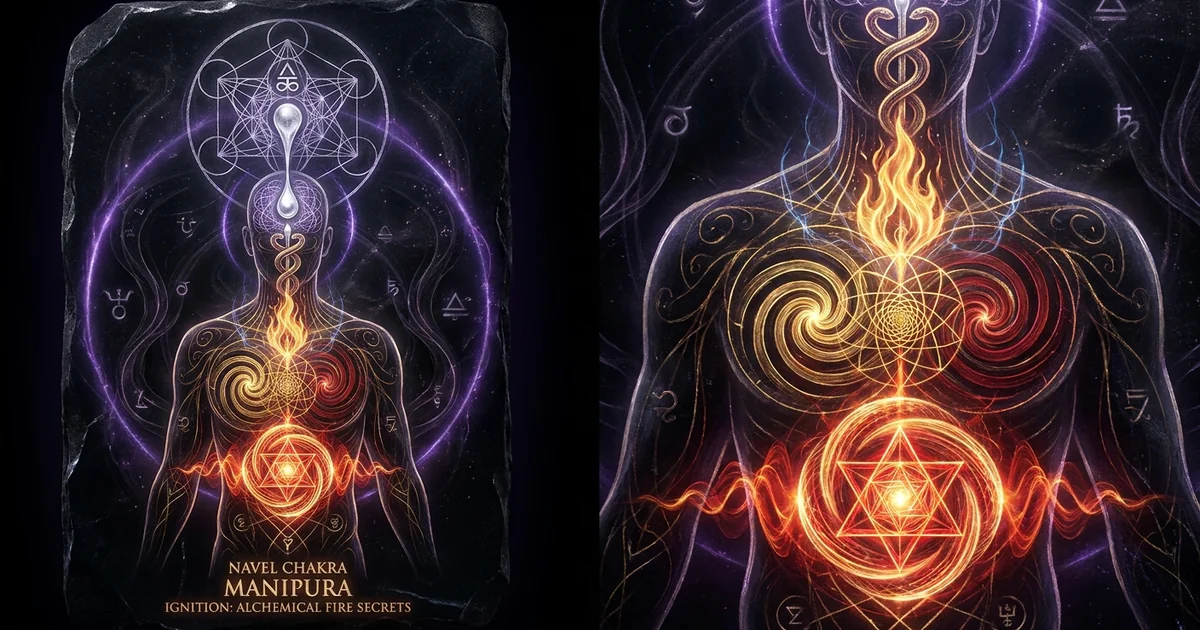
Navel Chakra Manipura Ignition: Alchemical Fire Secrets
Protocol Overview & Neurophysiological Thesis
The ignition of the Manipura center—designated in Indo-Tibetan tantric systems as the nabhi-padma or the furnace of candali (tummo)—is fundamentally a targeted neuro-visceral and bioenergetic transduction. Far from being a metaphorical exercise in somatic visualization, this protocol represents an intentional modulation of the human autonomic nervous system, the enteric-mesenteric axis, and visceral endocrine outflow. The somatic locus of this center resides directly anterior to the first through third lumbar vertebrae, anatomically mapped to the celiac plexus (the “abdominal brain”) and the superior mesenteric ganglion. By intentionally altering metabolic rate, intra-abdominal pressure, and neural oscillatory states, the practitioner converts potential metabolic energy into thermogenic output and coherent electrophysiological activity.
In his foundational commentary Ghar-ba gSum-gyi Khrid (elucidating the Six Yogas of Naropa), Je Tsongkhapa explicitly defines the physical seat of the inner heat (candali) not at the superficial dermal navel, but approximately four finger-widths beneath the umbilical aperture, positioned centrally within the retroperitoneal cavity immediately anterior to the spinal axis. Here, the central channel (avadhuti) terminates or anchors into the reservoir of subtle bio-energetic wind (vayu), precisely aligning with the junction of the superior and inferior mesenteric nerve plexuses.
The Celiac-Mesenteric Axis as the Physical Seat of Manipura
The celiac plexus functions as the primary autonomic clearinghouse for the upper abdominal viscera, synthesizing sensory input and autonomic motor commands across the stomach, liver, gallbladder, spleen, kidneys, and small intestine. Within the framework of the subtle body, this junction represents the seat of the subtle fire element (agni). When the practitioner activates the abdominal wall through specialized isometric contractions and diaphragmatic excursions, mechanical stress transduces directly across the celiac-mesenteric axis. This mechanical deformation engages mechanoreceptors and baroreceptors embedded in the visceral peritoneal fascia, sending afferent barrages through the vagus nerve and splanchnic pathways directly into the nucleus tractus solitarii (NTS) of the brainstem.
Simultaneously, the vascular beds supplied by the celiac trunk and mesenteric arteries undergo a dynamic redistribution. Through rhythmic fluctuations of intra-abdominal and intrathoracic pressures, the practitioner generates an oscillatory ischemic-reperfusion dynamic. This shifts local perfusion, up-regulates localized endothelial nitric oxide synthase (eNOS), and triggers systemic neurochemical cascades. Rather than leaving the enteric nervous system to oscillate on homeostatic autopilot, the protocol seizes conscious regulatory control over this massive neurological network, which contains over 500 million neurons and synthesizes roughly ninety-five percent of the body’s serotonin. Through deliberate neuromuscular locking, the physical seat of Manipura transforms into an endogenous dynamo.
Targeted State: Autonomic Co-Activation and High-Amplitude Gamma Coherence
Standard autonomic physiology operates across an antagonistic paradigm: sympathetic mobilization suppresses parasympathetic tone, while parasympathetic dominance dampens sympathetic drive. The core physiological anomaly achieved through the Manipura ignition protocol is the state of simultaneous autonomic co-activation. By pairing forced, high-frequency diaphragmatic hyperventilation with prolonged, isometric hypoxic breath retentions (kumbhaka), the practitioner unleashes a profound sympathetic adrenergic surge while maintaining deep parasympathetic vagal stabilization through pelvic and cervical bandhas.
[ Sympathetic Adrenergic Surge ]        [ Parasympathetic Vagal Tonus ]
   (Hyperventilation / Isometric Lock)      (Cervical/Pelvic Bandha Compression)
                   │                                        │
                   └───────────────► ◄──────────────────────┘
                                     │
                     [ Autonomic Co-Activation State ]
                                     │
               ┌─────────────────────┴─────────────────────┐
               ▼                                           ▼
   [ Splanchnic Lipolysis & BAT ]              [ Frontoparietal Gamma ]
   (Non-Shivering Thermogenesis)               (40 Hz Insular Synchrony)
This dual autonomic activation avoids the panic-flight collapse typical of unmodulated sympathetic arousal, stabilizing heart rate variability (HRV) into hyper-coherent, high-amplitude regimes. Neurally, this peripheral visceral state triggers an ascending volley of catecholamines that excites thalamocortical loops, precipitating high-amplitude gamma-wave synchronization states (38–45 Hz). This localized electroencephalographic synchrony anchors primarily within the anterior insular cortex—the primary cortical projection area for interoceptive visceral sensations—and the dorsolateral prefrontal cortex (dlPFC). The result is an unprecedented coupling of intense metabolic heat with razor-sharp, metacognitive attentional stability.
Transpersonal Teleology: From Caloric Expenditure to Non-Dual Awareness
While modern bio-hackers often target non-shivering thermogenesis purely for cold tolerance or metabolic expenditure, the traditional transpersonal teleology of Manipura ignition operates along an entirely distinct axis. Somatic caloric output is merely the gross physical epiphenomenon of subtle energetic reconfiguration. In the operational taxonomy of tantric physiology, the ignition of agni serves to dissolve the dualistic reification of sensory experience by pulling the diffuse vital currents out of the lateral energetic pathways (ida and pingala nadis) and forcing them into the central bio-magnetic corridor (sushumna or avadhuti).
As detailed in the transpersonal trajectories of the kundalini awakening neurobiology, thermodynamic heat liquefies psychosomatic fixations, clearing structural micro-obstructions (granthis) within the fascia and central nervous system. When the energetic current ascends, somatic heat gives way to luminous, non-spatial awareness. The visceral sensation of fire ceases to be experienced as an external or internal temperature variant and instead reveals itself as the foundational radiance of consciousness itself. The energetic furnace of the navel becomes the launching pad for non-dual absorption (samadhi), transmuting base caloric survival mechanisms into the vehicles of radical liberation.
Biophysical Mechanisms & Brainwave Dynamics
The biophysical validation of inner heat (tummo) transitioned from legendary folklore to quantified laboratory science when Herbert Benson’s pioneering research demonstrated peripheral digital temperature increases of up to 8.3°C in Himalayan yogis. Subsequent investigation has refined these discoveries, identifying exact cellular, metabolic, and neuroelectric correlates that govern this thermodynamic shift. The transformation of visceral metabolic baseline into focused heat relies on an intricate neuro-visceral axis operating across mitochondrial biochemistry, acoustic entrainment, and vagal afferent architecture.
[ Phase-Locked Acoustic Entrainment ]
   (136.1 Hz Carrier / 40 Hz Gamma)
                  │
                  ▼
      [ Auditory Brainstem FFR ]
                  │
                  ▼
   [ Thalamocortical Synchronization ]
                  │
                  ▼
[ Sympathetic Outflow via Splanchnic Nerves ]
                  │
                  ▼
   [ β3-Adrenoceptor Activation in BAT ]
                  │
                  ▼
   [ UCP-1 Mitochondrial Proton Leak ] ──► [ Core Metabolic Thermogenesis ]
Thermogenic Transduction: Brown Adipose Tissue (BAT) and Beta-3 Adrenergic Receptors
The primary physical engine of somatic heat generation during deep navel ignition is non-shivering thermogenesis (NST) localized within brown adipose tissue (BAT). Unlike white adipose tissue, which stores triacylglycerols for passive metabolic reserves, BAT is densely vascularized and saturated with iron-rich mitochondria. Crucially, the inner mitochondrial membrane of brown adipocytes uniquely expresses uncoupling protein 1 (UCP-1), or thermogenin. Under normative physiological conditions, the electrochemical proton gradient generated across the mitochondrial electron transport chain drives ATP synthase to synthesize adenosine triphosphate (ATP).
During the execution of the navel chakra manipura tummo solar plexus inner heat ignition, sustained isometric contraction of the rectus abdominis, transversus abdominis, and internal obliques combines with hypoxic stress to release localized bursts of norepinephrine directly from splanchnic sympathetic terminals. This norepinephrine binds to beta-3 adrenergic receptors on the surface of brown and beige adipocytes, triggering an intracellular signaling cascade via cyclic adenosine monophosphate (cAMP) and protein kinase A (PKA). PKA activates hormone-sensitive lipase, liberating free fatty acids that bind directly to and allosterically activate UCP-1. UCP-1 collapses the mitochondrial membrane potential by permitting protons to re-enter the mitochondrial matrix without passing through ATP synthase. The potential energy of the proton gradient is thereby completely dissipated as uncoupled, pure thermal energy, which is rapidly picked up by the circulating mesenteric vasculature and carried into the systemic circulation.
Kozhevnikov, M., Elliott, J., Shephard, J., & Do, R. (2013). “Neurocognitive and Somatic Components of Temperature Increases during g-Tummo Practice: Legend and Reality.” PLOS ONE, 8(3), e58244.
The authors established that inner heat practice contains two distinct physiological modalities:
- The ‘Force’ Style: Characterized by isometric core contraction, intense diaphragmatic bellows breath, and breath retentions (kumbhaka). This style elicits dramatic increases in core body temperature (reaching the fever zone up to 38.3°C) directly modulated by peripheral metabolic and muscular recruitment.
- The ‘Gentle’ Style: Minimizes intense isometric locking while sustaining refined somatic visualization, yielding lower peripheral thermal elevation but sustained high-amplitude neurocognitive alpha, beta, and gamma oscillations across frontoparietal networks. Real-world master practitioners strategically cycle between these modes to elevate core baseline temperature and then stabilize that energy within central neural circuits.
Hemispheric Synchronization via Acoustic Carrier Waves and Beta/Gamma Entrainment
The neuroelectric stabilization of this hyper-metabolic state requires specific acoustic entrainment parameters to prevent the practitioner’s brain from collapsing into chaotic sympathetic panic. Through the application of precisely tuned acoustic carrier waves, the brain’s natural frequency-following response (FFR) can be harnessed to synchronize hemispheric activity. Auditory evoked potentials in the superior olivary complex phase-lock with external acoustic differentials, establishing coherent phase relationships between the left and right cerebral hemispheres.
The primary carrier utilized in this protocol is 136.1 Hz—the classical sadja tone, which aligns with the frequency of the Earth’s annual rotation around the sun (an acoustic transposition of the planetary orbital period). Over this 136.1 Hz monaural or binaural carrier, a precise 40 Hz gamma differential is introduced. As explored within the Gateway Process Hemi-Sync protocol, coherent auditory binaural stimulation induces cross-callosal phase-locking. In this specific protocol, the 40 Hz gamma modulation drives the auditory cortex and brainstem reticular activating system (RAS) into synchrony with the visceral oscillations of the navel center, enabling the central nervous system to maintain hyper-attentive non-dual awareness while the autonomic system generates massive caloric and bio-magnetic shifts.
Enteric-Cerebral Coupling: Vagus Nerve Signaling During Kumbhaka
The critical bridge between the somatic furnace of the navel and the entrained cerebral mantle is the vagus nerve (Cranial Nerve X). During the hypoxic breath-retention (kumbhaka) phase of the practice, the lungs are held at near-maximal capacity (or alternatively, clamped at end-expiratory functional residual capacity). This mechanics sharply compresses the thoracic cavity, generating a sudden increase in intrathoracic pressure that radically alters cardiovascular dynamics. The baroreceptors embedded within the aortic arch and carotid sinus fire high-frequency signals into the NTS via the glossopharyngeal and vagus nerves.
Concurrently, the abdominal organs are mechanically compressed by the descending diaphragm and the upward-drawing pelvic floor (mula bandha). This dual-directional compression squeezes the sub-diaphragmatic vagal branches that innervate the enteric nervous system. The resultant ascending vagal input activates the locus coeruleus, prompting an endogenous release of norepinephrine across the neocortex. However, because this is accompanied by simultaneous vagal afferent braking, the typical panic and hyperventilatory collapse associated with systemic norepinephrine is completely bypassed. Instead, the enteric-cerebral axis enters a locked resonant state: the enteric nervous system drives non-shivering thermogenesis and primal somatic drive, while the cerebral cortex organizes this metabolic power into phase-locked beta-gamma oscillatory bursts.
Alchemical Bioenergetics: Agni, Samana Vayu, and Bodhicitta Dynamics
The empirical biophysics of thermogenesis and vagal afferents corresponds directly to the alchemical cartography of Indo-Tibetan tantra. In this lineage, the practitioner does not simply burn calories; they deploy the subtle kinetic energies (vayus or rlung) to ignite the central metabolic fire (agni), utilizing this heat to melt the crystallized psycho-physical ambrosia (bodhicitta) housed within the cranial vault.
[ Usnisa / Crown (Sahasrara) ]
        Crystallized White Bodhicitta
                     │
                     │  (Heat Ascending via Avadhuti)
                     ▼
             ▲               ▲
             │               │
  [ Descending Prana ]   [ Ascending Apana ]
             │               │
             └───► [ ◈ ] ◄───┘
             Samana Vayu Ignition
             (Navel Center / Agni)
The Equalizing Wind: Convergence of Prana and Apana at the Navel Hub
According to the classical taxonomy set down by Svatmarama in the Hatha Yoga Pradipika, the human subtle body is sustained by ten distinct energetic currents, among which prana vayu and apana vayu are primary. Prana vayu is the inward-moving, forward-gathering subtle wind centered within the thoracic and cardiac cavity, associated with pulmonary respiration, sensory intake, and sympathetic activation. Conversely, apana vayu is the downward-clearing, eliminating kinetic wind residing in the pelvic basin, governing excretion, reproduction, and somatic discharge.
Under habitual dualistic functioning, these two kinetic streams pull in opposing directions: prana dissipates outward through the upper sensory apertures, while apana drains downward into somatic entropy. In the Manipura ignition protocol, the central operational mechanism is the forced collision of these two vectors within the functional territory of the samana vayu digestion wind. Samana vayu occupies the intermediate space—the umbilical and epigastric zone—and governs enzymatic assimilation, cellular digestion, and thermodynamic balance.
By pulling apana upward through the pelvic lock (mula bandha) and compressing prana downward through the throat lock (jalandhara bandha), the two opposing winds are driven directly into the navel cauldron. Stripped of their ability to exit the energetic body, they circulate into the vortex of samana vayu. The compression of these two kinetic winds against one another acts like a pneumatic piston, creating high-pressure energetic friction that destabilizes the ordinary biofield balance and forces open the entrance to the sushumna nadi (or avadhuti).
Fanning the Agni: Sub-Diaphragmatic Bellows and Metabolic Acceleration
Once prana and apana are contained within the sphere of the samana vayu, they must be actively fanned to catalyze the ignition of the subtle fire element agni. This is accomplished through rhythmic, dynamic sub-diaphragmatic pumping (bhastrika pranayama), operating as an internal blacksmith’s bellows. Each sharp exhalation forces the abdominal wall violently against the lumbar spine, striking the central channel at the navel hub.
This rhythmic pneumatic percussion stimulates the bio-magnetic core of the human system, transforming mechanical tension into piezoelectric currents across the dense collagen structures of the abdominal fascia. The energetic temperature of the samana vayu elevates exponentially. In this alchemical kiln, gross somatic impurities—referred to in tantric literature as metabolic debris (ama) or karmic residues (karmic vayu)—are systematically consumed. The navel hub ceases to function merely as a digestive organ and morphs into a localized thermal singularity.
Vedic Manipura / Agni Dynamics
- Physiological Anchoring: Celiac plexus, abdominal wall, and adrenal glands.
- Directionality of Force: Concentric convergence of prana and apana into the navel; radial distribution of solar energy throughout the 72,000 nadis.
- Energetic Substrate: Solar prana (surya nadi / pingala), driven by metabolic fire (jatharagni).
- Teleological Apex: Burn away metabolic and karmic impurities (ama); activate personal will (iccha sakti); pierce the Brahma-granthi to initiate the upward ascent of Kundalini.
Vajrayana Candali / Bodhicitta Dynamics
- Physiological Anchoring: Sub-umbilical junction (four fingers below navel), retroperitoneal space at the root of the avadhuti.
- Directionality of Force: Vertical ascent of intense heat (candali) exclusively through the central channel to the cranial vault, followed by systemic descending liquidation.
- Energetic Substrate: Microscopic fiery half-syllable AH / red drops (rakta bindu).
- Teleological Apex: Melt the crystallized white lunar drops (sukla bodhicitta) at the crown; initiate the cascade of the Four Blisses (anandas); reveal pristine non-dual Voidness (sunyata).
Liquefaction and Descent: Melting the White Bodhicitta from the Usnisa to the Solar Center
The critical inflection point of the protocol occurs when the inner fire, fully fanned within the samana vayu, breaches the base of the central channel. The flame does not disperse into the peripheral tissue; instead, it funnels upward through the interior of the sushumna as an ultra-thin, razor-sharp needle of incandescent light. As this intense thermodynamic energy climbs through the cardiac and throat centers, it strikes the usnisa (the crown aperture, sahasrara).
Within the crown resides the white bodhicitta (often conceptualized as the white lunar bindu or the neuro-endocrine seed of bliss). Neurochemically, this correlates with the pineal-pituitary-hypothalamic nexus and the dense reservoir of endogenous neuromodulators, including endorphins, oxytocin, and neurosteroids. Under the intense thermal impact of the ascending fire, the crystallized white bodhicitta begins to liquefy.
It melts and drips downward through the central channel as a stream of cooling, ambrosial nectar (amrita). As this liquid nectar descends, it washes through the ascending fire. The interaction of the incandescent red flame ascending from the navel and the cooling white nectar descending from the crown produces a state of non-dual ecstatic absorption (sukha-sunyata). The physiological system experiences a systemic flood of profound bliss coupled with a radical reduction in baseline metabolic anxiety, grounding the practitioner in non-dual awareness.
Step-by-Step Experiential Protocol: Navel Ignition & Heat Modulation
To successfully bridge biophysical theory and alchemical bioenergetics, the practitioner must execute this protocol with uncompromising anatomical precision and temporal discipline. The practice must be conducted on an empty stomach (minimum three hours post-prandial) to ensure that visceral circulation is not diverted to enteric digestion.
The complete Manipura ignition cycle requires exactly 35 minutes of uninterrupted practice, partitioned into:
- Phase I (Acoustic-Somatic Priming): 8 Minutes
- Phase II (Vase Retention & Celiac Compression): 12 Minutes
- Phase III (Microscopic Needle Visualization & Flame Escalation): 10 Minutes
- Phase IV (Bodhicitta Liquefaction & Transpersonal Radiation): 5 Minutes Adhere rigorously to the specified breath ratios; do not force breath-retention beyond physiological adaptation.
[ Phase I: Priming ] ──► [ Phase II: Kumbhaka ] ──► [ Phase III: Escalation ] ──► [ Phase IV: Radiance ]
  8 Minutes                12 Minutes                 10 Minutes                    5 Minutes
  136.1 Hz + 40 Hz Entr.   Bhastrika & Retentions     Sub-Umbilical Needle Fire     Bodhicitta Melts
  Axial Alignment          Mula & Jalandhara Bandha   Ascent via Central Channel    Amrita Descent
Phase I: The Acoustic-Somatic Priming (Carrier 136.1 Hz + 40 Hz Gamma Differential)
- Acoustic Initiation: Don closed-back over-ear reference headphones. Engage the acoustic entrainment track tuned precisely to a 136.1 Hz fundamental carrier wave embedded with a 40 Hz binaural or isochronic gamma-frequency differential. Calibrate volume to a moderate, comfortable amplitude (approximately 60–65 dB SPL).
- Postural Alignment: Assume a classic seated posture—either Padmasana (Full Lotus), Siddhasana (Accomplished Pose), or Vajrasana (Thunderbolt Pose). The spine must remain straight, the cranium suspended as if pulled by an invisible cord, with the pelvis tilted slightly forward to maintain natural lumbar lordosis.
- Bandha Calibration: Rest the hands in the lower lap, palms up, with the thumbs touching (the cosmic mudra), resting directly against the lower abdomen. Gently contract the muscles of the pelvic floor—specifically targeting the perineal body in males and the cervix in females—to establish a subtle, foundational mula bandha.
- Somatic Settling: Spend the first 8 minutes synchronizing pulmonary respiration with the acoustic oscillation. Inhale smoothly for 4 seconds, exhale smoothly for 4 seconds. Direct proprioceptive attention away from external auditory stimuli and anchor it entirely within the physical space between the navel and the spine.
Phase II: The Vase Retention (Kumbhaka) and Celiac Compression
- The Bellows Pulse: Shift immediately into active diaphragmatic cycling (bhastrika). Execute 21 rapid, forceful exhalations, driving the belly sharply inward toward the spine with each breath, followed by passive, natural inhalations. The velocity should be approximately 1 to 1.5 cycles per second. Ensure the movement originates solely from the sub-diaphragmatic core; the upper chest and shoulders remain relaxed.
- The Deep Inhalation: Upon completing the 21st exhalation, immediately draw a smooth, full inhalation through both nostrils, filling the lungs to approximately 80–85% of total capacity. Do not inhale to maximum capacity, as excessive thoracic wall tension induces premature sympathetic escape.
- Swallowing and Compressing the Prana: Swallow consciously. As the saliva descends, use the muscular action of the pharynx to press the energetic breath downward into the epigastrium.
- The Dual Bandha Clamp (The Vase):
- Simultaneously drop the chin firmly into the jugular notch of the sternum to lock jalandhara bandha, sealing the breath within the thoracic-abdominal cavity.
- Sharply engage mula bandha, pulling the pelvic floor, perineum, and lower abdominal wall upward.
- Hold the breath in this pressurized pneumatic envelope (kumbhaka). This forms the classical “Vase” (kumbhaka): the descending prana is pushed down from above, while the ascending apana is pulled up from below, locking the samana vayu into extreme compression directly against the celiac plexus.
- Retention Duration: Maintain the retention for a strict ratio of 1:4:2 relative to capacity (for example, 8 seconds inhale, 32 seconds hold, 16 seconds slow, controlled exhalation through the nose). Execute four complete cycles across this 12-minute window, resting for three normal breaths between each cycle.
Phase III: Microscopic Needle Visualization and Flame Escalation
- Ignition Point Generation: During each kumbhaka cycle, fixate visual attention with laser focus upon a point four finger-widths beneath the dermal navel, deep within the interior of the body.
- The Seed Syllable Needle: Visualize at this locus a vertical, microscopic needle of blinding red-orange fire. In Tibetan iconography, this is the seed syllable AH (stroke-form: a vertical line ending in a sharp hook); in the classical Vedic tradition, it is the radiant seed syllable RAM. The needle is thin as a hair, intensely hot, and vibrates at an immense energetic frequency.
- Fanning the Flame: With each second of retention, visualize the compressed prana and apana rushing into the base of this flame like oxygen fed into an acetylene torch. With each heartbeat, the needle of fire burns brighter and hotter.
- The Central Ascent: As the thermal threshold mounts, perceive the flame shooting upward through the interior of the central channel (avadhuti). The heat rises like a thread of molten copper, shooting through the heart chakra, piercing the throat chakra, and impacting the center of the brain. The physical body will begin to generate tangible, radiating metabolic heat, observable as a flushed cutaneous sensation and perspiration along the spinal axis.
Phase IV: Bodhicitta Liquefaction and Transpersonal Radiation
- Striking the Usnisa: As the ascending needle of fire strikes the crown center, visualize the white, crystallized seed-drop of bodhicitta—a luminous, moon-like pearl of infinite energetic density—beginning to melt under the thermal onslaught.
- The Ambrosial Inundation: The white bodhicitta transforms into a glowing, cooling liquid nectar. It pours down through the central channel in a heavy, blissful torrent.
- The Unification of Fire and Water: As the cooling liquid nectar strikes the rising navel flame at the heart and solar plexus, a unified explosion of ecstatic light occurs. The subjective sensation of physical heat undergoes a phase transition, transmuting into an isotropic sensation of liquid radiance.
- Biofield Grounding: Release the bandhas completely. Discontinue the acoustic track. Rest in absolute immobility for the final 5 minutes, allowing the melted bodhicitta to suffuse every cell, tissue layer, and energetic channel throughout the biofield electrodynamics of the organism.
Operational Safety, Contraindications & Biofield Grounding
The neuro-visceral and energetic mechanisms engaged during the ignition of the solar plexus inner heat protocol are exceptionally potent. Because this methodology deliberately destabilizes normative homeostatic setpoints—driving the autonomic nervous system into concurrent sympathetic hyperarousal and high vagal tone—uncontrolled, unguided, or careless execution carries tangible physiological and psychiatric risks.
This protocol is strictly contraindicated for individuals diagnosed with:
- Epilepsy or Photosensitive Seizure Disorders: The 40 Hz acoustic/photic entrainment parameter drives high-voltage thalamocortical synchrony, which can trigger paroxysmal epileptiform discharges in predisposed neural substrates.
- Cardiovascular Pathology & Hypertension: The high-pressure Valsalva-like dynamics of kumbhaka cause dramatic spikes in intrathoracic, central venous, and intracranial pressures, posing severe risks for myocardial infarction, aortic dissection, or stroke.
- Aneurysmal Conditions or Glaucoma: Markedly elevated cephalic pressure during the vase retention can induce vascular rupture or optic nerve damage.
- Pregnancy: High intra-abdominal compression and intense sympathetic splanchnic vasoconstriction critically compromise uterine perfusion.
- Active Psychiatric Disorders: Conditions such as bipolar mania, schizophrenia, or severe borderline personality organization can be destabilized into acute psychotic de-compensation by rapid kundalini activation.
Autonomic Hyperarousal, Hypocapnia, and Respiratory Alkalosis Risks
The primary acute physiological hazard stems from improper regulation of the dynamic diaphragmatic bellows breath (bhastrika). Uncontrolled, rapid hyperventilation blows off immense quantities of carbon dioxide ($CO_2$), inducing acute hypocapnia. Hypocapnia shifts systemic blood pH toward respiratory alkalosis, which sharply increases the binding affinity of hemoglobin for oxygen via the Bohr effect, paradoxically causing acute cerebral tissue hypoxia.
Furthermore, severe hypocapnia triggers immediate cerebral vasoconstriction, reducing cerebral blood flow by up to forty percent. If an inexperienced practitioner enters a deep, pressurized kumbhaka while in a state of acute hypocapnic vasoconstriction, the combination of cerebral hypoxia and high intrathoracic pressure will rapidly trigger syncope (the classical “blackout”). In addition, respiratory alkalosis decreases ionized calcium levels in the plasma, leading to neuromuscular hyper-excitability, carpopedal spasms (tetany), and cardiac arrhythmias. If dizziness, digital paresthesia, or involuntary facial cramping occurs, the practitioner must immediately abort the bellows breath and return to passive nasal respiration.
Kundalini Syndrome and Neuropathic Sensory Distortions
In tantric nosology, the misdirection of the subtle fire element agni is termed prana-inversion or fire-vayu disorder (in Tibetan medicine, srog-rlung or “life-wind illness”). If agni is prematurely ignited through forceful will before the central channel is clear, the rising heat will bifurcate into the lateral pingala channel or cross into the somatic nervous system.
[ Misaligned Fire Ascent ] ──► [ Enters Pingala / Lateral Channels ]
                                      │
               ┌──────────────────────┴──────────────────────┐
               ▼                                             ▼
   [ Neuropathic Distortions ]                   [ Psychological Crisis ]
   (Burning Sensations, Allodynia,               (Intractable Insomnia, Terror,
    Severe Migraines, Tremors)                    Dissociation, Derealization)
This manifests clinically as a severe neuro-visceral dysregulation commonly termed the “Kundalini Syndrome.” Somatically, the patient experiences intense, un-calibrated burning sensations along the spinal column or dermal surface, chronic allodynia, severe temporal migraines, cardiac palpitations, and intractable gastrointestinal spasms. Psychologically, this state precipitates severe affective volatility, intractable insomnia, terror, and acute derealization. The nervous system becomes trapped in a continuous, un-grounded sympathetic flashover, unable to down-regulate its sensory gating mechanisms.
The Apana Down-Regulation: Grounding Protocols to Prevent Fire Inversion
To mitigate the risk of fire inversion and guarantee absolute autonomic stabilization, the practitioner must integrate the following down-regulation protocol whenever internal heat fails to resolve smoothly into bliss or begins to pool distressingly in the cranial vault:
- Immediate Visualization Dissolution: Cease all upward directional visualization instantly. Consciously draw the microscopic needle of fire back down through the central channel and submerge it deep within the reservoir beneath the navel. Visualize the flame dissolving into a dense, cool, dark blue indigo sphere of light, representing primordial water (ojas).
- The 1:2 Parasympathetic Vagus Brake: Transition immediately out of retention practices into elongated, sighing exhalations. Inhale through the nose for 4 seconds, and exhale effortlessly through softly parted lips for 8 seconds. This sustained expiratory phase maximally stimulates the cardiac vagal efferents, down-regulating sympathetic outflow and restoring normal arterial $pCO_2$ balance.
- Biofield Earthing: Physically step out of the practice enclosure and make direct, uninterrupted skin contact with the bare earth (soil, grass, or sand) for a minimum of 15 to 20 minutes. This facilitates trans-dermal electron transfer, discharging static electrostatic and bio-magnetic potentials accumulated across the fascial networks during the intense kumbhaka cycles.
- Nutritional Anchoring: Ingest a dense, heavy, unctuous substance—such as warm whole milk with ghee, bone broth, or root vegetables. In both Ayurvedic and Tibetan medical paradigms, heavy, sweet, and oily substances instantly anchor the upward-surging vayu, pulling the bio-currents back down into the lower enteric and pelvic regions.
Phenomenological Correlates & Empirical Verification
The validation of Manipura ignition requires matching subjective phenomenological signposts with objective, laboratory-grade biometric markers. When the practice transitions from mere physical exercise into true alchemical ignition, both the subjective perceptual field and objective neuro-somatic metrics undergo radical structural transformations.
Thermographic Mapping: Peripheral Vasodilation vs. Core Temperature Elevation
Biometric verification hinges on a decisive distinction: ordinary autonomic relaxation produces peripheral vasodilation (raising skin temperature in the hands and feet through the release of vascular smooth muscle tone), whereas genuine Manipura ignition elevates core metabolic and somatic temperatures. Infrared thermographic imaging of adept practitioners during the Force style of inner heat shows a distinct, progressive thermal topology.
Thermal elevation initiates in the hypogastric and epigastric regions, spreading across the thoracic torso before extending along the spinal axis. While baseline finger and toe temperatures can jump dramatically—often rising 5°C to 8.3°C above baseline as documented by Benson et al. (1982)—true mastery is confirmed by tympanic and core temperature logging. Kozhevnikov et al. (2013) demonstrated that adept practitioners are capable of driving their core body temperatures up into the true hyperthermic fever zone (reaching sustained levels of 38.3°C / 101°F) without the presence of any pyrogen or infectious biological illness. This proves that the metabolic machinery has been successfully repurposed under sovereign conscious control.
EEG Signatures: Asymmetric Frontal Gamma and Parietal Synchronization
High-density electroencephalography (EEG) during the peak ignition phase reveals an extraordinary neural signature that sharply diverges from both ordinary waking consciousness and standard meditative calm. While basic meditative states produce stable, global alpha (8–12 Hz) or diffuse theta (4–7 Hz) waveforms, the ignition of Manipura triggers high-voltage, phase-locked bursts of gamma-band activity (38–45 Hz, extending up to 80 Hz).
[ Normative DMN Baseline ] ──► [ Acute Ignition Phase ] ──► [ Peak Coherence State ]
  Diffuse Alpha/Theta            Suppression of DMN           Hyper-Coherent Gamma
  Default Self-Referencing       Salience Network Active      Fronto-Parietal Phase-Lock
  Visceral Somatic Quiescence    Insular/dACC Synchrony       Non-Dual Ecstatic Radiance
This gamma synchrony is not diffuse or chaotic; it demonstrates sharp structural localization:
- Salience Network Hyper-Coupling: Massive synchronization occurs between the anterior insular cortex (AIC) and the dorsal anterior cingulate cortex (dACC), reflecting the intense interoceptive processing of visceral heat and autonomic regulation.
- Default Mode Network (DMN) Deactivation: Concurrently, primary hubs of the DMN—specifically the posterior cingulate cortex (PCC) and the medial prefrontal cortex (mPFC)—are deeply suppressed, extinguishing mundane self-referential mental chatter.
- Fronto-Parietal Phase-Locking: As the inner heat ascends, high-amplitude gamma oscillations become phase-locked between the fronto-polar cortex and the bilateral parietal areas. This parietal stabilization corresponds precisely to the dissolution of proprioceptive body schema boundaries.
Subjective Topography: The Transition from Tactile Heat to Luminous Emptiness
Phenomenologically, the experiential progression of the ignition unfolds across four distinct stages:
- The Friction Phase: The practice begins with raw somatic effort. The practitioner feels the physical friction of the breath, the muscular tension of the abdominal wall, and the uncomfortable accumulation of visceral pressure. The heat experienced is purely physical, characterized by heavy, sweating, metabolic friction.
- The Ignition Singularity: As prana and apana collapse into the samana vayu, the tactile sensation abruptly concentrates into a single point beneath the navel. The somatic feeling of effort vanishes, replaced by a steady, humming vibration. The heat ceases to feel like muscular exertion and begins to feel like liquid fire or electric plasma circulating within an interior void.
- The Ascending Illumination: The tactile heat begins to transmute into visual and spatial phenomena. As the fire ascends the central channel, the internal visual field fills with intense red and golden light. The auditory cortex registers high-frequency acoustic ringing (the nada sound) that seamlessly merges with the 40 Hz entrainment frequency.
- The Void-Radiance Phase: Upon the descent of the melted bodhicitta, the sensation of discrete physical heating dissolves entirely. It is replaced by an overwhelming sense of spacious, cool liquidity imbued with extreme ecstatic bliss (ananda). The localized sense of self within the cranium or abdomen collapses; the practitioner experiences the entire biofield as an un-bounded, luminous space devoid of internal friction or temporal progression. Heat has fully completed its alchemical destiny, transmuting into pristine, non-dual awareness.
Frequently Asked Questions
How Does Manipura Ignition Differ from Ordinary Hyperventilation?
Ordinary hyperventilation—whether spontaneous or induced through shallow, rapid chest breathing—is characterized by disordered, thoracic-driven hypocapnia without isometric engagement or somatic containment. This results in rapid systemic vasoconstriction, a drop in core body temperature, profound anxiety, and functional cerebral ischemia.
In sharp contrast, the Manipura ignition protocol utilizes diaphragmatic bellows respiration (bhastrika) strictly as a brief priming mechanism, immediately followed by the pressurized containment of kumbhaka and the structural locks (mula and jalandhara bandha). This physical compression maintains intra-abdominal pressure, drives splanchnic sympathetic non-shivering thermogenesis via brown adipose tissue, and stimulates vagal afferents via baroreceptor activation. Rather than dropping core temperature, the protocol systematically elevates it while stabilizing the nervous system in coherent gamma-band synchrony.
What Biofeedback Metrics Confirm Genuine Somatic Agni?
A practitioner cannot rely solely on the subjective perception of warmth, as mental suggestion can easily simulate superficial cutaneous flushing through minor autonomic shifts. Genuine somatic agni is empirically verified through two primary modalities:
First, continuous core temperature logging via tympanic or ingested telemetric core sensors must register an elevation of core baseline temperature, distinguishing it from the simple peripheral vasodilation of ordinary relaxation. Second, multi-channel electroencephalography must demonstrate marked, phase-locked 40 Hz gamma coherence between the anterior insula and the frontoparietal networks, coinciding with the downregulation of Default Mode Network power.
Additionally, heart rate variability (HRV) analysis will reveal a distinct pattern of autonomic co-activation: high-frequency (HF) power (reflecting vagal parasympathetic modulation) remains paradoxically elevated alongside massive surges in low-frequency (LF) power (reflecting sympathetic splanchnic activation), yielding a unique physiological state unreachable through ordinary stress or relaxation.
How Can One Prevent Cranial Pressure When the Inner Heat Ascends?
The accumulation of distressing intracranial pressure during the ascent of inner heat is a classic diagnostic symptom of an un-integrated jalandhara bandha or an obstructed central channel. When the practitioner forces the energetic current upward without fully clearing the thoracic and cervical pathways, the ascending bio-currents pool in the vascular beds of the brain, causing cephalic throbbing, optical strain, and cognitive disorientation.
To resolve this instantly:
- Soften the throat lock slightly by elongating the cervical spine rather than violently compressing the chin into the chest, ensuring that the internal jugular veins and carotid sinuses are not pathologically occluded.
- Direct intentional focus away from the head and explicitly anchor the visualization upon the descent of the white bodhicitta. The ascending fire must never be left hovering in the cranium; it must immediately trigger the descent of the cooling ambrosial nectar.
- If pressure persists, immediately abort the retentions, engage the 1:2 prolonged exhalation ratio, and physically press the center of both palms firmly against the sub-umbilical navel zone while flexing the toes downward. This mechanically and energetically grounds the ascending current back into the lower physical reservoir. :::