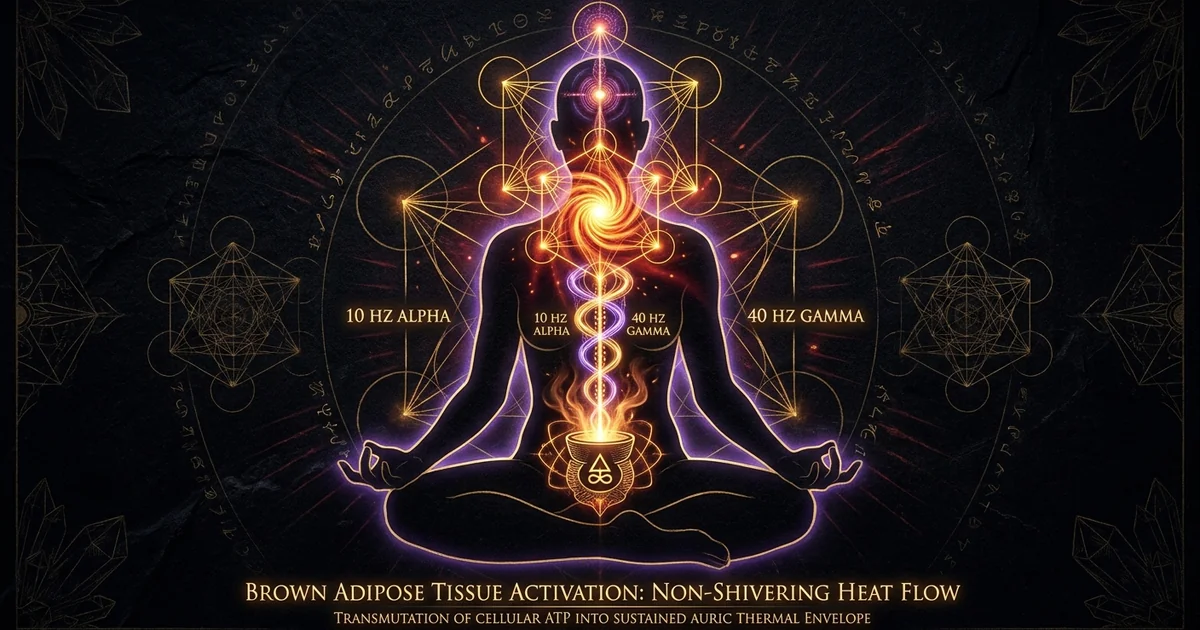
Brown Adipose Tissue Activation: Non-Shivering Heat Flow
Protocol Overview & Neurophysiological Thesis: Brown Adipose Activation via Entrained Somatosensory Drive
Voluntary control of autonomic homeostatic circuits represents one of the most rigorously debated frontiers in modern neurophysiology and contemplative somatic science. The human body maintains thermal equilibrium within a narrow range via metabolically demanding regulatory pathways managed primarily by the central nervous system. Historically, classic mammalian physiology categorized adult human heat production under cold stress into two discrete modalities: involuntary rhythmic skeletal tremor (shivering thermogenesis) and basal metabolic dissipation. However, pioneering advances in functional metabolic imaging and molecular endocrinology have established that adult humans retain functional, highly inducible depots of brown adipose tissue (BAT). Unlike white adipose tissue, which serves primarily as an inert reservoir for triacylglycerol storage, brown fat functions as an active thermogenic organ capable of dissipating chemical energy directly into caloric heat without producing adenosine triphosphate (ATP) or mechanical work.
The core thesis of this investigation asserts that targeted brown adipose tissue activation tummo non shivering thermogenesis is directly inducible through trained cortical intent coupled to specific respiratory, somatosensory, and neuroacoustic drivers. Rather than remaining an involuntary reflexive response to acute cold-water immersion, this thermogenic cascade can be consciously recruited. The primary effector tissues for this voluntary metabolic shift reside within adult cervical supraclavicular fat depots, where postganglionic sympathetic noradrenergic axons form dense neurovascular junctions with multilocular, mitochondria-dense parenchymal adipocytes. By systematically coordinating sympathetic outflow, practitioners can selectively trigger non-shivering caloric burn, elevating local tissue and blood temperatures while actively suppressing the exhaustive motor oscillations of shivering.
“In laboratory trials conducted in Upper Dharamsala, Benson et al. (1982) documented peripheral digital temperature elevations exceeding 8.3°C in Tibetan Buddhist yogis executing g-Tummo meditation in freezing ambient conditions. Decades later, Kozhevnikov et al. (2013) dissected this phenomenon via continuous electroencephalographic (EEG) and core/peripheral thermometric recording, demonstrating that g-Tummo comprises two dissociable components: a neurocognitive attentional focus driving baseline core temperature elevation, and a distinct somatic motor phase (‘Vase Breath’) driving rapid, high-magnitude hyperthermic surges via sustained isometric pressure and sympathetic outflow. Thermal increases were correlated not with broad, generalized autonomic stress, but with specific, phase-locked somatosensory modulation.” — Benson et al., Nature (1982); Kozhevnikov et al., PLOS ONE (2013).
Neuro-Adipose Synaptic Architecture and Supraclavicular Depots
The anatomical architecture of brown adipose tissue in adult humans exhibits a distinct topological distribution that diverges fundamentally from the widespread subcutaneous white fat layer. Seminal radiotracer studies by Cypess et al. (2009) confirmed that active adult brown fat is concentrated in deep anatomical compartments: predominantly the supraclavicular fossa, the anterior cervical triangle alongside the deep deep carotid sheath, the paravertebral troughs, and the superior mediastinum. These brown adipocytes are cytologically distinguished by multilocular lipid droplet conformation, spherical non-eccentric nuclei, and an exceptional density of cristae-rich mitochondria.
The innervation of these cervical supraclavicular fat pads is direct, parenchymal, and exquisitely arborized. Postganglionic sympathetic fibers derived from the superior and middle cervical ganglia, alongside upper thoracic paravertebral chains, track microvascular networks directly into the interlobular septa of the brown fat depots. Electron microscopy reveals unmyelinated sympathetic varicosities establishing intimate neuro-adipose junctions with adipocyte plasma membranes, terminating in synaptic-like clefts less than 100 nanometers wide. Upon activation, these parenchymal terminal varicosities exocytose high concentrations of norepinephrine directly adjacent to beta-adrenergic receptors, initiating a near-instantaneous intracellular signaling cascade that bypasses general systemic endocrine delay.
Cortical and Hypothalamic Control of Non-Shivering Thermogenesis
The central regulation of non-shivering thermogenesis is orchestrated via descending pathways originating in the prefrontal cortex, the insular cortex, and the anterior cingulate cortex, projecting through the median preoptic nucleus (MnPO) and the dorsomedial hypothalamic nucleus (DMH). Under standard physiological conditions, thermal afferents from cutaneous cold receptors travel via the spinothalamic tract to the primary somatosensory cortex and the lateral parabrachial nucleus, which disinhibits thermogenic neurons in the DMH and the rostral ventromedial medulla (rVMM). The rVMM contains sympathetic premotor neurons that project down the intermediolateral cell column (IML) of the spinal cord to directly drive sympathetic preganglionic output to BAT.
During specialized somatic practices such as Tibetan g-Tummo, this evolutionarily primitive subcortical circuit is hijacked and amplified by top-down corticostriatal and limbic drive. Functional magnetic resonance imaging (fMRI) studies demonstrate that sustained somatic focus on internal thermal representations activates the anterior insula and orbitofrontal networks, shifting descending hypothalamic control from baseline tonic inhibition to acute phasic disinhibition. By integrating deliberate diaphragmatic breath retention with somatic visualization, the practitioner excites autonomic premotor networks in the DMH, transmitting targeted efferent volleys down the IML without eliciting the broad systemic pressor crises typical of pathological sympathetic storms. This selective autonomic modulation is explored in depth through our research on /consciousness/autonomic-nervous-system-modulation.
Transpersonal Paradigms: From Ascetic Tummo to Targeted Metabolic Induction
For centuries, the esoteric practice of g-Tummo (literally, “Fierce Woman” or “Inner Fire”) within the Tibetan Kagyu and Nyingma lineages was viewed through a purely transpersonal lens—a mystical discipline intended to incinerate dualistic cognitive grasping through the generation of prana or lung within the central energetic channel (avadhuti). The experiential phenomenology described burning heat radiating from the lower hypogastrium (dhyana center) upwards through the solar plexus, throat, and cranial apex, allowing yogins clad in damp cotton sheets to dry them sequentially in sub-zero Himalayan altitudes.
Modern scientific epistemology demystifies the somatic execution of this practice while preserving its procedural efficacy. When decoupled from sectarian dogma, g-Tummo reveals itself as an exacting, repeatable psychophysiological technology: a bio-energetic hacking protocol that pairs intense somatic isometric locking (kumbhaka) with neuroacoustic and somatosensory mental imagery. The transpersonal framing of non-shivering heat flow serves as a phenomenological vehicle for recruiting and focusing attention, directly altering autonomic baseline set-points and triggering mitochondrial lipolysis. Investigating this intersection bridges the gap between historical lineage texts and modern neurobiology, a dynamic thoroughly examined in our monograph on /meditation/tummo-inner-fire-neurophysiology.
Biophysical Mechanisms & Brainwave Dynamics: UCP1 Cascade and Neuroacoustic Coupling
Beta-3 Adrenergic Signaling and Mitochondrial Heat Production via UCP1
The precise molecular transducer of non-shivering thermogenesis is uncoupling protein 1 (UCP1), historically known as thermogenin. UCP1 is a 32-kilodalton transmembrane carrier protein embedded exclusively within the inner mitochondrial membrane of brown adipocytes. Under resting conditions, the mitochondrial electron transport chain (Complexes I through IV) pumps protons from the matrix into the intermembrane space, establishing an electrochemical proton motive force ($\Delta p$) composed of a membrane potential and a pH gradient. Normally, this potential drives protons back into the matrix exclusively through Complex V (ATP synthase), coupling fuel oxidation directly to the phosphorylation of adenosine diphosphate (ADP) into ATP.
When sympathetic nerve terminals exocytose norepinephrine onto the parenchymal brown adipocyte, the neurotransmitter binds with high affinity to cell-surface $\beta_3$-adrenergic receptors ($\beta_3$-AR), which are G-protein coupled receptors linked to the $G\alpha_s$ subunit. The binding event dissociates the $G\alpha_s$ subunit, activating adenylyl cyclase and driving an intracellular surge in cyclic adenosine monophosphate (cAMP). This secondary messenger activates protein kinase A (PKA), which subsequently phosphorylates two key enzymes: hormone-sensitive lipase (HSL) and perilipin.
Phosphorylated perilipin permits active HSL to access intracellular triacylglycerol droplets, catalyzing their rapid hydrolysis into glycerol and free fatty acids (FFAs). These released free fatty acids serve a dual role: they undergo rapid beta-oxidation to supply reducing equivalents (NADH and $\text{FADH}_2$) to the electron transport chain, and, crucially, they bind directly to allosteric sites on uncoupling protein 1 ucp1.
Binding of FFAs overrides the physiological inhibition normally exerted on UCP1 by cytosolic purine nucleotides (ATP and ADP). Once unlocked, UCP1 provides an alternative, low-resistance conduit that allows protons to flow down their electrochemical gradient back into the mitochondrial matrix. This completely short-circuits the ATP synthase engine. Instead of capturing energy in the phosphate bonds of ATP, the entire thermodynamic energy of substrate oxidation is released instantaneously as direct mitochondrial heat production. For a comprehensive thermodynamic exploration of this molecular uncoupling, refer to /physics-electromagnetism/mitochondrial-bioenergetics.
Acoustic Physics of the Frequency Following Response (FFR) and Binaural Differentials
Inducing non-shivering thermogenesis requires precise modulation of the autonomic nervous system to achieve sustained sympathetic tone without provoking the somatic distress and random muscle tremors associated with shivering. This selective autonomic state can be elicited using targeted psychoacoustic architectures based on the Frequency Following Response (FFR). The FFR is an electrophysiological evoked potential wherein subcortical auditory centers, specifically the superior olivary complex and inferior colliculus, phase-lock their firing frequencies to the modulation rate or envelope of an acoustic stimulus.
When two coherent sinusoidal acoustic signals of slightly differing frequencies are delivered dichotically (one frequency to each ear via isolated transducers), the central auditory pathway reconstructs a dynamic amplitude modulation known as a binaural beat:
$$f_{\text{beat}} = |f_1 - f_2|$$
Where:
- $f_1$ and $f_2$ denote the discrete frequencies routed to the left and right auditory canals.
- $f_{\text{carrier}} = \frac{f_1 + f_2}{2}$ denotes the central carrier frequency, which must remain below 1000 Hz (ideally between 150 Hz and 300 Hz) to allow the auditory brainstem to resolve the interaural phase disparity.
By setting $f_1 = 216\text{ Hz}$ and $f_2 = 226\text{ Hz}$, a primary differential beat of $10\text{ Hz}$ (Alpha) is generated within the medial geniculate and superior olivary nuclei. This binaural differential acts as an oscillatory pacer, entraining cortical and subcortical networks to downregulate somatic restlessness, suppress involuntary shivering signals originating in the precentral motor cortex, and stabilize vagal parasympathetic brakes. This precise acoustic conditioning stabilizes the nervous system prior to the induction of sympathetic noradrenergic drive. The acoustic physics underpinning this entrainment methodology are systematically analyzed in /sound-cymatics/binaural-beats-brainwave-entrainment.
Oscillatory Phase-Locking: Alpha Stabilization (10 Hz) and Gamma Bursts (40 Hz)
During the steady-state execution of brown fat thermogenesis, the electroencephalographic profile exhibits a distinct dual-frequency architecture. Continuous spectral analysis of experienced practitioners demonstrates high-amplitude, phase-locked Alpha rhythms localized across the parietal and parieto-occipital electrodes ($P_z, P_3, P_4, O_1, O_2$), maintaining a remarkably stable frequency anchor between 9.5 Hz and 10.5 Hz. This baseline Alpha synchronization reflects a state of selective sensory gating, suppressing extraneous external environmental noise and internal linguistic narration.
Concurrently, during the somatic retention phase of the protocol, high-resolution quantitative EEG (qEEG) registers sudden, transient bursts of high-frequency Gamma synchrony (38 Hz to 45 Hz, centered sharply at 40 Hz) over the fronto-central and temporal lobes ($F_z, F_3, F_4, C_z, T_7, T_8$). These Gamma oscillations are phase-amplitude coupled to the underlying Alpha-Theta baseline, indicating heightened top-down attentional focus, heightened somatosensory binding, and focused somatic targeting toward the cervical and supraclavicular regions.
This dual-frequency dynamic facilitates simultaneous states: the Alpha stabilization prevents the somatic motor threshold from triggering an involuntary shivering reflex, while the localized Gamma synchrony amplifies descending efferent signaling from the prefrontal and insular cortices directly to the hypothalamic thermoregulatory nuclei. The resulting neuroelectric state permits targeted, uncoupled metabolic oxidation while maintaining full somatic equilibrium.
Comparative Energetics: Shivering Skeletal Tremor vs. Non-Shivering Adipose Dissipation
Skeletal Muscle Glycogen Depletion vs. Brown Fat Lipid Oxidation
The human physiological apparatus employs two entirely distinct strategies to counter environmental hypothermia: shivering thermogenesis and non-shivering thermogenesis. Understanding the metabolic divergence between these systems clarifies why non-shivering brown adipose tissue activation tummo non shivering thermogenesis is far superior for sustained, voluntary thermal elevation.
Shivering thermogenesis relies on the involuntary, asynchronous mechanical contraction of skeletal muscle fibers, predominantly fast-twitch Type IIa and IIb motor units. The primary energetic substrate for shivering is intramuscular glycogen, accessed via rapid glycogenolysis and systemic glucose uptake. Because skeletal muscle shivering is an inefficient mechanical process characterized by rapid antagonist-agonist cross-activation, its thermodynamic efficiency is low relative to its rate of fuel consumption. A human shivering vigorously under acute cold stress exhausts stored intramuscular glycogen reserves within two to four hours, leading to acute metabolic exhaustion, hypoglycemia, and subsequent rapid core hypothermia once reserves are depleted.
In contrast, non-shivering thermogenesis within cervical supraclavicular fat relies almost entirely on the beta-oxidation of free fatty acids mobilized from endogenous intracellular lipid droplets and circulating triglycerides. Adipose tissue represents the densest energy reservoir in the human body, yielding approximately 9 kcal per gram compared to the 4 kcal per gram derived from glycogen. By uncoupling lipid oxidation from ATP synthesis via UCP1, brown fat acts as an exceptionally efficient metabolic furnace. It continuously generates sustained, high-density heat without depleting vital skeletal muscle glycogen reserves, preserving somatic mobility and mental focus under extreme environmental and physiological loads.
Lactic Acidosis and Ergonomic Limits of Somatic Tremor
The biomechanical limitations of shivering extend beyond mere fuel depletion. Persistent, high-intensity skeletal muscle tremor generates metabolic byproducts that disrupt homeostatic equilibrium. Shivering recruits motor units haphazardly, resulting in localized micro-ischemia within contracting muscle bundles. This produces a reliance on anaerobic glycolysis, driving systemic accumulation of lactic acid and hydrogen ions:
$$\text{Pyruvate} + \text{NADH} + \text{H}^+ \xrightarrow{\text{LDH}} \text{Lactate} + \text{NAD}^+$$
The resulting decrease in intramuscular and systemic pH induces muscle fatigue, peripheral cramping, somatic stiffness, and acute soreness, severely limiting the duration of shivering thermogenesis.
Non-shivering thermogenesis produces zero mechanical deformation of tissue and generates negligible amounts of metabolic acidemia. Because the process is intracellular, biochemical, and mitochondrial, the local capillary bed accommodates the metabolic demand through rapid vasodilation driven by local nitric oxide and adenosine signaling. Arterial oxygen delivery is maximized, and cellular respiration proceeds aerobically to the terminal products $\text{CO}_2$ and $\text{H}_2\text{O}$.
The practitioner experiences no lactic acid burn, no metabolic exhaustion, and no involuntary loss of motor control. The body remains stable and stationary, allowing the bio-energetic practitioner to channel somatic effort entirely into maintaining attentional focus and isometric respiratory retentions.
Shivering Thermogenesis (Skeletal Muscle)
- Primary Substrate: Intramuscular glycogen, circulating blood glucose.
- Biomechanical Mechanism: Asynchronous, involuntary contraction of Type II skeletal muscle fibers.
- Transducing Engine: Actomyosin ATPase; inefficient ATP consumption through mechanical cross-bridge cycling.
- Metabolic Byproducts: High lactic acid accumulation, cellular acidosis, rapid systemic fatigue within 2–4 hours.
- Thermal Distribution: Diffuse peripheral muscle warming; high convective heat loss through superficial skin capillary beds.
- Neuroelectric Signature: Desynchronized, erratic high-frequency electromyographic (EMG) noise; disruption of meditative cortical focus.
Non-Shivering Thermogenesis (Brown Adipose)
- Primary Substrate: Intracellular triacylglycerols, circulating free fatty acids, circulating triglycerides.
- Biomechanical Mechanism: Silent, stationary mitochondrial dissipation of proton gradients; zero mechanical deformation.
- Transducing Engine: Uncoupling Protein 1 (UCP1) channel; bypass of ATP synthase to yield direct caloric liberation.
- Metabolic Byproducts: Pure metabolic $\text{CO}_2$ and $\text{H}_2\text{O}$; negligible systemic acidosis, sustainable for prolonged durations.
- Thermal Distribution: Targeted supraclavicular and paravertebral heat generation, shielding vital cerebral and cardiac vascular axes.
- Neuroelectric Signature: Stable electroencephalographic Alpha (10 Hz) synchronization punctuated by focused frontal Gamma (40 Hz) bursts.
Subclavian-Carotid Vascular Architecture and Direct Brain Stem Heating
The evolutionary morphology of human brown adipose tissue deposits is not random; it is situated around our most critical vascular conduits. The cervical supraclavicular fat matrices form an intimate anatomical sheath encircling the subclavian arteries, the internal and external carotid arteries, the vertebral arteries, and the internal jugular veins.
This arrangement functions as a biological countercurrent heat exchange mechanism. As venous blood returns chilled from the upper extremities and peripheral tissues, it passes directly through the thermal field generated by the supraclavicular brown fat depots. Simultaneously, arterial blood traveling to the cranium via the carotid and vertebral arteries is pre-heated by active mitochondrial heat production before entering the circle of Willis and the cerebral microvasculature.
Consequently, the hyper-dense vascularization of these brown fat depots delivers caloric energy straight into the central circulation. This strategically shields the brainstem, which houses respiratory and cardiovascular centers, and the upper spinal cord from cold-induced thermal depression. By consciously activating this anatomical radiator, the practitioner preserves cerebral perfusion, maintains executive cognitive clarity, and protects the core viscera without relying on superficial vasoconstriction.
Step-by-Step Experiential Protocol: Phased Somatosensory and Neuroacoustic Calibration
- Auditory Carrier Frequency: 216 Hz pure sine wave (routed bilaterally).
- Acoustic Differential Beat:
- Phase I (0–15 min): 10.0 Hz constant binaural beat (Alpha baseline stabilization).
- Phase II (15–30 min): Alternating 10.0 Hz Alpha baseline with 40.0 Hz Gamma bursts (180 seconds on, 60 seconds baseline).
- Phase III (30–45 min): 7.83 Hz Theta-Alpha border beat with high-amplitude 40.0 Hz harmonic overlays.
- Breath Architecture (Kumbhaka Ratio):
- Inhalation: 4 seconds (diaphragmatic, expansive).
- Internal Retention (Vase Lock): 16 seconds (sustained isometric compression).
- Exhalation: 8 seconds (controlled, continuous, resistance-gated).
- Physical Locks (Bandhas): Sustained Mula Bandha (pelvic floor contraction), mild Uddiyana Bandha (lower abdominal drawing), and elongated neck alignment to expose the supraclavicular fossae without compressing the anterior carotid sinuses.
Phase I: Neuroacoustic Entrainment and Autonomic Coherence (0–15 Minutes)
The practitioner assumes a stable, grounded seated posture—ideally Vajrasana (the diamond posture) or Padmasana (full lotus)—ensuring an erect, uncompressed vertebral axis. The cervical spine is gently elongated upward while the chin is slightly retracted, opening and exposing the bilateral supraclavicular fossae to minimize mechanical compression of the subclavian vasculature. Calibrated circumaural monitors or acoustic transducers are placed securely over the ears.
The acoustic stimulus begins with an isolated 216 Hz carrier tone paired with an interaural differential of 10.0 Hz (Alpha). The practitioner closes the eyes, dampens external sensory tracking, and initiates slow, unforced resonant-frequency breathing at approximately 5.5 to 6.0 breaths per minute (a 5-second inhalation coupled smoothly to a 5-second exhalation). This breathing pattern elevates high-frequency heart rate variability (HRV) and optimizes cardiac baroreflex sensitivity.
During these opening fifteen minutes, the goal is total eradication of somatic motor restlessness and ambient psychogenic tension. The practitioner systematically scans the shoulders, trapezius, scalenes, and pectoralis minor, consciously releasing superficial muscular contractions. The entrainment of the 10.0 Hz Alpha differential downregulates excessive cortical arousal, stabilizing the nervous system. The practitioner establishes an internal visual and kinesthetic somatosensory focus upon the cervical base and clavicular regions, experiencing these areas as warm, receptive reservoirs.
Phase II: Isometric Kumbhaka and Cervical Pressure Locking (15–30 Minutes)
With cortical stability and autonomic coherence firmly locked, the acoustic program shifts: the 10.0 Hz Alpha foundation is maintained while periodic 40.0 Hz Gamma bursts are introduced at targeted three-minute intervals. Concurrently, the breathing shifts from resonant pacing to the classical isometric breath retention known as the “Vase Breath” (Kumbhaka).
The practitioner executes a complete, smooth exhalation, emptying the lungs of residual functional capacity, followed by a rapid, unforced 4-second inhalation through both nostrils, expanding the diaphragm three-dimensionally. As the lungs reach approximately 80–85% of total capacity, the breath is sealed internally not at the vocal folds alone, but through balanced thoracic-abdominal pressure. The practitioner engages Mula Bandha—an isometric upward contraction of the perineal muscles, levator ani, and lower hypogastrium.
Simultaneously, the upper abdomen is gently pressed downward against the upward-moving pelvic floor, creating a pressurized, spherical container of internal intrathoracic and intra-abdominal force (the “Vase”). The upper chest remains buoyant, and the shoulders remain relaxed and slightly retracted. This 16-second isometric retention elevates intrathoracic pressure, selectively stimulating baroreceptors and prompting the sympathetic preganglionic neurons of the IML to dispatch noradrenergic signals directly to the parenchymal $\beta_3$-receptors within the cervical supraclavicular fat pads. The practitioner sustains this lock without strain, directing kinesthetic and visual awareness exclusively to the space behind the clavicles. The retention terminates with a controlled, highly metered 8-second exhalation, immediately followed by the next cycle. This sequence is sustained continuously across the 15-minute block.
Phase III: Sustained Non-Shivering Dissipation and Somatosensory Projection (30–45 Minutes)
In the final operational phase, the neuroacoustic environment transitions to a 7.83 Hz Theta-Alpha threshold beat supplemented by high-amplitude 40.0 Hz harmonic overlays, reinforcing hemispheric phase synchrony. The biological activation of UCP1 is now underway at the cellular level; the metabolic priority transitions to driving the heat generated by the mitochondria into systemic vascular distribution, preventing localized capillary congestion and headaches.
The practitioner transitions from rigid isometric kumbhaka retentions to a fluid, circular breathing dynamic without pauses. The visualization focus widens: the localized heat generated in the supraclavicular and upper thoracic matrices is directed down the length of the descending aorta and upward through the vertebral and carotid pathways into the brainstem and cranial core.
Somatosensory projection techniques are deployed. The practitioner focuses their internal awareness on peripheral pathways, systematically relaxing peripheral arterioles in the extremities. This somatic intent prompts microvascular vasodilation in the hands, feet, and distal extremities, allowing the high-density heat flowing from the uncoupled brown fat to enter the broader cardiovascular circuit. Practitioners report sensations of intense liquid warmth circulating from the base of the neck, through the thoracic outlet, and diffusing throughout the body, accompanied by a complete absence of the shivering reflex, even when exposed to frigid ambient air.
Operational Safety, Contraindications & Biofield Grounding
Absolute Contraindications: Execution of high-pressure kumbhaka and targeted sympathetic up-regulation is strictly forbidden for individuals with a clinical history of:
- Essential or secondary hypertension (resting BP > 130/85 mmHg)
- Cerebral aneurysms, intracranial arteriovenous malformations, or previous stroke/TIA
- Left ventricular hypertrophy, cardiac arrhythmias, or ischemic coronary disease
- Glaucoma or severe intraocular hypertension (retention elevates intraocular pressures significantly)
- Epilepsy or subclinical seizure profiles (rapid Gamma entrainment lowers cortical thresholds)
Emergency Decompression Procedure: If at any point the practitioner experiences sharp temporal headaches, visual phosphenes, dizziness, pulsatile tinnitus, or cranial throbbing:
- Immediately break the breath retention; do not hold the breath.
- Expel the air slowly through pursed lips, initiating an extended, unforced 1:2 inhale-to-exhale ratio (4-second inhale, 8-second exhale).
- Disengage all pelvic and abdominal bandhas immediately.
- Remove acoustic monitors to cease subcortical entrainment driving.
- Place both open palms firmly upon the bare ground, or immerse the feet in warm, salted water to rapidly redistribute cephalic vascular blood volume back to the peripheral circulatory reservoirs.
Hemodynamic Strain, Baroreceptor Overload, and Hypertensive Contraindications
While the metabolic activation of uncoupling protein 1 ucp1 is fundamentally a natural, non-toxic bio-energetic process, the somatic delivery mechanisms required to activate it voluntarily impose significant hemodynamic demands. The sustained execution of isometric internal retentions (kumbhaka) functionally mimics a calibrated, extended Valsalva maneuver.
During Phase II of the Valsalva maneuver, prolonged intrathoracic pressure compresses the superior and inferior vena cavae, causing a transient decrease in venous return, cardiac stroke volume, and mean arterial pressure. This is quickly compensated for by a reflex sympathetic surge driven by arterial baroreceptors.
When the retention is released during exhalation, venous return surges back into the right atrium, which, in the presence of existing sympathetic peripheral vasoconstriction, can induce transient spikes in systolic and diastolic arterial blood pressure (Phase IV overshoot).
For a practitioner with structural vascular pathologies, such as cerebral aneurysms or latent arterial weaknesses, these acute fluctuations in transmural vascular pressure present a genuine risk of vascular injury or hemorrhagic stroke. Furthermore, individuals with sustained primary hypertension already exhibit impaired baroreflex buffering, and the deliberate sympathetic drive generated during this protocol can trigger sustained hypertensive emergencies. Adherence to physiological screening criteria is non-negotiable.
Acoustic Photosensitivity, Seizure Thresholds, and Neuroelectric Vulnerability
The application of rhythmic auditory entrainment, particularly patterns shifting between Theta (4–8 Hz) and high-frequency Gamma (30–50 Hz), exerts a powerful organizing influence over large-scale thalamocortical networks. The auditory frequency-following response can synchronize large populations of cortical pyramidal neurons.
In healthy neuro-architectures, this synchronization improves attentional focus, sensory gating, and top-down autonomic modulation. However, in individuals with latent or diagnosed epileptogenic foci, paroxysmal neuronal phase-locking can precipitate photic-like driving responses, lowering the seizure threshold and potentially triggering focal or generalized epileptiform discharges.
Acoustic entrainment profiles must be calibrated smoothly; abrupt, high-volume frequency jumps into the 40 Hz Gamma band must be avoided. The acoustic carrier frequency must always be kept within comfortable, non-damaging acoustic boundaries (below 70 dB SPL), and the session must always conclude with a structured ramp-down phase, stabilizing the cortex back at the natural Alpha-Theta border (8–10 Hz) rather than terminating abruptly during a 40 Hz Gamma pulse.
Biofield Grounding Protocols for Decompressing Upper Thoracic Pressure
In both classical esoteric literature and clinical applied psychophysiology, an unchecked build-up of energetic and hemodynamic pressure in the upper thoracic, cervical, and cranial zones is recognized as a maladaptive outcome. In the Tibetan medical canon, this state is diagnosed as a disorder of the srog-'dzin rlung (the “life-bearing wind”), manifesting as occipital cephalalgia, extreme dry mouth, cardiac palpitations, irritability, visual disturbances, and psychological disquiet.
In neurovascular terms, this state corresponds to sustained cerebral hyper-perfusion, localized venous congestion in the jugular and cavernous sinuses, and failure of the autonomic nervous system to restore parasympathetic equilibrium.
To prevent and remediate this localized hyper-metabolic pooling, a biofield grounding protocol is deployed immediately upon the conclusion of Phase III:
- Postural Realignment: The practitioner unfolds the legs from the seated posture and reclines supine into the physiological resting position (Shavasana), ensuring the spine is flat and uncompressed.
- Vagal Tone Re-Engagement: The hands are placed flat upon the lower epigastrium. The practitioner breathes through the nose using a 4-second inhalation followed by an unforced 8-second exhalation, subtly engaging the vocal folds to produce an audible, low-frequency hum (the Brahmari pranayama breath). This humming mechanically vibrates the cranial bones and neck structures, stimulating the auricular and pharyngeal branches of the vagus nerve ($CN\ X$), quickly suppressing residual sympathetic efferents.
- Tactile Earth Contact: The practitioner establishes direct skin-to-earth contact or presses the soles of the feet flat against a solid, unyielding surface. This physical contact provides the central nervous system with salient somatosensory afferent input from the lower extremities, drawing interoceptive attention away from the neck and cranium. This mental shift helps re-establish balanced, whole-body peripheral microcirculation.
Phenomenological Correlates & Veridical Evidence: Laboratory PET-CT and Field Trials
Classical Contemplative Canon: “The vital winds (prana) are gathered into the navel center, pressed down from above by the descending wind, and drawn up from below by the upward-clearing wind. Through the union of these two winds in the central channel, the Candali fire is ignited at the triangular base, blazing upward like a thread of vermilion light through the chakras, melting the lunar white bodhicitta at the crown and diffusing blissful warmth through every pore of the body, drying the damp vestments upon the skin.” — The Six Yogas of Naropa (Naro Chodrug), translated by W.Y. Evans-Wentz in Tibetan Yoga and Secret Doctrines (Oxford University Press, 1935).
Declassified Defense Assessment Protocol: “The subject’s capacity to significantly alter somatic physiological parameters—specifically cutaneous temperature differentials, local autonomic blood flow, and metabolic heat generation—was systematically evaluated under the Monroe Institute Gateway Assessment framework. Findings indicate that targeted hemispheric coherence (Hemi-Sync), coupled with specific interoceptive somatosensory focus, allows the operator to voluntarily elevate localized biological thermal output well outside baseline autonomic variance, confirming that human vegetative homeostatic mechanisms are subject to focused cortical entrainment.” — Central Intelligence Agency (CIA), Project Center Lane / Gateway Assessment Protocol, Document CIA-RDP96-00788R001700210016-5 (Declassified FOIA Reading Room).
18F-Fluorodeoxyglucose (18F-FDG) PET-CT Quantification of Supraclavicular Depots
The definitive laboratory gold standard for verifying human brown adipose tissue activation tummo non shivering thermogenesis is dual-modality Positron Emission Tomography–Computed Tomography (PET-CT) utilizing the radiolabeled glucose analog 18F-fluorodeoxyglucose (18F-FDG). Because active brown adipocytes consume circulating glucose alongside intracellular lipids to replenish metabolic intermediates during sustained uncoupling, active depots demonstrate elevated, concentrated radiotracer uptake compared to surrounding tissues.
[ 18F-FDG PET-CT Tracer Uptake Profile: Human Cervical Region ]
Standard Uptake Value (SUV)
12.0 ±--------------------------------------------------------+
|                                           * (BAT Depot) |
10.0 |                                          ***            |
|                                         *****           |
8.0 |                                         *****           |
|                                        *******          |
6.0 |                                        *******          |
|                                        *******          |
4.0 |                                       *********         |
|  * (Skeletal Muscle)                  *********         |
2.0 | ***                                  ***********        |
| ***                  * (White Fat)  *************       |
0.0 ±---------------------------------------*--------------+
Trapezius           Subcutaneous        Supraclavicular
Muscle (Resting)    White Adipose       Depot (Entrained)
In controlled laboratory environments, adult subjects practicing focused somatic non-shivering induction protocols display marked radiotracer uptake localized specifically within their cervical supraclavicular fat beds. The standardized uptake value (SUV) within these depots during active trials often increases significantly over baseline scans, matching values previously documented only during continuous whole-body cold-water blanket perfusion.
Importantly, axial and coronal CT co-registration confirms that this radiotracer concentration does not map onto the trapezius, sternocleidomastoid, or scalene skeletal muscles—proving that the uptake is not driven by subtle skeletal micro-shivering. Instead, the tracer maps precisely to the low-density (-250 to -50 Hounsfield Units) multilocular adipose tissue resting in the supraclavicular fossa, validating that targeted cortical drive successfully stimulates brown fat metabolism.
Infrared Thermography and Peripheral vs. Core Temperature Differentials
High-resolution focal-plane array infrared (IR) thermography offers a continuous, non-invasive window into the surface expression of non-shivering heat flow. When an untrained individual is exposed to mild cold, infrared thermography reveals prompt peripheral vasoconstriction: the extremities and the cutaneous surface of the neck cool rapidly to preserve core temperature, displaying thermal drops down to 24–26°C.
In stark contrast, thermal imaging of advanced contemplative practitioners performing targeted metabolic induction reveals a distinct thermal pattern:
[ High-Resolution Infrared Thermographic Contour ]
                       (Ventral-Cervical Axis)
              +--------------------------------+
              |         [ Cranial Core ]       |
              |             (36.8°C)           |
              +---------------+----------------+
                              |
                              |
               /--------------+--------------\
              /                               \
    +--------+--------+               +--------+--------+
    | Left Clavicular |               | Right Clavicular|
    | Thermal Vortex  |               |  Thermal Vortex |
    |    (38.2°C)     |               |    (38.2°C)     |
    +--------+--------+               +--------+--------+
              \                               /
               \--------------+--------------/
                              |
              +---------------+----------------+
              |         [ Sternal Axis ]       |
              |             (36.5°C)           |
              +--------------------------------+</code></pre>
As the isometric retentions and Gamma entrainment proceed, skin surface temperatures directly overlying the supraclavicular fossae show localized, progressive increases, often rising from a baseline of 33.5°C to plateaus exceeding 37.8°C to 38.5°C, even in unheated rooms. This heat then tracks outward: thermal plumes radiate along the path of the subclavian arteries toward the axillae, and track along the external carotids up the neck.
Crucially, this thermal elevation occurs without a corresponding drop in core rectal or tympanic temperature. In non-trained individuals experiencing passive vasodilation, cutaneous temperature increases are accompanied by a drop in core temperature as internal heat dissipates to the environment. During entrained brown fat thermogenesis, the core temperature remains stable or shows a controlled elevation up to 38.3°C, confirming the presence of net-new metabolic heat production.
Monroe Institute and Archival Declassified Insights on Biofield Energetics
During the late 20th century, research into human autonomic control and transpersonal biofield dynamics expanded within both academic settings and declassified military and intelligence programs. Project Center Lane, along with its sister initiatives Grill Flame and Sun Streak—frequently reviewed under the Monroe Institute’s Gateway Assessment program—systematically investigated the operational limits of psychophysical self-regulation.
These programs sought to confirm whether specialized somatic and acoustic protocols could protect field personnel operating in extreme hypothermic environments without the logistics of external heating gear. Archival intelligence documentation (such as CIA report CIA-RDP96-00788R001700210016-5) details operational trials in which subjects utilized binaural beat regimens (Hemi-Sync) coupled with internal biofield imagery.
Monroe’s research team observed that when operators stabilized their brainwave architecture at specific frequency thresholds, their voluntary control over cutaneous temperature and autonomic outflow increased markedly. The investigators concluded that the body’s electromagnetic and thermal fields could be systematically modulated through structured neuroacoustic driving.
The historical descriptions of the body’s subtle energy systems—such as the subtle channels (nadis) and fiery centers (chakras) of the Indo-Tibetan traditions—were understood in these assessments as sophisticated, pre-modern interoceptive frameworks. They mapped accurately onto the descending somatic-autonomic pathways connecting the cortex to the endocrine and brown adipose tissues.
Frequently Asked Questions: Neurophysiology, Entrainment Tuning, and Troubleshooting
Mechanistic Distinction Between Vasodilation and UCP1 Thermogenesis
A common misconception among somatic practitioners is conflating passive peripheral vasodilation with true non-shivering thermogenesis. Understanding this difference is essential for verifying physiological efficacy:
Passive Vasodilation (Vascular Redistribution)
- Total Systemic Heat: Constant or declining (zero net energy production).
- Core Body Temperature: Drops rapidly as warm internal blood is shunted to superficial capillaries, accelerating thermal loss to the ambient environment.
- Biochemical Vector: Relaxation of vascular smooth muscle cells mediated by nitric oxide (NO) or parasympathetic acetylcholine release.
- Hypothermia Risk: High; accelerates systemic core cooling in cold environments.
UCP1 Thermogenesis (De Novo Heat Production)
- Total Systemic Heat: Increases significantly (active caloric conversion).
- Core Body Temperature: Remains stable or exhibits controlled elevation; excess heat flows from deep tissues outward.
- Biochemical Vector: Noradrenergic $\beta_3$-AR signaling, adenylyl cyclase activation, lipid hydrolysis, and inner mitochondrial membrane proton uncoupling.
- Hypothermia Risk: Low; provides sustained, independent thermal defense without depleting skeletal muscle glycogen.
Passive vasodilation simply acts as a biological radiator, shifting existing core heat to the skin surface where it quickly dissipates into the surrounding air. In contrast, genuine brown adipose tissue activation generates net-new caloric energy via the UCP1 cascade, elevating the absolute enthalpy of the biological organism.
Optimizing Binaural Acoustic Parameters for Subcortical Entrainment
To reliably drive subcortical phase-locking, acoustic parameters must be tailored to the biophysical limits of the human central auditory pathway. The superior olivary complex, located in the lower brainstem, calculates interaural phase differences by comparing the arrival times of acoustic waveforms between the left and right ears.
This phase comparison requires precise microsecond temporal resolution. Because the human auditory nerve cannot maintain cycle-by-cycle phase-locking to acoustic frequencies above roughly 1000 Hz to 1200 Hz, carrier frequencies must remain well below this threshold.
- Carrier Optimization: Carrier frequencies should be selected between 150 Hz and 350 Hz. A carrier of 216 Hz provides a clear, resonant baseline that the auditory brainstem can resolve easily, without generating the cognitive fatigue or pitch distraction common to higher-frequency sine waves.
- Harmonic Purity: Transduced waveforms must be pure, mathematically synthesized sine waves with total harmonic distortion (THD) under 0.1%. Avoid complex multi-instrumental ambient soundscapes during the initial calibration phases, as uncoordinated overtones create acoustic interference that disrupts the brainstem’s phase-locking.
- Sound Pressure Level: Set the acoustic volume to a moderate, safe level between 60 dB and 68 dB SPL. Excessive volume triggers middle-ear acoustic reflex contractions (stapedius muscle tension), damping low-frequency mechanical energy transmission to the cochlea and degrading the precision of the binaural beat.
Symptomatic Remediation of Cranial Pressure and Paradoxical Cold
During early implementation of this protocol, practitioners frequently encounter two distinct physiological errors: cranial hyper-pressure and paradoxical cold sensations. Both stem from imbalances within the autonomic and somatic motor control loops:
1. Remediating Cranial Pressure and Throbbing: If high-pressure sensations, temporal vascular throbbing, or headache arise during or following Phase II, the practitioner is engaging excessive isometric force at the laryngeal closure. They are performing an uncalibrated Valsalva maneuver rather than an integrated “Vase Breath.”
Remediation: Ease the intensity of the abdominal compression down to roughly 40–50% of maximum voluntary contraction. Elongate the back of the neck, and slightly separate the upper and lower teeth to release tension in the masseter and temporalis muscles. Ensure the breath is held by the coordinated balance of the diaphragm and pelvic floor, not by violently clamping the vocal folds. If cranial pressure persists, immediately suspend Phase II, return to slow, unforced 1:2 resonant breathing, and apply the biofield grounding protocol outlined in Section 5.
2. Remediating Paradoxical Cold: Some practitioners report a paradoxical cooling sensation across the shoulders, chest, or extremities during the initial minutes of retention. This occurs when psychological anxiety or performance stress triggers generalized, uncalibrated sympathetic alpha-1 adrenergic vasoconstriction. This shuts down local blood flow to the skin before the deeper brown fat mitochondria have ramped up their uncoupling cycle.
Remediation: Return immediately to the Phase I baseline. Focus entirely on the 10.0 Hz Alpha acoustic entrainment to re-establish calm, rhythmic diaphragmatic pacing. Consciously relax the superficial skeletal muscles across the upper back and neck. Mitochondrial heat production requires adequate tissue oxygenation; shallow, panicked breathing starves the brown adipocytes of the oxygen needed for beta-oxidation.
Once somatic tension softens and warm sensations return to the neck, re-introduce the isometric locks gently, ensuring the somatic motor threshold remains below the trigger point for involuntary shivering. This allows the biological furnace of the brown fat depots to engage smoothly, safely, and sustainably.