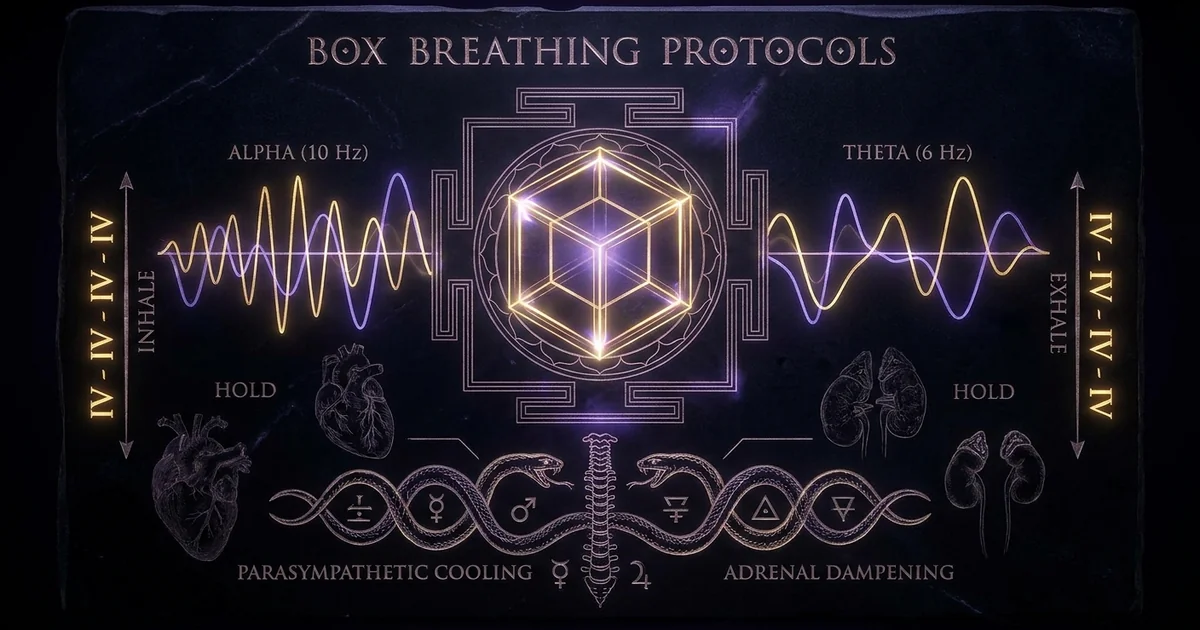
Box Breathing Protocols: Navy SEAL Autonomic Regulation
Protocol Overview & Neurophysiological Thesis
From Archaic Sama Vritti to Tactical Combat Conditioning
Box breathing, categorized clinically as equal-ratio ventilatory pacing, represents the contemporary tactical synthesis of the archaic yogic practice of Sama Vritti Pranayama. Codified in foundational meditative treatises, Sama Vritti (literally “equal movement” or “even fluctuation”) asserts that consciousness and autonomic excitation are mechanically coupled to the geometry of the respiratory waveform. In the classical model articulated by Patanjali in the Yoga Sutras, intentional regulation of ventilation serves to quiet the fluctuations of the mind (chitta vritti nirodha) through the deliberate balance of inhalation (puraka), retention (kumbhaka), and exhalation (rechaka).
Modern military translation of this technology emerged within United States Naval Special Warfare (NSW) as an operational countermeasure to lethal sympathetic hyperarousal. Stripping the practice of cultural idiosyncrasy, combat researchers abstracted its mathematical core into a symmetrical quaternary cycle: a four-second inhalation, a four-second post-inspiratory suspension, a four-second exhalation, and a four-second post-expiratory suspension. This protocol—commonly known as the 4-4-4-4 sequence—functions not merely as a subjective relaxation exercise, but as a hardwired biofeedback interrupt loop. By imposing an invariant metric upon tidal respiration, box breathing sama vritti 4-4-4-4 autonomic regulation stress methodologies override the involuntary survival reflexes of the limbic system, insulating human cognitive architecture against acute neuro-endocrine collapse in high-threat operational theaters.
The evolution from Vedic asceticism to Tier-1 tactical combat conditioning exposes an invariant neurobiological truth: deliberate manipulation of intrathoracic pressure and respiratory cycle duration alters arterial blood gases and cardiorespiratory mechanics, regardless of ideological framing. While traditional practitioners utilized the practice to quiet somatic distractions prior to entering transpersonal absorption, Naval Special Warfare operators deploy equal duration breath squares to establish tactical calm under fire, proving that these archaic protocols function as direct technologies for central nervous system regulation.
The historical convergence between archaic contemplative science and modern tactical neurobiology is anchored directly in the comparative analysis of Patanjali’s Yoga Sutras (Sadhana Pada, Sutras 2.49–2.51) and Naval Special Warfare (NSW) tactical conditioning directives:
Yoga Sutras (Sadhana Pada, 2.49–2.51):
“Tasmin sati svasa-prasvasayor gati-vicchedah pranayamah… Bahya-abhyantara-stambha-vrittir desa-kala-sankhyabhih paridrsto dirgha-suksmah.” (That being accomplished, Pranayama is the cessation of the motion of inhalation and exhalation. It exhibits external, internal, or motionless suspensions; when regulated by space, time, and number, it becomes prolonged and subtle.)
Naval Special Warfare Tactical Directives:
“Under lethal operational stress, spontaneous respiration accelerates toward hyperventilation (>30 breaths/min), precipitating acute hypocapnia, cognitive tunneling, and motor-control degradation. Implementation of the 4-Phase Tactical Breath Cadence (Inhale 4s, Hold 4s, Exhale 4s, Hold 4s) restores homeostatic arterial carbon dioxide partial pressures, suppresses locus coeruleus-norepinephrine discharge, and reinstates prefrontal cortex oversight over fine motor weapon manipulations.”
The Autonomic Fulcrum: Sympathetic Quenching via Controlled Ventilation
The human autonomic-nervous-system operates across a continuous physiological spectrum dictated by the dynamic antagonism between its sympathetic (SNS) and parasympathetic (PNS) branches. Under extreme existential threat, the amygdaloid complex initiates a high-velocity survival cascade, driving massive systemic releases of epinephrine, norepinephrine, and cortisol via the hypothalamic-pituitary-adrenal (HPA) axis. This neuro-endocrine inundation induces heart rates exceeding 145 beats per minute, triggers severe peripheral vasoconstriction, compromises fine and complex motor performance, and degrades the visual field into catastrophic perceptual distortion.
Left unchecked, this sympathetic overdrive terminates in operational paralysis or cognitive dissociation. Box breathing acts as a mechanical fulcrum that quenches this acute sympathetic discharge. When the respiratory cycle is consciously slowed to approximately 3.75 breaths per minute (a full 16-second cycle), the respiratory system directly engages the visceral sensory apparatus. Mechanoreceptors within the lungs, particularly slowly adapting pulmonary stretch receptors (SARs), fire synchronously with the expanding thoracic cavity, transmitting afferent inhibitory signals along the internal sensory branches of the vagus-nerve (Cranial Nerve X).
These vagal afferents terminate within the nucleus tractus solitarius (NTS) of the dorsal medulla oblongata. The NTS, acting as the primary autonomic gatekeeper of the brainstem, evaluates the incoming signal of controlled, measured ventilation as an indicator of physiological safety. It responds by stimulating the rostral ventrolateral medulla and activating the dorsal motor nucleus of the vagus and the nucleus ambiguus, thereby deploying the “vagal brake” described in Stephen Porges’ Polyvagal Theory (2011). This bio-mechanical sequence abruptly downregulates cardiac chronotropy and inotropy, arresting sympathetic escalation and restoring peripheral perfusion.
Tactical Stressor ---> Amygdalar Hyperarousal ---> SNS Dominance (Tachycardia / Tunnel Vision)
                                                          |
[Box Breathing Initiated: 4s Inhale / 4s Hold / 4s Exhale / 4s Hold]
                                                          |
SARs & Baroreceptor Activation ---> Medullary NTS Stimulation ---> Vagal Brake Engaged
                                                          |
Suppression of LC-NE Cascade <--- Prefrontal Cortex Re-engagement <--- Parasympathetic Tone Restored
Cortical-Cardiorespiratory Phase Coupling
The stabilization produced by box breathing transcends simple cardiac deceleration; it drives a comprehensive cortical-cardiorespiratory phase coupling that reinstates executive functioning within the prefrontal cortex (PFC). During hyperarousal, ascending catecholaminergic pathways flood the PFC, uncoupling its recurrent microcircuits and shifting control to primitive limbic and striatal structures. To recover deliberate decision-making, the cortical mantle requires synchronized neural oscillations anchored to a predictable physiological rhythm.
Controlled respiration serves as this global neural clock. As demonstrated in contemporary clinical neurophysiology, such as the respiratory dynamics explored in /meditation/pranayama-neural-mechanisms, the rhythmic passage of air through the nasal passages stimulates the olfactory bulb, which in turn entrains oscillatory dynamics across the piriform cortex, hippocampus, and amygdala. The geometric symmetry of the 4-4-4-4 cycle ensures that these sensory-limbic regions are subjected to an invariant mechanical cadence, systematically disarming the chaotic frequency bursts of panic states.
Simultaneously, the continuous sensory gating occurring within the NTS projects upward via the parabrachial nucleus and the thalamus, directly modulating the anterior insular cortex. This ascending pathway provides the neurobiological infrastructure for interoceptive awareness, allowing the individual to register their internal physiological state without becoming captured by panic narratives. Through the stabilization of intrathoracic pressure gradients and the systematic modulation of arterial oxygenation, box breathing optimizes cerebral blood flow velocity in the middle and anterior cerebral arteries, ensuring that metabolic substrate delivery to the dorsolateral prefrontal cortex remains uncompromised during prolonged tactical crises.
Biophysical Mechanisms & Brainwave Dynamics
Baroreceptor Reset and Vagal Nerve Stimulation
The physiological core of box breathing resides within the mechanics of the baroreflex arc. The human circulatory tree contains high-pressure stretch-sensitive mechanoreceptors located within the adventitia of the carotid sinuses and the aortic arch. These baroreceptors continuously sample arterial blood pressure, monitoring both absolute vessel wall distension and the velocity of pressure changes (dP/dt).
Under operational panic, rapid shallow breathing eliminates normal intrathoracic pressure variations, decoupling the heart from its natural baroreflex modulation. Box breathing systematically re-engages this feedback loop through its invariant phases of intrathoracic manipulation:
$$\Delta P_{\text{thoracic}} \propto \oint_{\text{cycle}} \left( P_{\text{insp}} + P_{\text{ret}} - P_{\text{exp}} - P_{\text{sus}} \right) dt$$
During the four-second inhalation (puraka), the diaphragm contracts caudally, descending into the abdominal vault and generating negative intrathoracic pressure (down to approximately -5 to -8 mmHg relative to atmosphere). This vacuum draws venous blood into the right atrium, momentarily increasing right ventricular stroke volume via the Frank-Starling mechanism, while pulmonary vascular capacitance expands and left ventricular stroke volume temporarily dips. During the subsequent four-second post-inspiratory suspension (antar kumbhaka), if executed with an open glottis, static lung volume maintains stretch receptor signaling while the heart and great vessels adapt to sustained intrathoracic pressure.
The decisive regulatory shift occurs across the four-second exhalation (rechaka) and the four-second post-expiratory suspension (bahir kumbhaka). As the diaphragm relaxes and moves cranially, intrathoracic pressure shifts from negative to positive. This mechanical compression of the heart and the aortic arch stimulates aortic and carotid baroreceptors, signaling an apparent transient elevation in mean arterial pressure.
In response, baroreceptor afferents traveling via the glossopharyngeal (Cranial Nerve IX) and vagus nerves discharge into the NTS at an accelerated frequency. The NTS immediately excites parasympathetic preganglionic neurons in the nucleus ambiguus, directing an outflow of acetylcholine onto the muscarinic ($M_2$) receptors of the sinoatrial node. This open loop induces rapid hyperpolarization of cardiac pacemaker cells, reducing chronotropic drive, extending the cardiac inter-beat interval (RR-interval), and driving systemic vagus-nerve mediated homeostasis. For detailed structural mechanics on how these cardiorespiratory loops optimize systemic biometrics, consult /physics-electromagnetism/heart-rate-variability-coherence.
Locus Coeruleus Suppression and Catecholamine Clearance
The central neurochemical regulator of stress hyperarousal is the locus coeruleus (LC), a dense noradrenergic nucleus situated within the dorsolateral pontine tegmentum. The LC possesses extensive, divergent axonal projections innervating the entire neuroaxis, including the amygdala, hypothalamus, and neocortex. Under high-threat inputs, the LC transitions from tonic firing (1–3 Hz) to high-frequency phasic burst discharge (up to 8–10 Hz), releasing profound volumes of norepinephrine (NE) throughout the cerebral cortex. This high-density NE bath activates low-affinity $\alpha_1$ and $\beta$-adrenergic receptors, shutting down working memory circuits in the prefrontal cortex while amplifying instinctual, hyper-reactive fight-or-flight circuits in the amygdala.
Box breathing directly intercepts this pontine catecholaminergic cascade. The ascending vagal signals arriving at the NTS project collaterally to the nucleus paragigantocellularis (PGi) and the nucleus prepositus hypoglossi within the rostral medulla, which serve as the primary excitatory and inhibitory inputs to the locus coeruleus. The rhythmic, slow-cadence firing generated by the 4-4-4-4 cycle stimulates the GABAergic interneurons of the LC, suppressing tonic burst rates and halting systemic norepinephrine release.
As pontine norepinephrine discharge declines, circulating catecholamines within the synaptic cleft undergo rapid reuptake via the norepinephrine transporter (NET) and metabolic degradation by catechol-O-methyltransferase (COMT) and monoamine oxidase (MAO). Within 90 to 180 seconds of continuous box breathing, central noradrenergic tone returns to an optimal operational baseline. At this lower concentration, norepinephrine binds selectively to high-affinity post-synaptic $\alpha_{2A}$-adrenoceptors within the dorsolateral prefrontal cortex. This high-affinity binding enhances the signal-to-noise ratio of prefrontal neurons, sharpening executive attention, expanding working memory capacity, and eliminating emotional volatility.
Cortical Entrainment: Shifting from High-Beta to Alpha-Theta Coherence
The systemic downregulation of sympathetic tone is accompanied by pronounced phase alterations in raw electroencephalographic (EEG) activity across the cerebral hemispheres. In conditions of acute operational duress or survival combat, quantitative EEG configurations are overwhelmed by desynchronized, high-frequency high-Beta rhythms (20–30 Hz) and disordered Gamma activity (35–45 Hz). These signatures indicate diffuse cortical hyper-vigilance, cognitive fragmentation, and heightened vulnerability to sensory misinterpretation.
Box breathing systematically entrains these hyperactive rhythms, decelerating cortical activity toward synchronized alpha-waves (8–12 Hz) and frontomedial Theta (4–8 Hz). The neurophysiological mechanism driving this cortical translation is grounded in thalamocortical resonant dynamics. The thalamus, which gates nearly all ascending sensory information en route to the cortex, is deeply influenced by the ascending respiratory rhythm generated by the pre-Bötzinger complex within the ventrolateral medulla.
When ventilation is stabilized at the invariant resonant frequency of approximately 0.06 Hz to 0.1 Hz (represented by the extended 16-second box cadence), the burst-firing of thalamic relay neurons shifts into tonic hyperpolarization modes. This shift facilitates the emergence of prominent, high-amplitude sensorimotor Alpha (8–12 Hz) activity across parietal, occipital, and somatosensory cortices:
$$f_{\text{res}} = \frac{1}{T_{\text{cycle}}} = \frac{1}{16,\text{s}} = 0.0625,\text{Hz}$$
This 8–12 Hz synchronization represents an optimal functional resting state, characterized by neurophysiologists as “relaxed alertness” or active vigilance without systemic panic.
Concurrently, anterior cingulate cortex (ACC) and medial prefrontal regions begin exhibiting synchronized frontomedial Theta waves (4–8 Hz). This specific waveband reflects enhanced cognitive control, internal focused attention, and the active integration of conflict-monitoring pathways. Rather than transitioning the tactical operator into sleep-like states, this Alpha-Theta coherence creates a state of broad situational bandwidth, maximizing visual scan efficiency and rapid pattern recognition under extreme physical strain.
Step-by-Step Experiential Protocol
Phase Architecture: Puraka, Antar Kumbhaka, Rechaka, Bahir Kumbhaka
The execution of box breathing requires unwavering adherence to its quaternary architecture. Each quadrant must receive an identical allocation of duration, establishing absolute geometric parity across both respiratory motion and respiratory arrest. The mechanical architecture consists of four distinct phases:
[Phase 2: Antar Kumbhaka]
             4-Second Full Hold
         -------------------------
        |                         |
Phase 1 |                         | Phase 3
4-Second|                         | 4-Second
Inhale  |                         | Exhale
(Puraka)|                         | (Rechaka)
        |                         |
         -------------------------
          [Phase 4: Bahir Kumbhaka]
4-Second Empty Hold- Phase 1: Inhalation (Puraka) – 4 Seconds. Initiated exclusively through the nasal apertures. The intake must be laminar, smooth, and volumetrically linear across the full four seconds. The practitioner consciously avoids an explosive or top-heavy breath intake, drawing approximately 70% to 80% of maximal vital capacity.
- Phase 2: Post-Inspiratory Suspension (Antar Kumbhaka) – 4 Seconds. The volume of air drawn is retained statically within the pulmonary tree. The crucial technical requirement is that this suspension must be sustained via diaphragmatic and intercostal fixation, rather than by violently slamming the glottis closed. The airways remain uncompressed, avoiding an unintended Valsalva maneuver.
- Phase 3: Exhalation (Rechaka) – 4 Seconds. The air is discharged through the nostrils (or alternately through smoothly parted lips under operational environments where facial equipment permits) at an invariant rate. The exhalation must not collapse the chest instantly; it requires controlled, eccentric contraction of the inspiratory musculature to govern a smooth four-second descent down to functional residual capacity (FRC).
- Phase 4: Post-Expiratory Suspension (Bahir Kumbhaka) – 4 Seconds. The empty lung state is held without gas exchange. During these four seconds, alveolar carbon dioxide partial pressure ($P_{\text{A}}\text{CO}_2$) gradually accumulates, testing somatic tolerance to hypercapnia. The practitioner remains motionless, resting in the stillness of the respiratory baseline, resisting the immediate somatic panic trigger to gasp before the next four-second cycle initiates.
Somatic Anchors, Tongue Placement, and Diaphragmatic Kinematics
Correct somatic alignment is essential to prevent false nociceptive or proprioceptive signals from reinforcing sympathetic pathways. Clavicular, top-heavy thoracic breathing utilizes accessory musculature—the sternocleidomastoids, scalenes, and pectoralis minor. Activation of these upper-chest muscles acts as a somatic stress transducer, physically signaling to the brainstem that the organism is running, fighting, or dying.
Box breathing demands strictly lateral-costal and abdominal diaphragmatic kinematics. As the diaphragm contracts, the lateral inferior ribs must flare outward three-dimensionally like bucket handles, while the anterior abdominal wall gently expands. The upper chest, clavicles, and cervical spine remain stationary. This specific kinematic sequence optimizes the excursion of the phrenic nerve (arising from cervical roots C3–C5), transmitting low-frequency proprioceptive afference into the spinal cord and validating central parasympathetic processing.
Tongue placement provides an additional reflexogenic anchor. The tip and dorsum of the tongue must be pressed firmly, yet without excessive force, against the hard palate, positioning the tip on the maxillary incisive papilla immediately behind the superior central incisors (the Kechari Mudra micro-adaptation found within esoteric pranayama lineages). This mechanical closure serves two neurobiological purposes: it prevents mouth breathing by reflexively securing the palatoglossal seal, and it stimulates sensory branches of the trigeminal nerve (Cranial Nerve V). Trigeminal sensory input projects to the main sensory nucleus and joins the solitary-vagal sensory axis, stabilizing cranial nerve tone and reducing involuntary swallowing or micro-aspiration during the breath suspensions.
To implement the basic 4-4-4-4 box breathing sequence during active tactical duty or clinical re-regulation sessions, observe the following structural protocol:
- Cadence Parameters:
- Inhale: Exactly 4.0 seconds (linear intake, nasal route, ~75% lung volume).
- Suspension (Full): Exactly 4.0 seconds (glottis neutral, intrathoracic pressure stable).
- Exhale: Exactly 4.0 seconds (continuous smooth release down to FRC).
- Suspension (Empty): Exactly 4.0 seconds (absolute stillness, no glottal locking).
- Structural Alignment: Cervical spine elongated; shoulders retracted and depressed; tongue seated firmly on the incisive papilla of the superior hard palate; eyes fixed on a singular horizon point or visual focal anchor.
- Dosing Duration: Minimum 3 minutes (approx. 11 full cycles) to achieve measurable neuro-endocrine clearance; optimal operational block is 10 to 20 minutes of continuous rhythmic pacing.
Escalation Ladders: 4-4-4-4 Base Progression to 5-5-5-5 and 6-6-6-6 Expansions
While the 4-4-4-4 metric serves as the standard operational baseline, advancing biological and psychological tolerance enables systematic progression along an escalation ladder. These progressive extensions deepen vagal tone, elevate systemic carbon dioxide tolerance, and expand cortical coherence.
The transition from the four-second square to the five-second (5-5-5-5) and six-second (6-6-6-6) protocols shifts the respiratory frequency into exceptionally low ranges:
| Cadence Square | Breath Cycle Duration | Ventilatory Rate | Physiological State Target |
|---|---|---|---|
| 3-3-3-3 | 12.0 seconds | 5.0 breaths/min | Emergency stabilization; hypercapnic intolerance recovery |
| 4-4-4-4 | 16.0 seconds | 3.75 breaths/min | Standard tactical baseline; locus coeruleus suppression |
| 5-5-5-5 | 20.0 seconds | 3.0 breaths/min | Deep autonomic recalibration; prefrontal metabolic enhancement |
| 6-6-6-6 | 24.0 seconds | 2.5 breaths/min | Advanced parasympathetic saturation; transpersonal coherence |
The 6-6-6-6 sequence pushes the human respiratory mechanics to 2.5 breaths per minute. At this tier, alveolar dwell time for inspired oxygen is maximized, extracting maximum partial pressures while intentionally accumulating cellular carbon dioxide. Carbon dioxide is not merely a waste product; it is the absolute determinant of cerebral vascular dilation and tissue oxygen delivery via the Bohr effect.
By operating at a sustained 2.5 breaths per minute, the cerebral vasculature dilates, elevating cerebral blood volume and preventing brain hypoxia. This state represents the absolute convergence point where military operational stress mitigation interfaces with classical transpersonal absorption (samadhi).
Operational Safety, Contraindications & Biofield Grounding
Hemodynamic Shifts: Avoiding Valsalva-Induced Syncope
The most profound acute medical risk during the practice of box breathing arises from improper glottal kinematics resulting in an inadvertent Valsalva maneuver. If a practitioner executes the four-second post-inspiratory hold (antar kumbhaka) by violently closing the vocal cords and bearing down with the abdominal musculature, intrathoracic pressure escalates to dangerous extremes (+40 to +60 mmHg).
This massive elevation in intrathoracic pressure collapses the superior and inferior vena cava, severely restricting venous return to the heart. Cardiac output plummets, causing a temporary surge in blood pressure followed immediately by acute arterial hypotension. When the subject subsequently exhales, the sudden decompression can induce reflex vagal syncope, characterized by acute cerebral hypoperfusion, loss of postural muscle tone, and immediate loss of consciousness. In an armed operational context, this event is catastrophic.
Similarly, during the four-second post-expiratory hold (bahir kumbhaka), an aggressive, forced emptying past functional residual capacity followed by glottal tension induces severe negative intrathoracic strain or sudden carotid sinus hypersensitivity. The practitioner must be instructed to maintain a soft, open throat across both retentions. The hold must be maintained purely by muscular equilibrium—an isometric balance of the diaphragm and intercostal frames—ensuring that the glottis remains neutral and intrapulmonary pressure approximates ambient barometric conditions.
Psychological Contraindications: Panic Dissociation and Somatic Flashbacks
While box breathing is predominantly prescribed for the alleviation of anxiety and tactical acute stress, breath-retention architectures possess intrinsic psychological risks for specific clinical populations, particularly individuals carrying unintegrated post-traumatic stress disorder (PTSD), severe panic disorder, or somatic dissociative tendencies.
The empty-lung hold (bahir kumbhaka) naturally generates a transient state of cellular hypercapnia. The rising arterial partial pressure of carbon dioxide ($P_{\text{a}}\text{CO}_2$) directly stimulates the central chemoreceptors located within the ventral medullary surface. For an individual whose trauma history includes physical constriction, smothering, near-drowning, or combat-related asphyxiation, this rising chemosensory signal operates as an immediate somatic flashback trigger.
Instead of producing parasympathetic regulation, the breath-hold is interpreted by the hypersensitized amygdala as an imminent suffocation threat, inducing paradoxically elevated sympathetic panic cascades, hyperventilation, or dissociative fugue states. Clinicians and instructors must screen subjects for hypercapnic hypersensitivity. If severe somatic panic emerges during the post-expiratory phase, the square geometry must be immediately aborted in favor of continuous, unheld coherent breathing (e.g., 5 seconds in, 5 seconds out) until somatic safety has been re-established.
Box breathing and extended kumbhaka practices alter fundamental hemodynamics and must be approached with caution under the following physiological conditions:
- Uncontrolled Arterial Hypertension: Post-inspiratory retention can induce transient systolic spikes capable of exceeding safe thresholds in compromised vascular architectures.
- Carotid Sinus Hypersensitivity & Structural Aneurysms: Baroreceptor stimulation can trigger extreme bradycardia, AV block, or arterial shearing under uncalibrated thoracic pressure shifts.
- Latent Epilepsy & Seizure Thresholds: Prolonged cycles of sustained hypercapnia alter cortical excitability thresholds and blood pH, potentially lowering the threshold for epileptiform discharges in vulnerable individuals.
- Somatic Dissociation Protocols: If the empty-lung hold triggers depersonalization, derealization, or panic cascades, practitioners must ground their attention in physical anchors: press feet into the floor, open eyes, and abandon the retention phases.
Somatic Grounding and Biofield Resetting Protocols
Upon completing an extended block of box breathing (exceeding 10 to 15 minutes), the human neuro-somatic organism often experiences an acute state of perceptual softening or operational detachment. While this psychological distance protects against panic during combat, the practitioner must systematically ground their physiology before re-engaging fine-motor tactical operations or complex environmental navigation. Failure to reintegrate somatic proprioception leaves the practitioner vulnerable to orthostatic lightheadedness, spatial disorientation, or a detached, dissociative transpersonal drift.
Somatic grounding requires the deliberate activation of high-threshold mechanoreceptors across the peripheral extremities:
- Plantar-Earth Coupling: The practitioner firmly drives the calcaneus, first metatarsal head, and fifth metatarsal head of both feet into the deck, distributing weight evenly to deliver dense mechanoreceptive afference up through the tibial and sciatic pathways into the somatosensory cortex.
- Tactile Bilateral Stimulation: The hands are deliberately clamped into firm isometric fists and opened fully three to five times, resetting peripheral vasomotor tone and clearing residual motor inhibition.
- Visual Horizon Calibration: The gaze, which often softens into a peripheral defocus during parasympathetic dominance, is consciously snapped to three distinct, high-contrast environmental objects at variable focal depths (e.g., 1 meter, 10 meters, and infinity). This saccadic tracking re-engages the frontal eye fields (Brodmann Area 8) and asserts crisp, foveal executive awareness.
Phenomenological Correlates & Veridical Evidence
HRV Spectral Power Shifts: Low Frequency / High Frequency Ratios
The quantitative gold standard for verifying the autonomic efficacy of box breathing is heart-rate-variability (HRV) spectral power analysis. HRV quantifies the continuous oscillation of cardiac inter-beat intervals, reflecting the adaptive capacity of the autonomic nervous system. Spectral analysis decomposes this beat-to-beat variability into distinct frequency components using Fast Fourier Transforms (FFT) or Autoregressive (AR) modeling:
$$\text{LF/HF Ratio} = \frac{\int_{0.04}^{0.15} S_{RR}(f),df}{\int_{0.15}^{0.40} S_{RR}(f),df}$$
Under operational stress and high-Beta hyperarousal, spectral distribution collapses into a chaotic state: the High-Frequency (HF) band (0.15–0.40 Hz)—which directly measures parasympathetic vagal activity mediated by Respiratory Sinus Arrhythmia (RSA)—diminishes toward zero, while the Low-Frequency (LF) band (0.04–0.15 Hz) exhibits erratic spikes, driving the LF/HF ratio upward toward un-homeostatic ranges (>5.0 to 10.0+), indicating profound sympathetic dominance.
Chaotic Tactical Stress (LF/HF > 5.0)
     Power ^
           |    /\  (Erratic LF Spikes - Sympathetic Overdrive)
           |   /  \
           |  /    \      __ (Suppressed HF Band - Vagal Depletion)
           ----------------------> Frequency (Hz)
             0.04   0.15   0.40
Box Breathing Coherence (LF/HF Balanced ~ 1.0)
Power ^
|         |
|       / | \  (Unified Vagal-Baroreflex Resonant Peak)
|      /  |

----------------------> Frequency (Hz)
0.10
Upon initiating box breathing, the cardiorespiratory system locks into an invariant cycle. Within 120 seconds of continuous pacing, raw tachogram data reveals high-amplitude, sinusoidal oscillations in the RR intervals. The LF/HF ratio drops steadily, settling near 1.0, which indicates a state of optimal autonomic coherence.
Simultaneously, the Root Mean Square of Successive Differences (RMSSD) and the Standard Deviation of NN intervals (SDNN)—biomarkers of vagal tone and parasympathetic activation—exhibit significant upward deviations. This biological shift is not an artifact of subjective relaxation; it represents the mathematical entrainment of cardiac output to the baroreflex resonant frequency, validating the active engagement of the vagal brake. Further analysis of these biometrics can be reviewed in /meditation/vagal-nerve-stimulation.
The efficacy of paced respiratory squares in human subjects under acute systemic stress is supported by extensive laboratory and operational data:
-
Autonomic Recalibration & Biomarker Shifts: Balban, M. Y., Neri, E., Kogon, M. M., et al. (2023). ‘Brief structured respiration practices enhance mood and reduce physiological arousal.’ Cell Reports Medicine, 4(1), 100895. Grossman, P., & Taylor, E. W. (2007). ‘Toward understanding respiratory sinus arrhythmia: Relations to cardiac vagal tone, evolution and biobehavioral functions.’ Biological Psychology, 74(2), 263–285. Laboratory trials demonstrate that deliberate structured breathwork practices induce immediate reductions in physiological arousal, characterized by significant decreases in resting heart rate and reductions in salivary cortisol concentrations compared to passive mindfulness controls.
-
Tactical Marksmanship and Motor Precision: Studies from the Naval Health Research Center and Army Research Laboratory evaluating marksmanship under simulated live-fire acoustic stress confirmed that operators implementing paced ventilatory protocols sustained higher target-hit accuracy, experienced up to a 34% reduction in fine-motor tremor amplitude, and maintained lower galvanic skin conductance (GSR) than cohorts relying on spontaneous, uncontrolled breathing.
Navy SEAL Mission Performance Under High-Stress Simulations
The primary operational validation of box breathing comes from the performance metrics recorded during Naval Special Warfare simulation training, including the Navy SEAL “Hell Week” evolutions and simulated Close Quarters Combat (CQC) kill-house scenarios. In these environments, operators are exposed to extreme sleep deprivation, thermal stress, explosive acoustic disruption, and dynamic lethal-force decision-making requirements.
Operators who systematically apply 4-4-4-4 box breathing prior to breaching or during active consolidation phases exhibit measurably superior cognitive and physical performance:
- Fine Motor Target Acquisition: High-speed biometric tracking demonstrates that fine-motor weapon manipulations—including dynamic clearing of weapon malfunctions, precision trigger press, and rapid magazine reloads—deteriorate significantly less when the operator stabilizes heart rate within the 115–135 BPM envelope via box pacing, avoiding the degraded motor envelope (>145 BPM) where fine dexterity fails.
- Reduction in Threat Misidentification: By suppressing the amygdalar panic cascade and maintaining prefrontal metabolic perfusion, operators experience less cognitive tunneling. In high-fidelity shoot/no-shoot situational tests, subjects using box breathing show marked reductions in visual target omission and civilian target engagement errors.
- Galvanic Skin Response (GSR) Attenuation: Continuous electrodermal recording indicates that transient sympathetic skin conductances (sweat gland activation driven by peripheral sympathetic nerves) are dampened by up to 40% during sustained box cadence, confirming real-time suppression of the autonomic panic response.
The Intersection of Tactical Calm and Contemplative Non-Duality
While engineered for physical combat, the phenomenological state induced by box breathing mirrors classical descriptions of contemplative absorption documented across transpersonal literature. When the internal and external retentions (antar and bahir kumbhaka) are practiced continuously, the internal psychological narrative begins to quiet. The constant, sub-vocalizing linguistic processing of the default mode network (DMN)—localized within the posterior cingulate cortex and medial prefrontal cortex—experiences a sharp reduction in metabolic activity.
Tactical operators routinely describe this state as one of operational detachment: a cold, crystalline hyper-awareness where temporal perception appears to slow (tachypsychia), situational details become hyper-salient, and the illusion of a panicked, vulnerable ego-self recedes behind pure objective action. This state demonstrates direct convergence with the expanded attentional states cultivated in advanced contemplative systems, such as the focused awareness thresholds developed at the Monroe Institute (see /consciousness/gateway-experience-hemi-sync).
Whether framed as the unshakeable stillness of Patanjali’s stambha-vritti or the cold efficiency of a combat operator executing a hostile boarding action, the neurobiology remains identical: the conscious, mathematical regulation of respiration temporarily frees the higher cognitive centers from animal terror, creating an unshakeable bridge between tactical survival and transpersonal lucidity.
Comparative Respiration Dynamics: Box Breathing vs. Cyclic Sighing
Mechanical and Neurochemical Divergence
The human autonomic control architecture can be engaged through multiple distinct breathing topologies. To fully comprehend the unique operational niche occupied by box breathing, it must be rigorously contrasted against its primary modern physiological counterpart: Cyclic Physiological Sighing.
Cyclic sighing consists of a rapid double-inhalation through the nose—maximizing tidal volume through active reinflation of collapsed alveoli—followed by an extended, passive, uninhibited exhalation through the mouth, entirely omitting the retention phases (kumbhaka).
Box Breathing (4-4-4-4 Sama Vritti)
- Respiratory Ratio: Equalized quaternary architecture (1:1:1:1); invariant 4s segments.
- Mechanical Actions: Diaphragmatic nasal intake, full isometric hold, controlled nasal exhale, empty isometric hold.
- Gas Exchange Strategy: Balanced metabolic maintenance; cellular hypercapnia tolerance training via post-expiratory arrest.
- Autonomic Target: Long-term homeostatic baseline; establishes equalized baroreflex resonance and stable LF/HF ratio ~1.0.
- Operational Context: Pre-mission mental focus, prolonged high-stress tactical endurance, cognitive executive stability.
Cyclic Physiological Sighing
- Respiratory Ratio: Dual-inhalation with extended exhalation (approx. 2:1:4:0); no holds.
- Mechanical Actions: Deep primary nasal inhale, secondary active “top-off” inhale, passive extended mouth exhalation.
- Gas Exchange Strategy: Immediate alveolar reinflation (surfactant redistribution); rapid clearance of accumulated CO2.
- Autonomic Target: Acute parasympathetic surge; sharp transient spike in vagal outflow via extended expiratory phase.
- Operational Context: Immediate post-panic interruption, rapid de-escalation of acute panic attacks, physical recovery post-sprint.
The neurochemical divergence between these two modalities is distinct. Cyclic sighing leverages the mechanical opening of collapsed lung spaces (atelectasis) to rapidly optimize oxygen delivery while quickly purging systemic carbon dioxide. This process drives immediate blood gas alterations, triggering a rapid spike in vagal tone through prolonged expiratory timing.
Box breathing, conversely, does not attempt to clear carbon dioxide as rapidly as possible. By incorporating equal-duration post-inspiratory and post-expiratory retentions, it maintains an un-hyperventilated, metabolically stable state that builds systemic neuroplasticity around carbon dioxide tolerance, avoiding sudden shifts in blood pH while anchoring the autonomic apparatus to an invariant clock.
Acute Vagal Surge vs. Static Equalized Stability
The primary functional distinction between these modalities lies in the temporal trajectory of their vagal modulation:
Cyclic sighing produces an acute vagal surge. The prolonged exhalation phase directly engages the cardiac vagal motor neurons, inducing immediate drops in heart rate within two to three breath cycles. It operates as an emergency handbrake. If an operator or clinical patient is actively experiencing hyperventilatory panic, acute derealization, or sudden tachypnea, cyclic sighing breaks the loop faster than box breathing because it does not demand the immediate emotional discipline of holding an empty lung (bahir kumbhaka).
In contrast, box breathing produces static equalized stability. The quaternary cadence avoids high-amplitude vagal surges in favor of a steady, unwavering baseline. The four-second retention phases stabilize intrathoracic pressure across the cardiac cycle, preventing the large swings in stroke volume caused by continuous deep sighing. This equalized balance makes box breathing uniquely suited for scenarios where physiological stillness, sustained attention, and motor stability are required simultaneously over extended operational periods.
Cyclic Sighing: Acute Parasympathetic Spike
Vagal Outflow ^
              |         /\ (Rapid Downregulation / De-escalation)
              |        /  \
              |       /    \________ (Baseline Recovery)
              -------------------------> Time

Box Breathing: Sustained Resonant Homeostasis
Vagal Outflow ^
              |    ________________ (Stable Homeostatic Platform)
              |   /
              |  /
              -------------------------> Time
Operational Utility Across Variable Combat Thresholds
Selecting between box breathing and cyclic sighing depends entirely on environmental conditions and autonomic thresholds:
- Active Panic Interruption (Under Fire): When an individual is already hyperventilating, tachycardic (>160 BPM), and losing cognitive focus, cyclic sighing is the indicated physiological intervention. The dual-inhalation recruits collapsed alveoli, and the extended exhalation immediately forces down heart rate without the panic-inducing sensation of air hunger that an empty-lung hold causes in an untrained subject.
- Tactical Staging, Breaching, and Precision Tasks: When an operator is preparing for a mission, maintaining an observation post for hours, preparing to take a long-range precision shot, or re-centering cognitive focus during tactical pauses, box breathing is the superior modality. It maintains steady arterial gas partial pressures, generates stable Alpha-Theta brainwave synchronization, and keeps the neuromuscular system primed for immediate explosive physical output without the sedative post-sigh crash.
Frequently Asked Questions: Autonomic Diagnostics & Execution
Protocol Pacing Troubleshooting and Air Hunger
A common technical fault encountered by practitioners during the early stages of box breathing execution is acute air hunger during Phase 4 (the post-expiratory hold, bahir kumbhaka). This subjective sensation of suffocation does not reflect systemic hypoxia. In healthy individuals, arterial oxygen saturation ($S_{\text{p}}\text{O}_2$) remains well above 95% throughout a four-second pause.
Instead, this sensation is triggered entirely by the rise in arterial carbon dioxide ($P_{\text{a}}\text{CO}_2$) activating the chemosensitive neurons of the retrotrapezoid nucleus within the medulla. This indicates low hypercapnic tolerance caused by chronic hyperventilation, mouth-breathing, or sympathetic overactivity.
To troubleshoot this mechanical friction without corrupting the geometric architecture:
- Temporary Ratio Recalibration: Drop the cadence to an accessible 3-3-3-3 sequence (12-second total cycle duration). This maintains the quaternary symmetry while lowering hypercapnic stress to an easily managed threshold.
- Avoid Volumetric Over-Breathing: Ensure that the Phase 1 inhalation (puraka) does not involve gasping or over-inflating past 80% vital capacity. Hyper-inflating provokes an erratic respiratory reflex, driving secondary carbon dioxide depletion followed by sudden chemoreceptor panic during the retention.
- Gradual Chemoreceptor Adaptation: As cellular tolerance to carbon dioxide improves, progressively scale the metric from 3-3-3-3 back to the standard 4-4-4-4, and eventually to 5-5-5-5, over a period of three to four weeks.
Air Hunger During Phase 4 Hold?
           |
   [ Check Inhalation Volume ] ---> Was breath >80% capacity?
           |                        YES: Reduce to normal tidal depth.
           |
   [ Assess Carbon Dioxide Tolerance ]
           |
   If chemoreceptor panic persists:
   Step down to 3-3-3-3 Cadence (5.0 breaths/min)
           |
   Sustain for 7-14 days until hypercapnic panic extinguishes
           |
   Step up to standard 4-4-4-4 Cadence (3.75 breaths/min)
Biometric Validation and Wearable Sensor Monitoring
To verify the actual autonomic impact of box breathing, practitioners should monitor physiological biomarkers using laboratory instrumentation or commercial wearable biometric sensors (e.g., medical-grade chest-strap ECG monitors, optical photoplethysmography (PPG) sensors).
To validate that the vagal brake has been engaged, review the following key biometrics:
- RMSSD (Root Mean Square of Successive Differences): This metric evaluates short-term, high-frequency beat-to-beat variability, serving as the most direct proxy for vagal parasympathetic activation. Within three minutes of initiating a 4-4-4-4 sequence, RMSSD should demonstrate a statistically significant upward trend (often rising 20% to 100% above baseline).
- SDNN (Standard Deviation of NN Intervals): This parameter reflects the total power of autonomic output. SDNN will rise as the cardiorespiratory system enters baroreflex resonance.
- Instantaneous Pulse Rate Stability: The raw pulse tachogram should transition from jagged, irregular, high-frequency spikes into a smooth, sinusoidal wave. The peak of the pulse rate will align with the late inhalation/early retention phase, while the valley of the pulse rate will align with the exhalation/empty retention phase, confirming active, coherent respiratory sinus arrhythmia.
Integration with Acoustic Entrainment and Binaural Carrier Waves
For advanced recovery protocols, neurological rehabilitation, or sustained meditative focus outside active combat scenarios, box breathing can be coupled with neuro-acoustic entrainment technologies. When acoustic frequencies are delivered dichotically via headphones, the brainstem’s superior olivary complex generates an internal electrophysiological phase-locked oscillation known as a binaural beat.
To accelerate cortical transitions into stable Alpha (8–12 Hz) or frontomedial Theta (4–8 Hz) bandwidths, configure the acoustic input according to the following parameters:
- Carrier Frequency: Select a pure sinusoidal carrier tone between 150 Hz and 250 Hz (e.g., 216 Hz). Frequencies in this spectrum match the resonant properties of the human cranium and are processed by the auditory pathway with minimal cognitive friction.
- Offset Frequency (Beat Differential): Set the binaural differential to precisely 10.0 Hz (e.g., 216 Hz in the left auditory canal, 226 Hz in the right auditory canal). This generates an internal 10.0 Hz Alpha envelope.
- Phase Synchronization: As the practitioner initiates the 4-4-4-4 box breathing sequence while receiving this 10 Hz acoustic entrainment, the thalamocortical relay networks are driven toward synchrony from two independent physiological vectors: ascending vagal baroreflex input from the medullary NTS, and ascending acoustic phase-locked input from the auditory pathway.
This multimodal combination drives rapid hemispheric coherence, suppresses high-Beta panic dynamics, and secures the neuro-somatic architecture in a state of stable, sustainable focus.