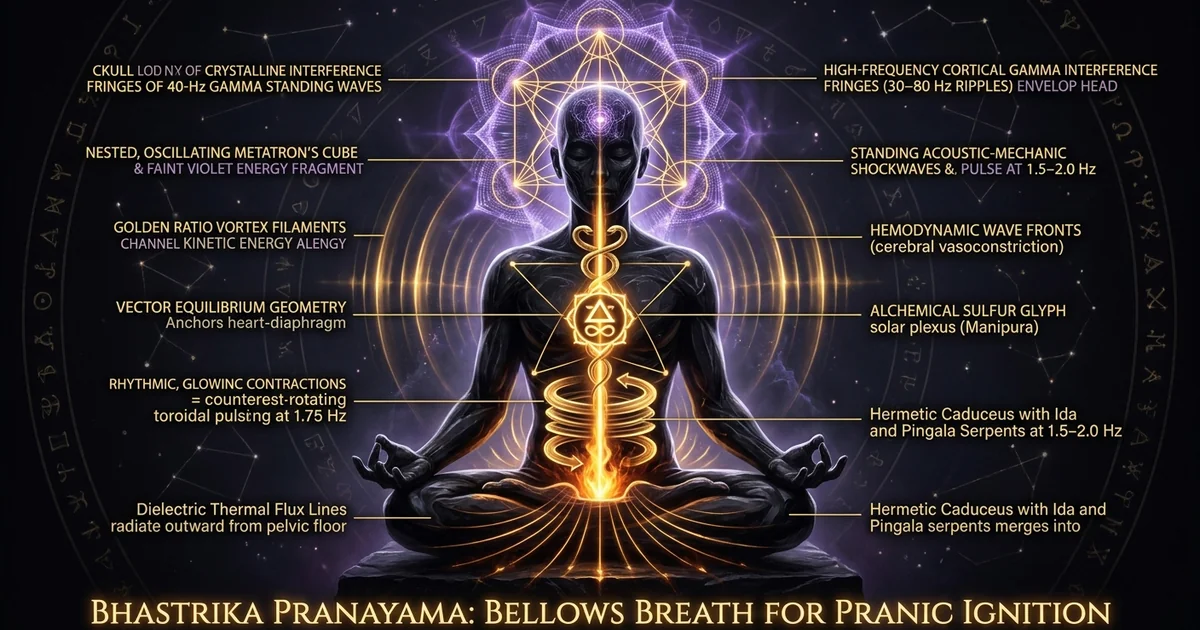
Bhastrika Pranayama: Bellows Breath for Pranic Ignition
Protocol Overview & Neurophysiological Thesis
Thermodynamic Ignition: The Bellows Paradigm and Kundalini Awakening
Bhastrika Pranayama operates as an intensive, hyper-ventilatory bio-energetic compressor within the classical yogic taxonomy. Distinguished from passive expiratory techniques, this practice pairs high-frequency, forced inspiratory exertion with equally forceful expiratory drive. The somatic engine driving this process is the rapid, rhythmic excursion of the thoracic diaphragm, typically sustained at an oscillatory frequency between 1.5 and 2.0 Hz. In the classical literature of Hatha Yoga, this protocol is conceptualized as the mechanical bellows of the blacksmith (bhastrika), utilized deliberately to generate an internal combustion capable of transmuting inert biological substrate into radiant metabolic force.
Yathaiva lohakarena bhastra vegena chalyate | Tathaiva charayedvayum gatyasangena dehatah ||
“Just as the bellows of the blacksmith is moved forcefully with velocity, so also should the practitioner move the breath through the body with deliberate speed and awareness.”
Svatmarama outlines that when fatigue sets in, the practitioner must inhale deeply through the right nostril (Surya Nadi), retain the prana with extreme focus (antara-kumbhaka), and apply the energetic locks (bandhas). This specific thermo-mechanical compression is stated to directly pierce the three psychic nodes (granthis) and awaken the dormant serpent power (kundalini-awakening) coiled at the base of the sushumna-nadi, forcing it to ascend the central cerebrospinal axis.
From a biophysical perspective, this practice initiates an acute metabolic shift. The thermodynamic phenomenon designated in yogic terminology as tapas or internal fire is not a subjective hallucination; it corresponds to profound autonomic-adrenal stimulation, elevated mitochondrial respiration, and sympathetic recruitment of brown adipose tissue (BAT) thermogenesis. By deploying the respiratory musculature as an oscillating fluid piston, Bhastrika generates cyclical pressure waves across the coelomic cavities. This physical oscillation compresses the visceral organs, accelerates venous return via the inferior vena cava, and mechanically mobilizes the column of cerebrospinal fluid (CSF) within the intrathecal space. The resulting neurochemical friction serves as a catalyst for clearing pranic blockages along the neuroaxis, reorganizing somatic holding patterns and preparing the central nervous system for transpersonal states of absorption.
Target States of Consciousness: Transcending the DMN via Controlled Metabolic Drive
The primary phenomenological target of Bhastrika Pranayama is the destabilization of habitual self-referential cognition, mediated neurobiologically through the down-regulation of the Default Mode Network (DMN). The hubs of the DMN—primarily the posterior cingulate cortex (PCC), precuneus, and medial prefrontal cortex (mPFC)—rely on stable, homeostatic metabolic perfusion and balanced arterial blood gas concentrations to maintain the internal narrative of an egoic self. The rapid metabolic and blood gas perturbation induced by Bhastrika forces the brain out of its stable baseline attractor states.
As arterial carbon dioxide tension drops precipitous under high-velocity ventilation, the resulting cerebral vasoconstriction curtails baseline blood flow to associative cortical regions. Simultaneously, the profound sensory bombardment ascending from diaphragmatic, intercostal, and baroreceptive afferents oversaturates thalamic filtering gates. Deprived of its homeostatic baseline, the DMN decouples. The mind transitions from discursive mentation to a state of absolute present-centered vigilance. This hyper-arousal state acts as a non-pharmacological vehicle for unbinding conscious awareness from linguistic and autobiographical frameworks, opening an experiential clearing wherein the subtle body can be directly perceived via endogenous biofield electrodynamics.
Autonomic Polarity: Sympathetic Surge Preceding Parasympathetic Rebound
The neuroarchitectural dynamic of Bhastrika rests upon a biphasic autonomic trajectory: a severe, controlled sympathetic surge followed immediately by an equally profound parasympathetic and vagal rebound. During the dynamic bellows phase (Phase I), the sympathetic branch of the autonomic nervous system (autonomic-nervous-system) is driven to near-maximal activation. Plasma catecholamines—epinephrine and norepinephrine—spike rapidly, triggering tachycardia, peripheral vasoconstriction, and metabolic upregulation. This controlled application of physiological stress acts as a systemic hormetic stressor.
+-----------------------------------------------------------------------------------+
|                            AUTONOMIC BIPHASIC TRAJECTORY                           |
|                                                                                   |
|  Sympathetic Surge (Phase I)            Parasympathetic Rebound (Phase II / III)  |
|  [ 1.5 - 2.0 Hz Pumping ]              [ Antara Kumbhaka + Tri-Bandha Retention ] |
|  - Catecholamine cascade                - Baroreflex activation                   |
|  - Hyperventilation hypocapnia          - Vagal brake engagement                  |
|  - Reticular activating excitation      - Splanchnic blood shunting               |
|  - Cortical high-beta/gamma emergence   - Whole-brain coherent gamma phase-lock   |
+-----------------------------------------------------------------------------------+
When the practitioner halts the hyper-ventilatory pumping and transitions into internal retention (antara-kumbhaka) paired with neuromuscular locks (tri-bandha), the system undergoes a sudden physiological inflection. The mechanical arrest of breathing, combined with heightened intrathoracic pressure and isometric muscular contraction, stimulates the carotid sinus and aortic arch baroreceptors. The brainstem interprets this massive pressure signal as dangerous hypertension, triggering the vagal brake. Acetylcholine floods the cardiac pacemaker tissues, systemic vascular resistance reorganizes, and the practitioner plunges into a state of profound parasympathetic calm characterized by high-voltage electroencephalographic coherence. This dynamic tension between high sympathetic arousal and intense parasympathetic tonus produces an alert, hypometabolic baseline that is essential for kundalini-awakening.
Biophysical Mechanisms & Brainwave Dynamics
Cerebral Hemodynamics: Hypocapnia, Vasoconstriction, and the Bohr Effect
The forced ventilation maintained during Bhastrika Pranayama systematically drives arterial carbon dioxide tension ($PaCO_2$) below normal physiological levels (40 mmHg), often dropping to 20–25 mmHg within 60 to 90 seconds. This condition, termed cerebral-hypocapnia, fundamentally alters the biochemical environment of the blood and brain. As carbon dioxide is rapidly evacuated from the pulmonary alveoli, the equilibrium of the carbonic acid-bicarbonate buffer system shifts:
$$H_2O + CO_2 \rightleftharpoons H_2CO_3 \rightleftharpoons H^+ + HCO_3^-$$
The reduction of hydrogen ions ($H^+$) elevates systemic arterial pH, culminating in acute respiratory alkalosis. Because carbon dioxide readily diffuses across the blood-brain barrier, perivascular pH in the cerebral tissue elevates rapidly, causing the smooth muscle layers surrounding cerebral arterioles to contract. This vascular reaction produces marked cerebral arterial vasoconstriction, decreasing global cerebral blood flow (CBF) by up to 30–40%.
Stancák and Kuna (1994) demonstrated that rapid, forced pranic respiration generates profound alterations in cortical electrical activity, marked by early desynchronization followed by high-amplitude, coherent rhythmic oscillations across fronto-central derivations. This aligns with findings by Kox et al. (2014) documenting that deliberate hyperventilatory regimens paired with systemic breath retentions stimulate profound adrenocortical activation, elevating circulating epinephrine levels above those observed during baseline stress testing, which modulates immune signaling and neural excitability.
Simultaneously, the alkaline shift in the systemic bloodstream modifies the structural conformation of hemoglobin via the Bohr Effect. Hemoglobin’s affinity for bound oxygen increases, which paradoxically impedes the dissociation and unloading of oxygen into neural tissues despite normal or elevated peripheral arterial oxygen saturation ($SaO_2 \approx 99\text{–}100%$). The cerebral parenchyma experiences a transient state of relative micro-hypoxia. Far from inducing cellular damage in healthy subjects, this temporary, controlled ischemic-hypoxic environment exerts a profound neuro-regulatory effect: it suppresses low-frequency cortical idling rhythms and triggers a compensatory burst of high-frequency, highly coordinated neural discharges designed to preserve informational fidelity through sparse, ultra-efficient energetic pathways.
Electrophysiological Rhythms: Shift from Alpha/Beta to Fast-Band Gamma (30–80 Hz)
Under normative resting-state conditions, the awake human electroencephalogram (EEG) is dominated by posterior Alpha rhythms (8–12 Hz) reflecting sensory gating and cortical resting, interspersed with desynchronized low-amplitude Beta waves (13–30 Hz) indicative of cognitive processing. As the rapid diaphragmatic movement of Bhastrika progresses at 1.5–2.0 Hz, these baseline rhythms undergo profound reorganization.
Initially, the cerebral hypocapnia and ascending somatosensory activation induce wide-scale cortical desynchronization: baseline Alpha power collapses, particularly over the parieto-occipital regions. As the respiratory cycles continue, this state transitions into synchronized bursts of high-frequency oscillations. Specifically, the brain transitions into fast-band gamma-synchrony spanning the 30–80 Hz domain, with prominent phase-locking centered at approximately 40 Hz across the prefrontal cortex, anterior cingulate cortex, and superior parietal lobules.
This 40 Hz entrainment represents an electrophysiological signature of long-range binding, wherein disparate sensory, interoceptive, and cognitive circuits synthesize their processing windows into a unified field of awareness. The neurophysiological mechanics underlying this synchronization involve the rhythmic firing of cortical parvalbumin-positive fast-spiking basket cells. These inhibitory interneurons coordinate the rhythmic pacing of large populations of pyramidal neurons. Driven by the rhythmic ascending barrages from the locus coeruleus and the reticular activating system (RAS), which fire in phase with the diaphragmatic oscillations, the neocortex shifts into high-amplitude Gamma oscillations, a phenomenon analyzed extensively within the framework of Gamma Wave Entrainment and 40 Hz Cognition.
EEG Spectral Shift during Bhastrika:
Normative Baseline:  |--- Alpha (8-12 Hz) ---|--- Low Beta (13-20 Hz) ---|
Phase I (Dynamic):   |--- Desynchronization ---|--> Rapid Burst Firing -->|
Phase II (Kumbhaka): |============= Synchronized Gamma (30-80 Hz) =============|
Neuroendocrine Cascades: Catecholamine Release and Endogenous Cannabinoid Signaling
The intense somatic exertion, transient micro-hypoxia, and acute alkalosis of Bhastrika operate as an orchestrated neuroendocrine catalyst. The sympathetic nervous activation triggered by this practice directly engages the hypothalamic-pituitary-adrenal (HPA) axis and the sympathoadrenal medullary system. As diaphragmatic excursion reaches maximum amplitude, splanchnic sympathetic efferents innervate the chromaffin cells of the adrenal medulla, driving exocytosis of catecholamines into the inferior vena cava:
- Epinephrine and Norepinephrine: Circulating plasma concentrations rise sharply, increasing cardiac output, metabolizing glycogen reserves into available glucose, and inducing bronchodilation to maximize alveolar gas exchange. Centrally, norepinephrine synthesis in the locus coeruleus spikes, sharpening selective attention and amplifying sensory signal-to-noise ratios.
- Endogenous Cannabinoids (eCBs): In response to mechanical cellular strain, transient tissue hypoxia, and widespread hyper-arousal, the brain synthesizes lipid-derived endocannabinoids on demand—specifically anandamide (N-arachidonoylethanolamine, AEA) and 2-arachidonoylglycerol (2-AG). Anandamide crosses the blood-brain barrier and binds to presynaptic cannabinoid $CB_1$ receptors throughout the amygdala, hippocampus, and prefrontal cortex. This retrograde signaling mechanism curtails excessive glutamate release, shielding neurons from excitotoxicity while inducing the subjective states of non-dual bliss, oceanic expansion, and physical analgesia reported by advanced yogic practitioners.
- Endogenous Opioids: Beta-endorphin release is stimulated concurrently within the arcuate nucleus of the hypothalamus, dampening the nociceptive signaling generated by the sustained somatic exertion and contributing to profound somatic lightness (laghava).
Systemic Architecture: Autonomic and Bio-Oscillatory Dynamics
Vascular and Mechanical Coupling: Diaphragm as a Fluid Pump
Beyond its role in pulmonary gas exchange, the thoracic diaphragm serves as the primary hemodynamic and hydraulic pump for the human core. The anatomical architecture of the diaphragm couples the intrathoracic and intra-abdominal cavities; its descending and ascending excursions during Bhastrika generate large alternating pressures within these compartments.
During the forceful inhalation phase, the diaphragm contracts downwards with high velocity, driving intra-abdominal pressure (IAP) to positive values while generating massive negative intrathoracic pressure (ITP). This vacuum draws venous blood from the peripheral and abdominal reservoirs into the right atrium via the inferior vena cava—a process known as the thoraco-abdominal respiratory pump. Conversely, the forceful exhalation phase snaps the diaphragm upward, generating positive intrathoracic pressure that expels blood through the pulmonary circuit and into the left ventricle, while simultaneously unloading the abdominal vascular beds.
Forceful Inhalation:  ITP drops (vacuum)  --> Venous draw to Right Atrium  --> CSF displaced down
Forceful Exhalation:  ITP rises (pressure) --> Stroke volume ejected       --> CSF pumped cranial
This mechanical alternation directly impacts the hydraulic dynamics of the central nervous system. Cerebrospinal fluid does not remain static; it pulsates in direct synchrony with arterial heartbeats and respiratory cycles. The intense pressure differentials produced by 1.5–2.0 Hz diaphragmatic pumping compress the epidural venous plexus within the spinal canal. This continuous compression drives a rapid, upward hydraulic piston effect that forces CSF through the foramen magnum and fourth ventricle toward the higher cerebral ventricles. This mechanical oscillation cleanses the interstitial space via the glymphatic system and exerts shear stress against the ependymal lining, stimulating mechanosensitive ion channels and activating neuro-piezoelectric signals along the neuraxis.
Bhastrika Pranayama
- Respiratory Mechanics: Fully active, forceful inhalation matched with active, forceful exhalation. Complete thoracic and abdominal excursion.
- Operating Frequency: Rapid, heavy cadence maintained at 1.5 to 2.0 Hz.
- Primary Autonomic Profile: Intense sympathetic excitation and catecholamine surge (sympathetic-nervous-activation), followed by parasympathetic rebound.
- Metabolic & Energetic Goal: Systemic thermodynamic ignition (pranic heat), core temperature elevation, mechanical CSF upward propulsion, and piercing of the psychic knots (granthis).
- Neuromuscular Load: High; complete involvement of diaphragm, intercostals, scalenes, and abdominal wall musculature.
Kapalabhati
- Respiratory Mechanics: Passive, rebound inhalation paired with rapid, active, forceful exhalation driven purely by the transversus abdominis.
- Operating Frequency: Rhythmic, pulsing cadence operating between 1.0 and 1.2 Hz.
- Primary Autonomic Profile: Moderated sympathetic arousal with early frontal parasympathetic gating.
- Metabolic & Energetic Goal: Frontal lobe purification (kriya / shuddhi), metabolic cleansing of the respiratory passages, selective clearing of sluggish CSF in the olfactory recess.
- Neuromuscular Load: Moderate-low; restricted almost entirely to the lower abdominal wall with a quiet, relaxed thoracic cage.
Comparative Energetics: Bhastrika versus Kapalabhati Dissimilarity Matrix
In standard contemplative literature, Bhastrika Pranayama is frequently conflated with Kapalabhati; neurobiologically and energetically, however, they represent distinct physiological protocols. Kapalabhati is classically categorized not as a primary pranayama, but as one of the six purificatory cleansing techniques (shatkarmas). Its mechanics rely entirely on passive elastic recoil for lung inflation: the abdominal wall contracts sharply inward to expel air, then completely relaxes, allowing atmospheric pressure to refill the lungs without muscular effort.
In sharp contrast, Bhastrika requires active, high-power muscular contraction on both phases of the respiratory cycle. The external intercostals, diaphragm, and accessory inspiratory musculature contract vigorously to pull air inward, immediately countered by the rectus abdominis, transversus abdominis, and internal intercostals contracting to expel it. This active symmetry radically changes the metabolic equation:
- Work of breathing and oxygen consumption ($VO_2$) increase multifold compared to Kapalabhati.
- Intra-abdominal and intrathoracic pressure swings are roughly twice as pronounced.
- The autonomic inflection shifts: whereas Kapalabhati serves as a stabilizing, clarifying technique that purifies the cranial tissues, Bhastrika functions as an energetic furnace. It produces intense visceral agitation, activates the adrenal medullary axis, mobilizes latent bio-energetic reserves, and generates the systemic heat necessary for clearing pranic blockages along the spinal channels.
Step-by-Step Experiential Protocol
Phase I: Dynamic Ignition (The 2.0 Hz Pumping Phase)
The practitioner assumes a stable, grounded posture, ideally Padmasana (Lotus Posture) or Siddhasana (Accomplished Posture), ensuring that the spinal column is held in neutral, vertical alignment. The pelvis must be tilted slightly forward to preserve lumbar lordosis, allowing the diaphragm unhindered excursion. The hands are anchored on the knees in Cin or Jnana Mudra to stabilize the upper torso.
[ Phase I: 2.0 Hz Ignition ]
       21 strokes of equal, forceful
       in/out breath through nostrils.
                    |
                    v
       [ Deep Inhalation (75% Total Capacity) ]
                    |
                    v
       [ Phase II: Antara Kumbhaka ]
       Hold breath internally.
       Apply Tri-Bandha:
         1. Mula Bandha (Pelvic Floor)
         2. Jalandhara Bandha (Throat Lock)
         3. Uddiyana Bandha (Abdominal Retraction)
       Sustain hold (30 - 60 seconds).
                    |
                    v
       [ Phase III: Dissolution ]
       Release Bandhas (Jalandhara -> Mula).
       Smooth, unforced right/bilateral exhale.
Integrate resting void; DMN quiescent.- Initiate one slow, full diaphragmatic purge: completely empty the residual volume of the lungs through the nose.
- Begin the rapid bellows sequence: execute forceful, equal inhalations and exhalations through both nostrils at a rigorous cadence of 1.5 to 2.0 Hz (approximately 90 to 120 breaths per minute).
- The breath must expand both the abdomen and the lateral ribcage simultaneously, transforming the entire trunk into an oscillating pneumatic chamber. Maintain precise muscular control: the movement must not degrade into shallow, erratic chest-panting. The sound of the breath through the nasal passages must remain steady, crisp, and mechanical, mimicking a blacksmith’s bellows.
- Continue for a calibrated cycle of exactly 21 strokes per round. Throughout this phase, somatic tension will accumulate, manifested as thermal sensations climbing the spine, peripheral tingling (paresthesia) stemming from respiratory alkalosis, and a heightened acoustic buzzing in the inner ear.
To prevent unregulated hyperventilation while inducing optimal neuro-energetic adaptation, Bhastrika must be executed according to a structured progressive schema:
- Round 1: 21 strokes of dynamic pumping (1.5 Hz cadence) $\rightarrow$ Deep inhalation (75–80% vital capacity) $\rightarrow$ Engage Tri-Bandha $\rightarrow$ Antara Kumbhaka sustained for 30 seconds $\rightarrow$ Slow, controlled exhalation through the right nostril (Pingala Nadi).
- Round 2: 21 strokes of dynamic pumping (1.8 Hz cadence) $\rightarrow$ Deep inhalation $\rightarrow$ Engage Tri-Bandha $\rightarrow$ Antara Kumbhaka sustained for 45 seconds $\rightarrow$ Slow, controlled exhalation.
- Round 3: 21 strokes of dynamic pumping (2.0 Hz cadence) $\rightarrow$ Deep inhalation $\rightarrow$ Engage Tri-Bandha $\rightarrow$ Antara Kumbhaka sustained for 60 seconds $\rightarrow$ Smooth bilateral exhalation into absolute stillness.
- Focal Vectors: During Phase I, lock visual focus (drishti) at the Bhrumadhya (eyebrow center/Ajna). During Phase II (Kumbhaka), shift internal awareness to the Sahasrara (crown), visualizing the ascended pranic charge condensing at the fontanelle.
Phase II: Antara Kumbhaka (Hyper-Oxygenated Apnea with Bandhas)
Upon the completion of the 21st stroke, immediately draw a smooth, steady, deep inhalation through both nostrils, filling approximately 75% to 85% of total lung capacity. Avoid over-inflating to absolute vital capacity, which triggers the Hering-Breuer deflation reflex and causes premature autonomic panic. Once the breath is drawn, cease all respiratory movement: this is the state of antara-kumbhaka (internal breath retention).
Without pause, engage the classical energetic locks—the tri-bandha—in precise anatomical succession, applying the neurovascular mechanisms described in The Neurovascular Architecture of Yogic Bandhas:
- Mula Bandha: Contract the perineal body (in men) or the cervix (in women), lifting the pelvic floor upward. This compresses the pudendal nerve, seals the lower energetic aperture, and redirects ascending bioelectric current upward into the central axis.
- Jalandhara Bandha: Extend the back of the cervical spine upward, draw the chin horizontally back, and depress it into the jugular notch of the sternum. This structural lock compresses the carotid sinuses, engaging the baroreceptor reflex to rapidly arrest the sympathetic tachycardia induced during Phase I, dropping the heart rate into a deep, rhythmic bradycardia.
- Uddiyana Bandha (Modified for Kumbhaka): Pull the lower abdominal wall gently in and up toward the vertebral column, stabilizing intra-abdominal hydraulic pressure without straining the stomach.
Hold this internal apnea for the targeted duration (30 to 60 seconds). As oxygen consumption drops in the hypometabolic state of retention, carbon dioxide slowly builds back toward normocapnia. The neurochemical environment shifts: the earlier alkalosis neutralizes, allowing oxygen to release freely from hemoglobin to hyper-metabolize neural cells that were sensitized during the hypocapnic phase. The central channel (sushumna-nadi) becomes an axis of focused bio-electrical conductivity.
Phase III: Dissolution and Sushumna Centering (Zero-Point Integration)
When the retention threshold is reached—discerned not through panicked struggle, but via the first subtle neurological involuntary signal of the diaphragm:
- Slowly disengage the locks in reverse order: release Uddiyana, gently lift the chin to dissolve Jalandhara, and finally relax the intensity of Mula Bandha while maintaining a subtle baseline tone in the perineal floor.
- Exhale with absolute muscular braking through the right nostril (or smoothly through both nostrils) over a prolonged duration of 12 to 16 seconds. The exhalation must be laminar, silent, and entirely devoid of abrupt collapse.
- Drop into the post-respiratory void (Kevala Kumbhaka). The autonomic nervous system enters a state of deep parasympathetic rebound: heart rate variability (HRV) increases, the pulse wave velocity calms, and the mind-stream falls into profound, non-conceptual stillness. Remain entirely immobile for 3 to 5 minutes, resting conscious awareness within the hollow lumen of the sushumna-nadi, directly observing the dissolution of somatic holdings and the integration of the awakened pranic charge.
Pranic Circuitry: The Neuro-Somatics of Kundalini Ignition
The Sushumna Vector: De-congesting Ida and Pingala Meridians
In the esoteric physiology of the yogic tradition, biological life is sustained by three primary energetic channels (nadis) flanking the cerebrospinal axis. Ida Nadi, terminating in the left nostril, represents the lunar, parasympathetic, cooling current associated with right-hemispheric intuitive processing. Pingala Nadi, terminating in the right nostril, represents the solar, sympathetic, heating current associated with left-hemispheric analytical activity. Under ordinary conditions, the human organism fluctuates between these two polarities, a rhythmic switching governed by the ultradian nasal cycle.
Subtle Nadi Architecture & Central Alignment:

       [ Ida Nadi ]            [ Sushumna Nadi ]            [ Pingala Nadi ]
      (Lunar / Left)           (Central Vacuum)             (Solar / Right)
            \                         |                         /
             \                        |                        /
              \                       |                       /
      ================== [ KUNDALINI / TAPAS IGNITION ] ==================
                              (Base: Muladhara)
Bhastrika Pranayama deliberately shatters this cyclical oscillation. By forcing equal, high-velocity air currents through both nasal apertures, it bypasses the unilateral resistance of the nasal erectile tissue. This bilateral airflow simultaneously engages both trigeminal-olfactory pathways, activating both cerebral hemispheres simultaneously. As documented in studies on Nadi Shodhana Pranayama and Hemispheric Synchronization, equilibrating nasal resistance balances the autonomic nervous system.
Bhastrika forces this balance through high-pressure airflow. The intense hyper-metabolism neutralizes the energetic charge stored within both lateral channels, systematically clearing pranic blockages (granthis) that congest the somatic nervous system. Deprived of expression through Ida or Pingala, the mobilized prana collapses inward toward the midline, opening the central energetic vector: the sushumna-nadi, which corresponds physically to the central canal of the spinal cord and its surrounding autonomic plexuses.
Micro-Vascular Transmutation: Transmuting Sympathetic Heat into Central Channel Vacuum
The thermodynamic heat generated by Bhastrika Pranayama (bhastrika pranayama bellows breath kundalini energy heat) originates as chemical and somatic energy—fueled by mitochondrial oxidation, catecholamines, and muscular friction. The esoteric practice of pratyahara and bandha transmutes this somatic energy into neurovascular polarization:
As the tri-bandha is locked during Phase II, the arterial vasoconstriction induced by hypocapnia combines with the mechanical compression of the pelvic floor and jugular tissues. The peripheral vascular beds in the extremities contract, shunting the core blood volume directly into the visceral and spinal capillary beds. The autonomic ganglia of the sympathetic chain—running immediately anterior to the vertebral bodies—undergo intense stimulation.
This creates a functional bio-electric potential gradient along the spine: an electro-positive charge establishes at the pelvic floor (Muladhara), while the hyper-oxygenated, alkalotic neocortex forms an electro-negative sink. This voltage differential along the cerebrospinal axis acts as an electromagnetic vacuum. The latent somatic heat dissolves structural tension throughout the axial myofascial sheaths, clearing resistance along the central pathway and allowing the upward transmission of neuro-electric impulses toward the cerebral ventricles.
Somatic Catharsis: Oscillatory Discharge of Bio-Memetic Armor
Chronic stress, developmental trauma, and conditioned behavioral loops inevitably manifest within the human physical structure as chronic muscular hypertonicity—a state identified by somatic psychologists as “character armor.” These holding patterns are maintained by sustained gamma-motor-neuron activity, primarily situated within the pelvic floor, the respiratory diaphragm, the thoracic inlet, and the sub-occipital complex.
The hyper-ventilatory agitation of Phase I directly interrupts these neuromuscular holding patterns:
- The 1.5–2.0 Hz rhythmic pumping forces the diaphragm through its full biological range of motion, breaking up diaphragmatic adhesions and intercostal rigidity.
- The sudden surge in blood pH decreases the concentration of free ionized calcium in the extracellular fluid (as calcium binds more tightly to serum albumin in an alkalotic environment). This increases peripheral nerve excitability, causing latent emotional tension to discharge spontaneously as physical tremors, fine fasciculations, or involuntary bio-electric waves (kriyas).
- Far from being dysfunctional spasms, these tremors represent the biological nervous system uncoupling its accumulated stress responses. The bio-memetic armor discharges, freeing somatic energy that was previously bound up in defensive muscular tension, and reintegrating it into conscious awareness.
Operational Safety, Contraindications & Biofield Grounding
Hemodynamic Constraints: Hypertension, Cerebrovascular Vulnerabilities, and Aneurysms
Because Bhastrika Pranayama acts as an acute, high-impact hemodynamic intervention, it imposes substantial mechanical stress upon the cardiovascular tree. During the dynamic bellows phase, systolic blood pressure can elevate sharply due to sympathetic activation and catecholaminergic release. Conversely, during the subsequent tri-bandha and kumbhaka phases, intrathoracic pressure swings dramatically modulate venous return, transiently elevating intra-cranial, intra-ocular, and intra-cardiac pressures.
Consequently, this practice is strictly contraindicated for individuals presenting with:
- Pre-existing cardiovascular pathology (e.g., coronary artery disease, history of myocardial infarction, cardiac arrhythmias, or severe valvular defects).
- Essential or secondary hypertension.
- Cerebrovascular vulnerabilities, including verified or suspected cerebral aneurysms, arteriovenous malformations, or a history of transient ischemic attacks (TIAs) or stroke.
- Glaucoma or acute retinal detachment risks, where intra-ocular pressure spikes may compromise optic nerve micro-circulation.
Subjecting weakened vascular architecture to the rapid pressure transitions of Bhastrika risks vascular rupture, hemorrhage, or profound baroreflex destabilization.
Absolute Contraindications:
Bhastrika Pranayama must not be performed by individuals with a diagnosis of active epilepsy, severe cardiovascular disease, unmanaged hypertension, intracranial pathologies, retinal detachment, abdominal wall hernias, active peptic ulceration, or during pregnancy. Furthermore, practitioners with a personal or first-degree family history of bipolar disorder, schizophrenia, or active dissociative episodes should avoid high-velocity breath practices, as rapid hypocapnic destabilization can trigger acute affective or psychotic decompensation.
Emergency Grounding Protocol:
Should a practitioner experience severe disorientation, unintegrated somatic heat, persistent vertigo, or acute autonomic dysregulation following this practice:
- Immediately cease all dynamic breath manipulation and retention.
- Lie prone (face down) on the ground, pressing the abdominal wall, sternum, and forehead directly against the earth to maximize cutaneous proprioceptive feedback.
- Transition respiration to slow, low-volume, sub-diaphragmatic nasal breathing with a prolonged, sighing exhalation ratio (1:2 cadence).
- Consume a grounding, dense meal rich in fats and complex carbohydrates, accompanied by abundant electrolyte hydration to restore blood volume and autonomic equilibrium.
Neurological Vulnerabilities: Latent Epilepsy and Hyperventilation-Induced Paroxysms
In the clinical neurological laboratory, sustained hyperventilation is routinely utilized as an activation procedure during electroencephalography (EEG) to unmask latent epileptiform activity. The neurochemical cascade induced by rapid breathing—specifically cerebral hypocapnia, respiratory alkalosis, and consequent micro-vascular vasoconstriction—induces synchronized, hypersynchronous firing across cortical neurons. In individuals with latent focal or generalized seizure disorders, this hyper-synchronous state can bridge directly into paroxysmal spike-wave discharges, precipitating absence seizures, focal motor events, or generalized tonic-clonic episodes. Practitioners who carry a diagnosis of idiopathic or acquired epilepsy must consider Bhastrika Pranayama an absolute clinical contraindication.
Biofield Grounding Protocols: Resolving Kundalini Psychosis and Spontaneous Kriyas
When an excessive volume of pranic heat is generated without adequate structural stability or experiential grounding, the practitioner risks acute psychological and somatic fragmentation. In clinical and transpersonal literature, this crisis is classified as Kundalini Syndrome or spiritual emergence—characterized by spontaneous, erratic tremors (kriyas), severe emotional lability, chronic insomnia, intense somatic heat radiating up the spine into the head, and profound cognitive ungroundedness. The neurobiological dynamics and therapeutic stabilization of these crises are explored within The Neurobiology and Integration of Kundalini Syndrome.
To prevent and resolve these dysregulations:
- Never skip the terminal resting phase: each round of Bhastrika must conclude with open-monitoring meditation and restorative integration.
- Incorporate cooling, parasympathetic pranayamas—such as Sitali or Sitkari (cooling inhalation over the tongue) or slow Nadi Shodhana—immediately following Bhastrika if excess internal heat (pitta) persists in the cranial vault.
- Ensure that somatic awareness is systematically anchored down the spine into the soles of the feet and the lower pelvic floor, transmuting free-floating neuro-electrical charge into stable somatic tone.
Phenomenological Correlates & Veridical Evidence
Sensory Transduction: Internal Luminescence (Photisms) and Auditory Nadis
As the neurochemical and vascular alterations of Bhastrika reach their peak during antara-kumbhaka, practitioners consistently report distinct internal perceptual anomalies. Chief among these are internal visual photisms (or phosphenes): perceived flashes of blinding white, golden, or deep blue light localized behind the eyebrow center (Ajna Chakra). Neurobiologically, these visual phenomena correlate with transient hypoxia and altered metabolic dynamics within the primary visual cortex (Brodmann Area 17). As occipital neurons undergo micro-hypoxic disinhibition, spontaneous burst firing registers phenomenologically not as darkness, but as radiant endogenous light.
Concurrently, practitioners frequently perceive non-external high-frequency acoustic phenomena, classically known as the Nada sounds. These vary from a high-pitched, steady cicada-like hum (often mapped between 8 kHz and 14 kHz) to the sound of bell-ringing, rushing water, or sustained flute tones. This auditory transduction stems from altered vascular dynamics within the internal auditory artery—which runs alongside the vestibulocochlear nerve—combined with hyper-excitability of the hair cells within the cochlea and spontaneous firing across the primary auditory cortex (Brodmann Areas 41 and 42) induced by the sudden shifting of cerebrospinal fluid pressures.
Somatic Sensation of Pranic Heat: Objective Thermography vs. Interoceptive Perception
A cornerstone of Bhastrika phenomenology is the subjective experience of intense, ascending heat (pranic heat or kundalini fire) traversing the perineum, navel, and spine. While classical interpretations frame this entirely as an ethereal phenomenon, modern clinical thermography reveals that this interoceptive experience correlates with objective, measurable physiological shifts.
Rigorous scientific investigations into Tibetan g-Tummo practices (which utilize a forceful respiratory engine identical to Bhastrika coupled with isometric abdominal locks) demonstrate marked physical thermogenesis. Benson et al. (1982) initially documented peripheral digit temperature increases of up to 8.3°C in Himalayan hermits. Subsequent investigations by Kozhevnikov et al. (2013) demonstrated that core body temperature could be voluntarily elevated into the true hyperthermic range (up to 38.3°C / 101°F). This temperature shift was directly tied to the forceful bellows respiration and isometric bandha retention (Vase Breath), verifying that pranic heat possesses a measurable, metabolic baseline.
[ Infrared Thermographic Profile During Bhastrika Kumbhaka ]
( ( * ) ) <-- Cranial Perfusion Re-distribution
/ | \
/ | \
[ BAT ] <-- Supraclavicular BAT Thermogenesis (+1.5 - 2.5°C)
| |
|*| <-- Sympathetic Axial Spinal Heating
|*|
---
/ \
[ Pelvic ] <-- Deep Core Visceral Shunting</code></pre>
Thermographic tracking reveals that rapid, forceful respiration paired with internal breath locks induces marked temperature increases across the supraclavicular depots of brown adipose tissue (BAT), as well as along the paravertebral musculature. This thermogenesis is driven by sympathetic-adrenergic signaling: norepinephrine binds to $\beta_3$-adrenergic receptors on brown adipocytes, stimulating mitochondrial uncoupling protein 1 (UCP1). This shifts the electrochemical gradient away from ATP production and releases energy directly as metabolic heat. The yogic perception of tapas is thus grounded in an authentic thermodynamic up-regulation of the organism.
Empirical Anomalies: Sustained Hypoxia Tolerance and Altered Perceptual Timeframes
Sustained long-term practice of Bhastrika paired with antara-kumbhaka results in remarkable adaptations in hypoxic and hypercapnic ventilatory responses. Adept practitioners demonstrate an ability to comfortably sustain breath-holds extending well past the 2- to 3-minute mark without experiencing the autonomic distress typical of untrained subjects.
This extended tolerance arises from an altered chemoreceptor threshold: the repeated, deliberate exposure to severe hypocapnia during Phase I resets the sensitivity of the peripheral carotid bodies and central medullary chemoreceptors, dampening the urgency of the involuntary respiratory drive.
Phenomenologically, this state of prolonged, effortless apnea produces a profound distortion in the subjective experience of temporal passage. Practitioners routinely perceive 60-second retentions as having elapsed in mere moments, or conversely, experience an infinite, boundless expanse within a thirty-second hold. Neurobiologically, this temporal elongation correlates with the disruption of internal cortical pacemakers within the insular cortex and frontostriatal circuits. Because subjective time is measured by the brain via sequential interoceptive ticks (such as heartbeats, breaths, and visceral shifts), the profound stabilization of cardiac output and complete cessation of respiration causes internal temporal indexing to dissolve into a non-linear, zero-point consciousness.
Frequently Asked Questions
Diagnostic Indicators of Optimal Execution
How does an advanced practitioner objectively verify that their Bhastrika practice is operating within the correct physiological threshold?
Optimal execution of Bhastrika Pranayama is characterized by several unmistakable neuro-visceral indicators:
- Acoustic and Cadence Uniformity: The nasal airflow must maintain a crisp, metallic resonance with precise temporal symmetry: the duration, velocity, and pressure of the inhalation must exactly match that of the exhalation. An erratic or gasping sound indicates diaphragmatic fatigue and loss of neuromuscular control.
- Abdominal-Thoracic Synchrony: The movement must not collapse into isolated chest panting or disorganized belly inflation. The entire torso should behave as a single dynamic unit, expanding three-dimensionally during inhalation and contracting cleanly during exhalation.
- The Post-Pumping Vacuum: Upon completing Phase I and drawing the final 75% breath, the transition into antara-kumbhaka should feel natural, without any urge to gasp or panic. The nervous system should feel energized yet completely steady, without severe muscular jittering or disorienting lightheadedness.
Differential Diagnosis of Hyperventilation vs. Pranic Heat
How can one distinguish between pathological hyperventilation tetany and authentic pranic heat generation?
This distinction is fundamental for safety and physiological efficacy:
Pathological Hyperventilation
- Muscular Manifestation: Characterized by painful, involuntary cramping, starting with carpopedal spasms (the classic “obstetrician’s hand”), facial grimacing, and rigid contractures of the distal extremities caused by uncontrolled, excessive alkalosis.
- Psychological State: Accompanied by acute panic, anxiety, disorientation, impending sense of doom, and severe autonomic distress.
- Thermal Sensation: The extremities typically feel cold, clammy, and pale due to unregulated peripheral vasoconstriction without compensatory metabolic heat generation.
- Resolution: Resolves only by halting the practice, breathing into a paper bag to re-elevate $PaCO_2$, or lying down in distress.
Pranic Ignition (Bhastrika)
- Muscular Manifestation: Characterized by fine, pleasant somatic vibrations, cellular tingling, and spontaneous bioelectric lightness (laghava), without painful tetanic locking.
- Psychological State: Marked by laser-sharp focus, unwavering cognitive clarity, interior tranquility, and unified awareness.
- Thermal Sensation: Experiences a radiant, warm, comfortable flush moving up the spine and through the core, driven by sympathetic brown-fat activation.
- Resolution: Integrates smoothly through antara-kumbhaka, tri-bandha, and controlled exhalation, leaving the nervous system grounded and refreshed.
Remediation of Somatic Dysregulation Following Breathwork
If a practitioner experiences persistent insomnia, unintegrated cranial heat, or lingering emotional agitation after performing Bhastrika, what specific protocols restore baseline equilibrium?
Such symptoms indicate that the intense sympathetic arousal and pranic heat generated during the practice were not routed down the central axis, but instead remained trapped in the upper energetic centers (Ajna and Sahasrara) or the somatic nervous system.
To remediate this state:
- Engage Left-Nostril Respiration (Chandra Bhedana): Block the right nostril and inhale exclusively through the left nostril, exhaling smoothly through the right or both. This selectively engages the parasympathetic tone, lowers core body temperature, and calms the left cerebral hemisphere.
- Execute Cooling Breathwork (Sitali or Sitkari): Curl the tongue into a tube (or clench the teeth lightly with lips parted) and draw the breath across the moist surface, exhaling slowly through the nose. Practice 12 to 24 cycles to directly cool the arterial blood flowing through the lingual and facial arteries toward the brain.
- Perform Prone Grounding (Advasana): Lie flat on the abdomen with the forehead resting on the floor or the folded hands. Focus awareness entirely on the exhalation, visualizing the excess charge draining from the cranial vault down through the soles of the feet directly into the earth. Maintain this position in silence for a minimum of 10 to 15 minutes.