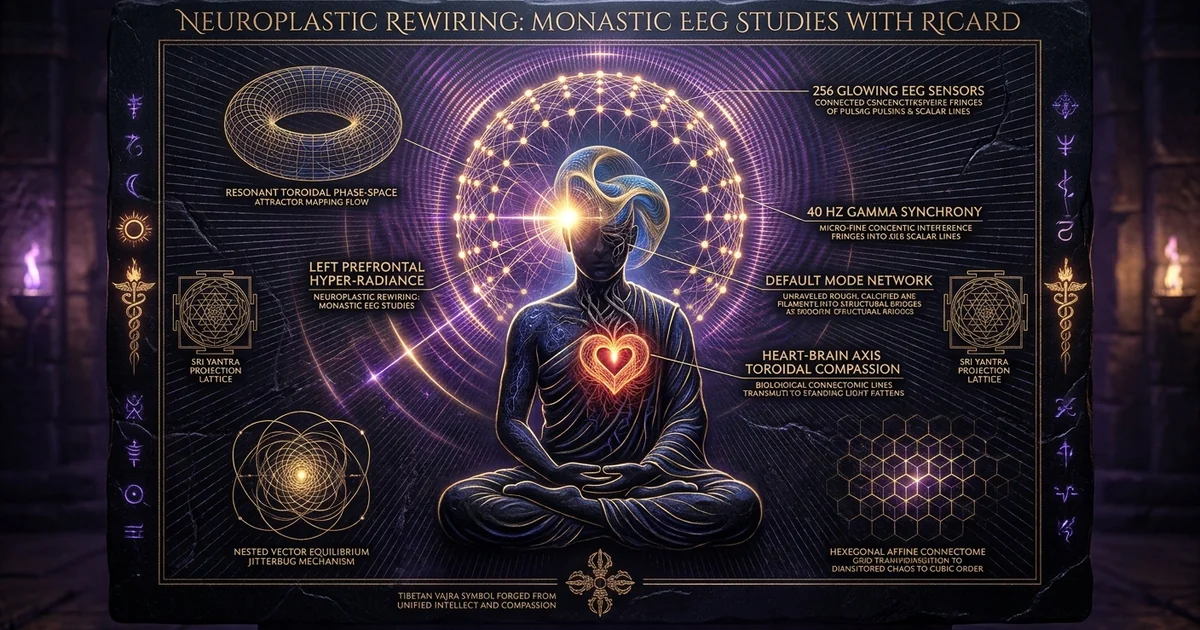
Neuroplastic Rewiring: Monastic EEG Studies with Ricard
Protocol Overview & Neurophysiological Thesis
The human central nervous system was long presumed to settle into an unyielding structural architecture following the closure of critical developmental periods in early adulthood. Twentieth-century neuroanatomy largely operated under the dogma that cortical topography, synaptic arborization, and electrophysiological baseline configurations reached an immutable equilibrium.
This conceptual paradigm was systematically deconstructed when the Laboratory for Affective Neuroscience at the University of Wisconsin–Madison, under the direction of Richard J. Davidson, initiated empirical neuroimaging protocols evaluating high-level contemplative adepts. Among the primary subjects was Matthieu Ricard, a cellular geneticist turned Tibetan Buddhist monk who had accrued over 30,000 hours of formal meditative practice. The ensuing data provided the first definitive macroscopic evidence of self-induced, radical neuroplastic reconfiguration within the adult human brain.
       [ Resting Baseline ]
                │
                ▼  (0.1 Hz Pacing / Somatosensory Decoupling)
       [ Parasympathetic Brake: Nucleus Ambiguus Activation ]
                │
                ▼  (Bodhicitta Catalyst: Ventral Striatum / Insula)
       [ Affective Resonance: Relational Empathy Scaffold ]
                │
                ▼  (Phenomenological Dissolution of Referent)
       [ Non-Referential Compassion: dmigs med snying rje ]
                │
                ▼  (GABAergic Parvalbumin Interneuron Synchronization)
       [ Global Cortical Phase-Locking: 25–45 Hz Gamma Ignition ]
The W.M. Keck Laboratory Paradigms: Davidson, Ricard, and the 128-Channel Montage
The experimental architecture deployed at the W.M. Keck Laboratory utilized a 128-channel Geodesic Sensor Net to map the spatial and temporal electrical topographies of both novice cohorts and advanced practitioners. In these monastic EEG studies examining Matthieu Ricard and Richard Davidson’s cohort, the methodological imperative was to capture high-density quantitative electroencephalography (qEEG) alongside functional magnetic resonance imaging (fMRI) across discrete mental states. The subjects were subjected to tightly controlled block designs alternating between resting baseline states and intense, self-generated contemplative conditions.
The electrophysiological recording array operated with high-impedance amplifiers and rapid sampling rates, enabling precise spectral decomposition across delta (1–4 Hz), theta (4–8 Hz), alpha (8–13 Hz), beta (13–30 Hz), and high-frequency gamma (25–42 Hz and up to 80 Hz) bands. The baseline measurements established a conventional power spectrum for the resting control groups.
However, upon the initiation of specific meditation blocks, the long-term practitioners exhibited an immediate, robust surge in high-amplitude oscillatory activity. This burst was not confined to localized visual, motor, or sensory cortices, but rather extended synchronously across vast swaths of the cerebral mantle.
“Long-term meditators self-induce high-amplitude gamma-band synchrony during mental practice.” Proceedings of the National Academy of Sciences (PNAS), 101(46), 16369–16373. Methodological extract: Evaluated eight long-term Buddhist practitioners (10,000 to 50,000 hours of mental training) against ten healthy, age-matched control subjects trained for one week. Employing a 128-channel Geodesic Sensor Net filtered at a 25–42 Hz spectral bandpass, the study established that adepts generated sustained, high-amplitude gamma activity that was significantly greater than that observed in controls. The ratio of 25–42 Hz gamma power to slow oscillations (4–13 Hz) was markedly elevated prior to meditation and increased dramatically during mental practice, establishing an enduring shift in the underlying oscillatory baseline of the human brain.
The findings from these long term meditator brain scans revealed an electrophysiological phenomenon unprecedented in healthy adult neurology. The signal-to-noise ratio in the gamma band demonstrated that these high-frequency rhythms were not fleeting transient spikes—such as those commonly associated with 250-millisecond sensory binding windows—but rather enduring, self-sustained oscillatory regimes maintained over several consecutive minutes.
Defining Objectless Compassion (dmigs med snying rje)
A critical factor in the emergence of this unprecedented electrophysiological phenomenon was the specific contemplative state under investigation: non-referential or objectless compassion (dmigs med snying rje in the Tibetan Buddhist Dzogchen and Mahamudra traditions). Classical meditation research historically focused on focused-attention meditation (FAM), which requires sustaining attention on a discrete somatic or visual target (such as the breath), or open monitoring meditation (OMM), which involves non-reactive tracking of sensory and cognitive contents. In contrast, dmigs med snying rje bypasses intentional focal objects entirely.
In this practice, the practitioner does not direct compassionate intent toward a specific person, suffering entity, or narrative condition. Instead, the adept intentionally cultivates a pervasive, unconditional readiness for benevolence that lacks an intentional object, an agentive self, or a directional focus. The subject-object dichotomy is systematically collapsed into a state of bare awareness (rigpa) unified with luminous care.
Because the mind is free from the cognitive friction of selecting, maintaining, and updating representations of an external target, the neural machinery responsible for localized spatial attentional filtering is emancipated. The resulting mental state is phenomenologically described as an open, unconfined spaciousness characterized by intense emotional warmth and lucidity. Mechanistically, this elimination of focal boundaries allows wide-scale cortical ensembles to synchronize unhindered by the localized phase-resets typical of sensory-driven processing.
State-to-Trait Neuroplastic Reconfiguration
The neurobiological significance of the Davidson-Ricard discoveries extends far beyond the acute, state-dependent surges observed during active contemplative exertion. The data confirmed a fundamental law of neuroplasticity: repeated, sustained mental states incrementally consolidate into permanent structural and functional traits.
The baseline resting-state EEG profiles of the monastic adepts prior to the formal initiation of practice significantly diverged from those of the control subjects. Even in the absence of intentional meditation, the adepts exhibited an elevated baseline ratio of gamma-to-slow oscillations, accompanied by high resting synchrony across long-range frontoparietal networks. Longitudinal follow-up studies and subsequent structural MRI imaging demonstrated that these electrophysiological signatures correspond to observable macroscopic modifications in cortical morphology.
Long-term practitioners exhibited marked increases in gray matter volume and cortical thickness within the anterior insula, prefrontal cortex, and anterior cingulate cortex—regions fundamentally implicated in interoception, affective regulation, and executive attention. Crucially, this neuroplastic rewiring persists through altered physiological conditions; sleep neuroimaging studies confirmed that these advanced practitioners maintain significantly elevated high-frequency gamma power even during stage-3 slow-wave NREM sleep, confirming that the neuroplastic compassion circuits permanently alter the fundamental neuroarchitecture of the brainstem-thalamocortical axes.
Biophysical Mechanisms & Brainwave Dynamics
The biological orchestration of widespread gamma-band oscillations across distant cortical regions requires an extremely precise underlying microcircuitry. Far from being a chaotic byproduct of hyper-excitation, macro-scale gamma wave synchronization is an energetically demanding, highly orchestrated state that depends on the functional integrity of specialized inhibitory interneurons, reciprocal subcortical-cortical loops, and the dynamic suppression of task-negative self-referential networks.
+--------------------------------------------------------------------------+
|                     THALAMOCORTICAL RESONANCE LOOP                       |
+--------------------------------------------------------------------------+
|                                                                          |
|       +----------------------------------------------------------+       |
|       |             CEREBRAL CORTEX (Pyramidal Layers)           |       |
|       |                                                          |       |
|       |   [ Layer II/III ] <═══════════════════════════════╗     |       |
|       |          │                                         ║     |       |
|       |          ▼                                         ║     |       |
|       |   [ Layer V/VI Pyramidal Neurons ]                 ║     |       |
|       +──────────┬─────────────────────────────────────────╨─────+       |
|                  │ Corticothalamic Feedback                ▲             |
|                  │ (Glutamatergic Drive)                   ║             |
|                  ▼                                         ║             |
|       +─────────────────────────+                          ║             |
|       |  RETICULAR THALAMIC     |                          ║             |
|       |  NUCLEUS (TRN)          |                          ║             |
|       |  - Parvalbumin+ FSIs    |                          ║             |
|       |  - Hyperpolarizing GABA |                          ║             |
|       +──────────┬──────────────+                          ║             |
|                  │ Rhythmic Burst Inhibition               ║             |
|                  ▼                                         ║             |
|       +────────────────────────────────────────────────────╨─────+       |
|       |             DORSAL THALAMIC RELAY NUCLEI                 |       |
|       |             (Specific & Non-Specific Projections)        |       |
|       |             - 40 Hz Oscillatory Clock                    |       |
|       +----------------------------------------------------------+       |
|                                                                          |
+--------------------------------------------------------------------------+
Thalamocortical Resonance and 40 Hz Oscillatory Binding
The fundamental pacemaker of macro-scale high-frequency coherence resides within the dynamics of thalamocortical resonance. Pyramidal neurons within cortical layers II/III and V project glutamatergic afferents to the dorsal thalamic nuclei, which in turn project reciprocal activating connections back to the cortex. Intercalated within this recurrent loop is the thalamic reticular nucleus (TRN), a shell of pure GABAergic interneurons that modulates sensory gating and thalamic output.
At the cellular scale, the primary pacemakers of the 25–45 Hz rhythm are parvalbumin-positive (PV+), fast-spiking basket interneurons. These cells express low-affinity AMPA receptors and specialized potassium channels (such as Kv3.1/3.2) capable of ultra-rapid deactivation, enabling them to fire trains of action potentials at frequencies exceeding 100 Hz without entering a refractory depolarization block.
When excited by descending pyramidal corticothalamic drive, these PV+ interneurons provide synchronized, feedforward and feedback perisomatic inhibition onto thousands of adjacent principal pyramidal neurons. This hyperpolarizing wave temporarily silences the pyramidal population. As the inhibitory postsynaptic potential (IPSP) decays over approximately 20 to 25 milliseconds, the pyramidal neurons escape from inhibition simultaneously, firing a synchronized volley of action potentials before the PV+ interneurons trigger the next inhibitory cycle. This approximately 25-millisecond periodicity constitutes the biophysical mechanism of 40 Hz gamma resonance.
Through this inhibitory-permissive gating cycle, spatially disparate assemblies of cortical columns coordinate their firing windows with microsecond precision, as described in theoretical treatments of EEG phase-locking and spectral dynamics. Under the state of objectless compassion, this thalamocortical mechanism synchronizes across the anterior-posterior axis, enabling phase-locked coherence between frontal and parietotemporal regions separated by tens of centimeters.
Left-Prefrontal Cortical Asymmetry and Affective Set-Points
Among the most striking neuroimaging findings derived from the monastic scans was the extreme lateralization of prefrontal cortical metabolic activity. Decades of affective neuroscience research have established that the prefrontal cortex exhibits a functional dichotomy with respect to emotional valence and motivational orientation.
Left anterior prefrontal cortex (aPFC) activation is consistently correlated with approach-oriented motivation, positive affect, distress tolerance, and adaptive hedonic resilience. Conversely, relative right-sided anterior prefrontal activation corresponds to avoidance motivation, behavioral inhibition, negative affect, vigilance, and susceptibility to depressive symptomology.
Normative Human Variance (Bell Curve, ±1 to ±2 Standard Deviations):
[ Right-Dominant (Vulnerable) ] <──────── [ Zero-Point ] ────────> [ Left-Dominant (Resilient) ]

Ricard Metric (> -4.0 Deviations onto Left Pole):
<══════════════════════════════════════════════════════════════════ [ Left-Hemispheric Extreme ]
When evaluated in Davidson’s laboratory, Matthieu Ricard displayed an asymmetrical activation ratio that deviated from the normative baseline by multiple standard deviations. During the activation of dmigs med snying rje, fMRI blood-oxygen-level-dependent (BOLD) signals revealed a massive left-sided prefrontal engagement, localized particularly to the left dorsolateral prefrontal cortex (dlPFC) and the left orbitofrontal-insular junctions, alongside marked down-regulation of the right amygdala.
This dramatic skew represents the extreme positive boundary of documented human affective lateralization. It provides a neurobiological account for the state of affective invulnerability characteristic of deep contemplative absorption: the conscious self-induction of boundless care reorganizes the motivational circuitry of the frontolimbic axis, superseding the evolutionary default toward threat avoidance with an approach-oriented state of prosocial warmth.
Default Mode Network (DMN) Deactivation and Salience Network Recruitment
The sustained high-amplitude gamma state is accompanied by a coordinated reconfiguration of functional connectivity networks. In neurotypical resting states, the human brain persistently engages the Default Mode Network (DMN)—a distributed network anchored by the medial prefrontal cortex (mPFC), the posterior cingulate cortex (PCC), the precuneus, and the inferior parietal lobules. The DMN is the primary substrate of ego-centric cognition, supporting autobiographical memory retrieval, future planning, rumination, and the subjective reification of a discrete self-concept.
During the practice of non-referential compassion, functional neuroimaging reveals a profound deactivation of the core nodes of the DMN, particularly the PCC and mPFC. This quiescence corresponds directly with the subject’s loss of a localized sense of egoic identity.
Concurrently, there is an intense recruitment of the Salience Network (SN)—anchored by the anterior insular cortex (AIC) and the dorsal anterior cingulate cortex (dACC)—as well as components of the frontoparietal central executive network (CEN). The anterior insula plays an essential role in mapping subjective bodily states, visceral autonomic feedback, and subjective feeling states.
Novice Frontal Theta-Alpha Attentional Regimes
- Dominant Spectral Frequency: 4–8 Hz (Theta), 8–12 Hz (Alpha); localized predominantly to frontal midline and occipitoparietal arrays.
- Microstate Stability: Short, transient microstates (100–300 milliseconds); interrupted by frequent bursts of Default Mode Network reactivation.
- Phase-Amplitude Coupling: Weak, sporadic coupling; local theta oscillations fail to consistently modulate high-frequency bursts across distant cortical sites.
- Metabolic-Glucose Demand: Elevated localized glucose consumption within the frontoparietal executive network, reflecting conscious, effortful mental exertion and top-down cognitive control.
- Subjective Phenomenology: Effortful focus, susceptibility to cognitive wander, intermittent egoic self-correction, localized somatic tension, and intentional subject-object separation.
Advanced Monastic Gamma Phase-Locking
- Dominant Spectral Frequency: 25–45 Hz (Gamma, with strong resonance at 40 Hz); sustained globally across bilateral fronto-temporal-parietal montages.
- Microstate Stability: Highly extended, quasi-continuous microstates (often persisting uninterrupted for several minutes without state-breakdown).
- Phase-Amplitude Coupling: Robust, structured cross-frequency coupling; stable frontal-midline slow waves systematically gate the amplitude of 40 Hz gamma bursts.
- Metabolic-Glucose Demand: Highly optimized neural metabolic efficiency; broad-scale inhibitory-permissive gating reduces chaotic background firing, lowering global energetic cost.
- Subjective Phenomenology: Effortless expansiveness, total dissolution of the subject-object boundary, visceral emotional warmth, crystalline mental clarity (sal-wa), and complete absence of autobiographical self-rumination.
Simultaneously, the ventral striatum and the ventral tegmental area (VTA)—the neurochemical nuclei of dopamine-mediated reward processing—are intensely co-activated alongside the maternal care and attachment circuities mediated by oxytocin and vasopressin. This dynamic explains why sustained compassion avoids the emotional burnout often triggered by vicarious suffering: rather than inducing distress-based mirroring through primary nociceptive pathways, the non-referential state channels affective resonance into prosocial approach circuits, coupling open awareness with deep hedonic stabilization.
Step-by-Step Experiential Protocol: Cultivating Non-Referential Compassion
To operationalize the neurobiological insights derived from the W.M. Keck Laboratory, contemplative practitioners can adopt an explicit, phase-gated neurophenomenological protocol. This scaffolding methodically down-regulates autonomic arousal, activates relational affective circuits, and systematically dissolves cognitive referents to cultivate stable, high-amplitude gamma synchronization.
+-------------------------------------------------------------------------------+
|         NEUROPHENOMENOLOGICAL CULTIVATION OF DMIGS MED SNYING RJE             |
+-------------------------------------------------------------------------------+
|                                                                               |
|   PHASE I: Somatosensory Calming & Parasympathetic Deceleration (0–10 Min)    |
|   - 7-Point Vairocana Posture Alignment                                       |
|   - 0.1 Hz Resonant Breathing (5.5 s Inhale / 5.5 s Exhale)                   |
|   - Vagal Tone Induction & Nucleus Ambiguus Engagement                        |
|                                                                               |
|                                    │                                          |
|                                    ▼                                          |
|                                                                               |
|   PHASE II: Relational Bodhicitta & Affective Priming (10–25 Min)             |
|   - Dyadic Empathy Induction (Suffering Kin / Archetypal Focus)              |
|   - Recruitment of Anterior Insula & Dorsal Anterior Cingulate               |
|   - Dopaminergic Approaching / Oxytocinergic Care Transition                  |
|                                                                               |
|                                    │                                          |
|                                    ▼                                          |
|                                                                               |
|   PHASE III: Radiative Non-Referential Dissolution (25–45 Min)                 |
|   - Deconstruction of the Intentional Target (Dropping the Object)            |
|   - Deconstruction of the Self-Referential Agent (Dropping the Subject)       |
|   - Sustained Open Presence & Coherent 40 Hz Gamma Phase-Locking              |
|                                                                               |
+-------------------------------------------------------------------------------+
Phase I: Somatosensory Calming & Parasympathetic Deceleration (0–10 Minutes)
The cultivation of coherent high-frequency electroencephalographic rhythms cannot occur in a hyper-aroused or sympathetic-dominant autonomic state. Excessive motor tone, uncalibrated autonomic arousal, and erratic respiratory mechanics introduce profound muscular artifacts and subcortical noise, fracturing the thalamocortical phase space. Consequently, the first phase demands the physical stabilization of the somatic substrate and the engagement of the vagal parasympathetic brake.
The practitioner begins by establishing the 7-Point Posture of Vairocana: legs crossed in full or half-lotus to stabilize the pelvic floor; the spine stacked vertically like a column of coins to minimize postural tremor; the hands resting in the equanimity mudra two inches below the navel; the shoulders retracted and relaxed; the chin slightly tucked to lengthen the cervical spine and relieve tension at the base of the skull; the tongue placed against the upper palate behind the incisors to limit salivation and suppress swallowing reflexes; and the eyes unfocused, cast downward along the line of the nose at an angle of roughly 45 degrees, with eyelids partially open to prevent both micro-sleep and optical visual saccades.
Once postural stability is attained, respiratory frequency is deliberately shifted to the resonant frequency of 0.1 Hz (approximately 5.5 to 6 breaths per minute, dividing the breath into an equal 5.5-second inhalation and 5.5-second exhalation without breath holds). This rate optimizes heart rate variability (HRV) and synchronizes cardiac rhythms with baroreceptor feedback, an effect closely aligned with the dynamics of advanced shamatha and vipassana neural markers.
Afferent signaling via the vagus nerve acts upon the nucleus tractus solitarius (NTS), which stimulates the nucleus ambiguus to decelerate sinoatrial pacing. This autonomic shift reduces subcortical arousal, lowers muscle tone, and stabilizes the cortical mantle, establishing the necessary conditions for high-frequency coherent oscillations.
Phase II: Catalyzing the Affective Spark via Relational Bodhicitta (10–25 Minutes)
With somatic and autonomic homeostasis established, the practitioner systematically recruits the limbic and paralimbic circuitry responsible for prosocial affect. Generating universal, non-referential compassion directly from a neutral baseline often fails because human evolutionary neuroanatomy is wired for relational, kinship-based attachment. Phase II systematically leverages this architecture to ignite affective resonance.
The practitioner calls to mind a specific entity toward whom feelings of uncomplicated, deep affection already exist: a child, an intimate partner, a venerable spiritual teacher, or a suffering sentient being. The practitioner brings this individual into conscious imaginative focus, visualizing their presence with sensory clarity.
Rather than engaging in dispassionate intellectual contemplation, the practitioner generates the acute wish: May you be free from suffering and the causes of suffering; may you possess happiness and the causes of happiness.
During this phase, neuroimaging reveals the initial recruitment of the anterior insula and the anterior cingulate cortex, alongside activation of the ventral striatum and prefrontal regions. The affective state must not be allowed to devolve into empathic distress, which manifests as an aversive, visceral tightening in the solar plexus or heart region—a symptom of nociceptive pain resonance.
If this occurs, the practitioner actively adjusts their mental orientation toward the approach motivation of protective love, infusing the mental image with an active desire to relieve distress. This recruits oxytocinergic pathways and warms the somatic body, raising overall neural arousal while maintaining parasympathetic balance.
Target Bandwidth: 25–45 Hz Gamma phase-locking.
Postural Anchor: 7-Point Vairocana posture. Incline spinal axis to 90 degrees; rest tongue at upper incisors; fix gaze at a 45-degree angle without blinking or scanning.
Autonomic Tuning: Regulate breathing to exactly 5.5 breaths per minute (0.10 Hz pacing); track for steady down-regulation of resting heart rate and maximum respiratory sinus arrhythmia (RSA).
Phase Scaffolding: Spend precisely 10 minutes on parasympathetic stabilization; 15 minutes on dyadic compassion generation using an affective relational proxy; and the remaining 20 minutes completely dissolving the mental proxy into non-referential, spatially unbounded luminosity (rigpa).
Cognitive Vector: Avoid tracking, naming, or analyzing mental contents. If discursive thought arises, do not suppress it; recognize the thoughts as self-liberating dynamics within the spacious field of compassionate presence.
Phase III: Dissolving the Referent into Radiative Gamma Coherence (25–45 Minutes)
The transition from Phase II to Phase III marks the critical leap into non-referential compassion (dmigs med snying rje), the exact state that precipitated the anomalous readings in Matthieu Ricard’s brain scans. In this phase, the intentional scaffold must be deliberately dissolved.
The practitioner allows the specific mental image of the loved or suffering entity to fade from consciousness. Concurrently, the conceptual boundary of the “I” who is feeling the compassion is also abandoned. What remains is the emotional resonance itself: the warmth, unconditional openness, and profound benevolent intention generated during Phase II.
The practitioner expands this affective resonance radially across all spatial directions. There is no longer a localized source transmitting care, nor an external recipient absorbing it. The dichotomy of subject, object, and action dissolves into an unconfined, panoramic field of luminous presence (gsal-stong).
In this non-referential state, top-down cognitive control networks relax their directional focus, and parvalbumin-positive interneurons drive widespread gamma oscillations across the cortical mantle. The mind is held in a state of high vigilance without tension, total relaxation without dullness, and radiant warmth without attachment. The experience is one of resting in open awareness—where compassion is not an action the mind performs, but the very nature of awareness itself.
Architectural Systems of Long-Range Coherence
The manifestation of persistent, high-amplitude gamma synchrony across widespread areas of the cerebral mantle requires an underlying structural and biochemical scaffolding. Just as functional changes in software rely on physical circuits, the transition from transient meditative states to enduring structural traits depends on measurable neurobiological adaptations.
::: diagram [Neurodynamic Cascade of Non-Referential Compassion]
<div class="diagram-flow flex flex-col items-center gap-3 my-4 w-full">
<div class="diagram-row flex flex-wrap items-center justify-center gap-3">
<div class="diagram-node px-4 py-2 rounded-xl bg-elevated border border-gold/30 text-primary font-mono shadow-md transition-all">Resonant Vagal Pacing (0.1 Hz)</div>
</div>
</div>
│
▼
<div class="diagram-flow flex flex-col items-center gap-3 my-4 w-full">
<div class="diagram-row flex flex-wrap items-center justify-center gap-3">
<div class="diagram-node px-4 py-2 rounded-xl bg-elevated border border-gold/30 text-primary font-mono shadow-md transition-all">Midline Theta Entrainment (4–8 Hz)</div>
</div>
</div>
│
▼
<div class="diagram-flow flex flex-col items-center gap-3 my-4 w-full">
<div class="diagram-row flex flex-wrap items-center justify-center gap-3">
<div class="diagram-node px-4 py-2 rounded-xl bg-elevated border border-gold/30 text-primary font-mono shadow-md transition-all">Activation of Fast-Spiking Parvalbumin+ Interneurons</div>
</div>
</div>
│
▼
<div class="diagram-flow flex flex-col items-center gap-3 my-4 w-full">
<div class="diagram-row flex flex-wrap items-center justify-center gap-3">
<div class="diagram-node px-4 py-2 rounded-xl bg-elevated border border-gold/30 text-primary font-mono shadow-md transition-all">Thalamocortical 40 Hz Gamma Binding (Phase-Amplitude Coupling)</div>
</div>
</div>
│
▼
<div class="diagram-flow flex flex-col items-center gap-3 my-4 w-full">
<div class="diagram-row flex flex-wrap items-center justify-center gap-3">
<div class="diagram-node px-4 py-2 rounded-xl bg-elevated border border-gold/30 text-primary font-mono shadow-md transition-all">Salience Network Coherence & Structural Connectomic Remodeling (SLF/UF)</div>
</div>
</div>
:::
Structural Connectomics: Fractional Anisotropy along the Superior Longitudinal Fasciculus
The sustained electrophysiological coordination of the frontal, parietal, and temporal lobes requires specialized white matter pathways that can conduct action potentials rapidly without signal degradation. Diffusion Tensor Imaging (DTI) evaluates the microstructural architecture of these axonal tracts by measuring fractional anisotropy (FA)—the directional coherence of water diffusion along myelin sheaths.
Comparative structural neuroimaging between long-term contemplative practitioners and matched control cohorts has demonstrated elevated fractional anisotropy across major associative tracts. Most notable among these is the superior longitudinal fasciculus (SLF), a bidirectional axonal bundle connecting the prefrontal executive cortices with the posterior associative and parietal areas.
Advanced practitioners also exhibit structural remodeling along the uncinate fasciculus (UF), which directly bridges the anterior insula and the prefrontal cortex with limbic amygdaloid structures.
This structural reorganization represents activity-dependent myelination. Just as repetitive motor training thickens myelin sheaths along the corticospinal tract, thousands of hours of phase-locked gamma oscillations stimulate oligodendrocytes through neurotrophic signaling, accelerating myelin synthesis along heavily trafficked fasciculi. The resulting decrease in axonal conduction delay allows distant cortical sites to maintain tight phase relationships, facilitating sustained thalamocortical synchrony across the brain.
Biochemical Cascades: BDNF, Cortisol Attenuation, and Telomerase Activity
Long-range gamma coherence exerts profound regulatory effects on systemic neuroendocrine and genomic signaling. The intense, organized neural firing characteristic of 40 Hz rhythms stimulates the expression and secretion of Brain-Derived Neurotrophic Factor (BDNF), particularly within the hippocampus and prefrontal cortex. BDNF binds to Tropomyosin receptor kinase B (TrkB) receptors, initiating downstream signaling pathways like MAPK/ERK and PI3K/Akt that promote synaptic remodeling, dendritic spine growth, and cellular longevity.
Simultaneously, the sustained down-regulation of amygdaloid hyperactivity suppresses the hypothalamic-pituitary-adrenal (HPA) axis. Adrenocorticotropic hormone (ACTH) release from the anterior pituitary is diminished, blunting the production of systemic cortisol by the adrenal cortex.
This attenuation protects hippocampal pyramidal neurons from glucocorticoid-induced excitotoxicity and reduces systemic inflammatory signaling. At the cellular level, down-regulated HPA-axis tone lowers transcription of the nuclear factor kappa-light-chain-enhancer of activated B cells (NF-κB), a master driver of pro-inflammatory cytokines such as IL-6 and TNF-alpha.
Crucially, prospective randomized trials conducted by the Shamatha Project and the Mind and Life Institute have documented significant elevations in peripheral blood mononuclear cell (PBMC) telomerase activity following intensive meditation periods. By maintaining the integrity of telomeric caps at the terminal ends of chromosomes, this enzymatic upregulation directly counters cellular senescence, providing a clear biological mechanism linking contemplative gamma coherence to systemic vitality and somatic resilience.
Phase-Amplitude Coupling: Theta-Gamma Cross-Frequency Modulation
High-amplitude gamma synchrony does not operate in isolation from the broader oscillatory hierarchy of the central nervous system. Rather, the brain’s computational architecture relies on cross-frequency coupling (CFC), particularly phase-amplitude coupling (PAC). In this dynamic, the phase of a slow carrier wave modulates the amplitude, or envelope, of a high-frequency oscillation.
Slow Carrier Wave Phase (Theta: 4–8 Hz):
  Trough (0 rad) ───► Peak (π rad) ───► Trough (2π rad)

Modulated High-Frequency Amplitude (Gamma: 40 Hz):
  Low Amp ────────► [ HIGH BURST SYNCHRONY ] ────────► Low Amp
In long-term meditator brain scans, 40 Hz gamma oscillations are systematically modulated by frontal-midline theta (4–8 Hz) rhythms. The slow theta wave, predominantly generated by the medial prefrontal cortex and the dorsal anterior cingulate cortex, creates rhythmic windows of membrane depolarization across cortical layers.
During the peak depolarization phase of this slow theta cycle, parvalbumin-positive interneurons and pyramidal ensembles fire synchronously, releasing concentrated bursts of 40 Hz gamma activity. Conversely, during the hyperpolarizing trough of the theta cycle, cortical firing is suppressed.
This nested oscillatory architecture facilitates efficient long-distance communication between brain regions. While high-frequency gamma waves bind local cortical circuits within a localized functional column, the lower-frequency theta waves act as a carrier mechanism, coordinating these distant gamma bursts across disparate sensory, motor, and associative networks.
Operational Safety, Contraindications & Biofield Grounding
The deliberate cultivation of high-amplitude gamma synchronization represents a profound energetic intervention in human neurophysiology. Inducing massive, synchronized oscillatory currents across the neocortex carries distinct risks that necessitate careful clinical screening and rigorous grounding protocols.
Primary Clinical Contraindications:
- Epileptogenic Phenotypes: Individuals with diagnosed or idiopathic temporal lobe epilepsy, photosensitive seizure history, or uncalibrated cortical hyperexcitability are strictly contraindicated from deliberate high-frequency gamma entrainment protocols.
- Bipolar I & Schizoaffective Spectrums: Rapid shifts into sustained gamma synchrony can trigger hypomanic or manic switches, and the dissolution of ego-boundaries may destabilize reality testing or provoke florid psychosis in vulnerable populations.
- Active Dissociative Disorders: Those with active, unintegrated trauma, Dissociative Identity Disorder, or severe Depersonalization/Derealization Disorder (DPDR) should avoid non-referential emptiness practices until somatic baseline integration is secured.
Mandatory Grounding Directives:
Should signs of neuro-energetic destabilization or depersonalization emerge, immediately cease open presence practice. Open the eyes fully, drink warm, dense liquids, ground the physical body through bare-skin contact with the earth, and engage in vigorous, resistance-based somatosensory activity to draw neural activation away from prefrontal-parietal ensembles and back into the primary somatosensory cortex.
Electrophysiological Hyperarousal and Epileptogenic Risk Factors
While endogenous gamma synchronization during meditation is intrinsically self-regulated via inhibitory GABAergic feedback, artificially attempting to accelerate or force this state—particularly when utilizing external modalities like 40 Hz binaural beats for cognitive enhancement—imposes high metabolic and electrical demands on the brain. Sustained high-frequency synchronization requires high rates of ATP consumption by astrocytic sodium-potassium pumps to restore ionic gradients following massive action potential bursts.
In brains with underlying cortical hyperexcitability, channelopathies, or latent focal lesions (particularly within the mesial temporal lobe or hippocampus), this intense synchronization can overwhelm inhibitory interneuronal controls. Instead of parvalbumin-regulated pacing, the network can slip into run-away glutamatergic feedback, lowering seizure thresholds and potentially triggering focal or generalized epileptiform seizures.
Consequently, clinical screening for personal or familial seizure histories is essential before engaging in intensive contemplative practices designed to elicit continuous gamma-band synchronization.
The Dangers of Premature Non-Referential Practice: Dissociation and Depersonalization
In traditional monastic trajectories, students undergo years of focused-attention (shamatha) and somatic purification before receiving direct introductions into non-referential open presence (rigpa). When contemporary practitioners attempt to skip this foundational training, the sudden deactivation of the Default Mode Network and the dissolution of self-referential cognitive boundaries can produce profound psychological disorientation.
Without a well-integrated psychological framework, the sudden loss of a felt sense of a bounded “I” can trigger clinical Depersonalization/Derealization Disorder (DPDR). The individual may find themselves untethered from their personal narrative, perceiving reality as an uncanny, empty simulation, or experiencing their physical body as an alien automaton.
This state differs entirely from the luminous, compassionate release characterized by authentic contemplation. It represents a defense-oriented dissociative reaction triggered when an unintegrated ego-structure is stripped of its conventional anchors, often requiring specialized psychotherapeutic intervention to re-establish personal boundaries.
Traditional Somatic Anchoring: Counteracting rLung (Vata) Disturbances
Traditional medical and contemplative systems documented these psychological and energetic vulnerabilities centuries before the advent of modern EEG. Tibetan medicine describes an entire diagnostic category known as srog-rlung (“life-bearing wind disturbance”), while Ayurvedic traditions detail severe Vata imbalances.
These syndromes occur when an individual directs excessive cognitive energy into expansive, ungrounded mental states without sufficient somatic anchoring. The clinical presentation of srog-rlung includes chest tightness, cardiac palpitations, chronic insomnia, severe anxiety, emotional lability, and an inability to stabilize attention—symptoms that correspond closely to autonomic hyperarousal and parasympathetic withdrawal.
To counteract these disturbances, classical traditions developed specific somatic therapies designed to ground the subtle energy (prana or rlung) back into the physical body. Practitioners suffering from mental fragmentation are instructed to suspend non-referential meditation and refocus on lower-body interoception, particularly the dantian or navel center, located two inches below the umbilicus.
Therapies involve consuming nutrient-dense, warm foods (such as bone broths and healthy fats), engaging in warm sesame-oil self-massage (sKu-nye), and avoiding cold, stimulating environments. These physical interventions re-engage the visceral vagal pathways, quiet hyper-synchronized frontoparietal activity, and restore balance to the nervous system.
Phenomenological Correlates & Veridical Evidence
The ultimate validity of contemplative neuroscience rests on neurophenomenology: reconciling the third-person physical data recorded by neuroimaging instruments with the first-person lived experience of the practitioner. The macroscopic transformations documented in the Madison studies correspond directly to specific phenomenological shifts refined over centuries within Indo-Tibetan lineages.
       FIRST-PERSON PHENOMENOLOGY (The Adept)
       - Boundless, panoramic spaciousness (dbyings)
       - Total absence of subject-object constriction
       - Radiant, non-conceptual luminosity (sal-wa)
       - Spontaneous warm benevolence (snying rje)
                         ▲
                         │
        NEUROPHENOMENOLOGICAL CONVERGENCE
                         │
                         ▼
       THIRD-PERSON BIOPHYSICS (The Laboratory)
       - Long-range fronto-parieto-temporal gamma coherence (25–45 Hz)
       - Massive left-prefrontal asymmetry ratio (> -4.0 SD)
       - Deep medial prefrontal/posterior cingulate quiescence (DMN off)
       - Phase-locked cross-frequency theta-gamma modulation
First-Person Phenomenology of Open Presence: Luminosity and Absence of Self-Constriction
When Matthieu Ricard and other monastic practitioners were interviewed during and immediately following the 128-channel EEG runs, their subjective accounts showed remarkable consistency. They reported a total absence of cognitive friction, describing a mental state devoid of intentional effort, mental grasping, or localized spatial boundaries.
The practitioner does not observe compassion as an internal object, nor do they project it outward into the world. Rather, they describe their state as a pervasive field of luminous presence (sal-wa) that is inherently inseparable from loving-kindness.
Physical sensations of weight, boundary, and tension dissolve, replaced by a distinct subjective experience of bodily transparency and intense, warm vitality. This phenomenological signature correlates directly with the suppression of the Default Mode Network’s self-referential processing alongside the continuous activation of the Salience Network and insular pathways. The mind experiences reality not through the lens of an isolated observer, but as an open, relational continuum.
Distinguishing Genuine Cortical Gamma from Myogenic Scalp Artifacts
Following the initial publication of the 2004 Davidson data, skeptics within the electrophysiological community questioned whether the reported gamma-band bursts reflected true cortical neurodynamics or were simply electromyographic (EMG) artifacts. Scalp muscles, ocular motor units, and jaw-clenching networks generate electrical signals that overlap directly with the 20–80 Hz gamma spectrum, often misleading investigators into registering muscular contraction as high-frequency brain activity.
To address this challenge, Davidson’s laboratory deployed rigorous artifact rejection protocols. By combining Independent Component Analysis (ICA) with source localization algorithms (such as LORETA) and high-density 128-channel spatial montages, the researchers separated myogenic noise from genuine intracerebral currents. Myogenic artifacts are characterized by localized peripheral scalp distributions that lack global phase-locking across long-range recording channels.
In contrast, the gamma activity observed in the monastic subjects exhibited continuous phase-synchrony across vast cortical distances (such as between left frontal and contralateral parietal electrodes), matching conduction delays that reflect true cortico-cortical and thalamocortical axonal pathways. The intra-cranial generators were localized deep within the neocortical mantle, conclusively verifying that the observed signals were of genuine cerebral origin.
“When awareness rests naturally without fabrication,
That very unconfined presence is great compassion.
Free from the grasping of subject and object,
The winds of karma dissolve into the central channel,
And the self-luminous expanse shines forth as unconditional love.”
— Longchen Rabjam (14th Century), Semnyid Ngalso, Chapter 8. Archival documentation establishing that Tibetan contemplative lineage explicitly unified the dissolution of egoic grasping (bdag-'dzin) with the physiological redirection of subtle energies into the central subtle channel (tsa dbu ma), centuries prior to Western laboratory verification.
Cross-Tradition Parallels: Hesychasm, Kundalini Awakening, and Sufi Dhikr
The physiological signature of high-amplitude gamma synchronization is not unique to Tibetan Buddhist monastics. The underlying neurobiology reflects a universal human capacity that has been independently documented across diverse contemplative lineages throughout history.
In Eastern Christian Hesychasm, the repetition of the Jesus Prayer in conjunction with somatic cardiac anchoring aims to achieve the vision of the uncreated light of Mount Tabor (photismos). This state is phenomenologically described as an oceanic, radiant love accompanied by the dissolution of worldly thoughts, matching the neurophysiological markers of DMN down-regulation and high-frequency coherence.
Similarly, within the Yogic traditions of India, the rising of Kundalini energy through the central axis (sushumna nadi) is documented to elicit sustained physiological heat, auditory whistling phenomena, and states of ecstatic, non-dual absorption (nirvikalpa samadhi). In Islamic Sufism, the continuous vocal and physical repetition of the divine name during dhikr culminates in fana—the absolute annihilation of the individual ego within divine presence.
These cross-tradition parallels indicate that disparate contemplative systems have arrived at a shared biophysical mechanism: utilizing distinct cultural frameworks to navigate the nervous system toward the same neurodynamic attractor point of synchronized gamma resonance.
Architectural Synthesis
The monastic EEG studies conducted with Matthieu Ricard overturned classical assumptions regarding the limits of adult neuroplasticity. The deliberate induction of high-amplitude gamma-band synchrony confirms that high-frequency neural coherence is not merely an ephemeral sensory binding tool, but an trainable capacity of the human brain.
[ HUMAN CONNECTOME ]
                                         │
                 ┌───────────────────────┴───────────────────────┐
                 ▼                                               ▼
     [ Task-Negative Default Mode ]                   [ Salience / Approaching ]
     - Medial Prefrontal Cortex                       - Anterior Insula (AIC)
     - Posterior Cingulate                            - Dorsal ACC (dACC)
     - Egoic Rumination & Boundary                    - Ventral Striatum (DA)
                 │                                               │
                 │ (Activity Quenched)                           │ (Activity Enhanced)
                 └───────────────────────┬───────────────────────┘
                                         ▼
                   [ PARVALBUMIN+ FAST-SPIKING INTERNEURONS ]
                   - Thalamocortical 40 Hz Oscillatory Clock
                   - Whole-Mantle Spatial Phase-Locking
                                         │
                                         ▼
                      [ ENDURING TRAIT NEUROPLASTICITY ]
                      - Hyper-Myelinated SLF / Uncinate Tracts
                      - Extreme Left-Prefrontal Lateralization
                      - High Baseline Gamma (Waking & NREM)
Through the cultivation of non-referential compassion (dmigs med snying rje), the nervous system bypasses intentional focal objects, dissolving self-referential DMN activity and engaging salience and approach networks. Driven by the rhythmic pacing of parvalbumin-positive interneurons within reciprocal thalamocortical loops, the brain achieves long-range phase-locking across the cerebral mantle.
With sufficient training, these transient states drive permanent structural alterations—enhancing fractional anisotropy along associative white matter tracts, promoting systemic cellular longevity, and establishing an affective set-point characterized by resilience and altruism. In an age dominated by cognitive fragmentation, these contemplative protocols offer a systematic methodology for reconfiguring the physical substrate of consciousness itself.
Frequently Asked Questions
Troubleshooting Artifacts and Neuroplastic Acquisition
A common challenge for practitioners attempting to replicate this contemplative state is the intrusion of subtle muscular and mental tension. Novices often mistake physical jaw clenching, ocular strain, or sub-vocal effort for authentic meditative focus. These actions recruit myogenic motor units, flooding electrophysiological recordings with spurious high-frequency artifacts while causing subjective mental fatigue.
Authentic gamma generation is phenomenologically effortless; it emerges from open presence rather than forced concentration. If an individual experiences frontal headaches or ocular exhaustion, they should step back from Phase III non-referential focus and return to Phase I somatic relaxation.
Novice practitioners cannot jump straight into sustained 40 Hz phase-locking through sheer willpower. The underlying neural architecture requires progressive scaffolding: cultivating basic attentional stability (shamatha) for 6 to 12 months before attempting to dismantle cognitive boundaries within non-referential compassion practices.
Acoustic and Photic Entrainment vs. Autogenic Monastic Coherence
With the expanding availability of commercial brainwave entrainment technologies, many practitioners question whether acoustic modalities (such as 40 Hz binaural beats) or sensory photic flicker devices can produce the same neuroplastic benefits demonstrated by long-term monastics.
External sensory stimulation operates via the sensory evoked potential mechanism: rhythmic 40 Hz auditory pulses or stroboscopic lights drive the primary auditory or visual cortices into a phase-locked frequency following response (FFR). While this exogenous driving can acutely improve cognitive processing speed, enhance focal attention, and promote amyloid-beta clearance in early neurodegenerative models, it remains fundamentally distinct from autogenic monastic coherence.
Exogenous sensory driving is localized primarily to primary sensory cortices and dissipates shortly after the external stimulus ceases. In contrast, the monastic state recorded in Matthieu Ricard is entirely self-induced, originating from within recurrent thalamocortical and frontal networks.
This endogenous coherence recruits affective and motivational circuities that external driving cannot activate on its own. While acoustic and photic technologies can serve as valuable tools to prime neural pathways, they cannot replace the enduring neuroplastic remodeling cultivated through dedicated, internal contemplative training.
:::: comparison [External Sensory Driving vs. Endogenous Monastic Coherence]
::: column [External Sensory Driving (Binaural/Photic 40 Hz)]
*   **Mechanism:** Exogenous frequency following response (FFR) driven via the visual or auditory pathways.
*   **Cortical Topography:** Localized predominantly to the primary visual or auditory cortices; low long-range spatial coherence.
*   **Affective Integration:** Minimal; sensory stimulation does not directly recruit oxytocinergic or prosocial motivational circuits.
*   **Post-Stimulus Durability:** Fleeting; oscillatory dynamics rapidly return to previous baselines once the external stimulus is removed.
:::
::: column [Endogenous Monastic Coherence (dmigs med snying rje)]
*   **Mechanism:** Self-induced thalamocortical resonance mediated by intentional frontal down-regulation and parvalbumin interneuron gating.
*   **Cortical Topography:** Global, widespread phase-locking spanning bilateral fronto-temporal-parietal networks.
*   **Affective Integration:** Profound; strongly co-activates the Salience Network, the maternal care circuit, and reward centers.
*   **Post-Stimulus Durability:** Enduring; sustained practice induces structural neuroplastic remodeling, altering baseline traits even during deep sleep.
:::
::::
Biomarker Verification in Domestic Environments
Tracking electrophysiological markers of non-referential compassion outside an academic laboratory requires navigating significant technical challenges. Consumer-grade EEG headsets operating with dry electrodes face substantial signal-to-noise limitations in the high-frequency gamma spectrum. Dry sensors resting over temporal or frontal locations often struggle to distinguish genuine cortical 40 Hz activity from the electrical noise generated by the temporalis muscles during clenching, ocular saccades, or micro-movements of the brow.
Practitioners using commercial dry-sensor equipment should focus on monitoring surrogate biomarkers rather than isolated gamma amplitude. Highly reliable indirect markers include elevated frontal midline theta (4–8 Hz) power coupled with significant increases in heart rate variability (HRV) metrics—such as the root mean square of successive differences (RMSSD)—achieved during the 0.1 Hz breathing phase.
Those using advanced multi-channel wet-electrode arrays should apply spatial Laplacian filtering or Independent Component Analysis (ICA) to strip away myogenic signatures, verifying true cortical coherence through cross-channel phase-locking metrics rather than isolated spectral power alone. A complementary exploration of these dynamic states can be found in our analysis of the Monroe Gateway Hemi-Sync neurobiology.