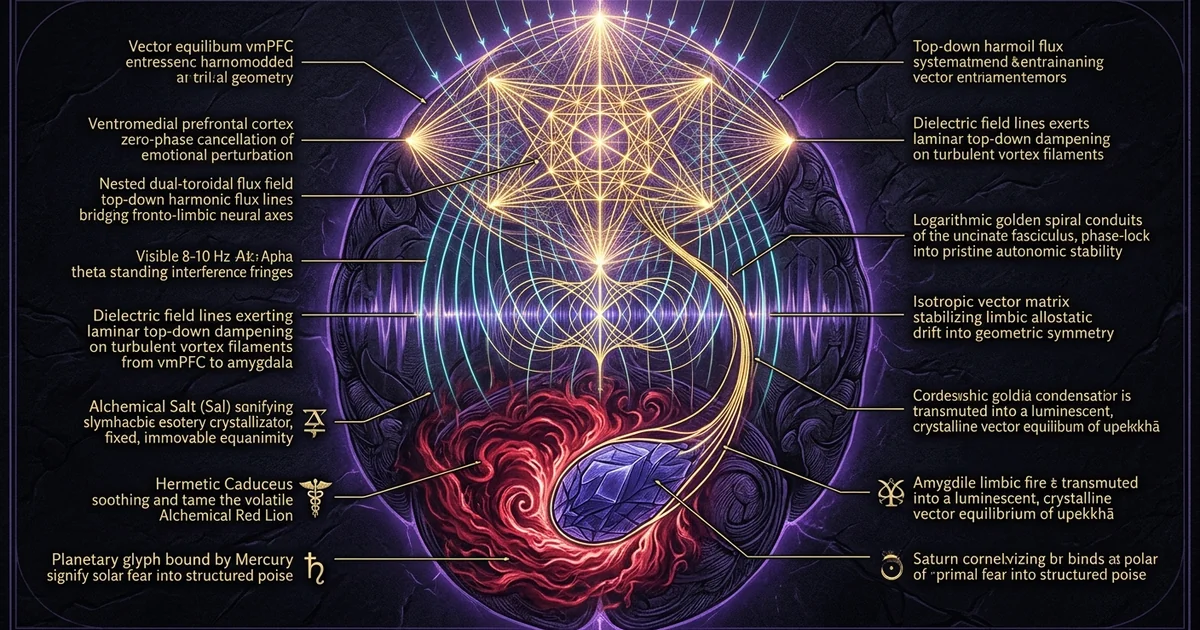
Amygdala Downregulation: Neural Correlates of Equanimity
Protocol Overview & Neurophysiological Thesis
The Fronto-Limbic Vector: Shifting from Amygdalar Hypervigilance to Cortical Regulation
The functional equilibrium of human affective processing depends upon the reciprocal, bidirectional signaling loop between the prefrontal cortex and the limbic complex. Under non-entrained baseline conditions subjected to persistent psychosocial stressors, the basolateral amygdala operates in a state of sustained hypervigilance. This hyper-reactive limbic tone drives hyperactivation of the sympathetic axis and perpetuates systemic allostatic load. The baseline architecture of the untrained brain prioritizes survival-oriented threat appraisal, frequently misinterpreting ambiguous sensory data as imminent threat vectors.
[Threat / Sensory Salience]
             │
             ▼
   [Basolateral Amygdala] ──(Uninhibited)──► [Sympathetic Surge / Allostatic Load]
             ▲
             │ (Deficient Modulation)
     [Prefrontal Cortex]
Contemplative neuroplasticity directly reverses this dynamic through targeted neuroplastic reorganization. Rather than enforcing psychological suppression—which paradoxically elevates autonomic arousal—sustained contemplative protocols paired with precision acoustic entrainment cultivate robust prefrontal-amygdalar connectivity. This shift recruits the ventromedial prefrontal cortex (vmPFC) and the orbitofrontal cortex to exert top-down inhibitory control over the central nucleus of the amygdala via descending projections. The functional decoupling of automated threat reactivity allows sensory inputs to be perceived as non-referential phenomena. This structural transition forms the neurobiological foundation for transitioning out of chronic sympathetic dominance into deep, restorative homeostasis.
Morphometric Structural Plasticity: Grey Matter Density Reductions in the Basolateral Amygdala
The physical architecture of the limbic system demonstrates remarkable malleability under sustained contemplative entrainment protocols. Chronic environmental stress induces excessive dendritic arborization, spine proliferation, and structural hypertrophy within the basolateral amygdala. Over extended intervals, this morphological shift locks the nervous system into persistent baseline anxiety and autonomic instability. Neuroplasticity, once thought to be limited to development, facilitates the structural reversal of this morphological aberration.
High-resolution magnetic resonance imaging (MRI) utilizing voxel-based morphometry (VBM) demonstrates that systematic contemplative practices induce selective grey matter density decreases within the basolateral complex. This structural remodeling is achieved through synaptic pruning of non-functional or hyper-reactive limbic networks, coupled with an upregulation of dendritic density in regulatory prefrontal regions. The attenuation of basolateral amygdala volume does not signal functional degradation; rather, it reflects the resolution of pathological allostatic inflammation and the elimination of redundant feed-forward excitatory circuits that drive sustained autonomic distress.
Hölzel, B. K., Carmody, J., Evans, K. C., Hoge, E. A., Dusek, J. A., Morgan, L., Pitman, R. K., & Lazar, S. W. (2010). ‘Stress reduction correlates with structural changes in the amygdala.’ Social Cognitive and Affective Neuroscience, 5(1), 11–17.
Voxel-based morphometry (VBM) was utilized to examine the structural correlates of stress reduction following an 8-week Mindfulness-Based Stress Reduction (MBSR) intervention. The analysis identified significant reductions in grey matter density specifically within the right basolateral amygdala of participants. These morphometric alterations correlated directly with reductions in Perceived Stress Scale (PSS) scores ($p < 0.05$), confirming that self-reported reductions in affective hyper-reactivity map to measurable structural neuroplastic remodeling within limbic nuclei.
The Transpersonal State of Equanimity (Upekkhā) as Functional Homeostasis
Within classical contemplative literature, equanimity (upekkhā) is explicitly distinguished from both apathy and affective blunting. Neurobiologically, apathy reflects hypo-activation across both the limbic salience network and executive control circuits, marked by generalized dopaminergic deficit and affective disinvestment. In contrast, equanimity represents an active state of high-coherence functional homeostasis. It is defined by heightened perceptual clarity, preserved sensory sensitivity, and the elimination of secondary autonomic over-reactivity. The practitioner perceives stimuli without precipitating an unconditioned fight-or-flight cascade.
This state represents the baseline neurobiological correlate of the witness state, as detailed in /meditation/neurobiology-of-witness-consciousness. At this stage, incoming sensory salience is processed without limbic amplification. The biological manifestation of upekkhā includes immediate stabilization of heart rate variability (HRV), normalization of blood pressure dynamics, and a rapid drop in systemic inflammatory markers.
As demonstrated by Creswell et al. (2016), mindfulness-driven prefrontal-amygdalar reorganization alters resting-state functional connectivity, which directly dampens interleukin-6 (IL-6) and suppresses the neuroendocrine axis. Equanimity, therefore, is not an emotional performance or a detached dissociation; it is the natural consequence of structurally verified limbic stability.
Biophysical Mechanisms & Brainwave Dynamics
Acoustic Entrainment Physics: Binaural Beat Differential and the Frequency Following Response (FFR)
Acoustic entrainment leverages fundamental electrophysiological mechanisms to drive whole-brain network synchronization. When two coherent acoustic pure tones of slightly differing frequencies are delivered dichotically to each ear, the brain processes the phase differential within the superior olivary complex. This central auditory processing architecture cannot localize the divergent inputs as separate spatial sources. Instead, it perceives an amplitude-modulated beat equivalent to the mathematical difference between the two carriers:
$$f_{\text{beat}} = |f_1 - f_2|$$
Through the frequency-following response (FFR), periodic electrical potentials generated within the brainstem auditory pathway propagate upstream through the thalamus to the neocortex. By engineering a precise binaural beat differential within the low Alpha/high Theta transition range ($7.83\text{–}8.5\text{ Hz}$), the auditory cortex and associated inter-areal networks phase-lock their native oscillatory rates to match this driving frequency. This acoustic entrainment, thoroughly analyzed in /sound-cymatics/binaural-entrainment-mechanics, provides an exogenous electrodynamic pacing mechanism. It disrupts cortical hyper-arousal and sets the neurochemical conditions necessary for limbic stabilization.
Cortical Rhythms: Alpha-Theta Transitions (7.83–8.5 Hz) and vmPFC Recruitment
The transition corridor between high Theta ($4\text{–}7\text{ Hz}$) and low Alpha ($8\text{–}10\text{ Hz}$), anchored centrally around the $7.83\text{ Hz}$ Schumann resonance mode, represents an electrophysiological boundary state. During alert wakefulness, dominant low-voltage, high-frequency Beta rhythms ($15\text{–}30\text{ Hz}$) reflect continuous exteroceptive processing, rumination, and persistent sympathetic readiness. When acoustic driving induces widespread synchronization across the Alpha-Theta transition zone, the spectral power density shifts dramatically toward slow-wave coherence.
This synchronized rhythm facilitates cross-frequency phase-amplitude coupling between the slow oscillatory baseline and localized high-gamma firing. Specifically, this state recruits the ventromedial prefrontal cortex (vmPFC) and anterior cingulate cortex (ACC). As the vmPFC oscillates in synchrony with thalamocortical loops at approximately $8.0\text{ Hz}$, its pyramidal projection neurons synchronize their firing patterns. This synchronous cortical discharge delivers high-potency glutamatergic signaling through the uncinate fasciculus directly to subcortical inhibitory targets, providing an efficient structural pathway for limbic regulation.
Neurochemical Cascades: GABAergic Interneuron Activation and Corticotropin-Releasing Factor (CRF) Inhibition
At the micro-circuit level, downregulation of the amygdaloid complex is executed by intercalated cells (ITCs). These dense clusters of GABAergic interneurons sit positioned between the basolateral input complex (BLA) and the central output nucleus of the amygdala (CeA). Under non-entrained baseline stress, excitatory glutamatergic tone from the basolateral amygdala directly excites the central nucleus, triggering prompt downstream activation of the periaqueductal grey and the lateral hypothalamus.
Untrained Hypervigilant Pathway:
[Sensory Input] ──► [Basolateral Amygdala (BLA)] ──(Glutamatergic)──► [Central Nucleus (CeA)] ──► [Limbic Surge]

Entrained Inhibitory Pathway:
[vmPFC Input] ──► [Uncinate Fasciculus] ──► [Intercalated Cells (ITCs)] ──(GABA)──┤ [CeA Inactivation]
When cortical synchronization drives descending excitatory projections along the uncinate fasciculus, these projections synapse directly onto the inhibitory intercalated cells. Upon activation, the ITCs release gamma-aminobutyric acid (GABA) directly into the central nucleus. This targeted hyperpolarization effectively shuts down the primary limbic output engine.
Consequently, the signal cascade driving corticotropin-releasing factor (CRF) release from the paraventricular nucleus of the hypothalamus is halted at its origin. This inhibitory shutoff dampens the hypothalamic-pituitary-adrenal (HPA) axis, dropping systemic adrenocorticotropic hormone (ACTH) and circulating cortisol levels while elevating parasympathetic vagal tone.
Comparative Paradigms of Emotional Regulation
Cognitive Reappraisal vs. Experiential Non-Reactivity
Conventional cognitive reappraisal involves a conscious, effortful intervention wherein a perceived threat or affective stressor is actively reframed through verbal-analytical reasoning. While clinically effective, functional neuroimaging reveals that cognitive reappraisal is metabolically demanding. It requires sustained activation of the left lateral prefrontal cortex, the dorsal anterior cingulate cortex, and working memory nodes. Cognitive reappraisal acts as a continuous cognitive override: the practitioner constructs narratives to counterbalance the limbic alarm, leaving underlying basolateral reactivity largely unaltered beneath this executive control.
In contrast, experiential non-reactivity (equanimity) dispenses entirely with narrative-level reframing. The practitioner does not deliberate, reinterpret, or construct cognitive counterweights. Instead, sensory and affective events are allowed to arise and dissolve as transient neural impulses. By withholding secondary conceptual elaboration, the primary salience signature decays rapidly. This bottom-up, non-narrative processing circumvents lateral prefrontal exhaustion, enabling stable emotional regulation that does not depend on continuous executive vigilance.
Cognitive Reappraisal (Top-Down dlPFC Suppression)
- Primary Neural Drivers: Left dorsolateral prefrontal cortex (dlPFC), inferior parietal lobe, dACC.
- Metabolic Cost: Elevated glucose utilization; prone to depletion and cognitive fatigue.
- Amygdala Mechanics: Intermittent, top-down suppressive damping; basolateral hyperactivity remains primed.
- Autonomic Signature: Delayed parasympathetic recovery; residual sympathetic adrenergic tone.
- Subjective Experience: Continuous narrative reframing, intellectual arbitration, active emotional effort.
Equanimity & Entrainment (Integrative vmPFC-ITC Decoupling)
- Primary Neural Drivers: Ventromedial prefrontal cortex (vmPFC), intercalated GABAergic cells, NTS.
- Metabolic Cost: Minimal; high parasympathetic efficiency; resting-state network preservation.
- Amygdala Mechanics: Direct structural attenuation via long-term depression (LTD) of CeA outputs.
- Autonomic Signature: Rapid vagal brake engagement; high respiratory sinus arrhythmia (RSA) and HRV.
- Subjective Experience: Panoramic non-reactive monitoring (upekkhā), effortless stillness, emotional clarity.
Dorsolateral Prefrontal Suppressive Control vs. Ventromedial Integrative Extinction
The operational divergence between suppressive emotional control and authentic equanimity maps onto distinct structural pathways within the prefrontal cortex:
Suppressive Axis:   [dlPFC] ──(Volitional Effort)──► [Prefrontal Fatigue] ──► [Limbic Rebound]
Integrative Axis:   [vmPFC] ──(Uncinate Fasciculus)──► [ITCs] ──► [Permanent Fear Extinction]
Dorsolateral prefrontal cortex (dlPFC) recruitment is typically recruited for suppressive control, relying on effortful volitional inhibition. When metabolic energy drops or acute stress exhausts executive bandwidth, dlPFC-mediated inhibition rapidly deteriorates, precipitating a limbic rebound characterized by emotional volatility and sympathetic overdrive.
Ventromedial prefrontal cortex (vmPFC) activation, by contrast, facilitates fear extinction and permanent synaptic modification. Through repeated, non-reinforced exposure to affective salience within an entrained state, the vmPFC drives long-term depression (LTD) across the synapses linking the basolateral amygdala to the central nucleus.
Rather than working against the limbic system, the vmPFC integrates sensory inputs without assigning emotional threat values. Over time, this rewires the uncinate fasciculus, structurally lowering the baseline reactivity threshold of the limbic complex.
Somatic De-escalation: Vagal Nerve Afferent Signalling to the Nucleus Tractus Solitarius
Genuine limbic de-escalation requires visceral, somatosensory reconditioning. The human central nervous system continuously samples peripheral autonomic tone via ascending vagal pathways. Approximately 80% of vagal nerve fibers are afferent, transmitting real-time visceral conditions from thoracic and abdominal baroreceptors directly into the nucleus tractus solitarius (NTS) within the brainstem.
[Visceral Afferents] ──(Vagus Nerve)──► [Nucleus Tractus Solitarius (NTS)]
                                                    │
                                                    ▼
                                     [Locus Coeruleus Downregulation]
                                                    │
                                                    ▼
                                      [Parabrachial Nucleus Damping]
                                                    │
                                                    ▼
                                      [Direct Basolateral Quenching]
When breathing rhythms are regulated into prolonged, decelerated exhalations, increased mechanical pressure on the pulmonary stretch receptors enhances baroreceptor activation. This input triggers a sustained burst of afferent vagal firing into the NTS. In response, the NTS signals the locus coeruleus to downregulate noradrenaline synthesis, while dampening relay pathways through the parabrachial nucleus.
By systematically altering ascending autonomic signaling, the somatic salience network shifts its operating baseline before the basolateral amygdala can initiate an affective alarm. The physical mechanics of this polyvagal reconditioning are detailed further in /meditation/vagal-nerve-polyvagal-contemplative-states.
Step-by-Step Experiential Protocol: The Equanimity Entrainment Axis
Phase I: Somatosensory Grounding and Autonomic Reset (0–10 Minutes)
The opening phase establishes peripheral autonomic de-escalation and pre-conditions neural networks for acoustic entrainment:
- Physical Posture: Establish a stable seated posture, preferably siddhasana, or sit upright in an ergonomically stable chair. Ensure the spine is erect and structurally unsupported to maintain active proprioceptive awareness without excessive muscular tension.
- Acoustic Delivery: Don circumaural, closed-back dynamic headphones capable of accurate low-frequency reproduction down to $20\text{ Hz}$. Confirm stereophonic channel orientation (left/right isolation).
- Respiration Pacing: Initiate an unforced $2:1$ vagal exhalation pattern. Inhale diaphragmatically through the nasal passages for a four-second count, followed by a smooth, unforced eight-second trans-labial exhalation.
- Somatic Anchoring: Sweep somatic attention across the pelvic contact points, spinal axis, and the myofascial bands of the craniofacial complex, consciously disengaging masseter and ocular tension.
- Baroreceptor Optimization: Complete ten full breathing cycles at the $0.1\text{ Hz}$ resonance cadence (approximately six breaths per minute) to synchronize respiratory sinus arrhythmia with natural vascular vasomotion cycles.
Phase II: Acoustic Entrainment and Affective Salience Induction (10–30 Minutes)
With baseline autonomic arousal attenuated, Phase II uses target frequency entrainment to expose and neutralize latent limbic reactivity:
- Acoustic Initiation: Introduce the dual-carrier acoustic matrix: a $216\text{ Hz}$ carrier tone delivered to the left ear, and a $223.83\text{ Hz}$ carrier tone to the right ear, establishing a precise $7.83\text{ Hz}$ binaural beat differential.
- Attentional Fixation: Direct open sensory attention to the resultant inter-aural rhythmic amplitude fluctuation located centrally within the cranium.
- Affective Exposure: Consciously call to mind a mildly charged biographical memory, somatic tension node, or unresolved emotional trigger. Avoid narrating, analyzing, or solving the cognitive elements of the scenario.
- Interoceptive De-linking: Focus sustained, non-judgmental attention purely on the localized somatic sensations—such as visceral tightening, throat constriction, or cardiac acceleration—evoked by the memory.
- Inhibitory Gating: Maintain non-reactive awareness as the exogenous $7.83\text{ Hz}$ auditory entrainment stabilizes the fronto-striatal network. This configuration activates intercalated GABAergic interneurons, decoupling the somatic sensation from its habitual limbic panic loop.
Parameters for the 45-Minute Daily Session:
- Acoustic Architecture: Dichotic delivery; Left channel: $216.00\text{ Hz}$ sine wave (Carrier); Right channel: $223.83\text{ Hz}$ sine wave (Target offset); Net frequency: $7.83\text{ Hz}$ (Alpha-Theta borderland). Absolute sound pressure level: $58\text{–}62\text{ dB}$ SPL.
- Respiratory Parameters: $0\text{–}10\text{ min}$: 4s Inhale / 8s Exhale ($2:1$ ratio). $10\text{–}30\text{ min}$: 5s Inhale / 5s Hold (antara kumbhaka) / 5s Exhale / 5s Hold (bahya kumbhaka). $30\text{–}45\text{ min}$: Spontaneous un-metered nasal breathing.
- Somatic Alignment: Lumbar curve supported naturally; cervical spine lengthened by slightly tucking the chin; hands resting in dhyāna mudrā on the lap to close the peripheral motor loop.
- Cognitive Vector: Transition systematically from Śamatha (concentrated awareness on the auditory beat) to Vipaśyanā (dissecting the transient somatic components of affective salience) to Upekkhā (stable, non-referential open monitoring).
Phase III: Integrated Open Monitoring and Limbic Extinction (30–45 Minutes)
The final phase stabilizes resting-state networks and consolidates the uncoupled baseline:
- Cognitive Release: Release all intentional breath-pacing and deliberate focus on the acoustic carrier. Allow the respiratory rhythm to settle into its natural, autonomous pace.
- Resting in the Open Field: Expand attentional scope into unbounded open monitoring (rigpa or pure upekkhā). Rest as the continuous, spacious witness of all arising sensory and mental phenomena.
- Dissolving Affective Traces: As subtle mental events or emotional ripples emerge, observe them as neutral sensory perturbations on the surface of awareness, without grasping, rejecting, or identifying with them.
- Network Integration: Remain seated in this quiet baseline for fifteen minutes, allowing the uncinate fasciculus to consolidate newly reinforced fronto-limbic inhibitory connections.
- Session Grounding: Gradually bring awareness back to somatic boundaries and physical contact points before opening the eyes and ending the entrainment protocol.
Operational Safety, Contraindications & Biofield Grounding
Trauma-Induced Abreaction and the Somatosensory Safety Paradox
Rapid neuroarchitectural downregulation of the amygdala carries inherent psychological risks if undertaken without appropriate preparation. Chronic affective hypervigilance frequently functions as a defensive somatic shield, sequestering unresolved psychological trauma and dissociative fragments beneath persistent neuroendocrine arousal.
When acoustic entrainment rapidly bypasses this protective limbic vigilance, practitioners can experience sudden trauma abreactions, intense emotional releases, or episodes of depersonalization and derealization (DPDR).
Rapid Amygdalar De-activation
             │
             ▼
[Sudden Loss of Defensive Limbic Shielding]
             │
             ▼
[Surfacing of Sequestered Traumatic Material]
             │
             ▼
   Without Grounding:                  With Somatosensory Scaffolding:
[Abreaction / Dissociation / DPDR]     [Integrated Neuroplastic Fear Extinction]
This dynamic represents the somatosensory safety paradox: while downregulating the amygdala is essential for long-term health, doing so without sufficient somatic grounding can destabilize a fragile nervous system. The sudden drop in limbic tone may expose un-integrated psychological material before cortical integration networks are strong enough to process it.
Practitioners with complex developmental trauma or post-traumatic stress must proceed systematically, ensuring that somatosensory scaffolding and stabilization techniques are firmly established before introducing entrainment frequencies.
Acoustic Entrainment Contraindications: Seizure Thresholds and Vestibular Sensitivity
While non-invasive, precision binaural beat entrainment directly alters neuroelectric oscillatory power and should not be used indiscriminately across all populations.
Contraindication Screening:
├── Idiopathic or Photosensitive Epilepsy / Cortical Dysrhythmia  ──► High Risk of Paroxysmal Discharge
├── Active Vestibular Pathology (Ménière's / Acute Labyrinthitis) ──► High Risk of Nystagmus & Vertigo
└── Uncompensated Dissociative / Borderline Personality Dynamics  ──► High Risk of Depersonalization / DPDR
Rhythmic auditory stimulation directly influences thalamocortical pacing networks. In individuals with diagnosed or latent epileptogenic foci, rhythmic acoustic pacing—particularly in the Theta and low-Alpha bands ($4\text{–}8\text{ Hz}$)—can lower the seizure threshold and precipitate paroxysmal electroencephalographic discharges.
Furthermore, dichotic auditory processing places specific demands on the superior olivary complex and the vestibular nuclei within the pontomedullary junction. Individuals suffering from active vestibular disorders, such as Ménière’s disease, benign paroxysmal positional vertigo (BPPV), or acute labyrinthitis, may experience aggravated spatial disorientation, severe nausea, or balance disturbances during dichotic frequency entrainment.
Finally, individuals with diagnosed dissociative disorders or active borderline personality organization should avoid intensive entrainment unless under direct clinical supervision, as limbic downshifting can destabilize basic psychological grounding.
Mandatory Clinical & Safety Screening Criteria:
- Absolute Contraindications: History of idiopathic or photosensitive epilepsy; presence of implanted neural pacemakers or cochlear devices; active psychotic episodes; current intoxication or neuroleptic/benzodiazepine withdrawal.
- Immediate Cessation Triggers: Severe depersonalization/derealization (feeling severed from one’s body or environment); acute optical fluttering or paroxysmal myoclonic twitches; vestibular nystagmus (involuntary eye oscillation) accompanied by severe dizziness.
- Emergency Grounding Intervention: If an abreactive surge or disorienting episode occurs, immediately remove the headphones. Discontinue breath retention and shift to active sensory grounding: place bare feet flat on a cold surface, firmly grip a solid object, drink four to six ounces of cold electrolyte water, and fix your visual gaze on a static point in the physical environment until normal equilibrium returns.
Somatic Discharge Reintegration and Transpersonal Grounding Protocols
Following deep downshifts in limbic tone, the nervous system often discharges residual neuromuscular tension. This discharge typically manifests as involuntary fine tremors, neurogenic shaking, deep spontaneous sighs, or sudden temperature shifts across the extremities.
These manifestations are direct physiological evidence of the motor and autonomic networks re-establishing equilibrium. Rather than suppressing these somatic discharge reflexes, the practitioner should allow them to run their natural course within a secure, stable posture.
To complete the grounding process after entrainment, practitioners must systematically reintegrate perceptual awareness with physical space. This transition involves:
- Engaging in deliberate physical weight shifts to re-activate the somatosensory motor strip.
- Introducing proprioceptive inputs via firm manual compression along the long bones of the limbs.
- Consuming calorie- and mineral-dense nutrition—particularly unrefined sea salts and complex bioavailable electrolytes—to support post-session homeostatic recovery across neural and cardiac tissues.
Phenomenological Correlates & Veridical Evidence
Declassified Military & Intelligence Findings: Project Stargate and Monroe Gateway Records
The intentional modulation of human hemispheric synchronization and limbic dampening has a well-documented history within twentieth-century military and intelligence research. In declassified assessments of the Monroe Institute’s Gateway Process—evaluated under Project Center Lane and Project Stargate—intelligence analysts investigated the operational utility of hemispheric synchronization (Hemi-Sync).
The primary objective was determining whether specific acoustic entrainment matrices could suppress stress-induced cognitive degradation in field personnel operating under severe physiological duress.
The declassified findings confirmed that dual-carrier acoustic entrainment altered electroencephalographic morphology across the fronto-parietal axis. Under optimal entrainment, the hyper-reactive startle response and emotional interference driven by the amygdala were substantially dampened.
This state of sustained bihemispheric coherence allowed human operators to process sensory information with minimal autonomic distortion, demonstrating the tactical viability of neurobiologically induced equanimity.
McDonnell, F. X. (1983). ‘Analysis and Assessment of Gateway Process.’ US Army Operational Group, US Army Intelligence and Security Command (INSCOM), Fort Meade, MD. Declassified by the Central Intelligence Agency (CIA) under the Freedom of Information Act (FOIA), 2003.
Lieutenant Colonel F. X. McDonnell evaluated the neurophysiological mechanics of the Monroe Gateway protocol, drawing heavily upon the biomedical models of Itzhak Bentov. The report notes that targeted acoustic entrainment successfully suppresses defensive limbic interference by driving sustained bihemispheric coherence (Hemi-Sync).
The analysis emphasizes that this state induces a functional decoupling of the sympathetic fight-or-flight reflex, stabilizing the central nervous system into an efficient resting frequency (~$7\text{ Hz}$). This baseline neutralization allows sensory processing to proceed unimpeded by emotional distortion under acute environmental stressors.
Neuroimaging Evidence: Real-Time fMRI Neurofeedback and BOLD Signal Attenuation
Modern functional neuroimaging provides empirical validation for the mechanisms identified in historical contemplative literature. Functional magnetic resonance imaging (fMRI) studies consistently confirm that long-term practitioners show marked blood-oxygen-level-dependent (BOLD) signal attenuation within the basolateral and central amygdala during exposure to emotionally provocative or threatening stimuli.
In a landmark study, Lutz et al. (2008) examined expert contemplatives and age-matched novices exposed to emotionally charged human vocalizations during focused attention and open compassion states.
The neuroimaging data revealed that experienced practitioners did not suppress affective processing regions; instead, their neural response was marked by an immediate initial registration of the emotional salience, followed by an accelerated return to baseline. In novice brains, by contrast, the initial stimulus triggered protracted BOLD signal elevation across both the amygdala and the insular cortex, indicative of secondary affective rumination.
Novice BOLD Response Curve:
BOLD ──┐      /‾‾‾‾‾‾‾‾‾‾‾‾‾‾‾‾\  (Sustained Affective Rumination)
Signal │     /                  \
       └────/────────────────────\────────► Time

Expert Contemplative BOLD Response Curve:
BOLD ──┐      /\  (Immediate Salience Detection)
Signal │     /  \
       └────/────\________________________► Time (Rapid Homeostatic Reset)
Complementary research by Kalyani et al. (2011) demonstrated that meditative vocalization protocols (such as neuro-hemodynamic “OM” chanting) induce profound bilateral deactivation of the amygdaloid bodies and anterior cingulate cortices, closely mirroring the neurovascular changes observed during direct vagal nerve stimulation.
These functional adaptations reveal that equanimity does not dull sensory registration; instead, it eliminates the sustained, un-integrated limbic reactivity that typically follows it. For further analysis on these neural dynamics, refer to /consciousness/monroe-gateway-neurophysics.
Phenomenology of Upekkhā: Transpersonal Witness Consciousness and Non-Dual Stability
The phenomenological reality of the practitioner directly mirrors these underlying neurobiological shifts. As basolateral amygdala reactivity is brought into balance by steady ventromedial prefrontal tone, the subjective texture of conscious awareness changes fundamentally.
The traditional identification of the self with transient emotional states dissolves. The practitioner steps out of the reactive cycle where internal narratives mirror limbic arousal, settling into a stable, non-referential posture of awareness: witness consciousness (sākkhi-bhāva).
Within this non-dual state, affective charges, environmental noises, and internal somatic sensations are perceived simultaneously within a spacious field of awareness. Stimuli arise, reveal their morphological properties, and dissolve into baseline consciousness without triggering an unconditioned fight-or-flight cascade.
The subjective feeling of equanimity is not one of cold indifference, numbness, or psychological suppression. Instead, it is experienced as an expansive, clear stability—an unshakeable internal baseline that remains steady through sensory fluctuations.
Frequently Asked Questions
What is the verified chronometry required to achieve observable morphometric reduction in the basolateral amygdala?
Structural modification of the basolateral amygdala is fundamentally a function of sustained neuroplastic remodeling, requiring repetitive, high-density neural firing over time. Longitudinal voxel-based morphometry (VBM) datasets, including the benchmark trial by Hölzel et al. (2010), indicate that statistically significant grey matter density reductions within the amygdala typically emerge after eight consecutive weeks of daily practice.
This morphometric threshold requires a minimum of 40 to 45 minutes of daily structured training. Practice sessions of less than 20 minutes daily, or protocols practiced inconsistently, may yield transient autonomic de-escalation, but they lack the cumulative neurochemical and electrodynamic drive needed to stimulate dendritic restructuring and synaptic pruning within subcortical limbic nuclei.
How can a practitioner distinguish neurobiological equanimity from functional dissociation or emotional blunting?
This diagnostic distinction can be evaluated across three objective markers:
Diagnostic Triage:
├── Subjective Sensory Acuity  ──► Vivid & Immediate (Equanimity) vs. Foggy & Muffled (Blunting)
├── Autonomic Adaptability      ──► High HRV & Dynamic Range (Equanimity) vs. Flatlined & Rigid (Blunting)
└── Relational Engagement       ──► Spontaneous Empathy (Equanimity) vs. Mechanical Avoidance (Blunting)
- Sensory Acuity: Emotional blunting and functional dissociation are defense mechanisms characterized by psychological withdrawal, depersonalization, and reduced sensory perception. Sights, sounds, and somatic cues feel distant, muffled, or artificial. Neurobiological equanimity, by contrast, sharpens sensory perception. Awareness is immediate, clear, and sensory experiences remain rich and vivid.
- Autonomic Dynamics: A dissociated state is typically marked by either a dorsal vagal collapse (manifesting as lethargy, flat affect, and low heart rate variability) or a rigid sympathetic freeze. Genuine equanimity exhibits high parasympathetic flexibility, high heart rate variability (HRV), and quick cardiovascular recovery following sudden stressors.
- Empathic Engagement: Dissociation isolates the individual from relational connection, resulting in flat, mechanical interactions. Equanimity preserves empathic resonance: the practitioner registers social and emotional cues without falling into reactive, distress-driven behavior.
Which consumer EEG metrics provide reliable feedback of successful fronto-limbic decoupling during home practice?
While direct subcortical structures like the amygdala cannot be recorded with standard surface electroencephalography (EEG), several cortical proxies reliably indicate top-down fronto-limbic modulation:
- Frontal Alpha Asymmetry (FAA): Calculated by evaluating spectral power density differentials across the frontal electrodes:
$$\text{FAA} = \ln(\text{Alpha}{\text{F4}}) - \ln(\text{Alpha}{\text{F3}})$$
Because cortical Alpha power correlates inversely with active regional processing, higher Alpha power over the right frontal cortex (F4) relative to the left (F3) reflects healthy approach-oriented motivation and effective emotional regulation, signaling that limbic hyper-reactivity has decoupled from frontal processing. 2. Elevated Mid-Frontal Theta ($4\text{–}8\text{ Hz}$): Strong spectral Theta coherence localized over the Fz and Cz leads indicates structural engagement of the anterior cingulate cortex (ACC) and ventromedial prefrontal cortex (vmPFC). This signature directly accompanies top-down down-regulation of limbic activity. 3. Frontal-Occipital Phase Synchrony: Phase-locking within the Alpha band ($8\text{–}12\text{ Hz}$) between frontal hubs (F3/F4) and occipital sensory regions (O1/O2) confirms that visual cortex input is being integrated through stable resting-state networks, without triggering subcortical threat pathways.